




Abstract
PISA test data from 2000 to today have shown Germany’s education system is one of the most inequitable within the OECD, with high correlations between student background and achievement outcomes. Scholars have identified the highly differentiated school structure, which tracks students as young as 10 years old, as a central cause. This scholarship has not evaluated why German tracking has proved difficult to reform over the last 20 years, despite evidence of negative outcomes. Using a case study of parents’ actions in Hamburg, this paper employs a discourse analysis of debates surrounding a tracking reform to argue that opportunity hoarding—that is, parents with more social capital maintaining certain advantages through ingrained systems that are theoretically open to all—may contribute to why Germany’s early tracking system persists despite evidence showing that it increases educational inequality. The findings presented have implications for an international discussion of tracking reform and opportunity hoarding.
Introduction
When Germany participated in the first PISA test in 2000, the country expected its students to score well due to its generous educational funding and highly regarded system of classical and technical education. But in what became known as the “PISA Shock,” German students scored well below the OECD average (Ertl, 2006), with results showing that the link between student’s social background and academic achievement was stronger than any other OECD country (OECD et al., 2011; Schlicht et al., 2010; Stanat et al, 2002). The reaction in Germany to the “PISA Shock” was dramatic. One principal wrote in the German magazine Aus Politik und Zeitgeschichte that the results “shattered the self-image of our education system” (Smolka, 2002). News agencies characterized Germany’s performance as “one of the hardest lessons German education had to face,” a “humiliation,” and a miserable failure (Deutsche Welle, 2005).
Since 2000’s “Pisa Shock,” Germany has made many efforts to improve its public education system, attended by 91% of German students (Statistisches Bundesamt, 2018), including increasing the quality of teaching, developing and monitoring common standards and curricula, and expanding its emphasis on students leaving the school system with skills for the workplace, reforms supported by both the political left and right (OECD et al., 2011). Reformers have not sufficiently addressed one major underlying factor leading to such unequal educational results, however: German students are separated by ability at one of the youngest ages in the world, just 10 years old, after which time students usually attend one of three separate school tracks, preparing for vocational qualifications or university. While this division of education may have been efficient at its inception in the late-1800s, in today’s society where the government endeavors to break down social class structure, an education system that maintains these divisions is no longer desirable (OECD et al., 2011).
Germany’s divided education system maps onto a broader pedagogical dilemma in global education: how to best educate a diverse group of students with different levels of ability, preparation, and support. Almost all educational systems track (or ability group) students during their secondary education (Maaz et al., 2008), despite a research consensus that tracking systems perpetuate inequity (Chmielewski, 2019; Chmielewski et al., 2013; Jackson and Jonsson, 2013; Raudenbush and Eschmann, 2015; Schmidt et al., 2015), with only a few studies arguing that the efficiency of instruction outweighs the creation of stigmas and resulting social divisions (Duflo et al., 2009, 2011).
Research and journalism in Germany have echoed these global findings that show that early tracking creates social inequality. Even so, many German politicians and parents have held on tightly to Germany’s differentiated system throughout waves of school reform (Becker et al., 2016; Chmielewski, 2019; Schmidt et al., 2015; The Economist, 2010). While a plethora of research examines the negative impact of school tracking in Germany, this body of work does not focus explicitly on why attempts to reform the German school tracking system have not remedied this issue. Responding to this gap in research, this paper uses a case study of a failed tracking reform in Hamburg, Germany in 2010 in order to pose the following research questions: What role did German parents play in obstructing tracking reform efforts in Hamburg? How does opportunity hoarding explain the limitations of tracking reform in Hamburg and Germany more broadly?
Research on parent involvement in education, primarily focused on the United States and the United Kingdom, has demonstrated the way that parents with wealth use their social, cultural and economic capital to access the best schools and academic programs for their children. In recent years, researchers have termed this practice opportunity hoarding, defining it as a strategic move to claim finite resources at the detriment to others in the community (Lewis and Diamond, 2015; Lewis-McCoy, 2014; Tilly, 1998). This paper posits that parents in Hamburg have had an effect on maintaining the current tracking system, arguing that opportunity hoarding could be a crucial reason why many in Germany have resisted detracking.
Using the theoretical lens of opportunity hoarding, this paper examines the role of parents in limiting tracking reforms in Germany. We conduct a discourse analysis of the debates surrounding an attempted tracking reform in Hamburg from 2008–2010. Using rhetoric drawn from a politically active parent group’s website and online debates regarding the proposed reforms, we show how parents organized, mobilized and shaped public opinion, ultimately demanding a referendum and defeating a plan to postpone the division of students into secondary school by two years. While Hamburg is only one of Germany’s 16 states, the case of parental opposition in Hamburg is remarkable in its fervor, but not entirely unique. In other states, parents voiced similar concerns in vigorous public debate that resulted in maintaining early tracking in Bremen in 2005 and led to tracking reforms in Berlin in 2010 and Saxony in 2020 (Bullion, 2010; Kollenberg, 2020; Moritz, 2020; Waldow, 2009). This case study of Hamburg exemplifies how parental resistance and the logic of opportunity hoarding has been a critical cause of the limitations to German tracking reforms in the last 20 years.
Literature review
Tracking in comparative education
While economists have recently argued in studies in Africa, the United States and elsewhere that tracking benefits all students and the instructional benefits outweigh any other negative effects (Carrell, Sacerdote and West, 2011; Duflo et al., 2009, 2011; Hoxby and Weingarth, 2005), a large body of educational research argues for the harmful effects of tracking. Research has shown that the earlier the tracking assignment is made, the more the sorting system is swayed by parents’ rather than students’ educational backgrounds (Schnabel et al., 2002). This decision has ripple effects on student achievement throughout their school years, as tracking also exacerbates inequalities by unequal content exposure, thereby limiting future academic studies, careers and earning potential (Chmielewski, 2019; Schmidt et al., 2015). Over a long period, tracks develop stigmas and often become coupled with other social divisions like race, ethnicity or religion, creating a long-standing impact on students’ sense of self and their academic motivation (Brunello and Checchi, 2006; Burris, Welner and Bezoza, 2009; Epple, Newlon and Romano, 2002; Lavrijsen and Nicaise, 2016). Tracking reproduces and exacerbates social divisions: parents’ education levels, socioeconomic status and immigrant status influence student track assignments, reproducing inequality (Dumont et al., 2019); ultimately, tracking “legitimize[s] the different positions [students] will hold in the labor market” (Dupriez et al., 2008: 246). The cumulative impact of tracking of any kind is significant: a global review of tracking policy concluded that around the world, “tracking exacerbates SES inequality” (Schmidt et al., 2015: 372).
Despite evidence showing that tracking leads to educational inequality, school systems around the world rely on it to serve students of varying academic abilities (Chmielewski, 2019; Chmielewski et al., 2013, Jackson and Jonsson, 2013; Raudenbush and Eschmann, 2015; Schmidt et al., 2015). Chmielewski et al. (2013) identify three types of tracking systems that most commonly occur at the secondary level: course-by-course tracking, within-school tracking, and between-school tracking. Course-by-course tracking, most common in the United States, occurs when students attend the same school but choose classes at varying levels. Though this offers the greatest opportunity for movement between tracks, even in this model, many classes serve as prerequisites for others, creating often rigid tracks within the school. Within-school tracking is prevalent in most of Europe, when students choose from multiple, often thematic, tracks within a school and take nearly all of their classes within that track. Lastly, between-school tracking, as it occurs in Germany, divides students by interest and ability into separate schools. In Germany, after students are separated into different schools and begin working toward various graduating certifications; movement from lower tracks to higher tracks is rare, though this vertical mobility has improved in recent years (Becker et al., 2016; Ertl and Phillips, 2000; Schnabel et al., 2002).
Almost all educational systems track students during their secondary education (Maaz et al., 2008), but in the last 50 years there has been a steep decline in between-school tracking globally, with countries opting instead for within-school or course-by-course tracking. In comparing the impact of tracking across countries, timing and flexibility prove to be especially important: the later tracks are introduced and the more flexible these tracks are, the better the outcomes for students (Dumont et al., 2019; Dupriez et al., 2008; Lavrijsen and Nicaise, 2016). Many countries, including the United States, the United Kingdom, and Finland, phased out their purely academic/vocational tracking and moved toward a comprehensive school model in the 1970s (Chmielewski, 2014). Outliers to this reform include Germany, other German-speaking countries, parts of Eastern Europe, and the Netherlands which have maintained this early, between-school tracking system (OECD, 2016a). These countries are slowly trending toward some methods of detracking by “delaying the onset of tracking or enrolling a greater share of students in the academic track” (Chmielewski, 2019). While all forms of tracking may lead to societal inequities, early-onset and between-school tracking as practiced in Germany remain the forms that create and maintain the strongest social divisions.
Parent involvement, tracking and opportunity hoarding
As mentioned above, research has shown that parents’ socioeconomic backgrounds, educational attainment, and immigrant background impact student tracks, creating explicit links between family background and the transition to secondary education (Maaz et al., 2008; Schlicht et al., 2010). Further, research in the United States has demonstrated that parents also play a strategic role in lobbying for tracking placements and tracking policies that benefit their children (Lewis and Diamond, 2015). This lobbying has been held up as an example of parents practicing opportunity hoarding, claiming finite resources that then limit the opportunities of other children and families (Lewis and Diamond, 2015; Rury and Saatcioglu, 2015) .
In many public education systems, such resources as high-quality teachers, individualized attention, and higher-level classes are scarce and prized goods. Opportunity hoarding occurs when parents with more social capital are able to acquire a disproportionate amount of these scarce resources. Though comparative education research is not yet using this term widely, parents hiring private tutors for exam preparation throughout Asia and parents “gaming” the system for Berlin’s high school admission are key examples of opportunity hoarding (Aurini et al., 2013; Dumont et al., 2019; Zhang and Bray, 2017). Specifically in the context of tracking, middle-to-high-SES parents advocating for preferential treatment for their children and overriding teacher tracking recommendations is opportunity hoarding in that it results in their children “hoarding access” to the higher tracks (Kelly and Price, 2011). In some cases, parents with social capital have resisted efforts to dismantle tracking systems in the United States, in order to maintain their children’s competitive edge (Kohn, 1998).
While the existing research has focused on opportunity hoarding and its specific relationship to tracking in the United States, there have been limited explorations of how parental opportunity hoarding might influence the tracking systems and reform efforts in other country contexts.
Tracking in Germany
In Germany, where tracks are introduced as early as age 10, the system’s tripartite design can have intense stratifying effects on educational outcomes, creating a strong incentive for parents who benefit from the system to preserve its current form. In the 1800s, the three secondary education tracks corresponded to German feudal social divisions (OECD et al., 2011). The lowest performing students were sent to the Hauptschule, while students who aspired to higher working-class jobs and low-status civil service jobs attended the Realschule. Students who had their sights set on university attended Gymnasium in order to earn an Abitur. In a number of German states, these three tracks still exist, with the graduation certificate from the Hauptschule now widely considered to be useless (Davoli and Entorf, 2018; Rotte and Rotte, 2007; Schulze et al., 2008). Over the last decades the percentage of students choosing the upper tracks of Realschule and Gymnasium has increased dramatically, whereas the percent of students who choose to attend the Hauptschule has continuously fallen (NCEE, 2015). In 1952, 15% of German students attended Gymnasium, 7% Realschule and 78% Hauptschule. By 2005, the distribution had shifted dramatically, standing at 33% Gymnasium, 27% Realschule and 24% Hauptschule, with 10% attending newly created comprehensive schools (Statista, 2008). Today, among the students attending Gymnasium, most continue on to university (Davoli and Entorf, 2018; Schnabel et al., 2002).
Due to the federated nature of the German education system, this tripartite secondary school model is not uniform across the country. In fact, recent examinations of this system show that while remnants of the system are evident in most states, it no longer exists anywhere in its original form (Becker et al., 2016). For instance, since German reunification in 1990, many former eastern states have developed a two-tier system, based on a combination of the East and West German systems. In both rural and urban states alike, the bottom two tiers are increasingly combined into one (Becker et al., 2016). In response to challenges against tracking in the 1960s and 70s, many states adopted an additional track: comprehensive schools (Gesamtschule). In states where comprehensive schools are offered, they are offered as another school option, rather than as a replacement (Ertl and Phillips, 2000; Waldow, 2009). In addition to these public options, the states subsidize such alternative private schools as Waldorf and Montessori; these generally comprehensive or even multilevel classrooms, educate less than 9% of German students (Deutsche Welle, 2017). Thus, while there have been some efforts to reduce the number of between-school tracks, by both removing and adding school types, the separation of students at age 10 has remained constant in most states.
Figure 1 shows simplified depictions of the tracking systems in Hamburg, Berlin, and Saxony, which demonstrates that while secondary options vary across states and Berlin begins secondary school two years later than Hamburg and Saxony, German schools are consistent in early-onset between-school tracking. The early tracking practice results in a stronger link between socioeconomic background and educational outcomes of German schoolchildren compared to other OECD countries. For instance, 2012 PISA results showed that a “more socioeconomically advantaged student” in Germany scored 43 points higher on that year’s mathematics test than a “less-advantaged student,” equivalent to more than a year’s difference in schooling (OECD, 2014: 4). In 2015, PISA data showed that 16% of the variability of German student performance in science could be correlated to differences in student SES (OECD, 2016b). Furthermore, Schnabel et al. (2002) conclude that even after controlling for other major factors, socioeconomic background still had a significant effect on all career-related decisions in Germany, showing that tracking effects extend beyond the end of school.
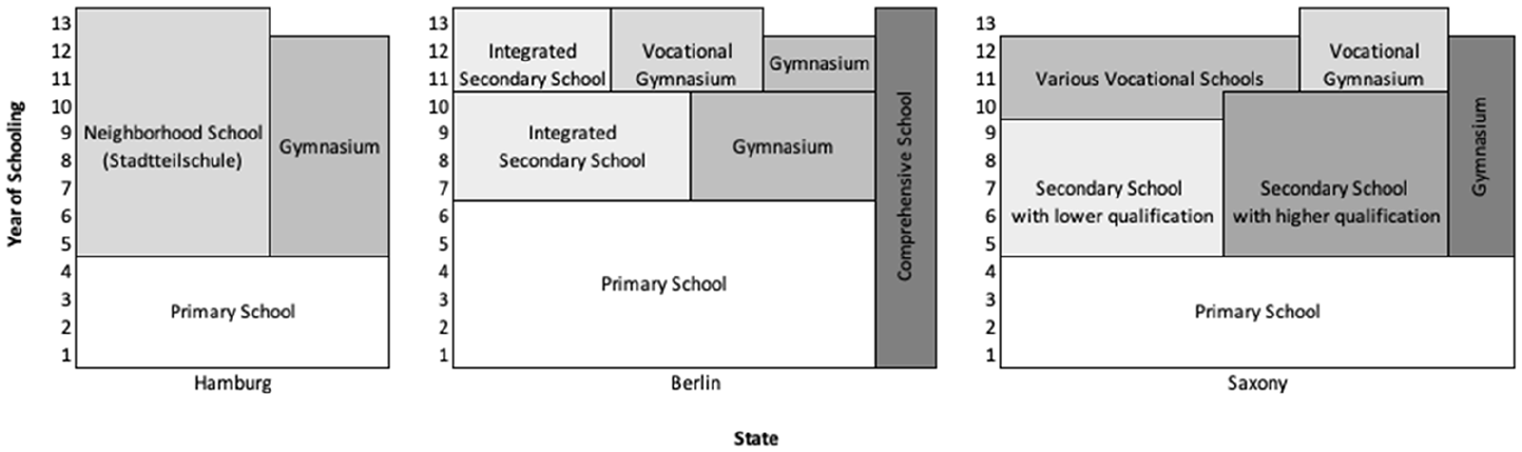
Overview of tracking systems in three German states ( Behörde für Schule und Berufsbildung, 2020; Berlin.de, 2020; Staatsministerium für Kultus Sachsen, 2020).
The tracking system in Germany has a disproportionately negative impact on all vulnerable populations, but especially on immigrants who do not speak German fluently and who are disproportionately sent to the lowest level: Hauptschulen (Cheng et al., 2007; Davoli and Entorf, 2018). As Germany has brought in large populations of immigrants and refugees, especially during the 2013–2015 Syrian refugee crisis, managing the variety of students’ linguistic, academic and socioemotional needs has become increasingly challenging. While Germany does not collect ethnic background in official educational statistics, PISA results show achievement discrepancies between German immigrant and non-immigrant students up to two grade levels of academic achievement, significantly higher than the OECD average, indicating that German schools are unsuccessful in significantly reducing the effects of student background on achievement (OECD, 2014; OECD, 2016b; OECD et al., 2011). Furthermore, Germany’s between-school tracking system keeps students from different backgrounds from attending schools together, thereby increasing the homogenization of certain groups and inhibiting integration (Carey, 2008). In Bavaria, statistics show alarming differences for students with migrant backgrounds and ethnic-German students. For instance, while 35% of non-immigrant German students attend Gymnasium, just 10.4% of students with immigrant backgrounds do (Rotte and Rotte, 2007). Moreover, even when controlling for socioeconomic background, a child from a non-immigrant German family is more than twice as likely than a migrant student to receive an intermediate or higher education certificate (Rotte and Rotte, 2007: 297).
Even though comprehensive school alternatives exist in 14 of the 16 German states, the early-onset between-school tracking system has persisted. While many have acknowledged that significant reforms to the German education system are needed, few proposed reforms include dismantling the system that is primarily responsible for the inequities. There is substantial research on tracking and consolidation practices in Germany, but this body of work does not focus explicitly on why reform movements have not worked or how parents have interacted with detracking efforts. The study of Dumont et al. (2019) showing German parental influence on tracking assignments, suggests that German parents may also play a sizable role in the maintenance of tracking systems.
Parents and opportunity hoarding in Germany
In Germany, parents’ ability to demand elite tracks for their children, hoarding a scarce opportunity, is dependent on their social capital, their network of contacts and the influence they hold in their community. Cheng et al. (2007) posits that parents’ social capital impacts track placements in Germany, as Turkish parents (the largest ethnic minority in Germany) are most likely to acquiesce to teacher recommendations for track placement than non-immigrant German parents, with language barriers playing a substantial role as well (Dumont et al., 2019). Social capital further influences tracking requests through an informal “grapevine of knowledge” around school placements as well (Ball and Vincent, 1998), although interethnic friendships (among non-immigrant Germans and immigrant Germans) can result in a higher track placement for immigrant children, indicating that with increased access to information, immigrant parents are in stronger positions to advocate for their children. The ethnographic study LeTendre et al. of Germany’s education system shows that parent-teacher conferences at the end of grade 4 in Germany “provide parents with a fairly strong sense that they have a major role to play in the placement of their child in secondary tracks,” giving parents one more way in which they can have a large impact on their students’ tracks (2003: 65). Thus, some parents are able to operationalize their social capital, by exerting pressure on track assignments and ensuring that their students access limited spots in Gymnasien. By garnering these scarce resources, they are hoarding opportunities from other families.
Perhaps not surprisingly, parents of students who benefit from the existing structure are least likely to support changing it. Parents of Gymnasien students are overwhelmingly in support of the tracking system, whereas parents whose children attend one of the lower tracks report lower levels of satisfaction with the tripartite system (Le Tendre et al., 2003). LeTendre et al. (2003) found that most German respondents, high-SES parents in particular, supported the highly differentiated system as long as they believed the tracks were fairly determined. While these parents may understand the downsides to such a schooling structure, they are able to leverage their positions in order to ensure that their children are benefiting from the tracking system.
Thus, existing research has shown that German parents from higher SES backgrounds use various forms of capital to support their children’s academic achievement, and in addition, when possible, they push for their children’s assignment in elite tracks. Having access to informal informational networks allows some parents to have an advantage over others when it comes to advocating for their children. Further, the act of parental advocacy, especially when it is disproportionately undertaken by parents who already have more social capital, is a prime example of hoarding a scarce resource: access to quality education. Largely missing from the German discussion of tracking is an analysis of how these individual actions by parents result in a process of opportunity hoarding across the system, and in particular how parents in Germany have reacted to and opposed attempted reforms to this system.
Methodology
Responding to gaps in the research, this paper uses a failed tracking reform effort in Hamburg in 2010 to examine broader reasons why a significant number of politically active Germans are still in support of this tracking system, in spite of all its shortcomings. While this study focuses only on Hamburg, the events and reactions prove similar to debates about tracking reform that have taken place across the country over the last two decades, with uneven reform results. For instance, in Bremen in 2005 the conservative-led government succeeded in eliminating the two-year transitionary period between primary school and choosing a permanent secondary school, yet also combined the tripartite system into just two tracks as a consolation for the left-leaning parties (Waldow, 2009). In 2010, school reforms were passed in Berlin that did away with the lowest track, reducing stratification of the school system (Bullion, 2010). Additionally, in Saxony in summer 2020 the government reached a compromise that allowed for longer learning together for two extra years (Moritz, 2020; Kollenberg, 2020). In many states in Germany debates continue over when to start tracking and to what extent the school systems should be tracked.
This study employs a discourse analysis of public communication from Hamburg in 2010 in the form of blogs and online reader responses to newspaper articles, analyzing “the use of language in social context” in order to scrutinize the running conversation among groups of stakeholders (Salkind, 2010: 368). Discourse analysis of social media has been used to understand how American and Singaporean parents evaluate the desirability of various schools and school enrollment processes (Debs and Cheung, 2020; Freidus, 2019). The primary limitation of this methodology is that conducting a representative survey is infeasible. This methodology nevertheless allows us to better understand public opinion in the school reform debate, to follow a critical event after it occurred and engage with a group of actors that are not traditionally included within policy analysis.
The primary sources used for this paper were blogs and the comment sections of newspaper articles. The first part of this analysis focuses on the blog of the Hamburg parent activist group Wir wollen lernen (We want to learn, or WWL), as it provides a direct window into their rhetoric and reasoning for opposing tracking reforming, providing evidence of how some of Hamburg’s parents portrayed their resistance to change. The WWL website was designed for Hamburg parents to learn more about the referendum and why parents were opposed to it. WWL’s site includes blog posts and campaign videos posted by members of the group from late-2009 until April 2016. For this analysis, we culled blog posts from the WWL site from its inception in 2008 until the 2010 referendum (Wir wollen lernen, 2010a). This study focuses on 25 of the 43 available blog posts that included original content and reasons to oppose the tracking reform. The 18 not included were radio spots, videos, posters, links to other articles, or information that had been posted since the referendum.
The second form of data includes articles from the Hamburg-based weekly newspaper Die Zeit, which has a reputation as a politically liberal paper, with wide national readership (Media Landscapes, 2020). Die Zeit extensively covered the political developments in Hamburg from fall 2009 until summer 2010 and operated a robust comment section, another resource for identifying primary source discourse. Keyword searches focused on “Hamburg Schulreform” (Hamburg school reform) and “Wir wollen lernen” (we want to learn); we identified three articles from Die Zeit that generated a robust discussion of the reforms in the comment section, amounting to 733 comments (Bangel, 2010; Die Zeit, 2010; Kahl, 2010). Of these comments, we focused our analysis on the 258 comments opposing the reforms, looking for repeated themes in which commenters explained their resistance to the reforms such as immigration, the democratic process, expense, holding back higher-achieving students, the impact of puberty, and stances on the reform. Arguments and rhetoric were coded in NVivo for frequency analysis. There were some public arguments made in support of detracking, but they are mostly outside of the scope of this analysis.
Online comments have clear limitations as data. Commenters are often polarized for and against, they do not comprise a representative sample of the broader public, and, as Freidus observes, “people say things a little differently [due to] the apparent distance” in online forums (2019: 1127). Even with these limitations, the comments section offers a second source of data separate from the parent activist group, with which to triangulate data. Following the design of discourse analysis, this paper does not take these comments for truth, but rather uses them to conceptualize how people from Hamburg (and across Germany) were reacting to the proposed tracking reforms. Furthermore, this study does not look at the arguments in support of the tracking reforms, but rather focuses on the arguments against the reform, in order to understand how parents conceptualized their resistance to the reforms.
The next section of the paper focuses on the discourse around the state of Hamburg’s attempt at detracking, first presenting a background of the detracking debate in Hamburg, then the discourse surrounding the debate, and finally an analysis of what the discourse means for Germany and further detracking reforms.
Case study background
The German state of Hamburg, home to 1.8 million people, serves as an important example of parents reacting to proposed tracking reforms. Hamburg is a wealthy city-state, one of three in Germany, located in northern Germany, and well known for its active port. It is also a region that is actively being transformed through immigration. In 2009, 43.9% of Hamburg’s under-18 population had a migrant background. While Hamburg has the highest rate of students taking the highest school-leaving exam, students with migrant backgrounds are much more likely to drop out of secondary school and to repeat grades, a trend that can be seen around Germany (Bale, 2016). Data from 2004 show that Hamburg spent the least of any German state on education, even though Hamburg’s GNP per capita is the highest in Germany (Rotte and Rotte, 2007).
In 2008, likely responding to the “PISA Shock,” a coalition government of the center-right Christian Democratic Union (CDU) and the center-left Green Party (Greens) proposed a series of three tracking reforms aimed at lessening the inequities in Hamburg’s school system. First, the Hamburg government was able to consolidate the lower tiers of schools (Hauptschule and Realschule, along with the existing Gesamtschule) into a new comprehensive school model (the Stadtteilschule). While the merging of the two lower tracks attracted little debate in Hamburg, subsequent reforms proved more controversial. The second tracking reform was delaying the beginning of the comprehensive Stadtteilschule and the elite Gymnasium by extending primary school two more years from grade 4 (age 10) to grade 6 (age 12) under a plan called “longer learning together” (längeres gemeinsames Lernen). The third reform was to eliminate the parents’ ability to override teacher decisions on track placement (known as Elternwahlrecht).
Although these reforms were an attempt to mitigate what research has shown to be some of the detrimental effects of early-onset tracking and the way that highly educated parents lobby for higher track placements, the extension of primary school and the elimination of parents’ influence in track placement led to a swift reaction (Bale, 2016). An opposition parent group known as Wir wollen lernen (We want to learn or WWL) formed in spring 2008 in stark opposition to this plan for longer learning together. The group, led by lawyer and later-CDU politician Walter Scheuerl, was comprised of Hamburg’s elite: wealthy parents from the west end of the city (Bale, 2016). From its inception and despite its elite composition, WWL framed itself as a grassroots organization (Bale, 2016). For over two years this parent group organized against tracking reform, applying enough public pressure to lead Hamburg state policymakers to reverse the policy that allowed teacher tracking recommendations to override parent preferences, and ultimately working to halt the proposed extension of primary school, gathering enough signatures to force the issue to a public referendum. It should be noted that public referenda in Hamburg are involved processes, requiring approval at three levels, and the WWL referendum was one of only seven proposed referenda that met all requirements in the last two decades (Behörde für Inneres und Sport, 2020). Achieving this feat demonstrates the WWL parents’ organizational capacity and political clout.
Drawing primarily from a base of CDU (center-right) and Free Democratic Party (center-right) voters (Bale, 2016), WWL aimed to educate Hamburg residents on the issues at stake and ensure that enough citizens voted against the proposed reforms in the 2010 referendum. On July 18, 2010 WWL proved successful, winning the referendum to overturn the state proposal to extend primary school until age 13, with 55.9% of the vote (Die Zeit, 2010). In an analysis of the referendum, Bale found that voter turnout was lower than in regular elections: only 40% (in comparison to 56% participation in regular elections). More importantly, Bale found that in wealthier Hamburg districts 60% of residents voted, whereas only 25% voted in poorer districts, further showing the tilt of WWL’s voting base toward affluent non-immigrants (German Federal Government, 2018; Bale, 2016).
Findings
To analyze how parents and the WWL successfully mobilized against the proposed reforms in Hamburg, this study focuses on the arguments as stated on the WWL website and how similar discourse against the reforms appeared in the comment sections of German newspaper articles. In the findings, the rhetoric from the site and the comment sections are delineated, so as to show how the reasoning connected and sometimes differed between the platforms.
Wir wollen lernen website
Between 2008 and 2010 when the tracking reform was defeated by referendum, the WWL parent coalition created several arguments that proved successful in galvanizing opposition to the proposed tracking reforms. WWL first organized to oppose the policy recommendation removing the parents’ right to override the track chosen by the teacher. Despite existing research suggesting that German parents already have considerable influence on school placement decisions, parents worried that teachers alone could not know the potential of their students as well as parents could: “Within just a year (9 months of schooling) it is impossible for teachers to get to know students better” than their parents already do (Wir wollen lernen, 2010b). This lobbying had a rapid impact: in April 2010, the Hamburg state government announced a compromise: parents could be included in choosing which school the child would attend, but within one school year, the teacher could alter that decision if it proved to be an unsuitable match.
The second concern was with the “longer learning together” plan, in which the age of separation was moved from 10 to 12, and WWL parents argued that the quality of education for all children would be impeded. Some reasoning seemed to be more extreme than others: for instance, three of WWL’s posts argued that it would be irresponsible for teachers to make this decision when students were 12 (or going into the “damned grade 7,” as WWL often referred to the year) as students would be so affected by the throes of puberty that they would have “no way to prove themselves” (Wir wollen lernen, 2010b). Even with the government’s concession of the one-year grace period to re-evaluate the initial tracking decision, WWL preferred that grade 4 remain the year of decision (Wir wollen lernen, 2010b). Further arguments on WWL’s website against this change in school structure centered around (1) expense, (2) a lapse in the democratic process, and (3) holding back high-achieving students.
Expense
The assumed costs were a major point of issue that WWL took with the reforms, with eight posts mentioning expense. A campaign video put out a month before the election told Hamburg residents that they must vote no in order to “prevent a dangerous experiment with [the] Hamburg schools and the estimated 1.2 billion Euros in expensive school conversions instead of in the education of our children” (Wir wollen lernen, 2010f). The reforms, to them, were a waste of taxpayer money. There was a common argument that the funds would be better spent in the earlier years on preschool education in order to even out the playing field, rather than later on (Wir wollen lernen, 2010d). However, there is no further evidence of WWL supporting transitioning these funds to early childhood education.
Democratic Process
Although the reforms had been drafted by a democratically elected coalition, invocations of the rights of the people and a breakdown of the political process are another theme throughout WWL’s public statements, referenced 12 times in the blog posts. One blog post describes the group’s self-proclaimed purpose: “We stand for civil democracy in our city” (Wir wollen lernen, 2010c). In a more explicit call to action, a July headline read: “So fight together with us” (Wir wollen lernen, 2010g). A third seems to hail WWL as bringing democracy back to the city: “WWL has made education policy tangible in Hamburg. Through the practice of democracy and the people’s legislative process, it has been made clear that the people no longer need to be excluded from the political process” (Wir wollen lernen, 2010h). WWL argued that the CDU government was reneging on a campaign promise due to the coalition government and that the will of Hamburg parents was therefore being ignored. They saw the referendum as the chance to override the decisions of the coalition government, which had sullied the CDU’s campaign promises. Following the referendum, many in Germany questioned whether this issue of school reform should have been eligible for the referendum, especially since only 40% of Hamburg residents voted in the referendum (Bale, 2016).
Holding back high-achieving students
Alongside arguments that teachers would not make good tracking recommendations for their pubescent teenagers, the extra costs were a burden on taxpayers and the public had been excluded from the decision-making process, WWL revealed their opportunity hoarding tendencies by focusing on the negative impact on the highest achieving students. As will be shown in the data below, by focusing on the children who were already benefiting from the tracking system, WWL parents were showing that they did not want educational services to be redistributed, similar to Lewis and Diamond’s finding that parents who are benefiting from the tracking system, “conveyed (at best) deep ambivalence and (at worst) outright hostility toward changing the rules and practices that, for the most part, benefit their children” (2015).
Despite the vast amount of research on the subject, WWL did not mention any research showing the societal or individual benefits of longer learning together (or delayed-onset tracking). In contrast, the central focus of their campaign was the negative impact on high-achieving students, present in six of their blog posts. As the children’s t-shirts they sold on the website stated Ich bin kein Versuchskaninchen (I am not a guinea pig), parents were worried about this reform hurting their children’s education prospects. In this framing, longer learning together was a social experiment that would wreak havoc on their children. Throughout the website, WWL highlighted the reasons this social experiment would be bad for high-achieving students. One blog post outlined the pedagogical reasons, as WWL conceived of them, against delayed-onset tracking. First, WWL held that by the end of grade 4, one to one-and-a-half years of learning differences already exist between students, a gap that would not be closed by another year or two of comprehensive primary school. Second, high-performing students would feel stunted by two more years of primary school. Third, WWL argued that it might endanger students’ future prospects, as there would not be enough time for the Gymnasium to teach all of the required information for the college entrance exam if the number of years were shortened. And fourth, given that the state of Hamburg was one of the highest scoring regions on the PISA tests, WWL also stoked fears that Hamburg’s test scores would fall due to there not being enough years of Gymnasium. Their argument hinged on the claim that studies show that “Comprehensive schools have often not been able to live up to their claim that they also support high-performing children. The higher performers [after these reforms] will not be supported accordingly” (Wir wollen lernen, 2010d).
While WWL seemed primarily concerned with the fate of the high-achieving students, their website was careful not to disparage or make racist or classist statements about other groups of students, especially immigrants, similar to explicitly “race-neutral” strategies observed by the new generation of integration opponents in the United States (Goldstein, 2019). Though this was less central than their argument of harm to high achievers, the parent group also attempted to argue that socioeconomically disadvantaged students would be harmed by the reforms as well. For instance, they argued that the Stadtteilschulen, which were a conglomerate of the Realschule, Hauptschule, and Gesamtschule (comprehensive school) through which an Abitur was also possible, would better be able to support students: “Better support for those pupils who have a large performance gap at the end of grade 4 can be achieved, with appropriate staffing and material resources. . . at the Stadtteilschulen” (Wir wollen lernen, 2010d). WWL argued further that by eliminating parents’ right to choose, “there will not be a reduction or elimination of social disparities, but rather the opposite: an intensification of educational inequalities” (Wir wollen lernen, 2010d). Interestingly, with this line of argument, WWL attempted to co-opt the arguments of those who were in favor of the reforms—because they would reduce social stratification—to their own advantage.
Finally, similar to “white flight” in the United States, WWL parents threatened to opt-out of the public system if their referendum were not approved. They suggested that if longer learning together were implemented, wealthier parents would “flee” to specialized schools that would start secondary school in grade 5; WWL foresaw disadvantaged parents struggling to move to neighborhoods that had the specialized schools or being able to afford private schools that WWL assumed would emerge following the reforms (Wir wollen lernen, 2010d; Wir wollen lernen; 2010e). Essentially, WWL members threatened to leave the Hamburg public school system if the referendum they organized did not pass, hinting that private schools would “spring up like mushrooms” (Wir wollen lernen, 2010d).
Online discussions
In the months leading up to the referendum, the arguments for and against the longer learning together initiative were extensively covered in both the local and the national press with robust debates occurring in the public comment section about each article. In the three articles in Die Zeit on the Hamburg school reform that generated the most robust debate, the authors of the articles were neutral to favorable about the reforms, but commenters were often divided on the issues, engaging in heated debates in the comment section. Of the 733 total comments, 258 were explicitly against the reforms and in support of the referendum and reflected similar arguments from WWL entering the public discourse. Among those in favor of the referendum, some of their concerns duplicated the arguments made by WWL, while in other cases, the online posting format led to arguments that were more explicitly racist and anti-immigrant.
Holding back high-achieving students
In the newspaper’s online forums, just four commenters of the 258 mimicked WWL’s arguments that the reforms were costly and two mentioned the effects of puberty. Instead, the comments emphasized the negative impact of the reforms on high-achieving students, 51 comments in all used this reasoning, highlighting the opportunity hoarding logic of resisting efforts to redistribute access to the highest track. Similar to WWL’s argument that early childhood education should prepare students before primary school, one commenter held that it was the responsibility of parents alone to make sure their children were ready for school: “Education begins at home. . . Families must be grounded in the knowledge that children can only profit from education. If they go to school and don’t have this knowledge, no amount of longer learning together or small class sizes will achieve anything” (Comment by user “K2K87” in Die Zeit, 2010). Another commenter argued that it was a “law of nature” that children from “better-off” families are generally more successful academically, insinuating that the extra two years of primary school would not help level out achievement disparities (Comment by user “WIHE” in Bangel, 2010). Yet another lamented comprehensive classrooms: “From the moment that the stronger students have to educate the weaker students, any hope for intellectual development is over, for students on both sides” (Comment by user “Carsten G.” in Bangel, 2010). These comments point to an expectation that academic ability is largely determined outside of the school context, and those who have succeeded should not have this opportunity taken away from them. Such logic questions the assumption that the state is responsible for providing every child with the resources needed to achieve their highest potential.
Furthermore, in an anonymous online format, in contrast to WWL, commenters were willing to be explicitly anti-immigrant and classist about other students in discussing the harm to higher-achieving students, with 30 individual comments mentioning immigrants when formulating their opposition to the reforms. This demonstrated again a focus on opportunity hoarding through a concern that non-immigrant students benefiting from the existing structure would lose these educational advantages to students with immigrant backgrounds. For example, one person conflated “less educated” and “socially disadvantaged” students and wrote that having “less educated” students in the classroom would distract the teacher’s attention from the “more educated” children. While this commenter remarks that “children from socially disadvantaged families can still achieve great things,” he concludes by saying that the reforms would hurt the “more educated” children most of all (Comment by user “Frank1994” in Bangel, 2010). One commenter believed the middle-class should not have to pay for the demographics change: “The middle-class did not bring in the migrants. That was done by the politicians. Now they want to solve the problems at the expense of the middle-class children” (Comment by user “WIHE” in Bangel, 2010). A commenter objected to the reforms on the grounds that “more intelligent” students should not just be used to help raise up the level of other students (Comment by user “Synelly” in Kahl, 2010). Another furthered this argument by saying that higher-performing students should not be used as “free teaching assistants” and that longer learning together would only be a step backward for higher-performing students (Comment by user “Arinari” in Kahl, 2010). Furthermore, one commenter, falsely equating the plans of “longer learning together” and comprehensive schools (which would extend all the way to graduation, rather than just the two extra years proposed in the Hamburg plan), wrote: “I know about the comprehensive schools. If I had intelligent children, I would not want to enroll them there. If I had stupid children, it would be fine with me, of course!” (Comment by user “Biljana” in Bangel, 2010). One commenter even pleaded: “Do you believe that six years of learning together would really even out the social and mental differences? Please think about the kids that don’t come from poor homes” (Comment by user “Arinari” in Kahl, 2010). These commenters and the parents involved in WWL seemed to believe their status in the school system was being jeopardized by the proposed reforms, their opportunities would be diluted, and worried about what would become of their children.
Educating a diverse population
While WWL was careful to avoid anti-immigrant sentiment in their public statements, mentioning diverse populations just four times and each time in a positive light, nearly 30 online commenters were explicit in linking immigrant students to educational problems that would result from the reforms. The question of language learning is important in the tracking debate, as the inability to speak German fluently heavily determines the track into which students are sorted. In response to a Die Zeit opinion article that argued that those who would be most affected by the changes to the school system could not vote in the WWL-organized referendum (referring to immigrants who were not German citizens), one commenter saw students’ inability to speak German fluently as the fault of parents and not the responsibility of the schools to remedy. The commenter complains of “The people. . . who freely decided to immigrate to Germany, but for the most part do not find it important to really learn the German language and speak with their children” (Comment by user “Stillfloating” in Bangel, 2010). This commenter concludes: “The school system cannot make up for that” (Comment by user “Stillfloating” in Bangel, 2010). Another commenter saw migrants as the reason comprehensive schooling could not work in Germany; they argued that while comprehensive schooling may work in Canada and Finland with their racial and ethnic homogeneity, Germany would go the way of France and the United States, likely referencing highly tracked comprehensive schools or even perceived “race wars” within schools (Comment by user “Gauss” in Bangel, 2010).
Users also highlighted the idea of meritocracy to argue that the system was fair, without acknowledging the extent to which poor and migrant children in Germany were excluded from the Gymnasium system. One commenter claimed that the German education system was and is permeable to “talent” from the “lower classes” (Comment by user “Moral_Majority” in Bangel, 2010). Another commenter argued that merit was the sole reason their children were able to attend Gymnasium, refuting the idea that parental background had any influence on track assignment: “Both of my children got very good grades and got to a Gymnasium that no one could get to without a recommendation. It was performance that counted, not parents’ money” (Comment by user “WIHE” in Bangel, 2010). The commenters and WWL organizers explicitly chose to ignore the disadvantages with which many students begin school in order to perpetuate the narrative that through hard work, any system is permeable. With a limited number of spots available in the Gymnasien and in universities, their focus was in ensuring that their children did not lose these scarce opportunities. By arguing that the tracking system was fair, the WWL and commenters in favor of the referendum show how equitable tracking reforms can be undermined by well-organized parent groups and how, perhaps unknowingly, parents are able to hoard access to scarce educational opportunities.
Conclusion
This study examines the role of Hamburg parents in mobilizing against an educational reform that was aimed at reducing the rigid tracking system, which has been proven to increase inequitable outcomes and social stratification and, by extension, hoarding opportunities through maintaining a system that privileged students already likely to attend the Gymnasium. They argued that the government was acting undemocratically and spending wastefully, that these reforms would hurt higher-performing students, and they raised the specter of the flight of affluent parents from city and public schools. Among the commenters against the reforms, their concerns were clearly for the children who were already benefiting from the system, not for those being hurt by it. As the case study with Hamburg shows, those who have benefited from existing structures of privilege acted swiftly and decisively to maintain such systems, continuing to hoard opportunities, when they perceive their privilege at risk.
The parent group Wir wollen lernen has been the focus of this analysis, as the group’s organizing efforts led to a referendum in 2010 that defeated the longer learning together initiative, serving as a prime example of how parental activism can inhibit equitable school reform. WWL framed themselves as “the people,” the ones who would represent what is best for all children in Hamburg. Their existence—and more importantly the lack of a prominent counter-parent movement in support of such tracking reforms—shows the impact of parental activism as they interact with politicians and policy makers. Parents as local political actors are able to garner credibility because they are directly related to those who will be affected by reforms, but they are also able to exert immense pressure against reforms that they perceive to be against their interests.
In the case of Hamburg, this reform played on the more affluent parents’ fears: fears of their children falling behind and fears of their historic role in society being taken away. Consistent with the Hamburg case study, Germany’s subsequent detracking efforts in other states have successfully merged lower tracks but have left the elite Gymnasium program untouched (Sälzer and Prenzel, 2014), demonstrating the power of families of higher track students to oppose these reforms. Just as Hamburg was able to consolidate the lower tracks into a Stadtteilschule with limited public opposition, in Baden-Württemberg, an amendment to the education law in 2012 created a system of comprehensive schools (Gesamtschulen), which did not take away the three track system (nor the coveted Gymnasium), but rather provided an alternative for some students (Directorate for Education and Skills, n.d.). These efforts have had positive benefits in increasing student achievement. Fourteen years after the PISA Shock, researchers found that all German students had made significant improvements in academic achievement and that achievement levels for low performing, low socioeconomic status and immigrant students had also markedly increased, but the failure to change the Gymnasium system still results in a substantial disparity between the highest and lowest performing students.
Moreover, detracking of the lower tracks across Germany is far from complete. As of 2018, five of the 16 states in Germany still had the Hauptschule, the lowest track, which gives students a school-leaving certificate that often considered to be of little value (Davoli and Entorf, 2018; Rotte and Rotte, 2007; Schulze et al., 2008). Further analysis could examine educational reforms in other German states to determine how much opportunity hoarding repeated itself, and whether the pattern of affluent parents opposing reforms consistently occurred only when the elite track was threatened. In addition, German education reform has been fairly constant over the past 20 years, resulting in studies that were taking place in the middle of policy debates. Further research on this subject should draw on more interviews and ethnographic observation, rather than data analysis, as these methods might be able to capture and assess the role of opportunity hoarding more dynamically.
This analysis of how affluent parents organized to oppose research-based tracking reforms in Hamburg also has implications for how such reforms might be implemented in Germany and globally. Today’s education policymakers are often grappling with expanding access, reducing opportunity gaps, and with how to best educate students from diverse backgrounds. Germany provides an excellent example of a country that has recently had to face the challenges of educating an increasingly heterogeneous student population. As such, a burgeoning conversation about Heterogenität has much to do with the end goal of developing the “social and democratic skills [in children] that a pluralistic society needs to flourish” (OECD, 2010: 213). Research has shown that within the European Union, educational inequality is a direct contributor to societal inequalities, which in turn impacts how well democracies function (Schlicht et al., 2010).
In addition, to facilitate equitable detracking reforms, education reformers must learn how to anticipate parental resistance and productively engage with it, for example, holding community meetings and targeting particular constituencies in order to build public consensus. Then, if there is public criticism, there can also be other groups available to speak up in support of a measure. Further, after the vote in Hamburg, many political leaders in favor of the reform lamented the fact that voter turnout among the middle and low classes was very low, as many lacked knowledge of the referendum (ARD, 2010). Hence, parental groups are effective at mobilizing voters and should be active on multiple sides of debates. As countries and education systems continue to deal with increasingly heterogeneous populations, reactions to changes in the status quo must be anticipated when proposing school reforms.
Absent a mobilizing effort among families who supported the Hamburg tracking reform, we can only speculate as to their preferences and reasoning. Among those in Hamburg who voted in favor of keeping children two years longer in primary school, some may have recognized the role they play in opportunity hoarding and endeavored to change it. In Dream Hoarders, Reeves (2017: 14) theorizes that among the upper middle-class in the United States “Some of us. . .already feel a degree of cognitive dissonance about the advantages we pile up for our own kids, compared to the truncated opportunities we know exist for others.” Commenters for the reforms may not have expressed the same self-consciousness, but some did see themselves as responsible for trying to ensure equal opportunity through the school system: “The later the division, the better the chances for children from poor families. Opportunities in education shouldn’t depend on the parents’ income. Much too often teachers make the wrong decisions after grade 4. Thus, we rob many children of their future” (Comment by user “AlexB1985” in Kahl, 2010). In the case of Hamburg, the primary argument in favor of longer learning together was to support lower-achieving students (ARD, 2010), however little is known about how parents shift from putting their children first to seeing the needs of society as a whole. Further research is needed on upper middle-class parents who feel compelled to undo their fate as hoarders of educational opportunities.
This case also demonstrates that detracking efforts are most likely to be successful removing lower tracks rather than changing to the highest tracks. As we have seen in Hamburg, and in other state reforms around Germany, opposition groups of parents do not mobilize when comprehensive schools are created, if they are unlikely to impact their children or if they are viewed as optional, but they do oppose any changes being made to the highest track Gymnasium that is critical to university access. As others have shown, parents have the potential to be powerful partners in public education as advocates for funding and programming. It takes deft maneuvering on the part of educators and policymakers, however, to ensure that parental efforts are focused toward the collective benefit rather than only the education of their own child.
Footnotes
Declaration of conflicting interests
The author(s) declared no potential conflicts of interest with respect to the research, authorship, and/or publication of this article.
Funding
The author(s) received no financial support for the research, authorship, and/or publication of this article.