




Abstract
The aim of the article is to describe and analyze the strategies used by teachers in their everyday encounters with those who express concerns towards peace education—parents, colleagues, head teachers, and students. The analysis uses a theoretical framework that builds upon critical peace education and brings into conversation the notions of “everyday peace” and “everyday diplomacy.” The data are drawn from a qualitative case study based on interviews with 25 Greek-Cypriot teachers participating in a peace education intervention. The findings show that everyday diplomatic strategies invented by teachers help create conditions under which this peace education intervention, as a form of everyday peace, can take place, although it is not clear to what extent these strategies challenge the long-term nature of concerns. The implications of the study highlight the need that teachers and policymakers engage with concerns towards peace education in productive, sensitive and strategic ways.
Keywords
Introduction
This article is interested in the everyday strategies employed by teachers who participate in peace education interventions and struggle to navigate through the concerns expressed by those around them—parents, colleagues, head teachers, 1 and students. Peace education in some deeply divided societies 2 remains a controversial topic, its mission, content, and message debated among educators, parents, and the local community (Bajaj and Hantzopoulosm, 2016; Bekerman and Zembylas, 2012; Hromadžić, 2015; McGlynn et al., 2009; Novelli et al., 2017; Zembylas et al., 2016). Our interest is in the strategies of ‘everyday peace’ (Mac Ginty, 2014) that teachers use “to navigate their passage” (Mac Ginty, 2014: 549) through educational spaces and handle the doubts, disagreements, or even hostility towards peace education by members of their community—an issue that is under-researched within the field of peace education. Everyday peace, according to Mac Ginty, refers to “the routinized practices used by individuals and collectives as they navigate their way through life in a deeply divided society” (Mac Ginty, 2014: 549), and involves coping mechanisms such as avoidance of contentious topics or ambiguity in self-representations in order not to reveal real stances and beliefs (see also Berents and McEvoy-Levy, 2015).
Here, we focus on teachers’ engagement with a recent peace education intervention in Cyprus, drawing from interviews with Greek-Cypriot teachers to explore how these teachers encounter various concerns expressed by individuals and groups in their community. In a sense, then, this qualitative case study from Cyprus attempts to reclaim a form of “critical peace education” that not only acknowledges the complex and diverse manifestations of peace education in different contexts (Bajaj, 2008), but also explores “local understandings of how participants can cultivate a sense of transformative agency” (Bajaj, 2008: 135). For this purpose, we use a theoretical framework that builds upon critical peace education—as a field of scholarship and practice that interrogates taken-for-granted notions and assumptions about peace and peace education (Bajaj and Brantmeier, 2011; Zembylas and Bekerman, 2013, 2017)— and brings into conversation Mac Ginty’s (2014) notion of “everyday peace” as well as the concept of “everyday diplomacy” (Marsden et al., 2016). Recent interdisciplinary developments critically reassess the ongoing assumption that modern world diplomacy is only reserved for the work of diplomats representing sovereign states and bring attention instead to the everyday conduct of diplomacy by non-elite actors—that is, “the forms of diplomatic activity important to everyday life” and how they “inform people’s modes of acting and behaving” (Marsden et al., 2016: 3). In this sense, we argue that teachers’ strategies to address the concerns of those around them towards peace education may constitute a form of “everyday diplomacy,” that is, a set of people-to-people activities that attempt to move a society towards “peace formation” (Richmond, 2016) and peace education.
Indeed, social, political, or educational attempts to engage productively and strategically with people’s concerns towards peace education are crucial for the future of peace education efforts within a particular setting. Often such attempts are met with utter failure, as they may frame peace education in essentialist and moralistic terms or they are caught up in fierce local politics and ideologies accusing these attempts as being a ‘sell-out’ or an unwelcome imposition from external actors, thus inviting a compromise with unacceptable practices and ideas (Charalambous et al., 2020; Zembylas et al., 2016). Although these reactions do not indicate complete antipathy to peace education efforts, they nevertheless create a hostile space for those teachers who choose to participate in such efforts, because they force them to deal with numerous visible and invisible obstacles. It is in this sense, then, that this situation constitutes an example of the “infrapolitics” of peacebuilding (Richmond, 2012; Scott, 1990) in schools—namely, the invisible political struggles taking place in teachers’ efforts to exercise their transformative agency by mobilizing diplomatic strategies that navigate through reactions in productive, sensitive, and strategic ways.
The article begins by outlining the theoretical framework of the study—critical peace education enriched with the notions of everyday peace and everyday diplomacy. This part of the article justifies the use of the notion of the “everyday” as part of critical peace education and explains how everyday peace and everyday diplomacy offer crucial insights in theorizing teachers’ strategies to engage with those who may, justifiably or not, express concerns about peace education. This is followed by a discussion of the historical and political context of conflict in Cyprus, the broader local peace process, and attempts to introduce peace education in Greek-Cypriot schools, focusing on the recent initiative that constitutes our interest in this article. Then, after the presentation of the methodological design of our study, the article analyzes the study’s findings. The last part of the article reflects on the insights emerging from this study, particularly in relation to better understanding the significance of paying attention to the ways concerns about peace education are entangled with the strategies that teachers use to navigate through everyday peace education efforts.
Theoretical framework
Peace education, as a formalized field of research and practice since World War II, has traditionally been premised on the notion of a normative, teleological project of Western Enlightenment humanism (Zakharia, 2017) that advocates for “liberal peace.” Liberal peace is essentially grounded in liberal views of peacebuilding; its proponents seek to appropriate everyday activities by inhabitants in conflict-affected societies and integrate these as support for the peace intervention (Richmond, 2011; Richmond and Franks, 2009). Also, universal conceptions of peace, humanity, and progress towards the elimination of conflict and violence drive these interventions, while cultural, structural, and economic inequalities are often ignored or undermined, thus creating a naïve and romanticized conception of the peacebuilding process (Zembylas, 2018a). To this end, scholarship and practice in peace education “have historically attempted to unify conceptualizations of peace and peace practices through a number of prescriptive measures” that “universalize or homogenize concepts or approaches” (Zakharia, 2017: 48)—something that may be counter-productive, according to Zakharia, “by masking power relations embedded in complex historical relations and undermining local understandings of how participants might cultivate their sense of transformative agency” (Zakharia, 2017: 48).
Research and practice in critical peace education in recent years (Bajaj, 2008, 2015; Bajaj and Brantmeier, 2011; Bajaj and Hantzopoulos, 2016; Zembylas, 2018a; Zembylas and Bekerman, 2013, 2017) have critiqued the tendency towards universal and romanticized conceptions of peace and peace education, by paying careful attention to how complex historical relations and social structures may cultivate a sense of transformative agency and create new social, epistemic, affective and political structures that advance more multifaceted views and practices of peace and peace education. For example, in our own work in Cyprus (Zembylas, 2015; Zembylas et al., 2016) and Israel (Bekerman and Zembylas, 2012), we have noted how universal conceptions of peace and naïve assumptions about “supporters” and “non-supporters” (“rejectionists”) of peace education are too simplistic to describe the variability and complexity of people’s everyday stances, affects, and opinions. Similarly, Zakharia (2016, 2017) discusses that distinctions between peace educators as “nonconforming” and those construed as “peacebuilding” fail to capture how these politically loaded terms reflect liberal international agendas. Other works also highlight the complex and multiple roles that teachers play in peace education programs (e.g. see Cremin and Bevington, 2017; Lauritzen and Nodeland, 2017).
Critical peace education, then, shows that the liberal peace and liberal peace education agendas are deeply troubling and often divert the prospects of peacebuilding in a post-conflict environment, because they fail to recognize the political and affective complexities at play in the formation of visions about peace and peace education. Hence, the “adoption” or “rejection” of these visions by various individuals and groups is not a matter of black and white choice. Complex responses and reactions by various individuals and groups emerge in peacebuilding efforts, therefore, it is important to pay attention to how local contexts, communities, and individuals engage with peace education interventions and acquire particular meanings. This is why foregrounding the “everyday” in peacebuilding efforts is so significant, argue Richmond (2011, 2012) and Mac Ginty (2014), especially as peace education efforts in schools often appear as resistance to the status quo. This occurs through a range of “minute, individual, autonomous tactics and strategies” (Foucault, in Scott, 1990: x), the constant everyday activities through which peacebuilding is painstakingly constructed or deconstructed (Berents and McEvoy-Levy, 2015; Mac Ginty and Richmond, 2013).
In the last decade, there is a “local turn” in the study and practice of peace and peacebuilding, emphasizing the role of local actors, conditions, and everyday practices (Mac Ginty and Richmond, 2013). The local turn is connected to the critical approach to peace, according to Mac Ginty and Richmond, and is seen as “necessary to understand the changing conditions of peace: understanding the critical and resistant agencies that have a stake in a subaltern view of peace, how they act to uncover or engage with obstacles, with violence and with structures that maintain them” (Mac Ginty and Richmond, 2013: 764). Both Mac Ginty’s (2014) idea of “everyday peace” and Marsden et al.’s (2016) notion of “everyday diplomacy” are situated within this “local turn” in which the idea of “everyday” is an analytical category that includes “mundane activities, lived experience, repetitive practices as well as, indeed eventual ruptures [. . .] that are used as devices for revealing the taken-for-granted dimensions of everyday life” (Marsden et al., 2016: 6). We argue, then, that the notions of everyday peace and everyday diplomacy offer an alternative avenue for peace education, because they enable a deeper perspective on the invisible everyday complexities that formulate visions and practices of peace and peace education.
The “local turn” or the “everyday turn” have emerged in social theory, especially in the last decade or so, highlighting local ownership and participation in peacebuilding efforts and a peace process that is an everyday type, namely, a process entailing ideas and practices that appear mundane, yet they can be significant and political in promoting or creating obstacles towards peace (Berents and McEvoy-Levy, 2015; Mac Ginty, 2014). In his analysis of “everyday peace,” Mac Ginty suggests that its conceptualization rests on three premises that are worthwhile to mention, because they are also relevant to peace education as an everyday form of practice. First, in thinking about everyday peace, as well as everyday peace education, “it is worth bearing in mind the malleability of individuals, collectives, ideas and practices” (Mac Ginty, 2014: 552). In other words, although identities and reactions to peace education efforts may often be considered fixed or monolithic, in reality there is much fluidity in the social world that makes peace education possible at some periods and impossible or unimaginable at others.
This emphasis on the fluidity of individuals, collectives, ideas, and practices, explains Mac Ginty (2014), leads to a second premise: the heterogeneity of groups often seen as homogeneous. For example, as noted earlier, it serves no analytic or other purpose to throw all those individuals who may react negatively to a peace education intervention into a single category of “rejectionists”; it is more prudent to conceive of groups as containing a wide range of intensity of affiliation, opinions and affects. Failing to do so, will risk simplifying a rather multifaceted process of engaging in peace education that needs to be explored in its full complexity to identify better strategies of engaging with individuals’ and groups’ concerns. Finally, the third premise is to stress the importance of the locality in which individuals and groups will engage with a peace education intervention. For example, if the conflict between rival communities is still unresolved and there are lingering political issues or issues of injustice (e.g. loss of life and property; refugees etc.), then those involved in peace education interventions “must negotiate a way through a complex range of social norms, practices and aspirations that shape their inter- and intra-communal experience” (Mac Ginty, 2014: 553).
The intragroup dimension of everyday peace, argues Mac Ginty (2014), reflects the variety in intensity of affiliation, opinions and affects likely to pertain within a group—for example, teachers or youth. While some teachers, for example, may be more supportive of peace education efforts, others may be more skeptical or hostile—yet there is a considerable variability within both “support” and “skepticism.” Similarly, youth conceptualizes and narrates everyday peace in different ways—sometimes resisting or rejecting peace, other times expressing support or raising concerns (Berents and McEvoy-Levy, 2015). This is why it is crucial to explore how everyday diplomatic skills may be used in different situations; this investigation will help calibrate strategic responses towards those who express concerns about the peace process. As a result, Mac Ginty (2014) identifies five types of everyday peacemaking responses that illustrate the extraordinary skills and strategies that are often demanded: avoidance of controversial topics; deliberate use of ambiguity in representing oneself; ritualized politeness, that is, avoidance of anything that may cause offence; telling, namely, an ability to recognize the identity and affiliation of others; and, blame deferral, whereby individuals and community members blame others (e.g. “outsiders”) for the conflict. These strategies, suggests Mac Ginty, “produce a complex system of interaction aimed at survival and risk minimization” (2014: 557).
In this article, we build on the insights that this body of work brings to critical peace education concerning the benefits of exploring the everyday in peace education efforts. By using the notion of “everyday diplomacy” (Marsden et al., 2016) in reference to teachers’ diplomatic skills to engage with those who express skepticism or even hostility about peace education, we seek to bring attention to a dimension of teachers’ engagement with peace education practice that has been under-examined. We are, therefore, interested in the ways in which teachers enact everyday diplomatic strategies in their efforts to mediate, communicate, persuade and negotiate aspects of peace education with other members of their community. Importantly, Marsden et al. (2016) emphasize, everyday diplomacy does not escape the broader social, historical and political conditions and their complexities; however, it allows us to track the intersection between the local, as it is manifested in schools, for instance, and the larger geopolitical setting in which everyday diplomacy is inevitably situated. Hence, in order to understand and interpret these diplomatic strategies of teachers involved in peace education interventions, it is important to take into consideration the broader historical, political and educational context in place.
The Greek-Cypriot historical, political and educational context and the Peace Education Program (PEP)
The Cyprus conflict—the Cyprus Issue, as it has become known—refers to the intractable ethnic conflict between Greek Cypriots (the majority, about 80%) and Turkish Cypriots (the minority, about 18%) for more than half a century. Cyprus emerged as an independent bi-communal state in 1960, following the Greek-Cypriot guerrilla struggle against the British colonial rule (1878–1960). However, independence was not embraced by the two ethnic communities in Cyprus. The anti-colonial struggle of the Greek-Cypriots aimed at enosis (union) with the Greek motherland (Mavratsas, 2004), whereas Turkish Cypriots, also influenced by the rising Turkish nationalism, counter-proposed taksim, namely, ethnic partition (Kizilyürek, 1993). Following a period of interethnic violence in the 1960s, the conflict culminated in 1974 with a Turkish military operation, which resulted in forced relocations and in the island’s de facto partition into two ethnically homogenized parts: the Republic of Cyprus, which controls the southern part and is practically dominated by the Greek Cypriots; and the “Turkish Republic of Northern Cyprus” (1983)—a formation that is known as “pseudo-state” by Greek Cypriots—which was declared legally invalid by the United Nations (UN). Despite the ongoing negotiations for a peace settlement under the auspices of the UN, the partition still remains in place. Since 2003 a number of checkpoints have opened in the buffer zone between the two ethnic cleavages, allowing relative freedom of movement across the dividing line between the north and the south.
Throughout the long Cyprus conflict, the peace negotiation process has dealt with conflicting arguments of territorial sovereignty, governance, the return of refugees, and property “through a lens of Greek and Turkish nationalism, ethnic majoritarianism, and ideology” (Richmond, 2016: 103). Formal methods of conflict management have had limited success, explains Richmond, who argues that overall, peacebuilding has so far been a failure. Hence, in order to understand the potential of peace formation in Cyprus, continues Richmond—and indeed the potential of any peace education efforts such as the intervention studied in this article—it is important to situate the discursive and practice processes of peace (education) efforts in the context of the specific roots and dynamics of the conflict. In this sense, any peace effort—even in the context of education—has to confront the major issues troubling each community: for Greek-Cypriots, it is the sense of injustice experienced by the approximately 250,000 internally displaced people (called “refugees” in Greek-Cypriot political discourse), the loss of life and property, the missing persons since 1974; for Turkish-Cypriots, it is the sense of injustice and loss of life and property experienced by the Turkish-Cypriot community from 1963 to 1974, and the fear that as the minority, they will be absorbed or controlled by the majority (Richmond, 2016). Peace formation would also have to deal with a number of other complex issues, as Richmond further explains:
It would have to deal with ethno-nationalism on both sides and all the political and social complexes that sustain it. It would have to deal with linguistic, religious, and ethnic differences, too. It would have to address convictions deeply held across both societies. It would have to find ways to build bridges across both societies, their institutions, and state structures in ways in which seem legitimate to members of both, nationalist or not, and then to translate accommodation and reconciliation into sustainable processes, norms, institutions and practices, and law. Much of this activity would have to reach far back into historical memory and deeply into contemporary society, and also build for the future. (2014: 104)
This is clearly a lot to demand of the peace process in a country that has not managed yet to find a political solution to its conflict. Hence, there are those who argue that first there should be justice (as perceived by each community) and then peace—a political position that has limited the peace process in Cyprus at a more informal level, what has become known as the “intercommunal movement.” Although there has not been a formal structure of this movement over the years, but rather many networks and civil society organizations, the intercommunal movement has tried to bring together people from the two communities in a spirit of mutual understanding and a common vision for peace. However, the movement has done little against the dominant structural and government power that opposes peace in both communities, thus this peace constituency remains small (Richmond, 2016). Local actors participating in the peace movement have often been seen as traitors by the political establishment or have been accused of taking money from international donors to change the ethnic identity of the communities, especially through education (Zembylas et al., 2016). All in all, a range of local and transnational networks of peace actors has been created over the years, however, these efforts remain parallel to, rather than integral to, the formal peace negotiations by the political leaders of the two communities as well as the wider ethno-nationalist social networks (Richmond, 2016).
Studies on the educational systems of the two communities confirm that education (e.g. through curricula, textbooks, school ceremonies etc.) has historically contributed to the spread of nationalism (Papadakis, 2008) and after 1974, the education systems of both sides sought to cultivate ethnic self-containment rather than a vision for a united, bicommunal Cyprus (Bryant, 2004). In the Greek-Cypriot educational system, the emphasis has been on the Greek-Cypriot suffering, trauma and victimhood resulting from the Turkish military invasion of 1974—which has been translated into policies and textbooks that have essentially made for a long time any peace education related initiative unthinkable in schools (Zembylas, 2015). For instance, the dominant and ongoing educational policy of I Don’t Forget and I Struggle—established a few years after 1974—was largely based on the idea of cultivating in younger generations the remembrance of the Turkish occupied territories in the north and a fighting spirit for the liberation of these territories (Christou, 2006; Zembylas, 2018b). So, when a new education policy was announced in 2008 calling teachers at all levels to cultivate a culture of “peaceful coexistence” and “mutual respect” between Greek-Cypriots and Turkish-Cypriots, and having a clear orientation to a common future envisioning a unified Cyprus, this was very unfamiliar to the dominant educational “ethos” and the usual educational activities within which it was supposed to be enacted (Zembylas et al. 2016).
A recent initiative, called here the Peace Education Program (hereafter “PEP”), is the first “official” peace education effort in the Greek-Cypriot educational system since 2008, and was introduced in 2016. 3 It is important to highlight that this program has the endorsement of the Ministry of Education, Culture, Sports and Youth; this is significant to the participants because it is politically legitimated by the educational authorities. The PEP is made possible as a result of negotiations under the auspices of a bi-communal committee of education appointed by the two political leaders of the Greek-Cypriot and Turkish-Cypriot communities in Cyprus; the mandate of this committee includes the aim to increase contact and cooperation between Greek-Cypriot and Turkish-Cypriot students and teachers. In other words, unlike previous peace education efforts, this initiative, which is implemented by a local intercommunal NGO, has for the first time the endorsement of the educational authorities in both communities. Importantly, for both political and educational purposes, participation in PEP is voluntary; a circular is sent at the beginning of the school year to all primary and secondary schools in both communities and students and teachers (from all subject matter areas) can apply for participation (after parental permission is given to students). 4 Teachers and students can also opt into the PEP in consecutive years, but priority is given to those who apply to participate for the first time.
Theoretically and pedagogically, PEP is based on a holistic understanding of a culture of peace, anti-racism, human rights, and nonviolence and includes a structured program of two experiential workshops. The first workshop, which usually lasts 2–3 hours, is conducted mono-communally to prepare students and teachers for contact with the other community; the second workshop, which also lasts for 2–3 hours, is bi-communal and takes place in an area controlled by the UN in the Buffer Zone of Nicosia, at the Home for Cooperation. 5 In these workshops with students—who come from primary and secondary schools in both communities— aside from the efforts to interconnect ideas for a culture of peace with the daily lives of students and educational praxis, non-formal education methods are used such as: brainstorming, dialogue and exchange of ideas, group discussions, individual and team tasks and presentations, case studies, critical study of various incidents, simulations, analysis of documents and sources from the media, outdoor activities, energizers, and dramatizations and role plays. Each group of approximately 20–s25 students from one community is matched with a group (of equal number) from the other community. The mono-communal and bi-communal workshops are conducted by trainers who receive special training for this program by the intercommunal NGO. The role of classroom teachers in these workshops is mainly supportive; some teachers are more active than others in the activities, but they generally work together with trainers to implement the activities of PEP. There is also specialized in-service training on peace education provided to classroom teachers (both mono-communally and bi-communally), once again on a voluntary basis.
Methods and data
The following analysis is based on 25 interviews conducted by the second author between May and August of 2019 with primary or secondary teachers in the public school system who participated in PEP during the first two years of its full implementation (i.e. 2017–2018 or 2018–2019). The focus question driving this analysis is: What strategies do teachers use in their everyday encounters with parents, colleagues, head teachers, and students to navigate through the concerns expressed by these groups about PEP? Apart from participating in PEP, we used the following criteria of a “purposive sampling” based on snowball method: gender, teaching experience, and geographic area (urban/rural) (see Table 1). By choosing a purposive sampling, we wanted to ensure that the sample selected would reflect the following characteristics of the total number of teachers in the Greek-Cypriot community; namely, that the large percentage of teachers in Cyprus are women (over 80%); there is a balance between more experienced (over 15 years) and less experienced teachers; and, there is a fairly balanced representation of all districts—however, the majority of teachers (almost one-third) work in the district of Nicosia. Generally speaking, the snowball sampling was implemented as follows: When we found a person who qualified to participate, according to our criteria, we asked him or her to recommend several other people who had the traits we were looking for. All in all, the 25 participating teachers came from 22 different primary and secondary schools from all districts of Cyprus.
Participants’ demographic data and professional background.
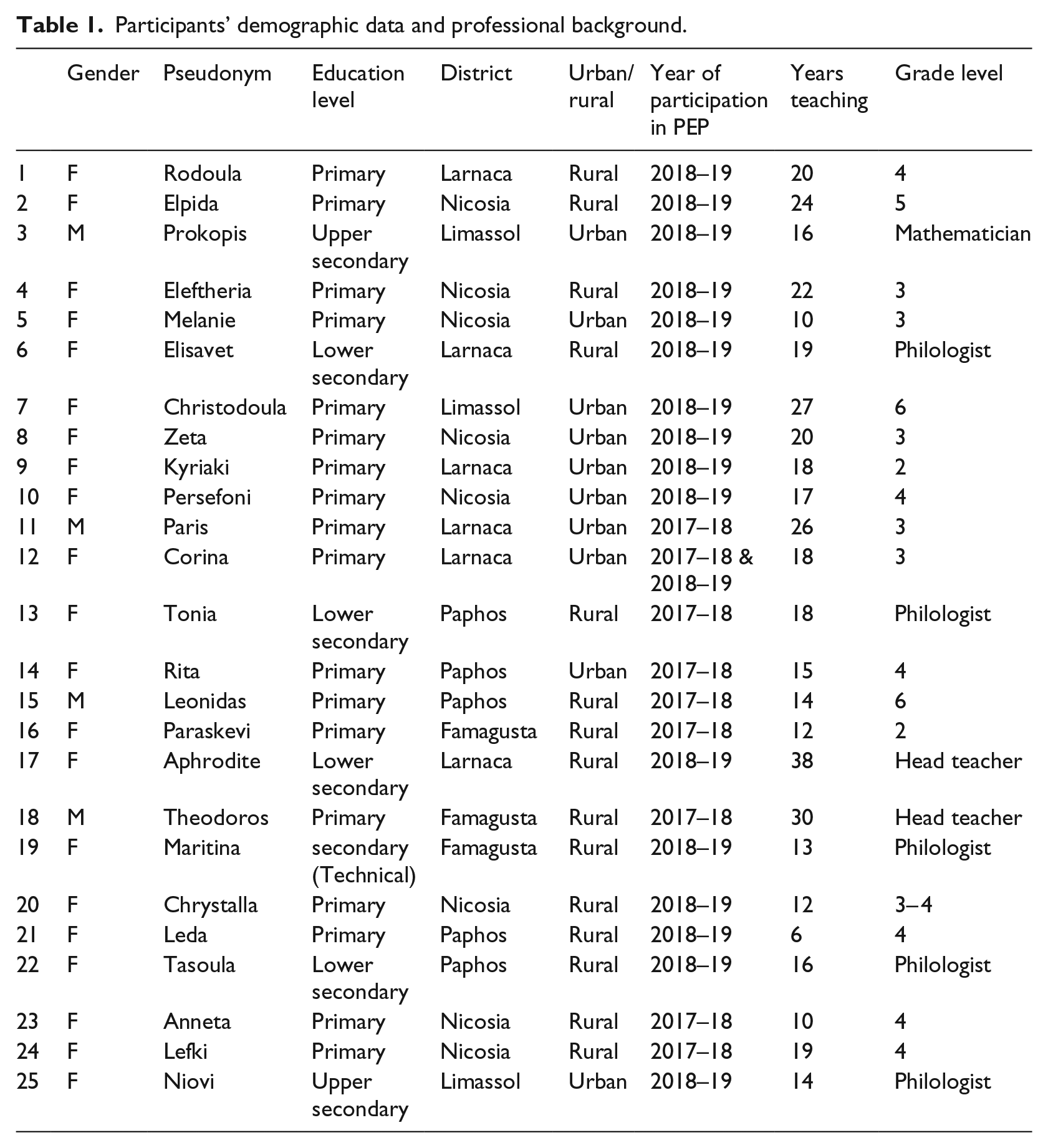
The research received ethical permission from our university and the teachers had signed a consent form prior to their interview. They were informed about the purpose of the study and they were told how the data would be used. Throughout the interviews participating teachers were encouraged to ask questions about the research process, and they were made fully aware that they could retire from the research at any stage without consequence. Although the interview questions covered a broad range of issues—that is, thoughts and emotions about the peace process in Cyprus and the role of peace education; thoughts and emotions of teachers participating in PEP and how they felt or addressed others’ concerns towards this peace education initiative—in this article we focused on data that specifically paid attention to the strategies that teachers used to engage with those who expressed concerns towards PEP. Interviews lasted between 60–90 minutes and for the purposes of analysis were audio recorded, transcribed, and later translated from Greek into English.
Our data analysis approach involved multiple phases of coding the interview data, beginning with open coding, looking for patterns and emerging, relevant themes (Strauss and Corbin, 1998). We identified the different kinds of concerns expressed towards PEP by various individuals and groups in schools, as those were described by teachers, and then examined how teachers chose to deal with those concerns. This refinement of our focus in analyzing the data allowed us to match how each teacher identified different types of concerns with his or her strategies employed to engage with these concerns. Clearly, our aim is neither to make any generalizations (e.g. about the most frequent concern/strategy) nor to identify particular trends (e.g. which concern/strategy is most likely to emerge within a group); the limitations of our data collection (e.g. single data source; small number of participants) do not allow for such conclusions. However, we do claim that it is crucial for strategic purposes to conduct this mapping exercise, because it enables the identification of the variability of concerns and the strategies that emerge as a response to those concerns in the complex context of “everyday peace” in schools. Through such methods, we are able to address two more specific questions: What types of concerns about PEP by different groups (parents, colleagues, head teachers, and students) do teachers identify in their schools? Which strategies do teachers employ to engage with these concerns?
Findings
In Table 2 we present a mapping that includes both the types of concerns towards PEP by different groups (parents, head teachers, colleagues, students) and teachers’ strategies to deal with those concerns.
Different types of concerns and teachers’ strategies to deal with them.
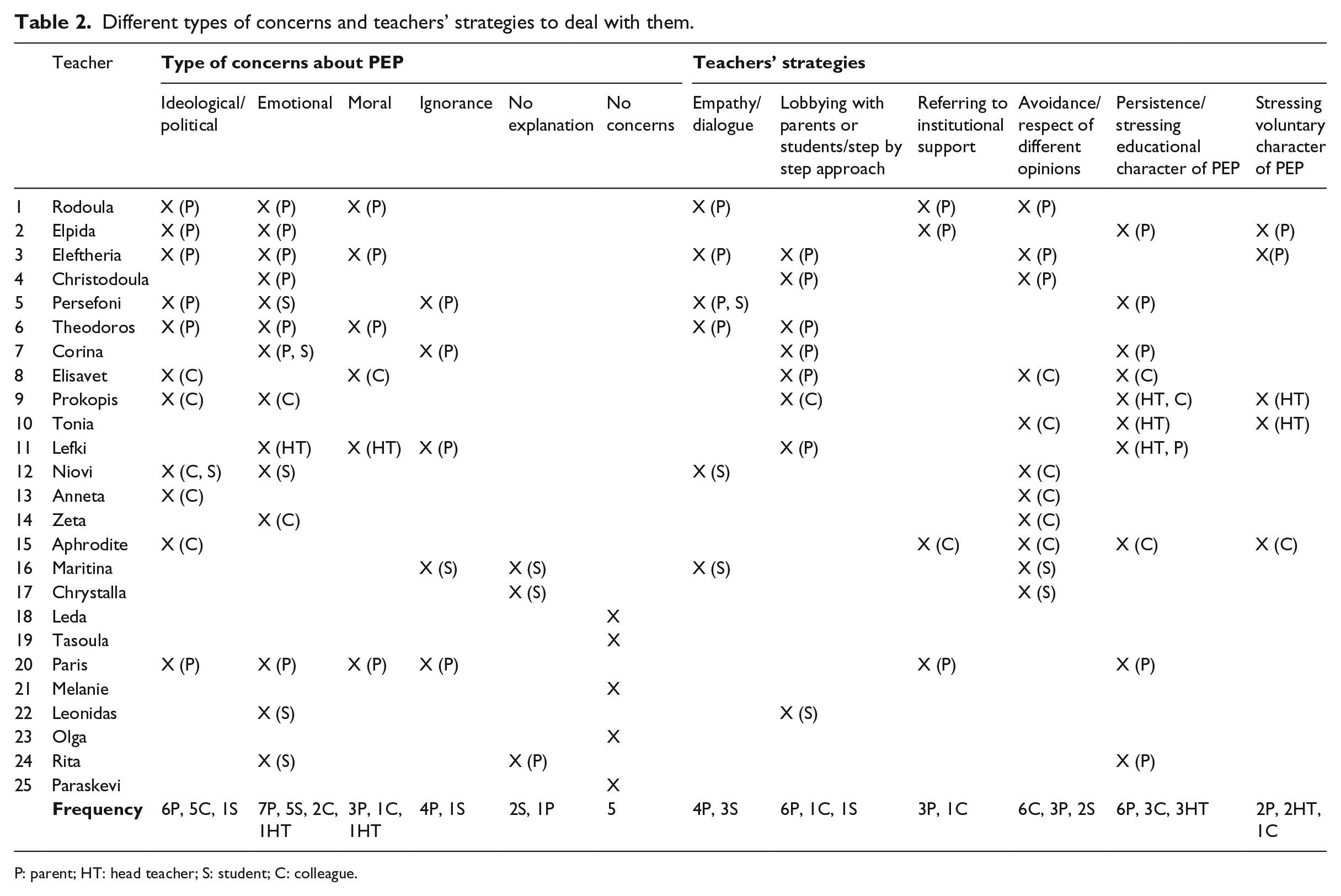
P: parent; HT: head teacher; S: student; C: colleague.
As can be seen in Table 2, we make an attempt to match how each teacher uses one strategy or more with different groups. Our attempt to calculate the total number of concerns and strategies, as shown in the frequency row at the bottom of the table, is not meant to “quantify” the qualitative elements of these findings; rather, it is meant to provide a holistic picture about how different concerns emerge within particular groups and which strategies teachers employ as a response.
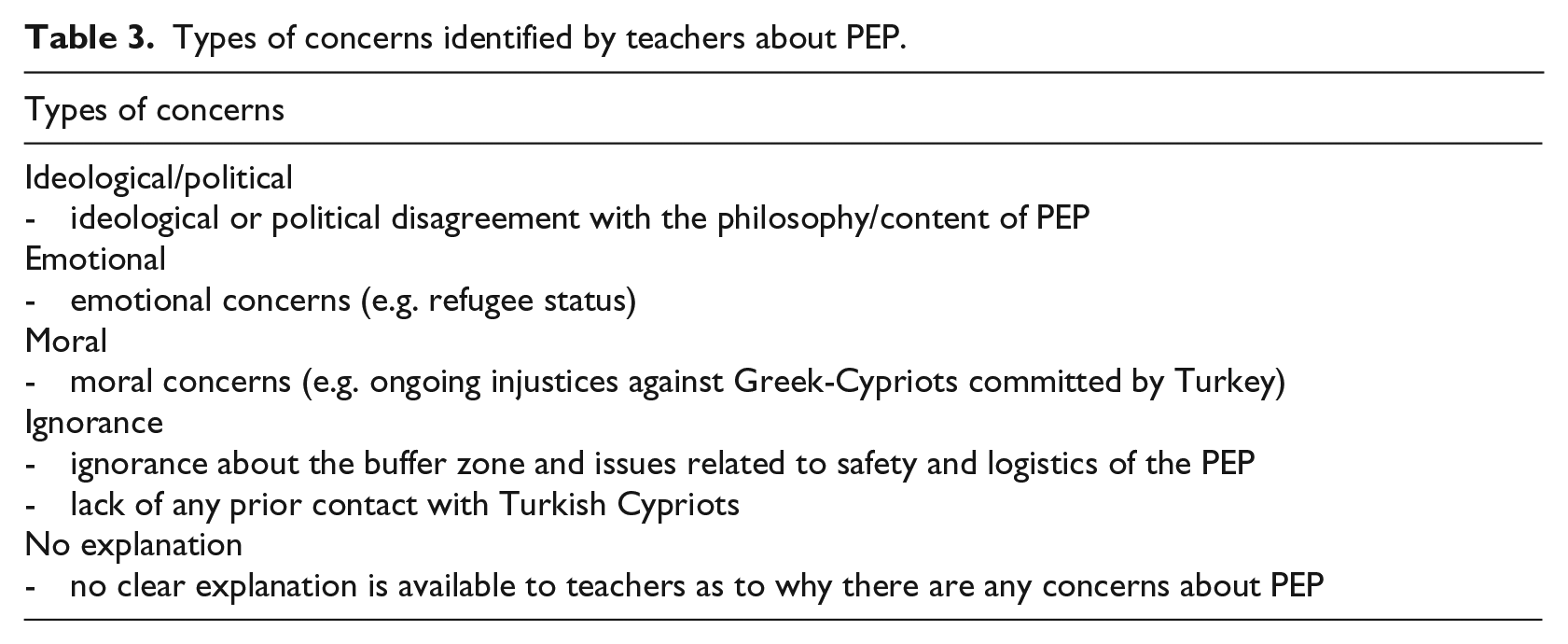
All in all, as shown in Table 3, our analysis indicates that teachers identify five types of concerns by parents, head teachers, colleagues, and students: ideological/political, emotional, moral, ignorance, and “no explanation.”
Types of concerns identified by teachers about PEP.
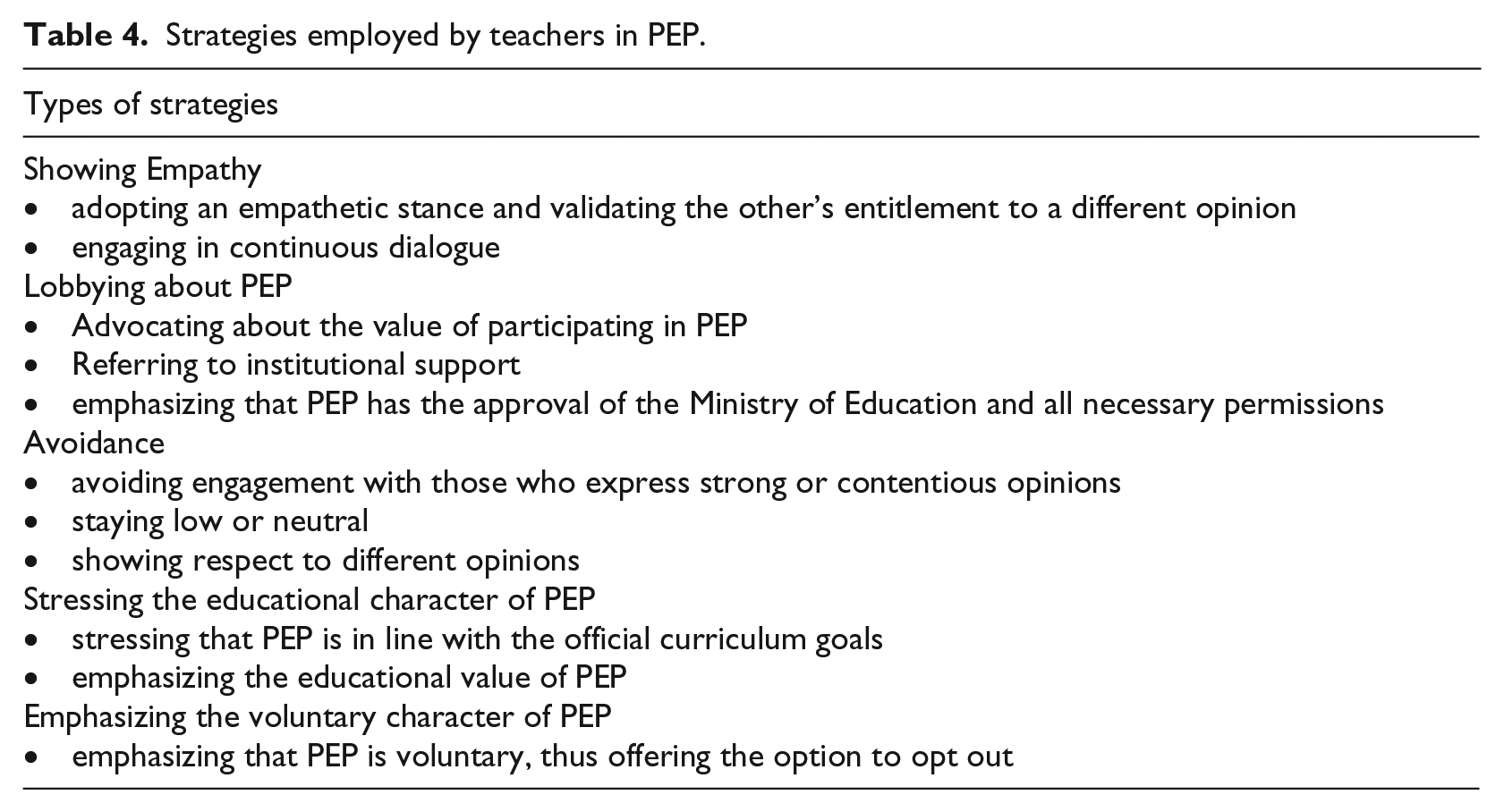
Also, as shown in Table 4, teachers employ six different strategies in engaging with the concerns identified in their school community: showing empathy, lobbying about PEP, referring to institutional support, avoidance, stressing the educational character of PEP, and emphasizing the voluntary character of PEP.
Strategies employed by teachers in PEP.
In the following sections we provide examples that show the concerns teachers identify and the different strategies they employ. We discuss both concerns and strategies together, because it is important to view them in context so that their entanglement is not lost; for this reason, the findings are categorized by group (i.e. parents, head teachers, colleagues, students). Needless to say, the examples offered here are meant to be illustrative rather than exhaustive of the different types of concerns and strategies found in the data.
Parents
Taking a quick glance at Table 2 makes it obvious that, according to what teachers reported in the interviews, parents are the group that express the most concerns towards PEP, leading teachers to invent a wide variety of strategies to engage with those concerns. One of the issues that seem to concern parents a great deal is related to ideological and political beliefs, often entangled with emotional and moral concerns as well. For example, Rodoula discusses a parent’s political and emotional concerns about the Turks being “two-faced,” which raises a moral dilemma for this parent on whether to allow his child to participate in PEP:
There was this parent who said, “I am not in favor of this [PEP].” He was so emotionally intense, he even said, “We should be careful of the Turks, they are two-faced.” Following the completion of the mono-communal workshop at his child’s school, this parent came back to me and said that his child wanted to participate in the second phase of the project and that he wouldn’t like to deprive her of an opportunity she wanted to be part of. But he made it clear to me that this did not qualify as a shift in his perception. [. . .] How did I handle this? I did not really take a stance . . . I just told him that PEP has the approval and support of the Ministry of Education and that it’s in line with the school’s objectives. I also told him that he was entitled to his own opinion and that, being a refugee myself, I understood his concerns. (Rodoula, primary school, Larnaca, rural)
Rodoula’s strategies include a combination of showing empathy, while at the same time, stressing that PEP is in line with educational goals and has political legitimation. Although these strategies may be effective in relation to reassuring the continuation of PEP at this school, it is unclear whether they have any effect on changing this parent’s adamant beliefs. The following teacher, Eleftheria, also uses a combination of strategies to deal with a concerned parent that include empathy, avoidance, and emphasizing that PEP is voluntary; interestingly, she also urges her students to discuss the issue with their parents, something that proves to be effective:
Eleftheria: I had this student whose parent did not give consent for participation in PEP. The reason behind this decision was pretty clear – he was a refugee. In the beginning, I said nothing. However, as time went by, this student’s friends applied for participation and so she went to her dad trying to convince him to let her be part of this as well. And she did convince him! [. . .] My role was not to convince anyone. I just held a discussion with my students in the classroom and told them that whoever feels like could have a discussion with their parents. There was no pressure, I made that clear. This wasn’t mandatory. As simple as that. Researcher: How did you deal with fears, whether these were coming from the students themselves or their parents? Eleftheria: Well, I had an ordinary discussion with the students. I told them that “Turkish Cypriot kids are like you,” and that “you will discover that there is nothing different about them,” and that we will not engage in any uncomfortable discussions with them. I also told my students to be kind and courteous. We actually prepared the floor for them to be in good terms with Turkish Cypriots and to avoid any possible tensions. (Eleftheria, primary school, Nicosia, rural)
It seems, then, that this teacher decides not to engage with parents, yet she shows empathy to their emotional or moral concerns; at the same time, she strategically prepares the ground by discussing in classroom the benefits of participating in PEP and urging children to do the same with their parents. When a student does so, this move seems to have a positive impact, because the student manages to convince her father to allow her participation to PEP. Unlike Eleftheria, Persefoni seems to have a more serious problem, as she is pressured by some parents not to participate in PEP, because they perceive this program to be “political”; while also showing empathy, she follows a different strategy as she decides to insist on her view and put aside parents’ pressures:
I was ambivalent at the beginning, since I had already received several phone calls and my name came up in discussions during meetings of the parents’ association in the form of “Why would this teacher go after such an initiative?”, “What is it that she wants to get out of this?”, “Why is she doing this?”. This annoyed me. I mean the fact that they did not perceive this as something innocent and, at the same time, lobbied and phoned me to say things like “Persefoni, this is all politics and it shouldn’t be part of the school.” [. . .] These are all valid questions and I blame no one. [. . .] However, I wanted to prove them wrong, that nothing bad happened to their kids and that, on the contrary, they returned back to school and were saying that “Look, these kids [Turkish Cypriots] are like us.” This is the message that I wanted to pass on and this was accomplished. [. . .] So, I’m telling you, I just let all this go, I just had a chat with one or two parents who phoned me, I reassured them that nothing would go wrong, I elaborated on the philosophy of PEP and my own approach of this, but never have I pressured them to give consent to their kids. (Persefoni, primary school, Nicosia, urban)
Unlike the examples so far, the following example refers to a case in which there were no reactions or concerns by parents. The teacher, Elisavet, explains that the reason there were no reactions is that the students seemed to have communicated the success and excitement of their first bi-communal meeting to the whole school and to their parents as well, and that she was also very well prepared to answer all questions and provide clarifications to the parents:
Parents didn’t even ask whether their kids would need to show IDs in order to cross to the north side during the “Nicosia Walk,” not even one! Everything was clear, I had already photocopied all details beforehand, I was very well prepared and asked kids to let their parents know that they could reach out to me in case they had any questions. [. . .] Kids were pretty cool and eventually returned home and told their parents everything in details, and everyone was pleased. I know this because a lot of my students, who participated in the PEP, are children of very close friends of mine, so a lot of these parents called me saying, “Elisavet dear, well done! The kids had an amazing time, congratulations! We wish this would happen again, and this is also what our kids keep demanding!” (Elisavet, Lower secondary school, Larnaca, rural)
It is worth mentioning that this teacher is very actively engaged and networked in her community, since she lives in the area, and parents seem to trust her and show affection towards her; this emphasizes that networking in the community may be an important element of teachers’ strategic approach to engage with parents’ concerns.
Finally, the following teacher, Paris, faces concerns by parents as a result of their ignorance about the buffer zone and issues related to safety and logistics of the PEP in conjunction with current political concerns about Turkey’s aggressiveness in the Eastern Mediterranean:
Some parents just said that they didn’t want their kids to take part in this program. What was mostly concerning to other parents, according to what they had told me, was the issue of safety. At that time, there was again some tension with Turkish naval ships in the Aegean, hence there was a certain tension between Greece and Turkey, and some parents were worried. We told them that kids were going to be with us at all times, that we would not cross to the occupied area (which was another concern of the parents), that we would be in a UN-controlled area, that teachers were going to be around etc. (Paris, primary school, Larnaca, urban)
All in all, parents express a variety of concerns about PEP that range from ideological/political concerns to emotional and moral ones, as well as concerns emerging from ignorance. As noted earlier in the article, these concerns cannot be isolated from the historical and political context in Cyprus, hence the types of strategies used by teachers to address those concerns may be somewhat effective in reassuring participation in PEP, yet it is unclear whether they enable any long-term shifts of opinion. What is clear, though, is that differences in the school and community context—particularly, the relationships among teachers, students and parents (or the community)—are crucial in generating certain capacities for strategies used by teachers.
Head teachers
Dealing with head teachers’ concerns has also been a major issue for teachers participating in PEP. As shown in the following examples, teachers mention reactions from their head teachers that are related to the fear that participation in PEP could create reactions in the community:
The only time I felt uncomfortable was with my head teacher. Not that he didn’t want to give his permission or whether he had an issue with this. I just kind of felt his fear of two things: the possibility of parents “complaining” and, secondly, the possibility of other teachers wanting to participate in the program, thus creating a situation of having different groups of students missing their classes because of this. (Prokopis, Upper secondary school, Limassol, urban)
Similarly, the following teacher, Tonia, mentions her head teacher’s hesitancy in granting consent for participation in PEP. She explains that the head teacher’s major concern is, once again, how the parents would react to such an initiative. What eventually leads to changing the head teacher’s mind is the overwhelming participation of students:
The head teacher was a bit hesitant in relation to the issue that our kids would be with Turkish Cypriots, about parents’ possible reactions, you know. [. . .] When the circular letter from the Ministry of Education reached the school, we had another chat and I was like “I discussed this with my students, and we decided to proceed.” I showed the head teacher the circular letter and so on and told him that this program requires parents’ consent so, in this way, we would know whether parents were positive or not. It eventually came up that everybody was positive, so he told me that it was OK to proceed. So, I did push this a little bit to be honest. (Tonia, lower secondary school, Paphos, rural)
In both these examples, the concerns expressed by head teachers seem to be deriving from a fear of possible reactions from disagreeing parents in the community and a discomfort to modify the school’s timetable and accommodate participation in this program. The latter could be interpreted as a sign of inflexibility, however, it is not unlikely that some head teachers may fear the political repercussions of participating in a peace education intervention, so it is possible that they hide behind technical issues such as the difficulty of changing the school timetable. In both cases, teachers respond by stressing PEP’s educational and voluntary character, and strategically using their students’ excitement as a springboard to negotiate participation to the next phase of PEP.
A different type of concern emerges when another teacher, Lefki, discusses the emotional concerns of her head teacher, who is a child of missing persons since 1974. Even though this head teacher is not supportive of the project, he entrusts Lefki with applying to PEP and also joins the bi-communal event that takes place at the buffer zone in Nicosia:
Initially, there was a concern by the head teacher who was against this. . . OK, both of his parents are missing persons. . .so you understand the situation. . . However, he trusted me on this, even though he was not supportive of the program. He respected my wish to participate since the first moment. [. . .] He even joined the activities at Ledra Palace. He might have joined in order to make sure that everything was OK, that there was no serious reason to worry about. I think what happened is that he trusted me, that’s why he accepted. I don’t think it was because he changed his mind or that he agreed with this. He just left it up to me. (Lefki, primary school, Nicosia, rural)
This example suggests that sometimes it may not even be a matter of using an effective strategy to engage with people’s concerns towards a peace education intervention. Some people in the community may have such traumatic experiences that their concerns may never really be adequately addressed by any diplomatic strategies. At the same time, it’s important to recognize that simple things such as developing collegial trust and mutual respect may open possibilities for peace education, even when there are no strategies to adequately address traumatic experiences.
Colleagues
Several teachers (7/25) discuss a range of concerns that are raised by their colleagues about PEP. Most of these concerns seem to be related to their colleagues’ discontent about the bi-communal character of PEP—that is, these reactions, that are often quite emotional, allude to ideological or political concerns. For example, in the following excerpt, Elisavet describes the negative emotional reactions by some of her colleagues:
Elisavet: There were colleagues who, off the record, would insinuate things about me personally [. . .]. For example, they would huddle up in the teachers’ room wondering where I would go with my students or who gave me permission or why I hadn’t asked them [. . .]. Interestingly, when the PEP team visited our school, these teachers were completely indifferent to this. Now we are talking about 4 or 5 colleagues. However, when the “Nicosia Walk” took place, they made a huge fuss about it. For example, they made very insulting comments like “Did they [Turkish Cypriots] invite you to a picnic? Was there a red tablecloth?” This was because they saw a post on social media with Ledra Palace in the background with the poppies and the blooming yellow daisies. [. . .]. These insulting comments. . . almost ended up in a fight, let’s say. Researcher: My question is: How did you deal with all of these? Can you give an example? Elisavet: These comments reached the head teacher, so I discussed it with her and I told her to neither pay attention nor invite them for an apology or anything, and that she should just let them. . .just let them stew in their own juice. Personally, since that day, I never spoke to them again; my stance is avoidance, scorn, and disgust. Well, I think they got the point, since we do not talk to each other, we do not even exchange “good morning” anymore. [. . .] Finally, the head teacher put them in their place by inviting them to her office and telling them to cut it off, because this was a program that had the endorsement of the Ministry. So, they realized they couldn’t do anything, that I was decisive and that no parent, no parent at all, made any complaint. On the contrary, parents were very positively inclined towards me and even called to congratulate me. (Elisavet, Lower secondary school, Larnaca, rural)
Elisavet’s strategy is avoidance, despite the insulting comments from her colleagues, in conjunction with her persistence to pursue this project. The role of the head teacher is crucial here as she takes decisive action by asking those colleagues responsible for the insults to stop doing so. The strategy used by this head teacher, then, to address the reactions from colleagues emerging from political and ideological concerns is to confront them directly, rather than avoiding or ignoring them, while stressing the educational value of PEP and its official endorsement by the Ministry of Education. Clearly, the head teacher’s authority makes a difference here; a teacher may not be able to do this. Hence, the teacher’s strategy is to lobby with the head teacher, and also invites her to participate in PEP to see the benefits first-hand; in turn, the head teacher uses her authority to address the emerging concerns to protect the project and avoid further escalation of this conflict at her school.
Finally, in the following excerpt, Zeta explains how her head teacher chooses strategically to provide information about PEP only to selected teachers—an incident that may be interpreted as an instance of empathy and care. The reason is that there is a colleague whose father is a missing person and is very sensitive about this issue, so the head teacher decides to act proactively:
There was this colleague whose father was, actually is, a missing person [. . .]. I was invited to participate to PEP by the head teacher who was like “would you be interested in this program?” This issue didn’t come up in one of the teachers’ meetings, even though we usually discuss everything during those meetings, we usually get informed about these things. Well, if this was shared with everybody, then maybe more colleagues would be interested but, on the other hand, we would have to deal with an emotionally difficult situation [. . .]. This colleague is very sensitive about her personal trauma and, since the head teacher could not predict her reaction, she chose not to share information about PEP during the teachers’ meeting. (Zeta, primary school, Nicosia, urban)
Interestingly, then, the strategy utilized most by participating teachers and head teachers when it comes to handling their colleagues’ concerns seems to be some sort of “avoidance”—yet, not only always in a “strict” sense, namely, as abstaining from discussions with colleagues to avoid conflict, but also as a manifestation of empathy, that is, avoidance to not hurt colleagues who may be sensitive to some issues. While we have previously observed participating teachers engaging in dialogue with parents and head teachers in order to advocate for the project, this is not the case when it comes to their colleagues. Dealing directly with their colleagues’ concerns does not seem to be an easy thing for teachers to do.
Students
Finally, teachers mention reactions by students before, during or after participation in PEP. In all cases where students resist their participation in PEP, teachers decide to respect their students’ decision and move on without their participation. For example, Maritina discusses this issue as follows:
There was this student, quite mature I’d say, who told me, during one of our discussions, that “since I have the right to opt out, I choose to do so”. He didn’t give me any reasons behind his decision, but I respected this. He was very polite and did not elaborate further and, at the same time, he didn’t try to fanaticize or insult anyone else. (Maritina, secondary school, Famagusta, rural)
When asked about the kinds of concerns expressed by Greek-Cypriot students during their encounter with Turkish Cypriots, half of the participating teachers mentioned that they noticed an initial hesitancy on behalf of some of their students to meet with Turkish Cypriots, but this was later overcome. The teachers explain that the reason behind this hesitancy is mostly “fear of the unknown,” namely, their lack of previous interaction with Turkish Cypriots:
There was this hesitancy by some of our students about going to the buffer zone and meet Turkish Cypriots. Even I was feeling uncomfortable meeting Turkish-Cypriot colleagues for the first time in my life. [. . .] I was kind of reserved; the same with the children, so I understand it and I think it’s normal. (Kyriaki, primary school, Larnaca, urban)
Some teachers tried to encourage their students to engage with students from the Turkish-Cypriot school, but they all agreed that interaction was eventually achieved through PEP’s collaborative activities. Hence, for most of these cases, no specific strategy was employed on behalf of the teachers.
In the case of teachers having to undertake an active stance or employ a specific strategy in order to assist their students to overcome whatever bias or hesitancy created discomfort during their bi-communal experience, certain incidents are examined and elaborated upon here. For example, on a handful of occasions specific teachers described incidents that created discomfort or led to uncomfortable situations. In the framework of these incidents, the teachers’ strategy was to engage in dialogue with their students and assist them to overcome their hesitancy. Leonidas recalls such an incident in which one of his students, during the bicommunal workshop, has a “difficult” exchange with a Turkish-Cypriot teacher.
A Turkish-Cypriot teacher asked one of our students “Why does your school have so few students?” with my student answering, “We are few because you killed us all.” OK, the Turkish Cypriots laughed at it. . .but we later told our student that what he said might have sounded a bit weird. . .[. . .] Listen, these perceptions do not emerge out of nowhere, neither can someone change them through punishment or anger or anything. It takes difficult and persistent work for someone’s viewpoints to change. . . So, I talked with this kid but he knows there had been a war, that Turks did terrible things to our community. What I invited him to think about was his own stance towards his classmates from the other community, whether there was any grudge to hold towards children of the same age, from the other community, after so many years. I actually think he got it, but these things need work and time. . . (Leonidas, primary school, Paphos, rural)
This teacher’s strategy, then, is to engage in dialogue with the student and show empathy and understanding towards this student’s reaction. The teacher understands that it is not easy for students to meet with members of the other community for the first time, so he takes a very sensitive and careful approach.
Another element that creates discomfort to students, according to Persefoni, is the location of the workshops (i.e. UN buffer zone, checkpoints, police, barbwire etc.). Persefoni recognizes that if it were her first time there too, she would have felt the same, thus her strategy is to show empathy towards her students when they struggle to make sense of that:
Well, on the day of the bi-communal meeting, kids had to pass through police, they crossed the checkpoint, they saw that there was control, that the bus could not enter the buffer zone, we walked to Ledra Palace Hotel and saw the bullet holes on the walls. All of this was really awkward for the kids; they were not at ease with these images. [. . .] I mean this wasn’t my first time there. . .if it was also my first time, I would have felt weird. (Persefoni, primary school, Nicosia, urban)
Empathy seems to be also the predominant strategy used by teachers upon their return to the school, after participation in PEP. Maritina explains how she handles some lingering concerns on behalf of students:
The next day, when we returned back to school, I dedicated one lesson in order to elaborate on our experience. During this discussion, different opinions were expressed which were, of course, respected. There were students who said that they were expecting something different but what they experienced was still pleasant. They were surprised that there was no tension after all. Well, there were also students who insisted on their own bias and various stereotypes against Turkish Cypriots but, as I told you before, I would not force my own opinion on students or try to change their opinion. These things require a lot of work. . . a systematic, step-by-step and sensitive approach. (Maritina, secondary school, Famagusta, rural)
All in all, in the case of students, teachers seem to mainly use empathy and dialogue or simply show respect of different opinions, compared to the range of strategies used with adults. Although students’ concerns are embedded within broader political and emotional discourses about the Cyprus Issue, it is important to recognize that teachers show empathy and understanding in order to create openings for further dialogue in the future, rather than employing a strategy of avoidance or trying to convince students with rational arguments that they don’t have the “right” views.
Discussion and Conclusion
Our data and analysis reveal that the strategies employed by teachers to navigate through the various concerns expressed by different groups produce a complex system of interaction aimed at risk minimization from participating in a peace education intervention (see Mc Ginty, 2014). These everyday diplomatic strategies invented by teachers help create conditions under which this peace education intervention, as a form of everyday peace, can take place, although it is not clear to what extent these strategies challenge the long-term nature of concerns. Interestingly, some of these strategies are similar to the types of everyday peacemaking responses identified by Mac Ginty (2014) such as avoidance or not revealing real stances and beliefs. Indeed, these strategies help teachers maintain the prospects required for participation in a peace education intervention, while a range of concerns is also present; so one may argue that these strategies have a certain degree of “effectiveness.” However, this is a “bounded” sort of effectiveness in the sense that there are certain boundaries created by the contextual concerns expressed as those are embedded in broader historical, affective and political issues. At the same time, these boundaries also function as platforms for facilitating teachers’ participation in peace education. Furthermore, these boundaries have consequences on the relative “success” or “failure” of one strategy or another. For example, avoidance may be a very effective strategy in one case with a particular group expressing concerns, while in another context, the same strategy may not be so effective. Hence, it is not a matter of compiling a set of strategies—as if there is ever a possibility to construct a complete “toolkit”—that can be used every time and everywhere without identifying first the concerns raised by different groups and exploring ways through which a strategy (or combination of strategies) may create openings that address those concerns.
By using the concepts of “everyday diplomacy” and “everyday peace” to examine teachers’ strategies of engaging in a peace education intervention, we provide here an analysis of how individuals’ and groups’ concerns about peace education and teachers’ respective strategies to engage with those are entangled and generate particular possibilities toward peace education. These possibilities might range from simply minimizing the risk of participating in a peace education intervention to instilling small “cracks” in individuals’ and groups’ “walls” of concerns towards a peace education intervention. These are the kind of possibilities that connect to what Richmond (2016) calls “peace formation.” Richmond defines peace formation as the relationships and networked processes through which local agents find ways of establishing and maintaining everyday peace processes. As it appears from our study, community members, parents, colleagues, and students often had pre-existing trust with their teachers—and this may have contributed to how they were able to be enactors of everyday peace. In this understanding, everyday diplomatic strategies by teachers to create possibilities for peace education—such as, for example, showing empathy or establishing “micro-solidarities” as Richmond (2016) calls them, that is, engaging in cooperation and networking with individuals and groups to deal with various obstacles of peace—are crucial, because these strategies can be “subversive” in handling those who express concerns towards peace education efforts (cf. Mac Ginty, 2014). It is also important to recognize that most of the participants in our study are established teachers, with all but one having well over 10 years’ experience; this might play a role in their sense of agency or approach to addressing concerns regarding PEP, namely, it is possible that they have already established a repertoire of strategies that serve them well in the situations they find themselves in. The point is not to eliminate concerns towards peace education efforts, as if this would be possible merely by using everyday diplomatic strategies; rather, the aim is to engage with concerns in productive, sensitive and strategic ways, that is, in ways that create openings of connecting with the more positive realm of peace education.
These findings have important implications in conflict affected societies struggling to introduce and maintain peace education programs. First of all, it is crucial for researchers and policymakers to pay attention to the different concerns about peace education expressed by individuals and groups and work with teachers to explore strategies that help them navigate through these concerns. For example, creating a situated mapping of the concerns-strategies entanglement in which a peace education intervention takes place is vital to creating a strategic and stepwise approach how to introduce and maintain a peace education intervention more effectively. If engaged in a process of peace education intervention, rather than being presented with a top-down, imported one, individuals and groups—including teachers, parents, head teachers etc.—gain a deeper understanding of the multiple complexities involved and the factors that could make this intervention more productive for everyone.
Furthermore, in regards to both teacher preparation and teacher professional development in peace education, this study suggests the need for an analytic approach that explicitly recognizes the various emotional, political, moral and other concerns emerging from peacebuilding efforts in education and treats those concerns as possibilities for productive engagement through the use of various strategies. Thus, raising awareness of the concerns by different groups in peace education efforts, and understanding the contested nature of these peacebuilding efforts, may be helpful in preparing teachers to identify, analyze, and navigate more effectively through the concerns expressed by various groups. Learning how to identify concerns that create obstacles towards peace education, teachers can play an important role in inventing everyday diplomatic strategies that could break down some of these obstacles.
In many accounts of peace education interventions, those who raise concerns and express ambivalences about peace education are often pigeonholed as “resisters” or “rejectionists.” But if we take a broader perspective of the multiple complexities involved in peace education efforts, then we can see that things are not black and white, and that there are always some opportunities to work critically and sensitively with those who are concerned about peace education, for legitimate or perhaps less legitimate reasons (Charalambous et al., 2020; Zembylas et al., 2016). The point is to recognize that those who express concerns about peace education may well be the very people who can be useful to the peace formation process, because they force peace actors to calibrate their approach through the use of better strategies. Future research on the “infrapolitics” of peace education and teachers’ strategies of everyday diplomacy will enable a more nuanced understanding of the interplay between concerns and strategies and alert us to the often-unnoticed discourses and practices that can be highly effective in establishing and maintaining productive peace education interventions.
Footnotes
Funding
The author(s) disclosed receipt of the following financial support for the research, authorship, and/or publication of this article: This research was financially supported by the Open University of Cyprus.