




Abstract
This paper reports on a study that sought to explore mainstream and special teachers’ inclusive practices during the Covid-19 pandemic and discusses issues that are relevant in the post-Covid-19 period. The study is contextualized with European and international studies and reports on teachers’ role in the inclusion of children with disabilities before and during the pandemic. The sample of the study comprised of 17 mainstream and special teachers based in public schools in the Republic of Cyprus. They were purposively selected due to their commitment to provide quality education. Following a thematic analysis of teachers’ interviews, some of the themes were mapped with Florian and Black-Hawkins’ Framework for Participation which was used as a tool to conceptualize how teachers promoted participation through ensuring access, collaboration and inclusive pedagogy in distance education. The discussion links the findings with key values of inclusive education, such as interdependence and belongingness and resistance of ableist policies. It is concluded that teachers’ inclusive responses during the pandemic may inform professionals who are committed to inclusive education to bring about change in competitive and individualistic education systems across Europe.
Introduction
In the aftermath of the Covid-19 pandemic, a number of researchers called for the need to critically reflect and evaluate the responses of education systems and individual stakeholders (e.g. teachers, children, parents, etc.) during the period of crisis, hoping that the outcome of such discussions will inform future decisions of countries in relation to inclusive education (Vlachou et al., 2023). The focus of this paper is on mainstream and special teachers’ efforts to include all children during the Covid-19 pandemic, a period when predominant beliefs about what education is about and how it is achieved were suddenly disrupted. Arguably, teachers in different countries were ‘trapped’ in education systems that relied both on segregating policies prior the pandemic and on unjust measures taken during the pandemic (Mitescu-Manea, et al., 2021; Symeonidou, 2023; Symeonidou and Karagianni, 2023).
In the last 25 years, there has been a growing interest at international and European level in defining inclusive education. The definitions of inclusive education changed from initially demanding the placement and support of children with ‘special educational needs’ in the mainstream school to the concern for the inclusion of all learners (European Agency, 2022; Slee and Tait, 2022). Although there are many definitions of inclusive education, it is now widely understood as the provision of quality education for all children which enables them to learn with their peers in schools that do not segregate or exclude in any way (Baglieri and Shapiro, 2017; Graham, 2020). In this process, addressing diversity and ensuring equity through high-quality education and participation are essential elements (Council of the EU, 2021). The title of the Global Education Monitoring Report highlights that for inclusive education to take place, ‘All means All’ and ‘gender, age, location, poverty, disability, ethnicity, indigeneity, language, religion, migration or displacement status, sexual orientation, gender identity and expression, incarceration, beliefs and attitudes should not be the basis for discrimination against anyone in education participation and experience’ (UNESCO, 2020: 20). Despite contemporary beliefs on inclusive education as a process safeguarding quality education for all children, it is frequently associated with the inclusion of particular groups of children, such as children with disabilities or children with migrant background. This connection often leads to separate policies and a parallel special education system, inauspiciously termed inclusive (Baglieri and Shapiro, 2017; Graham, 2020; Slee and Tait, 2022).
Although there are contextual differences between European countries, framed by cultural, historical, political, educational and economic factors (Armstrong et al., 2010), there are some common challenges for two-track education systems (i.e. distinct mainstream and special education system) across European countries. The prioritisation of learning outcomes is one such challenge. Despite the criticism, education systems still focus on comparative assessment, mainly in reading, mathematics and science, forcing teachers to ‘teach for the test’ and children to succeed (Tomlinson, 2017). This competitive individualism (Slee, 2011) and the persistence to create the ideal neoliberal citizen in schools that resemble businesses (Goodley, 2014) sentence children with disabilities to exclusion as their performance in tests will not favour the school or country’s rank. Assessing children individually is another challenge, since in the name of ‘early intervention’ more and more children are assessed to receive a ‘label’ (Baglieri and Shapiro, 2017). This is a mechanism that feeds existing segregating structures, since individual assessment is linked with specialist support. Last but not least, special policies, special schools and special curricula are still in place in many countries, sentencing children with disabilities to isolation both academically and socially during their time in school and throughout their lives as adults (European Agency, 2018). These are some of the existing policies that perpetuate inequalities and segregation in education systems.
Even though policies may not always promote inclusive education, it is argued that schools can engage in a process of maximizing responses to diversity and minimizing exclusion (Runswick-Cole, 2011; Symeonidou and Loizou, 2018; UNESCO, 2020). To this end, researchers in the field proposed frameworks that can inform schools, teachers and children engage in this process. The Index for Inclusion (Booth and Ainscow, 2011) was an influential framework aiming to support school development led by inclusive values. This framework proposes three dimensions: creating inclusive cultures, producing inclusive policies and evolving inclusive practices. The strength of this framework lies in the provision of specific indicators (e.g. building community, organising support for diversity, orchestrating learning, etc.) and sets of questions which schools can prioritize and work collectively and systematically to meet them. This framework informed collaborations between researchers and school stakeholders through collaborative action research projects, in England where schools have greater autonomy (Ainscow et al., 2004) and was validated and used for school improvement and other studies in different countries as well (e.g. Fernández-Archilla et al., 2020).
Florian and Black-Hawkins (2011) proposed the Framework for Participation which focuses on teachers and how they implement inclusive pedagogy. It involves three key tenets (i.e. focus on all children, rejection of deterministic beliefs about ability, ways of working with and through other adults that respect all children as equal members of the class) and it is structured around four dimensions of participation: access, collaboration, achievement and diversity. Each dimension sets indicators focusing on children and staff. In particular, ‘participation and access’ is about securing that all children have access and the strategies teachers use to enable access. ‘Participation and collaboration’ is about children learning together, members of staff learning together and with others from beyond the class. ‘Participation and achievement’ entails that the staff has the values, beliefs and skills to support children achieve. ‘Participation and diversity’ is about teachers accepting all teachers and children, and children accepting all children. The questions that elaborate each dimension of the Framework focus on ‘Who. . .?’, What are the teaching strategies. . .?’; and Why within the culture. . .?’. For example, Who is given access and by whom?/Who is denied access and by whom?; What are the teaching strategies that promote access?/What are the teaching strategies that deny access?; Why within the culture of class do some groups learn together/Why there are barriers to some groups learning together? (p. 817). This framework informed studies in different national contexts, aiming to observe and conceptualize teachers’ strategies and practices targeting all children, considering that they operated in systems favouring integration rather than inclusion (Kim et al., 2022; Losberg and Zwozdiak-Myers, 2021; Nind and Lewthwaite, 2018: 74).
The following section reviews research focussing on teachers’ role in the inclusion of children with disabilities before and during the pandemic. The next section provides information about the education system in Cyprus and important decisions taken during the pandemic. The methodology section and the findings sections follow. The last section discusses the findings in relation to key values of inclusive education, such as interdependence and belongingness. The paper concludes with suggestions about teachers’ role in education systems across Europe in the post-Covid-19 period.
Teachers’ role in the inclusion of children with disabilities before and during the Covid-19 pandemic
Despite the efforts to define the inclusive teacher and the nature of teacher professional development to encompass inclusive pedagogy, teachers still resist inclusive education (De Bruin, 2020; Spandagou, 2021). Relevant research in European countries records mainstream teachers’ insecurity to teach diverse populations, while at the same time they hold the view that inclusive education is in place, merely because children with disabilities are placed in the mainstream school (Graham, 2020). Teachers’ views about inclusive education and their role to teach all children stem from their experiences in ableist education systems. These systems are designed for the ‘average student’ who can learn independently following knowledge-based curricula. In such systems, where the ‘bell-curve thinking’ dominates (Florian and Black-Hawkins, 2011: 826), children with disabilities, migrant background or other characteristics are categorized by ability level, are gradually segregated, and eventually drop-out or graduate without any qualifications (European Agency, 2018). Within this context, which is considered ‘natural’, mainstream and special teachers often work independently; the former teach the ‘average student’, and the latter teach the basic literacy and numeracy skills to children with disabilities. Differentiated instruction and co-teaching are recognized as potential responses to inclusive education, but they are often an option only for teachers who voluntarily choose to engage in such processes. Last but not least, teachers tend to ‘transfer’ their responsibility to educate children with disabilities to special teachers and/or teacher assistants, and in these cases, children’s progress is restricted (Webster and Blatchford, 2020).
During the Covid-19 pandemic, some of the most essential elements of a typical school day were challenged, since the classroom was no longer the space of learning, the daily teaching time and the curriculum were no longer followed to the letter, and teachers had to familiarize themselves with new ways of teaching in order to engage children in distance education (Taneja-Johansson and Singal, 2021). Teachers were expected to take a leading role during the move to distance education. On the one hand, they had to follow the emergency policy measures, and on the other, they should develop their own ‘road map’ to cope. This entailed deciding about the content that ‘really’ needed to be taught, the teaching strategies for synchronous and asynchronous learning, and the channels of communication with families and colleagues (Dickinson et al., 2023; Sirkko and Takala, 2022; Thorn and Vincent-Lancrin, 2022). This oxymoron expected teachers to take control of their teaching, make informed decisions and take responsibility. At this juncture, teachers who grasped the opportunity became the protagonists.
According to the European Agency (2021) report, there is evidence to suggest that teachers’ voices on their experiences during the pandemic was not a priority research area. Most studies found in the literature describe special teachers’ experiences during the pandemic. In Finland, for example, research uncovered the challenges encountered by special teachers based both in mainstream and special schools at the beginning of distance education (Sirkko and Takala, 2022). Even though teachers had mixed feelings of fear and enthusiasm about distance education, they communicated and collaborated with staff, children and families. The pandemic led to learning experiences that helped teachers develop awareness about children and develop digital skills. Research from Spain suggests that special teachers based in special schools supported children’s learning by ‘delivering materials to families, communicating in diverse ways, providing academic or functional tasks, and working with other services’ (Simó-Pinatella et al., 2022: 907). Special teachers of children with autism, who participated in a study conducted in the USA, reported that they changed some of the intended goals for children with disabilities, developed new materials and highlighted ‘a renewed importance on collaboration with parents’ (Hurwitz et al., 2022: 889). Some studies and reports focussed on mainstream teachers’ negative experiences during the pandemic. In particular, issues of inadequate training to support children’s socio-emotional well-being during crises, and teachers’ traumatic stress from having to work with traumatized children, were raised and explored (e.g. Müller and Goldenberg, 2020). Other studies recorded the challenges mainstream teachers faced, such as low self-efficacy in digital skills and the use of technology to teach, lack of support and resources for distance education, increased workload and difficulties to engage and motivate children (Cardullo et al., 2021; Steed, 2022). It is noted however, that like special teachers, mainstream teachers also deployed a number of ‘innovations’ such as family-centred approaches and creative use of remote educational services (Carrillo and Assunção Flores, 2020; Steed, 2022).
Research on the experiences of families and children with disabilities acknowledged that there is a variation in their satisfaction from the support they received during the pandemic (Averett, 2021; Smith et al., 2023; Toseeb et al., n.d.). In some cases, parents appreciated some teachers’ practices during the pandemic, but they highlighted their disappointment from policy measures, schools and teachers, particularly because they did not show the necessary commitment in their children’s learning. Parents had to advocate for services that would ensure their children’s access in distance education (Averett, 2021; Dickinson et al., 2023). Research suggests that caring, active and supportive teachers were committed to support children and families and worked to establish and maintain communication, but this was not always the case (Capurso and Roy Boco, 2021).
This study recognizes the challenges and the difficulties faced by teachers, and the disappointment of families and children about all contextualizing factors that created inequalities during this period, including not-committed teachers according to parents’ testimonies. At the same time, the research question of the study was developed, having in mind that inclusive teachers’ practices during the pandemic need to be recorded, conceptualized and explained, as they may inform teachers’ role in inclusive education in the post-Covid-19 future and enable us rethink the limitations of a two-track system. Therefore, the research question guiding the study was: What decisions and teaching practices did mainstream and special teachers develop to include children with different learning profiles, including children with disabilities, in distance education during the Covid-19 pandemic?
The context of the study
Inclusive education is not a priority in the Republic of Cyprus (hereafter Cyprus). The existing law, entitled The Integration and Training of Children with Special Needs Act, N. 113(I)/1999 (Republic of Cyprus, 1999) legitimized the integration of children termed ‘children with special needs’ (article 2.1) in the mainstream school and regulated how special schools and special units would function. In 2011, Cyprus ratified the Convention on the Rights of Persons with Disabilities (United Nations, 2006), but no progress was observed in implementing Article 24 on inclusive education (Liasidou, 2016; Symeonidou and Mavrou, 2020). Thus, children with disabilities are still seen as a ‘special’ group of children who are often segregated from the mainstream class early in their lives. The policy system favours mainstream and special teachers’ separate work tracks, and even if both professionals are based in the mainstream school, they rarely collaborate to promote inclusion (Symeonidou, 2002a, 2002b, 2019).
During the Covid-19 pandemic, two lockdowns were enforced (March–May 2020 and January–February 2021) in Cyprus. Emergency policy measures that regulated distance education reached schools and teachers late, considered mainly children without disabilities and were sometimes contradictory. During the first lockdown, some schools and individual teachers took the initiative to initiate distance education in ways they considered appropriate, given the circumstances. Between the two lockdowns, oppressive discourses in relation to children with disabilities were developed, namely the ‘naturalization of vulnerability’ discourse which presented children with disabilities as vulnerable to Covid-19, and the ‘naturalization of inequalities in education’ discourse which disregarded the argument of vulnerability and rationalized inequalities in education in the name of disability (Symeonidou, 2023). Official sources, such as the Commissioner for the Protection of the Rights of the Child (2020) and the European Disability Expertise (2021), note that some of the most unjust policy measures for children with disabilities were: the decision to deny personal assistants to assist children from home, the decision to deny the return of some children with disabilities in the mainstream school (after the end of the first lockdown) because they were defined ‘vulnerable’ and the decision to keep cameras closed during online meetings.
Methodology
Participants
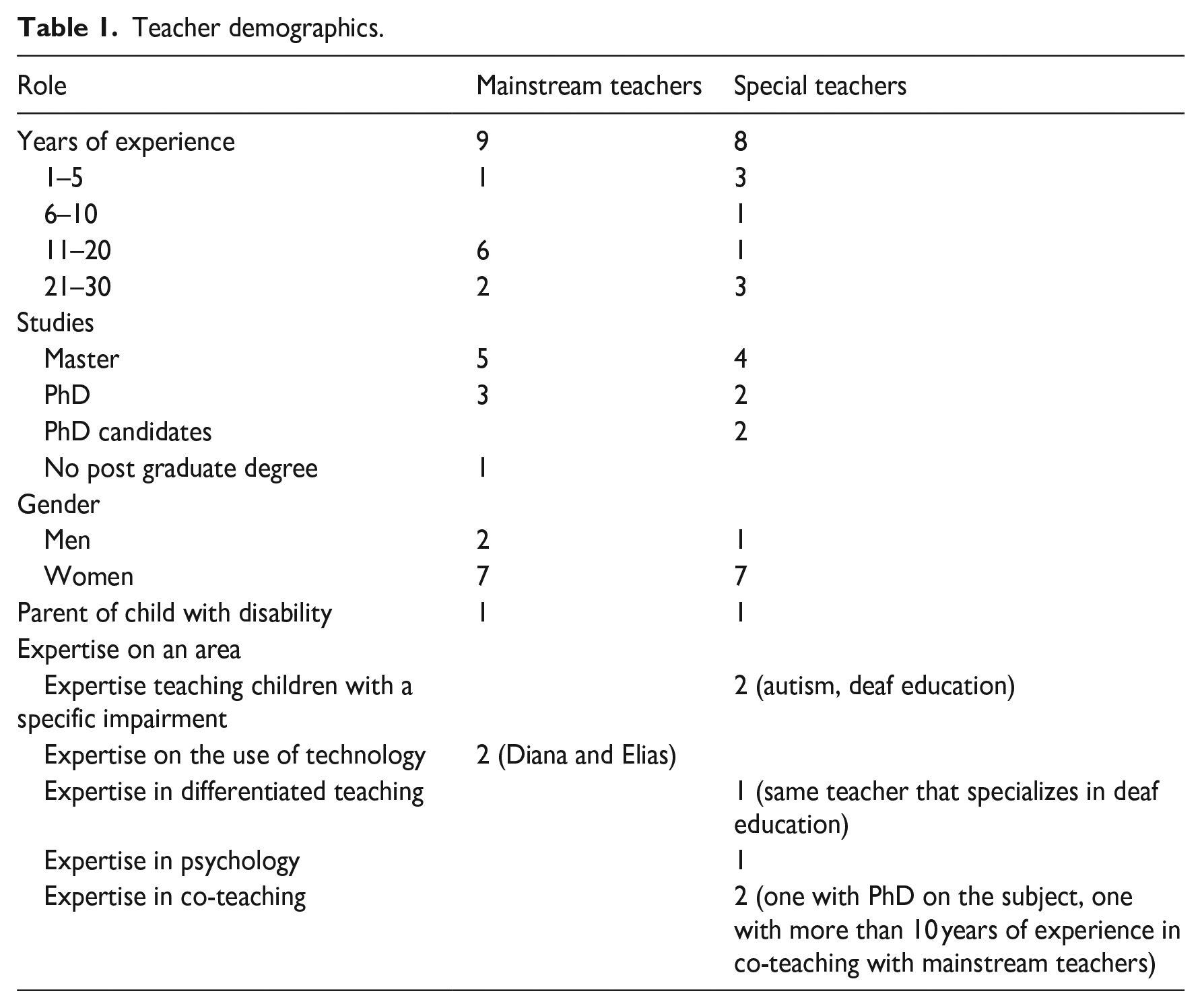
The participants of the study were 17 mainstream class teachers and special teachers who had at least one child with disability in their class during the two consecutive pandemic school years (2019–2020 and 2020–2021). We purposively contacted teachers who were committed to the inclusion of children with disabilities. Their commitment was indicated by their postgraduate studies (e.g. master or PhD in Inclusive Education) and/or their expertise in one of the following areas related to inclusive education: teaching children with specific impairments (e.g. autism, deaf education), use of assistive technology, expertise in co-teaching. We worked with most of these teachers as academics or interacted with them during teacher professional development seminars and we also considered their position that they are the primary teachers for children with disabilities as another indication of ethical commitment in inclusive education. Snowball sampling was also used since some teachers recommended other teachers who believed they could share inclusive practices they followed during the pandemic. Table 1 provides more information on their demographics. It is noted that the intervals we used to summarize the years of experience resulted after considering the literature on beginning/experienced teachers and the links between years of experience and teacher effectiveness (Graham et al., 2020, Podolsky et al., 2019).
Teacher demographics.
Data collection
Semi-structured interviews were conducted between January and May 2022, looking for teachers’ experiences during the first and second lockdown and the periods when they returned to school and had to follow health protocols. After being informed about the goals of the study, their rights as participants and the way the data would be stored and treated, the participants gave their consent to participate. The interview schedule included questions falling under the following topics: teaching strategies followed during the pandemic, challenges teachers faced, professional development, communication with parents, opportunities created to develop alternative ways of teaching/communicating with children and families, interpersonal relationships and collaboration with other teachers, children’s engagement in learning, communication with colleagues and head-teacher. The interviews had a duration between 40 and 75 minutes and took place in the participants’ preferred place. They were audio-recorded and transcribed. Teachers’ interviews were part of a larger study on the experiences during pandemic which included parents of children with disabilities. The entire study received approval from the Cyprus Bioethics Committee and the Cyprus Centre of Educational Research and Evaluation.
Data analysis
A thematic analysis of the data was undertaken and the process followed two stages. First, Braun and Clarke’s (2006) steps for thematic analysis were followed. Thus, all interviews were read by the research team to familiarize ourselves with the data. A preliminary coding scheme was drafted, which was used by the three researchers of the research team and a research assistant to code three interviews each. Following the preliminary use of the coding scheme, some codes were added or refined, and the final coding scheme was developed. The research team worked on the coding to ensure that 10% of the interviews were coded by two researchers. The emerging themes were reviewed, defined and named. The second stage, entailed mapping some of the themes with the elements of the Framework for Participation, developed and used by Florian and Black-Hawkins (2011: 817) to observe teachers’ inclusive pedagogies. It has already been mentioned that the Framework is comprised of four elements (i.e. participation and access, participation and collaboration, participation and achievement, participation and diversity). The Framework was believed to be helpful in the analysis, given the contextual characteristics of the local education system. In particular, Greek-Cypriot schools have limited autonomy and they cannot make decisions about the curriculum, textbooks, hiring teachers, allocation of resources, etc. Teachers have some autonomy in what concerns decisions about their class. The Framework for Participation addresses issues that are related to teachers and their class, and relationships/participation within the school. The Index for Inclusion framework, presented in the Introduction is more relevant to schools that have increased autonomy. Furthermore, the Framework for Participation can enhance answering the research question which is concerned with teachers’ decisions and teaching practices for inclusion. In particular, the first component of the Framework ‘participation and access’ was relevant to the themes of the study communication/collaboration with parents and practices applied during the pandemic. The second component ‘participation and collaboration’ was linked with opportunities for effective developments and development of alternative approaches in teaching. The third and the fourth components, ‘participation and achievement’ and ‘participation and diversity’, were relevant to the inclusive practices applied during the pandemic.
Findings
The findings are presented in three sections which reflect three elements of the Framework: participation and access, participation and collaboration, participation and achievement. Findings on ‘participation and diversity’ are not presented separately as all teachers recognized all children as equal, and the practices they applied are spread in all three sections.
Participation and access: Being there
Mainstream teachers felt that ensuring access in distance education and establishing communication with families were the first challenges they faced during the pandemic. For access to be possible, all children needed to have the necessary technological equipment and internet connection and be able to join the online meetings when these were planned. They also tried hard to keep children engaged during the asynchronous tasks they assigned by ensuring that they watched explanatory videos, understood the instructions for their homework, were able to send their homework back to the teacher independently or with their parents’ help, and could see that their work was checked. Most teachers explained that it was difficult to ensure access for all children, and they often ‘chased’ particular children to guide them accordingly. These were often children with migrant background who had limited access to tablets or smart phones, children whose parents were not at home (during the second lockdown) and could not support them with the use of technology or children facing challenging issues within their family. In relation to the latter, a mainstream teacher referred to a child whose profile and lack of home support restricted his access and participation.
One of the children was diagnozed with ADHD [Attention Deficit Hyperactivity Disorder] and Oppositional Defiant Disorder. In the online meeting, it was challenging to help him progress and on the other hand, he had difficulties with his mum and dad. Who would help him? When the schools opened, the psychologist’s one and only advice was that his mum should not help him with his homework so that their relations improved. His dad could not help him, so this child worked to the minimum, and I don’t blame him for that. (Ariana, mainstream teacher)
Special teachers noted that policy measures to keep cameras switched off was a significant barrier for children with disabilities. They also mentioned that individualized specialist support had to be scheduled in ways that did not prevent children’s participation in the whole class online meetings. A special teacher, working in a special unit, described how she established communication with parents and managed to overcome the barriers to ensure access.
I used Calendar in Teams and I developed an individualized schedule for each student. This was in the afternoon, because in the morning some students would attend the online meetings addressed to their class. [. . .] I sent a letter to the parents and they all signed. We did the activities and the parents sat next to their children. I called the parent, not the child. So, I was legally covered to use the cameras, because I used the parents’ email and the parents signed that it was OK for me to use the camera. This was the first thing I did. [. . .] I have to admit that soon, I received an email from my inspector saying that I was not allowed to do that, but I did not take it into consideration. We sent a letter to the inspector with the parents, saying that we all agree to work this way. (Sylia, special teacher)
It is evident that ensuring access in distance education entailed home – school collaboration, which is not a priority in Greek-Cypriot schools’ reality. It is usually restricted to an allocated time during which parents can visit/call the teacher and ask about their children’s progress. In some cases, teachers use applications to share photos, announcements and the homework with parents. Communication and collaboration between families and teachers is not continuous and productive, unless it is judged that there is a reason for more meaningful communication (e.g. children with behaviour problems, children with psycho-emotional difficulties, children who require support in ways that teachers are not familiar with, etc.). Thus, during the pandemic teachers pursued collaboration with all parents and relied on their support to safeguard children’s access in distance education, whereas prior the pandemic access was mostly teachers’ responsibility. Other support structures, such as family support from the Social Services are under-developed in Cyprus, and are provided to a very limited extent only to families who face severe challenges (e.g. violence in the family). Thus, during the pandemic, the lack of a well-organized support system was exemplified. The fact that technological equipment and familiarization with effective ways to use technology for all children’s learning were not addressed by the education system before the pandemic made efforts to secure accessibility even more difficult.
Participation and collaboration: Learning together
During the two lock-downs, some teachers sought to ensure that children were learning together, while themselves were also learning with other colleagues or professionals based outside their school how to work under the new circumstances. Despite the segregating nature of the education system and the challenges imposed by the pandemic, teachers encouraged all children to participate in the online meetings and prepared materials that they could use in asynchronous ways. The teachers themselves made efforts to engage in professional learning either through co-teaching, informal teacher groups and collaboration with school staff and other professionals outside school.
In the cases where all children learnt together, mainstream and special teachers learnt together though collaboration. In some cases, collaboration was developed because of one particular child. In the following example, a child who attended the first grade, had cerebral palsy and visual impairment and was entitled to individualized support and personal assistant. The mainstream teacher describes how she collaborated with the special teacher, parents and other members of the child’s support team.
I collaborated with the special teacher, who was so active. She was the light in my life, because she was an excellent special teacher who guided me during the pandemic. I feel that we collaborated effectively. I consider that multidisciplinary collaboration is important. [. . .] So, I collaborated with the child’s parent, the special education teacher, the personal assistant, the speech-therapist, and even the lady from the School of the Blind. The feedback we gave to each other worked very well and helped me handle the challenges of accessibility, learning and everything else during these two years I have him in my class. (Danae, mainstream teacher)
In other cases, mainstream and special teacher collaboration was developed because of the need to ensure that all children were learning together. For example, a special teacher mentioned that the headteacher asked her to collaborate with the mainstream teacher of the sixth grade, although this was not stated in the emergency policy measures. It is noted that the special teacher held an undergraduate degree in Primary Education and a masters and PhD in Inclusive Education, while her doctoral thesis focused on co-teaching. Prior and after the pandemic this special teacher’s role was to support students with learning difficulties individually, outside the mainstream class for about 80 minutes per week.
[During the lock-down] my role [as agreed with the headmaster] was to participate in the online meetings with the class teacher, support the class and intervene when necessary. [. . .] At the beginning, we worked this way. The next step was that I called the students in the afternoon, helped them with their homework and answered their questions. [. . .] This was agreed with the headmaster, who considered that it was more appropriate to ‘use’ me where there was a need, instead of letting me do what I normally did. [. . .] The decision to support only a few of the students [who were entitled to individualized support] was not right. [. . .] But the way we worked with the sixth grade was right, compared to other schools who considered that special education should be provided in a segregating way. (Nora, special teacher)
Learning together entailed that teachers collaborated to respond to the emotional needs of children. According to a special education teacher: We used Teams and we engaged in co-teaching, and one of the sixth grade teachers came to me and said ‘Please, if you have the time, do something because children are down’. The sixth grade teacher would say ‘They seem to be sleeping. I teach and they don’t participate. I call their names, ‘Mary’, ‘George’, and they don’t reply. (Sophia, special teacher)
Teachers were also learning from others beyond class. Both mainstream teachers and special education teachers collaborated with other teachers of their professional group to meet the challenge of developing materials that could be used in distance education.
Teachers exchanged materials which helped us realize how other colleagues differentiates the material, how they approached a topic. We created viber groups with other teachers to exchange ideas and discuss the challenges. (Zoe, special teacher) We collaborated and this was important, because we all felt insecure as to how we could practically function. We supported each other in the use of digital tools, material development, we exchanged materials. (Danae, mainstream teacher)
Clearly, teachers worked towards the goal of supporting children learn together, and at the same time, they pursued learning for themselves through networking with other colleagues or professionals. Like home-school collaboration, learning together is not a priority in the Greek-Cypriot education system. In the non-pandemic reality, teachers are expected to work individually, and serve their ‘traditional’ roles as mainstream or special teachers in their respective mainstream or special classes/units. Although collaboration and co-teaching between mainstream and special teachers has been suggested as promising practices (in seminars organized occasionally by the Ministry of Education), teachers are not expected to collaborate or engage in co-teaching. Even if they want to, they do not have the support to do so. Some of the barriers they face are the lack of policy to support collaboration and co-teaching, the expectation that some children need individualized support by special teachers outside the mainstream class and the fragmentation of teachers’ time (a number of special teachers move from school to school even during one school day). Further, the fact that there are no Material Banks that would facilitate teachers conceptualize and implement differentiated teaching leads teachers to the exchange of handouts, which however may not be suitable for their own class. As the findings indicate, during the pandemic, some teachers collaborated at different levels or engaged in co-teaching as an emergency measure, and they enrolled in larger (Viber) communities, extending beyond their school, which led them realize how other teachers differentiated their materials.
Participation and achievement: Inclusive pedagogy
Most teachers mentioned that during the distance education period, they had to lower their expectations because of barriers they could not directly remove (e.g. belated policy measures for the use of technology, lack of equipment for some children, some parents could not support their children in learning, different/conflicting views about how to respond to the pandemic at school level, etc.). However, teachers made efforts to support children progress, even during the pandemic, through their decisions for differentiation. Differentiation entailed choosing the core knowledge related to a topic/subject, preparing accessible presentations and materials, assigning differentiated homework, supporting students and parents to do the homework and providing feedback in different ways.
I ensured that everybody had some time to talk and I gave them the right to do so like a maestro, so that children listened to each other [. . .] When I prepared my presentation I ensured that it was accessible. Multimodality was something I considered, so the presentation had visual stimuli, audio, images, videos so that learning was enhanced. [. . .] Although the policy suggested the use of Teams, I would upload materials or accept homework sent in Viber or anything that was convenient to them. It is important to be flexible. (Danae, mainstream teacher)
Apart from the differentiation decisions to reach all children, teachers made adjustments for individual students in order to respond to their learning profile. It is important to note that the decisions made for individual students were incorporated in the differentiation decisions made for the whole class. In the following example, a mainstream teacher explains how he included a boy who did not speak or write and used a software that facilitated alternative communication.
We looked for the most suitable software, so that the child could work digitally without using materials in print. We also learnt to work on an individual basis with the child in parallel tracks with enabling participation in the whole class. Again, we used tools that allowed me to have access to his computer [. . .] I would give him instructions and I could see him working on his computer. [. . .] We prepared new grids [with words and symbols] for him in advance. The grids were relevant to the new lesson and with the mother’s support, the material was uploaded on his computer, so that he could participate in the online activities. (Orestis, mainstream teacher)
Similarly, a teacher of a child with visual impairment said: The child had a rare syndrome. He had visual impairment and used a tablet in the class to take photos instead of taking notes. During distance education, I would send my presentation or texts in large print in advance, and they could download it and he knew how to enlarge it on his tablet. He spent more time preparing than I did. I only had to send him everything in advance, the day before. (Athena, mainstream teacher)
Even when teachers taught the first or second grade and felt that there was not much they could do in distance education, they differentiated teaching to an extent, considering the whole class and individual children.
In the online meetings, we did simple things because the children were little. We would talk about a text, answer relevant questions, and I assigned homework. [. . .] I knew that when we returned back to school, I would repeat the most important parts. Homework was one thing I could differentiate. Although I avoided demanding tasks, for some children I would assign a more demanding task compared to others, to write up something for example. I could ask a child with learning difficulties to send me an audio rather than write up. I would send a video and an explanatory handout to the child with attention deficit, alongside some instructions for the parents. (Celia, mainstream teacher)
A special education teacher explained how she worked with her students who attended a special unit both on one to one basis and as a group.
I prepared interactive activities that were relevant to the content. We worked with these activities on one to one basis and then they worked on the activities with their parents. Another thing I did was that I took a box and cut some holes on it. I put my mobile phone on the top of the box [in a way that children could see what she was doing inside the box]. I used Teams and I could see the children in Teams on my mobile and the children saw the cards I was using and everything I was doing to explain the content using my hands. They could see what I was doing and I could see their reactions in Teams. This worked really well because the parents were sitting next to them. We started with 10 minutes, then 15, 20 and we reached half an hour on a daily basis. (Sylia, special teacher)
One of the mainstream teachers was impressed by the fact that children with multiple impairments affecting communication could participate with.
Can you imagine that for some children, they say that that they should be educated in a segregating context because they cannot participate or cannot do what the rest of the children do? But in this case, I think that children with disabilities proved that they can work even during distance education. I believe that sometimes we worked in phenomenal ways with children with disabilities; we tried new things. These children showed us that they can work in front of their computer without having the teacher in front of them, and that they can progress. (Orestis, mainstream teacher)
Ensuring participation covered the social aspect of education. Most teachers mentioned that they were concerned with children’s state of mental health and sometimes they felt that they were unhappy or unmotivated. So, they organized online meetings to encourage them talk about their daily activities at home or read a story. One of the teachers even organized a pyjama party! We found solutions during the lock-down. . . I will never forget the pyjama party! I wore my pyjamas with X [her son], we were decently dressed, and we read a story. Children shared their news and we said good night. This was not in the rules, and I was blamed for organizing it, because if there is a lock-down ever again, other teachers will feel they need to do this. (Athena, mainstream teacher)
Overall, both mainstream and special teachers who followed inclusive pedagogy made decisions that were in line with their understanding that all children could and should learn the core knowledge, while at the same time they should be emotionally stable. This approach seemed natural during the pandemic, but in non-pandemic times, teachers feel the pressure to ‘cover’ the content set in the national curriculum. Having made decisions on the core content, teachers were able to differentiate online, even though differentiation is not expected in non-pandemic times. Some of the examples presented in the findings indicate both mainstream and special teachers’ creativity in engaging all children in learning, and some of them were even impressed by how particular children participated in distance education. Teachers’ decisions targeted all children, while at the same time particular adjustments were made for some children, which again is a decision that is in line with differentiated teaching.
Discussion
We are now in the aftermath of the Covid-19 pandemic, and its negative impact on children at risk for exclusion has already been documented (European Agency, 2021). Despite the ableist nature of the education system in Cyprus, and the
To begin with, ensuring access so that children were learning together would not be possible if teachers did not believe in interdependence (Baglieri and Shapiro, 2017; Semetsky, 2012; Symeonidou and Mavrou, 2020) between themselves, parents and children. They recognized the needs of some children, without ‘classifying’ them as dependent (Greenstein, 2016), and they engaged them in learning through a relational way of working with them and others (e.g. parents, colleagues, teacher networks). According to the findings, they negotiated with parents about their roles in distance education and valued their assistance. At the same time, teachers knew they could not rely to parents for everything, they recognized their own difficulties during the pandemic (feeling insecure, emotionally fragile, difficulties to work from home and care for their own children), and thus, they chose the core knowledge that should be taught, assigned homework, sent explanatory notes or videos and provided feedback on children’s work. Parents would sit next to their children during online meetings, they gave their consent for the use of cameras whereas the stated policy prohibited it and they were responsible for receiving materials (videos, homework) and sending the completed homework back to teachers. Parents further supported the teachers when needed by taking the role of activists. Children relied both on their teachers and parents for support, but they also showed commitment to participate in this novel way of learning, communicating with their teachers in different ways, using new software or Learning Management Systems. Arguably, some of the family-centred practices recorded during the pandemic are practices suggested in the literature before the pandemic, but as Steed (2022: 467) notes, ‘the pandemic may have provided a context in which family involvement was so necessary’ that made this kind of interdependent relations develop.
Teachers recognized that children, parents and themselves belonged in the class community and in distinct communities (class community, family, school staff community and community of professional groups), and even if their daily school routine was interrupted, these communities were still important. This justified the decisions of special teachers to adjust their timetable and sometimes, work in the afternoon when they were not obliged to do so, to ensure that children who received specialist provision attended the online meetings with their classmates in the morning and also received individualized support from special teacher. Mainstream class teachers also made adjustments to their timetable to facilitate children to attend the online meetings, and at the same time ensure that children were emotionally stable (e.g. online pyjama party). Teachers also realized that they themselves belonged in the school staff community and in their professional community and thus, they collaborated between them. The outcome was different forms of collaboration (e.g. between mainstream and special teachers, between head teachers and teachers, between teachers of the same professional group, i.e. mainstream/special) and different outputs (e.g. distance co-teaching between mainstream and special teacher, shared decisions about the use of new software or adjustments that would facilitate particular children’s learning, exchange of materials). Evidently, valuing belongingness was an element that facilitated participation through collaboration.
Teachers who were committed in inclusive pedagogy, expected all children to participate in distance education. Thus, they resisted ableist policy measures and removed barriers in learning. Even though teachers’ role in differentiated instruction is not regulated by policy, they verified the equation ‘What you believe and Why you believe it = How you teach’ (Valle and Connor, 2019: 17). They differentiated the content, based on children’s readiness and the process based on children’s profiles (e.g. children’s age, children with disabilities). Some principles that guided their practices were that all children were given time to speak during online meetings, all children could follow the teacher (e.g. through a multimodal presentation that ensured access), all children had access to what was needed for the online meeting beforehand and to all necessary materials for the asynchronous activities that would follow.
Scholars in the field argue that disability should no longer be treated as an object that gets considered in the margins of different discussions; rather it should be ‘a conversation starter: a driving subject of which to make sense of ourselves and others’ (Goodley, 2021: 121, my emphasis; Greenstein, 2016). As the findings indicated, the teachers who viewed children with disabilities as a conversation starter were those who recognized diversity and accepted that all children had a place in distance education. Apparently, these would be the teachers who believed that before the pandemic (Authors’ papers under review). Thus, these teachers recognized how policy measures failed to consider children with disabilities, and other children who are also at the margins of the education system, such as children with migrant background. They saw the benefits of having children with different learning profiles in their class during the pandemic since they triggered their own professional development (e.g. some teachers discovered new software, ensured alternative communication channels, found innovative ways to present the content). After their experience in teaching during the pandemic, some teachers even wondered why the debate about segregating some children is still in place. This supports Goodley’s (2020: 50) argument that disability can unsettle ‘normative ideas of the human’, and embrace children and adults with disabilities as humans rather than less human, which is mostly the case.
This study was not without its limitations. One limitation was that given the extended period of the Covid pandemic and the changes in education policy measures, it might be that some teachers could not report on the different experiences and strategies they used in different time periods. This limitation was dealt by asking teachers to share with us any artefacts of the materials they had been preparing for this period, which also worked as a stimulus for them to recall the pandemic period. Another limitation is that children were not interviewed and this prevented us from having their own perspective on the time period of interest. The decision to include parents in the study compensated this limitation to an extent. However, this paper reports only on teachers’ perspectives.
Conclusion
The Covid-19 pandemic is now behind us, but lessons from purposively selected teachers who ‘escaped the room’ are important for the present and future of inclusive education. If these teachers who were ‘trapped’ both in their homes and in ableist systems, found the way out and ‘unlocked’ the door to pursue inclusive education during the pandemic, then the ‘escape room’ analogy (meeting all the challenges, resolving the riddles, collaborating with team members, enjoying every step of the process and celebrate after reaching the goal) may guide other teachers’ everyday practice. If other teachers, who did not participate in the study, can disavow the dominant dependence/independence argument and accept that all stakeholders, including children, families and themselves, are interdependent. This rationale will enable all children to be educated together and all stakeholders will work to ensure access in learning and socialization. Developing the sense of belongingness is also essential. In its absence, collaboration is limited, since it is assumed that each individual solely belongs to a distinct community. Disappointingly, children with disabilities are mainly seen as members of the community of children who receive specialist support, mainstream class teachers are seen as a separate community from special teachers, and parents are a distinct community that is frequently the ‘enemy’ (they demand inclusion for their children, but this is considered absurd for members of other communities). This should not be the case. The study presented in this paper, verified, once again, that mainstream teachers have the knowledge to differentiate teaching and include all children, and special teachers have the skills to support inclusion (Florian and Linklater, 2010; Valle and Connor, 2019). They can work collaboratively towards common goals for the benefit of all children. Additional analysis of the data (Authors’ papers under review) suggests that inclusive teachers were already applying inclusive practices well before the pandemic. The research team hopes that more and more teachers will ‘escape the room’ and reach all children, despite the political, material and attitudinal barriers that are still in place.
Having said that, future policy development for inclusive education needs to consider all children. Developing separate policies for children who belong in different categories at risk of exclusion should no longer be considered an option. This is recommended by international and European bodies in recent reports (e.g. Euridice Report of the European Commission, 2023). Furthermore, policy for inclusive education should no longer understand mainstream and special education teachers as two distinct categories of staff. Policy for inclusive education should address the need to change the role of specialist provision and legitimize the roles of all professionals involved in ways that encourage collaboration and co-teaching rather than independent work with children. Last but not least, policy for inclusive education should legitimize teachers’ responsibility to differentiate teaching. For practice to be more inclusive, all inter-linked policies need to prioritize differentiated instruction (e.g. education policy, national curriculum, teacher professional learning policy or strategic plan, etc.). Targeted teacher professional development for differentiated instruction and the provision of resources that will facilitate teachers in their efforts (e.g. resource banks with texts in different forms, such as easy to read, plain language, audio, etc.) are necessary in this process.
Footnotes
Declaration of Conflicting Interests
The author(s) declared no potential conflicts of interest with respect to the research, authorship, and/or publication of this article.
Funding
The author(s) disclosed receipt of the following financial support for the research, authorship, and/or publication of this article: This work was supported by the University of Cyprus and the European University Cyprus.
