



Abstract
The purpose of this study was to assess the degree to which sheltered versus unsheltered contexts of introductory communication courses impact communication skill development and overall learning outcomes for international students. Specifically, this study examined the following outcome variables: public speaking anxiety, engagement, communication mindset, communication efficacy, and student performance to investigate whether it is beneficial to sheltered international students in introductory courses. Results showed that there was no significant difference between groups for the public speaking anxiety, student engagement, or overall course performance, except for the final group presentation performance. However, there was a significant interaction effect for communication mindset and communication efficacy; students in sheltered sections saw increases in these outcomes over the course of the semester, while unsheltered students experienced the opposite.
Keywords
The Open Doors Survey found there has been a steady increase in enrollment of international students, and there are now more than one million international students enrolled at United States colleges and universities (Institute of International Education, 2019). With an increasing internationalization of the student body, American universities need to understand how to best meet the needs of international students by providing supportive structures for students to succeed (Jackson et al., 2019; Koehne, 2006). Oral communication skills are essential to undergraduate students’ academic success, sense of belongingness at their university, and employability after graduation. For international students, developing communication skills in their second language, English, is critical and particularly challenging (Jung and McCroskey, 2004; Lau et al., 2019).
In an attempt to support international students, many universities offer some introductory courses (especially public speaking) in sheltered sections that exclusively enroll international students, but to date, no research has explored whether these sheltered public speaking sections are actually more beneficial for students than unsheltered sections. Although proponents of sheltered courses hypothesize that international students might be more comfortable learning in such a context (Burroughs, 2008; Rubin and Turk, 1997), others suggest that integrating international students into diverse classrooms with domestic students might establish a comfortable learning environment in which students benefit more from having multiple cultural approaches to communication modeled in classroom interactions and performances (Broeckelman-Post, 2019).
The goal of this study is to compare the effectiveness of sheltered and unsheltered introductory communication courses by examining international students’ public speaking anxiety, engagement, communication mindset, communication efficacy, and academic performance in each course context. Ultimately, the goal of this study is to help universities better understand how to establish inclusive learning environments that allow undergraduate international students to thrive.
Literature review
The Open Doors report for 2019 showed that four of the top five countries from which international students originate do not speak English as a first language, and approximately 52% of international students in the United States are from China and India. This means that most international students in the United States are students for whom English is not the primary language (L2), and these students face a unique set of challenges where they are not just learning course curriculum, but also are increasing their proficiency in English at the same time (Doolan, 2014). A communication course that includes a public speaking component can be especially daunting for L2 students, so it is important to understand the impact that course context can have on students’ public speaking anxiety, engagement, mindset, efficacy, and academic performance in order to make curricular decisions that best support students on their learning journey.
Although no research has yet explored the effectiveness of sheltered versus unsheltered communication courses at the university level, research has examined the impact of sheltered courses for English language learners in other contexts, with mixed results. Sheltered courses are sections of a course that include only international students, and unsheltered sections include both international students and domestic students. Knoblock and Youngquist (2016) found that sheltered sections of a college-level reading class were more effective than unsheltered sections for improving L2 students’ reading abilities. Similarly, August (2018) found that students in a sheltered Sociology course were able to improve their English proficiency as well as create a stronger support system because it created a shared space and shared need for support. Another study at the high school level, however, found that creating sheltered and unsheltered courses “can potentially exacerbate students’ negative sense of nonnormative status,” which in turn affected student engagement and overall grades (Dabach, 2014: p. 118). Being placed in sheltered courses caused students to question their self-efficacy and intelligence, making those sheltered classes stigmatized spaces (Dabach, 2014). Costino and Hyon (2007) concluded that giving students agency to choose between mainstream and multilingual writing courses to select the type of course that best fit their needs contributed student satisfaction and success, though it can be difficult to predict student preferences. Although these studies provide some insight into the effects of sheltered courses, more research is needed to examine the needs of international students and the effectiveness of the resources universities provide.
Since creating sheltered sections of an introductory communication course requires a lot of additional resources—including time, effort, coordination, and often additional financial commitments—it is important for introductory communication course directors, communication departments, and programs designed to help international students transition into United States classrooms to know whether the investment in creating sheltered sections of communication courses is benefiting or detrimental to the students that those sheltered sections are intended to help. To help fill this gap, this study will examine the effects of sheltered and unsheltered introductory communication courses on students’ Public Speaking Anxiety, Student Engagement, Communication Mindset, Communication Efficacy, and overall course performance.
Public speaking anxiety
Public speaking anxiety (PSA) is defined as “situation-specific social anxiety that arises from the real or anticipated enactment of an oral presentation” (Bodie, 2010: p. 72). PSA is the most commonly experienced and serious subtype of the broader construct communication apprehension (CA), which is defined as “an individual’s level of fear or anxiety associated with either real or anticipated communication with another person or persons” (McCroskey and Richmond, 2006: p. 55).
Communication apprehension and PSA have both trait and state components; both have an underlying genetic and neurologic component that is nearly impossible to mitigate, which is the trait component (Beatty et al., 2011; McCroskey, 2009; Spielberger, 1966). At the same time, CA and PSA also have a state component that is related to the situation or context in which a person is speaking; previous research has shown that factors such as audience size, whether the speech is being graded, audience response, and type of delivery can impact the level of CA or PSA (Bodie, 2010). Although state CA and PSA can never be completely mitigated since they are heavily influenced by an individual’s level of trait CA and PSA (Harris et al., 2006), there are several treatments that can successfully reduce PSA, including communication orientation modification (COM) therapy, cognitive modification, performance feedback, habituation, systematic desensitization, and getting skills training through taking a communication course (Bodie, 2010; Broeckelman-Post and Pyle, 2017; Finn et al., 2009; Hunter et al., 2014; McCroskey, 2009; Rubin et al., 1997).
For L2 students, including international students, PSA presents an additional set of complications and challenges. Most students have higher PSA when speaking in a language that is not their primary language, and this seems to be due in part to concerns about language proficiency and about others evaluating the speaker negatively (Burroughs, et al., 2003; Jung and McCroskey, 2004; Liu and Jackson, 2008; Lucas, 1984; McCroskey and Beatty, 1998; McCroskey et al., 1985a; McIntyre and Gardner 1991). The level of PSA in a person’s primary language predicts PSA speaking in a second language (Jung and McCroskey, 2004; McCroskey et al., 1985a), and some cultures typically have higher levels of overall PSA than others (McCroskey et al., 1985b), particularly cultures in which speaking up as an individual might be seen as inappropriate in many speaking contexts.
Public speaking anxiety is a serious concern that can have negative effects during public speaking situations (Bodie, 2010) and is related to poorer academic performance and increased risk of dropping out (McCroskey et al., 1989; Rubin et al., 1997), so it is especially important that we do not set up a classroom context that causes increased PSA for L2 international students. At the same time, Koehne (2006) explains that the language used to classify curriculum for international students is just as important as the anxiety they feel about the course, so it is imperative to determine whether the sheltered courses are truly improving learning outcomes for international students since the language separating those courses can have an “othering” effect.
Previous research has found that L2 students who met TOEFL admissions standards had just as much of a reduction in PSA in unsheltered courses as L1 students in those same sections at linguistically diverse institutions (Broeckelman-Post, 2019; Suwinyattichaiporn and Broeckelman-Post, 2016), and also found that L2 students with below-admissions level TOEFL scores enrolled in sheltered sections of a communication course did not have the same reduction in PSA as their L2 counterparts with above-admissions level TOEFL scores who were enrolled in unsheltered courses (Broeckelman-Post, 2019). However, no studies have compared whether L2 international students with below-admissions level TOEFL scores who are enrolled in an intensive English language program fare better in sheltered or unsheltered sections of communication courses. Because we are responsible for ensuring that our international students who are recruited into and enroll in these programs have the best learning experience possible, and because reducing PSA is an important outcome of introductory communication courses, we pose the following research question: RQ1: Do international students enrolled in sheltered and unsheltered courses have a different amount of reduction in PSA as a result of taking an oral communication course?
Student engagement
Student engagement is an integral concept to understanding students’ intrinsic motivation to succeed in higher education (Bolkan, 2015; Hu and Kuh, 2002; Kuh, 2009). Student engagement is defined as “the quality of the effort students themselves devote to educationally purposeful activities that contribute directly to the desired outcomes” (Hu and Kuh, 2002: p. 555) and includes “constructs such as quality of effort and involvement in productive learning activities” (Kuh, 2009: p. 6). Although student engagement has been conceptualized and measured in multiple ways, most notably by Mazer (2012) and Reeve (2013), this study will rely on Reeve (2013) conceptualization of engagement since his measure has been tested and confirmed across multiple contexts and age groups (e.g., Reeve et al., 2020) and since it encompasses elements of both the student engagement and student interest scales developed by Mazer (2012).
There are four dimensions of student engagement: Behavioral engagement, emotional engagement, cognitive engagement, and agentic engagement. Behavioral engagement includes observable actions by students that show that they are on-task, putting effort into their learning, and persisting in their efforts even when learning is difficult (Reeve et al., 2020); this includes behaviors such as attendance, participation, completing tasks, and not being disruptive. Emotional engagement is the “affective connection between the student and the task” and can include either positively or negatively valanced emotions (interest, enjoyment, frustration, and anxiety) as well as either activating or deactivating dimensions (Reeve et al., 2020: p. 1), and higher levels of emotional engagement reflect greater positive-activating emotions. Cognitive engagement includes ways that students try to optimize their learning process by intentionally “employing sophisticated rather than superficial learning strategies,” such as using elaboration, problem-solving, critical thinking, self-regulation, increasing concentration, and other metacognitive strategies (Reeve, 2013: p. 579). Finally, agentic engagement involves students taking initiative to influence how classroom instruction occurs by offering input, expressing preferences about how the class is taught, asking for opportunities or resources, and communicating what they need to improve their learning conditions (Reeve and Tseng, 2011).
Student engagement is important because it is a strong predictor of learning, critical thinking, and academic performance (Astin, 1984; Brophy, 1986; Carini et al., 2006; Kuh, 2009; Mazer, 2013). However, while considerable research has been done about which variable predicts student engagement in United States classrooms, little research has examined predictors of international students’ engagement to find out whether there might be cultural differences in student engagement. Jackson et al. (2019) found that international students may not be engaging in the appropriate help seeking behaviors on campuses, which is an important aspect of agentic engagement.
Because student engagement is such an important predictor of learning, and because the different types of engagement can give insight into whether students are comfortable participating in their classes in ways that enhance their learning, this study asks the following research question: RQ2: Is there a difference between international students in sheltered and unsheltered sections of the introductory communication course in each type of engagement?
Communication mindset and efficacy
Mindset refers to the implicit assumptions that individuals have about intelligence and skills. Individuals with a fixed mindset believe that attributes (intelligence, morality, and specific skills) are traits that you are born with and can do little to change, while individuals with a growth mindset believe that those attributes can be changed and developed over time with effort (Dweck, 2006; Dweck et al., 1995). When experiencing failure, students with a growth mindset focus on strategies for improvement, which in turn leads to stronger performance, whereas individuals with a fixed mindset are more likely to give up and blame themselves (Dweck et al., 1995). Communication mindset is the degree to which a student has a growth mindset for communication skills specifically, and a belief that students can improve their communication skills with effort and persistence (Nordin and Broeckelman-Post, 2019). Communication mindset has been associated with stronger public speaking performance, lower public speaking anxiety, interpersonal communication competence, self-perceived communication competence, student engagement, self-efficacy, and more sophisticated beliefs about public speaking (Nordin & Broeckelman-Post, 2019, 2020; Stewart et al., 2019).
Although Communication Mindset is the belief that it is possible for an individual to improve their communication skills through effort and practice, Communication Efficacy is an individual’s beliefs about whether they have the ability to communicate effectively (Nordin and Broeckelman-Post, 2020). The American Psychological Association (nd) defines self-efficacy as “an individual’s belief in his or her capacity to execute behaviors necessary to produce specific performance attainments.” Self-efficacy has been studied as both a trait (e.g., Chen et al., 2001) and as a domain-specific state (e.g., Bandura, 1986) that can vary in magnitude, strength, and generality (Bandura, 1977). Communication self-efficacy has been associated with a broad range of positive communication and academic outcomes (see Nordin and Broeckelman-Post, 2020).
Because Communication Mindset and Communication Efficacy provide insight into students’ perceptions about their communication skills and their comfort in the course, we pose the following research questions: RQ3: How do sheltered and unsheltered sections of the introductory communication course impact international students’ communication mindset? RQ4: How do sheltered and unsheltered sections of the introductory communication course impact international students’ communication efficacy?
Finally, in order to find out whether the course context is having an impact on international students’ academic performance in the introductory communication course, which will in turn have an impact on their overall academic success at the university, we pose the following research question: RQ5: Is there a difference in course performance between international students who are in the sheltered and unsheltered sections of introductory communication courses?
Method
Context
This study was conducted at a large, diverse, public university located on the east coast of the United States. This university has a joint program with a corporate partner that focuses on recruiting international students who are academically prepared but do not yet have the academic English language skills needed to study in the United States. Students enrolled in this program spend a year in a pathway program that includes an intensive English language program as well as 15 credit hours of general education classes, including the introductory communication course. Students take one of the standard English Language Proficiency examinations when applying to the Pathways program (TOEFL, IELTS, etc.), and the scores and subscores on those exams (TOEFL iBT between 50 and 80, IELTS 5.0–6.5, or Pearson PTE 41–53) help to determine whether students enroll in a one, two, or three semester sequence. 1 Students who successfully complete the program are then admitted to the university, transfer those credits in, and begin their undergraduate degree program. This group of international students are transitioning not just between life in two different countries or cultures, but they are also navigating the transition to becoming matriculated students who are a part of the campus community and a degree program eventually.
Until the semester in which this study was conducted, students in this pathway program were exclusively enrolled in sheltered sections of the introductory communication course, which are sections of the course that exclusively enrolled students in the pathways program. However, pathway students have frequently requested more opportunities to take courses that are integrated with the entire campus community, so for the semester in which this study was conducted, faculty set up a pilot program in which some pathway students in the program were enrolled in sheltered sections of the introductory communication course, while other students were enrolled in unsheltered sections of the course. The unsheltered sections of the course included between five and seven pathway students alongside 17–19 students who were already matriculated in their undergraduate programs. This ratio was selected so that students in the pathway program would make up enough of the classroom population that they would not feel isolated from their classmates. Both sheltered and unsheltered courses were capped at 24 students and were taught by instructors who had been through a robust instructor training program and had prior experience teaching international students, and pathways students in both types of courses had a supplemental course with an additional support instructor who helped support their English language development needs in their communication course. It is also important to note that the matriculated students at this university are also linguistically and culturally diverse; nearly 50% of the students at this university are multilingual learners, so L2 international students might not stand out as being different from their classmates as much as they might on less diverse campuses.
Procedures
Students included in this study were enrolled in either a sheltered or unsheltered section of the introductory communication course by the administrative staff who coordinate the pathway program for students in the intensive English language program. Students did not get to choose which type of course they were enrolled in; the days and times of their other courses was the primary determinant of which section they were enrolled in, not any factors related to academic performance or language skill.
The introductory communication course in which students were enrolled meets the oral communication general education requirement for undergraduate students. This course is taught in a lecture-lab format that includes an asynchronous online lecture portion taught by the course director and in-person labs taught by instructors that meet for 2 h each week. Students meet face to face in the lab sections where students engage in activities and build unique classroom communities in each section. The course activities and assignments are designed to maximize peer interaction in the classroom to encourage an environment of active learning. The evaluation of the speeches for this course takes into consideration student’s ability to build and deliver an effective speech on a topic of their choice, additionally, students’ application of public speaking skills learned in the course are also assessed. The lecture modules and quizzes assessed the students’ comprehension of concepts learned in the course. However, in both courses, a secondary language instructor provides additional support and resources to the international students enrolled with these assignments.
The introductory communication course includes public speaking, interpersonal communication, small group communication, and intercultural communication skills. The course material for the asynchronous lecture section is identical for all sections of the course, and the textbook, assignments, grading rubrics, online resources, and weekly schedule are standardized for all sections of the course. However, instructors vary in years of teaching experience and have some autonomy in selecting classroom activities and developing lesson plans, all instructors go through an intensive pre-semester training, take a pedagogy course during their first semester of teaching, and attend monthly instructor meetings throughout the semester to ensure that all sections consistently support students in achieving the course learning outcomes. Additionally, each class section both sheltered and unsheltered has a secondary instructor present from the pathways program who is trained in pedagogy regarding teaching English as a second language. This secondary instructor is also the support for the students in these introductory courses as they hold weekly meetings outside of class to assist students with questions or resources as they navigate the introductory course.
A total of four instructors taught the eight sections of the course that were included in this study. One instructor, who has historically worked primarily with students in the pathways program, taught two sheltered labs and three unsheltered labs to minimize variance due to the instructor. Two additional instructors also taught a total of three unsheltered sections of the course.
As a course assignment, each student completed a pre-course survey that was available during the first 2 weeks of the semester and post-course survey that was available during the last 2 weeks of the semester. The data from pre- and post-course surveys and grade book data were merged, student identifiers were removed, and students who opted out of being included in research using course data were removed from the data set prior to analysis. The Institutional Review Board approved all the procedures included in this study.
Participants
A total of 63 participants were included in this study, all of whom were L2 international students with below-admissions level TOEFL scores who were enrolled in the pathway program. Of these students who completed the survey, 27 were enrolled in the unsheltered (integrated) sections of the class, and 35 were enrolled in sheltered (protected) sections of the class and one participant did not complete the survey. The mean age for all participants was 19.96 years. Participants reported the following ethnicities: 52.4% (N = 33) Asian, Hispanic, or Latino, 17.5% (N = 11), 14.29% (N = 9) did not disclose an ethnicity, 7.9% (N =5) white or Caucasian, 3.2% (N = 2) other, 1.6% (N = 1) Middle Eastern or North African, and 1.6% (N = 1) American Indian. When asked about gender, 42.9% (N = 27) of participants reported that they are male, 33.3% (N = 21) female, 1.6% (N = 1) other, and 22.2% (N = 14) choose not to disclose their gender. All the students were not yet degree-seeking students since they were part of the pathway program; thus, they did not fit into any of the traditional demarcations of undergraduate classifications.
Instrumentation
Public speaking anxiety
Public speaking anxiety was measured using the Personal Report of Public Speaking Anxiety (PRPSA; McCroskey, 1970), which includes 34 items measured on a seven-point Likert scale (ranging from 1 = Strongly Disagree to 7 = Strongly Agree). This scale includes items such as “While preparing for this speech, I feel nervous and tense” and a reverse coded item “Although I am nervous just before starting a speech, I soon settle down after starting and feel calm and comfortable.” Overall scale reliability in this study was α = 0.95.
Engagement
Engagement was measured using the Reeve (2013) student engagement (SE) scale. This scale included 21 questions on a seven-point Likert scale (ranging from 1 = Strongly Disagree to 7 = Strongly Agree) to measure student engagement within a classroom context. An example of a behavioral engagement item is, “I pay attention in this class.” An example of an agentic engagement item is, “I let my teacher know what I need and want.” An example of a cognitive engagement item is, “I make up my own examples to help me understand the important concepts.” Finally, an example of an emotional engagement item is, “When I am in this class I feel good.” Overall scale reliability in this study was α = 0.96. The scale includes individual subscales for four subtypes of student engagement: behavioral (α = 0.88), agentic (α = 0.90), cognitive (α = 0.89), and emotional (α = 0.92).
Communication Mindset
Communication Mindset was measured using Nordin and Broeckelman-Post (2019) Communication Mindset Scale. This scale is adapted from Dweck (2006) Implicit Theories of Intelligence Scale and includes eight items measured on a seven-point Likert scale ranging from 1 = Strongly Disagree to 7 = Strongly Agree. Sample items include, “You can always substantially change how well you communicate,” and “You can learn new things, but you cannot really change your basic communication skills” (reverse coded). Higher scores reflect a stronger growth communication mindset. In this study, reliability was α = 0.87 for the pre-course survey and α = 0.87 for the post-course survey.
Communication Efficacy
Communication Efficacy was measured using eight items adapted from Chen et al. (2001) General Self Efficacy Scale to focus specifically on communication skills, measured on a seven-point Likert scale ranging from 1 = Strongly Disagree to 7 = Strongly Agree. Sample items include statements such as, “Even when things are tough, I can communicate very well,” and “I believe I can succeed at most any communication endeavor to which I set my mind.” In this study, reliability was α = 0.90 for the pre-course survey and α = 0.95 for the post-course survey.
Overall course performance
Overall course performance included overall grade, attendance, three speeches, and total grade for all online learning modules. The speeches are included in chronological order: (1) Culture and Perception Speech (100 points), where students are partnered with another student and present their cultural similarities and differences in an intercultural speech, (2) Explanatory Speech (100 points), where students presented on a complex idea related to their major or professional interest to a non-expert audience, and (3) Deliberate Dialogue (100 points), where each student was placed into a group of 4–5 students and presented a persuasive argument to solve a problem faced by the campus community. The online learning modules, which are compiled of the online lectures and quizzes that assess students’ comprehension, added up to 330 points. Finally, the attendance grade is out of 50 points. All sections of the course have the same distribution of points across assignments, with a maximum total of 1000 points.
Results
Public speaking anxiety
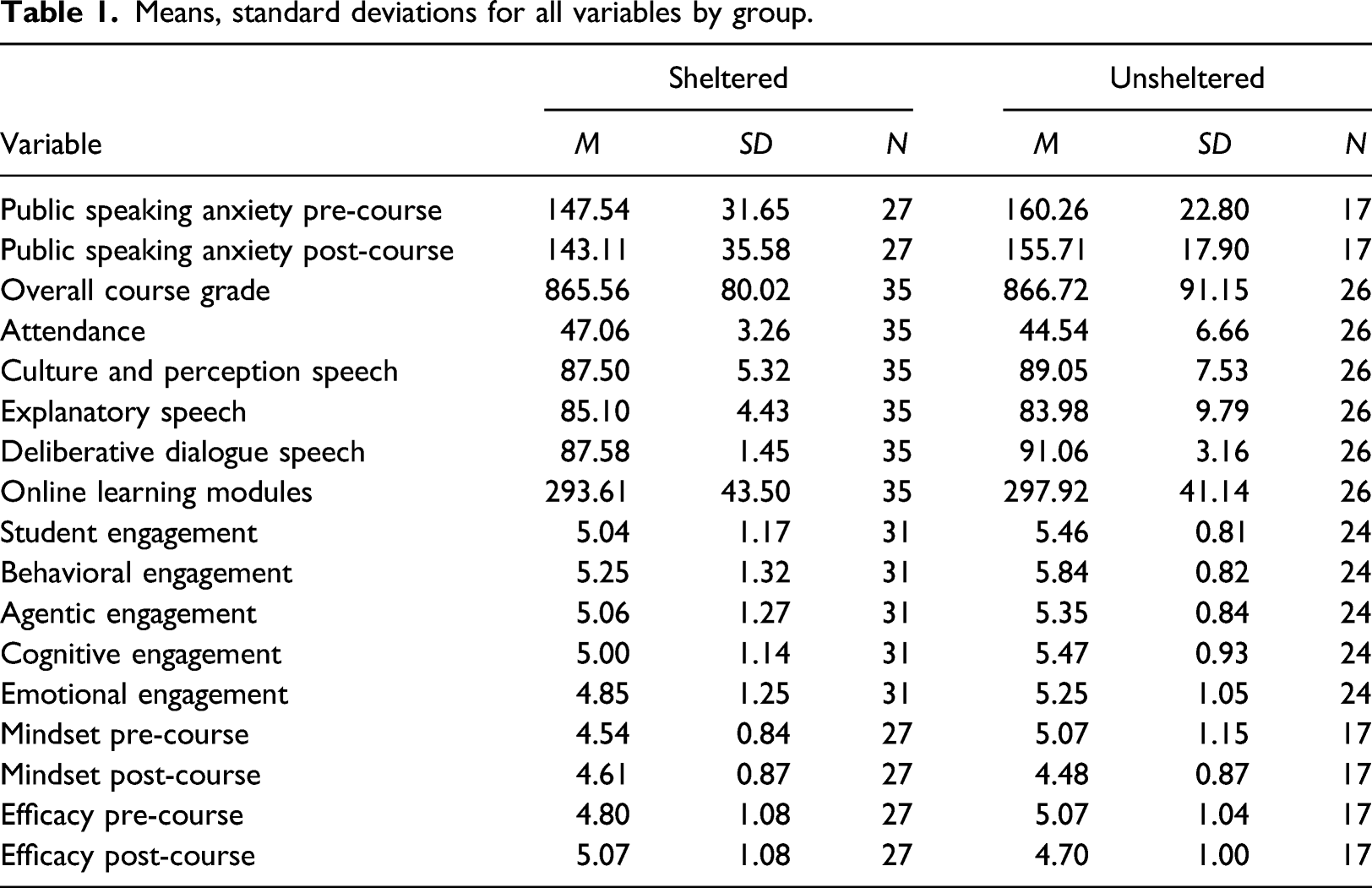
Means, standard deviations for all variables by group.
Student engagement
In order to reduce familywise inflation of alpha, a MANOVA with one independent variable (group: sheltered vs unsheltered) and four dependent variables (1) behavioral engagement, (2) agentic engagement, (3) cognitive engagement, and (4) emotional engagement was conducted. Multivariate tests were not significant for group, F (4, 50) = 1.21, p = 0.32, indicating that there is no significant difference between students in sheltered and unsheltered courses in any type of engagement.
Communication mindset and efficacy
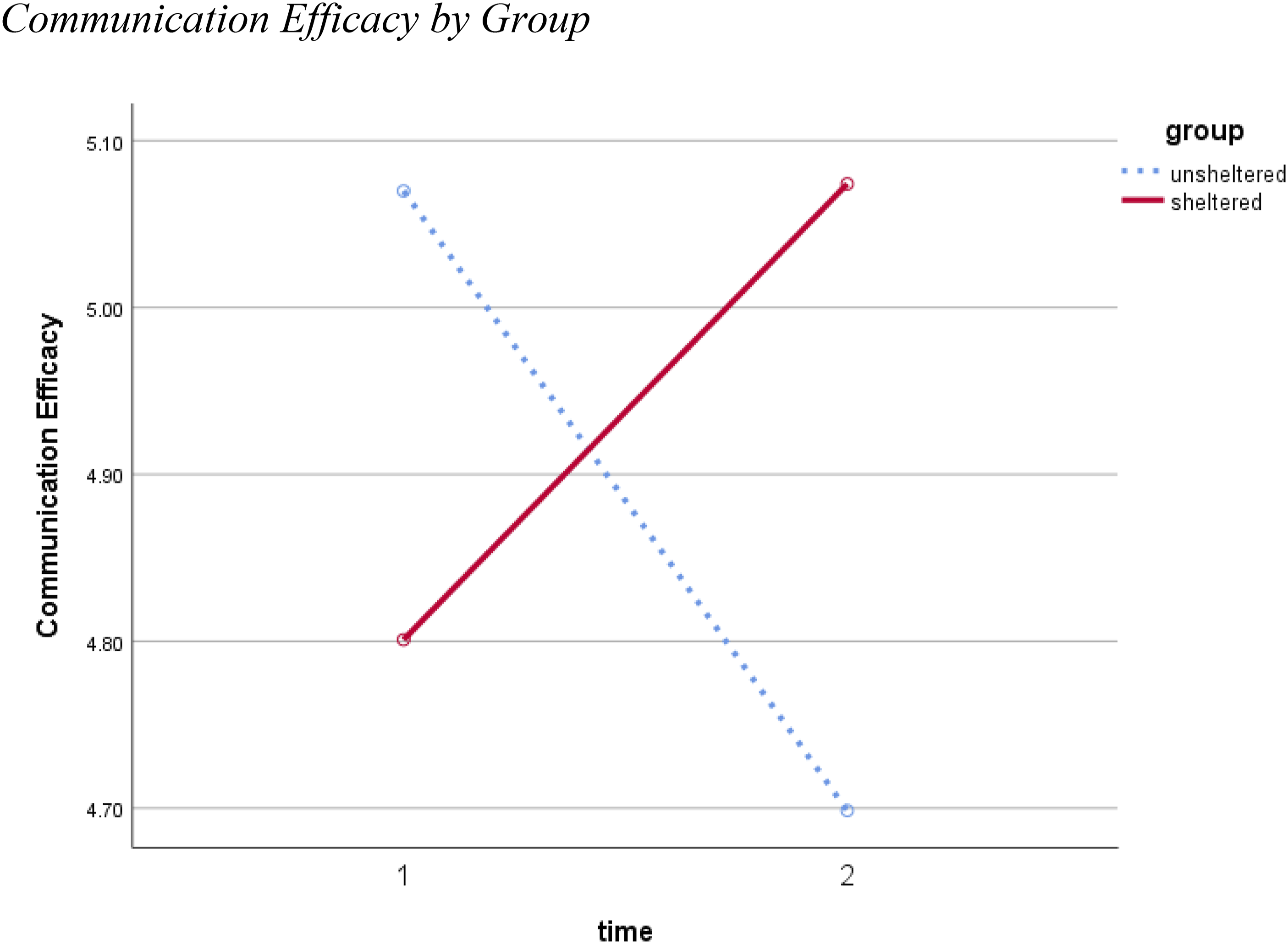
A within-subjects MANOVA with one between-subjects factor (group: sheltered versus unsheltered) and two within-subjects factors (Communication Mindset, Communication Efficacy) was conducted to find out whether there is a difference in the degree to which students in sheltered versus unsheltered courses of the introductory communication course changed in Communication Mindset and Communication Efficacy over the course of the semester. Multivariate tests showed that there was an interaction effect for time by group [F (2, 41) = 2.00, p = 0.02, ηp2 = 0.17, power = 0.70]. However, there were no significant between-subjects effects for group [F (2,41) = 0.68, p = 0.51] or for time [F (2,41) = 1.02, p = 0.37]. Univariate tests indicated that there were significant interaction effects for time by group for Communication Efficacy group [F (1, 42) = 6.18, p = 0.02, ηp2 = 0.13, power = 0.69], but not for Communication Mindset [F (1, 42) = 3.28, p = 0.07, power = 0.42], though the low power and low p-value suggest that it is worth looking at the interaction plot to examine trends since small sample size might be impacting significance. An examination of the means and profile plots shows that students in the unsheltered sections of the course decreased in both Communication Mindset and Communication Efficacy over the course of the semester, whereas students in the sheltered sections of the course increased in both of these variables over the course of the semester (see Figures 1 and 2). Communication mindset by group. Communication efficacy by group.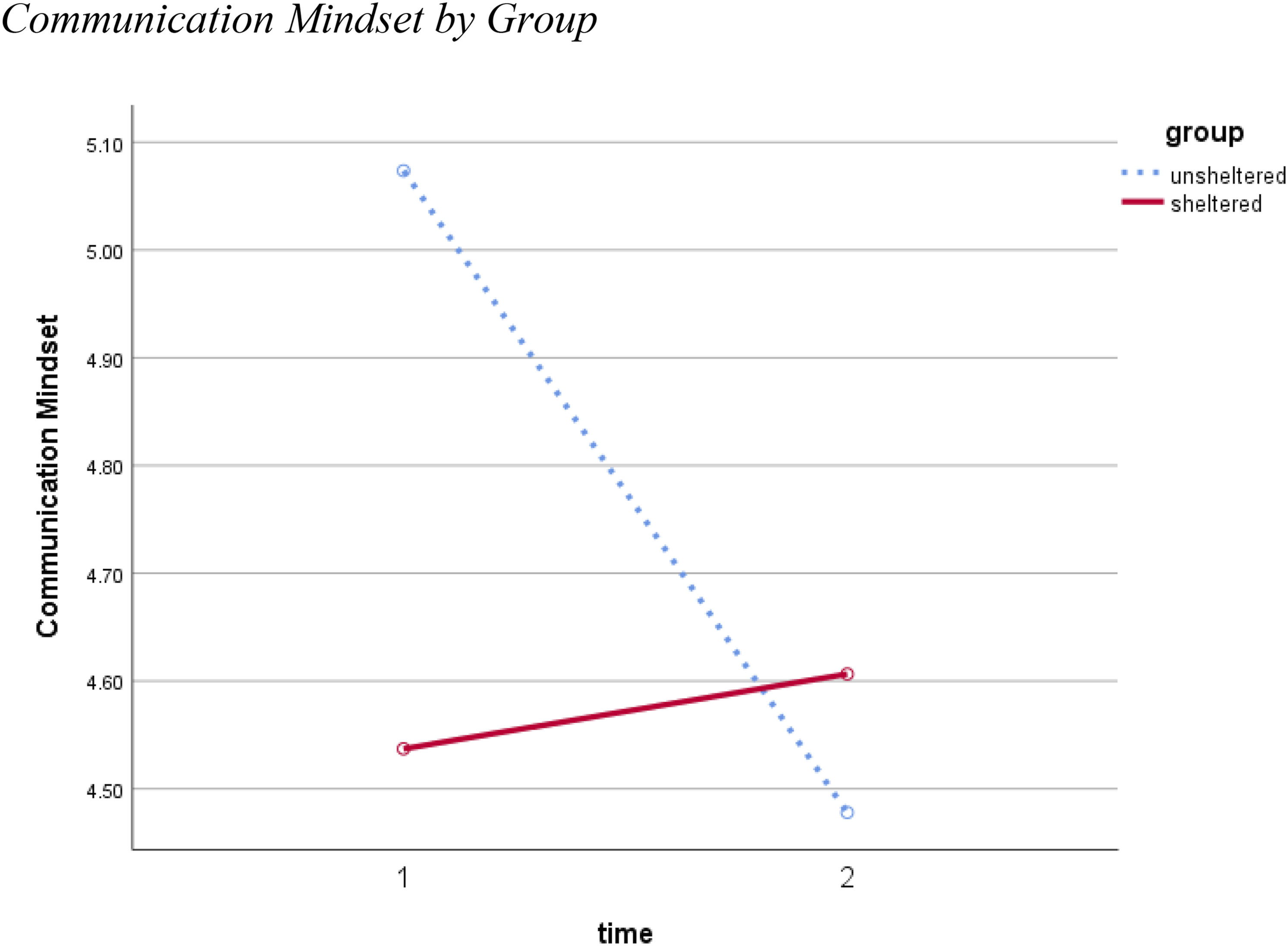
Course performance
In order to reduce familywise inflation of alpha, a MANOVA with one independent variable (group: sheltered vs unsheltered) and six dependent variables, (1) total grade, (2) attendance, (3) explanatory speech grade, (4) culture and perception speech grade, (5) deliberative dialogue speech grade, and (6) online learning modules total grade was conducted to find out whether there was a difference between students in sheltered and unsheltered sections in course performance. Box’s M test for the equality of covariance matrices was significant, F (21, 10,650.22) = 2.49, p < 0.001, so Hotelling’s Trace corrections were used. Multivariate tests showed a significant main effect for group, F (1, 42) = 8.36, p < 0.001, ηp2 = 0.48, power = 1.00, which indicates that there are differences by group for at least some of the dependent variables. Tests of between-subjects effects indicated that there was no significant main effect for group on total grade, [F (1, 59) = 0.003, p =0.96], attendance [F (1, 59) = 3.79, p =0.06], Culture and perception speech [F (1, 59) = 0.89, p =0.35], Explanatory Speech [F (1, 59) = 0.36, p =0.55], or Online Learning Modules, F (1, 59) = 0.15, p =0.70]. However, there was a significant effect for group on the Deliberative Dialogue presentation [F (1, 59) = 33.33, p < 0.001, ηp2 = 0.36, power =1.00]. Pairwise comparisons indicate that students in unsheltered classes have higher Deliberative Dialogue speech grades (M = 91.06, SD = 3.16) than students in sheltered sections (M = 87.58, SD = 1.45). However, there were no significant differences between sheltered and unsheltered students for any of the other performance variables. See Table 1 for complete list of means and standard deviations for pairwise comparison.
Discussion
The goal of this study was to learn more about the effect that sheltered and unsheltered introductory communication courses have on student learning outcomes and experiences, specifically for students who are simultaneously enrolled in an intensive English language pathway program. Overall, this study had mixed outcomes that add complexity to our understanding of the impacts of sheltered and unsheltered courses, but these results do not yield a clear answer to whether one format of the course is better than the other.
In terms of student performance and engagement, the results indicate that students are performing similarly in both sheltered and unsheltered versions of the course, which is consistent with August (2018) findings. There were no significant differences between groups in student engagement or in any of the performance measures, except in the grade of the Deliberative Dialogue presentation. The Deliberative Dialogue presentation is a persuasive speech given with a group as part of the final course capstone project. For this speech, students in unsheltered classes earned higher scores, which suggests that students benefitted from being in a classroom environment and working with domestic students. Since this speech was about a campus issue, it is also possible that working with students who were likely more socialized into the campus community might have been especially helpful for this particular assignment, similar to Knoblock and Youngquist (2016) findings that students in unsheltered courses improved their English language reading abilities more than peers in sheltered courses. Although none of the other assignments showed significant difference between sheltered and unsheltered groups, which might be due in part to the small sample size, it is worth noting that the mean grades for students in the unsheltered classes were higher for most measures of performance than for students in the sheltered classes, with the exceptions being slightly higher attendance and Explanatory Speech scores for students in sheltered sections. This suggests that students are performing at least as well—and perhaps better—in unsheltered courses than in sheltered courses, which suggests that the additional investment and risk of stigmatization (Dabach, 2014) associated with placing pathways students in sheltered sections of the course might not be worthwhile.
However, an examination of students’ PSA, Communication Mindset, and Communication Efficacy adds a bit of complexity and uncertainty to this discussion. Unlike Broeckelman-Post (2019) study, which found that all groups experienced a decrease in PSA, this study did not find a significant decrease for students enrolled in the sheltered and unsheltered groups, nor was there a significant difference in PSA for sheltered and unsheltered students. This is likely due in part to the small sample size and low power; to be included in this analysis, students had to complete both the pre- and the post-course survey, so only 17 unsheltered and 27 sheltered students remained for this analysis, resulting in exceptionally low observed power. However, an examination of the means and profile plots suggests that pathways students in both classes might not be getting the same reduction in PSA as other students (e.g., Broeckelman-Post and Pyle, 2017; Hunter et al., 2014), which suggests a possible inequity that needs to be addressed. Moreover, while the difference was not enough to be significant, students enrolled in unsheltered sections had higher mean PSA scores across the semester, which suggests that they might be experiencing greater anxiety in the course, though we do not know whether this might be due to feeling a stronger need to assimilate into an unsheltered classroom environment, a perception of difference, greater efforts to be perceived as relatable, the extra burden of code switching (Ellwood, 2008), or other factors. Furthermore, even within a sheltered classroom community with other international students experiencing similar stressors regarding English proficiency, building a classroom community takes time and as well as developing the skills that would reduce PSA.
Somewhat similarly, students in unsheltered sections of the course started the semester with higher levels of Communication Mindset and Communication Efficacy, but saw decreases over the course of the semester. Students in sheltered sections had the opposite experience and saw increases in each of these outcomes over the course of the semester. Since PSA, Communication Mindset, and Communication Efficacy are typically correlated with student performance and engagement, involve self-focused cognitions, and are related to beliefs about public speaking (Nordin & Broeckelman-Post, 2019, 2020; Stewart et al., 2019), this is a cause for concern. These results might be an indication that pathways students are more comfortable and gaining greater confidence in the sheltered sections of the course, compared to the unsheltered sections of the course where they might be comparing themselves negatively to other students in the class who have more experience speaking English and, for many, more experience with public speaking due to cultural expectations and factors. It is also possible that students in the sheltered sections of the course are starting with lower levels of Communication Mindset and Communication Efficacy because of the othering effect or the stigma associated with being separated from mainstream students in sheltered courses (Dabach, 2014), and that the changes are due in part to a reduction of that effect over the course of the semester. Thus, this study leads to a need for further examination of what influences the initial level of PSA for international students to create spaces that target the needs of international students to reduce anxiety and improve a sense of community whether in sheltered or unsheltered classrooms.
Limitations and future research
An important limitation to consider when interpreting the results of this study is that the sample size was small because there were only 63 students enrolled in the introductory communication course who were also part of the pathway program with intensive English language skills during the semester this study was completed. Additionally, for tests of PSA, Communication Mindset, and Communication Efficacy, any student who did not complete either the pre- or post-test was excluded from analysis, which further limited the power to see significant differences for that specific test. Although the sample size was limited by the number of students enrolled in the pathways program during the semester in which this study was conducted, future research should seek to expand the scope of the study by collecting data in sheltered and unsheltered classes across multiple campuses or multiple semesters. Furthermore, it would be helpful to replicate this study across a range of university types, particularly since this study was collected at one of the most diverse universities in the United States (in terms of culture, language, national heritage, race, ethnicity, religion, socioeconomic status, and many other dimensions), which likely impacts how international students see themselves in relation to their classmates.
Another limitation of this study is that, while the data give us some information about student performance and self-reported communication variables, it does not explain why students are responding to the class formats and surveys the ways that are seen in this study. Although we suspect that there are peer comparisons and stigmatizing effects at play in the way students think about their own performances, as well as modeling effects impacting classroom engagement and performance, those guesses are well-informed speculation at best. Future research should include qualitative interviews or focus groups to give students enrolled in the program an opportunity to share their perceptions of both types of classes as well as their communication skills development. When developing these questions, as Quinton (2019) cautions, scholars need to keep the current political climate and other factors in mind, as well as consider ways that domestic students’ perceptions of international students can contribute to a sense of belongingness and community.
Conclusion
The goal of this study was to find out whether international students enrolled in an intensive English language pathways program had better outcomes in sheltered or unsheltered introductory communication courses, and ultimately, this study left us with more questions and areas that need further investigation than answers. However, students in unsheltered courses had as strong if not better performance and engagement outcomes than students in sheltered courses, an examination of PSA, Communication Mindset, and Communication Efficacy suggest that we need to dig deeper and learn more before we can conclude whether either class format is more beneficial than the other.
When we only look at academic achievement, we miss a lot. As Ellwood (2008) notes, “Rather than alienating or silencing students, acknowledging the relevance of identity for pedagogy validates the identities that students bring with them, those they seek to perform, and those they are seeking to become” (p. 554). Although this study is an important starting point, a more in-depth, nuanced exploration is needed to help basic course directors, communication departments, and international student programs better understand how to best meet the needs of all of our students.
Footnotes
Declaration of Conflicting Interests
The authors declared no potential conflicts of interest with respect to the research, authorship, and/or publication of this article.
Funding
The authors received no financial support for the research, authorship, and/or publication of this article.
