



Abstract
This study examines whether students who started their doctoral degree with different motivation profiles differ in their emotional engagement in their studies, and how this pattern differs between domestic and international students in Finland. This study used survey data collected from 1064 domestic and 120 international students. The results showed that students who started their degree with a low motivation to extend their career prospects were significantly less satisfied with their studies. Interestingly, the students in the group with the lowest level of interest in their research work were nonetheless fairly satisfied in their studies if their motivation to develop their career prospects was at a moderate level. The international students embarked upon their doctoral programmes with a greater wish to develop their career prospects and were more satisfied with their doctoral studies. The discussion emphasises that students, specifically domestic students, become more aware of the meaningfulness of doctoral studies for their career opportunities, which helped them to engage more positively with their doctoral studies.
Keywords
Introduction
Prior research on doctoral experience has shown that motivation plays a significant role on students’ engagement in doctoral studies. For instance, doctoral students who lack motivation for their studies are at risk of experiencing their academic scholarly community more negatively than their more motivated counterparts (Stubb et al., 2011). Another study suggested that a lack of motivation results in negative engagement with their studies, such as undesirable perceptions of their academic experiences and dissatisfaction with their working conditions and supervisory support (Pyhältö et al., 2009). There is also some evidence that doctoral students themselves consider motivation as one of the central factors that affects their persistence in continuing their doctoral studies (Ivankova and Stick, 2007; Spaulding and Rockinson-Szapkiw, 2012) and in being able to duly complete their doctorates (Wao and Onwuegbuzie, 2011). Despite this, we know surprisingly little about to what extent doctoral students’ personal motivations for doctoral studies vary among students within the same context. We know even less about whether or not the patterns of their academic motivation and academic engagement differ between student groups from different backgrounds; for example, domestic and international students.
There has been an increase in the share of international doctoral students in major developed countries (Nerad and Evans, 2014; OECD, 2008). This trend has also been apparent in Finland (Ministry of Education and Culture, 2015). We may presume that, since international doctoral students need to be more proactive in launching their degrees and reorganising their entire life in a new country, they may somehow have more explicit and specified goals than the domestic ones. However, this does not necessarily mean that domestic doctoral students are academically less motivated. In addition, these two groups of students may value different motivational dimensions to pursue a Ph.D. degree, which in turn may further affect how they engage in their doctoral studies, but little empirical evidence is yet available. Hence, to be able to provide adequate support for all doctoral students, we need to gain a better understanding of the characteristics of a highly diverse cohort of doctoral students.
This study examines whether students who started their doctoral degree with different motivation profiles also differ in terms of one dimension of emotional engagement; that is, the level of satisfaction with their studies. The study also addresses differences and similarities between domestic and international doctoral students with regard to their motivation profiles and levels of emotional engagement in their studies.
Theoretical framework
Engagement refers to students’ effort and active involvement in educational tasks and activities provided by universities (McCormick et al., 2013). An engaging doctoral study experience is characterised by positive, fulfilling encounters including vigour, dedication and absorption (Schaufeli et al., 2002: 74; Vekkaila et al., 2014). Accordingly, emotional engagement consists of students’ feelings, values and reactions to learning activities and communities (Fredricks et al., 2004), including supervisors, peers and other members of the scholarly community. The emotional dimension of academic engagement is one of the primary and highly conspicuous elements in the multifaceted construct of academic engagement (Axelson and Flick, 2011; Fredricks et al., 2004; Jimerson et al., 2003; Kahu, 2013). The emotional aspect of doctoral students has often been neglected in the literature, but the lack of such a positive state has been identified as a reason for high levels of doctoral student attrition (e.g. Ali and Kohun, 2006; Ali et al., 2007).
Factors associated with emotional engagement in doctoral studies
Prior research on doctoral experiences has identified several reasons for lower levels of student emotional engagement in doctoral studies, including overly high workload (Protivnak and Foss, 2009), inadequate supervision, poor relationships with faculty and peers (e.g. Ali et al., 2007; Golde, 1998), financial concerns (Lee, 2009), frequent evaluations, competitive atmosphere, and difficulty in combining research work and private life (e.g. Kurtz-Costes et al., 2006; Stubb et al., 2011). In turn, recent studies showed that students’ sense of being a good fit within the scholarly community enhanced their engagement with their doctoral projects (Vekkaila et al., 2013) and promoted their psychological well-being (Stubb et al., 2011). The active support of supervisors through giving comprehensive advice has also been found to contribute to student satisfaction with their research (Ives and Rowley, 2005; Zhao et al., 2007). Lee (2009) has reported several more incentives for positive doctoral experiences, such as recognition by family members and expectations of better job prospects after completing the doctorate.
There is also evidence that individual doctoral students’ skills and attitudes in pursuing a Ph.D. can influence their academic engagement and levels of persistence. For example, students’ own motivation, self-regulation and academic skills (Lee, 2009; Pyhältö et al., 2012a) are major factors affecting individual students’ doctoral experiences. Other studies have also argued that lack of student motivation and decreased levels of study satisfaction are typical consequences of their disengagement, and even work as the predecessors of their attrition (e.g. Lovitts, 2001; Pyhältö et al., 2012a; Stubb et al., 2011). Another study found that students motivated to prioritise learning process-related goals were emotionally more engaged with less stress, exhaustion, anxiety and lower risks of dropping out than outcome-oriented students, and maintained a greater interest in their own Ph.D. work (Stubb et al., 2012). These studies underline the significance of doctoral students’ motivation for their healthy engagement in Ph.D. studies. However, Stubb et al. (2014) showed that students’ reasons for studying for a doctorate varied greatly, from an emphasis on learning and developing academic expertise to personal status and accomplishment, and this implies that analysing a certain cohort’s motivation as a whole may end up with very vague results. More individual sensitive approaches for analysing students’ motivation to undertake doctoral study seem necessary.
Characteristics of international doctoral students on motivation and satisfaction in their doctoral studies
The quality of international students’ study abroad experience can be affected by several complementary factors. The host country’s living environment, the target university’s reputation, governmental policies, the student’s home country’s linguistic traditions and economic circumstances and the student’s own educational background are the major drivers for student mobility (González et al., 2011; Li and Bray, 2007; Llewellyn-Smith and McCabe, 2008; Zheng, 2014). However, previous studies have seldom explored doctoral students’ own motivation towards mobility and launching a Ph.D. Araújo (2007) and Delicado (2010) examined Portuguese doctoral students’ motives for leaving their home country, finding that scientific interest and better opportunities in research, training and future employment prospects were key to going abroad. Portuguese students also valued the opportunities for forming scientific networks during their studies (Araújo, 2007). Those studies explored the characteristics of international doctoral students’ motivations for cross-national mobility, yet available research is insufficient to show how and to what extent their motivations differ from those of domestic students for pursuing a doctoral degree, and whether international doctoral students have particular tendencies in their motives in starting their studies.
According to studies of factors contributing to international students’ emotional engagement with their studies, students’ experience in interacting with domestic students can be a major factor accounting for one dimension of student emotional engagement, such as their academic satisfaction with their study experiences (Perrucci and Hu, 1995; Trice, 2004). More recently, Sakurai et al. (2012) showed that international doctoral students’ satisfaction was significantly associated with the perceived quality of supervision and with elements of their personal status such as family support, full- or part-time student working conditions, living environment and health. However, a review by Streitwieser et al. (2012) found that comparative research on international students has seldom appeared in major comparative educational journals, despite the current growing trend of student mobility worldwide. Furthermore, based on the prior literature summative list by Streitwieser et al., no studies have focused on doctoral students. Among few comparative studies in other journals, Harman (2003) found that overall satisfaction levels of international doctoral students were higher than those of domestic students in Australia, but international students’ satisfaction levels with more specific academic aspects such as workspace, library facilities and supervisory experiences were not significantly different.
International students often face unique challenges and difficulties, but the literature has not yet achieved a solid understanding of them, particularly to what extent international doctoral students are satisfied with their studies. To implement functional strategies in enhancing the quality of students’ engagement with their studies, universities should also be cognisant of international student engagement in their demanding doctoral programmes. A comparative scope will indicate which dimensions of students’ learning experience should be immediately addressed in order to streamline a university’s supporting resources.
Aims of the study
The aim of this study was to gain a better understanding of the interrelationship between doctoral students’ motivations for embarking upon their doctoral studies and their emotional engagement as indicated by their degree of academic satisfaction. In addition, the differences in study satisfaction and motivation levels between domestic and international doctoral students were analysed. This study examines the following specific questions:
How and to what extent do domestic and international students differ in their motivational profiles for starting their doctoral degrees, and in the levels of their satisfaction with their studies?
Do students’ motivational profiles for starting their doctoral degrees have any systematic patterns with their levels of academic satisfaction?
Methods
Participants
A total of 1064 domestic (women: 67%) and 120 international (women: 52%) students of the University of Helsinki participated in this study (response rate 28%). The samples represented well the numbers of domestic and international doctoral students within the given university (approximately one out of nine students was an international student). The participants had at least one supervisor for their doctoral project. The signature pedagogy has been the supervisor–student apprenticeship model, although the tradition has gradually shifted towards a more institutionally organised and structured design. Coursework and seminars equivalent to 40 to 60 European Credit Transfer System credit points are individually designed under the supervisors’ guidance. These can include, for instance, research method courses, international conference participation and teaching. Many (65%) reported that they were working full-time on their Ph.D. The majority of domestic students (56%) worked alone, whereas the majority of international students (62%) worked in a research group.
The response rate was not very high (28%), but the sample represented the whole university population sufficiently in terms of gender distribution (Saari and Moilanen, 2012); about two-thirds of the domestic students (63%) and about half of all the international students (48%) were women. The domestic students across 11 faculties well represented the university domestic group as a whole (see Sakurai, 2014 for more details). The international student sample ratios for the faculties of Agriculture and Forestry, Arts, and Pharmacy (21%, 8% and 7% respectively) were slightly different from those of the entire international student cohort (10%, 20% and 2% respectively). This study did not collect information about students’ countries of origin, as that was beyond the scope of the study.
Data collection and instrument
This study used a large survey dataset collected online as a part of an international evaluation of research and doctoral education at a Finnish university (Saari and Moilanen, 2012). The request for students to participate was sent via e-mail. The survey consisted of statements that were scored on a five-point Likert scale, including open-ended questions and background questions. The survey was validated in pilot studies in which a total of 20 doctoral students from different disciplines participated, and their comments were used for revisions. The ecological validity of the findings was also confirmed in discussions with research colleagues and in university pedagogy training for supervisors of various faculties.
This study exclusively reports the results of students’ motivations for starting their doctoral degrees and their levels of satisfaction with their studies as an indicator of the intensity of their emotional engagement in their doctoral studies. This study used 14 Likert-scale items to measure students’ motivation to embark upon doctoral studies (1= not important to 5= very important), and 20 Likert-scale satisfaction items to measure students’ emotional engagement in doctoral studies (1=fully disagree to 5= fully agree). The single Likert-scale item ‘please assess the level of your satisfaction with your doctoral education’ assessed students’ overall satisfaction with their doctoral education.
Analysis
Based on the individual survey items, an exploratory factor analysis (EFA) with a list-wise deletion of missing cases (maximum-likelihood estimation) formed scales measuring students’ motivation to embark on a doctoral degree and satisfaction with their studies. The factors extracted were considered to correlate with each other, and thus the promax rotation method was chosen (Fabrigar et al., 1999). To estimate the number of factors, this study considered the Kaiser criterion, the scree test, parallel analysis and Velicer’s Minimum Average Partial criteria. Items with low communalities (far below .2) were omitted since those items seemed less relevant to the factors extracted. Items that had a factor loading of 0.3 or higher were grouped into factors, which comprised at least three items for more solid interpretations (Fabrigar et al., 1999). The scales were created by calculating a mean score for each EFA factor.
Subsequently, a model-based cluster analysis was implemented by using the mclust package (version 4.3) (Fraley et al., 2014) in the R environment in order to cluster students according to the patterns of their motivation scale scores. The analysis suggests the optimal number of respondent groups (clusters) based on scale scores in a concerning dataset without a priori knowledge of the number of clusters by referring to a fit index, the Bayesian Information Criterion (BIC) (Fraley and Raftery, 2007). The largest BIC index produced by mclust suggests the best number of clusters. Respondents are assigned to the most likely cluster based on the levels of their individual scale scores; that is, those grouped in the same cluster have similar tendencies with respect to a series of scales under analysis. The clusters were named according to the tendencies of the scale means of each cluster. When domestic and international students had a similar tendency on the motivation scales, our data would show a similar distribution of those students among several clusters. In contrast to a traditional approach, which often used a priori classification such as ‘domestic’ and ‘international’ for the students, the advantage of this method is that it is data-driven and has an individual orientation of classification. The major reason for this individual focus was that researchers have reported there may be large individual differences in motivation for embarking upon doctoral studies (Stubb et al., 2014), and that international students’ perceptions of the scholarly community during a doctoral study also vary considerably (Sakurai et al., 2012). Hence, we chose the person-oriented approach, which still statistically captures the general patterns of the groups of students.
A following analysis using analysis of variance (ANOVA; significance level 5%) examined whether the student clusters with different motivation profiles for starting doctoral studies differed in their levels of satisfaction. Welch’s ANOVA was also used to analyse the differences, since it does not assume equal variances and sample sizes between clusters (Tomarken and Serlin, 1986). Effect sizes (η²) were calculated to strengthen the statistical analyses. The limiting values were as follows: .01= small effect, .06= medium effect and .14= large effect (Cohen, 1988). Post hoc comparisons using the Games–Howell method with η² were performed to identify significantly different pairs between the means of the satisfaction scales. This method allows for different sample sizes between clusters and does not assume homogeneous variances between clusters (Armstrong et al., 2000). The same procedures also compared the scale means between a priori groups of students; that is, domestic and international students. Cross-tabulation and the chi-square test (significance level 5%) with an effect size value (Cramer’s V) analysed whether or not either domestic or international students unevenly belonged to particular clusters with consistent motivational characteristics. The adjusted residual analyses then identified cross-tabulation cell pairs that showed significantly greater or smaller observed frequencies of domestic and international students on certain clusters.
Results
Factor structures for motivation to start doctoral studies and satisfaction with studies
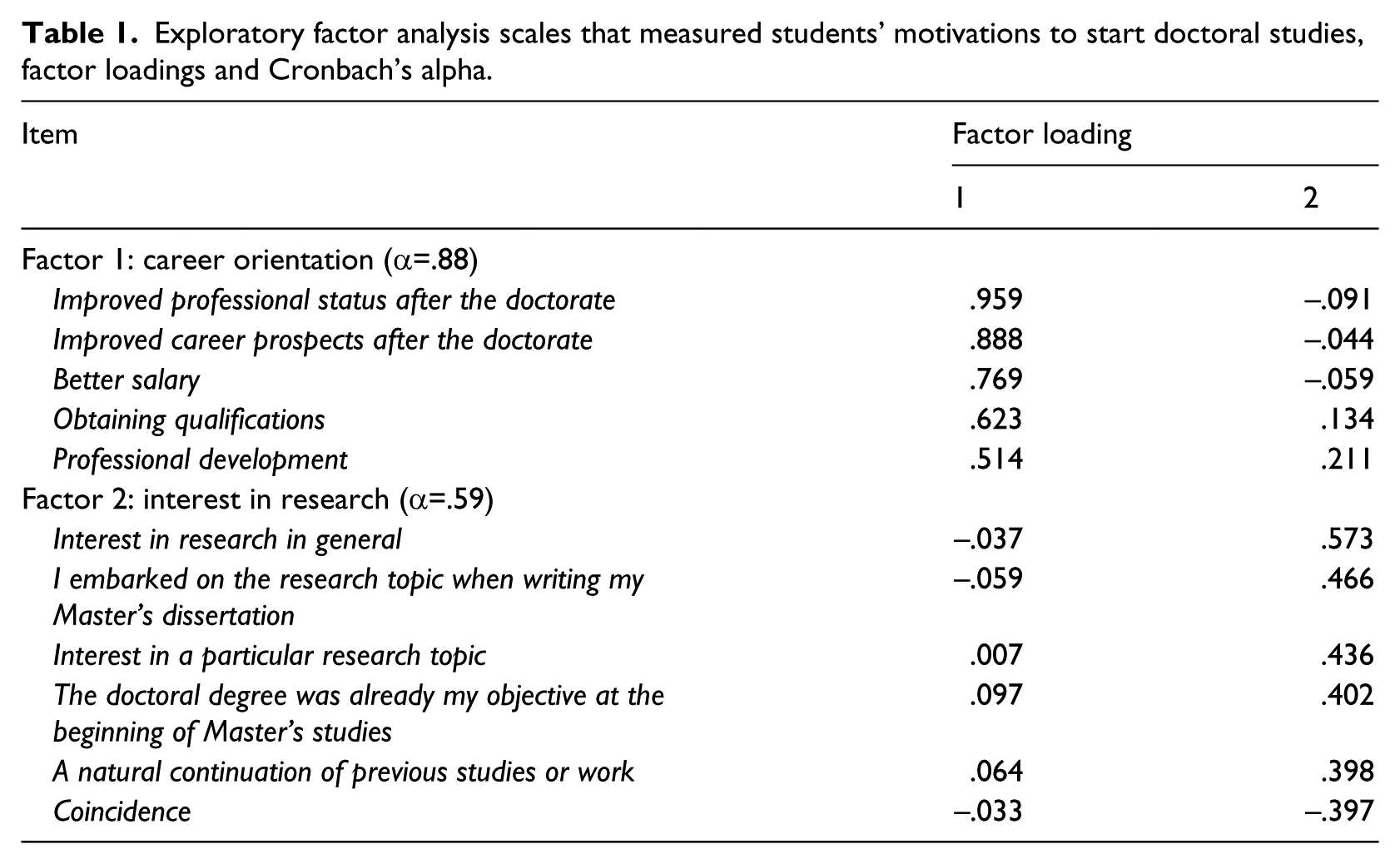
The EFA results suggested that items regarding reasons to start doctoral studies formed two factors after excluding two items (Table 1). The communalities were between .16 and .90, and the data fitted the analysis well (Kaiser–Meyer–Olkin test (KMO) =.790, Bartlett’s test<.05). Five items loaded onto the first factor: career orientation, which comprised items related to professional career development, salaries and qualifications. The items in the second factor were concerned with a general interest in research and in one’s own major subject; thus the factor was termed interest in research. Cronbach’s alpha values for the two factors were .88 and .59 respectively. Overall, interest in research (mean= 3.45, SD= 0.75) was greater than career orientation (mean= 3.20, SD= 1.05) as a reason to embark on doctoral studies. The factor correlation was .181.
Exploratory factor analysis scales that measured students’ motivations to start doctoral studies, factor loadings and Cronbach’s alpha.
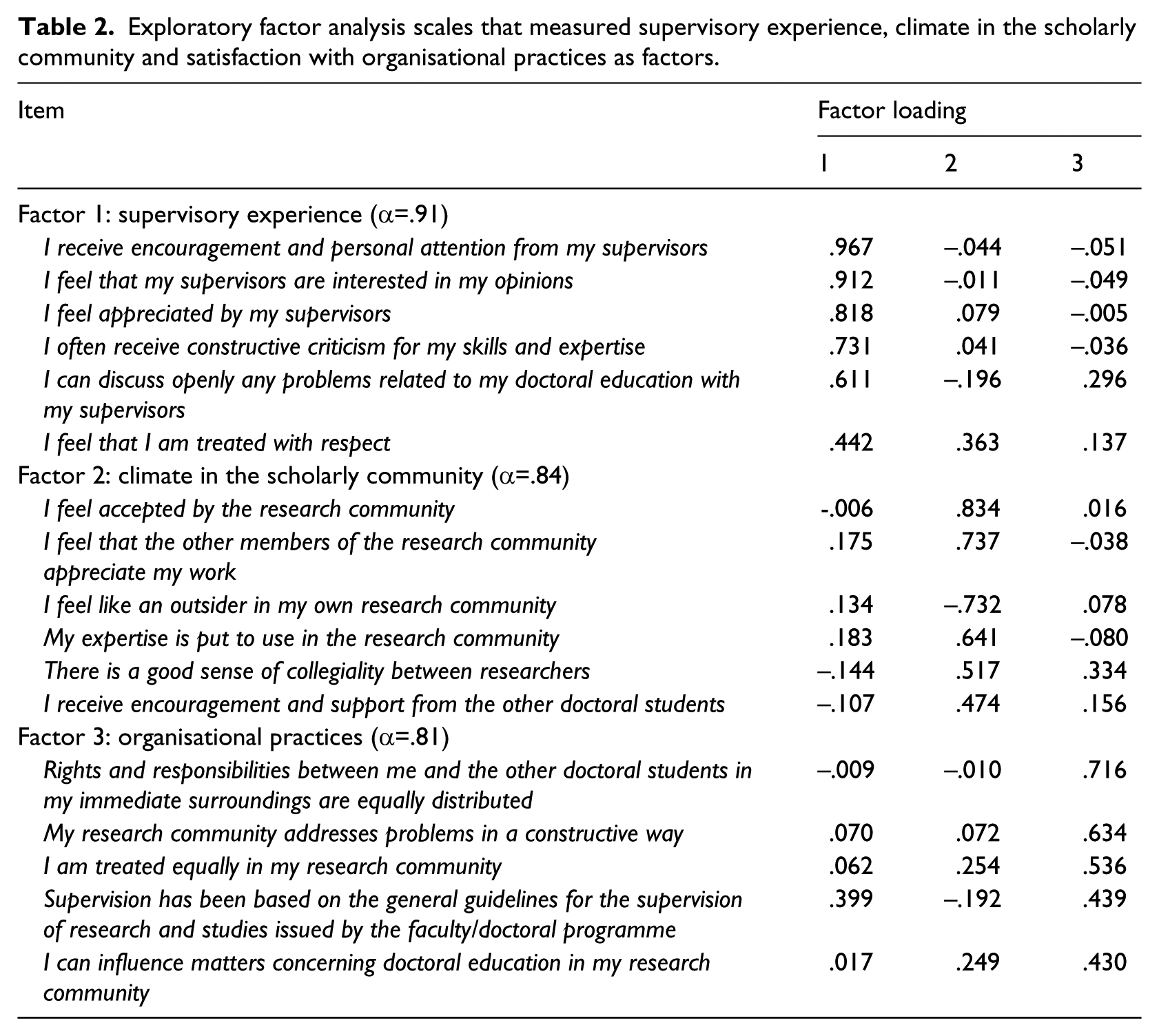
The EFA results of students’ satisfaction with their studies suggested a three-factor solution (KMO= .94, Bartlett’s test< .05) (Table 2). The communalities were between .28 and .83, and Cronbach’s alpha values were .81 or greater. The three factors nominated according to the concepts were: supervisory experience, climate in the scholarly community and organisational practices. Supervisory experience had items that closely represented the students’ perception of different aspects of their supervision, such as supervisor feedback, interest, appreciation and encouragement. The second factor, climate in the scholarly community, was formed by items centred around the collegial atmosphere in and the sense of belonging to their scholarly community. Items related to practical regulations, the handling of doctoral education and participating in a research group loaded on the third factor, organisational practices. The means of supervisory experience (mean=3.52, SD=0.98), the climate in the scholarly community (mean=3.47, SD=0.85) and organisational practices (mean=3.14, SD=0.85) were correlated highly between .597 and .660. According to the general single satisfaction scale, the doctoral students appeared satisfied with their overall doctoral education (mean=3.41, SD=0.94).
Exploratory factor analysis scales that measured supervisory experience, climate in the scholarly community and satisfaction with organisational practices as factors.
Clustering according to individuals’ motivation profiles
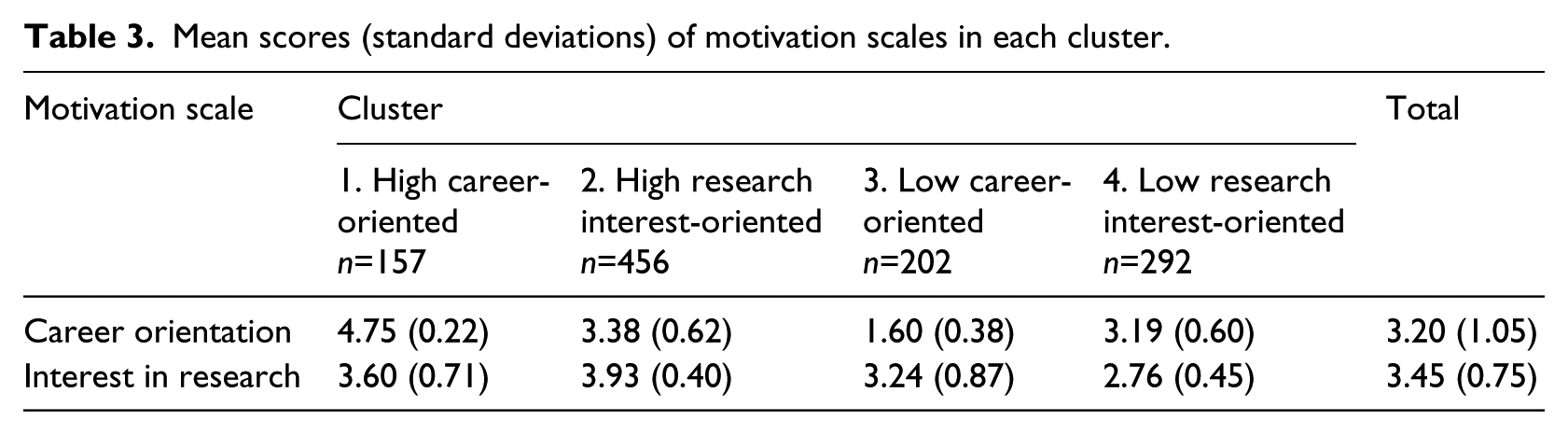
Using the two motivation scales, further investigation by model-based clustering (diagonal, varying volume and shape model, BIC= –6245.2) suggested four different kinds of motivation clusters. According to the mean scores (Table 3), we created a high career-oriented cluster, which was characterised by the high score for career orientation in launching their doctoral studies. This group reported a moderate score on their interest in research activities. The second cluster, high research interest-oriented cluster, placed strong emphasis on their interest in research and, in turn, scored moderately on their career orientation. The students in the third cluster, low career-oriented, on the other hand, reported the least interest in doctoral education for their own better career prospects among the clusters. Finally, students of the low research interest-oriented cluster scored lowest on their interest in research among the clusters, but moderately on their career orientation. The largest percentage of doctoral students (456: 41%) belonged to the high research interest-oriented cluster, while one-fourth (292: 26%) belonged to the low research interest-oriented cluster, one-fifth (202: 18%) to the low career-oriented and 14% (157) to the high career-oriented cluster.
Mean scores (standard deviations) of motivation scales in each cluster.
Among these different motivation clusters, further analysis based on ANOVA and Welch’s ANOVA indicated that doctoral students’ satisfaction levels varied between the clusters (Figure 1 and Table 4). Post hoc Games–Howell pairwise tests suggested that the satisfaction scales of three clusters were not statistically significantly different, the exception being the low career-oriented cluster; students who initially least perceived the doctoral degree as a means of developing their career prospects were significantly the least satisfied. All the effect sizes were between the size criteria of small and middle.
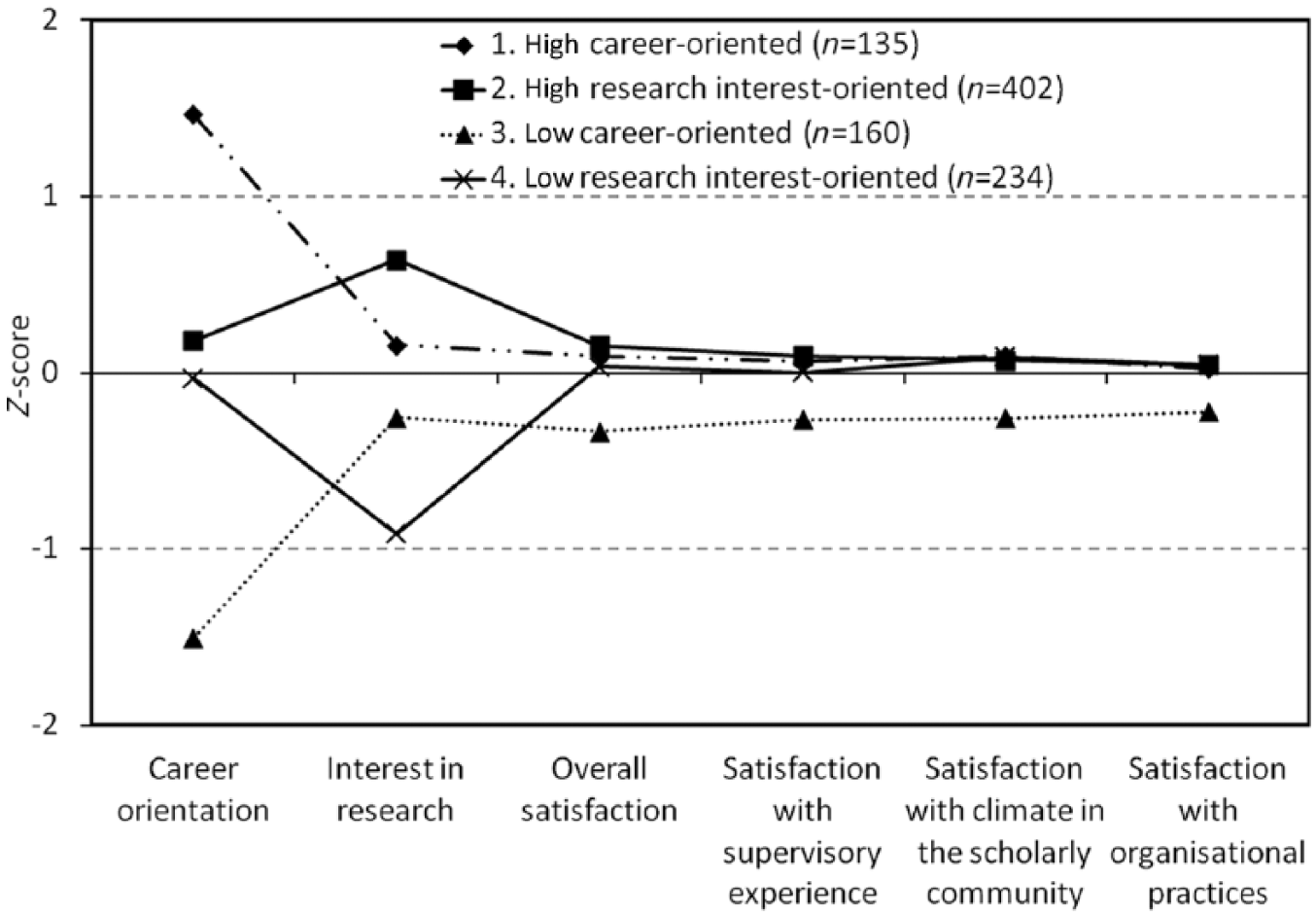
Standardised means of students’ motivation and satisfaction scales among motivation clusters.
Mean scores (standardised deviations) of motivation and satisfaction scales in each cluster.
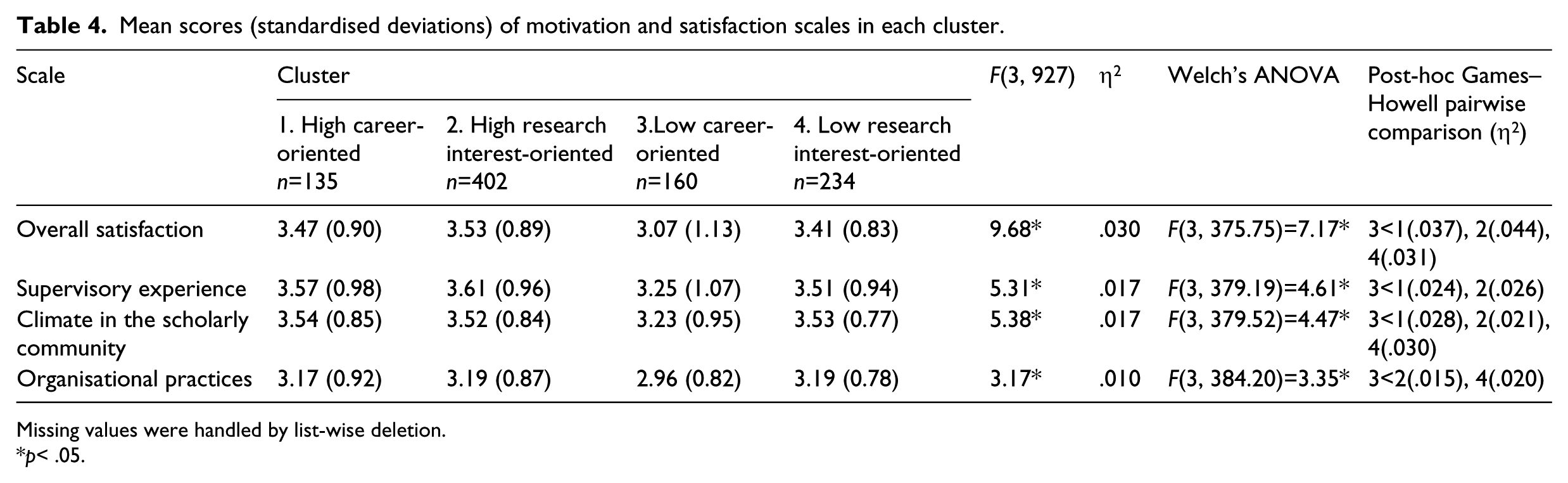
Missing values were handled by list-wise deletion.
p< .05.
The chi-square (χ2) test showed that the ratios of domestic and international students among the four clusters were significantly different (χ2=31.618, df=3, p<.05) (Table 5). Cramer’s V indicates that the strength of association was not very large (Cramer’s V=.17). Analysis of adjusted residuals showed that a significantly larger portion of international students belonged to the high career-oriented cluster (adjusted residual, 5.0), whereas a larger proportion of domestic students belonged to the low career-oriented cluster (adjusted residual, 3.4).
Distribution of domestic and international students (ratio) among clusters.
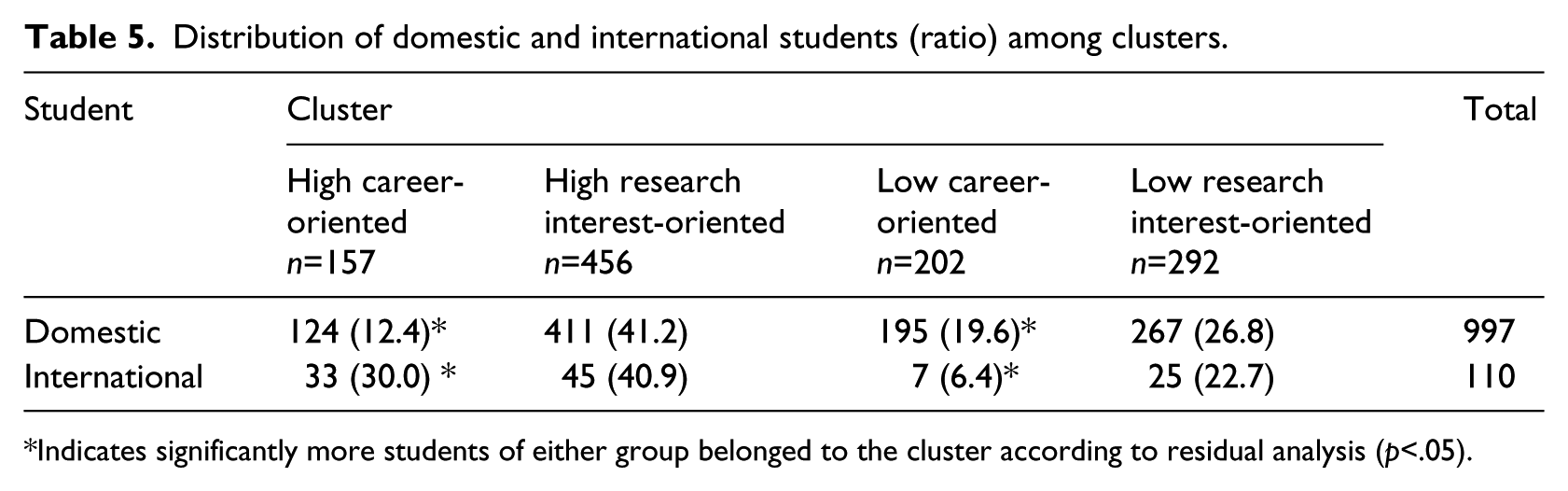
Indicates significantly more students of either group belonged to the cluster according to residual analysis (p<.05).
Furthermore, scale mean differences between domestic and international doctoral students were explored (Table 6). Career orientation was significantly more prominent for international students for participating in a Ph.D. programme (F(1, 929) =27.29, η2=.029). In addition, international students had a significantly greater interest in research than did domestic students (F(1, 929) =6.89), but an effect size (η2=.007) below the criterion of small size (.01). The comparative results on two satisfaction scales, overall satisfaction and supervisory experience, were significant (F(1, 929) =8.40, η2 =0.009; F (1, 929) =5.09, η2 =0.005 respectively), but the sizes of the differences were lower than the criterion of small size. Therefore, it is assumed that these statistically significant results were due to the large sample size rather than actual differences between the groups.
Comparison of domestic and international students’ mean scores (standard deviations) of motivation and satisfaction scales.
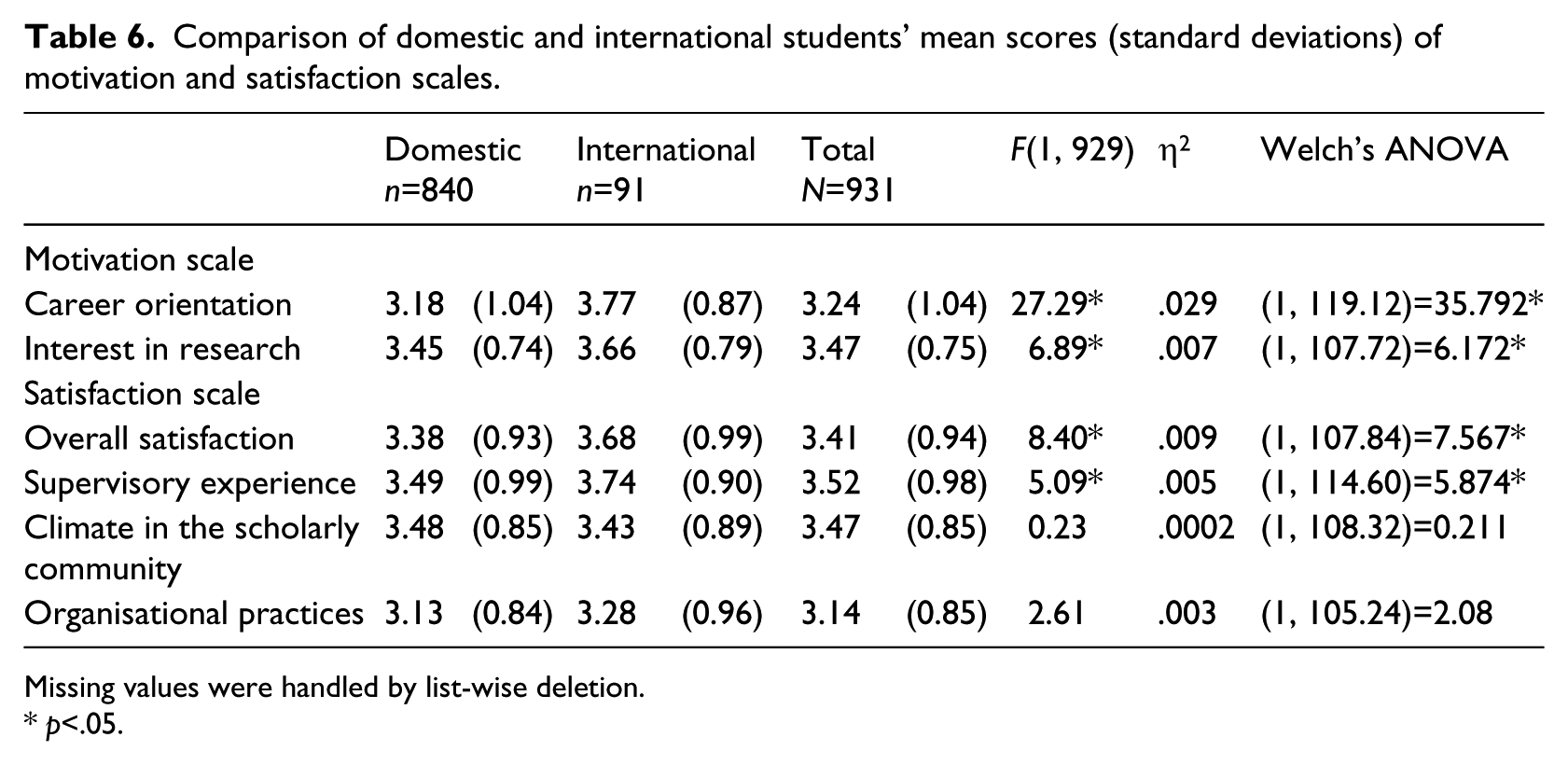
Missing values were handled by list-wise deletion.
p<.05.
The summary of the results
A general answer for the first research question can be summarised as follows. The international doctoral students started their studies with slightly stronger motivation to develop their own career prospects than the domestic students. International students’ interest in research as a reason for starting a Ph.D. was also greater than for domestic students, but the difference was very small. Focusing on individuals’ motivation profiles regarding their career orientations and interests in research, the results showed that the ratio of international students who highly emphasised their opportunity to develop their career potential with a Ph.D. was more than double that of the domestic students. To the contrary, the ratio of international students with low levels of career development motivation and moderate levels of research interest was about one-third that of the domestic students. International students’ satisfaction levels with doctoral studies were higher on the scales of their overall satisfaction and supervisory experiences. However, the sizes of the differences were very small.
With respect to the second question, the students in the cluster characterised with low motivation to develop their career potentials were less satisfied with their studies, despite the fair levels of their interest in research work; one cluster scored even lower on students’ interest in research, but the satisfaction level of the cluster was greater. The satisfaction levels of the other three clusters were almost identical, although their profiles of motivation for Ph.D. studies notably varied.
Discussion
Methodological reflections
We adopted a statistical person-oriented approach to explore different, more coherent student clusters according to students’ motivational profiles. Instead of only comparing domestic and international students as single and homogeneous entities, we demonstrated the tendencies of both domestic and international individual students distributed over different motivation clusters. In this regard, our study did not stick to the widely used procedure in which all international students are labelled the same. However, because of the cross-sectional nature of the study, we cannot prove causal relationships. In addition, possible study discipline differences were beyond the focus of the analysis because of the limited sample size of the international students. Another concern that further studies should consider, and that may create possible bias in the findings, was the negligence of other confounding factors such as individual supervisory relationships, resource access, part- or full-time student status and family support.
Although the measures that we used were sufficient, there is room for some improvement. For example, Cronbach’s alpha index for students’ motivation scale, interest in research, was not very ideal (α=.59) despite the theoretically sound and interpretable solution. The results are, however, still informative for developing the scales further, since few evaluation tools for doctoral education have been developed to date.
Arguably, larger sample sizes, especially in terms of international students, could have resulted in more convincing evidence, although this study met the general Cochran’s (1954) criteria for a chi-square test; all the expected frequencies in the cross table were above 5. Another limitation is that the motivation survey items partly measured students’ reasons retrospectively, and thus they might not accurately recall their past perceptions. However, if the study had collected the data at two points in time, it would have been more difficult to get a good-sized sample.
This study intended to illuminate characteristics of international doctoral students in reference to Finnish students as a domestic group. Previous studies have shown that perceptions of students in different learning environments significantly differed even within European countries in undergraduate education (Wierstra et al., 1999). Of course, the immediate applicability of their findings to doctoral education is uncertain, and more studies in other contexts are necessary to examine to what extent the trends found in this study can be generalised.
Reflections on the results
Two similarities between domestic and international students deserve attention. First, the largest percentage of the both groups was in the high research interest-oriented cluster. The students in this cluster had a strong interest in research and moderate levels of career orientation when they started their doctoral studies. Second, two out of three satisfaction sub-scales were not significantly different between both groups of students. However, the overall satisfaction levels of the two groups were statistically significantly different although the size of difference was not very large. This finding is similar to the results by Harman (2003), who showed that there were not significant differences with several sub-dimensions of academic satisfaction with doctoral studies between domestic and international students, and that more international doctoral students expressed their satisfaction with the overall doctoral experience than did domestic students.
Our study further supports and extends Harman’s (2003) findings. The results similarly demonstrated that a higher percentage of international students belonged to the clusters with high satisfaction levels, and that international students’ overall satisfaction score was higher. However, considering the effect sizes (η2) which previous studies have seldom considered, this study showed that the difference in the overall satisfaction with doctoral education between the two cohorts may not be very large.
Our results also support a prior finding that international doctoral students in general are more career-oriented than domestic students (Harman, 2003). We showed that at the beginning of their degree programmes, a higher percentage of international students were strongly motivated by their career prospects to start their degree. To our knowledge, there is no prior empirical comparative evidence of the reasons expressed by international or domestic doctoral students for undertaking their studies. However, some studies have shown that, regardless of the levels of academic degree, international students often find their experience of studying abroad useful in extending their career potential (Araújo, 2007; Delicado, 2010; Li and Bray, 2007).
The results implied that students’ motivation for their continuing doctoral studies shows a systematic pattern with their currently expressed satisfaction with their doctoral experience. Students who started their degree with low motivation to extend their career prospects were significantly less satisfied with their studies. A higher proportion of the domestic students fell into this cluster than international students. In contrast, the students in the other three clusters were more satisfied across all the satisfaction scales: overall satisfaction, supervisory experience, climate in the scholarly community and organisational practices. Interestingly, the students in the low research interest-oriented cluster still had significantly higher satisfaction scores than the cluster with a higher score of interest in research (the low career-oriented cluster). This result implies that, without students’ moderate career orientation in pursuing a doctoral degree, they may experience low levels of satisfaction during their studies, even though their interest in research is moderate.
Moreover, the results contribute to the theoretical understanding of the association between students’ motivation and emotional engagement in terms of study satisfaction. Our results suggested that students’ initial motivation to start doctoral studies had a relationship with their subsequent emotional engagement in doctoral studies. However, the interrelation appears to be nonlinear, which implies that greater career- or research-oriented reasons do not linearly lead to higher levels of satisfaction. It may not be the case that the higher the students’ interest in research as a motivation to start their Ph.D. is, the higher their emotional engagement will be. If students’ academic motivation to extend their career prospects does not reach a ‘threshold’ level, they may be likely to be less engaged emotionally; if it does reach this level, then they on the whole may consistently show similar levels of emotional engagement in their studies, regardless of the levels of their motivations above the threshold level. Again, in this regard, the use of the person-oriented approach in this study is considered meaningful as compared with relying solely on a linear statistical model approach, such as regression analysis and ANOVA.
Our findings appear to partly contradict Lulat and Altback (1985), who reported that international students with a specific career path tended to be dissatisfied with their courses. The researchers argued that such students were more eager to acquire particular practical skills and knowledge, than theoretical knowledge useful for their career. In contrast, our results suggested that doctoral students who wished to pursue a Ph.D. to extend their career opportunities would be more satisfied with their study experiences. Doctoral education in Finland is highly focused on independently conducting research. Therefore, learning opportunities in doctoral education and what students wished to learn as early career researchers might be closely aligned; therefore, a tendency similar to that reported by Lulat and Altback (1985) might not emerge in our study.
Pedagogical implications
It seems important for research colleagues and supervisors to provide a positive atmosphere and constructive advice for developing students’ career visions, especially with domestic students. Kubatkin and Christie (2006) suggested that there was a discrepancy between doctoral students and their supervisors regarding the doctoral students’ motivation to start their studies; students were more concerned about extending their career opportunities, whereas supervisors believed that doctoral students started their studies because of their interests in the science rather than a desire to improve their career prospects. Pyhältö et al. (2012b) analysed the fit between perceptions held by students and supervisors about the challenges and resources for doctoral studies. These authors found that in faculties in which both the supervisors’ and the students’ perceptions were similar, doctoral students were generally more content with their studies. Although Pyhältö et al. did not investigate students’ motivations for starting their doctoral studies, their results suggest the importance of how well the communication between supervisors and students is in understanding students’ expectations regarding a Ph.D. degree. Research supervisors should positively communicate with their students and guide them to consider actively not only matters of doctoral research work, but also their future visions and expectations as highly skilled professionals. Such discussions may help supervisors and students construct a shared understanding of the focus of supervision in terms of students’ goals and ambitions for their doctorates. These discussions are crucial, especially at the beginning of the doctoral process when supervisor–protégé relationships are formed, research projects are started and goals for the process are set. Golde (1998) showed that one of the main reasons for attrition among doctoral students during the first year was a mismatch between students’ and supervisors’ aims, expectations and working styles. Students’ goals, however, may change over the course of the programme. Hence, it is important to update these goals continuously. In practice, this can be supported by encouraging supervisors and students to use a specific tool for their elaborations such as a personal study plan (Lahenius, 2013), including career planning courses. These practices may eventually enhance their emotional engagement with their doctoral studies.
In addition, although the differences between the two student groups in this study were not highly evident, it is still worth noting that doctoral study takes a long time – an average of six to seven years in Finland (Stubb et al., 2012). The impact of negative consequences for individual students can be thus enormous in the long run (Bourke et al., 2004). However, research from a long-term perspective on support mechanisms for early career researchers, including doctoral students, is still scarce (Boeren et al., 2015).
Conclusion
Our person-oriented approach offered more sensitive findings on individual differences, and was suited for presenting both similarities and dissimilarities between student groups. During demanding doctoral studies, research advising that leads them to successfully complete their Ph.D. may well become a high priority in supervisory sessions of doctoral projects. Our results suggest that, even though students are moderately interested in their research project, they might experience a less satisfying doctoral journey unless they are aware that they can develop their own career prospects through their Ph.D. studies. This was more obvious for the domestic students than for international students. We emphasise the importance of nurturing students’ prospective career orientation and awareness so that they may positively develop themselves as highly skilled professionals through their work in their doctoral studies.
Footnotes
Declaration of conflicting interests
The authors declare that there is no conflict of interest.
Funding
This research received no specific grant from any funding agency in the public, commercial, or not-for-profit sectors.