



Abstract
In view of cross-national student mobility and increasing internationalization of the labor market, a common understanding of economic concepts as well as awareness for country-specific factors influencing economics education is essential. Therefore, the development of instruments that allow for comparable investigation across countries is crucial. The present study describes economic education in Japan and Germany and explores the specific conditions for access to higher education in each country. On this basis, we examine the level of economic literacy (using TEL-IV) at the beginning of higher education among 232 German and 198 Japanese students of Business & Economics and the impact of personal influencing factors thereon. Overall, comparable entry levels can be observed, whereby each student group shows different response patterns. Predicting economic literacy, primarily gender and interest reach significance. A final outlook regarding the significance of cross-national studies is given, taking limitations and implications of this study into account.
Keywords
Introduction and research objective
Economic literacy is considered worldwide to be an important ability of (young) adults to cope with challenges in everyday and work life (Oleabhiele and Ede, 2020; Yamaoka et al., 2010a). Economics is also one of the most popular fields of academic studies internationally (MEXT, 2020; OECD, 2017). The valid assessment of students’ economic literacy has become an increasingly important research area within and across countries (OECD, 2013). In the context of increasing internalization in education and labor markets, cross-country comparative studies are gaining particular attention (OECD, 2020; Pilz, 2018). Taking into account cross-national student mobility and exchange programs, especially in higher education, comparative analyses of study preconditions and their determinants are of particular importance.
This study investigates the cross-national comparability of an assessment of economic literacy, which has been determined to be the most important prerequisite for successfully studying economics in several national studies (e.g., Denny, 2014). However, there are only few comparative studies measuring students’ economic literacy across countries and cultures, and hardly any studies focusing on beginning higher education students in particular (Förster et al., 2015a; Rebeck et al., 2009). Based on prior research on students’ economic literacy in secondary school (Happ and Förster, 2018; Yamaoka et al., 2010a) as well as on the economic literacy and knowledge of higher education students (Biewen et al., 2018; Brückner et al., 2015a, 2015b; Zlatkin-Troitschanskaia and Schlax, 2020) this study focuses on a particularly interesting phase of education, the transition between secondary school and higher education. This stage is especially relevant in the context of international education, as at this point students most frequently move to another country to study abroad 1 . This is particularly true for the domain of economics (Federal Statistical Office, 2019).
By examining Japan and Germany, we focus on two countries that have become collaborating partners in both education and economics (Eurostat, 2018). Prior studies established the comparability of economics education in the two countries (OECD, 2011: p. 14), for example in terms of study structures and core curricula, that is, a common understanding of fundamental economic concepts and models (e.g., Beck and Krumm, 1994; Brückner et al., 2015a; Schmitz, 2004; for more details, see Factors Influencing the Economic Literacy of Students in Germany and Japan section). Thus, the comparability of economic literacy of beginning students in these countries can also be assumed and will be further examined in the study presented here.
Conceptual and methodological background
Economic literacy
Before a construct can be measured in a comparative study, a cross-nationally uniform and universally recognized construct definition needs to be established. There is a wide variety of definitions of economic literacy and related constructs such as financial literacy, which need to be distinguished from each other (Wuttke et al., 2016). The Council for Economic Education (CEE, 2010) in particular distinguishes between topic areas (e.g., economic systems and allocation mechanisms, voluntary exchange and trade, and markets and prices) and cognitive demands (Koeppen et al., 2008). Based on this general concept, several tests have been developed and used internationally. Especially the USA has a long tradition of assessing economic literacy in secondary and higher education. Walstad and colleagues have developed several assessments for measuring economic competencies, including the Test of Economic Literacy (currently in its fourth revision, TEL IV; Walstad et al., 2013). Due to its broad use in the high school sector, it has already been adapted and translated into many languages, including German (Förster et al., 2015b) and Japanese (Asano et al., 2004). The study presented here was based on the original concept of economic literacy by Walstad and colleagues and used the Japanese and German TEL IV versions to assess and compare economic literacy among beginning economics students in both countries.
Functional equivalence
In international comparative studies, the so-termed functional equivalence of the test is particularly essential, which includes several aspects: linguistic and cultural equivalence, equivalence of content and curriculum, and equivalence of measurements (Davidov et al., 2014; Milfont and Fischer, 2010; Owen, 2012). Although adaptations of the same test are available for use in different countries, functional equivalence needs to be established before a comparison of the test scores can be attempted. While linguistic and cultural equivalence as well as equivalence of content and curriculum were already established in previous studies based on the two adapted versions of TEL IV in German and Japanese and corresponding analyses (including curriculum analyses and expert interviews, Förster et al., 2015b )
2
, the measurement equivalence (testable by measurement invariance analyses
3
) needs to be examined based on the data of the study presented here (see Statistical Procedure section). In this context, the fact that the test score is influenced by external variables that are often not part of the test, but may impact measurement invariance (e.g., gender), needs to be considered.
Research Question (RQ) 1: Does the test assess economic literacy among beginning students in Germany and Japan in a comparable way?
Level of economic literacy at the beginning of university studies
Although the importance of economic literacy as an everyday skill is evident, previous national and cross-national studies indicate a relatively low level of initial economic literacy and subsequent development throughout higher education, even among first-year students, who generally have quite high general cognitive abilities compared to the general public (Henry, 2008). In addition, studies on Japanese and German secondary school students already indicate deficits in economic literacy (Förster and Happ, 2019; Jappelli, 2010; Yamaoka et al., 2010b, 2010c). Moreover, previous research using the TUCE indicates differences in students’ level of micro- and macro-economics knowledge between countries (Brückner et al., 2015b; Förster et al., 2015a). The analysis of economic literacy among beginning students as a critical prerequisite for the acquisition of economic knowledge and understanding in higher education therefore requires particular investigation to identify evidence-based indications on how to support students in both pre-tertiary (e.g., secondary) and higher education.
RQ 2: What is the basic economic literacy level among beginning higher education students in Germany and Japan?
Factors influencing the economic literacy of students in Germany and Japan
In recent years, the effect of students’ prior education and gender on their economic literacy has been discussed increasingly (Davies et al., 2005; Happ et al., 2016a, 2016b; Owen, 2012). Recent studies analyzed the level of economic knowledge of beginning students in higher education and compared the effects of prior economic education and gender between students from Germany, Japan and other countries (Brückner et al., 2015a; Zlatkin-Troitschanskaia et al., 2016) using TUCE IV.
4
Remarkably, numerous findings show a gender effect favoring male students in Germany (and other countries such as the USA) with regard to economic knowledge (e.g., Brückner et al., 2015a; Förster et al., 2015a) whereas in Japan, a smaller or no difference was found between the genders (Asano and Yamaoka, 2015; Brückner et al., 2015a; Happ et al., 2021; Zlatkin-Troitschanskaia et al., 2016). This study therefore also addresses the effects of gender on economic literacy.
RQ 3: What gender effects on basic economic literacy can be identified in the countries and how do these effects differ between Germany and Japan?
The comparison of Japanese and German students is particularly challenging as the countries differ greatly not only in language and culture (Schmidt, 2018) but also in terms of their education systems (for detailed insights into the transition from (higher) education into professional life in Japan, see Pilz and Alexander, 2020). In particular, entry into the higher education system differs between Germany with its school-based university entrance qualification (Studying in Germany, 2020) and Japan with its entrance tests (for more details, see Pilz and Alexander, 2011). In Japan, a degree in business or subject-related skills are not necessarily a prerequisite for working in a company; other factors are also of interest to employers, such as socialization (for more information regarding Japanese employers’ views, see Inui and Hosogane, 1995). Furthermore, most Japanese students end their university careers after completing their bachelor’s degree (Yoshimoto, 2007). In Germany, more than half of all bachelor’s graduates go on to enroll in a master’s degree (Herrmann, 2008). In addition, German companies focus particularly on professional qualifications and often directly involved in the further development of their employees, for example, in dual study programs (Müller et al., 1998; Mergener and Maier, 2019).
At the educational level, although the introduction and teaching of the subject economics has been the focus of Japanese and German educational research for some time now (Asano and Yamaoka, 2015: p. 412; Asano et al., 2013: p. 77; Förster et al., 2015a; Zlatkin-Troitschanskaia et al., 2016), the integration of economic contents into school curricula differs both within and between the countries. For instance, there are several different types of secondary school in Germany, which can be divided into general secondary and vocational education (Federal Institute for Vocational Education and Training, 2018). The vocational training system in Germany is characterized in particular by a combination of classes at commercial schools on the one hand (e.g., Dumas et al., 2010) and practical experience in professional contexts, that is, ‘training on the job,' on the other hand (for more details, see Solga et al., 2014). About one fifth of beginning students of Business and Economics have completed a vocational training prior to entering higher education (Commission of Experts for Research and Innovation, 2014). However, despite the increasing importance of economic literacy, there is no uniform nationwide economics-related curriculum and instruction framework for these education sectors (Federal Institute for Vocational Education and Training, 2018; Oberrauch and Kaiser, 2019). Contrary to general secondary education, in vocational training, economics is taught as an individual subject (Weber, 2002).
Unlike the German education system, the organization and structures of the Japanese education system are the responsibility of the National Ministry of Education, Culture, Sports, Science and Technology (MEXT). Despite the distinction between a general upper secondary school and a vocational upper secondary school, the Japanese educational system clearly focuses on general (secondary) education (Bromann, 2010; Hiromitsu, 1994: p. 192). Economic content is often a minor component of the curriculum; however, it varies between school types and regions in its degree of instructional integration (Ellington and Uozumi, 1994). Curricular analyses show that economic topics and concepts are only covered in the classroom to a limited extent. In high school, students attend either ‘Contemporary Society' or ‘Politics and Economics.' In ‘Contemporary Society,' economic concepts are treated rather superficially. Topics covered in this school subject include current economic phenomena, characteristics of the Japanese economy, and economic development and welfare. In contrast, students in ‘Politics and Economics' learn about economic topics in a systematic manner and great theoretical detail, including a broad range of themes like economic growth, international relations, and current economic topics and changes in Japan (Ellington and Uozumi, 1994: p. 173).
There are several concerns related to economic education in (upper) secondary education, particularly in terms of teachers’ professional characteristics and qualities (Asano et al., 2017). For instance, teachers are often less motivated to teach economic education at high school level due to the relatively low popularity of the subject ‘Politics and Economics' (Kamaga, 2013).
The hierarchical structure of higher education as well as admission requirements and examination methods based on predominately paper-pencil tests, influence the selection beginning students as well as the (demographic) composition of the student body. In 2019, more than half of high school graduates (53.7%) enrolled in higher education and 45.6% of all undergraduate students were female (MEXT, 2020). Business and economics is a popular major, as indicated by the proportion of undergraduate students majoring in these fields (17.6% in 2019; MEXT, 2020). Previous studies show that students who have pre-university experience with the topic are at an advantage in terms of economic literacy and knowledge (e.g., Asano et al., 2013; Brückner et al., 2015b; Kadoya and Khan, 2019; Owen, 2012). Therefore, we also investigate the influence of pre-tertiary economics-related education on economic literacy. Vocational training is excluded in this study since there is no comparable equivalent in Japan.
RQ 4: What effects of previous economics-related school learning opportunities can be identified in both countries and how do these effects differ between Germany and Japan?
Since there is no comprehensive, completely uniform curriculum framework for economic education in Japan and Germany, the students’ interest in economic topics is also of particular importance (e.g., Jensen and Owen, 2001; for the general relevance of interest in educational contexts, see Krapp et al., 1992; Valsiner, 1992). Several national studies have shown effects of interest on economic literacy (e.g., Schlax et al., 2020a); however, effects of this kind are under researched in cross-national comparative studies so far, and are thus included in the analyses presented here (see Results section).
RQ 5: To what extent does interest in the study topic have an influence on economic literacy at the beginning of studies and how do these effects differ between the two countries?
There is evidence, especially for German (school) students, that the influencing factors interest and gender interact, in the sense that male subjects are also more interested in economics and economy-related topics (Bansak and Starr, 2010; Evans et al., 2002; Jensen and Owen, 2001; Schumann and Eberle, 2014). Since some interaction effects between the influencing factors of economic literacy were found in Germany-US comparisons, it is also important to investigate the possibility of such interactions in this study.
RQ 6: To what extent do the findings pertaining to RQ2-5 persist even when all the influencing factors are taken into account?
Materials and methods
Study design
The analyses are based on data from Germany and Japan. The curricular structures of undergraduate programs in economics as well as the assessed samples were found to be comparable between the two countries (Zlatkin-Troitschanskaia et al., 2016). The German dataset was gathered in an assessment study in the winter term of 2016/17, where a total of 232 students of economics from four universities were assessed at the beginning of their studies in introductory courses (for more details, see Zlatkin-Troitschanskaia et al., 2019). The Japanese data set of 198 students was collected in 2015 in introductory courses at four universities in central Japanese prefectures. In both countries, the assessments were carried out via paper-pencil questionnaires that included questions regarding socio-biographical and study-relevant information as well as an economic literacy test. Participation in this study was voluntary. To ensure test motivation, the students received monetary incentives.
Instruments
To assess economic literacy, the Test of Economic Literacy (TEL IV; Walstad et al., 2013) was used, which comprises single-choice items. The adaptation process was oriented on the TRAPD model (translation, review, adjudication, pretesting, documentation; Mason et al., 2007) and on TAG (test adaption guidelines; Hambleton, 2001; ITC, 2017) and the Standards for Educational and Psychological Testing (AERA et al., 2014; for the German adaptation, see Förster et al., 2015b, for the Japanese adaptation, see Yamaoka et al., 2004).
Preliminary validation studies have determined that 15 of these items are sufficiently appropriate in terms of content and difficulty for beginning students in both countries. Moreover, the 15 items are representative of the overall test, which is indicated by high correlations between the test performance of this short version and the total score of 45 items: in studies of Japanese (r = 0.877) and German high school students (r = 0.874, see Field, 2018). Previous validation studies have also confirmed the theoretically expected one-dimensionality of the short version as well as its empirical differentiation from other related constructs such as general intellectual ability. Furthermore, there are numerous indications of its prognostic validity (e.g., Schlax et al., 2020b; Zlatkin-Troitschanskaia et al., 2019). Therefore, the short test was used to meet limited test time requirements in both countries and conduct a time-efficient implementation of the study.
The test score was built as a sum score of the results of 15 items, whereas missing values were treated as wrong answers (for details, see Schlax et al., 2020a, 2020b). Thus, the score can range from minimum 0 to maximum 15 points.
Influencing variables, such as gender, previous school experience with economics as well as economic-related interest, were surveyed using a single item and (with the exception of interest) coded dichotomously. Notably, solely school experiences have been included as the vocational training system in Germany has no equivalent in Japan.
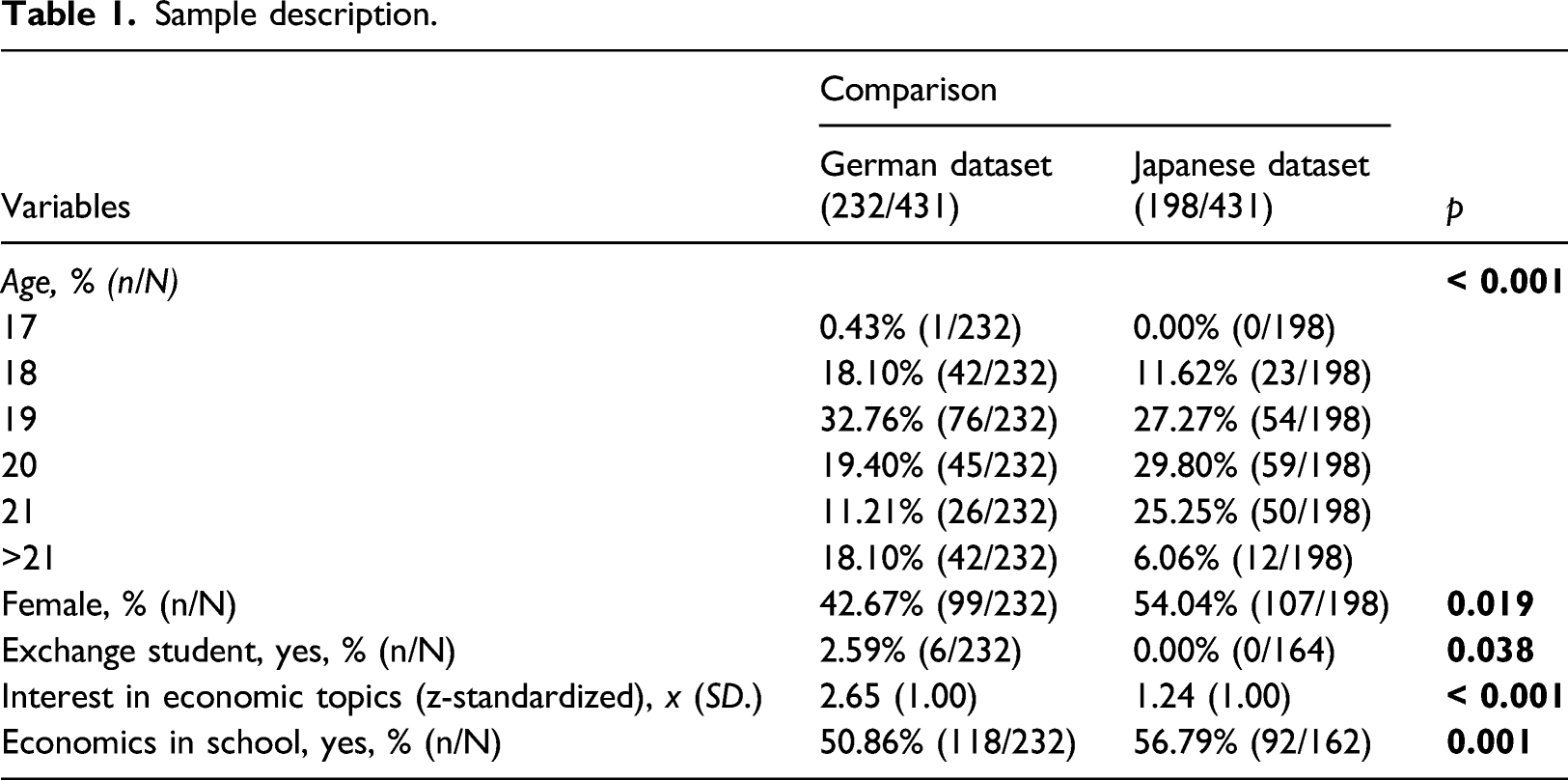
Sample description
Sample description.
Statistical procedure
In preparation for the analyses and to address RQ 1, differential item functioning 5 (DIF) analyses and measurement invariance (MI) analyses were carried out. To investigate the RQ 2, descriptive statistics as well as group comparisons for significance testing were carried out (t-tests, chi2 tests), whereby Cramer`s V and Cohen`s d (Cohen, 1988; Ellis, 2010; Field, 2018; Grisson and Kim, 2012) provided indications of the actual effect strength. Influencing factors we controlled for, such as interest, were z-standardized to ensure the same scale level for Germany and Japan. With regard to RQ 2–4, mean value comparisons and univariate multi-level analyses (MLM) were carried out within the sample of each country. Due to a high ICC in the Japanese sample (ICCjap = 0.153), MLM analyses (universities at group level) were chosen instead of (single-level) regression analyses (for higher comparability between analyses in both countries despite a relatively low ICCger = 0.005 in the German sample). MLM with country at group level would extract the country effect, which makes it difficult to make any substantial statements about the country effects. Regarding RQ 5, all influencing factors were examined in multiple MLM, including age as a control variable. R 2 as an indicator for the model fit is calculated manually for the total R 2 (instead of R 2 per level) based on the quotient: (variance zero model - variance comparison model)/variance zero model. The analyses were conducted using Stata Version 15 (Stata Corp., 2017).
Results
Differential Item Functioning regarding country.
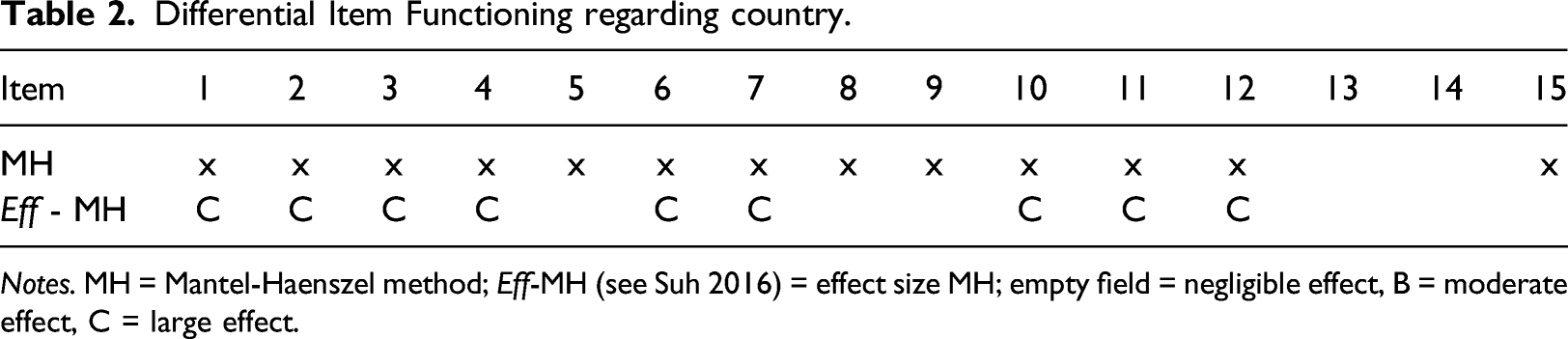
Notes. MH = Mantel-Haenszel method; Eff-MH (see Suh 2016) = effect size MH; empty field = negligible effect, B = moderate effect, C = large effect.
Regarding the content, the items that showed DIF (or caused missing MI) refer to the following topics: market economy, taxes, competitive market and firms, wage increases and differences (for DIF, see Table 2). In the further procedure, the analyses were carried out with the TEL score both including and without the items causing MI. The adjusted TEL score included the results of 13 items instead of 15 items (range 0–13).
Frequency of probability of item solution per item.
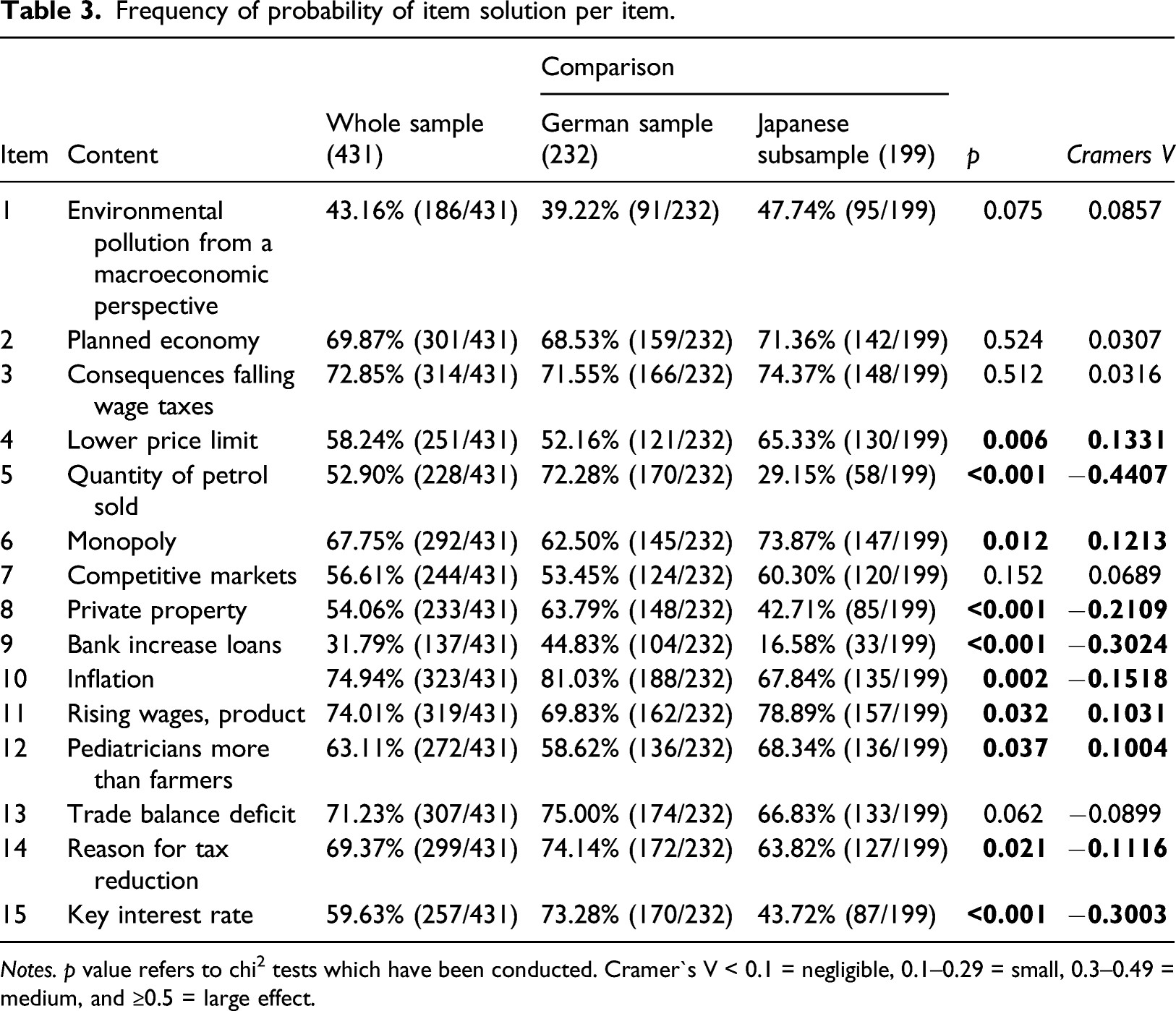
Notes. p value refers to chi2 tests which have been conducted. Cramer`s V < 0.1 = negligible, 0.1–0.29 = small, 0.3–0.49 = medium, and ≥0.5 = large effect.
When investigating the possible influencing factors, male students (RQ 3) gained higher overall scores than female students in the German sample (Δ = −1.404, p<0.001, d = −0.589) but not in the Japanese sample (Δ = −0.296, p = 0.455, d = −0.106). In predicting the TEL sum score solely based gender, this factor seems to play an important role in the German sample with b = 1.446 (z = 4.60, p<0.001, model R 2 = 0.08), but not in the Japanese sample, while with b = −0.221 (z = −0.56, p = 0.575, model R 2 = 0.009).
When explaining economic literacy, previous economics-related learning opportunities were also considered (RQ 4). Overall, in both countries, more than half of the sample had already attended economics courses as part of their previous school education (see Table 1). Comparing the groups with and without previous economics-related experience, there was no significant difference (on a 5%-α-level) in basic literacy at the beginning of university studies, neither among Japanese (p = 0.136, d = −0.238), nor among German students (p = 0.079, d = 0.232). The MLM confirmed these results (German: b = −0.567, z = −1.76, p = 0.078; Japanese: b = 0.309, z = 0.83, p = 0.407). Looking at the explained variance in the models, it also became evident that, with R 2 jap = 0.114 and R 2 ger = 0.013, respectively, previous economic learning opportunities were not able to contribute to predicting the basic economic literacy level of this sample at the beginning university studies.
When focusing on interest (RQ 5) and its possible influence on the TEL score, no significant correlation became evident between these variables in the Japanese sample (r = 0.090, p = 0.213). In the German sample, however, there was a small positive correlation (r = 0.147, p = 0.026). However, the multi-level modeling, which was adjusted for institutional effects, showed that interest had a significant effect in both the German b = 0.362 (z = 2.24, p = 0.025, R 2 = 0.019), and the Japanese sample with b = 0.616 (z = 3.40, p = 0.001, R 2 = 0.003).
The extent to which the influences on economic literacy (interest and gender) also interact with each other was examined in an MLM with interest as a dependent variable. While in the German sample, interest was significantly predictable by gender in favor of male students (b = 0.390, z = 2.99, p = 0.003), that factor had no influence on interest in the Japanese sample (b = −0.165, z = −1.10, p = 0.273).
Results from final multi-level-model.
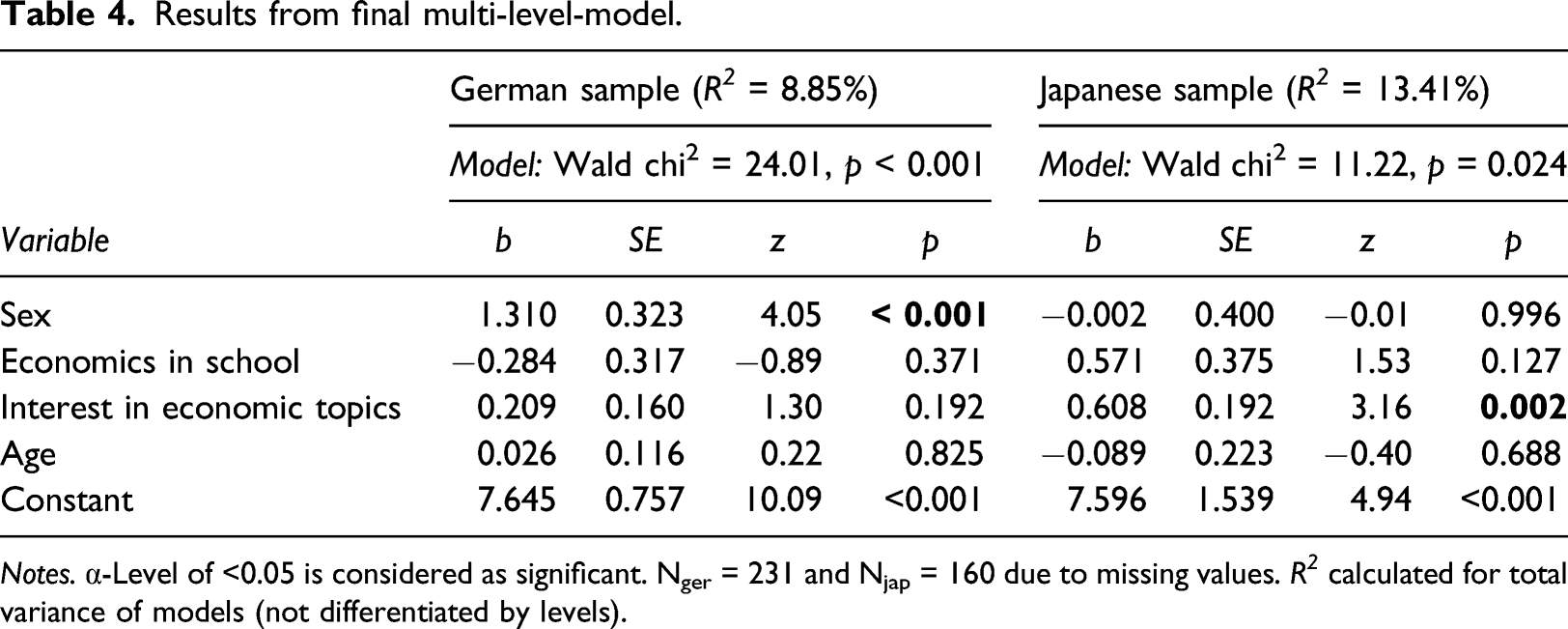
Notes. α-Level of <0.05 is considered as significant. Nger = 231 and Njap = 160 due to missing values. R 2 calculated for total variance of models (not differentiated by levels).
Discussion and conclusion
Summary
Initial findings regarding the comparability of the economic knowledge test and the factors influencing economic knowledge at the entry stage of higher education in Germany and Japan can be obtained from the study and interpreted against the background of the limitations (see Chapter 5.2). The assessment of students’ economic literacy in Germany and Japan using the TEL can be considered comparable in terms of measurement invariance, even though item difficulty differs between the countries and DIF can be proven for some items. However, according to measurement invariance analyses, the test measures the same underlying construct of economic literacy in both languages (RQ 1). With regard to the extent of basic economic literacy at the beginning of university studies (RQ 2), a certain amount of basic literacy was shown for both the Japanese and the German sample. However, the TEL was originally developed for high school students, and therefore the level of basic economic literacy in the group of beginning students can be considered as rather low as, on average, only less than two thirds of the items were answered correctly. When including only the 13 measurement-invariant items, there was no significant difference in TEL sum score between the countries. At the individual TEL item level, the strengths and weaknesses of students in the two countries became evident in certain content areas. However, further item analyses are required to draw possible conclusions in terms of students’ item comprehension and, for example, particular difficulties that can impact their actual knowledge level: For example, item 9 (bank increase loans) shows only a low proportion of correct answers cross-nationally, which can possibly be explained by the item difficulty.
With regard to gender (RQ 3), in line with previous studies, there was only an effect in the German sample, favoring male students, but not in the Japanese sample. Thus, the gender gap seems to be country-specific and needs further investigation. This could be due to the fact that in the German school system, male students are more often assumed to have mathematical skills than female students (Brunner et al., 2008) whereas in Japan, the same potential is assumed of all children as discipline and more uniform teaching of all pupils play a central role (Pilz and Alexander, 2020; for a more detailed discussion on gender effects in Germany and Japan, see Brückner et al., 2015a, 2015b; Happ et al., 2021).
Remarkably, in both countries, no advantage was identified for students with previous experience with economic content (RQ 4). This finding contradicts previous theoretical and empirical findings (e.g., Schlax et al., 2020b) as well as the reported results of curricular analyses in both countries. This unexpected result may be explained by other influencing variables not controlled for in this study, for instance, general intellectual abilities (e.g., as reported by Asano and Yamaoka, 2015). In addition, simply querying previous experience in a yes-no-format might not allow for conclusions to be drawn about the intensity of the corresponding pre-tertiary economics education (for this and further limitations, see Discussion and Conclusion section).
Regarding the influence of interest on the level of literacy (RQ 5), multi-level modeling indicated a positive effect in both samples. Consequently, high schools and universities in Germany and Japan should make more of an effort to promote students’ interest in economics topics. In this study, we did not investigate the types of teaching methods used by teachers in high school and universities to convey economic content. Learning theory points out that holistic forms of teaching, such as problem- and case-based learning, have the potential to promote interest.
Notably, a multiple regression analysis (RQ 6) in the German sample showed that after including all influencing variables in the model, only the gender effect remained significant. This finding might be explained by the indications of differences in the degree of interest between the genders (e.g., Lim et al., 2014; see Results section for interest and gender). In the Japanese sample, interest was shown to be significant in multiple analyses in addition to the negative effect of age. It is possible that this effect is due to forgetting effects in the sample, that is, the economic content learned at school is forgotten over time, and therefore with increasing age. This could be interpreted as an indication of the lack of a deep understanding of economics.
Limitations
Despite the differentiated empirical insights into the level of economic literacy among beginning students in both countries and the identified influences thereon, some limitations of the study presented here should be noted. First, this study addressed a limited number of potential influencing factors in both datasets. The data can therefore only provide initial indications of possible influences but does not offer a comprehensive examination of theoretical explanations of economic literacy levels. The relatively small amount of explained variance in the TEL scores also points to further, still uncovered influencing factors (e.g., general cognitive abilities, differences in learning materials and media use). For instance, Kühling-Thees et al., 2021 identified significant differences among freshmen German and Japanese economics students with regard to many different study-related skills such as critical thinking and fact-based argumentation.
Second, effects of the (closed-response) test format cannot be ruled out, as already suggested by several studies (for insights into the (dis-)advantages of the closed-response test format, see Yilmaz, 2013). Possible future analyses can provide more insights, for example by integrating open task formats, in response to existing evidence that female test takers (at least in Western research) are disadvantaged by the multiple-choice format and perform worse than male participants (e.g., Marin and Rosa-Garcia, 2011; Parker, 2006; for a discussion, see Owen, 2012).
Third, using the full TEL test (45 items) will enable more comprehensive analyses, particularly with regard to the concept-specific differences across TEL items. Even though the short and long form of the test are highly correlated, the reduction to 15 items leads to lower curricular representativeness regarding economics topics that are important according to the test definition. In addition, the comparative assessment of economic literacy in this study is based on the definition of economic literacy by the Council for Economic Education (CEE, 2010) and Walstad and colleagues (2013). The test therefore does not cover content aspects that go beyond this. A broader definition could include further, for example, non-cognitive, areas relevant for economic literacy and education.
In particular, it would also be interesting to test whether further measurement-invariant items can be identified, and which concepts they cover. Notably, even the measurement-invariant score contained items that showed strong DIFs, and these items and underlying concepts require further in-depth analyses
Fourth, the findings must be viewed in the light of the small sample sizes in both countries. The institutions surveyed in Germany and Japan represent only a fraction of higher education institutions offering business and economics programs in both countries. The extent to which the economic literacy of the respective student population can be deduced from these limited sample sizes and the inclusion of (only) four universities in each case is questionable. For future investigations, larger, more representative samples at both student and institutional level would allow for more robust and generalizable results.
In spite of the mentioned limitations, the dataset offers a sound basis for comparative analyses of economic literacy and its influencing factors. The findings of this study allow for initial conclusions for educational practice in the field of economics as well as further research.
Implications and outlook for research and practice
Based on the results presented here, the assumption of a cross-national validity of a general economic literacy concept can be preliminary supported—here, with regard to the comparison of Japanese and German beginning students. Although it is assumed that a common understanding of economics has developed internationally in the wake of globalization, some TEL items do not seem to be measurement-invariant between Japan and Germany. Further research should investigate these differences, not least to derive possible adjustments for the test items. With the exception of these individual items, it is possible to compare the economic knowledge of German and Japanese students using the TEL.
For teaching practice, it can be deduced that there might be internationally different understandings of specific content areas, which need to be specifically addressed in instruction. The items with DIF might sensitize teachers and educational institutions to not simply assume a comparable level of economics literacy per se, but to anticipate differences in an instructionally effective manner. Using a universally applicable testing instrument for entry-level economic literacy, differentiated needs for support of (vulnerable) student groups can be identified, for example, in the study entry phase. The identification of student groups or individuals who should receive additional support is particularly important in light of the evidence presented here that both groups of students in both countries have a certain level of basic economic literacy on average, but the findings do not indicate that these students have comprehensive basic economic knowledge and understanding. Basic principles of economics are often assumed to be known by university students and are often only taught to a limited extent.
In light of the findings presented here, cross-national studies on the different curricula as well as the consideration of possible cultural differences in understanding of some economic concepts are required. These can be conducted through in-depth content analyses to achieve a more detailed profiling of students’ strengths and weaknesses (in terms of understanding economic concepts) across countries. This would open up new perspectives for practitioners in higher education to adequately address the challenges of increasing heterogeneity, internationalization, and student mobility in higher education economics.
As an implication of the repeated evidence of gender-specific differences in domain-specific literacy in Germany at the beginning of studies, the establishment of preparatory courses before the beginning of studies might allow for a more homogeneous student group. In Japan, high school students commonly visit a type of private school (cram school, also called ‘Juku,' see Harnisch, 1994) to prepare for the university admission tests (Dolly, 1993; Yoko and Zhang, 2017). Even though the Juku is already seen as competition to regular schools in many respects (Højlund Roesgaard, 2006), it might provide indication with regard to the lower gender difference in Japan. 6 Gender-specific differences that arise before the beginning of studies might be reduced through attendance of the Juku school, and thus fair conditions can be created at the beginning of higher education studies. The assignment to different preparatory courses could be done on the basis of a standardized test of economic literacy administered to students when entering higher education. Notably, with regard to Japanese female students, our findings do not indicate any need for particular support, which stands in contrast to German female students. However, the findings also suggest that interest-led study is advisable for economic knowledge across countries.
Although the findings presented here provide evidence of relevant influencing factors, further analyses are required to examine possible explanations for these relationships. In addition, besides the examination of economic literacy at the beginning of studies, its further development and its impact on students’ acquisition of economic knowledge during their studies is even more interesting and requires further investigation—not least from at the international level. This also requires comparative curricular content analyses of how economics is taught in higher education in both countries.
In conclusion, if the increasing international openness, willingness to adapt and the trend towards globalization stimulates an increasing harmonization in higher education, country-specific differences and their implications for learning progress and students’ learning outcomes require further in-depth analyses. This particularly applies to the domain of economics, where an international “core curriculum” and common economics understanding is assumed—here, too, the specific features of individual countries need to be recognized and appreciated for their added value.
Footnotes
Acknowledgements
We would like to thank Oliver Kroppach who was involved in data analysis. Furthermore, we would like to thank the reviewers for their differentiated valuable feedback, which supported the improvement of this paper.
Declaration of conflicting interests
The authors declared no potential conflicts of interest with respect to the research, authorship, and/or publication of this article.
Funding
The authors disclosed receipt of the following financial support for the research, authorship, and/or publication of this article: This study was funded by the German Federal Ministry of Education and Research with the funding number 01PK15001A.
Notes
Author biographies
Jasmin Reichert-Schlax has been part of the Chair of Business and Economics Education at Johannes Gutenberg University (JGU) Mainz since 2017. Her work focuses on the development of domain-specific competence over the course of studies as well as on possible influencing factors.
Olga Zlatkin-Troitschanskaia has been Chair of Business and Economics Education at Mainz University (Germany) since 2006. She has led numerous (inter)national research projects on modeling and measuring learning outcomes in higher education. Since 2013, she has had nearly 300 (inter)national publications, including 15 editorships in renowned journals as well as monographs, in addition to organizing dozens of (inter)national conferences. She is active in numerous (inter)national advisory and editorial boards as well as a peer reviewer for 25 (inter)national journals and various institutions (such as DFG, BMBF, SNF, Wissenschaftsrat, Leibniz Association, Foundations etc.).
Roland Happ is a substitute professor for business and economics education at the University of Leipzig. His research interests lie in modeling the economic and financial knowledge of young adults. He has conducted numerous international comparative studies on the economic competencies of young adults in Germany, the USA, Japan, China, and South Korea.
Michio Yamaoka is a professor at Graduate School of Asia-Pacific studies and executive director at Waseda Institute for Economic Education in Waseda University. His research fields are historical review of Asia-Pacific region and economic education in the same region. Professor Yamaoka received International Award from National Council on Economic Education (now, Council for Economic Education) in 2004 for his outstanding contributions to economic education in Japan.
Tadayoshi Asano is a lecturer of economics at department of human communication Yamamura Gakuen College. He engaged himself in the research in East–West relations in the postwar period, Japans’ comprehensive security police, international telecommunication system, and country risk in the Middle East for the then Ministry of International Trade and Industry of Japan, while studying international relations.
Shintaro Abe is an Associate Professor at Josai International University, Faculty of Business Administration and Information Sciences, Japan. He is an executive director of Japan Academy of Consumer Education. He was one of the authors of the National Guideline of Home Economics. He received his M.A. in Pedagogy from Waseda University in 1999. His research fields are economic education, consumer education and economics.