



Abstract
The paper compares the institutional development of skills formation in Lithuania and Ukraine by focusing on the implications of the post-communist transition and Europeanization and exploring the role of policy transfer. The research follows the theoretical approach of historical institutionalism and skills formation ecosystems. Despite similar critical junctures typical for the institutional development of skills formation in Lithuania and Ukraine within this timeframe, the existing differences of these development pathways can be explained by the different policy choices and different impacts of the institutional legacy. The main implication of integration with the EU for skills formation in Lithuania and Ukraine is related with enabling holistic and strategic institutional development of skills formation institutions. The paper concludes that policy transfer was one of the key driving forces and capacity-building sources in the development of skills formation institutions in both countries.
Keywords
Introduction
Many Central and Eastern Europe (CEE) EU member states have achieved significant progress in the institutional and methodological development of their skills formation and are now seen by other countries as models to follow and as sources for policy learning and policy borrowing. Nevertheless, so far, there has been a shortage of knowledge about the potential of the skills formation models and systems in these countries to offer valuable and relevant content of policy learning to facilitate the reforms and development of skills formation policies and institutions in current EU candidate countries. This paper aims to contribute to closing this gap by comparing skills formation changes and reforms in Lithuania and Ukraine from the perspective of policy transfer. To attain this goal, the research is focused on comparing the pathways of the institutional development of skills formation by taking into consideration the role, place and implications of policy borrowing and policy learning in these pathways.
Since skills formation systems are dynamic, following Thelen (2004), we are taking a historical institutional perspective that explores the emergence, development and adaptation of skills formation institutions. This perspective takes into consideration the institutional change of skills formation and deployment influenced by critical junctures, such as collapse of the former socialist systems of skills formation and their subsequent reforms, access to the EU in 2004 and later years as well as the global economic crisis of 2008–2009 and its aftermath.
Skills formation systems and the institutional settings of Lithuania and the Baltic countries are described as the neoliberal institutional model (Dorothee and Greskovits, 2007; Kogan, 2008; Kogan et al., 2008, 2011, 2012; Martinaitis, 2010). This model is characterized by (1) strong market orientation of skills formation processes and institutions, (2) the important roles of employers and especially big businesses – and the state in decision making on skills, (3) lack of social dialogue and fragmented representation of employee and learner interests in skills formation, (4) radical implementation of institutional reforms by following the ‘catching-up’ approach and (5) strong negative implications such as high rates of emigration; the demographic crisis; and high income inequalities (Sommers et al., 2014; Robert et al., 2019; West, 2013) of the economic, social and educational reforms for the socio-demographic development of society. On the other hand, skills formation and skills usage in Ukraine is characterized by the stronger impact of the institutional legacy of the Soviet period that led to more protracted institutional reforms than in the Baltics, as well as strongly state-led and bureaucratized changes and reforms in the vocational education and training (VET) system and higher education (HE) (Deissinger and Melnyk, 2019; ETF, 2015; ETF, 2020; Kupets, 2016). However, in the past decade, more similarities can be seen between the pathways of skills formation in Ukraine and Lithuania with the systemic implementation of the national system of qualifications and development of social dialogue in skills formation at the sectoral and national levels.
History and geography provide important contextual factors in comparing skills formation systems in Lithuania and Ukraine. The analysed countries shared a common historical destiny from the time of the Grand Duchy of Lithuania to the end of the Middle Ages, the period of the Polish - Lithuanian State in the 16th–17th centuries, being part of the Russian Empire from the end of the 18th century to 1917 and being part of the Soviet Union until 1990–1991. The legacy of the communist system of skills training and the institutional framework can be seen as a starting point for the analysis of the ‘post-communist’ transformation in the two countries. The length of time the countries were under the communist system could also play a role – the legacy of the communist rule is stronger and plays a more important role in Ukraine, which was part of the Soviet Union for more than 70 years, while Lithuania was occupied for 50 years. Differences in development following the collapse of the Soviet Union also played an important part in the transformation of skills formation institutions. Accession to the EU in 2004 and the subsequent years were an important critical juncture, determining the different development paths between the countries of Central and Eastern Europe which became members of the EU and those which did not.
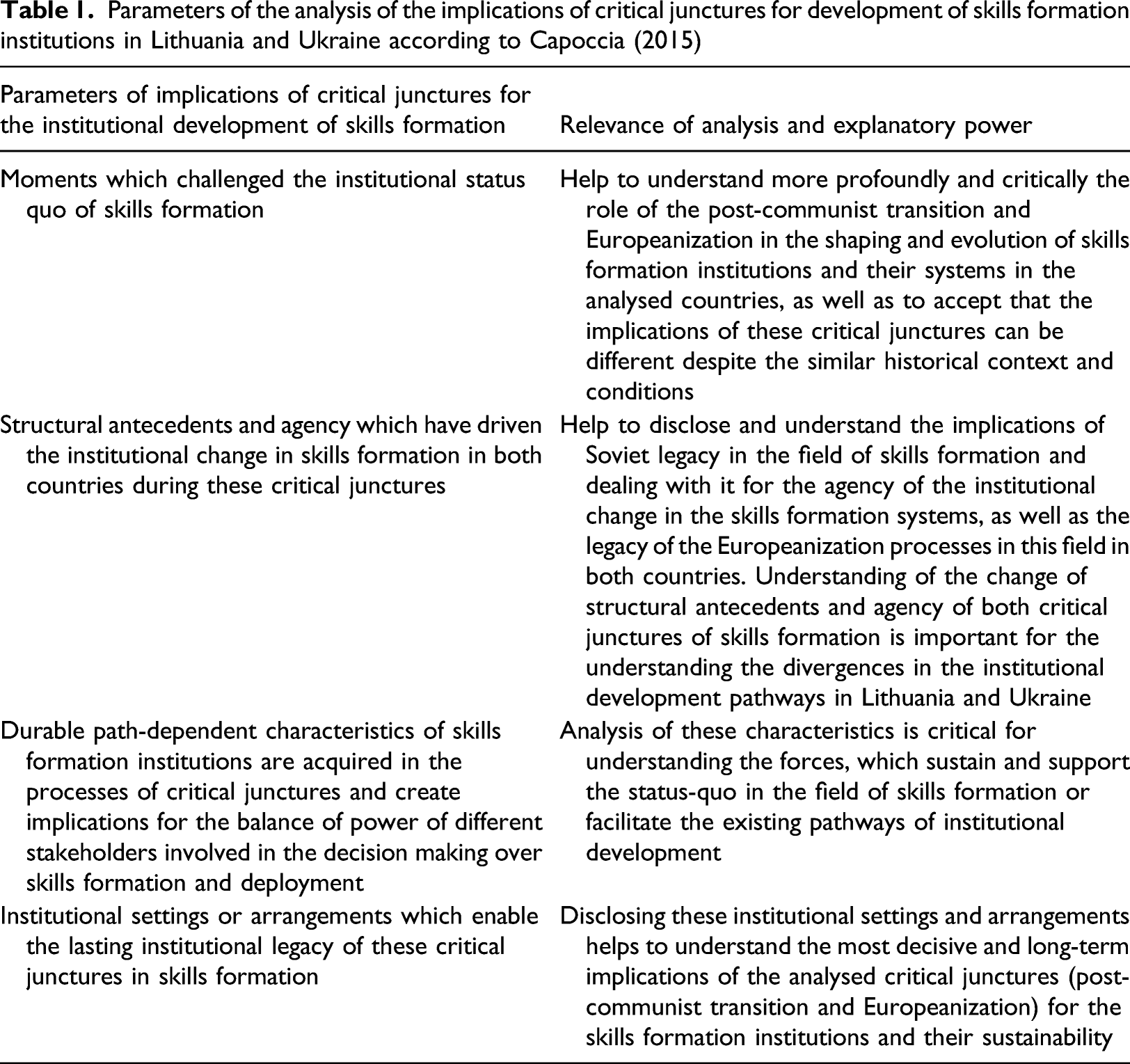
We will explore the main implications of the post-communist transition and the integration with the EU for particularities of the institutional development of skills formation in Lithuania and Ukraine by referring to the following questions based on the analysis parameters of critical junctures suggested by Capoccia (2015): (1) What moments challenge the institutional status-quo of skills formation in Lithuania and Ukraine during these critical junctures? (2) What kind of structural antecedents and agency drive institutional change in skills formation in both countries during these critical junctures? (3) What durable path-dependent characteristics of skills formation institutions are acquired in these critical junctures? What are the implications of these critical junctures for the balance of power of different stakeholders involved in the decision making on skills formation and deployment? (4) What institutional settings or arrangements enable lasting institutional legacy of these critical junctures in the skills formation of Lithuania and Ukraine? (5) What is the role of policy transfer in the institutional development of skills formation systems of both countries?
The paper first discusses the context of the CEE skills formation ecosystems and involves a theoretical analysis of the development of institutional skills formation from the perspective of policy transfer. This is followed by a comparison of the institutional development of skills formation in Lithuania and Ukraine in two periods – the period of post-communist transition and the period of Europeanization of skills formation institutions by seeking to disclose the role of policy transfer in these processes and the potential generated by the institutional change and reforms.
Specificities of the historical institutionalism and development of skills formation ecosystems in the post-communist CEE countries
This article follows the holistic definition of skills formation as a set of processes which interlink the education and the world of work by shaping knowledge, skills, competence and qualifications through a wide range of interactions between learners, employees, employers, education and training providers, state institutions and international bodies (Busemeyer and Trampusch, 2011; Bosch, 2017; Buchanan et al., 2017). Following this concept, the skills formation system can be defined as a setting of social institutions serving for the design, provision and usage of knowledge and skills in society, while being an integral part and active agent of society and the economy in which it exists (Bosch, 2017; Busemeyer and Trampusch, 2011).
The theoretical framework of the research is based on the theories of institutional development related to historical institutionalism. This is a research tradition which explores the implications of temporal processes and events for the establishment and development of social institutions and which helps to understand how these institutions emerge and develop in given space and time period (Fioretos et al., 2016). Historical institutionalism provides a powerful methodological background for exploration of the development of skills formation institutions and systems in post-communist countries because it takes into consideration the implications of the different specific critical junctures, historically developed path-dependent characteristics, cooperation modes, as well as specific styles of reasoning and behaviour of the institutional actors of skills formation shaped by the historically developed matrix of ideas (Gonon and Bürgi, 2020). This feature of historical institutionalism is very pertinent for the research of skills formation systems in the post-communist societies and institutions because post-communist transition and related institutional change of skills formation are highly complex and historically defined processes which cannot be properly explained by referring only to the rational deliberations and requirements of involved institutional actors.
Critical junctures, legacy and the path dependence are the central concepts of this methodological approach. A critical juncture is defined in literature as a period of significant change in society, which creates specific path-dependent processes emerging from the relationship between the produced institutional legacy and the reproduction of institutions (Collier and Collier, 1991; Capoccia and Kelemen, 2007). From the perspective of political economy, critical junctures are regarded as tipping points in the historical development of political economies that open up contingencies that may (or may not) lead to the renegotiation of the institutional and political settlements of the past, while at the same time, setting in motion the process of transforming the political arena for the next round of renegotiations in the future (Busemeyer and Trampusch, 2011, 8).
In exploring the institutional development of skills formation in Lithuania and Ukraine, we distinguish two main critical junctures which are common for the skills formation in both countries: (1) the period of post-communist institutional transition and establishment of statehood after the collapse of communism and the Soviet Union and (2) integration with the EU or Europeanization. Here, the integration with the EU is defined as a formal institutional process leading the EU accession, whereas Europeanization means orientation and adjustment of the skills formation processes and institutions to the approaches and practices promoted by the EU institutions and member states through the processes of policy borrowing and policy learning (Martinaitis, 2010; Powell and Trampusch, 2012).
Another key concept in this study is path dependence, which is defined as a self-reinforcing process which involves positive feedback (Fioretos et al., 2016). In the context of the institutional development of skills formation, path dependence is driven by the patterns and cleavages of the economic, technological and social development (e.g. industrialization and development of the service economy) which have a bearing on skills training (Martin, 2017). The legacy produced by the critical junctures influences the strategic direction of institutional change, shapes specific settings of the political regimes and governance models of skills formation systems, and facilitates the development of cooperation patterns between stakeholders, as well as methodological approaches to skills formation. For example, dealing with the legacy of the Soviet model of skills formation pushed the policy makers of post-communist countries to implement agendas of institutional decentralization and the market orientation of skills formation systems, by favouring neoliberal approaches to the design of qualifications and curricula (Tūtlys and Aarna, 2017; Tūtlys et al., 2016).
Streeck (2010) provides a comprehensive framework of the features of historical institutional transformation, which is helpful for understanding post-communist transformations of skills formation systems. The uniqueness and contingency of the post-communist transformation in the field of skills formation has led to the divergence of the skills formation processes and institutional settings in the post-communist countries. Irreversibility of the changes and their impact was ensured by the abrupt and radical character of change at all dimensions of skills formation illustrated by the domination of liberalism, neoliberalism, developmental state ideologies, establishment of the new institutional settings related to the market economy and democratic civil society (West, 2013; Martinaitis, 2010; Dorothee and Greskovits, 2007). The historical legacy of the socialist/communist system also defines a historical givenness of these transformations – a unique, contingent and irreversible character of producing events in a historical process (Streeck, 2010). Several key factors of this historical givenness can be distinguished: (1) institutional infrastructure (e.g. impact of the legacy of the egalitarian Soviet education system on the high level of educational attainment maintained during the post-communist transition), (2) relationships between the institutions and stakeholders (e.g. institutional weakness of social dialogue in the field of skills formation), and (3) readiness of the post-communist societies to accept the institutional changes in the skills formation and the complicated development of social trust in the new institutional settings of skills formation (Norkus, 2008; O’Dell, 1988; Soltys, 1997). As a result, the establishment and emergence of new formal institutions and institutional structures of skills formation in many cases was much quicker than the formation of corresponding norms, attitudes and know-how of actors, leading to capacity gaps and inefficiencies of established institutions and the unbalanced growth of power of stakeholders in decision making and governance of the skills formation processes (Tūtlys et al., 2016).
Institutional change of skills formation is one of the key forces which shape different skill ecosystems. The concept of the skill ecosystem, which encompasses business settings and models, institutional policy frameworks, modes of engaging labour, job structure, and skills formation processes and skills, is also very helpful in analysing the change of skills formation institutions and related critical junctures (Buchanan et al., 2017). This concept permits us to focus the analysis of change of skills formation on the micro level by paying attention to the different bottom-up initiatives in skills formation and disclosing the initiatives and self-reliance of different stakeholders and social partners (especially employer and employee organizations) in the field of skills formation and development. Furthermore, the analysis of skill ecosystems provides insights into social coalitions and different internal mechanisms that help or hinder implementation and execution of the skills formation policies (Buchanan et al., 2017). The emergence and development of skill ecosystems in the post-communist countries share many common features. Firstly, it was accompanied by the abrupt institutional change resulting in lock-in effects which shaped the development of skill ecosystems, for instance, countries turning into low-skilled economies competing in providing raw materials and components for more advanced European economies, or reductionism and primitivism of economic relations (Norkus, 2008). Others, like emergence of the purposeful industrial policies in the Visegrad countries, by seeking to protect the strategic enterprises and sectors from collapse, had a constructive and enabling effect on the shaping of these ecosystems (Kurekova, 2012). Skill ecosystems in the post-communist CEE countries were shaped by the different socioeconomic contradictions, such as economic growth accompanied by the deepening social inequalities, emigration of skilled workforce, growing research and development costs with a very low economic base and the deterioration of economic structure, and liberalization and privatization of economic relations bringing the collapse of outputs and harsh crisis (Martinaitis, 2010; Norkus, 2008; Tiits et al., 2008; West, 2013). Domination of the competition based on cost cutting rather than on increasing knowledge intensity significantly reduced the demand for formalized education and training, as well as decreased the market demand for the public education and R&D system reform (Tiits et al., 2008). Integration with the EU partially changed this situation by triggering some policy change and opening new funding opportunities for education, training and innovations (Ferry, 2014; West, 2013). In the first decade of transformation, from the 1990s to the 2000s, during the internal revolutionary institutional transformations in the post-communist CEE countries, the construction of welfare mechanisms and welfare state was not a policy priority (Josifidis et al., 2018). In the second stage of reforms marked with the European integration and implementation of the EU’s acquis communautaire, CEE countries executed institutional harmonization by strengthening the neoliberal reforms – the case of neo-corporatist regime (Slovenia) or embedded neoliberalism (Visegrad countries) – or by introducing and strengthening some institutions and policies of the welfare state in the neoliberal regimes (Baltic states) (Kogan et al., 2008; Martinaitis, 2010; West, 2013).
The development of the skills formation systems in the post-communist CEE countries has been strongly influenced by specific dispositions of capacities of involved stakeholders and social partners. First of all, employers enjoyed greater power than labour in many of these countries (especially Baltic countries) leading to the development of employer-oriented employment relations. The pressure of international capital for the policy making in the field of labour relations (pushing their references for lower labour costs and deregulated labour markets) has been much stronger and more effective in the post-communist CEE countries compared to the Western Europe countries (Meardi, 2014). Such pressure had negative or destructive impact on skills formation by discouraging national and corporate investments in skills formation and development. (Duman and Kurekova, 2012) notice a certain imbalance between the capacities of the social partners or the weak potential of industrial relations in the field of skills formation on the one hand, and the legal empowerment of social partners and stakeholders in the skills formation introduced by the different reforms on the other hand. Neoliberal policies executed by some CEE countries (Baltic states) entrenched the lack of social dialogue and representation of employees’ interests making these countries ill-prepared for implementing skills development measures oriented to a high-skills economy (Sommers et al., 2014). These circumstances can explain why the transformation and reforms of skills formation institutions in many CEE countries were more strongly oriented to the development of the elite rather than of socially oriented skill ecosystems (Spours and Grainger, 2020).
The characteristics of the institutional development of skills formation in the post-communist countries described above strongly influenced the processes of policy transfer during these reforms, which can be classified into policy borrowing and policy learning. According to (Raffe, 2011), policy borrowing is a process by which policy makers use international experience (or experience of other countries) as a source of examples of the transferable best practice by ignoring the local context and strongly relying on the top-down accounts of their policies. Policy learning supports development of the tailored national policies by using international experience only as a source of learning and identifying suitable policy options by taking into consideration historical context, paying attention to learning from mistakes and ensuring effective communication between policy and practice (Raffe, 2011). Policy learning helps to identify alternative strategies and approaches that are better embedded in the national contexts and help to inform policy development, as well as to build capacities of policy makers and stakeholders needed for the design and implementation of reforms (Chakroun, 2010). According to Chakroun (2010), policy learning very often involves peer learning by bringing together policy makers from different countries to discuss the approaches to reforms and to analyse solutions of policy problems.
Research methodology
Parameters of the analysis of the implications of critical junctures for development of skills formation institutions in Lithuania and Ukraine according to Capoccia (2015)
Policy transfer plays different roles in enabling, strengthening or weakening of the implications of post-communist transition and Europeanization for the institutional development of skills formation in Lithuania and Ukraine. These issues are explored in the next two sections of the paper.
Post-communist transition of skills formation in Lithuania and Ukraine after the collapse of the communist system
The communist skills formation systems were rejected as unfit for the changed conditions of the market economy and democratic society in both Lithuania and Ukraine (Deissinger and Melnyk, 2019; Norkus, 2008; Poviliūnas, 2000). This rejection involved the ideological dimension of skills formation through elimination of the communist ideology from the education and training curricula, as well as the procedural dimension through rejection of the centrally planned and segregationist provision of education and training (Laužackas, 2005). For this reason, the design and implementation of new skills formation processes and systems had to be executed on the vestiges of the skills formation institutions remaining after the collapse of the former planned system (Bünning, 2008; Laužackas, 2005). New demand for skills emerged from the market economy together with the need of the ‘liberated’ citizens to diversify individual skills. Transition to the market economy brought social tensions and problems related to a sharp increase of structural unemployment, poverty and social exclusion that became the object of skills formation measures and policies dealing with the problems of the ‘losers’ of post-communist transformations (Poviliūnas, 2000; Laužackas, 2005).
Post-communist transformations in Lithuania and Ukraine also involved reconstruction of statehood and state institutions from scratch (Norkus, 2008, 2014), leading to establishment of new institutions of governance, legislation, political regulation and civic participation in various fields, including education and skills formation.
Both countries had to deal with the Soviet legacy in reforming their skills formation systems. This legacy was related not only with the characteristics of institutional settings, such as a vast network of education and training providers and centralized governance of skills formation systems, but also with the specific societal features and attitudes to skills formation, such as the lack of interest in further education amongst youth, or insufficient communication between educational institutions and stakeholders in the emerging market economy (Dienys and Pusvaškis, 1998; Kupets, 2016).
One of the key common features of the institutional development of skills formation in Lithuania and Ukraine during the post-communist transition was the collapse of the ‘Soviet dual VET model’ based on close links between state enterprises and VET schools in providing human resources needed for a planned economy (Laužackas, 2005). This model involved work-based training at state enterprises as an integral and decisive part of VET, where students spent greater part of their training in the work-based learning environment at the state enterprises, which provided the necessary training infrastructure and resources. The collapse of this model was more radical in Lithuania, where fast privatization, economic restructuring, deindustrialization and shift to the development of the services sector dominated by the newly established SMEs disrupted connections between VET and sectors of economy. Newly established private enterprises were unable and reluctant to share the responsibility for skills formation with reformed public vocational schools (Laužackas, 2005). The economic priorities of survival in the market also challenged and limited the possibilities of newly established enterprises to participate in the skills formation. These circumstances significantly contributed to the deterioration of the social image of VET which already suffered from the memories of social segregation of their role in the Soviet period when they produced a loyal workforce (Laužackas, 2005; Profesinio Mokymo Reformos Programos Koordinavimo Centras, 1999). As a result, the post-communist transition in the field of VET involved development of the school-based VET system oriented to the demands of the market economy and playing an important social role in mitigating the challenges of structural unemployment of transitional period (European Training Foundation, 2017).
One of the key directions of the post-communist VET institutional reforms in Lithuania was the decentralization of governance and fostering of autonomy of VET schools (Laužackas, 2005; Laužacka et al., 2009). Centralized enrolment of students was abolished and functions of curriculum design, development of training materials and organization of assessment were delegated to VET schools. The Anglo-Saxon approaches to VET provision and curriculum design were the most suitable and attractive objects of policy borrowing and policy learning in these reforms (Laužackas et al., 2009; Tūtlys, Winterton and Kaminskienė, 2016). Implementation of these reforms required coordination and provision of expertise. This created preconditions for the establishment of the Methodological Centre for VET under the Ministry of Education and Science in 1997. It also coincided with the consolidation of the state policy in the field of VET and its legal regulation – the first Law of the Republic of Lithuania on Vocational Education and Training was adopted in 1997 and in 1999 a White Book on VET, the first strategic document for VET development, was published.
The VET curriculum reform with the adoption of competence-based VET standards started with the application of the “British” functional analysis approach and involvement of social partners in the VET curricula design (Laužackas, 2005; Laužackas et al., 2009). However, these attempts of policy borrowing in decentralizing VET provision and curriculum design were hampered and challenged by several local insufficiencies: weak and insufficient social dialogue and insufficient capacities of the teaching staff (Laužackas, 2005; Tūtlys et al., 2016). The national and sectoral tripartite VET bodies, such as the Council of Vocational Education and Training, regional VET councils and expert groups of the branches of economy involved in the design of the VET standards established in 1997–1998 by the initiative of the government played merely formal roles of approval. The main responsibilities in the design of the VET standards and curricula were assumed by VET providers. A rather significant step in the development of the social dialogue in VET was the delegation of the responsibility for competence assessment in VET to the chambers of industry, commerce and crafts in 2003, following the examples of German speaking countries (ibid). However, this change contributed to slowly emerging domination of the state and employers’ organizations in the social dialogue on VET and skills formation.
Decentralization of the curriculum design made VET providers and their teaching staff the key actors in this process and soon they accumulated expertise in the field of competence-based VET curriculum design. Nevertheless, VET teachers and trainers were largely lacking the know-how needed for the implementation of competence-based teaching and training practices, such as didactic approaches of learner-centred and work-based learning. This was one of the key reasons of the ‘hybrid’ implementation of the competence-based VET curricula, where the curricula were rewritten in terms of learning outcomes, but the teaching practices still followed a subject-based approach (Tūtlys and Vaitkutė, 2021).
The institutional development of HE after the re-establishment of Lithuania’s independence involved state-prioritized institutional reform of the HE system by resorting to the restitution and innovation approaches (Poviliūnas, 2000). Both approaches can be exemplified by the re-establishment of Vytautas Magnus University (originally established in 1919 after the first restoration of the independent state of Lithuania and closed under Soviet rule in 1950). This university was re-established in 1989 with the support of Lithuanian emigrants in the USA, bringing ideas from the American academic system and the liberal arts model to higher education (Leišytė, 2018). The main aims of the post-communist HE reform included (1) implementation of the principles of autonomy of universities and academic staff (legal preconditions created by the Law on Education and the Law on Higher Education and Science adopted in 1991), (2) introduction of the Western model of HE degrees and qualifications (the bachelor, master and doctoral degrees introduced in 1992) and (3) decentralization and liberalization of HE provision. The decentralization of HE provision in this period was hampered by the lack of interest and involvement of social stakeholders in HE reforms, thus leaving the state the main responsible body for the institutionalization of HE provision. The establishment of the Centre for Quality Assessment in Higher Education by the Ministry of Education and Science as an independent public agency responsible for the external quality assurance policy in higher education in 1995 provides a good example of such ‘state-led decentralization’ (Dobbins and Leišytė, 2014).
An important turning point in the HE reform occurred in 2000 with quite a straightforward establishment of the universities of applied sciences on the basis of the former higher vocational training schools, which were established in 1990 on the basis of the former Soviet higher VET schools (technikums) (Laužackas, 2005). This change involved different policy borrowing and policy learning exercises in seeking to develop the Western binary structure of HE establishments on the vestiges of the Soviet institutional legacy in education and training (Misiūnas, 2008). However, the expectations that newly established institutions would, as their Western counterparts, support the development of human capital in the regions was never completely realized, as the strongest universities of applied sciences were concentrated in the largest cities of Lithuania and became direct competitors of research universities (Kaminskas, 2019).
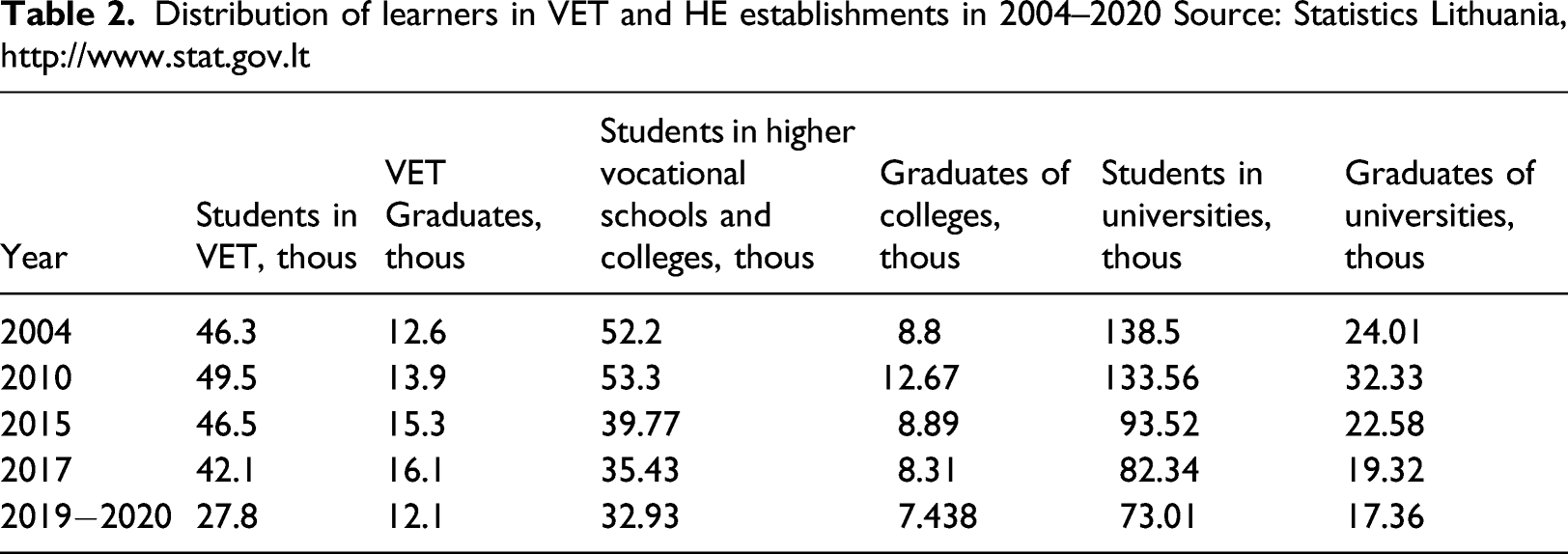
Distribution of learners in VET and HE establishments in 2004–2020 Source: Statistics Lithuania, http://www.stat.gov.lt
Similarly to Lithuania, in Ukraine, the initial deconstruction stage of the institutional transition of VET took place in 1991–1995/1995 and was strongly influenced by the liberalization of socioeconomic relationships and rapid deindustrialization. Meanwhile, the stage of the formation of the new institutions of skills formation and VET in 1996–1999 coincided with the intensification of the policy responses to the socioeconomic crisis and slowing down of economic decline (Deissinger and Melnyk, 2019; Kupets, 2016). With the privatization and restructuring of former partner state enterprises which provided practical training, many VET providers lost industry orientation established in the Soviet period. Seeking financial survival and retention of pedagogical and scientific staff, many VET providers and HE establishments reoriented their training and studies towards ‘prestigious’ occupations and professions (or simply those most popular ones among young people, but not required by employers), without sufficient educational resources. The extremely low level of remuneration for teachers and trainers became a critical problem, in addition to progressive ageing of personnel and loss of key pedagogical staff to the private sector or destinations abroad. Despite measures taken to consolidate educational institutions, the downward trend in student enrolment has continued (ДНУ «Інститут освітньої аналітики» 2019, Освітня реформа: результати і перспективи 2019).
Unlike in Lithuania, the disaggregation of the Soviet dual VET model in Ukraine did not lead to its total extinction and left a very important and influential legacy. It took place in the context of privatization of the big former Soviet industrial enterprises by their former managers leading to the oligarchization of the economy (Plokhy, 2016) and the continued quasi-totalitarian methods of public administration and policy making (Kuczabski and Michalski, 2014). In addition, the post-communist transition involved significant de-skilling which was caused by (1) the deindustrialization and growth of the SME dominated tertiary sector and (2) by the transition from the strong military specialization industry during the Soviet period to low-skilled production of mass consumption goods or subcontracting for low-skilled manufacturing by foreign enterprises (Kupets, 2016). Oligarchization of the economy strengthened the power and influence of big enterprises and employers in the field of skill formation and contributed to the ‘survival’ of some legacy of the Soviet dual VET model. The examples of such legacy include practical training centres of the enterprises and specific ‘centralized’ instruments of the human resource management for structuring the workforce according to the level of acquired skill and qualifications (a former Soviet system of ranks – razryady). Another important legacy of the Soviet period was the state order for training skilled workers in VET institutions, which was maintained and continuously reformed, but was never abolished (European Training Foundation, 2015).
The transitional reforms of the VET system enabled increasing the variety of the types of public VET providers in Ukraine. The former Soviet vocational schools were transformed to different types of VET establishments according to the different needs and demand of the economy and society. The transition from the ‘Soviet dual’ VET to school-based VET provision was evidenced by the establishment of higher vocational schools. The Law of Ukraine ‘On Vocational Education’ adopted in 1998 legalized a wide range of different VET establishments: profiled vocational schools, higher vocational schools, art vocational schools and a wide range of VET centres for practical training and work-based learning established together with enterprises or on the basis of the practical training units of enterprises (European Training Foundation, 2015).
The beginning of the 21st century marks the start of the consolidation of the institutional settings and curriculum reforms in Ukraine. The new economic conditions, especially economic stabilization, and the start of economic growth were favourable for the differentiation of VET qualifications in terms of their types and levels. Different types and levels of VET provision were introduced in 1999, such as higher vocational schools alongside existing vocational technical schools, vocational technical schools in arts, VET centres, training centres for work-based learning in enterprises and centres for training and retraining of employees Мельник (2017). Significant efforts were made to standardize curricula by introducing and periodically reviewing methodological guidelines of the VET curriculum design in 2005. New instruments of curriculum design and management were introduced, such as VET standards, typical training plans and programmes, and working/operative plans and training programmes at the level of VET providers. These instruments formally adopted a competence-based approach and simultaneously sought to establish a compromise between providing specialized vocational competencies and generic knowledge and skills to increase mobility of learners in the turbulent transitional labour market.
The introduction and implementation of the VET curriculum reforms in Lithuania and Ukraine have many commonalities as well as their own particularities. One of the key commonalities of these reforms is policy transfer orientation application of the Anglo-Saxon approach of functional analysis in the VET curriculum design supported by different international donors. It had rather marginal implications for the VET school-based and subject-oriented teaching and training practices. Redesigning the curricula in terms of competencies was combined with the subject-based teaching, where the subjects were aligned to the competence requirements.
Integration with EU and Europeanization of skills formation institutions in Lithuania and Ukraine
The EU enlargement in 2004 and subsequent years enhanced different reforms in the field of skills formation in the new EU member states and candidate countries. This led to some institutional and process comparability via the compliance with the EU policies and strategies in skills formation. It served as an important advancement of institutional development on the basis of policy learning. Europeanization promoted the neoliberal pathway of economic and social development in many post-communist CEE countries (Ante, 2015; Hardy, 2014). EU policies and strategies in this field (Bologna and Copenhagen processes) prioritized and promoted linking of skills formation with the labour market needs based on the social partnership and implementation of learning outcomes and competence-based occupational standards and qualifications (Kozma, 2014; West, 2013).
The authors of this paper argue that the integration with the EU and Europeanization of skills formation institutions and processes in Lithuania and Ukraine led to the institutional and curriculum reforms of skills formation systems by referring to the open method of coordination (OMC). The OMC is a voluntary process where more informal strategies are used to align the systems of skills formation, especially related to the comparability of skills and qualifications and mobility of workforce and learners within the EU. Three main aims of these reforms can be identified: (1) increasing the match between the supply and demand of skills in the labour market and fostering employment, (2) ensuring transparency and comparability of the systems of qualifications in order to enable mobility of learners and workforce, and (3) development of the lifelong learning possibilities in all subsystems of education and skills formation (Laužackas et al., 2009; Spöttl and Tūtlys, 2017). As a result, Europeanization of skills formation in both countries enhanced comprehensive reforms of skills formation systems supported by the EU in terms of provision of know-how and financial assistance (structural funds, know-how and expertise provided by the European Training Foundation, Cedefop, European Council and other European bodies).
Lithuania: a case of straightforward and fast Europeanization of skills formation institutions?
In Lithuania, access to the EU enabled quite straightforward reforms which strengthened the legitimacy of VET among policy makers and social partners. The orientation of VET reforms towards EU agendas (Lisbon strategy and Copenhagen process) made the VET system more open and enabled the gradual shifting of focus from improvement of the initial VET system to more systemic and strategic development of the national qualifications system (Tūtlys and Spūdytė, 2011). The EU agenda of reforms in the field of VET was accepted with enthusiasm, mainly because the newly established and fragile institutional frameworks of the VET system needed external support in terms of materials, financial resources and of know-how (Tūtlys et al., 2016). The VET providers, social partners and government accepted the Copenhagen process in the VET reform without major debates, because they lacked their entrenched interests and institutional strategies in this field. However, the implementation of the strategic instruments and measures created by these reforms (such as the Lithuanian Qualifications Framework, skills-based qualifications and their systems, ECVET, and quality assurance instruments) required strong and sustainable institutional capacities which were largely lacking in the system of education and thus were expected to be developed with the EU support (Profesinio Mokymo Reformos Programos Koordinavimo Centras, 1999). Overall, looking at the scope of the pre- and post-EU accession reforms and changes of skills formation in Lithuania, there the following key priorities could be distinguished (Laužackas, 2005; Tūtlys and Spūdytė, 2011): 1) Capacity building of VET and HE providers in terms of investment in infrastructure and development of teaching staff needed for the implementation of the curriculum reforms. 2) Implementation of the systemic curricula and qualifications reforms by introducing competence-based qualifications (Lithuanian Qualifications Framework and occupational standards), implementing competence-based national modular VET curricula (and ECVET) and HE curricula based on learning outcomes (implementation of the Bologna process). 3) Development of the lifelong learning and work-based learning approaches in the VET, higher education and adult education.
Soon after the EU accession, initiatives were launched for the development of the national system of qualifications. The 8-level Lithuanian Qualifications Framework was approved by the government in 2010, and the implementation of the competence-based occupational standards started in 2013 (Tūtlys and Spūdytė, 2011). In the same period, a national project for the implementation of the ECTS in higher education was launched.
These systemic reforms of skills formation launched after the EU accession involved very diverse combinations of policy learning. For example, design of the National Qualifications Framework and development of the National System of Qualifications launched in 2006 led to a search of different conceptual approaches to qualifications: from qualification in the narrow British sense of a certificate or diploma attesting to an individual’s competence to applying the concept of qualification used in German-speaking countries as possessing the necessary competences needed for performance in the work process (Winterton, 2007). Similarly, in the design of the occupational standards launched in 2013, there was a shift from the British approach of functional analysis typical for the VET standards developed in 1997–2008 to a more holistic approach of the work process analysis promoted by German-speaking countries (Spöttl and Tūtlys, 2017; Tūtlys and Aarna, 2017). The modularity principle in the VET curriculum design was implemented by choosing the core work tasks as the basis for modules. This was aimed at finding a compromise between modularization as a way to ensure the flexibility of curriculum design and training and the holistic approach to curriculum necessary for the development of work-based learning (Tūtlys and Vaitkutė, 2021).
Initiatives for the institutional implementation of the dual and enterprise-based work-based learning and apprenticeship in the school-based VET emerged in parallel with the curriculum reforms in VET based on competence and learning outcomes. It can be explained by the attempts to improve the match between supply and demand of skills in the developing market economy and to move from the un-systemic enterprise-driven work-based learning to the transparent apprenticeship measures based on the skills needs in the sectors of economy. Apprenticeship as an alternative VET pathway was introduced by the Law on VET in 2007. However, this initiative did not give rise to apprenticeship due to the lack of interest of enterprises and VET providers. Promotion of apprenticeship and work-based learning intensified in the aftermath of the global financial crisis when it became to be considered by the EU policies and strategies as an effective remedy against structural unemployment. The 2017 Law on VET and the 2016 Labour Code provided additional legal arrangements which were expected to enhance the implementation of apprenticeship as an alternative pathway to school-based VET. For example, the Labour Code introduced different types of apprenticeship contracts both for the company-based apprenticeships and for dual apprenticeship schemes.
These developments evidence a gradual and rather inconsistent shift of the skills formation policies from the liberal Anglo-Saxon model to the collective skills formation approaches. They can be illustrated by the introduction of different formal institutional and methodological attributes typical for collective skills formation models, such as dual apprenticeship. This process faces multiple obstacles because of the absence or insufficiency of the institutional and organizational arrangements, such as an active social dialogue in the skills formation and mutual trust of the involved stakeholders. Seeking to activate the social dialogue in the design and development of qualifications, the multipartite sectoral professional committees with the delegated function of the quality assurance of occupational standards were established in 2013. In 2013–2017, under the ESF-funded project, 42 sectoral practical training centres were introduced that aimed to ‘compensate’ the low involvement of enterprises in the implementation of dual apprenticeship. However, such measures did not prove to bring a quick and positive impact so far.
Europeanization of skills formation policies and practices and the EU support in this process did not challenge or alter the structural asymmetry in representing the interests of stakeholders in the social dialogue on skills formation. State and employers continue to play dominant roles in the development of the national system of qualifications, while other stakeholders, including trade unions and professional organizations are involved in a rather fragmented way (Tūtlys and Aarna, 2017; Tūtlys and Kaminskienė, 2008). This situation fosters regulatory asymmetry in skills formation and deployment, evident from the remaining strong imperative role of the government in the field of skills formation (e.g. a strong link between enrolments to VET schools and the national forecasts for skills needs in 2019). These two asymmetries exacerbate the institutional asymmetry in the labour market and skills formation, leading to weak endurance of the practices and policies of skills formation. It also creates many difficulties in implementing policy decisions in this field, such as implementation of apprenticeship or work-based learning.
Capacity building and provision of resources to skills formation providers and stakeholders enabled by the EU support (ESF funded projects) have been an important enabler of the incremental improvement in the VET quality. The project-based implementation of the EU-supported skills formation reforms is characterized, on the one hand, by ambitious and comprehensive design and by rather fragmented implementation of the new instruments on the other hand. It was rather typical for the introduction of occupational standards and modularization of the VET curricula in 2013–2019, as well as for the introduction of new institutional practices of skills formation, such as efforts to implement the dual VET and work-based learning in 2007–2019. As a result, systemic transformation of the formal skills formation policies enabled by the EU accession have been progressing faster than sustainable implementation of the new skills formation measures in practice. For example, the establishment of the sectoral practical training centres by investing in the infrastructure and equipment of selected public VET providers is expected to support the implementation of the dual VET and apprenticeship, but the lack of capacities in terms of human and administrative resources prevents from using these centres for this purpose to the full extent (Lietuvos Respublikos Valstybės kontrolė, 2020). Besides, implementation of the change at the level of skills formation practices faces rather strong resistance due to the inertia in the functioning of the existing institutional settings and actors. This can be exemplified by the difficulties in the implementation of dual apprenticeship due to passive involvement of both VET providers and social partners and by the challenges in the introduction of the modular VET curricula posed by resistance from a certain part of VET teachers (Cedefop, 2016; Tūtlys and Vaitkutė, 2021).
Following the EU accession, the HE reforms took the direction of liberalization and market orientation, seeking to solve the problems left by the reforms launched in the previous decade, such as emerging crisis of under-funding, inefficient use of resources, decreasing quality of studies, or lack of relevance of provided degrees to labour market needs (Pilietinės visuomenės institutas, 2007). These problems were targeted by the neoliberal market-oriented reform of the HE funding regime launched in 2009 when the previous universal state funding of undergraduate studies was, following the Anglo-Saxon approach, replaced with the funding model based on the principle ‘money follows the student’ (voucher system).
The EU accession also fostered implementation of the Bologna reform in HE and the introduction of the European Credit Transfer and Accumulation System (ECTS). The implementation of this reform on the basis of the ESF-funded project run by the leading universities did not bring the essential change in the study practices either. The contribution and compliance of HE establishments during this reform were overly formal and not leading to restructuring of the study processes according to the logics of learning outcomes (Leisyte et al., 2015). In 2016, reforms aimed at strengthening and capacity building of HE providers by initiating their mergers were launched, but the top-down implementation and focus exclusively on optimization of the network of public HE providers resulted in significant resistance of universities and hampered full-scale implementation of reforms (only one merger of three universities took place in 2017–2020).
Ukraine: Europeanization as a paradigm shift in skill formation?
Unlike in Lithuania, Europeanization in Ukraine has been much more complex, dramatic and controversial. The conditions for further skills reforms in Ukraine were consolidated following the Revolution of Dignity in 2014, which, in turn, provoked the Russian military intervention, annexation of Crimea and launching of the military conflict in the Donbas and Luhansk regions. With the estimated losses from this military aggression in the amount of about 20% of GDP, this factor has had colossal negative repercussions for the overall socioeconomic development of the country, including for the development of skills formation institutions. This further worsened the demographic situation and facilitated dramatic negative changes in the labour market. Between 2010 and 2019, the decrease in workforce was 9.3%, the decrease of employees working under employment contracts was 13.6%, and the decrease in the number of contracted labour was 27.5% (України, 2020a; України, 2020b). The situation was exacerbated by emigration and loss of human capital, not to mention the loss of the skills formation providers in the occupied and uncontrolled territories. These external factors significantly reduced the capacities of stakeholders to implement skills formation reforms and to raise the importance of optimization of the skills formation system as the way to mitigate the loss of human capital.
The Association Agreement between Ukraine and the European Union concluded in 2014 initiated the alignment of the skills formation system in Ukraine with the EU integration requirements (European Training Foundation, 2015). The signing of the Ukraine - EU Agreement following the Revolution of Dignity helped to intensify the processes of Europeanization in different fields, including skills formation and qualifications. It also brought a departure from the conservative norms of the legislation of the Soviet-Russian model and a transition to the European analogues, standards, methods and principles of skills formation.
The process has been strongly supported by the cooperation with different EU bodies, such as the European Training Foundation (ETF), which provided know-how and facilitated planning and implementation of different measures in the areas of lifelong learning, development of the system of qualifications, skills needs analysis, development of key competencies, and VET quality assurance and development (ETF, 2017).
The aims of the projects led by the ETF involved strengthening of the autonomy of VET providers in the fields of curriculum design and organization of training, as well as development of social dialogue in the field of VET. This institution played the role of the agent of policy learning by encouraging the government of Ukraine and related national bodies to execute the evidence-based vocational education policy as a part of the Torino Process (ETF, 2015). Support was provided to the representatives of government bodies and other stakeholders in performing the analysis of the existing situation and conditions of the VET provision on the national and regional levels and for the development of strategies for the development of vocational education in the regions (ETF, 2015, 2020).
The European Education Foundation has carried out about 20 projects in Ukraine aimed at the formation of the national system of qualifications and the National Qualification Framework (NQF), what helped to establish new institutional structures, such as the National Qualifications Agency and the Interdepartmental Working Group on the Formation of the National Qualifications System (December 2016–March 2020), and to introduce the National Register of Qualifications. This organization also provided legislative and regulatory support, such as drafting of the national Laws (the Law of Ukraine On Education and the government decree on the creation of the National Agency of Qualifications); the approval of the methodologies, procedures and orders for the development of occupational standards; and the Register of Qualifications. One of the most important contributions of the ETF has been provision of expert assistance in the implementation and development of the competence-based VET curricula, which included development, dissemination and implementation of the guidelines for the development of occupational standards, standards of vocational education, and design of the modular VET curricula.
The intensive European-oriented modernization of the legal and institutional frameworks of skills formation has been strongly supported by the EU, for example, through the implementation of the Twinning Project ‘Modernisation of Legislative Standards and Principles of Education and Training in Line with the European Union Policy on Lifelong Learning’ launched in 2013. This modernisation was comprehensive and holistic in terms of the sectors and fields of education and skills formation it encompassed. It manifested in the subsequent adoption of the key legal acts, such as the Law on Higher Education in 2014, followed by the Law on Education in 2017, the new Law on Complete General Secondary Education in January 2020 and the Law on Professional Pre-Higher Education stipulating education and training provision in colleges and the higher VET schools (technikums) (European Training Foundation, 2020). Different policy learning activities in the field of forecasting the needs for qualifications and regulation of the scale of labour migration in different regions of Ukraine, such as Lviv, Volyn, Rivne, Odessa, Dnipro and Zaporizhzhia, were implemented within the Eastern Partnership framework. The Friedrich Erhard Foundation provided assistance in the formation of a dual system of continuing vocational training in Ukraine. The Twinning Program and GIZ projects have contributed to the policy learning in the fields of integration of blue-collar occupations and their renewal in the national and regional labour markets, and the UNDP helped in reforming the vocational education provision in the eastern Ukraine. Since 2018, the EU4 Skills project has been implemented involving a consortium of different organizations from the EU. The project provides more coordinated expert support in the field of the implementation of the competence-based VET curricula.
With the stronger involvement of the EU aid, a more systemic approach to the VET curriculum reform based on enabling policy learning and capacity building of local experts and VET teachers emerged. Integration with the EU and related reforms of skills formation and qualifications have opened the possibilities for a multi-vector approach towards policy learning in the formation of the National Qualifications System and its components. It means an incremental development of the original institutional settings and instruments by applying know-how from the analysis of the experience of other countries. For example, in the field of the design of occupational standards and competence-based VET curricula, know-how and methodical approaches from the UK and the EU countries have been adapted and applied (functional analysis and the DACUM method). The experience of France serves as a source for policy learning in the design of occupational standards and assessment of learning outcomes. Experts and policy makers in Ukraine analyse the experience of Finland, Germany and Estonia in the field of the consolidation of the VET qualifications and curricula, as well as in the field of modularization of VET curricula. Like in many other countries, Germany provides a lot of material on policy learning in implementing and developing work-based learning approaches and dual VET pathways; however, the development of effective local solutions in this field is very slow and complicated. Turkey has provided some valuable sources for learning with the involvement of employers in competence assessment activities. The design and implementation of the National Agency of Qualifications was partially inspired by studying the experience of similar bodies in Estonia and Portugal. Development of the legislation on the national system of qualifications was influenced by learning from the legislation of Estonia, Lithuania, Poland, Croatia and Belgium (Flanders).
The experience and know-how of the EU member states from the Central and Eastern Europe presents a very attractive and low-risk source for policy learning because it provides innovative know-how from the institutional settings which experienced similar transformations as in Ukraine and often were strongly influenced by the experience of the Western European countries.
A problematic issue for Ukraine remains a certain orientation of some VET providers and especially teachers and trainers towards partial policy borrowing from the Russian Federation, where the resource-based economy, jobs and qualifications imply focus on maintaining a strict regulation of the skills formation processes and downplay the importance of introduction of new skills and competencies.
The systemic reform of VET curricula and qualifications based on the introduction of competence-based curriculum design (development of occupational and educational standards), and implementation and promotion of dual VET and studies are being hampered by the lack of capacities and readiness of the skills formation providers, disbalanced and weak social dialogue in the field of skills formation (domination of big employers) and the prevailing state bureaucratization of skills formation processes (Deissinger and Melnyk, 2019; Мельник, 2017; Мельник, 2020). The implementation of new instruments and measures of skills formation is very often hampered by co-existence of the measures and instruments inherited from the Soviet period. For example, the implementation of the National Qualification Framework (NQF) adopted by the Resolution of the Cabinet of Ministers of Ukraine in 2011 compromises the functioning and usage of the old system of qualification characteristics, inherited from the centrally planned system of the Soviet period (European Training Foundation, 2015).
Overall, the policy transfer contributed to the establishment of the neoliberal developmental model of skills formation aimed at increasing the autonomy of education and training providers, decentralization of the governance and strengthening of the links between the supply and demand of skills.
Big employers and their associations have a significant influence in decision making in the field of skills formation in the national and regional collegial bodies, such as the National Agency for Quality Assurance in Higher Education, Interdepartmental Working Group for the Development and Implementation of the National Qualifications Framework, and regional stakeholder councils for the development of vocational education. Employers have become the key stakeholders in the formation of the National System of Qualifications (Kupets, 2016; Deissinger and Melnyk, 2019). All industry and professional councils for the development of qualifications have been created on their initiative and with their participation. At least 70% of occupational standards have been developed and approved by the employers’ bodies, which actively promote a dual form of training.
Big enterprises also carry out different corporate training and competence development activities related to on-the-job training (more than 1200 corporate training centres function on the basis of such enterprises) and develop different corporate systems of qualifications, such as internal assessment systems, design of the corporate qualifications, and implementation of the international corporate qualifications systems on the basis of international companies (Мельник, 2017; Мельник, 2020).
The period of 2019–2020 also involved a lot of different initiatives in the field of creating conditions for the development of work-based learning and dual apprenticeship. Several important legal acts and governmental orders concerning the implementation of the dual VET were adopted. In 2019, 12,440 applicants in 190 professions received vocational (vocational and technical) education in a dual form, which was provided by 262 VET providers in cooperation with 1160 employers (European Training Foundation, 2020). The implementation of the dual VET is aligned with the trends of decentralization and ‘regionalization’ of the governance and funding of public VET provision by seeking to activate stakeholders, especially employers in the regions to take part in the dual VET provision and executing the selection of the interested enterprises at the regional level. The practical training centres established in the regions also serve this purpose (comparable to the sectoral practical training centres established in Lithuania).
One of the key challenges created by the domination of employers in the national skills formation system is their excessive power and monopoly in this field. The interests of employers are defended by a few national and sectoral organizations representing big companies, such as the Federation of Employers of Ukraine, and at the sectoral level – by the Federation of Metallurgists of Ukraine. Such a situation significantly limits the possibilities of other stakeholders, including SMEs, trade unions or professional organizations, to engage more actively in the skills formation policies.
Trade unions have very limited possibilities to participate in the social dialogue on skills formation because of the decrease in their membership, lack of leadership and increasing dependence of the leaders of trade unions on employers. Trade unions over-focus their activities on maintaining and protecting the infrastructure and assets inherited from the Soviet times and defending themselves against increasingly aggressive policies of the government and employers.
At the same time, the issues of the activity of educational service providers, their responsibility for high quality and suitability of the provided competencies and qualifications to the labour market needs have been either largely ignored or strongly bureaucratized by the state. As a result, a quasi-developmental model of skills formation, which combines neoliberal institutional settings (a strong role of big enterprises in the design and provision of qualifications and training) with strong bureaucratic control of state, has formed.
Europeanization also has played a significant role in the modernization and reforms in higher education. In 2005, Ukraine began to actively implement the Bologna Process. From 2011, the National Qualifications Framework for higher education was in place, the ECTS system was introduced, and the foundations were laid for an independent assessment of graduates. From 2014, the efforts of Europeanization in higher education intensified and focused on the strengthening of the institutions and legal regulation in this field. Basic laws which stipulate the compliance of the legal regulation of the HE system to the European legislation were adopted and updated (ДНУ «Інститут освітньої аналітики» 2019). A system of external independent assessment of the HE graduates was introduced and the National Agency for Quality Assurance in Higher Education was established.
In this period, some efforts were made to introduce a dual form of HE studies by developing national HE standards on the basis of occupational standards and there was some experimenting with the introduction of the on-the-job training and internships (ETF, 2020). However, such practices are still quite rare, and the introduction of dual studies remains at an early phase.
Further orientation of the HE system and universities to the labour market needs and work-based studies is hampered by the current status quo, where successful universities are satisfied with the size of state and local funding and with commercial income from private organizations and are not motivated to introduce qualitative changes in the field of studies. On the other hand, employers, disillusioned with the bureaucracy and inertia of the public HE system, seek to shift the training of high-skilled specialists to the corporate training and study systems or to use the possibilities of training and studies offered by the universities and HE establishments in the other countries.
Discussion
The implications of post-communist transition and Europeanization for the institutional development of skills formation in Lithuania and Ukraine.
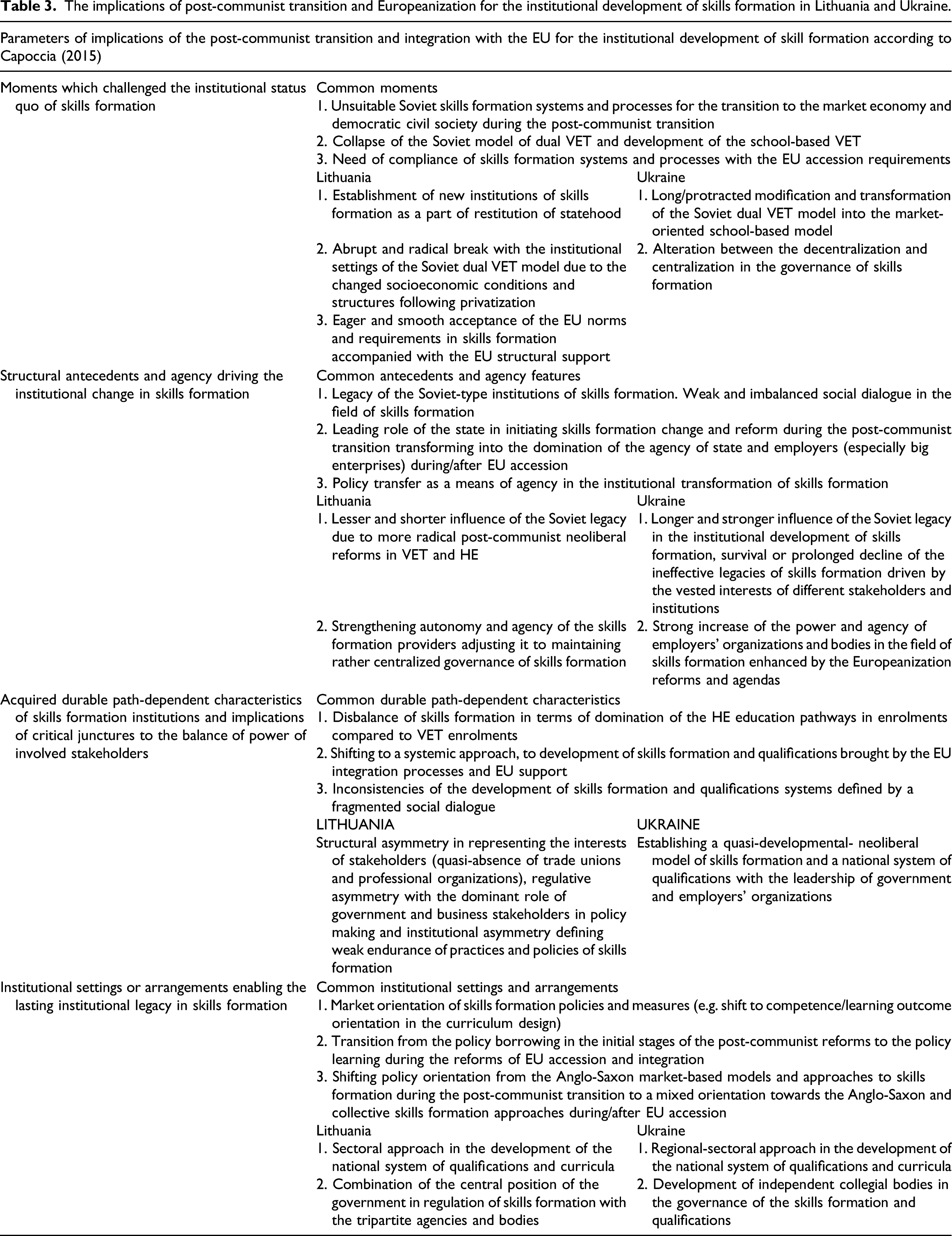
In the case of Lithuania, institutionalization of skills formation was part of quite a radical and swift institutional implementation of new statehood leading to an abrupt and radical break with the institutional settings of the Soviet dual VET model due to the changed socioeconomic conditions and structures after privatization. In the case of Ukraine, we can see a more conservative, longer and more protracted modification and transformation of the Soviet dual VET model into a market-oriented school-based model characterized by alteration between the decentralization and centralization in the governance of skills formation.
Challenges related to integration with the EU and Europeanization have also been slightly different. In the case of Lithuania, EU accession was a clearly structured and strategically binding process, which implied strong compliance to the accession requirements and eager and smooth acceptance and implementation of the EU norms and requirements in skills formation using EU structural support. In the case of Ukraine, the (revolutionary) character of the European orientation enhanced the political will and determination of stakeholders to implement different institutional changes, but the lack of a clear agenda for accession to the EU and the lack of institutional capacities makes this process very protracted and less structured, involving different drawbacks and fluctuations.
In both countries, the legacy of the Soviet-type institutions of skills formation as well as weak social dialogue in this field were important antecedent factors for the post-communist transition and reforms in skills formation which contributed to the leading role of the state in initiating skills formation changes and reforms. However, the implications of the Soviet legacy for the institutional development of skills formation were weaker in Lithuania compared to Ukraine because of more radical and swift deconstruction of different legacy settings. In the case of Ukraine, the Soviet legacy had a stronger influence on the development of skills formation institutions due to its longer impact and deeper rooting in the skills formation practices and policies, which led to the decline of ineffective legacies of skills formation driven by the vested interests of different stakeholders and institutions, like big restructured industries developed in the Soviet period.
Policy transfer has been an important means of agency in the institutional transformation of skills formation in both countries. During the initial stage of the post-communist transition, policy borrowing was an important factor for the establishment of new institutional settings and development of their capacities. At later stages, especially under Europeanization of skills formation, policy learning supported with the financial and institutional assistance from the EU significantly contributed to the development of a systemic approach to skills formation institutions and processes.
Post-communist transition reforms and Europeanization of the skills formation institutions in both countries have contributed to the development of similar durable path-dependent characteristics of skills formation systems and institutions by creating rather similar patterns of the balance of power of involved stakeholders. A rather significant domination of HE education pathways in enrolments compared to VET enrolments can be observed in both countries, which presents a significant challenge for VET development. Europeanization of the skills formation systems and processes together with the EU support in both countries have enhanced more systemic approaches to the development of skills formation and qualifications. This trend is more visible in Lithuania, where the EU accession brought a more consistent and concrete agenda of reforms, as well as more intensive processes of institutional change compared to Ukraine. It can also be presumed that in implementing the EU-supported skills formation reforms after the EU accession in 2004, policy makers and stakeholders in Lithuania enjoyed a significantly higher level of autonomy in the decision making and managing the reform processes, which enabled more mature policy learning processes compared to Ukraine, where international donors, such as the ETF, were more influential in setting the agendas and content of reforms.
However, both countries faced similar problems and challenges in the implementation of different reforms and changes of skills formation institutions related to the fragmented social dialogue and the lack of capacities and interests of some social partners (trade unions and professional organizations) to engage in skills formation.
What regards creating some lasting institutional legacy in skills formation of the both countries, market orientation became a permanent feature of skills formation policies and measures in different fields, such as curriculum design (implementation of leaning outcomes and competence-based approaches) or provision of education and training (promotion of work-based learning).
Conclusions
The institutional development of skills formation in both countries has involved different approaches to policy transfer. While the Anglo-Saxon market-based models and approaches to skills formation were the dominant sources for policy borrowing in both countries during the post-communist transition, the EU accession (Lithuania) and Europeanization reforms (Ukraine) enabled a mixed orientation to the Anglo-Saxon and collective skills formation in Lithuania and a multi-vector orientation of the policy learning in Ukraine. Important elements of such institutional legacy in Lithuania are a sectoral approach in the development of the national system of qualifications and curricula, and a combination of the central position of the government in the regulation of skills formation with the agency of tripartite structures and bodies. In Ukraine, the regional varieties of economic structures as well as strong power of some sectoral economic stakeholders have contributed to the development of a regional-sectoral approach in the development of the national system of qualifications and curricula. Strategic intentions and efforts to delegate more power and decision-making rights in skills formation to independent collegial bodies, such as recently established National Agency of Qualifications, are still threatened by the powerful state bureaucratization.
What is the role of policy transfer in these institutional changes of skills formation?
Firstly, policy transfer has contributed to the emergence of the moments which challenged the institutional status-quo of skills formation and helped institutions of skills formation to respond to these moments. In case of the post-communist transition, the policy borrowing and policy learning from Western models of skills formation was one of the key sources for capacity building of the local skills formation institutions in both countries, but especially in Lithuania, which was more open to Western policies and practices during the post-communist reforms of skills formation. In the period of integration with the EU, policy learning was a key factor which enhanced the establishment and development of the skills formation practices and institutions through the EU support and capacity building. In case of Lithuania, the systemic reforms of skills formation launched after the EU accession were initiated and coordinated by local governmental institutions, public bodies and different stakeholders, whereas EU institutions intervened with expert support and funding arrangements. In case of Ukraine, the international donors and EU institutions have had a higher involvement in setting of the agendas and content of the reforms of skills formation due to the specific socio-economic context of transition and higher deficit of the local institutional capacities and expertise.
Secondly, policy transfer has been an important means of agency in the institutional transformation of skills formation in both countries. It played a highly important role in the design of the policies and strategies, especially in the phase of EU integration marked by compliance with the EU policies and strategies and implementation of the related tools and instruments. A good example here is development of the national systems of qualifications, NQFs and competence/outcome-based qualifications and curricula in both countries.
Thirdly, policy transfer has contributed to the development of the acquired durable path-dependent characteristics of skills formation institutions in both countries. It was an important source of know-how and capacity building for shifting to a systemic approach to development of policies of skills formation and qualifications brought by the EU integration processes. However, so far, policy transfer has not been able to provide effective and sustainable solutions in tackling the key problem, path-dependent challenges, such as a fragmented social dialogue or disbalance of skills formation in terms of domination of HE education pathways in enrolments compared to VET enrolments.
Fourthly, policy transfer helped the incremental development of the institutional settings and arrangements leading to the lasting institutional legacy in skills formation. A gradual shifting of the policy orientation from policy borrowing from the Anglo-Saxon models and approaches during the post-communist transition to policy learning from the different skills formation models can be observed.
What are the key implications of this research for the skills formation practice? The comparison of the institutional development of skill formations in Lithuania and Ukraine, as well as the role of policy transfer in this process, reveals a huge and unexploited potential for intensive and mutually beneficial exchange of know-how and experience between the local skills formation actors in both countries. A similar direction of institutional change and reforms in skills formation as well as similar challenges in the development of skills formation practices, or similar needs for capacity building of the skills formation institutions and stakeholders, create a space for a valuable and promising partnership at the practice level. Such cooperation can be developed by exploiting the possibilities offered by the EU programmes (e.g. Erasmus+) or on the basis of different bilateral projects. Existing differences of the skills formation institutions and solutions should not be treated as obstacles, but rather as opportunities for an exchange and development of innovative solutions.
What are the policy implications of the research findings? The research findings of this paper can be helpful in critically reviewing existing practices of policy transfer in the skills formation in Lithuania and Ukraine, as well as in reflecting possible future scenarios.
The research has also revealed that both the post-communist transition and Europeanization of skills formation have facilitated strong market-oriented skills formation strategies and approaches in both countries, which favour human capital development and competitiveness and focus on the existing skills needs. These priorities also strongly define the content, donors and institutional mechanisms for policy borrowing and policy learning. One of the key questions here is the relevance of these priorities in skills formation policies and practices for the current and future challenges related to environmental sustainability, dealing with economic and educational inequalities, migration and other global problems. To what extent and how can the skills formation policies and institutional models of the CEE countries, which focus on ‘catching-up’ and competitiveness, respond to these challenges? What kind of policy transfer can be helpful in dealing with them? These are the questions for the future research agenda.
Footnotes
Declaration of conflicting interests
The author(s) declared no potential conflicts of interest with respect to the research, authorship, and/or publication of this article.
Funding
The author(s) received no financial support for the research, authorship, and/or publication of this article.
