



Abstract
Researchers in comparative education have suggested different ways in which their field of study can be enhanced by considering units of analysis at different levels rather than focusing on a single level such as the nation-state (Bray and Thomas, 1995; Torney-Purta and Barber, 2011). The study reported here seeks to contribute to this area of interest to comparative researchers. It does so by identifying groups for comparison that are not predefined in advance of any analysis but which emerge during the analytic process itself. Drawing on data from ICCS 2009 (Schulz et al., 2010), the intentions of 14-year-old students in five Asian societies to participate in future civic related activities are analyzed with a focus on the students’ responses to specific questions. The results show that there is considerable variation within each of these societies when it comes to type of future civic engagement. At one end of the spectrum are groups of students who are classified as “Radical Participators” while at the other there are the “Minimal Participators” and there are other clusters of students in between. Groups such as these exist in each society, although not in the same proportions. The implications of these results are discussed, especially with reference to how comparative research can be enhanced by identifying groups through person-centered analytic techniques.
Bray and Thomas (1995) highlighted the potential multi-level nature of comparative studies with their emphasis on non-locational demographic groups, geographic location and different levels and aspects of education. This multidimensional approach to comparison opened up a broader range of possibilities for comparative research and highlighted the benefits of taking account of multi-level contexts. More recently Torney-Purta and Amadeo (2013a) suggested that comparative citizenship education research based on secondary analysis of international large scale assessments could take account of person variables, context variables and process variables, the possibility of multiple interactions among these variables and the effects such interactions may have on outcome measures. Both of these frameworks for comparative research sought to broaden the scope of such research by identifying and analyzing a diversity of contexts available for investigation. In an important way such frameworks also problematized comparative research by multiplying the potential sources of variation.
In this paper we are particularly concerned with the variation in the way Asian students think about their future civic participation. The focus on the geographic location of these students is quite deliberate. It is consistent with Bray and Thomas’ (1995) focus on this level of comparison and Torney-Purta and Amadeo’s (2013a) identification of context variables in large scale assessments. Recognizing a region as a geographic location and as a specific national context that might influence students’ civic values highlights the possibility of identifying distinctive student characteristics that might be attributable to that context. Importantly, such a bounded context also signals that for the purpose of this research the values of students in Western countries are not the standard or benchmark against which to compare those of Asian students. Traditional national level comparisons, especially between Asian and Western students, were not of interest to the study reported here (although this would be a valid set of comparisons). Rather the interest was within-region analyses: with the ways students from the Asian region think about what they might do in the future once they become adult citizens of their respective societies. Yet we wish to go further than Bray and Thomas (1995) and Torney-Purta and Amadeo (2013a) whose frameworks identified observable points of comparison. In what follows our focus will be on what Holman (2004) has called “the hidden characteristics of data.”
Comparative perspectives on citizenship education studies
As citizenship education and its investigation have grown internationally, a range of studies on citizenship education has been conducted locally, nationally, cross-nationally, and internationally (Hahn, 1998, 2006; Hahn and Alviar-Martin, 2008; Schulz et al., 2010; Torney-Purta and Amadeo, 2003), resulting in the development of what Hahn (2010) referred to as “comparative civic [citizenship] education,” and argued that “the field of comparative citizenship education has gone global” (Hahn, 2010). This argument is also reflected by the prominence of international large-scale assessment studies on citizenship education, and the growing prominence of comparative perspectives about and developments in citizenship education. Scholars note that people, including policy makers, practitioners, stakeholders and researchers are becoming more interested in learning more about what others are doing in citizenship education for their own improvement and development (Kerr, 2012: 19).
Although citizenship education is implemented in different educational systems around the world with a variety of approaches and models, citizenship education research is primarily constructed on Western models of politics and the state. Alternative views of citizenship have rarely been considered, given that liberal democracy has been the dominant paradigm influencing the development of citizenship education. This case is evident in successive international civic education assessment projects (Schulz et al., 2010; Torney et al., 1975; Torney-Purta et al., 2001). Yet with “Asia’s rising,” Tellis et al. (2010) mentioned more needs to be known about contexts other than those where liberal democracy provides the foundation for political life. The student samples to be used in this study (and reported in more detail later) will move us in this direction.
This focus on Asia is consistent with Hahn’s (2010) recommendation that further research in the field of comparative citizenship education should specifically include indigenous research focused on local contexts and issues of citizenship education. Existing theoretical work has argued that Western models have a different perspective on citizenship compared to models based on the context of other regions, particularly that of Asia. Emerging literature has attempted to address issues specifically prevalent in that part of the world. In particular, literature on citizenship and citizenship education in Asia has been growing (Grossman et al., 2008; Kennedy et al., 2013a; Kennedy et al., 2010; Lee, 2004a, 2004b, 2008, 2009, 2012). These efforts have recognized the importance of tapping diverse views of citizenship in the Asian region and identifying other models of citizenship aside from those based on the Western context.
Citizenship in the Asian region
As previously highlighted, one aspect of the comparative citizenship education advocated by Hahn (2010) is the growing literature on citizenship education issues in Asia (Grossman et al., 2008; Kennedy, 2010; Kennedy et al., 2010; Kennedy et al., 2013b; Lee, 2004a, 2004b). Lee and Kennedy (2006) continued this conceptual work with a special edition of Citizenship Teaching and Learning. Further conceptual work involving the investigation on the learning theory in the Asian context has extended these theoretical explorations (Lee and Mok, 2008; Mok et al., 2011; Mok et al., 2008).
Research on citizenship education in the Asian region highlighted a number of major issues emerging from conceptual research. Kennedy and Fairbrother (2004) provided several descriptions of this work, noting common themes. First, multiple modernities in Asian countries provide fruitful contexts for citizenship education development. Second, moral virtues and personal values have had greater influence than civic and public values in shaping citizenship education in the Asian region. Third, civil society in both the West and Asia has a significant role in the formation of citizenship education. Finally, students’ own constructions of citizenship should be taken into account and their capacity to “resist” civic values promoted by families and schools should not be underestimated (Kennedy and Fairbrother, 2004).
Interest in empirically examining these regional perspectives has also been demonstrated. Asian students’ conceptions of citizenship have been one of the focal points of these studies, enabling comparisons among the views of students from different parts of the world as well as assessments of the distinctiveness or otherwise of the views of Asian students. Both theoretical and empirical studies on Asian citizenship education are expected to contribute to the discussion of regional emphasis of citizenship education beyond the Western liberal traditions. Several empirical studies have emphasized the distinctiveness of citizenship issues in the Asian region (Kennedy et al., 2013b; Kennedy et al., 2011). These studies focused on five Asian societies, namely, Taiwan, Hong Kong, Korea, Indonesia and Thailand. Kennedy et al. (2013b) focused on the interplay of traditional values in Asia and Western citizenship values and the influence on students’ civic knowledge proficiency and their participation in schools, and compared their effects in Confucian heritage tradition. Their findings indicated that the traditional values and Western citizenship values are varied across the five Asian societies under investigation – Hong Kong, Taiwan, Korea, Thailand and Indonesia. Kennedy et al. (2011) reported the variety of roles schools play in developing students’ political trust in different societies.
These empirical analyses also supported the notion that the Asian conceptions of citizenship can be understood from a perspective that is different from the traditional Western perspective (Hahn, 1998). In sum, these existing studies have provided a better understanding of Asian students’ conception of citizenship by investigating their attitudes and assessing the implications for understanding the nature and purpose of citizenship education in the Asian contexts. Hence, Asian societies and the region in which they are embedded may be regarded as distinctive entities in studying citizenship education.
Contribution of the study
The empirical studies mentioned above, though useful for identifying similarities and differences across societies, have focused on identifying those differences that are clear and sometimes even obvious. These range from broad observable characteristics such as country of origin, ethnicity, immigration status, socioeconomic status, gender, and age to personal dispositions, civic values and future civic actions. Yet our focus will be on characteristics of students that some might call “unobservable” or at least not obvious within a group of students from societies within Asia. What follows is a brief account of the theoretical underpinnings of identifying underlying typologies and, in some cases what might be called “unobservable” student characteristics.
Traditional approach to the analysis of large-scale assessment data
Traditionally, the focus of large-scale assessments, such as the International Civic and Citizenship Education Study (ICCS), is often country-by-country comparison. Each student assessed is assigned a score to represent his or her level of performance. These scale scores of individuals in turn enable calculation of an average score to represent the level of performance of the national sample.
For example, in ICCS, scale scores are produced to represent the average level of students’ expectations of voting in the future and this enables comparisons cross-nationally or internationally. A country where students had a higher average voting expectation received a higher score than a country where students showed a lower expectation. Similar comparisons were done for other variables such as “expected protest” and “political participation.”
In this kind of analysis and comparison, observable groups, often called manifest groups (Tay et al., 2011), are compared using average scale scores for a particular variable. For example, scale scores can be computed at the country level so that cross-country comparisons can be made based on these scores. Similarly, within countries scores can be computed for girls and boys separately so as to make gender comparisons based on the performance of each group. These comparisons are based on what is often referred to as observed heterogeneity in the data (Leszczyc and Bass, 1998) because the “group” is specified in advance.
Yet statisticians have argued that considering heterogeneity on the basis of manifest or observable groups only may ignore the possibility that there may be other forms of heterogeneity within data. As Morin et al. (2011: 59) indicated, results from these kinds of analyses “are obviously very important in their own right, but they simply ignore the fact that the participants may come from different subpopulations in which the observed relations between variables may differ, quantitatively and qualitatively.”
The “sub-populations” referred to above may represent observable sub-groups such as immigrants or ethnic minorities within a larger group such as a country. Yet other forms of sub-groups may also be present in data but they are less readily “observable.” Groups or groupings of individuals may be nested in the data defined by some patterns other than those that can be defined by single scale scores. For example, heterogeneity may be related to patterns of multiple scale scores (or multiple variables) that may not be investigated when only single scale scores are used as indicators for a group’s characteristics.
Once a statistical tool has been used to identify possible heterogeneity, then comparisons can be made between these previously unidentified groups. It is relatively more indirect than usual to understand the diversity within a sample beyond the uniformity signaled by an average scale score for a particular group. Therefore, diversity that is not obvious requires another way of looking at the data. Such analysis is often done in an exploratory manner (Zyphur, 2009). The following section briefly describes cluster analysis as a tool for exploring groups not identified in advance and its potential for identifying what is technically referred to as “unobserved heterogeneity.”
Identification of unobserved heterogeneity
Cluster analysis explores patterns among individuals in a sample (Okazaki, 2006) and for this reason is often referred to as a person-centered approach to analysis compared to one that focuses on the characteristics of variables. By investigating response patterns in the data, this person-centered approach to analysis can identify groups based on similarities and differences in these patterns. Individuals with more similarities are classified into the same group whereas individuals with more differences are classified into different groups (Jung and Wickrama, 2008). These “groups” were previously not identified (they were “unobserved”) – cluster analysis is an analytic technique that identifies groups composed of individuals with similar response patterns.
As a result, within each group persons often show similar patterns of performance on the variables of interest and a review of different groups will show different patterns in the variables of interest. The benefit of the above approach to analysis in the present context is that it can take on a comparative perspective to explore at the same time both commonality and difference in persons’ characteristics. This is “especially useful for large-scale studies where there are multidimensional outcomes” (Torney-Purta and Amadeo, 2013b: 98). Torney-Purta and Amadeo (2013b: 101) further argued that in the international context, cluster analysis “can identify different profiles that characterize individuals within and across countries [and] aids in interpreting the information gained from cross-national summary statistics.” Further, they explained, cluster analysis enables researchers:
to understand the strengths and weaknesses found in patterns of civic engagement than when they are told only about averages and statistical trends. It thus allowed us to examine group patterns both within and across several countries along multiple dimensions. (Torney-Purta and Amadeo, 2013b: 101)
There are also some other studies that take a person-centered analysis to the study of participation and civic engagement in other national and cultural contexts, for example, in Sweden, Canada and the United States. By using a person-centered analysis approach, Amnå (2012) investigated the change and transition of civic engagement in Swedish adolescents over time. Pancer et al. (2007) explored the distinction between “activist” adolescents and “uninvolved” adolescents. Voight and Torney-Purta (2013) identified types of civic engagement in early adolescence by using latent class analysis from a sample of students in urban middle schools in the United States.
In short, cluster analysis helps identify multiple groups that are unobservable prior to the analysis, and is particularly useful and effective when there are multiple dimensions, or variables of concern. In connection to the study reported here, cluster analysis will be used in the context of five Asian societies and five dimensions of civic engagement.
Research Questions
How do patterns of students’ intention to participate compare within and between five Asian societies?; and
What are the implications for understanding civic engagement in particular and for comparative education research in general?
Data
Brief description of ICCS
The ICCS database provided data for secondary analysis in the current study. This large scale assessment involved 130,000 Grade 8 (or equivalent) students in more than 5000 schools from 38 education systems. Among these, six were from the Asia-Pacific region (five from Asia and one from New Zealand), 26 from Europe, and six from Latin America (Schulz et al., 2010: 3). The current study analyzes data from the five Asian societies only.
Samples
For quality assurance reasons, the ICCS followed guidelines for data collection. The samples were designed as two-stage probability samples (Schulz et al., 2011: 63). In the first stage of sampling, a procedure of “probability proportional to size as measured by the number of students enrolled in a school” (Schulz et al., 2011: 19) was used to sample schools in each society.
After schools were sampled, a random selection process took place within each participating school to sample an intact class from the school randomly. Within each randomly selected sample, all students in that class were surveyed on the day the ICCS questionnaires were administered.
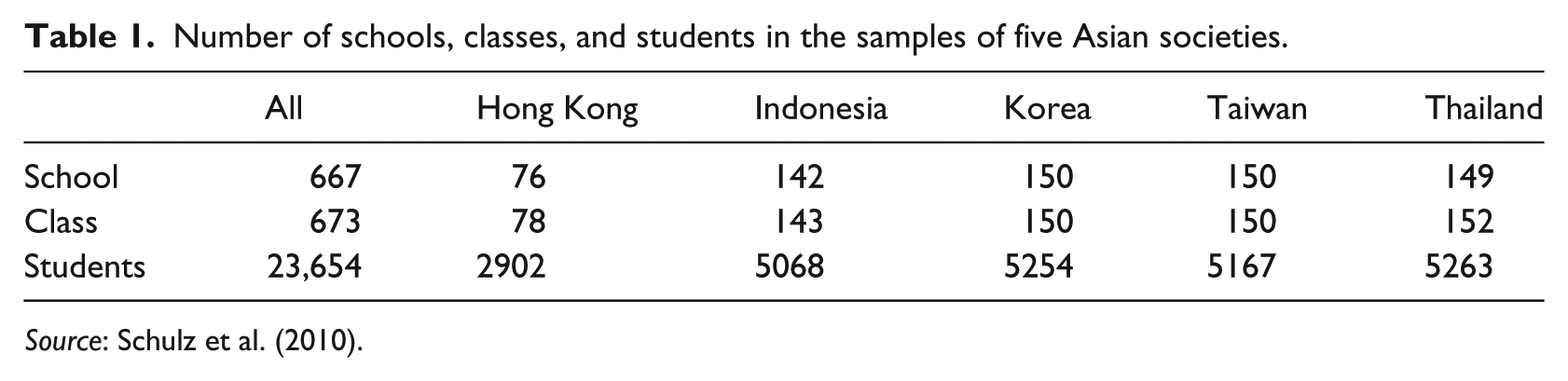
The ICCS student population was students in Grade 8 with a minimum age of 13.5 years at the time of the assessment. On average, the students were around 14 years of age. The sample sizes across the five Asian societies analyzed in this study are shown in Table 1.
Number of schools, classes, and students in the samples of five Asian societies.
Source: Schulz et al. (2010).
Five Asian societies
The samples analyzed in the current study are from the five Asian societies participating in the ICCS, i.e. Taiwan, Hong Kong, Korea, Indonesia, and Thailand. Geographically, Taiwan, Hong Kong, and Korea are in the East Asian region, whereas Indonesia and Thailand are in the South East Asian region.
Instruments
The instrument was designed to collect data on the students’ attitudes, values, behavior, and behavioral intentions about citizenship issues. Students were given 40 minutes to complete the above information in a total of 121 Likert-styled items and some open-ended types of items. The students’ expected civic participation was assessed in this student questionnaire.
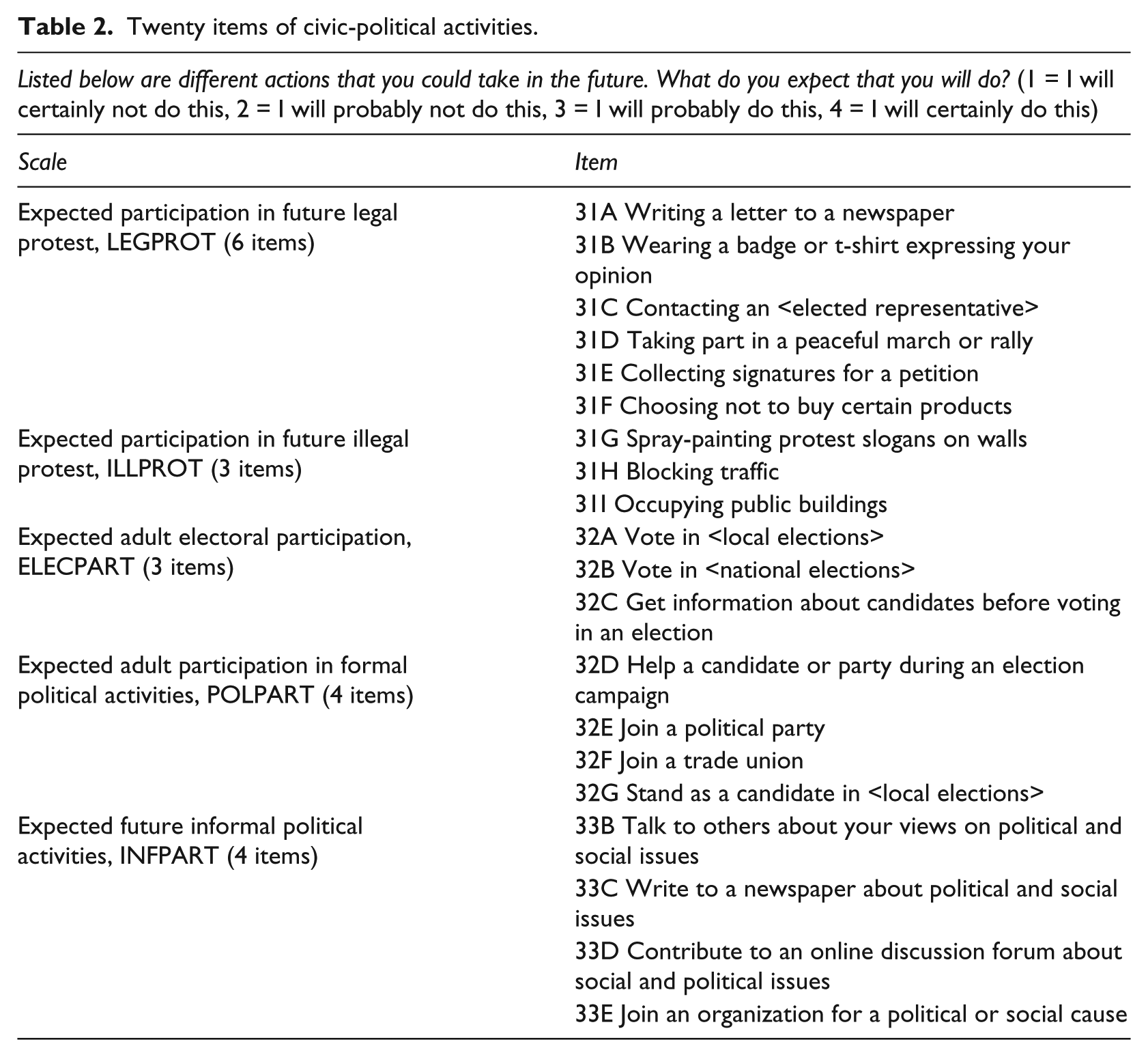
There are five different scales corresponding to a total of 20 civic-political activities (see Table 2). These are: (1) expected participation in future legal protest (LEGPROT, six activities); (2) expected participation in future illegal protest (ILLPROT, three activities); (3) expected adult electoral participation (ELECPART, three activities); (4) expected participation in formal political activities (POLPART, four activities); and (5) expected future informal political activities (INFPART, four activities). These five variables can thus be conceptualized as the students’ “intention to participate.” By focusing on expected active citizenship in the future, participating countries were ranked according to their relative performance in each of these scales with the international mean score.
Twenty items of civic-political activities.
Analysis
Cluster analysis (Chiu et al., 2001) was used to examine the potential diversity in students’ orientation toward future participation in civic activities. Cluster analysis is “a multivariate statistical procedure that starts with a data set containing information about sample entities and attempts to reorganize those entities into homogeneous groups” (Aldenderfer and Blashfield, 1984: 7). The number of clusters and the corresponding properties of the members within each cluster are unknown prior to the analysis but need to be inferred from analysis of the data (Blömeke, 2012; McLachlan and Peel, 1997).
Cluster analysis has been applied in re-analysis of large-scale assessment data (Torney-Purta, 2009; Torney-Purta and Amadeo, 2011, 2013a; Torney-Purta and Barber, 2011). According to Torney-Purta and Amadeo (2013b), person-centered analysis has been adopted in developmental psychology research (Bergman and Magnusson, 1997; Mahoney et al., 2001). Despite the increasing number of studies where a person-centered approach to analysis has been applied, this method is rarely used in citizenship education studies with some notable exceptions (Torney-Purta, 2009; Torney-Purta and Barber, 2011).
In their studies adopting a person-centered approach to secondary analysis, Torney-Purta (2009) and Barber (2011) have used cluster analysis investigating students’ citizenship attitudes. For example, Torney-Purta (2009) combined both the person-centered and variable-centered approaches by using cluster analysis with cross-national data from the 1999 Civic Education (CivEd) study. In her study, Torney-Purta (2009) used the CivEd data in two cluster analyses of the 12 scale scores of students’ citizenship attitudes, separately done on five Eastern European countries and five Western European countries. This showed that both samples can be categorized into five clusters, which she referred to as social justice, conventionally political, indifferent, disaffected, and alienated clusters. These different clusters showed distinctive profiles in their attitudes and values, and were distributed unevenly across each of the countries analyzed. For example, according to her study, across Eastern European countries, 25% fell into the conventionally political cluster in Hungary but only 10% in Estonia. In another example, across the Western European countries, 25% of the participants from England were classified into the social justice cluster but only 15% in Finland.
Although these studies adopting a person-centered approach to secondary analysis of attitudes and norms have been conducted, a person-centered approach to the analysis of civic and political participation measures remains much less prevalent. The current study focuses on students’ conception of future participation. It is worth noticing that, similar to Torney-Purta and Barber (2011), an observed variable cluster technique (rather than a latent variable cluster technique) was employed in this study. In particular, two-step cluster analysis was used. In doing the two-step cluster analysis, weights were used in the way that ensures equal contributions across the five societies.
Results
An important aspect of cluster analysis is to determine the extent to which individual respondents can be “clustered” into similar response patterns. A decision has to be made about the number of clusters to be identified from the analysis. In one sense this is a technical issue but it also needs to be informed by theoretical considerations. This article does not focus on the process of arriving at the decision on the number of clusters but those details can be found elsewhere (Chow and Kennedy, 2014). Four clusters emerged and the remainder of this article examines those clusters and the implications that flow from these results.
Characteristics of the four clusters
Figure 1 shows the four clusters and the students’ scores on the five “intention to participate” scales. Students in Cluster 1 had the highest scores across all five scales and therefore registered the highest “intention to participate”. Students in Cluster 4, which is on the bottom end of the plot, have the lowest “intention to participate” in all five sets of activities. Students in Cluster 2 have high “intention to vote” but have low “intention to protest illegally.” By contrast, students in Cluster 3 have lower “intention to vote” but higher “intention to protest illegally.” Despite these differences, Clusters 2 and 3 show comparable intention for other activities, that is, legal protest and formal and informal political activities.
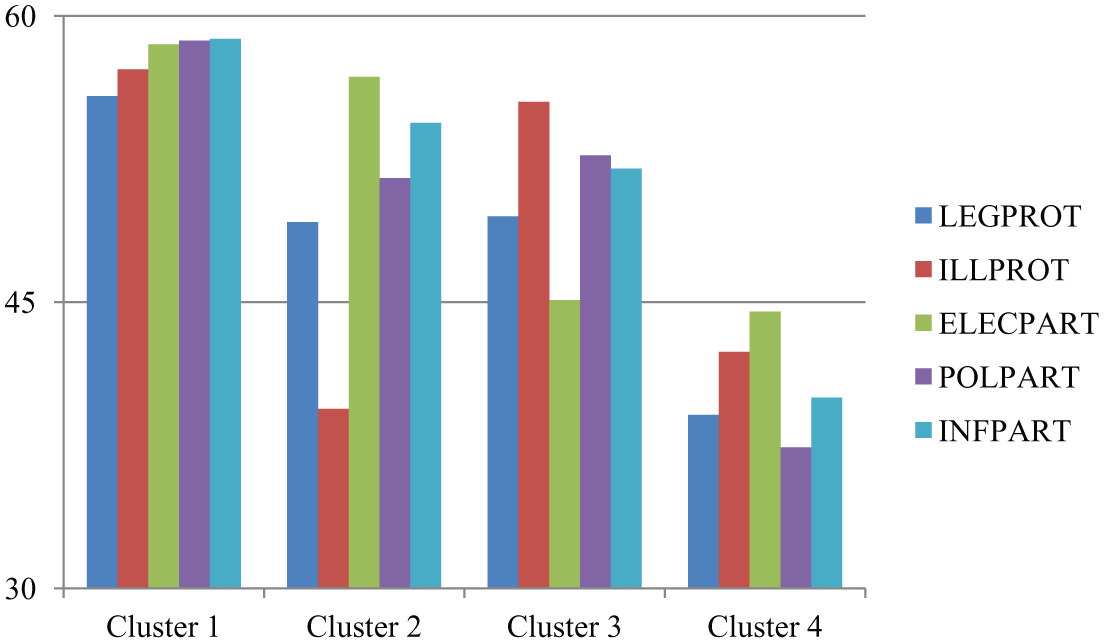
Five scale scores of “intention to participate” across the four clusters.
These clusters, which emerged from the cluster analysis, can be categorized qualitatively based on students’ average scores within each cluster. Students in Cluster 1 tend to take a very active approach to participate in society using a range of strategies to show their engagement. Such students can be labelled “Active Participators” and they made up 21.8% of the sample. Students in Cluster 2 would emphasize voting behavior but are likely to reject illegal protest. These students could be labelled “Conventional Participators” and they made up 25.7% of the sample. Students in Cluster 3 would consider illegal protests and favor voting to a lesser extent than Clusters 1 and 2 although they do not totally reject voting as a form of civic engagement. They made up 29.0% of the sample. These students could be labelled “Radical Participators.” Students in Cluster 4 have the least intention to engage in any of the civic activities. These could be labelled “Minimal Participators” and they made up 23.5% of the sample. These similarities and differences across four clusters add qualitative and theoretical weight to the four-cluster solution and enhance the interpretability of the results, which is a key issue in cluster analysis (Marsh et al., 2004). Statistical tests can be conducted to validate further the distinctiveness of any cluster solution and for the solution reported above such tests were conducted and have been reported elsewhere (Chow and Kennedy, 2013). Yet for the purposes of this article it is the theoretical adequacy of the identified clusters that are highlighted.
Comparison of participator groups across the five Asian societies
The figures referred to above indicated the broad distribution of participator groups for the whole sample. The second step is the comparison of the groups across the five Asian societies. This distribution is shown in Table 3.
Distribution of participator groups (%) across the five Asian societies.
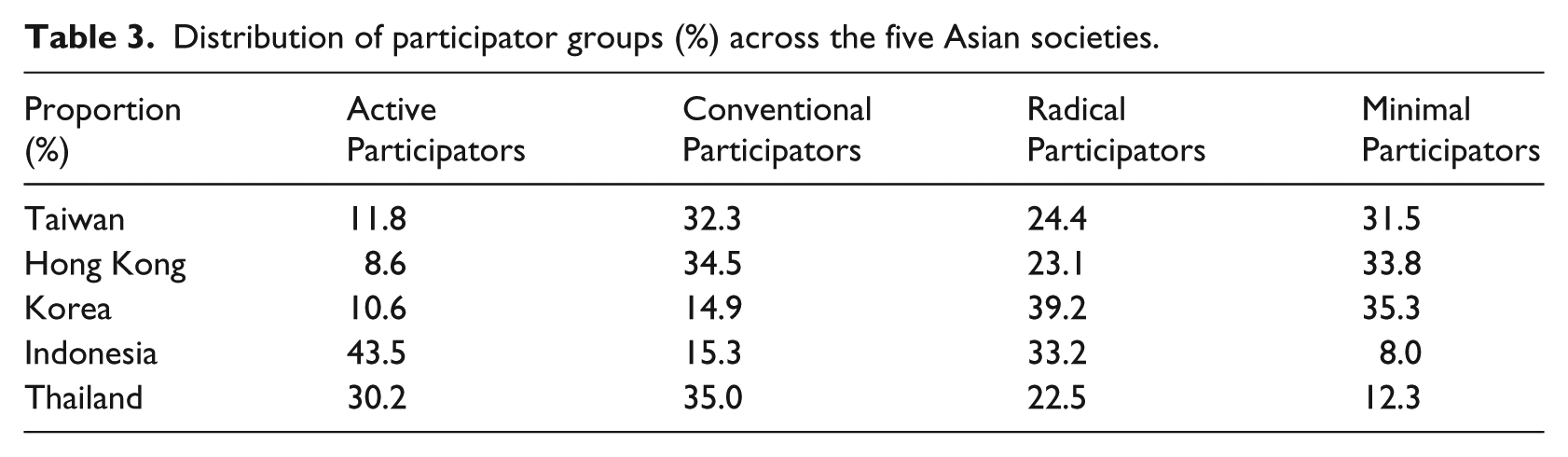
A number of points can be made about these results. First, all participator groups are represented in each society (at least 8%). There are dominant clusters within each society but these differ from society to society suggesting that context may play a role in the way clusters develop in different societies. Second, despite the obvious heterogeneity in the way clusters are distributed across and within societies, there is also a degree of similarity. For example, the three East Asian societies, namely, Taiwan, Hong Kong, and Korea, share a certain degree of similarity in participation group proportions. Similar proportions with regard to Active Participators were observed: Taiwan (12%), Hong Kong (9%), and Korea (11%). Such similarity was also observed for Minimal Participators: Taiwan (32%), Hong Kong (34%), and Korea (35%). This pattern is not shared by the two South East Asian societies, Thailand and Indonesia, and there is no obvious pattern that these two societies share except in relation to a similar proportion of Minimal Participators: Indonesia (8%) and Thailand (12%). The results in Indonesia may be influenced by a large number of missing answers and the need for imputation of missing data.
The groupings of students from the five Asian societies shown in Table 3 was not identified in the ICCS International Report (Schulz et al., 2010). These results have emerged from the analysis conducted in the present study. The results show diversity both within and across societies in terms of students’ intention to participate in the future. These results are discussed below.
Discussion
The adoption of cluster analysis in this study sought alternative ways of understanding how students from Asian societies conceptualized their future civic participation. This person-centered approach to analysis is not an innovation in this study except in as much as it was used with samples of Asian students. The approach was an extension to previous work done by Torney-Purta (2009) and Torney-Purta and Barber (2011). The focus was on comparisons both within each society as well as across societies.
Heterogeneity in proportion of participator groups
Cluster analysis applied to the data in this study provided a classification of students in four distinct groups that cut across national boundaries – Active Participators, Conventional Participators, Radical Participators and Minimal Participators. Representatives of these groups could be found in each Asian society, thus demonstrating considerable heterogeneity within each society. These results do not identify an “average” level of future civic participation but rather distinct groups with varying orientations to future participation. Despite the sub-regional homogeneity for East Asian societies referred to above, there was considerable regional heterogeneity especially between East Asian and South East Asian students. Thus Asian students cannot be regarded as a homogenous group and individual Asian societies cannot be regarded as homogenous when the students’ intention concerning future civic participation is considered. It is even difficult to attribute the role of history, politics and culture in shaping young people’s attitudes to participation because of the diversity of orientations to participation within societies (Almond and Verba, 1963). Asian students’ conceptions of civic engagement are complex and explanations about conflicting conceptions within national groups cannot be easily provided. Further studies that are qualitative in nature would be necessary to attempt to answer the question of why a particular society demonstrated a particular distribution of these groups. Cluster analysis, however, has the potential to provide nuanced and insightful representations of the conceptions of students and their attitudes toward future civic participation. We shall return to this point later when we discuss the implications for comparative education.
The findings in this study appeared to support sub-regional homogeneity. Table 3 shows that the three East Asian societies share a certain degree of similarity. These societies had similar proportions of Active Participators (9% in Hong Kong, 12% in Taiwan, and 11% in Korea) and Minimal Participators (32% in Taiwan, 34% in Hong Kong, and 35% in Korea). The two South East Asian societies did not exhibit the same pattern, although they shared a similar proportion of Minimal Participators (Indonesia at 8% compared to Thailand at 12%).
However, a more detailed examination of the data does not fully support the sub-regional homogeneity hypothesis. Initially, only Hong Kong and Taiwan demonstrated a very similar grouping proportion in two groups, that is, Conventional Participators (35% in Hong Kong and 32% in Taiwan) and Radical Participators (23% in Hong Kong and 24% in Taiwan). In contrast, Korea did not share this similarity with around 40% of students in the Radical Participators group. The South East Asian societies, Indonesia and Thailand, showed more heterogeneity; despite a similar proportion in Minimal Participators (8% in Indonesia and 12% in Thailand), they had a gap between the other three clusters: a difference of proportion from 10% (Radical Participators), 14% (Active Participators), to 20% (Conventional Participators), as shown in Table 3.
This result challenges the contention of sub-regional homogeneity. The results indicated that the attitudes of students within sub-regions were more complex than the regional divide suggested by the comparisons of scale scores. Further studies may investigate the reasons Korean students are different from their peers in East Asian societies, or the reasons Thailand and Indonesia exhibit more differences than might be expected from a sub-regional hypothesis. Additional data from more societies in Asia may help identify the factors that contribute to these phenomena and this could be a focus in further studies.
Implications for comparative education studies
The above findings have implications for comparative citizenship education studies based on the literature reviewed above (Hahn, 2006; Torney-Purta and Amadeo, 2003). The present study responds to the question of whether the nation-state or national educational system remains the best unit of comparison and analysis (Bray et al., 2007), or whether other useful units of comparison that consider the impact of globalization and increasing global inter-connectedness exist (Kerr, 2012: 26). An exploratory approach to analysis was employed in the current study to identify previously unobserved groups. Whether the groups identified have been more influenced by political socialization factors within individual societies or by globalization across societies remains a question for further comparative research. For example, a number of key questions for comparative researchers emerge from the current study:
Are Active Participators (or any of the participator groups) in Korea more like similar groups in the other Asian societies or do they still share common civic values within their society?
How do common histories, cultures and social values in each society result in such diversity within those societies when it comes to future civic participation? Lee et al. (2014) have highlighted the importance of context in the field of comparative education but in this study results are nevertheless very diverse for the same individuals who have experienced the same context.
What is the nature of the differences between students in East Asia and those in South East Asia? This is not the first study to identify such differences (see, for example the general results of ICCS 2009 and the most recent PISA studies) so this has become quite a fundamental question for comparative researchers.
These are complex questions for comparative researchers and they have emerged from the current study focusing on the analysis of individual student responses rather than single variables. The questions suggest it is time to move beyond the simple cataloguing of differences between Asian societies to finding explanations for those differences. It is a challenging agenda for comparative educators.
Using cluster analysis in this study was a way to address Levi-Faur’s (2004) call for new innovative approaches to comparative studies through
new languages, new terms, new procedures and new instruments of inference; it is, in short, to innovate and to move on with a critical view of the dominance of both case-studies and statistical approaches. It also implies an effort to bridge the divide between case-[person-] and variable-oriented research.
But more such studies are needed. For example are the differences both within and between societies identified in the current study also reflected in similar studies of students from European countries or Latin American countries? Or has this study identified a peculiarly Asian response to how students view future civic participation? This is another challenging question for comparative researchers.
Finally, this study also has implications for what is being compared in comparative inquiry. Bray and Manzon (2014: 232) have indicated that “the field of comparative education is dominated by geographic descriptors. When countries are taken as the units of analysis, in most cases the boundaries can be taken as clearly defined.” This study has shown that geographic boundaries are limited in explaining Asian students’ future civic participation and that there is similarity across those boundaries as well as within. Therefore a continued focus on making comparisons between geographic units without considering the diversity within those units is likely to yield misleading results. A more useful approach in the future, at least in terms of well-defined geographic units, should be to compare like groups across different units because then the comparisons are meaningful. The issue here is identifying appropriate units of analysis for comparative research and comparing “like with like.” Rather than conventional geographic units, it is subgroups within and across those units that may yield the more interesting results.
Limitation of the current study
The participation of citizens in society is not limited to political participation. Researchers suggested that attention should be paid to other facets of participation that are relevant to the community (e.g. Torney-Purta, 2009; Torney-Purta and Amadeo, 2011; Torney-Purta and Barber, 2011). This study, however, mainly covered civic activities and focused on adolescents’ expectation in relation to their civic participation in the future when they become older or reach adulthood. Another limitation is the difficult reading level of some of the items in countries such as Indonesia, which led to large amounts of missing data that had to be imputed.
Conclusion
This study has shown how cluster analysis, a person-centered analytic technique, can identify diversity in a sample that remains unobserved without the use of such a technique. In this sense, the study has added “unobserved heterogeneity” to Bray and Thomas’ (1995) model and to Torney-Purta and Amadeo’s (2013a) call for a more expansive approach to comparative citizenship studies. The results showed that there was considerable diversity when it comes to students’ future civic participation and that this diversity was as obvious within societies as it was across societies. These results have provided another example of how a person-centered approach to analysis, as previously also demonstrated in Torney-Purta (2009) and Torney-Purta and Barber (2011), can serve the new comparative research agenda that should be concerned with identifying and understanding multiple forms of heterogeneity in data and finding explanations that account for such heterogeneity. It is a challenging agenda for the future.
Footnotes
Funding
The research reported here is part of a Hong Kong Research Grants Council General Research Fund project, Asian Students’ Conceptions of Citizenship: Constructing Indigenous Views of Citizens, Citizenship Education and the State [HKIEd 842211]. The views expressed here are those of the authors.