



Abstract
Recently, increases in numbers of international schools have been fuelled by a growth in numbers of aspirational families selecting them. The perception that international education affords children access to social advantages has been established in the school choice literature, but there has yet to be an examination of this trend in relation to parental engagement in international schools. Views of parents on this growing trend will be sought in a separate study, but in this paper we approach the problem through international school staff perceptions of issues relating to parents. These emerged during interviews with those responsible for implementing one part of the International Baccalaureate Diploma Programme: Creativity, Activity, Service. A communities of educational practice framework, adapted for parental engagement, indicated previously unidentified tensions in the international school/parent relationship. Conditions in international education markets create conditions that tip the balance of power, conventionally with the school, towards already-privileged international school parents, raising important questions about the relationship between international schools and social inequalities perpetuated by education.
Keywords
Introduction
International schools offer an increasingly important and distinct form of research approach to international education (Dolby and Rahman, 2008). With their traditionally multicultural and transient population of children of globally mobile expatriate professional parents, the largely English-medium international school sector has, until very recently, been expanding rapidly (Bunnell, 2020; Hayden, 2011); the impact of COVID-19 on this trend is as yet unknown. Key factors fuelling recent notable growth include not only increasing numbers of globally mobile professional parents, but also a change in the nature of the sector as a growth in globally mobile students has been accompanied by a proportionally much larger increase in recruitment of students drawn from ‘host’ countries’ aspirational middle classes. The balance between children of expatriate and local families attending international schools is estimated to have shifted in the last two decades in favour of the latter, from 80:20% in 1989 to 20:80% by 2019 (ISC Research, 2019). Demands for international schooling from ‘host country’ families arise from the benefits some attribute to ‘internationality’ (Breidenstein et al., 2018), such as giving their child advantage through the experience of an English-medium education leading to an internationally recognised pre-university qualification, and are intimately connected with parents’ aspirations concerned with potential for their children to access international opportunities. Closely associated with the growth in international schools and those wider opportunities is the growth of curricula designed with an international focus, including the widely recognised continuum of four programmes offered by the International Baccalaureate (IB).
Despite the research base for both international schools and international curricula notably extending in recent years, there have been few recent studies on the school/parent relationship involving parents of international schools. The small number that have focused on this relationship tend to concentrate on issues around parental choice (see, for instance, Ezra, 2007; MacKenzie et al., 2003; Potter and Hayden, 2004), with few if any relating to other aspects of the relationship between school and parent. The relationship is the subject of research in another growing field: that of parental engagement. This paper brings together insights from both bodies of literature to examine the complexities of the school/parent relationship in the particular context of international schools, with the aim of contributing to both fields while attending to the implications for the stakeholders in question. We are further prompted by the inter-relatedness of aspiration and international education to attend to the effects of marketisation as it manifests in the teacher/parent relationships in international schools.
Catering largely for relatively affluent, professional and well-educated families – globally mobile or otherwise – and, thus, for a narrower stratum of socio-economic status than would be found in most national contexts of education, international schools are considered here in relation to the extent to which they reflect conventional conceptions that underpin research in the field of parental engagement more widely. Writing within a national context, Goodall (2021), for instance, agrees with Treanor (2017) when arguing that parental engagement research focusing on parents of lower socio-economic status is, in part, responsible for perpetuating a deficit discourse around parents. Goodall (2021) goes on to point out a further failure to recognise the structural inequities that perpetuate the dis/advantages of social class. Although there is some understanding about how class advantage plays out in international education to re/produce social elites (Hayden et al, 2020; Kenway et al., 2017; Maxwell et al., 2018; Tarc and Tarc, 2015), there is debate, in the context of school choice, as to the impact this has on the conventional conception of the school/parent relationship that schools dictate practices of parental engagement. Some argue that this is destabilised when parents are framed as ‘customers’ in the education market (Angus, 2015), while others argue that teachers in a marketised sector still maintain the balance of power by virtue of their professional status as educators (Breidenstein et al., 2020). The particularities of the international school/parent relationship have yet to be considered within this debate. We undertake this consideration and add a further acknowledgement of the multiple forces at play when parents, aspirations and international education are interwoven. We argue that the international school/parent relationship offers a microcosm of issues of global significance, relating to the emergence of a global middle class (Ball and Nikita, 2014) through the shift towards local families opting for international education, and that this has implications that reshape local and international educational contexts and the actors in them.
Parents’ perceptions are central to parental engagement research, and it is clear that there are multiple perspectives to consider. In the context of globalisation and marketisation, which come to the fore in international school research, we follow Bunnell’s (2017) call to recognise international schoolteachers as occupants of a neglected middle space in the emergent ‘business expatriate’ concept. Drawing on Bourdieu, Bunnell (2017) presents international schools as ‘fields’ where the development of societal and cultural norms (‘habitus’) create often uncontested hierarchies (‘doxa’). In the wider school community, teachers and parents operate within a complex set of power relations. The teacher as professional is also an employee, simultaneously holding high and low status with parents, and operating in a series of hierarchies and potential inequalities: ‘caught in the middle – seen as superior (to some) but deemed inferior to (and by others)’ (Bunnell, 2017: 199).
We find, in Bunnell’s (2017) suggestion that they be conceived as ‘middling actors’, a conceptual and methodological rationale for framing their perspectives on international school/parent relationships that brings to the fore the conditions of marketisation within which many such schools operate. Additionally, it connotes the distinct mix of market and cultures, as well as building on a small number of recent studies that point toward the value of gaining teachers’ perspectives into parental engagement (Borup, 2016; Boyd, 2015). Finally, as Breidenstein et al. (2020) note, the view of ‘providers’ is not common in research on parental choice, as we ourselves have noted in the field of international school/parent relationships. Therefore, our contribution aims to further inform current conceptions of this relationship from a less commonly acknowledged group of middling actors.
By examining the ways in which staff at international schools perceive parents, we offer an insight into the parent/school relationship in these complex educational settings, and examine moves in the conventional power balance between parents while raising questions about the role of international schools in perpetuating privilege.
Parental aspirations and international education
Education has long been linked to families’ class aspirations (Desforges and Abouchaar, 2003; Lareau, 1987; Sacker et al., 2002). The inter-relation of socio-economic status and parental aspirations can, in some cases, bring socially beneficial outcomes (Baker and Barg, 2019), while parental aspirations have been found to relate to beliefs about children’s individual future prosperity amongst parents who have the funds and inclination to opt out of local provision to pay for private education (Angus, 2015). Discourses that conflate education and social advantage (Ball, 2003) thrive in a marketised education sector (Ball, 1993; Bowe et al., 1994) and rest on the belief that competition will drive up standards of academic attainment (Lauder et al., 1999). While parents from less privileged backgrounds who have class ambitions (Lynch and Moran, 2006) are advantaged only if they can operate strategically within the education market (Benson et al., 2015), this process takes on new significance in the context of international education.
There has been a tendency to frame international schools as highly marketised economic environments (Brummitt and Keeling, 2013; Bunnell, 2019; MacDonald, 2006) that invokes a related conceptual vocabulary such as brands, marketing, profit and, importantly for this article, the parent-consumer (Angus, 2015). However, bracketing this sector with other global markets risks ignoring specific characteristics of aspirations connected with international schools. Although there has long been a desire for elite education on a national level, at international level this phenomenon is relatively recent. Continued growth across the sector (Bunnell, 2020), and particularly in China and Southeast Asia (Kim and Mobrand, 2019; Young, 2018), has broadened access to international education in competition with local schools. Competition is played out in local, not global, contexts that are strongly influenced by regional and national cultural, religious and policy factors. Indeed, in the context of the school choice literature, parents are framed as responsiblised actors who choose international schools as desirable alternatives to ‘local’ schools (Breidenstein et al., 2020; Lee et al., 2021; Proctor et al., 2020). Thus, parent-consumers are framed as simultaneously shopping for education in local markets and global markets, with local schools appearing relatively less desirable compared to the international trajectories marketed by international schools. In this setting, the already-complex site of international schools is interwoven with national and international forces, shaping the actors, relationships and values within them.
Certain educational qualifications, valued for their transactional character (Bourdieu, 1986) as an economic and a private good (Besley, 2011), give possessors tacit advantages and a competitive edge in the global jobs market (Brown et al., 2011; Törnqvist, 2019). When parents’ aspirations for their children have this global reach, an international curriculum which promotes the development of multilingualism, intercultural understanding and international mindedness may be particularly attractive. One such curriculum is promoted throughout the IB continuum – the Primary Years, Middle Years, Diploma programmes (Hill, 2010; Walker, 2002) and, since 2014, the Career-Related Programme (Hayden et al., 2017b) – arguably the most well-known and widely offered form of international education found in international schools. Furthermore, the IB Diploma is an internationally recognised university entrance qualification (Hayden and Thompson, 2011) that seeks to develop individual characteristics through involvement in extra-curricular activities and service volunteering. Such activities can be found in Creativity, Activity, Service (CAS), a compulsory, experiential learning element at the core of the IB Diploma (Hayden and McIntosh, 2018; International Baccalaureate, 2015). Arguably fostering certain characteristics is a point of alignment that is shared between school and parents, though this brings potential to make the delineation of school and parental responsibilities is less clear.
Parents who opt for an international school offering the IB Diploma may have aspirations that extend beyond educational outcomes. Some argue that international education constructs the kind of workers valued by multinational companies (Resnik, 2008) and, when the global labour market is increasingly competitive, young people who develop ‘international’ characteristics may stand out amidst other, similarly well-qualified, potential employees (Kenway and Fahey, 2014). Furthermore, international schools have been connected with contributing to class-making (Kenway et al., 2017; Tarc and Tarc, 2015) that further advantage their students.
Seen this way, parental aspiration is inextricably entangled with international education, financial investment and social mobility. We fully recognise that the parent-consumer (Angus, 2015) has expectations about the products of an international education that include, but may not be limited to, educational outcomes, but we argue that this representation of the parent is simplistic; it can be contested when the perspectives of staff are introduced (Breidenstein et al., 2020), particularly where they are seen as middling actors.
International schools and international school parents
The earliest subscribers to international schools were geographically mobile, largely comprising diplomatic or military personnel, or business people (Hayden and Thompson, 2013). International schools have been intimately connected with the International Baccalaureate Diploma from those early days, offering educational continuity for children changing school at regular intervals. Although not all international schools offer the IB, continuity remains an intention of the IB four programme continuum (Hayden and Thompson, 2013; Law et al., 2012), which may attract those increasing numbers of parents, with the motivation and means, who leave their home country in pursuit of better employment opportunities (Lijadi and Van Schalkwyk, 2018). To such aspirational parents, the international school sector may be attractive, particularly if payment of school fees is included as part of a relocation package or employment contract (Zilber, 2005). Such schools may offer the IB Diploma, although not all do, and neither is the IB Diploma found solely in international schools (in the USA, for instance, it is widely offered in state-funded schools). However, parents exercising this choice bring a further dimension to the already complex international school/parent relationship.
The complexity is historic. Many international schools began as parent cooperatives, with parents on the school board influencing governance (James and Sheppard, 2014) and performance through staff recruitment and policy direction (Hayden, 2006). Additionally, a number of teachers in international schools are themselves parents of children attending the same school (Zilber, 2005), and for transient expatriate families, volunteering at school can be a way through which parents can meet others in a new country (Hayden, 2006). The parent group in traditional international schools have particular characteristics worth noting. Sometimes parents have to communicate through interpreters or are physically absent because their children board at the school (in cases where the school offers residential facilities). In some contexts, nannies, drivers or maids employed to look after the children can become families’ proxies (Bradley, 2010), while cultural expectations about parent/teacher relationships may need delicate handling (Shaw, 2001). Expectations about the relationship are mediated by staff who, particularly when they are expatriate, serve as middling actors between parents and the school (Bunnell, 2020) to reflect Western practices and values embedded in the IB curriculum (Van Oord, 2007).
It may once have been the case that parents valued international education for reasons including its promotion of multilingualism (Potter and Hayden, 2004), developing and sustaining English fluency (Wright and Lee, 2014), gaining a qualification with global recognition in schools offering the IB Diploma (MacKenzie et al., 2003) or the liberal world views associated with an international education (MacKenzie, 2010). International education has now also become associated with aspirations for ‘better’ employment prospects (Resnik, 2012a).
Aspirational parents with limited financial capital but whose work contributes to transnational businesses and organisations have been dubbed the global middle class. According to Ball and Nikita (2014), the global middle class choose schools that advantage their children in highly competitive education or employment markets. Such practices place school choice within a framework of globalisation and international mobility, and link international education with cultural capital (Plum, 2014) and a long-term investment in ‘reputational capital’ that flows from the prestige of attending schools that provide it (Potter and Hayden, 2004). For example, parents in Hyderabad, India, were found to value a private international school offering the IB Diploma Programme over a local fee-paying school, for the language skills developed through the DP and its association with securing middle-class employment (Gilbertson, 2014). Thus, the international school was perceived to provide its students with linguistic and cultural capital unavailable to students attending the other school, resulting in a value-hierarchy even amongst those families able to afford private schooling.
Consumer parents, who may be expected to be empowered (Allen, 2000), can be seen as a driving force (DiGiorgio, 2010) in pursuit of an education with perceived advantages in international higher education (Clifford and Montgomery, 2017) and employment markets (Brown et al., 2011). Whereas the school might conventionally be considered ‘the privileged locus of learning’ (Goodall, 2017: 5), under globalised and marketised conditions we ask how and in what ways do international schools’ parents disrupt this convention. We do so by examining teachers’ perceptions of parental engagement and, in particular, the extent to which the aims of international school parents and staff align.
Parental engagement and international schools
A key premise of parental engagement research is that schools and parents share responsibility for bringing up children (Hargreaves and Lo, 2000). Although schools focus on academic matters they, like parents, have wider pastoral concerns. While schools’ role in children’s development is part of the formal requirements of care in loco parentis, parents’ role in supporting learning is less clear. Indeed, there is disagreement about what parents can best do to support their children’s learning outcomes. Whereas Epstein (1995, 2010) wrote about what she described as parental involvement – identifying parenting, communicating, volunteering, learning at home, decision-making and collaborating with the community – parental engagement tends to focus on parenting practices that specifically support learning (Goodall, 2017; Goodall and Montgomery, 2014). Núñez et al. (2015) suggest that parents who engage in children’s learning contribute to a statistically significant improvement in their children’s academic achievement in junior and high school, although this upholds the position of parents as ‘helpers’ (Epstein, 1995) and as subsidiary to schools’ focus on formal learning.
While parental involvement positions parents as subsidiary to schools, parental engagement seeks to encourage a more balanced relationship, or parent–school alignment (Huat See and Gorard, 2015), thereby addressing social inequalities reproduced in education. Arguments that focus on improved educational outcomes as the chief benefit gained by engaging parents (Hoover-Dempsey and Sandler, 1995) overlook the impact of other factors such as families’ socio-economic background (Organization for Economic Co-operation and Development, 2016) or the quality and quantity of child–parent interaction (Goodall, 2017). While those with upper and middle socio-economic status predominately benefit from parental engagement (Baker and Barg, 2019; McNeal, 2001), the social justice agenda, in which much parental engagement work is rooted, may be contributing to the problem it is trying to overcome (Goodall, 2021).
Limitations recognised in parental engagement research include under-theorisation and homogenisation of the parent group (Reay, 1995) as disempowered (Goodall, 2021), as well as failure to recognise the complexities of school/parent relationships (Todd and Higgins, 1998). This suggests a need for research that examines parents who occupy varied social positions, and which acknowledges education as part of the mechanisms of capitalism that perpetuate systemic social inequity. Turning attention to schools that attract those who have, or are aspiring to, higher socio-economic status is one way to generate such research. This approach has implications for conceptions of school/parent relationships that rest on assumptions of alignment with respect to educational outcomes.
In the context of the IB Diploma, alignment between teachers’ and parents’ aspirations might be expected when parental engagement activities aim to support academic success. This scenario reflects the conventional conceptions of engagement, where parents’ activity is led by the school. However, we suggest that CAS, a compulsory non-academic element of the IB Diploma with three experiential learning strands, may present opportunities to engage parents differently. CAS requires students to engage in activities that are creative, physically active and involve volunteering or service, and to combine two or more of the strands in a CAS Project. The IB claims that, through CAS, students develop open-mindedness, collaboration, communication and critical thinking (Hayden et al., 2017a) as well as international mindedness (Barratt Hacking et al., 2018), arguably characteristics that can be equally supported by parents. However, progress towards completing CAS is monitored by staff – often referred to in schools as CAS Coordinators or IB Diploma Coordinators – who have the power to authorise a ‘pass’ in this aspect of students’ studies, without which they will not be awarded the IB Diploma. Such Coordinators retain the conventional balance of power invested in them by educational structures, but experiential learning aimed at developing students’ personal characteristics opens a space where their work overlaps more closely with parents’ responsibility. This makes CAS a site of activity where schools’ and parents’ goals may meet to work towards a common goal (Wenger et al., 2002).
Communities of educational practice
We adopt here a communities of educational practice lens to examine the international school parent/teacher relationship, suggesting this relationship is mediated by ‘collective learning in a shared domain of human endeavour’ (Wenger, 2011: 1). Teacher/parent relationships are conceptualised as practices of teaching and learning that support children towards adulthood. We recognise that these practices extend beyond classrooms to include extra-curricular activities and parental engagement, which occur within a community of educational practice comprised of students, staff and parents. The communities of practice approach has been criticised for failing to take power and hierarchy into account, especially in competitive contexts (Pemberton et al., 2007; Probst and Borzillo, 2008), and we acknowledge these facets, particularly the existence of hierarchies, in the relationships between international schools and parents. Nevertheless, we suggest that this analytical framework supports examination of alignment which can shed light on the power relations between these two groups.
While a school’s staff are a core group with power to coordinate activities aimed at achieving the community’s objectives, parents, conventionally, remain peripheral. Seen this way, conventional school/parent relationships produce a hierarchy where staff have power as agenda-setters whilst parents’ agendas are subsidiary. However, knowledge is also hierarchical. Formal learning led by staff adhering to academic curricula, such as the IB DP, is privileged over more informal, parent-led learning, such as storytelling and conversation. Here Wenger’s later work, which expanded to include informal learning (Wenger, 2011), is helpful in conceptualising the legitimacy of informal learning within formal education. Because CAS is a compulsory experiential element of the DP, this informal learning becomes legitimated within the curriculum as well as more closely aligning with informal learning activities typical of child/parent interaction. This legitimation unsettles the formal/informal knowledge hierarchy as well as conventional school/parent relationships.
Wenger (2011) suggests a framework for understanding the teacher/parent relationship in educational practice (see Table 1). Parental involvement (1) is the first of four ways in which Wenger (2011) conceptualises schools’ educational practices to actively engage peripheral community members. Participative practice (2) incudes learning experiences organised by staff, such as drama workshops or laboratory experiments, where content is immediately relevant to curricular aims. Extending the school community (3) can occur when participants from outside the traditionally defined school community are involved, for example, in school work-experience placements. Finally, extending the focus of educational practices to students’ lifetime (4) can include topics that are relevant to students beyond their initial schooling and the usual remit of teachers’ responsibilities.
Parent/school practices framework; adapted from Wenger (2011).
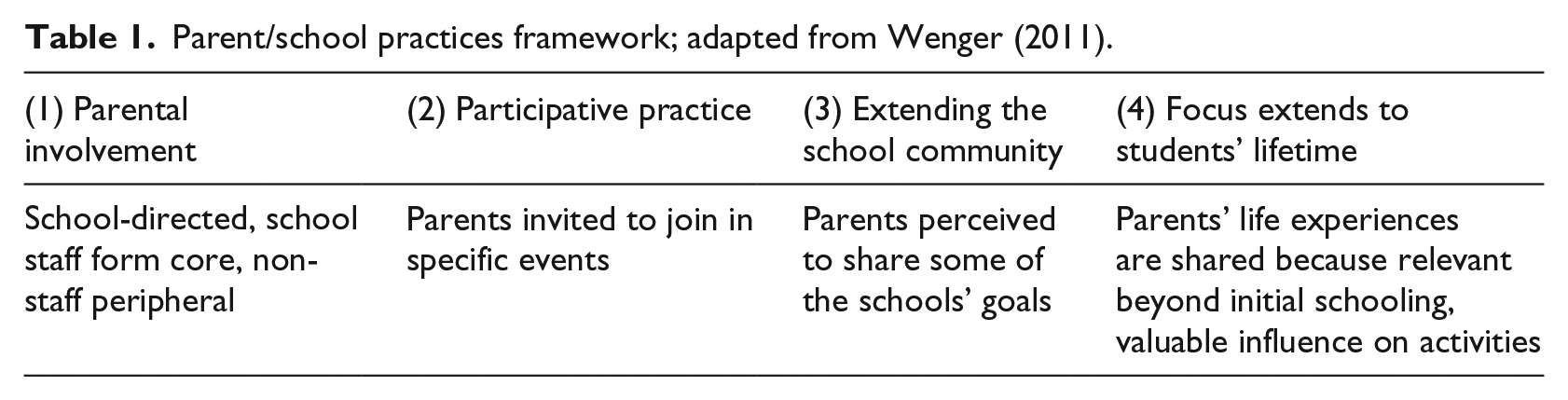
The fourth section, we suggest, creates a space for parents to become legitimate participants in educational practices, through their expertise in informal learning practices, although tensions may emerge between what staff and parents consider valuable and relevant.
Existing research suggests that experiential learning arising from participating in CAS has the potential to be transformative (Hayden and McIntosh, 2018), increasing students’ awareness of socio-economic issues and their own role in promoting social change (Lindemann, 2012). The way in which CAS is implemented (Kulundu and Hayden, 2002) and how CAS is valued in individual schools (Martin et al., 2016) is mediated by CAS Coordinators and IB Diploma Coordinators in particular. Coordinators tend to have leadership roles that involve contact with parents. Their perceptions of the school/parent relationship give insights into the relative power of the actors and can contribute to debates about the tacit advantages of an IB Diploma education which groom (Kenway and Lazarus, 2017) students to join an international elite.
Methodology
The data set drawn on here was part of that collected for a large, two-phase mixed-methods investigation of the impact of CAS on students and communities (Hayden et al., 2017a). The participant groups were Coordinators, students and alumni in international schools offering the IB Diploma. Sampling was purposive, selecting international schools where CAS was implemented from two of the three IB global regions: Asia-Pacific and Africa, Europe and the Middle East. The Americas were excluded as a study on civic-mindedness in this region, undertaken just prior to the large study, had focused extensively on CAS (Billig and Good, 2013). Interviews included an element of convenience sampling to coincide with pre-arranged travel, while the remainder were conducted remotely via Skype.
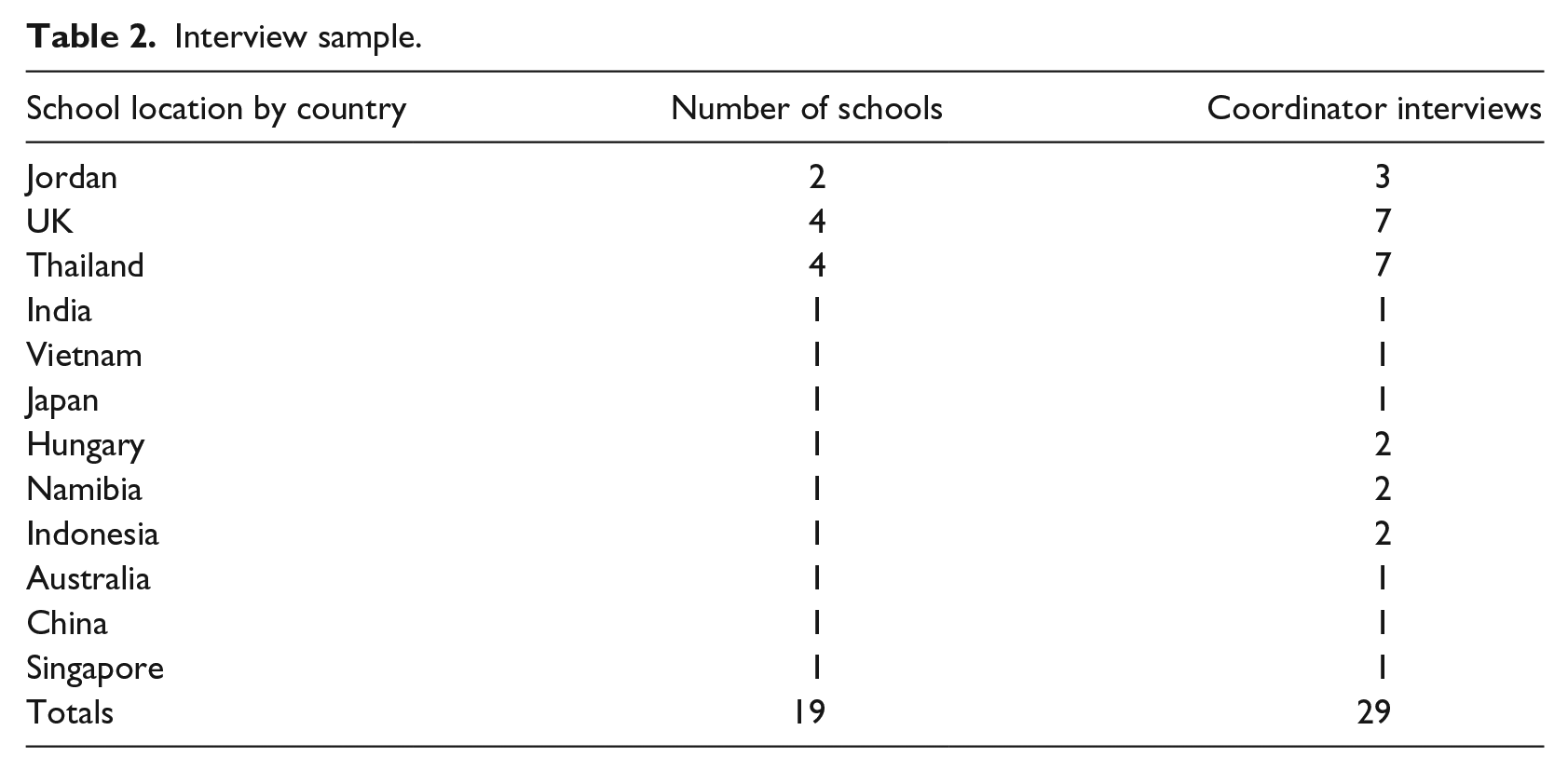
The data analysed for this paper draw on interviews with staff (n = 29) from 19 international schools, in 12 countries (see Table 2). Participants, either CAS or IB Diploma Coordinators, were all directly involved in implementing CAS. The second author and two other members of the 2017 research team conducted the interviews. Conforming to ethical guidelines, interviewees gave informed consent to participate, to be digitally recorded and to have their words transcribed. Identifying features were removed from the data included in this paper to adhere to confidentiality agreements.
Interview sample.
In one-to-one semi-structured interviews (Robson, 2002), either face-to-face or over Skype, Coordinators were asked about CAS implementation in their school (Appendix 1) and encouraged to express their views on implementing the CAS programme and to reflect on its impact. The flexible nature of semi-structured interviews allowed Coordinators to identify issues they felt were important. During interviews, perceptions of the role played by parents emerged unsolicited in responses to the following questions:
Who else, in addition to Coordinators, are involved in implementing CAS?
How is the CAS programme introduced to IB Diploma students?
What works well about current CAS practices?
What challenges do Coordinators face?
Coordinators’ responses relating to parents were gathered to form a subset of data for this paper. Their responses offered some important insights into parents in international schools.
The limitations of this approach stem from the fact that the research was not principally aimed at establishing teachers’ perceptions of parents. Coordinators’ reflections were unprompted and so do not follow a consistent pattern in response to a targeted question. Additionally, the approach taken presents a one-sided view of the school/parent relationship. Indeed, by putting forward teachers’ perceptions, this research could be said to prioritise staff narratives over those of parents, and thus further reinforce the school’s power. Despite these limitations, we argue that the data provide novel insights into tensions in the international school/parent relationship that have not previously been addressed in research.
Initial content analysis of all 29 transcripts identified 23 Coordinators reflecting on parents’ engagement with the school. The school/parent relationship was categorised using the four categories shown in Table 1. The data indicated Coordinators’ additional perceptions of parents, leading to thematic analysis and two new themes. These made explicit some implicit aspects (Braun and Clarke, 2006) of the international school/parent relationship. Thus, while the communities of practice framework demonstrates that staff identify conventional conceptions of parental engagement where the school is the locus of power, thematic analysis made apparent disruptions to those conventional conceptions.
Findings
Evidence is presented in two sections: (1) conventional conceptions of parental engagement and (2) disruptions to these conventional conceptions. The latter have power implications, made evident when played out in knowledge and social hierarchies. Presentation of findings begins with the former before moving on to show how international school parents disrupt conventional conceptions of parental engagement in ways that raise questions about the relationship between international schools and social privilege.
Conventional conceptions of parental engagement
A communities of educational practice lens highlights the extent to which parents, as perceived by Coordinators, are peripheral to the school community. Parents’ participation remains peripheral when the school controls how and to what extent they are involved. There was abundant evidence of activity in Category 1 (Table 1), corresponding to Epstein’s (1995) conception of parental involvement. Parent–teacher meetings, reports and letters are activities that position parents as helpers, and, therefore, subordinate to the school. However, the remaining three categories from Table 1 – participative practice, extending the community and a focus on learning extending to students’ lifetime – reflect the extent to which Coordinators see parents as assistants, resources and partners, respectively. The findings are organised as follows to show parents as most to least peripheral.
Parents as assistants
Parents positioned as assistants are limited to clearly defined activities and are positioned as subordinate to the school (Category 2, Table 1). Clear insider/outsider boundaries to educational practice were often in evidence. This is typified by the response of a Coordinator in an Australian school. Parents were invited to become involved with CAS only ‘if it’s something sport-based and not school related’. The boundary is clear, the school holds the balance of power, and the school can recruit parents in ways that staff perceive as appropriate to community endeavours. This resonates with the way in which core actors mobilise networks to extend to more peripheral members in order to meet community goals (Wenger, 2011). The tennis-playing parent who coaches some students may be useful at times, but largely remains peripheral to the core group.
Parents as resources
When parents are considered as resources, boundaries are more flexible (Category 3 in Table 1). Although the Coordinator here uses the phrase ‘parental involvement’, parents are clearly considered more than ‘helpers’: [parents are given a] follow-up session for CAS by itself to explain CAS in more depth and more detail because it’s probably the most complex [part of the IB Diploma]. Also what I’ll be looking for from that, to be honest, is the parental involvement, because a lot of our parents have got all sorts of different things that they’re involved in which we can tap into.
This Coordinator in an Indian school is describing how the school informs parents, but he reveals that this is done with the intention of identifying opportunities for parents to become engaged in CAS activities. Although power still lies with the school as instigator, parents are perceived as potentially valuable in working towards a goal. Coordinators purposively select from the parent body whilst also being open to ideas which originate from them, as in this example from a school in Indonesia: ‘We’ve actually got one parent who is very keen on helping us with one particular project, with sponsoring, and she’s given us the idea of perhaps a residential opportunity.’ There is sufficient permeability in the way that parents are positioned in this school’s practices to legitimise their participation. According to Wenger et al. (2002), fuzzy boundaries are an important aspect of cultivating communities of practice, to encourage ‘peripheral members to drift into the center (sic.) as their interests are stirred’ (Wenger et al., 2002: 56). However, the conventional power balance, as conceptualised in the parental involvement and engagement literature, remains firmly in favour of the school.
Parents as partners
It can be argued that the experiential learning at the heart of CAS, with its focus on learning skills and attributes which extend throughout the life course (Table 1, Category 4), is quite uniquely placed to align parent and school expertise. There was evidence that Coordinators were open to connecting with parents’ life experiences when they perceived them to support the aims of CAS. Here, parents were viewed more as partners. In the following example, part of this UK international school’s finance system was available to enable parents and the Coordinator to collaborate on students’ CAS projects, in this case introducing screening for blind children: And [the parent] pitched it to some students, or I helped him to pitch it to some students, and they’re running with it and so that screening will start in the next couple of months. That wouldn’t be happening if they hadn’t done that, and the students are doing all the work for it. I’ve got an assistant that works with me but we stay in the background; they’re pushing it, they’re fund raising, they’re deciding on when we go, and doing the emails and everything, and it’s pretty powerful – a couple of kids want to go on and work in public health.
Enabling parent access to an institutional grant system resonates with elements of a community of practice (Wenger et al., 2002). This grant system is an example of an evolved practice which existed prior to the parent’s idea; problem-solving is at the heart of the parent’s idea; and the efforts of community members – parent, teacher, students – combine, aligning learning to the common goal of arranging screening. The clear communication – the parent was aware that the Coordinator was open to ideas – shows that the Coordinator had established a way of encouraging parents’ legitimate participation. Notably, however, the power to do so remains with the core group and may ultimately depend on teachers’ individual attitudes and values developed in their work with parents (Boyd, 2015).
The school/parent relationship perceived by Coordinators so far can be described as conventional, with schools as the locus of power but fostering strong connections when goals closely align. However, this was not the case when divergent goals were apparent.
Disruptions to conventional conceptions of parental engagement
As previously noted, some characteristics of international schools can make working towards a common goal difficult; an additional factor disrupted the conventional relationship, however, when schools’ and parents’ goals diverged. This was made clear when CAS was perceived to compete with academic outcomes and where parents’ future goals were perceived to focus on children’s upward social mobility instead of, or as well as, broader aspects of education: ‘By and large [parents’] biggest priority is that UCAS hurdle; that’s something that the CAS side of things competes with.’ This Coordinator in a school in Jordan perceives CAS to vie with parents’ main (academic) goal. In another international school, in Thailand, the Coordinator explains how aspirational parents do not see the relevance of CAS to the careers they want for their children: I get some parent pressure, some college pressure. We have students who are coming from professional backgrounds where parents see their children as doctors or engineers at grades 9 and 10. So, I prefer them to look at their children not as doctors, but as their 14-year-olds that have their whole life to explore other things.
The pressure this Coordinator feels, from within the school as well as from parents, creates a tension for students between career goals and holistic goals that has been identified elsewhere (Rizvi, 2015; Wright and Lee, 2014), and prompted closer examination of data showing tensions between school/parent goals. Thematic analysis of this data found two hierarchies with disruptive potential:
Knowledge hierarchies
Social hierarchies
We argue that these implicit hierarchies suggest disruptions to the conventional balance of power in the school/parent relationship that may have implications for social mobility, whilst recognising that the findings presented here are just indicators of what is, currently, a poorly understood aspect of international education. Nevertheless, the rise in international education and its adoption by the growing, so-called, global middle classes, compels consideration of these issues for new insights into some mechanisms that re/produce power and privilege on a global scale.
Knowledge hierarchy
When the school is the locus of power, school staff are mediators of values (Shaked and Schechter, 2017). Coordinators nominally hold power; the Diploma will not be awarded without them deciding that the requirements of CAS have been met. However, when schools do not value CAS, Coordinators’ power is weakened: Sometimes [the attitude of] the parents and . . . people who live here in this country [is]: ‘actually we want our students to study math, science, we want them to be engineers.’ [S]ometimes we face time management with the student and to find the space for the CAS activities is actually another challenge.
Although the Coordinator perceives parents prioritising academic work in this school in the Middle East, it is also clear that the institutional constraints on time and space for CAS tacitly reinforce messages that value it less than academic subjects. Similarly, research in Turkish schools suggests that a CAS programme complementing schools’ values is more likely to engage students and meet programme aims than a programme in a school where the IB Diploma is seen only as a passport to university (Martin et al., 2016). Thus, CAS and academic subjects relate to different goals and values. Although CAS may be valued for developing well-rounded students (International Baccalaureate, 2015), the Coordinator in one school in Thailand indicates that this educational goal does not always coincide with parents’ goals: ‘for all [that parents] talk about how they want their “rounded kids”, that’s what their goal is, they’d swap that in a heartbeat for higher IB results. People within the school know it, parents know it, kids know it.’ Here, the explicit discourse masks the goals that the school implicitly values. This process of ‘disavowal’ (Kenway and Lazarus, 2017) has been found in elite international schools where overt assertion of a socially ‘worthy’ set of values, particularly in connection with the idea of ‘service’, ignores the power inherent in such elite establishments with colonial histories that favour advancement of already dominant groups. Coordinators who contend with such disavowal may find their institutional power undermined. An academic/non-academic (formal/informal) knowledge hierarchy, therefore, has the potential to undermine the school as the locus of power. This epistemological imbalance can be further compounded when social hierarchies disempower teachers and shift the balance towards parents.
Social hierarchy
This shift in the balance of power is illustrated clearly through teachers’ perceptions, particularly when they are understood to occupy the precarious employment status and social position of a middling actor (Bunnell, 2017). This can weaken some of the power that conventional conceptions of school/parent relationship are built upon. This weakening can disrupt the relationship and tip power towards parents, with consequences for schools’ ongoing activities. The nuances made visible from teachers’ perspectives offer important insights, especially when parents distance themselves and their children from pursuing social advantage through international schools (Ng, 2012). Coordinators’ insights extend beyond the school community to connect to broader societal trends where international education and the practices of marketisation intersect.
Although it has been found that some parents, particularly globally mobile professionals, may send their children to an international school because of, inter alia, the language of instruction (Hayden, 2006), others argue that the international school is part of a class strategy (Ball, 2003) that supports social advantage. Parents of children at two international schools in Buenos Aires ranked the social aspects of their choice as very low in importance, while language benefits and academic excellence were stated as the highest (Potter and Hayden, 2004). The authors continue to note that ‘certain kind of parents’ (Potter and Hayden, 2004: 101) have hopes for social benefits during the selection and application process, which recede in importance once their children are successfully enrolled. This post hoc ‘filter’ (Potter and Hayden, 2004: 101) points towards the intertwining of disavowal (Kenway and Lazarus, 2017) and ‘class-making’ (Kenway et al., 2017; Tarc and Tarc, 2015) necessary for parents to simultaneously justify and separate their part in social inequalities and social division (Gilbertson, 2014; Plum, 2014) that the cost of such an education often incurs.
Fees for international schools are usually not widely affordable, limiting student intake to affluent families and delineating a (dominant) social group whose members, through schooling, become mutually acquainted and can recognise in each other the entitlement to belong to a durable network (Bourdieu, 1986). Dominant parents’ investment, in every sense, in their children’s education is a powerful driver. The ‘element of social status attached to enrolling one’s child in an international school’ (MacKenzie, 2010: 113) conveys benefits among international school parents who ‘. . . owing largely to their socio-economic background . . . might expect to be more empowered’ (Allen, 2000: 132). When this mix of aspiration and international education are enacted in a marketised education sector, further layers of empowerment benefitting paying parents become evident.
It is not uncommon for some more recently established international schools to be run as businesses (Bunnell, 2019; Hayden, 2006), resting on latent power relations linked to the commodification of education. The language of markets provided by middling actors is evident in this Coordinator’s description of the ‘habitus’ of this international school in the Middle East: ‘[s]chool is an institution, students are customers, parents are the clients, you are producing a product.’
The Coordinator sees their relationship with parents as closely related to preserving parents’ satisfaction, because ‘the ultimate point of accountability in any business must be to the customers . . . parents need to know whether the school is giving value for their money’ (Blandford and Shaw, 2001: 22). When schools see parents as customers, they stop being peripheral to the community of practice and the locus of power can be unsettled. The extent to which the power balance shifts will relate to how concordant or divergent parents’ and schools’ goals are.
There’s not (sic.) commitment or understanding of non-academic requirements within the academic faculty, there’s pressure put on the students and parent pressure as well, the process of applying to Ivy League schools or high end universities, it’s going to be a real stretch for the students, and they’re encouraged to go down that path rather than have time to go and do that project I was talking about.
The Coordinator in this international school in Hong Kong describes CAS almost as a distraction to colleagues, parents and students alike, all of whom focus on academic work, with explicit aspirations linking the IB Diploma to admission to ‘top’ universities. The parental aspirations are dominating the agenda in ways that are, we suggest, heightened by a business-consumer hierarchy that undermines teachers’ power and empowers paying families. Such empowerment can increase parents’ influence over schools’ priorities and educational goals, leading to change when they do not align with the school, as in this international school in Vietnam: [The school] started off with a strong affiliation with the UN and other big NGOs: 80% of the kids were either diplomatic or NGO kids. Now the parent body is much more commercial, [and includes] other [host nation] families whose priorities are probably not an understanding of development issues and those things that overlap with the IB mission, so that’s a shift in the emphasis of the school and it then becomes an ideological discussion about how much emphasis to place on things like CAS, and field trips and going out into the community. (Emphasis added by authors)
Prompted by changes in the dominant group, the priorities shift to reflect those of the more numerous host-nation parents, and are perceived as a divergence between parents’ and schools’ goals. This Coordinator is describing a shift in the school’s priorities in response to the priorities of ‘more commercial’ families in a portrayal that conjures up the empowered parent-consumer (Allen, 2000; Angus, 2015).
However, school/parent relationships playing out in response to the marketisation of education are not simple, and specific cultural and geographical contexts should not be overlooked. For example, the subtle introduction of policy changes to accommodate international education in China and countries in Southeast Asia have created ‘a quiet pathway to marketisation’ (Kim and Mobrand, 2019: 311) that sit uneasily with some nations’ traditional values. Meanwhile, in Germany, where the introduction of choice is relatively recent, Breidenstein et al. (2020) contend that parents cannot simply be framed as ‘informed and rational acting customers’ (p.415). These authors go on to suggest that teachers resist any incursion to professional identity caused by interference from inexperienced parents. They conclude that teachers and parents recognise boundaries between their respective responsibilities, and teachers will repel parental encroachment on professional territory by pointing to ‘the always partial perspective of [parents who are] focused on their own child’ (Breidenstein et al., 2020: 419). Our findings differ somewhat from this conclusion. In the context of international schools, from the perceptions of our participant Coordinators, the evidence points towards conditions that undermine the conventional power balance in favour of parents, emergent in a nexus of marketisation of international education and parental aspiration.
Writing about parental ambitions as aspirational capital, Basit (2012) argues that social and cultural capital is created through privileged families’ expectations around education. However, asserting that expectations create cultural capital is problematic. Bourdieu (1986), upon whom Basit (2012) draws, makes particular claims for the power of the institutionalised state of cultural capital in the form of educational qualifications that can enable holders ‘to exchange their qualifications for a monetary value, which might be greater for some qualifications than others’ (Bourdieu, 1986: 51). Views of the IB Diploma as a type of ‘gold standard’ qualification with this exchange potential (Doherty et al., 2009; Resnik, 2012b; Whitehead, 2005) rely on its utility in gaining entrance to ‘Western’ universities, accessing international networks, and obtaining ‘distinction (as a new class) and socioeconomic advantage’ (Bunnell, 2019: 61). Here we return to Bourdieu’s (1986) contention that academic qualifications have the potential to be converted into economic capital, and his argument that these qualifications ‘become the conditions for legitimate access to a growing number of positions, particularly dominant ones’ (Bourdieu, 1986: 55). Although these arguments relate to national systems of education, they point towards further-reaching implications about the role of a marketised form of education which, in international education contexts, raises serious questions about the role of international schools in the re/production of social inequality on a global scale.
Conclusion
It has been demonstrated here that parental engagement in international schools takes multiple forms. Adopting a communities of educational practice lens reveals how, when the school is the locus of power, parents remain peripheral to the school community’s goals and assume subordinate roles. Furthermore, flexible school/parent boundaries and goal alignment have the potential to foster parental engagement in learning in partnership with schools. However, we also show that, when parental goals diverge from schools’, the balance of power can tip their way and shape schools’ agenda. Examining parental engagement in the international school sector draws attention to issues that are overlooked when parents are presented as an homogenous group or conceptualised as deficient in educational matters (Goodall, 2021). When the forces of parental aspirations interweave with national and international forces in a marketised education sector, conditions may favour the upward social mobility of the so-called global middle classes. Perceptions of CAS and IB Diploma Coordinators, framed as middling actors, afforded insights into the implicit hierarchies emerging in such conditions and which contribute to the re/production of dominant social groups.
In this paper we contribute to wider debates on the extent to which parents’ socio-economic status perpetuates existing social dis/advantage (Baker and Barg, 2019; Doherty et al, 2009; Lareau, 1987; Treanor, 2017). We have also responded to calls for the development of a more nuanced conceptualisation of parents (Goodall, 2021; Reay et al., 2011) and recognised that the multiple factors at play in the re/production of social inequality through education are contextual and situated.
This paper comes at a time when some consider international education to be reducing its emphasis on internationalist ideals and millennial global citizenship agendas (Bunnell, 2019) in favour of the more individualistic advantages an international education can bring (Hayden et al., 2020). Drifting away from its idealistic origins and swayed by the trends of globalisation, international schools may be supporting aspirational parents in ‘class-making’ (Tarc and Tarc, 2015) through the embodied state of social capital which certain educational qualifications yield, and which give prestige to those who possess them (Kenway and Lazarus, 2017; Törnqvist, 2019). This suggests that the IB Diploma advantages its possessors (Besley, 2011; Resnik, 2008) by boosting upward social mobility in international, rather than merely national, fields of opportunity (Kenway et al., 2017). However, this process may also reinforce conformity towards neoliberal norms (Gilbertson, 2014) and questions remain about the extent to which the emergent global middle classes will be able to realise the aspirations they perceive an international education to afford.
It is important to acknowledge that the methodological limitations outlined above moderate any claims resting on this research, and we present our analysis in the hope that these issues will be further scrutinised in future studies. The challenge for international schools lies in finding ways to manage the multiple tensions inherent in engaging parents in wider aspects of the IB Diploma that are brought to the surface by CAS, as well as in recognising the part that international schools play in tipping power towards an educational agenda driven by the already socially advantaged.
Footnotes
Appendix 1
Interview questions on school practice.
Funding
The author(s) received no financial support for the research, authorship, and/or publication of this article.
