



Abstract
European countries and their regions are trying to develop quality foreign language policies to help citizens become communicatively competent. The Spanish region of Andalusia has implemented Bilingual Education since 2005, whereas in the United Kingdom the take-up rates of languages in schools are low despite the linguistic demands that Brexit will pose to citizens. Scotland, however, seems keen on promoting the inclusion of languages into curricula. Analysing language policies may help understand differences between both contexts and, ultimately, build synergies between the educational administrations of these countries. Considering that corpus linguistic analysis of language policies allows identifying political ideologies permeating language policy and planning, this article studies and compares the use of language in Scottish and Andalusian language teaching policies. Although differences are identified in terms of the focus of the instruction and the language approach followed, findings show the efforts of Andalusia and Scotland to foster plurilingualism.
Introduction
For many years, European schools have faced the double challenge of providing quality education for a growing population of migrant students and adapting to the new set of demands for educators caused by globalisation, a phenomenon that has provoked intense social, political, technological and educational changes (Moskal, 2016). In this context, students need to be prepared to live in a multicultural society and to become interculturally aware, globally conscious and, ultimately, competent citizens of the 21st-century world (Koizumi, 2010; Suárez-Orozco et al., 2010). As a result of this, the Council of Europe, a leading European human rights and education organisation, has developed guidelines and directed efforts to promote proficiency in more than one language as a key to professional success for European citizens. In this sense, the first actions to promote modern-foreign language (MFL) 1 learning within the borders of Europe were made in the 1990s and the 2000s after the publication of documents such as the White Paper on Education and Training (henceforth White Paper; European Commission, 1995), the Common European Framework of Reference for Languages (CEFR, which is also acquiring great importance outside Europe; Council of Europe, 2001, 2018) and the Language Learning and the Linguistic Diversity Promotion Plan (European Commission, 2003). All these texts set the bases for a new language teaching methodology that allowed students to become linguistically competent in at least one MFL.
Influenced by the Canadian immersion programmes that emerged in the 1960s, the European efforts to promote MFL learning gave rise to Bilingual Education (BE) in Europe, understood as the teaching of content subjects through a language other than the mother tongue. Countries in the continent have subsequently been designing and implementing diverse BE programmes to promote linguistic diversity. Among all the possibilities, Content and Language Integrated Learning (CLIL) has spread in the past 20 years as a widely adopted approach in Europe, aiming at fostering the simultaneous learning of an MFL and non-linguistic contents so as to facilitate intercultural awareness, global integration and plurilingualism among citizens (Coyle et al. 2010).
Spain has been subject to assertions of a generally low level of MFL proficiency, mainly due to the inefficient training in languages traditionally developed in the country (Morales et al., 2000). However, attempts to improve the situation began during the last decades of the 20th century and, since the early 2000s, BE programmes have been developed and implemented. As Izquierdo (2017) posits, the linguistic reality in Spain started to change at the end of the 1990s with the White Paper’s requirements to develop a new teaching methodology in which the language was not only seen as the object of learning, but also as a medium for learning other subjects (European Commission, 1995). Since then, Spanish regions (known as ‘autonomous communities’) have developed BE seeking to foster students’ communicative competence and, despite the general controversy towards such teaching programmes, the scientific literature remains positive regarding academic results in both language and content (Moya and Ruiz, 2019; Pérez-Invernón, 2013).
However, in bilingual autonomous communities (i.e., those where Spanish co-exists with co-official languages: Catalonia, the Basque Country, the Community of Navarre, Galicia, the Valencian Community and the Balearic Islands), BE had been practised for decades, and a series of actions have been developed to protect and restore the importance of co-official languages – such is the case of Basque in the Basque country (Azkarate, 2012; Etxebarria, 2012) – and to foster MFL learning. In this sense, Spanish regions have the competence to organise educational affairs – always taking Spain’s education law (LOMCE, Ley Orgánica 8/2013) as a base –, which explains why BE programmes tend to vary to some extent from one region to another.
Andalusia and the Community of Madrid became precursors in the field of BE in Spain. In the former, CLIL has been developed since the implementation of Plan de Fomento del Plurilingüismo (‘Plurilingualism Promotion Plan’) in 2005 in order to reinforce MFL learning and communicative competence development (Junta de Andalucía, 2005). A decade later, the Plan Estratégico de Desarrollo de las Lenguas en Andalucía (‘Strategic Plan for the Development of Languages in Andalusia’) was developed to update previous guidelines, now giving more attention to the development of intercultural competence (Junta de Andalucía, 2016). At the beginning of the 2019/20 academic year, BE was offered in 25.31% of public Andalusian schools 2 through the use of English, French and German (Junta de Andalucía, 2019), a number that reveals the efforts of the region to promote BE.
BE programmes and strategies to promote linguistic diversity are being developed across Europe; however, in its education policies, the United Kingdom (UK) seems to take little account of BE/MFL learning or continuous teacher professional development as part of its political agenda (Papaja, 2014) despite being one of the most immigrant-receiving European countries (Baldi and Goodman, 2015). This lack of interest in language learning, due in part to the establishment of English as a lingua franca and its dominance in Europe and the world (Macedo et al., 2016), undermines the UK citizens’ utilitarian reasons for learning languages other than English (i.e., they do not believe they need to learn languages other than English to get a good job or to be considered better-educated people) (Lanvers, 2014, 2017; Lo Bianco, 2014).
The British Academy stated in 2019 that the UK ‘is currently nowhere near to fulfilling its linguistic potential’ (2019: 4) due to the drastic and continuing decline in the numbers of students that take up language lessons in Secondary Education and at universities. As Kelly (2018) explains, what makes a difference between the UK and any other country with language skills deficit is the fact that in these nations the ‘priority foreign language is English’ (2018: 14) due to its status as the 21st-century lingua franca, whereas in the case of the UK, ‘there is no overwhelming economic or social reason why everyone [. . .] should opt for one particular foreign language’ (Kelly, 2018: 14–15). In this light, scholars claim that the UK needs to carefully reconsider the way language and intercultural skills of its citizens are addressed, a need that is ‘likely to increase, not decrease, following the withdrawal ok the UK from the EU’ (Wyburd, 2018: 176).
Learning a language means both knowing how to use it appropriately in different contexts and situations (Chacón-Beltrán, 2015) and learning cultural aspects associated with it (Byram, 2012; Kramsch, 2011). When discussing future needs of the post-Brexit UK, Wyburd points that an ‘interculturally competent, multilingual graduate is likely to be in increasing demand post-Brexit’ (2018: 177). Consequently, it is necessary for the UK’s language policymakers and university language departments to promote MFL learning as a unique way to become more interculturally competent and, ultimately, to prepare citizens for what is yet to come after the withdrawal from the EU.
Bearing in mind the Brexit situation, and considering that fostering language diversity and multiculturalism is a way to facilitate both social cohesion and citizens’ integration into society (Council of Europe, 2008), the UK’s Equality Act 2010 does not specifically refer to the inclusion of languages in the legislation (UK Parliament, 2010). Yet, Scotland is committed to fostering MFL learning among its younger citizens. There are three official home languages in the Scottish territory: English, Gaelic and Scots. Besides, the increasingly multilingual nature of its population, the growing demand for multilingual public services and the continuous attempts for the revitalisation of Gaelic (MacLeod and Smith-Christmas, 2018) have resulted in language policies and approaches that provide Scottish students with possibilities for MFL learning (McKelvey, 2017). However, these policies are unlikely to be influenced by the possibility of a withdrawal from the EU as in fact they existed before the 2016 results of the Brexit vote (Doughty and Spöring, 2018). Additionally, Scotland is committed to promoting language support for refugees (for instance, in the form of informal community-language classes; Phipps, 2018) and it develops specific policies for their integration into society (Scottish Government, 2014, 2018).
There is a number of Scottish frameworks intended to improve MFL provision, such as the 1+2 Language Strategy and the Scottish Qualifications Authority’s guidelines, which aim to ensure that citizens have the opportunity to learn two MFLs (Scottish Government, 2017b, 2017a; Scottish Qualifications Authority, 2006). Furthermore, Gaelic medium education (GME) is also provided in some schools across the nation, in which students learn content subjects through Gaelic, and have English as a second language (L2). According to the most recent Scottish Pupil Census, only 0.85% of Primary Education pupils and 0.32% of Secondary pupils are enrolled in GME in the country (Scottish Government, 2019). Other than this, interdisciplinary learning is an alternative to more traditional subject-based education that is also developed in Scotland. Introduced in the Curriculum for Excellence (Scotland’s curriculum; Education Scotland, 2019) and aiming to ‘encourage learners to be flexible and creative, and acquire skills that would make them more independent in their learning’ (Humes, 2013: 88), this educational idea proposes the integration of all subjects (including MFLs) to help learners make links across different domains of knowledge and, ultimately, be prepared for the 21st century. In this light, the scientific literature is optimistic when analysing how education policies in Scotland promote plurilingualism and MFL learning (Doughty and Spöring, 2018; McKelvey, 2017).
Considering all the aforementioned, language use, in terms of word choice, plays a significant role in the elaboration of MFL and BE policies, as it reflects the way language itself is seen in a certain community. As Cárdenas discusses (2011), language is a socially-constructed phenomenon since its primary function is communication; in this sense, it is the society that adapts or even creates the language system (e.g., new words or expressions that are coined) by constantly using it. Therefore, using it implies generating a series of culturally and socially dependent practices with which human beings represent the world through the use of words. Thus, it could be assumed that the choice of lexicon in official documents in general –and in language policies in particular– can show how a certain country understands such issues. In this sense, the scientific literature is profuse when stating the benefits of corpus linguistics methods for language education (Ellis et al., 2008; Pérez-Paredes, 2014), but although there are some studies analysing language use in political discourse (e.g., Aloy and Taboada, 2017; Llamas-Saíz, 2018), this method has been scarcely applied to the analysis of language use in politically dependant documents such as language policies (e.g., Fitzsimmons-Doolan, 2014). According to Fitzsimmons-Doolan (2015: 107), applying corpus linguistic techniques to language policy allows studying ‘the identification of ideologies encoded in political texts’, an issue of interest in the analysis of language policy and planning.
Bearing in mind how language learning conception in the UK and Spain differ on the surface, it seems relevant to study and compare language use in the language education policies of two of their most MFL-provision-aware regions: Scotland and Andalusia. For this reason, this article aims to study language use in MFL teaching and BE policies of these two regions, examining the similarities and differences between both systems. To do so, a mixed-methods corpus analysis is applied to study official documents concerning MFL teaching and BE.
Method
This study follows a mixed-methods corpus analysis (consisting of a combination of content analysis strategies and quantitative techniques) designed to study language use in Scotland’s and Andalusia’s MFL teaching and BE and examine possible similarities and differences. The study adopts an exploratory and inductive approach to analyse linguistic forms in policy texts (Bauer and Aarts, 2000). It seeks to understand the foundations of both educational systems in terms of MFL teaching and BE and how they contribute to the development of communicative competences in MFLs of Andalusian and Scottish citizens. Three research questions are formulated: RQ1: How are MFL teaching and BE addressed in Scottish language education policies?; RQ2: How are MFL teaching and BE addressed in Andalusian language education policies?; and RQ3: Which are the similarities and differences between Scottish and Andalusian language education policies in terms of MFL teaching and BE?
Content analysis was applied in the first stage of the study. This qualitative research method allows discovering the internal structure of the information, either in its structure, composition, or dynamics (López-Noguero, 2002). By making inferences from the data to the context, content analysis helps advance knowledge, offers new perspectives, represents facts, and provides guidelines for action (Krippendorff, 2004). Bearing this in mind, content analysis strategies will help determine key terms and expressions related to MFL teaching and BE in the specialised scientific literature. These terms will be eventually used in a quantitative analysis of language use in Scottish and Andalusian MFL teaching and BE policies.
The study is based on two premises: (1) the way language is used can show cultural features and beliefs (Fairclough, 1991; Kim, 2003); and (2) language ideologies are implicit in language policies (Fitzsimmons-Doolan, 2014). Therefore, analysing language use can help understand how a country conceives MFL provision at schools. Furthermore, if language use shows one’s ideology (Kang, 2018), studying word choice in particular and language use in general can help reflect on the fact that the educational discourse is politically and culturally bound (Aggestam, 2004; Flores and Sobrero, 2011; Gastil et al., 2016). In this light, the study intends neither to judge the appropriacy of the language used in the official documents selected nor to underestimate the long histories of language learning and teaching of any of the contexts, but it rather develops a descriptive account of the terminology employed.
Procedure
Three analytic stages are followed: (1) research design, (2) data collection and analysis, and (3) conclusions. Seven steps are set within these three phases. In order to assure the quality of the research protocol, the phases and steps have been assessed as follows: specific research procedures have been used to reach construct validity; relationships between analysed documents are studied to enhance internal validity (i.e., value of this study’s findings); finally, generalization of the findings is established to reach external validity.
Stage 1: Research design
This stage includes four steps:
Step 1. Pre-test literature review: – Conducting a general search in bibliographic databases (British Education Index, Dialnet, Elsevier, Google Scholar, Scopus, Springer, WOS) to examine previous literature analysing the UK’s and Spain’s MFL teaching and BE policies (see Figure 1). – Identifying potential keywords to include in the search query for finding Scotland’s and Andalusia’s official documents regarding MFL teaching and BE policies.
Step 2. Research protocol development for corpus building: – Developing the research protocol by stating the RQs, creating the search query (see Figure 1), identifying pertinent bibliographic databases (Google Scholar and Scopus), establishing a 2007-2019 timeframe, and limiting the languages (Spanish and English).
Step 3. Corpus building: – Conducting a search following research protocol (see Step 2) to build the documentary corpus. – Article selection and corpus building – sub-corpus 1 (SC1) with Scottish documents, and sub-corpus 2 (SC2) with Andalusian documents – considering inclusion criteria (official documents published by Scottish and Andalusian education administrations) and exclusion criteria (other types of documents or official texts with irrelevant or unrelated topics)
3
. – Obtaining the full text from the selected databases.
Step 4. Keyword selection for corpus analysis: – Conducting a general search in bibliographic databases (British Education Index, Dialnet, Elsevier, Google Scholar, Scopus, Springer, WOS) to find articles related to MFL teaching and BE (see Figure 1). – Using content analysis techniques to identify key terms. To do so, two steps are followed: a theoretical phase in which the information of the selected articles is organised superficially, and a descriptive phase in which categories are identified and the data is described and analysed (Arbeláez-Gómez and Onrubia-Goñi, 2014; Elo and Kyngäs, 2008). – Creating a list of key terms based on the results of the content analysis (considering documents are written in different countries, the list is created both in English and Spanish) for the analysis stage. – Online dictionaries and keyword thesauri (Cambridge Dictionary, 2021; Diccionario de la Lengua Española, 2021; UNESCO Thesaurus, 2021) are used to check the relevance of selected terms and to translate them from English into Spanish and vice versa.
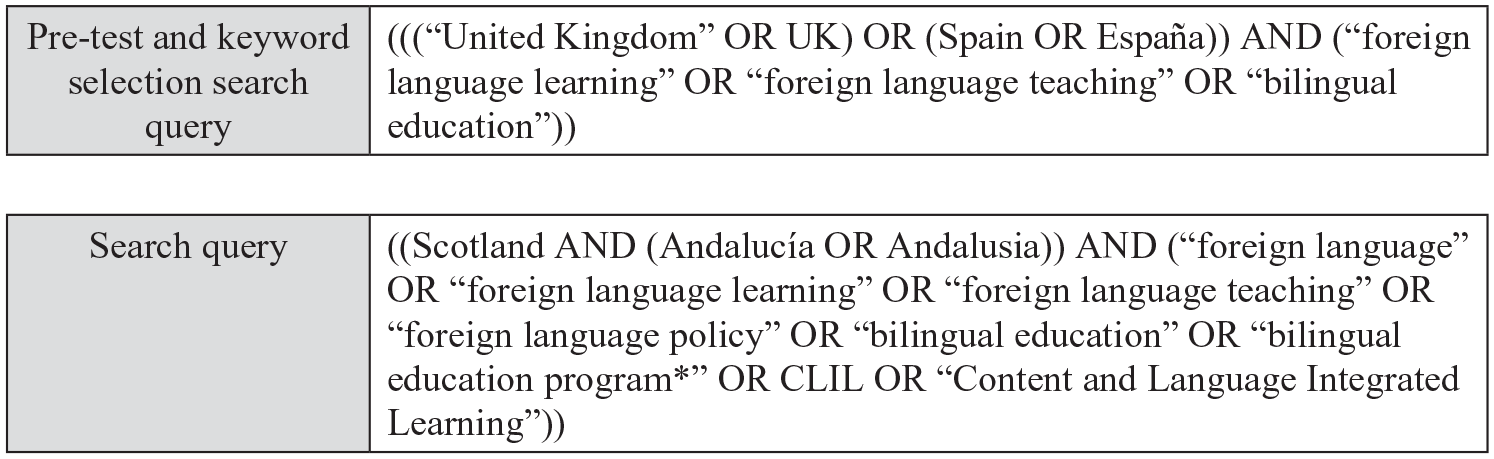
Search queries.
Stage 2: Data collection and analysis
This stage includes two steps:
5. Step 5. Data collection: – Analysing the presence of selected key terms (see Step 4) in SC1 and SC2, considering titles and text, and excluding references, website links, headings and page footers (the presence of terms in English has been studied in SC1, while the presence of terms in Spanish has been studied in SC2).
6. Step 6. Data analysis: – Developing a statistical description of the collected data using Microsoft Excel 2019 for Windows. – Developing a descriptive synthesis of the collected data. – Comparing the results of SC1 and SC2.
Stage 3: Conclusions
This stage includes one step:
7. Step 7. Answering RQs:
– Developing an understanding of the foundations of Scottish and Andalusian MFL teaching and BE policies based on the results of the analysis.
Analysis
Data analysis is conducted using Microsoft Excel 2019 for Windows (for building a statistical description of key terms present in the corpus). Arbeláez and Onrubia’s stages for content analysis (2014) are followed to identify key words; later, logical reading, analysis, synthesis, deduction and induction procedures are applied following Okoli’s (2015) guidelines (employed for developing a descriptive synthesis of the results). Furthermore, to analyse the frequency of appearance of the terms, a p value equal to or higher than 0.05 has been considered (Zhu, 2016).
Results
Corpus
The documentary corpus used for the study consists of a total of 9 documents. Table 1 shows detailed information of each item in chronological order including authorship, title and reference, year of publication, country/region referred and number of words or tokens:
Corpus for analysis.

SC1 consists of 5 documents and a total of 24488 tokens, while SC2 is composed of 4 documents and 55429 tokens. The education law of Andalusia, LEA (Ley 17/2007), has been considered as part of the Spanish corpus as it includes guidelines for MFL teaching. On the contrary, and due to the existence of documents that specifically refer to MFL (such as the 1+2 Language Strategy; Scottish Government, 2012; 2017a; 2017b; and the National Framework for Languages; McLennan et al., 2018), the Curriculum for Excellence (Education Scotland, 2019) has not been included in SC1.
Key term selection
The general search conducted to find articles related to MFL teaching and BE and the use of content analysis techniques to identify their keywords have allowed the creation of the list of key terms. Although the list of terms presented in this article only includes nouns so as to reduce the number of words displayed, the terms have been grouped according to semantic similarity to lessen the number of words (e.g., teacher training, professional learning and teacher education; bilingual and bilingualism; evaluation, evaluate, assessment and assess; or culture and cultural). Furthermore, the Cambridge Dictionary (Cambridge University Press, 2021), the Diccionario de la Lengua Española (Real Academia Española, 2021) and the UNESCO Thesaurus (Unesco, 2021) have been used to check the relevance of the chosen terms and for translation. A total of 25 sets of words has been selected. As documents are written in two different languages, the terms presented in Table 2 are in English with their equivalents in Spanish:
Key terms for analysis.

Key term analysis
A systematic search of the selected 25 sets of words has been carried out to analyse their presence in the documentary corpus. Microsoft Excel 2019 for Windows has been used for data collection, data ordering and statistical description building. The figures below display the most notable findings and, although results are presented in terms of number and percentage of appearance, only the latter will be mentioned in the description due to statistical significance, while the former will only be referred in certain cases.
As can be observed in Figures 2, 3 and 4, the presence of key terms slightly varies from Scottish to Spanish documents. According to the significant p value established in the previous section (p ⩾ 0.05; Zhu, 2016), 16 key terms have a significant presence in both sub-corpora. Out of those 16 terms, language (3.0178%), learning (1.1679%) and teacher (0.8412%) are the most present in SC1, while teaching (0.7487%), learner and student (0.6783%) and language (0.6116%) are the most used in the official documents of SC2. There is some similarity of appearance in the terms language, teacher and learner in both sub-corpora, while the presence of the key terms bilingual and bilingualism is much higher in SC2 (0.4041%, that is 224 times) than in SC1, where it does not have a significant appearance; out of those 224 times, the term bilingual program appears 34 times in the Spanish corpus (0.0613%), being not present in SC1. There are few references to both CEFR and CLIL in SC1 (not statistically significant in any case), although they appear to be more present in SC2 (0.0397% and 0.0433% respectively) than in SC1 (less than 0.02 for both terms).
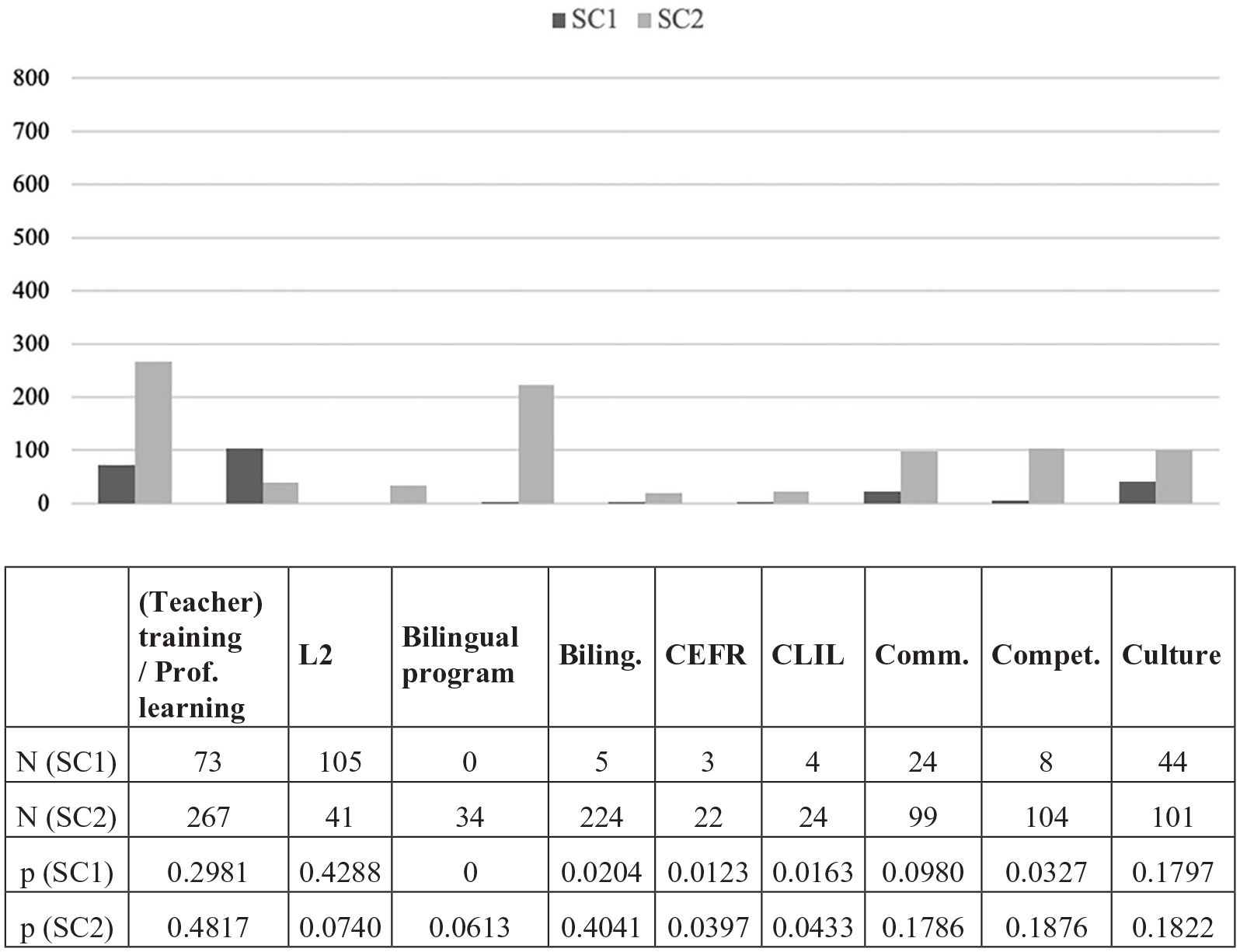
Key term presence in SC1 and SC2 (1/3).
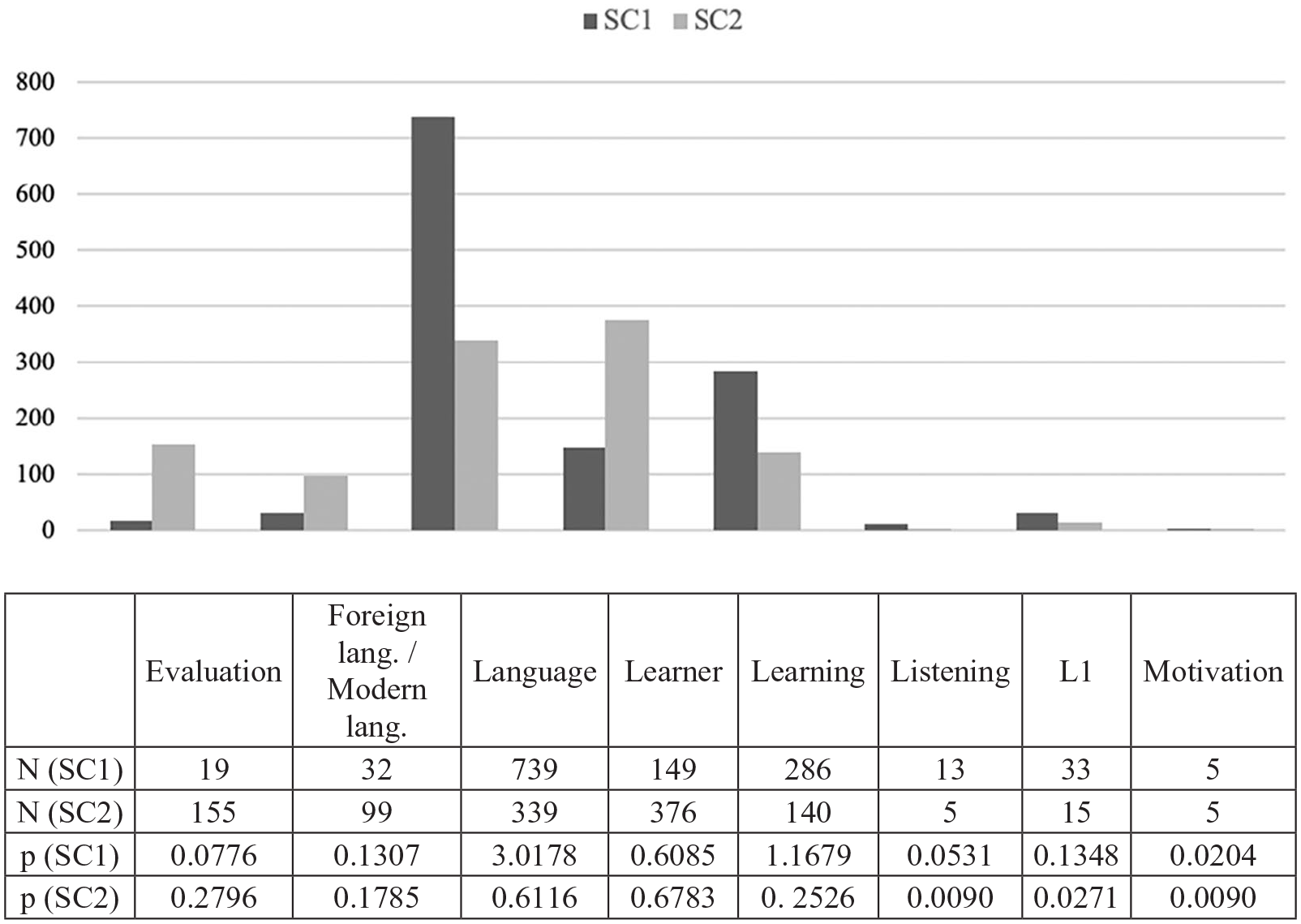
Key term presence in SC1 and SC2 (2/3).
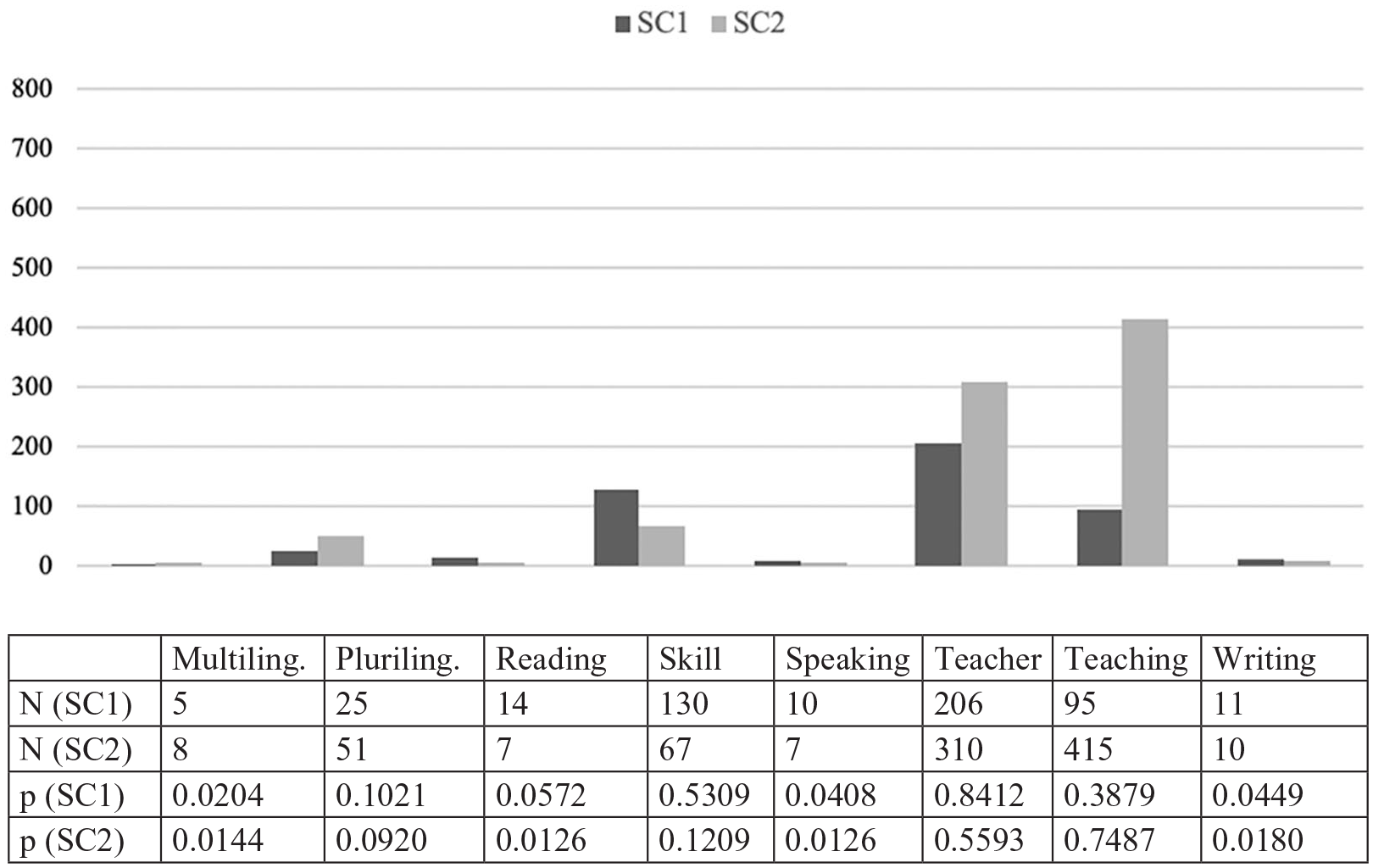
Key term presence in SC1 and SC2 (3/3).
In relation to teacher education, the terms used in both sub-corpora are slightly dissimilar. While in Andalusia and Spain there is a tendency to refer to the provision of knowledge, attitudes and skills for teachers to perform their educational tasks as teacher training and formation (or simply training), in Scotland and the UK it is more common to define this as teacher education, professional learning, Career-Long Professional Learning (CLPL) or Continuing Professional Development (CPD). In any case, the presence of this concept is significant in both cases, although higher in SC2 (0.4817%) than in SC1 (0.2981%). Furthermore, mentions to the cultural aspects of language learning (culture, interculture and multiculture) are statistically significant both in SC1 (0.1797%) and in SC2 (0.1822%).
There is a tendency in SC2 to refer to target languages of MFL teaching and BE policies as foreign languages, unlike in Scottish official documents, which, besides referring to L2, introduce the concept of modern languages as the ‘terminology used in Curriculum for Excellence (CfE) for foreign languages’ (Scottish Government, 2012: 9). It is also worth mentioning how the term learning is used as a key in both corpora, but yet more commonly in SC1 (1.1679%) than in SC2 (0.2526%); however, in both cases, there is a similar reference to the learners and students (0.6085% and 0.6783% respectively).
As presented in Figures 2, 3 and 4, SC1 seems to give more importance to the learning process rather than to the teaching task (3.0178% versus 0.3879%), while the opposite happens in SC2 (0.2526% versus 0.7487%). Similarly, Scottish documents refer more to the concept of skill (0.5309%) than to competence (no significant use of the term), whereas Andalusian policies mention the latter slightly more (0.1876% for competence and 0.1209% for skill). Additionally, the terms multilingual and multilingualism are scarcely present either in SC1 or SC2, while plurilingual and plurilingualism are more likely to be used (0.1021% and 0.0920% respectively).
Finally, the terms mother tongue, first language and L1 are significantly used in SC1 (0.1348%), as well as of the receptive language skills reading (0.0572%) and listening (0.0531%), which are not significant in SC2.
Discussion
The way language is used in oral and written texts can unveil cultural features and ideologies (Fairclough, 1991; Kim, 2003). Therefore, analysing word choice (among other linguistic elements) can reveal much about a speaker of a certain language. It could be assumed that the lexicon employed in official documents referring to MFL and BE shows how a country understands the issue of MFL provision at schools. Bearing this in mind, this article has attempted to study language use in both Scottish and Andalusian MFL teaching and BE policies aiming at examining their main similarities and differences.
Before discussing the results, it is worth mentioning the strong efforts of these two contexts in the provision of MFLs, probably because both Scotland and Andalusia have the autonomy to decide over their educational affairs. Due to the devolution of competences to the UK’s nations, education is a devolved matter in Scotland, which implies that the Scottish government decides over educational policies and school curricula. Likewise, Spanish regions are free to organise the way education policies are implemented since 1992 (Ley Orgánica 9/1992), although they must always take into account national guidelines.
The analysis performed has revealed certain differences between the two models of MFL teaching, shown in Table 3:
General findings.

From a general perspective, Scottish MFL policies seem to be more concerned with the process of learning than with teaching, as the number of references to the first surpasses the second (1.1679% and 0.3879% respectively). Going beyond the language-use analysis carried out and analysing some of the selected documents in SC1 more deeply, the Scottish official education bodies seem to pay little attention to a specific teacher training process for MFL provision. In fact, the 1+2 Language Strategy document states that ‘they [teachers] can use their existing skills in the teaching of English, such as the teaching of sound systems, listening and talking skills, and turn taking, as they introduce modern languages’ (Scottish Government, 2017b: 1), with which they appear to leave the task of MFL specialised training to teachers themselves.
On the other hand, Andalusia’s documents seem to give more importance to how languages should be taught as it can be observed through the number of references to the teaching process. Similarly, there seems to be more preoccupation with the importance of teacher training from the Andalusian administration than from the Scottish. In fact, the literature regarding teacher training analyses Scottish initial teacher education from a general perspective but does not reveal much about language specialists except for the obligation of studying a language in master’s degrees (e.g., Gray and Weir, 2014; McCall, 2017) and for some specificities related to teachers working in GME contexts (e.g., Milligan-Dombrowski et al., 2014). In this respect, the 1+2 Language Strategy official document states that ‘primary teachers do not have to be fluent in the modern language(s) they teach’ (Scottish Government, 2017b: 2), which suggests that teacher training in languages is not a priority. In Andalusian policies, however, teacher training in the field of languages plays a central role and, in fact, some important initiatives are significant in this respect, such as the creation of more language schools offering specific courses for teachers, the development of innovative projects promoting CLIL, and the increase of the number of schools offering CLIL and BE (Junta de Andalucía, 2016).
Bilingualism and BE programmes are not much referred in Scottish language policies as, in reality, schools provide students with MFL lessons, while CLIL and BE are not that much implemented – except for the use of GME in schools; however, the 1+2 policy recommends further exploring the potential CLIL for Secondary Education (Scottish Government, 2012) –, as opposed to the Spanish and Andalusian spread of CLIL schools (Pérez-Cañado, 2012; Roldán-Tapia, 2012). There are two specific official documents (Instrucciones 15 de mayo de 2019; Orden de 1 de agosto de 2016) that regulate BE at Andalusian schools, establishing, among other aspects, the time devoted to MFLs and content subjects taught through an L2, and particular considerations regarding CLIL.
In Scotland, importance is given to the teaching of MFLs, L2, additional languages, or, as it is commonly referred to in the analysed documents, modern languages. This could be explained with the presence of the 1+2 Language Strategy, which allows students to learn a first MFL since the first year of Primary Education and a second from the fifth (Scottish Government, 2017b), but does not guarantee or refer to the implementation of MFL-medium education. In this regard, it seems necessary to analyse whether exposure to the MFL in the language lessons only is enough for learners to become proficient and communicatively competent by the end of compulsory education or, if on the contrary, an increase of input time with a BE programme, as it is done in Spain, would be necessary.
In relation to the use of the term modern language instead of foreign, this illustrates the tendency in Scotland to avoid referring to any kind of ‘foreignness’ for three main reasons: (1) it is an unhelpful concept considering the obsession with borders and with keeping foreigners out existing in some countries of today’s world; (2) the UK, to which Scotland belongs, is one of the most immigrant-receiving countries in Europe (Baldi and Goodman, 2015); and (3) the population of migrant students in classrooms is growing (Moskal, 2016). In this sense, the term ‘modern’ seems to be more socially appropriate so as not to make any population group feel discriminated against or undermine any languages other than the officials. Conversely, in the Spanish region, this idea of ‘foreignness’ seems not to be perceived as having any pejorative connotations – although Spain is also one of the most immigrant- and asylum seekers-receiving European countries (González-Monteagudo and Zamora-Serrato, 2019) – yet it continues to be used to refer to anything ‘international’ or different from the local. Nevertheless, Spanish education bodies should reflect on the possible negative undertones of such words, since diversity in Spanish classrooms is increasingly present (Jiménez, 2012; Goenechea, 2016). In any case, both modern language and foreign language refer to any language that is not recognised as official in the country but spoken anywhere else.
Similarly, Scottish institutions are careful with the use of terms related to bilingualism in their official documents, despite being commonly employed in European, Spanish and Andalusian language education policies (see Council of Europe, 2001; Junta de Andalucía, 2016). For instance, there is no reference to the terms bilingual or bilingualism in the Scottish National Framework for Languages (McLennan et al., 2018) (except when referring to GME as a BE model). Scotland’s education bodies use plurilingualism (a much more inclusive term that refers to ‘the ability to use more than one than one language appropriately’ and which ‘involves linking languages with literacies’; McLennan et al., 2018: 6) as they aim at promoting proficiency in more than one MFL and look for students to become ‘successful learners’, ‘confident individuals’, ‘effective contributors’ and ‘responsible citizens’ (Scottish Government, 2017b: 1). On the other hand, there is an excessive trend in Spain to use the words bilingual and bilingualism inappropriately, which has caused an increasing criticism in the fields of BE. In this light, it is common to refer to schools implementing BE as ‘bilingual schools’ (Roldán-Tapia, 2012) by thinking that students, once they have finished their schooling, should be perfectly proficient in the MFL. It would be advisable for policymakers to consider avoiding the use of possibly confusing terms and refer to them simply as ‘CLIL schools’. Additionally, educational institutions should spread awareness of what BE means.
Two ideas are key when referring to language learning and teaching: the cultural dimension (Porto et al., 2017), and the CEFR (Council of Europe, 2001, 2018). Concerning the first, it has been long discussed the complementarity between MFL and cultural aspects, and concepts such as intercultural communicative competence due to the role of languages as cultural products (Byram, 2009; Liddicoat and Scarino, 2013). On the other hand, the CEFR can be considered as the European prime guideline for MFL learning, teaching and proficiency, which is been increasingly adopted in many other countries (Afip et al., 2019; Read, 2019). Nevertheless, few mentions are made to these two key terms in Scottish language policies. Although the CEFR is not a prescriptive document and does not aim ‘to tell practitioners what to do, or how to do it’ (Council of Europe, 2001: iii), it provides a well-founded background of what it means to learn and teach a language which should not be overlooked by any policymaker. Something similar happens with the cultural side of language learning. As Loewenstein reports, ‘understanding how language works requires attending to how culture works. Given how pervasive language is in human culture, the reverse is true as well’ (2019: 247). Thus, it makes sense to assume that MFL learning cannot be understood without cultural contents. As the analysis of the language use shows, Spanish and Andalusian language policies seem to give more value to these two aspects as essential in their BE programmes (Junta de Andalucía, 2016).
The concepts of competence and skill are also worth mentioning. The analysis has revealed how Scottish language policies tend to focus more on skills as referring to the ability to do something, while Andalusian documents are more systematic with the use of the term competence, showing the increasing spread and global popularity of what is known as ‘competence-based education’, a more constructivist way of understanding the learning process which opposes to traditional education and stands not only for teaching knowledge, but also for how to access, manage and use that knowledge (Koenen et al., 2015). All this shows that, although Scottish policies appear to be more concerned with learners’ abilities to use the target MFL, not much explicit attention is paid to the knowledge behind those abilities, which are equally necessary for students to become proficient.
Finally, the use of the terms multilingualism and plurilingualism is significant. According to the CEFR, these two concepts differ slightly; while the first refers to ‘the knowledge of a number of languages, or the co-existence of different languages in a given society’ (Council of Europe, 2001: 4), the second has become increasingly important over the years as it is more concerned with the interrelated competences associated with being able to speak those languages (i.e., cultural knowledge and awareness, communicative language competences, or the willingness to take initiatives when using a certain language). In this light, both Scottish and Andalusian documents tend to refer more to plurilingualism since it encompasses a broader idea of the meaning of language learning, going beyond the ability to speak to being able to interact with speakers of the language and taking into account the multiple and different social, conversational and cultural aspects at stake.
Conclusions and Limitations of the Study
After discussing the main findings of the language analysis of Scottish and Andalusian MFL and BE policies, it is necessary now to answer the RQs of the article.
In relation to RQ1 (How are MFL teaching and BE addressed in Scottish language education policies?), MFL is starting to gain recognition in Scotland’s policies as it is shown by its government’s attempts to promote plurilingualism in an increasingly multilingual and multicultural society. In this light, the 1+2 Language Strategy is the most relevant language policy in the country. Unfortunately, BE is not considered yet except for GME, whose benefits are profusely analysed by the scientific literature (Cape et al., 2018; MacQuarrie and Lyon, 2019).
Regarding RQ2 (How are MFL teaching and BE addressed in Andalusian language education policies?), although Spanish education policies are trying to respond to Europe’s suggestions and guidelines to foster the mastery of, at least, two MFLs (Council of Europe, 2018), criticism towards BE programmes in Spain has increased considerably among parents, policymakers and even teachers (Burgos, 2017). This may be somehow due to the mislabelling of BE schools as ‘bilingual schools’, when, in reality, they are content-based programmes with different degrees of exposure to the MFL which ‘have little to do with bilingualism’ (Roldán-Tapia, 2012: 71).
Finally, and concerning RQ3 (Which are the similarities and differences between Scottish and Andalusian language education policies in terms of MFL teaching and BE?), there are discrepancies between the two contexts. In this sense, Andalusia directs many efforts to foster MFL learning through BE programmes. Conversely, and despite the general tendency of the UK educational system not to pay much attention to the promotion of linguistic diversity, Scotland seems to have adopted a different perspective of plurilingualism as an important part of education.
Nevertheless, findings and conclusions must be seen in the light of three main limitations. Firstly, this study has developed an analysis of the language used in official documents. For this reason, future studies should consider developing an exhaustive analysis of the contents of the documents or even develop a complementary study at schools to provide a clearer understanding of how MFLs are understood in the considered settings. Secondly, a reduced number of documents was selected; therefore, an analysis of more MFL and BE policies (either in force or not) may warrant more data. Thirdly, only official documents were studied, and, in this sense, prospective research could focus on studying the published literature concerning Scottish MFL provision (since there are not many findings of the results of the 1+2 approach) and Andalusian BE to keep on deepening in the comparison between both contexts.
It has been mentioned through the article that analysing language use in language policies can help understand how important a community considers languages. This has been the main premise of this study, and based on this, it has been shown how discrepancies exist between the two systems considered. In any case, both Andalusia and Scotland are directing efforts to foster plurilingualism and, ultimately, contribute to the development of their citizens’ linguistic and social competences in MFLs. The challenge now is to develop further research on how MFL teaching and learning are really implemented in both contexts, as well as to compare them and build synergies between the educational administrations of the two countries. Despite appearing utopic, this can improve the communicative and intercultural skills of citizens and eventually helping them become globally aware and prepared to face the challenges of the 21st century.
Footnotes
Declaration of conflicting interests
The author(s) declared no potential conflicts of interest with respect to the research, authorship, and/or publication of this article.
Funding
The author(s) disclosed receipt of the following financial support for the research, authorship, and/or publication of this article: This article was supported by Project ‘Facing Bilinguals: Study of Bilingual Education Programmes’ Results through Social Data Analysis’ (Ref. no. EDU2017-84800-R), granted by a competitive call of the Spanish Ministry of Science and Innovation. Moreover, it was also supported by the Spanish Ministry of Education (Resolución de 5 de diciembre de 2017, de la Secretaría de Estado de Educación, Formación Profesional y Universidades, por la que se convocan ayudas para la formación de profesorado universitario, de los Subprogramas de Formación y de Movilidad incluidos en el Programa Estatal de Promoción del Talento y su Empleabilidad, en el marco del Plan Estatal de Investigación Científica y Técnica y de Innovación 2013–2016).