



Abstract
The relationship between class attendance and academic performance has been an important area of research, with a positive association being posited between the two. The setting for our study is an International Branch Campus (IBC) of a British university that needs to demonstrate the quality of its service delivery both to the parent institution and to the fee-paying students. We employ a dataset of over 900 students in an undergraduate degree programme and subject it to statistical techniques, namely quantile regression and two-stage quantile regression. Our results show that attendance has a beneficial influence on academic performance and this benefit persists at higher percentile of grades. We propose that IBCs could consider an attendance policy that encourages students to attend classes.
Keywords
Introduction
In an ‘Ask me anything’ interaction on Reddit.com, Bill Gates, Microsoft Corporation’s co-founder, claimed that he never attended any of the classes he signed up for at Harvard University and yet received ‘A’ grades ‘almost always’ (Willet, 2016). Notwithstanding the excellent grades of Bill Gates despite not attending classes, there is considerable debate in academic circles about the merit and usefulness of classroom attendance. Apart from learning from teachers and peers when students come in direct contact with them, it is widely believed that classroom attendance leads to better performance, although to varying degrees (Romer, 1993; Marburger, 2006; Stanca, 2006).
This study examines student performance and attendance at an International Branch Campus (IBC) that has a long-standing association with a UK-based higher education institution (HEI). This exercise is important because, while this model of transnational education (TNE) is growing (Garrett et al., 2016), there is a paucity of studies that examine learning outcomes for students at such IBCs (Escriva-Beltran et al., 2019). This is a significant lacuna for an education model that has displayed substantial growth in recent years. The number of IBCs has more than quadrupled from 67 in the year 2000 to almost 260 in 2017, with more than 80 countries around the world hosting at least one IBC (Mackie, 2019; Jhingan et al., 2019). Studies from IBCs would help institutions not only develop the right policies but also convey to all stakeholders the value of the face-to-face model of programme delivery in an international setting and thus justify the very existence of IBCs.
In this study, we make a distinction between two types of classroom attendance: (a) lecture attendance, usually for somewhat didactic methods of teaching classes that range in size from 50–100 students; (b) tutorial attendance for more socrative/facilitative teaching methods for class sizes of up to 25 students. Given the fewer number of students in tutorial classes, attendance in tutorials offers better learning opportunities to students as compared to lecture attendance (Büchele, 2020), although some research (e.g. Rodgers, 2002) casts some doubt on this. Hence, this separation in our exercises between lecture attendance and tutorial attendance offers a way of comparing the two.
The plan of this paper is as follows: Section 2 presents a description of the working environment of IBCs and the pulls and pressures that they have to cope with; Section 3 provides a review of the relevant literature; Section 4 describes the data, and the methodologies employed; Section 5 reports on empirical exercises; Section 6 discusses the results obtained and seeks to relate these to prior findings in the literature; and Section 7 concludes by examining implications for a range of stakeholders.
International Branch Campus
An IBC is defined as ‘an entity that is owned, at least in part, by a specific foreign HEI, which has some degree of responsibility for the overall strategy and quality assurance of the branch campus’ (Garrett, 2018). Wilkins and Rumbley (2018) add that IBCs are unique cases in transnational HE as they usually retain the name of the home campus and offer the infrastructure that allows students to gain a student experience that is similar to that offered at the home campus.
From the perspective of an HEI, the reasons for setting up international campuses include competing for academic prestige, enhancing global reputation, faculty research collaborations and promoting exchange opportunities as well as gaining new income sources and benefitting from the incentives offered by host country governments and financial partners (Mazzarol et al., 2003; Wilkins et al., 2012; Harding and Lammey, 2011). Host countries are increasingly seeking foreign universities to establish IBCs to become education hubs, with the aim of developing their human capital, improving economic activities and gaining recognition and influence on an international stage (Lee, 2015). For IBC students, the main benefit is having access to international curricula and gaining foreign degrees while staying closer to their homes, families, current employment and familiar business environments and while maintaining cultural and religious proximity often at a lower cost compared to a traditional international student experience (Hoyt and Howell, 2012; Meraj et al., 2016, Wilkins et al., 2012; Huang, 2007). Bearing in mind the interests of so many stakeholders in the setting up of IBCs, there is compelling reason to carry out research on educational policy and practice in these settings (de Wit, 2020).
While there may be differences across different countries, a stylised IBC–Home HEI relationship is one where the IBC delivers programmes/curricula developed at the Home HEI. The assessments are devised by the Home HEI but evaluated at the IBC with moderation by faculty members and external examiners at the parent campus. The degree will usually bear the name of the Home HEI. Given that the degree awarded to students at the IBC is no different from that awarded to students at the parent campus, assurance of quality is critical at the IBC. In pursuit of this quality assurance, IBCs must adopt academic policies from their parent/home campuses even though the profile of students at the IBC may have different characteristics – for example, a higher proportion of mature students or part-time students (see Garrett et al., 2016). This, in turn, has implications for students. Yang et al. (2019) reported that students at an Asian IBC of a Western university experienced significant differences in the educational cultures when transitioning from high school to university level studies.
Further, some of the institutions that establish IBCs are identified as not-for-profit or public institutions in their home countries but operate as for-profit, privately funded institutions in their host countries, relying on tuition fees paid by students for revenue (Scherrer, 2005). This ‘pay-as-you-go’ model of funding means that there are consumerist attitudes among students (Zepke et al., 2014; Bartram, 2007) and higher expectations in terms of delivering value to students.
Students of IBCs and, indeed, prospective employers of these students, need assurance that the education they receive is on par with that of the Home HEI (Hou et al., 2018). Shams and Huisman (2014) reported that IBCs maintain important aspects of the identity, curriculum and processes of the home campus for strategic reasons, even though they may operate with localised staffing operating structures and differences in infrastructure. The UK Quality Assurance Agency for Higher Education (QAA) audit report showed that the Home HEI often requested that IBCs adopt the same quality assurance and academic standards and learning outcomes as the home campus (QAA, 2010, quoted in Hou et al., 2018). The IBC, it should be evident, is under immense pressure to deliver on many fronts:
It needs to safeguard the integrity of the academic programmes developed by the HEI by ensuring no dilution of academic standards. As a measure of attainment of student learning outcomes, the Home HEI will generally view progression rates – the percentage of students completing a course or a programme – at the IBC as a measure of successful programme delivery, despite misgivings about the use of such metrics ( Pyvis, 2011). This, as Hou et al. (2018) point out, can be quite strenuous for the IBCs. It may be noted that the issue of academic standards relates directly to our study in that we examine the role of classroom teaching in assessments of learning outcomes.
Students and their fee-paying guardians need to be assured that the quality of education being imparted by the IBC is on par with that in the home campus. Given that assessment of student learning outcomes is the same in the home campus and the IBC, success rates at the IBC are an important indicator of the quality of education being provided by it. Student performance at IBCs, therefore, comes under strong scrutiny from the home institution, which wishes to see evidence of comparable academic outcomes, and from students and parents, who expect the same quality and demand value for the fees that have been paid up-front (Hill et al., 2014). However, ensuring absolute similarity is nearly impossible for a variety of reasons, including cultural differences (Coleman, 2003; Tikly, 2004).
Employers in the host country need assurance that the graduating students are as employable as similar students from the home campus (Belderbos, 2019). The primary signalling device to employers regarding the quality of students are the grades obtained. While grade-inflation might be an obvious danger to guard against, prospective employers will be assured that this not the case given that assessments are devised by the home campus and evaluations of students are moderated by experts at the home campus.
This study explores the relationship between attendance and academic performance in the context of an IBC in the United Arab Emirates (UAE). As described above, the institutional structure of an IBC makes it very different from a traditional educational institution, which has generally been the setting for the examination of the attendance–academic-performance relationship. As noted by Andrietti and Velasco (2015), it is important to test the robustness of this relationship by using data from a wide range of educational institutions. This study takes a step in this direction by investigating this relationship in an IBC in the context of its unique characteristics.
As of 2017, there were 42 IBCs in the UAE, of which 32 were in Dubai (C-Bert, 2017). The UAE has more IBCs than any other host country in the world (Wilkins et al., 2012), and this makes for a very hyper-competitive environment within which the IBCs operate. IBCs in the UAE, if they are to thrive, need to attract and retain students in large numbers and the only way to do so is to ensure that the three stakeholders listed above are convinced of the quality of education imparted. Three signalling devices are available for this purpose: one, a long-standing association with an international university of repute; two, providing quality education to students; and three, making students increasingly employable. For all three signalling devices, the performance of students at their assessments and their grades (as a summary measure of these assessments) are critical and something that IBCs are especially conscious about. Hence, IBCs need to closely monitor the performance of its students and make all efforts to improve it without any dilution of quality (Wilkins, 2017). This will result in positive word-of-mouth (WOM), offering credibility to the IBC. Fernandes et al. (2013) argue that WOM impact is amplified in an IBC setting as prospective students must navigate through a complex decision-making process.
Literature review
Romer’s (1993) seminal paper in the area of attendance and performance begins with three questions that still remain relevant: What is the extent of absenteeism at lectures and ‘other class meetings’? How much, if at all, does absenteeism affect learning? Should anything be done about absenteeism? Romer quantified the extent of the (positive) relationship between academic performance and class attendance. However, the author clearly recognised that those factors that affected performance – ability, intelligence, effort and motivation – affected attendance decisions as well, rendering attendance endogenous. We recognise this endogeneity in our exercises and employ techniques to overcome this problem while estimating the effect of attendance on performance.
The primary objective of studies on this topic is to understand and explain the relationship between academic performance and student attendance. This has been studied in a range of countries and across various study disciplines, but the reliability and robustness of the results reported depend to a great extent on the methodologies employed to explicate the relationship between performance and attendance. The methodologies that have been employed by previous researchers range from simple correlation techniques to panel data methods, each of which poses its own challenges while offering distinct advantages. Given the importance of methods employed while extracting the effects of attendance on performance, our literature review is organised as per the methods employed by various authors.
Studies using tests of association/correlation
Moore (2006) states that studying the attendance–performance relationship is important because students need to know what they should do to help them perform well. Massingham and Herrington (2006), on the other hand, seek to explain the reasons for students not attending lectures or tutorials. Both studies find that there is a strong relationship between attendance and academic performance. Links between attendance and performance have been studied in the context of different subjects – for example, Gunn (1993) and Thatcher et al. (2007) for psychology, Self (2012) for macroeconomics, Millis et al. (2009) for medicine, Sharma et al. (2012) for physics students, Hutcheson and Tse (2006) for finance students and Horton et al. (2012) for physiology students. All the studies – whether using ANOVA, Chi-square tests, correlation tests or t-tests – have found that there was a statistically significant relationship between attendance and performance in exams or tests or essays or any other assessment.
Regression techniques
Regression analysis takes one crucial step beyond what has been revealed by correlation analysis or by tests of association by proposing a relationship between a dependent variable (performance) and independent variable (attendance) while controlling for other factors that might affect performance. The following often-quoted studies have estimated standard regressions models using data from diverse HE settings such as Australia (Rodgers, 2002), Ireland (Purcell, 2007) and South Africa (Horn and Jansen, 2009). All the studies showed that attendance positively impacted student performance. We follow techniques from Caviglia-Harris (2006) and Pani and Kishore (2016) in our study. The former recognises the possible endogeneity of attendance, which we also do in our exercises; the latter use quantile regression to evaluate the performance of students over the entire range of distribution.
Panel data techniques
Panel data techniques score over the standard cross-sectional regression approach by bringing in the time dimension, which allows for variations over time in the cross-section units. One great advantage of this is the increase in the number of observations since each cross-section unit is observed for several time periods. Important studies in this genre are Rodgers (2001), Stanca (2006), Cohn and Johnson (2006) and Latif and Miles (2013) who report a positive effect of attendance on academic performance. Andrietti (2014) and Andrietti and Velasco (2015), however, caution that the positive impact of attendance on performance may be driven by unobservable factors such as student motivation and, controlling for such factors, may weaken the relationship.
Data and methodology
The following sub-sections explain the data used in our analysis and the methodologies employed to understand the relationship between classroom attendance and academic performance.
Description of data
The data for the current study was compiled over three years from the academic profiles of business school students enrolled in undergraduate programmes of a British HE provider’s IBC in Dubai. The purposive sample was carefully selected from each of the three years, representing courses that focus on quantitative methods and strategy. Hence, our data spanned three time periods of the degree programme across three courses. The courses included were Business Statistics for level-one students, Research Methods for Marketing for level-two students and Marketing Strategy for level-three students. We thus had a sample of 303 students studying the three subjects for Time Period 1, 322 students for Time Period 2 and 283 students for Time Period 3. We pooled these three samples over the three time periods to yield a total of 908 observations. Our data, in the terminology of Wooldridge (2018), can be called ‘independently pooled cross-section which is obtained by sampling randomly from a large population at different points of time’ (p. 426).
Our primary focus is on the performance of a student (i.e. grades scored) in a course, as it relates to the student’s attendance in lectures and tutorials for that course as well as some other variables that may be relevant. We have also made an attempt to explore if the impact of attendance on performance is uniform across the three years of study at the university or whether it differs across the years. This testing will be enabled by employing dummy variables for the year of study and their interactions with attendance. A brief description of the main variables is provided below. Table 1 reports all variables along with their respective abbreviations, and their relationships with the dependant variable.
Variables used in the empirical exercises.
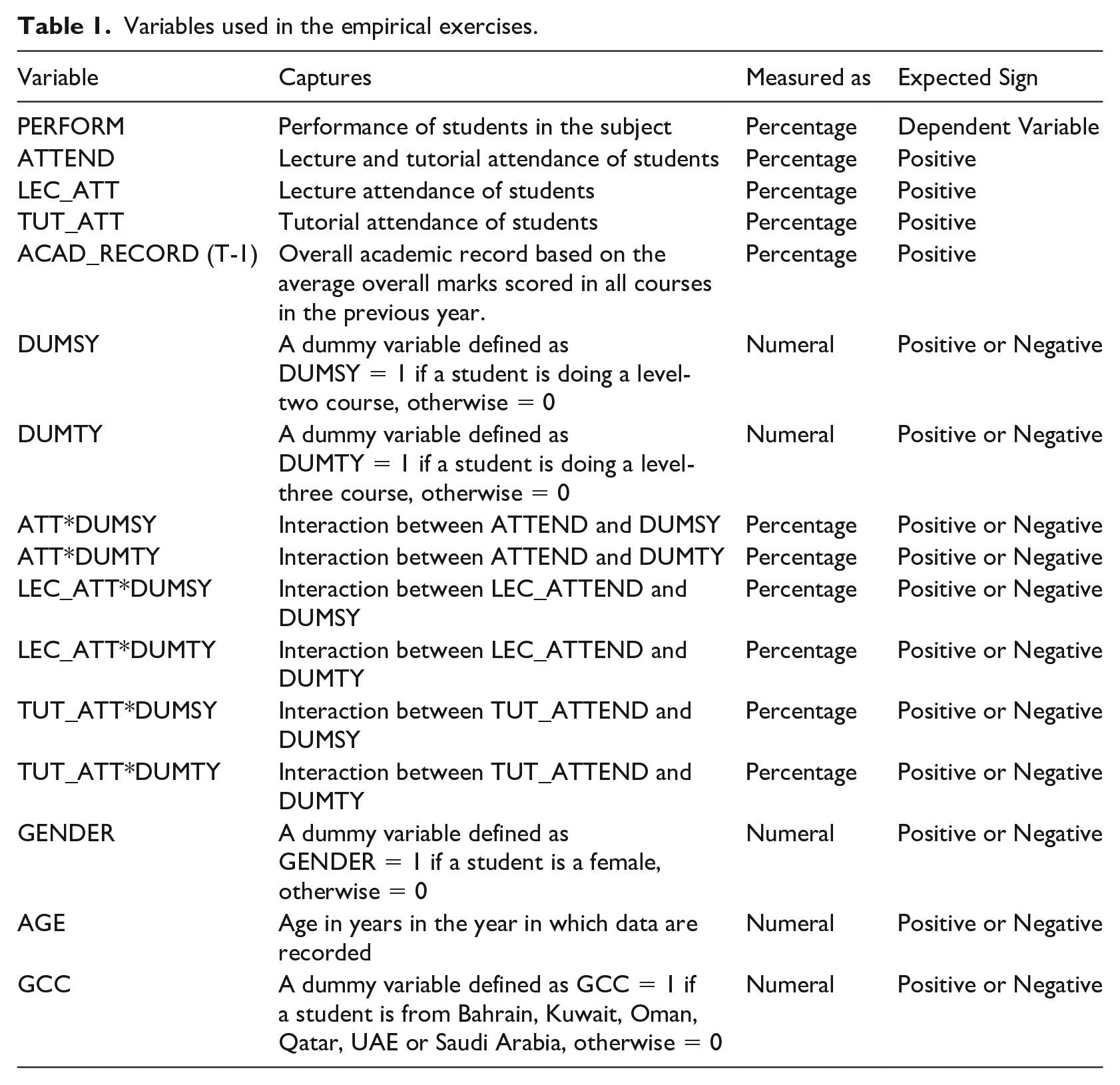
Performance of students in the course: The performance of students was measured based on grades scored in the three courses that students had enrolled in (D’Addazio et al., 2008; Dobkin et al., 2010; Latif and Miles, 2013). This was calculated as a weighted average of the various evaluation/assessments in each course. The assessments in the three subjects were a combination of multiple-choice tests, short answer tests, case-study tests, individual reports, group projects and final examinations. The overall performance in each course was important as it played a critical role in the final degree classification (i.e. whether a student passed with ‘first-class honours’ or with a ‘second-’ or ‘third-class’ degree).
Lecture and tutorial attendance: Classroom teaching for all three courses was conducted through lectures and tutorials, and students were expected to attend both. As per the university’s attendance policy, students must attend at least 75% of scheduled classes in order to pass the course. Weekly attendance records were maintained accurately. It must be pointed out that, given the institutional structure of an IBC, enforcing the 75% attendance requirement through academic penalties needed the approved of the home campus. Given that such an attendance requirement was not present at the home campus, enforcing it at the IBC was difficult. It is highly likely that, had the 75% attendance requirement been enforced strictly, our empirical results might have been very different due to much lower standard deviations in the attendance data (see Table 2 below).
Previous performance of students: Previous performance was based on the average overall marks scored in all courses in the previous year (Pani and Kishore, 2016). For level-two and level-three students, previous performance reflected overall performance in the first year and second-year courses respectively; for level-one students, we compiled the previous year’s performance data from their high school qualifications. The schooling systems relevant to our sample were the Indian Central Board of Secondary Education (CBSE), International Baccalaureate (IB), British A-Levels and General Certificate of Secondary Education (GCSE), and International General Certificate of Secondary Education (IGCSE). All the school graduating results were available in percentage format; however, where these were not available, appropriate conversion scales were used.
Dummy variables: We employed two dummy variables indicating the level of study of the student, and these, along with all the other variables, are described in Table 1.
Preliminary data analysis (n=908).
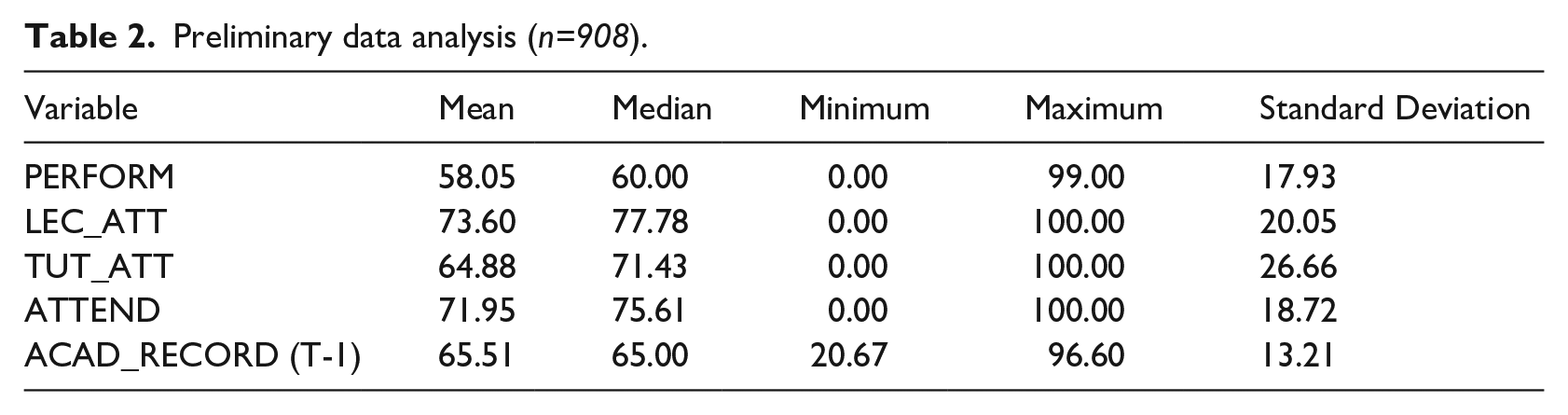
In Table 2, we present the results of the preliminary data analysis.
The fact that the means of LEC_ATT, TUT_ATT and ATTEND fell below the university stipulated requirement of 75% attendance requires some explanation. It could be argued that a better way of looking at attendance records is by considering the median. For ATTEND and LEC_ATT, we see that the median was above 75%, which suggests the majority of students fulfilled the requirement of minimum attendance set by the university. Further, a granular examination of student records revealed that attendance tended to improve in the second term of the academic year as compared to the first term. The reason for this was that the university intervened at the end of the first term and issued a cautionary letter to students whose attendance fell below the required level. This negative reward had a desirable effect on most students, and even though their overall attendance may not have risen above 75% (especially if they had been very negligent in the first term), their attendance for the second term did show improvement. This was in line with expectations (Baderin, 2005). Of course, there still remained a minority of recalcitrant students who showed no improvement. Inevitably, such students performed rather poorly in their various assessments.
Methodology
As seen from the discussion so far, the relationship between attendance and performance has occupied a lot of researchers. Regression methods, the preferred approach of many researchers, have been deployed to estimate this relationship. At least some of the researchers (Romer, 1993; Caviglia-Harris, 2006; Dobkin et al., 2010; Andrietti and Velasco, 2015) have recognised the possibility that class attendance, the independent variable in the attendance–performance relationship, may be endogenous rendering its coefficient in the regression equation biased and unreliable. Caviglia-Harris (2006) employs two-stage least squares (2SLS) to overcome this problem. We, too, address the issue of endogeneity and employ instrumental variables (IV) estimation techniques in our exercises.
In the presence of endogeneity, the estimated coefficient (from a standard OLS regression equation) that indicates the impact of a one-unit change in the independent variable on the dependent variable cannot be trusted. The ‘true’ impact may be higher or lower than the estimated impact. Consequently, drawing conclusions and offering recommendations on the basis of such unreliable estimates becomes hazardous. Endogeneity is a problem that arises when the correlation between the independent variable in a regression equation and the disturbance term is non-zero. This typically happens when (a) an important variable is omitted from the regression equation, and (b) when there is this simultaneity – that is, the dependent and independent variables affect one another. Of course, considerable circumspection is required before the relationship between the independent variable (in our case, attendance) and the dependent variable (performance) is pronounced to be causal since the relationship between the two could well be bi-directional.
The bi-directional relationship between attendance and performance may be closely associated with student engagement or the lack of it. Engagement is understood as the time and effort that students devote to educationally purposeful activities, while its antonym, disengagement, is understood as the negation of engagement (Chipchase et al., 2017). While there may have been many factors that result in disengagement, we did not delve too deeply into them, apart from noting that disengagement was likely to affect both performance and attendance. It might have been interesting to administer a survey to students in our sample to explore such disengagement (if any) by investigating whether reduced classroom attendance was compensated by more additional study of the subject at home. A couple of issues deterred us from exploring this option. One, any information reported by students about their study at home would be self-reported and, hence, unverifiable or inaccurate (see Duckworth and Yeager, 2015). And two, the requirement of anonymity for our survey would have meant that we could not have matched the responses of students with their attendance and academic performance records.
If disengagement is indeed such an omitted variable in our analysis that affects both attendance and performance, that is one more reason why a simple OLS regression may be methodologically inappropriate. Thus, the presence of a possible omitted variable provided one more motivation – apart from the possibility of bi-directional causality or simultaneity (as it has been labelled above) – for the use of IV estimation, which allowed us to extract a reliable estimate of the impact of attendance on performance. We shall have more to comment on this when we present our results.
Estimating the attendance–performance relationship posed one more issue that we wished to overcome. Linear regression techniques estimate the average relationship between the independent variable(s) and the dependent variable – that is, we estimate the mean of the dependent variable given the independent variables (Baum, 2013). However, there was a strong likelihood that the impact of attending classes might have had a differential impact away from the mean of the performance variable. Hence, standard OLS or IV estimation may over- or underestimate the impact. Quantile regression allowed us to overcome this lacuna of standard regression approaches.
Quantile regression
Even though quantile regressions are not employed as extensively in empirical applications as are the standard mean-based techniques, there are certain advantages in using this method. Chevapatrakul and Paez-Farrell (2014) note that, apart from the advantage of estimating the response of the dependent variable to the explanatory variables at different points along the distribution of the dependent variable, quantile regression estimators have been shown to be more efficient when the error terms are not normally distributed.
Quantile regressions, introduced by Koenker and Bassett (1978), seek to extend the idea of a standard regression to conditional quantile functions (Koenker and Hallock, 1999). A conditional quantile may be denoted by Qy(ϕ|X) where ϕ lies between 0 and 1 (Cade and Noon, 2003). Thus, for ϕ=0.90, Qy(ϕ|X) = Qy(0.90|X).
A linear quantile regression may be written as:

We were concerned with estimating quantile regressions relating to academic performance and class attendance. Specifically, we estimated these regressions at the 25th, 50th, 75th and 90th percentiles of academic performance with a view to compare the estimated coefficients.
The problem of endogeneity also needed to be addressed since quantile regressions were also likely to be afflicted by this problem. We employed an approach similar to 2SLS (Chevapatrakul and Paez-Farrell, 2014):
(a) In the first stage, a quantile regression was estimated by regressing the offending endogenous independent variable on a set of instruments;
(b) the fitted values of the endogenous independent variable from the first-stage regressions were calculated;
(c) finally, we estimated the main quantile regression of interest using the fitted values of the endogenous variable calculated in the first stage as the explanatory variable along with other explanatory variable(s).
The approach described above is called by Kim and Mueller (2004) as a two-stage quantile regression (2SQR).
Empirical exercises
This section reports the results of our empirical exercises. We begin by reporting the standard OLS estimates of the attendance–performance relationship. To show the bias in the OLS estimates, we also present two-stage least squares (2SLS) estimates of the relationship. We then compare these two regression equations with quantile regression estimates at the 50th percentile – that is, we report the median regression. We round off this initial discussion by reporting the two-stage quantile regression (2SQR) to correct for the endogeneity of the attendance variable. We carried out this exercise for various measures of attendance: total attendance, lecture attendance and tutorial attendance.
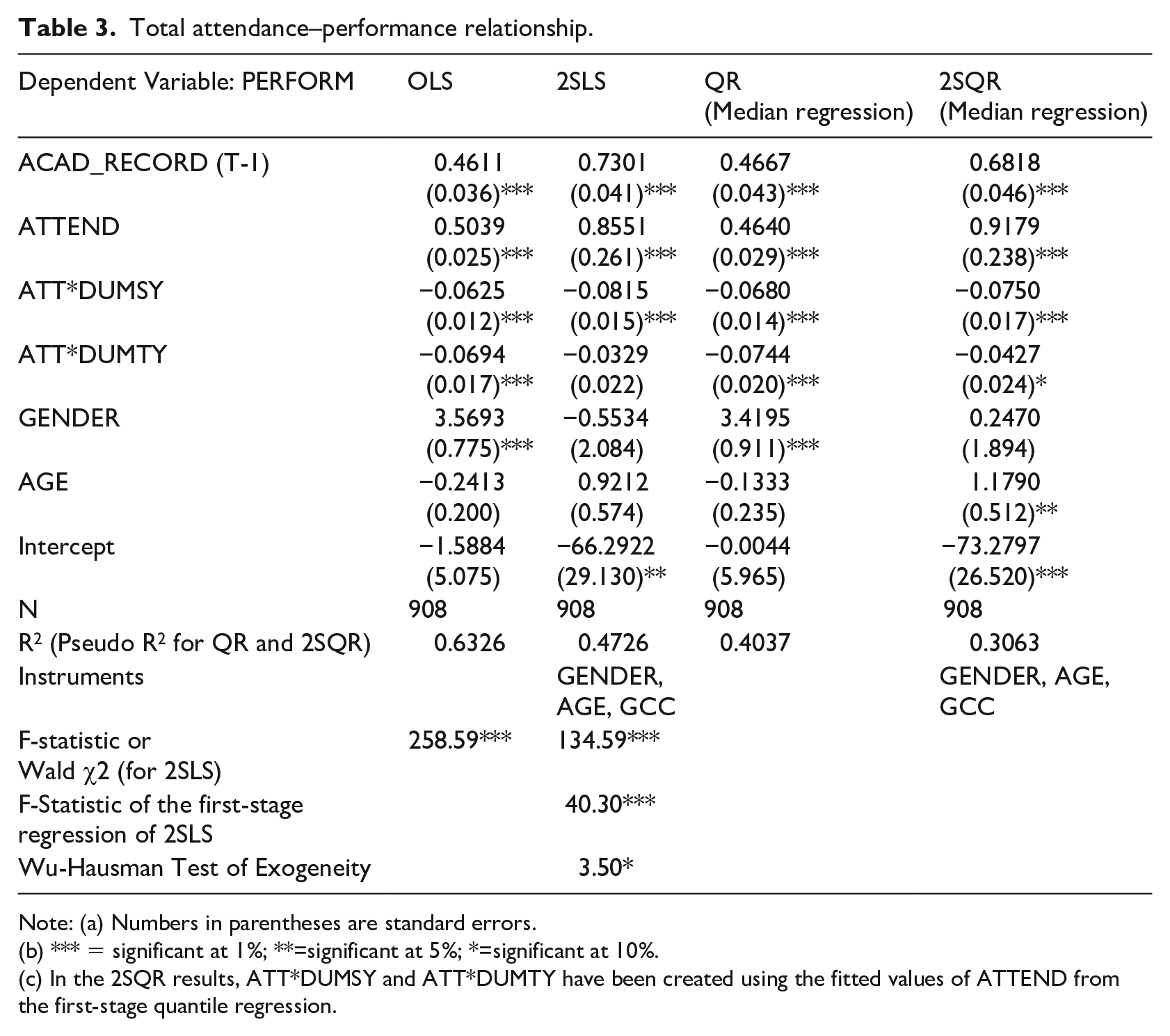
Table 3 shows the results for models where we considered total attendance of students.
Total attendance–performance relationship.
Note: (a) Numbers in parentheses are standard errors.
(b) *** = significant at 1%; **=significant at 5%; *=significant at 10%.
(c) In the 2SQR results, ATT*DUMSY and ATT*DUMTY have been created using the fitted values of ATTEND from the first-stage quantile regression.
The instrumental variables that we chose for our 2SLS and 2SQR models were GENDER, AGE and GCC (Gulf Cooperation Council). The importance of Gender and Age in determining motivation have been studied by Brouse et al. (2010), Martin (2010) and Edgar (2015), among others. The instrumental variable GCC was a proxy for culture that has been found to affect student motivation (King, 2014). GCC represents the so-called Gulf countries, which consist of the Arab ethnic group. According to Waterbury (2019), the Arab learning pedagogy is still based on rote learning, which is likely to encourage classroom attendance among students from this region. See also Dubai School of Government (2013) and United Nations Development Program (2016) for similar views about pedagogy. Given that the university we studied is located in the UAE (a member of the GCC), which acts as a magnet for students from the neighbouring Arab nations, the variable GCC is likely to be an important instrument variable for classroom attendance.
Caviglia-Harris (2006) notes that ‘possible instruments for class attendance include those proxies that can identify student motivation and performance in the classroom prior to taking the course’ (p. 9). The instruments we used satisfied these requirements in that they were all determined prior to taking the relevant course and were designed to capture the possibly unobservable qualities of students (e.g. intrinsic motivation) which might have an impact on the attendance. The appropriateness of the instrumental variables can be gauged from the F-statistics obtained from the first-stage regression of the 2SLS model. Table 3 reports this in the column related to 2SLS, and it is seen to be significant.
It may be noted that in each of the models reported in Table 3, we have introduced slope dummy variables, which allow the slopes to change as per the year in which the students are studying. The reference group in each model is level-one students. To illustrate the use of these models, we present below the coefficients for each group of students for the OLS model:
Coefficient of ATTEND for level-one students: 0.5039;
Coefficient of ATTEND for level-two students: (0.5039–0.0625) = 0.4414;
Coefficient of ATTEND for level-three students: (0.5039–0.0694) = 0.4345.
Clearly, an increase of one-percentage point in ATTEND gave the largest impact in terms of an increase in PERFORM for level-one students, which progressively diminished in higher years. As students progressed through the years, the courses that they had to study got increasingly difficult and class attendance had to be supplemented with longer hours of additional independent study time.
The results in Table 3 revealed important facets of the attendance–performance relationship. First, there was little doubt regarding the beneficial effect of attending classes. The coefficient of ATTEND was positive and significant for all the models. Second, the Durbin test of exogeneity offered clear vindication of the suspicion of Romer (1993) that the ATTEND variable is not exogenous. Finally, the coefficients of ATTEND in the simple OLS and QR models were biased downwards. In the sub-section on Methodology, we posited that the estimated impact of a one-unit change in the independent variable (ATTEND) on the dependent variable (PERFORM) might be higher or lower than the ‘true’ estimate if endogeneity is ignored. These were empirically confirmed in the columns labelled OLS and QR. In the 2SLS model, a one-percentage-point increase in attendance increased PERFORM by 0.86 percentage points (as compared to 0.50 in the OLS model). The result was slightly stronger for 2SQR: a one-percentage-point increase in attendance increased PERFORM by 0.92 percentage points for level-one students (as compared to 0.46 for the QR model).
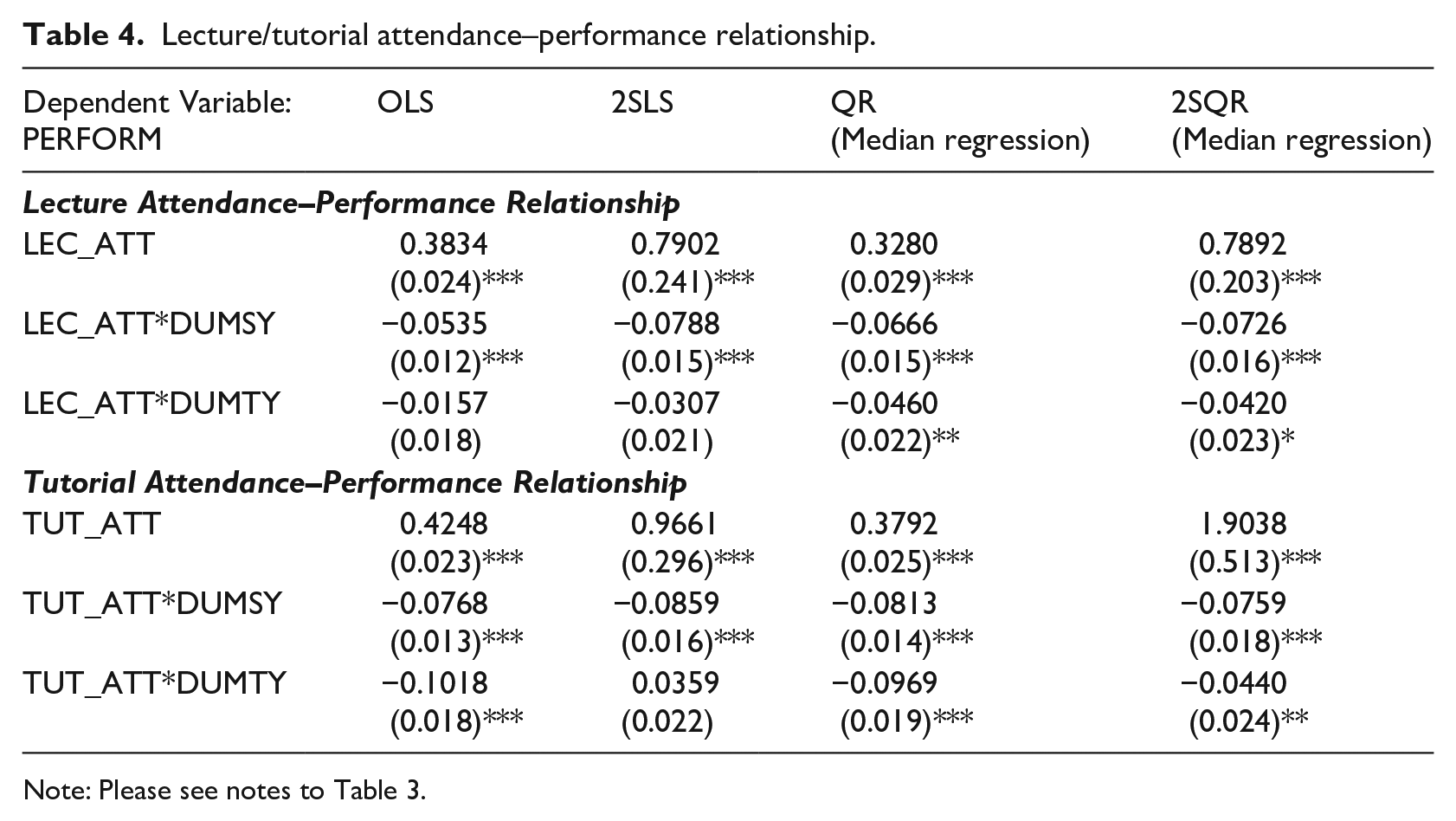
Next, we report results for lecture attendance and tutorial attendance. In the interest of brevity, we only report the coefficients of the ATTEND variable and its interaction with DUMSY and DUMTY in Table 4. Detailed results for lecture attendance and tutorial attendance are available from the authors on request.
Lecture/tutorial attendance–performance relationship.
Note: Please see notes to Table 3.
The results of Table 4 mimicked the patterns established in Table 3 for total attendance. Attendance at both lectures and tutorials helped improve student performance whichever model is considered. Correcting for endogeneity increased the effect of attendance on performance.
Having established that attendance helped improve grades and having demonstrated that the endogeneity problem was solved by estimating 2SQR models, we took our next important step. This was to examine the impact of attendance on performance at various points in the distribution of the dependent variable, namely, PERFORM. This exercise was important from the perspective of an IBC’s attendance policies. If we could identify where exactly the benefits of attending classes lay, it would allow the IBC to carry out targeted interventions where attendance fell below the average or median levels.
Table 5 first reports the results for total attendance (lectures plus tutorials) at the 25th, 75th and 90th percentile. We shall only be reporting 2SQR estimated models for the sake of brevity. Although detailed 2SQR models were not reported here, they are available on request from the authors.
Attendance–performance relationship: by percentile.(2SQR models).
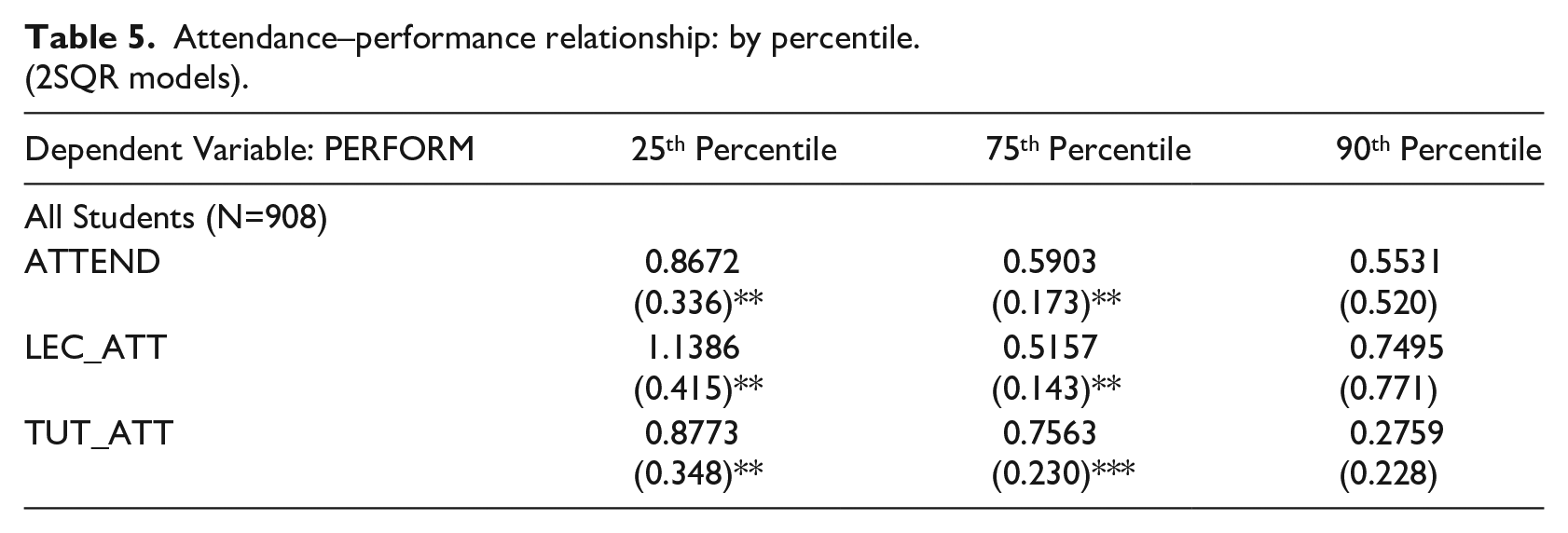
The most striking result of Table 5 is how we can identify where the most significant benefits of attendance lie not just for total attendance but also for lecture and tutorial attendance. For all three measures of attendance, the highest benefits of attendance can be found at the 25th percentile. This benefit dips at the 75th but continues remains significant and, finally, at the 90th percentile, the significance of the coefficient vanishes. This begs an important question: for students performing at lower percentiles, does this reflect some degree of disengagement with the learning process on the part of the student? In our sample, there are 233 students at the low end of performance (i.e. up to the 25th percentile, of which 33 are at the level-one subject, 110 at the level-two subject and 86 at the level-three subject). It has been suggested that many students may not be adequately prepared for tertiary/higher education, causing them to disengage from the learning process (Chipchase et al., 2017). Yang et al. (2019) theorised that such problems might be particularly challenging in IBCs, where students are exposed to teaching styles and academic cultures that are unlike their local educational institutions. Baldwin and Koh (2012) have pointed out that the transition from passive and surface learning (that is endemic in schools) to active and deep learning that is required for study at university level can be frustrating for many students. Our results suggest that the performance of students at lower percentiles can be enhanced if attending classes can be encouraged among such students.
The results of Table 5 were important for two reasons: first, demonstrating to students the benefits of attending classes, especially those at the 25th and 75th percentiles, Second, helping students to transition from a surface learning style to a deep learning style. This could be an important area for intervention and academic support initiatives to help improve the performance of students. These results also communicate to universities that attendance records of students need to be monitored closely in order to correct for any slippage (perhaps due to disengagement) before it starts to have a permanent debilitating effect on performance. A related area of emphasis is the importance of students forming positive relationships early on to facilitate a positive transition to university life. Maunder’s (2018) research showed that students who made strong peer relationships demonstrated higher levels of adjustment, while Kassarnig et al. (2017) examined social aspects of class attendance and found that academic success was influenced not only by attendance but also social interactions and peer effects.
Discussion and implications
Classroom teaching involves investment in both time and money and, therefore, has been, and continues to remain, an important area of research. While the topic has been studied in several disciplines and geographies, the methodology employed in the current paper adds value and a new dimension to the existing literature. This is especially so, since our exercises have been conducted in the context of an IBC in the UAE, a geography that has seen arguably the fastest growth in IBCs. The results that we have obtained confirm that student attendance has a positive impact on academic performance and are consistent with similar findings from other settings such as Chen and Lin (2006), Cohn and Johnson (2006), Crede et al. (2010) and Arulampalam et al. (2012). An important contribution of our study is the use of quantile regression, which allows the estimation of the effects of attendance over the entire distribution of the performance variable rather than only at the means as is done by OLS. In fact, our exercises go further as compared to extant literature in that we explicitly recognise and address the problem of endogeneity of classroom attendance by using the techniques of 2SLS and 2SQR, which have not witnessed much use in this field.
The main results that we have obtained are as follows:
(1) As shown in Table 3, attendance has a beneficial influence on academic performance whichever model is used. Using 2SLS or 2SQR corrects for the downward bias in the estimates obtained using OLS and QR.
(2) The above results hold true for lecture attendance and tutorial attendance (Table 4).
(3) Estimating 2SQR models for different percentiles of student performance yields important results. The benefit of attending classes is seen to be important at all but the highest percentiles.
Contribution to practice and policy
Our findings have several implications for higher education managers and policymakers, faculty and students as well as for the society. Specifically, our results can be of great value for IBCs, which have to cater to compelling demands from local students, staff members and regulators as well as from their home campus and international regulators.
Implications for managers of IBCs
The fact that attendance and academic performance go hand in hand has important implications for IBCs, which have to match the learning outcomes of the home campus and are under pressure to show satisfactory progression/graduation rates. If superior grades are an important signifier of learning outcomes, and if attendance of classes improves grades, this clearly points to the importance of attendance policies at IBCs. The debatable question, however, is whether a mandatory attendance policy is a good enough tool to keep students motivated and thereby acquire knowledge (Browne and Hoag, 1995). Romer (1993), expressing concern at the rampant absenteeism among students, wondered whether mandatory attendance might be worth trying. Concerns have, however, been expressed about its pedagogical merit; unmotivated students may feel compelled to attend classes only due to the mandatory attendance policy without displaying any sense of involvement with the classroom (Macfarlane, 2013). While these concerns remain valid, Dobkin et al. (2010) offer support to the beneficial effects of a mandatory attendance policy. In a carefully implemented attendance policy, attendance was made compulsory for students who scored grades below the median in the mid-term examinations. It was observed that attendance of such students improved significantly after the mid-term examinations and, even more importantly, students who were subject to mandatory attendance performed better in the final exams. Self (2012) reinforces the importance of attendance by suggesting that an attendance policy that penalises students for missing classes works better than a policy that rewards students for attending classes.
Policymakers in IBCs should further recognise that lectures and tutorials, which are two different modes of delivery, have an important bearing on student performance. Our results show that attending tutorials gives more ‘bang for the bucks’, as indicated by the results of Table 4. Consequently, there may be a case for setting a stricter attendance policy for tutorials as compared to lectures. Büchele (2020) has reported that tutorial attendance mattered more than lecture attendance, as it encouraged behavioural engagement when students had to actively engage in problem-solving, discussions and practice questions. A sampling of attendance policies across educational institutions reveals that a uniform attendance policy for all delivery styles seems to be the norm (Stanford University, nd; Monash University, nd). The IBC that we have reported on in this paper, enforces attendance for both. Shimoff and Catania (2001) report that merely recording attendance makes a difference and, as we know, that will have a beneficial effect on performance. Transparently, consistently and conveniently recording attendance should create greater awareness among students themselves (Moores et al., 2019).
In the context of IBCs, additional implications arise. As outlined earlier, IBCs are often governed by the academic policies of the parent/home campus. Similarly, they may have limited ability to adapt learning activities for their own students to build engagement or implement some technology-enabled innovations for attendance monitoring systems. There may be constraints on designing the curriculum, course content and delivery requirements, assessment schemes and the technological platforms adopted by the parent/home HE institution (Shams and Huisman, 2014).
Implications for faculty at IBCs
Faculty members should realise the impact and importance of attendance, especially as technology-enabled remote asynchronous learning is becoming increasing commonplace, where students are able to miss live lectures and catch up online. The motivation of students to attend classes has been found to be considerably impacted by how faculty members conducted classes and the manner in which material was presented (Fjortoft, 2005). Keeping students engaged in the classroom is a challenge the faculty must be prepared to face. For this, the faculty should not only promote attendance in class, but, perhaps, design the course curriculum and assessments in a way that encourages attendance. In this context, continuous assessment strategies may motivate students to attend classes regularly (Artés and Rahona, 2013). Similarly, faculty need to consider building in activities that students value and create interactivity during classes through discussions, tasks and group activities (van Schalkwyk et al., 2010). Such activities could also focus on building peer networks, particularly for newly enrolled students, as research has shown that such interactions affect academic success as well as class attendance (Kassarnig et al., 2017).
Implications for students and society
Our sample includes students of age 18 and above. These adult learners are ultimately responsible for their attendance. If the attendance policy is strong and its benefits are clearly communicated to students, parents and related parties, a class would likely draw higher attendance.
The question then is about getting students to attend classes either using coercion (i.e. compulsory attendance) or by appealing to students’ self-interest. The latter is most likely to create willing learners but the problem often is that, at least, a reasonable number of students may be myopic and fail to recognise that their own long-term interest lies in better academic performance. A meta-analysis by Crede et al. (2010) found that compulsory attendance led to a small but significant improvement in grades. However, enthusiasm for compulsory attendance is not shared by many (see St Clair, 1999). The best way to motivate students to attend is if they can see tangible benefits of being in class.
Recommendations
The above discussion has revealed that students might be motivated to attend classes via a combination of continuous or frequent assessment and an attendance policy that monitors and keeps meticulous records of student attendance. Perhaps the attendance policy may be more strictly enforced for tutorials than for lectures. The benefits of such a policy will include the following:
An attendance policy that brings students into class is highly likely to help improve overall performance and progression rates. This is likely to meet the approval of the Home HEI, which receives an assurance that learning outcomes are being met in the IBC.
It was mentioned above that IBCs come under strong scrutiny from parents of students who have to bear the burden of tuition fees. A strong attendance policy with a view to improving the quality of education will likely meet with the approval of parents.
An attendance policy that brings students to class and improves grades may also send an important signal to potential employers of IBC students giving them the confidence that the level of instruction and learning outcomes at the IBCs match those of the home campus.
Conclusion
The literature does not have a unanimous view on the benefits of an attendance policy. However, most of such discussion has taken place in traditional centres of education and have bypassed IBCs. This paper takes an important step in bridging this lacuna. We have pointed out that an IBC faces its own peculiar challenges and solutions to improving learning outcomes at IBCs need to recognise these challenges. We delineated the challenges faced by IBCs bearing in mind the concerns of important stakeholders of IBCs. Our findings indicate that IBCs will be able to deliver high-quality learning outcomes, comparable to those at the home campus, by making conscious efforts to get students into the classrooms as this will translate into superior performance.
Footnotes
Acknowledgements
We would like to thank two anonymous reviewers for some important suggestions that helped improve the quality of the paper. The usual disclaimer applies.
Declaration of conflicting interests
The author(s) declared no potential conflicts of interest with respect to the research, authorship, and/or publication of this article.
Funding
The author(s) received no financial support for the research, authorship, and/or publication of this article.
