



Abstract
This article provides a comparative examination of teachers’ experiences of both participating in Catholic teacher education programmes and teaching within Catholic schools in the Republic of Ireland and the United States. This mixed-methods study consisted of surveys and interviews with 22 teachers who are graduates of both Irish and US teacher education programmes and have taught in Catholic schools in both countries. This distinct cohort of Irish Catholic educators reveals how faith and Catholic identity are experienced in two distinct education systems that share a common mission. The research underscores how context powerfully shapes the lived experience of teachers in both Catholic teacher education programmes and in Catholic schools, and it highlights implications for those responsible for Catholic teacher education programmes and also for the leaders of Catholic schools. The extent to which members of a school community explicitly identify and choose to embody the Catholic identity greatly shapes outcomes.
Introduction
Catholic schools have a rich history in both Ireland and the United States. Although Catholic school systems matured in both countries through the 20th and into the 21st century, a number of structural differences emerged. In Ireland, Catholic schools are the largest providers of education, making up 82% of all schools nationally (Department of Education and Skills, 2019). They are funded centrally by the State, and teachers are classified as public servants. Teacher salary does not differ between those teaching in a Catholic school versus a school under a different patronage or based on the socio-economic status of the students or local community.
Catholic schools in the United States operate in a very different context than those in Ireland, educating only 3% of the school-going population. 1 In contrast with Ireland, Catholic schools in the United States are privately funded and receive virtually no funding from the government. 2 Furthermore, teacher compensation is about half to two-thirds of a comparable position in US public schools and salaries vary widely based on the socio-economic status of the school and local community (Przygocki, 2004).
Given the historical and contextual differences of Irish and US Catholic education, teachers are likely to experience the profession of teaching in a Catholic school differently in each country. This article focuses on the experiences of a small group of contemporary Irish educators who have, over the past 16 years, travelled from Ireland to the United States to study and teach in Catholic schools. This group of teachers provides a unique insight into the impact that local context plays in how the same teachers experience their faith and Catholic identity in schools from two different countries, both committed to a shared mission of Catholic education. The participants are graduates of a variety of Initial Teacher Education (ITE) programmes from two different Catholic colleges in Ireland, as well as having completed a graduate ITE programme in the United States at the University of Notre Dame (the programme is designated as an ITE programme even though the Irish teachers have already completed their undergraduate programmes, so it is somewhat repetitive for them). The Notre Dame programme is one type of ITE that focuses intentionally on forming Catholic school teachers; not all graduate ITE programmes in the US have such a focus. This intentionality finds expression in an active programme of faith formation, comprised of retreats, coursework, daily Mass, and facilitated group faith-sharing experiences, as well an emphasis on the integration of faith across the programme’s curriculum. This research explores the participants’ sense of Catholic identity at a personal level, as well as in the context of their ITE programmes and serving in Catholic schools in the United States and Ireland. Each teacher in the study has a minimum of two years of primary school (K-5) teaching experience in both countries. The project examines the experiences of the same group of Catholic school teachers in schools in both countries and explores what any differences may tell us about the role of context in shaping an educator’s faith life both professionally and personally.
This comparative research explores the personal experiences of faith of the participants and their professional perceptions of Catholic identity during their ITE and while teaching in US and Irish Catholic schools. While Catholic schools are a world-wide phenomenon, the explicit role of Catholic identity, and teachers’ experience of it, in schools in two different countries is a unique addition to an understudied area of scholarly research.
ITE
Catholic schools traditionally have depended on faith-filled teachers – both religious and lay – to educate their students and fulfil their mission. In recent years, ‘secularization and a weakening of established modes of Catholic culture’ have challenged Catholic schools’ ability to attract faith-filled teachers to serve and lead (Franchi and Rymarz, 2017: 12). This phenomenon appears most pronounced either in places where a once dominant religion that served an essential social function has subsequently diminished or in places where increasing sectors of society are vehemently opposed to religion having any place in the public sphere (Voas and Doebler, 2011). This description fits the Irish and US contexts very well.
There have been significant shifts in individual religious practices, beliefs and attitudes toward religious institutions in both contexts but especially in Ireland in recent decades. For example, weekly Mass attendance in Ireland has fallen from between 88% and 95% in the 1970s to 36% in 2016, with even lower rates of 24% among younger age groups (Irish Catholic Bishops’ Conference, 2010; McGarry, 2018). Irish overall Mass attendance mirrors closely the rate in the United States, which was 39% in 2017, a figure that had fallen 6% over the preceding nine years and significantly from peak levels of 55% in the 1970s (Frequently requested church statistics, nd; Saad, 2018).
Changing views on social issues, most pronounced in the Irish context, also point to the effects of a rejection of certain Church teachings and loss of confidence in the institutional Church. In 1981, 68% of Irish citizens reported believing that homosexuality ‘is always wrong’, and 82% reported that abortion ‘is always wrong’ (European Values Survey, 1981). In contrast, 62% of Irish voters in a 2015 national referendum supported legalizing same-sex marriage, and 66% of voters in a 2018 referendum supported legalizing abortion. In addition to these dramatic shifts in social attitudes, public opinion polls confirm a bruising loss of confidence in the institutional Catholic Church, as confidence has plummeted from 51% in 1981 to 20% in 2008. 3 Such results also suggest that there is a growing diversity among Irish citizens about what it means to be Catholic. These recent referendum results in particular point to a new reality for many Irish Catholics in which they no longer have to follow the dictates of the Church hierarchy or hold traditional doctrinal views to consider themselves Catholics in good standing.
This dramatic weakening of religious practice, changing set of social attitudes and overall decline in young people identifying as Catholic have significant implications for the formation of Irish Catholic teachers seeking to serve in Catholic schools. This is especially relevant because the Church depends on the central role of teachers to uphold the Catholic identity of a school. The Congregation for Catholic Education states ‘that teachers and educators fulfil a specific Christian vocation and share an equally specific participation in the mission of the Church, to the extent that it depends chiefly on them whether the Catholic school achieves its purpose’ (1998, #19). With far fewer people within Ireland upholding Church teachings and trusting in the Church as an institution, it is much more difficult to attract and train teachers who want to explicitly integrate faith into their teaching.
In the United States, the shift away from Catholic Church teaching on a range of social issues, amongst the Catholic population, is following a similar trend to Ireland. Seventy-six percent of US Catholics say that the Church should allow the use of birth control. On the issue of allowing priests to marry, 62% believe it should be allowed. And while not as high as in Ireland, 46% believe that the same-sex marriage should be recognized (Masci and Smith, 2018). The profile of Catholics in the United States is changing too, with large numbers of white ethnic Catholics now classed as ‘lapsed’ with a growing number of Latino immigrants taking their places in the pews. This demographic shift is most pronounced amongst young people under 35, with 67% of young Catholics attending church regularly being Latino (Putnam and Campbell, 2012). Interestingly, this demographic change in the pews has not transferred to US Catholic schools where just 18% of students in Catholic schools are Latino.
In parallel with this rising secularization in western nations has been a significant change in the profile of the teaching corps in Catholic schools. Over the past 50 years, there has been a passing of the baton from a predominantly vowed religious teaching corps to an almost completely lay teaching staff in both Ireland and the United States. As part of this shift, there has been a growing number of teachers with little or no active faith, which is an increasingly important and problematic reality in western Catholic school systems (Franchi and Rymarz, 2017). Beyond western/anglo cultures, a review of available literature reveals an absence of investigation on the topic of faith in the lives of contemporary teachers and those aspiring to the profession; however, an increasing loss of Catholic identity within Catholic schools is noted (Omolade, 2009). Therefore, a key question is whether a new generation of lay teachers and leaders will be able to cultivate and sustain the robust intentional culture for which Catholic schools have long been recognized and praised (O’Donoghoe, 2004, 2012).
Faith in Catholic schools
A lived experience of a faith community is most deeply encountered for many through their attendance at a Catholic school (Cook, 2000). Indeed, the school as a faith community is integral to a school’s Catholic identity (Convey, 2012). Evidence in the United States suggests that teachers self-select for this by choosing to teach in a Catholic school as a way of participating in the evangelizing mission of the Church (Cho, 2012; Convey, 1992; Cook, 2004; Schuttloffel, 2008). Among the current primary teaching corps in Ireland, data suggest that a large percentage (72%) 4 believe that schools should not be denominational in character; yet 93% of all Irish primary schools are Catholic. Thus, significant numbers of teachers in Irish Catholic schools have little or no desire to engage in the mission of the Church through education and simply want to teach children. Again, although this is difficult to measure, such demographics imply that growing numbers of teachers may be either ambivalent towards or opposed to Church teaching, while being tasked with passing on the faith to their students.
These changes pose considerable challenges to the Catholic Church, which has been clear on the central role a teacher’s faith has in fulfilling the educational and spiritual mission of the Catholic school: The Catholic educator must be a source of spiritual inspiration . . . The lay Catholic educator is a person who exercises a specific mission within the Church by living the faith, a secular vocation in the communitarian structure of the school: with the best possible professional qualifications, with an apostolic intention inspired by faith. (Congregation for Catholic Education, 1982: 14)
There is a well-identified connection between a Catholic teacher’s faith and their commitment to their Catholic school (Ciriello, 1987; Tarr et al., 1993). Consequently, such a commitment, strengthened by their perception of a shared religious mission has a positive influence on the academic achievement of their students (Guerra et al., 1990). Although there are many factors that undoubtedly influence teacher motivation in the context of Catholic teachers, scholars consistently argue that ‘faith needs to be considered as one of the most important predicators that would create, sustain, and/or improve teacher commitment’ (Cho, 2012: 132).
Sustaining and fostering this motivation and connection to the school mission through a teacher’s personal faith is an important task of the Catholic school leader. Through faith formation and the effective use of professional development, school leaders have the ability to ‘lead lay teachers toward a deeper personal relationship with God, a fuller understanding of Catholic faith, a greater confidence integrating faith and learning for students, and a higher level of devotion to school mission’ (Cho, 2012: 134).
While there is an emerging body of research on the role of faith in both the formation and the practice of Catholic school teachers, as well as on the Catholic identity of Catholic schools, there has been no comparative research carried out with participants who have experiences in both the United States and Ireland. Given the shared contemporary trends in Ireland and the United States in relation to secularism and religious practice, it is worthwhile, therefore, to explore the experiences of teachers in both countries to better understand the forces impacting the faith of Catholic teachers and Catholic identity within Catholic schools. We know that Catholic schools share a common mission, and through this study we seek to better understand the role of the local educational landscape on the ability of Catholic teachers and Catholic schools to fully realize this mission.
Methods
This study employed a sequential explanatory mixed-methods design (Ivankova et al., 2006). The researchers were currently or formerly affiliated with the US graduate ITE programme and had contact information for all the graduates. For the first phase of the study, a survey was created using an online survey platform (Qualtrics) and administered via an email link. Twenty-eight Irish teachers 5 were invited to complete the survey, with 22 choosing to participate. Respondents were aged between 22 and 37 years of age, had between 2 and 16 years’ teaching experience, with 6 being male and 16 being female. The survey included demographic information, school teaching experience, and questions related to teacher preparation, professional development, school community and spirituality for both Irish and US Catholic schools. The survey included both Likert-scale rating questions and open-ended comment questions. Data from the survey phase were analysed descriptively and helped to inform the interview phase of the study.
After the survey was completed, 20 participants, who had at least 2 years of teaching experience in both countries, were contacted to schedule follow-up interviews with one of the researchers. Nine interviews took place via an online video-conferencing service (Zoom), with 2 conducted face-to-face, with interviews lasting between 25 and 45 minutes. The researchers used an open-ended, semi-structured interview protocol including questions about their experiences in teacher preparation programmes and working in Catholic schools in both the United States and Ireland.
The researchers reduced bias due to personal familiarity with many of the participants. For example, the recruitment email text and verbal script included language emphasizing that individual responses would be kept confidential and the researchers were not focused on evaluating the ITE programmes or either country’s schools, but instead explored differences between initial training, teaching and ongoing professional growth in different countries. Ultimately, we believe personal rapport with the participants elicited open and honest responses.
Interviews were audio-recorded and then transcribed for coding. The researchers coded interviews according to an a priori list of codes developed based on analysis of the surveys (see code list, Appendix 1) (Saldana, 2009). In addition, the researchers used grounded theory (Strauss and Corbin, 1990) to identify additional themes emerging from the data. The three researchers coded a subset of three transcripts independently before meeting to compare and reconcile any differences in coding through discussion. There were occasional cases of disagreement in the use of a code, and, in these instances, researchers explained their thinking and devised a common approach. This process was repeated with at least two researchers coding and discussing each interview. The researchers then examined codes across participants, analysing patterns of co-occurrence and frequency of themes.
Results
ITE experiences
The ITE programmes in this study were structured differently in Ireland and the United States. Teachers in this study earned undergraduate degrees in education in Ireland over three or four years. The teachers surveyed received their master’s-level training over two summers with additional distance learning over the two academic years while they were teaching in their own classrooms in the United States. It should be noted that the US graduate programme was specific to Catholic education and not representative of all graduate teacher education programmes in the United States. Despite the structural differences and changes to programmes throughout the years, 6 virtually all the teachers in this study rated the overall quality of their teacher preparation as good or excellent in Ireland (90%) and in the United States (100%).
Data from the survey indicate some similarities and a few differences in terms of how the teachers perceived their initial training. In general, both ITE programmes emphasized classroom excellence, but the US programme also underscored integrating faith and building community in the classroom. In the survey, teachers were asked to reflect on how much they learned about various aspects of teaching from their respective programmes. Reflecting on experiences in both countries, a high percentage of teachers reported that their programme spent ‘a lot’ of time on planning effective lessons (71% in Ireland and 68% in the United States), varying instructional methods to increase student learning needs (60% in Ireland and 68% in the United States) and differentiating instruction to meet individual student learning (70% in Ireland and 55% in the United States). These were the only categories in the Irish programmes where over 50% of teachers responded that they learned ‘a lot’. In contrast, teachers in the US programme also learned ‘a lot’ about managing student behaviour with rules and procedures (77%) and assessing student behaviour (71%) compared to only 24% and 40% of teachers learning ‘a lot’ about these themes in their Irish training.
The most striking difference in the two programmes was how much teachers learned about community and spirituality in the US programme compared to their Irish ITE programme. For example, 91% of teachers in the United States learned ‘a lot’ about building a positive classroom community compared to only 25% in Ireland, and 55% learned ‘a lot’ about communicating with parents and guardians as opposed to only 5% in Ireland. The differences are greater in the area of faith and spirituality. In reflecting on the US programme, 100% of teachers learned ‘a lot’ about how to integrate faith into their teaching and 59% reporting learning ‘a lot’ about effectively teaching religion compared to only 5% and 15% of teachers learning ‘a lot’ about these in their Irish programmes.
Follow-up qualitative evidence reinforces these findings that faith was part of every aspect of their specific ITE programme at Notre Dame but was absent in much of the Irish experience of teacher training. According to one teacher, faith was rarely discussed in Irish courses or among friends, and when it was talked about with peers it was often done so in negative terms. In contrast, this teacher stated that ‘when I went to the US, I found people very much like me. They were open to it (faith), they wanted to talk about it, and wanted to grow in their capacity to help people.’ While some teachers indicated their initial apprehension about the explicit nature of faith in the US context, they chose to ‘just throw myself into it and just embrace it. And it just become something very, very natural, very quick for me.’ Ultimately, the same teacher felt that ‘being immersed in it for two years, and living in community, 7 was what really was life-changing for me’.
A common theme among these Irish teachers commenting on their ITE experience in the United States was that they learned to integrate faith into all aspects of the curriculum. One teacher stated that bringing religion and your faith into every aspect of your teaching was huge. Even if you’re talking about nature when you’re teaching social studies or something like that and you bring your faith into it. That’s not done here (in Ireland) at all.
Another teacher noted the value of integrating faith in a much more intentional way into their teaching, with clear benefits such as learning ‘how to foster a classroom atmosphere and how to create relationships with students’. This integration of faith and focus on teaching in a Catholic school was markedly different from their undergraduate experience for many teachers in the study. In Ireland, ‘there wouldn’t have been that emphasis on the Catholic side of things . . . Whereas in the US, all the classes had teaching and learning infused with Catholic values and teaching in a Catholic school.’ Another teacher reported that in Ireland ‘we had our Religious Education classes and electives for religious education and teaching of religion as part of our degree’, but in the US programme there ‘was a lot more targeted focus on teaching in a Catholic school’. This intentional focus on preparing teachers to teach in a Catholic school was something that stood out for teachers interviewed.
Catholic identity in schools
Similar to the experience of ITE programmes, the teachers in this study reported very different experiences in terms of how overall Catholic identity was practised in their schools.
Survey data suggest that there are few similarities for the participating teachers in terms of how they experienced Catholic identity at the personal or school-wide level. For example, when asked to rank the importance of various aspects of Catholic education, participating teachers reported similar, and high, values regarding promoting social justice, being a leader within the school and preparing the students for academic success, in both countries. However, in the Irish schools the participants placed a higher value on developing as a professional educator (50% in Ireland compared to 36% in the United States) and collaborating with colleagues (also 50% to 36% respectively). By contrast, the participants reported placing a higher value in the US schools on being a Catholic role model for students (63% in the United States compared to only 10% in Ireland) and integrating Catholic faith and tradition into your classroom (74% in the United States and only 10% in Ireland). These differences point to a significantly higher emphasis placed on Catholic identity and faith formation as part of what excellence in Catholic education means in the US context.
The primary differences between Catholic schools in the two countries is that there is a much more intentional Catholic culture and ethos in the United States than there is in their experience of Irish Catholic schools. In the Irish schools, especially at the primary school level, virtually all schools are Catholic, and therefore teachers lack a real choice based on mission and must accept a position where they can get a job. As one teacher stated: In Ireland, a lot of people are there by default. So, it’s not that they were driven to teach in a Catholic school. It’s just that they wanted to be a teacher, and those were the only options available to them. And, so that wasn’t a strong part of the school’s identity for many of the teachers.
Although the overwhelming majority of schools are ‘Catholic’ in name and historical legacy in Ireland, the clarity of mission has dissipated. One teacher stated that ‘every time I go for an interview for a position here (Ireland) in a school, Catholic identity, or Catholic ethos is always at the bottom of the agenda for the interview’. This same teacher added that ‘there’s very little intentionality about it. There’s very little about the love for Catholic school or why we do it.’
The US Catholic school context is dramatically different. A key difference is that in the United States, there is an explicit choice on the part of teachers to teach in Catholic schools and for parents to want to send their children to Catholic schools. Because teacher salary in US Catholic schools is less than their public school counterparts, many teachers are choosing for mission. Therefore, it is easier for US schools to build community around this common identity and sense of culture. In the words of one teacher: It was a lot more of a deliberate choice (in the United States).They were making a personal decision to teach in a Catholic school for vocational reasons. They felt very strongly in their Catholic identity. So, it was a much more visible and indelible print on their identity and on the school’s identity.
Parents also choose to send their children to Catholic school for mission and cultural reasons and they must pay for it, which demonstrates their commitment and sense of purpose. One teacher said that in US schools, the parents were all involved, and there’s Mass; the kids knew how to behave at Mass, and they knew what was going on. Not just because you were teaching it, but because they go to Mass all the time. And they were involved in their religion. It was all around them at home. It makes a difference. They know what you’re talking about.
In contrast, another teacher reports: ‘I don’t remember one single spiritual experience the whole time in my school in Ireland.’ Another teacher stated that in the United States, parents were sending their children to a Catholic school because their faith is what’s most important to them and you get the sense it’s part of their identity and they want their children at a faith-based school even though it’s costing them a lot of money.
This sense of choice and explicit Catholic identity pervaded all aspects of Catholic schools that the participating teachers experienced in the United States, including frequency of school-wide prayer and how religion is taught in the school. The surveys reveal clear contrasts with Irish Catholic schools. First, there were significant differences in the ways in which prayer (e.g. school-wide and classroom) was practised in the US and Irish schools, with much higher prevalence of school-wide prayer in the United States. For example, 79% of participants reported that their Irish school prayed as a whole school ‘never’ or ‘about once a month’, whereas respondents stated that 95% of the US schools prayed as a whole school ‘about once a week’ or ‘daily’ with only 5% never praying as a whole school. Similarly, participants reported that their Irish schools rarely had Mass as a whole school, with 47% never having Mass and 53% having Mass ‘about once a month’. In contrast, 90% of participating US schools had Mass as a whole school ‘about once a week’. Curiously, when left to themselves and the students, the teachers as individual classroom leaders regularly prayed together with their respective classes in both Ireland and the United States. In Ireland, 84% of the participants reported praying with their class ‘daily or almost daily’, whereas in the United States this figure was slightly higher at 100% praying with their class daily. The similarly high levels of personal and classroom prayer contrast with the vastly different levels of school-wide prayer to further illustrate the critical impact institutional and cultural factors have in influencing outcomes. It is not that teachers are opposed to integrating their faith into the classroom or celebrating it on a broader level within the school community, but the two countries promote different behaviour. Choice matters! In the US context, where students, parents, teachers and leaders select Catholic schools often at considerable cost to them personally, there is clear intentionality about being Catholic, whereas in Ireland the denominational structure of the system limits choice for many students, families and teachers.
The intentional nature of Catholic schools in the United States meant that faith was part of everything, not just Mass or school-wide prayer, but in the classroom and other community experiences. One teacher captured the contrast between Irish and US Catholic schools and even admitted it being so culturally different that it took time to get accustomed before they could embrace the way school assemblies and prayers and the curriculum connected the Gospel to the students’ lives: ‘I was also kind of overwhelmed by how Catholic everything was . . . And I found difficult too, at first. But, gradually, with practice and listening to the Principal and to other teachers, that became more routine and natural.’ Given the all-encompassing nature of Catholic identity in the US context, the teaching of religion did not stand out as much because it was linked with all the other practices in the school.
The experience of teaching religion was noticeably different in Ireland because the Catholic ethos was less integral to the overall mission of the school. A majority of the teachers reported that there was little importance placed on teaching religion, and the quality of the curriculum was poor. In Ireland, religion has become just one subject among many and increasingly a non-essential one that ends up getting side-lined in favour of other subjects. One teacher reported: Our religion curriculum isn’t the best. And for me, I just ended up putting it to one side, because it’s turning the kids off it. It’s not activating the Catholic spirit in our classroom. So, I just ended up devising my own religion curriculum to teach in the classroom.
Others report that there is also a lot of pressure to teach other subjects in Ireland due to the demanding overall curriculum and, as a result, religion gets less attention. According to another teacher: You’re teaching thirteen subjects and trying to fit time every single week to get everything done so it becomes tough to get half an hour of religion done every day . . . it’s difficult with the amount of pressure that’s put on you just to teach English, maths and Irish.
There can even be explicit pressure from the principal to limit the amount of time they spend on religion. One teacher reported that her principal said: ‘You’re doing too much religion time and that if an inspector (from the Department of Education) came they would highlight this.’ Another teacher said that her previous Irish school set aside time every day for every class to do religion, whereas her current school downplayed the need to teach religion. The teacher reported that in her current school, [only] half the teachers (out of 13) are teaching religion on a weekly basis – that will be it – and our Principal doesn’t ever check whether we’re actually doing any religion. There’s zero follow-through on that. I know for a fact that some teachers in my school haven’t opened the religion book once this year.
Many of the teachers suggested that ultimately all teachers and leaders were responsible for the Catholic identity of the school. However, many reported that in practice this was often left to the principal or a religious education teacher, and others did not address or engage with faith and Catholic identity. This is especially true in the Irish schools compared with the US schools, where a more collective responsibility prevailed. The fact that there is a clear choice by all those working and attending Catholic schools in the United States means that it is more likely to identify a shared responsibility and to take this on with joy and energy. One teacher captured this critical difference: I suppose everyone is responsible for upholding the ethos . . . and not to be pessimistic, but there’s a whole lot of the teachers in my (Irish) school that don’t go to Mass and have no interest in religion and wouldn’t teach it unless we had to and they don’t really teach it if they can get away with it.
Contrast this with the many examples like this one in the United States where there was much greater buy-in: Everyone got together, and we’d have a staff meeting every Thursday. And it was like how can we work as a team to develop our goals of the Catholic school? So definitely it was more of a focus on a team with the principal being the leader.
Personal faith experiences
It is important to recall that these assessments are all based on the experiences of the same set of faith-filled teachers, who have taught in both countries. Virtually all these teachers remain committed to being excellent teachers and valuing their Catholic faith. Curiously, when asked about their personal prayer, the participants reported very similar results irrespective of whether they were in Ireland or the United States. When asked how frequently they engaged in personal prayer not with their students, 55% reported that they prayed by themselves ‘daily or almost daily’. The participants reported slightly lower personal Mass attendance rates when they were in Ireland than when they were teaching in the United States, with 47% reporting that they attended Mass ‘about once a week’ in Ireland compared with 62% of the participants reporting weekly Mass attendance when they were in the United States. Faith and personal prayer are consistently important for the participating teachers in both contexts, which is why the varied experiences these teachers have had in Catholic schools in the two countries underscore the critical ways that institutional structures and culture shape overall faith experiences of the teacher.
An additional difference for the participating teachers was that professional development related to developing adult spirituality was included in the US Catholic schools but not in Ireland. According to the survey, none of the teachers in Ireland reported gaining ‘a lot’ of faith-based professional development or spiritual direction, and 55% reported receiving none such ongoing development, 35% ‘a little’ and 10% ‘some’. Compare this to the same teachers’ experience in the United States, where 45% reported ‘a lot’ of faith-based professional development or spiritual formation, 27% had ‘some’, 14% had ‘a little’ and only 14% had none. As one teacher explained: ‘In the States they offer you time to develop your faith along with everything, whereas that isn’t the norm over here.’ Participating teachers observed that their principals in the United States were charged with leading the spiritual dimension of the school in a way that was not present in Ireland. In fact, teachers perceived that spiritual leadership from principals would likely be unwelcome in Ireland. One teacher explained: ‘If (principals) wholeheartedly push for an increase in Catholic ethos and try to get and integrate it more into the classrooms, I think there would be a lot of pushback from the school community, and maybe from parents.’ After having taught in US schools, teachers expressed that they believe Irish schools would benefit from stronger spiritual leadership and embracing of Catholic ethos in their schools, but the cultural differences and broader education landscape mean that driving change at a whole-school level would be difficult. One teacher summarized: ‘I think, in our school, it’s something we need to begin to drip-feed, rather than force it all on at once.’ These sentiments reinforce a model that invites individuals to incorporate and live their faith rather than a model or system that demands this even in cases where such faith is absent or different from what is being practised in the school.
As a result of these discernible differences, it is not surprising that teachers identified very different outcomes in terms of the impact on their own personal faith lives based on teaching in Irish and US Catholic schools. According to the surveys, 16% of participants reported that teaching in their Irish school had no impact on their faith, compared to 42% who reported ‘a little’ impact and an additional 42% who reported ‘some’ impact on their faith life as a result of teaching in an Irish Catholic school. Overall, the same participants believed that teaching in their US Catholic school had a more significant impact on their personal faith life. For example, 57% reported ‘some’ impact and the other 43% answered that teaching in their US Catholic school had ‘a lot’ of impact on their personal faith.
Discussion
The experience of teaching in a Catholic school in the United States appears to have been more formative from a faith perspective than teaching in Irish Catholic schools for the participants in this study. This implies that there is a more intentional – or at least impactful – experience of faith and Catholic identity associated with Catholic schools in the United States compared to those in Ireland for our participants. Participants reported that their ITE programmes in Ireland did not prepare them to teach with an intentional focus on the Catholic faith and that teaching in Catholic schools in the United States had a more profound impact on their own personal faith as well as that of their students. If the goal of those engaged in leading Catholic education is to enhance and integrate faith across ITE and within the local school context, then our findings prove instructive. Although the Catholic education systems in both the United States and the Republic of Ireland have particular local characteristics, clear differences emerge from the data in the experience of the same set of teachers with experience in both countries, from which we offer some considerations for reflection and discussion.
The Catholic school systems in both Ireland and the United States operate within dynamic and changing social and religious contexts that share many similarities. Notwithstanding these similarities, clear differences exist in the lived experience of participants in this study of faith in ITE programmes as well as through serving in schools.
The intentional focus of making space for faith in US Catholic schools translates into a more lived faith experience on behalf of teachers, which in turn had a meaningful impact on their personal faith lives. Catholic schools in the Ireland may benefit from a more explicit approach to fostering faith formation among their teaching corps, which beyond tending to personal faith development has benefits in relation to increasing commitment to the mission of the schools.
ITE programmes aim to prepare student teachers to meet the academic and developmental needs of the students they will encounter in their classrooms. ITE programmes focused on preparing Catholic school teachers must meet an additional criterion; that is, to prepare teachers to meet the spiritual needs of their students and form them in the faith. The degree to which this additional preparedness is successful is partly related to how integrated faith is across the whole ITE programme. An approach that sees faith siloed into religious education, or side-lined to the status of just another subject area, is unlikely to have teachers fulfil their ultimate role as set out in Vatican II’s Declaration on Christian Education: Gravissimum Educationis: ‘they determine whether the Catholic school can bring its goals and undertakings to fruition’ (1965: 8).
Therefore, forming teachers whose professional lives intersect with their lives of faith is paramount if faith is going to be vital and effective in schools. Given the central role teachers have in the evangelization of the young people in their classrooms, schools seeking to enhance their Catholic identity and those who lead them need to prioritize the faith formation of the community of teachers they lead. Their ability to do so, and the degree to which they are successful, will have significant implications for the Catholic identity of schools in the decades to come.
Although this vision for the role teachers have in the mission of Catholic schools is clearly articulated, this research points to a disconnect in the lived reality of teachers in Irish Catholic schools. The current education landscape in Ireland makes it more difficult to staff Catholic schools with a faith-filled corps of teachers who have a desire to authentically nourish their own faith in community with their colleagues. Furthermore, the de facto denominational nature of the Irish primary sector means that families for whom a faith education is not desirable have little option but to send their children to Catholic schools. School leaders are left to grapple with managing this reality and are doing so with merit, but often to the detriment of forming an intentional Catholic culture in schools. The lived reality of faith-filled Irish teachers, opting to teach in Catholic schools from a sense of vocation and belief in mission, is unlikely to be altered to their satisfaction until these deeper structural challenges are addressed at a national level. Resolution of the current inertia on the issue of school choice in a modern pluralist Ireland can only be achieved by the Catholic Church (patrons) and the Irish Government (funders).
Conclusion
This study represents the personal perceptions of the participants and should not be viewed as a commentary on the wider landscape of the Catholic education systems in either the United States or Ireland. Given its sample size (22), findings cannot be generalized beyond the local schools in which the participants taught. The clear distinctions and common perceptions of participants between the US and Irish schools warrant further comparative research on faith and Catholic identity as experienced by students and serving teachers, and the factors that influence such different overall experiences.
This study points to the powerful role that context has on the lived faith experience of teachers in Catholic ITE programmes and subsequently in Catholic schools. To ignore the context within which Catholic education is carried out and the degree to which faith and Catholic identity are intentionally chosen ultimately risks the very mission that Catholic education seeks to fulfil. Future research could include intervention studies in Ireland to increase Catholic identity, and comparative studies of experiences of teachers in Catholic education in additional countries.
Footnotes
Appendix
Code list for interviews.
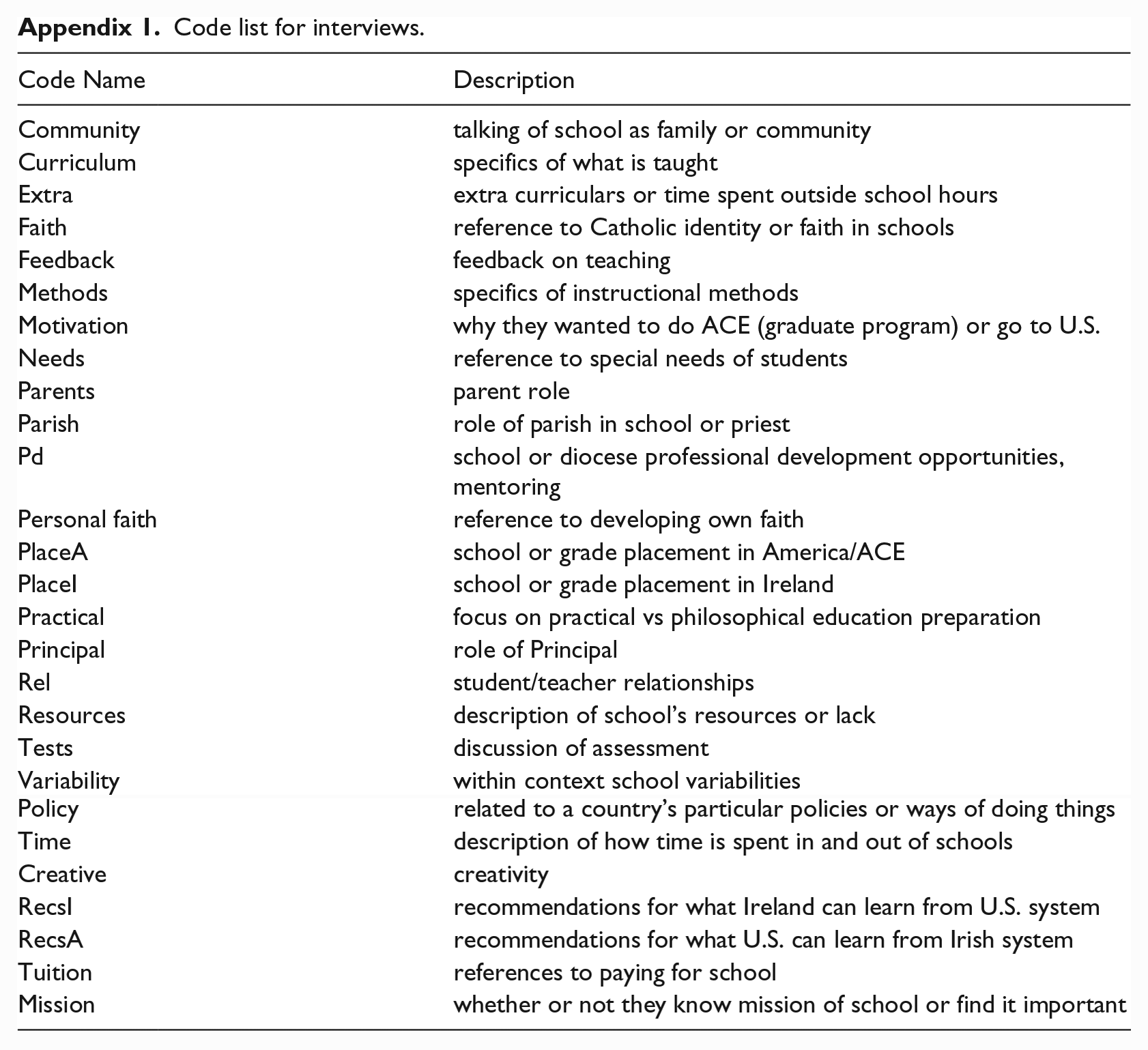
| Code Name | Description |
|---|---|
| Community | talking of school as family or community |
| Curriculum | specifics of what is taught |
| Extra | extra curriculars or time spent outside school hours |
| Faith | reference to Catholic identity or faith in schools |
| Feedback | feedback on teaching |
| Methods | specifics of instructional methods |
| Motivation | why they wanted to do ACE (graduate program) or go to U.S. |
| Needs | reference to special needs of students |
| Parents | parent role |
| Parish | role of parish in school or priest |
| Pd | school or diocese professional development opportunities, mentoring |
| Personal faith | reference to developing own faith |
| PlaceA | school or grade placement in America/ACE |
| PlaceI | school or grade placement in Ireland |
| Practical | focus on practical vs philosophical education preparation |
| Principal | role of Principal |
| Rel | student/teacher relationships |
| Resources | description of school’s resources or lack |
| Tests | discussion of assessment |
| Variability | within context school variabilities |
| Policy | related to a country’s particular policies or ways of doing things |
| Time | description of how time is spent in and out of schools |
| Creative | creativity |
| RecsI | recommendations for what Ireland can learn from U.S. system |
| RecsA | recommendations for what U.S. can learn from Irish system |
| Tuition | references to paying for school |
| Mission | whether or not they know mission of school or find it important |
Funding
The author(s) received no financial support for the research, authorship and/or publication of this article.