




Abstract
This article is set in the context of multicultural 21st-century Australia, whose diversity is marked by religious plurality as well as varied ethnic groupings. The article reports on a study of professional learning in three Australian faith-based schools (Christian, Jewish and Muslim) that investigated the role such schools might play in the creation of an Australian society characterized by mutual respect and tolerance. The authors argue that professional learning which is underpinned by the Freirean concept of conscientization could be used as a significant strategy to support the empowerment of teachers in developing critical awareness. In this way, they would be better able to address the issues related to life in the rapidly changing 21st century within an increasingly multicultural society, and in particular to assist students in developing ethical judgments and a commitment to social justice. The authors examine the metaphors for professional learning that were articulated in the study. These helped to gain insights into the way the schools’ educational leaders understood professional learning, and also highlighted the nature and focus of each school’s professional learning program.
Introduction: an Australian study
This article develops some of the findings of a comparative study of the professional learning in three Australian faith-based schools (Christian, Jewish and Muslim). Schools with a faith base have been a part of independent schooling in New South Wales since its earliest days as a colony, with the establishment of The King’s School in 1831.
Independent schools, Catholic schools and government schools comprise the three sectors of Australian school education. Independent and Catholic schools together constitute the non-government sector, which in 2014 represented 35% of students in Australian schooling (Independent Schools Council of Australia, 2015). Independent schools are not-for-profit organizations which, unlike Catholic systemic schools, operate autonomously, rather than being responsible to central bureaucracies. The proportion of independent schools in Australia has been steadily growing, from 4% of students in 1970 to 14% in 2014, when there were over 500,000 students in Australian independent schools. During this period, the proportion of students in government schools declined from 78% to 65%, and the proportion in Catholic schools remained stable at 20–22% (Independent Schools Council of Australia, 2015).
All Australian independent schools receive annual government recurrent funding on a student per capita basis, with the bulk of funding coming from the Commonwealth. Until 2014, funding was based on socio-economic status. Under this funding model, schools enrolling students from predominantly higher socio-economic status areas received less funding than schools drawing from lower socio-economic status areas. Following a major review of school funding in 2011 chaired by David Gonski, a new model of funding was proposed for all schools (Australian Government Department of Education and Training, 2011), based on a new Schooling Resource Standard supplemented by loadings to address educational disadvantage. Funding began in 2014 under this model, under a Labor government. However, there seems to have been a departure away from this model under the Coalition government (Liberals and Nationals), which has presented alternative reforms for consideration.
The non-government sector of Australian school education is dominated by faith-based schools, with 85% of all Australian independent schools having a religious base, across 19 different religious affiliations. The sector is significant – in 2014, for example, educating over 576,000 full-time equivalent students (Independent Schools Council of Australia, 2015). In her analysis of Australian faith-based schools, Buckingham (2010) observes that ‘increased immigration from non-Christian countries … is creating a multicultural society unlike any experienced in Australian history’ (1), marked by a growing number of religious schools, especially ‘Islamic schools and new classifications of “fundamentalist” Christian denominations’ (ix).
Diversity generally may be seen as a hallmark of multiculturalism. Among the diversities characterizing faith-based schools are those relating to their stakeholders, the school’s curriculum (in particular, its religious education program), and any integration of faith perspectives into the school’s broad teaching programs. In some non-Christian Australian faith-based schools, which may reflect particular ethnic groupings, the particular issue of assimilation versus preservation of cultural identity may be a specific discourse. Some Jewish or Muslim parents, for example, may choose to educate their children in faith-based schools as vehicles of a transmission of culture, while others may choose government schools which do not share a faith-based ideology. This observation is supported by Rutland (2003), in the particular context of Jewish schooling, in her survey of early Australian Jewish education. As she explains: ‘in the late nineteenth and early twentieth centuries Jews felt a desire for non-distinctiveness in the Australian society’, resulting in ‘a section of the Jewish community [feeling] that secular education was more important than religious education’ (Rutland, 2003: 13, 15).
In the context of multicultural Australia, Buckingham (2010) posits that Australian faith-based schools foster acceptance of diversity. Parker-Jenkins et al. (2005: 59) argue that emerging UK faith-based schools of minority ethnic communities demonstrate ‘the promotion of diversity in education which has changed the existing social order’. As Buckingham (2010: 1) explains: ‘diversity of religious beliefs is a critical element of a pluralist society but requires a delicate balancing act to maintain tolerance and social harmony’.
Each faith-based school is its own community while being part of the wider secular community. It will consequently seek to balance what Sullivan (2006: 937) terms a ‘dual allegiance’ to religious fidelity and government regulations. Our study investigated the ways in which this dual identity shaped the schools’ professional learning, recognizing the complex diversities of race, culture and privilege that may be evident in Australian faith-based schools.
In the complex interplay of policies and practice, teachers are final arbiters in the educational process, bringing skills, knowledge and insights to bear as they support students in understanding and negotiating the world in which they live. Developing teachers’ critical awareness through conscientization (Freire, 1985, 1986) may thus be a fundamental strategy in identifying and resolving various ideological constraints in the school context, including any arising from the faith tradition.
For faith-based schools, strategically focused professional learning may include reflection on the relationship between the faith tradition and the school’s policies and practice, over and above professional learning directed at satisfying any state-determined priorities. Such engaged professional learning could be particularly relevant in the Australian context, where issues of Islamophobia and anti-Semitism have been identified in recent reports. Thus, the Executive Council of Australian Jewry drew attention in its 2014 report to ‘firstly, the spread of anti-Semitism from the extreme margins of Australian society into mainstream discourse; and, secondly, the increasingly open anti-Semitism associated with polemical attacks against Israel as part of the fallout of the Israel–Gaza war’ (Nathan, 2014: 6). In addition, Hassan and Martin, in their 2015 report for the International Centre for Muslim and Non-Muslim Understanding, analysed a survey of 1000 adult Australians. The researchers, while recognizing a generally low level of Islamophobia in Australia, explained that ‘there are pockets of prejudice and anxiety directed towards Muslims, for example among the aged and those facing financial insecurity’, while also reporting that ‘more [participants] felt social distance from Muslims than from other religious groups’ (Hassan and Martin, 2015: 6).
Our study examined any relationship that may have been evident between the professional learning in the school and its faith base. The study also recognized that while teachers might identify professional learning opportunities relevant to their own professional needs, they may also be constrained by particular priorities set by the school’s educational leaders. Consequently, we sought to understand how the schools’ educational leaders conceptualized professional learning, since their understanding may shape the nature and/or content of the school’s professional learning activities.
We asked interviewees to use metaphors as one way of conceptualizing professional learning, as a strategy to stimulate reflection and engage dialogue. As Miles and Huberman (1994: 245) point out, metaphors provide ‘a way to achieve more integration among diverse pieces of data’. Their insights are consistent with such seminal writers as Muller (2008), Lakoff and Johnson (1980, 1999), and Ortony (1993).
Professional learning
Transformative professional learning occurs when teachers are ‘sharing and critically interrogating their practice in an ongoing, reflective, collaborative, inclusive, learning-oriented, growth-promoting way’ (Bolam et al., 2005: 5). This definition is consistent with Schon’s (2006) insight of the ‘teacher-as-reflective-practitioner’. Both Schon (2006) and Freire (1998) recognize the strategic nature of reflective practice, which is characterized by ‘a freedom to reflect, invent and differentiate’ (Schon, 2006: 333). For Freire (1998: 55), the critical self-consciousness of conscientization is part of a human unfinishedness which ‘we have to follow if we are to deepen our awareness of the world’. In the context of professional learning, as Schon (2006: 338) explains, reflective practice ‘is essential to the process by which individuals function as agents of significant organizational learning, and it is at the same time a threat to organizational stability’. In the context of the faith-based school, this professional learning may, in part, address issues of hegemonic pressure arising from the faith tradition itself, or its local expression in the school.
Rather than seeing professional learning as being focused only on techniques of classroom practice, we would argue that ‘expertise … consists of spontaneous and flexible direction and redirection of the learning enterprise’ (Carr and Kemmis, 1997: 37). Educational practice, then, calls for teacher self-reflection and informed action, guided by a disposition to act with justice and moral prudence. We posit that professional learning directed towards the growing conscientization of teachers may provide a vehicle for them to better understand the ethical values which underpin their decisions, and may empower them to support students’ development of ethical analysis and judgment, which is an important step towards enabling transformative social justice and tolerance. We also see our study of the professional learning in Australian faith-based schools as providing a window onto the ways schools more generally respond to the pressures and constraints under which they operate.
Classifying metaphors of professional learning
We perceive metaphors to be a powerful tool in understanding professional learning. For Boud and Hager (2012: 20), the term ‘continuing professional development’ is metaphorical, ‘encapsulat[ing] the idea that professionals are in a process of becoming’. Rather than seeing continuing professional development through the lens of acquisition (acquiring knowledge) or transfer (transference of skills), Boud and Hager (2012: 22) propose metaphors of ‘participation’, ‘construction’ and ‘becoming’. For Boud and Hager, these metaphors capture the characteristics of teachers’ situated, collaborative learning. We support the situated and engaged dimensions of ‘participation’, ‘construction’ and ‘becoming’, and suggest that they constitute frameworks within which metaphors might be located and discussed.
We locate our analysis of professional learning within a two-dimensional framework identifying the dimensions of ‘deficit/growth’ and ‘institutional/individual’, which we find useful. Firstly, ‘deficit/growth’ allows for professional learning directed towards attaining professional standards, as well as enhancement and growth. Secondly, ‘institutional/individual’ allows for recognition of teacher reflection and growth, and is used by each school to highlight professional learning activities in their annual reports.
This approach is visible in the work of researchers in this field. Huberman and Guskey (1995: 269) discuss professional learning in terms of deficit: ‘the idea that something is lacking and needs to be corrected’. Such professional learning is found, for example, in relation to standards-based frameworks, regarding skills and knowledge acquisition, and is a requirement of standards-based frameworks worldwide. By comparison, Kennedy (2005) locates professional learning in a dimension of increasing professional autonomy and growth, speaking directly to the teacher-as-learner, which is consistent with professional learning that is ongoing, collaborative and career-long. On the other hand, Sparks (2004) distinguishes ‘top-down’ professional learning, marked by institutionally mandated compliance, and a ‘bottom-up’ approach, characterized by the individual teacher’s reflection and collaborative goal-setting. The collaborative characteristics of effective professional learning (see, for example, Hargreaves and Fullan, 2013; Keay and Lloyd, 2011) are recognized in this ‘institutional/individual’ distinction.
We therefore examine the reported metaphors in terms of their apparent commitment to promoting growth, removing/correcting a deficit, personal autonomy and institutional autonomy. We also investigate whether the particular responsibilities of principals are reflected in their choice of metaphors, and examine the professional learning practices in the most recent annual reports of the case-study schools.
The context of the 21st century
Contemporary Australian faith-based schools operate, as Sullivan (2006) recognized, within structures and constraints that reflect both their faith-based origins and the nature of 21st-century Australia. In the 21st century, with its technological innovation, access to information and increasingly urbanized populations, all schools, whether faith-based or not, have a significant role in creating a just and tolerant society. Like Freire (1985) , we argue that schools could provide transformative educational experiences centred in ‘the unity of praxis and theory, action and reflection’ (Freire, 1985: 157). In Freire’s (2007: 104, 105: 105) terms, this transformative education may aim for a ‘stand for freedom, which implies respect for the freedom of others, in an ethical sense, in the sense of humility, coherence, and tolerance’. In a society marked by religious as well as ethnic diversity, with identifiable instances of anti-Semitism and anti-Muslim sentiment, faith-based schools may be seen as having a particular opportunity and responsibility to play their part in identifying the pursuit of mutual respect and social justice, including religious tolerance.
Contemporary workforces in the 21st century may be understood as requiring specialist knowledge, creativity and innovation. In this context, Robinson (2009, 2011), Robinson and Aronica (2015), and Freire (1985, 1996, 1998, 2007) support an education that is holistic, responsive to highly diverse and dynamic human intelligences and talents. In such an environment, professional learning programs may support schools in becoming transformative spaces where creativity flourishes, in an era in which numbers of students in our schools are digital natives. Teachers themselves may become creative-thought leaders, using professional learning opportunities to discover ways to motivate and engage their students. We argue that these characteristics have force within all schools, whether faith-based or not.
Individual creativity may often be stimulated in the group context, which is subject to cultural factors. The faith-based school may be subject to religious cultural factors, including, for example, faith-based societal expectations, over and above other contextual forces experienced by all schools. Expressions of creative thinking may be constrained by faith-based ethics and mores, or by denominational expectations or requirements.
Encouraging critical thinking, problem-solving and collaborative working in teams have always been significant aspects of education, for both students and teachers. However, they have become more so in the information revolution of the 21st century. Both teachers and students are required to use these skills to allow them to sift relevant data from a cornucopia of readily available information, and verify its accuracy while more and more information enters the Internet at the speed of light. As educators, one of our tasks is to teach others how to use this information wisely. A particular responsibility of the faith-based school, may be to encourage thoughtful engagement with the insights and practices of the school’s faith tradition, together with those of other faith traditions, as a significant strand in the development of a student’s critical thinking.
The political perspective in faith-based schooling
As Freire (1985: 188) explains: ‘education worldwide is political by nature’. The politico-ideological contexts of the school may significantly impact the hidden curriculum through what is valued or disparaged. In faith-based schools, this may result in significant faith-related dissonances and potentially conflicting norms and values across students and their families, teachers, educational leaders and, potentially, the faith tradition itself.
Both Freire (1985) and Habermas (2006) point to the role of reflection in relation to religion in the secular society, and in the development of critical awareness. Habermas (2006: 9) argues that, in modern societies, ‘the religious certainties are in fact exposed to an increasing pressure for reflection’. So too Freire (1985: 68) puts forward the notion that ‘only beings who can reflect upon the fact that they are determined are capable of freeing themselves’. The commitment of a faith tradition to develop respect for the individual and facilitate a respectful engagement with other faith traditions and the secular society may provide a faith-based underpinning for an education that may move its students towards promoting understanding, tolerance and social justice as espoused in the Universal Declaration of Human Rights (United Nations, 1948). We argue that the professional learning program of a faith-based school may provide opportunities to explore the nature and extent of such a commitment.
Methodology
The research was conceptualized as a comparative study using three Australian faith-based schools as cases. We valued the insights of individuals through the use of interviews and focus groups, and undertook documentary analysis of relevant publications and available reports.
The varying understandings of teachers and institutions regarding professional learning reflect the situated nature of educational practice. As Creswell (2007: 21) explains: ‘[subjective meanings] are formed through interactions with others … and through historical and cultural norms that operate in individuals’ lives’. Interactions and norms also arise in the institutional policies and practices to which teachers are subject. Since teaching and learning are ultimately mediated through the classroom teacher, the research valued the insights of teachers and students, as well as their educational leaders. We therefore set our research in an interpretive paradigm, which is consistent with Denzin and Lincoln (2005: 3), who define qualitative research as ‘a situated activity that … consists of a set of interpretive, material practices that make the world visible’.
Case study is consistent with an interpretive perspective, drawing on the observation by Stake (2005: 444) that ‘case study concentrates on experiential knowledge of the case and close attention to the influence of its social, political and other contexts’. This research used a multiple-case design consistent with Yin’s (2003) analysis, in which each school formed a ‘whole’ study and the choice of schools was conceptualized as a theoretical replication. As Johnson and Christensen (2000) argue, when using a multiple-case design, cases can be compared with more likelihood of generalizability than from a single-case study.
Three independent Australian schools (Christian, Jewish and Muslim) in New South Wales were chosen, using their faith-based affiliation based on the Commonwealth government’s 2007 Non-Government Schools Census. Purposive sampling was used to select schools where it was felt that relevant data could be gathered from selected participants with in-depth knowledge, stratified across the three faiths. Each school taught kindergarten to Grade 12 (i.e. covered the full range of school ages), was co-educational and had at least 1000 students, so that professional learning needs across all school ages and teaching subjects could be considered. Co-educational schools were chosen since they comprise the most common structure of independent schools in Australia (Independent Schools Council of Australia, 2015).
The research design called for semi-structured interviews with the school’s principal, its religious leader and the senior staff responsible for the curriculum, together with focus groups of teachers and students (primary and secondary). Once the school had been selected, the principal identified the other participants. The educational leaders interviewed are those who, under the principal’s direction, may be expected to develop the school’s strategic priorities and shape the professional learning program. Focus groups allowed for the perceptions of teachers and students to be considered. School documentation was used to triangulate, clarify and augment other evidence. We recognized that the central role of the principal in the selection of other participants might be seen as a limitation in the research design, reducing the possibility of disaffected persons being selected. This limitation was mitigated in the following ways: the selection of senior staff (for example, the religious leader) was determined by their position, rather than by the personal choice of the principal; interviews and focus groups were conducted in the absence of the principal, who was therefore not able to influence the discussion; and no feedback regarding individual comments or opinions was provided to the principal. We formed the view that the interviews were open and frank. Our use of school documentation as part of the triangulation of the data was also relevant.
Bearing in mind that metaphors can be used to make sense of the world (Brooks, 2015), we began our interviews by asking the following question: ‘If you had to use a metaphor to describe professional development and professional learning activities, what would it be?’ We envisaged that reflecting on metaphors of professional learning would enable the interviewees to reflect on familiar processes in a new light (Carpenter, 2008: 274) and initiate a deeper exploration of the approaches used in their practice. This strategy legitimizes a self-understanding, as the individual speaks reflexively from their socially situated world and their multiple perspectives of class, race, religion and gender (Carpenter, 2008: 274). Although we did not specifically ask the focus groups to identify a metaphor for professional learning, two teachers each identified a metaphor, which we have included.
The interviewees were free to interpret the term ‘metaphor’ themselves. This approach resonates with the ‘wide’ sense of metaphor, following the triadic structure of Lakoff and Johnson (1980, 1999), in which the relationship between object and metaphor is mediated through the interviewee’s experience and understanding (Muller, 2008: 28). Given the varied backgrounds and experiences of the participants, a wide assortment of metaphors was identified.
Our data has been interrogated in three ways: firstly, by examining the professional learning across all three schools in an effort to provide general insights into Australian faith-based education; secondly, by examining in each school separately the way in which its educational leaders conceptualize their practice in terms of their values and religious framework; and, thirdly, by examining data gathered from the school principals as a group in order to see whether their conceptualizations of professional learning differed from those of the teachers.
Findings
As part of our research, we looked at the positioning of the schools regarding their understanding of faith, extending the analysis of Ammerman (2005) to see whether faith was understood in terms of a concern for social and economic justice or in terms of the expression of personalized values in everyday life. All three schools seemed to understand faith in expressions of social justice; the Christian and Muslim schools also understood faith in its individualized expression, but this was not apparent in the Jewish school. There are implications for professional learning arising from these orientations. Schools that value institutional expressions of faith, for example, might encourage professional learning focused on developing and assessing strategies aimed at developing students’ commitment to social justice. Schools that value individualized expressions of faith might devise professional learning programs encouraging the development of students’ personal commitment to tolerance and mutual respect.
In practice, we found that the schools in this study seemed to understand professional learning, and offer professional learning activities, principally in terms of the acquisition of requisite skills and knowledge and the removal of deficit. There seemed to be little, if any, attention to the relationship between the education offered and the schools’ faith base. Given that the faith base is one of the schools’ distinctives, the seeming lack of attention may reflect a tension between the schools’ faith base and the governmental and societal pressures that are experienced by any Australian school.
Metaphors of professional learning in the Christian school.
Metaphors of professional learning in the Jewish school.
Metaphors of professional learning in the Muslim school.
Metaphors of professional learning across schools sorted by educational position.
The Christian school
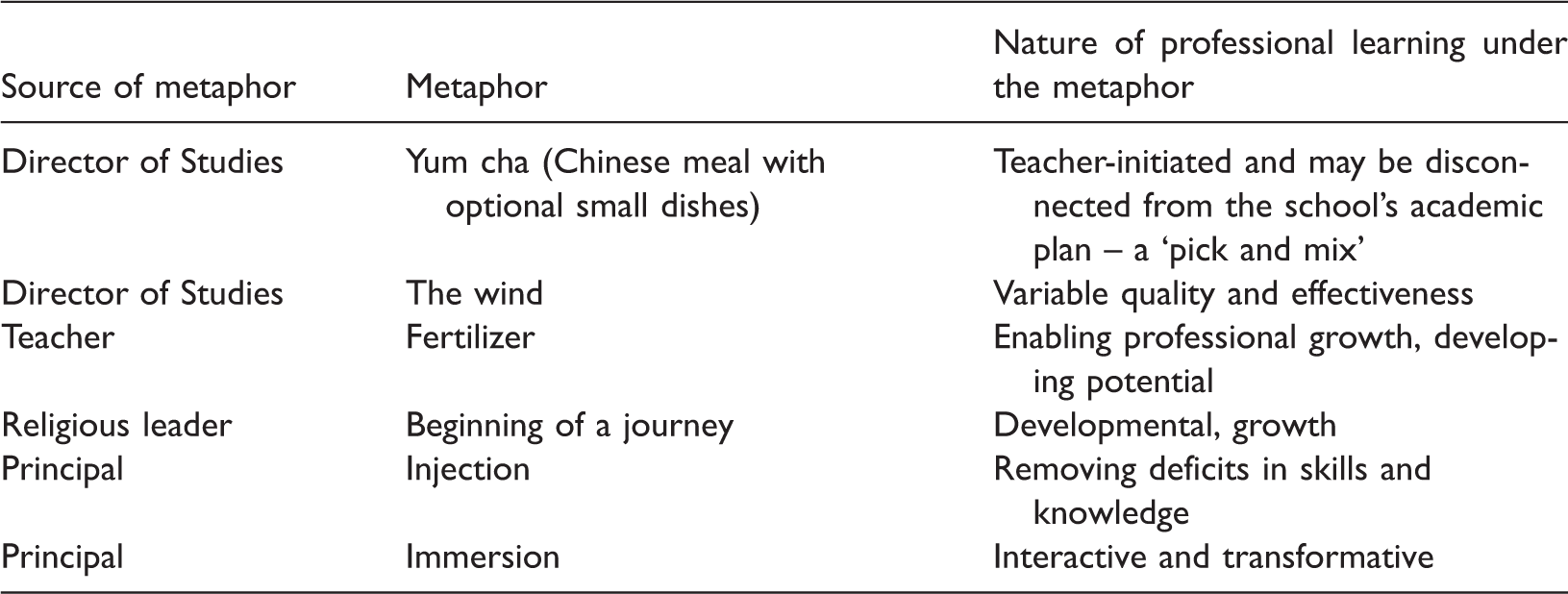
In the Christian school, metaphors were articulated across the dimensions considered in this article. The Christian school’s chaplain responded that ‘I see professional learning as being the beginning of a journey’, explaining that the journey was the career-long experience of the teacher concerned, being supported and enriched by their professional learning activities.
The Director of Studies identified two metaphors: ‘I see professional learning as like the wind, or like yum cha’, which in Australia is a Chinese morning or afternoon meal with a range of small dishes. These metaphors, the Director of Studies explained, reflected the Director of Studies’ view that the professional learning activities were not well integrated and were of variable ability to address perceived professional needs. The Director of Studies also explained that, in the Christian school, teachers generally selected their own professional learning opportunities from among the varied activities on offer.
The principal articulated the one metaphor that apparently addressed the concept of deficit: ‘I see professional learning in terms of injection’. This metaphor speaks to a perceived need to correct deficits in the teacher’s knowledge and skills through the intervention of particular professional development activities. We would argue that this is consistent with the principal’s responsibility for teacher management and performance (see Table 1).
The Jewish school
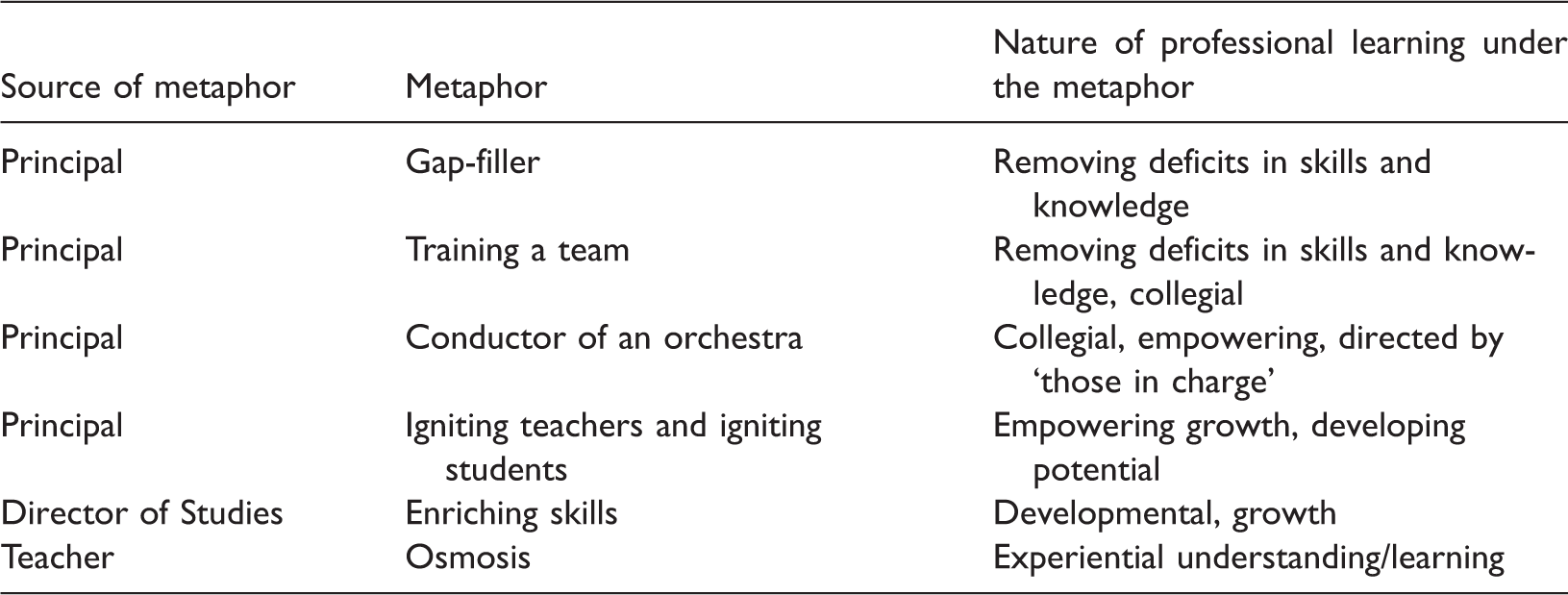
In the Jewish school, the only metaphors relating to deficit were articulated by the principal. Of the principal’s four metaphors, two were clearly focused on deficit. ‘I see professional learning’, the principal said, ‘as a gap-filler’, referring to professional learning aimed at the remediation of teachers’ deficiencies in skills or knowledge. Similarly, he explained that ‘professional learning can be understood as training a team’. Here, the principal, as the manager of the teachers, saw the purpose of professional learning as getting teachers to work cooperatively with management.
The unexpected metaphor of ‘osmosis’ arose in the teachers’ focus group. One teacher explained: ‘the way we celebrate our festivals … embraces everybody and through these experiences I think there is an osmotic absorption of the Jewish values, and it does go into the classroom’. In the Jewish school, this deliberate program of Jewish observances was a regular feature. There did not seem to be any corresponding articulation of a relationship between faith tradition and professional learning activities in the other schools (see Table 2).
The Muslim school
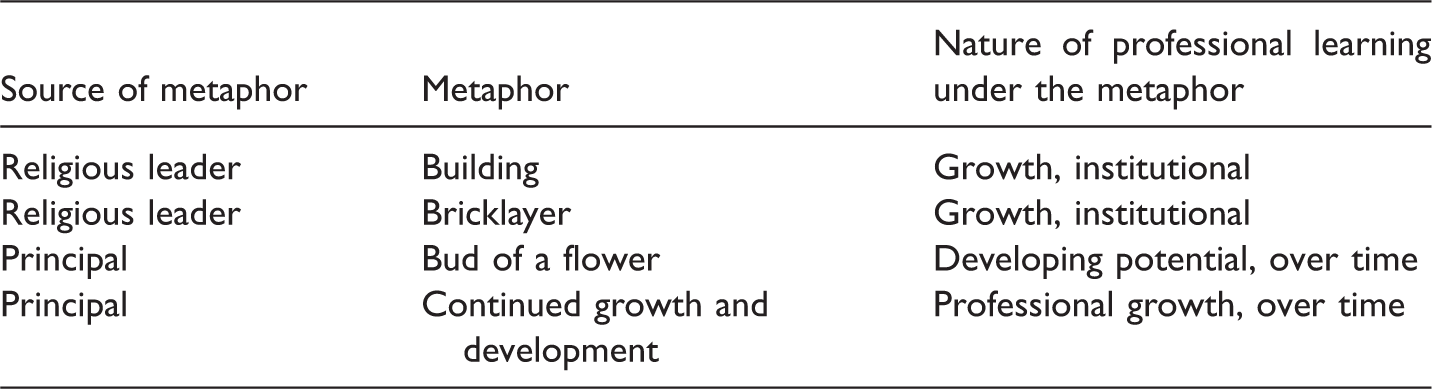
In the Muslim school, there did not seem to be any particular distinction between institutionally and individually determined professional learning activities, and the reported metaphors seemed to focus on growth. The school’s religious leader, the imam of the school’s mosque, identified metaphors with elements of deficit and growth. For example, he said: ‘I see professional learning in terms of a bricklayer’. This metaphor speaks to an intentional program of growth over time of activities that aim to create a layered battery of skills and knowledge.
The Muslim school’s principal explained his rationale for professional learning: the child himself is the most important thing in the school, but to get anywhere, it’s the teachers really who make the difference, so in that sense the teachers are the most important people … our reason for investing so much in professional development of our teachers.
The principals’ metaphors
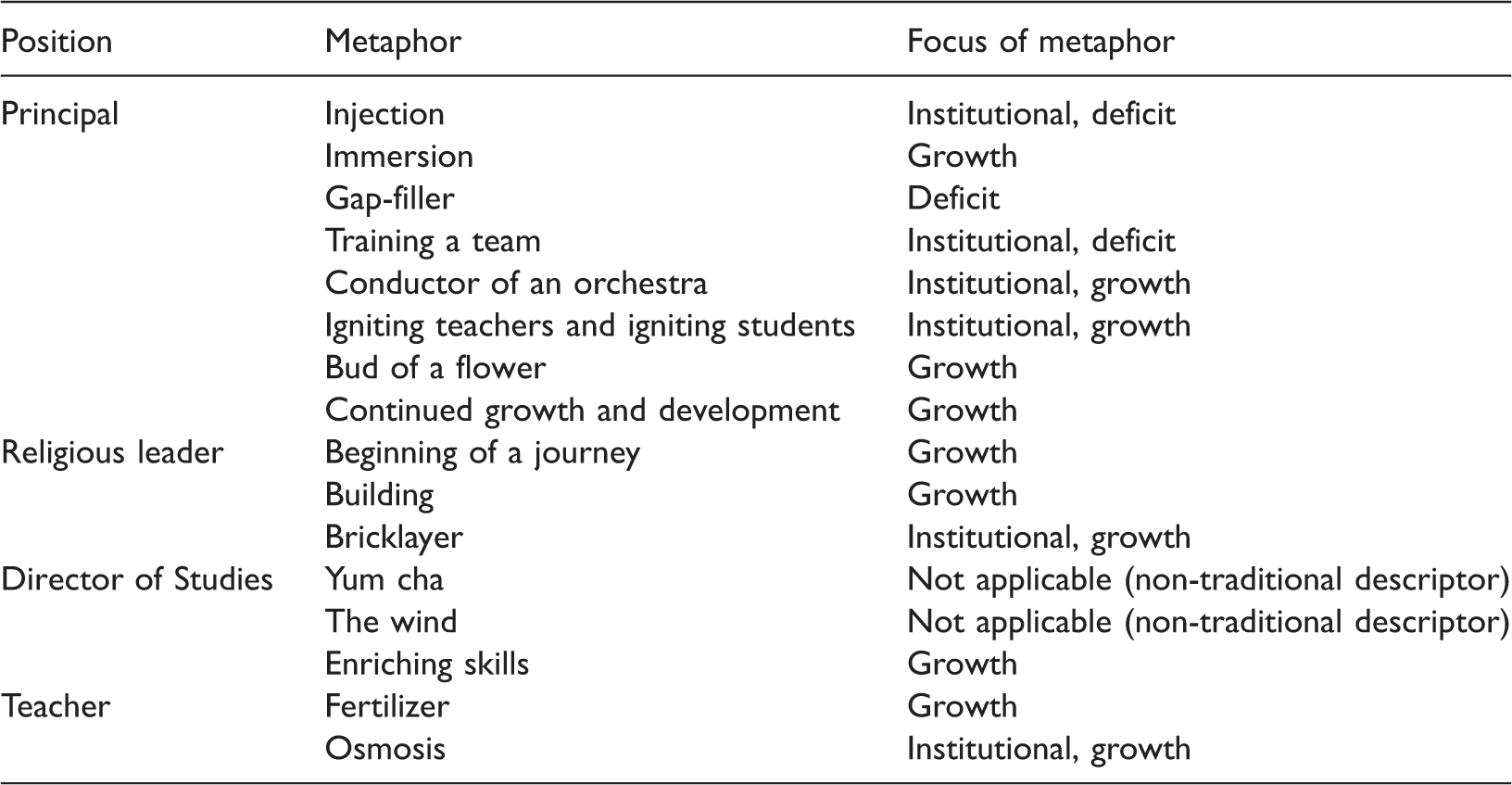
Table 4 reports the metaphors sorted by school position, and summarizes the apparent focus of each metaphor as institutional, growth or deficit. The metaphors of ‘the wind’ and ‘yum cha’ do not seem to fall within any of these categories and are considered in greater detail in our discussion.
Discussion
After considering the dimensions of ‘deficit/growth’ and ‘institutional/individual’, together with the principals’ metaphors, we examine the schools’ recent annual reports regarding their professional learning activities and any relationship that may be evident between their professional learning and the faith tradition. Finally, we give attention to the two metaphors which do not seem to be easily classified.
The use of metaphor
Reporting on a University of Glasgow project regarding the use of metaphors, Brooks addresses their significance: Metaphor is pervasive in language and is also a major mechanism of meaning-change … metaphor is not simply a literary phenomenon; metaphorical thinking underlies the way we make sense of the world conceptually. It governs how we think and how we talk about our day-to-day lives. (Brooks, 2015)
Thomas and Beauchamp (2011: 763), in their examination of teachers’ metaphors regarding their professional identities, put forward the idea that ‘although metaphors can provide insights into the ways people conceptualise experience, they are also culturally bound … rendering the accompanying explanation crucial’. Supporting their view, our categorization of the reported metaphors provides a scaffold which recognizes the situated nature of each interviewee’s thinking.
Deficit/growth
A number of the metaphors, such as ‘injection’ (Christian school), ‘gap-filler’ and ‘team coaching and trainer’ (Jewish school), speak to professional learning as responding to perceived deficits. These conceptualizations may be expected to lead to activities focused mainly on training and the acquisition of skills and knowledge.
Some metaphors allude to one perceived need only – for example, ‘gap-filler’. Some metaphors suggest more than one perceived need. For example, ‘team coaching and trainer’ connotes a perceived need to remediate deficits in skills and knowledge, and also the strategy of providing mentoring. Guided by this metaphor, professional learning may be expected to value collaborative learning underpinned by critical reflection, and may also be marked by a personal interest and commitment by the school’s educational leaders (the ‘coaches’), with the potential either to empower teachers in their understanding of education or to impose ideological constraints on the learning process.
‘Laying bricks’ (Muslim school), with its concepts of layering, gradual improvement and development, may be grouped with metaphors that speak to transformative professional learning, since the bricklayer is an agent of change. The bricklayer might be identified as either the individual teacher or the institution. In either case, success will depend on a sturdy foundation for the structure, built gradually and systematically, pointing to the importance of sound subject knowledge and pedagogy as the goals of professional learning activities.
Other metaphors also seemed to recognize the transformative nature of professional learning: ‘immersion’, the ‘beginning of a journey’ (Christian school), the ‘conductor of an orchestra’, ‘igniting teachers and igniting students’, ‘osmosis’, ‘enriching skills’ (Jewish school), a ‘bud of a flower’ and ‘continued growth’ (Muslim school). These metaphors speak to a concept of future potential, resonating with the perspective of Lange and Burroughs-Lange (1994) that professional learning should be understood within the framework of professional growth. We take the view that professional growth occurs when educational practice is transformed through the increase of knowledge or skills and professional autonomy is enhanced. These metaphors also recognize aspects of professional learning beyond its transformative nature, such as the role of the one lighting a fire or the intentional care provided by the gardener to the flowering plant.
The metaphor of a ‘journey’ is illuminating. Extended journeys can take unexpected twists and turns, reflecting the complex process of reaching a goal over time. Journeys, as opposed to trips, can be lengthy, recognizing the career-wide nature of continuous professional learning. ‘Conductor of an orchestra’ conjures up images of the complexity of professional learning, recognizing the contribution of all ‘players’. The orchestra’s conductor does not play, or may not be able to play, every instrument, but the performance depends on both the conductor and the players. However, the leadership is clearly in the conductor’s hands, reflecting this leader’s understanding of their responsibility for motivating and inspiring the team.
Institutional/individual
The school’s financial ability and willingness to fund professional learning programs constrain opportunities for a teacher’s professional learning. In turn, the institution’s priorities for professional learning may reflect not only the pressures of meeting statutory requirements or parental expectations (common pressures in all schools), but also faith-related expectations. These faith-related expectations may arise from a concern that the school provides education that is religiously consistent with the school’s faith tradition, potentially imposing faith-related constraints on the school’s professional learning programs. Our argument is that Freirean conscientization directed towards understanding such possible constraints may empower teachers in their pursuit of a transformative education.
Some metaphors focused on the individual teacher’s self-actualization – for example, a ‘bud of a flower’, where the potential of the flower to fulfil its ‘task’ is directly affected by the care and attention that it has received throughout its growing period, reflecting an institutional role for professional learning. However, the teacher’s potential is the focus of the metaphor; individual teachers will fulfil their differing potential to differing degrees, as individual blooms appear in the garden.
Other metaphors focused on the school’s initiative (‘igniting teachers and igniting students’, for example). As with ‘team coaching’, some metaphors distinguished institutionally determined and individually determined professional learning. ‘Conductor of an orchestra’ and ‘laying bricks’ point to the role of the school in its professional learning program, since orchestras do not usually play without the direction of a conductor, nor do brick walls build themselves.
The Jewish school’s metaphor of ‘osmosis’ speaks to both institutional and individual dimensions, since Jewish observances are provided by the institution and can be seen to permeate the individual’s experience and result in their ‘absorption’/growth in understanding of Jewish values.
Finally, the unusual metaphors of ‘yum cha’ and ‘the wind’ (Christian school) remind us that professional learning takes place in the real world of the daily life of the school. Like yum cha, the school may be faced daily with a wide variety of offerings/issues to be addressed. These issues may be surfacing on a continuum of intensity from stillness or gentle breezes to gale-force wind and cyclones.
Pressures at work may include meeting the statutory requirements of government, performing strongly in public examinations, and issues of student welfare, such as the development of effective policies regarding bullying. Professional learning may also be disjointed and incoherent, resulting in ineffective, unpredictable and variable outcomes.
The principal’s role
The metaphors articulated by the principals are of particular interest, given the ability of a principal to overrule decisions made by others and their responsibilities for the day-to-day conduct of teachers. Given their leadership role, the principal of an Australian independent school may experience particular pressures to conform in their oversight of the school’s professional learning program. These pressures may include faith-related expectations to conform in the content of the teaching program or in expressions of ethical and behavioural mores. Such pressures may arise from the school’s governing body or from the wider faith tradition itself. In either case, the principal’s metaphors may reflect particular faith-related priorities.
Four of the six metaphors reflecting institutionally determined professional learning were articulated by the principals. Of the remainder, the program of Jewish observances in the Jewish school (the subject of ‘osmosis’) could be expected to result from the decision of the principal together with the school’s governing body. The metaphor of ‘bricklayer’ also carries institutional implications.
Of the principals’ eight metaphors, four relate to institutionally determined professional learning, three focus on deficit, and five focus on growth. Of the eight metaphors identified by persons other than the principals, two are institutionally focused (of which ‘osmosis’ also relates to the principal) and six focus on professional growth. We conclude that there seems to be evidence for principals being aware of differing aims for professional learning programs, but that, not surprisingly, many of the principals’ metaphors reflect an institutional focus. This institutional perspective may also underpin the three principals’ metaphors relating to deficit, since ensuring that teachers are well equipped for their teaching roles may be seen as one of the principal’s institutional responsibilities. This institutional perspective, with its authoritarian overtones, may be limiting and seen to be a safe option by the principal.
The five metaphors identified by the principals that relate to growth provide some evidence of an understanding by principals of the opportunity within professional learning programs for the development of teacher autonomy and self-reflection. This may be seen as consistent with a principal’s responsibility for teachers’ professional performance. We did not find, however, clear evidence of any sensitivity to the school’s faith tradition in the reported principals’ metaphors.
Revisiting the schools
Although our original interview schedule invited interviewees to reflect on faith-based perspectives, we found a seeming lack of attention to this issue. In retrospect, we might have asked a further question: ‘Are there aspects of your school’s professional learning which are not caught up in the metaphor(s) you have outlined and, if so, what are they?’ In an attempt to understand the schools’ current professional learning, the most recent expression of their distinctives, and any relationship between professional learning and their faith tradition, we examined the most recent annual report of each school.
The Christian school
In its 2013 annual report, the Christian school continues to articulate its faith base when it identifies itself as having an inclusive enrolment policy; seeking to develop ‘an authentic and open approach to Christian learning’; valuing students as individuals; and seeking to develop critical thinking and ‘well-rounded global citizens’. The Christian school’s professional learning is ‘designed to be significant, challenging, networked and future-focused’. The program included creating collaborative staff groups across such areas as ‘project-based learning’, off-site conferences and hosting visitors, which was reported as being of professional value. Of the five collaborative groups, designated by the Christian school as ‘Teaching and Learning Teams’, four were focused on teaching and learning issues and one on student welfare.
There appeared to be no specific attention to what might constitute ‘an authentic and open approach to Christian learning’. Rather, there seemed to be a general commitment to improving pedagogy. It might be argued that the school’s concern for student welfare constitutes the main expression of its faith-based character.
The Jewish school
Over and above academic excellence, the Jewish school promotes ‘an awareness of and a feeling for Jewish traditions and ethics’. This is extended in the Jewish school’s aim to promote ‘a positive commitment to Orthodox Judaism and identification with and love of Israel’. The school is exclusive in that its policy is to enrol only Jewish students.
The Jewish school aims to be an innovative learning organization and reported its professional learning program using the institutional/individual dimension. The reported strategies included whole-school staff days, visiting guest speakers/experts, staff workshops and off-site conferences. The creation of learning teams reflected a commitment to collaboration. Of the ten teams reported, seven were focused on teaching and learning, and three on understanding the school’s faith-based character. Of these, one (foreshadowed) aims to consider a Jewish approach to teaching and learning. Developing a Jewish approach to teaching and learning would impact the teaching program of the school. It might be expected to encourage a greater awareness of Jewish ethics and a clearer commitment to Orthodox Judaism. It would, in our view, represent a more developed focus on these two school goals rather than developing a Zionist identification with and love of Israel.
The Muslim school
The strong focus in the Muslim school on academic achievement is reflected in the school’s rationale that professional learning should ‘increase staff understanding of effective use of pedagogy to improve their everyday classroom practice’. The Muslim school’s professional learning focused on teaching and learning, together with institutional compliance issues, such as child protection policies. The strategies reported included whole-school staff days, interactive workshops, visiting experts, off-site in-service courses and the use of online modules.
This school is also exclusive, with its policy of enrolling only Muslim children. Although the school identifies itself as Muslim, there appeared to be no faith-based dimension in the rationale for, or the content of, professional learning activities at the school. We conclude that there seems to be no relationship between the school’s faith base and the professional learning of its teachers.
Summary
All three schools seem to employ similar strategies in their delivery of professional learning. Collaboration is valued in the setting up of staff workshop groups in each school. However, as faith-based schools, the schools seem to present three different positions. While the Christian school clearly articulates its Christian basis, there does not seem to be any flow-on from its articulated Christian distinctives into its professional learning. We see the Jewish school, by comparison, in transition. Like other Australian Jewish schools, the Jewish school has a specifically political dimension in its support of the state of Israel. However, the Jewish school now appears to be moving towards integrating its faith perspectives into teaching programs, as the school addresses in its professional learning program what difference its faith base might make in the teaching and learning in the classroom. There did not seem to be any corresponding move towards faith integration in the Christian school or the Muslim school.
The Muslim school seems to present a different situation again. Many current Australian Muslim children come from a refugee background that rarely applies to children in present-day Christian or Jewish schools. The Muslim school clearly articulates its faith base in its enrolment policy and in its self-designation. However, as observed above, the school’s professional learning program seems focused on the effective use of pedagogy, with no apparent relationship with its faith tradition.
We posit that, in part, these differences come from the nature of the schools’ faith traditions and their enrolment policies. The Christian school represents the dominant Australian faith tradition and is open to students of any (or no) faith. It follows that its challenge is to provide education acceptable to a school community which is wide-ranging in its religious outlook. Both the Jewish school and the Muslim school, by comparison, only enrol students from their respective faith traditions. Their character, at least in part, seems to be as community schools providing quality education to the children of their community. In the Muslim school, all students have language needs reflective of an ethnic/religious minority of relatively recent origins with little or no experience of English. We hypothesize that, in the Muslim school, the focus in professional learning on effective pedagogy reflects a school community with particular educational needs.
In each of the case-study schools, professional learning was focused on meeting government regulation and the development of effective pedagogy and classroom management skills. This emphasis reflects the pressures and expectations that bear on any Australian school. We theorize that, although the schools are faith-based, the force of parental expectations, the need for strong examination results and the requirements of governmental regulations create an environment in which ‘secular’ requirements seem to overrule any desire the school might have to implement faith-based distinctives beyond a commitment to values education.
Nonetheless, we take the view that since each school seems to regard its faith base as seminal, and since there are potentially strong faith-related hegemonic pressures, appropriate professional learning might include programs aimed at understanding more clearly faith-related expectations, together with possible tensions between these expectations, societal expectations and government requirements. We see such professional learning as being relevant to the situated environment of the school, with its range of stakeholder groups.
The ‘aberrant’ metaphors
The two metaphors ‘yum cha’ and ‘the wind’ seem resistant to easy clarification, but may be reflective of teaching and learning in the 21st-century world. The diversified provision of education for the 21st-century student will imply diversified needs for the professional learning of teachers in schools. Thus, ‘yum cha’ may point to professional learning needs and opportunities that cut across the institutional/individual divide, consistent with the importance for schools to see professional learning as forming the basis of communities of practice with a smorgasbord of opportunities (Wenger, 1998; see, for example, the use by Walford (2009) of communities of practice in understanding Muslim schools in England and the Netherlands). For the faith-based school, we are arguing that among varied professional learning opportunities, developing critical awareness of faith-based ideologies enhanced with an understanding of a United Nations (1948, 2014) human rights and diversity framework may form part of teachers’ professional activities.
The metaphor of professional learning as ‘the wind’ was reported in the Christian school by the Director of Studies. As already observed, the Director of Studies’ understanding of this metaphor reflected their judgment of the fragmented professional learning offered at the Christian school. The Director of Studies expressed the view that there was a lack of coherence and variable effectiveness found within the wider professional learning program. As education in the 21st century moves towards a commitment to tolerance and respect for difference, we see ‘the wind’ speaking to two issues. Firstly, it connotes the unseen influence that an empowered teaching body may have to shape difference through the school environment. Teachers bring their critical awareness to bear on the education they provide and, for faith-based schools, on the faith-related consonances and dissonances with the perceived qualities of a tolerant and just society. This critical awareness of teachers will, on the one hand, empower them to better act as informed gatekeepers and guides in the school and, on the other, support the empowerment of students to better understand and respond to issues of social justice and tolerance.
Secondly, ‘the wind’ encompasses movement and energy, while recognizing the unpredictability of unfolding strategies. The wind carries seeds from place to place; it brings rain; it cools in times of heat and brings damage in times of tempest. As the Lebanese-American poet Kahlil Gibran (1926: 36) articulates in Sand and Foam: ‘If you reveal your secrets to the wind you should not blame the wind for revealing them to the trees’ . His insight points to the transformational energy of the wind and, for us, the implications for professional learning as it spreads the essence of the learning, analogous to the intrinsic nature of the wind in its effects.
Conclusion
Professional learning in the 21st century
In the dynamic environment of the 21st century, teachers can find themselves navigating through huge amounts of data to inform their decision-making, all the while forming contextually sensitive judgments. Flexibility in managing the curriculum, pedagogy and interpersonal relationships becomes an important asset.
As contemporary education moves from an industrial model to one that is more responsive to the cultural and economic changes of the 21st century, we argue that professional learning programs might be directed towards developing strategies to empower students to engage critically with the rapid changes taking place around them, helping them to create and recreate their own new world in ways that make sense to them. Such programs would provide opportunities to develop critical thinking; creativity and problem-solving; communication skills and the ability to work in teams collaboratively; skills in accessing and analysing information; curiosity and initiative; a holistic commitment to a broad curriculum and flexible teaching styles; recognition of students’ individuality; and the moral nature of educational processes. These programs might be delivered through interactive study groups, think tanks, curriculum workshops, action research learning projects and school evaluation workshops. Within these methodologies, teachers’ insights can be valued without an ideological commitment to a particular viewpoint.
We suggest that the quality and focus of the professional learning in a faith-based school may demonstrate its commitment to such a transformative education. In particular, exploring the relationship between the faith tradition and the school’s education may be significant in identifying and resolving ideological faith-based constraints. In the Australian context, this focus may be directed towards understanding the operationalization of the faith tradition’s values within the school, together with the coherence of these values with the Values for Australian Schooling (Australian Government Department of Education, Science and Training, 2005).
In examining the schools’ annual reports, we found a consistency between the metaphors articulated and their reported professional learning programs. These programs were very basic and aimed principally at acquiring requisite skills and knowledge, and the removal of deficits. However, there was little attention paid to overarching and unifying issues – for example, to the pressures and influences within the school of any values, norms and beliefs. We also found little attention paid to providing a critique of the values and norms of the wider Australian society, or to the intersection of faith and the curriculum. Moreover, there seemed to be few or no programs of research, or indeed action research/learning, which have been identified as being eminently suitable for schools in their practice of research-informed teaching and learning. However, in these contexts, there seemed to be some opportunities for collegial reflection, critical thinking and mentoring. These would be consistent with Wenger’s (1998: 81) focus on socially located learning within communities of practice, where the communities and their interactions contribute to learning in a ‘regime of mutual accountability’.
Understanding professional learning through metaphors
We have cast our discussion in the context of what we see as the changing nature of education in the 21st century. Although our original study was focused on faith-based schools, we suggest that, for any school, articulating metaphors for professional learning may be a helpful strategy that the school could use to clarify its expectations for its professional learning programs and its commitment to collaborative learning and teacher growth. Critically analysing these metaphors may help schools to understand their operational style, develop programs relevant to the pursuit of informed educational priorities, and develop transformative education strategies. Rather than seeing professional learning mainly from a deficit perspective, this may help empower schools to consciously address strategies for social justice and societal change through the adoption of educational paradigms that are responsive to the new world in which our students live.