




Abstract
Given current trends in international education, many institutions of higher education in the United States and elsewhere seek to prepare students for life and careers in a globalized world. For many institutions, this means internationalizing curriculum and campus, increasing educational exchange opportunities (for both domestic and international students), and developing intercultural abilities in their students. In the process, several questions arise: (1) which strategies are effective, (2) what research gaps exist, (3) what standards measure quality, and (4) what factors determine the quality and effectiveness of their efforts while lacking evidence about competencies? This article explores a possible response to the questions posed drawing on half a century of experience in educational exchange and intercultural service, a review of the intercultural literature, plus two multinational research projects. These combined efforts led to an expansion and (re)conceptualization of the seminar theme of intercultural effectiveness. Despite more than 50 terms found in the literature (including “intercultural effectiveness”) (see, among others, Byram, 1997; Deardorff, 2004; Edelstein, 2014; Martin and Nakayama, 2000), to describe abilities needed for intercultural interaction, one term emerges as perhaps the most comprehensive and most accurate – intercultural communicative competence (ICC).
Keywords
Introduction
In April 2018, Binghamton University (State University of New York), with support from the Spencer Foundation, organized a Cross-Disciplinary Dialog on Intercultural Effectiveness to address the topics of internationalization, educational exchange, and intercultural competencies development. Convening intercultural researchers and practitioners to dialog on the topic of intercultural quality and effectiveness is an important and timely event. Given that the field of intercultural communication is quite young (about 50+ years), this exchange holds promise in helping to advance the field. The conference organized by Binghamton University was reminiscent of the early years of the U.S. Peace Corps during the 1960s, when intercultural trainers and language educators who prepared volunteers, were inventing the intercultural field through their practice. Volunteers were trained for countries from Afghanistan to Zimbabwe and were taught unfamiliar languages. The exchange of training ideas through periodic meetings of Peace Corps staff from around the country resulted in creation of the premiere intercultural society – the Society for Intercultural Education, Training, and Research (SIETAR International), that eventually spawned 35 local groups around the world (Wight et al., 1999: 11–16). What has persistently failed to happen is the integration of the theories and practices of both the intercultural professionals and language educators, despite their common goal – developing intercultural competencies.
In a similar way, the Binghamton seminar presented an opportunity to raise important questions for discussion, consideration, and action, to further common interests. The goal, of course, is to improve approaches to internationalization and preparation for intercultural interaction – for students, educational exchange participants, and, more generally, to foster the same for all those who cross an ocean and those who remain at home.
Why intercultural communicative competence?
The notion of intercultural communicative competence (ICC) builds on an earlier concept – that of “communicative competence” (CC), introduced and used widely in the field of language education some 40+ years ago to identify the multiple dimensions involved in competent communication in any language-culture – the linguistic, paralinguistic, extralinguistic (i.e., non-verbal), and sociolinguistic components (Fantini, 2019: 31–38). When joining one’s native CC (or CC1) plus the addition of a second communicative competence (CC2), the combination leads clearly to “inter-cultural” CC wherein both CC1 and CC2 interact with each other. More significantly, the term “intercultural communicative competence” situates language at the heart of intercultural abilities, commonly left out of most models and unmentioned by most intercultural scholars.
Whereas no one doubts the significance of one’s native language to become an acceptable and participating member of one’s native culture, it is odd that language is not also placed at the center of the ability to participate in a second linguaculture. One’s intercultural competence is directly related with ability in the host language, aside from the humility and affective dimensions experienced when attempting to communicate on someone else’s terms. Doing so in one’s own language is clearly not the same; it limits one to interact only with hosts able and willing to use one’s language, and severely restricts access to their worldview.
Moreover, in the early days of the Peace Corps, it was common to speak of preparing volunteers for “effective” functioning in the host culture. It soon became quite clear that “effective” functioning was an outsider’s view of one’s performance in the host culture (an etic perspective); what was missing were the hosts’ judgments regarding sojourner performance and the host’s view of the host’s own culture (an emic perspective). The host perspective is often associated with whether one’s functioning is “appropriate” or not. Sociolinguistic research, although in its infancy some 40+ years ago, eventually provided the theoretical basis for understanding the concept of contextual appropriateness, which must be determined from the host culture stance while in the host culture.
The task was now clearer: in an intercultural situation, “effectiveness” in new cultural contexts is tied to “appropriateness,” judged from the host culture’s viewpoint. Hence, entering the host’s worldview and learning to see the world anew is the challenge. This requires transcending one’s native paradigm and recognizing how one’s native worldview may be the biggest impediment to being able to see things differently. Language is central to this process.
Whereas ICC is easy to define and commonly cited as the complex abilities that one requires in order to interact effectively and appropriately when dealing with members of another language-culture, identifying its components is more challenging. In fact, despite the many superordinate terms cited in the intercultural literature for this phenomenon, the subcomponents cited are less consistent. Clarity of both the term ICC and its subcomponents is needed, and together, in fact, they provide a response to the questions. How is this so?
A clear and comprehensive ICC definition and identification of its multiple subcomponents serve in three important ways: (1) first, they provide the goals and objectives for our work, (2) they serve as guidelines for implementation, and (3) they establish the assessment criteria for assessing program quality as well as for monitoring and measuring ICC development in students and alumni. Moreover, these criteria also serve to guide faculty and staff development (who also require ICC competencies for a fully “internationalized” campus), given that many faculty and staff may also not have had the benefits of intercultural development in their own preparation.
Conceptualizing intercultural communicative competence
How do we conceptualize ICC and identify its components? A clear understanding of both must be at the core of attempts to internationalize curriculum and campus in addition to the conduct of educational exchange programs. Whereas most academic disciplines have well-established concepts, theories, and practices, the field of intercultural communication is still young and still evolving. Principal concepts, theories, and practices vary greatly. This was clearly evidenced in a survey of intercultural courses conducted at 50 universities, revealing variance in course objectives, practice and implementation, and approaches to assessment (Fantini and Smith, 1997: 125–148). This was further demonstrated through a compilation and analysis of over 140 intercultural assessment instruments, which likewise varied in concept, content, and approaches.
Having worked personally in both the fields of language education and intercultural communication over 50 years – in the U.S. and abroad, in academia and in field situations, in the Peace Corps, service, and development, and in educational exchange – I proffer insights based on these experiences, and more importantly, bolstered by research. Two multinational projects were preceded by an extensive review of the intercultural literature – works by multiple scholars, in six languages, spanning 50 years – to formulate the ICC concept and identify the components upon which the research designs were based (Fantini, 2019). Two principal survey instruments – Assessment of Intercultural Competence (AIC) used in the first project and Assessment of Intercultural Communicative Competence (AICC) in the second – encompass this conceptualization. Surveys were conducted in eight countries on three continents, involving over 2000 educational exchange participants and alumni, and over 200 host families; first, to substantiate the validity of the ICC construct and secondly, to assess the impact of intercultural experience upon alumni and hosts up to 20 years later.
Components that emerged from the review, incorporated into the survey instruments cited above, and substantiated through empirical research, were: various characteristics or attributes, three specific abilities, four areas or dimensions, and host language proficiency (see Figure 1). Development of these components occurs through a longitudinal process, with occasional stagnation or regression possible, reflecting varying levels of attainment at each stage over time.
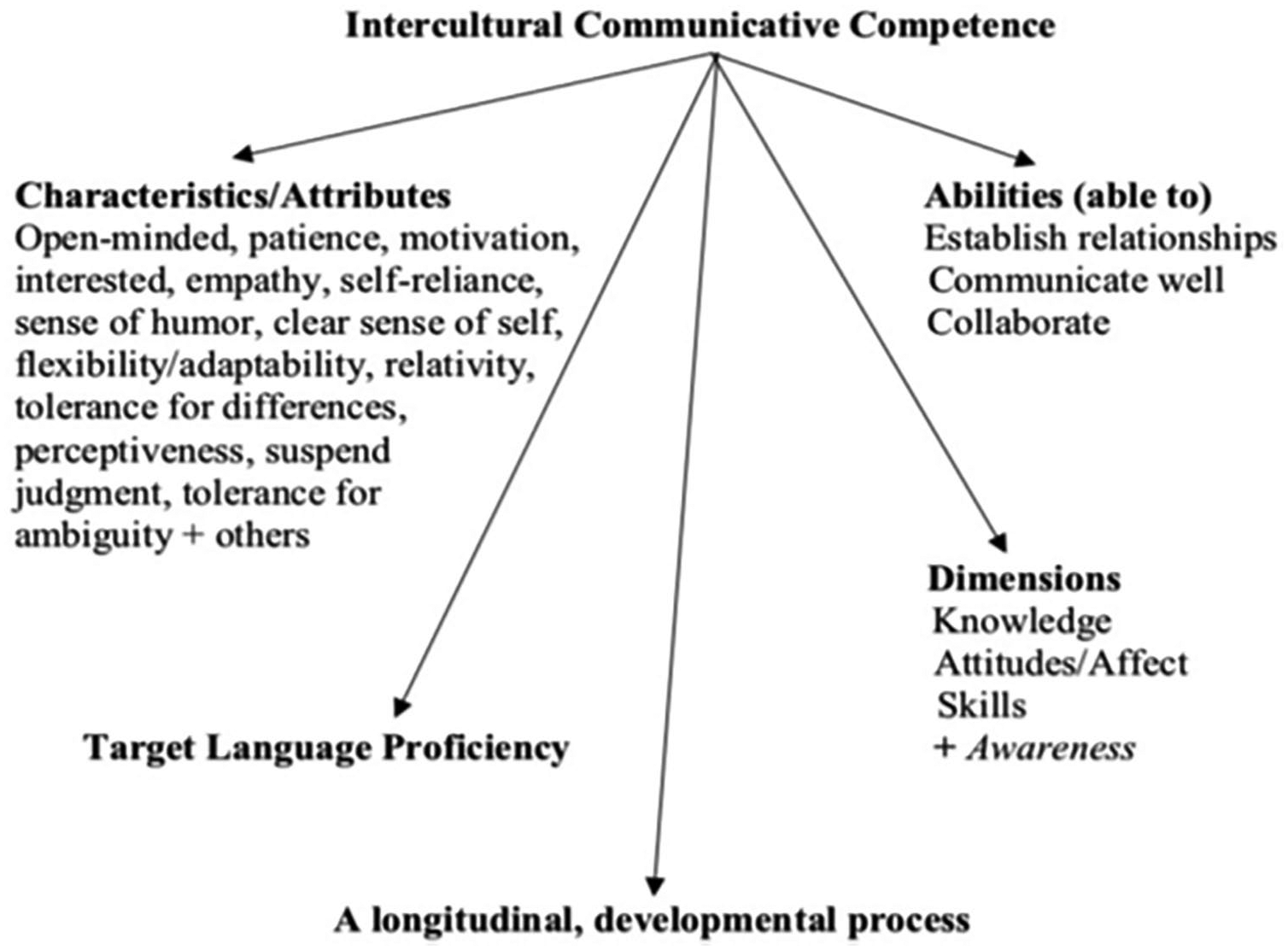
Components and aspects of intercultural communicative competence (ICC)1.
The AIC and AICC forms specify what to assess in terms of content; however, multiple strategies for ongoing and continuous formative assessment are clearly required throughout the process. To summarize, assessment must address all components, incorporate multiple perspectives (ideally including etic-emic perspectives), followed by dialog with the individual being assessed to explore strategies for moving forward. It must be stressed that ICC development without also striving to develop host language ability results in a primarily etic view. Consequently, host language proficiency is included in the assessment process with both instruments.
In the end, ICC development is important for all parties: students, sojourners and hosts in field contexts, and staff and faculty. The approach to ICC development must not only be academic and cognitive, but also experiential and affective. Indeed, ICC development is for all: ourselves and others; English-speakers and other language-speakers; and important for diversity, at home and abroad; and for internationalization and internationalism.
What strategies are effective in developing intercultural competencies?
Given the proposed ICC definition and set of subcomponents, goals and objectives become obvious. Happily, there is no lack of intercultural materials regarding activities, exercises, simulations, and the like, to prepare individuals for intercultural contact and interventions while abroad. However, objectives must be realistic. It is counterproductive to set forth unattainable expectations. Consider, for example, various terms extant in the intercultural field that posit unrealistic objectives: Global competence comes to mind, impossible and unattainable since no one can become globally competent. Whereas one can develop inter-cultural competence, one culture at a time, one can never be competent everywhere, all the time.
Multicultural man (i.e., person), described by Adler (1976) as “a person competent and comfortable in all cultures,” is a corollary to global competence for similar reasons. Whereas one can become inter-cultural and multi-cultural in several linguacultures, it is impossible to be part of all linguacultures. “Ethnorelativity,” likewise, is problematic. One can understand ethno-relativity intellectually, but one cannot become ethno-relative. One can transcend one’s native paradigm and transform it, add another and perhaps another, but in each case, one formulates a new stance. “Non-judgmental” is another commonly cited intercultural attribute, related in a similar way to the above terms. As human beings, we constantly, always and everywhere, make judgments, some trivial, some important. This attribute must be rephrased as, “suspend and revisit” one’s judgments when in another culture, recognizing that we judge other linguacultures based on our own cultural lens. Such judgments may be incorrect or unfounded in new contexts until we have understood the emic view.
Generalizations and stereotypes are commonly cited as negative actions, however, common nouns in every language generalize about phenomena. The word “animal,” for example, is a generalization that acknowledges commonalities among creatures as disparate as pigs, elephants, and llamas. Stereotypes, likewise, recognize certain commonalities, despite disparate aspects of others and other cultures. What offends perhaps is when stereotypes or generalizations, are unyielding, despite new criteria or evidence, owing to underlying pre-judgments that we are unwilling to reformulate.
Etic and emic, mentioned above, are relevant concepts that must be applied to our work. Our goal is to attempt to grasp the emic view of another culture. For example, how natives see their own culture, not how we see it. Clearly, this is challenging and may never be fully achieved, but it remains our goal. However, it is also quite impossible without also entering into the host language, in which emic thoughts are encoded.
What research gaps hinder our ability to develop ICC competencies?
Several research findings can help our approach to developing ICC competencies. The primary issue, discussed above, is the need to agree on the term, concept, and components of ICC. This is fundamental and coming to terms with this issue will provide clarity and direction. The superordinate term cannot be intercultural sensitivity, not intercultural competence, not global competence, nor any other of the nearly 50 terms in use. We need to be consistent as to what components form ICC. This motivated the literary search in multiple languages spanning many years; the synthesis of consistent, comprehensive contributions of scholars from many sources; and empirical substantiation through multinational research efforts.
A full range of decisions flow from this reconceptualization – objectives, program and course designs, implementation and activities, and how to assess ICC development. Input from others, specifically from other languages and cultures, is essential. From a North American and English point of view, we alone cannot definitively determine something about a concept that requires multiple views and applies to people of multiple language-culture backgrounds.
To be comprehensive, the multiple components must include: characteristics or attributes (a common list was identified from the literature and amplified by respondents in the survey), three dimensions (relations, communication, and collaboration), four areas (attitude/affect, skill, knowledge, and awareness), and target language development. And their development must be understood as an ongoing, longitudinal process (despite occasional stagnation or regression). Awareness, or self-awareness, is central and enhanced through discussion, introspection, and reflection. Target language development cannot be omitted, despite its absence from most models (Fantini, 2012: 263-278). Bilingual-multilingualism must accompany bicultural-multiculturalism. Monolinguals simply cannot access another worldview directly or experientially, only cognitively, intellectually, indirectly.
If language is indeed fundamental to ICC, language educators and interculturalists must work together, share and exchange ideas, support each other’s work, ideally combine departments, academic disciplines, conceptual models, and practices. American Council on the Teaching of Foreign Languages (ACTFL), TESOL, SIETAR, and other professional societies, should identify ICC as their common goal, sharing concepts, models, practices, and assessment procedures.
Attentiveness to being effective and appropriate are intrinsic aspects of intercultural development. Happily, most scholars now include both notions in their definition of ICC acknowledging that input is needed from dual perspectives (Fantini and Tirmizi, 2006). As a result, both effective and appropriate become extremely important, the latter reflecting the view of hosts, which leads to the concept of “etic” and “emic.” Whereas etic refers to one’s own view of context and situation, an outsider’s view of the target linguaculture, emic refers to the view of context and situation held by host members, an insider’s view. A goal is to strive to grasp the emic view, knowing that all is mediated, up to this point, by our own native perspective or worldview.
Intercultural communication and diversity are interrelated. Although treated as separate fields, they share a common goal: to develop tolerance, respect, and understanding among all people, across an ocean and with neighbors around the block. We must acknowledge that ethnic minorities face intercultural issues every day, each time they leave home and deal with neighbors and colleagues. ICC is for everyone in today’s world, given globalization and given increasingly diverse societies. We share the same in the aspiration of peace, social justice, and equality. We work to counter opposing tendencies, which seem to emerge more strongly and more widely around the world and around the corner from where we live. We need to learn how to transcend initial paradigms, native worldviews, transforming them as we learn other perspectives.
Finally, the concept of worldview and its transcendence is central to our work. Our initial paradigm serves as well; however, because it has been with us from infancy, it also constitutes the biggest impediment to entering another vision of the world. We can no longer afford to be limited to monocular vision. Alternative perspectives enrich everyone.
What standards help to measure the quality of our efforts?
The research described earlier provided significant evidence regarding ICC in addition to the impact of intercultural experience on participants. These research findings and that of others, many coming from younger graduate students, provide good empirical evidence to support our work. For example, the two projects cited above, sought to: (1) synthesize intercultural research findings in the literature, in multiple languages and over many years; (2) develop instruments in multiple languages to assess ICC development in participants during educational exchange (sojourners and hosts); (3) measure and monitor how these experiences impact alumni over many years; (4) assess the reliability and validity of the assessment instruments, and (5) develop a multinational perspective by engaging respondents from multicultural backgrounds. The studies are notable for several key design elements which make the findings and insights from these research efforts even more valuable to guide our future efforts.
The research referenced above represented a unique collaboration between funding agencies and one of the oldest educational exchange institutions in the world, one with Member Organizations (MOs) around the globe – the Federation of The Experiment in International Living. These MOs possess alumni records dating back nearly nine decades that allowed researching the nature and development of ICC by generating responses from over 2000 sojourners and over 200 hosts, conducted in five languages (plus three varieties of English), involving eight countries on three continents, and spanning 20 years – unique studies given their longitudinal and multinational perspectives.
These studies also helped to reconceptualizing ICC. Because the concept of ICC is termed by many names and its components are described variously and often incompletely, this project reformulated ICC based on over 200 scholarly publications and substantiated by extensive research. The comprehensive ICC concept and components directly affected research design, implementation, and results obtained. Given that intercultural sojourns are rich experiences, it was important to account for the multiple aspects of ICC, not just some of them.
The host language, a fundamental component of ICC, while omitted in most intercultural models, was addressed in both projects. The nexus between language, culture, and worldview is clear; yet, language educators and interculturalists work as though in separate disciplines. To develop ICC in its fullest sense, assessment of target language proficiency was a necessity. Intercultural entry is incomplete without host language development; conversely, host language proficiency facilitates intercultural entry and acceptance. The role of one’s native language at home for full participation in one’s own culture is unquestioned; it cannot be ignored when abroad. Although intercultural experience through English alone is possible, adequate and direct access to the host culture worldview is impossible. Similarly, these research projects are notable in their inclusion of both etic and emic perspectives. Most research investigates etic viewpoints of intercultural experiences only; however, the emic view provides the other side of the story. Aside from consulting viewpoints in many languages in this project, hosts and mentors were involved in addition to sojourners, adding perspectives regarding an experience that affects all parties.
Finally, the findings were based on quantitative and qualitative data, obtained through surveys and interviews. Combined data yielded valuable insights plus important implications and applications: for program design and implementation, assessing the value of specific program components, selection processes (for sojourners and hosts), cross-cultural orientation and ongoing interventions, monitoring and measuring ICC development, and assessing the impact and outcomes upon participants long after the sojourn. In the end, findings substantiated the value of intercultural experience as one of the most holistic and profound educational experiences of their lives. Participants (and in many cases, hosts) were changed and transformed.
Ten assertions were posited in advance of the studies and were validated by the quantitative and qualitative data analyses. Detailed explanations are provided in the full report; here the validated assertions are briefly restated (Fantini et al., 2016):
Assertion No.1: ICC is a complex of abilities (precise abilities are listed and substantiated).
Assertion No.2: Intercultural experiences are life altering (people were changed, transformed, and described in detail by respondents).
Assertion No.3: Family homestays were the most compelling component of the intercultural experience (helping sojourners to integrate into the culture, developing lifelong relationships, aiding language learning, and providing a sense of security).
Assertion No.4: Learning the host language affected ICC development (this was strongly confirmed in multiple ways by respondents).
Assertion No.5: All parties in intercultural contact were affected to some degree and in various ways (i.e., host family members as well as sojourners, as well as others with whom sojourners have contact).
Assertion No.6: People were changed in positive ways through their experience (they developed new abilities, tended towards specific job areas, developed new values, and much more).
Assertion No.7: Many returnees leaned toward specific life choices, life partners, lifestyles, values, and jobs as a result of their experience (respondents in the survey spelled this out in detail).
Assertion No.8: Alumni often engaged in activities that impacted others (respondents discussed education, service, and development areas they chose upon return as a result of their experience that affected others (the multiplier effect)).
Assertion No.9: There were often surprising and unexpected other benefits (reported by respondents when asked what else they wished to add. Most of all, respondents spoke of the positive nature of the experience, its value as one of the “most important educational experiences of their lives,” and their desire that others, including their own children, have the same opportunity).
Assertion No.10: These activities furthered Federation EIL’s mission (i.e., comments validated and supported the mission of MOs engaged in providing exchange programs).
In summary, research substantiated the ICC construct proposed and used. It produced valid, reliable, and comprehensive assessment instruments in multiple languages. Provided individual, particularist country perspectives, and a composite universal multinational perspective. A perspective that revealed the nature of intercultural developments shared by people of diverse backgrounds participating in exchanges in even more diverse locations around the world. The research measured and monitored ICC development not only during sojourns, but over 20 years later to ascertain how these experiences impacted participants long after the programs ended. In addition, the research assessed specific program components to determine how each contributes to ICC development.
Quantitative and qualitative data provided evidence of value not only for other researchers, but also for educators and trainers engaged in providing intercultural exchanges. In addition, the data provided information regarding program design and implementation aspects that can enhance and assure quality experiences for future participants.
Improving university internationalization efforts
Based on my experience in international intercultural education, service, and development, plus the research results, I propose several areas for consideration toward improving the effectiveness and quality of university internationalization efforts.
First, while the fields of foreign language and intercultural communication are often treated as separate disciplines, they share a common end goal. Both fields might benefit from greater interaction among professionals across departments, combining them into a single academic discipline, even a single department. Second, there is value in designated courses in intercultural communication. The survey of intercultural courses at 50 universities cited earlier (Fantini and Smith, 1997: 125–148) showed divergence in approaches to course design and implementation, beginning with objectives, implementation, and assessment. It is clear the field is still evolving and that a common concept of ICC has value. Third, there is a role for professional societies and associations. Whereas language educators commonly participate in relevant professional societies, such as ACTFL or TESOL, many interculturalists seem unaware of SIETAR, the principal society for intercultural educators, trainers, and researchers. Participation addresses their professional interests, keeps them abreast of developments, enriches professional dialog, and supports their work.
It is also important that faculty exhibit ICC. As universities strive to internationalize and to develop ICC in students, it is often the case that many faculty and staff are not interculturally competent themselves. They may not have had the benefit of an intercultural sojourn nor speak another language. Acceptable levels of ICC competence should be established (required?) for university employees, followed by strategies to help them develop competence. Similarly, both academic and experiential learning is required. It is well acknowledged that ICC is not based on knowledge alone, but involves attention to attitudes/affect, skills, and awareness. Development in these latter areas requires going beyond academic educational approaches to provide experiential activities and intercultural experiences. These components often go beyond traditional teaching, testing, and grading.
Universities would also be well advised to incorporate both evaluation and assessment. Evaluation is typical within academic institutions wherein performative judgments are made and grades assigned. Intercultural assessment differs in its focus on longitudinal development and, as such, it often involves learners in the educational process itself and requires formative assessment that includes self- and peer assessment, and triangulation, followed by discussion of these observations and of strategies to develop further. Multiple assessment modes and strategies that go beyond traditional mid- and end-of-term testing are required. Longitudinal assessment and impact/outcome studies are particularly important. Courses evaluate their objectives within a given timeframe, but the development of ICC, as a goal, transcends courses and extends over time. Impact/outcome studies of alumni conducted by institutions years later help to assess whether and to what degree they are achieving their goals in developing ICC over time and the effect on the lives of graduates. Although institutions may have multiple approaches to ICC development, institutions and accrediting bodies need to establish quality standards and procedures to monitor that standards are implemented and adhered to, and consider accreditation of those institutions which demonstrate excellence.
As a fundamental component of ICC, the development of second language ability, measured in proficiency terms, is required. Becoming bilingual (to some degree) is necessary for ICC development. According to ACTFL (1996), however, language enrollments continue to decline in U.S. schools. Approaches to language education must be communicative with language curricula based on ACTFL World-Readiness Standards. It is important to note that ICC is on a continuum with interpersonal development (IP); that is, it is an extension of, and further enhances, IP development. While sojourning in Greece and learning about Greeks, for example, most sojourners say they also learn more about themselves. Although ICC differs by confronting increased variables and challenges, many of the same attributes developed in ICC enhance IP development, enhancing in turn, one becoming a better member within one’s own society. ICC is also related to the diversity. The concerns and abilities of intercultural communication and diversity overlap; they are related and reinforce each other. Moreover, abilities ethnic minorities develop at home are akin to ICC abilities developed abroad, yet seldom recognized, acknowledged, or valued. We need to discover how to reinforce and enrich both areas.
In the end, we are engaged in an important and profound educational experience. One that has the power to transform lives, by developing new perspectives and alternative ways of conceptualizing, of being, of understanding, of interacting. Intercultural experiences help to develop an emic stance, to transcend one’s singular worldview, to see anew, to learn more about others and oneself. This is what the development of ICC is about. And this is what quality and effective internationalization is about – establishing intercultural relationships, developing friends from other cultures, becoming comfortable with differentness. While internationalization helps commerce, increases competition, and enhances our ability to deal politically in the world, these are perhaps secondary to our primary goals, those that hopefully lead us toward what we most desire – peace, social justice, and equality.
Footnotes
Funding
The author disclosed receipt of the following financial support for the research, authorship and/or publication of this article: Funding for the research on which this report is based was provided by the Center for Social Development (CSD) at Washington University, St. Louis, Missouri, for the Initial Research Project (2005-6); and by the Center for Educational Resources in Culture, Language, and Literacy (CERCLL) at the University of Arizona, Tucson, Arizona, for the Follow-on Research Project (2015-16).