




Abstract
Developing intercultural communication competence (ICC) is a pursuit that has captured the interest of researchers in several disciplines for a number of decades. The urgency and interest to produce graduates who are ready for the global marketplace has never been more prevalent amongst educators as it is today. This article outlines strategies for developing ICC based on prior research, and articulates a new framework for global graduates based on four understandings: understanding of self, understanding of others, understanding of self’s responsibility to others, and understanding of others’ contributions to self. Curriculum development and institutional investment considerations are discussed in relation to the proposed framework.
Introduction
Developing intercultural communication competence (ICC) is a pursuit that has captured the interest of researchers in several disciplines over a number of decades. The urgency and interest to produce graduates who are ready for the global marketplace has never been more prevalent amongst educators than it is today. This is due to the increased cultural diversity in the workplace in many economically developed countries, which reflects the increased cultural diversity in the population in general, and greater global mobility. For example, in the Australian Bureau of Statistics (2018–2017), every country in the world was represented in Australia in 2018. While global international and intercultural (GII) competencies are one way of framing what we aspire to develop in our students, it is essential to deconstruct what we mean by GII. In the discipline of communication, ICC is the commonly used label to describe effective and appropriate communication between people of different cultures. The purpose of this article is to examine research in ICC, enumerate strategies that are currently in use for developing ICC in students, propose a framework for global graduates, and identify future imperatives.
Intercultural communication competence (ICC)
Intercultural competence or ICC has been the subject of study since the late 1960s and early 1970s (Arasaratnam, 2016; Bradford et al., 2000). For example, some of the early work in ICC involved the identification of variables that contribute to ICC (Hammer et al., 1978; Ruben and Kealey, 1979). While there are multiple definitions of ICC, it is commonly understood as effective and appropriate communication between people from different cultures (Arasaratnam, 2016). There is consensus amongst researchers that ICC has cognitive, affective, and behavioral components (Spitzberg and Chagnon, 2009). In her process model, Deardorff (2006) identifies sets of attitudes, knowledge, and skills that lead to internal and external outcomes, which include empathy, flexibility, and adaptability, among others. Bennett’s (1993) model of intercultural sensitivity identifies six distinct developmental stages where one moves from ethnocentrism to ethnorelativism through intercultural encounters and learning. The Integrated Model of Intercultural Communication Competence (Arasaratnam, 2006; Arasaratnam et al., 2010), identifies five variables that have a causal relationship with ICC, namely experience, motivation, positive attitude toward other cultures, active listening, and empathy. The ability to empathize not only implies an understanding of others through cognitive and emotional role-taking, but also understanding of self (Calloway-Thomas et al., 2017). Literature in ICC further implies that a competent intercultural communicator is someone who is more aware, more attuned, and more mindful (Gudykunst, 1995). Similarly, humility (Alexander et al., 2014) and cognitive complexity (Gudykunst and Kim, 2003) are also variables associated with ICC. What is clear is that self-knowledge and self-growth, as well as empathetic understanding of others, are key components of ICC.
Strategic considerations for developing ICC
Although there are several effective ICC initiatives around the world, this section draws heavily from Deardorff and Arasaratnam-Smith’s (2017) publication that showcases 29 case studies from different countries and disciplines. Deardorff and Arasaratnam-Smith (2017) identify 10 key strategic considerations for developing ICC.
First, developing ICC (or GII) has to be intentional. In other words, developing ICC in students cannot be consistently achieved without systemic and institutional initiatives as well as institutional support. Second, programs for developing ICC should take into consideration the context in which such programs are delivered. Examples of contextual variations include level of study (undergraduate or postgraduate), disciplinary differences, role of participant (student or staff), socio-cultural factors, and availability of resources. Third, ICC programs should prioritize maximum benefit for the learner (rather than ease of delivery, for example). Considerations for learner-centric approaches to program design include considering any perceived power differences that may affect learning. For example, if training for a group of indigenous or socially disempowered students is facilitated by a lecturer who belongs to a group of perceived power or oppression, the students may either not be receptive to learning or perceive that the lecturer does not adequately understand their context. The fourth consideration is that any ICC development initiative should include a component of active engagement. In other words, classroom learning should be coupled with application of knowledge in everyday situations either through practicums or other mechanisms as appropriate for the learning context. Fifth, ICC development involves not only the assimilation of relevant knowledge, but also the development of necessary attitudes and attributes. For example, empathy, humility, mindfulness, and flexibility. ICC initiatives should be designed intentionally to facilitate the development of such attitudes and attributes as well.
While results are often the focus of learning initiatives, ICC development initiatives should focus instead on process. In other words, according to the sixth tenant, the focus should not be just on the “what” of the learning, but also the “why” (why is this knowledge/experience significant?) and “how” (how will you apply what you have learned?). A seventh strategic consideration is that ICC programs should incorporate a diversity of perspectives. Needless to say, the perception of what is effective and appropriate communication varies from culture to culture and context to context. Hence learners need to be exposed to different iterations of these variations. Including illustrations and readings from different parts of the world is one way of incorporating multiple perspectives into the learning process. Additionally, variety in assessment is a key component of an effective ICC program. Qualitative and quantitative assessments along with formative and summative assessments should be considered. Assessments should not only include assessments of students, but also assessment of the effectiveness of the program itself.
The penultimate consideration is customization in ICC training. In other words, prior to implementation, training programs should take into consideration the purpose of the training, the needs of learners, and the particularities of the environment in which the training would be delivered. Finally, the tenth strategy identified by Deardorff and Arasaratnam-Smith is that developing ICC in students necessitates developing faculty members’ ICC. As such, ICC development initiatives should focus on training for faculty and staff as well as students.
Global graduates
The imperative to develop graduates who are not only literate in their discipline, but also ready for the global workforce is clear. But what qualities does such a graduate possess? How do we deliberately develop those qualities in students? The answer to these questions can be gleaned from existing models of ICC. Since ICC consists of cognitive, affective, and behavioral elements, competent intercultural communication is about a way of being rather than a list for doing. I propose that developing global graduates is about developing certain types of understandings in students. The word “understanding” is suggested because it encompasses cognitive (comprehension, discernment, mastery), affective (empathy, consideration), and behavioral (tact, diplomacy, support) elements by definition. The proposed understandings result from a synthesis of knowledge, attitudes, and behaviors that are contributors to ICC. As such, four specific understandings are proposed as characterizing global graduates (Figure 1).
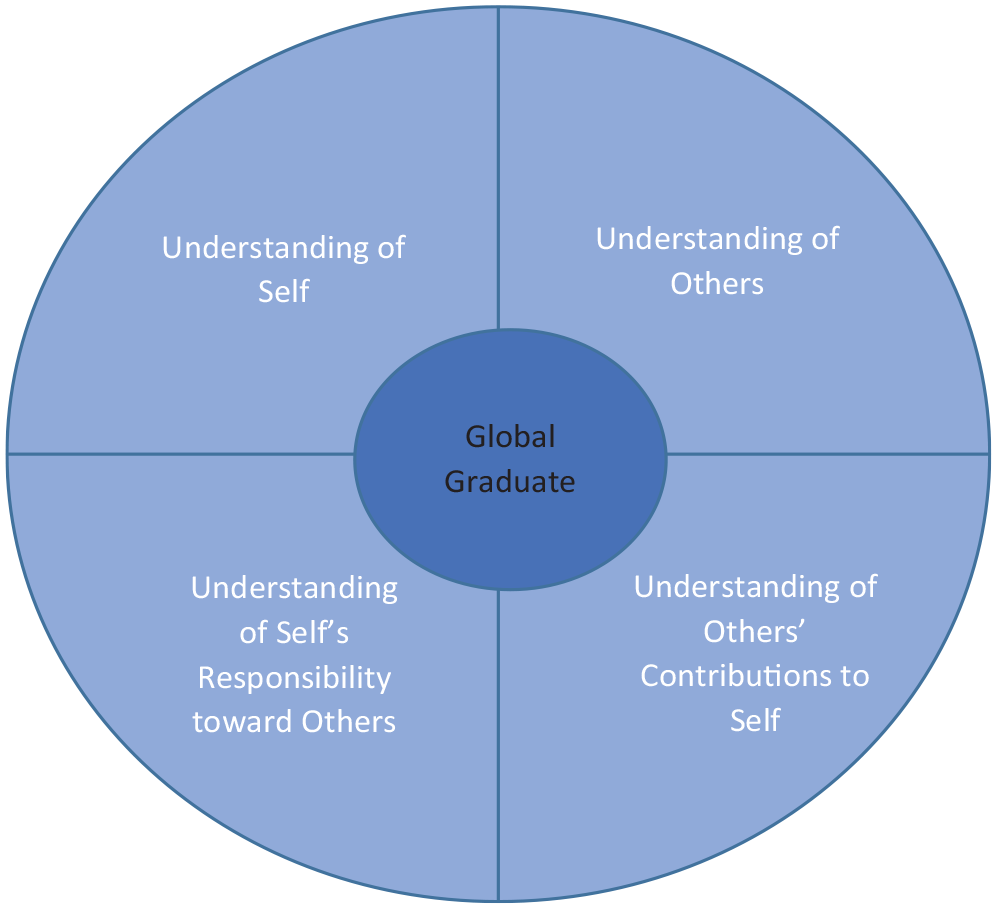
Global graduates.
Understanding of self
Recognition of the influence of one’s own culture, on one’s perception and communication, is a significant component of ICC. Various models of ICC illustrate this. For example, “self and self-concept” is one of the six exogenous variables in Gudykunst’s (1995) model of communication effectiveness. Research is replete with evidence that self-awareness and understanding of self are necessary for effective social interactions. In intercultural communication, understanding of self not only involves self-awareness in day-to-day interactions, but also awareness of the social and cultural lenses through which one sees the world; and all the biases inherent therein.
Understanding of others
Communication is a process of sharing meaning. Meaning cannot be shared unless there is a common point of connection or understanding. Hence understanding of others is a necessary component of communication and ICC. As previously noted, empathy and mindfulness are key variables in ICC. Understanding of others not only cognitively, but also emotionally, is necessary for competent communication. Further, understanding others requires positive attitudes toward people of other cultures and a motivation to interact with, and get to know people of other cultures (Arasaratnam, 2006). It necessitates active listening (Arasaratnam and Doerfel, 2005).
Understanding of self’s responsibility toward others
Because we as humans live in communities, interdependency is part of our existence. As such, there are instances where one has occasion to give up one’s personal “right” for the benefit of someone else. For example, a smoker at a bus stop might extinguish her cigarette if she realizes someone waiting next to her starts coughing due to smoke allergy. The smoker has a personal right to smoke in a public place where there are no explicit signs prohibiting smoking. However, extinguishing her cigarette in response to someone coughing indicates her awareness of others around her, and her willingness to forgo her right to smoke as a consideration for someone else’s aversion to cigarette smoke. ICC requires balancing individual rights with social responsibilities. In other words, mindfulness, for example, is not just about being aware of the dynamics of the conversation, but also having the willingness to change one’s behavior in response to what one has observed. It is my position that global graduates are such persons whose awareness of others is coupled with a sense of responsibility toward others’ wellbeing.
Understanding of others’ contribution to self
Individualistic worldviews promote independence and sense of personal achievement (Triandis, 2018). While independence and personal achievement are praiseworthy, we are inevitably shaped by the contributions of others who came before us in history. For example, a contemporary woman turning up to vote on election-day is the beneficiary of countless women who were part of suffragette movements in previous generations. The freedoms, access to knowledge, and scientific benefits enjoyed by modern persons is the work of people who came before them. This awareness, in addition to the awareness that such contributions have been made by people from different parts of the world (not just people from one’s own culture), better positions one to have the kind of humility that has been identified as one of the key components of ICC.
Developing global graduates
The previously noted ten strategic considerations in ICC initiatives apply to developing global graduates. Curriculum development and institutional investment are key considerations in this process.
Curriculum development
Developing global graduates requires a curriculum that facilitates the development of the four understandings. Curricula that strip away the “softer” disciplines in favor of developing students with a particular set of disciplinary tools may produce graduates who are disciplinarily competent, but not necessarily competent in working with people from a variety of cultures in diverse workplaces. For example, consider the program structure for a Bachelor of Engineering in an Australian university (Table 1). It is clear that a graduate of this program would have every chance of being an excellent engineer, but the extent to which the student would be prepared to be an engineer in the global marketplace is unclear at face value.
Outline of a Bachelor of Engineering program in Australia.
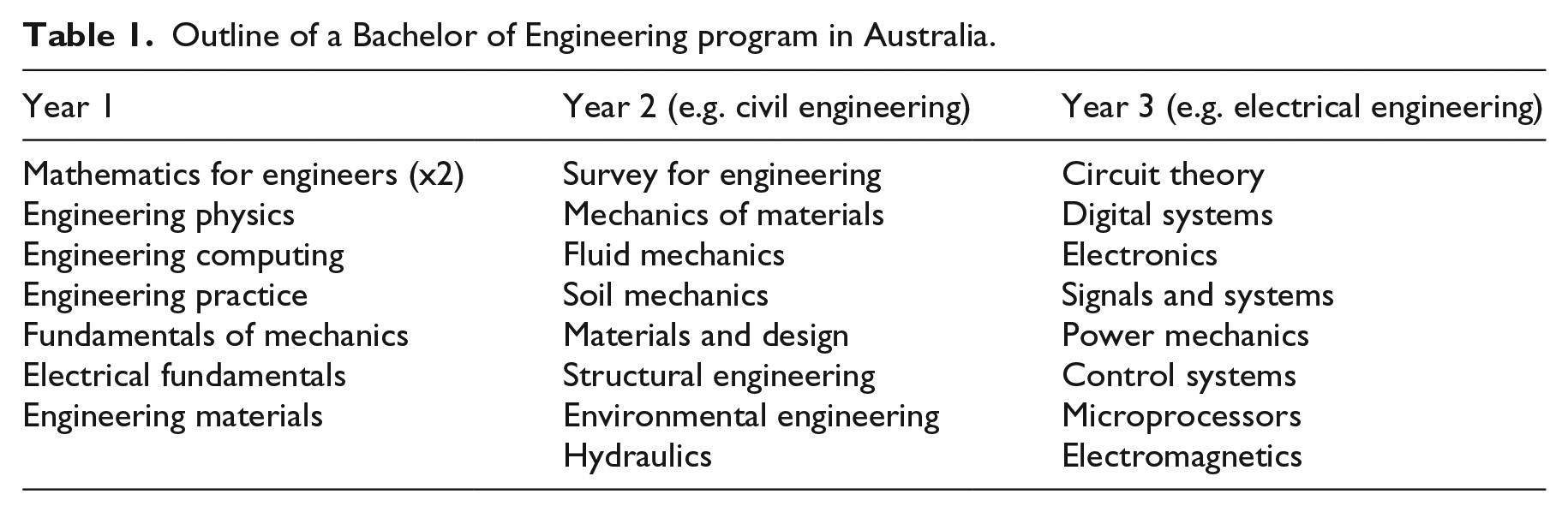
If we are serious about developing global graduates, then we must design curricula that support this goal. For example, could engineering or physics include a brief history of the subject, the key persons who contributed to current knowledge, and the socio-cultural factors that influenced the evolution of the discipline, to facilitate understanding of others’ contributions to self? Could elements of teamwork, intercultural communication, and self-reflection be incorporated into the subjects and assessments? A process-oriented (as opposed to result-oriented) approach to the development of ICC demands an integrated approach to curricula, where ICC development is progressively facilitated through content and assessment.
In regards to assessing the development of the four types of understandings in global graduates, there are a number of possibilities. For example, understanding of self could be assessed through measures of self-awareness (Ashley and Reiter-Palmon 2012; Govern and Marsch, 2001), measures of self-concept (e.g. Pena et al., 2015) and qualitative mechanisms such as experienced-based reflective journals. Different aspects of understanding of others could be assessed through measures such as cultural empathy (Van der Zee and van Oudenhoven, 2000), interaction involvement (Cegala, 1981), and qualitative peer-feedback. Understanding of self’s responsibility toward others could be assessed through mechanisms such as responses to scenarios, critical reflection on social issues, and measures of self-construal (Singelis, 1994). Understanding of others’ contribution to self could be assessed through mechanisms such as reflective essays and historical mapping. Regardless of the specific types of assessment, developing global graduates involves deliberate structuring of the curriculum and systematic and progressive assessment of the understandings that we wish to develop in students.
Institutional investment
As previously observed, in this article, successful ICC initiatives require institutional commitment and investment. This can be in the form of commitment of monetary resources, commitment to developing faculty and staff’s ICC, commitment for whole-scale curricula review, commitment to partnering with external bodies for mutually beneficial arrangements in developing global graduates, and commitment for regular and candid assessment of the effectiveness of programs or initiatives. Known obstacles to institutional investment include financial constraints, lack of buy-in for the need to develop ICC in students and staff, lack of trained faculty to drive ICC initiatives, and competing alternative priorities (Deardorff and Arasaratnam-Smith, 2017). As such, one area worthy of further exploration is measures of return on investment. Measures could provide tangible data to facilitate decision-making processes of university administrators in regards to ICC initiatives. In addition, longitudinal studies that link the development of global graduates with their effectiveness in workplaces would provide helpful data for assessing the value of investing in ICC initiatives in higher education.
Conclusion
As the global landscape changes, so must research in ICC and ICC development initiatives. Gaps in ICC research, suggestions for future directions, and key topics for discussions have been addressed in several publications (see Alexander et al., 2014; Arasaratnam, 2007; Arasaratnam, 2014). This article has identified 10 strategic considerations for ICC initiatives and four understandings that form global graduates. Considerations for developing global graduates have been presented. While there may not be consensus on one definition of ICC, there is a general consensus on the types of attitudes, knowledge, and skills that are required for ICC. Several ICC initiatives across the world have reasonably established measures for assessing whether subject-level outcomes have been achieved by students. However, apart from instruments such as employment placement surveys and graduate surveys, we do not yet have established measures to assess whether we are producing global graduates. Identifying the types of understandings that we should inculcate in global graduates is one step toward this goal.
Footnotes
Funding
The author received no financial support for the research, authorship, and/or publication of this article.