




Abstract
This article presents a critical analysis of key elements within the conference question as the basis for proposals for an inclusive and systematic approach to the development of mainstream disciplinary higher education curricula designed to meet the needs of students and societies in a multicultural globalizing world. The critical analysis considers key objectives, understandings and limitations of GII ‘competencies’, how we conceptualize ‘students’ within a globalizing higher education, how ‘effective’ strategies might be framed, and how internationalization abroad and at home might be re-envisioned in the era of the post-national university. The article illustrates how this critical analysis points to the need to embed internationalization efforts, and their success indicators, within the mainstream curriculum across the disciplines.
Introduction
The neoliberal agenda in higher education (Rustin, 2016; Slaughter and Rhoads, 2000) encourages the development of employability competencies which serve the individual student (and the employer) well, but which may contribute nothing to wider society, whether within local or global communities. In contemporary social and political contexts, educators committed to global social justice must assert their practice as an anti-hegemonic enterprise, requiring a clear vision of its mission, and a deep commitment to the development of their students and all those wider stakeholders who invest universities with a trust in their futures. Internationalization of the learning experience and its outcomes, variously referred to as internationalization of the curriculum (IOC) or internationalization at home (IaH), has for some time been seeking to introduce notions of global learning, global citizenship, intercultural competencies, global perspectives, and similar construct into the learning experiences and outcomes of students in higher education. For convenience, these are referred to collectively as ‘GII competencies’ in this paper, alongside a critique of the term and proposals for how aspirations for student learning, in and for a multicultural globalizing world, might be conceptualized. It should no longer be necessary to reiterate the findings of the many studies which illustrate that both the recruitment of international students, and the laudable efforts to establish meaningful study abroad experiences for a small percentage and a limited demographic among our domestic students, continue to prove themselves unsuccessful in bringing GII learning to the vast majority of students (Fozdar and Volet, 2016; Harrison and Peacock, 2010; Kimmel and Volet, 2012; Rienties and Nolan, 2014). A similarly disappointing picture presents itself for those multicultural learning experiences which are accessed only by small numbers, and which remain non-critical to overall academic success. Each of these becomes more problematic in a globalizing higher education, where increasingly diverse students of a single institution may be studying for common awards across highly diverse social, political, cultural, and economic contexts – globally and locally.
Students, faculty, university administrators, policy-setters, and the wider public stakeholders attribute most value to disciplinary learning. This article argues that to be impactful, therefore, GII learning needs to be embedded within the mainstream curriculum. To support that argument, I briefly set out a critique of key areas under four questions: (1) What objectives underpin the development of GII? (2) What do we understand by GII competencies? (3) Which students are we concerned with? and (4) What do we mean by most effective strategies?
The answers to these questions demonstrate some of the complexities surrounding the introduction of GII competencies in a rapidly changing arena of global higher education, seeking to serve the needs of highly diverse students in a multicultural globalizing world. These complexities, I believe, firmly support the need to embed GII learning within the mainstream curriculum, as set out in the concluding sections.
What objectives underpin the development of ‘GII competencies’?
A difficulty with competency development is that it can be effective in enabling individuals to act solely for their own advancement. For example, GII competencies may serve to bolster self-interested graduates in pursuit of globally damaging or narrowly nationalistic objectives. Facilitating graduate development to apply GII competencies in this way has no place within a higher education that values global social justice, and sees its objectives as enabling its graduates to respond to the emerging, connected, and complex needs of the planet and its communities. GII competencies have the potential to be a significant enabler for such objectives, but their development, and the ways in which they are framed, need to be set within a critical pedagogy framework (Freire, 1970, 1972; Kincheloe, 2012) which sees education as a process of liberation and a means to activate social change. In the context of a globalizing higher education, particular attention needs to be given to ensuring this work is expansive and inclusive across the wide spectrum of our diverse global learners. Work in culturally relevant and responsive pedagogies (Gay, 2000; Ladson-Billings, 1995), with their focus on building curriculum and educational experiences which recognize, validate, and empower students from minority groups, has much to offer in response to this question. GII competency development engages with objectives of student empowerment, social justice, and identity development for students locally and globally.
What do we understand by ‘GII competencies’?
There are multiple excellent examples of well-thought-out taxonomies of GII competencies devised for different purposes and contexts (CILT, 2009; Deardorff, 2008; Spencer-Oatey and Stadler, 2009). Skills such as being able to reflect on one’s own impact on others, behavioral changes like challenging prejudice, and an increase in knowledge or awareness of how different cultures might view or display hierarchy, work alongside taxonomies that include or imply sets of attitudes like being open, being curious, and being respectful. Skills, behaviors, and knowledge competencies are observable and quantifiable, and so they can fit easily with an outcomes-based paradigm of curriculum design. However, assessing student attitudes is not possible. This presents GII advocates with a significant problem, and we should not pretend otherwise. GII competencies, tied to the objectives of student empowerment, social justice, and identity development for students locally and globally, necessarily involve attitudes towards self and others.
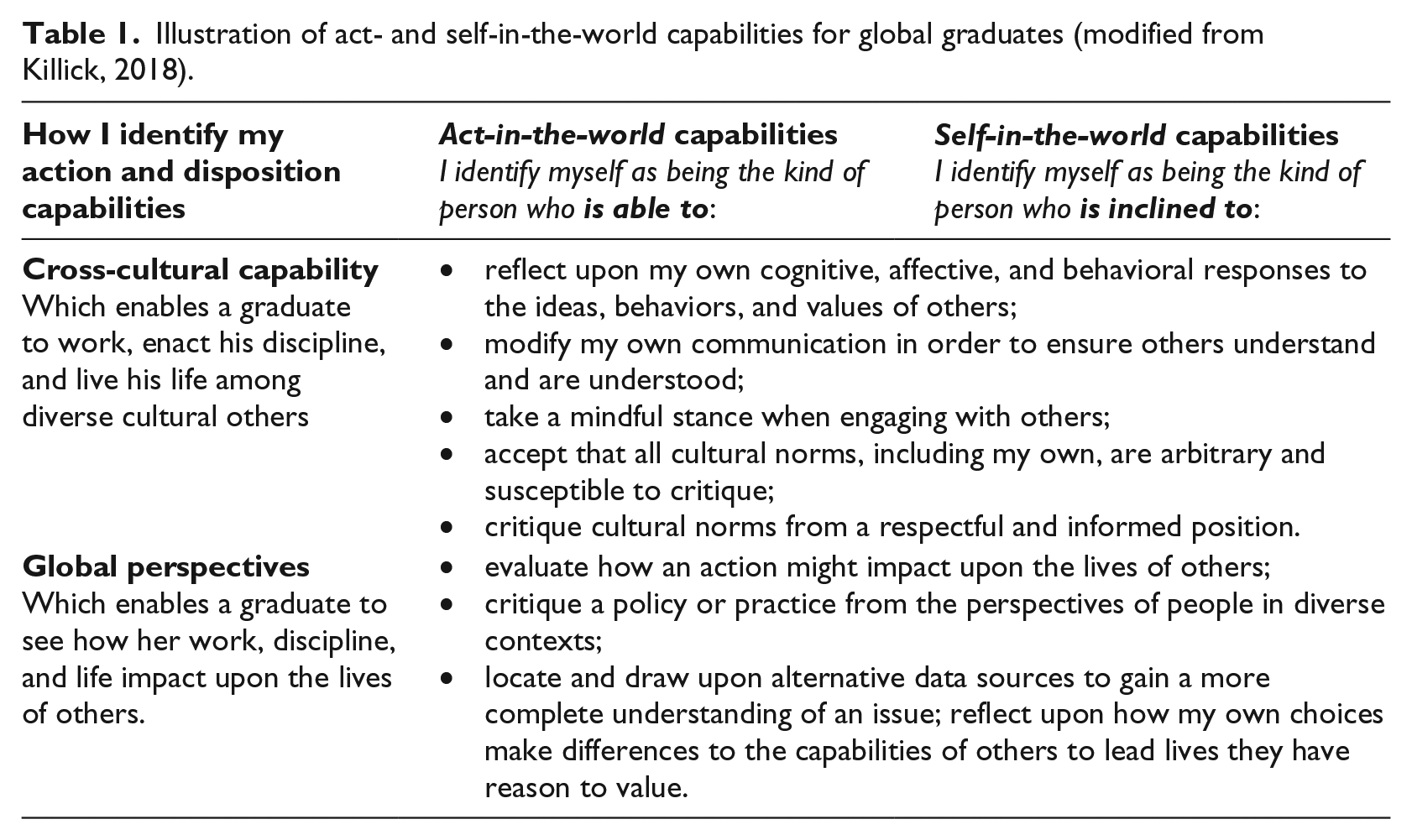
In part because competencies can be understood to be about skills, behaviors, and knowledge, I prefer the term capabilities, borrowed from Amarta Sen’s work (1993, 1999), as the measures of an individual’s freedoms to lead a life they have reason to value in a multicultural globalizing world. In my understanding, having reason to value the life one leads requires reflection on that life, and means at the very least that it should be a life lived in ways which do not diminish the capabilities to others to also lead lives they have reason to value. Some freedoms are delineated by the individual’s circumstances in the world. For example, their access to clean water and health services, rights to education and freedom of speech, absence of threats of violence or identity subjugation. Others are dependent upon an individual’s personal capabilities and so are open to development through their education. I suggest that GII freedoms can be described as the mutually-reinforcing personal capabilities to do something, act-in-the-world, and the capabilities to be someone, self-in-the-world. As illustrated in Table 1 they are necessarily tightly bound to an individual’s self-identity. The examples of capabilities in the Table 1 concern (i) working with others across cultures and (ii) doing so with the kinds of critical literacies which inform and are informed by wider perspectives on how the world works for others. In all cases, being able to and being inclined to are necessary and mutually-reinforcing. Essential to both, is that students recognize these capabilities in themselves and take ownership of them as part of their identity. I suggest that such change is unlikely to be achieved through ad hoc or incidental learning opportunities at university. Instead, it will require engagement with GII learning in modules and classes throughout a student’s full program of study.
Illustration of act- and self-in-the-world capabilities for global graduates (modified from Killick, 2018).
Which students are we concerned with?
Other than international student recruitment, there is a tendency to focus internationalization education activities around the experience of (i) majority students because fewer students from minority groups participate in study abroad and (ii) domestic students. Institutional success metrics tend to measure numbers engaged in international internships, volunteering, and study. Advancing the causes of minority students tends to be seen as being enacted through multicultural learning centers, disability offices, or specific advocacy groups, usually physically and structurally separated from international education offices. International students are largely regarded, if they are regarded at all, as a resource for GII learning among their domestic peers (BCCIE, 2003), rather than as targets for, or beneficiaries of, any internationalization of learning initiatives per se. Diversity among international students is rarely given any attention, though there are certainly all aspects of diversity, all examples of privilege and disadvantage, all the nuances of learning disabilities and of personal characteristics spread across this ‘group’ as any other. Current simplistic ‘nationality’ or macro-culture demarcations, for instance ‘Confucian Heritage Students’, impoverish the work of all concerned. GII capability development needs to be situated as work that is designed to empower all students, and to do so requires a sophisticated, intersectional (Crenshaw, 1991) perspectives on domestic and international student diversity, and on the associated power differentials between groups and individuals. Increasingly, institutions are shifting their institutional risk and stakeholder impact into the international arena, often in the form of cross-border, transnational, education. In such post-national universities (Killick, 2017), where students in Malawi, Nepal, the UK, and Brazil might be studying the same curriculum for the same award within their respective home institutions, academics and administrators, need always to be alert to the potential for the ways they design and resource student learning to discriminate and disadvantage some within that complex milieu. GII can be seen in part as an educational response to these shifts, as institutions look for ways to match curricula to students and contexts. In short, then, GII is concerned with all our globally diverse students, domestic, international, majority, minority, on home campuses, on overseas campuses and within partner institutions. It is only the mainstream curriculum which is guaranteed to reach all students.
What do we mean by ‘most effective’ strategies?
Given the discussions above, ‘most effective’ needs to be understood in terms of what is achieved and who has achieved it. As noted, educational strategies which successfully developed expert skills in intercultural communication would not be effective within the terms set out above if graduates deliberately utilized those skills to manipulate or exploit others. Similarly, strategies which successfully developed cross-cultural and global perspective capabilities as set out above would not be effective if they did so only for a limited student demographic.
Although a seemingly tautological answer to this question, the most effective strategies are those which achieve the greatest degree of desired outcome for the greatest number and diversity of students. This means that metrics on student numbers participating in study abroad, attending intercultural and diversity courses, enhancing their intercultural competency scores, and so forth, need to be critically interrogated to create a clear understanding of who is and who is not engaged. As noted above, it also means that if GII learning is to have any chance of benefiting the widest number of students, it must become the responsibility of the mainstream disciplinary curricula.
Strategies within mainstream curriculum
In light of the discussions above, it is appropriate to ask: Which internationalization strategies are most effective in developing GII outcomes which enhance all our students’ capabilities to lead lives they have reason to value in and for a multicultural globalizing world? I contend that that only effective space for GII outcome development for all students is within their mainstream, disciplinary curriculum. Mainstream, refers to curriculum which is required for a student’s progression and graduation. Disciplinary, refers to that curriculum which is focused upon subjects aligned directly with a student’s chosen field of study. The following are not part of the mainstream curriculum: an elective course; an optional (even if for credit) study abroad, service learning, diversity encounter or experience, (etc.); learning activities in which only some students engage with peers and perspectives which are somehow significantly different to themselves; a required course which lies outside the disciplinary field (e.g. a generic module in intercultural communication); or a learning activity (lecture, seminar, piece of group work) within a disciplinary course which has un-assessed outcomes. This is not to suggest that there is no place for the above, or that they cannot do valuable work for individual students, but they are not adequate and should not be prioritized because they are avoidable and/or are diminished in importance by their divorce from a student’s disciplinary focus. Since all students, at home and abroad, on-line and in our physical classrooms, study and are assessed through the mainstream curriculum, demonstrating achievement of the GII outcomes embedded throughout that curriculum becomes a requirement for all those who participate in order to graduate. To my knowledge, there has been no reported attempt to do this at an institutional level, other than through a project to embed a global outlook as a graduate attribute within one UK institution (Jones and Killick, 2013).
Within the mainstream curriculum, the driving-force for learning and for the required assessment of that learning is its intended learning outcomes. Within the outcomes-based curriculum paradigm, which currently dominates Anglophone higher education, this necessarily means that what we set out in our learning outcomes must be measurable through the assessments we design (Biggs, 2003). This is problematic for the kinds of self-in-the-world capabilities illustrated in Table 1. We cannot measure how a student identifies herself, nor what she is inclined to do. We can only measure what she does. I cannot see that we have any choice but to accept this limitation. The question then becomes, what can be done within the mainstream curriculum which is likely to develop these invisible GII outcomes we set out to achieve? I suggest three related strategies: embed the critique of own and others’ perspectives within disciplinary learning outcomes and assessments; create learning and assessment experiences within which all students engage with locally and globally diverse others in exploring and critiquing disciplinary perspectives and activities; and engage all students in critiquing the mainstream curriculum and their own learning for its effectiveness in empowering them to act.
Strategy one: Embedding perspectives
There is much discussion within internationalization of the curriculum about the inclusion of content drawn from diverse sources and representing diverse perspectives. By calling for embedding, this strategy echoes calls within that discussion for diverse content to be more than an add on; it also firmly locates that content within the discipline, ruling out the more peripheral spaces indicated above. Most significantly, it puts the emphasis on what the students do with the content – developing and exhibiting the capabilities to critique several perspectives, including those of their own cultures, societies, and other in-groups, be they from a majority or a minority. Where a course is delivered to diverse students in diverse contexts, the students and the context should provide some of the specifics of the diverse perspectives to be engaged with. Diverse perspectives, though, do not depend upon having a diverse cohort – nor should they be limited to the dimensions of diversity present within a cohort. A course delivered to a mixed Black and White cohort should engage perspectives from both groups, but also, from indigenous people, people in other continents, people with disabilities, people of other faiths/no faith, and so forth, whether or not they are represented within the cohort.
The capability to critique needs to build in complexity over time. In all cases, the constructive alignment process should then lead to the achievement of those learning outcomes being assessed, with appropriate criteria developed to ensure that passing the course is contingent upon a satisfactory level of performance, and to learning experiences being designed to enable students to demonstrate their learning.
Strategy two: Learning and assessment
Engaging with diverse others in meaningful activity is identified as an important factor for prejudice-reduction (Allport, 1979, 1954; Pettigrew and Tropp, 2008). The same contact theory also identifies authority support and equality among participants as key features of the contact situation. In this case, authority support is provided most clearly by making relevant capabilities an assessment requirement, while participant equality is enhanced by ensuring that students take on the role of expert informants, for example, by validating their perspectives as a source of knowledge. By witnessing themselves and those who are like them successfully engaging in intercultural contact experiences, students are able to build their self-efficacy (Bandura, 1997) for future encounters (i.e. I am the kind of person who can. . .). The confidence of self-efficacy lends support to a positive attitude to engage (i.e. I am the kind of person who is inclined to. . .).
The students within the cohort, at home and overseas, provide a significant resource for these kinds of activities, especially with the expanding possibilities for on-line study collaborations (Guth, 2013) across communities and continents. As noted, engaging diverse students as expert informants enhances their status and power. However, as also noted, it is important to engage with others whose perspectives might not be represented within the cohort, or within higher education more broadly.
Taking one example of a possible Year 1 learning outcome: students will be able to identify the differences and similarities between the use of cosmetics within their own social group and two contrasting social groups. Assessing this outcome signals to students that different people engage differently with cosmetics, and that the differences are socially/culturally normative, economically circumscribed, have historical influences, signal group memberships, impact ecologically, and so forth. By exploring the topic with members of other social groups, there is a need for students to articulate what are likely to be hidden dimensions to their own use or non-use of cosmetics, and to recognize that others, peers who are outside their selected community, can contribute to their own process of identifying differences and similarities. Others become people to seek out face-to-face or virtually, and seek to understand, rather than people to ignore, misinterpret, or misrepresent.
The capability to successfully engage with diverse others is indirectly evidenced through an individual student’s performance in the assessment of the stated outcome above. However, more direct assessment of this capability can be achieved through other variations on learning outcomes. I use the same one to illustrate the point, but a course would select a range of areas of knowledge and performance as appropriate to the discipline.
For example – students are often assessed on their presentation skills – so the learning outcome above might be structured to incorporate this: students will be able to give a presentation illustrating the differences and similarities between the use of cosmetics within their own social group and two contrasting social groups. To directly assess one aspect of successfully engage with diverse others which is relevant to giving a presentation, the above can be further modified: students will be able to give a presentation to an audience with diverse competencies in English, illustrating the differences and similarities between the use of cosmetics within their own social group and two contrasting social groups.
This particular modification makes speakers of English as a foreign language expert informants and raises awareness among those for whom English is their first language of their own responsibilities for achieving effective communication and successful encounters in a multilingual world. A second illustration would be: students will be able to conduct primary research on the differences and similarities between the use of cosmetics with research participants from their own social group and two contrasting social groups.
Strategy three: Critiquing the curriculum
A significant reason for this is to acknowledge that diverse students are better able to identify how their individual learning has been impacted by their experience on the course. Faculty are rarely well-placed to understand students whose identities and life-experiences are significantly different from their own; all the more so across the cohorts and contexts of the post-national university. Several examples of students becoming expert informants in curriculum design and development processes can be found in the literature on Students as Partners (Healey et al., 2014; Matthews et al., 2018; Peters and Mathias, 2018). While these projects have mainly engaged domestic students to date, their reported successes indicate significant potential for engaging students from across the student body as genuine partners, whose diverse perspectives can help shape more relevant, accessible, and empowering curricula. Bringing this type of engagement into disciplinary learning also requires that students explore with others if/how different types of learning experience may impact differently across diverse peers, and what impact their own learning behaviors may have on those peers.
If this kind of engagement is embedded throughout the learning period of a course, students will develop capabilities to reflect on their experiences and their own feelings and behaviors during those experiences (Archer, 2007), and to also reflect in their experiences (Schön, 1983) concerning how they and others are interacting and impacting. Such reflection requires, and encourages the kind of mindfulness (Langer, 1989) within encounters with others which can liberate students from the constraining power of preconceptions and stereotypes. I would argue this to be a key capability for ongoing learning and agency; by bringing those reflective/reflexive acts under a critical lens with diverse others, it may be possible to ameliorate the dangers of reflecting only from within a culture-bound mindset (Blasco, 2012).
Measuring the effectiveness of the internationalization of learning activities
Assessed student critiques, along the lines of those outlined above are, themselves, a significant measure of effectiveness at the individual level. Additionally, within the mainstream curriculum model of internationalization proposed here, the measurement of the effectiveness of those elements of GII learning which are measurable across the whole student body can be achieved through a review of student performance on those assessment components in which they are embedded. Such a review should interrogate student performance against a wide range of demographic factors – student nationality, first language, gender, ethnicity, disability, and so forth – to identify where courses might not be equitable in their design, delivery, and/or assessment features.
Effectiveness in developing the wider capabilities associated with identity and inclination are not susceptible to such direct measurement. I also doubt that they are measurable by quantitative research instruments, although I accept these are particularly popular in the USA. Hard-to-do, and harder-to-fund measures are needed, requiring qualitative, and comparative longitudinal studies which explore how graduates enact their future professional, social, and civic lives across the life-course.
Footnotes
Funding
The author received no financial support for the research, authorship, and/or publication of this article.