



Abstract
The purpose of this study is to measure the impact of international scholarship programs for social justice – a case study of the Ford Foundation International Fellowships Program (IFP), the first model of scholarships for social justice. The human capability approach advanced by Amartya Sen is selected to conceptualize the measurement of the impacts. This study attempts to propose an alternative approach, which allows scholarship sponsors to see scholarship impact on the matter of people’s capabilities, rather than economic growth. By using the data from the 2012 IFP Alumni surveys (n = 1,794, 49.4% female, 50.6% male) and the fellows data (n = 422, 47.6% female, 52.4% male) collected in 2003, 2004, 2005, and 2006 by the Center for Higher Education Policy Studies, this study examined the relationships of the very foundational rationale behind the creation of IFP as well as the proposed structural equation model built upon the human capability approach with fellows’ impacts on social justice in their home country. Structural equation modelling was employed as the statistical technique. The results of the analyses revealed that: (a) fellows’ success of choices were positively related to fellows’ impacts on social justice; and (b) fellows’ capabilities and achieved functionings positively predicted fellows’ impacts on social justice. The proposed structural equation model was proved to be theoretically sound and explain the data well.
Introduction
There is still a little amount of research focusing on evaluation of the impacts of scholarship programs. Specifically, it is not clear yet whether international scholarship programs really help the investing countries achieve their development goals, how much scholarship recipients contribute to national community development of their home countries after study completion, or how social change and social justice issues, to some extent, have been addressed by international scholarship programs through their recipients. The growing body of literature in scholarship topic covers studies focusing on the academic success of the scholarship recipients studying in the host countries’ higher education (Matthews, 2007), the internationalization of the university’s curriculum and the effects to international students (Hellstén and Prescott, 2004), the demand by foreign students for higher education in the host countries (Agarwal and Winkler, 1985), international students and social capital (Neri and Ville, 2008; Westwood and Barker, 1990), culture and adaptation in international students in higher education (Andrade, 2006; Olivas and Li, 2006; Ramburuth and McCormick, 2001; Zhou et al., 2008), international students, learning environments and perceptions (Robertson et al., 2000), microeconomic estimates of returns to education (Alba-Ramírez and San Segundo, 1995), and the economic returns to schooling (Ashenfelter and Krueger, 1994).
The growing phenomena of investments in education in the form of international scholarship programs is still driven by the paradigm of promoting human capital development in the purpose of improving countries’ global competitiveness and realizing countries’ development goals. The investing countries simply embrace the idea that education is the most salient component for human capital development in attaining both individual and national growth (Schultz, 1993). By educating people with knowledge and skills, the quality of human resources will be enhanced (Heckman, 2005), thereby potentially stimulating developments in the aspects that become the foci of the national education. At this point, Amartya Sen essentially criticizes the use of economic growth as an indicator of national development. He argues that national development should be measured by considering what people are actually able to do and to be, in which he uses the term “Development as Freedom,” focusing on the importance of human capabilities (Sen, 1980, 1982, 1985, 1992, and 1999). Thinking of development’s goal by using human capital leads to the understanding of human as utility or means to achieve development’s goal. Gross national product (GNP) that tends to be used to measure a country’s development from a human capital perspective fails to explain the heterogeneity and non-commensurability of the various aspects of development, especially in the aspects of human capabilities. Sen contends that the goal of development should be a state of condition of persons; it is not enough measuring development only by looking at economic growth since a country should also strive internally to achieve a higher level of development for its people’s capabilities (Nussbaum, 2003).
The present study takes a specific position to raise a substantial question: what exactly is the impact of international scholarship programs for social justice in education, particularly in the context of higher education? Empirical research on this topic has not received as much attention as the scholarship programs have among countries and scholarship sponsors despite the trend of investment in scholarships. Additionally, a question related to the appropriate method to measure scholarship impacts for social justice and social change in the home country also provides a challenge, as the available empirical studies on this topic are so much driven by the paradigm of human capital development for the sake of economic growth. This study, hence, seeks to offer contributions in bridging the gap between the growing investment in scholarship programs and the need for more empirical studies on scholarship impacts for social change and social justice by examining a model of scholarship for social change and social justice by using the human capability approach of Amartya Sen (1980, 1982, 1985, 1992, and 1999).
The Ford Foundation International Fellowships Program (IFP)
The Ford Foundation International Fellowships Programs (IFP) was chosen as the case study because of its exceptional goal to empower individuals from disadvantaged areas who have limited access to higher education with the expectation to create leaders for the community to address social justice issues. IFP pioneered the model of fellowship programs addressing the lack of individual access to higher education with no scholarships initiating such a program before, and the IFP’s model, especially its exceptional goal on addressing social justice issues, seems to have been embraced by recent scholarship programs.
In 2001, the IFP was launched by the Ford Foundation and the Institute for International Education (IIE), making it the largest single initiative in the history of the foundation. The program was implemented for ten years with a budget of US$330 million, providing graduate fellowships for disadvantaged individuals who showed academic promise and proven leadership capacity, for study in any countries in the world with the duration up to three years. The selection processes were conducted from 2001 to 2010, but the program was completed in 2013 following the study accomplishment of all IFP fellows. The Ford Foundation Annual Report 2001 explains the background of the launch of IFP: The I.F.P. responds to the world’s need for new generations of outstanding leaders with direct knowledge of some of their societies’ worst problems and inequities, and a sense of moral urgency about them. Such leaders will need more than talent, good ideas and determination, crucial as these qualities are. Many will also need the analytic skills, social networks and know-how that can come from advanced professional or interdisciplinary education, and from the diversity of thought and experience now found on many of the world’s university campuses. (Ford Foundation, 2002: 3)
Unlike other types of scholarships, IFP targeted exceptional and socially committed individuals from underrepresented groups who would normally not have the opportunity for graduate study because of some reasons, such as geographic isolation, discrimination based on gender, ethnicity, physical disability, or family poverty. About 22 countries were listed as the recipients spread out in Asia, Russia, Latin America, Africa, and the Middle East. The country recipients included Brazil, Chile, China, Egypt, Ghana, Guatemala, India, Indonesia, Kenya, Mexico, Mozambique, Nigeria, Palestine, Peru, Philippine, Russia, Senegal, South Africa, Tanzania, Thailand, Uganda, and Vietnam.
The goal of IFP focuses on talent and social exclusion, coupled with the freedom to pursue a degree anywhere in the world, was considered unique, but very challenging in the implementation. Zurbuchen (2014) elaborates that at the time the program started, there was no such model of scholarship implementation at a global scale. The IFP’s starting point and overarching orientation was for addressing social justice issues – giving opportunities for members of less advantaged groups to access quality postgraduate learning. The selection committee looked for evidence for whether the applicants had overcome barriers to higher education, whether they showed significant social commitment, and whether they linked their study plans to community improvement work after fellowship. This starting point distinguishes IFP from other types of scholarships that commonly target the top layers of better prepared and well-resourced individuals. Table 1 provides the information of the socio-demographic and socio-biographical background of IFP finalists.
Socio-demographic and socio-biographical background of International Fellowships Program finalists (2003–2010).
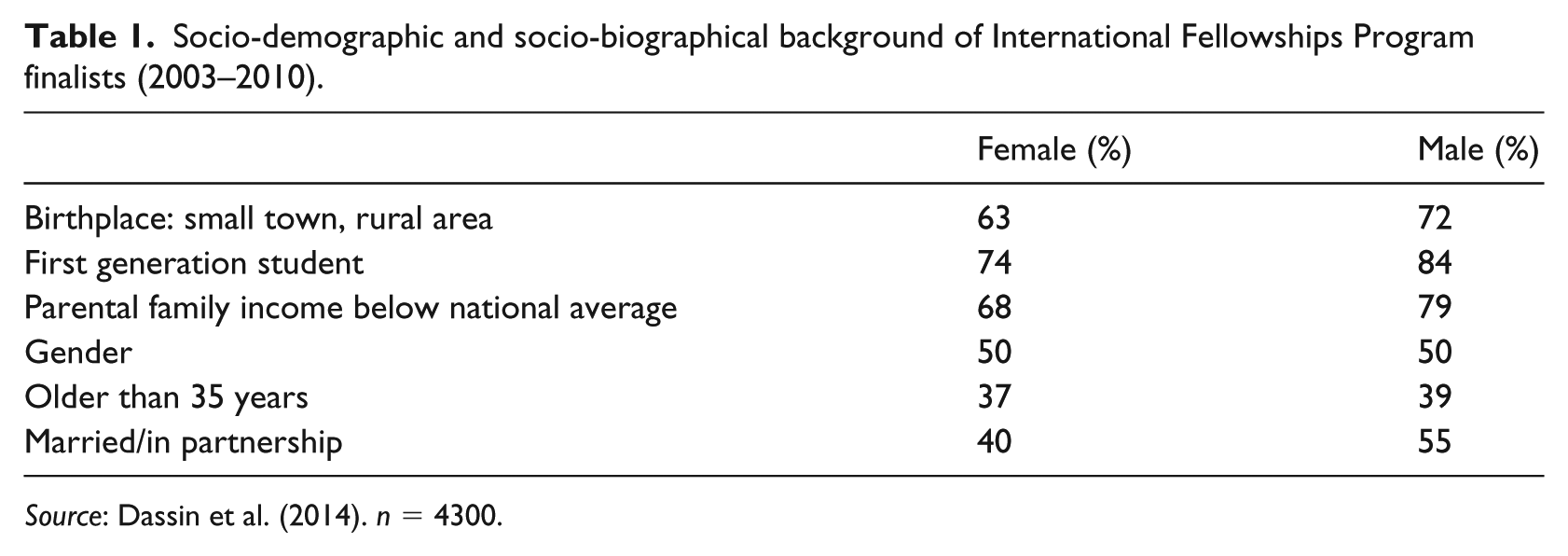
Source: Dassin et al. (2014). n = 4300.
Of the IFP selection processes held between 2001 and 2010, the program had awarded approximately 4300 fellowships, in which 82% of the fellows studied Master’s and 18% studied doctoral degrees. Fellows studied in various academic fields, including arts and humanities, social and behavioral sciences, environment, health, and applied sciences. IFP allowed fellows to pursue graduate degrees either in foreign countries or in their home countries. It was reported that, on 30 June 2013, there were 4225 IFP fellows who had completed their studies at 560 universities in 46 host countries, and 187 fellows who had accomplished their degrees at 79 universities in 22 home countries (Dassin et al., 2014).
The IFP finished in 2013, when a 10-year project called “The IFP Alumni Tracking Study” was initiated by the IIE. It aims to analyze the impact of higher education scholarship programs, specifically with regard to IFP, in furthering educational access and social change. The current study was designed to investigate how IFP fellows impact social change and social justice in their home countries after they finished the fellowships. The focus is to study and unveil the evidence of the long-term impacts of IFP beyond the contribution of individual fellows.
The model of IFP for social change and social justice
The model of IFP was built upon two premises aimed to address the inquiries of access and equity in higher education, and matters of socioeconomic development and social justice in the global South (Dassin et al., 2014). The first premise is that students from marginalized groups can succeed at accomplishing graduate studies in highly competitive international programs if they are given the proper enabling conditions. This premise contests the predominant notion – many international scholarship programs mainly consider the highest grades and prior academic achievements of applicants – while IFP looked for individuals who had completed and done well in their studies despite facing serious obstacles, such as poverty, discrimination, and limited access to high quality schools. Second, IFP targeted individuals committed to development and social justice and provided them with educational opportunities that could help build their leadership potential for promoting social change and social justice.
In the implementation, IFP was committed to be flexible following the national and local contexts of its country recipients and to prioritize inclusiveness in program design (Zurbuchen, 2009). In South Africa, for example, considering the history of the politics of apartheid in the country, IFP committees were focused on recruiting applicants with disadvantages based on geographic location, race, gender, and disability (Hassim, 2009). IFP emphasized more on building partnerships with local higher education institutions and high levels of transparency during the implementation in Nigeria; it is a lesson learned from the government scholarship programs that lacked transparency and deeply inefficient implementation standards despite their goal to provide equal educational opportunities among indigent, handicapped, and other less privileged students (Akpan and Akinyoade, 2009). Indigenous population became the focus of IFP in Mexico, Guatemala and Brazil (Navarrete and Acevedo, 2009; Silvério, 2009), and caste-based discrimination was the IFP focus in India (Devy, 2009). Defining the target groups of IFP can be considered a complex and multi-level process, involving ongoing reflection within countries and on regional and sub-regional meetings (Enders, 2012).
Human capability approach
The human capability approach was an alternative conceptual model offered by Amartya Sen (1992 and 1999). It is argued that human capabilities can provide more detailed insights in exploring social-justice related issues and human rights, rather than considering human as a utility to achieve development goals shown in the number of economic values. This approach is also further developed by Nussbaum (2003) who contends that the human capability approach can help construct a normative conception of social justice with a specifically definite set of capabilities. It is an outline suggested for moving beyond the human capital approach and as a critique on understanding legal rights to education that have underlain educational policies for decades. Sen explains: The idea of ‘capability’ (i.e. the opportunity to achieve valuable combinations of human functionings—what a person is able to do or be) can be very helpful in understanding the opportunity aspect of freedom and human rights. Indeed, even though the concept of opportunity is often invoked, it does require considerable elaboration, and capability can help in this elucidation. For example, seeing opportunity in terms of capability allows us to distinguish appropriately between (i) whether a person is actually able to do things she would value doing, and (ii) whether she possesses the means or instruments or permissions to pursue what she would like to do (her actual ability to do that pursuing may depend on many contingent circumstances). (Sen, 2005: 153)
The human capability approach allows us to capture the situation that although two persons may have the same set of means, they may have very different substantial opportunities. A disabled person, for instance, can do far less than an able-bodied person can, regardless of their same levels of income and number of primary goods. In this instance, the disabled person cannot be said to have equal advantages and the same opportunities as the person without any physical handicap (Sen, 2005). It is understood that an individual’s capability set will be contingent on personal characteristics, such as rurality, disability, ethnicity, gender, sexual orientation, and the broader social relations of power and inequality that can potentially create disadvantages (Tikly and Barrett, 2011). The understanding of capabilities in such a way permits the assessment of equality of opportunity, instead of simply looking at access to resources of equality of outcomes.
Saito (2003) synthesizes that the human capability approach is about freedom and capabilities. The word “freedom” here should be defined as the range of options owned by an individual in deciding what kind of a life he wants to live in (Drèze and Sen, 1995), while a capability is the ability to achieve freedom in the positive sense (Sen, 1997). Then, there are concepts of agency and functioning. Agency is characterized by an individual’s ability to pursue goals that are valued and are considered important for the life of the individual, whereas functioning refers to an achievement, related to diverse aspects of living conditions (Lozano et al., 2012). These three concepts, functioning, capabilities, and agency, are very important in the human capability approach and are explained in the following section.
Functioning, capabilities, and agency
Functioning
The concept of functioning is defined as “the various things a person may value doing or being” (Sen, 1999: 75). Functionings simply refer to the valuable activities and states that constitute people’s well-being, for example being safe, being educated, having a healthy body, having a good job, or being able to visit loved ones (Alkire and Deneulin, 2009). Once a person is able to perform a set of functionings, it is considered that he or she has faced a number of possibilities and has decided to function with regards to the most appropriate possibilities for their well-being (Lozano et al., 2012). Functionings are associated to goods and income; nonetheless, they depict what a person is able to do or be as a result. Functionings are also about aspects of human fulfilment that include fromthe fulfilment of basic needs, such as food, clothes, literacy, etc., to the fulfilment of complex needs, such as being able to play electric guitar, being able to eat caviar, and so forth. These basic and complex functionings, then, create different dimensions of life that focus on certain themes, such as survival, work, relationships, empowerment, or self-expression. The concept of functionings sets is one aspect in the human capability approach that distinguishes it from other approaches with regards to the evaluation of well-being (Alkire, 2005).
Capabilities
The concept of capabilities refers to the substantive freedoms that a person enjoys and the kind of life she or he has reason to value (Sen, 1999). The range of options that a person can choose from to live a kind of life she or he wishes to lead is called freedom (Sen, 1992). The idea of capability means “the opportunity to achieve valuable combinations of human functionings – what a person is able to do or be” (Sen, 2005: 153). Basically, capabilities are a sort of opportunity freedom (Alkire and Deneulin, 2009). As an illustration, a person with US$1000 in their pocket can buy many more different things compared to a person with US$100 in their pocket. This means that the first person could have more capabilities than the second person, because she or he could enjoy more different things, activities, or even pursuits. Capabilities involve only possibilities that a person really values; thus, activities or states that a person does not value or have reason to value could not be considered capabilities.
Agency
The concept of human agency in the human capability approach refers to a person’s ability to pursue and realize goals in line with his or her conception of the good (Sen, 1985). An agent is defined as someone who acts and brings about change (Sen, 1999). Alkire and Deneulin (2009), elaborate that a person who is forced, oppressed, or passive cannot be considered an agent. Agency can be linked to other approaches, such as stress, self-determination, autonomy, authentic self-direction, self-reliance, empowerment, voice, and so forth. It focuses on the development processes fostering participation, public debate, and democratic practice. However, in Sen’s account of agency, agency is considered plural in both concept and measurement (Alkire and Deneulin, 2009). Agency follows the goals that a person values and has reason to value. It is not only focused on individual agency, but also on what a person can do as a member of a group. The exercise of agency can be linked to advancing well-being or addressing other important goals for the sake of one’s family, community, or other people. A person who harms or humiliates others would not be considered exerting agency. The evaluation of a human agency should consider the agent’s responsibility in the related state of affairs (Alkire, 2005).
Conceptual framework
To conceptualize the present study, the following framework was employed.
Capabilities
Terzi (2007) argues that the capability to be educated, in terms of real opportunities including formal schooling and informal learning, can be considered a capability in two ways: (a) the absence or lack of such opportunities would essentially harm and disadvantage the individual; and (b) the capability to be educated plays an important role in the expansion of other capabilities; therefore, it is fundamental and a foundation to the capabilities needed for well-being and leading a good life. Terzi provides a list of basic capabilities for education, which involves literacy, numeracy, sociality and participation, learning dispositions, physical activities, science and technology, and practical reason. This list was used as a reference in determining the appropriate variables of measurement for capabilities in this study.
Functionings
Flores-Crespo (2007) contends that despite the key role of education in expanding human capabilities, a list of frameworks is required as a guideline for the sake of research methodology. By following Nussbaum’s list of central capabilities and Sen’s two instrumental freedoms, Flores-Crespo develops a list of seven functionings for university graduates, which fits the context of IFP fellows in this study – all IFP fellows graduated from university after the fellowship. The list consists of the assessment of personal achievement (“being”) and professional achievement (“doing”).
Human agency
Alkire (2005) elaborates two approaches that can be used to measure human agency, including self-efficacy and self-determination. The current study specifically focuses on self-efficacy rather than self-determination, given that “the human agency” of interest involves personal and collective agency. However, it avoids detailed discussions about the self-efficacy approach; instead, it is only interested in measuring human agency by looking at the appropriate elements of self-efficacy. Measures of people’s perceived self-efficacy are concerned with people’s belief in their capabilities to mobilize the motivation, cognitive resources, and courses of action needed to exercise control over given events (Ozer and Bandura in Alkire, 2005).
Social justice
The term “social justice” has increasingly been used by education scholars in their work, embedded in their missions and programs, such as education reform proposal, teacher education program, scholarship program, etc.; however, defining social justice in practical terms can be challenging as it varies pertaining to the actual context it refers to (Choules, 2007; Hytten and Bettez, 2011). Therefore, in the current study, the definition of social justice is specifically referred to IFP’s goal, which is providing access to higher education for exceptional and socially committed individuals from underrepresented groups who would normally not have the opportunity for graduate study because of some reasons, such as geographic isolation, discrimination based on gender, ethnicity, physical disability, or family poverty. In addition, Walker, in framing social justice in education, argues, “In a class-stratified society widening participation is a matter of justice; it ‘speaks’ to the ethical as much as the economic purposes of higher education” (Walker, 2006: 171); the IFP’s goal speaks of social justice, which is to address access and equity in higher education.
Research hypotheses
Background in this context refers to fellows’ experiences of social injustices, future goals beyond their IFP fellowship, success of choices, gender, family income, life satisfaction, and freedom of choice and control of personal life. This hypothesis seeks to examine the very foundational rationale behind the creation of IFP, saying that, “…. if talented individuals from underserved populations with demonstrated academic potential and social commitment were provided with advanced study opportunities, they would contribute to furthering social justice in their home communities and beyond” (Martel and Bhandari, 2016: 13).
The second hypothesis is focused on three constructs built upon the human capability approach from Amartya Sen (1992 and 1999). The purpose of H2 (a) and H2 (b) is to see if the constructs based on the propositions of the human capability approach are linked and show significant relationships with IFP fellows’ impacts on social justice in their home country.
Methods
This study employs a quantitative research design using the data of IFP alumni in 2012 and some background information from the data of IFP fellows collected in 2003, 2004, 2006, and 2007. The data of IFP alumni were collected by the Center for Higher Education Policy Studies (CHEPS). They were obtained in August 2016 through the IFP archive data at Columbia University. The data contain different surveys among IFP alumni in 22 countries’ recipients, conducted in 2007, 2008, 2011, and 2012. As explained in the codebook, the datasets involve all IFP alumni whose fellowship had been ending at least six months before the beginning of the survey, except for the 2008 survey. The participants in the 2008 survey could involve those IFP alumni whose fellowship had been ending from six to eighteen months prior to the start of the survey distribution. This means that all the participants in these surveys are IFP alumni and such a circumstance meets the purpose of the study. Nevertheless, CHEPS explains that because of the organization of the surveys some IFP alumni might have participated up to four times in these IFP alumni surveys. Also, there are several different items among the surveys. Hence, to avoid any confusion in data analysis and data interpretation, only the data of IFP alumni in 2012 are utilized in this study.
The present study also utilizes some background information of IFP fellows collected by CHEPS in 2003, 2004, 2005, and 2006. The background information is taken from the IFP fellows’ data since it provides much deeper information about IFP fellows and will be very useful for examining the first hypothesis in this study. Nonetheless, it is only the data of the participants in the 2012 IFP alumni survey that will be used in this study. To sort out the data, IFP identifications (IDs) attached to all IFP fellows are applied to find the same participants in the 2012 IFP alumni data and in the IFP fellows’ data. Thus, the data resulting from this match are not as many as the original data because the participants who did not participate in the IFP fellows’ data or in the 2012 IFP alumni data are not included.
Instruments
The instrument used to collect the data is a survey questionnaire. The questionnaire consists of 4 sections, comprising contact information/personal inventory (eight items), study related to IFP fellowship (16 items), alumni activities (five items), and current situation (25 items). The contact information includes questions of IFP ID number, family name, given name, home country, email address, gender, marital status, and the number of children/dependents. The items of study related to IFP fellowship include questions about the beginning of study program, the obtained degree, plan to earn degree, end of fellowship, field of study, host country, host institution, the kind of degree, evaluation of study program, program preferences, recommendation, pre-academic training, evaluation of experience and outcomes of IFP fellowship, established contact, and the ways contact was established. For alumni activities, the items consist of questions about establishing contact with other IFP alumni, with whom the participants established contact, how the participants established contact, participation in alumni activities, and specific alumni activities.
The section on current situation has questions about the place where the participants are currently living, studying/completing an additional further degree, the country where the participants studied or are currently studying, type of degree the participants have obtained, financial resources of further degree, the participants current main activity, position, the types of organization the participants are currently working in, the place where the participants are currently working, position at work, leadership position, community service, specific relation of the participants’ current position, activities performed in the participants’ current position, voluntary activities, leadership position, areas of voluntary work, activities in voluntary work, problems after IFP fellowship, authority and responsibility, application of gained knowledge during fellowship, impact of work on social justice, impact of work on social justice in specific areas, knowledge about impact, and intention to stay in their home country or live overseas.
The 2012 surveys were distributed in spring 2012. The samples were all IFP alumni finishing their fellowship before the end of December 2011. The number of questionnaires sent out was 3245 and the number of received questionnaires was 1792. According to the standards described by Bartlett et al. (2001), this response has fulfilled the minimum returned sample size and is acceptable for this kind of study.
Independent variables (IVs)
Fellows’ experiences of social injustices
IThis variable is assessed by asking the IFP fellows about their experiences of social injustice because of caste, ethnicity, gender, political discrimination, poverty, race, religion, living in a politically unstable region, living in a remote/rural area, sexual orientation, and violence/war. The examples of the questionnaire items are “I am currently experiencing social injustice due to caste,” “I am currently experiencing social injustice due to ethnicity,” “I am currently experiencing social injustice due to gender,” and so forth. The responses range from 1 to 5, where “1” = “Not at all” and “5” = “Very much.” The Cronbach’s alpha is 0.944, which shows very high internal consistency.
Future goals after IFP fellowship
This variable consists of 14 items in the IFP fellows surveys, designed to know the fellows’ future goals after the fellowship. The items, for example, are “Live and work in my home community,” “Live and work in my home country,” “Live and work in another country,” “Work in a non-governmental organization,” and so forth. The provided responses range from 1 to 6, where “1” = “Low priority,” “5” = “High priority,” and “6” = “I don’t know.” The Cronbach’s alpha is 0.883, which shows very high internal consistency.
Success of choices
This variable is evaluated by asking the fellows about how successful they feel about their educational, professional, and social action choices. The items are “I consider my educational choices are successful,” “I consider my professional choices are successful,” and “I consider my social action choices are successful.” The provided options are from 1 to 5, where “1” indicates “Not at all,” and “5” indicates “Very much.” The Cronbach’s alpha is 0.745, which shows high internal consistency.
Life satisfaction
This variable is assessed by asking the IFP fellows a question “All things considered, how satisfied are you with your life as a whole these days?” The options range from 1 to 5, where “1” = “Not at all satisfied” and “5” = “Very satisfied.”
Freedom of choice and control of personal life
This variable is evaluated by asking the IFP fellows a question “Some people feel they have completely free choice and control over their lives, while other people feel that what they do has no real effect on what happens to them. Please, indicate how much freedom of choice and control you have over the way your life turns out?” The choices range from 1 to 5, where “1” = “No freedom” and “5” = “Very much freedom.”
Gender
The gender variable is assessed by asking the respondents “Please, indicate your gender.” The options provided to these items are “female” and “male.” In this study, the gender variable is computed into a dummy variable, which will be useful for the regression analysis (Suits, 1957). The values were recoded into “female” = “1” and “0” = “male.”
Literacy
This variable is evaluated by looking at the responses on the evaluation of the study program that the IFP fellows undertook during the fellowship. The items are “The study program provides quality teaching,” “The study program provides training in research methods,” and “The study program provides academic support for thesis/dissertation.” Responses range from 1 to 5, in which “1” means “Poor” and “5” means “Excellent.” The Cronbach’s alpha is 0.773, which shows high internal consistency.
Learning disposition
Three items were created to assess the learning disposition. The items include “The experience of IFP fellowship builds skills for scientific work,” “The experience of IFP fellowship builds intercultural competencies,” and “The experience of IFP fellowship builds my academic reputation.” Fellows responded to the scales from 1 to 5, where “1” indicates “Strongly disagree” and “5” indicates “Strongly agree.” The Cronbach’s alpha is 0.894, which shows very high internal consistency.
Science and technology
This variable explores fellows’ experiences with the development of computer and social and communication skills through the educational opportunities provided by IFP. Fellows responded to two items provided in the survey, consisting of “The experience of IFP fellowship develops computer skills” and “The experience of IFP Fellowship develops social and communication skills.” The options are from 1 to 5, where “1” = “Strongly disagree” and “5” = “Strongly agree.” The Cronbach’s alpha is 0.702, which displays high internal consistency.
Personal achievement “being”
Two items were used to assess this variable, including “I have more authority and responsibility than I had before within my professional activities” and “I have more authority and responsibility than I had before within my voluntary activities.” Responses range from 1 to 5, in which “1” represents “Strongly disagree” and “5” represents “Strongly agree.” The Cronbach’s alpha is 0.813, which displays high internal consistency.
Professional achievement “doing”
This variable is evaluated by using two items, which are “I can apply the knowledge gained in my professional activities” and “I can apply the knowledge gained in my voluntary activities.” The provided options are from 1 to 5, where “1” = “Not at all” and “5” = “To a very high extent.” The Cronbach’s alpha is 0.735, which shows high internal consistency.
Current paid work
Fourteen items were created to find out about fellows’ current paid work. The items involve various areas, such as arts and culture, children, youth, and family, community development, education, environmental issues, gender issues, health care, human rights, international cooperation, literacy, media, religion, sexuality and reproductive health, and workforce development. The examples of the items are “My current position is specifically related to arts and culture,” “My current position is specifically related to children, youth, and family,” “My current position is specifically related to community development,” and so forth. Responses are selected and not selected, where “0” indicates “Not selected” and “1” indicates “Selected.” The Cronbach’s alpha is 0.745, which expresses high internal consistency.
Current paid work activity
This variable assesses the specific paid work activity done by the IFP fellows. The items involve “Within my current position, I perform coalition-building,” “Within my current position, I perform information gathering/ research,” “Within my current position, I perform networking,” “Within my current position, I provide training,” “Within my current position, I raise funds,” “Within my current position, I perform strategy development,” and “Within my current position, I write policies.” Responses are selected and not selected, where “0” indicates “Not selected” and “1” indicates “Selected.” The Cronbach’s alpha is 0.786, which expresses high internal consistency.
Current voluntary work
This variable evaluates the IFP fellows’ current voluntary work that involves arts and culture, children, youth, and family, community development, education, environmental issues, gender issues, health care, human rights, international cooperation, literacy, media, religion, sexuality and reproductive health, and workforce development. Fellows responded to the applicable choices that were coded “0” = “Not selected” and “1” = “Selected.” The Cronbach’s alpha is 0.747, which expresses high internal consistency.
Current voluntary work activity
This variable looks for the specific voluntary work activity done by the IFP fellows. The items include “Within my current position, I perform coalition-building,” “Within my current position, I perform information gathering/ research,” “Within my current position, I perform networking,” “Within my current position, I provide training,” “Within my current position, I raise funds,” “Within my current position, I perform strategy development,” and “Within my current position, I write policies.” Responses are selected and not selected, where “0” indicates “Not selected” and “1” indicates “Selected.” The Cronbach’s alpha is 0.799, which shows high internal consistency.
Dependent variables
Fellows’ impacts on social justice
This variable assesses fellows’ impacts on social justice in general and in specific areas, such as academic field, home country, home region/community, employment organization, volunteering organization, governmental policies, and non-governmental policies. The examples of the items are “The impact of my professional and/ or voluntary work in general is strong,” “The impact of my professional and/or voluntary work on social justice in my academic field is strong,” “The impact of my professional and/or voluntary work on social justice in my home country is strong,” and so forth. The provided responses range from 1 to 5, in which “1” represents “Not at all strong” and “5” represents “Very strong.” The Cronbach’s alpha is 0.891, which displays very high internal consistency.
Fellows’ understanding and commitment on social justice
Three items were created to know how the fellowship has improved fellows’ understanding and commitment on social justice. The items are “I understand what is needed to improve the situation in my home country/community,” “The experience of IFP fellowship strengthens my commitment to social justice,” and “The study program is useful for my personal development.” The choices range from 1 to 5, in which “1’ = “Strongly disagree” and “5” = “Strongly agree.” The Cronbach’s alpha is 0.729, which expresses high internal consistency.
Fellows’ leadership skills on social justice
This variable was evaluated by using two items, which are “The study program is useful for developing my social and communication/ leadership skills” and “The study program is useful for developing social justice leadership competencies.” Responses are from 1 to 5, where “1” = “Poor” and “5” = “Excellent.” The Cronbach’s alpha is 0.800, which shows high internal consistency.
Control variables
Number of children/dependents
This variable is assessed by the question “Do you have children/other dependents?” The responses include “Yes, I have children/dependents” and “No, I don’t have children/dependents,” recoded into “Yes” = “1” and ‘No” = “0.”
Problems after finishing study
This variable is assessed by the question “Did you have problems with any of the following matters after your IFP fellowship ended?” This question consists of seven items, including “Readjusting to life in my home country,” “Finding an adequate job,” “High expectations of family/people around me,” “Reconnecting to old relationships,” “Applying/implementing the knowledge gained,” “Becoming recognized as a professional,” and “Realizing plans I made before/during my fellowship.” The provided responses were scaled from 0–5, where “0” indicates “Not applicable/not at all,” and “5” indicates “Very serious.” The Cronbach’s alpha is 0.859, which expresses high internal consistency.
Model illustration and statistical technique
Model 1 addresses the first hypothesis
The first model was examined by using path analysis. The rationale behind the selection of path analysis is that path analysis is basically an extension of the regression model, employed to examine the fit of the correlation matrix against two or more causal models that are being compared (Garson, 2008). Since the first model does not have any latent constructs, path analysis is considered the most appropriate method to see the relationships between IFP fellows’ background and their impacts on social justice. Nevertheless, as this path analysis is only used for testing the first hypothesis, it does not look for any mediation within the model.
Model 2 addresses the second hypothesis
Confirmatory factor analysis (CFA) was used to test the second hypothesis. CFA is considered the appropriate statistical technique to test the second hypothesis because it examines the extent of interrelationships and covariation among the latent constructs (Schreiber et al., 2006). In addition, Mueller et al. (2001) contend, “CFA allows for the assessment of fit between observed data and an a priori conceptualized, theoretically grounded model that specifies the hypothesized causal relations between latent factors and their observed indicator variables.” In the present study, the latent constructs include capabilities, functionings, and human agencies as conceptualized by the human capability approach. The purposes are to find out the interrelations among the three human capability approach constructs on social justice and to examine the fitness of the proposed structural equation model based on the human capability approach.
The model fit assessment in this study used three indices, including root mean square error of approximation (RMSEA), Tucker–Lewis index (TLI), and comparative fit index (CFI). The selection of these indices was based on a study by Jackson et al. (2009) who reviewed research articles using CAFA published between 1996 and 2006. They found that most of the researchers used RMSEA, TLI, and CFI to assess the model fit with the cut offs for RMSEA (0.06), TLI (⩾ 0.95), and CFI (⩾ 0.95). CFI compares the improvement of the fit of the proposed structural model over a more restricted model, while RMSEA corrects for a model’s complexity (Weston and Gore, 2006). TLI can be accepted for model fit if the value is ⩾ 0.95 (Schreiber et al., 2006).
Results
Hypothesis 1
The results of the analysis show that among the eight IVs, only success of choices was positively related to fellows’ leadership skills on social justice (β = 0.19, p < 0.01). The model explains 44% of the variance in social justice. The slope of the line indicates that social justice is likely to increase by 0.2 for every one unit increase in success of choice (B = 0.20, standard error (SE) = 0.07, p = 0.004). The indices of the model fits display a just identified model because the Chi-square value and degree of freedom were 0 (p < 0.001), with RMSEA < 0.001, TLI = 1, CFI = 1. The total of the observations is 241 and the number of free parameters is 10. The results are illustrated in Figure 1.
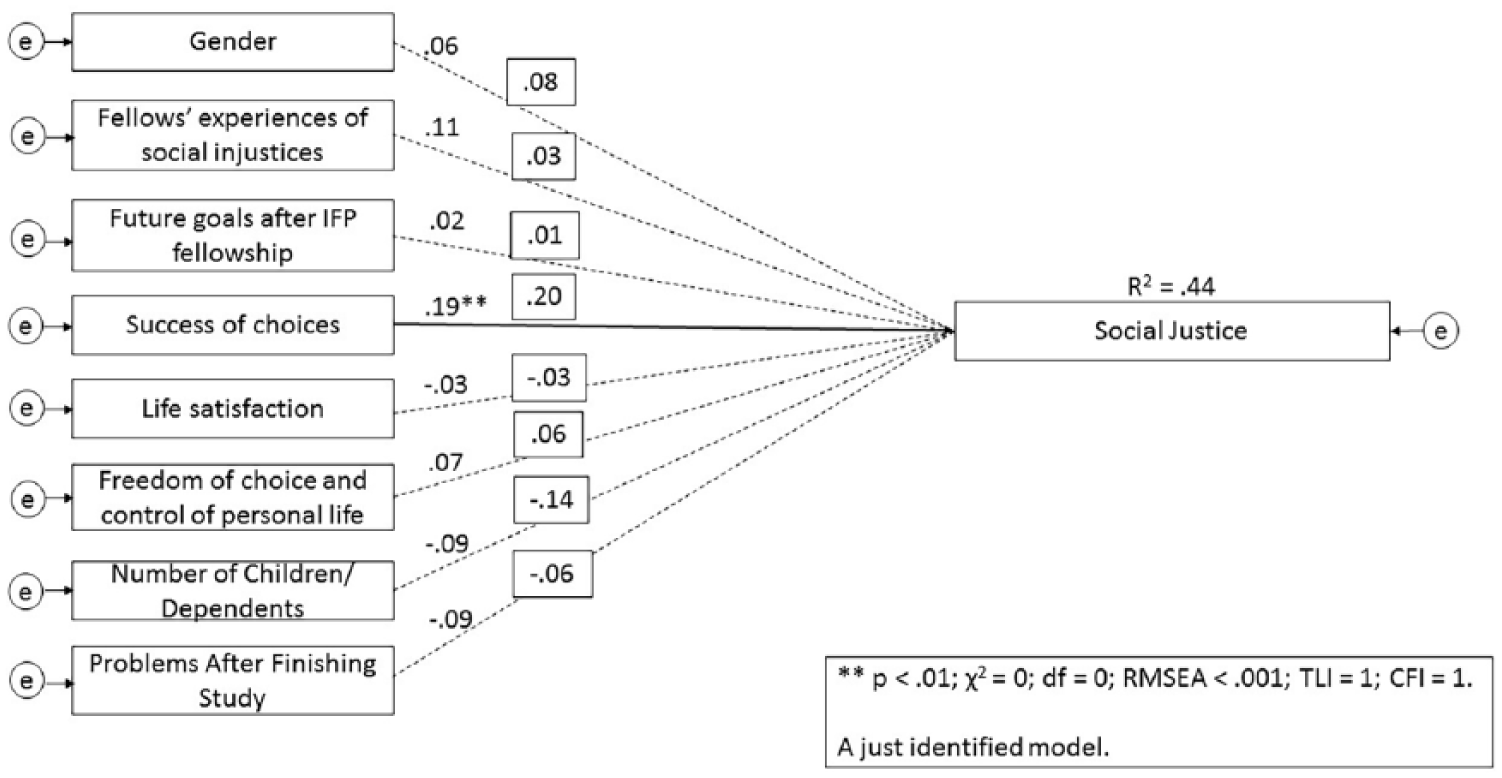
The illustration of the path analysis results for hypothesis 1.
Hypothesis 2
The relationship results
Three relationships were analyzed at this stage, which consisted of the relationship between the observed variables (OVs) and latent constructs, the relationships among the latent constructs, and the relationship between the latent constructs and social justice. On the first relationship, the OVs including literacy, learning disposition, and science and technology were significantly related to the latent construct capabilities. Of the three observed variables, learning disposition had the strongest relationship with capabilities (β = 0.89, SE = 0.01, p < 0.001), followed by science and technology (β = 0.88, SE = 0.01, p < 0.001), and literacy (β = 0.26, SE = 0.02, p < 0.001). These results showed that literacy, learning disposition, and science and technology statistically predict the set of capabilities to be educated that were received by IFP fellows during the fellowship. In addition, the model results for unstandardized regression coefficients depicted that the set of capabilities would increase by 0.19, 0.95, and 0.92 in every one unit increase in literacy, learning disposition, and science and technology, respectively.
The OVs involving personal achievement (beings) and professional achievement (doings) were positively related to the latent construct functionings. The variable professional achievement (doings) had a stronger relationship with functionings (β = 0.71, SE = 0.02, p < 0.001) than personal achievement (beings) (β = 0.60, SE = 0.02, p < 0.001). These results statistically predict that every one unit increase in personal and professional achievement would increase the set of IFP fellows’ functionings by 0.68 and 0.61, respectively. In other words, the more IFP fellows obtained personal and professional achievement, the more they would function with the set of human capabilities that they received from their IFP fellowship.
The other four OVs including perceived personal efficacy: current paid work, perceived personal efficacy: current paid work activity, individual social efficacy: current voluntary work, and individual social efficacy: current voluntary work activity were positively related to the latent construct human agencies. The results of the analysis revealed that perceived personal efficacy: current paid work activity had a stronger relationship with IFP fellows’ practiced human agencies (β = 0.59, SE = 0.05, p < 0.001) than perceived personal efficacy: current paid work (β = 0.48, SE = 0.04, p < 0.001), while individual social efficacy: current voluntary work activity showed a stronger relationship with IFP fellows’ practiced human agencies (β = 0.66, SE = 0.05, p < 0.001) than individual social efficacy: voluntary work (β = 0.58, SE = 0.05, p < 0.001). From these results, it was predicted that IFP fellows would likely increase their practiced human agencies by 0.16 in every one unit increase in their perceived personal efficacy: current paid work activity; the increase would be by 0.15, 0.08, and 0.07 in every one unit increase in their individual social efficacy: current voluntary work, individual social efficacy: current voluntary work, and perceived personal efficacy: current paid work, respectively. Table 2 provides the details of the factor loadings.
Factor loadings for the relationships between the observed variables (OVs) and latent constructs.
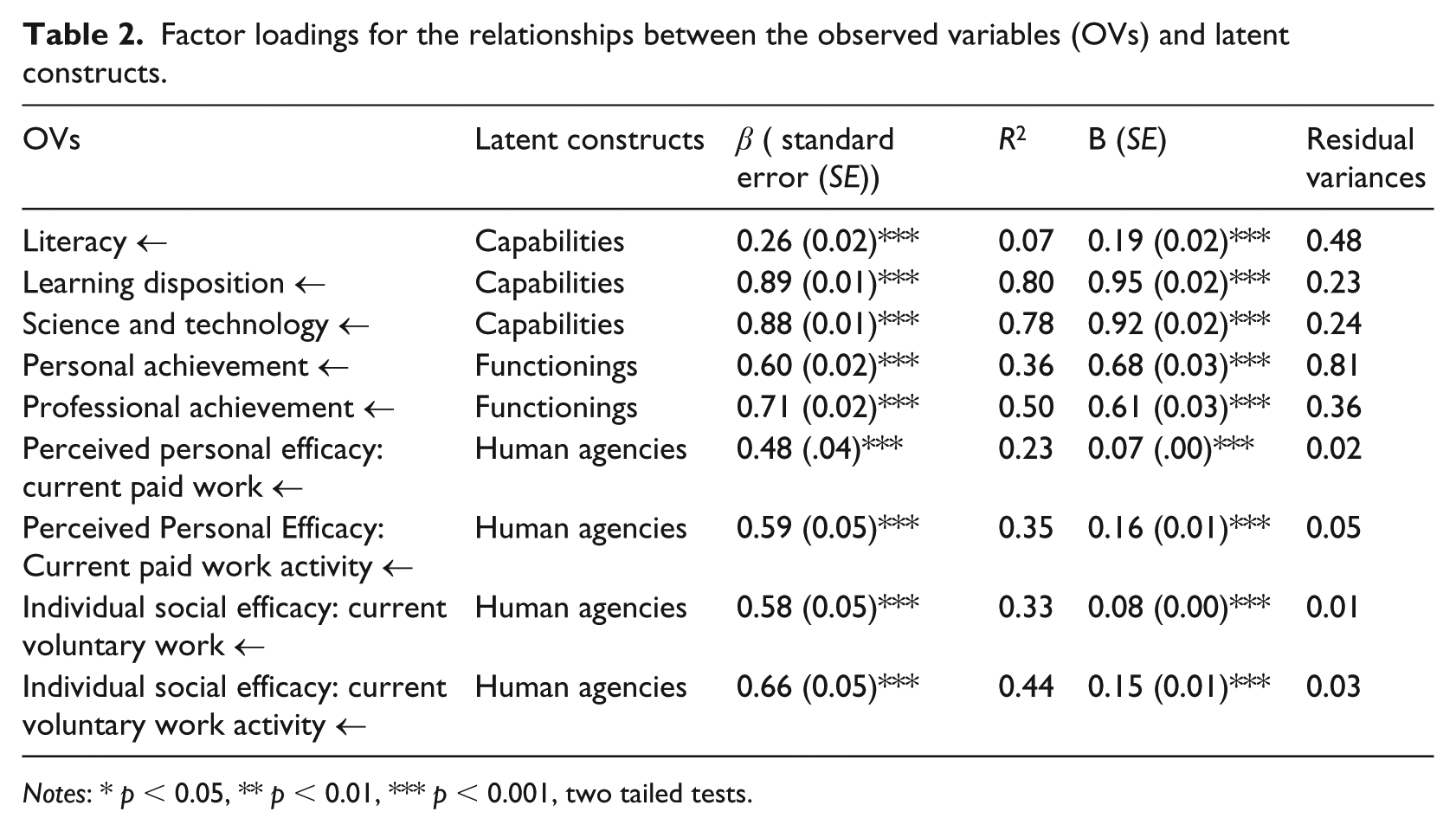
Notes: * p < 0.05, ** p < 0.01, *** p < 0.001, two tailed tests.
On the relationship among the latent constructs, the analysis showed that the three factors involving capabilities, functionings, and human agencies were positively related. Human agencies had a stronger relationship with functionings (β = 0.03, SE = 0.04, p < 0.001) than capabilities with functionings (β = 0.27, SE = 0.03, p < 0.001).
Furthermore, the last analysis was about how the latent constructs predict social justice. It was obtained that human agencies were not significantly related to social justice, but capabilities and functionings were. Capabilities had a stronger relationship with social justice (β = 0.70, SE = 0.02, p < 0.001) than functionings (β = 0.42, SE = 0.02, p < 0.001). Every one unit increase in capabilities and functionings predicts the increase by 0.47 and 0.28, respectively, in social justice. Table 3 shows the factor loadings among human capability approach constructs and with social justice.
Factor loadings for the relationships among the latent constructs and between the latent constructs and the outcome variable.
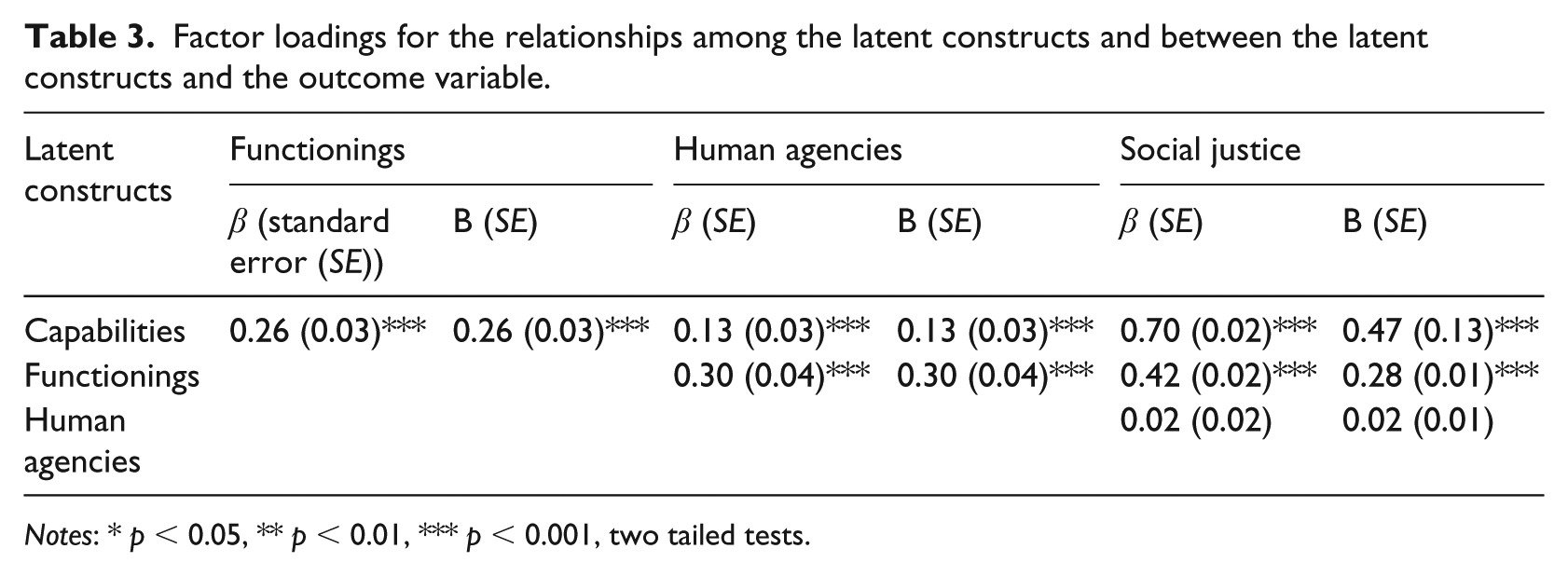
Notes: * p < 0.05, ** p < 0.01, *** p < 0.001, two tailed tests.
Model fit assessment
The results of the analysis revealed that the value of Chi-square of model fit was 247.343 (df = 27, p < 0.001), while the value of Chi-square of model fit for the baseline model was 7560.733 (df = 25, p < 0.001). As the sample size is big, the result of the Chi-square tends to be significant (Kline, 1998); thus, other indices for model fit were assessed. The estimate value for RMSEA was 0.07, which was decent, given that the accepted value is < 0.08 with confidence interval (Schreiber et al., 2006). The results for TLI and CFI were great at 0.95 and 0.97, respectively. The number of observations was 1794 and number of free parameters was 38. These results indicated that the proposed structural model was theoretically sound and explained the data well. The model significantly explains 83% of the variability in fellows’ impacts on social justice (R2 = 0.83, SE = 0.01, p < 0.001). Figure 2 shows the structural equation model with the values for each observed variable and latent construct.
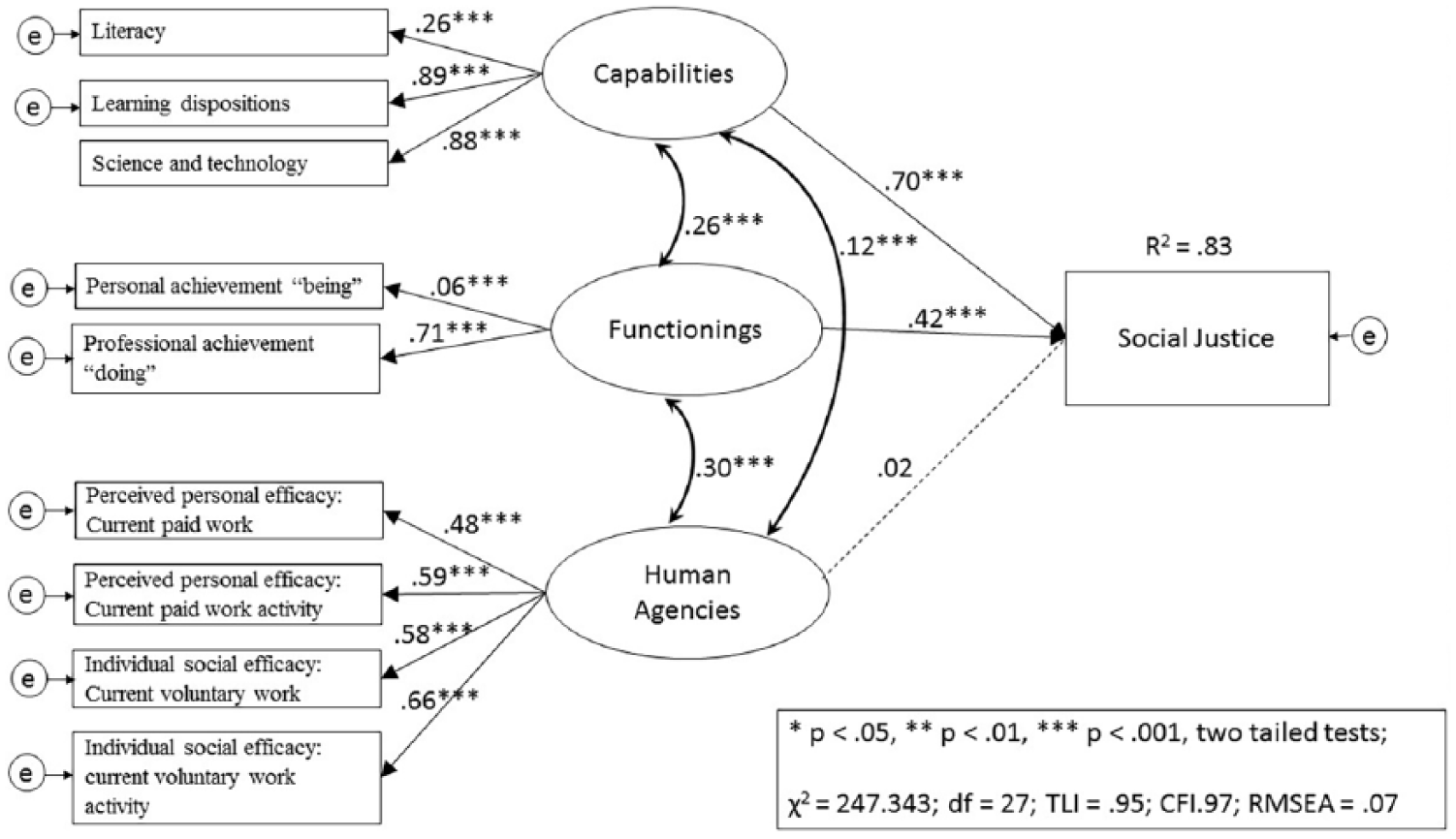
The summary of the proposed structural equation model built upon the human capability approach.
Discussion
The quantitative results of the analyses do not fully support the first hypothesis since it is only one variable, success of choices, in the IFP fellows’ backgrounds that was positively related to fellows’ impacts on social justice. This suggests that albeit the creation of IFP was based on the rationale, “…. if talented individuals from underserved populations with demonstrated academic potential and social commitment were provided with advanced study opportunities, they would contribute to furthering social justice in their home communities and beyond” (Martel and Bhandari, 2016: 13), the path analysis results in this study did not show that IFP fellows’ backgrounds fully predict IFP fellows’ impacts on social justice in their home country.
Success of choices is the variable to evaluate how successful fellows feel about their educational, professional, and social action choices. Previous studies on how scholarship impacts recipients’ personal and professional development suggest a positive relationship. The studies include the impact of a Fulbright Scholarship on Turkish scholars personally, professionally, and socially (Demir et al., 2000), the impact of Fulbright cross-cultural educational programs on professional knowledge and status of the participants (Borgia et al., 2007), and positive perceptions of the Fulbright experience on professional development (Sunal and Sunal, 1991). Thus, the finding of this study is consistent with the previous empirical studies.
Furthermore, the results of the quantitative data analyses confirm three relationships. First, the relationships between the OVs and the human capability approach latent constructs were positive and had statistical significance. Specifically, in the latent construct capabilities, the OVs literacy, learning disposition, and science and technology were significantly related to capabilities. These results indicate that IFP fellows have the substantive freedom to enjoy the kind of life they have reason to value (Sen, 1999). The types of capabilities that they received from the fellowship experience are the range of options which they can choose from to live in a kind of life s/he wishes to lead, defined as freedom (Sen, 1992). Fellows evaluated that the study program provided excellent quality of teaching, excellent training in research methods, and excellent academic support for thesis/dissertation on capabilities of literacy. The experience of IFP fellowship built skills for scientific work, intercultural competencies, and academic reputation on capabilities of learning disposition. The experience of IFP fellowship built computer skills, and social and communication skills on science and technology. These are fellows’ basic capabilities in education, and essentially, education is viewed to be the key to all human capabilities (Nussbaum, 2006). The implication of this finding is that scholarship programs should pay attention to this set of capabilities.
In the latent construct functionings, personal achievement (beings) and professional achievement (doings) were positively related to functionings. The concept of functioning is defined as “the various things a person may value doing or being” (Sen, 1999: 75). Once a person is able to perform a set of functionings, it is considered that he or she has faced a number of possibilities and has decided to function with the most appropriate possibilities for their well-being (Lozano et al., 2012). Fellows reported that they have more authority and responsibility than they had before within professional activities and voluntary activities; on professional achievement, fellows thought that they can apply the knowledge gained in professional activities and voluntary activities to a very high extent. These findings suggest the set of functionings that IFP fellows had achieved was as a result of the capabilities received from the fellowship experience.
On the last latent construct, the OVs that consisted of perceived personal efficacy: current paid work, perceived personal efficacy: current paid work activity, individual social efficacy: current voluntary work, and individual social efficacy: current voluntary work activity had statistical significance and positive relationship with human agencies. The concept of human agency refers to a person’s ability to pursue and realize goals in line with his or her conception of the good (Sen, 1985). An agent, in this case an IFP fellow, is defined as someone who acts and brings about change (Sen, 1999). From the list of fellows’ current paid work, fellows reported that their work position was mostly related to education and community development. Many fellows performed strategy development, information gathering/research, and networking. Meanwhile, fellows’ current voluntary works were related to community development and education, in which fellows provided training and technical assistance. These findings elaborate fellows’ practiced human agencies in relation to social justice.
Second, the human capability approach constructs, capabilities, functionings, and human agencies, were positively related. Human agencies had a stronger relationship with functionings than capabilities with functionings. Third, the latent constructs, capabilities and functionings, were positively related to IFP fellows’ impacts on social justice. Capabilities had a stronger relationship with IFP fellows’ impacts on social justice than functionings. Overall, the findings of the present study do not fully confirm the second hypothesis part (a). The reason is that human agencies were positively related to IFP fellows’ impacts on social justice, but did not show statistical significance. It is argued that human agencies might have become part of fellows’ background that showed socially committed individuals so that it no longer affected fellows’ decisions in contributing in their home country. On the other hand, fellows acquired a new set of capabilities that gave them options for achieved funtionings, especially on their contribution to their home country upon study completion.
The quantitative analysis results suggest that the proposed structural model was theoretically sound and explained the data well. The findings have an implication on the future model of scholarship for social justice. Scholarship programs aimed to address social change and social justice in recipients’ community/home country can adopt this conceptual model, which consists of capabilities, functionings, and human agencies. The model was built upon the human capability approach, which is relevant to well-being and freedom of people and has an indirect role through influencing social change and economic production (Saito, 2003).
The model aids us to view scholarship programs not only in the aspect of providing educational opportunities and access to higher education, but also in consideration of values and resources distribution involving gender, race, social classes, and ethnic inequalities. From the perspective of the human capability approach, it can also be interpreted that IFP had put fellows in the process of identity formation of becoming and being this kind, instead of that kind of person. As fellows learned more subjects and skills during their study, they developed knowledge and cultural understandings that eventually shaped her or him as a person that s/he wanted to be. It is also essential to advocate this model of scholarship for social justice because a focus on capabilities can help us understand what it might mean to be educated and how this relates to notions of development beyond monetary outcome measurement (Tikly and Barret, 2011). Scholarship should be seen from the angle of how it impacts well-being and freedom of people as it can indirectly influence social change and economic production.
Conclusion
Scholarship as an investment in education can be an instrument for triggering social change and addressing social justice in the home country. It will, however, require scholarship sponsors to see scholarship impact on the matter of people’s capabilities, instead of economic growth. High level of economic growth does not capture the state of condition of people in a country. Using the human capability approach model to conceptualize a scholarship program enables us to disclose what specific capabilities are developed by scholarship recipients, and how they develop capabilities and experience access to higher education and relational resources. The model of scholarship for social justice examined in the present study can offer an opportunity to look at socially committed, talented individuals from groups lacking access to higher education, which have frequently been ignored by scholarship programs for the sake of academic success.
The future practice is expected to put more emphasis on the development of human capabilities rather than economic growth. Education is the key to all human capabilities. By focusing on human capabilities, the scholarship sponsors are treating recipients as a human being instead of treating them as a means to achieve national development goals. High GNP that tends to be used to measure a country’s development shows the country’s economic growth, but it may not disclose the wealth of the citizens individually. A country development should strive internally in the level of development of its people’s capabilities. Hence, instead of leading fellows to be that kind of person that human capital purposes want to them to be, scholarship sponsors should hear out the kind of life that fellows have reason to value and help them acquire the required capabilities.
The findings of this study are limited to the Ford Foundation IFP and cannot be generalized to all types of scholarships; however, scholarship programs that have goals to stimulate social change and address social justice will find the conclusions of this study useful. It is also important to reveal that missing data exist in the examination of hypothesis 1. So, there is a possibility that the results could have been different if there were no missing data. Besides, the use of self-assessment of participants could be very subjective to the participants’ personal perspectives; therefore, future studies using different methods would be strongly recommended.
Footnotes
Acknowledgements
We thank the Rare Book and Manuscript Library, Columbia University, Institute of International Education, Center for Higher Education Policy Studies, and Ford Foundation for their supports in the accomplishment of this study. Also, we thank Professor Joan Dassin, Brandeis University, for her contribution as the external member of the first author’s dissertation committee.
Declaration of conflicting interests
The author(s) declared no potential conflicts of interest with respect to the research, authorship, and/or publication of this article.
Funding
The author(s) received no financial support for the research, authorship, and/or publication of this article.