



Abstract
The present study compares career choice motives of future early childhood educators studying for a tertiary qualification. Suitable analyses of this kind are still missing. Diverging training systems, traditions and professional images in the different countries are related to certain motives. These motives are categorised according to a theory that is used as a theoretical framework. The study takes into account 468 student teachers from Germany, Sweden, Switzerland and Romania and is methodologically based on variance analyses. Overall, intrinsic motives were found to be of greater significance. This applies equally to all countries. Furthermore, addressee-related motives are more pronounced among Swiss and German prospective early childhood educators than among those from Sweden or Romania. On the contrary, extrinsic motives have a stronger presence among Romanian student teachers. Income and prestige, as the only exceptions, are important for students from Sweden and Switzerland. The results are discussed referring to country-specific working conditions and the current status of professionalisation processes existing in problem areas.
Keywords
Introduction
The Organisation for Economic Co-operation and Development (OECD) (2014) describes the role of early childhood education with the following core messages:
• Fifteen-year-olds who had at least one year of pre-primary education tend to perform better at school.
• Early childhood education has grown alongside the increase in women working in many OECD countries, but improving access without improving the quality of these services will not ensure good results.
• Education now begins for most children in OECD countries well before they are 5 years old. In Belgium, France, Iceland, Italy, Norway, Spain and Sweden, more than 90% of 3 year olds are enrolled in early childhood education.
• More than three-quarters of 4 year olds (82%) are enrolled in early childhood education across OECD countries; the figure is 86% for OECD countries that are part of the European Union (OECD, 2014: 20).
These core messages point to the particular importance of early childhood education in the scientific and political discourse area and raise the question of how to better qualify persons working in this context. According to international studies such as Effective Provision of Pre-School Education (Sylva et al., 2003, 2004), Researching Effective Pedagogy in the Early Years (Siraj-Blatchford et al., 2002) and Study of Pedagogical Effectiveness in Early Learning (Moyles, Adams and Musgrove, 2002), the qualification level of early childhood educators is correlated with children’s positive social and cognitive development. Although we have these international studies depicting important dimensions on how to qualify staff in early childhood education, and although the training quality can be attributed a relevant role for the success of early childhood education (Sylva et al., 2003, 2004), the quality of training is quite different among the European countries (OECD, 2004). There are different traditions and structures in almost all European countries, and those traditions and structures particularly depend on whether early childhood educators receive a tertiary or a vocational training background and what percentage of educational staff holds a tertiary qualification. Especially with regard to this dimension, European countries differ significantly (Eurydice, 2014).
Different traditions, types of professionals and training systems create diverging professional images and are associated with a certain motivation to choose a profession and/or a course of study (Wigfield and Eccles, 2000). This motivation is the focus of the following article, since in the field of early childhood education there is almost no body of coherent research on career choice motivation. Only some single findings exist (Langford, 2007; Torquati, Raikes and Huddleston-Casas, 2007). Furthermore, cross-country analyses are missing, so the present study aims to identify and to compare career choice motives of future early childhood educators in the European countries Germany, Sweden, Switzerland and Romania. In this area, a number of different types of professionals are involved with the everyday care and education of children. In addition, staff performing similar roles may also have different types of job titles, making analysis of this complex area rather difficult (Eurydice, 2014). With the above in mind, the present study focusses on staff with tertiary qualifications. The comparative analysis of career choice motives is preceded by a description of the divergent elements of the professional field in the mentioned countries. The findings are discussed in the context of professionalisation and the resulting country-specific demands.
Early childhood education: Professional images and career choice
Professional images, traditions and training structures in the countries of the present study
Europe has no harmonised system in terms of professional images, educational traditions, training structures and types of professionals involved in education (Eurydice, 2014). Therefore, it is necessary here to describe the differences referring to the countries considered in the present study. The present study explicitly focusses on Germany, Switzerland, Sweden and Romania. These countries were taken into account, because, as described in the following, they are characterised by sharp contrasts: this applies for the tradition in having staff with a tertiary qualification in early childhood education as well as for framework conditions such as salary or occupational security.
In Germany, several studies have found a barely satisfactory quality in early childhood education (e.g. see NUBBEK study, Tietze et al., 2012). This unfavourable situation becomes even more dramatic when we consider the entitlement extended to for families for their children’s day care needs. This entitlement has led to an increased demand for qualified staff. Furthermore, a public debate on the importance of early childhood education (Mischo and Fröhlich-Gildhoff, 2011; Thole, 2010), per se, and on the training in this field was launched, basically demanding a more academic qualification path (Rauschenbach and Schilling, 2013). As a consequence, academic university programs have been established at some universities (Stisser et al., 2012). Nevertheless, a broad academic orientation in early childhood education is only developing slowly, and the academic tradition still is young. In practice, there are no well-defined professional images for educators with a tertiary degree or with a vocational qualification (Projektgruppe [Project Group] ÜFA, 2013). Staff members who hold academic degrees struggle for the recognition of a distinctive professional image and for better salaries. However, early childhood educators enjoy high levels of social prestige in the public’s mind (Forsa, 2013).
In Sweden, the status of early childhood educators corresponds to the status of schoolteachers; both groups are equally referred to as ‘teachers’. Early childhood education is characterised by an academic aspiration; the staff is supposed to have a tertiary qualification. Universities offer courses in early childhood education at a high academic level that comes from a long tradition. Despite the academic aspirations of the field, in practice less than 50% of teaching staff actually has a tertiary qualification. However, the high proportion of inadequately trained teachers is a fundamental problem in the Swedish school system, which raises many discussions (Skolverket [National Agency for Education], 2015a). Currently, there is an increasing shortage in early childhood educators (Bertilsson, 2014; Skolverket, 2015b). The primary reasons for this lie in the profession’s high workload, excessive bureaucratic burdens, a decreasing level of social prestige and low salaries (although salaries have risen to above average in the last few years; Medlingsinstitutet [Swedish National Mediation Office], 2015).
In Switzerland, early childhood education is a mandatory part of schooling for a period of one or two years (depending on the canton). Early childhood schools operate in a way similar to how the schools for older children do, so they are based on a standardised curriculum, have fixed learning objectives and are supposed to cooperate with other institutions, as all other schools do. The main cooperation partner is primary education: both types of institutions share a common school building; teachers in early childhood and primary education form a common body of professionals. The Swiss approach to teacher training is academically oriented: working in early childhood education requires a tertiary degree from a university of applied sciences (Leuchter, 2005; Swiss UNESCO Commission, 2014). The teachers’ professional image is well defined, and the demands are clearly specified. Due to the integration of early childhood teacher training into academic training institutions, the social prestige of the profession is continuously rising. Compared to that of other countries, incomes of Swiss early childhood educators are among the highest in the world (OECD, 2006).
In Romania, early childhood education is characterised by contrasts. It has a long tradition in the Romanian education system, and reforms carried out in the last few years have led to a significant appreciation of early childhood education (see the report for the SEEPRO project; Oberhuemer, Schreyer and Neumann, 2010). A mandatory curriculum for teaching 3- to 6-year-old children has been developed. Furthermore, the training venues for educational staff have been modified, shifting from teacher training colleges to universities, and the study courses are now combined with primary education training. The academic level in early childhood care institutions, especially for children between the ages of 3 and 6, is high; the staff members consistently hold tertiary qualifications. At least on paper, a low child–teacher ratio is intended. Additionally, special courses in teaching children from 1 to 3 years are about to be established at some universities – here, Romania is a European pioneer. This high standard is in contrast with a severe problem: a high and increasing teacher shortage. The salaries in early childhood and primary education scarcely cover the costs of living, particularly among those starting in their profession (Oberhuemer et al., 2010); this fact discourages many interested people from entering the profession.
The brief synopses of these four European countries illustrate some disparities in early childhood education. These differences are related to professional images, qualification levels, training structures and public recognition and salaries. The countries of the present study are in different stages. In this context, it is of interest whether different professional images (well-defined or not), training structures, and levels of academic rigour are reflected in career choice processes. Before investigating this question, the current research for career choice motives of future teachers is shown.
Career choice motivation in the teaching profession
Professional images and training structures refer to career choice motives, because both constitute incentives to pursue a course of study and to enter a profession (Wigfield and Eccles, 2000). Career choice motives are an internationally prominent subject for research, especially in the context of teacher education, and existing findings are continuously broadened and deepened (Watt and Richardson, 2007, 2008). In early childhood education, no comparable body of research exists; there are only some single findings (Langford, 2007; Torquati et al., 2007).
The present study, based on the Self-Determination Theory by Deci and Ryan (2000), seeks to examine career choice motives of future early childhood educators in different European countries. Deci and Ryan (2000) differentiate between intrinsic and extrinsic motivations. Significant for the differentiation are the degree of self-determination and the degree of self-perceived control by external factors. Intrinsic motivation presumes an experience of competency and a certain degree of autonomy. Extrinsic motives can be further differentiated in line with the degree of self-determination. This is illustrated below, according to results in the field of teacher education. The dimensions of the different motives described by Deci and Ryan, in our opinion, reflect the international findings on career choice motives. It is very common to group motives for entering the teaching profession into different categories, for example material versus professional reasons or extrinsic and intrinsic motives (Bastick, 2000; Kyriacou et al., 2003; Moran et al., 2001; Rinke, 2008; Watt and Richardson, 2007, 2008).
Intrinsic motives are described by two terms: ‘specialist knowledge and its mediation’ on the one hand and ‘pedagogical work with children/youths’ on the other. A strong orientation toward specialised knowledge as well as an interest in a particular subject and in scientific subject matter characterises student teachers in secondary schools (Serow, Eaker and Forrest, 1994; Sinclair, 2008). A solid foundation in subject matter is considered an important precondition for teaching, primarily in secondary schools, because they prepare pupils for university entrance qualifications or a demanding profession. A pedagogical or addressee-related motivation reflects the desire to establish a relationship with children/youth, to give them stability and to foster students with special preconditions. Altruism and idealism are named, such as ‘to fulfill students’ needs’ and ‘to support students’ growth and development’ (Liu, 2010). It seems to be important to make a contribution to society (Goh and Atputhasamy, 2001).
Extrinsic motives can be classified by the degree of the related self-determination (Deci and Ryan, 2000). Extrinsic aspects such as job security, self-directed work scheduling and compatibility of family and profession (Hobson et al., 2004; Richardson and Watt, 2006) allow a certain degree of self-determination (so-called ‘integrated regulation’). Furthermore, the impact of former teachers on a student’s decision to enter the teaching profession is acknowledged (Liu, 2010; Su, 1993). The same applies for having no other occupational perspective (‘regulation through identification’). Income and social prestige also represent career choice motives; they are a less autonomously driven form of extrinsic motivation (‘introjected regulation’). The recommendations and the advice of others, such as family members, friends or school career advisers (Manuel, 2003; Wilhelm, Dewhurst-Savellis and Parker, 2000) form the least autonomous motivation; it is due to external demands. For some of these reasons, major differences exist between European countries. These are related to country-specific working conditions and administrative frameworks (e.g. salary) (Eurydice, 2013).
The described motives are subject of the present study and are summarised in in Figure 1.
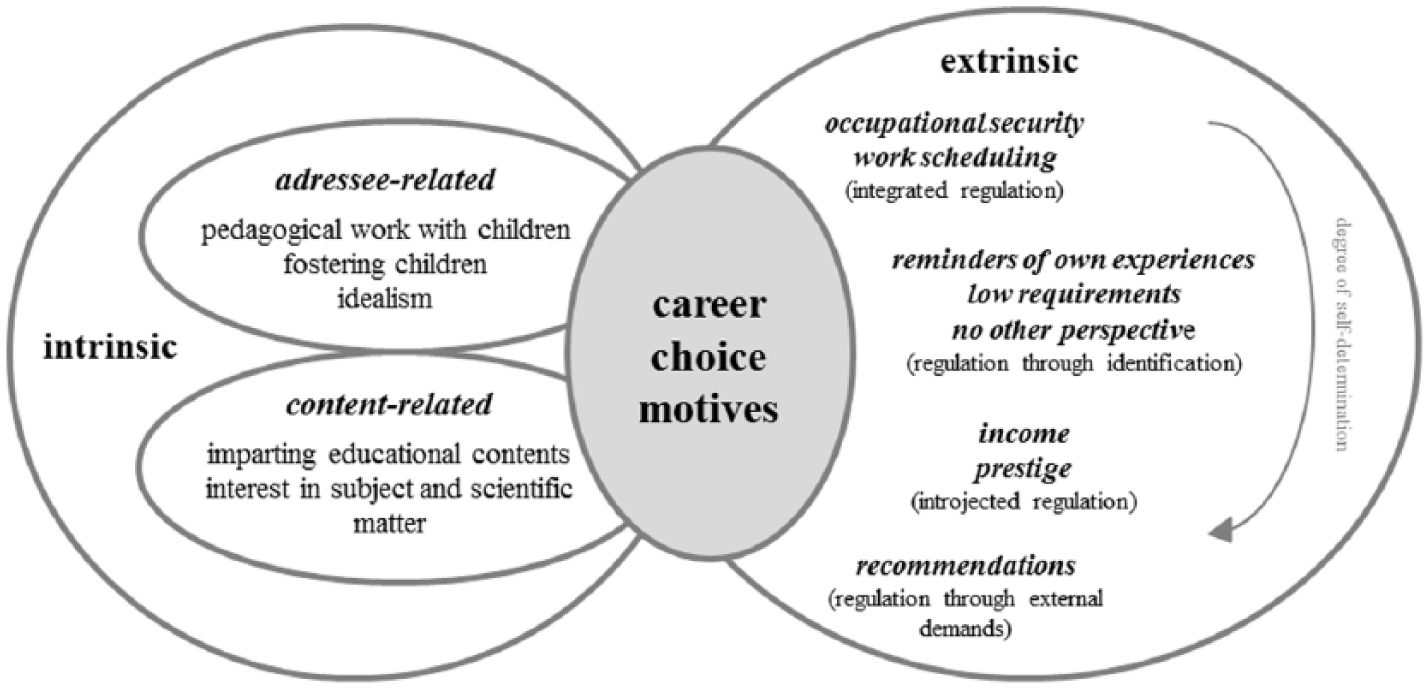
Systematisation of intrinsic and extrinsic career chioce motives.
The studies mentioned above relate to students of primary and secondary teaching. As has been pointed out in the field of early childhood education, no comparable body of research exists; however, the few published empirical approaches show similar findings. The Canadian qualitative study by Langford (2007) underlines the importance of intrinsic, addressee-related motives such as working with (young) children. Extrinsic motives do not appear to be decisive. Langford, however, did demonstrate a contrast between intrinsic, partly idealistic, aspirations and perceived working conditions such as low salary and less social prestige. Similar results are provided for the United States by Torquati, Raikes, and Huddleston-Casas (2007), and confirmed by an Irish study (Molony, 2010). The German study by Helm (2010) focusses on the motive for socially relevant work.
Demands for research and questions
As described above, early childhood education and training are subject to specific administrative frameworks, training structures and working conditions in different European countries. The academic levels respective to the countries’ academic aspirations are also factors that distinguish the countries of the present study. This gives rise to the question of whether these different conditions and structures are reflected in career choice processes. This question is being analysed by a cross-country comparison of career choice motives in Germany, Sweden, Switzerland and Romania. Because there are few empirical findings on the topic to date, we do not propose hypotheses, but instead focus on the following research questions:
Which motives can we identify among early childhood educators?
Are there differences in the attitude levels of career choice motives in Germany, Sweden, Switzerland and Romania?
Method
Project and research context
The present study is part of the research project Student Teachers’ Motives of the Chair of School and Teacher Research at the Ludwig-Maximilians University Munich in Germany, which cooperates with other higher education institutions in Germany, Switzerland, Sweden and Romania. The goal of the project is a comparison of career choice motives and personal characteristics in the area of teacher education. A sub-project focusses on personal characteristics and career choice processes of prospective early childhood educators. The results of the project are supposed to provide an empirical basis for recommendations and counselling instruments that early childhood student teachers should consider before and during their studies.
Sampling and data collection
The total sample of the present study includes 468 early childhood education students. In line with the questions of the study, students from different countries were taken into account, as described above from Germany, Sweden, Switzerland and Romania. The data collection took place during winter 2016/17 in all participating countries. The coordination of the data collection, and the analyses, were conducted at Ludwig-Maximilians University in Germany. Altogether, six European higher education institutions were involved in data collection, as follows:
• In Germany, three higher education institutions were involved: the Justus-Liebig-University in Giessen, the Freiburg Advanced Centre for Education, and the Alice Salomon University of Applied Sciences in Berlin.
• In Switzerland, data were collected at the Zurich University of Teacher Education.
• In Sweden, Södertörn University in Stockholm participated in the project.
• In Romania, the University de West in Timişoara was involved.
The mentioned higher education institutions in the participating countries offer teacher training programs for early childhood education with tertiary qualification. For the data collection, the future early childhood educators were asked to complete a questionnaire on the spot – in each country during a mandatory lecture to be attended by all students of a study course. The exact distribution of the sample by country and gender is described in Table 1.
Distribution of the future early childhood educators (country, gender).
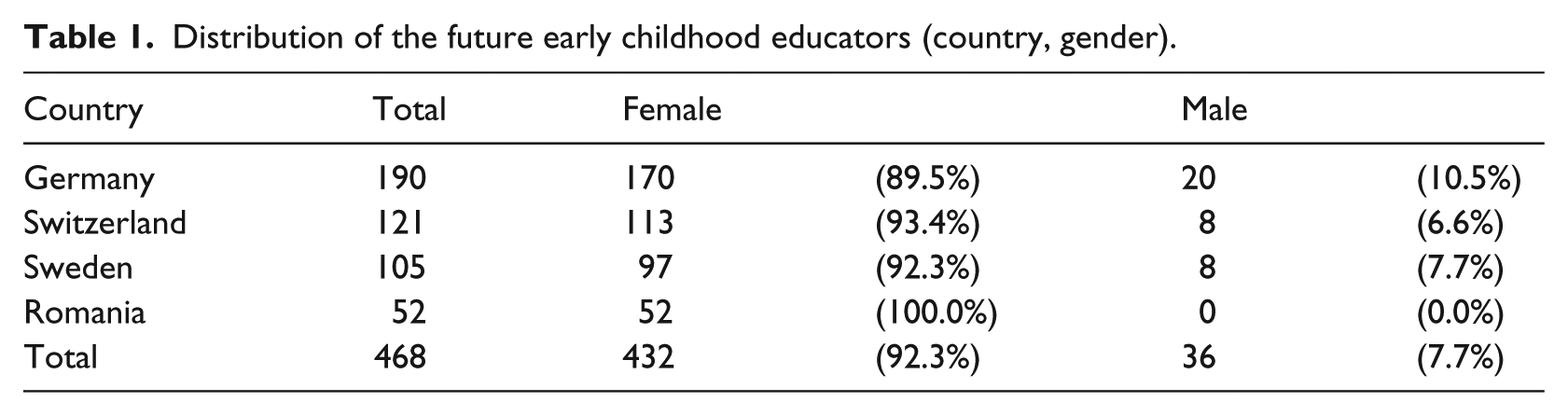
As the table shows, 92.3% of the total sample is female. The gender distribution varies depending on the country. Further information about the sample is provided in Table 2.
Descriptive statistics (age, number of semesters).
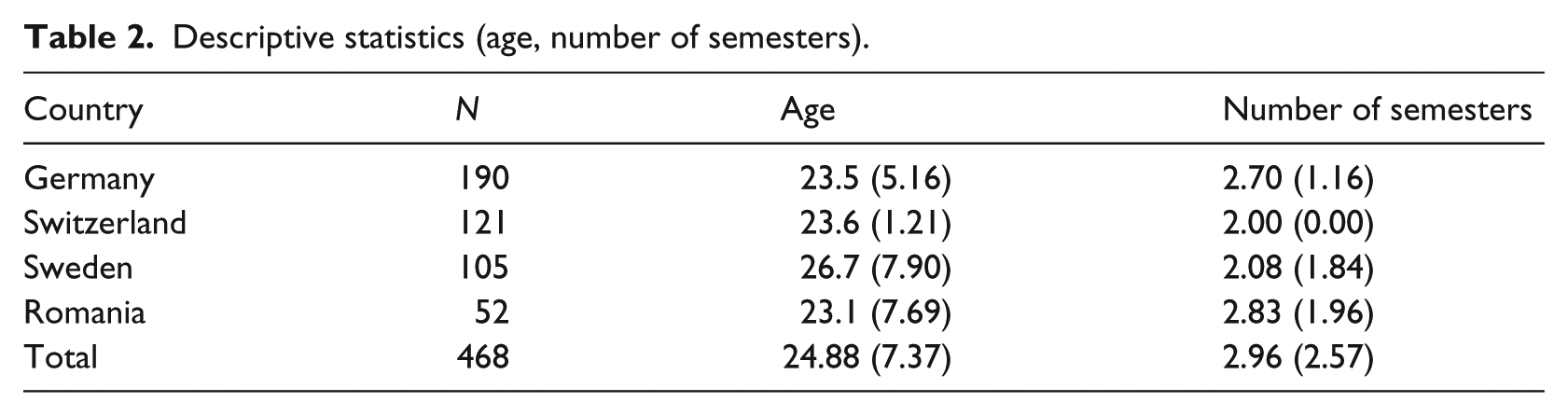
The future early childhood educators were in their first or second semesters of study, and their average age is 24.88 years (SD = 7.73). The average age is disproportionately higher compared to other courses of study; the reason for this is that about one in three students completed a vocational training course before matriculating at a university.
Measuring instrument and analyses
The measuring instrument for career choice motives was designed in an earlier research project (Efficacy of Teacher Education) with similar objectives at the Ludwig-Maximilians University. Its development was based on a large dataset of approximately 1500 student teachers. The instrument has been tested, validated and used several times under this framework, and many published papers have employed it (Lerche, Weiß and Kiel, 2013; Weiß and Kiel, 2013). The instrument was first designed to draw upon already existing studies. On the basis of these studies, items referring to different kinds of motives were created. In the second step, missing aspects were identified, by interviewing experts; educationalists and people active in teacher training supplemented the existing list of motives from the studies mentioned above. The items were rated using a four-point Likert scale (‘0 – does not apply at all’ to ‘3 – applies totally’) and were reduced to scales on the basis of factor analysis (principal component analysis with Varimax rotation and Kaiser criterion). The factor calculation was based on the eigenvalue criterion (>1). Items with a factor content < 0.4 were excluded. In the context of the present study, 54 items are used. The resulting factors can be assigned to the intrinsic and extrinsic motives previously outlined (see Figure 1).
The existing factor structure and the reliability scores constitute reference values for the area of teacher education. Therefore, the measuring instrument underwent a further factor analysis and a subsequent a reliability analysis. The first results have already been published (Weiß et al., 2016). The measuring instrument is applied successfully in the framework of the present sample. Reliability analyses show (very) good to satisfactory reliability scores for most of the scales (Cronbach’s α > 0.70). Two scales show lower reliabilities, which are discussed with the aim of developing the measuring instrument further. Table 3 depicts the scales of career choice motivation used in the present study.
Scales of career choice motivation (number, example items, Cronbach’s α).
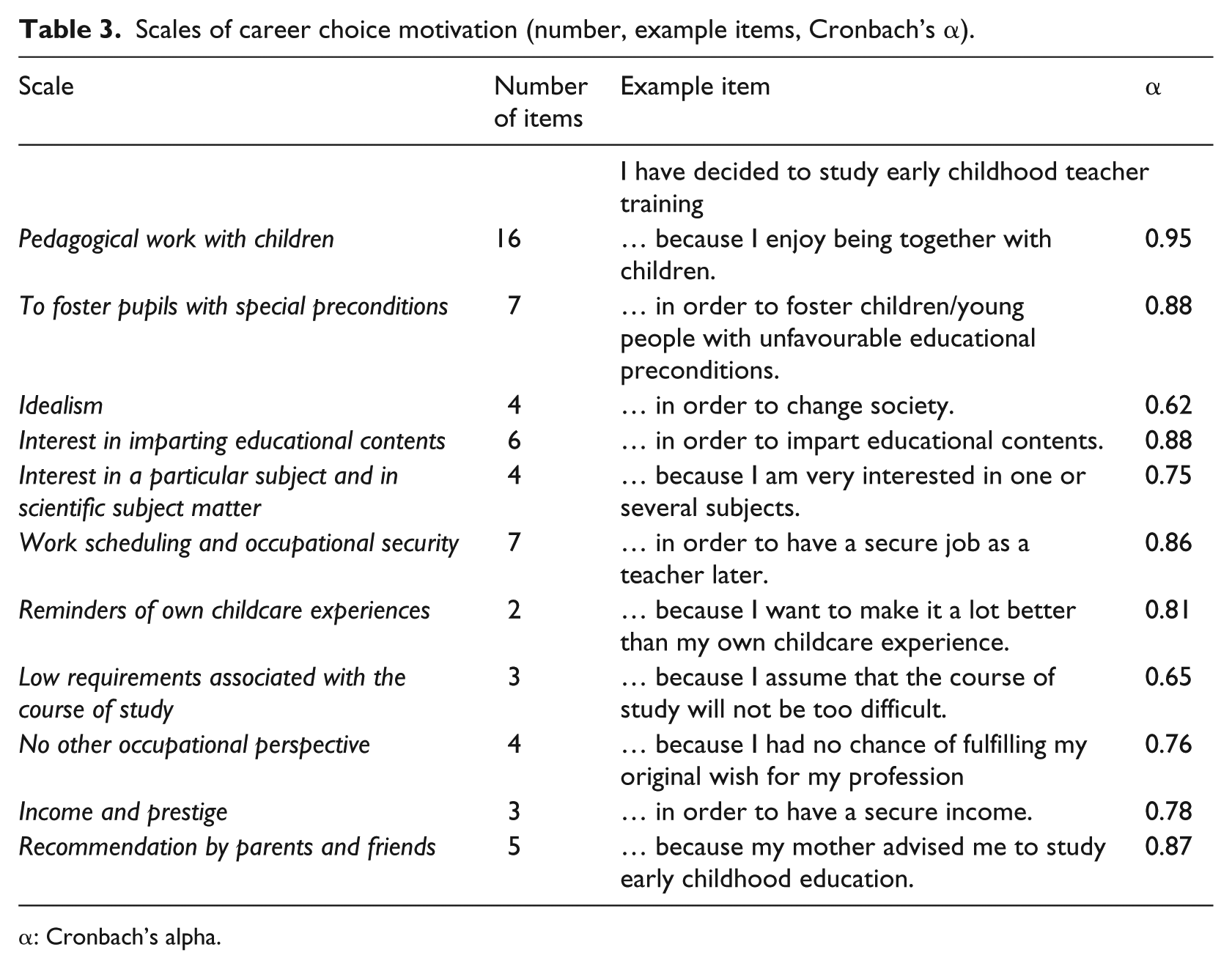
α: Cronbach’s alpha.
Results
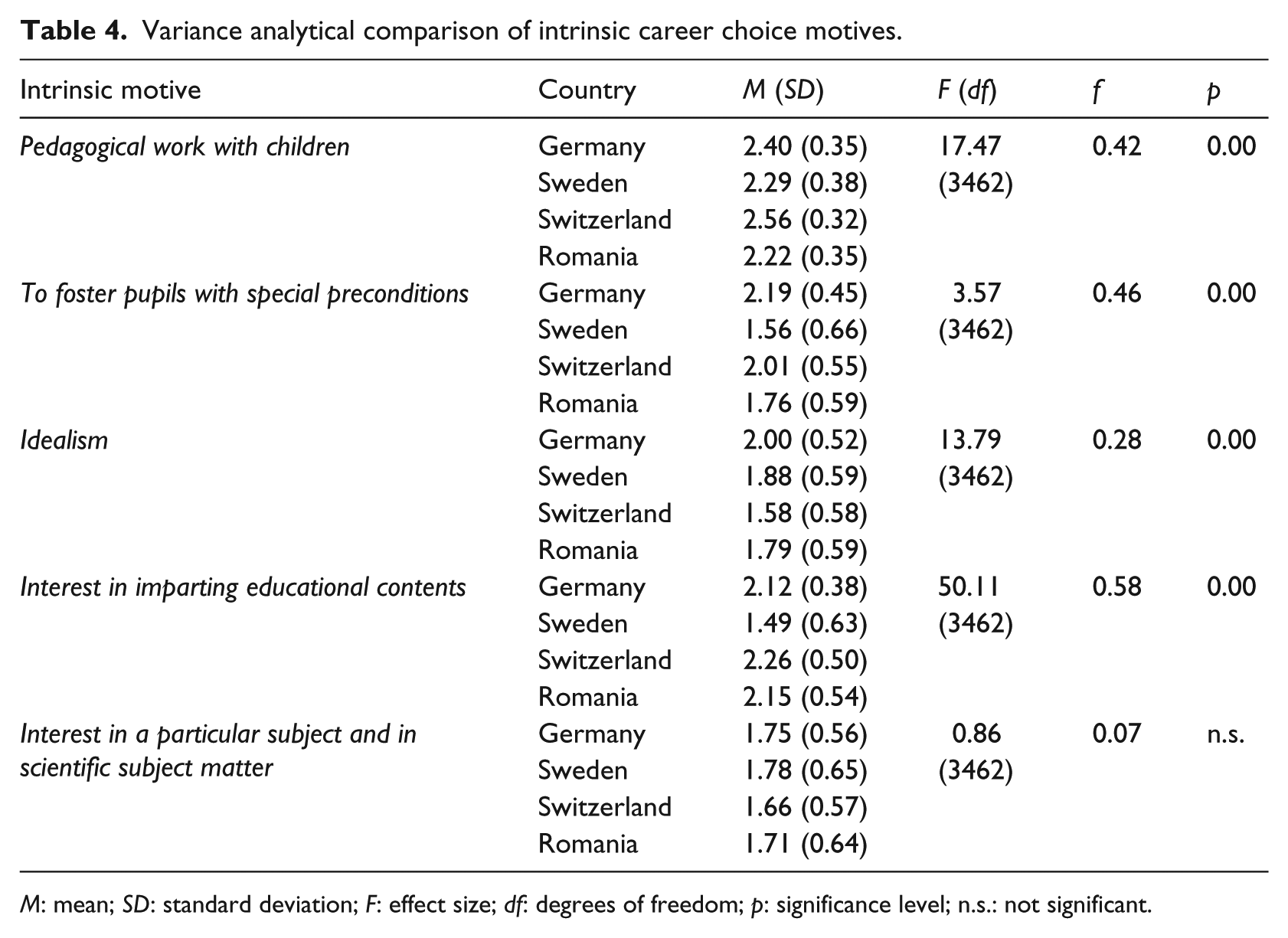
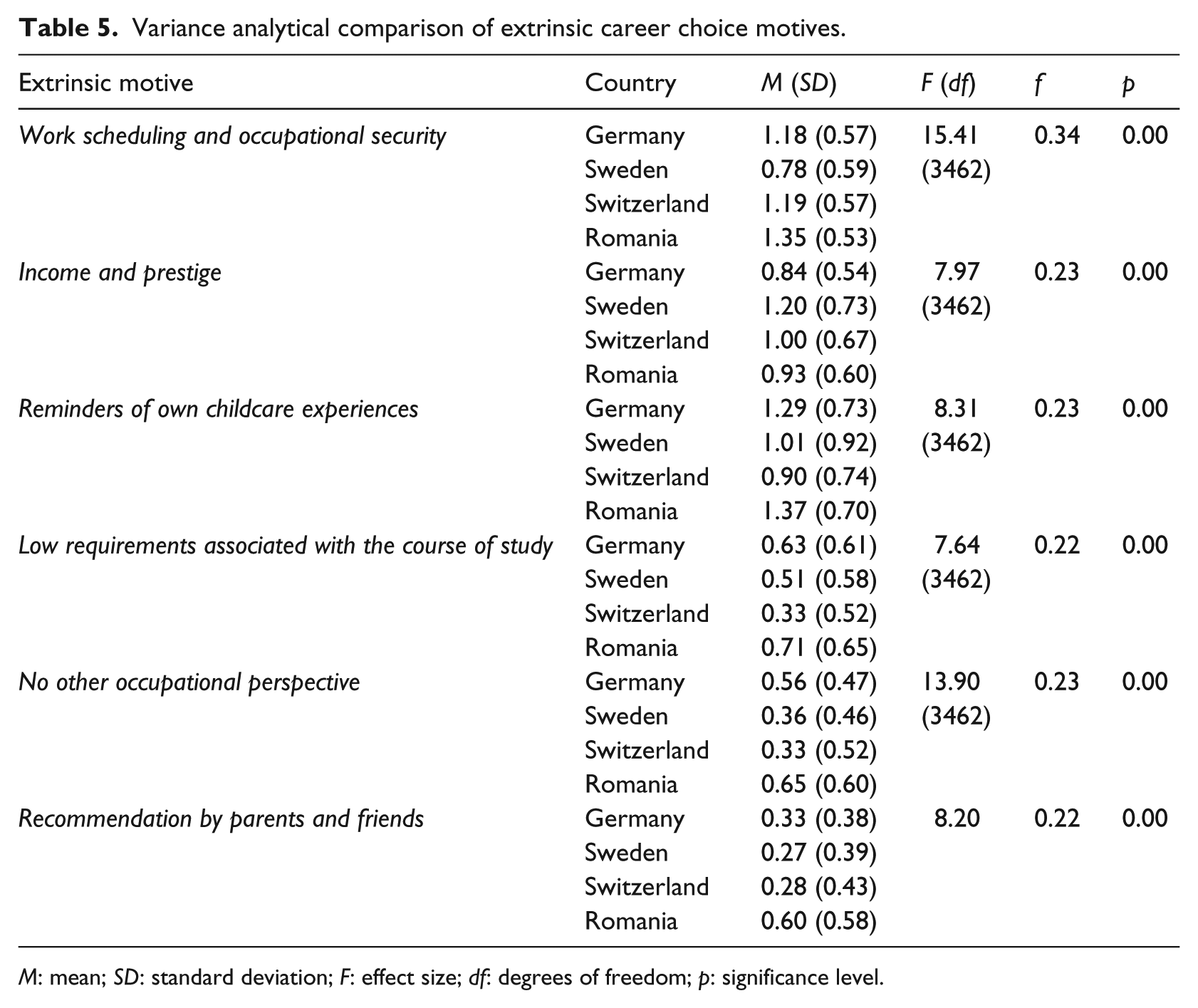
The motives are compared by variance analysis with post hoc tests (according to Bonferroni). The country (Germany, Sweden, Switzerland or Romania) is taken as factor. Additionally, the effect size is calculated using the tool G*Power (Faul et al., 2009) (Cohen’s f in the analysis of variance or ANOVA, with Cohen’s d in the post-hoc tests; see Cohen, 1988). According to Deci and Ryan (2000; see their section 2.2), the motives are split into intrinsic and extrinsic reasons; extrinsic motives are further subdivided by their degree of self-determination. To emphasise this differentiation, intrinsic and extrinsic motives are illustrated in separate tables (Tables 4 and 5).
Variance analytical comparison of intrinsic career choice motives.
M: mean; SD: standard deviation; F: effect size; df: degrees of freedom; p: significance level; n.s.: not significant.
Variance analytical comparison of extrinsic career choice motives.
M: mean; SD: standard deviation; F: effect size; df: degrees of freedom; p: significance level.
Intrinsic motives
With the exception of interest in a particular subject and in scientific subject matter, the ANOVA calculations show significant results at the 1% significance level for all scales (see Table 4), with medium to mostly large effects, according to the classification by Cohen (1988; see the description for Cohen’s f).
We can identify clear differences in addressee-related motives for future early childhood educators in Germany and Switzerland. The motive pedagogical work with children has higher at-tribute levels. Post-hoc tests reveal significant differences compared with Swedish and Romanian student teachers. The effect sizes are medium to large, especially the comparison between Swiss and Romanian student teachers, which is characterised by a very large effect size (dGer/Rom = 0.52, dGer/Swe = 0.31; dSwi/Rom = 1.04; dSwi/Swe = 0.78; p < 0.01 in each case). The same applies to the desire to foster pupils with special preconditions, for example, in the case of educational disadvantages or family deficits (dGer/Rom = 0.89; dSwi/Rom = 0.45, p < 0.01 in both cases; see below for effect sizes for Sweden). Germany and Switzerland differ from each other regarding levels of occupational idealism. The notion of idealism is particularly strong among German early childhood education students. In contrast, it is of only minor importance to Swiss prospective professionals (p < 0.01 in the post-hoc comparison), but the effect size is small (dGer/Swi = 0.34). Future early childhood educators in Sweden and Romania are characterised by lower attitude levels of addressee-related motives. Of particular note is the low desire of Swedish student teachers to address the needs of children that possess special preconditions with medium and strong effects (dSwe/Ger = 1.18, dSwe/Swi = 0.75, p < 0.01 in both cases).
Intrinsic motives also comprise interest in imparting educational contents and interest in a particular subject and in scientific subject matter. The motive of educational knowledge and its mediation is very important for Swiss future professionals (in comparison to Germany: dSwi/Ger = 0.33; p < 0.05, and to Sweden, showing a large effect, dSwi/Swe = 1.37, p < 0.01). Here again, a particularly low importance of this motive is attributed to Swedish students, which is also reflected in large effect sizes (dSwe/Rom = 1.10, DSwe/Ger = 1.31; p < 0.01, in both cases). The interest in a particular subject and in scientific subject matter is found to be of subordinate significance compared with other intrinsic motives. As mentioned above, the countries do not differ in that aspect.
Extrinsic motives
The ANOVA shows significant results for all extrinsic motives at the 1% significance level (see Table 5). The motives are listed according to the degree of self-determination (Deci and Ryan, 2000). In the overall context, extrinsic motives were found to be of slightly lower significance in contrast to intrinsic motives. This applies equally to all countries. In particular, low requirements associated with the course of study, no other occupational perspective, and recommendations by parents and friends are subordinated. If one considers extrinsic motives with regard to the different countries, many diverging results can be identified, so the discussion below aims to develop coherences between motives and country-specific conditions and structures. As a tendency, future professionals from Romania give a greater weight to extrinsic motives, with the exception of income and prestige. Overall, the effect sizes for the ANOVA altogether are small too, but some of the post-hoc tests show large effects. The results for the individual scales are presented below, according to the differentiations outlined by Deci and Ryan (2000).
If one takes into account the motives referring to framework conditions of the profession, work scheduling and occupational security (‘integrated regulation’; Deci and Ryan, 2000), the following finding can be ascertained: that extrinsic motive with a higher degree of self-determination proves to be more important for future early childhood educators in Romania. It is especially slight for Swedish students with medium to large effects (dSwe/Ger = 0.70, dSwe/Swi = 0.71, dSwe/Rom = 1.00; p < 0.01, compared with each country). Extrinsic motives from the area of ‘regulation through identification’ (Deci and Ryan, 2000) again play an important role in choice of profession, especially for Romanian and German students: reminders of their own child-care experiences are more important (compared with Sweden: dRom/Swe = 0.42, dGer/Swe = 0.35, p < 0.05; to Switzerland: dRom/Swi = 0.65, dGer/Swi = 0.51, p < 0.01). The same applies for low requirements associated with the course of study: this motive is found to be of subordinate significance. All mean values are below 1, but this motive has a stronger significance among German and Romanian future educators with medium effect sizes (compared with Switzerland: dGer/Swi = 0.52, dRom/Swi = 0.68, p < 0.01). Among Swiss student teachers, this motive carries very little weight. The mean values of having no other perspective as part of the career choice are also very low, but there are significant differences: prospective German and Romanian educators give the motive greater weight (compared with Swiss and Swedish students: dGer/Swi = 0.47, dGer/Swe = 0.43, dRom/Swi = 0.59, dRom/Swe = 0.57, p < 0.01 in all cases).
In contrast, future early childhood educators from Switzerland and Sweden attribute a higher importance to income and prestige. Post-hoc tests reveal significant differences compared with Germany (dSwi/Ger = 0.27, dSwe/Ger = 0.59, p < 0.01) and Romania (dSwi/Rom = 0.11, dSwe/Rom = 0.39, p < 0.05), but only with small to medium effect sizes. This motive is, according to Deci and Ryan (2000), characterised by a lower degree of self-determination (‘introjected regulation’). Recommendation by parents and friends, the least autonomous motivation (‘regulation through external demands’), is most strongly pronounced among Romanian students with medium effects, compared with the other countries (dRom/Ger = 0.63, dRom/Swi = 0.67, dRom/Swe = 0.72, p < 0.01).
Discussion
Career choice motives of future early childhood educators
Overall, intrinsic motives were found to be of higher significance than extrinsic motives; this applies equally to all countries considered in the present study. This is in accordance with the few reported results of early childhood students (Langford, 2007; Torquati et al., 2007) and with the broad research data on the teaching profession (see the meta-analysis by Brookhart and Freeman, 1992; Lortie, 2002). Furthermore, future early childhood education professionals from Germany, Switzerland, Sweden and Romania differ in their motives, which are summarised in the following with respect to Deci and Ryan (2000). The findings are discussed with a view toward professionalisation and consequences for each country.
Intrinsic motives, such as addressee-related and educational content-related reasons, allow a high(er) degree of self-determination (Deci and Ryan, 2000). Our main results show that pedagogical motives are more pronounced in Swiss and German prospective early childhood educators. Those from Germany are characterised by the highest degree of idealism. Swedish students, in particular, have a remarkably low desire to foster children with special needs, for example those with disabilities or family deficits. Imparting education to young children is of high importance to Swiss professionals.
Extrinsic motives vary depending on the degree of self-determination and the perceived influence of external factors (Deci and Ryan, 2000). Key results expose that most of the extrinsic motives, no matter their degree of self-determination, have a stronger presence among Romanian future early childhood educators than in other groups; for example, for Romanians, occupational security, reminders of own childcare experiences or ‘negatively regarded’ reasons such as low requirements associated with the study course or having to other occupational perspective are important considerations. Income and prestige, as the only exception, is important for students from Sweden and Switzerland. Future German educators also give a higher weight to the negatively connoted motives of low requirements and lack of other occupational perspectives.
Career choice in the face of country-specific working and training conditions: Conclusions for early childhood education and training
The differences described above can be discussed in the context of working conditions, training structures and the current status of countries’ professionalisation processes. The findings reflect country-specific professional images, traditions and aspirations as well as problem areas; this is illustrated individually for each country. Furthermore, some initial conclusions can be drawn from the identified problem areas.
In Switzerland, addressee-related and content-related intrinsic motives play an important role. In particular, the high interest in imparting educational content to young children is worth mentioning. Extrinsic reasons are less important, with the exception of income. This motive structure mirrors in some way the professional image and the standard of early childhood education in Switzerland, which is tasked with fulfilling a standardised curriculum with fixed learning objectives (Swiss UNESCO Commission, 2014). Teachers’ high content-related interests are possibly linked to that fact. Moreover, the high weighting of income points out the working parameter that Swiss teaching staff is among the best paid in the world (OECD, 2006). The motive structure also reflects that future educators show a high degree of perceived self-determination (Deci and Ryan, 2000). This fact certainly is a good basis for entering the profession. Self-determination allows an experience of competency and autonomy, which, in turn, is negatively related to job dissatisfaction and attrition (Gagné and Deci, 2005).
The Swedish students in the present study stand out from the other considered countries because of their lower levels of intrinsic motivation. They show only a small interest in the mediation of educational content to young children. The motive for fostering children, for example those with social or intellectual disabilities, has the lowest weight. This conflicts, on the one hand, with the high academic aspirations of the Swedish early childhood education system. On the other hand, it comes in conflict with an additional concern: efforts toward continuing inclusion. Inclusion is not only an issue for children’s schools that cater for older ages, but also for early childhood education (European Foundation for the Improvement of Living and Working Conditions, 2015): professional staff, in particular, are increasingly entrusted with the demand of fostering children with disabilities (diagnosing children’s need for support, options for support and therapies, etc.), but the career choice processes of Swedish students do not reflect this fact. The consequences for study courses are to prioritise demands drawn from the low intrinsic motivation: addressee-related issues, such as mediating educational contents to young children and, even more, developing options for children with special needs, could be reinforced. Swedish students actually give intrinsic motives a lower weighting; the reasons for this need to be investigated, for example with a view to the professional image (high workload, bureaucratic burdens, etc.).
In Germany, there is currently no distinctive professional image for staff members who hold tertiary degrees. The already initiated professionalisation process (Kirstein, Fröhlich-Gildhoff and Haderlein, 2012) aims to raise early childhood education to a higher level. Increasing the proportion of professionals with a tertiary degree and strengthening educational contents and its mediation in training and practice are key targets. The motive structure of German future early childhood educators reflects this on-going process in a certain way. Addressee-related motives are rated higher, and the motive of imparting educational contents are in the middle range; the latter certainly offers potential for further development, but this process is already in progress. The students’ high levels of idealism also need to be addressed. This motive also characterises students in other studies, but it may conflict with the real working conditions they experience (Moloney, 2010; Torquati et al., 2007). Idealists who enter the teaching profession because of strong feelings toward altruistic service are more likely to leave teaching, ultimately frustrated by a sense of disappointment and discouragement if they fail (Miech and Elder, 1996). The presence of motives such as low requirements associated with the study course is perhaps an expression of a lack of knowledge about the course of study, and of an unclearly defined professional image. Thus, training should pay attention to unrealistic expectations concerning occupational demands. In short, measures that address unrealistic attitudes are necessary. Furthermore, higher education institutions should attract candidates with a motivation that is less severely guided by external factors (see Decy and Ryan, 2000) – that is, not simply attract those who have no other occupational perspective. A number of initiatives regarding this are in progress (see the report by Aktionsrat Bildung [Action Commission Education], 2012).
Early childhood education in Romania is shaped by contrasts that are also reflected in the student teachers’ motives. The academic orientation has a long tradition, and a mandatory curriculum for teaching 3- to 6-year-old children has been developed. Romania is a European pioneer establishing new study courses for early childhood education. In part, the students’ motives reflect these traditions and structures. For example, imparting knowledge to young children, as required in the curriculum, is a part of their motivation, even if it is not quite as important as it is for Swiss trainees. Extrinsic motives in Romania achieve the highest scores of all countries in the present study. Reasons such as having no other occupational perspective and low requirements, are subordinate compared to other (intrinsic) motives, but they have the biggest impact in contrast with Swiss, German and Swedish trainees. This implies that the career choice processes of Romanian future early childhood educators are strongly controlled by external factors (Deci and Ryan, 2000); Romanian trainees experience a lower level of self-determination with regard to their career choice. The only exception is the motive of income, which is comparably lower. These facets of extrinsic motivation – with high values except for income – underline a contradiction respective to a severe problem area: the salaries in early childhood education are so small that they scarcely cover the cost of living (Oberhuemer et al., 2010). This applies in particular to those just starting in the profession. As a consequence, young educators were discouraged, recognising only a few options for self-determination, occupational self-development and opportunities for shaping their lives. Issues of quality also affect attracting suitable professionals and may be superimposed by economics matters. Therefore, it is difficult to develop concrete proposals for training. Changes that take place at administrative levels would have a more serious impact improving quality.
In summary, demands and developmental tasks arise not only from country-specific motive structures, but also from the different professional images, training structures and stages of professionalisation found in each of the countries under study. The present study is primarily aimed to cover and to compare the motives of future early childhood educators. Further research as described below can start here to broaden and deepen measures for professionalisation and training systems.
Limitations and further research
The present study focusses on the career choice motives of future early childhood educators using a purely quantitative measure. However, trainees can only respond to a pre-defined set of items, which is one of the study’s weaknesses, reflected, among others, in the low reliabilities in a few motive scales. Due to the lack in such research, the present study approaches the matter of career choice in early childhood education from the perspectives of professional images and the teaching profession. It is becoming more obvious that some of the used items are not accurately related to the profession of early childhood education and future professionals’ perceptions of it. More selectivity is necessary, so there is a need to revise the measuring instrument. Specifying some of the items could make the instrument more distinctive for early childhood education. The findings from the present study could provide starting points for developing some of the items further. A qualitative approach could also be a further step. Qualitative interviews or group discussions could clarify motivations and backgrounds in the context of motives that have not yet been covered. Moreover, additional characteristics could be considered, such as personal resources or previous occupational experiences.
In this context, further studies could explore the issue of a possible gender bias. In all countries included in the present study, the proportion of female future early childhood educators is very high. This proportion reflects the gender distribution in this profession in the countries involved, indicating that early childhood education is still a professional field in which women are significantly overrepresented (Eurostat, 2015). The body of research on early childhood education remains lacking, but findings from similar occupations, such as the teaching profession, show a gender bias: in some studies, for example, male pre-service teachers scored slightly lower on intrinsic motives than female pre-service teachers (e.g. Bruinsma and Jansen, 2010). However, inquiring whether such a gender bias could also be found for future early childhood educators is made more difficult by the fact that the percentage of male professionals is very small, or barely existent (see the Romanian sample).
Overall, a further specification of the findings would refine more targeted proposals and strategies for training systems and for administrative development. These strategies should be particularly helpful for providing supportive structures for trainees at the beginning of their studies. With the above in mind, further research prospects could be related to a comparison with additional countries, something that is planned in the framework of the project. A possible choice would be a comparison with non-European countries that focusses on differences between European and non-European countries.
Footnotes
Declaration of Conflicting Interests
The author(s) declared no potential conflicts of interest with respect to the research, authorship, and/or publication of this article.
Funding
The author(s) received no financial support for the research, authorship, and/or publication of this article.