



Abstract
The civil war between the Sri Lankan government and the Liberation Tigers of Tamil Eelam (LTTE) ended in 2009, with total defeat of the LTTE and many thousands of civilian casualties. The country is now engaged in peace-building. Key elements of the secondary school curriculum – truth-seeking, social cohesion and active citizenship – may contribute to this. Six state secondary schools serving different ethnic and religious groups were selected for qualitative research into how far this is the case. Data was collected on the application of knowledge, skills and values in lessons, extra-curricular programmes and whole school culture. The analysis suggests that truth-seeking is weak, with no teaching about the historical roots of the conflict or contemporary issues. There are efforts to build leadership skills and impart democratic values, but the critical thinking and discussion skills necessary for social cohesion and active citizenship are largely absent. The findings are discussed in relation to evidence from Uganda, Cambodia and Northern Ireland.
Keywords
Purpose of the study
The General Assembly of the United Nations have agreed and set out 17 sustainable development goals (‘the Global Goals’), effective from 1 January 2016 (United Nations, 2016). The key areas are poverty alleviation and economic inequality, democratic governance and peace-building, climate change and disaster risk. Goal 4 – high quality inclusive and equitable education – has an important part to play in meeting all the other goals. In particular, inadequate or distorted education will impede work towards the reduction of inequality within and between countries (Goal 10) and the promotion of peaceful and inclusive societies with effective, accountable and inclusive institutions (Goal 16). Historical and contemporary conflicts present a particular challenge to achieving the global goals.
Achievement of high levels of quality education is seriously impeded by war and civil conflict. Educational inequality (especially along ethnic lines), and poor quality education can also help cause conflict (Bush and Saltarelli, 2000; Ostby and Strand, 2010). When the fighting stops, the prevention of renewed outbreaks of violence requires a range of measures, including transitional justice and social, political and economic reform. This process has been variously termed ‘positive peace’ (Galtung, 1969), ‘long-term peace-building’ (Brahimi, 2000), and ‘conflict transformation’ (Miall, 2004). The contribution of education to peace-building is a growing field (Davies, 2014; Dupuy, 2008; Johnson, 2014). Novelli et al. (2017), for example, propose a transformational approach and have developed a framework for the United Nations International Children’s Emergency Fund (UNICEF) proposing that successful peacebuilding educational policies should promote redistribution, recognition, representation and reconciliation. This holistic approach to education systems in their institutional and social context is being explored in a range of post-conflict settings. 1 Parallel to these theoretical developments, and compatible with them, Cunningham developed a framework to show at a more detailed level how the school curriculum can contribute to peace-building after civil war, illustrated by empirical work on schools in Northern Uganda and the examination of school curricula in Rwanda, Cambodia and Northern Ireland (Cunningham, 2014).
This analysis of the Sri Lanka experience has been designed to deepen the evidence base. Sri Lanka is recovering from a serious and lengthy civil conflict that ended in 2009. The wide range of different cultures and identities presents a significant challenge for an education geared towards sustainable peace. A large Buddhist majority, it has been suggested, may feel no need to be sensitive to the values or needs of minority groups. Conversely, these minority groups may feel threatened by ill-thought out curricular policies on language, history, religious instruction and preparation for a pluralist society (De Silva, 1986).
Economic, social, political and historical background
Sri Lanka has a population of approximately 21 million, identifying themselves by ethnicity, language and religion (see Table 1). The complexity is the result of the island’s position on trade routes and its history of immigration, colonization and intermarriage.
Ethnicity, religion and language of population of Sri Lanka.
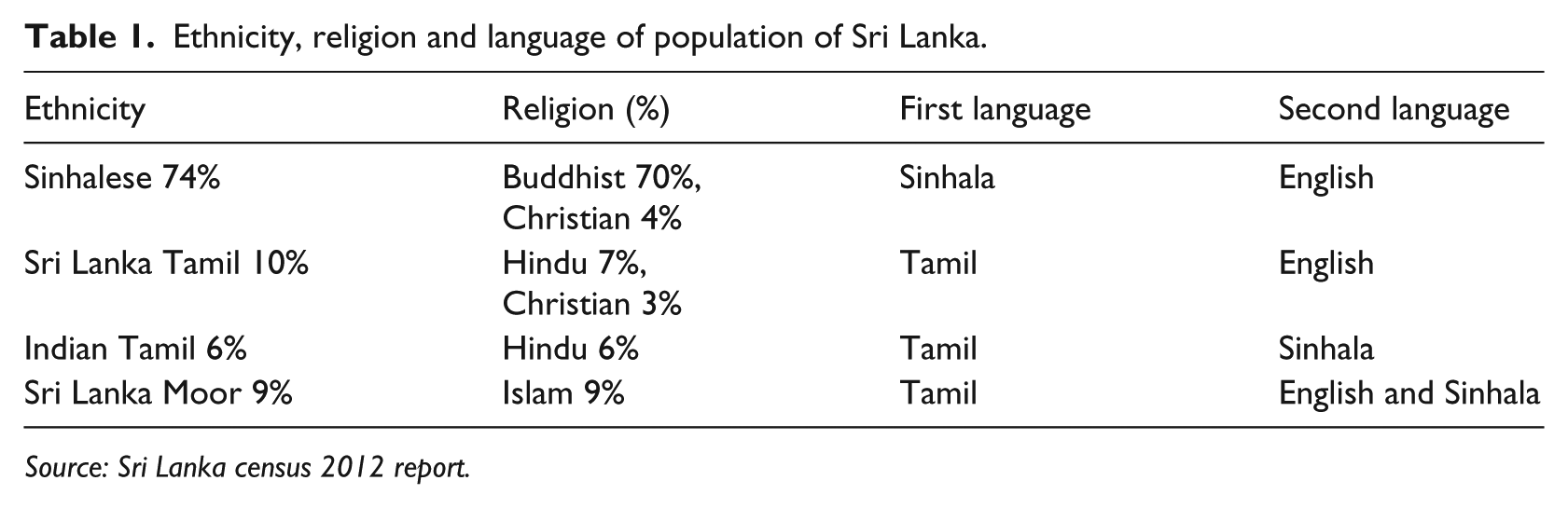
Source: Sri Lanka census 2012 report.
The impact of the war
Mistrust between different ethnic and religious identity groups in Sri Lanka has roots deep in the past: ‘The country is haunted by a history that is agonizing to recall but hazardous to forget’ (De Silva, 1986). Although Sinhalese greatly outnumber Tamils in Sri Lanka, they are outnumbered in their turn by the combined Tamils of Sri Lanka and Southern India. The myths and history of early Sinhalese civilizations sustained a powerful sense of the need to protect Buddhism that could be exploited by politicians and some religious leaders to create disrespect and racism (Bandarage, 2009). After the colonial period, some policies sought to reconcile national integration with pluralism. However, starting with the introduction of a Sinhala-only language policy in 1956, Tamils began to demand federation, devolution and finally the creation of a new nation state to be called Tamil Eelam (Wickramasinghe, 2006). Anti-Tamil riots in 1983 sparked off a violent campaign against government forces, led by the Liberation Tigers of Tamil Eelam (LTTE). The war ended in 2009 when government forces pushed the LTTE and many thousands of civilians into a small pocket in the north-east of the island. Specified ‘no fire zones’ were widely ignored by both sides, with resulting heavy civilian casualties. In the final assault, most of the LTTE leadership was killed, some allegedly after having surrendered (Weiss, 2011).
The war had devastating social and economic consequences for the country. There are widely differing estimates of the number of deaths according to whether the source is government, Tamil or international bodies. There were an estimated 60 to 76 thousand deaths between 1990 and 2009 (Uppsala Conflict Data Program, 2017), and credible allegations were made that ‘tens of thousands’ of civilians were killed, largely by government shelling, in the final stages of the war (United Nations, 2011). Less visible are the physical injuries, post-traumatic stress and the large numbers of widows and orphans. Some 50% of the Tamils of Northern Province were displaced and 25% left the country, most of the best educated and richest settling permanently in the West, and the rest in refugee camps in Tamil Nadu state in India. All the Muslims from Jaffna were expelled by the LTTE virtually overnight, losing their homes and possessions. The impact on the political economy was great: the army increased from 60,000 to 235,000 and in 2001 40% of government spending was on the armed services (Wickramasinghe, 2006).
The end of the war has impacted different communities in contrasting ways. Both sides of the conflict adopted authoritarian approaches. The LTTE state dealt ruthlessly with internal opposition, forcibly recruited child soldiers of both sexes and used the civilian population as human shields in the last weeks of the war (Weiss, 2011). The government displayed triumphalism and Mahinda Rajapaksa used the presidential election victory of 2010 to consolidate political power. Accusations of war crimes against the army in the last stages of the war were treated as Western interference, or a plot by the USA and its allies to undermine the Sri Lankan state. The government moved towards China and Russia in order to block United Nations Security Council involvement in human rights investigations. There was a lack of respect for freedom of speech, evidenced by the killing or torturing of journalists (Spencer, 2011).
Sri Lanka since 2015
The election of President Sirisena in 2015 showed that Sri Lanka can make a peaceful political transition (Aliff, 2016; Nelson, 2015), but sustainable peace-building and the development of a democratic, pluralist political economy is a major challenge. The government has responded to pressure exerted by the international community to independently investigate alleged war crimes during the final days of the war (Manikkalingam, 2016). In 2012, Sri Lanka implemented a language policy intended to encourage the attainment of trilingual capabilities by all citizens (Mueller, 2012). The government has taken the first steps in compelling all new government servants to learn all three languages. During the Independence Day celebrations in February 2016, the Sri Lankan national anthem was sung in Sinhala and Tamil at the official ceremony for the first time since 1949 (Ameen, 2016).
However, the army’s ongoing occupation of land in the north and east in what the government terms ‘high security zones’ is a thorny issue (Jones, 2015). Land release has been very slow since the war ended in 2009 creating ongoing hardships for the communities in these areas. There is also continuing resentment of the army’s destruction of LTTE cemeteries, meaning that families have nowhere to express their grief over what they still see as ‘fallen combatants’, but what the army terms ‘terrorists’ (Salter, 2017: 3-4).
The newly established Office for National Unity and Reconciliation (ONUR) is working with the Ministry of Education to mainstream national unity and reconciliation into the education structure (Rutnam, 2017). Scholarship on education for peace-building in Sri Lanka has suggested that there is a viable framework but a lack of commitment and political will (Lopes Cardozo, 2008; Lopes Cardozo and Hoeks, 2014). The change of government and national mood since these studies justifies an up-to-date examination of the school curriculum today.
Research context
Building on Cunningham’s (2014) previous work and responding to the views of educationalists and officials during an exploratory visit to Sri Lanka in 2015, a framework was developed for research into the extent to which the Sri Lankan secondary school curriculum is contributing to sustainable peacebuilding (see Table 2). Noting that ‘peace-building’ itself is a loaded term with many interpretations, the position taken follows Novelli et al. (2017) in specifying social transformation. The definition of the curriculum is ‘the totality of the experiences the pupil has as a result of the provision made’ (Kelly, 2009: 13). School students learn a great deal, not only from planned syllabuses and teaching programmes but also from the intentional and unintentional process of school life. Assemblies, ceremonies, intervals, the day-to-day relationships between and among students and staff all contribute to whole-school culture, which is an element of curriculum (Abbott, 2014).
A conceptual framework for a school curriculum for truth-seeking, social cohesion and active citizenship.
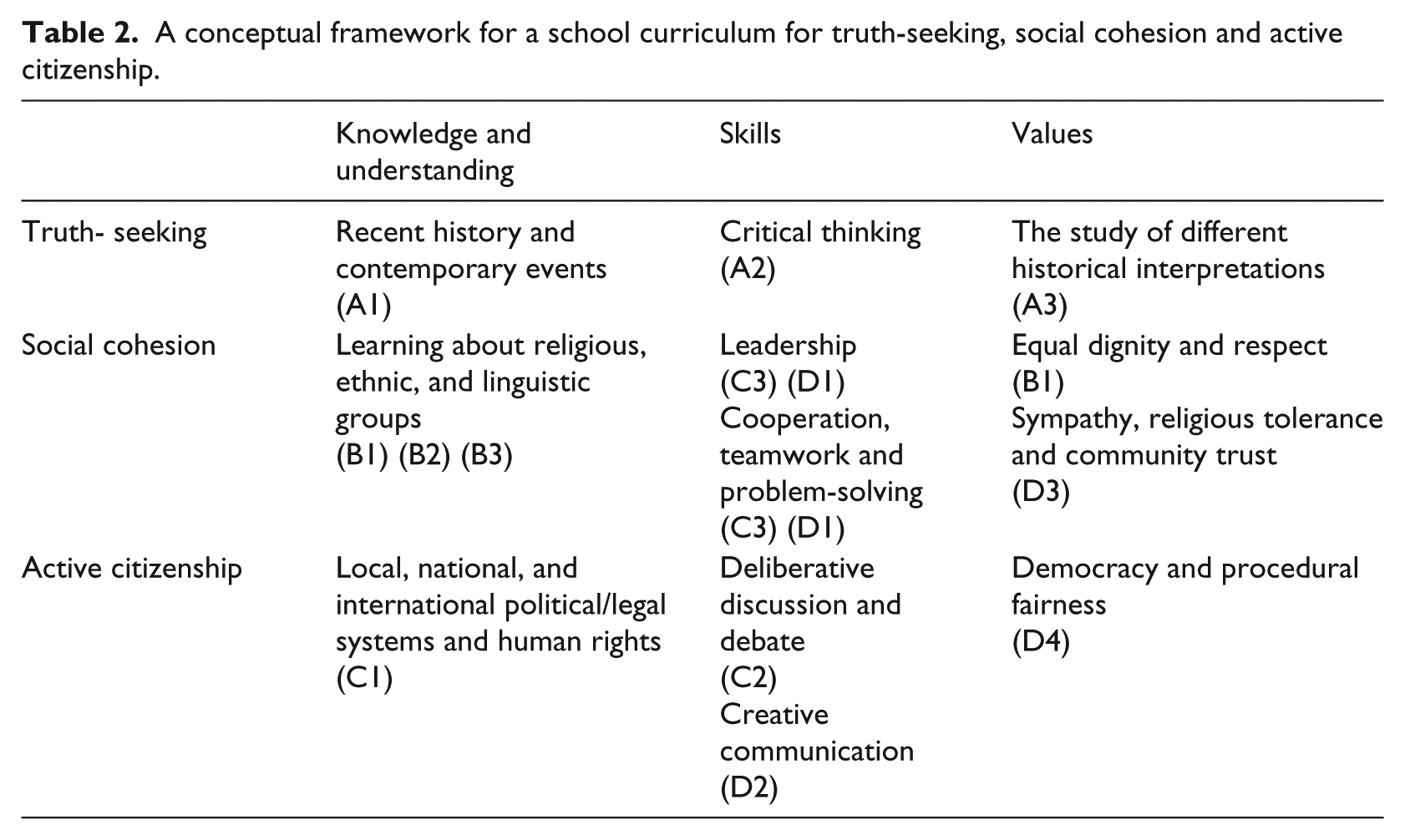
There are three main challenges for the school curriculum to be able to contribute to sustainable peace. First, sharply differing interpretations of the causes and ending of the conflict highlight the importance of truth-seeking. Second, the national policy on education for social cohesion - defined as ‘willingness of members of society to cooperate together in order to survive and prosper’ (Stanley, 2003) - aims to convey ‘attitudes of peace and tolerance, and values that help build a sense of national solidarity’ (Aturupane and Wikramanayake, 2011). Third, the frustrations of relatively well-educated youth, who have little legitimate scope for action, are known to feed extremist ideologies (Honwana, 2012). Active citizenship means teaching young people not only the structures and systems of democracy but also how to participate and use them.
Research questions
In order to assess the extent to which the Sri Lankan school curriculum is contributing to sustainable peace-building, thirteen research questions were developed from the framework, organised into four sections: A Truth-seeking; B Social cohesion; C Active citizenship; D Whole school culture. Each question is directly related to one or more of the nine ‘boxes’ of the framework, and its number appears in brackets.
The teaching of history is important for truth-seeking. Young people denied the opportunity to learn about recent history and contemporary issues are at the mercy of manipulative narratives purveyed by self-interested parties. Personal narratives by victims of war may be a starting point.
Critical thinking is the process of applying reasoned and disciplined thinking to a subject, and is different from the formal transmission of facts and ideas. It involves examining assumptions, identifying hidden values, and assessing evidence in order to reach conclusions (Paul and Elder, 2002). It is an important element of the peace-building curriculum as it helps people understand and resist propaganda or political manipulation (Fountain, 1999).
An authoritative view of history, with only one perspective can lead to a rigid view of contemporary issues, in which there is only one correct view. Learning about different perspectives or interpretations of the same events may develop tolerance and understanding of different cultural groups and actors.
Since the bulk of the population is educated in their own religious or cultural environment, how schools treat and teach the other cultures and religions is very important. Teachers need the skills and values to outline the main elements of different religions in an honest way, modeling respect for other people’s beliefs.
The government is trying to improve social cohesion by bringing young people of different identities into direct contact with each other. The Denuwara Mithuro [Pals of Two Cities] programme that twins different schools together has been widely encouraged (World Bank, 2011). The question is about how it is working out in practice.
For link programmes to be successful, the sustained support of principals, teachers, and students is essential. ICT and social media may support this, but it is not clear how much they are used.
Active citizenship means both a sense of belonging, and the access to political agency on the part of different communities (Osler and Starkey, 2005). A thorough knowledge of local and national civic life and an understanding of democracy and human rights are important for building resilience against extremist and hate-filled ideologies (Davies, 2008).
To participate in local and national affairs, students need the skills of debate, and deliberative discussion. Debate is framed in competitive, usually dualistic, terms and can lead to the idea that all that matters in a democracy is to win a majority. Deliberative discussion is the practice of discussing an issue with an attempt to clarify it and establish a consensus. This is an important skill for active citizenship as it tends towards compromise and problem-solving (Dryzek, 2002).
The Student Parliament Handbook produced by the Ministry of Education and the National Institute of Education is intended to: open … out opportunities of practical experiences to students on democracy, its responsibility and accountability, on supremacy of the law, on the significance of the vote … develop (…) attitudes and skills like engaging in dialogue, reaching agreement, listening to and respecting the opinions of others and accepting the concept of agreement by majority … envisaged the building up of a broad social cohesion (Government of Sri Lanka Ministry of Education, 2016: 3). The question is designed to explore to what extent this plan is being realised.
Most Sri Lankan schools have a prefect system, designed to support the culture and ethos of the school and develop leadership skills. The powers of prefects and their role in imparting a culture of cooperation and fairness has been little examined.
Social cohesion and active citizenship depend on people being able to communicate with each other. Communication skills such as public speaking, displays and dramas may be used for persuasive purposes, which some might portray as manipulation, or for creative approaches to solidarity and mutual understanding, through accessing people’s empathy and emotional response.
To some extent the questions about the school links cover this, but link programmes may only touch a small minority of pupils. It is necessary to consider the overall impact of school culture on the development of these values.
The degree to which young people absorb the values of citizenship, democracy and the rule of law depends on how the school culture models respect for fairness and rules for democratic decision-making. Peer support and mediation, the involvement of young people in helping solve inter-personal problems are important methods of building capacity for citizenship. This is not easy to achieve in a crowded exam-influenced curriculum, where increasing numbers of adolescents are showing signs of extreme stress (Rodrigo et al., 2010).
Research sample
The time and resources available allowed for examination of six government secondary schools selected from different parts of the island. Random sampling was rejected because of the aim to represent the demographic and linguistic diversity of the country. The sample is of two rural (village) schools, two town schools and two city schools, reflecting three broad categories of catchment (see Table 3). The selected schools are all government schools, their resourcing and planned curriculum is broadly similar. There was no plan to compare the findings on city, urban and rural schools.
Characteristics of sample of schools.
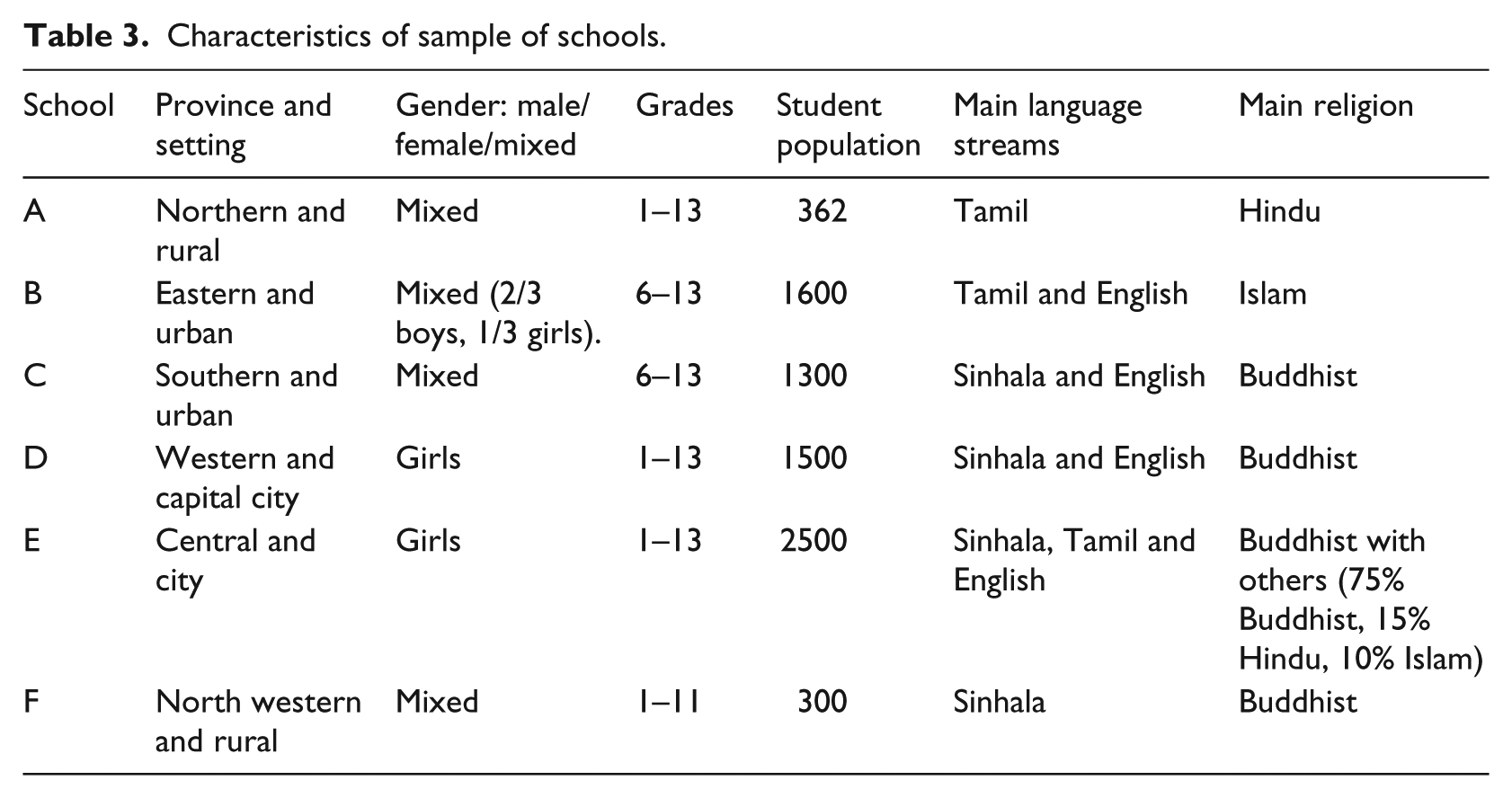
Two of the schools (A and E) were chosen through personal contact with a Sri Lankan educator, who was supervising the advanced studies of members of the management team. His view was that they were typical of their category. One (F) was selected with the advice of a provincial peace-education official responsible for developing school links. The remaining three were recommended by the Ministry of Education. Here, although we specifically requested to visit ‘ordinary’ schools and we were assured that this was so, it is likely that we were pointed towards relatively high-performing and successful schools. Two of these exhibited good practice in international school links, and may have been chosen for their perceived openness to researchers. This factor potentially skews the findings in a ‘positive’ direction. Where these schools are performing well, we may not assume that all schools are matching that performance, and where they are performing poorly, it is unlikely that most schools are doing better.
Data collection
The wide spread of questions and the attempt to explore skills and values as well as content and performance argued against a quantitative approach and in favour of mixed qualitative methods with an ethnographic element. In order to gain some sense of school culture, a week was spent in each school, giving enough time for semi-structured interviews, participant observation and documentary study. To ensure that wider social aspects could contribute to the study, a research diary was kept, in which were recorded notes from conversations with members of the public, observations of daily life, religious practice and so on.
Semi-structured interviews
The sample for interviews was the same in each school: the principal, deputy head, school counsellor, teachers of civic education, religion, history and English, chosen for their particular relevance to the research questions. Equivalent student leadership groups were interviewed in each school, generally school prefects, but on two occasions other groups (cadets and Scouts) were interviewed. They were chosen in preference to random groups for two reasons: first, they had direct experience of leadership roles, and second, they were more likely to have the confidence to speak to a foreign researcher. Previous experience of randomised student groups showed that often only one person had the confidence to speak. Some education officials and members of the public contributed to background knowledge and understanding. These were not the product of any sampling method. An outline interview schedule was used. Time was allowed at the beginning for narrative, life story and values statements to create a reasonably relaxed and empathetic atmosphere. A total of 78 semi-structured interviews were conducted and recorded with contemporaneous notes, amplified with a research diary (principals: 6; teachers: 41; groups of students: 17; officials: 8; members of the public: 6). The lead author (Jeremy Cunningham) took the majority of interviews in English, and, where it was required, with the assistance of a teacher-translator. The co-author (Suren Ladd) undertook four interviews in Sinhala. Traditional note-taking was used not only because the background noise level in Sri Lankan schools precludes recording, but also to reduce the chances of participants drying up or becoming nervous. The interviews appropriately focused on the participants’ role. For example, interviews with principals focused more on whole-school issues, whereas interviews with religion teachers were geared towards their faith and their subject.
Participant observation in schools
A total of 21 lessons were observed in history, civics, religion and ICT. A brief survey was made of each school library. Participant observation in the schools included observing prize-giving, morning assemblies, mock examinations, student union meetings, exchange launch, Buddhist association meetings, preparations and conduct of Teachers Day ceremony, science day preparations, preparations for Buddhist pirit ceremony, interval behaviour, teachers’ rooms, canteens, drama, sports and music practice and traffic safety co-ordinators. The author also taught some lessons in each school. All these aspects of school life were recorded contemporaneously in the research diary.
Documentary study
The Sri Lankan national curriculum is in the process of revision, starting with grade 6 (that is the 6th year of compulsory schooling). New textbooks and teacher guides have been prepared by the National Institute of Education. Examples of history, civic education, physical education, Buddhist religion and English textbooks and teacher guides were examined for evidence that would contribute to answering the research questions. These materials are produced in Sinhala, Tamil and English. Co-author, Suren Ladd examined Sinhala versions. Research notes were taken from school policy documents and wall notices in most schools.
Data analysis
The number and breadth of the questions required complex data analysis. Answers and observations from the interviews were coded against the 13 sub-questions (A1 to D4). Interviews of senior staff officials and students covered the ‘whole school’ elements of sections B, C and D. The interviews with classroom teachers were more about curriculum content, existing and proposed, and therefore the coding depended to some extent on the specialism of the teacher. History and citizenship teachers were asked questions relating to sections A and C. ICT teachers and those involved in school links, or the school parliament system were probed on their experiences and views of these elements of school life. Statements and observations were extracted from the interview notes and placed in the relevant section, sometimes contributing evidence to more than one section.
Accumulation of evidence in one section gave rise to an assertion or generalization, considered as secure where corroborated by participant observation as recorded in the research diary. For example, all the classroom teachers were asked about the advisability of students learning about other religions. Their answers formed a pattern which was largely positive but with a minority negative view. This was checked against the responses of senior staff and students and supported by many conversations outside school. Discrepancies between participants’ reports and what was seen were taken into account when making observations or conclusions.
Notes taken during participant observation, informal discussions with members of the public or officials research diary entries were coded according to the nine main ‘boxes’ of the research framework, and where possible, further coded into the sub-sections (A1-D4).
The programmes of study, teachers’ guides and textbooks were analysed for their relevance to section A and questions B1 and C1. School rules, notices and library collections contributed to observations about section D.
Findings
A Truth-seeking
A1 Young people’s study of recent history and contemporary events
The vast majority of Sri Lankan students do not study recent history or contemporary events in school; the core history curriculum ends in 1978. All except one of the civics and history teachers interviewed were cautiously positive about discussing some contemporary issues, but the absolute priority is to complete the syllabus and for the students to do well in examinations. ‘Definitely I want to teach the children – there is no racism – they should know their history but it is not in the curriculum – if they ask me I give them a brief description and explanation’ (history teacher). The general social background is not conducive to discussion of controversial issues, and it might even be dangerous for an individual teacher to be entering this territory. ‘If a teacher teaches out of the syllabus or about the war, I might be arrested’ (history teacher). The end of the war is still close and encumbered by bitter controversy over civilian deaths in the final stages. Some teachers said that if students ask, then they give some general information, for example when asked about the reasons for the war. The Sri Lanka Peace Education programme itself makes little mention of Sri Lankan history, even though discrimination and inter-ethnic hostility contributed to the war in the first place (Government of Sri Lanka Ministry of Education, 2008).
A2 Development of critical thinking
The teachers’ guides for the new curriculum in history are based on a ‘competency’ approach, shifting from a teacher- to a student-centred system. They give freedom to teachers to select ‘quality inputs and additional activities to develop the competencies of students’ and they must be used together with the textbooks which cover the required content. The competencies include tolerance and respect for human dignity. However, there is a gap between the language and organization of the national goals, the basic competencies and the subject goals, and it is clear that different minds and groups have applied themselves to each main section. For example, in the competency titled ‘develop critical thinking through the study of sources that help build up history’, one level is ‘builds history though objects used by man’, and the learning outcomes are: ‘clarifying what history is’; ‘summons facts in support of the proposition that history reveals the past story of mankind’; and ‘explains history through sources’. The guides’ key terms are not analytical, but descriptive such as ‘illustrates’, ‘shows’, ‘explains’, ‘indicates’, ‘names’. In some cases, value judgements are presented as facts, such as ‘explains the greatness of King Pandukabhaya’. Although presented in the language of competencies, the guides’ emphasis is on ensuring that students accept the importance and greatness of early kings. There appears to be no requirement for critical thinking, analysis or questioning, and little guidance on how to develop these key skills (Sri Lanka National Institute of Education, 2014; Sri Lanka National Institute of Education, 2015).
A3 Study of different historical interpretations
The lessons observed and the textbooks and teacher guides studied showed that history is mainly taught as a series of received ‘facts’ and that there is, as yet, no consideration of different interpretations and viewpoints. The grade 6 and grade 10 guides show that although there is some reference to different sources of evidence (local and foreign literature, archaeology) there is no guidance on the distinction between myth and fact, on how evidence is created and the purpose that historians may have in presenting narratives in particular ways. Interviews with teachers confirmed this. However, distorted versions of history in textbooks have been a focus of academic study and concern, and some of the more extreme examples have been removed or toned down (Aturupane and Wikramanayake, 2011). Some teachers claim to be presenting a nuanced view: ‘We teach that history is not straightforward and that kings had to do unpleasant things to protect their country’ (history teacher).
B Social cohesion
B1 Learning about religious, ethnic and linguistic groups
The curriculum neither directly addresses the social and cultural composition of the country nor investigates the lifestyle and values of different religious groups. Since Sri Lankan textbooks are nationally commissioned, approved and published, stereotypes or the complete absence of various cultural groups can reinforce negative assumptions or create bitterness about the invisibility of one’s own identity. For example, a grade 9 English textbook appears to be encouraging groupwork and active learning, and the characters have Sinhala and Tamil (but not Muslim) names. However, much of the textbook is centred on the Maldives, and there does not seem to be any reference to the different cultural groups of Sri Lanka itself. The impression given is one of unity on the terms of the Sinhala Buddhist majority.
Religious education is exclusively focused on teaching the religion of that community, with little or no attention to the practices of other religions. Six out of eight teachers of religion interviewed said that it would be a good idea to learn more about other religions, e.g. ‘they should know other religions … I have a lot of Christian friends … they all preach peace and guidance to people … love the truth and do not envy neighbours’ (religious education teacher). However, they are constrained by the national examination syllabus. Two interviewees from the Hindu Tamil community disagreed, saying that their religion is in a minority and that they feared that their young might tempted to convert to other religions.
Nearly all interviewees, adult and student, declared an interest in the festivals and customs of others and in schools with mixed populations they are referenced or celebrated in the daily life of the school. In the urban school with a Tamil stream, Sinhalese students are learning alongside their peers. Social systems in the school like prefects and societies have children from different communities working in teams together. Where there are English language streams in the school (an increasing trend), children with different religious and cultural backgrounds work alongside each other for most of the time.
The history curriculum, teacher guides and text books show that the emphasis is firmly on the Sinhala Buddhist interpretation of the history of the island. One missing issue (probably because it is controversial) is the extent of Tamil language and religion before the arrival of Buddhism. A characteristic study goal is to ‘develop good qualities through the influence of Buddhism in building up a good society’. The so-called ‘hydraulic civilizations’ and the Kandyan kingdoms are studied in increasing detail in grade 6, grade 8 and grade 10. An assessment goal is that students ‘will accept the fact (sic) that the national heritage and national identity … exhibited through the Kandyan kingdom … should be preserved’. Although a key learning outcome is that the student ‘shows that people in the past lived in ethnic co-existence’, there is very little mention of the different languages and cultures of the island. ‘Hindunism, Islamism and Roman Catholism (sic)’ are mentioned in grade 8 but in grade 10 they are referred to cursorily as ‘other religions’.
Reading fiction can be a way of developing sympathy for people in other cultures, places and times. There was no evidence of children reading books or seeing films about the daily life of different cultural groups. That is not to say they are totally unaware – several participants said that Sinhalese children like watching Tamil docu-dramas and musical films – but it is not clear how realistic a depiction these media give of the life of others. In libraries there were some translations into Tamil of well-known Sinhalese folk tales and a few of the reverse equivalent, but no modern examples of fiction for young people based on different Sri Lankan cultures and ways of life. The one set text invariably mentioned in response to questions about the development of empathy and sympathy is Dickens’ Oliver Twist. While Dickens’ novel can rouse considerable sympathy for poor children in 19th century London slums, there is unexplored potential for studying more recent and relevant works of art on similar themes.
B2 Experiences of principals, teachers and students on school links programmes
The schools link programmes sponsored by the Ministry of Education under the titles Denuwara Mithuro [Pals of Two Cities] and Senehasaka Thaksalawa [Friendship Schools Programme] are beginning to have an impact. The aim is to pair up schools from different parts of the island, representing different ethno-religious groups. Two of the sample schools had got as far as a visit of teachers and students in each direction, two had visited in one direction and the return visit was in the planning stage.
One teacher who came here and one little girl – they were both very scared – they had been told ‘be careful of Sinhala people’ – but girl was crying when she left, sorry to leave her new friends ‘I will tell my parents how nice they are’ (English teacher and exchange co-ordinator).
The inauguration of a ‘Pals of Two Cities’ programme was observed at the rural school, linking Tamil-speaking Hindu and Muslim schools from Ampara district with Sinhala Buddhist schools in the North West province. One school had well developed international links, but a teacher said that they had ‘little time’ for their link with another Sri Lankan school. Principals and teachers gave almost unanimously positive reports of the visits. Respondents from southern schools visiting the north admitted they were nervous about going, but that they were made very welcome. Video footage was shown of tearful farewells at the end of four-day visits. The focus has been on artistic experiences and the sharing of food as these have direct impact on people’s emotional responses. The sharing of religious experience has been common too, especially explanation of festivals. There have been real efforts to spread the message within the school for those who have not had the opportunity to travel.
Language remains the main obstacle. ‘It was very positive- the main problem is language and fear of the war. They still cannot forget the situation- and we have a lack of knowledge of their real attitudes and feelings’ (exchange organiser). While Sri Lanka is trying to ensure that all students learn a second national language and English, progress so far is quite modest, and of course teachers themselves have not had this opportunity. The programmes rest heavily on the teachers of English and the second language who have sufficient language skills to translate for the group. One senior staff member from a northern Tamil school expressed doubt and some hostility to the exchange programme, saying that the Sinhalese would like to broadcast their culture, music, dance and religion even when visiting the north, and that the programme feels different if you are a wounded and traumatized minority.
B3 Extent to which schools are using ICT and social media to support school links
Student groups in two schools mentioned meeting children from our ethnic or religious groups on leadership programmes, scout jamborees or army-sponsored cadet camps. They explained how wonderful it was to make friends and told how they were using Whatsapp and Facebook to keep in contact. Some link teachers are using mobile phones and skype for joint planning. No school has yet used group Skype calls, or class emails on school ICT equipment. Only one of the six schools has an internet connection for their ICT lab. However, as the cost of connection to the web is reduced and becomes more of a norm, one can expect such communication to increase. The production of films of the exchange visits which are then ‘mass produced’ for participants is increasingly economical and provides a good way of cementing the positive feelings.
C Active citizenship
C1 The teaching of local, national and international political systems, democracy and human rights
All students study civic education to the end of grade 9. Syllabus and textbooks were studied and several lessons observed in different schools with different ages. This is a very thorough and well-organised programme with plenty of opportunities for group work and discussion. A very good lesson was seen, in which five groups reported back to the class on different types of publicly - funded institution such as transport, telecommunications and the postal service. The outlines of the national political system are covered and there is also a simple account of international organizations like the United Nations. Nearly all older students above grade 9 interviewed had heard of human rights and could explain what they are in simple terms. However, after grade 9 Civic Education is an optional subject and only a very small minority of students choose it as part of their ‘basket’ of choice. Between the ages of 14 and 19, an important stage of intellectual and social development, students do not receive any detailed preparation for life in a pluralist democracy in a rapidly changing world. This may be compared with history, a core subject up to 16 years of age, where students receive a solid grounding aimed at developing a national narrative.
They oversimplify [human rights] – they absorb the parts that suit them. They are taught in grade 9 civics but human rights are complex – they should be given to all students as a main subject, but syllabus change is very slow (principal).
C2 Use of debate and deliberative discussion
Group discussion in class is a recent but growing development. No examples were seen of classes discussing controversial issues, but there was anecdotal evidence that this occasionally takes place in civics lessons. One obstacle is that the curriculum allocates almost no time for the study of current moral or social issues, indeed little emphasis on thought, reflection or consideration of the many aspects of an issue. The overwhelming emphasis is on top-down transmission of factual information to be recalled for examinations. Another major drawback is that most of the schools, especially the large urban ones, are grossly overcrowded. The tropical heat means that schools are built with large open windows, and the noise from neighbouring classes is overpowering. Often the teacher struggles to be heard. When, all too often, a class is left unattended, the prefects cannot easily control the noise and it disturbs nearby classes. Group discussion is very difficult in these circumstances and may be limited to simple tasks such as dividing up information gathering and asking groups to report back to the class. Two of the schools have debating societies, which encourage presentation and oral skills. Sri Lankan society is very competitive and teams from debating societies take part in local and national competitions.
C3 Impact of the student parliament system
The objectives of the student parliament system (see Government of Sri Lanka Ministry of Education, 2016) are summarised as:
a) understanding democratic concepts and practices;
b) to bring about peace and reconciliation;
c) to develop social cohesion and conflict resolution, mutual understanding among multi-ethnic and multi-religious groups;
d) to involve young people in nation building;
e) to develop leadership skills;
f) to develop theoretical and practical civic education skills.
It is clear that the student parliament carries a heavy load of expectation in terms of education for inclusive citizenship. It is to be headed by the teacher in charge of citizenship education, and another teacher under the supervision of the principal. This teacher is to be a ‘guardian’ of social cohesion and peace education programmes for reconciliation and co-existence. The parliament is meant to be established in the first term and held at least once a term. There is an elaborate structure of ‘cabinet ministers’, and an executive committee headed by the principal. There are ten committees including ‘interschool goodwill building and development’, ‘social reconciliation and student security affairs’ and ‘behaviour development and student welfare’. There are detailed instructions for nominations and elections. Through a representative to the parliament, any student in the school can forward a written proposal which can be implemented after discussion in the parliament.
There was no opportunity to observe a student parliament or ‘ministry’ in operation. Teachers and students from one school out of the six that had held regular student parliament meetings were enthusiastic: ‘Every school should have a school parliament so children can learn democracy from practising it … we have a list – we ask questions about our school – the relevant minister must stand up and answer – the notes are taken in Sinhala’. Another school ‘had agreed to hold one’, but it had not yet happened. One school’s regular meeting of the student union (which consists of the whole school) was observed. The meeting is managed by the students, and has a chair, secretary and treasurer. All the staff attend. Each class brought performances and contributions such as poems, short quizzes or prayers to the meeting, but it did not seem to be used for raising school issues or suggestions for improvements.
D Truth-seeking, social cohesion and active citizenship in whole school culture
D1 Development of leadership, cooperation and teamwork skills
All the schools are placing a strong emphasis on the development of leadership. The prefect system is a notable feature of Sri Lankan education and the features are strikingly similar in each school. Prefects assist the teachers in maintaining an orderly and friendly atmosphere in the school. They may manage the punctuality system, for example, recording latecomers and applying simple sanctions like work on the school grounds. In some schools they arrive early and supervise classroom cleaning. They are often responsible for keeping classroom order if the teacher does not appear (a common event in some schools). They play a major role in planning and officiating at school events like prize-giving, Teachers’ Day, science days and exchange visits.
Prefects are appointed to teams at intermediate and senior levels, after formally applying with a resumé of their school achievements. In several schools, the head prefect is chosen by their peers. In mixed schools, boys and girls are prefects. Prefects are given visible evidence of their role and status with an array of badges and formal clothing for big occasions. Teachers in several schools were at pains to point out that prefects are not necessarily the most academically gifted, nor from the wealthier families. The staff are looking for human qualities such as patience, warmth, consistency and teamwork. Prefect teams were interviewed in every school. They spoke of the satisfaction of serving others, of trying to make their school better, and displayed confidence in their relationship with senior management.
Prefects were observed at work in several schools – for example, in the preparations for 2016 Teachers’ Day in the capital city school, marshalling teams of volunteers, sorting out decorations and the programme. The principle of the celebration is that the students run it in gratitude for the yearly work of their teachers. As well as prefects, there are other opportunities for leadership development. In one school, a group of male ‘cadets’ linked with the armed forces was interviewed. They go to a yearly camp where they meet young people from other cultural and ethnic groups. Some students who had been picked for a leadership conference – bringing together youngsters from all parts of the country were also interviewed. The participants made friends from all over the place and explained how they had worked in mixed teams on a variety of initiative-building tasks. School A has an active Scouts and Guides group and again the young people had chances to meet with a wide range of other youngsters in regular jamborees.
There were a number of examples of teamwork and cooperation, notably through after-school activities such as sports, music and drama. Groups were seen planning drama presentations – in one school an English play was acted by students in grades 7 and 8 and directed by grade 10 students. In the central city school, a dance display for a science day had been choreographed by a grade 11 girl who was directing the dancers herself. Senior members of the girls’ netball team in the capital city school were coaching younger children. There is a national system of traffic wardens – young people of about 15 years old in high visibility yellow jackets who keep the traffic calm outside the school at the beginning and end of the day. All the schools except the more remote rural school have these traffic warden teams – a clear example of expecting responsible and civic behaviour on the part of young people.
There was evidence from three of the schools of prefects having the confidence and trust in the principal and senior management to make suggestions leading to improvements.
We went as a group to the principal to suggest improvements in discipline and she said that she can make people more obedient with the help of the prefects (prefect group). We have a list – we ask questions about our school – the relevant minister must stand up and answer – the notes are taken in Sinhala. One day we discussed giving something for needy schools – we collected items – pens, books – we gave them to a needy school. During the floods we announced a collection, clothes, detergents, we separated everything out, wrapped things and took the parcels to the education department in the school van (prefect).
It is likely that students in leadership positions are gaining experience of informal discussion and group planning. Nevertheless, compared with the amount of time and energy put into leadership, there is relatively little attention paid to discussion and negotiation.
D2 Fostering creative communication
Active citizenship requires people to be confident in communicating their ideas in a range of different ways – both orally and through writing and other forms of presentation. They need persuasive communication skills, able to harness emotions as well as logical thought. There was evidence of a range of approaches. In all schools, young people were seen being given the opportunity and responsibility to make speeches including Teachers’ Day, prize-giving and the school union. In two schools, morning news was broadcast on the tannoy (and in one school in three languages). Speeches in English (the students’ second language) seemed to be read without much deep understanding or emotional investment. One English teacher responded when asked about the most important citizenship skills: ‘English of course, confidence, speaking skills, dialogue, role play, meetings. They get the chance at Literary Association and in the Debating Society … today they have gone for a debate … group songs, small speeches, story-telling.’
In one school, there was a notice about a PowerPoint competition – evidence that students are being expected to prepare for the norms of the wider world. There were several examples of role-play and drama sketches used to convey a message – in one case it was to dramatise the effect of alcoholism on family life. Although most of the music and dance observed was classical and not used for narrative, it was interesting to see a dance used to introduce a science day, with the dancers variously taking on the role of robots and molecules.
D3 Fostering values of social cohesion
Where there are sizeable Sinhala and Tamil speakers in the same school, the organization of different streams may appear to create ‘schools within schools’, but the very crowded and open sites mean that these groups are working very closely alongside each other. Indeed, on occasion, almost identical civics lessons were taking place in adjacent (open) classrooms – one taught in Sinhala, another in Tamil and a third in English. School announcements and notices are in three languages, and there are regular observances of each other’s holy days and festivals. Students made it clear that their friendships cross religious and linguistic borders. The process of learning other languages assists this, but there are obstacles such as lack of sufficient numbers of trained teachers. Where the school consists wholly or largely of one language or religious group, the lessons of tolerance are more symbolic and tenuous, such as singing the national anthem in two languages.
Grade 10. Teacher explains aims of lesson, uses role play and gets students actively involved – unity tolerance and emphasized. ‘According to Buddhist religion all people face suffering, no matter what caste, nationality, language … Lord Buddha gave freedom of religion’ (research notes taken in religious education class).
D4 Respect for procedural fairness and democratic values
All the young people were asked about fairness in carrying out their responsibilities. Most claimed that they take fairness very seriously and that they feel the responsibility to make their school a better and happier place. Some reported that when they were younger, older prefects were occasionally harsh and unfair. All the schools have discipline committees that include senior students as well as the principal, school counsellor and other teachers. These committees give a good example of due process and fair treatment. Corporal punishment has been officially banned in Sri Lanka but there are some visible canes, even in a ‘child friendly school’.
If we do it cruelly they don’t respond . . . our team always discussed matters(prefect). We want to forgive them – at the end of the day the past is past and they can start a new day fresh (prefect) We cannot hit children – I invite the students and talk to them individually – they should appear in front of discipline committee – they write an apology to the committee and promise good behavior – if he or she fails we call the parents (principal)
The schools are teaching young people some basic democratic meeting structures through clubs and societies. An after-school meeting of the Buddhist society in one school was run by students, with a chair, secretary and treasurer. The minutes of the previous meeting were read, and the agenda provided. Students stood to contribute and presented a number of different items. The religion teacher was in attendance and guiding the meeting, but the students had responsibility for organizing the items and controlling the discussion.
Conclusions and discussion
The main purpose of this study was to explore the extent to which a diverse group of Sri Lankan secondary schools may be contributing to sustainable peace-building through the whole school curriculum. The conclusions are discussed in relation to previous empirical findings from post-conflict Uganda, and literature reviews on Cambodia and Northern Ireland (Cunningham, 2014).
Truth-seeking
Young people in Sri Lanka want to know why there was a war and wish to discuss contemporary issues. Victims from both sides are determined not to be forgotten and want their stories to be told. However recent history and events are absent from the curriculum, and are left up to the guarded remarks of individual teachers. Several said it is important for students to know, but they are constrained by the curriculum. Others think that recent history should be suppressed for fear of inciting new waves of resentment. History teaching consists of the transmission of ‘accepted’ facts; there is little or no critical thinking or study of different historical interpretations. Some teachers make efforts to correct the bias in the previous curriculum models. Nevertheless, there is little evidence of any requirement for Sinhalese Buddhist students to investigate the Tamil Hindu history of the island. And there is almost no space given for discussion of contemporary issues.
Uganda, like Sri Lanka, has not sufficiently ‘settled’ its recent history to allow it into the curriculum. There are some peace-building elements in the curriculum but the emphasis is on personal attitudes and relationships, and there is no attempt to come to terms with a shattered past. There is still a view among teachers and parents that a focus on past conflicts may invoke ethnic divisions that no longer exist (Datzberger et al., 2015).
Cambodians too have been encouraged to focus on peace and reconciliation without addressing their history. Many of the country’s leaders were once members of the Khmer Rouge (KR) which carried out the political murder of more than a million people between 1976 and 1979 when the country was named Democratic Kampuchea. They decided to bury the past – teachers were ordered not to mention the Khmer Rouge. The resulting lack of clear information has sustained myths and left compelling questions unanswered. The grade 9 history text book devotes only five sentences to the KR era. The grade 12 book fails to describe who KR were and how they came to power, and does not mention forced labour or massacres (Kiernan, 2004). There have been some developments, however. The Documentation Centre of Cambodia, (DCC) a civil society organization, led the process of collecting the stories of victims so as to ensure that the narrative of Democratic Kampuchea would not be lost. In 2007 DCC published a secondary school textbook, A History of Democratic Kampuchea (1975–1979), officially endorsed by the Ministry of Education as a core reference for secondary schools (Dy, 2007). In 2011, after considerable pressure and campaigning, the Ministry revised its social study textbooks for grades 9 to 12 to incorporate parts of the DCC textbook into history, Khmer studies and citizen morality classes. DCC has trained over 3000 teachers of history in developing a culture of human rights, democracy, empathy, critical thinking and interactive group work. However, thus far there has been no serious study of the impact of this initiative (Dy, 2013).
It seems that after a civil war, recent history is unlikely to be studied in school until after a thorough and successful transitional justice process in society at large. The developments in Cambodia came 30 years after the killings. Nazi Germany only entered the West German curriculum after 1968, nearly 25 years after the end of World War II. Northern Ireland may be a partial exception. The 1998 Good Friday Agreement marked the beginning of peace-building after civil conflict. Five years later, Barton and McCully (2003) found that students were encouraged to think critically about evidence, to see events from different perspectives, and to reach conclusions based on consideration of different interpretations. Four years after that, the history curriculum was considered to encourage the discussion of contentious issues so as to foster tolerance (see Kitson, 2007). Teachers were motivated and well-trained. Textbooks succeeded in presenting a largely balanced view of Irish history, with careful use of language, and a sensitive approach to potentially divisive issues. Nevertheless, the history education that pupils in each school received was distinctive and unique as more than 90% of students are in schools segregated by religion and cultural background. Teachers were divided on whether or not all students should study the most controversial issues. Students from different cultural and religious backgrounds could cope impressively with rationalistic historical enquiry when dealing with distant subjects, but they had deeply held positions acquired through family and community and they reacted emotionally to local issues.
The United Kingdom government has now decided that all children should discuss some controversial issues and provides teachers with guidance on how to lead discussions. The Consultative Group on the Past report in 2009 acknowledged the ‘importance of education in building a better understanding of the nature and causes of conflict’ and recommended that young people be ‘provided with the skills necessary to ensure there is no repeat of the past’(Consultative Group on the Past, 2009). Students are required to investigate how history has been selectively interpreted to create stereotypical perceptions and to justify views and actions, e.g. ‘The Troubles’, Slavery, Apartheid, Arab/Israeli conflict, etc. (Northern Ireland Council for the Curriculum, Examination and Assessment, 2015). However, History is only compulsory up to age 14. In some schools, students take an optional syllabus, ‘Northern Ireland and its neighbours 1960–1985’, that is due to be revised to cover the period of ‘The Troubles’ up to 1998. There is a unit in the citizenship curriculum called ‘Untangling the Past’, with questions such as ‘Why is it important to know about the past when growing up in Northern Ireland? Why was Ireland partitioned and what were the consequences? What steps have been taken to solve problems and what direction would you like to see Northern Ireland moving in?’.
Social cohesion
Sri Lankans wish to reach out to other communities, more so the Sinhalese and the Muslims than the northern Tamils, many of whom feel wounded and defeated. Much is resting on the impact of school link programmes on whole school culture. These are in their early stages, but there is considerable enthusiasm among teachers and children who have participated. The challenge is to spread the impact through the school and community, as only a small proportion can take part. Many link pair schools that are far apart, while some closely neighbouring schools of a different culture have little contact with each other. The need to build trust between different cultural groups is common to both Sri Lanka and Northern Ireland. In Northern Ireland 93% of young people are educationally segregated by religious affiliation, thereby validating group difference and mutual suspicion. Schools are encouraged but not compelled to engage in contact activities. A significant proportion of such programmes appear to have had limited impact. Left to only a few teachers, they have touched relatively small numbers – 20% of primary students and 10% of post primary students – and have often failed to address issues of division and conflict (Gallagher, 2004).
In Sri Lankan schools, values of equal dignity and respect are being emphasised, but knowledge of the lives of others is very limited. Few books or films treat the ordinary life of other children in such a way as to emphasise their common interests and values. Libraries have almost no examples of modern or classical Tamil literature translated into Sinhala, and contain just a few folk tales translated the other way round. The Sri Lankan religious education curriculum concentrates exclusively on teaching young people about their own religion. Although there is some mention of different places of worship and festivals, there is nothing about the common values in the different religions and, in some areas, a reluctance to believe that this is important. This focus on difference may be misguided. By contrast, in Northern Ireland, teaching about prejudice, sectarianism and reconciliation is specified within the compulsory syllabus for religious education. By looking at the issues through religious stories and sacred texts, pupils are encouraged to examine their own attitudes to people from different backgrounds (Northern Ireland Council for the Curriculum, Examinations and Assessment, 2008). The approach in largely Christian Uganda is to teach all students about the second major religion, Islam (Datzberger et al., 2015). In Cambodia, a Buddhist country, there is little obvious religious difference but there is a high level of discrimination against ethnic Vietnamese, dating back to Vietnamese annexation of some Cambodian provinces in the 19th century. As yet, little research has been conducted on how Cambodia is handling values of empathy and respect for different cultural groups.
In Sri Lanka, there is a major emphasis on leadership, problem solving, teamwork and cooperation skills. It is thorough and well thought through and consistent in all areas of the country. The prefect system and other leadership roles are very well developed. Scouts, cadets, religious associations, history and literary clubs, and debating societies are making a strong contribution. Sporting teams seem to be healthy in many schools in the earlier years. The teaching of three national languages is important – an opportunity to exemplify toleration and equal respect. Similarly, Ugandan schools have a strong tradition of developing the leadership values and skills of young people through school prefect systems and after-school clubs. These approaches were developed in the colonial period under the influence of the English public-school system. Leadership development in Cambodian schools is another unknown area.
Active citizenship
The Sri Lankan civics curriculum is consistent and all schools reported knowledge of the basic ideas of democracy and human rights. However, it is only compulsory to grade 9 and after that a very small minority develops their knowledge and understanding of the modern nation state, or international law and agreements. There is some group work in civics which gives children the chance to discuss matters and in several schools young people are contributing their ideas for school improvement. There is evidence of debating and rhetorical skill development, but deliberative discussion is still a very rare experience for most young people who are being subjected to relentless factual teaching by traditional chalk and talk methods. All the same, young people are receiving a grounding in the basic elements of democracy through fair procedures: meeting structures, discipline committees and the training of prefects.
The student parliament is an ambitious programme, but there are questions about its long-term viability. There is no budget indicated, nor any reference to the time taken from other school activities. It may struggle to compete against relentless examination pressure and the many other extra-curricular activities. The very high expectations may be beyond the skills of elected groups with little experience of problem solving.
In Uganda, specific training in citizenship knowledge, skills and values can be found. Most students were familiar with the term ‘human rights’, though the focus was on economic and social rights. There was some debate and problem solving among prefects and in after school clubs. Students were observed setting up and managing their own debates about the peace process and international justice. Procedural fairness was evident in approaches to school discipline. Students have strong feelings about forgiveness, and gender equality was being promoted. Yet, there was little opportunity for students to participate in school improvement and deliberative discussion was absent in the main curriculum. In Cambodia, school culture and pedagogy militate against preparation for citizenship. Teachers dictate from memory, from texts or their notes, or write on the blackboard. There is little or no interaction between teachers and students, who passively absorb information (Yi et al., 2003). Child-friendly schools, some active learning and child-centred approaches are being introduced, but there is considerable classroom corruption, with many teachers expecting presents in return for good marks (Bunlay et al., 2010).
In Northern Ireland., the development of citizenship education in all schools after 2002 was a way of underpinning a long-term commitment to democratic politics as part of a fragile peace process. A new compulsory subject, local and global citizenship, was introduced, to be taught by trained specialists and supported by high quality materials. This citizenship education goes beyond ‘patriotic’ models defined by national identity and develops four themes: democracy and participation; diversity and inclusion; justice and equality; and rights and responsibilities. The aim is to encourage young people to think about the future and to promote participation skills in school and society (Northern Ireland Council for the Curriculum, Examination and Assessment, 2017). Evaluation of the pilot study suggested that explicit teaching about citizenship can impact positively on attitudes, behavior and confidence and develop greater tolerance, equality and stability if supported by committed schools and agencies (UNESCO Centre, University of Ulster, 2007). However, since then, the low status and priority given to citizenship, the lack of resources and training, and the schools’ freedom to deliver it as a discrete subject, through cross curricular programmes or in whole school activities, has reduced its effectiveness. It is questionable whether it is possible to separate education for democratic citizenship from teaching directly about the contested past. Enlarging citizenship to include global issues and themes might provide educators with convenient cover for avoiding local controversial issues as it is safer to draw lessons from human rights abuses elsewhere than from those in one’s own country (Worden and Smith, 2017).
Footnotes
Acknowledgements
The authors are grateful for the advice received from colleagues in Sri Lanka, the editor and reviewers of this journal. The authors would like to thank colleagues in Sri Lanka who made this research possible, and the anonymous reviewers who suggested improvements to the paper.
Declaration of Conflicting Interests
The author(s) declared no potential conflicts of interest with respect to the research, authorship, and/or publication of this article.
Funding
The author(s) received no financial support for the research, authorship, and/or publication of this article.