




Abstract
Lesson Study is a Japanese approach to teacher development borrowed by American researchers in the late 1990s seeking to break from top-down, “best practice” approaches. Two decades later, Lesson Study has gained a strong foothold in American policy circles. Seeking to contribute to the growing research base, this article looks deeper into the cultural obstacles obstructing effective practice in the American context. It suggests that the divergent onto-cultural basis of the Japanese context may be one major factor that helps make Lesson Study successful in Japan but challenging in other national contexts worldwide, perhaps most of all in the United States. The account is based on a meta-analysis of existing research on Lesson Study (1999–2015), combined with a reconceptualization of a rich ethnographic literature on compulsory schooling in Japan. This account frames the American borrowing of Japanese teacher developed practice in terms of educational borrowing and lending, suggesting that scholars need to return to the puzzle of culture, engage philosophically, and be open to ontological alterity.
Keywords
Introduction: learning from Japan?
We cannot wander at pleasure among the educational systems of the world, like a child strolling through a garden and pick off a flower from one bush and some leaves from another, and then expect that if we stick what we have gathered into the soil at home, we shall have a living plant (Sadler, [1900] 1964).
Projects such as the Programme for International Student Assessment (PISA), the Programme for the International Assessment of Adult Competencies (PIAAC), and the World University Rankings now garner the lion’s share of global attention to education, promising new avenues to answer the field’s oldest question: What can be learned from other systems of education? In the shadow of these well-funded, much-hyped global enterprises, however, other proposals are being quietly pursued as well. Often these smaller projects focus less on the goals of boosting quantifiable student achievement or increasing economic returns of schooling, and more on well-rounded student development, social justice/equity, and support for teachers. One such project is a sustained, two-decade long attempt by scholars in the United States to borrow an approach to teacher professional development widely utilized across Japan. Translated into English as ‘Lesson Study’, the approach comprises a 4-step, on-going mutual learning process led by teachers at the school level: (i) collaborative goal setting and lesson planning; (ii) conducting and observing demonstration lessons; (iii) group reflection and critique; and (iv) subsequent revision of goals and lesson plans, whereupon the cycle is repeated.
Despite explicitly tracing its origins to Japan, Lesson Study has managed to gain a strong foothold in America. Leading American journals of education frequently carry articles on Lesson Study and major grants from large organizations (e.g., National Science Foundation (NSF) and the Bill & Melinda Gates Foundation) have been forthcoming. In 2010 the State of Florida Department of Education officially adopted Lesson Study as its statewide teacher development model, directing part of its USD $700 million Race to the Top Grant to supporting monthly study sessions at persistently low achieving schools (Akiba et al., 2014). Although accurate data are not available, recent estimates suggest that perhaps upwards of 1500 American schools now have active Lesson Study communities.
Given the disproportionate share of America’s domestic concerns on the shape of global research imaginary, this attention to Lesson Study has spread worldwide: the World Association of Lesson Studies (WALS) was established in 2005; annual WALS conferences have been conducted globally since 2007; and the International Journal for Lesson and Learning Studies was established in 2011. Researchers in education systems as diverse as Australia, China, England, Indonesia, Hong Kong, Singapore, Iran, and Germany have all attempted to follow American researchers, borrowing from America the original borrowing from Japan (Cheung and Wong, 2014). In a world increasingly dominated by quantitative data sets, expert knowledge, and the seduction of “best practice” magic bullets, it is undoubtedly refreshing to find a thoughtful, sustained, and research-practitioner led attempt to improve education by learning first from an-Other foreign system, then from one another as practitioners.
But will it work? Following Steiner-Khamsi’s (1998) thoughtful distinction, we pose this crucial question not in the usual functionalist, normatively laden sense of Will borrowing Lesson Study improve teaching and thus raise student learning outcomes? but instead in a more rigorous research-oriented way: Can America (or other systems worldwide) successfully borrow Lesson Study? If not, what interferes with reproducing the Japanese practice? Or, if we recast the question in Sadler’s still fragrant metaphor, what is it specifically about the American soil that might prevent the successful transplant of the Japanese flower of Lesson Study?
Our research is driven by a concern that Lesson Study may be failing to take deep root in American practice. It derives primarily from summary appraisals by its key American promoters. James Stigler and James Hiebert, authors of the widely influential book The Teaching Gap (1999 [2009]) that initially put Lesson Study firmly on the American policy radar in the late 1990s, expressed concern in a 2009 update of their best-selling volume that:
Although professional development practices, like lesson study, have emerged as important alternatives to traditional learning opportunities in the United States, it is clear that numerous subtle but powerful cultural forces work to keep conventional teacher training in place… In spite of the success of professional development practices [in Japan] that include these features, [American] teachers who attempt to implement them in their own schools and districts can become frustrated with the cultural forces that try to keep more traditional approaches in place. We have heard from many ‘pioneers’ who are bumping into this kind of resistance. In addition, those who endorse teacher learning opportunities like lesson study often view the practices through their own cultural lenses and unintentionally distort key features… (Stigler and Hiebert, 1999 [2009]: 190–191, emphasis added).
Here leading American proponents of Lesson Study admit it is running up against definite “cultural forces” and emerging distorted by the “cultural lenses” through which it is understood. But what specifically constitutes those unseen cultural impediments? What are the cultural spectacles invisible to the American eye? Despite flagging this issue, Stigler and Hiebert are curiously silent on what these “subtle but powerful cultural forces” resisting change might be.
Our aim in this article is to attempt to fill this silence with a unique, if challenging hypothesis: that at least some of the success of Lesson Study in Japan and its failure to take deep root in America derives from deeper ontological differences. By ontological difference, we mean the different assumptions people make about what exists; ontology signifies first assumptions about the world, being, truth, and self. In effect, we suggest that the cultural friction flagged by Stigler and Hiebert is a symptom of divergent ontologies found in these two contexts that manifests in culture, something we seek to capture with the shorthand term onto-cultural (partially inspired by Heidegger’s discussion of onto-theology (Heidegger, 1957) 1 ). Yet, instead of an essentialist, static view of ontology and culture, we view this onto-cultural dimension as changeable, shaped and reshaped in each generation primarily, but not solely, through educational practices. Accordingly, we posit that to make Lesson Study work in America (and worldwide), it would require American scholars and practitioners alike to first recognize their own ontological assumptions, and second rethink the onto-cultural underpinnings of American education as a whole. We offer this article as a modest first step in what needs to become a far-reaching project of deep contemplation. The contribution we envisage is thus more of a conceptual thought piece that may one day open up new theoretical possibilities, rather than a rigorous empirical register of Lesson Study in America.
Our sources and approach follow from this. To first understand Lesson Study in America we conducted a meta-analysis of primary research: a review and analysis of approximately 30 of the most influential scholarly articles and online sources (interviews, lectures, demonstration classes, etc.) on Lesson Study spanning the years 1999–2015 (influence roughly determined by number of subsequent citations). These articles were primarily written in English, but a few Japanese language materials are included as well. We supplemented these with other publicly available materials (conference proceedings, grant proposals, unpublished lectures, and speeches) and, perhaps most significantly, an extended personal interview with the leading American advocate of Lesson Study, Catherine Lewis (conducted June 2016). The goal was to understand: (i) the rationale, motivations, leading actors, and process of borrowing from Japan; and (ii) the specific problems encountered in implementation in the United States. This analysis comprises Sections II and III, respectively.
Having surfaced these problems, we next highlight leading Japanese thinkers that might help us make sense of the differences. This review is presented in Section IV. This section represents the most challenging piece of the paper, both because it becomes philosophical and relates modes of thinking that may initially be quite unfamiliar to non-Japanese readers. With this in mind, we have thus taken the added step of “matching” what can first appear to be uniquely Japanese ideas and practices with leading Western thinkers who have put forth similar arguments. This matching necessarily lengthens the piece. Readers who are able to grasp the point quickly might well skip the additional explanations. Our implicit point here is that such ideas and practices are not necessarily unique to Japan but only more widespread and actively fostered there as compared with America.
But what then explains the higher pervasiveness of this onto-cultural alternative in Japan? In Section V we argue that it is, in large part, the result of formal schooling practices. To make that case we synthesize, summarize, and reconceptualize more than three decades (1980–2015) of rich ethnographic research on compulsory schooling in Japan, spotlighting specific practices that contribute to the creation of a different onto-cultural fabric: what we call onto-pedagogy.
The implicit backdrop to the entire paper is the theme of educational borrowing, specifically the difficulties of “cultural borrowing” that Sadler so memorably captured. While we are aware of recent critiques of repeatedly mobilizing Sadler’s well-worn phrase and the distortions for research it can cause (e.g., Cowen, 2006; Sobe and Kowalczyk, 2013), we hold that the familiarity of the imagery makes it a useful entry-point. We envisage this piece as carrying implications beyond the empirical “object” of Lesson Study: it helps us get beyond actors, structures, motivations, and shallow debates about social action, an approach that still finds comparativists cataloguing exotic foliage and rooting around in the epistemological top-soil, and encourages us to instead dig deeper to contemplate the onto-cultural depths. In the Conclusion (Section VI), we come back to explicitly draw together these themes: borrowing; culture; and ontology. There we again “match” these ideas to help us make our case, this time with leading historically-comparative sociologists such as Robert Bellah (Bellah et al., 1985), an American sociologist intimately familiar with Japan.
One brief final note on our own positionality, necessary in light of our title. One of us is Japanese and so, in some sense, this critique arises intuitively. That is not to say that all Japanese scholars would feel this way, but only that fewer Americans would ever arrive at these conclusions without explicit rational analysis. The other author is an American who has lived and learned in Japan for nearly a decade, so this work represents a “mid-term report” of sorts on an on-going, unfinished project of learning to see the World from a different onto-cultural perspective. It should go without saying that this is one Japanese perspective, not the Japanese perspective.
Tracing the roots and routes of Lesson Study
What is Japanese Lesson Study? Where did it arise from?
Lesson Study is, as briefly summarized above, an approach to in-service teacher development utilized widely across Japan. It places primary emphasis on collaborative interaction by teachers themselves, rather than delivery of “best practice” through cascade or cafeteria style in-service approaches. A Lesson Study cycle begins when teachers collectively identify an overarching goal for student learning, then jointly plan a lesson that aims to achieve that goal. Next, one teacher is selected from among the group to teach that lesson to students in a live classroom setting, while others observe and carefully watch how students react: problematic concepts or premises; patterns of (mis)understanding; intensity and object of student focus; motivational catalysts; etc. In a subsequent reflection or critique session (called hanseikai in Japanese), teachers collaboratively discuss how the lesson contents or the delivery (teaching) might be improved. Usually these improvements are then incorporated into a revised lesson plan and again taught in a live setting, followed by another session of reflection and critique. The cycle continues on until the teachers collectively agree to identify a new overarching goal for student learning, whereupon the cycle begins again but with a different goal or subject as the focal point. The basic process is illustrated in Figure 1.
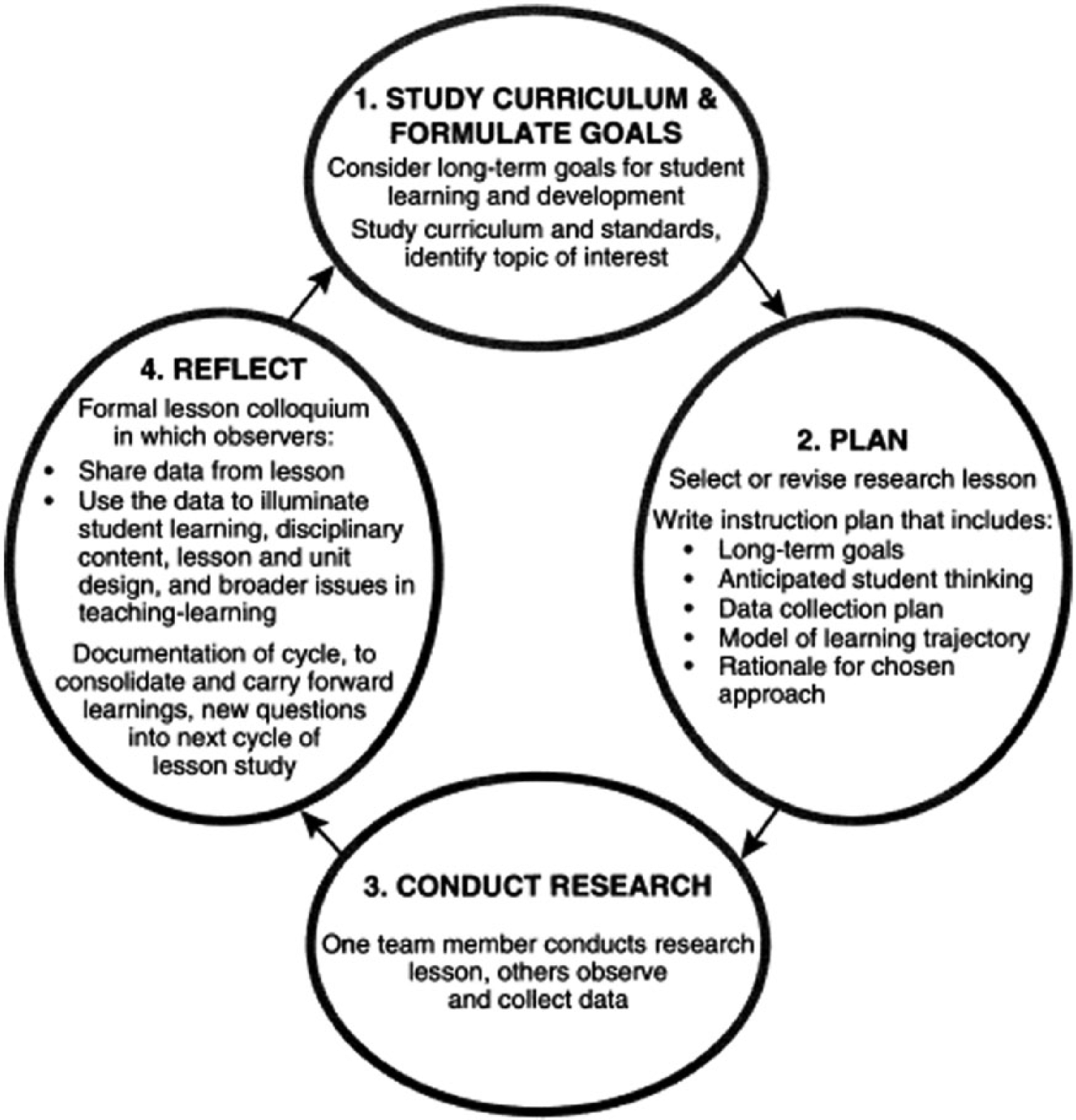
Lesson Study cycle (from Lewis et al., 2006: 4).
For non-Japanese interested in the practice, what is apparently novel here is the idea that teachers themselves diagnosis, design, and test improvements in teaching in an on-going process, rather than have those prescribed by authorities/experts outside of local contexts in a one-off manner (e.g., Choksi and Fernandez, 2004: 528; Lewis, 2002a: 15–20; Lewis, 2002b: 15–16). It is an inductive approach that stands in opposition to the deductive approaches commonly found in much teacher development elsewhere: implementation of global–regional “best practice”; expert-led trainings; evidence-based prescriptive approaches (where evidence is reduced to quantitative, universal indicators); and so on. Another appeal of Lesson Study apparently lies in its focus on collaborative interaction, rather than in efforts by individual teachers to improve their practices. The attempt to borrow Japanese practice then implicitly highlights and works against three modes of professional development that have been historically dominant, mostly in America but also elsewhere: (i) deductive, “top-down” approaches; (ii) temporary, one-off programming; and (iii) individualized, self-improvement style schemes.
A brief word about the roots of Lesson Study in Japan is in order. Several educational historians have argued that Lesson Study began when Japan “borrowed” Western education in the early 1870s. In response to an acute lack of trained personnel and learning opportunities coming at the precise moment when teachers faced the challenge of understanding and digesting a completely foreign approach to education Japanese teachers spontaneously established regional learning groups (chiiki no gakushu shudan). These were designed to:
facilitate the sharing of experiences about learning, teaching, designing effective lesson plans, and managing the classroom and school administration… [thus having] a significant impact on teachers’ professional development in the first decades of the Meiji period [1868–1912] when most schools could employ only one or two teachers (Arani et al., 2010).
It was out of these regional learning groups, most historians contend, that Lesson Study later evolved, perhaps absorbing the approach of empirically testing lesson plans from the new discourse on modern education disseminated out of new teacher education colleges (Katagiri, 1990; see also Makinae, 2010).
We find this analysis sound, but we also emphasize that it focuses merely on the rise of the structure of Lesson Study. It fails to account for groups performing similar roles to Lesson Study found across various domains of Japanese society in the pre-modern era. One salient example is renku poetry: a common practice where several poets would come together, taking turns building new haiku poems off the last line of a previous poet utterance. In an open system that required a balance of careful listening, receptivity, and creativity of the receivers, the poems would evolve around common imagery, mutually influencing and reinforcing each other in ways that eventually produced a “multiauthored poem [in which] different egos live in harmony” (Motokawa, 1989: 503–504). Another example is the Japanese tea ceremony, a social art form produced by several persons interacting together in which the “aesthetic experience” is “located not in the private minds of subjects or in the qualities of the objects but in the experience of the aida or ‘betweenness’” (Odin, 1996: 60). Still another example is Buddhist monasteries/temples committed to collective cultivation of individual practice. Just before the 1868 Meiji Restoration, the number of temples numbered some 88,000 (Umeda, 1971), although perhaps only a fraction of these would have qualified as learning groups arising spontaneously.
We hope these examples do not sound exotic. These are simply the easiest to convey concisely. Our point here is that the roots of Lesson Study go back much further than the arrival of modern education and cannot be reduced to a rational response to a lack of resources. A lack of resources in most countries leads to failure or a commandeering of scarcity, rather than a coming together; a misfit between national policy prescriptions and local realities all too often leads to inappropriate lessons or non-compliance, rather than an attempt to alter the lessons. Thus, we underscore that Lesson Study must be seen as a reflection of a deeper cultural “logic”, explaining why it shows up across many domains of Japanese society, historically as well as today. We come back to explicitly elaborate this logic further in Section IV.
How did Lesson Study move to America? (And then spread worldwide?)
To fully understand how Lesson Study migrated in America, we must look back to the 1980s and recall a highly significant shift in the larger context of American education reform. In April 1983, the Reagan White House launched one of the most trenchant critiques of public education in American history – A Nation at Risk. This report, together with international achievement test data (Trends in International Mathematics and Science Study (TIMSS)), set-off a scramble by much of the mainstream American educational research establishment to find “solutions” to the purported crisis of low student achievement, a research agenda premised on finding technical-functionalist solutions to the “achievement gap” that has arguably grown to dominate American academic research today. Given Japan’s powerful economy, prowess in science and dominant manufacturing and – perhaps most significant of all – its perceived “fit” with the ideological preferences of the Reagan administration, Japan became the major point of reference for American education reform (Rappleye, 2007, 2012).
Directly following A Nation at Risk, President Reagan instructed his top aides to undertake an extensive study of the Japanese system, later published as Japanese Education Today (1987). As part of the background research for this study, the US Department of Education commissioned a series of research papers by leading scholars. These included now familiar names in Japanese educational research – Lois Peak, John Hawkins, Harold Stevenson, and Catherine Lewis among many others – all of whom had previously written analyses of Japanese education. Harold Stevenson would later go on to publish a highly influential book, The Learning Gap (Stevenson and Stigler, 1992) with his long-time collaborator James Stigler of the University of California, Los Angeles (UCLA). That work attempted to pinpoint precisely where Japanese mathematics instruction beat the USA in measurable outcome indicators and what could be learned from the Japanese system. Later Stigler would continue the project but with a twist, one perhaps unwittingly induced by the powerful rise of the Teacher Effectiveness movement: using the 1993 TIMSS video study he turned the focus on observable differences in teaching styles.
One of his leading collaborators throughout the 1990s was Clea Fernandez (e.g., Stigler et al., 1995). Fernandez would become one of the leading advocates for Lesson Study in the subsequent two decades. In 1999, this body of work was published for a non-academic audience as The Teaching Gap, now widely recognized as the primary text that brought Lesson Study to mainstream American attention. Interestingly, the specific interest in Lesson Study by Stigler and Fernandez apparently came from Mokoto Yoshida, a young Japanese graduate student who had written a dissertation on Lesson Study at the University of Chicago, later joining Stigler’s work at UCLA: Yoshida mentioned to Stigler in 1989 that the Lesson Study might have been one key factor behind the polished lessons of Japanese teachers revealed by the videotaped lessons, but not visible to the camera’s eye (Lesson Study Research Group, 2006). At roughly the same time, Catherine Lewis, who would go on to become the leading advocate of Lesson Study in America, also took a keen interest in Lesson Study. In 1996, Lewis received a NSF grant to study Japan’s science education practices, with an explicit focus on Lesson Study as a possible reason for Japan’s superior performance. In 1998, she would later publish the first scholarly article on Lesson Study in the USA (Lewis and Tsuchida, 1998).
In a series of articles mostly published by Catherine Lewis and Clea Fernandez in outlets popular among practitioners and administrators (e.g., Phi Delta Kappan and Educational Researcher) that added details to the broad outlines sketched out by Stigler and Hiebert, Lesson Study took quickly off in the imagination of the mainstream American research community in the first decade of the 2000s. In Fall 2000 Delaware became the first state to launch a state-wide lesson study initiative with other experiments taking place in individual districts (e.g., Bellevue Washington). By 2005 lesson study was purported to be present in one district or more in some 35 states (Lesson Study Research Group, 2006). In 2010 the State of Florida (the third most populous in the USA) officially pledged, as mentioned above, a substantial part of its Race to the Top grant of US$700 million to implement Lesson Study statewide (Akiba and Wilkinson, 2015). In 2015, Catherine Lewis received a USD $2.8 million grant from the Bill & Melinda Gates Foundation for school-wide implementation of Lesson Study at three major US school districts (Oakland, San Francisco, and Chicago), with the explicit aim of assisting teachers in the subject areas of mathematics and language arts to reach the new Common Core State Standards.
This abbreviated history is important because it underscores that Lesson Study was transferred to America to address a very specific, functional goal: remedying a purported relative deficit in student achievement. Perhaps this is one reason that Lesson Study in America is more narrowly defined than the Japanese original (Fernandez, 2002; Suzuki and Nagata, 2005). In other words, Lesson Study came to America as a mere technology or – if recast in Sadler’s terms – a flower plucked out of the onto-cultural soil in which it originally grew forth in Japan. The purported causal link between Lesson Study and student achievement was a mere conjecture, albeit partially backed up by Stigler’s conclusions about superior teaching by Japanese teachers and the “fact” that Japanese students scored higher in international achievement tests. The imagined causal chain was that the practice of Lesson Study was leading to better quality lessons, not that, say, it was affecting a deeper change in the total disposition of teachers. There was no discussion in any of the materials we reviewed in our meta-analysis that hinted that cultural differences between Japanese and American contexts might be a significant factor to consider. Only when a revised and updated version of the Teaching Gap (2009) was released did Stigler and Hiebert flag, as mentioned above, “powerful cultural forces” that continued to impede reform. Lesson Study had moved to America as structural hardware, with the cultural software either unintentionally forgotten, intentionally disregarded, or conspicuously concealed.
Resistance to Lesson Study in America: four major problems
Although leading American advocates of Lesson Study often lament the cultural impediments stymying adoption in the American context, their discussion of the obstacles is heavily abbreviated, mentioned only in passing, left dangling, or – most often – utilized as an entry-point to further clarify the Lesson Study technique. We assume the reason for this is that those leading the movement have been more focused on advocating for change, rather than analyzing academically. Here we intend no criticism: on the whole these scholar–practitioners have shown great integrity in relating their findings and maintaining high academic standards. Still, we feel that the problems – what we here term “resistance” following Stigler and Hiebert (1999 [2009]) – need to be explicitly clarified, not least because it allows us to open up discussion of the deeper contextual differences. Below we summarize four major problems hinted at in the existing research but yet to be thoughtfully unpacked.
First and foremost, the literature on Lesson Study in America highlights the difficulties, often bordering on sheer inability, for many American teachers to take criticism from their peers. As practiced in Japan, peer feedback, critique, and criticism are essential components for successful Lesson Study, not only when teachers present their ideas in discussion sessions but also when they conduct public research lessons. Without critical exchange, it is rarely possible to make visible implicit assumptions embedded in particular teaching practices; without first making these ideas visible, alternative choices remain invisible (Perry and Lewis, 2008; Stigler and Hiebert, 1999 [2009]: 100–101). Fundamental to Lesson Study then is opening one’s self: the willingness to engage in self-critical reflection (Lewis, 2002a: 14–15; Lewis and Tsuchida, 1998: 51 2 ).
Nonetheless, research on Lesson Study in America suggests that many, although certainly not all, American teachers struggle with this. Catherine Lewis underscored in our interview that:
Of all the potential problems you raised, I do think that American teachers on the whole have the toughest time being critiqued. I have seen this repeatedly…. I remember an instance in which I brought Japanese teachers over to the US to comment on American practice. One Japanese teacher gave quite pointed criticism of a female American teacher who led the public lesson. The point of the critique was basically that she didn’t listen to her students, although she was trying to elicit student feedback…. Seeing her [the American teacher’s] reaction, I doubt that teacher will be participating again in Lesson Study, which is of course a shame…
Lewis’s comments suggest not only that criticism in America can lead to teachers breaking off the very relations on which Lesson Study is predicated, but also that Japanese teachers are less likely to hold back from critique. It is interesting to note here that this runs counter to persistent cultural stereotypes that would suggest American assertiveness and public honesty in contrast to purported Japanese passivity and maintenance of public harmony even at the cost of dishonesty (Finkelstein et al., 1991).
Even when relationships are not completely broken off and lesson study sessions continue, this resistance to critique manifests in the way that the language of interaction is rendered superficial: instead of substantive comments, feedback becomes banality and cursory praise. Choksi and Fernandez lament this tendency in the US sites they worked in:
When sharing their feedback about the observed lesson or examined lesson plan, [we observed that] teachers and other observers maintain politeness at all costs and offer superficial and tentative feedback rather than constructive criticism. [But] The very purpose of lesson study is to provide a non-threatening context for teachers to share constructive and concrete feedback…. In order to take advantage of this potential, participants must learn to negotiate the delicate balance between politeness and critical honesty…. Our observations of Japanese teachers have revealed that critical honesty can be delivered effectively only with politeness, concrete evidence, and precise language (Choksi and Fernandez, 2004: 524).
Recognizing the repeated retreat to politeness, the US literature on Lesson Study often emphasizes the construction of “safe environments” (Perry and Lewis, 2008) mostly through the use of explicit rules and protocols (discussed below). Another manifestation of the unwillingness to be critiqued is for US teachers to stubbornly defend one’s ideas to the last, usually by resorting to abstract arguments or advocating for the superiority of a particular teaching philosophy, with the consequence that US discussions often get “bogged down in abstract debates” (Choksi and Fernandez, 2004: 522).
A second problem hinted at in the literature is the inability for many American teachers to envisage themselves and function as a member of a group. In Japanese Lesson Study, new ideas arise through mutual interaction; innovations are created just as much from the unexpected spin-offs of different perspectives and comments as from planned transmission of individual ideas. Nonetheless, the literature suggests that American teachers seem to be locked into the idea of individual exchange, thus experiencing difficulty working together, finding means of resolution, and identifying ways to collectively move forward:
Initially, leaders had assumed that the benefits of collaboration would be obvious to participants and that collaborative skills were adequate or would learned naturally as groups worked together…[but] As lesson study expanded within the district and groups were formed from teachers unused to working together, collaborations sometimes became difficult. In some cases, disagreements about instructional ideas arose within groups that did not know how to move toward resolution; in other cases teachers avoided conflict by being “polite” (rather than honest or constructively critical) (Perry and Lewis, 2008: 376).
One contributing structural factor here is that US teachers often work alone in their own classrooms, mostly interacting only in non-academic settings such as the teachers’ lounge or sporting events, aggravating a situation that researchers describe as American teachers “minimal collaborative experience” (Lewis et al., 2006: 278; see also Lewis, 2002a: 11–12). Yet structural factors alone seem insufficient to explain why US teachers struggle with the basic requirements for group interaction: ensuring space for everyone to speak; taking an interest in the perspectives of peers; asking good questions and opening to others’ opinions; facilitating time; ensuring seating and other arrangements conducive to sharing; and becoming proficient in resolution of disagreements (Fernandez, 2002; Fernandez and Chokshi, 2004: 129–131; Lewis et al., 2009: 295–296).
A third problem frequently highlighted in the literature is the single-minded search for a “perfect lesson”; a prioritizing of ends over means. Although the Lesson Study import was predicated on improving American instruction, the goal of the practice in Japan was not to identify, once and for all, the “best” lesson for a particular curricular item. Instead, it is directed towards initiating a process of continual improvement without end (something Japanese business circles term kaizen). Nonetheless, the literature on American Lesson Study repeatedly points out the impulse of American teachers to seek “best lessons” and penchant for many groups to attempt to use Lesson Study to fine tune a single “perfect” lesson plan. For example, Lewis et al. (2006: 274–275) relates how teachers in one US site sought to use lesson study to “polish” the best lessons, with the hopes of placing a compendium of best lesson plans on the district intranet (see also Lewis, 2002b: 18; Perry and Lewis, 2008). In several other US sites, teachers assumed that “lesson study was an opportunity to showcase exceptional teachers as opposed to typical, novice, and even preservice teachers,” thus transmitting the form of a “best lesson” to those less experienced (Chokshi and Fernandez, 2004: 522). For this reason, Lesson Study advocates repeatedly warn their American readers: “we must emphasize that study lessons are not meant to be compiled into a single, unified, ‘one-size-fits-all’ curriculum” (Chokshi and Fernandez, 2004: 523). Lesson Study advocates also feel compelled to remind American practitioners that “mistakes can be treasures” (Perry and Lewis, 2008: 380), implicitly underscoring that American teachers were mostly inclined to see value solely in terms of “what works” (i.e., rather than recognizing learning opportunities even in what does not work).
In a similar vein, when Lesson Study first came to America, practitioners sought to make sure that they faithfully reproduced the Japanese “best practice” (Lewis, 2002a, b). That is, rather than recognize that Lesson Study was the crucible that would hold a collaborative, mutual search for improvement, American scholars and practitioners were repeatedly in search of the secret substance of Japanese Lesson Study; the presumption of an essential substance prompting the belief that it should be reproduced as faithfully as possible for it to produce similar results in America. This became manifest in a fixation on the laws/rules of Japanese Lesson Study and a desire for Japanese “experts” to come in and transmit the practice, a line of thought terminating in US administrators who produced packaged materials to faithfully guide Lesson Study (Akiba and Wilkinson, 2015: 88). Lewis et al. even report how “remarkably some U.S. trainers seem to believe that participation in one or two lesson study cycles qualifies them as experts who can provide definitive blueprints to others” (Lewis et al., 2006: 277). This premature expertise, belief in the expert, and the single-minded search for the “perfect lesson” can be seen as different dimensions of the same underlying problem: seeking product over process.
The fourth and final problem identified is the inability or unwillingness for Americans to open space to listen to others, wait, and keep silent when needed. Although framed as a recommendation for improvement, the following comment clearly reveals the problems observed in practice:
[E]ach observer should not comment on too many aspects of the lesson at once, so that other observers have an opportunity to share their insights… this procedure prevents one observer from dominating the feedback session and allows everyone to share insights (Fernandez and Chokshi, 2004: 133).
For mutual feedback and interaction to work, there must be space open for ideas to emerge. When someone is speaking this space is occupied. Although many Americans assume that substantive interaction is not possible without verbalization there is arguably an equally prevalent belief in Japan that verbalization is not possible without a preexisting silent space. In other words, communication properly conceived requires the interaction of language and silence, speaker and listener. Concretely, this requires a “waiting etiquette” (Fernandez and Chokshi, 2004: 133) and a suspending of the one-sided valorization of autonomy and independence (Murata and Takahashi, 2002: 1885). The inability to keep silent produced American Lesson Study interactions marred by domination of a single member, two or more participants speaking at once, and/or digression or loss of focus on the main topic (Hurd and Licciardo-Musso, 2005; Lewis, 2002b; Lewis et al., 2006).
As one further piece of evidence that the dominant themes of resistance culled from a meta-analysis of existing studies, we highlight here are representative, we reproduce verbatim below the abbreviated “Protocol for Lesson Study” (Lewis, 2002) developed by Catherine Lewis and used extensively in American Lesson Study (Figure 2). The extended version of this Protocol includes a suggested list of “norms” that Lesson Study advocates suggest all groups should adopt to ensure effective practice, one in which the “ground-rules” for productive and supportive interactions are elaborated.
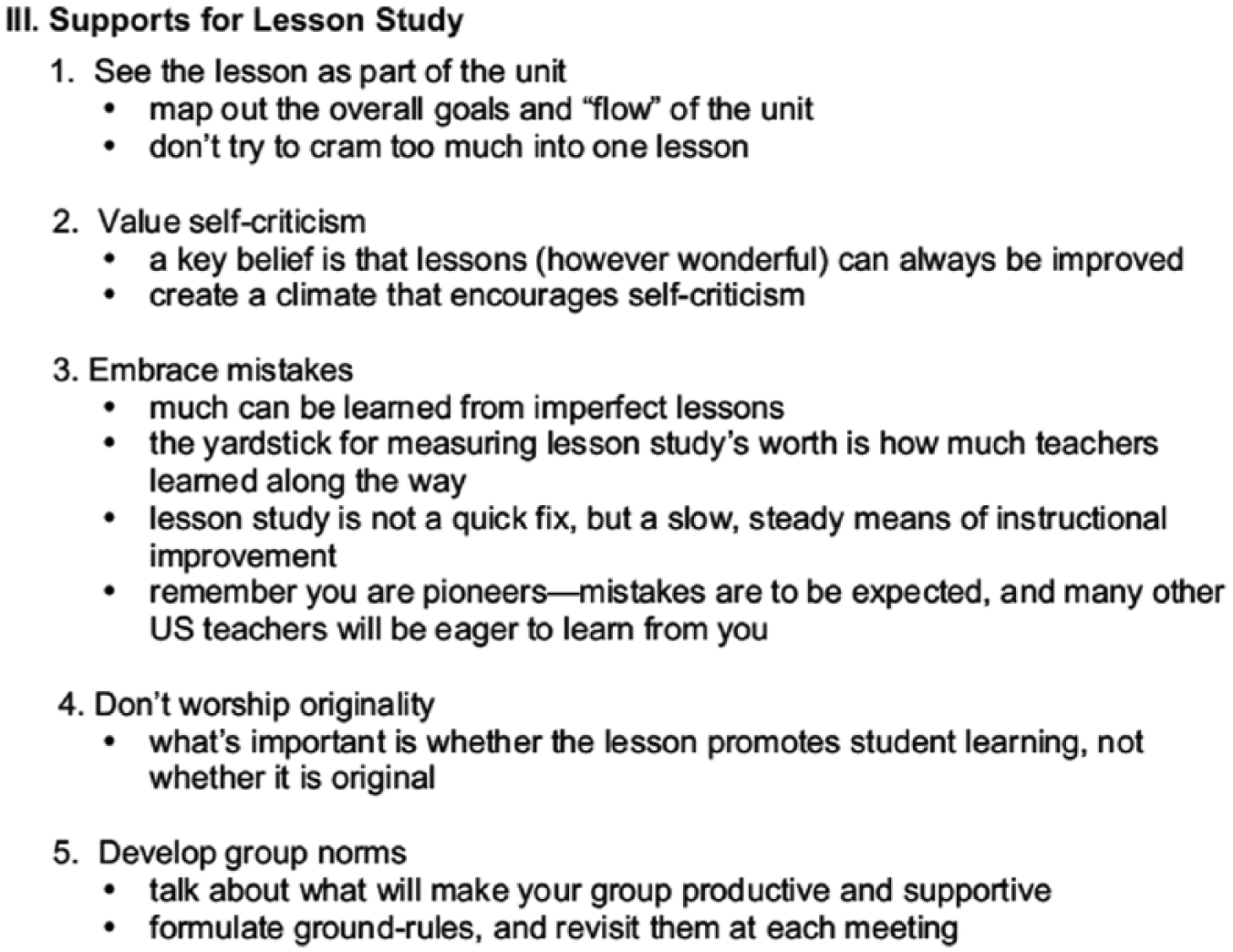
“Protocol for Lesson Study” (Lewis, 2002b).
As Catherine Lewis explained in our interview, this Protocol was deemed necessary in the American case to prevent the types of behaviors that would derail Lesson Study.
Other American Lesson Study advocates also felt it necessary to develop a Lesson Study Protocol. These place even more emphasis on taking turns, preventing domination by one member, and the necessity to “absorb feedback in a reflective manner” (Chokshi et al., 2001). Fernandez and Chokshi comment that:
The goal of a discussion protocol is to formalize procedures that minimize the nervousness and potential for hurt feelings that such feedback activity can provoke. Such a protocol, however, it not meant to make the feedback less reflective or less critical; instead it is meant to help make the process more constructive and efficient (Fernandez and Chokshi, 2004: 132).
We note that all four themes we highlight above are covered by these protocols, underscoring the persistent and widespread nature of resistance to replicating the Japanese practice in America. As Lewis confirmed, explicit protocol was necessary in America but not in Japan because the wider social and cultural norms make such an explicit list redundant. That is, these norms are already embedded in the cultural context of Japan.
Understanding Lesson Study deeply: concepts, philosophy, and parallels
Is there anything that connects the four problems outlined above? Why do not the same problems arise in Japan? In this section, we put forth a hypothesis about the source of the differences. Rather than do this through merely introducing Japanese thought and thereby risk incomprehensibility and incommensurability, we instead pursue a three-fold strategy aimed at bringing Japanese ideas as close as possible to readers (who we assume to be operating on different onto-cultural assumptions). First, we present a basic conceptual schema to clarify the differences, what we term System I and System II. Here we briefly pause to raise the possibility of the historical continuity of the basic onto-cultural “grammar” we describe. Second, we introduce Japanese philosophers who have clearly recognized and provided insights on the System II position. Third, we “match” these Japanese philosophical ideas with prominent Western thinkers, primarily Edmund Husserl and Karl Popper, to illustrate that such ideas exist even in the West, albeit have not become socially pervasive enough to rework the wider onto-cultural fabric. We here sprinkle in brief insights from recent psychology and neuroscience research, imagining that this will further help de-mystifying System II ideas for skeptical readers. Each of these three parts may be seen as different doors that seek to take the reader to the threshold of the same basic set of ideas, a place we hope will bring the different onto-cultural foundations of Lesson Study more clearly into view.
Conceptual schema
To understand our hypothesis about the basis of the four problems above, it is perhaps useful to begin by conceptualizing two basic systems, what we call here System I and System II (Figure 3). The three underlying assumptions of System 1 are: (i) a “best” pedagogy exists in advance, somewhere “out there” beyond individual teachers; (ii) an expert enjoys privileged knowledge that allows him or her to access this one best pedagogy; and, as consequence, (iii) it becomes efficient to transmit this best pedagogy from this expert to individual teachers. As such, communication between teachers is not required for System I to function (see Figure 3a). Such a model makes it possible to synthesize and understand the first three problems described above: unwillingness to be critiqued (as colleagues cannot know any better than myself); inability to envision oneself as part of a group (no group is necessary); and inability to keep silent and listen to others except in the face of the expert (the goal is getting to the ‘best’ practice efficiently, that is, through the quickest possible means). The fourth problem identified above – the belief in the possibility of a preexisting “perfect lesson” that works in all cases – is the basic assumption that anchors System I.
Contrast this with System II, a conceptual schema that helps clarify the original Japanese practice. System II (i) does not assume that one “best” pedagogy exists “out there” and thus it is impossible for someone such as an expert to know what the “best” pedagogy is; and (ii) individual teachers must share their experiences to jointly construct a pedagogical model suited to the specific conditions they find themselves in. The three key assumptions of System II are that: (a) all pedagogical practices are tentative; as such (b) these practices must be subject to revision as new experiences/situations emerge; and (c) this can only be done through mutual interaction. Figure 3 juxtaposes visual representations of the two schemas. Note that for the Japanese system, the individual teachers are drawn with dotted lines to represent a less fixed identity, one that places a heavier emphasis on relations rather than individuals (see Komatsu and Rappleye, 2017a, for a related discussion). We note we are limited by two-dimensional figures: Figure 3a is intended to show hierarchy, while 3b intends no hierarchy among teachers.
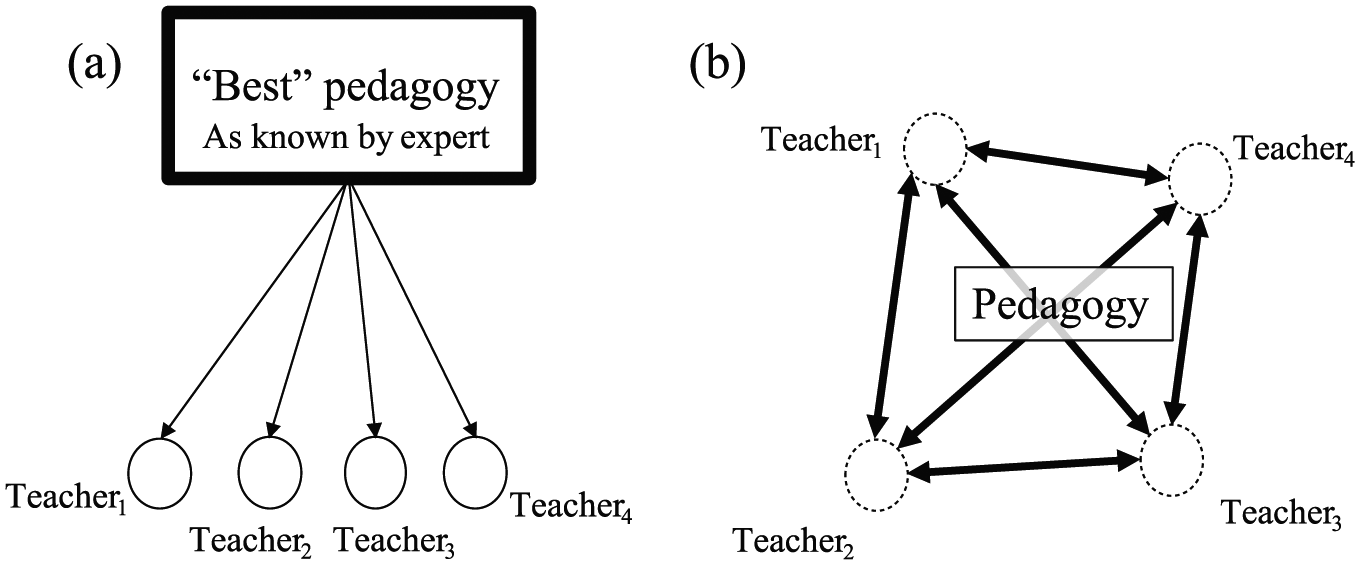
Schematic drawing of: (a) System I; and (b) System II.
A hypothetical example supplemented with visual diagrams (Figure 4) will help explain System II further, particularly the temporal dimension. Suppose there are two teachers formulating a lesson, each with their own stock of experiences (E1 and E2). Through sharing their experiences, they construct a model (MA) which incorporates and explains disparate experiences (E1 and E2). If a newcomer comes to take part in this community (E3), MA is necessarily revised to accommodate his/her experience and a new model for practice (MB) is constructed (Figure 4a). Revision of the model for practice necessarily and always happens when a new participant joins the community (Figure 4b). Importantly, revisions also take place when the members of the community are fixed. Why? Because each teacher continues to accumulate new experiences. For example, suppose two teachers, who respectively had E1 and E2 previously, now have new experiences (E1’ and E2’). The original pedagogical model (MA) needs to be revised so as to accommodate E1’ and E2’ (MC, Figure 4c). Revision of the model thus has no terminus, even in cases where the members of the community remains fixed.
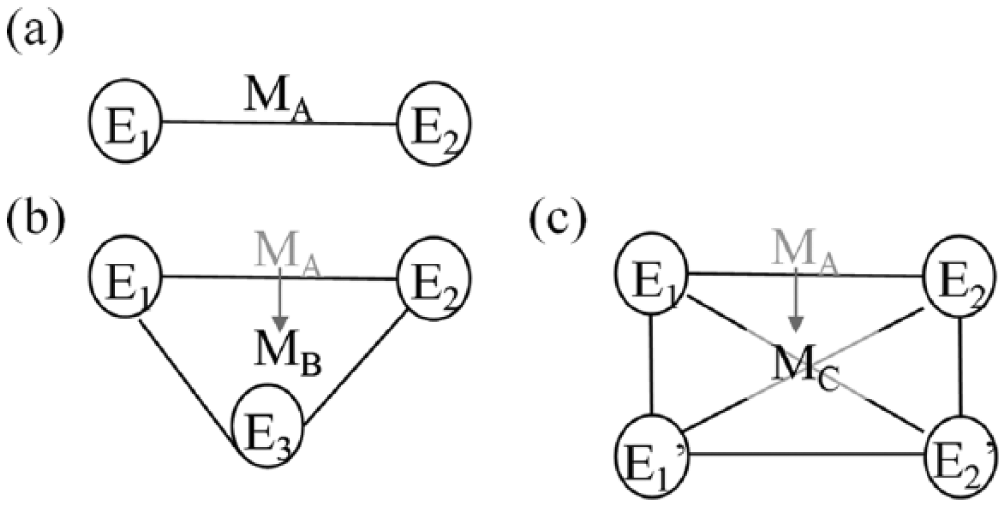
How models are shaped and reshaped in System II.
Although space limitations do not allow us to elaborate deeply, future research would do well to explore the long history of continuity that underpins the basic “grammar” of System I, not just in the domain of teacher development but across Western thought in general. Three familiar examples are Platonic Form, the Christian God, and the Truth of the modern paradigm of science (Komatsu and Rappleye, 2017b). Platonism assumed that: (i) Good existed in advance; (ii) philosophers could come to know the Good; and (iii) philosophers should enlighten the citizens, gradually shaping the polis in accordance with this higher Good. Although most Western scholars still view Christianity as a decisive rupture from Greek thought, the “grammar” of Christianity emerges when the philosopher is replaced by the priest and, as someone once insightfully quipped, the ‘o’ is dropped: Good becomes God. It is precisely this continuity that sparked one prominent Western intellectual historian to remark: “Christianity is Platonism for the masses” (Nietzsche, 1886, [1998]). Similarly, the modern science model emerges when Good–God is in turn replaced by the Truth of the objective world and the philosopher-priest by the scientist. This vision of science is most appropriate when describing Newtonian science that dominated the 17th–19th centuries (see Burt, 1932 [2003]; Whitehead, 1925 [1967]; see also Weber, 1922 [1963]). We note that this model does not depict how contemporary science functions today, a distinction elaborated below.
In a similar fashion, the “grammar” of System II can be found at various points and across multiple domains in Japanese history. Restricted from presenting examples (in any case unlikely to be familiar to most readers) we note that it is the repetition of System II that has prompted several prominent comparative-historical sociologists to view Japan as “non-Axial” (Eisenstadt, 1996; Ito, 1985; Sonoda 1999; see also Arnason, 1997: especially 61–74). Non-axial is a technical term which means that Japan never obtained a structure of a belief in an unchangeable Good, God, or Truth; and never subscribed to the belief in entities transcending the bounds of the human community constructing it and thus in things “achieving” an independent ontological reality. As Eisenstadt summarizes in his monumental review of Japanese history and culture:
Any institutional arena – political, economic, family and cultural creativity, or individual, group or organizations – has been defined in terms of its relation to the social nexus in which it was embedded…The distinctive characteristic…[is] that they were not defined in relation to some principles transcending them. Thus, social actors, individuals or institutional arenas have been defined in their relation to other such actors not as autonomous ontological entities, but in terms of their mutual interweaving in common frameworks or contexts. Concomitantly, the major arenas of social action have not been regulated above all by distinct autonomous, legal, bureaucratic or “voluntary” organizations or rules – even if such organizations have developed within them – but mostly through various less formal arrangements and networks which have in their turn usually been embedded in various ascriptively defined, and continuously redefined, social contexts (Eisenstadt, 1999: 2–3).
A more detailed elaboration of the relationship between this alternative “grammar” and alternative educational theory, institutions, and practice found in Japan is a much-needed area for future research.
Japanese philosophical depth
But does this conceptual schema simply approximate empirically observed differences on the surface? Or does it reflect a tradition of thought that resides at a deeper level? We continue arguing the latter, pointing to successive generations of Japanese philosophers who have worked to explicate the “grammar” constituting System II (e.g., Hamaguchi, 1982; Kimura, 1972; Kumon, 1982; Nishida, 1911 [1947]; Noya, 1995 [2005]; Watsuji, 1934 [2007]).
Initiating this tradition in the modern era, Nishida Kitaro in his most famous work entitled An Inquiry into the Good (Nishida, 1911, [1947]) rejected the idea of a transcendent Good, God, or Truth. In contrast, he elevated “subjective” 3 experience to be the key philosophical puzzle, seeking to understand how human beings lost touch with pure experience, became caught up in dualist thinking, and thus came to harden subjective experiential moments into unchangeable “real” entities (e.g., the Good).
Building on Nishida’s insights, Teturo Watsuji focused more on relations between persons, rejecting the very premise that ethics could ever be built atop a “right” or “Good” body of knowledge carefully smelted in the furnace of Reason by philosophers, priests, or scientists. Instead, Watsuji argued that ethics began when individuals realized they existed only “in between” (Watsuji, 1934 [2007]), always in relation to one another and always inextricably inter-connected in the encompassing spatial climate (fūdo) from which they arose. Radical collective interdependence at the subjective level then, rather than individual independence through realist attention to mere physical bodies alone. For Watsuji, authenticity of oneself was not compromised by being with others. Instead being with others was precisely what made the “self” authentic (see Sevilla, 2015, 2016).
Extending this prewar thought, three prominent Japanese thinkers in the postwar era further elaborated the idea that “self” only arises at the intersection of ever-changing experience and collective intersections (Hamaguchi, 1982; Kimura, 1972; Kumon, 1982). Hamaguchi succinctly rearticulates the idea of a radically contextually self:
[F]or the Japanese, ‘self’ means…. the living space shared between himself and the other person with whom he has established a mutually dependent relationship. The reason why the self-consciousness of the Japanese is formed this way is because self and others are in a symbiotic relationship, and that they regard their own existence as largely dependent on the existence of others (Hamaguchi, 1982: p. 142).
Although some readers might rightly be put off by Hamaguchi’s suggestion that all Japanese share the same idea (one common feature of nihonjinron style excess), our point here is not to slight diversity but instead suggest that System II places primary emphases on the relationships and shared experience. It is not that relationships do not exist in System I but that these are not the primary point of emphasis. In other words, relations come first, with individuality (and thus diversity) a derivative of these deeper bonds. Here space, experience, and self are all relationally defined, highly social in character, and thus fluid, open, and constantly open to change.
Prominent philosopher Ohmori Shozo adds the final piece when he argues that within such a system the World is not something that is taken to exist a priori, but is instead “socially produced by the community utilizing language” (Ohmori 1995 [1996]: 217). Not language as an objective tool or a never ending dualistic regress but a co-construction that actually brings the World into being.
Higaki (2015) among others has highlighted the deep continuity between Nishida and Ohmori. When we line up Nishida, Watsuji, Kimura, Kumon, Hamguchi, and Ohmori, we can thus support the notion that the System II schema is not simply an abstraction from observed difference, but a reflection of whole body of thought that manifests in the practice of Lesson Study: rejection of an absolute Good; rejection of privileged access; preeminence of experience; and mutual construction of the World (and self) through inter-action.
Parallels in Western thought
That these “Japanese” ideas will not be completely unintelligible to our readers, underscores the fact that similar ideas exist in Western thought. Most prominent among these are the phenomenology of Edmund Husserl (1913 [1982]) and the alternative science paradigm of Karl Popper (1934 [2002]).
In Husserl’s phenomenology, the “objective” world is assumed to be unknowable, corresponding to the first assumption of System II. Arguing that everyone perceives the world subjectively through his/her own consciousness, Husserl asserted that objectivity is “achieved” when people reach agreement amongst themselves about these perceptions. This corresponds to the second assumption of System II. A simple example helps clarify Husserl’s basic ideas. Suppose there are three people sitting around a table and there is a flower on the table. When all the three perceive the flower as a real one (i.e., not an imitation), this agreement in their perception leads them to assume that their perception is objective. However, if two perceive the flower as a real one but the third an imitation, their perceptions cannot achieve objectivity. Husserl argued that this disagreement in perception incites them to accumulate further experiences. They might next touch the flower, at which point all three perceive the flower is made of plastic. Now, Husserl argued, they will reach the conclusion that their present perception is objective. The key point is that each participant has a tentative model for explaining their experiences and that the model is revised through communication between participants and accumulation of her/his own experiences. Only then is objectivity achieved, leading to subsequent action.
The model of science proposed by Popper (1934 [1982]) bears close affinities to the assumptions of System II, paralleling phenomenology in many respects. Popper, like Nishida, rejected the notion of Truth which exists a priori, one static and not subject to revision. Popper believed that the history of science clearly demonstrated this basic fact. To confirm any given hypothesis, Popper pointed out that it would be logically necessary for scientists to examine an infinite number of cases. Yet, no scientist is capable of performing this task; they are restricted by time and space to testing a finite number of cases. This finite number of cases would always be insufficient to establish Truth, but sufficient to falsify an existing hypothesis. Thus, Popper advocates that scientists actively exchange their cases, in an effort to falsify an on-going series of hypotheses. Only hypotheses which have survived this falsification process would be regarded as a tentative truth, although these tentative truths too must continually face revision based on new cases. This constructive nature of truth (small “t”) approximates the assumptions of System II. We note here that even Albert Einstein, inspired by Ernst Mach who was one pioneer of phenomenology (Husserl built on his ideas), rejected the notion of Truth and regarded scientific concepts as useful in ordering experiences, but never fixed (Einstein, 1916: 102). Some readers might also note that prominent American pragmatists such as John Dewey (1938) and George Herbert Mead (Mead and Morris, 1934) held similar ideas about the tentative, inter-relational nature of truth.
But do these close parallels suggest there is nothing divergent in Japanese thought? Is the only difference the degree of socio-cultural pervasiveness? We do not believe so. Although we offer Husserl and Popper as familiar faces to bring readers closer, we believe these thinkers still stop short of the radical application of phenomenology carried out by many Japanese philosophers: turning the phenomenological insight back around to rewrite the very meaning of ‘I’. It is only this more radical approach, we believe, that makes it possible for Lesson Study to achieve its full potential. To explain we return to the example of three people sitting around a table gazing at the flower.
Suppose that “I” am one of the three. The table positioned in front of me is something I perceive. The flower is as well. Even agreement among the three persons is something I perceive. We here notice that the qualification “I perceive” is completely unnecessary and redundant, because everything is something that I perceive. In other words, there is an equivalence between “I perceive” and “the world is”. That is, “I” (or specifically my consciousness) exists interdependently with the world, a world which includes others. Because of this interdependence, “I” as a participant of the community do not have strong consistency, somehow independent of the others. Instead “I” responsively changes with the changes in the world and others. When one comes to understand this concept of interdependence between “I” and the world inclusive of others, one can effectively partake in the experiences of others. That is, this interdependence among participants is the oil that lubricates communication in System II. This is not simply instrumental exchanges between individuals but loss of “I” that signifies participation and co-construction, not mechanical exchange.
We recognize that this concept of self might seem mystical, mystifying, or incommensurably foreign for those situated in predominantly System I contexts. This is because System I assumes, as part of the basic “grammar”, the independence of individuals, those who fix their identity against the unchangeable Good, God, or Truth. However, we emphasize that some thinkers who never left System I onto-cultural contexts were able to reach the same concept of “I” or self, by digging deep enough philosophically. One example is Ludwig Wittgenstein, who wrote that “solipsism strictly carried out coincides with pure realism” (Wittgenstein, 1922 [1961]: 5.62), meaning that when we assume that I am an independent entity and the only certainty is that I exist, the very notion of “I” becomes pointless. “I” am therefore interdependent with the world as “the world and life are one” (Wittgenstein, 1922 [1961]: 5.621). Another example is Emmanuel Levinas who linked the basic ideas of phenomenology to notions of self, Other and teaching-learning, writing that:
To approach the Other in conversation is to welcome his expression….it is therefore to receive from the Other beyond the capacity of the I, which means exactly: to have the idea of infinity. But this also means: to be taught…Teaching is not reducible to maieutics; it comes from the exterior and brings me more than I contain (Levinas, 1961, [1969]).
These insights may well parallel the depths of Japanese thought we are attempting to highlighting. Future comparative research is needed. One model for such work might be Intimacy or Integrity: Philosophy and Cultural Difference (Kasulis, 1998), where intimacy becomes a sobriquet for System II and integrity for System I. 4
Still fearing that even this might still seem mystical or mysterious in a world were integrity reigns, we note that a prominent North American neuroscientist has recently reached the same conclusions empirically. Hood (2012) argues “neuroscience … has found little evidence for” the existence of self, which is “an essential entity at the core of our existence that holds steady throughout our life”. Instead, neuroscience has found much evidence “to support bundle theory”, which assumes that self is just a bundle of our perceptions and therefore confirms the interdependent nature between self and the world perceived. We would add this world would necessarily include others.
Japanese onto-pedagogy: a brief reconceptualization of Japanese schooling practices
Despite our explicit appeals otherwise at the very outset, we expect that some readers will still misread our abbreviated review of Japanese history and philosophy as an argument that Lesson Study “works” in Japan because of some essential onto-cultural fabric of ancient, mythical, or mysterious origin. In this section we dispel that idea by showing how these deep dispositions are not innately gifted to the Japanese, but consciously shaped and reshaped through education in each generation through specific schooling practices. This is in line with recent trends in anthropology problematizing natural and innate versions of culture (Anderson-Levitt, 2012). We call these practices onto-pedagogy, noting that such practices find few parallels in American schools. In what follows we review both the onto-pedagogical practices and the structures that support practice, at each of three stages of Japanese compulsory schooling: preschools (0–6 years old); primary schools (6–12 years old); and middle schools (12–15 years old). Our limitation to these three levels and our brevity reflects the constraints of space. 5
The onto-pedagogical practices found in Japan reflect the following two principles, ideas which mirror and promote the System II structure: (i) teachers prepare non-hierarchical conditions in classrooms which will promote students’ spontaneous participation and social interaction between student and student rather than emphasizing student and teacher; and (ii) teachers encourage students to build an attitude of interdependence with their peers. Our account is based on three decades of sustained, highly rich ethnographic work of Japanese schools by both Japanese and foreign scholars (Cave 2004, 2007, 2016; Lewis, 1995a; Tobin et al., 1991, 2009; Tsuneyoshi, 1992, 2001). We attempt to stitch together a coherent set of approaches from what has been, to date, a set of largely unconnected studies. We purposefully use mostly English-language literature so that follow-up reading is possible for non-Japanese speakers.
Preschool
Structure
One factor promoting non-hierarchical conditions in Japanese preschool classrooms is the low ratio of number of teachers to students (Boocock, 1989; Hayashi et al., 2009; Tobin et al., 1991, 2009). Low teacher/student ratios reduce the possibility of over-intervention by teachers. Tobin et al. point out that most Japanese educators believed that over-intervention by teachers would impede spontaneous interaction between students, with one of his Japanese informants commenting: “when the class size falls below twenty children per teacher, it becomes a kind of danger zone, where there are … too few [children] to make it clear … that it is up to the children to handle their own problems” (Tobin et al., 2009: 120). Over-intervention by the teacher would reinforce the idea of a hierarchical difference between teachers and students, where teachers could be called upon to adjudicate “right” and “wrong” like an expert or judge (Hess and Azuma, 1991; Tobin et al., 2009). Seen from this angle, the low teacher/student ratio is thus not an unfortunate result of poor funding (although we do not claim that funding is adequate) but a rather seen as a desirable condition for Japanese educators.
One structural factor encouraging the interdependent attitudes of students is to promote activities with mixed-aged groupings (Che et al., 2007; Izumi-Taylor and Ito, 2015; Koizumi et al., 2013; Tsuboi and Yamaguchi, 2005). Here Japanese preschool students gain experiences interacting with those of different abilities and cognition. In some schools, older students even have a chance to feed toddlers and help them walk (Tobin et al., 2009: 103). Although this mixed-age grouping is not found in every school in Japan, it appears to be an ideal, with most Japanese educators attributing positive outcomes to the practice, particularly cultivation of the responsiveness and non-verbal empathy to the feelings of others (Che et al., 2007; Izumi-Taylor and Ito, 2015; Tobin et al., 2009). These are the starting points for fostering interdependent dispositions among both older students and younger students (Tobin et al., 2009: 114). We note that mixed-aged grouping is virtually absent in American preschools where the emphasis is on “developmentally appropriate practice”, that is, a heavy emphasis on the neuro-cognitive development of individuals as individuals (Che et al., 2007; Suzuki and Boomer, 1997).
Practice
Complementing the non-hierarchical structure of preschools is the non-intervention approach of many Japanese preschool teachers (Che et al., 2007; Lewis, 1991; Peak, 1989; Suzuki and Boomer, 1997). When arguments, disagreements, and even fights break out Japanese teachers try not to intervene. This was memorably depicted in the now famous Preschool in Three Cultures study (Tobin et al., 2009: 100–102). It captured an impassioned row over a teddy bear by three girls. While one girl holds the bear, another younger girl attempts to snatch it away. Thereafter two additional two girls intervene, soon finding all four girls on the floor in a pile of twisting, pushing, and pulling bodies. Tobin et al. highlighted that the teacher was aware of what was happening, but she did not step in to intervene. The teacher subsequently explained:
If I think a fight, such as this one … is unlikely to result in anybody getting hurt, I stay back and wait and observe. I want the children to learn to be strong enough to handle such small quarrels… If it’s not dangerous, I welcome their fighting (Tobin et al., 2009: 111).
Significantly, most Japanese educators who later watched the same video endorsed this teacher’s approach (Tobin et al., 2009: 108), suggesting widespread cultural practice. Just as significantly, American preschool teachers were much more likely to critically disapprove of this non-interventionist approach.
Another practice that encourages interdependent attitudes is attempts by Japanese teachers to “teach” students, usually through encouragement, to be sensitive to other people’s thought and feelings (Hayashi et al., 2009; Peak, 1991; Tobin et al., 2009). Teach may not be the right word here but instead “empathize with”. Tobin et al. (2009) highlights one case in a Japanese preschool in which the classroom teacher intervened uncharacteristically in an argument between boys that looked like it might lead to physical harm. The teacher first confirmed what happened among them and then made them apologize to each other. But the key focus of her intervention was making the boys become aware of and express the sadness that comes from interpersonal distance resulting from such fights (Tobin et al., 2009: 135). This priority on empathetic understanding over compliance with abstract rules is confirmed by numerous other studies (e.g., Shimizu, 1999: 77). A solution was reached then not by segregating the boys but encouraging them to recognize and reconstruct the close, emotionally shared relations.
Surprisingly for many Western scholars, this approach is also frequently applied when forging relations with non-human elements (Inagaki and Hatano, 1994; Tobin et al., 2009). Tobin et al. (2009) again capture this, giving the example of a preschool teacher who while circulating the lunch room discovered that many of the children had finished eating their meat and rice and dessert, but left their carrots untouched appealed to the class: “Poor Mister carrot! You ate Mr. Hamburger and Mr. Rice, but you haven’t eaten any of Mr. Carrot. Don’t you think he feels sad?” (Tobin et al., 2009: 137) Preschool students are here encouraged to somehow imagine even the feelings of Mr. Carrot. This practice contrasts with American preschools where verbalization is encouraged and the emphasis is placed on eliciting rational, personal responses from students about why particular actions are undesirable according to general principles (“it is not good to hit others”).
Elementary school
Structure
One key factor ensuring non-hierarchical relations in Japanese elementary schools are conditions and policies of non-segregation, tracking, or ability grouping (Lewis, 1995b; LeTendre et al., 2003; Tsuneyoshi, 1992, 2001). Japanese elementary school classes and in-class activities include students of unequal academic abilities. Teachers tend to view this variation in academic ability not as an obstacle, but as a resource for improving students’ academic abilities and social capabilities (Lee et al., 1995; Lewis, 1995a; Stevenson, 1991). Cave (2007: 26) relates teacher interviews where Japanese teachers explicitly cite variability in academic ability as opportunities for students to learn from one another. The belief that more able students can learn something from interactions with less able ones highlights a belief that cognitive gains by individuals are subordinated to lessons about the interdependent nature of learning.
Another factor to ensure non-hierarchical conditions in classrooms is the use of small groups (Lewis, 1995c; Lee et al., 1995; Tsuchida and Lewis, 1995; Tsuneyoshi, 1992, 2001). These groups called han typically comprise four or five students. The use of small groups, of which members are fixed during a semester for approximately three months, facilitates students of all abilities in expressing their opinions to other members in the same group. In group activities, leaders are strongly encouraged to identify the merit of each member and reflect it in some way in the final process/product (Mashio, 2010; Matsuda, 2013). Small groups further intensify the already interdependent lessons of the larger classroom, as students are forced to interact more frequently whilst in small groups and then learn to readjust to new groups at frequent intervals.
The same han groups are used for a range of non-academic activities as well, such as daily cleaning and lunch serving. In most of these non-academic activities, direction and intervention by teachers are minimized. Students are expected to achieve the goal without the authority of teachers. Feedback and adjustments occur based largely, although not solely, on the reactions of the larger group, that is, how lunch is served (Cave, 2007; Lewis, 1995b, c). In school cleaning, each group has a designated area to clean up (e.g., classrooms, corridors, and the entrance hall), and all areas of the school are cleaned by the cooperative efforts of all students.
By extending to non-academic activities, the implicit message is that interdependence is crucial for all aspects of life. Small group oriented activities certified by the larger groups reinforce non-hierarchy and interdependence. In contrast with Japanese elementary schools, researchers have pointed out how American elementary school groupings are far more tentative (short term), directed towards academic goals, and tasks such as cleaning are allocated to specific individuals rather than small groups (Tsuneyoshi, 1992, 2001). 6
Another factor encouraging interdependent attitudes of students is the use of a range of school events, such as sports day and overnight excursions. These events constitute approximately 30 school days among 195–240 school days of a year (Lewis, 1995a, b). Japanese teachers look upon these events as crucial resources for changing students from mere classmates to nakama: “people who help one another, are concerned for one another’s welfare, and share experiences to effort and emotion as the group works towards a common goal” (Cave, 2007: 63). Relations between nakama members are not extrinsic (i.e., not based on personal benefits or preference) but intrinsic. The annual Sports Festival held in all schools across Japan is one activity where nakama relations are fostered: students start preparing the sports festival months in advance and since sports festival events focus primarily on team events, students are forced to practice together for months in pursuit of a common goal (Akada, 2014; Cave, 2007; Shimojo and Hirose, 2015). The most symbolic event of the sports festival is the performance of team gymnastics usually performed by sixth graders (final year in elementary school). In this event, students create various structures, such as pyramids, fans, and towers, using their bodies. In creating pyramids, stocky students take the role of the foundation and agile students climb up upon them. Each student thus plays an appropriate role to create something larger than themselves. Students are expected to learn interdependence physically and symbolically through such events (Akada, 2014; Cave, 2007; Ogawa, 2011 Shimojo and Hirose, 2015).
Practice
One factor ensuring non-hierarchical conditions in elementary classrooms is the purposeful adoption and stressing of non-expert role by the classroom teacher (Lee et al., 1995; Stigler et al., 1995; Tsuchida and Lewis, 1995). Cave (2007) found that teachers he observed tended to initially engage students by explaining that they were in a joint exploratory study. Such sessions are marked by teacher expressions and utterances that diminish the impression that teachers know the answer in advance (Cave, 2007: 144). Such expressions and purposefully passive stance of the teacher foster a classroom environment in which students assertively express their own opinions and continue to question even after a tentative solution has been reached. It is also often observed that Japanese teachers do not give an evaluative feedback to an idea proposed by a student, but s/he lets other students evaluate that student’s idea (Murata and Fuson, 2006; Stevenson and Stigler, 1992).
This pursuit of non-hierarchical conditions is observed in non-academic activities as well. An illuminating example is hansei or reflection (Lewis, 1995b; Tsuneyoshi, 1992, 2001). Although a proto-form of reflection is observed even at a preschool level, it becomes more frequent and formalized at an elementary school level. For example, members of small groups are often given an opportunity to reflect on the quality of cooperation after group activities such as a science experiment and cleaning (Lewis, 1995b). Students are expected to evaluate their performance by themselves and to hear others’ opinions on their performance, just as teachers are expected to do so in a lesson study group (Arani et al., 2010; Doig and Groves, 2011; Lewis and Tsuchida, 1998). The classroom teacher tends to refrain from expressing her/his opinion at the end of these reflections, sensitive to the fact that it will be mistaken as authoritative and work against ensuring non-hierarchical conditions in classroom discussion.
Reflection is even used to solve serious problems such as students’ misbehavior, particularly behaviors that work against the interdependence. These behaviors include formation of cliques by students and bullying (Cave, 2007; Ohta and Ishida, 2009; Sakanishi, 1997). Teachers often submit such a topic to the whole-class reflection session for deliberation, instead of resorting to individualized counseling or remedial action. In the whole-class reflection session, students are expected to express their own feelings and understand other students’ feelings. The underpinning idea of using this approach is that problems concerning the interrelations/interdependence are only solved fundamentally by using an approach based on students’ interdependence (Cave 2007: 81). Importantly, such an approach finds support not only by teachers but also by students: when Cave (2007: 67) asked 17 students in a class whether they preferred the whole-class reflection approach to solve a problem about students’ misbehavior or an individual-counseling approach, all but one selected the whole-class approach.
Significantly, interdependence is not only emphasized in classroom practices, but also in primary school textbook content (Cave, 2007; Gerbert, 1993; Tomo, 2012). Particularly in Japanese language textbooks, there is a heavy emphasis on the interdependence of all beings, including human beings. One example is the frequent inclusion of the poem “Ezo Pines” (Kanzawa, 1986). The poem spotlights the specific regeneration pattern of Ezo Pine trees (Picea jezoensis): when an old Ezo Pine tree dies and falls, the fallen trunk provides a nursery for seedlings to grow up within. The poem depicts this interdependence between old trees and seedlings, analogous to interdependence between old and young in society. The poem reads:
Night in the forest. The Ezo Pines stand gazing up at the stars. They stand where they fell as small seeds. A hundred – two hundred – three hundred years, they continue to stand. And then one day, these trees too will topple. Upon them seeds will fall, and new life grow up. From those that have grown old to their successors, life is passed on. While the world remains (cited in Cave, 2007: p. 93).
Other poems or stories of interdependence in textbooks include “Making Way for Young Sprouts” (yuzuriha, Kawai, 1948), “To Live” (ikiru, Tanikawa, 1971, [1989]), “Dawn Is Passed Around the World” (asa no rirei, Tanikawa, 1968, [1993]), and “Life of the Ocean” (umi no inochi, Tatematsu, 1992).
Middle school
Structure
The basic structures of Japanese middle schools are very similar to those of Japanese elementary schools (Cave, 2016; Fukuzawa, 1996; Le Tendre et al., 2003): no overt ability tracking or segregation, the use of small groups, mutual cleaning, lunch serving, and school events (i.e., sports festivals and overnight excursions). Where the differences do lie are in: (i) a wider variety of school events available; (ii) the greater “enthusiasm” that attends school events; and (iii) the centrality of club activities (bukatsu).
These three features of Japanese middle schools contribute to alleviating what is seen as a detrimental rise of hierarchy among students frequently occurring at this age, one that carries the potential of fragmenting the class. More specifically, students become more sensitive to individual academic performance after enrollment in middle schools, as they are anticipating the important high school entrance examinations in their third year – a fork in the academic road that can considerably affect one’s life course (Cave, 2016; Fukuzawa, 1996). This increased attention to academic achievement can lead to a rise of hierarchy among students according to academic performance (as well as those against it). Because entrance examinations are based on competition among individuals, there is an added danger of fragmentation. To combat this, middle schools prepare a wider variety of school events and club activities as compared with elementary schools, and teachers emphasize the importance of student participation in school events and club activities (Cave, 2016; Sumiya and Muto, 2001). Cave (2016) reports interviews with a middle school teacher which emphasized that school events were even “more important than study” (Cave, 2016: 69).
Practice
Practices in Japanese middle schools are basically continuous with those in elementary schools. Although individual academic achievement becomes increasingly important and teachers tend to use lecture-style instruction in middle schools, the use of group work in students’ academic learning is still present (Ohishi, 2014; Schaub and Baker, 1991). Despite the continuity between primary and middle schools in Japan, club activities are a factor that differentiates primary and middle schools clearly (Cave, 2004; Kobayashi, 2012; LeTendre, 1999). According to one nationally representative questionnaire survey conducted by the Japanese Ministry of Education (1997), 91% of middle school students participate in club activities. Students, on average, participate in club activities six days a week. The average time for club activities is two to three hours each and club activities are performed even during long holidays. The time spent for club activities is thus almost comparable to that for academic classes. On the other hand, club activities are generally unavailable in primary schools in most regions (Seki, 2009). Even when they are available, the time spent for club activities is much less in elementary schools than in middle schools.
In Japanese middle schools, there are typically between 5-20 different club activities available (Nakazawa et al., 2008). These can include sports, music and art extra-curricular activities, but can also include sewing and calligraphy. Although sewing and calligraphy do not require group-based activities, students in these clubs consider themselves engaged in their individual works together. The point of club activities is to come together around shared interests, not to accomplish a particular goal (i.e., participate in competitions with clubs in other schools). Students are generally expected to select one club from among the school’s offerings (or start their own if they have enough followers). Ideally, students do not to change the club during the entire three years of middle school (Kobayashi, 2012; Ministry of Education, 1997). In contrast with formal classrooms where teachers’ lead, in these club settings students are overwhelmingly initiating, shaping, and directing activities. In fact, teacher-supervisors do not always come to club activity meetings. Indeed, it is common that teacher-supervisors often do not have prior experiences of the sports or arts which students of the club are engaged in (Ministry of Education, 1997; Nakazawa et al., 2008).
Another significant characteristic of club activities in Japan is the senpai–kohai system (Buckley, 2006; LeTendre, 1999; Sano, 2014). Senpai is a Japanese word for older students and kohai means younger. It is a relational word, having no significance as stand-alone phrases. This is analogous to the relationship itself: they are interdependent and do not function without the other. Similarly, both sides of the relationship fulfill specific roles: Senpai are expected to take lead of club activities and to guide kohai (Cave, 2004), reminding us of both the mixed-age groupings of preschool and the “Ezo Pines” poem mentioned above. According to Cave’s (2004: 405) interviews with younger students, good senpai, should be kind enough to scold kohai (thus helping them improve), but should also be easy to talk to when one faces problems. Good kohai, on the other hand, should be humble, eager to listen and learn from senpai, and eager to engage with other members. Again, there are no senpai without kohai.
Some readers might wonder whether the senpai–kohai system assumes a hierarchy within a club which could counter our claims of the preference for non-hierarchical conditions in schools. It is certainly true that the system introduces hierarchy in the club. Kohai are often expected to clean the field and prepare and clear equipment before and after the practice (Cave, 2004; LeTendre, 1999). When senpai are partaking in official matches or events, kohai on the sideline are expected to yell formulaic cries of encouragement like “fight” (ganbare!). However, this hierarchy is not as crucial as it looks, we argue: kohai is not an intrinsic feature of any individual but a moment in time (kohai will become senpai one year later); senpai are expected to bracket hierarchical relations when necessary and finally both senpai and kohai share the belief that the outcome of their activity, such as the victory, is an interdependent consequence of everyone’s contributions. Kohai’s energetic sideline encouragement is regarded by senpai as an essential ingredient for success (Cave 2004: 409). This resonates with the facts that the audience’s encouragement in professional baseball is more enthusiastic in Japan than in America and that baseball players in Japan almost always acknowledge the audience’s encouragement as a contributory factor to their performance (Chun et al., 2005).
As compared with middle schools, academic activities in Japanese high schools and universities are far more individualized. However, club activities in high schools and universities are basically not different structurally or in practice from club activities in middle schools (Cave, 2004; McDonald and Hallinan, 2005). This suggests a widespread implicit belief that individualization of Japanese youth starting in modern middle schools should be compensated by club activities that continue to foster interdependence among individuals. Furthermore, many Japanese educators believe that club activities have positive impact on students’ motivation for individual academic activities, which is partly supported by recent psychological research (Ishida and Kameyama, 2006; Nonoue et al., 2008; Okada, 2009). Cave relates comments by members of a volleyball team that ‘the volleyball club is a kind of microcosmic society’ (Cave, 2004: 396). We note that Japanese companies tend to favor students who put their efforts in club activities to join the companies during recruitment, believing that interdependence of is a key skill for the company’s success and continual improvement (McDonald, 2009; McDonald and Hallinan, 2005).
In concluding this section, we underscore that all of these schooling practices contribute to an outlook among most, but not all, Japanese students that primarily emphasizes that they are interdependent members of a group, rather than independent individuals. While this interdependent–independent self-hypothesis is hardly new, it is novel to point out that this comes from practices taught in schools. To bring the discussion full circle, we argue that when Japanese teachers engage in Lesson Study these cultural norms make the practice natural, requiring no explicit Protocol to ensure that participants can accept criticism, work effectively as a member of a group, emphasize process over product, and clear space for others to participate. Put simply, what must come spelled out in explicit law in America, comes as culturally embedded in Japan.
Conclusion: beyond ontological individualism?
If we took seriously the notion that teaching is a cultural activity, we would begin the improvement process by becoming more aware of the cultural scripts teachers are using. This requires comparing scripts, seeing the other scripts that are possible, and noticing things about our own scripts that we had never seen before. Becoming more aware of the scripts we use helps us to see they come from choices we make. The choices might be understandable, but still they are choices, and once we are aware of them, other choices can be made (Stigler and Hiebert, 1999 [2009]: 100–101, emphasis added).
In this article we have contemplated Lesson Study in America, seeking to offer a hypothesis for the “cultural forces that try to keep more traditional approaches in place” (Stigler and Hiebert, 1999 [2009]: 191). We suggested that the specific problems that American Lesson Study has faced derived from the same source: an ontological disposition that produces a specific cultural fabric that we called System I. We contrasted this with a System II conceptualization that approximates the different onto-cultural basis of Japanese practice, the soil that first gave rise to Lesson Study. Keenly aware of potential charges that we are sneaking cultural essentialism and reification in the back door, we argued that the roots of this divergent ontological disposition result from teaching in Japanese schools; choices elaborated in the structures and practices of formal schooling. In short then, we concluded that what makes Lesson Study successful in Japan is the ontological disposition of Japanese teachers, who learned their mode of being in large part during the course of their own compulsory schooling. This ontology manifests in wider cultural norms and a choice of specific educational practices.
Before extending this argument, however, we pause briefly to revisit the framing theme: educational borrowing. Much of the recent work in this genre has remained transfixed on the agencies of transfer, the politics of borrowing/lending, and the types of polices that travel (e.g., Rappleye, 2012; Steiner-Khamsi and Waldow, 2012). These perspectives are surely important. However, this increasing focus on actors, structures, and policy texts has gradually shifted attention away from the question of history and culture – a piece of the borrowing puzzle that was paramount for previous generations of scholars (Beech, 2006; Phillips, 2006; Phillips and Ochs, 2004). It is surely no coincidence that the term “cultural borrowing” has now been wholly eclipsed by the terms transfer, travelling reforms, and de/re-contextualization. There are surely good reasons for this shift, not least the post-modern challenge and the scrambling induced by globalization (Rappleye et al., 2011).
Yet even if recent research has pushed culture to one side, this does not mean that the salience of culture has actually disappeared. The borrowing of Lesson Study helps us see that. In this paper we attempted to resuscitate “culture” and understand its impact through two moves, one innovative and the other modest. First, we viewed culture at the level of fundamental ontological assumptions. Second, we did not view those assumptions as essential and immutable, but as choices enacted through divergent educational practices, resulting in a different type of self. We hold that the theme of “borrowing” is unlikely to advance much further if it remains unable to engage deeply with culture, ontology, and self.
This is why Sadler’s metaphor remains useful for us. Despite critiques, it invites us to envisage two discrete layers at work in transfer. One layers comprises the “flowers” and “leaves”, elements that are transferrable. The other comprises the “soil” that appears non-transferrable. In the context of this paper, we have understood the scripted four-step learning practice of Lesson Study as the “flower” and the deeper assumptions of System II as the cultural “soil”. For Sadler, attempts to borrow always implied a rupture and discontinuity, something that we agree with: when Lesson Study moved to America it was lifted out of System II ground and repotted in System I soil. Yet, where Sadler is pessimistic about the future prospects of the “transplant” living on, we depart and are more optimistic.
Our departure begins by pointing out that there is no indication in Sadler that he thought the soil could ever change as a result of the transplant. Perhaps the reason for this was that Sadler, like many scholars of an older generation, believed that culture was fixed, natural, determined, and “closed” (see Anderson-Levitt, 2012). Yet, having above redefined culture as an ontological manifestation (onto-culture) and an ontological disposition as something that can be taught (onto-pedagogy), we believe that what is transferred can – at least in theory – change a culture. That is, we believe that what is planted can change the cultural soil of a place, unlike Sadler who may have placed too much weight on historical continuity; and that new practices can work to change the deepest layers of culture, albeit only if sustained over considerable lengths of time. Interestingly, there is a biological/agricultural parallel here called “soil improvement”. One of the strategies of soil improvement is to introduce a particular plant, usually legumes, to reenergize depleted soil (Peoples et al., 1995; Zahran, 1999). If sustained, the legumes fix atmospheric nitrogen to make the soil fertile, allowing other crop plants to grow. In this sense, we resuscitate the potential for “borrowing” as learning that Sadler was so obviously pessimistic about, but underscore that this potential can only be achieved if we begin to think in terms of an ontological opening unfolding over long stretches of time. Transplants like Lesson Study that replenish the soil may be the key, not just for the success of specific practice, but for rendering an entire onto-cultural ecology healthy once more.
To clarify further and move to a final conclusion, let us now offer an explicit answer to the question our title promises: How can we make Lesson Study work in America? The American context, when viewed from the Japanese side, operates on a different set of onto-cultural assumptions. These ontological assumptions push Americans to seek a Good beyond context and interaction, as well as seek to defend the autonomy of the self. From the Japanese perspective these qualities do not inhere essentially in individuals (a perspective that comes from an ontological individualism as a first assumption) but are enacted through education itself. In that sense, from a Japanese perspective, the answer to how to make Lesson Study work would be one that most readers would not willingly embrace: redefine compulsory schooling in America to place a greater emphasis on the way truth is a mutual construction, interdependence, and onto-pedagogies that reveal to students how the “I” is changeable. To put it too simply, to make Lesson Study work in America a much more thoroughgoing borrowing of schooling practices in Japan is necessary.
However, we are certainly not so naïve as to seriously believe that America could ever borrow Japanese schooling practices en masse. An alternative approach is thus to instead sustain the practice of Lesson Study over a sufficiently long period of time to allow the onto-culture (read: ontology of teachers) to change, hoping that the changed culture of teachers will, in turn, change the wider culture (i.e., induce a system wide shift to System II). Moreover, there are certainly qualities nurtured by the American system that we might want to be preserved or learned to be switched on and off; some might suggest autonomy, assertiveness, and diversity as such virtues that become necessary in particular situations.
When viewed from this angle, the borrowing of Lesson Study has far wider implications than a mere technology of instructional improvement to close the achievement gap: it is an attempt to rework the cultural fabric of America through teacher professional development.
But what is the wider importance of this beyond closing a purported achievement gap? Just briefly to conclude, we wish to step back and draw on social science research that has already pointed out the corrosive effects of “ontological individualism”, the way it hinders the possibilities for future social improvements and argues forcefully for a shift in American cultural life. In Habits of the Heart: Individualism and Commitment in American Life (1985) eminent sociologist Robert Bellah and associates demonstrated that “ontological individualism, the idea that the individual is the only firm reality, [has] become widespread” (Bellah et al., 1985: 276). One consequence of this is that there is little commitment to the “social ecology” that sustains social institutions, for example, formal schooling. Bellah et al. lament that the “the language of individualism, the primary American language of self-understanding, limits the way in which people think” (Bellah et al., 1985: 290). In the context of teaching and learning in schools, we might well imagine that this “language of individualism” limits people from looking outward to others to co-construct solutions. Individualism turns them “upward” to experts or (if they do not trust experts) turn further “inward” and try to come up with the solution inside themselves. It is the former that drives demand for the “expert” or “best practice”. It is this demand that can then be filled by the top-down, didactic “what works” approaches to teacher professional development that are becoming increasingly dominant.
Against this wider social backdrop, we may view Lesson Study as a crucial attempt to stem the tide of the growing trend to put decisions in the hands of experts, “evidence-based” or “what works” approaches, through reconstructing communities of practice. But we emphasize that this will only work when the community is marked by ontological interconnectedness – a deep belief that I am not complete by myself. Writing some three decades ago, Bellah et al. were already pessimistic that “The culture of separation, if it ever became completely dominant, would collapse of its own coherence,” but feared that “well before that [collapse] happened, an authoritarian state would emerge to provide the coherence the culture no longer could” (Bellah et al., 1985: 281). Are not evidence-based, “what works” approaches the attempt to provide the coherence that a culture weakened by ontological individualism no longer can?
Given the onto-cultural assumptions of System I, some might well worry that this emphasis on collective interdependence will compromise individual independence. Here we concur again with Bellah et al. who pointed out that such claims are unwarranted:
…the individual and the society are not a zero-sum situation; that a strong group respects individual differences will strengthen autonomy as well as solidarity; that in not in groups but in isolation that people are most apt to be homogenized (Bellah et al., 1985: 307).
This argument is borne out empirically in studies comparing Japanese and American teaching practices. For example, Stigler and Hiebert point out that while individual American teachers insist that they each have their own style, in fact American teaching is remarkably homogenous:
How is it possible that, in a country as diverse and decentralized as our own, to find a national pattern than can characterize teaching?… In fact, the American pattern we have described is consistent with a general method of teaching that has been prevalent in the United States for some time, not only in mathematics and not in in the eighth grade (Stigler and Hiebert, 1999 [2009]: 83).
We argue that America’s onto-cultural fabric facilitates increased homogenization as all teachers look “up” in anticipation of perfect lessons. “Best practice” and “what works” as institutionalized in, say, the What Works Clearinghouse. These developments can be seen here as the next, intensified phase of the System I “grammar”. In this way, best practice can be seen as an unfortunate reassertion of the very onto-cultural script that has long blocked learning and growth in the US. Future research should look at how, when “best practice” travels globally in the wake of projects such as PISA (see Auld and Morris, 2016), it can counter-intuitively come to block learning and growth in other contexts worldwide by weakening the ties that bind us.
But we do not intend to end on a pessimistic note, merely a realistic one. To make Lesson Study work in America and worldwide, it would take a fundamental rethinking of ontology. While this might seem impossible, we note with promise that Catherine Lewis and Clea Fernandez both report localized success by utilizing the Lesson Study Protocol. Recall this included such items as creating supportive discussions environments, encouraging self-reflection, learning from mistakes, and becoming aware of others. It is as if teachers, by spending a bit of time at the outset to reflect upon and agree to such rules/norms outlined in the Protocol, are able to operate on a different ontology. Here there are striking similarities with psychological experiments in which simply reading a story with an interdependent theme or even circling interdependent pronounces (e.g., we) instead of independent pronouns (I) in a word search task increased interdependent self-construal (Brewer and Gardner 1996; Gardner et al., 1999; Trafimow et al., 1991; see also Nisbett, 2003). That is, an interdependent ontology can be primed.
Perhaps if sustained over the long term, what is primed through explicit Protocols can transform into embedded cultural practice. Perhaps academic research too needs to depart from System I and work to “prime” its readers for interdependent self-construal. This seems to be the only way to make Lesson Study “work” in the short and long term; the only way to move beyond Truth and towards each other.
Footnotes
Authors’ Note
Both authors contributed equally to this piece. After several years of mutual learning, we feel designating a first author is neither possible nor useful.
Declaration of Conflicting Interests
The author(s) declared no potential conflicts of interest with respect to the research, authorship, and/or publication of this article.
Funding
The author(s) received no financial support for the research, authorship, and/or publication of this article.