




Abstract
This paper presents the view that Lesson Study has the potential to make a significant contribution to future developments in primary physical education. To set the paper in context, we explore the concerns that have long been voiced about primary physical education, particularly the nature of the professional development experiences of generalist primary class teachers. Contemporary approaches to teachers’ professional development, one of which is Lesson Study, are presented as having some potential in addressing these concerns as they are focused on teacher collaboration, autonomy and agency. Building on this background, the paper reports on a longitudinal physical education Lesson Study investigation that took place in one primary school in Japan: a country where Lesson Study has been a key feature of teachers’ professional development for more than a century. Working with 30 teachers over a three-year period, the findings highlight how the long-term, collaborative and situated nature of the Lesson Study experience helped create a positive context for the teachers’ professional development in physical education. Specifically, the findings reveal that the shared planning, observation and reflective experiences over time helped the teachers develop a more positive and detailed view of physical education. The paper concludes by proposing that Lesson Study, as a long-term, collaborative and situated endeavour, has the potential to foster productive developments in generalist teachers’ enactment of the primary physical education curriculum.
Introduction
Globally, primary physical education has recently received increased attention across the political, professional and academic domains (e.g. Griggs and Petrie, 2018; Kirk, 2005; Tsangaridou, 2012). As a result, the subject appears to be moving from its long-held marginal role in primary schools (Carse, 2015). While this attention is to be welcomed, concerns about the quality of primary physical education persist (e.g. Harris et al., 2011). Most of these concerns focus on the nature of the physical education experience received by primary school-aged children when delivered by generalist class teachers (Graber et al., 2008; Griggs, 2010; Morgan and Bourke, 2008). Studies have repeatedly highlighted how a lack of content knowledge contributes to teachers’ reduced confidence (Faucette et al., 2002; Morgan and Bourke, 2008) and their doubts about what they are actually teaching (DeCorby et al., 2005; Hart, 2005). In addition, many generalist teachers have reported negative attitudes towards physical education (Portman, 1996; Xiang et al., 2002). Concerns have subsequently been voiced about teachers’ planning, learning expectations, pace of lessons and assessment (e.g. HMIe, 2001; OFSTED, 2005). However, given that generalist class teachers are primarily responsible for the teaching of physical education in primary schools (Edwards et al., 2019; Tsangaridou, 2012), significant progress is unlikely to be made until issues relating to their knowledge, competence, motivation and confidence are addressed. At the heart of these issues is both the quantity and the nature of the physical education experiences that generalist class teachers receive in their initial teacher education and as part of their in-service professional development (Jess and McEvilly, 2015). Therefore, while there may be evidence of increased interest in professional development in primary physical education across the world (see Griggs and Petrie, 2018), creating effective ways to support the professional development of generalist class teachers in their approach to physical education remains an issue requiring significant attention (Keay et al., 2018). As Armour and Duncombe (2004: 18) have suggested, primary physical education is arguably the ‘phase where enhanced professional development for teachers is most needed’.
The complex nature of teachers’ professional development in primary physical education
Since the beginning of the millennium, interest in teachers’ professional development in general has increased considerably across the education profession (Hargreaves, 2000), and more specifically within primary physical education (e.g. Ha et al., 2004; Harris et al., 2011; Morgan and Bourke, 2008; Petrie, 2010). This interest has mainly come about because professional development is now recognised as a means of improving the quality of teaching and learning in schools and also of enhancing teachers’ motivation and confidence (Day and Gu, 2007). Aligned with this shift, there is evidence of large-scale professional development programmes in primary physical education (e.g. Harris et al., 2011). Critically, however, these programmes have tended to take a traditional approach to professional development based on a set of short courses for class teachers. Concerns about the nature and the quality of this approach have been voiced for many years (Armour and Duncombe, 2004). Usually involving infrequent, short, one-off and off-site courses that involve the transmission of different types of knowledge and skills (Harris et al., 2011; Keay and Spence, 2012), these courses usually ignore teachers’ previous physical education experience and focus on ‘quick fix’ products as opposed to the processes of professional learning (Morgan and Bourke, 2008). For example, in their investigation of the Youth Sport Trust’s TOPS programme in England, Harris et al. (2011) concluded that while the professional development courses on offer made some impact on teachers’ knowledge and attitude towards physical education, the short timescale of the courses, the focus on pre-prepared resources and the lack of follow-up support limited the effectiveness of the programme. In addition, it has also been reported that the ‘experts’ delivering these courses (e.g. teacher educators or consultants) often fail to discuss how the course content may be applied in teaching contexts (Bechtel and O’Sullivan, 2006). This traditional form of primary physical education professional development has subsequently developed a poor reputation and appears to make little impact on the knowledge, competence and confidence of generalist teachers (Keay et al., 2018).
Although this traditional approach to professional development continues to dominate, a small number of projects have set out to develop physical education professional development experiences that are designed for and with teachers and focus on the teachers’ everyday practice (Helterbran and Fennimore, 2004). These projects recognise that professional development is a long-term ‘dynamic enterprise’ (Sheridan et al., 2009: 385) that involves a range of learning experiences concerned with increasing knowledge, skill sets and attitudes. In addition, these projects recognise the influence of the social context in which the teachers’ professional learning takes place (Hoban, 2002) and appreciate that collaboration with colleagues is a pivotal feature of the professional learning process (Fleet and Patterson, 2001). These more contemporary projects subsequently set out to engage teachers in the learning process, enhance their motivation and confidence, and also build their capacity to improve teaching quality (Kennedy, 2005). For example, in New Zealand, Petrie (2010) worked for a year with 25 ‘lead’ primary teachers to bring about whole-school development in primary physical education. She found that primary teachers changed their view of physical education, transferred their more inclusive teaching practices from the classroom setting to the gymnasium and generally felt more confident and motivated to teach physical education. However, she also found that teachers were hindered in developing learning experiences because of their limited content knowledge about physical education. In another long-term project in Scotland, primary teachers were offered the opportunity to enrol on a postgraduate programme focused on primary physical education (Campbell and Jess, 2012). Over a period of two years, teachers regularly had opportunities to apply ideas from the programme in their own school contexts and were then able to reflect on these experiences and share them in a ‘community of practice’ with fellow students and university staff. Studies investigating the impact of this project demonstrate how its long-term nature contributed to changes in teachers’ thinking about physical education and helped them develop programmes that were contextualised within their own school settings (Carse, 2015; Elliot and Campbell, 2015). Critically, having the time to reflect on their personal physical education experiences proved to be a key starting point, and ongoing feature, of their professional learning. By regularly reflecting on their thinking and practice, the teachers began to view their physical education professional learning as a long-term process and not simply an occasional ‘quick fix’ and add-on to their ‘real’ work in the classroom (Jess et al., 2016). However, while the programme influenced the teachers’ thinking and practice, many reported feelings of isolation in their school settings because they found it difficult to influence the traditional approach to physical education that was held by their classes and colleagues (Elliot et al., 2013). Nevertheless, while they report some difficulties, these projects from New Zealand and Scotland highlight how long-term and contextualised experiences, aligned with opportunities for collaboration and reflection, offered classroom teachers the time and space to immerse themselves in a professional learning process that helped them develop their thinking and practice over time.
Therefore, given the concerns raised about the traditional approach to teachers’ professional development in primary physical education, and the positive impact of the longitudinal, contextualised studies, we now introduce Lesson Study as an approach we believe has considerable potential to make a positive and long-term impact on primary teachers’ professional development in physical education. We first discuss what we mean by Lesson Study before presenting an example of a longitudinal primary physical education Lesson Study project that took place in Japan. This study focuses on the latter stages of a three-year project which involved a group of 30 primary teachers from one school attending a series of 10 related Lesson Study sessions focused on primary physical education. As we discuss later in the results section, the evidence from the study suggests that this series of lessons helped change the way the teachers viewed, and approached, physical education as a school subject.
Introducing Lesson Study
Lesson Study was initially introduced in Japan in the late nineteenth century as a teacher-led approach to professional development. Saito (2012) has noted that since its introduction, Lesson Study has evolved in two main ways: in a top-down manner to disseminate new approaches to curriculum and teaching, and also as a bottom-up method to transform teachers’ pedagogy through collective observations and reflections (Inagaki, 1995; Inagaki and Sato, 1996; Nakano, 2008). In practice, Lesson Study involves groups of teachers meeting regularly over a period of time to execute ‘research lessons’ that are taught in classrooms to teachers’ own students (Stigler and Hiebert, 1999). Lewis and Tsuchida (1998) highlight how these ‘research lessons’ involve a number of key elements: A focus on specific issues or topics created by the teachers; Detailed planning, usually with one or more colleagues; Observation and recording of the lesson by other teachers; A post-lesson colloquium involving Lesson Study group members, other colleagues, administrators, and/or invited individuals.
While each of these interrelated elements are included as an important feature of the project, we particularly focus on two key aspects of Lesson Study that, we believe, help address the issues of generalist teachers’ competence, confidence and motivation to teach physical education. First, we focus on the value of groups of teachers working together on Lesson Study within their own schools over a period of time. As we discussed above, this collaborative, situated and sustained experience represents a significant shift from the traditional short, off-site courses and ‘quick fix’ programmes that have long dogged developments in primary physical education. Crucially, the long-term nature of the project also offers the teachers the opportunity to work together to identify topics, plan sessions, observe lessons and discuss key issues emerging from lessons. Second, we particularly focus on the post-lesson colloquium. We do this because the colloquium is a time when teachers have the opportunity to collectively reflect on their lesson observations and develop new ideas and new understandings of practice (Rock and Wilson, 2005). While these discussions traditionally focus on the student learning that took place during the ‘research lesson’, when teachers are new to Lesson Study they will often focus on the teaching methods they have observed and less on the children and their learning (Saito et al., 2008). It is important to stress that the purpose of the colloquium is not to assess teachers’ practices, but to collectively share their observations of the learning process. The emphasis is on the whole group and not only the teacher who taught the lesson (Fernandez and Chokshi, 2002). This collaborative reflection process can help teachers strengthen their ability to reflect upon their practices as professional teachers (Fernandez and Robinson, 2006). The colloquium, consequently, has close connections with the concept of ‘reflective practice’ introduced by Schön (1983), which is now a consistent feature across much of the teacher education literature. Inagaki and Sato (1996) consider that this reflective process is a central feature in reconceptualising classrooms and schools into a ‘discourse community’ (p. 20), whereby different members value individual differences and explore challenging issues. Further, these post-lesson colloquia may also help the teachers engage in a more reflexive and transformative process in relation to their thinking and practice in physical education; i.e. reflexivity is a process whereby teachers may experience elevated levels of awareness about their reflective capabilities (Lamb and Aldous, 2016). While we acknowledge the importance of the planning and observing of the ‘research lesson’ as central to the Lesson Study process, we suggest that it is this long-term and situated nature of the Lesson Study process, alongside the iterative reflection opportunities within the post-lesson colloquia, that are most likely to change generalist primary class teachers’ view of, and approach to, physical education.
It is with this background in mind that our paper now presents findings from the longitudinal Lesson Study project focused on primary physical education in Japan. The paper concentrates on the impact of a three-year project involving generalist primary teachers in this collaborative and situated form of professional development and presents insights into the value of the colloquium as a means of engaging the teachers in in-depth reflections about primary physical education.
Description of the research study
The specific aim of the project was to use Lesson Study as a means of supporting the development of physical education in a Japanese primary school. The study took place at Sakura Primary School (pseudonym) from early 2014 to late 2016. The school is located in the suburban area of a city in Japan which has a population of approximately one million people. The school roll at Sakura Primary School at the time of the research was 521 students with 51 teaching staff. The project involved 30 teachers from the school, a physical education advisor employed by the city where the research took place and the first author, a teacher educator from a local university. The senior management at Sakura Primary School were supportive of the demands of the project. Mr. Taro (pseudonym), a teacher in the school and a participant in the project, acted as the school-based Lesson Study coordinator for this project. The project received approval from the academic ethical committee of the Graduate School of Education at Hiroshima University.
Following an initial meeting to set the agenda for the project in April 2014, nine rounds of Lesson Study followed over a three-year period during which time the project focused on different aspects of the Lesson Study process (see Table 1). During the project, the physical education lessons that were part of the project concentrated on different age groups (Year 1–Year 6) and focused on a range of different physical education activities, including: gymnastics, modified games, and physical activity exercises. The research reported in this paper concentrates on the seventh round of Lesson Study in the project and a focus group interview that took place following completion of the project. The data were gathered after the participants had been engaged in this Lesson Study project for at least two years and provides evidence of their progress across the project and also from a snapshot at one specific moment in time. The research lesson featured in this seventh round was taught by Mr. Taro, the Lesson Study coordinator and a generalist primary teacher. Across the time span of the project, a small number of teachers shared the responsibility to lead the research lessons and this was Mr. Taro’s third and final time as the lead teacher of a research lesson.
An overview of the Sakura Primary School Lesson Study Project.
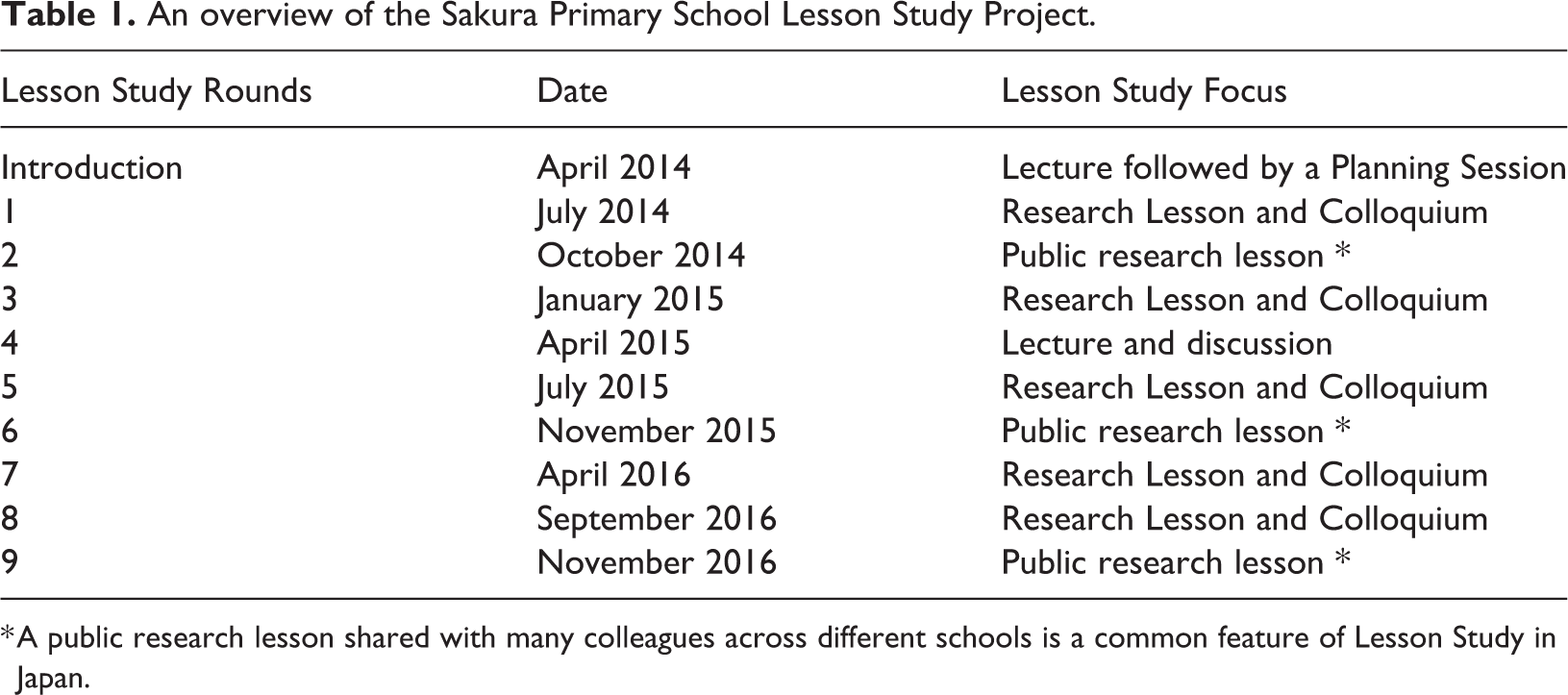
* A public research lesson shared with many colleagues across different schools is a common feature of Lesson Study in Japan.
Mr. Taro is 30 years old and has been teaching in a primary school setting for eight years. The research lesson was with sixth graders (approximately 11 years old) and there were 30 children taking part in the class. The lesson took place in a multi-purpose gymnasium and the children were engaged in a modified central-net game that was similar to volleyball. The lesson was collaboratively planned by Mr. Taro and a primary teacher from the school and built on the previous Lesson Study session. The aim of the research lesson was for the learners themselves to make further adaptations to the central-net game in order to enhance participation, fairness and engagement. For example, while the lesson began with Mr. Taro introducing the game and explaining a small number of initial rules to get the games underway, it was not long before the children started to change the rules in different ways in efforts to enhance participation, fairness and engagement. Throughout the lesson, Mr. Taro observed the children’s efforts and would stop them from time to time to pose questions to each group and challenge their thinking about how to support participation, fairness and engagement. Groups were asked to share their ideas with the rest of the class. While this research lesson was in progress, the teacher educator and the other 29 participating teachers from the school were in the gymnasium. These teachers remained on the periphery of the action, but were subdivided into six groups and each group was individually allocated a small number of learners to observe during the lesson.
Data collection
There were three main sites where data were collected: during the observed lesson, during and immediately following the colloquium, and during one focus group interview at the end of the project. The ways in which data were gathered across these different sites is outlined in subsequent paragraphs.
The observed research lesson
The teachers were encouraged to record their observations during the lesson and were guided by the ‘KJ method’ (Kawakita, 1967), a methodological design widely deployed across the social sciences in Japan since the 1980s (Scupin, 1997), and also by Lesson Study scholars (Iwata et al., 2006; Kobayashi and Ito, 2015; Murai et al., 2011).
In simple terms, the KJ method provides an interactive, creative methodological approach for gathering and analysing data. Initially inspired by Kawakita’s anthropology work on Himalayan culture, it involves idea-generating or brainstorming techniques to draw out the individual and collective perspectives of a group or community. Using this brainstorming technique inspired by the KJ method, which traditionally involves the use of business-sized cards for participants to note relevant information (Kawakita, 1967), the teachers in this study wrote down their observations during the lesson on different coloured ‘sticky notes’: positive points on yellow, not-so-positive on blue, and suggested improvements on pink. With each of the six observation groups having their own A0-sized version of the lesson plan mounted to the wall of the gymnasium, different sticky notes could be attached to specific parts of the plan by individual group members. It is important to stress that the observing class teachers were not presented with specific criteria for what were positive and not-so-positive aspects, but were given the opportunity to decide their own criteria. These criteria were then shared with the other teachers during the post-lesson colloquium as part of the discussions about the lesson.
The colloquium
After the lesson had finished, the teachers remained in the gymnasium for the colloquium part of the process. There were three main phases during the colloquium: Observation groups returned to their A0-sized lesson plan to review the different sticky notes that had been added during the lesson. These comments were then discussed in more detail and each group prepared a presentation that was to be delivered to all the other teacher participants. Having prepared a summary presentation, one representative from each group shared the ideas with all others at the colloquium about how the learners engaged with the planned material in the lesson: positive points, not-so-positive points, and suggested improvements. Immediately after the colloquium, individual teachers used a reflection template to record their own group’s observations about the lesson together with the additional ideas learned from listening to, and asking questions about, the presentations from other groups.
The colloquium was led by the first author and the discussions that took place between the participating teachers in each of the six observation groups were audio recorded. For instance, as these six groups were reflecting upon the lesson in these different phases, these conversations were captured by individual recording devices.
The focus group interview
At the conclusion of the three-year project, the teacher educator, author 1, conducted a focus group interview (Vaughn et al., 1996) with a smaller number of the participating teachers. This group of participants comprised four teachers – Mr. Taro, Mrs. Field, Mrs. Hanako and Mr. Peace (all pseudonyms) – who were purposely chosen to represent class teachers from across different levels of schooling (i.e. a cross-section from years 1–6). The focus group interview was approximately one hour in duration during which time the teachers were asked to reflect on their experiences over the three years of the Lesson Study project generally and, more specifically, to discuss their experiences when taking part in the colloquium sessions at the end of each of research lesson. As such, two central interests guided the process: What professional learning progress was identified by these teachers from engaging in the long-term Lesson Study project? What reflections and deeper meanings about physical education emerged for these teachers from taking part in colloquia during the Lesson Study project?
Data analysis
As the data from the sticky notes, colloquium conversations and focus group were in Japanese, a three-phase process was carried out to translate the data into English. The initial translation was carried out by the first author and his daughter, a teacher who had been working in Australia for five years. This initial translation was then checked by a research fellow at the Institute for the Promotion of Global Education at Hiroshima University. The third phase was carried out by the second author, who read through each data set to ensure that the English text was appropriate for analysis and reporting purposes. The date were then analysed quantitatively and qualitatively in the following three ways.
Quantitative analysis of sticky notes
The number of observations added to sticky notes by the teacher participants during the lesson (i.e. before the colloquium) and after the colloquium (i.e. on the reflection templates) were analysed descriptively. We analysed the number of observations made for each item during the lesson and after the colloquium – positive, not-so-positive and possible improvements – to examine if there were differences within and across each of these items.
Qualitative analysis of sticky notes
The teachers’ written comments for each item – positive, not-so-positive and possible improvements – were analysed inductively by the first author. As noted above, these written comments were recorded by the teachers during the lesson (i.e. on sticky notes) and also after the colloquium (i.e. on the reflection template). Drawing upon the approach to data analysis set out in the KJ method (Kawakita, 1967), three key steps were employed to analyse the written comments made in each item into broad conceptual categories.
The first step was to review all the written comments for each item and to form these into an ‘affinity diagram’ (Kawakita, 1967: 78), which is frequently used in qualitative inquiry to organise notes from field work in Japan. This involved shifting and rearranging the sticky notes within each item into different configurations to look for similarities and diversities in the data. The second step involved taking clusters of sticky notes in the affinity diagram and forming these into small categories to summarise the data. The first author used the written ideas of the teachers to create a title card (Kawakita, 1967), or label, that captured the similarities within each cluster of sticky notes. Broader conceptual categories were formed by merging some small categories together and renaming these to capture the essence of the data. The final step involved theoretically sorting the conceptual categories (Kawakita, 1967) and these were member-checked (Merriam, 1998) by three participants involved in the project.
Qualitative analysis of the colloquium conversations and the focus group interview
The colloquium conversations and focus group interview data were analysed in similar ways. These audio recordings (six colloquium conversations and one focus group interview) were transcribed verbatim and the analysis of the transcripts was led by the third author. Drawing upon the guidelines for inductive analysis outlined by Charmaz (2014), there were five main steps to the analysis process. The first step involved reading and re-reading each transcript; this was important and enabled the third author to gain intimate familiarity with the data. The second step involved the ‘initial coding’ of data. The transcripts were read again and, as the third author progressed through the data, short codes (often just one word) were added to each line to represent the meaning in the text. This step generated many initial codes and helped us to ‘fracture’ (Clarke, 2005) the data and take a fine-grained view of what the teachers were saying about their experiences. The third step was ‘focused coding’. This process involved reviewing the large range of initial codes and clustering these together, based on similarities in meaning, to create a smaller number of conceptual codes. The fourth step of analysis employed the grounded theory technique of ‘constant comparison’ (Charmaz, 2014). Memo writing was a helpful tool to monitor developments throughout the analysis process, but is particularly related to constant comparison where the analysers review the decisions made in the evolving analysis (Charmaz, 2014). Therefore, the memos from the third author provided scope to review the focused codes, indicating any discrepancies and points for further analysis. The fifth and final step was the ‘theoretical categorisation’ of the focused codes. This process comprised refining the focused codes into a smaller number of overarching categories, which summarised and connected larger chunks of the data.
Results and discussion
Following analysis of the data, key themes were identified as being important for the primary teachers’ professional development in relation to physical education. As will now be discussed, these themes focus on four interrelated issues: the long-term and recursive impact of the colloquium experience, the colloquium as a space for reflective and collaborative discussion, observing the learners to ‘observe’ the teacher and re-interpreting the gym hall as a classroom.
The long-term and recursive impact of the colloquium experience
A key finding was that the teachers repeatedly referred to their earlier experiences during the Lesson Study project. The long-term, iterative and collaborative design of the project was identified by the participants during the focus group interview as providing a cumulative effect on their learning about physical education as they progressed through each round of Lesson Study. By the time the participants had completed the seventh Lesson Study round, they highlighted that reflection was a central part of their professional learning during the project. The following quotation is from Mr. Taro during the focus group interview. Mr. Taro, whose teaching was being scrutinised in the seventh round of the project (and twice more in earlier rounds), evidences the progress of the participants over the three-year project: I think, this time [in the round seven colloquium], we had more meaningful thoughts and deeper discussions compared to the first year [round 1]…looking back…we just had this rough view about problems or good points [in the round one colloquium]. And we didn’t have a clear idea of why those were good or bad, or what the solutions were. But, this year [in the colloquium], more teachers…gave me the ideas of what I could have done better…I got an idea of what I could have done to meet the class goals…I don’t think many teachers had these thoughts three years ago…
Staying on this topic of the cumulative learning trajectory of the participants, Mr. Taro also identifies a crucial shifting of the interactions between the participating teachers and the coordinators (school-based and the teacher educator) of the Lesson Study project as they progressed from earlier to later rounds: I truly think we had more meaningful and better discussions this year [in the round seven colloquium] because both the lesson coordinators and the participants were thinking through the solutions together while the last two years [the colloquia in rounds 1–6], we, the coordinators, were just presenting the ideas.
These findings are important for primary physical education professional development, as they highlight how reflection was a key feature of the participants’ learning during the project and how discussion during the colloquia sharpened these capabilities over time. This underscores the possibility for transformation – in motivation, knowledge, confidence, and, ultimately, teaching quality (Day and Gu, 2007; Fullan, 1993; Guskey, 2002; Kennedy, 2005) – during long-term professional development. The participating teachers’ experiences during this long-term project suggest that Lesson Study is one route to facilitate this transformational learning process. This finding strengthens Keay and Lloyd’s (2011) claim for moving beyond the traditional, one-off, short-term professional learning ‘course’, which has long dominated generalist class teachers’ engagement in primary physical education professional development.
The colloquium as a reflexive, collaborative learning space
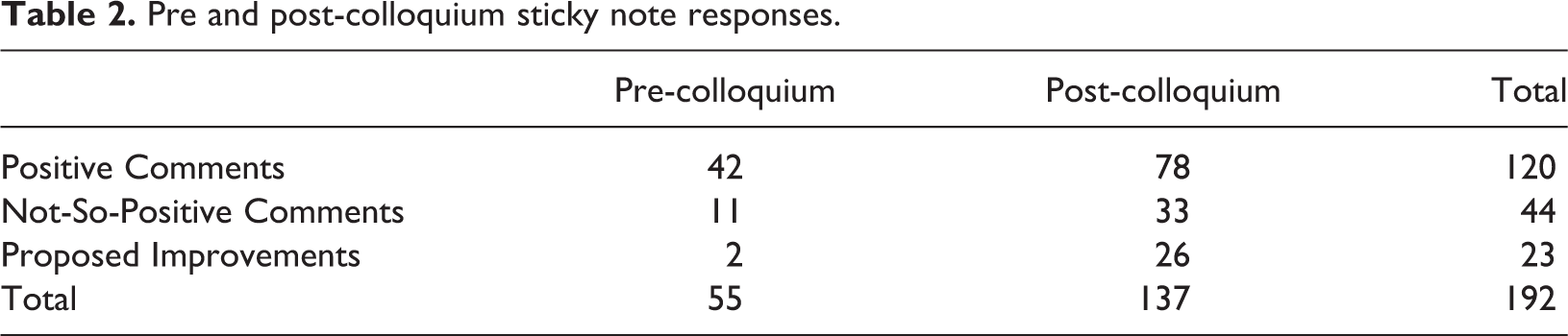
Focusing on the quantitative and qualitative findings from the colloquium during the seventh Lesson Study round suggests that the teachers now appeared to be in a position to engage in reflexive and collaborative discussions that were both detailed and in-depth. While the quantitative findings from the sticky notes do not represent the in-depth discussion in which the teachers were engaged, they offer an important overview of the different topics that the teachers explored during the colloquium as a result of their involvement in the research lesson. In total, the teachers’ observations and discussions during this Lesson Study round created 192 different sticky note comments (see Table 2), of which 55 were made during the lesson observation phase before the colloquium. Critically, the findings also revealed that a further 137 comments were added during the actual colloquium itself. This would suggest that the colloquium offered the teachers the space to spend more time to reflect on the lesson in more detail.
Pre and post-colloquium sticky note responses.
More detailed analysis of the content of the sticky note comments reveal that, by this seventh Lesson Study round, the teachers worked collectively to discuss a broad range of issues relating to the positive, not-so-positive and possible improvement categories for the teaching of physical education. Across these three categories, the majority of the topics discussed focused on three broad themes: The planning and proposed revision of the lesson. The children’s performance, engagement and learning during the lesson. The teaching approach used during the lesson.
Across each of these themes, it is important to stress that many of the comments written on the sticky notes by the teachers were included in all three categories, highlighting the different ways that the teachers viewed elements within the research lesson. For example, when discussing the teaching approach employed during the lesson, the teachers noted that feedback was both a positive and not-so-positive aspect of the lesson and, accordingly, this was an inherent feature in the possible improvements for the future. However, one sub-category of positive comments worthy of mention relates to the consistently positive learning climate that existed between the teacher and the children and also between the children in the class.
As explained in the introductory section of this paper, our concern is with how, as a professional learning approach, Lesson Study can positively influence generalist teachers’ thinking and practice in relation to their teaching of physical education and address issues related to their perception of the subject and to their competence, confidence and motivation in teaching physical education. Given the significant differences between the comments recorded before and then during the colloquium, it would appear that by this stage in the project the colloquium had become an important space in which the teachers were comfortable to share and identify different topics about physical education. In addition, with the potential for extensive discussion with other participants during the colloquium, this opportunity for reflection-on-action with others could be one aspect that helped facilitate participant learning about the teaching of physical education.
Building on these quantitative findings garnered from the sticky notes, the qualitative findings from the colloquium conversations and from the later focus group interview offer more in-depth and nuanced evidence about the role of the colloquium as a key part of the teachers’ learning. From the analysis of the data, two key topics were identified as representing a change in the teachers’ thinking about physical education: observing the children as learners and recognising physical education as a context for learning.
Observing the learners to ‘observe’ the teacher
During their colloquium discussions the teachers increasingly acknowledged the opportunities presented as they made sustained observations of the children during the research lesson. The teachers recognised that turning their gaze on the learners in the physical education class was crucial for gaining insights about the teachers and their teaching. The following excerpt is from a conversation by a group of year 1 classroom teachers during the colloquium. Close observation of the students in the class enabled this group of teachers to uncover possible limitations in Mr. Taro’s teaching during the observed lesson: We think the problem was that…the idea of the game…hadn’t been discussed…with the whole class. Although Mr. Taro wrote the aim of the [volleyball] game was that ‘everyone should participate’ in the lesson plan, it wasn’t talked about in the class…If this concept [‘everyone should participate’] had been shared among the class, the activity of counting how many times individual students touched the ball during the games would have worked better and been more meaningful…it would encourage students to pass the ball between team-mates…There would be no confusion…between students. We just would like to know why it [sharing the focus of the lesson] hasn’t been done…
This next quotation is from a group of year 2 classroom teachers during the colloquium. The conversation shares how they observed the students and how this enabled them to detect some skilful improvisation from the teacher: …the students noticed a problem [during the volleyball game]…after they played some mini games. They found the problem from the games they played, from their experience. We think some of them felt they should make a new rule…to prevent the problem…the suggestion of one-bounce rule…[seemed to be] from the teacher; however, it was originally from the…students. The teacher just picked it up from what the students had. It means the suggestion was actually from the students, but [the way the teacher responded to it] we think that this was a good point.
Re-interpreting the gym hall as a classroom
During this seventh round of Lesson Study, the findings also suggest that these generalist primary teachers had started to perceive physical education as a credible space for learning. In a similar way to their classroom-based work, the evidence suggests that these teachers were aware of key principles about ‘good’ teaching and they were increasingly able to apply these in relation to teaching in physical education settings. The following extract from Mrs Hanako during the focus group explains how she started to draw increasing connections between her classroom work and the physical education hall: I noticed that while I was teaching this volleyball unit in physical education class, I was actually thinking about my classroom and classroom management, which includes the discipline of learning…through this whole Lesson Study, I got a chance to review not only the contents of teaching physical education, but also the structure and rules of my classroom. …it was important that we found [in this round of Lesson Study] that the structure of making a lesson is common to all subjects. It does not really matter if you are making a class for physical education or other subjects. It’s pretty obvious, but the structure is based on how students learn things. The students think and create their new ideas according to what they have already known and their experiences. Then, the new ideas become their knowledge or skill to deepen their understanding…
From these qualitative extracts, Lesson Study, with its focus on the children and their learning, appears to provide a means to gauge the quality of teaching practices (Inagaki, 1995; Inagaki and Sato, 1996; Nakano, 2008). These subtleties would likely have remained unnoticed in traditional forms of observation in which senior managers audit teacher competence. There is a tendency to foreground teaching, the presentation of content knowledge, and classroom management during this form of observation (Grimm et al., 2014). In addition, while traditional observation formats may have a purpose in some settings (Wragg, 1999), their irregular deployment, high-stakes emphasis on auditing teacher competence, and lack of a pre-arranged focus, can often cause feelings of distress and fear (Donaldson, 2016). In contrast, Lesson Study appears to position observation in a completely different light by making it a regular feature of school life. Collaborative planning and a shared focus for inquiry, which are central features for realigning the practice as productive professional learning (Dudley, 2015), appear to help ease the fear of classroom observation. Consequently, the findings from this study highlight the importance of the colloquium as a reflexive space in which the teachers are able to review their observations and develop a more in-depth understanding and awareness of the learning that is taking place and the teaching approaches that facilitate this learning.
Conclusion
The findings presented in this paper highlight the potential of Lesson Study to alleviate many of the concerns that have long been voiced about primary physical education. We argue that Lesson Study can make a significant contribution to the professional development of generalist class teachers by positively impacting on their competence, confidence and motivation to teach physical education. In particular, this three-year study highlights how the long-term, collaborative and situated nature of Lesson Study helped create the context for teachers to engage in a collective planning, observation and reflexive experience that helped them develop a more positive, detailed and connected approach towards physical education. However, with the traditional short-course approach to generalist class teachers’ professional development in physical education still dominant, we acknowledge that this shift towards Lesson Study will take some time. Efforts to convince teacher educators and professional development providers of the need to reorient the way they approach the design and delivery of professional development programmes will be critical in instigating this shift in any significant way. Consequently, while the authors of this paper will continue to work closely to develop physical education Lesson Study for primary teachers in our respective countries, we encourage teacher educators and professional development leaders around the world to introduce Lesson Study as a key feature of the primary physical education professional development programmes within their own countries. While we recognise that these efforts may be a protracted endeavour, we take the view that Lesson Study, as a long-term, collaborative and situated approach, has the potential to bring about the positive changes that will help physical education become a more central and educational feature of the primary school curriculum.
Footnotes
Declaration of conflicting interests
The author(s) declared no potential conflicts of interest with respect to the research, authorship, and/or publication of this article.
Funding
The author(s) disclosed receipt of the following financial support for the research, authorship, and/or publication of this article: This research was supported by JSPS KAKENHI Grant Number JP16H03224.