




Abstract
Oppenheimer urged communities all over the world to study how children come to understand peace, conflict, and war. Set in various countries, their review of studies, as well as more recent examinations reveal trends in how children view these phenomena, often differing by gender, age, and extent to which they were exposed to highly dangerous and traumatizing situations, like being forced to be child soldiers or sex slaves. No such research has been published in the contemporary post-war Uganda context. Using focus group methodology, we asked: How might Ugandan primary school children’s stories about peace (traditional and otherwise) help them navigate conflict? What sorts of conflicts do these children observe in their home, school, and community, and how do they describe peace as being resolved by themselves or others? The purpose of our study was to contribute to the knowledge base on peace education in Uganda and to ultimately develop written materials that students can use as part of their learning in their respective schools. Local studies like this one are relevant to the global situation because racial and economic conditions are global phenomena. The local manifestations can speak to those racial and economic conditions as perspectives not often used to put the global situation in relief. This paper explores the findings related to the children’s overarching conceptions of peace and their ideas of peacebuilding, including activities that both hinder and encourage peace. The voices of the children speak strongly of the connection between peace and access to basic necessities in the community.
Introduction
Consistent with the message that African universities and institutes of higher learning ‘are of the greatest importance’ (Tandon, 1995) in building indigenous knowledge (see Brock-Utne, 1998), a group of faculty members from the various schools and departments that comprise Kyambogo University in Kampala, Uganda convened in 2006 to determine how best to teach peace among students of all ages. The group’s primary objective was to “enable students to acquire knowledge and skills in prevention, resolving conflict and promoting peace amongst themselves, and family and the community” (Ugandan Peace Team, 2006). This is in keeping with United Nations documents on peace education, whereby “the promotion of a culture of peace is crucial in educating people to see themselves as peaceful with norms that emphasize cooperation and the resolution of conflicts through dialogue, negotiation, and non-violence” (Salomon, 2011: 47). In the current research, a cross-national team sought to articulate children’s conceptions of peace for the purpose of informing a peace curriculum at the two school sites from which the data were drawn. Although there have been studies of children’s conceptions of peace in Western countries, few studies have been conducted in African nations with the active engagement and leadership of Africans themselves. Our researchers engaged small focus groups of primary school children in conversations about peace and conflict to learn that the local knowledges regarding peace do not mimic the voices and experiences of Western youth. Thus, insights on peace and peace culture can benefit the international community as well as the work of peace education in Uganda (African Association for Literacy and Adult Education, 1994: 186) and other strife-worn countries in East Africa.
Uganda’s history of imperialism, mismanagement, and inequality can inform an understanding of ongoing problems in peace and peacebuilding. While efforts to weigh up and consider how these and other challenges can be addressed in peace education curriculums in schools can be considerable, even daunting, they are not insurmountable. The development of peace conceptualizations that are context-specific would appear to be crucial to praxis whereby reflection about and the ability to work through the roots and continuing dynamics of war and conflict can produce meaningful applications for change and empowerment.
Ager et al. (2011) used focus group methodology successfully to assess the effects of a psychosocial program in northern Uganda on the improvement of child well-being. They used the structure of the primary schools to organize their focus groups. They concluded, “Participatory focus group methodology using free-listing and thematic analysis was effective in developing local measures of child well-being with acceptable internal consistency” (Ager et al., 2011: 1132). Using the same methodology, we asked in the current study: How might primary school children’s stories about peace (traditional and otherwise) help them navigate conflict? What sorts of conflicts do these children observe in their home, school, and community, and how do they describe peace as being resolved by themselves or others? The purpose of our study was to contribute to the knowledge base on peace education in Uganda and to ultimately develop written materials that students can use as part of their learning in their respective schools. It is the hope of the researchers that these materials can also be used not only in the two schools from which the data were drawn, but in other schools in Uganda. Secondly, a study of Ugandan conceptions can inform practice more generally, because it allows us to call into question that status of knowledge regarding peace education as it has been developed in global West and North, where more information is available. Local studies like this one are relevant to the global situation because racial and economic conditions are global phenomena. The local manifestations can speak to those racial and economic conditions as perspectives not often used to put the global situation in relief.
Background and literature review
In a comprehensive review of research, Oppenheimer et al. (1999) called for international education in part by urging stakeholders in societies all over the world to learn how children come to understand peace, conflict, and war. Set in various countries, their review of studies, as well as more recent examinations (e.g. Boyden, 2003; de Souza et al., 2006; Hakvoort and Hägglund, 2001) reveal trends in how children view these phenomena, often differing by gender, age, and extent to which they were exposed to highly dangerous and traumatizing situations, like being forced to be child soldiers or sex slaves.
Imperialist and sociopolitical militaristic and economic forces have given rise to violence in all regions of the world. Feelings of rage, trauma, and hopelessness can follow pervasive violence and remain even when the immediate threats to safety have lifted. Although disclosures of these feelings do not, in and of themselves, lead to recovery, skillful facilitation of often suppressed stories as well as the knowledge that the stories will carry some purpose for the better of the larger good can prove beneficial and have a healing impact. In interviews conducted on the survivors of the Korean War, Liem (2007) found that the lack of expression about the survivors’ experiences proved unhealthy to their individual and collective recovery. Liem noted that “some psychological research suggests that external cues that instruct the individual to avoid focusing on a past experience may actually enhance rather than lessen memory rehearsal” (Liem, 2007: 159). Resolution of problems wrought by violence can have significance for individuals and for the collective. To support the expression of the violence – and peace – as experienced firsthand and/or as observed by children, we researchers sought to play a role in the process of healing. It also is the aim of the research team to continue cultivating these expressions in all classrooms, but most immediately, in the classrooms of the children from which we drew our participants.
The psychological impacts of violence and trauma can be manifested ostensibly in school settings and therefore, it is important to consider the intersection of psychology and education in order to provide benefit to children and communities. For example, the Collaborative on Social and Emotional Learning (CASEL; www.casel.org) has emphasized that children learn best when educators are aware of their students’ needs not only at cognitive levels, but also at affective levels. Stated simply, children learn best when their overall needs for safety, a sense of belonging, and self-esteem, are taken into account and addressed within the scope of what is taught and how teaching occurs. This argues not only for a substantive curriculum of peace, but also for pedagogies of peace. Aspiring to do well in one’s studies and becoming contributing members to one’s family and village because of one’s education are goals that are realized when children as well as communities and societies are healthy. With efforts to help root strategies for peace in children at early ages and throughout their schooling, peace education can prove valuable to a future in which societies are able to build structures of peacebuilding for generations to come. It is the goal of us, the researchers, to contribute a small part to this objective toward peace in Uganda.
Methodology
We researchers engaged a critical theoretical orientation (Carspecken, 1996; Dennis, 2014; Habermas, 1981, 1984) to conduct this focus group study at 2 primary schools in Uganda. The critical theoretical orientation assumes that understanding is intersubjectively structured. Critical theory also requires that researchers take seriously the power relations embedded in the lives of participants and in the research process itself (Kincheloe and McLaren, 1998). Researchers who call themselves critical also are open to the ways in which their research provides an opportunity and an obligation to examine taken-for-granted knowledge, including knowledge as formulated by less advantaged groups and knowledge that underpins the research itself (Carspecken, 1996; Dennis writing as Korth, 2005).
It is commonly known that democratizing the research process with children is difficult because of traditional power relations between adults and children in many societies, and especially in school contexts. As such, we decided to use a focus group methodology to encourage an active discussion of peace amongst the children. There are very few studies that engage children in talking with adults and other children about peace (Akesson et al., 2014; King, 2014 for examples) and none that we could find which do this with Ugandan children and yet, focus group methodology is very good for engaging people in conversations about their experiences and their conceptualizations. Moreover, Ugandan co-researchers conducted the focus groups so that the framing of research questions was compatible with their levels of cognitive maturity and affective readiness (the latter pertaining to the care undertaken with some children having encountered trauma experiences in the past and so that cultural norms could be respected). These aspects of the methodology are themselves contributions to the literature on better understanding of children’s conceptualizations of peace.
Critical researchers are interested in engaging in research which is fundamentally connected to the lives of the participants themselves. In this case, it is intended that the research should inform the production of a book for children that can be placed back into the hands of the students and teachers themselves. Doing this is seen as an extension of the service owed to participants for their participation. This stance is particularly important given the great needs within these settings. This approach to doing research with Ugandans rather than on Ugandans has not been typical.
School sites
Two Ugandan private primary schools served as the context from which student participants were drawn. These two schools were specifically selected because of their concern for peace in education. Also, both schools are privately funded with missions to serve children who were likely to be left un-schooled. It is assumed that both schools are also in the throes of change – for Mirembe Primary School in central Uganda, change would be associated with the increase of technology and media in the lives of the children, while for Pere Pere Primary School in northern Uganda, change would be related to the easing of the civil war conflicts in the region and the need for stabilizing youth services. The civil war has ended, but the trauma of that war continues to the present day particularly in the northern region. How these changes might manifest in the findings was of interest to the team.
Mirembe Primary School 1 is in the Makindye Division of the capital city of Kampala, the largest city in Uganda, with a population of 1,383,200. This school was opened in 1993 to provide an education to children of limited resources. This school serves children from pre-primary through Primary 6. There were approximately 155 children enrolled in the school at the time of the study. The Makindye Division is infamous since Idi Amin’s time. It was in this division that the army barracks were the site of some of the most notorious military crimes. One passes those barracks on the way to the school. Yet, today, the area is lively. There are many small shops along the streets and new schools.
Pere Pere Primary School is in the northern city of Gulu, the second largest city in Uganda with a population of 146,900. Construction of the school started around 2004 and was completed in 2006 when the school opened. Uganda’s civil war ended around 2012. However, children interviewed are direct victims of the war. Some were child soldiers; others are orphaned by the war, homeless and victims of war abuses. Besides change related to easing the problems resulting from the civil war and stabilizing youth services, psychological interventions to meet the mental health needs would constructively speed up the desired changes in positive outlook towards life. The school was meant to receive and rehabilitate the children who have returned from the war and were unsettled. Students are drawn from several war-affected districts to the Guluarea. The school once was oriented toward a curriculum of local vocational skills, like crafts, to help the children fit back into the society. During this time, the children also did not sit for examinations and instead received mostly psychosocial support. However, the children now receive the formal, national primary curriculum and children have begun taking examinations though their performance is not strong. Since conducting the study, Pere Pere school was closed because of funding mismanagement. Pere Pere had been opened and funded initially through a European aid organization, but the school got into huge debts with suppliers who took it to court and were able to close the school down for failure to pay the debts.
Focus groups
Focus group methodology has long been used for market research, but with a hermeneutic orientation, focus groups become an optimal opportunity to encourage talk and interaction (Freeman, 2013). Three teams of three Ugandan researchers conducted focus group interviews with small groups of age-identified children.
A total of 36 pupils participated in this research project. Researchers invited six students to participate in each group and there were six groups in total, three from each school. With an interest in gender, ethnic and ability balance, teachers invited children to participate in the focus groups.
Rapport with the students as well as teachers was facilitated by the research team visiting the school prior to the interviews to establish this rapport. Additionally, the use of existing friendships and cohort groups in the school classes brought children together who were familiar with one another. In some cases, teachers were present during the focus groups to contribute to the trust building, as Ugandan children tend to develop strong trust attachments with their teachers. Where students seemed inclined to open up (and indeed this was borne out in the data) with their teachers present, teachers were invited to sit in. Pere Pere was a boarding school where children from the war were particularly being served by teachers who had well-established relationships with the youngsters. Though the interviews were conducted in English (the language of the schools in Uganda), local languages (Luganda in Kampala and Luo in Gulu) were used to explain and supplement questions or support the engagement of the children with the research team. Researchers conducted follow-up visits with the schools where researchers talked with the children about the findings and also invited the children to draw pictures. These pictures will be used in the children’s book of peace stories that will be created from the focus group interviews and the books will be given to the schools.
The focus group interviews were audio-recorded on digital recorders and then transcribed by the Ugandan research team. The interviews were conducted in a semi-structured fashion so in general the same questions were used to stimulate conversation, but with varying order and follow-up questions oriented to helping children talk more deeply about peace. The questions were open-ended and worded appropriately for each age, but included such interests as, “Describe for us what you think of as a peaceful school” – also, asking about the village and the family. “What kinds of stories of peace have you heard?” Then, depending on the stories told, the researchers might say something like: “How is peace involved in the story?” or “Do you know other stories like that one?” The children were also asked what can disturb the peace of the school, community or home. Even with questions worded more positively (describe for us what you think of as a peaceful school), children often responded in the negative – “no one is fighting”. This is consistent with reports of how children of this age do tend to talk about peace.
Analysis
The research team collaboratively analyzed all of the data. Data were entered into QDA Minor Lite software for coding. The free version of QDA Miner Lite (https://provalisresearch.com/products/qualitative-data-analysis-software/freeware/) was chosen because it could be made accessible to the entire team without cost. The coding involved a process of reconstructing the meaning of an utterance or story. These reconstructions were then reviewed and refined through subsequent conversations. Rich discussion amongst the inter-ethnic, male/female, team of researchers opened the door for deeper dialogue about cultural meanings and assumptions. In Uganda, there are similarities and differences across ethnic, gender, religious, and regional lines that should be articulated and engaged. The analysis was consistently tied to Ugandan cultural awareness and assumptions, with American researchers taking part in the dialogue and prompting probes about taken-for-granted assumptions about the interview data. Codes were layered. For example, the code “fighting” fit into the larger category of “Hindrances to Peace building.” Code families were organized into three broad overarching thematic categories: “Conceptualizations of Peace”; “Peacebuilding”; and “Contexts for Peace.” In this paper, we focus on the first two of the themes.
Validity and limitations
Researchers took care to strengthen the validity of the study throughout the process. A pilot study was conducted at two urban primary schools. The researchers used recording devices to capture the focus groups verbatim. Negative case analysis was also employed in the final stages of analysis, whereby the research team specifically looked to see if there were counter-examples in the data which might complicate the coding patterns (Carspecken, 1996). Following analysis, the research team engaged in member checking by gathering drawings from the children which corroborated the findings and by sharing the analysis with the children and adults at the schools.
As with any study, limitations constrain how we might draw on the insights of the study. For practical and conceptual reasons, the study involves only a small number of children. It is a starting place, but we recognize that the small numbers place limitations on the robustness of the findings. Additionally, students from Pere Pere school faced trauma that affected the quality of the focus group interviews. Students with trauma did not open up so easily. The results of the study are insightful, but are not generalizable.
Findings
Analysis of the rich qualitative interviews made it possible to articulate children’s conceptions of peace. We found that boys accounted for 54% of the coded segments with 46% of the coded segments attributed to girls. Sixty-seven percent of the coded segments in the data were attributed to the children at Mirembe Primary School, with 33% being attributed to the children from Pere Pere Primary School. This unequal distribution in the coding potentially stems from the social differences of the children, challenges in rapport building, and the increased trauma associated with the children attending Pere Pere Primary School.
The children’s talk revealed that they assume peace is a social process. This general finding underlies each of the specific thematic categories identified through the analysis. This contrasts with the idea of peace as an internal psychological construct. Though some children did talk about feelings of peace, these feelings were always implied as a social other, like feelings of respect. Feelings of peace were expressions of connectedness to a broader social network of relationships. Thus, each of the code families discussed below must be interpreted through this idea that peace is social in nature. It reflects an awareness of social justice in relation to peace and standing as a seed for the idea that peace is linked to social justice and equity.
Secondly, many of the children described peace in its negative terms. For example, the children talked about people not sharing food as an example of disturbing the peace. Their conceptualizing peace in negative terms fits with some of the literature suggesting that it is not unusual for children to talk about peace as the absence of something negative – like fighting (Hakvoort and Hägglund, 2001). In fact, readers will notice that throughout the findings, sharing and fighting contrast as mechanisms for ensuring or disturbing peace.
There are two prominent categories of findings that emerged from the analysis of interviews and will be reported on in this paper: “Overarching Conceptualizations of Peace”; and “Peace building.” These two work together in that the overarching conceptualizations of peace indicate how peace is recognized and appreciated by the children while the theme of peacebuilding articulates the mechanisms that promote or risk peace according to the children. The children talked about their ideas of peace and they did so by also indicating mechanisms for peace-building and peace destruction. For this reason, the mechanisms for securing or hindering peace will be evident in the first section, but detailed in the Peace Building section. Of particular importance are the ideas of sharing and fighting which are seen as primary mechanisms for insuring and destabilizing peace, respectively.
Overarching conceptualizations of peace
In this section, we begin by introducing the fundamental ways children in our study directly conceptualized peace, then we will present feelings they associated with peace, and the way peace was conceptualized within relationships. On a most basic level, children thought of peace as a situation in which people’s basic needs, and needs for health and safety, were met. In this section, we see that the children in the study conceptualized peace as material security/health, relational security/health, and as associated with positive feelings.
Peace as having basic needs met in the context of health and safety
Across all focus groups, children talked most consistently about peace as a social process through which basic needs are met within an overarching context of health and safety. This notion of peace involved how the family and the community together was able to see that basic needs were met with health and safety included. The way it was expressed by the children, indicates an awareness in social justice and equity as a primary aspect of peace. For example, a girl from Pere Pere said that a peaceful village is one where “there is always food” enough for everyone. A boy from Mirembe Primary School described a peaceful village as one where “people share food with those who don’t have any.” Children referred to homes where they were able to offer food to visitors as being peaceful.
The children told us stories about how basic needs must be met within the community and the family for there to be peace. They recognized that a situation where some people’s needs are met while others needs are not, is not a peaceful situation and, in contrast, actually threatens the possibility for peace. This conception of peace must not be mistaken as personal well-being, but is, rather, best understood as communal well-being. The seed of a social justice orientation or attitude is alive within this way of thinking. Moreover, the children’s stories reflected more trust and confidence in mothers for meeting the basic needs of the family and thereby helping to secure peace in the home and community.
The children in our study, also, talked about peace as communal safety. “Gatekeepers …keep peace and guard us.” A child from Mirembe Primary School claimed that “It is good to have neighbors because in case of danger they can save you” and a peaceful village is one “where you are free to go [safely] anywhere you want.” The children reported that teachers, village leaders, elders and police help to maintain the peace by maintaining safety. Sometimes the children described the need to be protected from other people, including “men with spears” and other times they described the need to be protected from animals that might be dangerous, like snakes.
Children, also, reported that peace means “there are no diseases affecting people and their health and bodies should be clean.” The country continues to be challenged by health issues and from the children’s perspective disease threatens peace. They tended to talk about this aspect in the negative – as peace being the absence of disease and uncleanliness. A boy from Pere Pere reported that a peaceful home is a “home without sickness and diseases.” Many of the children see tidy and clean homes as a way to lessen the spread or likelihood of disease.
The children talked of learning about personal hygiene in order to maintain peace. “One bathes often and keeps the body clean.” “You avoid going to the toilet barefoot.” Even the presence of toilets at schools and home, contribute, in the children’s minds, to cleanliness and the overall health of the community. There is a responsibility at the personal level for cleanliness that is related to the health of the family and the community. The children mentioned doctors as being important to peace “because when you are sick, the doctor treats you and you become strong again.”
Peace as positive feelings within relationships
The children talked about three primary feelings they associated with peace: Happiness; Love; and Respect. Each of these feelings was described in relational terms. The feelings they associate with peace are positive emotional responses to cultural values, particularly the value of maintaining amicable relations.
The children talked about happiness as a feeling one has with others: “mummy and daddy [should be] happy with each other” and “Children should be happy with their parents.” Their talk of happiness was oriented through the idea of “happy with” and was not talked about in strictly personal psychological terms. One of the older children said that peace is when you are “enjoying one another.”
Love was, also, talked about in terms of relationships and it was deeply inferred in the way the children talked about the traditions within the community, like the tradition of burying a loved one. The children would say things like “our parents show love to us” to create peace at home. They talked about “loving their friends” and that within homes, villages, and schools, “There should be love [enacted].” The children recognized and appreciated love as associated with peace but did not articulate specific definitions for love. This recognition and appreciation that love was associated with peace, while it lacked definition in the children’s talk, was very definitely about relationships and the positive way people can and should relate to one another.
Respect in Uganda is related to humbleness in a relationship that is marked by age – a younger person would feel this in relation to an older person. For Ugandans, respect is an action-oriented mannerism – it bespeaks a willingness to do something. Respect requires no force. It is a responsiveness to an adult on the part of the child. It is a required humbleness to social norms that are internalized as good feelings involved in how you relate to those older than you whom you admire and appreciate. An example of this is a child who greets her parents in the culturally respectful way. To be sure, the same actions, like greeting one’s parents in the culturally-respectful way, can be forced upon children, but this use of force would not be associated with respect on the part of the child.
The children implicitly connected together the feelings associated with peace. Within the Ugandan context, there might be an inherent link between happiness, love and respect. The next quote illustrates this: “When you buy things for grandparents it makes them happy and they buy something for you in return.” For Ugandans, this quote indicates attention to elders and the desire to sustain loving relationships with others. Here the use of the word “happy” in a relationship is implicitly linked to expressing “love” and “respect.” There is a mutuality to this respect that is free of force and is indicative of a peaceful and harmonious set of relationships.
Peace as relational health and well-being
The children described different categories of relationships related to peace. Within the context of relationships, peace seemed to exist if the two people involved demonstrated some equity in the relationship in the sense of not being a burden to one another. Our participants expressed a keen awareness that they are social creatures and that peace is a social process. The primary relationships described were: parent and child; mom and dad; and friends with one another. We understand the children to be saying that peace is both found and constrained within relationships. As the children talked about peace as part of their relationships they indicated that within a relationship certain activities contributed to peace and other activities threatened or hindered peace in that relationship. Children also said that the peace of the home, the village, and the school were linked to the peace within these relationships. For the children, there seemed to be an unexamined relational overlap between people where there is a “Zone of Peace in Relationship.” This zone reflects the possibility for two people to engage in activities with one another that either promote or hinder peace. The children never talked about peace as a personal characteristic, like a state of mind within one person. For each type of relationship, we were able to articulate the key descriptors of activities the children associated with peace/not-peace through which the relationships are engaged.
Children, particularly those at Mirembe Primary School, talked a lot about their relationships with parents in the context of conceptualizing a peaceful home. This was not as prominent amongst the children at Pere Pere, who described peaceful homes as those that are healthy and clean and safe (more about this later). One boy from Mirembe told the following story: “I have a brother called Mubarek. He is in Senior One [referring to the grade level in school]. My mother told him to go and fetch water and he started quarrelling. [Then] My mother told him, ‘Leave the water. I will send Rwamoro.’ He felt jealous and he again started quarrelling.”
In this story, the youngster is responding to a question about things that have disturbed the peace in his home. Asking a child to fetch water is reasonable in the Ugandan context – it is a common way for children to contribute to the functioning of the household. When a child fails to respond to such a reasonable request, the child is not engaging in the relationship with respect or obedience, love or happiness. Typically, the children orient respect and obedience as from the child to parent, the absence of abuse as from parent to child, and love and happiness as bidirectional.
Though caning is a common form of discipline in Ugandan homes and schools, one child reported that a peaceful home is one where “the mother you are staying with doesn’t cane or spank you” and other children said things like this: A peaceful home is “where your parents don’t beat you.” The line between beating through the use of caning and disciplining is one that the children talk about. A child from Pere Pere said that “Parents should show good behaviors to the children” as a way of modeling. Also, on the positive side, children repeatedly expressed this sentiment: “Our parents show us love” as a way of maintaining a peaceful home.
The children described friend-to-friend relationships within the village and at school. A child at Mirembe Primary School told researchers that a peaceful village is a place where “you are making friends and sharing with them.” Sharing and helping were the most commonly mentioned aspects of peace in friend-to-friend relationships. Children talked about loving friends and happiness when playing with one’s friend. One of the children from the same focus group noted that teachers tell them that a peaceful classroom is one in which children help one another with their school work. Helping one’s friends and playing with them are also entailed in their way of thinking about peace. There was an emphasis on sharing when talking about peace and friendships and this sharing was oriented toward basic material needs. In thinking about how peace was conceptualized within friendships, we find that what was labeled above as “Zone of Peace in Relationship” reflects equity in the relationship, including the idea that the people are not burdens to one another. This notion of equity in the relationship is fundamental to the idea of social justice as peace. We think that this emphasis also indicates a readiness/openness for seeing the social justice aspects of peace.
Summary
The children’s conceptualizations of peace are rooted in a notion that peace is a social process and a social construct. Peace is what holds a harmonious community of relationships in balance. There is an awareness on the part of the youngsters that equity, having basic needs met, and positive feelings are involved with peace. Peace, for them, is inseparable from these qualities. Harmony was an oft-talked about descriptor associated with peace for the children. Children used the word “unity” and said, for example, “the home has togetherness.” “Home is where [all] people are happy.”
Peacebuilding: The ways to secure or hinder peace
The second category of findings is about peacebuilding. In this section, we articulate the activities that children deemed as promoting or hindering peacebuilding. Through these ideas, we are able to locate specific notions of agency the children have about their own abilities to participate in peacebuilding (Figure 1). Peace was seen as fragile by the children – they were well aware that it could easily be put at risk. As the children talked about peace they did not separate the activities for building or limiting peace from their ideas of peace. The children talked about fighting and disobeying as fundamental hindrances to peacebuilding. Children, also, had ideas about what people did to build peace and, also, how they might, as children, be involved in peacebuilding. In this section, the hindrances to peacebuilding will be discussed first, followed by a description of mediation strategies for peacebuilding as they were identified by the children. There were strong narratively-structured corollaries linking the children’s identification of hindrances to peacebuilding and their ideas about how children themselves could contribute to building peace in relationships. In fact, this whole section focuses on activities engaged in by children themselves. These corollaries provide a nice introduction to the two subsections.
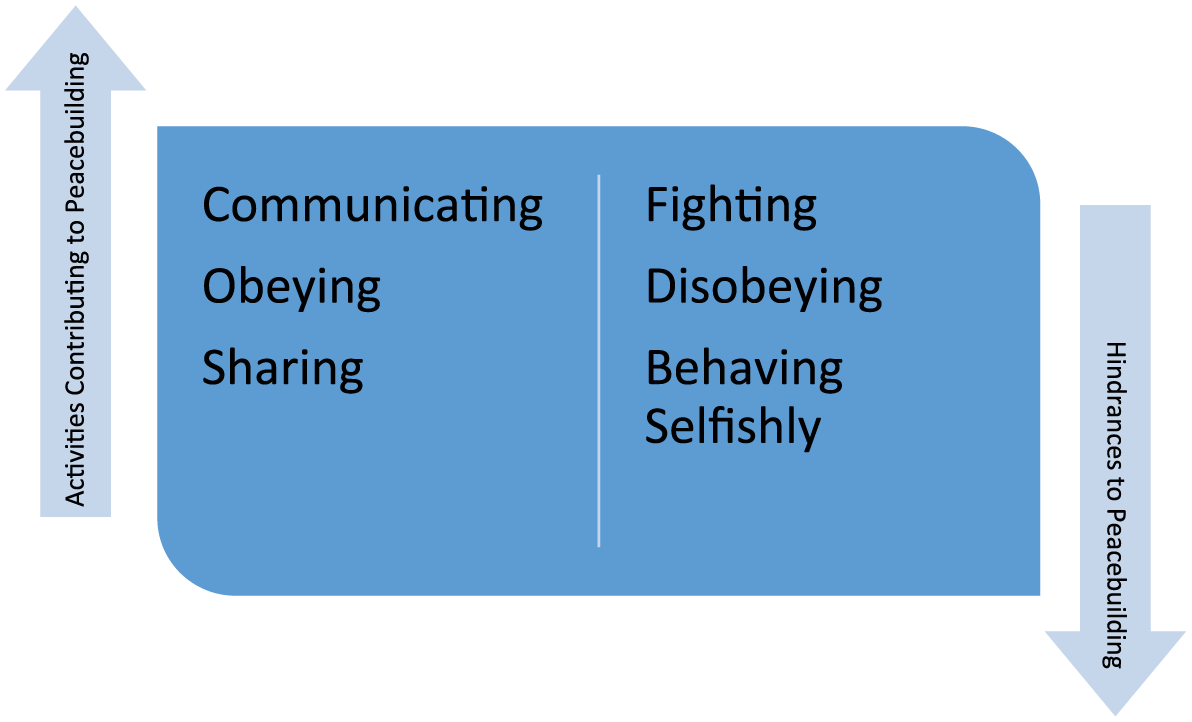
The Structure of Peace Building and Its Hindrances.
Hindrances to peacebuilding within relationships
The analysis suggests that hindrances to peace involve people failing to see themselves as part of peace. “Fighting” was the most frequent substantive codes surfacing in the analysis. The children shared many stories about fighting. Fighting is a word used in Uganda to specifically refer to physical disturbances, rather than verbal (for which the words “quarreling” and “abuse” are used). Actually, fighting indicates that communication has broken down; when the communication is absent or distorted then “fighting” is more likely to happen. Also, fighting was linked to the absence of sharing and sharing is considered of primary importance in establishing peace. A child at Pere Pere said, “Today in class I didn’t have a pen, so I went to borrow a pen from a friend. I asked him, ‘can you borrow me a pen.’ The person refused and then I slapped her.” This escalation to fighting was consistently articulated as a hindrance to peace – as something that threatened peace and made peace vulnerable. Other prominent hindrances to peace identified by the children include disobedience and behaving selfishly.
The children’s descriptions of fighting were quite vivid, high in number, and easily conjured in contrast, for example, to their descriptions of love. This “negative” approach to conceptualizing peace is not uncommon for children, though in these data, equal numbers of boys and girls talked about fighting (fighting in the Western literature is more prominent amongst boys). More children from Pere Pere talked about fighting than children from Mirembe. The concreteness with which they are able to talk about fighting, in contrast with how they talked about love, is interesting to note. Their vivid details seem to suggest their familiarity with it and, also, the vulnerability of peace in their lives.
One boy told this story: “We were playing football in the field and I scored a lot of goals. Then, my friend said he had won. I saw that his heart was bad, so we started fighting.” Most examples of fighting were related to material goods: “I saw my friend Angule and the other one, Musa. And Musa stole the other one’s book [Angule]. He didn’t check to see whether there was a name so the other one [Angule] said, ‘It’s my book.’ He [Angule] told him, ‘I am the one who wrote this on my book [pointing to something in the book that had been written] and my pen was getting used up [so I was not able to write my name in the book] so you stole my book. They went to the head teacher and reported Musa. They told Musa, “You brought 13 books and now you want to have 14 which means you are the one who stole the book.’ And they started fighting from there.”
This middle grade child was not unique in his ability to describe fighting situations. A young child said, “I saw Anita beating her friends with a stick because her friends didn’t like her, so she beat them with a stick.”
There were a few political stories told about fighting, which were not counterbalanced by stories of peace on the same scale. One Muslim girl at the Mirembe Primary School told this story: “My mother told me about Gaddafi. Gaddafi wanted to build a Mosque. Obama told his soldiers to go and kill Gaddafi. Gaddafi told his soldiers to go and kill Obama. So they started fighting and American soldiers killed Gaddafi.”
Another child relayed a story about the Ugandan President: “My mother told me a story about his Excellency Yoweri Kaguta Museveni [long-standing President of Uganda] and Besigye that they were together as brothers when they were in the bush fighting and Museveni said let me hide myself and Besigye, also, went to hide there but Museveni said that [Besigye should] go away [because] ‘they will find me and kill me.’ Then, they got Besigye, but they did not kill him. And up to now they [his Excellency Museveni and Besigye] are not friends again.”
Children talked of disobedience as a hindrance to peacebuilding. Obedience is a salient way in which Ugandans think about caring for children, protecting children and retaining communal harmony. This shows up in the way children talk about disobedience as disturbing peace, and it is as well in the children thinking of obedience as contributing to peace (more on the positive corollary below). Children had a keen understanding that to disobey adults (particularly teachers, parents and elders in the village) is to disturb the peace in fundamental ways.
The children also told stories about how selfishness hindered peace. One girl told the researchers this: “I have a friend called Sandra. She wants to quarrel every time. When one uses her toys, she starts quarrelling.” One of the older children in Pere Pere offered this advice: “Work with friends. And when a friend asks you about something, answer very well, and don’t be selfish.”
How students contribute to peacebuilding within relationships
Because the children conceptualize peace as a social process and as something that is relationally established, peacebuilding is also largely talked about in the context of relationships. These factors are corollaries to the main hindrances, but it is interesting that their salience and importance do not match. That is fighting was, by far, the most prominent hindrance to peacebuilding discussed by the children. Its corollary, communicating, was the least often talked about of the three main hindrances. The corollaries disobedience/obedience both stood in the middle in terms of the frequency of the coding for both hindrances and contributing factors. Sharing was the most commonly talked about way to promote peace within relationships, while its hindering corollary selfishness, was the least talked about of the three primary hindrances. In this section, each of the three main factors discussed will be analyzed in order of their importance to understanding the children’s perspectives. Each of the three contributing factors were all thought of, by the children, as something within their capacity to do – as something they have control over.
Sharing is very practical and if a child has something like a small piece of bread, no matter how small, they will share it with a friend. The children were primarily talking about sharing material things. One girl said there is peace “when people share with each other.” Another child said that a peaceful village is one where “people share food when you don’t have [any].” Sharing is valued in the culture and is seen as a reason for disgruntlement. One of the younger children suggested that “Eating with them [one’s friends]” demonstrated peace. The idea is that sharing one’s food contributes to peacebuilding. There was a keen awareness amongst the children that material wealth, food, and other materials are unequally distributed in the community. Those who have food should share with those who do not: “People should share food [with you] when you don’t have any.” This is inextricably linked to the conceptualization of peace as having basic needs met. One of the children told researchers that her teacher says, “Charity begins at home” indicating a tight communal character to the practice of sharing. More girls than boys talked about sharing and children in Mirembe talked more openly about sharing than children at Pere Pere.
Obeying was clearly thought of as an important activity for peacebuilding and it was something that children saw as within their power. Obedience is a reflection of respect and love in a relationship between an adult and a child. Discipline is the adults’ side of the interaction for which obedience is linked. Discipline and obedience involve mutual respect in Ugandan cultures. Children contribute to peacebuilding by “obey[ing] your elders” including an admonition to “follow [your] elders’ example.” Another story was offered – it goes like this: “If I go to the village and the grandmother told me, ‘You go and dig’ I don’t have to refuse [I could refuse, but I don’t] because I have to respect elders [so I will go and dig].” This comment about respect is also a comment about obedience. Obedience has a double-edged aspect to it in the child–adult relationship. Across Ugandan cultures, the child can/should be disciplined if she “refuses” to be obedient, but also, this discipline is intended to be internalized as respect for the adults. Respect cannot be forced, so while the children and adults are aware that discipline can shape behavior (such as shaping obedience), ultimately peace in the relationship is not achieved through force, but through obedience that comes with respect. “Obeying parents brings peace.” Another child said, “Respect your parents, if they tell you to go and fetch water do not refuse.”
Communicating was the least directly articulated of these three primary modes of peacebuilding activity. It was however, implied. Here is a story told by a girl about how her mom disciplines her: “When you make a mistake, my mother sits with me and tells me not to do it again and she tells me that she will beat me if I do it again.” The girl is telling researchers how they achieve a peaceful home. The idea of discipline and obedience is there, but the first strategy involved in the disciplining is sitting and talking. The children described the need to “listen to … elders and parents plus everyone.” Here the focus is on listening, not on disciplining per se. The section to follow on mediation highlights the role of communication in the mediation process.
Mediation
Positive communication was the basis for several of the activities that served as mediating peace in relationships. In this section, our analysis focuses on mediation activities involving the child as an active agent in the mediation, namely forgiveness, soliciting help from adults and peers, speaking/talking the truth. The following story depicts several of the elements children talked about as mediation: “My mother bought for me a ball. I left the ball there [on the ground nearby] and I started washing utensils. My friend came with a nail. He asked me for the ball and told me that, “[I] am going to pierce it.’ I told him to wait until I finished washing utensils. He refused and pierced it. I went and reported him to his mother. His mother didn’t beat him, but told me she was going to buy it, so we started fighting and his mother did not buy the ball.” The child goes on to say, “He told me sorry and I forgave him because God said we should forgive.”
The children consistently expressed the idea that forgiveness was a fundamental way to mediate conflict toward peace. One child referred to this in the negative, telling researchers, “I have a friend called Aisha. She doesn’t want to admit when she has made a mistake. She doesn’t want to say, ‘Sorry.’ When they tell her to say, ‘Sorry,’ she refuses. And after they quarrel.” In this quote, we can tell that there is a desire to have people apologize and say they are sorry as part of the forgiveness process of peace mediation.
Children also spoke of soliciting help from adults for help in mediating. A story reported earlier about Anita beating her friends with a stick, ended with the children reporting the beating to Anita’s mother who was able to intervene. In the earlier story about Musa stealing Angule’s book, the children appealed to the teacher, though the strategy did not seem to be as effective in that particular instance. Here is another example: “At home I have a big sister and we have a grinding machine, people from the community also come to use the grinding machine and give us money. I keep the money they pay separately and my sister, too. One day, people used the machine and gave me money; I went and hid it such that I would give it to my father. When my sister learnt about it, she went and got that money such that she would give it to my father as her own. I found her and we started quarreling and then fought. When my father came back he found out about what had happened and he solved it.”
Children spoke mostly about turning to parents and teachers for support in mediating conflict and restoring/establishing peace. Other community leaders and elders were also mentioned. Primarily, children will “report students who are doing bad things to others” with the hope that by involving the adults, peace can be mediated. Reporting wrong-doing was seen as a positive response for peacebuilding, particularly when contrasted with fighting.
Embedded in several of the stories about resolving conflict and establishing peace, the older children mentioned “speaking” or “telling” the truth of the situation to offending others. One participant told the interviewers: “Respect your friends…tell them calmly, ‘Don’t be selfish.’” Another student reported that if you are with children who are behaving with bad manners, you should tell them, “that what they are doing is bad, and that they shouldn’t do it again.” Students expressed the desire and confidence to tell their classmates “to behave well,” “to maintain peace,” “to be hardworking” as ways to contribute to peacebuilding.
A couple of the children told us about peers talking with peers to get advice about how to handle unpeaceful situations. This example was particularly striking: “I have friends whose parents always quarrel. He came to me and told me that, “I don’t have freedom at home because my parents always fight. I told him to go and help them make peace. At first, they refused. And the second time, he cooked food and put it in the mother’s room. Father came and put it [the food that had been prepared by the boy] in the dining room. The mother asked, ‘Who cooked food?’ The father said, ‘It is the boy.’ Then they [the parents] became friends again.”
In this particular story, the extraordinary effort on the part of the boy had an impact on his parents and seemed to motivate them to reach understanding and restore peace. The child’s cooking as well as his seeking advice from a friend, were innovative mediation efforts demonstrating the agency a child can have in efforts to establish peace within various contexts – like home.
Children engaged in communicative conflict resolution through each of the above forms of mediation. Within the communicative category, researchers also want to include something children seemed to express as a first step toward mediation. When a person has been wronged, that person might verbally abuse his or her wrongdoer. This is interpreted as a first step toward peace because “abuse” is understood as a verbal confrontation or exchange rather than physical altercation for which words like “fighting” and “aggression” are used. This contrasts sharply with how the word abuse is used in Western contexts so researchers want to be sure this is not misunderstood. Verbal abuse is an expression of anger, disgust, or annoyance in response to having been wronged somehow. It is thought of as action oriented toward stopping the wrong-doing without escalating toward physical confrontation. Verbal abuse is a stop-gap in the confrontation or a preventive action of escalated physical violence. A child told us, “My brother abused his friends when they were playing.” When the exchange remains communicative (rather than physical), the potential for peace is opened up in the midst of conflict. When one uses verbal “abuse” as a response to wrongdoing, one ostensibly invites a verbal response which could somehow lead toward peace and understanding. Once a verbal exchange of this sort results in resolution or understanding between two friends, it becomes a resource for knowing that things can be resolved verbally without the use of physical aggression. Schools could play a role in helping children hone their abilities for communicative conflict resolution.
A few children also talked about mediation strategies as internalized religious beliefs and norms. For example, “Bishops in the church tell us the good things that Jesus did and tell us to do the same.” Earlier in a quote, the same child promoted the idea of forgiving as contributing to peace because that is what God has told people to do. This form of mediation contrasts with communicative orientations because they rely on faith beliefs rather than communicative achievement.
Discussion for peace education
The children in this study spoke of the absence of basic necessities like food and shelter as a measure of non-peaceful settings. They spoke of this equation in ways that reveal that they are able to conceive of the basis of conflict as emanating from hunger, and interpretively, desperation over a family or village’s ability to survive. These are the qualities that refer to “constraints on human potential caused by economic and political structures” defined by Galtung (1969; in Schwebel, 2001: 85) as forms of structural violence, and represent aspects that extend beyond direct observations of violence. It is perhaps the experiences of these young people, despite their ages, that they have the good fortune of observing some measure of sustained peace when food and shelter are available to serve as a contrast to the conditions when these necessities are absent. This finding of naming these forms of structural violence is in line with Professor Yashpal Tandon (of Uganda) (see Machila and Mangoola, 1988) when he spoke of the history of colonial violence as pertinent to deliberations on peace education in Africa, who wrote that the concept of peace has been usually defined in foreign terms (e.g. nuclear war and disarmament – terms not resonant with African experiences), but he argued that peace for Africans should not only include the absence of war, but also a peace which rests on the abundant satisfaction of basic needs. Tandon also argued strongly that the concepts about peace vary from country to country, and even in one country, stressing the need to examine carefully the contextual issues that shape people’s ideas about peace and their perceptions on the needs for achieving it. Further, Danesh (2006) in articulating an integrative theory of peace, posited that peace has its roots “at once in the satisfaction of human need for survival, safety and security; in the human quest for freedom, justice and interconnectedness; and in the human search for meaning, purpose and righteousness,” implying that the absence of war constitutes only one aspect of a much broader view.
The urgency of children to bring about changes in their environments is well-illustrated in the story told by one student involving his preparing a meal for his mother and his father, and that the act of meal preparation in itself helped quell the fighting between his parents. We emphasize this urgency to exemplify the creative ways in which children can be empowered to stop conflict. With greater attention to children’s rights, and with more effort by this team to tap into existing peace resources, levels of empowerment by Ugandans of all ages can continue to address the conflicts that were described by these children. By emphasizing meeting basic needs and health, Ugandan children understand peace to be a deeply social way of acting that is intrinsic to human rights – basic rights for food, water, shelter. Sustaining these provisions for the communities and families is necessary for peace. No form of peaceful relationship can be maintained without this. Thus, while our interviews with Ugandan youngsters conformed developmentally with studies conducted elsewhere in the world (for example, negative peace being talked about more specifically than positive peace), the focus on access to basic material needs has not been so clearly articulated by elementary age youngsters in other qualitative studies.
Insights for Peace Education curriculum and practices might be of interest beyond the Ugandan context. First and foremost is an inspiration to link peace education with local conceptions of peace. This can be accomplished by gathering initial ideas children have about peace, using focus group approaches to get these conceptions articulated. Each of the following suggestions brings local conceptualizing to bear on what might be developed for peace education in primary schools. Second, the findings suggest that peace education locates ways in which children think of themselves as agents of peace – they link peace education substance and pedagogy with children’s sense of urgency and expand that sense of urgency in ways that include expanding how children see themselves in the contexts of peace and violence within which they live. Thirdly, the Ugandan children clearly talked about basic needs as fundamental to peace – from this we might infer that peace education should be active – these ideas should engage children in thinking about and providing services oriented towards meeting basic needs like subsistence gardening at home and school. The peace curriculum could involve developing relational and communal plans to map out how basic needs are being met in the community and where there might be short-comings. This approach to the peace curriculum would be particularly social justice-oriented as it would involve thinking about the importance of meeting basic needs. Perhaps in this way peace education is not fundamentally content about peace, but peaceful practices through which children are engaged. The pedagogy and substance of this more active orientation toward peace education engages children in addressing inequities of the social world through which peace, at least according to the wisdom of these Ugandan children, is threatened. Lastly, the study suggests that peace education could foster sharing, communication, and role cohesion (as obedience) while also encouraging a critical reflection on their limits. The children in our study were critical of unequal relations and distribution of goods, but not of the limits and constraints on building peace through sharing, communication and role cohesion as children.
Footnotes
Authors’ note
While conducting this research and working on this paper, we lost our dear colleague Mr. Okumu. He was a persistent encourager to us all who valued deeply the potential of peace for his country and the world. He is greatly missed and is included as an author who contributed much to this project and the writing of this paper.
Declaration of Conflicting Interests
The author(s) declared no potential conflicts of interest with respect to the research, authorship, and/or publication of this article.
Funding
The author(s) received no financial support for the research, authorship, and/or publication of this article.