



Abstract
During more than 50 years of socio-political unrest in Colombia, extreme violence has profoundly affected marginalized students in public schools. Although these topics have been mainly addressed by history and social studies teachers, English language teaching (ELT) has paid little attention to addressing issues of social injustice in the class. To fill this gap, this critical ethnography looks at how a social justice curriculum has been used in ELT classes to empower students to learn skills that allow them to discuss the violence that occurs both inside and outside of the school environment. The fieldwork was carried out in a public high school for eight months, in Bogotá (the capital of the country) with three English teachers and their young students. Data was collected through focus groups, interviews and classroom observations and then analysed using thematic analysis. The findings of the study revealed that the activities suggested by the teachers proposed a change in teaching pedagogies toward solving social problems in students’ communities. The findings further suggest that a negotiated curriculum with the students fosters a critical humanizing pedagogy that promotes social cohesion, and as a consequence improves language learning.
I Introduction
For more than 50 years, in Colombia (South America), social and political violence executed by leftist guerrillas, right-wing paramilitary organizations, organized crime, the armed forces, and the police has translated into youth experiences of violence in and out of the schools (González González, 2014; Sherman, 2015; Vargas & Caruso, 2014). This has, particularly, been reflected in how students experience social distraught such as drug addiction, drug dealing, bullying and family violence within their communities (López de Mesa-Melo et al., 2013; Rodríguez, 2014). This perceived social injustice, social violence and social conflict seemed unceasing despite the peace agreement signed in 2016 between the leftist guerrillas (FARC) and the government (Sierra & González, 2021). To this, education has been appointed to address reconciliation and curriculum initiatives at a classroom level, therefore offering hope to move forward and creating a sense of total peace among Colombians who dream of a better future (Osorio Sánchez et al., 2021).
In typical Colombian pedagogy, the topics of conflict and peace are addressed in history and social studies classes (Bickmore et al., 2017), whereas English as a foreign language (EFL) classes draw on linguistic content that is unrelated to the cultural and social realities of students in both urban and rural areas (Cruz-Arcila, 2020, 2022; Usma, 2015; Usma & Pelaez, 2017). Indeed, the outdated English curriculum proposed in 2014 by the Ministry of Education (Colombia Bilingüe 2014–2018) states that English language teaching (ELT) should provide students with the professional and academic skills needed to succeed in the global market in order to compete in Latin America. Although learning the English language is important for reasons beyond purely economic ones, emergent discussions in Colombia on the role of the EFL curriculum and instruction are not enough to promote peace and social justice (Sierra Piedrahita, 2016).
Ongoing conversations to question the role of the English language in the classroom and how it helps or not students to develop the necessary skills to bring about social justice are emerging (Aguirre et al., 2022). This is important because it has been stated that English teachers not only use their pedagogical approaches to teach for standardized tests but also to foster new generations of social agents of change, especially for those working on the margins in urban and rural areas (Miranda et al., 2022). Thus, this demonstrates that the history and social studies curricula are not enough to achieve peace and justice, but a cross-curricular approach is necessary to address violence from different angles, and English as a subject matter becomes an important instrument in the process of understanding peace, truth and reconciliation in Colombia (Aguirre et al., 2022; Aldana, 2021).
Given this introductory context, this article hopes to add on to these conversations by proposing a framework emerging from the work of English teachers and their students from a marginalized community in Bogotá, the capital of Colombia. As part of the process of developing theory, conceptual articles serve as a link between scholars and practitioners, expanding our capacity for thought, design, and significant field influence (Gilson & Goldberg, 2015). According to Jaakkola (2020) conceptual papers enable us to ‘break new ground’ and can potentially become a stage in the process of expanding researcher’s capacity for thought, design, and significant test ideas based on collected data to advance extant knowledge (p. 25). As such, drawing on the concepts of critical education and humanizing pedagogy in tandem with collected data, the main purpose of this evidence-based conceptual article is to offer a framework that has the potential to be implemented in research, in ELT scholarship, or any other language teaching environment not only for Colombia but also in other underprivileged or post-conflict contexts to purposely respond to the social needs of the students, teachers and their communities.
II Conceptual considerations
First of all, it is worth mentioning how essential the idea of criticality in relation to education for a more human world is. For scholars in the Global south (e.g. Latin America), it has been particularly important to think critically, question assumptions, analyse information, and evaluate arguments and evidence that better understand the suffering and struggles of those who have been at the margins (Afro descendants, Indigenous peoples and campesinos) (Grosfoguel, 2019; Macedo, 2000; Maldonado-Torres, 2008). This would involve engaging in deep, reflective thinking that goes beyond surface-level understanding and challenges established norms or beliefs. To this, critical scholarship helps to examine ideas from multiple perspectives, consider alternative viewpoints, and assess the implications of different viewpoints or actions to tackle, and challenge systems of oppression from below (Freire, 1970; Giroux, 2011; Mclaren, 2003).
Long ago, critical pedagogy, rooted in the South, pointed out that education has to be critical and transformative through a pedagogy that centres on fostering critical consciousness, empowering learners, and challenging oppressive structures vigorously (Freire, 1970; McLaren, 2015). At this core, the promotion of an awareness of social, political, and economic inequalities is key through dialogue and collaboration in which learners engage in a process of collective inquiry, sharing their experiences and perspectives to construct knowledge collaboratively through actionable items to change society (Bajaj, 2015).
The research project described in this article considered how the creation of critical consciousness, fostering empowerment, and promoting dialogue and reflection offers a powerful outline for advancing social justice and liberation through education and, as such, this section examines critical education and humanizing pedagogy, and their convergence as concepts that are a powerful means for critical questioning of the status quo, particularly in times of struggle.
1 Critical education
Discussing critical education (CE) requires mentioning Paulo Freire, especially in contexts of the Global South. For Freire, a philosophy of education and social movement known as critical pedagogy (CP) must develop and apply ideas in the form of praxis in real life. CE and CP stem from the realms of critical theory (CT) in the study of education and culture. This convergence of concepts suggests that the work teachers do must be geared toward educational activities for social justice and democracy beyond the classroom (Liggett, 2014; Riddle, 2019). Early concepts of CT in education focused on the theoretical and conceptual aspects of criticality (Giroux, 2011; Mclaren, 2003); however, emerging work has incorporated CE in actual classroom practices (Banegas & Villacañas de Castro, 2016; Herrera-Molina & Portilla-Quintero, 2021; Kubota, 2021). More specifically, Janks (1991) advocates for criticality in language teaching to engage students about the relationship between language and power by building some understanding of its possible discoursal functions in the social and political life of the school.
It has been clear for a long time that the goals of critical education are to develop both theory and practice (Bajaj, 2015; May & Sleeter, 2010) in order to explore the possibilities for social change in marginalized communities. As such, critical education, as a school of educational thought and practice, must engage on the social and political level in order to bring about social change from the ground up, and thereby challenge local and global power structures (Bajaj, 2015). Most importantly, CE emphasizes independence, renewal, cognitive justice, and social creation in support of neoliberalism and decolonization for resistance, and reconstruction of a post-pandemic world, especially in challenge to those who continue to seek power (Mayo & Vittoria, 2023). Also, it has been suggested that CE needs not only to create avenues to challenge the unequal social structures of society but also to work in relationship and solidarity with communities towards humanization (Prainsack, 2020; Søren, 2013).
Furthermore, from a global perspective, the field of ELT has contributed to expanding the hard work of bringing criticality to the table (Banegas & Villacañas de Castro, 2016; Troudi, 2020). CE has continuously inspired teachers to review and build their pedagogies in order to take charge of what transpires in their local settings and identify contextualized solutions as a result of these practices, which continue to bring discussions about justice and improvement to classrooms and schools (Crookes, 2021; Troudi, 2020).
In Latin America (López-Gopar et al., 2022) and more specifically in Colombia (Herrera-Molina & Portilla-Quintero, 2021), criticality has gained attention in ELT to explain the role of educators and teachers as agents of social change. Teachers have promoted the use of pedagogical approaches to develop critical language skills that can be applied in real-life contexts. Critical language education has become a way to implement different strategies in the classroom to foster critical thinking skills not only to enhance English language learning, but also to help students develop the necessary communicative abilities to question, contest, and respond to power relations experienced in their own communities (Chan & Coney, 2020; Cruz-Arcila, 2022).
Criticality has become paramount in education as it gives students the necessary thinking skills to discuss inequalities in society (Bajaj, 2015; Simpson & Dervin, 2020). Therefore, it has been suggested that growing and emerging pedagogical approaches ultimately must be utilized to promote language use for democratic values associated with equality, freedom, and solidarity because in the end: If a professional cannot manifest their values, they are probably not being allowed to operate as a professional. If one’s teaching circumstances are unprofessional (and that is so often the case), one is living an alienated life. Sometimes that is all the life this world offers us, but most of us, given the opportunity, will strive for something better. (Crookes, 2021, p. 255)
A pedagogy for critical education in language teaching is about helping students gain the knowledge to question paradigms rather than describing information provided by curricular guidelines, lesson plans or classroom practices (Chan & Coney, 2020). Ultimately, critical education means understanding the roots of oppressive systems and their discourses to problematize those paradigms (Lawrence-Wilkes & Ashmore, 2014) and move towards a more reflective practice of critical pedagogy (Simpson & Dervin, 2020).
Critical education cannot be isolated of social justice as it addresses issues pertaining to gender, race, sexual orientation, socio-economic status, and other variables that may contribute to solve injustice and discrimination (Nieto & Bode, 2012). Sen (1999) stated that social justice should put more of an emphasis on enhancing people’s freedom and potential rather than merely guaranteeing equality of result. Here, Rawls (1971) stresses that a just society should be founded on the concepts of equality and fairness for a more democratic and liveable future. Moreover, multiculturalism and multilingualism have also been linked to social justice education. According to Banks and Banks (2016), it is the duty of educational institutions to offer a curriculum that is inclusive and representative of the varied experiences and backgrounds of all students, including those who speak different languages and cultures. A social justice approach to education must be multilingual since it has been underlined how crucial it is to give students the knowledge and abilities they need to navigate a world that is becoming more globalized and changing quickly by employing all of their linguistic repertoires (Prasad et al., 2022).
With this in mind, not only students but also teachers explore the dynamic relationships between languages, power and identities at the centre of education to bring awareness of societal issues that permeate both global and local language and cultural practices among all communities. For example, in Colombia, Martínez Pineda and Martin Soler (2015) provide specific definitions about social justice from the perspective of teachers and their role in society. They attempt to re-define social justice as tools for social and cultural chance to promote inclusiveness at all levels of society. Furthermore, Martínez Pineda and Martin Soler (2015) focused on addressing the social injustice in the Colombian territory and how Colombian schools can recognize and analyse the structural cause of such inequality. As such, they have proposed changes at a curricular level to challenge all inequalities in a violent country to fight discrimination and social exclusion.
2 Humanizing pedagogy
Discussing the idea of humanization is about arguing what it means to be a human being. From a critical perspective, it has been problematized how humans are referred to those civilized Western Europeans and less barbarians from foreign lands (Reynolds & Kendi, 2020; Said, 1994).
Marginalized communities have been discriminated against for numerous reasons such as race, ethnicity, language, and belief system. Such acts suggest that the perpetrators consider those that are different from them – that are not white, Anglo-Saxon, able-bodied and heterosexual (Fanon, 2008; Kendall, 2006; Mbembe, 2019) – to be less than human (de Sousa Santos, 2014; Oviedo Freire, 2020). To respond to this dehumanization, integration of a humanizing pedagogy into critical education approaches can serve to dismantle prevalent Western concepts of normativity.
Bartolomé (1994) argued, ‘for a humanizing pedagogy that respects and uses the reality, history, and perspectives of students as an integral part of educational practice’ (p.173). Freire’s (1970) philosophy also acknowledges the premise that humans are motivated by a desire to reason and take part in the process of becoming. To this, Freire (1985) was interested in how pedagogy acknowledges the experiences, struggles and difficulties of those who have been at the margins and how these can get the necessary skills to achieve both individual and group self-actualization, realizing their whole humanity in the process.
In the past few decades, there has been an attempt to focus on education as a ‘process of becoming more fully human as social, historical, thinking, communicating, transformative, creative persons who participate in and with the world’ (del Carmen Salazar, 2013, p. 126). Here, the educator’s role in fostering a humanizing pedagogy is to encourage students to know, learn and contribute to a more just world (Ita Olszewska et al., 2021). To achieve this, teachers must be committed and prepared to work for social justice, equity and inclusion. This can be accomplished by giving youths the linguistic tools they need to understand and be critical when exposed to discourses of power and misogyny and to participate in social change through a humanistic lens (Fredricks & Peercy, 2020).
A humanizing pedagogy requires a dialogic approach that privileges the voices of students and educators to use communication as the key means to connect and reconnect with what it means to be human (Veloria & Boyes-Watson, 2014). Human is not only about the Western, white, and civilized European but also one whose dignity is being recognized and celebrated as equal; therefore a pedagogy for humanization needs to be transformative so that individuals can fully participate in the world. In this process, compassion and care for others need to be the centre of education in which teachers and students engage in culturally sustaining pedagogies that resolve problems experienced by those who have been deemed not human (Blum & Dale, 2021; Paris, 2021).
In the end, critical education and humanizing pedagogy share common goals and principles, and there is often an overlap between the two approaches. While they are not synonymous, they are closely related and can complement each other in educational practice. On one hand, critical education, rooted in critical theory and critical pedagogy, emphasizes the development of critical thinking skills and the examination of power structures and social inequalities. It aims to empower students to challenge dominant ideologies, think critically about social issues, and become agents of social change. Critical education encourages students to question and analyse the status quo, challenge oppressive systems, and advocate for social justice.
On the other hand, humanizing pedagogy focuses on creating nurturing and inclusive learning environments that prioritize the well-being and dignity of students. It recognizes the importance of positive relationships, student voice, cultural responsiveness, and social-emotional development in education. Humanizing pedagogy aims to foster a sense of belonging, respect, and authenticity within the classroom, valuing the individuality and diverse identities of students.
The relationship between critical education and humanizing pedagogy converges and supports each other (Figure 1) towards actionable elements for personal or social transformation that can be understood under the following key ideas:
Shared Values: Both critical education and humanizing pedagogy emphasize the importance of creating inclusive and equitable learning environments (Crookes, 2021). They value student agency, empowerment, and the development of critical consciousness.
Holistic Approach: Humanizing pedagogy recognizes the social-emotional dimensions of learning and prioritizes students’ well-being (del Carmen Salazar, 2013). Critical education acknowledges the role of power structures and promotes critical thinking and analysis. Together, they provide a holistic approach to education that addresses both the socio-emotional and critical aspects of learning.
Intersectionality: Both approaches recognize the intersectionality of identities and the importance of honouring students’ cultural backgrounds and experiences (Crenshaw, 1991). They aim to create culturally responsive classrooms that value diversity and promote social justice (Ladson-Billings, 2009).
Praxis: Critical education and humanizing pedagogy emphasize the importance of action and praxis (Freire, 1970). They encourage students to apply their learning to real-world contexts, fostering active engagement, and empowering students to become agents of change.
While critical education tends to focus more explicitly on challenging power structures and systems of oppression, humanizing pedagogy complements this by creating the supportive and inclusive environments necessary for students to engage in critical inquiry and social transformation. By combining these distinct elements of critical education and humanizing pedagogy, educators can create learning experiences that promote both critical thinking and the holistic development of students (del Carmen Salazar, 2013).
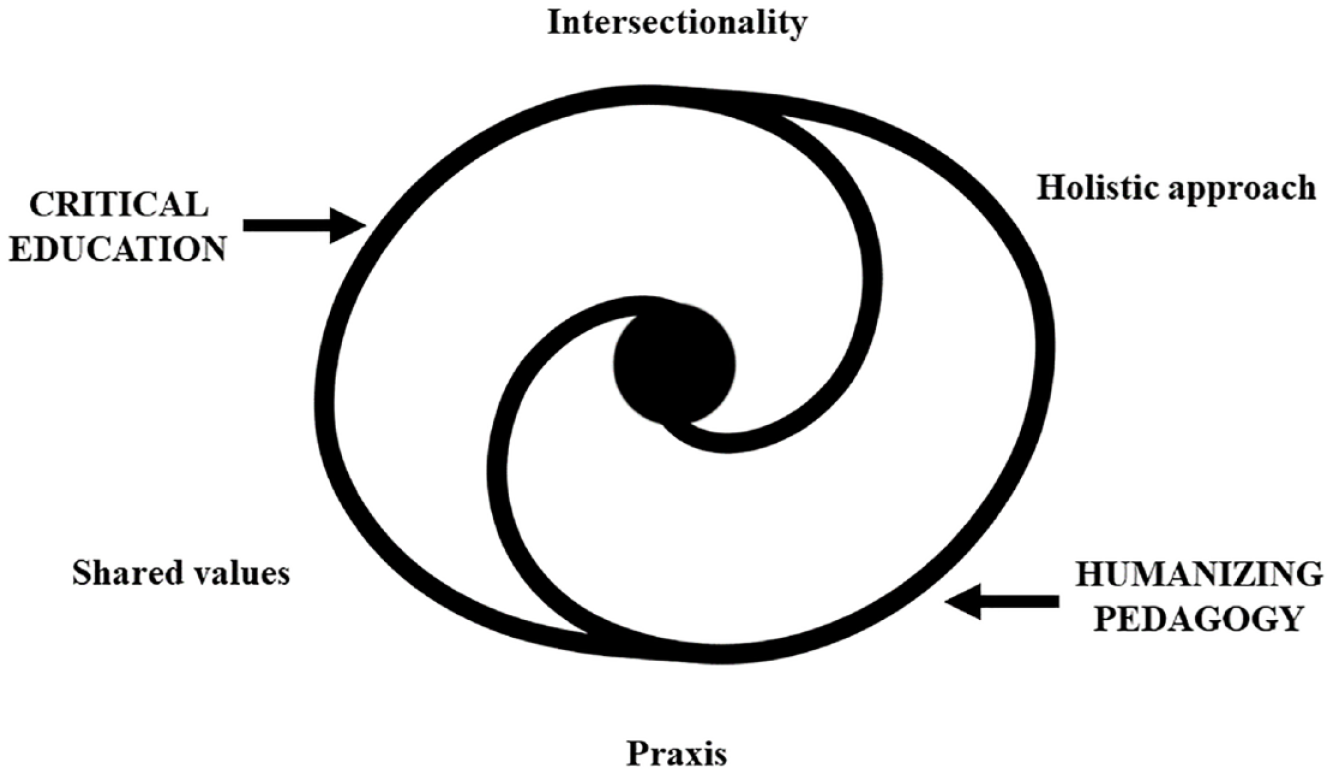
Critical education and humanizing pedagogy convergence.
III Context and rationale
The research based for this article focused on exploring how secondary English teachers deploy a critical and humanizing approach to their teaching. I sought to understand how their classroom practices addressed some of the social injustice experienced by their students and the communities they live in. To accomplish this, I employed a critical ethnography as an analytical tool to investigate the teacher’s and students’ relationships and how they created projects to address some of the social problems experienced by their communities.
I chose critical ethnography (CE) intentionally because it has its roots in interpretative approaches to research and has been influenced mainly by critical theory, but also by phenomenology, structuralism, semiotics, and linguistics (Denzin & Lincoln, 2000). As a critical ethnographer, I felt compelled and morally obligated to learn from the teachers and students as I gained the trust and was invited to participate in the classes not only as an observer but also as a participant. As a Colombian-born researcher, I also needed to contribute to ongoing conversations about social justice education in the country and also thought it was timely and necessary to work on how to better understand and support English teachers in their day-to-day work.
In 2014, I travelled to Colombia for a conference on ELT and, through various conversations with teachers, I met Sol. At that time, she had been working as an English teacher for more than 20 years in public schools in underprivileged neighbourhoods in Bogotá. She shared with me that she wanted to teach English through the lens of peace and peacebuilding. I proposed collaborating in a small action research project to explore the ways in which English could be taught through this lens (Ortega, 2019, 2020).
After one year of working together, I proposed that we continue doing this work but through the lens of social justice as a topic for my doctoral dissertation; she agreed, and for the next few years we worked together on the project. We developed trust and strengthened our relationships in my attempt to understand how social justice was presented in the different classroom tasks. Sol and other teachers (Hadasa and Camello) helped me to build the research project that served as the basis for the emerging conceptual framework presented in this article.
IV Towards a humanizing praxis
The conceptual considerations developed and described in this article were based on the findings of this study that were developed through a systematic process of analysing and interpreting data as an answer to the research question of how participants envisioned and enacted a social justice curriculum. The data collected evidenced emerging patterns related to teachers’ pedagogical responses to the Colombian policy for language teaching. This policy (Colombia Bilingüe) promotes the teaching of English to train students to get the language skills to work in an international market and thus help Colombia to be the economic leader in Latin America (Ministerio de Educación Nacional de Colombia, 2016). However, it is important to mention that the data revealed that teachers contested this government narrative with a form of pedagogical practice that responded to the students’ socio-emotional and academic needs instead of training them for a labour market.
Although several themes emerged during the analytical process, this conceptual article only details the collected data that illustrate the teachers’ practices and intentions reflected as a pedagogical process that I have conceptualized as a ‘critical humanizing pedagogy’ (CHP) for language teaching with its components be[ing], be[longing], and be[coming].
In this pedagogical approach (CHP), ‘be[ing]’ represents a person who is in constant change and growth, ‘be[longing]’ encompasses the individual’s place in the community, the neighbourhood, the country, and the world, and ‘be[coming]’ speaks to the person who seeks transformation for self and community toward a better world for all. These three components were infused within a pedagogy focused on the teachers creating the conditions for positive learning and helping students to become social agents of change, future citizens, and individuals who care about humanity.
The analysis revealed that the teachers’ approach to teaching was not prescriptive nor mandated by the school or the government, it became a co-created teaching practice in learning with a more humanistic approach. This approach primarily reflects the students’ lived experiences, the teachers’ concerns about their students’ lives, and the pedagogical academic activities they employ to address the struggles in their community and question their roles in society.
Below, I detail how the three intersecting concepts are related to the teachers and students who purposefully focused to engage in pedagogical activities that activate critical consciousness and critical awareness toward practical actions to make societal changes.
As a critical ethnographer immersed in the classes and school activities, I observed the classroom pedagogies and their impact on the students. This opportunity also gave me insight into how such classroom experiences might influence the larger society. Students and teachers attempted to work for social justice not only for themselves as individuals but also for the well-being of their communities. The classroom activities and pedagogical tasks used to practice the English language skills demonstrated a sentiment of solidarity as humans, undergirded by a vision of changing and transforming society (Johannessen & Unterreiner, 2008). Freire (1970) asserted that the humanity of oppressed peoples has been stolen and that a process of humanization must be set in place to emancipate, overcome alienation, and affirm their place on this land. Teachers who use a humanizing pedagogy recognize the socio-historical and political context of their students’ lives, including the influence of societal power and cultural values (Bartolomé, 1994; Freire, 1970, 1987; del Carmen Salazar & Fránquiz, 2008). In my work with the teachers and students, I witnessed a distinctive relationship between the work the teachers did and the kind of human beings they wanted their students to become.
During my classroom observations, I took notes on how teachers at the school brought humanity back to their students through their pedagogical approaches. For example, in the following excerpt taken from one of my observations and reflections, I explain how Hadasa saw her class as a humanizing act: A child in her class had cancer and her students were constantly bullying him, then she stops the class and tries to explain the importance of seeing him as another human being who deserves respect, her class is not only about teaching the English content provided by the curriculum but also promoting humans who care about others. (Research notes, 12 August 2018)
This excerpt is one of the many examples of how the teachers in this study attempted to create social consciousness. A sense of ‘conscientization’ was created (Freire, 1970), a process of developing a critical awareness of their own social reality through reflection and action against oppressive systems with pedagogical intentions (Fanon, 2008). I understood how the English class was not only about teaching the content but also about using it as a platform to help students question the inequalities they experience and how they can help their communities while creating projects to transform their future.
Below, I describe three conceptual aspects that synergistically interact with how teachers put humanization as praxis at the centre of their pedagogical tasks (Figure 2). Stemming from the person in a state of existence – the verb ‘to be’ – these are as follows:
Be[ing]: the person in a state of constant personal change and transformation.
Be[longing]: the person in relation to the community and place.
Be[coming]: the person in the process of creating a better future for all.
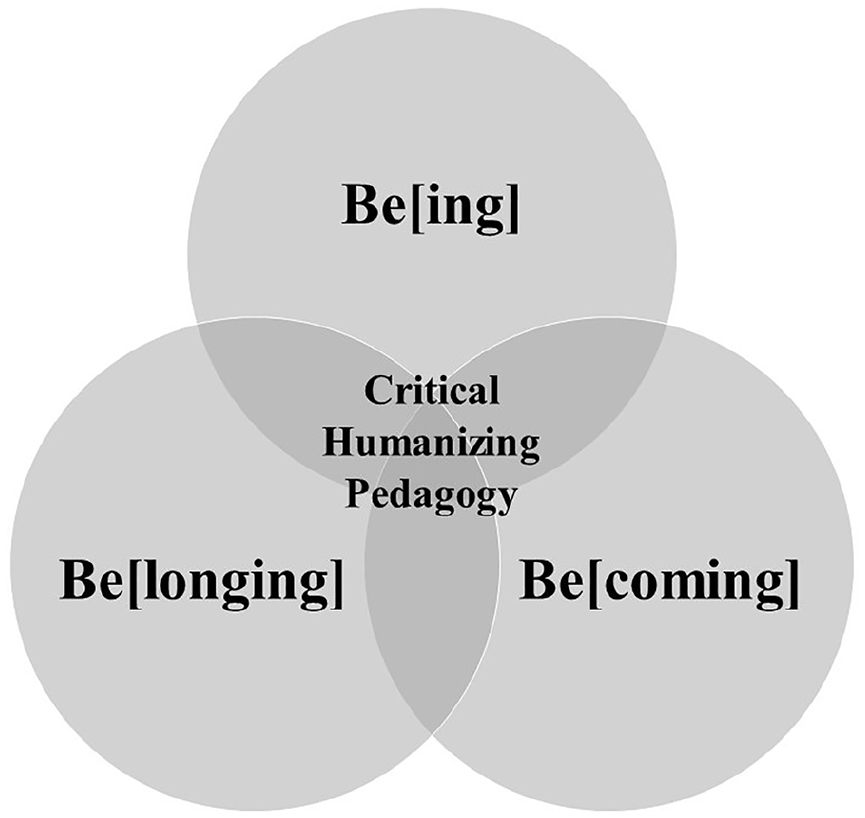
A critical humanizing pedagogy (CHP) for language teaching.
1 Be[ing]
In the English language, a verb ending in ‘ing’ refers to the present continuous. Be[ing] suggests a person in the present moment doing what is necessary to transform their life through purposeful action. Teachers, in this study, saw their students as potential agents of social change, in a sense, students as key drivers that engender change through strategic critical thinking to change the world (Zimmerman, 2001). Conversely, teachers also saw themselves as educators who are not fixed but constantly learning from their students to find ways to better support them personally and academically through their pedagogical approach.
Be[ing] refers to that person (teacher or student, perhaps a researcher) who is in continuous transformation and change; a person who puts the human at the heart of their actions in a way that moves beyond the classroom to be expressed in society. Teachers constantly invite their students to know that with English they can learn about other cultures and understand different worldviews. For Oxford (2013), this kind of approach to teaching is in close connection with the inner dimension of a human being seeking to weave language into actions in a manner that promotes peace and social justice. Certainly, this sentiment is highlighted in one of Hadasa’s interviews when she responded no estamos solos, estamos conectados con el mundo (‘we are not alone, we are connected to the world’) (13 August 2018). As such, Be[ing], applies to a person (a teacher or a student) who cares not only about themselves but also about others in a process of transforming the world around; thus, the classroom becomes the space to foster such mentality. Figure 3 represents this person as depicted by one of the students: Be[ing] reflects on who he is and what he can do with the knowledge he has gained product of ongoing reflections on his own artistic identity (my style). Be[ing] is about the many possibilities for a person to respond, create and engage in social change through personal daily actions; and how a person can freely exercise their identity for self-determination and attempt social transformation.
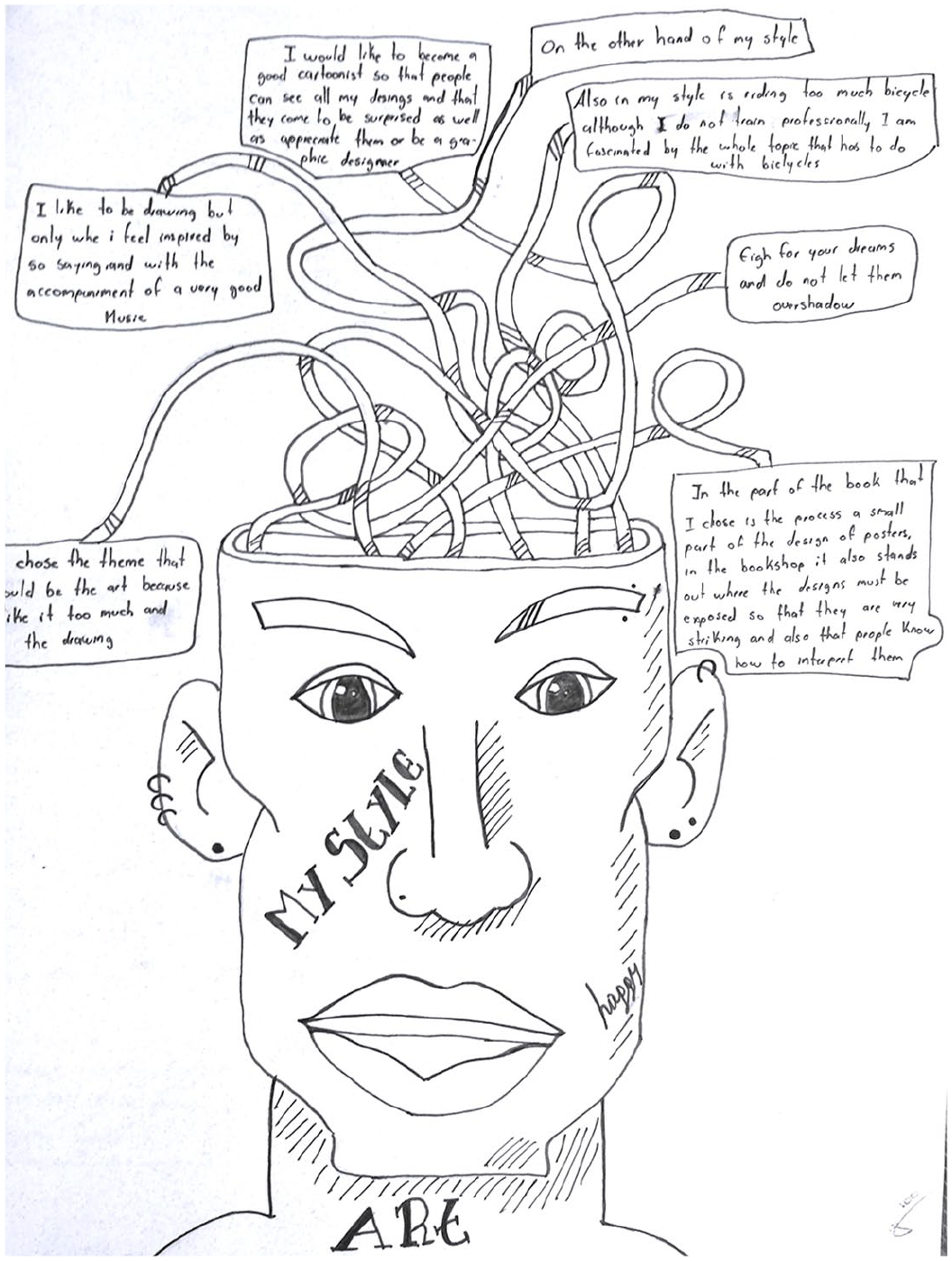
Student’s self-portrait of his own artistic identity.
2 Be[longing]
Be[longing] describes a person in connection with the community in which they live. In my experience visiting Hadasa’s class, I learned how she creates a space for learning and community support. She had been working on an initiative called ‘Dreams and Hopes’ for which she asks her students to envision their community and what role they can have in their collective future. Hadasa asked students to answer the question ‘How do you want to support your community once you finish high school.’ Students were encouraged to create booklets to depict their thoughts, ideas and reflections. By looking at some of the students’ work attempting to answer this question, I noticed how most of the drawings and designs were about addressing the Colombian history of violence and how they are eager to change that history. Their artistic renditions suggested that they wanted a better future for their communities, a future in which there is respect and understanding of differences within their communities. Figure 4 portrays one of the students’ artistic booklets from this initiative and how she responded to the prompted question.
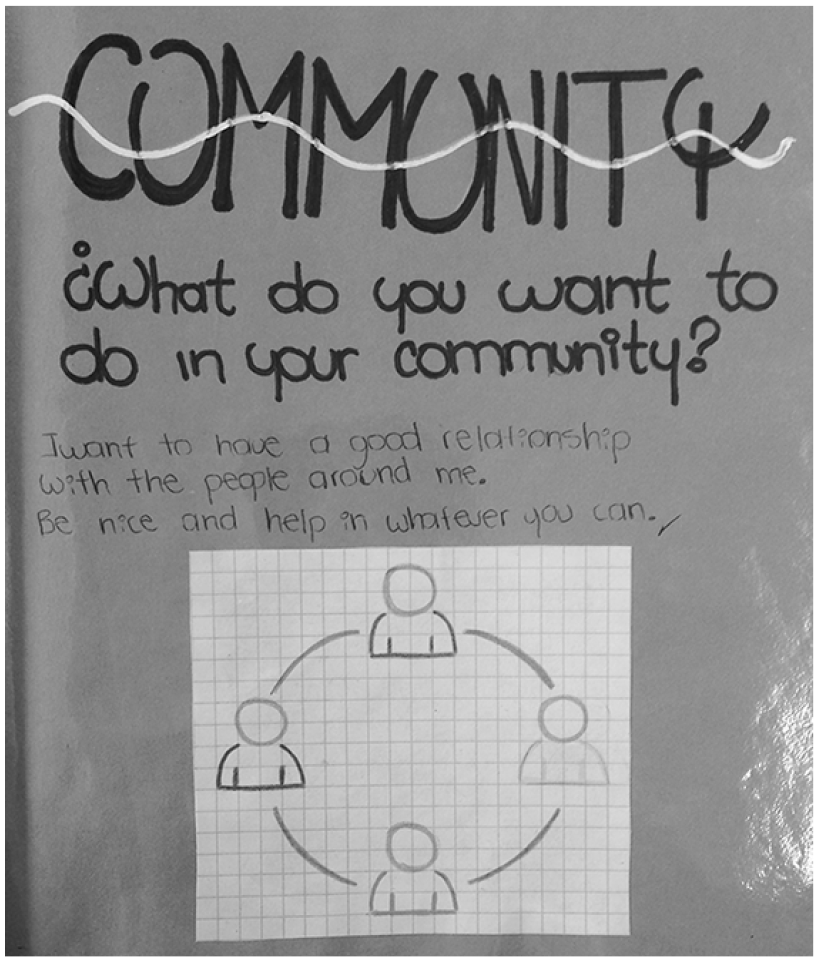
Community as depicted by one of the students.
This particular photo demonstrates the student’s vision of her community, respect and understanding of the differences as well as being united to fight against inequality which is consistent with some of the responses in the interviews with other students who believe that to truly belong to a community and find peace some kind of dialogue must happen. Hadasa reviewed her students’ work and concluded that most of the students seek to support their communities and perceived a high sense of belonging after this project. This idea correlates with some worldviews of Indigenous peoples in which our relationships with our communities are central to teaching (Smith, 1999; Styres, 2011; Styres et al., 2013) which provides students with a sense of belonging. This cultural commitment to their neighbourhood, their city and the country was demonstrated throughout the study as teachers and students highlighted some social problems and looked for possible solutions that would benefit all. In the following interview excerpt, Laura, one of Sol’s students, describes how the teacher connects the class with the community as she teaches in a way that connects the students’ realities and spaces: Ella (la profesora) nos hizo llevar a cabo la idea no solo como un proceso de aprendizaje, pero para crear un cambio y hacer concientizar a las demás personas de la problemática que estamos pasando y la ayuda que necesitamos, no solo nosotros sino toda la comunidad. (‘She [the teacher] helped us with the ideas, not only as a learning process, but to foster awareness about others, the problems we are going through and the needs we have as a community.’) (Laura, 24 September 2018)
Here, Laura demonstrates her sense of belonging and willingness to transform her reality and do whatever is necessary to support her community. Furthermore, based on collected data, it was demonstrated that Be[longing] is perceived as an affinity for a place or situation, but also (longing) a yearning desire to participate in changes that affect individuals and their communities positively. This emerges as a human emotional need to be accepted as members of a group (such as the school or the neighbourhood) with an inherent desire to belong and be an important part of something greater than themselves with compassion and care (Blum & Dale, 2021). In the previous interview excerpts, Hadasa as a teacher and Laura as a student have seen how learning English is not merely learning about content but is also a purposeful and powerful tool for learning about their realities in an attempt to support their community.
3 Be[coming]
Be[coming]: This concept refers to individuals concerning their future expectations and realities. Be[coming] is about creating the projects and conditions for a sustainable future for all. The following interview excerpt represents this idea. Here, Horacio, one of the students, explains how the social-justice-oriented pedagogical approach used by Sol helped him to understand that his learning experiences are not only related to current situations for him or society but are also for the greater good in the near future.
Siempre he notado que da como pequeños guiños con recomendaciones hacia el futuro, entonces cuando hablamos del tema de comercio justo siempre nos enfocaba hacia una ética visión hacia nuestra economía en el futuro. (‘I have noticed how the teacher gives us recommendations for the future, we talked about fair trade and how this is going to help our more ethical future economy.’) (Horacio, 24 September 2018)
Here, Horacio understands that a pedagogical approach oriented towards making changes for the future is important not only for the country but also for society in the long run. In class, there were discussions about how coffee fair trade in Colombia will help coffee growers in the country to have a better future based on the current economic policies. Sol gave this example for students to think that if they study English they can learn about other cultures and eventually envision a better economic future for themselves and their families. Similarly, after several observations in Hadasa and Camello’s classroom, I also evidenced how their projects and classroom pedagogical tasks prompted students to think about how they can transform their lives and those of others for a better future with no violence. I realized that the idea of Be[coming] denotes a human being in a constantly changing process, someone who self-reflects on the possibilities that respond to questions of who we are and who we want to be in relation to a non-distant future for personal and social transformation (Lederach, 2006). Within this framing, some students noted that because of their marginalized status, learning English communicative skills might help them to go ahead in life despite the difficult circumstances they live in. In the excerpt below, Alicia, one of the students, asserts that learning English might open up opportunities in the future after graduation to get a decent job that would potentially help her to leave the violent conditions she and her family have experienced.
Teacher, no tenemos futuro. Mire esa violencia que hay allá afuera. Pero estoy segura de que, con el inglés, más oportunidades se presentaran para tener buenos trabajos. (‘Teacher, we don’t have a future. Look at the violence out there. But I am sure that with English, more opportunities will pop up to get good jobs.’) (Alicia, 12 September 2018)
The previous excerpts demonstrate that a humanizing pedagogy of Be[ing], Be[longing] and Be[coming] converge at the teachers’ and students’ relations with the class, the school and the world as they relate to classroom activities, tasks and projects which are rooted in social justice. In a sense, teachers’ teaching approaches are mainly looking at: (1) treating others as human beings (Nieto & Bode, 2012); (2) encouraging a sense of belonging to the spaces they share with others (Sleeter, 2018); and (3) empowering students to create a safer future for themselves (Simon, 1987), their communities and the society at large in which learning English becomes one more tool to accomplish those goals.
In the end, CHP presents an opportunity to inspire researchers and educators who resonate with the work already done in critical applied linguistics (Pennycook, 2001) and other critical perspectives on language use, language teaching, and language policy. Additionally, CHP also resonates with approaches combating racism and challenging power relations, social inequality, and the ideological dimensions of language (Ashcroft, 2001). For example, raciolinguistic ideologies (Flores & Rosa, 2015) have already questioned the set of beliefs, attitudes, and discourses that link language with race. CHP hopes to add to this body of knowledge by challenging how these ideologies are shaped by societal views on race, influencing how language practices are perceived, valued, and used within different racial or ethnic groups. CHP considers it important to address how these raciolinguistic ideologies are engineered at the intersections of language and race, and how these contribute to social hierarchies, discrimination, and identity formation (Leung, 2019; Rosa & Flores, 2017). For example, CHP can be a useful tool to exemplify how a raciolinguistic ideology can be found in the way certain accents or dialects are stigmatized or associated with particular racial or ethnic groups (Ramjattan, 2019). Students in this study were aware of the already-existing discrimination and bullying for their non-native English accent, and the attitude therefore that deemed them to perhaps be less educated, intelligent, or competent; this is something they believe is not important as they focused on learning and practicing language to address social problems.
It is important to note that CHP as a proposed conceptual framework hopes to address some of these raciolinguistic ideologies that have been socially constructed and context-dependent for a long time, and they can vary across different societies and historical periods (Cushing, 2022; Rosa & Flores, 2017). Scholars in sociolinguistics and critical applied linguistics often study these ideologies to understand their impact on language attitudes, policies, and practices, as well as to challenge discriminatory language ideologies and promote linguistic justice. However, CHP hopes to fill some of the gaps in relation to critical and humanizing pedagogical approaches to the teaching of English in conditions of precarity; thus, the passionate work of teachers of English in marginalized conditions is paramount for a world worth living.
V Discussion
This article conceptualized, from gathered data, a framework that explores the possibilities for a social justice approach to engaging students in learning English with a social and critical purpose. This can act as an example to collaborate in projects across the curriculum with other subjects such as social studies, history, and ethics. Teachers and researchers may be encouraged to connect theory and practice toward social change with actions in which language can be used for personal and societal transformation. Chapman and Hobbel (2010) specifically suggest that social justice education should inspire students to know the world through a critical understanding of themselves, the communities and the larger society in which they live, from multiple curricular perspectives, to transform and ameliorate the world. Nieto and Bode (2012) propose that social justice should challenge, confront, and disrupt misconceptions and stereotypes that lead to structural inequality and discrimination based on race, social class, gender, and other social and human differences. Certainly, CHP is in line with these ideas, and it can be appealing to educators in the field of ELT, or the teaching of any other language (foreign languages, additional languages, home languages, heritage languages, etc.), especially in contexts of marginalization.
As the findings of the study suggest, a social justice approach to language teaching has the potential to create safe spaces in which students can be themselves, assert their identities in relation to their communities and develop plans for their professional and personal future (Ortaçtepe-Hart, 2023). In this way, it overlaps with key concerns outlined by Dei (2019), in which educators’, parents’, and researchers’ actions can further decolonial praxis. As I described from the vivid examples, this praxis can be articulated as concrete action-oriented tasks or purposeful and intentional acts of undertaking decolonization; ‘. . . for us to be more effective, our decolonial praxis must be about resistance to all forms of oppression given that colonialism and colonization are fundamentally about exploitation and oppression of peoples’ (Dei, 2019, p. viii). In other words, this article has described a transformative approach that has the possibility to problematize oppressive narratives that are part of a decolonial project in action that is ‘deeply implanted in the ways we transform our political, economic, cultural and school systems’ (Dei & Lordan, 2016, p. vii). Teachers, during the interviews, mentioned that they see themselves as rebels of the system because they provide students with the necessary skills not only to learn English for the students’ future after graduation but also with the social and emotional skills to navigate the injustice they experience in their communities.
Finally, borrowing from de Sousa Santos (2008) who envisions a reality in which other practices and pedagogies are possible, educators can be inspired to understand, envision, enact and engage students in alternative forms of teaching. However, in light of the teachers’ and students' experiences in the study, the concept of CHP and its implementation involves subtle distinctive considerations and challenges. Balancing cultural sensitivity while avoiding stereotypes, addressing individual learning needs in diverse classrooms, and navigating power dynamics are nuanced aspects. Challenges include overcoming resistance to change in traditional educational systems, finding alternative assessments compatible with these approaches, managing time constraints, and ensuring equity in student engagement. I also found that teacher training is crucial for successful implementation, as educators may need support and professional development to effectively adopt these methods. Despite these challenges, the potential benefits of fostering critical thinking, inclusivity, and student empowerment make CHP valuable for reshaping education in more meaningful and responsive ways. Collaborative efforts among educators, administrators, and policymakers are essential to navigate these complexities and promote effective, student-centred learning experiences.
VI Conclusions
This evidence-based conceptual article argued that a critical and humanistic teaching approach that provides an alternative pedagogical framework for the language teaching field is also possible. To humanize education, educators, and practitioners, might look at the social role and purpose of teaching languages from a social justice perspective, as we meet the needs of the most marginalized communities in a non-distant future. This might act as a call to constantly question whether teaching should maintain the current socio-political and economic status quo that favours some or whether teaching should inspire a new generation of global citizens who care about others. I am hopeful that, with the exemplary approaches to teaching I have highlighted in this article, teaching can advance towards a new era in which we locate the (human) being at the front and centre of language education in relation to other non-human entities.
Additionally, CHP can be utilized as a point of entry for those interested in expanding or adding a more critical and human vision into language curriculum development, language teacher training, and language policy. For example, in marginalized contexts, implementing humanizing pedagogies and critical education requires a tailored approach to educational changes. In curriculum development, a focus on culturally relevant content, community involvement, real-world connections, and multilingual approaches ensures that education speaks directly to the experiences and needs of marginalized students. Also, language teacher training programs could prioritize cultural competence, inclusive pedagogies, community engagement skills, and trauma-informed practices to equip language educators with the tools needed to navigate the challenges faced by students in these contexts.
At the language policy level, there is a need for equitable resource allocation to schools in marginalized areas, flexible language assessment models that consider diverse learning experiences, community-driven decision-making processes, ongoing professional development opportunities for teachers, and inclusive curriculum standards that recognize the diverse cultural identities of students. These measures collectively can potentially contribute to creating an educational environment that is not only responsive to the unique challenges of marginalized communities but also empowers students to thrive academically and personally. Through these initiatives, language education can become a tool for social change in marginalized contexts similar to those in Colombia.
Additionally, this conceptual paper might also offer a number of opportunities for research in which design studies can use CHP to see how it can have an impact on students at different levels such as raising critical consciousness, language and content development, civic engagement and addressing socio-emotional skills (Herrera & Martinez-Alba, 2021). In a sense, CHP helps to conceptualize a hybrid type of inquiry as a stance and as a transformative theory of action (based on teachers’ practices) to reposition the collective intellectual capacity of practitioners into social-justice oriented best practices, thus promoting schools as sites of innovation (Cochran-Smith & Lytle, 2009).
Here, CHP can provide the necessary conceptual tools to support practitioners and schools to incorporate ideas of linguistic diversity into classrooms and pedagogical initiatives to be recognized and actioned by teachers in marginalized contexts. Considering these opportunities and their possible affordances, CHP might better inform complex viewpoints in understanding how students learn under difficult conditions while acquiring the knowledge and skills to challenge power ideologies through critical education. This can, in turn, act as an enabler for bringing pedagogical strategies into the classroom to maximize learning opportunities for marginalized students who seek to learn languages other than English (including local Indigenous languages).
I would like to finish this article with something Horacio, one of the students in the study, said: Estoy aprendiendo inglés para ver si algún día creamos un mundo hacia un futuro mejor para todos (‘I am learning English to see if someday we can create a world towards a better future for all’). The proposed model of CHP and its components somehow responds to Horacio’s cry as it might be utilized as lights to guide curriculum design and lesson planning for language teachers who seek to answer to students’ academic, social and affective needs while fostering a sense of acceptance: be[ing]; affirming cultural and linguistic identities: be[longing]; and promoting a more sustainable future for all: be[coming].
Footnotes
Acknowledgements
I would like to thank the teachers and students in this project who work every day for a better future for all.
Funding
The author disclosed receipt of the following financial support for the research, authorship, and/or publication of this article: This research was supported by The Social Sciences and Humanities Research Council of Canada (SSHRC) and the International Research Foundation for English Language Teaching (TIRF).
