



Abstract
This paper explores the gap between the rhetoric of institutional policies on internationalisation and how academics understand and translate these policies into in their daily practices. It is based on a study conducted in one large, research-intensive university in Australia. Recent studies investigating this gap from the perspective of academics have tended to do so using an individual/psychological or structural lens. This study applies both lenses to investigate academics’ perceptions and practices of internationalisation of the curriculum (IoC). Academics from a range of disciplines were invited to discuss their understandings of internationalisation and its impact on their curriculum and teaching. ‘Re-storying’ the interview data revealed a range of responses: from ‘transformalists’ who articulated strong, positive personal views and understandings of the concept, to ‘transactionists’ who had little understanding or interest in the concept. It was found that individuals’ understandings and practices of IoC were shaped by what they understood to be the purpose of a tertiary education and their sense of students as future graduates; their approach to teaching; their understanding of their discipline’s orientation to the global context; their own identities as teachers/researchers and citizens; and their capacity or agency to develop these understandings into an authentic teaching practice. Four interrelated threads were common to all transformalists’ narratives – the impact of international experience; an understanding of active, student-centred pedagogy; a sense of belonging in a like-minded (disciplinary) community; and a reflective awareness of the self and others – have implications for the professional development of academics, and for further research.
Keywords
Introduction
The higher education sector has been subject to, and transformed by, a ‘widening, deepening and speeding up of worldwide interconnectedness in all aspects of contemporary life’ (Held et al., 1999: 2) for nearly two decades and the process has intensified in more recent years. While ‘not all universities are particularly international, all are subject to the same processes of globalisation’ (Scott, 1998: 122). Through teaching and research, universities can contribute to the development of sustainable, equitable societies within and across national borders.
In order to achieve this effectively, universities need to become less transactional and more transformational, less focused on quantifying in- and out-flowing resources, more excited about fostering reciprocal relationships, which change the lives of all stakeholders. A curriculum ‘for the age of instability’ (Barnett and Coate, 2005: 8) must enable students to develop into globally responsible citizens. Many universities – for example in the United Kingdom (Caruana, 2010), Canada (Hanson, 2010) and Australia (Green and Mertova, 2011) – declare that ‘global citizenship’ is one of their ‘graduate attributes’, and that ‘internationalisation of the curriculum’ (IoC) is the means to that end. From a moral and economic perspective, universities have an obligation to prepare students for increasingly uncertain globalised futures. Yet, there is an oft-observed gap between a university’s internationalisation policy and practice at the coalface in the faculties where teaching and learning occur (Childress, 2009; Leask, 2015; Liddicoat et al., 2003).
This gap is the focus of our paper. Most commonly, as Sanderson (2008) points out, investigators have researched this gap from an institutional perspective, asking what kinds of institutional policies/strategies are likely to support academic engagement. This paper takes the road less travelled, by focusing on the perspectives of individual academics. We present and discuss findings gleaned from a qualitative study at one Australian university, where academics from a wide range of disciplines were invited to reflect on what internationalisation meant to them and the impact it had on their curriculum and teaching practice.
Our theoretical orientation shapes the sense we make of this interview data. We begin by explaining the terms, ‘internationalisation of the curriculum’ for ‘global citizenship’ – terms that in themselves constitute a problem for research on this topic (Caruana, 2010). Secondly, we review differing perspectives on academics’ engagement with IoC, paying particular attention to Leask and Bridge’s (2013) framework for IoC, and Sanderson’s (2008) ‘foundation for the internationalisation of the academic self’, because these concepts underpin our analysis of the situated and authentic nature of university teaching in our data. In discussing our findings, we reflect on these concepts in order to better understand how individual and extra-individual factors within our complex local/institutional/global contexts shape IoC practice. Finally, we consider the implications of this emerging theoretical understanding for further research and practice.
Defining ‘internationalisation of the curriculum’
Over several decades, the conceptualisation of ‘internationalisation’ in higher education, particularly in Anglophone countries, has been perceived essentially as an economic enterprise. This economic rationalist imperative has dominated, for instance, Australian higher education for several decades (Marginson and Sawir, 2011) and, indeed, Australian universities have become financially dependent on fee-paying international students. Over the past decade, this imperative has been challenged by those who believe universities have the responsibility to prepare all students to live in the increasingly interconnected global world.
Influenced by these changing perspectives on internationalisation in higher education, universities in Australia and elsewhere have begun to see internationalisation within a broader framework of Graduate Attributes (GAs) and intercultural capabilities for all students. IoC is commonly understood to support this broader agenda (Leask, 2008). IoC was originally defined by IDP Education Australia in 1995 as follows: …the process of developing a curriculum which is internationally oriented, aimed at preparing students for performing (professionally, socially) in an international and multicultural context, and designed for domestic students as well as foreign students. (IDP Education Australia, 1995)
While a number of definitions of IoC have now been developed (Hall, nd), the original IDP definition is still commonly used by Australian universities. Importantly, IoC should not be seen as an ‘end’ in itself, but rather as ‘a strategy which will assist learners to become more aware of their own and others cultures’ (Leask, 2005). There is broad agreement in the literature that an internationalised curriculum has the following intended learning outcomes: global perspectives, intercultural communication and ‘global citizenship’, or the ability to act responsibly in the face of global inequities (Clifford, 2009; Green and Mertova, 2011). This third dimension – ‘global citizenship’ – is not without controversy, as it is also associated with cultural imperialism, particularly related to the Anglophone and Western world. Responding to increasing interest in the concept in higher education, many universities now include the term ‘global citizenship’ in their policy documents. Clifford and Montgomery (2011) perceived this move as a ‘good feel’ moment for many of these institutions, because they ignore or paper over these important debates. The fact that many universities ignore academic debates on IoC results in a range of ‘incoherent and contradictory goals’ (Caruana, 2010: 51), which make it difficult to discern implications for teaching and learning. Nevertheless, IoC is widely seen as the ‘means’ to a global citizenship ‘end’, particularly in Anglophone countries.
Because IoC is a construct, not a set of prescribed practices (Curro and McTaggart, 2003), academics need to be actively engaged in interpreting it in their own teaching practices (Clifford, 2009; Green and Mertova, 2011; Green and Whitsed, 2013; Leask, 2015). According to Jones and Killick (2007), the more mature, complex and ‘values-based’ the approach to IoC is, the more it will encompass skills and attitudes as well as knowledge. For teachers as well as students, deep engagement with IoC is challenging because it necessarily ‘involves epistemological explorations … of the thinking which informs an interdisciplinary notion of “intercultural”’ (Crichton et al., 2004: 42, 44), within the context of globalisation. In short, an internationalised curriculum ‘requires the creative utilisation of the imagination and agency’ of academics. (Jones and Killick, 2007: 114).
Academics’ engagement with internationalisation
Although IoC appears in many university policy documents, it tends to resonate negatively with academics due to being associated with an economic rationale for internationalisation, hence with uniformity (Schapper and Mayson, 2004) and a ‘one size fits all’ Western curriculum. ‘IoC, couples two fuzzy, ideologically-laden terms: ‘internationalisation’ and ‘curriculum’ (Leask and Beelen, 2009; Whitsed and Green, 2014). As Leask (2008: 13) argues, ‘decisions about curriculum innovation for internationalisation are not neutral’. They are ideological in nature, shaped by beliefs about internationalisation/globalisation and about the curriculum itself. Internationalisation may be a ‘familiar’ term, but it is problematic because it is ‘subjected to extensive and varied use in research and discussion’ (Marginson and Sawir, 2011: 14). The same can be said of the curriculum. Whereas ‘traditional curricula’ emphasised knowledge attainment, ‘emerging’ curricula encompass three domains: knowing, doing and being (Barnett and Coate, 2005). Today’s students, facing a future in many ways unknown, need a teaching with an ontological focus, one that engages them as whole persons, as global citizens. As Leask and Beelen (2009) observe, this has profound impliciatons for IoC. Approches to IoC assume a ‘broad conceptualisation of curriculum’, encompassing ‘all aspects of the teaching/learning situation and the student experience’, yet this is likely to be at odds with understandings in many disciplines, which have generally not considered the influencing potential of informal dimensions of the curriculum (Leask and Bridge, 2013: 81). Given the slipperiness of IoC’s component terms, it is not surprising to find that it is a concept often misunderstood and under-developed in practice (Green and Whitsed, 2015; Leask, 2015).
Researchers investigating the gap between IoC rhetoric and practice have tended to take an institutional perspective (Sanderson, 2008). In underscoring the importance of organisational approaches to the implementation and evaluation of IoC, these institutionally focused studies can usefully inform university management regarding the effective leadership of IoC. Yet, despite some recognition of the need to work from the ‘bottom up’, an unfortunate tendency can be discerned: the framing of academics as the problem, as obstacles to the process, ‘gatekeepers’ or ‘harbingers’ (Green and Schoenberg, 2006: 4) with the power to block or ‘resist’ (Mestenhauser, 1998) changes to the curriculum. Few studies demonstrate an understanding that the curriculum, and its ‘architects’ – academics in the disciplines (Leask and Bridge, 2013) – are at the heart of a university’s internationalisation processes (Green and Whitsed, 2015). Teaching in universities is complex, and highly context-dependent work (Leask and Bridge, 2013). Reflective, theoretically informed, contextualised studies of IoC, which include the voices of academics, are rare (Leask, 2015).
Mestenhauser (1998) was one of the earliest to focus inquiry on academics themselves. He attributed faculty academics’ lack of engagement with IoC to ‘conceptual confusion about what international education means’ (p.4). However, Bell’s (2004) study suggested that an academic’s broader understanding of teaching, learning and knowledge, rather than IoC per se, is functionally linked to his/her responses to this agenda. She found that academics take up four distinct positions along a spectrum of attitudes towards curricular and systemic change. At one end, those who had negative attitudes towards IoC ascribed to a content-focused curriculum, and perceived major obstacles to the development of IoC. At the other end, those who viewed IoC positively ascribed to a process-focused curriculum and perceived minimal obstacles to its implementation.
Two more recent studies address the same issue from a different angle: the shaping of IoC knowledge and practices by the ‘extra-individual’ – the discourses and material conditions that shape academics’ work (Kemmis and Groontenboer, 2008). The first of these studies, by Clifford (2009), found that disciplinary understandings of IoC coincide with Becher’s (1989) categorisation of the disciplines according to their understandings of teaching, learning and knowledge. Clifford observed that the least sophisticated understandings were associated with what Becher termed the ‘hard pure disciplines’ (natural sciences and mathematics), where knowledge and ways of teaching and learning are considered to be universal, and culturally neutral.
Clifford’s work illustrated the power of disciplinary communities to shape understandings and practices of IoC, but it offered no way of understanding intra-disciplinary differences or cross-disciplinary similarities between academics in relation to their teaching. Leask’s (2013) recent study significantly complicated previous understandings by investigating the ‘the differing cultures among different scholarly fields with respect to internationalization’ (Leask, 2013: 82, citing Stohl, 2007: 368). In the conceptual framework developed by Leask and Bridge (2013), the place of disciplinary knowledge is recognised as one critical determinant of academics’ conceptualisation and practice of IoC, but this knowledge is nested within and shaped by the institutional, local, national, regional and global contexts. The dynamic interrelationships between these contextual layers explain how differences in practice arise. In Leask’s IoC Framework (Figure 1), disciplinary knowledge (its ways of knowing, seeing and doing) is nested within and shaped by the institutional, local, national, regional and global contexts. This means that while academics within a discipline may share ways of understanding the world, differences can arise due to the dynamic interplay between these contextual layers. Dominant and emergent paradigms within a discipline, the requirements of relevant professional bodies and practices, assessment practices, and even the approach to developing learning outcomes, are all influenced by the nested context in which this work occurs.
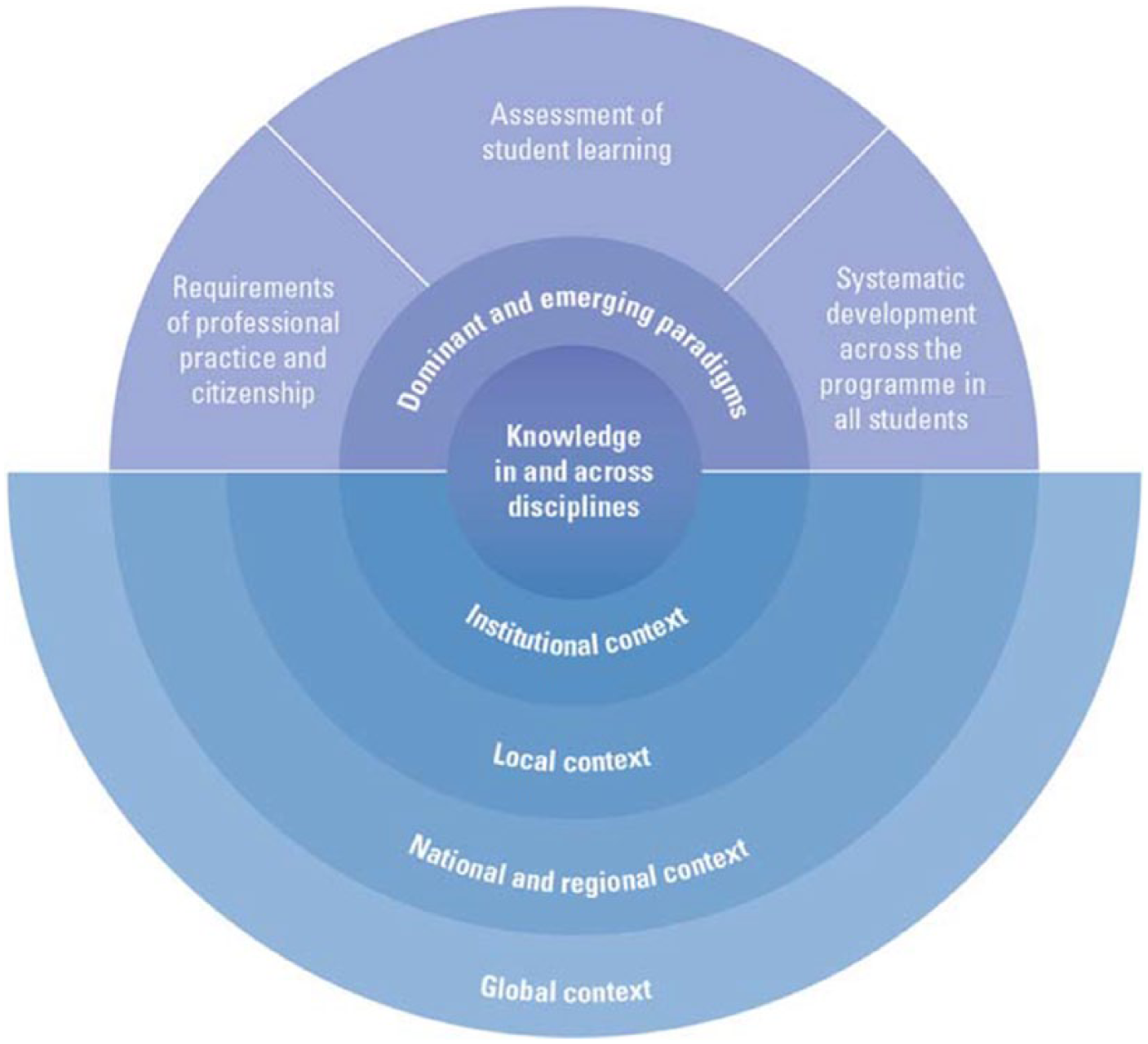
Internationalisation of the curriculum conceptual framework (Leask and Bridge, 2013).
Leask and Bridge’s (2013) framework is the most nuanced to date, yet questions remain. Most importantly, how can we account for the fact of individual differences between academics working in the same context? How is it that one or more ‘champions’ operate in contexts so apparently unsupportive of IoC? Sanderson’s (2008) ‘foundation for the internationalisation of the academic self’ addresses this question by sketching a theoretical foundation for understanding IoC as a personally transformative process. Drawing on Cranton’s (2001) conceptualisation of the ‘authentic teacher’, he concluded that the ‘whole of person transformation’ required for IoC calls for an ‘internationalised academic Self’ (p.286).
What such an ‘internationalised academic self’ might look like in practice, how such academics might conceptualise and actualise IoC within their disciplines and, importantly, how the disposition to do so might be fostered are questions not addressed by Sanderson. As he acknowledges, his ‘foundation’ is theoretical and abstract. It leaves academics trapped in virtuous or vicious circles, depending on whether they ‘want’ to become ‘internationalised’ (Sanderson, 2008; Trahar et al., 2015). Hence, as he admits, the ‘reliance on an individual’s disposition toward developing [an internationalised Self] is clearly a limiting factor’ (Sanderson, 2008: 297), which makes it difficult to imagine a way forward.
In summary, our consideration of relevant seminal research highlights the importance of developing a critical understanding of the dialectical relationship between the individual and extra-individual factors within our local/institutional/global contexts and how these impact on IoC practice. In the following, we explore this dialectic in relation to perceptions and practices of IoC in a large Australian university.
The study
This qualitative study was undertaken at one large research-intensive Australian university, which had no explicit policy regarding IoC, but had supported the aims of IoC for many years through its Teaching and Learning Plans and GAs Statement. All senior academics and those responsible for curriculum leadership within faculties, schools and research institutes were invited to take part in interviews to discuss their understandings of internationalisation and its implications for curriculum and teaching. Only one school opted out of the research, indicating that they had nothing to say on the subject. The interviews lasted between 10 minutes and an hour, depending on how much the interviewees felt they had to say. They were mostly conducted face-to-face; where this was not possible, they were conducted over the phone. With the interviewees’ informed consent, we recorded the interviews, then anonymised, transcribed and analysed the data in an inductive and iterative manner, which included feedback from interviewees.
Although the study’s overall findings have been published elsewhere (Green and Mertova, 2011; Mertova and Green, 2010), this paper focuses on one particularly important subset of the data: the interviews with those at the lowest level of leadership in the university, within the schools – such as heads of schools, chairs of teaching and learning, programme directors and other senior lecturers/lecturers who have direct responsibility for the quality, design and teaching of the curriculum. Understanding perceptions and practices within this group is important in relation to IoC, because it calls for a collaborative approach across degree programmes (Leask, 2013), and this group have the potential to influence and include others informally, as well as formally through comprehensive curricular reviews (Anderson and Johnson, 2006). Although the research was conducted nearly six years ago, we have observed that little has changed in terms of IoC policy and practices at that university, and indeed others believe that this is the case in many other Australian institutions 1 (Leask, 2015). Therefore, there is value in returning to this study to take a closer look at this data subset.
From a total of 115 interviewees, 35 with staff in schools were selected for re-analysis, this time using ‘re-storying’ techniques (Creswell, 2013) involving three steps. Firstly, the transcripts were rewritten as narratives built from information given by the academics during interviews. Secondly, a ‘horizontal’ reading ‘across’ the re-storied data revealed common patterns in the stories (Creswell, 2013). Thirdly, a close ‘vertical’ reading of particular individual narratives was undertaken, in order to develop detailed profiles, which illustrate differing approaches to IoC. Our findings, in terms of broad themes and representative profiles, are explored below.
Making sense of the findings
Analysis revealed widespread uncertainty and confusion among academics about the university’s expectations of them regarding IoC, regardless of their discipline or position (Green and Mertova, 2011; Mertova and Green, 2010). However, there were marked variations in participants’ responses to this institutional uncertainty. These ranged from the enthusiastic to the uninterested and overwhelmingly negative. While we observed a tendency for science academics to be uninterested or negative, as did Clifford (2009), we were unable to draw any substantial conclusions about the impact of discipline on IoC engagement, due to the limited numbers of interviews within each discipline. What is clear is that discipline alone does not determine an individual’s response to internationalisation. There were academics in all disciplines who articulated strong, personal views and understandings of the concept, which they were able to apply in practice. There were also those who had little understanding or interest in the concept; while some of these acknowledged the economic benefits of increased international student enrolments, they felt that IoC was entirely inappropriate for their discipline.
We characterise the first of these orientations as ‘transformalist’, following Held et al. (1999), as their perspective on internationalisation implies a pedagogy that is critical, transformative and informed by a particular understanding of higher education within the context of globalisation. We characterise the other dominant orientation found in our study as ‘transactionist’, to represent the overriding tendency of this group to frame internationalisation in terms of economic transactions. While some interviewees could be situated at points along this spectrum, most gravitated strongly towards one end or the other.
The following analysis focuses on these two polarised positions, because they provide valuable insight into the understandings, motivations and practices of those who most strongly support and those who resist IoC. Our aim in making sense of our findings in this section is to holistically illustrate and analyse the attitudes, worldviews and practices of those interviewed. The analysis begins with detailed profiles of two academics representative of these positions: Lisa, a ‘transformalist’ and Herbert, a ‘transactionist’. Each of these profiles is then further developed and analysed with reference to other interviewees’ narratives in order to highlight the following predominant attitudes of academics towards IoC:
understanding who their students are;
pedagogy;
identity and orientation to the world;
understanding of their discipline’s orientation to the world;
understanding of the place of IoC in the curriculum;
approach to IoC in academic practice.
The transformalist
Lisa 2 is an experienced senior lecturer in the social sciences. When asked about her understanding of internationalisation, Lisa immediately began to talk about her students and what she believed they needed from their university education in a globalising world. She wanted her students to develop as ‘global citizens who aren’t expecting other people to be like them’. She described this as a fundamental ‘political and personal’ belief, which in practice meant that she aimed to teach students to be ‘critically reflective about the cultural origins of knowledge and how they were going to utilise that knowledge after leaving university’. She hoped her students would ‘learn to interact with others with dignity and respect’. To do otherwise would be to ‘do ourselves, our students and our universities a disservice’. Thus, Lisa’s transformalist’s perspective of IoC became evident early in the interview, in the way she spoke of her students as responsible, reflective citizens, willing and able to interact respectfully with others different from themselves.
Describing her pedagogy as ‘inclusive’, Lisa talked about ‘creating learning experiences that welcomed students who are not Australian, or who are culturally and linguistically diverse Australians’. In contrast to the ‘deficit model of seeing international students as lacking’, which she believed was frequently adopted by her academic colleagues, she described her approach as ‘privileging and celebrating diverse knowledge and experiences’. She went on to give numerous examples of how she did this in her own classes. This, she felt, was a ‘far more sophisticated, far more complex’ approach to internationalisation, and one that ‘cannot be done as an add-on course run by outside people; it needs to be embedded into everything we do’.
Lisa’s practice could be described as authentic, in that she felt her approach to IoC grew out of her personal/disciplinary knowledge. Lisa talked about her experience at her previous university, which had given her opportunities for transnational teaching, where she ‘had to engage with a very, very different way of seeing the world’. At the same time, IoC resonated with her disciplinary understandings of what knowledge is and its ways of thinking, teaching and assessing. She spoke of her approach as ‘epistemologically sound’ because it reflected what she believed to be her discipline’s understanding that ‘what we know is the product of a very limited history and that if we are going to be able to operate internationally, then we need to understand that there are many knowledges and there are many ways of being and that we need to be able to adapt to those’. For example, she said, ‘the concepts of ethnocentrism’ and ‘epistemology are central’ to social science and IoC. In short, for Lisa, IoC was part of who she was and what she did as a university teacher and researcher.
Lisa’s practice was also agentic, in that she acted as if the dominant ‘deficit model’ at the university was ‘amenable’ (Warhurst, 2008) to disruption. From her perspective, the university had ‘not faced up to the complexity and the challenges and the problems, and the difficulties of working in an international arena, and working with indigenous people’. Despite her view of the university’s superficial and ‘highly problematic’ approach, she felt able to practice ‘a very, very different internationalisation’.
There are several key elements to Lisa’s story that resonated with a number of other re-storied interviews. These are developed below.
Transformalists’ understanding of who their students are
Like Lisa, other transformalists began their interview by talking about their students. They spoke of them as future graduates, who would live and work effectively and ethically in an interconnected world. With this in mind, they gave considerable thought to the kind of work environments their students would enter, making statements like ‘our graduates need to be able to work in multicultural contexts’ or ‘the problems this generation faces are interconnected global ones’. At the same time, they positioned their students as agents in their own learning, with the capacity to co-produce knowledge with teachers. For example, several explained how they and their multi-cultural students deepen their global perspectives and intercultural awareness by learning from each other. Thus, these transformalists positioned students, implicitly, and sometimes explicitly, as ‘active collaborator(s)’ rather than ‘consumer(s)’ (Dunne and Zandstra, 2011: 4).
Transformalists’ pedagogy
Envisaging their students graduating as citizens as well as workers in an interconnected world meant transformalists were keen to develop a more ‘expansive’ (Warhurst, 2008), innovative pedagogy. Elizabeth (physical sciences), for example, believed that students needed to understand ‘the bigger picture’ for science within a globalising world: ‘Connecting students across borders’ was important and she enabled this through organising international student e-conferences. Peter (health sciences), saw his students as working internationally; thus, he perceived the need for ‘an international component… in all we teach, for the benefit of our own students who are not necessarily that well prepared [for that]’. Bernadette (applied social sciences) described how she ‘introduced comparative and international materials into courses … to challenge students to understand why these differences have occurred’. In short, transformalists provided numerous examples of innovative pedagogy that were informed, comprehensive and consistent with the IoC literature (Green and Mertova, 2011); that is, their teaching practices were inclusive of all students (Leask, 2009); comparative and reflective (Mestenhauser, 2011); intentionally designed to foster intercultural learning (Jones and Brown, 2007); global and local (Shiel, 2006); interdisciplinary (Mestenhauser, 2011); and embracing of the informal curriculum (Leask, 2009). In line with Bell (2004), transformalists understood that IoC is essentially good pedagogy, based on an understanding that learning needs to be ‘contextual, discursive, experiential, inclusive and critical’.
Transformalists’ identity and orientation to the world
Although the interviewer did not prompt interviewees to reflect on their own identity, or ask for any biographical information, transformalists wove their sense of self into their stories in order to explain how they developed their understanding and practices relating to IoC. Many referred to themselves as ‘cosmopolitan(s)’ who wanted their students to develop a similar disposition. For instance, Laura (creative/design disciplines) said: I’ve taught in London… I’ve practiced in South Africa. I know people in Chile. I speak Portuguese and Spanish. I have a commitment to cosmopolitanism. You know, I don’t want our domestic students to graduate as provincial hicks who are unable to interact in that kind of way.
Leo (applied social sciences) explained that working internationally gave him confidence to develop and teach an internationalised curriculum: [My international experience] means I can move really globally in terms of the curriculum … [It’s important to] be able to comfortably draw upon one’s own personal experience … to be able to confidently move across what are increasingly artificial boundaries.
So, like Lisa, other transformalists felt their international and intercultural experience was what motivated them, made their teaching authentic, gave them confidence and enabled them to act as role models for their students.
Transformalists’ understanding of their discipline’s orientation to the world
Just as Lisa spoke of the resonance between her disciplinary knowledge and ways of understanding and engaging with the world, and her teaching, so did other transformalists. While this orientation to the world might be expected in the social sciences (Clifford, 2009), we found this perception of one’s discipline’s orientation to and engagement with the world to be common among enthusiasts, regardless of their discipline. For example, Clare (business studies) perceived internationalisation as a complete ‘frame of mind’ within her discipline, while Paula (health sciences), saw her discipline as being inherently international in the way it understood national health systems in an international comparative context.
My discipline is by definition international… and thinks that way. So everything we talk about [to students] is international… Even on local issues we have a global perspective.
Hence, for transformalists, the link they perceived between their discipline’s understanding of the world, their own research within it and their understanding and practice of IoC meant that the latter was, as Lisa said, ‘epistemologically sound’.
Transformalists’ understanding of the place of internationalisation in the curriculum
Typically, transformalists stressed that the international/global context was ‘not an optional extra’, but ‘core’ and ‘essential’ within their curriculum, regardless of whether their focus was on local, national, regional or global issues. Elizabeth (physical sciences) explained: In first year, we embed an international e-conference that way students can talk with other students in different countries. So it’s a lot broader than just saying we’re going to put a week on international in the course.
For this reason, IoC had to be comprehensive in scope. It could not be ‘just as an optional extra that a few students can engage with if they want to … It’s a central part of every student’s experience’ (John, humanities). Typically, transformalists linked this understanding of IoC as essential and integral to their personal experiences, understandings and values of the world, and to their perception of its importance to their discipline, rather than their engagement with the literature or a concern for university policy.
Transformalists’ approach to IoC in academic practice
Authenticity and agency were common threads through all of the transformalists re-storied narratives. As we noted earlier, there was a pervasive sense of uncertainty about the university’s ‘correct’ or ‘formal’ definition, its policy and its expectations in relation to IoC. Like Lisa, other transformalists questioned the dominance of an economic rationale across the Australian higher education sector, and were critical of what they saw as contradictory and superficial approaches within the university. Yet, they expressed strong personal views that were informed, comprehensive, consistent with the literature and surprisingly similar. In a less than supportive national/institutional context, they spoke of working on IoC ‘under the radar’, and readily illustrated this with examples from their own practice.
At the opposite end of the spectrum, some academics were uninterested, sometimes even cynical, about internationalisation and IoC. Their understandings of IoC were quite limited; while some recognised the financial ‘necessity’ of international students and felt that others in the university had an obligation to provide pastoral care and/or remediation, they did not believe that ‘internationalisation’ had any implications for their curriculum or the way they teach.
The transactionist
A senior lecturer in physical sciences, Herbert, began the interview by explaining that he was very uncertain about what IoC meant. He sought reassurance from the interviewer that his interpretation was ‘correct’. He was not aware of any internationalisation initiatives within his school. He did acknowledge the presence of international students in the school, but complained that they placed more demand on academic staff ‘to help them bring their standard up’. The university, he thought, should offer international students ‘pastoral care’. Nevertheless, he saw economic benefits for his school in having full-fee-paying international students, and academic benefits for the international students studying in Australia. Essentially then, Herbert understood engagement with international students in financial terms, with costs involved in remediation and additional work for academic staff.
Herbert was also aware that the university had set certain targets for encouraging home students to study abroad, but he was not convinced this would be beneficial. He emphasised the problems involved – ‘complications with credit transfer, finding equivalent courses overseas and their recognition back in Australia’ – and spoke of the costs to the student and the university as significant barriers. However, what is just as interesting in Herbert’s narrative is what he did not say. Unlike the transformalists, he did not mention his Australian students, except to discount the value of them studying abroad.
Internationalisation, in Herbert’s view is, and should be, entirely about international students. Interestingly, he did not speak of any of his students as graduates, or indeed people beyond the classroom; he did not imagine them as people with a future. He did not mention university policies and practices relating to internationalisation, nor any personal conceptualisation or definition of what this is beyond remediation. He appeared to be untouched by wider public discourses about the role of the university in preparing graduates who can live and work in a globalising world. Unlike the transformalists, he did not discuss his research or discipline’s orientation to the world; throughout the interview he did not discuss his discipline. Nor did he mention how his own (international) experiences might shape his approach to teaching.
There are several key elements in Herbert’s story that were evident in the other re-storied interviews with sceptics. Again, these are developed below.
Transactionists’ understanding who their students are
Herbert’s focus on the ‘economic benefits’ of overseas students was shared by others, such as Brian (health sciences), who spoke of international students, as ‘markets’: ‘We also have markets at different levels… developing countries … that’s the sort of primary market’. Such statements suggest a tacit acceptance of the dominant neoliberal discourse of internationalisation, as it is manifested in higher education through minimal public funding and the marketisation of teaching and learning (Lingard and Rizvi, 2009).
Transactionists’ pedagogy
Remediation for international students was central to transactionists’ concerns. For some, this seemed well intentioned and motivated by genuine care for students. For example, ‘we need to make courses friendly for overseas students and perhaps some pastoral care for [them] as well’. Others expressed resentment at the additional work involved, characterising international students as ‘hard work’. While some wanted to see ‘the university’ provide remediation for ‘international students’, none of this group perceived a need to change their approach to teaching in response to increasing cultural diversity, or changing expectations of all graduates in a globalising world. Also notable was a general tendency to keep comments regarding their pedagogy to a minimum, in contrast to the detailed comments made by the transformalists about their ‘expansive’ pedagogy.
Transactionists’ identity and orientation to the world
None of those who were uninterested or opposed to IoC explicitly discussed their international experience or their understanding of internationalisation. Given that academics at this research-intensive university regularly travelled internationally to present research and develop research collaborations, failure to mention such experiences in the context of IoC seems remarkable. Certainly, it suggests that regular international experience alone has not disrupted their perspective of internationalisation; it had not led to any changes to their practices because, to them, there was nothing fundamentally new about it.
Transactionists’ understanding of their discipline’s orientation to the world
Typically transactionists either did not mention their discipline or they considered it to be ‘universal’. For example, Henry (applied sciences) said: I understand what a lot of people mean about introducing international-type content. It’s easy to talk about non-Australian history & geography, etc. When you move over [into my discipline it] becomes less plausible because … the laws of [science] are the same no matter where you go.
Much like Clifford’s (2009) characterisation of pedagogy in the sciences, the transactionists of all disciplines understood their discipline’s knowledge and ways of teaching as ‘universal’ and therefore reasoned that IoC is irrelevant to them.
Transactionists’ understanding of the place of internationalisation in the curriculum
Given the views regarding IoC’s irrelevance to their disciplines, it is not surprising that this group felt that IoC had no place in their curriculum. Some, however, felt it could be ‘added on’ through outbound mobility programmes. For example, Alan (physical sciences) saw study abroad as an opportunity for some students to immerse themselves in an ‘international social and cultural environment’. ‘It’s simple’, he said, ‘IoC means no more than that’. That learning from international immersion experiences will occur naturally or automatically was a belief held by several transactionists. Yet, research shows how important it is to foster students’ ‘capacity to construe those events and then reconstrue them in transformative ways’ (Bennett and Salonen, 2007: 46) within the formal as well as informal curriculum (Gothard et al., 2012).
Transactionists’ approach to IoC in academic practice
Considered holistically, as complete narratives, the transactionists’ practice might be perceived as authentic but not agentic. It was authentic in that it consistently reflected their explicit beliefs about their discipline and its ways of teaching and relating to students, as well as their implicit beliefs about internationalisation and their tacit acceptance of the dominance of neoliberal ideology in the discourse. However, they gave no indication of the agency we saw in the transformalists’ interviews. In contrast, the transactionists rationalised their own inaction, even about issues for which they saw some need, such as ‘pastoral care’, by blaming the university for its lack of leadership and support. In short, they gave no thought ‘to overcome[ing] established structures of workplace power’ (Warhurst, 2008: 465).
Discussion
As highlighted earlier, Sanderson’s ‘foundation’ of the ‘internationalisation of the academic self’ raises many unanswered questions, including what such an ‘internationalised academic self’ might look like in practice, how academics might conceptualise and actualise IoC within their disciplines and, importantly, how the disposition to do so might be fostered. In the process of ‘re-storying’ interviews with curriculum leaders in a broad range of disciplines regarding IoC, we have addressed the first two of these questions by developing a detailed profile of ‘an internationalised academic self’, which we characterise as ‘transformalist’. In contrast, our second profile, characterised as transactionist, provides a detailed picture of understandings and practices of those who do not engage with IoC. While our analysis lends some support to Clifford’s (2009) research regarding the impact of disciplinary cultures, in that we too observed a tendency for science academics to be uninterested in IoC, although the limited numbers of interviews within each discipline means that we cannot draw substantial conclusions about the impact of specific disciplines on IoC practices. What our analysis clearly shows is that the discipline alone does not determine an individual’s response to internationalisation. The discipline is but one factor among many that contribute to the development of an individual academic’s practice. It is worth stressing that those with transformalist and transactionist perspectives were found in all disciplines, from the sciences, applied sciences, social sciences and humanities. Similarly, while Leask and Bridge’s (2013) IoC framework explains how disciplinary power is tempered by a number of interconnected contextual layers, it cannot explain the variations we found within one institution.
What our findings suggest is that authenticity is as essential to IoC as it is to all other dimensions of academic practice in universities. Following Bourdieu (2001), Archer (2008: 386) argues that ‘questions of authenticity and legitimacy are central to the formation of social relations within the academy’. Although authenticity is bound up with power and the formation of hierarchies, it is acquired through contestation with ‘rival, sometimes hostile representations, which all claim the status of truth and thereby the right to exist’ (Bourdieu, 2001: 13). Although neoliberalism dominates higher education policy in many countries, competing ideological constructions also circulate (Lingard and Rizvi, 2009). Within this highly contested space, the construction of an authentic academic identity becomes a ‘principled’ personal project (Clegg, 2008: 17). Our analysis suggests that this project related to IoC involves the totality of an individual’s beliefs about the purpose of a tertiary education and their students as future graduates; their pedagogy; their discipline’s orientation to the global context; their own identity as teachers/researchers and citizens; and their capacity or agency to develop these understandings into an authentic teaching practice.
Each of our re-storied narratives was characterised by internal consistency between these elements. Reading ‘horizontally’ across the narratives (Creswell, 2013), we found most interviewees provided coherent accounts of their perspectives on internationalisation, which we characterised along a spectrum. At one end of the spectrum were the ‘transformalists’, who saw their discipline’s engagement with the world as inherently sensitive to the undeniably material effects of globalisation, which impact communities in uneven ways. Consistent with this view, they saw themselves and their students as global citizens and, as a consequence, practised a student-centred, inclusive and innovative pedagogy, in which they drew reflexively on their experience of other cultures and countries. At the other end of the spectrum were the transactionists, who did not believe that ‘internationalisation’ called for any changes to their practices because, fundamentally, nothing about their world had changed (Held et al., 1999).
Given the internal consistency between beliefs and approaches to IoC practice, we could say that all interviewees were engaged in authentic practice. However, according to Sanderson (2008: 287), authenticity as a teacher requires more than internal consistency between beliefs and practices; it requires an ‘understanding the Self through an active and conscious introspection of personal values’. It is an ongoing, transformative project – a disruptive process, which involves ‘unbecoming’ as well as ‘becoming’ (Colley and James, 2005: 1). The attainment of ‘authenticity’, then, is not a ‘unidirectional’ development throughout one’s career towards a fixed identity, nor is it ‘inseparable …from personal and political identities and trajectories’. This more critical conceptualisation of authenticity was evident in the transformalists’ narratives and was accompanied by a strong sense of agency. In the face of uncertainty about the university’s definition of IoC and perceived dissonance between the dominant neoliberal discourse of internationalisation and their own views, they spoke confidently of internationalising their own curriculum and teaching practice. According to Warhurst (2008), the relative lack of support for teaching innovation in universities means that the socio-cultural practices relating to pedagogy ‘are not deeply sedimented, and are therefore amenable to development through individual agency’. Our findings show this to be the case in relation to IoC.
Previous research addressing the gap between the policy and practice of IoC has tended to consider it from an individual (Bell, 2004; Sanderson, 2008) or socio-cultural perspective (Clifford, 2009; Leask, 2013; Leask and Bridge, 2013). Our study underscores the value of considering the problem from both angles at once. According to Kemmis and Groontenboer (2008: 55), the individual and the social within universities are: …dialectically-related; that is, as mutually-constituted so, on the one side, the knowledge and identities – the (self) understandings, values and skills of individuals – are constituted through engaging with, on the other side, the culture and discourses, the social structures, the material-economic arrangements of the worlds they inhabit.
In considering the implications of our findings, it is important to stress that the ‘academic self’ (Sanderson, 2008) is not inherent or fixed, and it is not essentially tied to particular disciplines. This understanding brings us back to the third question we raised in response to Sanderson’s theoretical foundation of the academic self: How might a disposition towards engagement with IoC be fostered in universities?
While our study cannot address this question in any definitive way, the transformalists’ narratives provide some clues. Common to all were four interrelated threads: international experience; a deep understanding of active, student-centred pedagogy; a sense of belonging in a like-minded community (within their disciplines); and a reflective awareness of the self and others. Importantly, international experience may be a starting point, but it is not enough. After all, international experience, as an integral part of academic life, ‘internationalises’ some ‘academic selves’ (Sanderson, 2008) but not others. Several studies (Green and Myatt, 2011; Sanderson, 2008; Trahar, 2011) investigating academics’ cross-cultural experiences underscore the value of narrative as a reflective tool; conducted in structured, supportive settings, telling one’s story of cross-cultural encounters can help ‘make the familiar strange again’. Mertova (2013) proposed using ‘critical events’ as a way of enabling academics to reflect, make sense of and improve academic practices. Also essential to the process is support for critical reflection on the broader structures, the ‘moral and political attitudes, values and beliefs that are influential and presuppose particular renditions of global citizenship’ (Caruana, 2010: 51). Previous research demonstrates the importance of cultivating critical intra- and inter-disciplinary spaces in order to support the kind of critical reflection that is conducive for IoC development (Green and Whitsed, 2013; Leask, 2015).
While highlighting the power of the individual academic to enact IoC, in the face of uncertain institutional support, the study also underscores ‘the limits to individual agency [and] the social situativity’ of developing an academic practice (Warhurst, 2008: 466). If universities are serious about ‘internationalising the curriculum’ in order to foster global citizenship, they need to do more than provide clear policy directions and support international travel. Clear policy at home and meaningful intercultural experience abroad need to be accompanied by continuing professional learning practices that foster reflection and critical intra and inter-disciplinary communities of practice.
Conclusion
This paper has explored the gap between the rhetoric and practice of IoC in higher education. Recent studies investigating this gap from the perspective of academics have tended to do so using an individual/psychological (Sanderson, 2008) or structural (Clifford, 2009; Leask and Bridge, 2013) lens. Here, we have used both lenses to investigate academics’ perceptions and practices of IoC. We found, through the process of re-storying interview data collected from curriculum leaders, that individuals’ IoC understandings and practices were shaped by what they understood to be the purpose of a tertiary education and their responsibilities as teachers of future graduates; their approach to teaching; their understanding of their discipline’s orientation to the global context; their own identities as teachers/researchers and citizens; and their capacity or agency to develop these understandings into an authentic teaching practice. Furthermore, we found a spectrum of perspectives, from the ‘transformalists’ who articulated strong, positive personal views and understandings of the concept, which they were able to apply in practice, to transactionists, who had little understanding or interest in the concept. While some interviewees could be situated at points along this spectrum, most gravitated towards one end or the other. Given the limited scope of this study, undertaken at one institution, we cannot claim this tendency would be replicated elsewhere. Nevertheless, we argued that our exploration of these two polarised positions provides valuable insight into the understandings, motivations and practices of those who most strongly support and those who resist IoC. The interrelated threads common to all transformalists’ narratives – the impact of international experience, a sense of belonging in a like-minded (disciplinary) community and a reflective awareness of self and others – provide directions for further research.
We acknowledge the limitations of this study. Although its reach was broad, and included curriculum leaders from all but one school, it was not deep. It only captured the views of curriculum leaders, who might not represent the majority view within their disciplines. Nevertheless, this group’s perspectives are significant because they have the potential to lead and influence others. These limitations suggest the need for further studies whose scope is broader (several different kinds of institutions) and deeper (include a wide range of academics, from the most junior to the most senior). Including a range of different types of universities within one national context could reveal the ways in which institutional cultures impact on academics’ perceptions and practices in IoC. Conducting comparative in-depth studies in two or more countries could reveal more about how national policies and different cultural contexts impact on academics’ perceptions of internationalisation.
Ultimately, this study adds to our understanding of the dialectic relationship between the individual and the structural in relation to IoC. This understanding highlights the need for universities to not only encourage their staff to seek international experiences, but also to help them find ‘new ways of looking out through looking in’ (Sanderson, 2008: 287) by fostering critically reflective communities at home.
Footnotes
Declaration of Conflicting Interests
The author(s) declared no potential conflicts of interest with respect to the research, authorship, and/or publication of this article.
Funding
The author(s) received no financial support for the research, authorship, and/or publication of this article.