



Abstract
This paper presents an overview of a situational analysis of inclusive schooling in Spain from the perspective of students with special educational needs. The purpose of this work was to learn how young people collectively considered their experiences of school inclusion. The participants—aged 12–19 years who attended six different settings—highlighted the school community, resources, teacher pedagogy, support and social cohesion as germane aspects of their inclusion. Through a presentation of these characteristics, this analysis demonstrates how schools can effectively fulfil the core requirement of teaching and supporting diversity and, in so doing, how they can incite included subjectivities of differently abled students. This analysis is positioned within the climate of economic instability in Spain, which threatens to derail the headway made towards inclusive schooling via the introduction of severe austerity measures.
Keywords
Introduction
This paper is about the lived experiences of 23 jóvenes: young men and women aged 12–19 years who attended six different inclusive secondary schools in Salamanca and Madrid, Spain. Each of the young people lived with impairment or other diversity, and each received special educational support at school. They—some more than others—located their experiences of inclusion at their local “ordinary” schools as successful. The ordinary school “centro ordinario” refers to a mainstream school in Spain that supports the integration of students with disabilities (Echeita et al., 2009; Verdugo and Rodríguez, 2012).
Drawing on principles of disability studies in education (DSE), this research draws on the accounts of insiders—individuals who are at risk of marginalisation because they have recognised special educational needs (SEN; Allan, 1999, 2006; Booth and Ainscow, 2011; Connor et al., 2012; Messiou, 2012; Shildrick, 2012). Special needs labelling typically does “not hold a positive connotation in education contexts” (Messiou, 2012: 11). Instead, children so labelled perpetually have their rights forfeited to be educated in inclusive schools (UNICEF, 2011). This issue is further exasperated at times of economic instability when normative discourses tend to overrule disability rights (Biel Portero, 2012).
The stories told in this paper foreground the themes that participants considered cogent to their schooling experiences. The supporting arguments provide a reading into how the subjectivities of students with particular diagnoses are shaped in inclusive schools via a multitude of practices. With an “incitement to discourse” (Allan, 1999: 124), this research reveals that a description of lived experience alone does not fulfil a commitment to learning about what works to promote inclusive schooling. Instead, a study of the effects of practices within schools lends itself to a discursive analysis of power relations (Clarke, 2005). Discourse, for Foucault (1972) describes the set of underlying rules that coalesce to produce people’s identities, or subjectivities. Multiple discourses are cited through particular practices, and they each interrelate through the exercise of power. The effects of discursive practices in schools, for example, are “constitutive of the student, constitutions whose cumulative effects coagulate to [either extend or] limit ‘who’ a student can be” (Youdell, 2006: 13).
This research forms the second phase of a single study aimed at learning how young people who receive special education support experience inclusive schooling. The first phase (Whitburn, 2014a) was conducted in Australia with a group of five young people with vision impairment (VI) who attended an inclusive secondary school. By adding the current phase, the objective is to investigate how inclusive schooling operates across transnational borders as a way of widening the inclusive education conversation (D’Alessio and Watkins, 2009; Parrilla, 2008). Marginalisation in schools is convoluted and messy, and it demands scrutiny in particular contexts (Messiou, 2012). On a similar note, although inclusive schooling focuses on the right of all students to be educated (Booth and Ainscow, 2011), this research concentrates on the schooling of students who are deemed to require special education support due to the presence of an impairment or other diversity.
The research adopts situational analysis (Clarke, 2005)—an analytical approach informed by grounded theory methodology and the analysis of discourse to generate interpretations of social situations. Specifically, the study is embedded in concerns about how young people with impairments or other diversities are shaped through interactions with school administrators, teachers, support personnel, peers and resources, which together set the trajectory of the included or excluded subject (Allan, 1999; Youdell, 2006).
The analysis is situated within the current economic and policy climate, where large funding cuts are being made to education (López-Torrijo and Mengual-Andrés, 2014) and young people increasingly encounter difficulties in finding work (Pallisera et al., 2012; Vallejo and Dooly, 2013). Since 2008 Spain has endured economic recession. Severe austerity measures were introduced to try and counter the crisis and recovery has slowly been realised (Boudreaux and Bjork, 2013). What impact this will have on the lives of young people with disabilities, however, is uncertain. On the whole, the discursive situation thus produced provides fecundity to the research project that culminates in a reading of the “included” subject.
The policy terrain of inclusive schooling in Spain
A study of a country’s inclusive education system is incomplete without acknowledging its policy terrain (D’Alessio and Watkins, 2009). Education policy, moreover, circuitously impacts the schooling experiences of students via discursive practices. Therefore, it merits space in a situational analysis (Clarke, 2005).
Spain has a relatively high rate of success in enacting inclusive schooling for young people with disabilities (Chiner and Cardona, 2013). Approximately 0.4% of the students with diagnosed special needs are enrolled in segregated special educational centres, while the remaining population attend regular settings (López-Torrijo and Mengual-Andrés, 2014; Pallisera et al., 2012).
Notwithstanding, for students with SEN specifically, the trajectory of inclusive education in Spain has followed a pattern of segregation, through to normalisation, integration and inclusion (López-Torrijo and Mengual-Andrés, 2014). With severe austerity measures in place as a drastic response to counter economic downturn, “the profile of Inclusive Education has become blurred on the hazy horizon of … educational policy” (Parrilla, 2008: 19). This is particularly the case as the incumbent conservative government introduced a new Organic Law for Improving Educational Quality (LOMCE) in the summer of 2013 that not only drastically cut funding to education, but also aimed to address Spain’s falling representation on the Organisation for Economic Co-operation and Development’s (OECD’s) Programme for International Student Assessment (PISA) tables and early dropout rates. Under the new legislation, external evaluations are increased, and students are funnelled into either academic or vocational streams at a young age (Vallejo and Dooly, 2013).
The latest shift follows a particularly dramatic policy change regime. Under both sides of politics Spain has endured hurried and continuous changes in education, with six radical policy shifts having been achieved in three decades (Vallejo and Dooly, 2013). Education policy in the 1970s concentrated on special segregated education provision to disabled, low achieving and culturally diverse students (Cardona, 2009; Chiner and Cardona, 2013; López-Torrijo and Mengual-Andrés, 2014; Parilla, 2008), but gradually moved towards more inclusive ideals for all students more recently (Chiner and Cardona, 2013; Verdugo and Rodríguez, 2012).
Parrilla (2008) describes the 1990s as an encouraging decade for inclusive education in Spain, although she laments that it has deteriorated more recently. Entrenched conservatism in policy encourages the act of labelling children with SEN more often, which leads to their being treated differently to “mainstream” students. The circular motion of policy discourse depletes the headway made towards inclusive education in favour of a neoliberal agenda (López-Torrijo and Mengual-Andrés, 2014; Vallejo and Dooly, 2013). Exemplary of this point, “Where unique equipment or professional specialisation is called for to effectively respond to the needs of certain pupils, all of the Autonomous Communities contemplate the possibility of enrolling them in a separate school” (Egito, 2005: 60). This is typically the case for students with diagnoses of autism and severe behavioural conditions, and others with multiple disabilities (Cardona, 2009). However, the law recognises the desires of parents regarding their children’s education and, as such, tries to implement inclusive schooling whenever specifically drawn to do so (López-Torrijo and Mengual-Andrés, 2014).
In practice, despite the wavering political commitment to inclusive schooling, students who present a wide variety of diversities are enrolled in inclusive settings, and have been for over two decades (Cardona, 2009; Chiner and Cardona, 2013; López-Torrijo and Mengual-Andrés, 2014; Verdugo and Rodríguez, 2012). However, marginalisation in schools occurs upon specific student groups for a variety of divergent reasons, including disability, gender, socio-economic status and/or diverse cultural background (Echeida et al., 2009; Moriña Díez, 2010; Parrilla, 2008; Rojas et al., 2013; Susinos, 2007; Susinos and Parilla, 2008; Verdugo and Rodríguez, 2012).
As in many contexts, this might be easily explained. Research conducted by Chiner and Cardona (2013) has shown that while class teachers genuinely hold strong ideologies of full inclusion, in practice they have reservations about the skills required and the availability of appropriate resources and support to ensure its full implementation. This finding is supported by Marchesi et al. (2005), whose research revealed that secondary teachers were the most critical about inclusive schooling with specific regard to students with disabilities. Moliner et al. (2011) have found similarly, noting that functionalist perspectives held by teachers lead them to believe that students’ disabilities, social or family backgrounds explain their inability to learn.
Inclusive schooling in Spain then, appears to be threatened by normative discourses and political/economic tensions. “Inclusive education implies that all schools will include a diverse pupil population, and it is very difficult to achieve this outcome within systems which are driven by the market rather than social justice concerns” (NESSE, 2012: 26). That Spain has a commitment to inclusive schooling as a right for all students regardless of background, as enshrined in the Convention for the Rights of People with Disabilities (2006), might be easily overlooked. With recent policy amendments again modifying the educational landscape away from inclusive ideals, it is imperative that the current facilitators and/or barriers to the inclusion of potentially at risk students are identified. Inclusive practices that are sympathetic to the cause and yet do not generate financial hardship to implement will likely be revealed.
Research design
Situational analysis frames this research–Adele Clarke’s (2005) regeneration of grounded theory. Twenty-three young people with diverse diagnoses aged 12–19 years informed this phase of the study into how the included subjectivity of a differently abled person is created in schools. The focus of this research is on how school interactions with human and non-human variables—people, places and things—in inclusive settings shaped their subjectivities as included students. Situational analysis embraces the postmodern turn in social theory (Clarke, 2005), which opens a broad array of possibilities for exploring how and why exclusion exists in discourse and in practice (Shildrick, 2012).
Students’ voiced experiences provide a close inspection from an insider’s perspective of how “included” subjects are formed in schools. In Allan’s’ (2006: 129) terms, others—policy makers, educators and people generally—“could be entertained with a demonstration of some of the possibilities of inclusion, to see it in its bodily effects.” In the following sections, details are provided of the situational analysis and grounded theory design of the project. This precedes a description of participants and the research settings, which is then followed by a discussion of some ethical considerations that arose from this research. Data collection instruments and analyses are then discussed before the presentation of findings.
Grounded theory and situational analysis
Constructivist grounded theory is a qualitative framework that guides both data collection and analysis, with the objective of developing interpretive theory on a particular social phenomenon (Charmaz, 2006). The researcher using grounded theory considers everything as data that might impact the particularities of an investigation. Hayhoe (2012) describes grounded theory as “a mode of discovery [that] is most appropriate in esoteric, nonmainstream studies where a body of knowledge does not exist or where the literature is inconsistent with the story of what is being observed” (p. 184). Traditionally, grounded theory leans towards positivist conceptions of social incidents from the perspective of the knowing subject (Glaser and Strauss, 1967), whereas situational analysis (Clarke, 2005) actively seeks to pull it away from this inclination by embracing the postmodern turn in social theory.
Using situational analysis (Clarke, 2005), the researcher recognises the situatedness of knowledge; s/he accounts for reflexivity in the development of theory; s/he acknowledges the influential capacity of both human and non-human entities; and is able to expedite a flexible research design that crosses multiple sites. Whereas the aim of traditional grounded theory is to seek to explain a single basic social process (Glaser and Strauss, 1967), situational analysis decentres the knowing subject when seeking to understand the complexities of circumstance. Clarke (2005) scrutinises the constitutive forces within materials and practices that “systematically form the objects of which they speak” (Foucault, 1972: 49) through discourse. An example of non-human articles that can influence student inclusion is that of policy from the above discussion, and particular resources such as Braille books that can provoke wary responses from other students (Allan, 1999). To this end, situational analysis is a useful framework that enables the collection of data about human and non-human materials and discourses that either facilitate or hinder the inclusion experiences of young people in schools. This analysis moves away from “expert” understandings of what works in inclusive schooling to instead provide a detailed account of what influences good inclusion from the perspectives of insiders. Furthermore, it aims to bring to light practices by which the “included” subjectivities of students with SEN are constituted.
Student participants
Consent was given for 23 young people aged 12–19 years who attended six different schools to participate in this project. Each attended secondary education at either a compulsory or non-compulsory year level in accordance with the Spanish education system. Secondary education in Spain consists of two phases: compulsory and non-compulsory (Egito, 2005). Compulsory learning spans the ages 12–16 years, and after completion students may go onto undertake a non-compulsory Bachellerato (academic) or Ciclo formativo de grado medio (vocational) course from the ages of 16–18 years. Subsequent university entrance and/or transition to a trade are dependent on the completion of this non-compulsory phase of learning.
Table 1 displays specific details about each participant, including sex, age, year level and diagnosis—vision (VI), Down’s syndrome (DS), pervasive developmental disorder (PDD), cerebral palsy (CP), attention deficit/hyperactive disorder (AD/HD) and mild to moderate intellectual impairments (IIs). Such a diverse sample population provides this study with a multiplicity of angles from which to view how schools create included subjectivities of differently abled students. Sampling in this way demonstrates that there exists no such thing as a fixed category of disability (Shildrick, 2012) for which schools must adapt their practices.
Research participants.
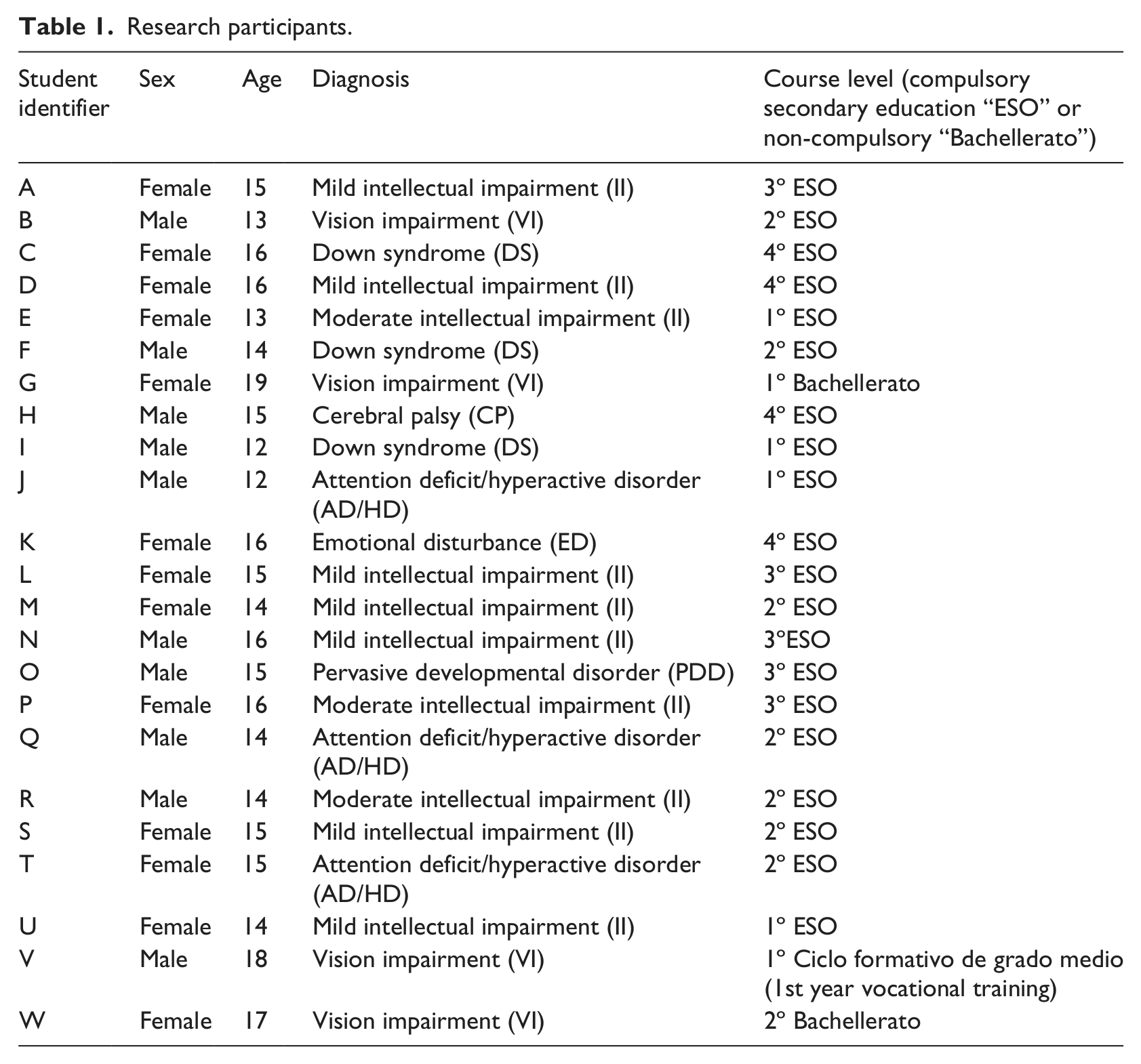
In this paper the participants’ comments translated to English are presented in the text anonymously, although the age, sex and diagnosis of each is provided to enable readers to contextualise responses from the diverse sample of participants. This is important to the current research so as to limit the probability of participants being identified, while at the same time recognising that while a diagnosis of impairment or special educational need defines merely a part of the whole child, it also importantly shapes their embodied experiences (Whitburn, 2016).
Research settings
Participants were recruited from six secondary schools in two Spanish cities (Madrid and Salamanca). Both schools in Salamanca were public and were located in an urban and rural setting. These two schools received only enrolments of secondary students in the compulsory or non-compulsory phases of education. The four semi-private schools in Madrid—that exclusively received public funding from the education administration—had enrolments of students from the infant to post-compulsory secondary levels. Two of these schools were located in affluent, inner-city neighbourhoods, while the other two shared low-economic settings in Madrid’s outer suburbs.
Ethical considerations and sampling
With the assistance of colleagues from The Autonomous University of Madrid, six secondary schools were identified as settings in which there were known to be students with SEN enrolled. Ethical clearance to undertake the study was granted from the Deakin University Human Research Ethics Committee, and letters of introduction were sent to school principals. Letters of consent were also passed through schools to parents of potential participants to seek approval for their son or daughter to take part in interviews. The parents of 20 students returned signed forms to the research team, while the remaining three were above the age of consent and were able to provide their own signatures. One item of the consent letter notified participants and their parents of the inclusion of an addition of a third person in interviews—a translator in the case that neither party could comprehend each other’s verbal communication, given that the researcher’s native tongue is English. Colleagues from the Autonomous University of Madrid generously fulfilled this role.
Data collection instruments
The young people were asked to participate in a face-to-face interview with the researcher and the invited translator, although some also were able to meet on two occasions. The semi-structured interviews were digitally recorded and transcribed. Each interview took place over 20–65 minutes at participants’ schools. The research team encouraged the participants to talk about their experiences at school, and any facilitators and/or barriers to their inclusion: questions not dissimilar to those put to the Australian participants in the prior phase of the study (Whitburn, 2014a, 2014b). These questions were aimed at motivating the young people to provide details about experiences at school with peers, teaching staff, support, resources and pedagogy. Follow-up questions referred to their emotional reactions to different circumstances surrounding the experiences that they related.
Member checking
In the production of knowledge about the disabled perspective, it is important that research procedures are shared with participants. To facilitate this process, the research team returned to five of the six schools to enable participants to view and comment on the transcripts of their interviews. School timetabling prevented the team from returning to the other setting. Transcriptions were presented to participants in either print or electronic formats, or read to the few students who were unable to follow the written material. The research team was surprised to observe the level of enthusiasm with which participants absorbed the transcripts. They each commented on errors or misinterpretations of language as they located them. The research team made the recommended changes to each participant’s transcript in their presence as requested.
Data analysis
Researchers working with grounded theory can attend to data analysis by openly coding the collected material line by line (Charmaz, 2006); constantly comparing slices of analysed data (Glaser and Strauss, 1967); and performing focused examinations of the material while acknowledging their own memos taken during fieldwork (Charmaz, 2006). Situational analysis does not stray from this protocol (Clarke, 2005); however, divergent “actions, situated perspectives, symbolism, and the heterogeneity of discursive positions and their relations can be discerned and creatively grasped” (p. 8). Through increased emphasis on researcher reflexivity, situational analysis recognises that different readings of data may occur to different people. It therefore demands that researchers explain how they reached particular positions in their analyses. Therefore, “the goal is critically analyzing to produce ‘a truth’ or possible ‘truths’—distinctive analytic understandings, interpretations, and representations of a particular social phenomenon” (Clarke, 2005: 8–9).
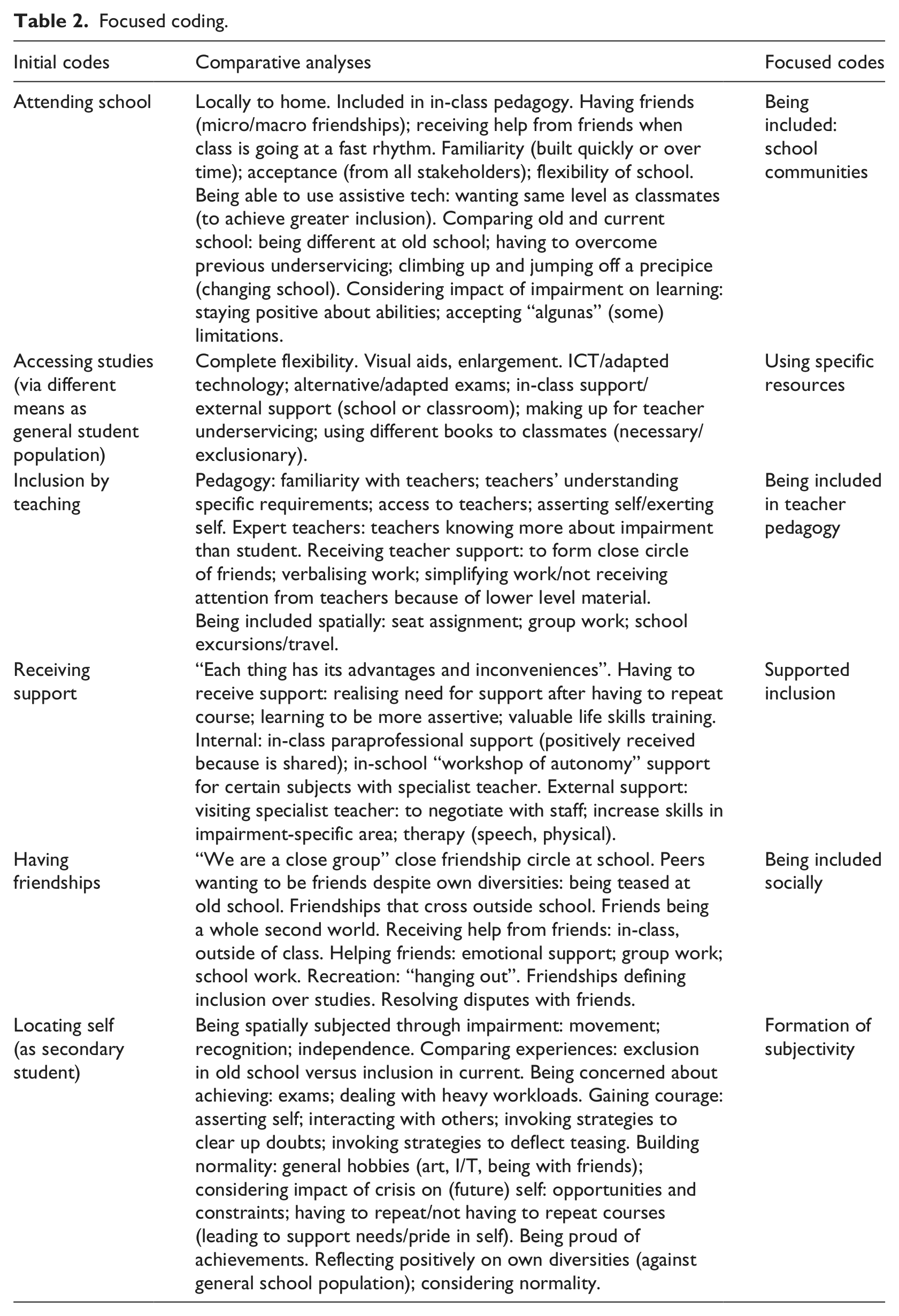
On verification of each transcript, the researcher coded the data line by line as suggested by Charmaz (2006). Specifically, this meant combing the participants’ dialogues about matters that concerned them, such as the circumstances that they believed marked out their differences to other students and their emotional reactions to these. The researcher also referred to the extensive memos taken throughout fieldwork in which were included notations about the schools, participants’ views, and other information that seemed relevant to the situation. In addition, the situated variances and discursive practices that impacted the students’ experiences were taken into account. In particular, this referred to the diversity of participant experiences from different school settings, which included the variances in gender, diagnosed SEN, ethnicity and/or age in regard to their experiences of inclusion in their respective schools. The data collected from all participants was then compared (Glaser and Strauss, 1967). Following grounded theory, the task is then to take to focused coding (Charmaz, 2006), which in a sense is the writing up of the analysed material—leading to the construction of the following codes (Table 2).
Focused coding.
Findings
The analysis of the data is presented along five interconnected tracks: school communities, resources, teacher pedagogy, support services and social inclusion. The variety of positions that each of these aspects denotes (e.g. facilitators and/or barriers to participants’ inclusion) incites a greater awareness of the discursive and material practices at play in the formation of students’ “included” subjectivities. This analysis reaches beyond traditional grounded theory by revealing power relations that produce difference (Clarke, 2005) in the schools and that go on to either accommodate or deride it.
Before presenting the analytical categories, it seems appropriate to discuss a noteworthy point that emerged from this study in relation to the juxtaposition of participants’ experiences of inclusion depending on their placement. This contrast provides noteworthy context to the analysis of the young people’s observations of their schooling.
Almost two thirds of the sample of participants (N = 15) had either logically transitioned to different schools—primary to secondary—as they progressed through their education, or had attended the same k-12 equivalent setting from the beginning. It was these participants who contributed the least to interviews about their experiences at school, perhaps because they had nothing to contrast positive inclusion against. To them, everything was “normal”; they studied in regular classes—engaging as they did so with other students either with or without support; they were in wide friendship circles with these students, which extended outside the school gate; and they achieved their goals—experiencing the pressure of living up to high personal objectives, the strain of examinations and the everyday tensions that often arose between themselves and parents, siblings and friends.
The rest of the sample (N = 8) had moved to the research sites on account of being dispossessed of an education at their former schools. Each reported that they had been left—for the most part—to do “nothing” (male, 12, AD/HD). Each of these young people expressed unease. “I didn’t know anything—neither how to read, I couldn’t understand anything, nor to spell” (female, 14, II). Each of these participants described underservicing class teachers who had generally ignored them; overpowering special education support that discouraged them from mixing socially with other students at recreation; as well as maltreatment from peers. These students recognised inequity in this treatment. “When I realised that other kids were studying, [could] write their names and dates [etc.] … I knew that it wasn’t fair. What am I doing here [at school], if I’m not doing anything?” (female, 14, II).
Each of these participants had consulted with his or her parents about changing schools, and it was not until transferring into the research settings that they realised positive connotations of being genuinely included in a school. “I thought that it was normal that they push me around, normal that they frightened me, that they rejected me; but no” (female, 19, VI). “Here I feel good and they treat me well, and this is different from how they treated me [at my old school]” (male, 12, AD/HD). The compassion of teachers and support staff in the research settings buoyed the students to apply themselves to achieve high results.
School communities
Participants described their schools as small communities: places where school leaders, teachers, support staff, students and parents melded together to form a productive, supportive environment. “This school is small and familiar” (female, 19, VI). Directors of the schools were accessible to the students, and some taught them directly in scheduled lessons. “All of them who have control [of the school] I have as teachers” (female, 19, VI). When relating the closeness of school leadership to the students, one observed that in her previous school, speaking with the director was like “asking to meet with the pope” (female, 19, VI). Teachers, too, were close to the students. “The treatment of teachers towards students is different [here]—closer, less cold … [the school environment], it’s more cosy” (female, 19, VI).
The schools appeared supportive of flexibility to aid the students. Individuals’ specific needs—such as speech/physical therapy or academic support—were easily facilitated. Some participants reported that they periodically skipped classes to attend external support from advisory visiting teachers. Others often withdrew from subjects to take alternative courses with a specialist support teacher; some reported attending regular individualised sessions during school hours with tutors to advance their studies. Some participants also described having adapted delivery of the course material, and/or having the opportunity to split year levels into longer time periods. “I decided to divide the two-year subjects into three years, so it would be easier, because in addition my personal situation [with health] is very unstable – I never know if tomorrow I might need to rest” (female, 19, VI).
Material resources
Accessible resources and the use of specific locations in classrooms was commonplace among participants. Some with VI sat in particular locations in classrooms where they could make best use of their residual vision, and/or equipment and resources including magnifying miniscopes, Braille, large print and/or laptops with accessible software and electronic books loaded on them. Others used alternate books to their classmates, and studied from lower levels of the curriculum.
Non-human actors in social situations carry discursive significance (Clarke, 2005). For example, there was initial apprehension among some participants who used laptops in lessons. “I thought my schoolmates weren’t going to accept the computer well, but they have accepted it quite well” (male, 13, VI). Students without SEN reportedly made use of different equipment besides traditional books and pens in lessons, which was reassuring to participants. “So now it’s normal I go to classes with a computer” (female, 19, VI). All participants learned computer skills at school, and each had access to electronic mail; many referred to the significance of electronic resources for entertainment, communication with friends and family and for study purposes. Some stressed, however, that they would prefer to learn more technical skills with computers at school, such as multimedia production—video, web pages and E-commerce.
Not all participants were reassured, however, by the alternate resources they had to use. Some participants studied from a different curriculum, and subsequently used alternate material to the general student population in lessons. Many of these students lamented, for example, that they could not “go at the same rhythm as the class” (female, 16, II), and consequently “[teachers] can’t help you like they do [the other students]” (female, 16, II). These participants were divided on whether or not the use of different material to classmates mattered: some stressed that they felt excluded as a consequence; others acknowledged that their base level of knowledge was lower than that of their same-aged peers—accepting without fuss having to learn from more simplified resources. “I wanted to do it [study] with the same books that my class has, but I can’t, because I’m not so much like other people. And I know it” (female, 14, II). Internalising personal difference in this way might be construed by the reader as inherently negative. However, the participant’s discussion demonstrated that her divergences from other students—made obvious by the use of alternate materials—did not put her at a disadvantage socially. This is indicative of a schooling environment that accommodates difference through positive discursive practices that do not disadvantage students so labelled.
Teacher pedagogy
Class teachers generally made participants feel included in lessons. However, inclusion in lessons was seemingly dependent on an understood classification of normalcy. “What I want [from teachers] is the most normality possible” (female, 19, VI). “Normality for me is that they treat me equally as my class mates; or [at least] to the extent that they can” (female, 19, VI). For participants with VI, for example, this generally meant providing accessible resources on time, and verbalising their actions when modelling on the blackboard. “For me, the teachers who go speaking when they go writing on the board I appreciate a lot” (male, 18, VI). Each of the participants described being included in rotating seating assignments in classrooms, and they actively participated in group work.
Other participants explained that teachers were above all very patient with them—facilitating flexibility in courses as required. “The teachers who help us in those classes say ‘if I find it a little difficult, they’ll make it a little easier’” (female, 16, II). Teachers also compensated for previous educator underservicing to participants who had transferred to the research settings. A majority of participants pointed out that having teachers explain thoroughly the concepts of lessons heightened their sense of inclusion. These participants subsequently felt as though they were encouraged to exert themselves in their work, and they placed much emphasis on studying for, and passing, their exams. “You have to study a lot, [here] but I put up with it. Also the teachers are kind” (male, 12, AD/HD). These expressions of participants are suggestive that power relations within the sample of schools were less hierarchical, and more flattened. The students were able to express their needs for particular adaptations to which the teachers abided. This then led the students to invest more effort in their studies.
Conversely, however, some participants felt uncomfortable towards teachers who did not consistently explain concepts in detail. Maintaining parity with peers for the entirety of lessons was not always possible, depending at times on underprovided teacher instruction. “When he speaks quickly, I can’t [always] understand him” (male, 14, DS). There was some disparity between participants as to whether or not they utilised strategies to clear up any doubts that arose during lessons. While a majority asked for teachers to repeat instructions without concern—”I just say, or put up my hand” (male, 12, DS)—some were anxious about interrupting teachers. These participants tended to let opportunities to seek help pass. “There are times I don’t want to interrupt, or sometimes I’m a little shy” (female, 16, II). Others would turn to their friends for help. “You have to turn to your people” (female, 15, II). Within mainstream discourse, these findings are suggestive of a position of agency. That is to say, by turning to one’s “people”, this student could subvert special educational provision and maintain an included subjectivity.
Receiving special educational support
How the students received support differed across the sample. Some attended all lessons with their peers without special education provision. “I am inside the classroom all the time with my classmates” (female, 19, VI). Many of these participants depended on the support of classmates when required to read work from the board, or to clear up any doubts that arose. Other participants sat with a paraprofessional at all times in the regular classroom. “She sits next to me and explains the things” (male, 12, AD/HD). Unlike participants of the Australian phase of this research (Whitburn, 2013, 2014a, 2014b), in-class paraprofessional support provided to these young people did not make them feel awkward. They reported that they always shared their support with others in their classes. Other participants were withdrawn from various lessons to attend “workshops” with a special education instructor, but received no direct support in the classroom. “I think it’s [support] appropriate to the requirements of each one [student], because there are different types. The same classes but different types of support depending on your necessities” (female, 16, II).
The students had mixed feelings about the support provided at their schools. Most who either received in-class support, or withdrew from lessons to take specialist instruction, regarded it as unquestionably “normal”, as it did not interrupt their social inclusion and they found that it helped them to focus on their studies. “The truth is that I think [the special class] helps you a lot if you have some sort of a problem” (female, 16, II). Others, though, were under the impression that by receiving academic support in alternative classrooms, they were unable to graduate from secondary school and receive a formal qualification for their efforts. Instead they were channelled into vocational education where they would try to achieve certified qualifications in a trade. Other students were compelled to work from specialist resources, even when they were sitting with their peers in classrooms. “Man, I would want to [do] more the subjects a little more like my class mates. Each thing has its advantage and inconvenience” (female, 16, II). The few students who were not comfortable with the amount of support that they received also recognised a need to be more assertive about their wants and needs, and for the most part, they felt comfortable about talking these matters over with the teaching staff at their schools.
Social inclusion
All participants described being socially included at school. Participants who had moved to the research settings were both surprised and relieved how easily they made friends. “When I came [here] people wanted to be friends with me” (male, 12, AD/HD). In breaks they often played sport and/or chatted with their friends. Most participants emphasised the social environment of their schools as being definitive of their inclusion.
I always say that the friends at school are like a second world inside the world where we live. I consider that all of the … gossip that goes on among the students at school; they’re like a second life. (Male, 15, CP)
Participants related that the support they received from friends was indispensable.
For me they’re huge support. … To have support from your friend, you know that you can go on. You know that they’re going to help you. I think that that is the most important [thing], more than your studies … it’s a vital function, we need to have contact, you can’t live in isolation. (Female, 19, VI)
Some participants recognised the value of the community and the efforts of teachers towards fostering friendships among the students. “They try to make us a close circle. They try to reinforce our relationships inside the classroom and you can notice it. And, we are a close circle” (female, 19, VI). Most of the students lived locally to their schools, and spent time with their classmates outside of contact hours, unlike participants in the Australian phase of this study (Whitburn, 2014b).
“Included” subjectivities
An analysis of this kind culminates with the articulation of research participants’ incited subjectivities as “included” students. Subjectivity is constituted through relations of power that occur in material and discursive practice (Foucault, 1982). The exercise of power, in this sense, describes the “way in which certain actions modify others” (Foucault, 1972: 788) and all members of a discourse—either human or non-human—enact it.
As this analysis has demonstrated, student participants recognised that they were different to others in the school. Some spoke of being teased as a consequence, however this occurred rarely. “I like it more when they [peers] are friendly and nice, they are understanding of how I am, and we are playing [together]” (female, 16, DS). This again is indicative that social inclusion occurred readily for the students. Other participants commented that their particular diagnoses did not in any way affect either their social or academic inclusion in their schools. “People know me; they accept me the way I am. I’m not alone [nor] isolated (male, 15, CP).
Participants were contented that they fit well into the life of their school communities, and some recognised that this underpinned their positive dispositions. “Some friends from La ONCE [the national blindness foundation] … in their schools they are not as well accepted as I am here. I feel fortunate for that” (male, 13, VI). “I feel very comfortable [here]” (female, 15, II). Participants who had moved to the research settings from other schools acknowledged the positive impact of the inclusive environments that they had encountered. “[Everyone] tells me that I’ve changed and that I talk a lot. I used to be a mute. Everyone tells me how much I’ve changed” (female, 13, II). This further suggests that the students learned a new way of seeing themselves alongside their peers who did not receive special education support. “We’re all human, we’re not defects” (male, 13, VI).
Once again the productive potential of the power relations that circulate in the schools is revealed, as the students’ subjectivities reflect schooling discourses in which they are able to express themselves freely. In so far that subjectivity defines “the possibility of lived experience” (Ball, 2013: 125), an included subjectivity hinges on power relations mutually dispersed. Socially and academically included as described, the students both listened to and expressed their needs and desires with all members of the school community. They felt confident to speak back to issues that arose, while at the same time having respect and exerting themselves academically for their teachers. The students’ own artefacts of power—“self-esteem and empowerment … hopes and dreams, fantasies and desires” (Ball, 2013: 125)—mediated their experiences of inclusion. It is only those who hesitated to express themselves—exercise the productive potential of the power afforded them—who felt less included in the schools.
Findings that pertain to the constituted subjectivities of research participants come from the turn to discourse afforded by Clarke’s (2005) situational analysis. The positivist tendencies of grounded theory ensure that it is recalcitrant towards discursive analysis. An interpretive approach, however, recognises the complexity of context, and aims to work within that space to generate an “imaginative understanding of the studied phenomenon” (Charmaz, 2006: 126). To include the analysis of power within a situation, furthermore, leads to the interpretation of subjectivity.
Post-school plans and the impact of economic crisis
With regard to post-school plans, most participants had only tentative ideas of a vocation or study path that might suit them. Irrespective of the current employment crisis troubling the nation (Vallejo and Dooly, 2013), some participants believed that they could transition into their chosen professions easily; they conceded, however, that they would have to rely on the support of others, such as parents or disability organisations, to find work. “I suppose it [finding work] would be more difficult than for a normal person” (female, 17, VI). This problem was further emphasised by the current economic crisis. “You’re not a normal person … and I think that [particularly nowadays] generally a business person looks for someone who is the quickest and most effective [at their job]” (male, 18, VI).
Above all, however, participants recognised the necessity to find work similar to other people, because of the sense of normality that it would carry. “It’s not easy, but in that is merit” (female, 17, VI). These students’ comments indicate the strength of normative discourses and their capacity to subjectivate the lives of people with disabilities. This creates a gridlock, for when placed against economic downturn, people with disabilities have been cornered out of the labour market (Biel Portero, 2012; NESSE, 2012; Pallisera et al., 2012), an issue that will potentially lead to problems for these students in the future.
Discussion and conclusion
From the outset, inclusion, as participants of this study have experienced it in their schools, was revealed via a host of routine discursive practices that were altogether constitutive of the included—however diverse—subject. For the most part, this empowered the students to defy “the greater social task of concealing their differences” (Mitchell and Snyder, 2012: 43) in order to fit in. Instead they relished the inclusion experience—concentrating as they did so on successfully navigating their studies and fostering supportive—and sometimes challenging—friendships.
However, to conceive that the students were included simply on the basis that the schools had secured the means (material resources) to cater to their particular support needs would be naive. Rather, participants described schools that effectively worked with the disorderly nature of diversity. While special education intervention was commonplace, each school provided individual support to students on the basis that it was required, or rather left the pedagogical task to teaching staff; in many cases the young people felt empowered to seek support for themselves from peers.
Participants indicated that the schools fortified social, supportive connections between all students and other school stakeholders, including parents, peers and staff—effectively creating communities and fulfilling the educative role of “recognizing the silhouettes” (Slee, 2011: 166) of potentially marginalised students. The schools secured the students’ inclusion through a general response to diversity that included the seamless incorporation of specialist equipment and pedagogical techniques as required. These findings suggest that these schools—regardless of socio-economic and/or rural/urban setting—effectively employed the concept of transformability (Hart et al., 2004)—the recognition that an unbreakable symbiotic link exists between learning, teaching and students’ outcomes. Transformability is a way of thinking that facilitates schools to “understand and engage with difference in constructive and valued ways” (Barton, 2003: 13) to form inclusion through practical pedagogical techniques that can only occur through strong participatory relationships within communities (Hart et al., 2004). Being active participants of these communities led students to exert themselves in their studies when combined with the inclusive pedagogical practices of teachers. These students’ rights were being recognised: exclusionary values and inequalities were challenged (Barton, 2003)—activities that are cited in the United Nations (2006) as goals to be achieved in education.
With specific regard to the students’ concepts of themselves, they perceived that at their schools they were treated as whole persons rather than labelled deficiencies (Booth and Ainscow, 2011; Florian and Linklater, 2010). At the same time for some participants, there was a constant risk that their biological differences and/or their learning from a different curriculum to general class populations might expose their inherent abnormalities. This tended to jeopardise their social inclusion rather than the academic, for which they felt appropriately supported. Nonetheless, these students recognised a need to be more assertive about their needs and wants, in order to gain social and academic authority over their personal circumstances and/or perceived detachments from normality.
The findings of this analysis of the inclusion situation for young people demonstrate that despite the unsteady policy terrain of the Spanish inclusive schooling system, young people with diagnosed impairments were effectually included in what Slee (2011) refers to as irregular schools: exceptions to the exclusionary rule; “beacons of hope” (Knight in Slee 2011: X) that facilitated the formation of included subjects despite their diversities. This is in stark contrast to the descriptions of inclusion provided by participants of the Australian phase of this research (Whitburn, 2013, 2014a, 2014b). These students related that the inhibitive actions of stakeholders—teachers, paraprofessionals and special educators—excluded them by virtue of their impairments, in spite of their aspirations for agency. The discursive practices within the school left an alienating legacy; the students were held to an excluded subjectivity that constantly referred them and others to their deficiencies (Whitburn, 2014b).
Nevertheless, with severe austerity measures being implemented in Spain aimed at countering rising unemployment among Spanish citizens, the government has withdrawn funding from education while introducing the LOMCE policy that shifts focus onto individualised competitiveness (López-Torrijo and Mengual-Andrés, 2014; Vallejo and Dooley, 2013). Those currently included might therefore become imminently excluded.
Foregrounding the voices of students with impairments in inclusive schools, as demonstrated in this study, enables research to disrupt professional discourses around inclusive education (Allan, 1999, 2006; Messiou, 2012; Parrilla, 2008; Slee, 2011) by emphasising how included subjectivities of diverse students are shaped (Youdell, 2006) via human and non-human actants and resources that mobilise in given situations. Further, studying inclusion across diverse cultural borders enables this research to make a transnational-sized deposit into the global “inclusive education knowledge bank” (Parrilla, 2008: 34) that is crucial to informing policy and practice from the situated and embodied experiences of insiders across multiple constituencies. The project presented in this paper demonstrates that inclusive schooling, and moreover the included subjectivities of young people with disabilities, can be achieved via a variety of mechanisms, but the danger of their marginalisation persistently lingers.
Footnotes
Acknowledgements
The researcher is sincerely grateful for the assistance of Cecilia Simón, Gerardo Echeita and Soledad Rappoport from the Autonomous University of Madrid, without whom this study would not have been realised. Thanks also to the students who took part in interviews and the staff from each school for taking such interest in this work.
Declaration of Conflicting Interests
The author(s) declared no potential conflicts of interest with respect to the research, authorship, and/or publication of this article.
Funding
The author(s) disclosed receipt of the following financial support for the research, authorship, and/or publication of this article: Funding for this study was provided by an Australian Postgraduate Award (APA) for Ddoctoral research from the Australian Federal Government. Travel and fieldwork grants were made available to the researcher from Deakin University.