



Abstract
Applying the Strategic Relational Approach, this paper analyses the circumstances behind and educators’ strategies in response to education reforms in two nation-states undergoing socio-political transformation – Bolivia and Timor-Leste. Despite the starkly different histories and contemporary context of each nation, we suggest that transformation in both settings is driven by a desire to unshackle histories of colonisation and social conflict. Education reform, at least discursively, aims to dislocate past practices and replace them with a new material reality. In such spaces, we find that teachers are acting as strategic political actors, but in ways that are historically situated and driven by real and perceived personal and professional constraints. Their actions lead to particular types of ‘resistance’ and strategic action, leading to outcomes that are simultaneously continuous and disconnected from the past.
Introduction
The teacher sits reclined in his chair, his legs stretched nearly taut against the legs of his large teacher’s desk, head hunched to the side and eyes shut – seemingly oblivious to a care in the world. Nowhere in the picture are students, which may lead one to believe that in this classroom, at least, they are not the priority. In the picture below this, another teacher stands hunched over a group of her bright-eyed and curious students, who appear to be eager and willing to learn. The table is a cacophony of colour and activity, cut-out flowers, papers and pens scattered across, with the students sitting in a cluster, pens in their hand and soaking in the information she shares with them. These two photos, on the cover of a recent World Bank publication titled Making Schools Work: New Evidence on Accountability Reforms (Bruns et al., 2011), make a clear statement. The first picture is of a teacher who is resisting reforms to practices, supposedly because he is lazy, unmotivated, and not held to account for his actions, while the second is of a teacher who is compliant, willing and able to motivate students to learn.
This paper intends to disrupt this stark binary and portrayal of teacher agency as being one of compliance or resistance as the photographs described above so vividly illustrate. It is well known that teachers’ beliefs and practice are shaped by a myriad number of issues including the characteristics and nature of reform; the local characteristics and conditions in which reform actors and structures are embedded; and the mechanisms of framing and classification that are attached by external actors to enforcing such an agenda (Altinyelken, 2010; Barrett, 2008; Paine and Zeichner, 2012; Robertson, 2012; Tatto, 2007; Welmond, 2002). This scholarship compels us to move beyond simplistic black and white accounts of teachers’ resistance being either positive/emancipatory versus negative/unprincipled. Where this paper adds a different perspective is in bringing together the often contentious and complex structural conditions of teachers’ work, with their room to manoeuvre, or space of agency using Colin Hay’s (2002a, 2002b) Strategic Relational Approach (SRA). Applying an analysis based on the SRA enables us to unite important insights on teachers’ agency in two seemingly different contexts at first glance: that of pre-service teachers working within a decolonising educational policy framework established under Evo Morales in Bolivia, and in-service teachers within the confines of the newly independent and emerging post-colonial state of Timor-Leste (East Timor). We argue that current and future teachers are (un)consciously using the strategic space for manoeuvre enabled through particular structural constraints and opportunities in each context – their agency – in relation to processes of societal and educational change.
We begin by suggesting that in recent years in both contexts, education’s purpose and teachers’ roles and responsibilities within education have been significantly reframed by broader projects of social and political transformation that both nations have undergone. In the case of Timor-Leste, this has been the product of the nation gaining independence in 2002 after a long period of colonial rule by Portugal, 24 years of illegal occupation by Indonesia, and 3 years under a UN transitional administration. In a relatively short period of time, policymakers produced a succession of policy and planning documents that set out educational goals for the country (MEC, 2005, 2007; MECYS, 2004a, 2004b). Underwriting this proliferation of educational policy was the argument that the education system under Portuguese and Indonesian rule had not worked for Timorese children and required systemic change.
In Bolivia, the mandate for education reform was driven by the democratic election of Evo Morales in 2006. Being part of a larger Latin American ‘region in revolt’ (Dangl, 2007: 7), the government of Morales applies a ‘politics of change’, through which it endeavours to radically restructure Bolivian economy, politics and society, with education as a major vehicle for this change. Since 2006, education has been given the mandate of establishing a “new society based on solidarity, justice, harmony and complimentarily of own cultural identities” (Proyecto de Ley ASEP, MoE Bolivia, 2006). 1
In both contexts, however, the state struggles to move these ideational purposes of education into the realm of reality. Through an analysis of the dialectic that exists between particular structural and material conditions of teachers’ work, and teachers’ agency, in this paper we identify particular strategic responses to this reform agenda. Using SRA we argue that such responses are the product of teachers, as strategic actors, navigating a context that is increasingly uncertain and ambiguous, and constrains and enables particularly strategies, and affords particular types of space for manoeuvre within them. By opening up this picture of apparent ‘resistance’ to reform to closer scrutiny using SRA, we hope to suggest an alternative approach to looking at the policy to practice ‘divide’ and how if might afford a more nuanced insight of the complexities underpinning teachers’ responses to reform.
Conceptual and comparative methodology
To understand how teachers as key actors within a series of reforms to education and society navigate two rapidly changing contexts, we draw on the SRA. We believe the SRA provides a useful heuristic tool for conceptualising the contingent and dialectal relationship between structures, agents and the agency they employ (Hay, 2002b; Jessop, 2005). In this model, structures are seen as strategically selective. While all actors have tendencies, or preferences, for action, the social, economic and political spaces in which actors operate are “densely structured and highly contoured”, which presents an “unevenly distributed configuration of opportunity and constraint to actors” (Hay, 2002a: 381). Action is framed by a constant engagement of actors within their environment, and can lead to the pursuit of different strategies and tactics in different conjectures (Jessop, 2005: 48–49). At the same time, the model acknowledges that different individuals and groups may have varying opportunities and constraints to do so, due to their levels of access to particular strategic resources (social, political, cultural, economic capital, information).
Using SRA, teachers’ agency is defined for this research as their space for manoeuvre, within a strategically selective context framed by discursive and material conditions, in which they develop intended or unintended strategies of action in response to such a context. We will also suggest that these key educational actors face an uneven distribution of opportunities and constraints in their contexts, which acts as a significant determinant of the capacity of actors to realise their strategies (Hay, 2002a: 164–166).
While the empirical work presented in subsequent sections was conducted as two separate research studies, in this paper we aim to bring these two case studies together using the vertical case study. This approach, developed by Frances Vavrus and Lesley Bartlett (2009) helps to situate that which is observed in classroom practice within a broader cultural, historical and social context that extends beyond the nation-state. It allows for an exploration of how seemingly similar policy discourses are mediated by deeply embedded discourses and practices that are historically and culturally situated. These lead to outcomes that may appear outwardly similar but on second glance are remarkably different when the motivations and rationales of strategic actors, such as teachers, are superimposed. Inspired by this approach, this paper makes a comparison simultaneously along three different planes: (1) vertically by giving attention to the micro, meso and macro levels in each case; (2) horizontally by comparing how similar processes/changed discourses unfold in distinct locations in space and time; and (3) transversally by historically-situating such processes and the outcomes observed.
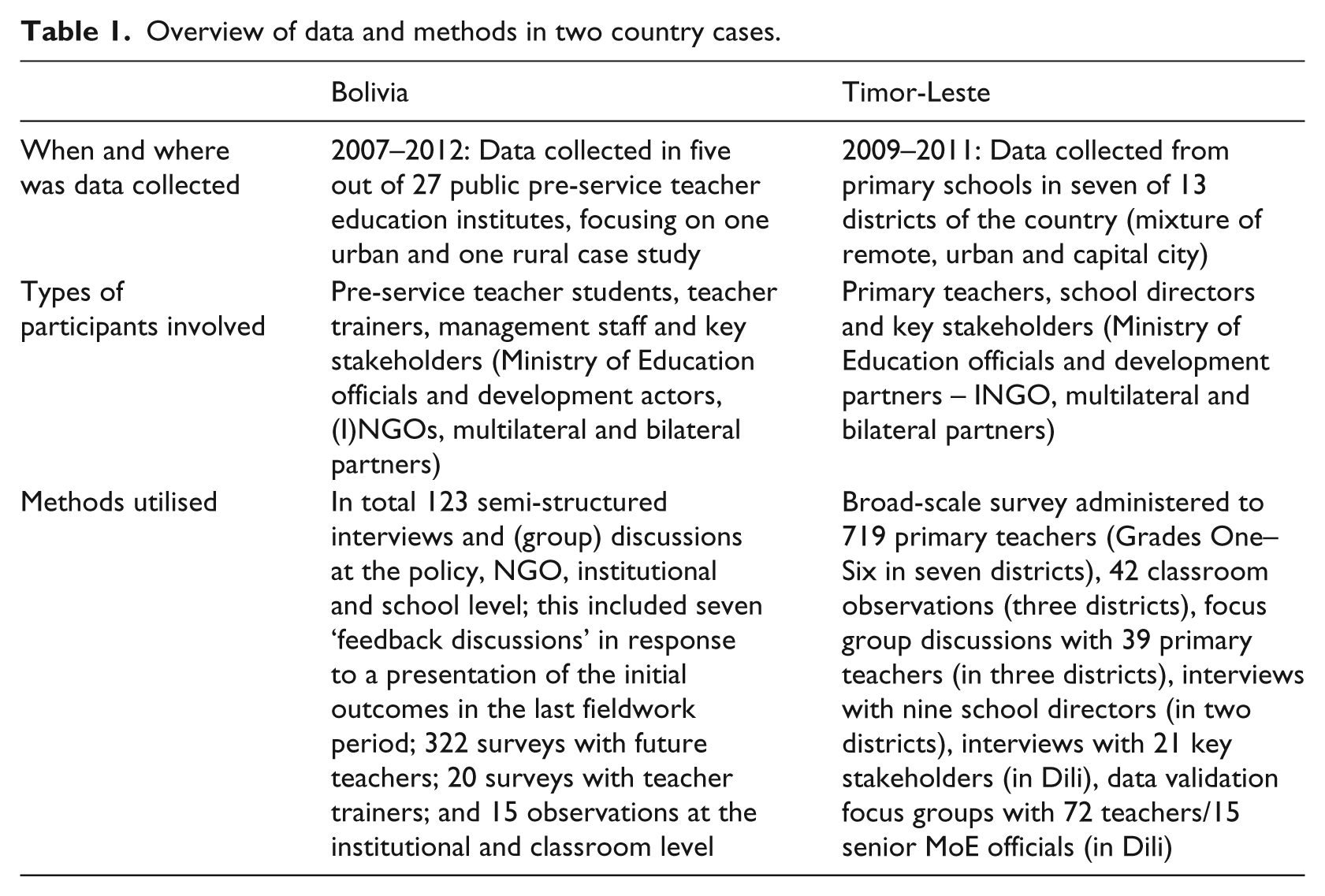
Both empirical studies, conducted between 2007 and 2012 in several intensive periods of field work, followed a critical ethnographic research approach that involved interviews, focus group discussions, surveys, and observations with current (Timor-Leste) and future (Bolivia) teachers (see Table 1).
Overview of data and methods in two country cases.
Survey data in both contexts was analysed using descriptive statistics to qualitatively provide a broad overview of teachers’ perceptions and beliefs. Collected interviews, focus group discussions and observation notes were transcribed with the help of a native-speaking research assistant in both settings, and organised and coded by the authors using qualitative data analysis software. All focus groups and individual interviews were qualitatively analysed into themes through an inductive coding process (Charmaz, 2005; Corbin and Strauss, 2008).
Given the nature of data collected, we do not believe that grand narratives or overarching claims can be made about the strategic actions of all teachers in either country. Nor is that our intent. A key contribution of SRA and the broader critical realist ontology and epistemology from which it draws, is to move analysis of (in our study teachers’) strategic actions away from singular narratives towards one that highlights the myriad of outcomes that are contingent and historically, culturally, socially, economically and politically mediated.
The historical, discursive and material conditions of teachers’ work: understanding the strategically selective context
Historically, teachers’ work in both Bolivia and Timor-Leste was tightly framed and classified within a colonial-era framework in which particular epistemologies were indoctrinated through the schooling system. Education historically suppressed, or at least ignored indigenous knowledges, and gave primacy to Eurocentric and colonial epistemologies.
Historical and present ideological and discursive claims on teachers
Throughout most of the 20th century, following Bolivia’s liberation from Spain, formal education in Bolivia acted to create one type of national identity and citizen that was largely founded on Eurocentric values (see for instance Canessa, 2004; D’Emilio, 1996; Lopes Cardozo, 2011; Luykx, 1999; Regalsky and Laurie, 2007). Schooling historically aimed to homogenise Bolivian society, as it “has always been oriented towards the so-called ‘national community’, which is ideally white, modern, urban and non-indigenous” (Speiser, 2000: 228–229). This ideology extended itself to the teacher training institutes, called Normales, themselves, which aimed to transform students coming from peasant indigenous families from indios to mestizos (Regalsky and Laurie, 2007: 238). 2 In such a system, the trained teacher was viewed as an ambiguous link between the community (to which they do or do not belong) and the school (D’Emilio, 1996: 9, 21), and between local and regional power networks. Despite the large-scale education reform for intercultural and bilingual education that was introduced to improve the quality and relevance of Bolivian education in 1994, teachers remained to be seen as “a major source of assimilationist cultural ideology and [that they] are principal agents in reproducing hegemonic racism in Indian communities” (Canessa, 2004: 185).
Discursively, the role of teachers changed after passage of the new 2010 ASEP reform for decolonising education, as education is officially recognised as “the highest function of the state” (Proyecto de Ley ASEP, MoE Bolivia, 2007). Where historically teachers were supposed to assimilate themselves and their students into a ‘modernised’ and European-centred society, today they are encouraged to serve as key actors in processes of social transformation and decolonisation. For example, during the public launch of Bolivia’s new education law in December 2010, president Morales claimed that “teachers are the soldiers of the liberation and decolonisation of Bolivia” (MoE Bolivia, 2010b).
In accordance with this ideal, the Normales are perceived to be crucial environments to train teachers with this mind-set. The ASEP Reform (Article 33.1, MoE 2010a, ‘Objectives of Teacher Education’) stipulates how teachers should be trained to become “critical, auto-critical, reflexive, proactive, innovative professionals and researchers, who are dedicated to democracy, social transformation and the integral inclusion of all Bolivians”. This political climate of envisaged progressive change stands in contrast to the rather conservative institutional context that characterises most of the teacher education institutes who carry on Eurocentric practices of the past (Lopes Cardozo, 2011). This creates a challenging ‘strategic selective context’ for Bolivia’s new teachers that are being trained.
The more recent 24-year occupation of Timor-Leste by Indonesia deeply altered both the role of education and the function of the teacher, as prior to that, most Timorese had little or no access to mass schooling. During this occupation, education served an important ideological and indoctrinating role for Indonesia to legitimate its continued rule over the territory. The expressed aim of the schooling system was to promote pancasila, an ideology based on a singular Indonesia with a shared history, set of values and beliefs, despite the marked diversity within the archipelago (Cribb, 1997). Schooling under tightly regulated and centralised Indonesian control was a mechanism to “forge nationalistic loyalties and identities over ethnic, religious and class divisions” (Kipp, 1993: 77), assimilating future generations into Indonesian society and discounting the existence of a distinct Timorese identity. According to the Commission for Reception, Reconciliation and Truth (CAVR), “[schooling] was used…as a part of an integrated security approach whose overriding objective was to ensure that pro-independence sentiment did not take root in a new generation” (2006, quoted in Boughton, 2011).
As part of this, teachers were expected to obediently follow the directives from above. As public employees, they were required to commit to full loyalty to the state, pledging to abstain from political associations or subversive activity (Bjork, 2002). Those seen to be politically active, or resistant to the Indonesian regime, were heavily sanctioned, either by losing their job or being imprisoned (Shah, 2013). Teachers, particularly those who had migrated to Timor-Leste from other parts of Indonesia, came to be seen as enemies of the community, and many educators came to fear for their own safety and security as they came under threat from both students and parents (Shah, 2013).
The need for schooling to promote a collective identity and affiliation of the population with a still-imagined ‘nation’ was heavily promoted in the aftermath of Timor-Leste successful but violent 1999 referendum for independence (Millo, 2002; Millo and Barnett, 2004). Similar to other countries in Southeast Asia, the intent was for schooling to contribute to conflict prevention, political stabilisation, and protection against internal and external threats (Borgerhoff, 2006). To that end, the National Education Policy 2007–12, stressed the importance of providing education for the sake of “national unity” by ensuring that the system helps to build a sense of solidarity, commitment to the nation and ultimately “better citizens” (RDTL, 2008: 7, 11–2).
3
Within this framework of building the nation, schools (and particularly teachers) were given primary responsibility for building active and engaged communities and citizens that are partners in the state’s social, cultural and political development. For example, the Organic Law for Education makes it clear that the current schooling system should promote, The development of a democratic and pluralistic spirit, respecting others, their personalities, ideas and individual life projects, open to the free exchange of opinions and to agreements…[allowing] citizens to judge, with a critic [sic] and creative spirit, the society where they live and to take an active part in its development, in more just and sustainable terms. (RDTL, 2010: Art 3.2)
4
Little credence, however, was given to the professional needs of teachers to fulfil such responsibilities, despite the fact that most are under/unqualified for the positions they now assume (Shah, 2011a, 2013, 2014).
Policy, at least in rhetoric in both case studies, emphasises the critical role of teachers not just as willing agents, but also as individuals actively negotiating a society in flux. Nonetheless, the expectation of policymakers in both contexts was that irrespective of the specific historical, cultural and socio-political constructs within which teachers operated, they would and could be willingly engaged in such acts of reform. As our respective ethnographic studies uncovered, however, decisions regarding professional practice were much more complex, and continue to be mediated and mediate the structurally selective context of reform.
Ambiguities, contradictions and tensions within the current context
In both contexts, teachers and educational local experts alike expressed concern about the inability of their respective education ministries to deliver necessary information, guidance and support (professional, material and financially). This has serious implications, not only for the way teachers become frustrated (or even apathetic) and think about the unclear situation now, but also for the way they judge the new reform that they are supposed to implement. On the other hand, we suggest that the absence of teachers’ training or a system of evaluation has given teachers certain space for manoeuvre to (continue) teaching in the ways they decide themselves, as will be further explained below. The gap between policy and practice seems to have led to a tension between envisioned change and a largely continuing reality in classrooms.
In Timor-Leste, the capacity of the Ministry of Education remains quite limited, despite successive policies which discursively and symbolically make bold promises of reform on all aspects of schooling – from class sizes and infrastructure to curriculum and language policy. Ministry documentation suggests that as an organisation, staff within it lack clarity on their duties and are unqualified to do their jobs, much of which is the product of the emerging nature of the still young state appartus (MoE Timor Leste 2010). As a result, there continues to be a, “deficiency and insufficiency of monitoring and supervision mechanisms, devices and structures…for educational management, planning and supervision functions,” particularly at the school level (MoE Timor Leste, 2007: 7). In some ways this translates into challenges to teachers’ ability to do their jobs as they would see fit, particularly in regards to key issues such as the availability of textbooks and other teaching resources, having access to adequate school infrastructure, and the timely payment of their salaries and school grants (Shah, 2011, 2012). Ironically, it also affords teachers greater space to manoeuvre, in the sense that the school inspectorate has little real control/power/authority over the sanction and oversight of teachers, and school administrators are often unqualified to take on a supervisory role.
In addition, teachers are often presented with ambiguity when it comes to whether reform is really predicated on transformation. While a significant overhaul of the primary curriculum was undertaken in 2004 with the intent of making it one that was more inclusive, representative and ‘Timorese’, particular aspects of it encourage the continuance of practices of the past. Specifically, the new curriculum (1) maintains the delineation of subject disciplines and time allotments for the teaching of each subject within the curriculum; (2) encourages the utilisation of a language of instruction (Portuguese) which clearly distinguishes the school context from that of the community and maintains the primacy of a colonial language/heritage; and (3) reinforces an assessment and examination system focussed on summative mechanisms which identify and retain a large number of students due to their own learning failures (Shah, 2012).
In Bolivia, teachers as well as teacher trainers similarly complain of a lack of real action to stand behind the changed discursive conditions of their work. While the Morales administration quickly repealed the 1994 education reform soon after it assumed power in 2006, it took until 2012 before new forms of support or new guidelines for teacher practice began to take effect. As a result, in the period following 2006 teachers faced great insecurity regarding what new policies will mean for their actual teaching practices and how long they would have to wait for new support to be introduced (Lopes Cardozo, 2011, 2012a, 2012b). One scholar, interviewed in 2010 expressed such frustration quite candidly: In this context of change that we are living in, it is inexplicable that after more than four years of a government-of-change, we still do not have a new alternative political orientation. There is a total absence of public policy to accompany these proposed plans in education.
For many teachers, this vacuum of information has led them to continue with the last policy with which they were familiar – either that of 1994 or an earlier reform under which they were trained as a teacher. A MoE official added that while new curricula are still being developed, “everyone does what he wants. There is an institutional and academic chaos, but this is also because of the many societal conflicts”.
Since August 2012, the MoE has started a large-scale in-service training called PROFOCOM to accompany the implementation of the new ASEP curriculum for the majority of Bolivia’s teachers. The programme started with 44,000 teachers subscribed, while an additional 66,000 teachers joined for the second round of the training in 2013. With 110,000 participants, the training programme reaches out to about 80% of Bolivia’s total teacher population of 130,000 (Schippers, 2014). Despite these promising figures, in various interviews with MoE representatives in 2012, it was expressed how they faced serious difficulties in recruiting the required qualified facilitators to conduct these training programmes, primarily because there are few people familiar with and capable to train others about the new pedagogical approaches and rationales of the decolonising education law.
While Bolivia struggles to get its first large-scale in-service teacher training programme underway, Timor-Leste has invested significant resources and attention into in-service provision since independence. This is largely driven by vast numbers of un/underqualified teachers 5 who acknowledge themselves that they lack the required skills in terms of language, content knowledge, and pedagogy to do their job effectively (Shah, 2011, 2012). A significant concern remains, however, with whether current training provision adequately addresses the needs of teachers and the demands of the reform process with many teachers adamant that current in-service provision is insufficient to their needs.
Significant issues that came out of interviews regarding current training provision included the fact that:
There has been an overemphasis on Portuguese, to the detriment of discussing teaching methodology or classroom management;
The utilisation of Portuguese in all training made it difficult for all teachers to participate effectively in the programme;
Training during school holidays didn’t provide teachers with any time to plan or rest between terms;
There was no coherence to the training that was offered, as teachers had no clear sense of how each module fit into a bigger qualifications framework;
The exclusion of teachers who were already deemed ‘qualified’ ignored the fact that all teachers needed to have access to continuing professional development; and
Instruction in larger groups for short period of times did not meet the needs of individual teachers and schools.
As one teacher expressed in frustration, “it is not enough to have teacher training for one or two weeks…instead it is better to offer something
Teachers’ strategic responses to reform
Out of the contexts we have described in preceding sections, teachers face particular dilemmas that are personal, professional, institutional, and political – which then shape and constrain the individual identities, positions and actions taken when faced with change (Davies and Talbot, 2008; Kirk and Winthrop, 2008; Weinstein et al., 2007). In this section we turn to discuss the collective and individual strategic responses of teachers that are both influenced by, and at the same time influencing, these structured environments. In line with our theoretical view of teachers as active agents that either consciously or unconsciously develop strategic responses, we first discuss how teachers react collectively in response to reform, and second how individual strategies are designed in relation to the conditions described previously. Acknowledging the spectrum of responses that exists within each context to the demands of reform we provide one example from either Bolivia or Timor-Leste of the collective, individual, ‘principled’ and ‘un-principled’ positions that are taken up.
Bolivian teachers, historically and at present, remain a very ‘visible’ group in the political and social arena. Unsatisfied teachers make themselves heard through the effective use of popular pressure mechanisms (strikes, demonstrations or even crucifixions or hunger strikes) to enforce their demands. Through these collective mechanisms, Bolivian teacher unions have historically established a strong negotiating position in relation to the policy world and the Ministry of Education, for instance in relation to salary increases or pushing for the continuation of a system of automatic salary increase per scale (the escalafon, originally dating from the 1950s). The unions are relatively powerful institutions since teachers automatically become a (paying) member of one of the two teacher unions, either the urban or the rural union, depending on the professional location of the teacher. Although the organisational structure of both the urban and rural teacher union allows for a diverse make-up of central/national and more decentralised offices, a general picture of their respective responses to the reform emerged in the period of the development and first instalment of the new ASEP reform (2006–2012). While the rural union was generally more supportive to and involved in the policy-development processes, the urban union (and particularly the La Paz section) has shown fierce resistance to the new reform ideology (Lopes Cardozo, 2011).
Similar to many other countries worldwide, Bolivian teachers are often viewed quite negatively by society as being ‘resistant’ and under-qualified professionals. This is especially the case when classes are suspended because of ‘unionised’ activities, such as demonstrations, strikes and so forth. In some instances, these collective forms of teacher resistance towards state initiatives can be a productive and necessary counter-voice in the political arena, since collective interest might be used to overcome powerlessness of certain social groups by pooling their resources and constituting themselves as strategic actors (Hay, 2002a). Nevertheless, policy-making actors, both in Bolivia and elsewhere, often perceive such collective forms of teachers’ resistance as troublesome and unconstructive, hence aiming to downplay the power of teacher unions (Vongalis-Macrow, 2007: 428–433).
In the Bolivian case, collective and individual strategies adopted by teachers in response to the new ASEP reform are often closely interlinked and take place in a context of historical and present political struggles. Even though the government claimed the policy-design and early implementation to be inclusive to teachers’ involvement, the reality as perceived by teachers has been one of a very limited and politically steered involvement. One unionist explained the conflict between the La Paz teachers’ federation and the urban Normal over participating in the design of the new ASEP teacher education curriculum: We as the urban union, we rejected this new law. So when the Ministry saw we would not collaborate in their curriculum design, they started to personally invite some individuals from [the urban teacher training institute, that has close alliance with the union]. The Normal should have obeyed the resolution of our union, but instead they have sent delegates and so the Ministry could say [this institute] has participated.
The union leader was clearly unhappy with these independent developments of the Normal they have supported in various previous political struggles. Viewed from the perspective of a trainer and delegate of the Normal, the situation is even more complex because of internal struggles within the institute. She reveals her individual strategy of ‘principled acceptance’ and participation in these meetings in an institutional context of ‘principled resistance’: I was sent to represent this Normal in a congress on the new law and its curriculum, and the directorate of this institute rejects the proposal. I think this is dangerous because once we do not accept it, it will just be imposed on us, and imposition is not good at all. This will not help us to change. Contrarily, when we stay involved along the way we can influence, and come to a consensus.
The strategic choice of this particular teacher trainer to become involved in the implementation process is in contrast to the resistance to the new reform of her colleagues. It also is an exception to many in-service teachers in Bolivia, who have simply felt uninformed and hence not in favour of yet another reform (Lopes Cardozo, 2011, 2012a, 2012b, 2015). This illustrates how teachers’ individual strategies and choices are often closely related to collective strategies around them, as well as both individual and collective political and societal discourses and beliefs, to which we will now turn.
In some cases, strategic decisions made by teachers in the strategically selective structures of educational reform in both countries lead to actions that that symbolically mimic the language of reform, but are substantively conservative in nature. One area where this was observed was in regards to beliefs and attitudes about the important role of the teacher as a change-agent, and beacon of symbolic change inside their communities, which was found in both Bolivia and Timor Leste. In the case of Timor Leste, teachers surveyed and interviewed held a strong conviction about their role and responsibility in shaping the country’s next generation. Some entered into teaching specifically with this purpose in mind, but almost all teachers recognised the important function that schooling served in promoting values of democracy, tolerance, respect and citizen engagement. As one Timorese teacher described, You have to gain knowledge, morals and respect for each other as a result of going to school…it is about forming good citizens. If there is no knowledge there is no respect, and it raises conflict between neighbours and others…knowledge when learned in school is spread eventually through the entire community and it helps to make our nation stronger.
The majority of teachers surveyed in Timor-Leste either agreed or strongly agreed with items relating to the role of schooling and of teachers in sculpting citizens who could play an active role in the nation’s democratic and social development. 6 However, when teachers probed further about what this meant in the focus groups, a slightly different story emerged. Many teachers discussed good citizenship in a conservative, rather than radical stance (see Turner, 1990). Teachers often described their role as forming children who would ‘fit in’ rather than challenge the rules of society. A good citizen, as identified by the majority of teachers interviewed, was an individual who “follows the rules of society,” as one teacher expressed. Through analogy, students were often described, as one teacher noted, as, “young seedlings that need to be trained to grow straight. If you don’t put these seedlings straight when they are little, they will grow to be bent and twisted.” In terms of classroom practice, this meant that of greatest importance to teachers was maintaining order and control, and ensuring that all students were obedient to directions given. Thus, while a discourse of creating new citizens was pervasive in both policy and practice, understandings of this greatly varied, and were enacted through colonial-era definitions of good citizenship.
Often this was a result of teachers lacking appropriate awareness, ability and support to translate the discourse/rhetoric of reform into practice – a situation described earlier in the case of in-service training provision. One example from the empirical data was how Timorese teachers understood ‘active’ and ‘democratic’ participation. Many teachers claimed that providing a space for students to ask questions (even if none did), giving students opportunities to come to the board (and shamed if they made a mistake), or having chances to speak during the lesson (often as part of choral response), were part of active learning. Some of these beliefs were founded on historical precedent, as teachers were told during Indonesian times that such techniques were examples of active learning. Others felt that they were following a mantra of “75% of the time should be teachers talking and 25% of the time students”, a motto one teacher repeated in an interview and that reflected the simplistic messaging delivered to teachers when the new curriculum was first introduced in 2005.
In practice, this meant that classroom interactions continue to be dominated according to the description offered up by one Timorese school director as, “teachers talk[ing] at the students from the time they enter until the time they leave,” with the result being that, “the students just sit there as statues.” This was commonly observed in the classrooms visited in Timorese schools (as well as in Bolivian teacher education institutes). 7 In general, educators provided very little opportunity for (teacher) students to contribute their opinions or ideas as content was being discussed. Questioning, when utilised, was mainly closed in nature, and little opportunity was given for students to think, discuss, or provide feedback into the learning process. 8 This situation where both Timorese and Bolivian teachers follow a ‘banking’ model of teaching, continues to reproduce classroom environments that are more reflective of each country’s colonial and repressive and discriminatory past, rather than its independent, inclusive or ‘decolonising’ future which policy ascribes to.
In both contexts, this continuation of ‘banking education’ stands in contrast to what the new policy guidelines prescribe. While we exlained before how teachers stuck to their ‘old’ routines of teaching mainly because of a lack of information and support about new policy directions, we also observed how some teachers and teacher trainers made more conscious and willing decisions to resist calls to make learning more democratic, active or learner-centred. In what other researchers have labelled as ‘principled resistance’, reform messages can often be actively contested by educators based on strongly held beliefs and preferences regarding what they believe is necessary or important for the students they teach and the communities they serve (Achinstein and Ogawa, 2006).
In Timor-Leste, for example, a significant number of teachers and school directors interviewed/surveyed were sceptical of how they could meet the imperative of transmitting knowledge efficiently and effectively through learner-centred approaches, in settings with large class sizes, and where examination-driven and content-based assessment processes drive student promotion decisions. One director reflecting on instructions she had recently received from the Ministry to rearrange the desk so that students were sitting in groups questioned with concern how: …when the students are facing each other, they are not facing the front, and how are they going to learn this way? The students can’t look at the blackboard, or the teacher, and have to make a big effort to turn around and look at that, so it is difficult for their concentration. It has been only a few days since we have received these orders, and we are having difficulty in implementing these directions, for the students and the teachers.
Thus she had decided to ignore the directives of the Ministry and the trainers who had advised them, and return all desks in the school to a typical format of rows facing the front. When principled resistance was exhibited at a school-wide level, this created barriers for individuals who believed that democratising and decolonising teaching and learning practices was important. Several teachers/teacher educators spoken to in both contexts reflected on how their colleagues’ professional scepticism, when coupled with their professional uncertainties on issues like language, content, teaching approaches and/or classroom management, led to a return to approaches that were familiar and uncontested.
Drawing on the SRA, these examples illustrate how collective and individual decisions and actions made by teachers within these changing conditions can be seen as strategic, but not always well-informed, responses. While such action might be identified by policymakers as acts of resistance to reform, we argue that the reasons behind this are much more complex than initially appears, and is as much a product of reconciling tensions between historical and present day narratives, and making sense of structural uncertainties, as it is one of free will or choice.
Conclusion
In this paper we aimed to develop a comparative approach that builds on a joint and critical theoretical framework of analysis. By applying the SRA, we hope to open up new and more nuanced ways for understanding and positioning teacher practice in times of rapid social change in relation to the broader socio-political and economic contexts. We argue that such an approach moves us beyond the black and white portrayal of teacher responses to reform to illustrate the existence of a diverse and complex strategic selective educational reality and the dialectic that occurs with particular lines of teacher action and strategy. These (un)intentional and strategic actions of teachers, we argue, are the product of teachers operating within multiple (economic, political and socio-cultural) and simultaneous realities (present, past and future) concurrently, juxtaposing their own beliefs, motivations and space for manoeuvre within a context which is both strategic and selective.
In such an environment, it is the teachers who are transforming and negotiating a vision of reform into a set of conditions that are still uncertain and emerging. Thus, rather than simply judging current outcomes as dysfunctional, and to be labelled as a teacher workforce that is unaccountable, lazy or apathetic (remember the description of the sleeping teacher at the start of the paper), more attention must be paid to how this particular order has been, and currently is being negotiated. We argue that with this understanding, policy that aims to transform practices of teaching and learning must start with and engage local actors and the perceived and real constraints they face. We believe, that fundamental changes to schooling practices in both Bolivia and Timor-Leste will only come about when teachers are given opportunities to articulate, reflect on, and defend their theories and acts of teaching. At the same time, we argue that the transformative rhetoric must go beyond symbolism and extend real opportunity and mechanisms to support the change that is desired by many.
Footnotes
Acknowledgements
We are grateful for the comments made by Athena Vongalis-Macrow on an earlier draft version of this paper, and to Marielle Le Mat for her editorial support. We also appreciated the constructive feedback on the comparative nature of this article by colleagues from Critical Studies in Education at the University of Auckland during a writing seminar.
This paper reflects the equal input and scholarly contribution of each of the two co-authors irrespective of the order in which the names appear.
Declaration of Conflicting Interests
The author(s) declared no potential conflicts of interest with respect to the research, authorship, and/or publication of this article.
Funding
The author(s) received no financial support for the research, authorship, and/or publication of this article.