




Abstract
This paper analyses the extent to which the process of Europeanisation can be observed within a specific policy area: that of school leaving and graduation. The paper investigates what is known about school leavers and graduates at the national and the European levels on the one hand, and how the data collections portray Europe and European policy agendas on the other. Documentary data are used along with expert interviews conducted in three national contexts about school leavers’ and graduates’ information systems (SLGIS). This paper suggests that the policy area of school leaving and graduation, and thus that of SLGIS, show some rather blurred connections to the process of Europeanisation. The paper argues that the internationalisation agenda, especially at the higher education level, could be the driving force for better comparability amongst national data on school leaving and graduation if this is deemed an important policy area.
Keywords
Introduction
This paper explores whether and to what extent the process of Europeanisation can be observed regarding a specific area of education. The research this paper is based on compares data production and utilisation practices in different national settings across the European Union regarding the available information on school leavers’ and graduates’. A comparative perspective on how different nation states create and utilise their school leavers’ and graduates’ information system (SLGIS) allows drawing on the particular and universal nature of the ongoing processes. Due to the European Union being the comparative frame for this research, the gathered information allows for examination of Europeanisation as well. Beyond defining Europeanisation, this introduction discusses two key aspects of the context of the SLGIS. First, the interplay between the national and the supranational level regarding educational policy-making; and second, the production of data on education for the European Union.
Europeanisation: a set of questions for research
The starting point for this research is to explore whether the policy area of school leaving and graduation and especially the data that are collected within this area show any relation to the process of the European integration. School leavers’ and graduates’ information systems are conceptualised in the methodology section; here the process of Europeanisation is considered further.
As a crude definition, Europeanisation is considered to be some kind of domestic change that can be related to European integration and policy-making at the European level (Ladrech, 2010; Vink, 2003). In the past decade it tends to be viewed as a process, rather than a definitive outcome (Radaelli, 2004); more specifically, a ‘process of incorporation of EU norms, practices and procedures into the domestic level’ (Moumoutzis, 2011: 608). Due to the nature of the European integration, Europeanisation is viewed as making a differential impact at the national level (Olsen, 2002), and thus constituting ‘different forms of diffusion processes of European ideas and practices across time and space’ (Flockhart, 2010: 788). The process of Europeanisation within academic research is increasingly viewed as a puzzle that helps asking questions ‘for the analysis of the interplay between different levels of governance’ (Radaelli, 2004: 15).
To find answers to the questions posed by Europeanisation, Radaelli (2004) suggests that there are two main approaches with respect to the research design beyond that of European integration studies:
- the top-down design aiming to observe the actual impact of European pressure at the domestic level, and
- the bottom-up approach starting from the domestic level and ‘if, when, and how the EU provides a change in any of the main components of the system of interaction’ (Radaelli, 2004: 4).
The latter design describes best the approach taken in this research. This paper tries to observe the process of Europeanisation within the specific policy area of school leaving and graduation starting from and arriving at the national level. The main questions for this paper are twofold. First, they refer to what we know about school leaving and graduation at the European level through national and international information systems. The section on the SLGIS in Europe scrutinises the absence or presence of these information systems across the European Union and provides possible explanation for the regional pattern. Second, the paper analyses whether and if yes, how ‘Europe’ and ‘European’ agendas are flagged in the SLGIS in the different national contexts. The two key policy areas investigated regarding whether the national SLGIS gather data on them are lifelong and life-wide learning, and international student mobility.
Educational policy-making at the European level
This sub-section provides a brief discussion of the general features of decision-making on education at the European level to better understand the context in which data on different policy areas are gathered. The role of the EU in general education and higher education policy-making is discussed and further references are made to the agenda of lifelong learning.
In the forming years of the community, the main policy focus regarded issues strongly linked to the economic agenda like that of vocational education and training as part of the labour market and social policies (Beukel, 2001). The beginning of the 1970s was marked with more direct links to a common educational policy, mainly relating to compulsory education. The Janne Report (1973) argued the necessity of a common educational policy and to further the European agenda beyond the economic issues. Education was seen to be ‘about fundamental values and was, therefore, a crucial part of the cultural policy’ (Lawn and Grek, 2012: 36), a crucial part of the Europeanisation process.
An important turning point in the process of Europeanisation of education was marked by the Lisbon Strategy agreed in 2000. From this point onwards, education has a key role in building the ‘European knowledge economy’, with its emphasis on enhancing the EU competitiveness through investment in human capital (European Council, 2000). The Lisbon Strategy set the ground-rules for new procedures of policy-making at the community level: the Open Method of Coordination (OMC) (Alexiadou et al., 2010; European Council, 2000; Lange and Alexiadou, 2007). The OMC is a set of policy tools: setting short-, medium- and long-term goals; guidelines for achieving these goals; launching quantitative and qualitative indicators and benchmarks for global comparisons; translating these into national and regional policies; and accompanying the procedure with monitoring and evaluation as well as peer reviewing (European Council, 2000). Based on the procedure of the OMC, the resulting policy programmes launched within the field of education and learning identified common problems and set benchmarks in the field of education to achieve within the given time period (EU, 2009; Lawn and Grek, 2012). Examples of the common policy issues are raising higher education enrolment, reducing early school leaving and supporting active citizenship (Council, 2002; EU, 2009). ‘Soft governance’ of the European educational policies describes well the persuasion through unobtrusive powers of best practices and the ‘hidden politics of data and standards’ (Lawn and Grek, 2012: 51).
The discussions regarding the Europeanisation of higher education happened alongside that of general and vocational education. Corbett (2005) argues that although seemingly higher education had a shorter and less political history, it has been a crucial area since foundations of the European Community (EC). The fundamental change in Europeanising higher education happened partly bypassing the EC:
A typical policy entrepreneur, Allégre [Claude, the French minister of education] made the Sorbonne celebrations [of the 800th anniversary] the opportunity to act collectively, bringing together the ministers responsible for higher education in Germany, Italy and the UK to join him in an appeal to other European governments. He openly admitted, to the fury of those who had been left out, that if these three joined France to make such a plea, the others would of course follow. (Corbett, 2005: 195)
The Sorbonne declaration in 1998 was followed by the Bologna declaration in 1999, where 30 countries of Europe pledged to create the European Higher Education Area (EHEA). Pointing beyond the EC, the number of countries who have joined the agreement by 2010 is 47 (EHEA, 2010). As pointed out in a European Commission (2006: 71) document on the history of the educational legislation at the community level, ‘by reducing the differences between university systems and programmes, the exact aim of the Bologna process […] was to make the finished product of higher education institutions more homogeneous’. However, according to Beerkens (2008: 422) this will not necessarily lead to a ‘new supranational layer’ for higher education despite many nation states heading towards a similar direction: they still retain their power in reforming education.
Lifelong learning suggests learning should be spread across the whole lifespan, in opposition to ‘front-end’ education that is tied to childhood (Tight, 1998). The role of the European Union in relation to promoting lifelong learning became more significant during the last two decades as evidenced in several strategy documents (Pépin, 2007). The EU documents stress the importance of personal fulfilment and the learning for active citizenship, along with emphasising the importance of being employable at the individual level, and enhancing the competitiveness of the transnational and national level (Edwards and Boreham, 2003; Jarvis, 2009). As for the latest developments within this policy arena, the EU is one of the most important promoters of the new view of lifelong learning that integrates some of the humanistic and sociological elements with the human capital concept (Rubenson, 2009).
Data production in Europe
One of the important measures of the European integration process has been collecting trans-nationally comparable data within several policy areas, such as education. The European Union is also involved in financing different cross-national research projects related to more specific research areas. Halász (2012) argues that the importance of research data gathered from the nation states is underpinned by two main reasons. First, the European, transnational level has to convince the national level about the significance of the proposed policy change and this can be effectively done through providing a solid evidence-base. Second, the transnational decision-makers are ‘far away’ from the national educational field and this creates information shortage that can be partly filled by commissioning research projects within education.
The project of informing Europe and the decision-making of the Union started with setting up a statistical team at the construction of the EU that led to ‘measuring’ Europe and presenting a diverse set of data through Eurostat (Michelis and Chantraine, 2003). To accompany the statistics, Eurydice gathers ‘qualitative’ information on educational systems and policies (Grek and Lawn, 2009, 2012).
The European Union does not have direct measures of the outcomes after school or university. However, one of the largest research endeavours of the EU, the Labour Force Survey, is used to relate educational and labour market outcomes at the national and regional level. This research analyses how school leaving and graduation is measured at the nation states’ level and whether and how the separate national information systems provide any information about Europe.
Definition of SLGIS and methodology
This section provides the main definitions used throughout the paper, details the research design and methods employed and provides a rational for the structure of the discussion.
School leavers’ and graduates’ information systems (SLGIS) in this research are defined as follows:
The SLGIS collect and analyse school leavers’ and graduates’ data at the national level.
The SLGIS provide evidence of post-educational outcomes from both secondary and tertiary education.
The SLGIS either collect data from more than one cohort of young people or the same cohort has to be contacted several times.
This research excludes SLGIS with a regional scope, covering a specific educational institution, or only one educational phase but not the others.
This research compares national approaches that measure school leaving and graduation, and to do so it employs an international comparative research frame as defined by Phillips and Schweisfurth (2006). The main rationales for using this framework are a) to assess the national SLGIS in their educational and wider societal context and b) to compare them at the European level to give an overview of the wider region itself.
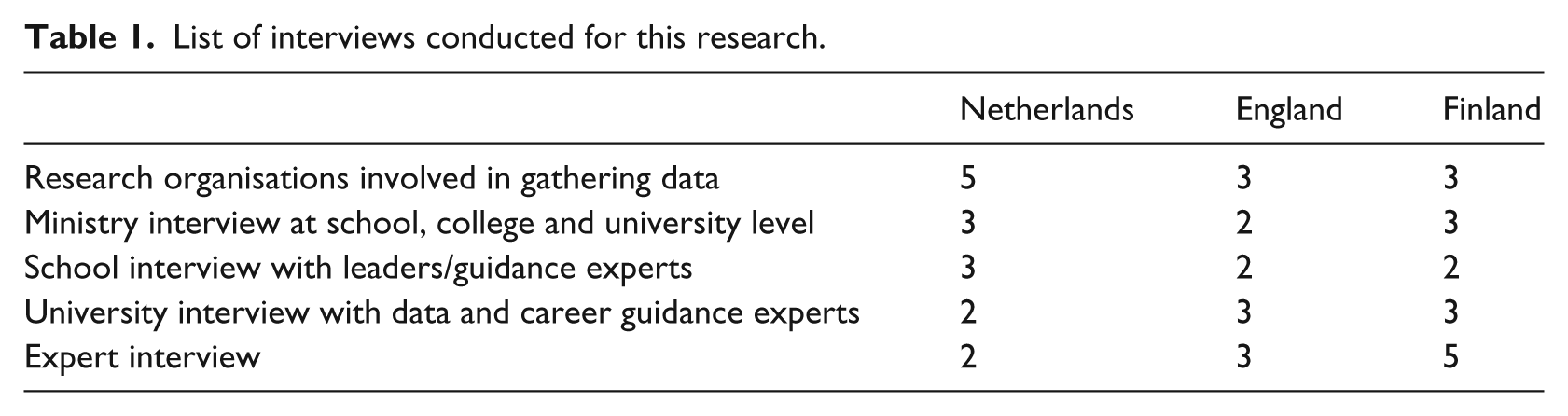
The research underpinning this paper aims to uncover how information on school leavers’ and graduates’ are gathered and utilised by different stakeholders. In the first, cross-sectional phase, a wide range of documents are analysed to identify SLGIS in all European countries to uncover the differences in the SLGIS methodology, as detailed by Hordósy (2014a, 2014b). Building on this phase, three case study countries were chosen to represent maximum methodological and regional variation and are used to seek a deeper understanding of the production and utilisation of SLGIS (Hordósy, 2016). The three distinct cases are the Netherlands (cross-sectional sample SLGIS from Continental Europe), England (longitudinal sample SLGIS from the UK-Ireland region) and Finland (longitudinal census SLGIS from the Nordic region). The case studies build on a total of 44 élite interviews with 60 experts who are either involved in collecting or are using the school leavers’ and graduates’ information as detailed in Table 1.
List of interviews conducted for this research.
The transcribed interviews are analysed manually, using a two-level coding system. The first level of codes derives from the research questions mainly and some of them emerge during the fieldwork and the manipulation of the data; these codes are largely the same across the three case study countries. The second level of codes emerges entirely from the collected interview data itself and varies substantially between the cases.
The discussion section of the paper is organised into two main sections. The first section outlines the main characteristics of SLGIS conducted at the national and the supranational level. The second section analyses two policy areas: that of lifelong learning and international student mobility with respect to their reference to ‘Europe’.
The SLGIS in Europe
This section provides an overview of what type of school leavers’ and graduates’ information systems are available in Europe and provides a number of possible explanations for the substantial regional variation; it also points to the international projects conducted within on this topic.
Regional variation of SLGIS within Europe
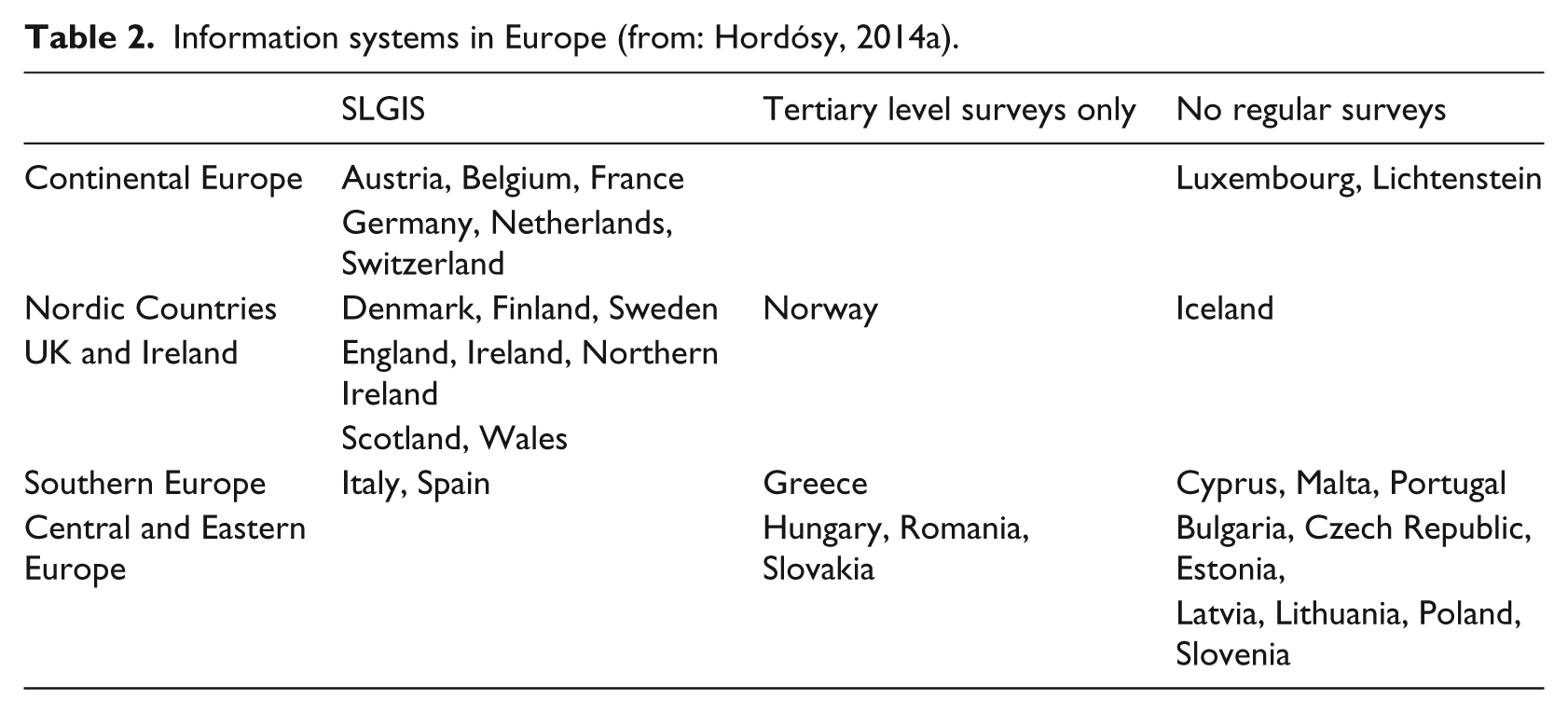
There is substantial regional variation in terms of whether SLGIS are conducted by the different European countries and what level of the education system they gather data about, as shown in Table 2 and detailed in Hordósy (2014a). As Table 2 suggests, the majority of the western and northern countries run some kind of school leavers’ and/or graduates’ information system, whereas the countries without such data collections are in the eastern and southern part of Europe. This section considers a number of possible explanations regarding the similarities and differences in the national approaches to SLGIS as well as the regional variation shown here.
Information systems in Europe (from: Hordósy, 2014a).
The first phase of this research permits highlighting some of the similarities in the methodology of SLGIS in countries where some evidence of policy learning can be found (Hordósy, 2014a). The first such example is from the UK and Ireland context where, according to Howieson and Croxford (2008), the discontinued English and Welsh survey, the Youth Cohort Study, was originally based on the Scottish experiences. The second is the cooperation between Nordic countries to share their practice in administrative data linking to acquire national datasets (Myrskylä, 2001; United Nations, 2007). It seems that policy learning happens in a number of smaller regions of Europe, not at the supranational level itself with regards to data on school leaving and graduation. The two examples suggest that policy learning occurs in contexts where nation states are closer culturally and historically to each other and where there is a longer tradition of working together.
The variance within Europe seen in Table 2 could yield a number of explanations. The differences between the regions could be attributed to the economic situation, where the countries with higher GDP spend more on educational research, as for instance gathering information on school leaving and graduation. However, as the Dutch example suggests, their SLGIS were initiated in times of economic hardship mainly as an aid for government to plan policies. As suggested in a data expert interview:
In the early 80s the [Dutch] government decided that there had to be more relations between education and the labour market. […] so they started regional centres for education and labour market and they had different activities, but one of the activities was how does education link to the labour market, they needed graduate surveys as a basis for information. (Research institute, NL)
When comparing the regions regarding the absence and presence of SLGIS, Europe’s history in the past few decades seems to yield a further possible explanation. As suggested in Table 2, central and eastern European countries are less likely to have running SLGIS. In these areas the communist ideology dictated a planned economy in which there was no need to measure school leaving and graduation: everyone was supposed to comply with the labour market planning and take ‘their place’. In the market-economy of the western and northern European countries, the role of the state has been profoundly different. The state provides the structures and the market is thought to decide on the ‘value’ of school leavers’ and graduates’ from different institutions. This latter approach might raise the need to measure this ‘value’ and thus the need for information gathered through SLGIS. Further scrutinising the three market economies serving as case studies, the importance of labour market planning arises. Whereas this has a strong tradition in the Netherlands and in Finland, in England the labour market is less regulated. This seems to be related to how comprehensive the SLGIS of a country is. The higher-level labour-market planning seems to go along with more comprehensive SLGIS. It could be assumed that the comprehensiveness of the educational level yields an equally comprehensive, overarching SLGIS. Finland fits this assumption; however, the other two case studies do not. England compared with the Netherlands is a more comprehensive educational system, whereas regarding their SLGIS this seems to work the other way around. As an expert involved with the Dutch SLGIS explained why they find the core part of the SLGIS questionnaires important:
(…) you can compare higher vocational education, secondary vocational education, measured at the same period, measured the same group in the sense how long that they are in the labour market and measured precisely by the same questions. That gives you tremendous possibilities to compare it. (Research institute, NL)
The above arguments seem to suggest that it could be the role of government that makes a difference regarding whether the SLGIS exist and whether they cover all educational levels similarly or with different approaches. If the role of government is to plan the labour market, a more comprehensive SLGIS seems to be useful. If it is geared towards facilitating market procedures, more specialised SLGIS that can provide information for student choice and institutional evaluation are more suited.
SLGIS as European projects
As suggested earlier, the European Union has been involved in financing cross-national educational research for decades. These research projects build on international networks of experts within educational and labour market research, drawing on their knowledge of their own national setting.
Some of the research conducted at the European level concerned the school-to-school and school-to-work transitions or with a more general concept of school leaving or graduation. This section provides an overview of the data gathered on school leaving and graduation at the European level. It points out what focus they have, what methodology they use and what problems are encountered when conducting them. The research conducted at the European level aims to compare data on school leaving and graduation cross-nationally. Analyses of the school-to-work that provide an overarching, system-level view are generally built on numeric data (Raffe, 2008). As there is no internationally agreed methodology of measuring outcomes after school leaving or university, the comparative information either derives from micro-data, drawing on the nationally collected, separate research outcomes, or it is gained through internationally organised research programmes, such as the Labour Force Survey (Raffe, 2008). In terms of their time-frame, these research projects are concerned mainly with the initial transitions from education to the world of work. Thus they do not provide a longer-term view, for instance a picture of lifelong learning.
Regarding the time-scale of the transition research, although there are several longitudinal designs, a substantial part is gathering data in a cross-sectional manner. The timing of such research programmes through snapshots views transitions through a retrospective lens. Longitudinal data would be better suited to analyse mid- and longer-term outcomes as well as to describe cross-country differences (Couppié and Mansuy, 2003; Raffe, 2008). The available datasets are constrained especially in relation to the time-scale applied:
A retrospective school leavers’ survey cannot expect to chart the development of occupational aspirations in school pupils; nor can it observe the process of vocational guidance. It can however record young people’s retrospective views of different sources of advice, and their relative helpfulness. (Raffe, 2008: 47)
One of the first research projects on school-to-work transitions ran between 1997 and 2000 with the title Comparative Analysis of Transitions from Education to Work in Europe (CATEWE). This project built on the expertise of a wide range of researchers from Ireland, Germany, Scotland, the Netherlands, France, Belgium, Portugal and Sweden (Gangl et al., n.d.). This research project used the Labour Force Data and in addition some ‘longitudinal data from school-leaver surveys, which unfortunately exist in only a small number of European countries’ (Gangl and Müller, 2003: v–vi). The CATEWE project was followed by multiple comparative research programmes, mainly on the transitions from the tertiary level to the labour market. Examples are: the Careers after Higher Education, a European Research Study (CHEERS) project running between 1998 and 2000; The Flexible Professional in the Knowledge Society New Demands on Higher Education (REFLEX) in Europe project running between 2004 and 2007; and the Higher Education as a Generator of Strategic Competences (HEGESCO) running between 2007 and 2009.
Some of these international research programmes flagged the technical problems of comparability. The CATEWE research team suggested that some changes to the Labour Force Survey (LFS) could be made, a possible cohort-study at the European level could be set up, as well as the national level information systems could be harmonised to some extent:
while full harmonisation of existing national transition surveys is not feasible, it is recommended that agreement should be reached on a template which represents best practice and principles for the partial harmonisation of these surveys. (Smyth et al., 2001: 11)
Beyond the international research projects comparing transitions, there are some comparisons of the methodology of school leavers’ and graduates information systems, as for instance of the work of Mainguet (1999). Their work reviewed the then existing research programmes on school-to-work transition with a view on the research methods used, the sources of information and the topics covered. They also reviewed the international research programmes tapping into the topic of transitions. A further account of how the data on school transitions were collected was published in 2001; this work reviewed the data needs of policy-makers and researchers (Raffe, 2001). A more recent account to contrast how the actual school leavers’ and graduates’ data are acquired and used in the different nation states was published in 2012. As Gaebel et al. (2012: 16) suggest in the study entitled ‘Tracking learners’ and graduates’ progression paths’ (TRACKIT), ‘the tracking of students and graduates has so far received little attention, at least at European level’. Their work concerned the methodologies of graduate research and how the data about current and former students is used at the policy level as well as within higher education institutions in different European countries.
Europe in the SLGIS
The second topic this paper investigates is whether and if yes, how the idea of ‘Europe’ appears in the school leavers’ and graduates’ information systems at the national level. As suggested in the previous section, there has been little convergence between the information systems in terms of their definitions or methodologies. However, some important policy agendas seem to appear in the SLGIS that suggest some level of influence from the European level. The first such area refers to the notions of lifelong and life-wide learning; the second topic investigated relate to the agenda of internationalisation and student mobility. This section builds mainly on the three case studies, teasing out the aspects of SLGIS mentioned that relate to the European integration.
How do we have information about lifelong and life-wide learning?
One of the starting points of this research is the data needs arising from the notion of lifelong learning. This concept is based on viewing education and, more crucially, learning as an ongoing process that does not finish with the initial years of schooling. It seems that national SLGIS mainly ‘stop’ gathering information after the initial educational levels. In addition, they seem to be concerned mainly with qualifications rather than a more general view on learning.
It is only Finland that gathers data on longer-term learning outcomes: the Statistics Finland data allow comparisons of labour market outcomes for at least ten years after leaving the institution. However, this information is constrained to whether or not the individual is employed, not detailing the level or the type of employment.
Life-wide learning views ‘learning’ as happening in many different situations, not only in designated educational institutions. However, SLGIS do not provide a very broad perspective on schooling, suggesting that there are difficulties around gathering information on it. Learning in these information systems seems to be connected to some economic value and official certification. For example, the English survey programmes gain some evidence on this notion when gathering data about training at the workplaces and beyond initial schooling. In the case of the Netherlands, further learning especially at the workplace are viewed within a short time-frame after finishing initial education. The Finnish Aarresaari Networks’ surveys offer some information about learning after leaving the university. The national datasets of Statistics Finland for all educational levels and sectors, however, provide limited information, as suggested in an interview with data experts:
(…) education leading to an officially recognised degree, that’s complete. If there are some education programmes which are short [?] like some sort of adult education, which are not leading to officially recognised degree, there are not very complete data. (Research institute, FI)
Beyond the SLGIS analysed in this research, the Labour Force Survey (LFS) is a crucial information set that covers labour market outcomes and provides a longer term and wider picture on learning as well. The importance of it was raised in all case study countries especially in relation to comparing outcomes from different levels and sectors of education. Crucially, as mentioned regarding the European research programmes on transitions in the previous section, the LFS is one of the most important datasets that permits cross-country analysis of labour market outcomes. It covers both initial labour market positions and longer-term career prospects, providing some data about further learning experiences as well. This is the only current comparable measurement that provides information from across several countries over a longer period of time on learning after initial education. Crucially, the LFS is used as the main information set for the lifelong learning indicators by the European Union to monitor the recent policy initiatives.
What do we know about international student mobility?
Internationally mobile students who move to one of the European countries to study seem to be a group ‘missing’ from SLGIS. Only graduates’ data are considered here, as tertiary education seems to be the main arena for international student mobility.
In all three case study countries the data collections take the graduates of an institution into account as opposed to the national labour market they go into. However, Finland does not seem to have any information on individuals moving out of the country beyond the ‘quantity’ of emigrants. This is due to the methodology and the sampling used in the Finnish SLGIS by Statistics Finland using national administrative records. Both the English and the Dutch SLGIS methodology operate by sending the online questionnaires to graduates, thus gaining some level of data from the internationally mobile individuals as well. Admittedly, the response rate for international graduates and home-graduates living in other countries is lower than home-graduates living in the given country. Collecting data from beyond the borders takes up vast resources according to an English university interview:
Just simply a practical issue is that [asking international graduates] would cost us a fortune in overseas postage. If we want to telephone survey these people, then we have to have people set up in the middle of the night. Because the majority of our overseas students come from Asia, Southeast Asia, they are at least five–ten hours ahead of us in time-difference. Just the practicalities of doing this would be a real drain for institutions. (University, En)
However, it seems that utilising new technology enhances the tracking of internationally mobile graduates according to an English university interview:
The other thing about email [with the online questionnaire], while we’re probably in a position now where email is a viable option to all of our territories, but five years ago we’ve tried emailing certain countries, a number of candidates in certain countries and they couldn’t respond for weeks because broadbands were down […] it’s got to a point now where email and internet access probably is our main form of communication. But four–five years ago we couldn’t rely on that for all territories. (University, EN)
The subject of internationally mobile students is expected to become more important in the future. In all case study countries, the tertiary level institutional interviewees and ministerial respondents pointed out their commitment to ‘internationalise’ their higher education partly through attracting more international students. In terms of the graduates’ information systems, so far it is only the UK that has taken measures for gathering more reliable data.
Conclusion – Europeanising the SLGIS?
This paper used the example of school leavers’ and graduates’ information systems to see whether the process of Europeanisation can be observed within a specific policy area at the level of the nation state. The SLGIS analysed in this paper showed growing relevance of the European agenda regarding their content. These links, however, seem rather blurred between the European agenda and the national policy-making prompting a number of explanations. The outcomes of the international comparative research suggest ‘the path-dependency of countries and the failure of national transition patterns to converge’, meaning that the actual educational systems do not become more similar (Raffe, 2008: 292). Moreover, in the case of trend-data and longitudinal records of educational phenomena, comparability over time is one of the most valuable aspects of information systems such as the one on school leavers’ and graduates’ (Hordósy, 2014a, 2014b).
Due to these it is not surprising that the SLGIS did not become more comparable to each other over time, thus actually producing a European level view on school leaving and graduation. As one European-level research project suggested, comparability could be enhanced through the ‘improvement of existing data sources [i.e. the LFS] coupled with the collection of new data [which] would greatly enhance our ability to understand transition systems across Europe in years to come’ (Smyth et al., 2001: 12).
Some level of convergence can be observed ‘outside’ the mainstream political agendas, suggesting a clearer process of Europeanising these areas. First, the example of early school leavers gained its definition from the LFS, providing a broad description that is above and beyond any of the national educational systems and their characteristics (European Commission, 2013). Second, the actual Bologna-process was not initiated by the EU itself and the influence points much further than the community itself. Heinze and Knill (2008) suggest this policy change had differential national effects within the common framework for higher education. Mirroring this, the national graduate information systems set up during the years of policy change exhibit substantial differences depending on the national context of higher education and tradition of collecting data.
Two policy topics that seem to be important in terms of the Europeanisation agenda identified in the case studies as important regarding the SLGIS are lifelong learning and internationalisation of higher education. Both of these were mentioned as aspects that are aimed for, not yet entirely realised in any of the analysed cases.
Based on the above examples, a next step of collecting data ‘on the fringes’ could aim for more comparable data on the path of internationally mobile students – this would also cover a substantial topic ‘about’ Europe. Currently the available information regards the overall number of student in and out-fluxes of the different countries of the EU. There are attempts in the case study countries to collect better quality data on mobility and internationalisation of higher education. This could be the next area where more definitions and data-collection procedures are agreed within the European Union or within the European Higher Education Area to the data then to be gathered by Eurostat. Moving forward from here, it might be possible to agree on some further measurements to compare school leaving and graduation. The European-level comparability of the school leavers’ and graduates’ data could help mutual policy learning between European countries. This is especially timely considering the high levels of youth unemployment in some nation states of the EU (European Commission, 2013).
Viewing Europeanisation as an analytical tool that prompts questions for research and coupling this view with a bottom-up design seems to be a useful structure when analysing the development of a specific policy area and its interplay with the European project. This paper showed that conducting such studies and comparing a number of national settings can highlight the interplay of policy-making between different stakeholders at the national level as well as the differential impact of Europeanisation between countries.
Footnotes
Acknowledgements
Sincere thanks to both my supervisors Professor Peter Davies and Professor Stephen Gorard who provided very useful comments and feedback on this paper.
Declaration of Conflicting Interests
The author(s) declared no potential conflicts of interest with respect to the research, authorship, and/or publication of this article.
Funding
The author(s) disclosed receipt of the following financial support for the research, authorship, and/or publication of this article: The research was funded through the School of Education Doctoral Scholarship of the University of Birmingham.