




Abstract
A social democratic, egalitarian public sector and a corporatist political economy have been strong, distinctive and enduring characteristics of Norwegian education. However, this article demonstrates that the education sector has experienced a period of rapid and extensive implementation of New Public Management (NPM) reforms and post-NPM reforms the past 15 years. In contrast to other scholars, who claim that NPM is not contested but rather consistently promoted and maintained by centre-left governments, we argue that from 2005 such governments have added new ideas of government and implemented new methods of steering education in line with post-NPM reforms. To regain central capacity and control and to compensate for the negative effects of NPM on social inclusion and equality, new measures for input control were adopted, and the negative effects of marketization were to some degree moderated by later educational reforms.
Introduction
This article reveals how marketization under New Public Management (NPM) and moderated versions of management reforms have influenced Norwegian education and questions whether the waves of management reforms challenge the long tradition of social inclusion and equality.
The Norwegian education system has promoted social inclusion by securing equal access to education for all, comprehensive public schools and an emphasis on democratic values, community and equality (Aasen 2003; Arnesen and Lundahl, 2006). Thus, since the Second World War, the education system has been important in building the universal social democratic welfare state. Although Norwegian education has a strong unitary tradition, local autonomy is an important element. Over time, the municipalities have had various degrees of responsibility for basic education within state legal frameworks.
Until the 1990s, the social democratic education system included a prescriptive national curriculum, standardized teacher training and extensive regulatory legislation. Hence, the steering of education by formal structures and decision-making procedures was centralized. Strict state-level regulatory inputs were implemented at the local level. Currently, this input-driven governance model is more or less history. In the past two decades, educational reforms have been implemented in the name of NPM. However, compared with other countries, the education sector in Norway has been reluctant to adopt NPM reforms. Marketization elements such as contractual relationships, decentralization, competition and output control have replaced direct hierarchical control forms, but elements such as privatization, public–private partnerships, subcontracting and free choice for parents regarding the choice of a school have only been introduced to a limited extent. Nevertheless, there has been general political agreement on the introduction of NPM elements into education (Arnott et al., 2009; Solhaug, 2011).
Increasingly, the literature has pointed to the negative effects of NPM and questions concerning its efficiency and effects on political control (Christensen et al., 2014), as well as challenging its ability to ensure social inclusion and equality in education (Arnesen, 2011). Thus, ‘post-NPM reforms’ (Christensen and Lægreid, 2011a) have been introduced as a response to NPM. Recently, alternative regimes such as New Public Service (NPS) (Denhardt and Denhardt, 2000, 2015), New Public Governance (Osborne, 2010) and Whole-of-Government (Christensen and Lægreid, 2007), among others, have been launched to address the negative effects of NPM. The alternative management regimes have different labels, but they have similar characteristics. Increasingly, partnerships, network governance and soft measures are being devised to push organizations in the same direction (Christensen et al., 2014). In this article, we explore the forms of governance that have been adopted in Norwegian education over the past 15 years and their influence on social inclusion and equality. First, we analyse the education reforms that have been introduced and have gained support in three terms of government from 2001 to 2013, and discuss whether they can be characterized as NPM or post-NPM reforms. Thereafter, we narrow our scope and analyse one national programme, namely the Improving Learning Environment (ILE) strategy, and find that marketization governance is contested in education. We also raise the question of whether this new direction in education governance provides solutions for the loss of political control and educational inequality.
Analytical framework: classifying reforms in education
In discussing the influence of administrative reforms on inclusion and equality in Norwegian education, we draw an analytical line between NPM reforms and post-NPM reforms.
The most common characteristics of NPM in Norway are structural devolution and horizontal specialization, together with the introduction of both market and management principles (Christensen and Lægreid, 2011a). Structural devolution is seen as an answer to central capacity problems because it allows leaders to focus on strategic questions and frame steering (Christensen and Lægreid, 2011b). In Norwegian education, two forms of structural devolution have been prominent – devolution of decentralized responsibility to the municipal political administrative level and the establishment of more regulatory agencies with strong autonomy – in addition to greater priority being given to market values (Christensen and Lægreid, 2011a). Output control is seen as an important feature of NPM in education.
However, post-NPM reforms rely on insights from the social sciences rather than economics and are seen as a response to negative feedback on NPM. This literature claims that it has undermined political control and increased fragmentation. In addition, NPM is criticized for problems with efficiency at both the macro and micro levels (Christensen and Lægreid, 2011a: 133). To counter the fragmentation caused by NPM, post-NPM reforms are designed to co-ordinate sectors (Christensen and Lægreid, 2011a). In contrast to NPM reforms, post-NPM reforms are intended to improve the horizontal co-ordination of governmental organizations and enhance co-ordination between the government and other actors (Christensen, 2012: 664). Moreover, post-NPM reforms are designed to increase central capacity and control, and are influenced by both structural and cultural elements. Thus, management is value based, and the reforms are intended to create a stronger common cultural understanding of collective goals and norms to remedy the specialization and fragmentation encouraged by NPM (Christensen and Lægreid, 2011a: 133). Christensen (2012: 4) also points out that post-NPM reforms generally seem ‘to be more about working together in a pragmatic and intelligent way than about formalized collaboration…’. Denhardt and Denhardt (2000, 2015) have introduced NPS as a concept to draw attention to democratic perspectives, which they argue are neglected in the NPM literature (Denhardt and Denhardt, 2015: 664). As an alternative to NPM, NPS addresses core questions about the nature of public administration and the role of administration in governance, among other issues (Denhardt and Denhardt, 2015: 664).
Denhardt and Denhardt (2015) point to four main features of public administration related to democracy issues: (1) citizen engagement; (2) values of public interest and collaborative leadership; (3) reliance on market models of entrepreneurship and (4) privatization and government as rowing, steering or serving. We pay particular attention to the second feature: values of public interest and collaborative leadership. Others (see Lindberg et al., 2015) point to the post-NPM period as a new era of paradoxes, both those that are key features in themselves and those resolved through co-ordination and collaboration, through IT solutions, through municipal projects or through evidence-based practices. When we analyse educational reforms in Norway in the past 10 to 15 years, we anticipate that the definitions of NPM and post-NPM reforms may be overlapping and blurred.
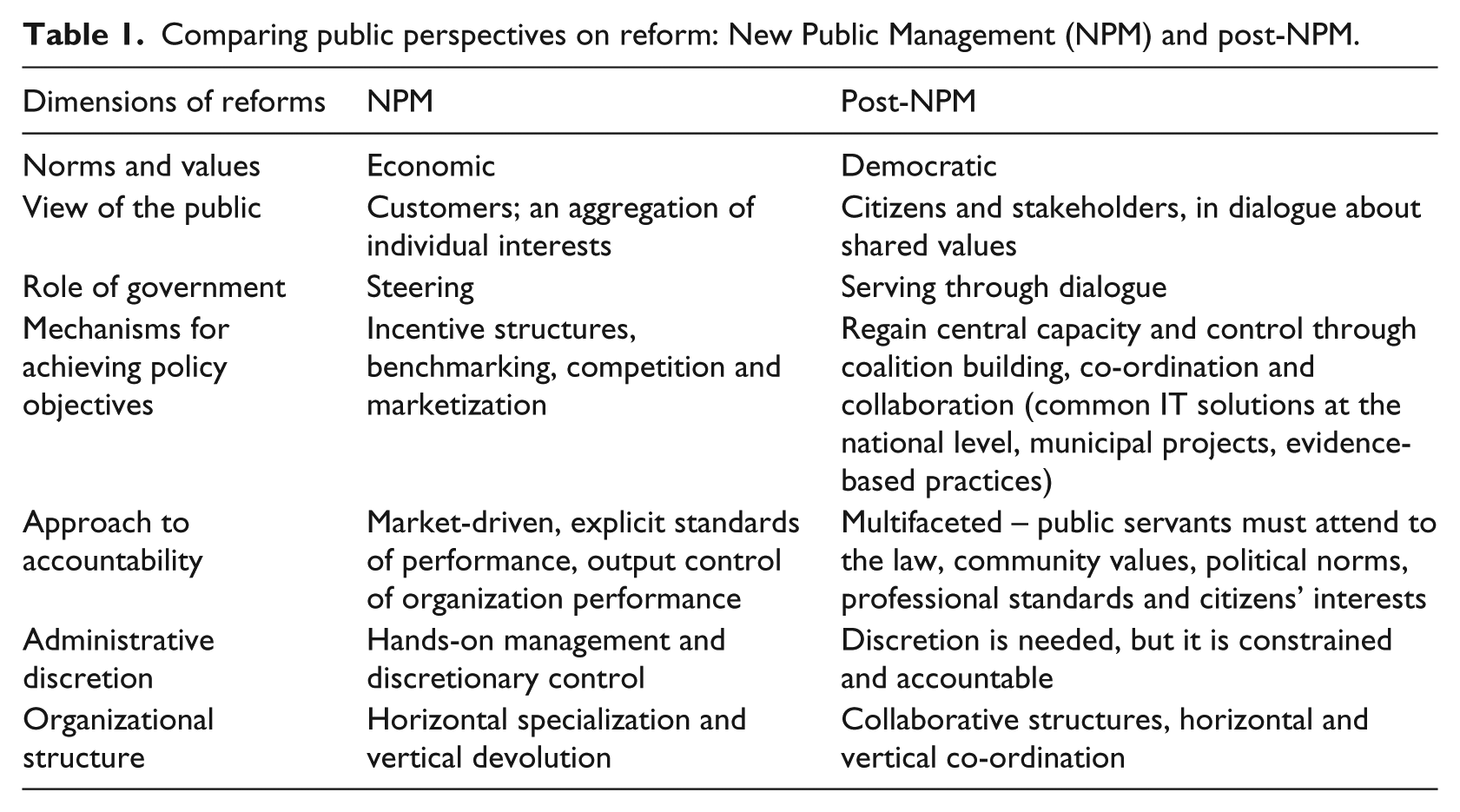
Inspired by Christensen and Lægreid (2011a) and Denhardt and Denhardt (2000), we consider the following dimensions to be relevant to the comparison of NPM and post-NPM public reform perspectives: norms and values; the views of the public; the role of government; the mechanisms for achieving policy objectives; approaches to accountability; administrative discretion and organizational structure. Table 1 summarizes the characteristics of the two modes of governance in terms of the dimensions presented above.
Comparing public perspectives on reform: New Public Management (NPM) and post-NPM.
In the first part of the article we rely on research literature and policy documents, in addition to our own research. In the second part, we specifically rely on findings from a research project commissioned by the Directorate for Education and Training. During a five-year evaluation of the ILE strategy (2011–2015), we have explored the implementation of the strategy through analyses of survey data, documents and qualitative interviews conducted in eight municipalities and two counties, half with ILE projects, the other half without. The interviewees included school leaders and teachers in 13 schools in 2011/2012 (44 informants) and 2013/2014 (38 informants) (Helgøy and Homme, 2013a, 2014).
NPM in Norwegian education
The strong tradition of democratic and egalitarian public education in Norway has been characterized by a prescriptive national curriculum, a standardized system of teacher training and extensive regulatory legislation to realize a unitary state school system. In this section, we analyse how educational governance has been extensively changed by educational and administrative reforms since the beginning of the 2000s. In the past 15 years, different governments have successively initiated, prepared and implemented educational reforms. Here we concentrate on the period between 2001 and 2009, which was the start of the NPM era in Norwegian education. We start with the 2001 centre-conservative government’s New Public Management reform initiatives, and the ways in which they were or were not followed up by the centre-left (Red–Green) government in office from 2005.
NPM reforms implemented by the centre-conservative government
Except for several administrative reforms to strengthen the municipalities’ responsibilities in education, the NPM reform process proceeded rather reluctantly during the 1990s. The Norwegian political–administrative culture is marked by co-operation and collaboration with civil service unions and by little tension between political and administrative executives, in addition to a high level of mutual trust between public-sector organizations at different levels (Christensen and Lægreid, 2011a). Thus, the system is characterized by stability and reluctance to adopt institutional change, as is also the case in the education system (Arnott et al., 2009).
The 2001 general election resulted in a centre-right government, with the Minister of Education, Kristin Clemet, representing the Conservative Party. The changes in government meant a shift in the style of governance in education, along most of the dimensions of NPM.
The 2001 government promoted a new system of transparency in education, as there was concern about the lack of information on performance in education. At this point, a transparent national evaluation system to give insights into local performance had already been on the political agenda for a long time. Despite a strongly standardized and legally regulated education system, Norwegian education authorities had insufficient access to information on the quality of local practices and performance. After decades of reports and preparation, attempts to establish a national evaluation system in education had allegedly failed (Arnott et al., 2009; Helgøy, 2006). However, this government put more effort into steering education in a new direction. There were two main political reasons for change. First, there was a need for evidence collection to enable informed political decisions. The Minister of Education pointed out that a lack of transparency had tended to prevent responsible authorities from making informed decisions. Moreover, it was argued that parents and the public in general should have access to information on educational performance (NOU, 2002). Second, at the beginning of the new century, international comparisons indicated that Norwegian students did not perform to a high standard, but rather to a mid-range standard. Publications from international school studies conducted by the Organisation for Economic Co-operation and Development (OECD) in 2001 and 2003 revealed low scores from the Programme for International Student Assessment (PISA) and also from the Trends in International Mathematics and Science Study (TIMSS) (e.g. Solhaug, 2011). The published low scores were debated with considerable interest in the media, and became an important political issue for the centre-right government. Thus, the educational reform process, including the implementation of NPM elements, was given the necessary basis to proceed (Arnott et al., 2009; Sjøberg, 2005; Solhaug, 2006, 2011).
Moreover, the road was paved for a public debate, creating a sense of Norwegian education in crisis. To gain support for a new direction, Norwegian education was represented as being characterized by mid-range scores, reproduction of social inequalities, gender differences, disciplinary problems, lack of evidence-based teaching and lack of differentiated teaching. Given its failure to establish a quality evaluation system for local practices, the government was dependent on a broad understanding of demands for educational change. The government highlighted the disconnection between the resources spent and the mid-range educational performance, and in several debates and documents it underlined that Norway was one of the countries that spent the most resources per capita on education, but still performed below average. According to Arnesen (2011), the representation of a national crisis based on international student test results is part of an international trend, and has become a common concern among most OECD member countries. The motivation was to support a political agenda of reform and legitimize governments’ acceleration of the implementation of new reforms (Arnesen, 2011: 199). The political agenda that the Norwegian government devised represented a break with the traditional broad approach to education, which emphasized democratic citizenship and devoted less attention to measuring performance. The reforms relied on typical NPM characteristics: a transparent system of output control based on explicit standards of performance, with national testing as a key element. Below, we highlight three of the most important reforms that the 2001–2005 centre-right government prepared and implemented, namely testing (including the publication and ranking of results), curriculum change and local autonomy.
National testing, publication and ranking
Concerning the primacy of economic values in NPM, Minister Clemet, underlined knowledge as being crucial for wealth growth, education as being a vital driving force of economic development and, last but not least, humans as being the single most important factor in business success. To raise quality and performance in education, as well as to inform educational authorities at different levels, national testing for school years 5 and 8 in reading, writing and numeracy was implemented in 2004. The test results were published, and schools as well as the authorities responsible for the schools were benchmarked and permitted to be ranked in league tables.
The turn towards output control represented a rather radical break with the traditional input-based control system in Norwegian education, and was met by huge opposition, including the boycotting of tests by teachers and students. Clearly, this indicates a sense of aggravation about the disruption to the previous collaborative climate between the government and the teachers’ unions and teaching community, and is in line with research concluding that during the term of the 2001–2005 centre-right government the traditional policy style was challenged, especially regarding the influence of the unions (Christensen and Lægreid, 2011a).
National testing comprises nearly all the NPM elements. Testing relates to the economic values of education as it produces public data that can be considered to reflect the schools’ ‘price and value’ system, as well as ‘winners’ and ‘losers’ (Elstad, 2009; Solhaug, 2011). Furthermore, testing produces information, which the 2001–2005 government claimed was missing from the former system – specifically, sufficient information about the market to enable parents and pupils to choose schools. It may also produce information to hold teachers, school heads or school owners accountable to the education authorities.
Curriculum change
Besides national testing and the introduction of market economic values, reform of the curriculum was essential in the Norwegian NPM educational reforms. Implementing a new curriculum was the main element of the 2006 Knowledge Promotion reform prepared by the 2001–2005 government. The reform was launched as part of the transparent steering system intended to improve the information flow. Knowledge and openness were promoted as preconditions for improving schools (Ministry of Education and Research, 2005a). The reform also included goals for improved teacher education, increased local autonomy by deregulating national standards and the establishment of a national system for quality assessment. The new curriculum consisted of less detailed syllabuses than those in the former 1997 curriculum. Instead, its focus was on clear competence goals. As the goals were meant to function as the basis of student assessment and dialogue between the parents, students and teachers, they needed to be clear and measurable (Directorate for Primary and Secondary Education, 2004). Therefore, every subject syllabus incorporated key competencies in basic skills. The new curriculum implied measurability and comparability and so enabled competition for the purpose of output control (Solhaug, 2011). Accordingly, by introducing the curriculum reform, Norwegian education took a large step towards implementing the typical NPM steering element of management by objectives and results.
The Knowledge Promotion reform was initially characterized by the reintroduction of a political hierarchy at the expense of the tripartite collaboration between the government, education sector employees and the employers’ organizations to improve state capacity in education. Teachers’ unions were involved to a lesser extent in policymaking (Helgøy and Homme, 2007). The reform was justified by broad majority support in the parliament, including several opposition parties. This political support paved the way for a much more confrontational style of policy towards the teachers’ unions. Moreover, instead of the unions being involved in decision-making processes, actors from other fields of knowledge, such as statisticians, economists and social scientists, became important sources of information for decision-making. The establishment and assignment of the Norwegian Directorate for Education and Training in 2004 illustrate the beginning of increased technocratic influence in education. The inclusion of new expert groups in education underlines weakened teacher influence. In addition, broad political support reduced the political costs of breaking the tradition of teacher influence.
Increased local responsibility
As indicated above, devolution was important in the NPM reforms, and is essential to the concept of management by objectives and results. In 2004, municipalities were given budgetary responsibility and the freedom to organize education, including class sizes (Solhaug, 2011). Devolution also included local influence on subject curricula. Per capita funding, experiments allowing citizens to choose freely among schools and not least the devolution of teacher wage negotiations from the national to the local level in 2003 were important elements of the increase of local autonomy during the term of the centre-conservative government. Moreover, the decentralization of wage negotiations was yet another example of the break with the tripartite collaborative model, as this decision was taken without involving the teachers’ unions, which were strongly against the decision. The leader of the main teachers’ union, Utdanningsforbundet, was informed about the decision by an SMS text message from the Minister of Education on a Friday afternoon, resulting in huge protests and criticism from the union (Helgøy and Homme, 2007).
The devolution reforms caused great debate and concerns about increased inequality in education. A study of municipality and county spending on education found great variation (Borge and Naper, 2005). Moreover, a study of school accountability reforms and the use of special education showed that the Knowledge Promotion reform was implemented to varying degrees and at different times, and that increases in the proportion of special education placements were significantly smaller in municipalities with a high degree of reform implementation (Iversen, 2013). The issues of inequality and social justice were addressed by the new 2005–2009 centre-left government, yet it was unable to reverse the main elements of the NPM reforms already implemented, as we see in the next section.
The 2005–2009 centre-left government – from NPM to post-NPM?
As indicated above, there was broad political support for implementing NPM reforms in Norway. However, the electoral campaign of the incoming centre-left government had been based largely on an ‘anti-NPM’ platform supported by the civil service unions. Thus, the newly elected government was expected to offer a clear anti-NPM administrative programme quickly, but this did not happen (Christensen and Lægreid, 2011a). A discrepancy between the Labour and Socialist parties in the governing coalition became obvious: while the Labour Party tried to limit the undermining of NPM, the Socialist Party tried to strengthen the post-NPM reforms (Christensen and Lægreid, 2011a). Nevertheless, as the Minister of Education and Research was from the Socialist Party, a redirection of NPM policies might have been expected. Below, we explore the degree to which the new government was able to stop or redirect the NPM reform wave.
It became clear that the 2005–2009 Red–Green government would continue the former NPM education policy path. The government agreed that human capital was an economic resource, and that the need to improve education was the main education policy issue (Prime Minister’s Office, 2005). However, its attention was redirected from the mid-range performance of the resources spent on education to a need to strengthen the traditional unitary school and educational system that included all children and promoted learning, solidarity and democracy (Ministry of Education and Research, 2007a). In contrast to the previous 2001–2005 government, the 2005–2009 government was more sympathetic to the teachers’ unions’ demands for more resources in education, thus enabling a new collaboration between the government and the teachers’ unions. Below, we show the modifications to the NPM reforms undertaken by the new government.
National tests, publication and ranking
The centre-left government recognized the critique of the national tests, and the government’s first Minister of Education, Øystein Djupedal, considered the professionals’ arguments against the tests. The centre-left government chose a quite different collaboration strategy from the previous government, in accordance with Norway’s historical legacy of collaborative education policy development. As the former government had disrupted the previous collaborative relationship with the teachers’ unions and the teaching community, the first act of the new Minister of Education after gaining the position was to state that ‘education reform will not succeed without collaboration with the teachers’ (Ministry of Education and Research, 2005b).
The government declared that national tests could not be implemented if their pedagogical validity was called into question. An evaluation report had concluded that the tests did not measure what pupils were taught at school (Lie et al., 2005; MMI, 2005). The government began to review the tests, appointing an expert group to modify the national tests in dialogue with key interest groups. The aim was to reduce the control element of the tests and underline the importance of the tests as a pedagogical tool. Moreover, such collaboration was meant to re-promote the policy agenda of unitary schools, inclusion, diversity and democracy. The tests were thus modified to gain support from teachers and students. The national testing continued but was modified and redirected from ranking and benchmarking to providing an essential mean to improve differentiated teaching.
The centre-left government agreed to emphasize control of school outcomes, but disagreed over publishing and ranking the results. The government agreed to testing as a means of quality improvements in school, although it also promoted solidarity and inclusiveness as efficient approaches in education (Solhaug, 2011). Furthermore, the government showed some inconsistency in its prolongation of national testing: it warned against league tables but at the same time was in favour of benchmarking (Arnott et al., 2009). The possibility of ranking schools was established, as the test results were published on the national school portal website (www.skoleporten.no) and the public, including journalists, could legally gain access to the information.
Curriculum change
Concerning curriculum reform, the centre-left government made only minor changes. As the preparation process for the new national curricula ended just before the 2005 election, after a long and resource-intensive process, the new government accepted the new subject curricula (Solhaug, 2011). The timing may have played a role in this acceptance of the former government’s proposals. The most important change was the rewriting of the main objectives for teaching according to the new government’s demands for a more inclusive and democratic community in school (Ministry of Education and Research, 2007b). Thus, the policy was made more compatible with Norway’s historical legacy of a unitary school system for all. State intervention to enforce social inclusion seems to be the point on which the centre-right and centre-left governments disagreed, but this has had minor consequences for the subject syllabuses and output control.
Increased local responsibility
Although there has been a political consensus in favour of devolution, which has proceeded gradually since the 1992 municipality reform, there is a difference between the two governments in their concern about local variations and possible inequalities in education. The centre-left government was more concerned about social inequalities and the consequences for vulnerable groups (Ministry of Education and Research, 2006), and disagreed with the former government’s abolition of a maximum limit to the number of pupils in classes. However, its concern about inequalities in the distribution of educational resources did not lead to practical changes during its years in office (Arnesen, 2011; Solhaug, 2011). Thus, the devolution process was not stopped, but rather seen as irreversible.
To summarize, since the introduction of NPM from early 2000 until the 2009 election, a transparent evaluation system consisting of testing and other forms of output control was introduced, among other measures, including a curriculum adapted for measurable goals and output control, decentralization of responsibilities and local autonomy followed by increased accountability. Several classical NPM elements were implemented through these reforms, such as viewing parents/students as customers, a stronger and specific steering role for government, as well as the development of incentive structures for benchmarking, competition and marketization. A new approach to accountability followed the introduction of output control and vertical devolution, making teachers, school leaders or local authorities responsible for student achievement. However, so far this has had limited practical consequences for actors at the local level. There has been a political consensus on the administrative reforms, but disagreement over marketization in education. The centre-left government acknowledged and expressed concerns about social inequalities that stemmed from marketization in education, but until the subsequent election in 2009 we did not observe any substantial state intervention to limit NPM.
Until the 2009 election, little evidence was produced supporting positive outcomes from the NPM reforms, either in quality improvement or in increased governing capacity. On the contrary, there was a growing concern about increased inequality because of differences in performance, students dropping out of upper secondary school and persistent low performance in international surveys such as PISA and TIMSS. Moreover, the central authorities questioned the school owners’ ability to take responsibility for providing education under the decentralized model of governance. In the next section, we identify a change in the marketization of education in Norway caused by modified and redirected administrative management.
Post-NPM reforms: improving the governing capacity, equality and education quality?
The second centre-left government
In September 2009, the centre-left government was re-elected, with the Socialist Party retaining the Minister of Education position. Kristin Halvorsen was appointed as the new minister. Education policy continued along the same paradoxical path as the previous government (2005–2009) followed, consisting of post-NPM social inclusion values on the one hand and an NPM output-control approach to accountability on the other hand. The policy documents stressed the democratic value of social inclusion, and thus the ideals of the traditional unitary and comprehensive school system. The post-NPM rhetoric was not translated into the mechanisms for achieving policy objectives, which were still inspired by NPM. Hence, the governing strategy was still management by objectives and results. However, from 2009 we find a change in educational governance. The following central policy documents stressed social inclusion values. The ‘Learning and communities’ report to the Storting (Ministry of Education and Research, 2011a) proposed measures to support students with special needs in education, and the 2011 ‘Motivation—mastering—possibilities’ report to the Storting (Ministry of Education and Research, 2011b) introduced a strategy for renewing lower secondary education. The ambition of the ‘Youth Report’ (Ungdomsmeldinga) was for students to achieve the goals of mastering key competencies and graduate from upper secondary education, and for all students and apprentices to be included and to experience success in education (Ministry of Education and Research, 2011b: 6). Although the document stressed key competence goals, social inclusion was underlined as equally important. Moreover, another report to the Storting, presented in spring 2013 (Ministry of Education and Research, 2013), strengthened the inclusive school argument for basic education even further. The report was called ‘On the right path. Quality and diversity in the common school’. The document presented the second centre-left government’s ambition to continue the established education policy path as well as introducing measures to strengthen the quality of education (Ministry of Education and Research, 2013: Foreword). All reports to the Storting on basic education, i.e. primary and secondary education, were based on dialogues with municipalities, counties and teacher and student organizations, among other parties, in addition to relying on national and international educational research. This implies that the government intended to continue the re-established collaboration with teachers’ unions. Furthermore, the documents emphasized stronger collaborative ties between the administrative levels of the education system, i.e. with municipalities and counties. This points to post-NPM reform and a governance strategy achieved through dialogue and vertical co-ordination. (2011b: 9)
The national tests, the PISA tests and the national assessment system (NKVS) remained important for output control. In 2009, the government strengthened output control through the introduction of a mandatory report on the condition of education (Tilstandsrapport). All school owners, i.e. counties, municipalities and private school owners, had to report annually to the directorate. By introducing this report on the condition of education, the government signalled that it would put more weight on organizational performance and the strengthening of local government accountability.
We find that NPM and post-NPM policies are present in the central policy documents from the term of the second centre-left government as well as those from the former period. The government focused both on students’ academic performance and on the inclusion of all students. In this particular period, various pedagogical measures were introduced and several arenas for dialogue were established. These new soft governance measures are in line with post-NPM ambitions, as they indicate both an approach of reform through dialogue and a desire to regain central capacity and control. Hence, we find that the government introduced reforms to strengthen political control (see Dahlström et al., 2011). As an example, the number of written guidelines in education increased from 12 in the 1999–2003 period to 50 in the period from 2004 to 2009 (Ministry of Local Government and Regional Development, 2012). The guidelines represented support at the local level with no formal obligations for the municipalities. The guidelines had no legal status, but stressed the government’s expectations of the municipalities and counties, and how the municipalities and counties should improve. Since 2009, the government has further developed soft governance measures in education. Presentations of evidence-based practices and best practices in arenas for dialogue with school owners and school representatives have proved very important in the term of the second centre-left government. Arenas for dialogue to strengthen collaboration and co-ordination between the state and municipal level were introduced. We identify the dialogue arenas as post-NPM mechanisms for achieving policy objectives. Examples of such dialogue arenas are the ‘Advisory team’ (Veilederkorpset) and the ‘School and municipality development project’ (SKUP), which were both measures of dialogue between the central and local levels and were introduced to strengthen the effort to assist municipalities with low student performance. Both measures were first implemented in a limited number of municipalities, and were intended to be extended to more over time. Two national strategies, New Possibilities (Ny GIV) and Improving Learning Environments (ILE; Bedre læringsmiljø) were intended to enhance social inclusion in education and covered all municipalities and counties. Participation in the advisory team, the SKUP project, the New Possibilities project and the ILE strategy was voluntary for the municipalities/counties, although the government stressed that broad municipality participation would lead to the best learning outcomes and would be most useful to the local government sector as a whole (see Ministry of Local Government and Regional Development, 2012).
The New Possibilities project was part of the government’s strategy to increase the rate of graduation from upper secondary education. The Ministry of Education and Research invited all counties, and eventually all municipalities, to participate in a three-year project (2010–2013). Its intention was to establish continuous collaboration between municipalities (as lower secondary school owners) and counties (as upper secondary school owners) to improve school conditions so as to enable more students to graduate from upper secondary education (Helgøy and Homme, 2013b). While the ministry itself co-ordinated and administered the New Possibilities strategy, the responsibility for administering the ILE project was devolved to the Directorate for Education and Training. In the following section, we analyse the ILE project more thoroughly in light of the two reform perspectives at the focus of this paper, i.e. NPM and post-NPM. Is the programme in accordance with the elements of NPM governance, post-NPM governance or both? Does the ILE strategy reflect a new direction and a solution for the negative effects of NPM?
The Improving Learning Environment strategy – NPM or post-NPM governance?
To provide the conditions for learning environments that promote students’ health, well-being and learning, according to the individual student’s right to a good physical and psychosocial environment (see the Education Act, Chapter 9a, Directorate for Primary and Secondary Education (2004)), the ministry launched the national programme called the ILE strategy. The strategy can be seen as a social inclusion strategy, even though it was intended to support individual rights. The right to good physical and psychosocial learning environments for all is by definition inclusive, and the policy underlines the point that any Norwegian school should be characterized by a good learning environment. The responsibility for the ILE strategy was devolved to the directorate, which designed and administered the programme. The strategy was designed to support local schools in fulfilling their obligations with regard to both the physical and the psychosocial environments, and applied to all school owners and schools. Moreover, the strategy was designed based on dimensions that research had found to be vital to the learning environment. An expert group appointed by the directorate conducted an evidence-based literature review of the topic and prepared guidelines for schools. The literature review pointed to five factors that were important for establishing good learning environments: (1) good leadership, organization and a culture for learning; (2) teachers’ ability to lead classes and teach; (3) positive relations between students and teachers; (4) positive relations and a culture for learning among students and (5) good collaboration between home and school (Directorate for Education and Training, 2009).
The strategy consisted of two main measures: (1) guides based on the literature review were published on the directorate website, which the local education authorities and schools were free (and encouraged) to use, and (2) financial support for selected local projects in 86 schools. The school owner – municipality or county, depending on the school level – managed each local project. The locally developed projects focused on one or more of the factors that were conducive to good learning environments according to the literature review. Thus, there was room for some local discretion in all projects in deciding how to ensure the students’ rights were respected and to develop practices that would support and sustain good teaching environments. Each project had to establish partnerships with sources of external expertise, such as a higher educational institution, a research institution or a private management or educational consultancy, to encourage collaboration with new public or private actors.
Voluntary participation and national co-ordination characterized the implementation of the national strategy, although the aim was to improve compliance with Education Act regulations. The voluntary aspect of the local projects underlines that there was room for local discretion in the ways municipalities and counties fulfilled their devolved responsibilities. The directorate, as the co-ordinator at the national level, provided guidelines and timetables for strategic goal achievement; the local schools and school owners were to interpret these goals and adjust them to their specific contexts. The directorate developed indicators for benchmarking and comparisons, and spread information on best practices both via the Internet and at national and regional conferences. These arenas represented new forms of dialogue between the central and local governments in the education sector, and underlined the availability of opportunities for the local level to participate in policy formulation and vertical co-ordination, which characterizes post-NPM governance. We characterize the strategy as a tool for mutual collaboration and learning between the levels of the education system. However, it is evident that conferences also served to hold the projects accountable to the central government, i.e. the directorate. In addition to the strategy, the directorate assigned the county governors the task of inspecting compliance with Chapter 9a (Directorate for Primary and Secondary Education, 2004) in all municipalities and counties over a three-year period. These inspections represent a different approach to accountability from the dialogue arenas. Thus, several approaches to accountability are consistent with post-NPM governance.
Does post-NPM governance succeed in increasing central capacity and control and promoting social inclusion in education?
Above, we have identified the ILE strategy as mainly attributable to post-NPM reforms. In the next section, we discuss the extent to which the strategy represents a form of governance that reduces the unintended consequences of NPM and supports the incumbent government’s goal of social inclusion in education. Based on the five-year ‘Evaluation of the Improving Learning Environment Strategy’ research project (2011–2015), we examine whether the implementation of the ILE strategy supports local school owners and schools, assists co-ordination of the political administrative levels and increases central capacity (Helgøy and Homme, 2014). We considered three research questions:
- Do the school owners and school leaders use the strategic guides (written guidelines), and if so, do they find them useful and relevant?
- What are the school owners’ routines and systems, and how do they safeguard students’ individual rights?
- How have school leaders’ responsibilities as providers of good learning environments developed during the period of the strategy?
We found that both school owners and schools throughout the country were familiar with the strategy, and that their use of the guidelines/guides published on the directorate’s website increased during the strategy period. We also found that local efforts to improve learning environments tended to reflect a more holistic approach at the end of the strategy period than at the beginning, suggesting that the strategy worked as a way of strengthening vertical integration in this particular area of education. The interviews with school owner representatives confirmed the increased level of school owner involvement. Municipalities and counties intensified their efforts and made systematic attempts to improve learning environments during the strategy period. They had all implemented systems to support and control their schools. The systems included result measurement tools as well as tools for evaluating qualitative processes and learning environments at the school level. A second main finding is that the methods of improving learning environments at the school owner and school level differed early in the period, but became congruent over time. However, this finding was most striking in the municipalities that gained project support from the directorate. Similarities in the use of methods indicate that the strategic projects were intended to increase vertical co-ordination, at least within municipalities and counties.
A second example of the impact of the strategy is the implementation of a particular evidence-based factor for good learning environments; namely, class leadership. We found that class leadership has been the most prominent measure implemented at the school level. Almost all 13 schools – both the ILE project schools and the others – worked to strengthen the teachers’ leadership abilities in their daily work. Berg et al. (2014) support this finding because they report that among project school teachers, class leadership is a factor that they feel is necessary to succeed. During the strategy period, efforts to strengthen the teacher’s leadership role were related to other measures intended to encourage mutual benefits. The schools integrated efforts to improve the relationship between students and teachers, in terms of how teachers work with projects in areas such as assessment techniques to improve students’ learning, differentiated teaching (i.e. teaching adjusted to the individual student and/or parent) and school collaboration. Thus, we found that over time the strategy encouraged the schools to see such measures and school projects as part of their holistic development work. The schools improved their performance in terms of several of the factors recommended in the directorate guidelines. This indicates that the strategy worked. The development of similar systems for learning environment work and content indicates increased central capacity. Examples from the ILE strategy implementation indicate that the state has returned to defining not only the objectives of education but also how to reach them. However, little is known about how the ILE strategy affects students’ experiences of their learning environments. Berg et al. (2014) find that most students in project schools are satisfied with their learning environments.
In summary, the ILE strategy seems to have succeeded in its post-NPM approach to increasing central capacity through co-ordination and collaboration between actors in the multilevel education system. Through the establishment of new arenas for dialogue on shared values between the central government, school owners, schools and educational experts, it seems that the directorate has taken a step forward in implementing social inclusion policies in practice.
Discussion and conclusion
The aim of the paper has been twofold. First, we have analysed the development and changes in Norwegian education governance in the past 15 years. We have revealed modes of governance during three terms of government: the centre-conservative government (2001–2005) and the two centre-left governments (2005–2009 and 2009–2013). Second, we have explored the significance of governance for social inclusion in education in each government period.
From a Scandinavian perspective, Norwegian education showed a reluctance and resistance to change, but at the beginning of the 2000s it experienced a period of rapid and extensive implementation of NPM reforms. In response to the sense of crisis induced when international surveys revealed only mid-range performance in education, a centre-conservative government undertook high-speed reforms. Although there was an overall political consensus on the administrative reforms, the centre-left expressed concerns that social inequalities would stem from marketization. Moreover, reducing the influence of NPM was important in the Labour and Socialist parties’ 2005 election campaign. However, when the centre-left government came into office, it did not deliver the radical changes expected by many citizens based on its campaign rhetoric. There was disagreement between the Labour Party, which wished to maintain NPM systems, and the Socialist Party, which spoke most strongly against the negative effects of NPM on social justice. Nevertheless, within the NPM period we observe a gradual change in administrative policies. In contrast to other scholars, who claim that NPM has not been contested but simply furthered and maintained (Arnesen, 2011; Solhaug, 2011), we argue that the centre-left government added new ideas of governance and implemented new ways of steering education, in line with post-NPM governance. We agree with Christensen and Lægreid (2011a) that post-NPM ideas have not replaced NPM in education. Instead, we find an overlap during the whole period from 2000 to 2013: some post-NPM characteristics were already apparent in the first years of our study, and NPM elements still characterize the final years. In other words, new ideas have been added to the old ones, and the old and new ideas complement each other. To regain central capacity and control and to compensate for the negative effects of NPM, the government has established input control. Growth in the number of guidelines during the latter years of the study as well as a growing emphasis on national strategies with prescribed standards indicate a new direction in educational governance. The collaborative policy style, undermined in the first government period, has to some degree been reinstated in the past few years, including a new type of input-oriented governance. This illustrates that ‘reforms are constricted by structural, cultural, and environmental features, but can also strike back and change such features’ (Christensen and Lægreid, 2011a: 138). The trend of ‘bringing the central state back in’ seems to be influenced by international trends, as pointed out in the 2009 government’s overall administrative policy (Ministry of Government, Administration and Reform 2008–2009). The development of educational governance cannot be viewed as a linear or one-dimensional process – such as the continual expansion NPM reforms – but must be viewed as a dynamic and multidimensional process consisting of competing, inconsistent and contradictory structures and elements. Therefore, we can identify places where NPM and post-NPM elements exist side by side, often intended to balance contrasting considerations such as output and input control, or elements to repair negative effects such as a decline in social inclusion (2011a).
What was the significance of governance for social inclusion in the three terms of government? The NPM reforms did not appear to reduce differences in student performance and secondary school dropout rates. Thus, discontent grew at the central level that the municipalities and counties were not fulfilling their devolved responsibilities as school owners. In addition, NPM steering through output control, management by objectives and devolution left the government without control over input or the content of education services. The second centre-left government expressed concern about devolution leading to variation, inequality and possible social segregation (Ministry of Education and Research, 2011b), and several measures were introduced to increase state capacity and control, and to reduce inequality and social segregation in the education sector. As claimed above (see Christensen and Lægreid, 2007), NPM has a constricting effect on post-NPM reforms. Thus, we ask whether NPM reforms constricted post-NPM measures, or whether the post-NPM reforms managed to promote social inclusion in education. Arnesen (2011) argues that a focus on students’ academic performance undermines the overall goal of social inclusion and that the centre-left government only rhetorically promoted social inclusion values. Was that really the case? Was there any government attempt to support the inclusion perspective in educational governance structures? We argue that a need to regain central capacity and control was evident in the new forms of soft governing tools introduced in the second centre-left government period. The most extensive measures introduced, the New Possibilities project and the ILE strategy, were intended to reduce inequality and promote social inclusion. These particular programmes introduced pedagogical measures, and several arenas for dialogue about shared values were established. Our analysis of the ILE strategy showed that the new arenas for dialogue on shared values between the central government level, school owners, schools and educational experts have led to changes in administrative routines at the school owner level and to more similar approaches to improving the quality of learning environments at the school level. Since 2005, social inclusion has been an important policy idea and is increasingly included in policy measures implemented throughout the education sector (2011b).
Concluding remarks
The paper contributes to understandings of a break in education governance from traditional, ‘old’ public management to NPM by Norway’s centre-conservative government in the period 2001–2005, and an incremental turn towards reasserting state involvement in the following two terms of government. The second centre-left government introduced dialogue-based reforms to compensate for the negative effects of marketization and to offer state support to secure schools’ inclusiveness at the local level. The eventual outcome of these efforts remains to be explored.
After the general election in the autumn of 2013, a new conservative government (the ‘Blue–Blue government’) came to power, and the present education minister represents the conservative right-wing party (Høyre). So far, the government has not proclaimed a specific education policy direction, except a stronger intention to use evidence-based knowledge through randomized controlled trials for policy formulation. An important question is whether the change in government implies a new shift in educational policies and whether NPM reforms will regain their dominant status in Norwegian education governance at the expense of post-NPM reforms. The significance of the change in government for social inclusion in education remains to be explored.
Footnotes
Funding
The author(s) disclosed receipt of the following financial support for the research, authorship, and/or publication of this article: This article is partly based on research commissioned and funded by the Norwegian Directorate for Education and Training.