



Abstract
Every year, tens of thousands of young people in Germany fail to find access to dual vocational education and training (VET), because they cannot find a company to hire them as apprentices. This particularly affects persons with poor school leaving qualifications, socially deprived persons or people with a migrant background. In order to improve their opportunities, there has been an increased discussion in recent times about a training guarantee. The central idea is that unsuccessful applicants undergo training at extra-company training institutions. This paper investigates the chances of realising such a reform proposal on the basis of organisational theories like agency theory and neo-institutionalism. The assumption is that particularly stakeholders from the employers’ and business associations will have reservations. Since their power within the state-corporatist governance system of dual VET seems to be higher than the power of the trade unions, the chances for this reform proposal should be relatively low. A survey of 300 stakeholders from different organisations that are involved with the governance, administration, implementation of and research into VET confirms this assumption. Apparently, disadvantaged young people are still expected to adapt to the less attractive residue of company-based training offers that are not taken up by better qualified applicants.
Keywords
Introduction
In Germany, there is a fundamental difference in the governance of access to higher education (HE) and non-academic vocational education and training (VET). Access to HE is state controlled, and the state stakeholders usually adjust the number of study places to the number of persons who have acquired a HE entrance certificate (Figure 1(a)). In the non-academic sector, the dominant role is played by the dual VET system, which combines part-time vocational school with company-based training and which is governed by a state-corporatist system (Baethge, 2006). Access to dual VET is market-based. Young people who wish to gain a training place have to apply to companies that are interested in providing training. Companies are completely free to decide whether to provide training and to whom. Since their decisions on training provision are much more guided by their own economic interests than by the needs of the young people (Troltsch and Walden, 2010), there is no substantial correlation between the number of dual VET places offered and the number of persons interested in dual VET (Figure 1(b)).
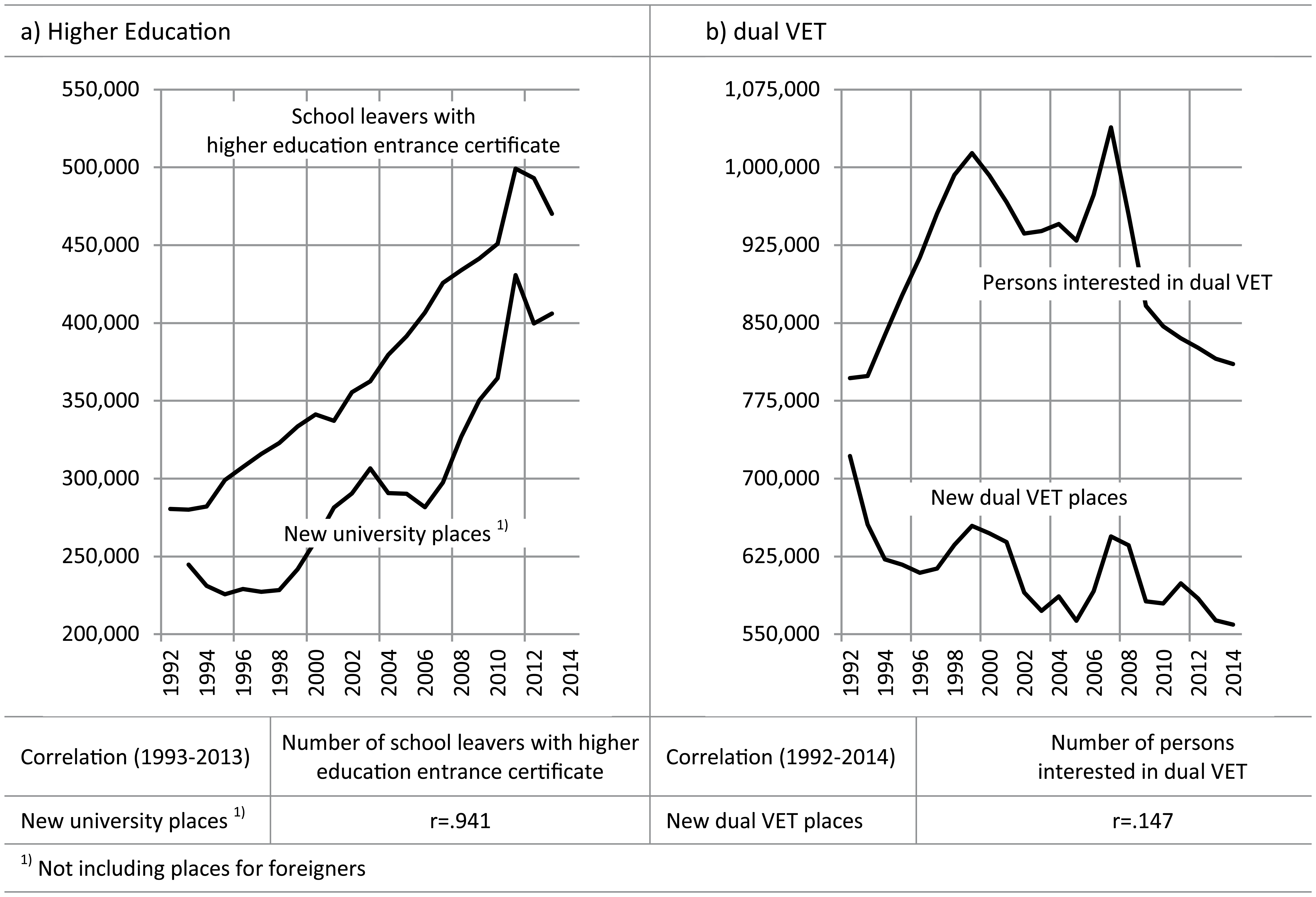
Supply of new places in universities and dual vocational education and training (VET) 1992–2014.
Many young people look in vain for a dual VET place. Only some of these are socially disadvantaged, persons with learning difficulties or with disabilities. They are mostly market-disadvantaged people living in regions with a shortage of dual VET places or wishing to be trained in occupations with such a shortage. They are outclassed in the competitive process by other training applicants. Many instead begin only partially qualifying vocational training courses, which are mostly financed by the state. Since these programmes are designed to improve the chances of transition to fully qualifying VET, they are grouped under the term ‘transition sector’ (see the second section). However, after completing these courses, the participants need to reapply for a dual VET place. Once again, a significant proportion fails to obtain a VET place (Beicht and Eberhard, 2013). As they get older, the only remaining option is an unskilled job. This means there is a risk that they will never complete a fully qualifying vocational training (Solga, 2005).
The number of young people interested in training has been falling steadily since 2007 in Germany due to demographic reasons, and there is an impending shortage of skilled workers in the coming years (Maier et al., 2014; Matthes and Ulrich, 2015; see also Ebner in this issue). Since disadvantaged young people constitute a considerable ‘hidden reserve’, increasing consideration has recently been given to a training guarantee (Herkner, 2013). The idea is to raise the number of skilled workers by providing unsuccessful applicants with state-financed dual VET training places at schools or in extra-company institutions.
This paper looks at the chances of realising such a proposal. We deal with the question of how this kind of proposal is evaluated by the different stakeholders of the state-corporatist system that manages dual VET. With reference to organisational and institutional theories such as agency theory and neo-institutionalism, we assume that representatives of employers’ and business associations in particular will adopt a critical stance. Their strong political influence is likely to significantly reduce the chances of a training guarantee (see the third section).
We tested our assumptions using a survey of around 300 stakeholders from different organisations that are involved in the governance, administration and implementation of and research into dual VET. By using different multivariate techniques, we try to identify the factors within the state-corporatist system that influence the political acceptance and implementation of this kind of reform proposal. The results confirm our assumptions (see the fourth section). Thus, attitudes that predominantly define VET as a part of the employment system and as something that needs to serve the current qualification interests of companies are more influential in Germany than attitudes that dual VET should support the educational needs and personal development of young people (see the fifth section).
Market-based access to dual vocational education and training
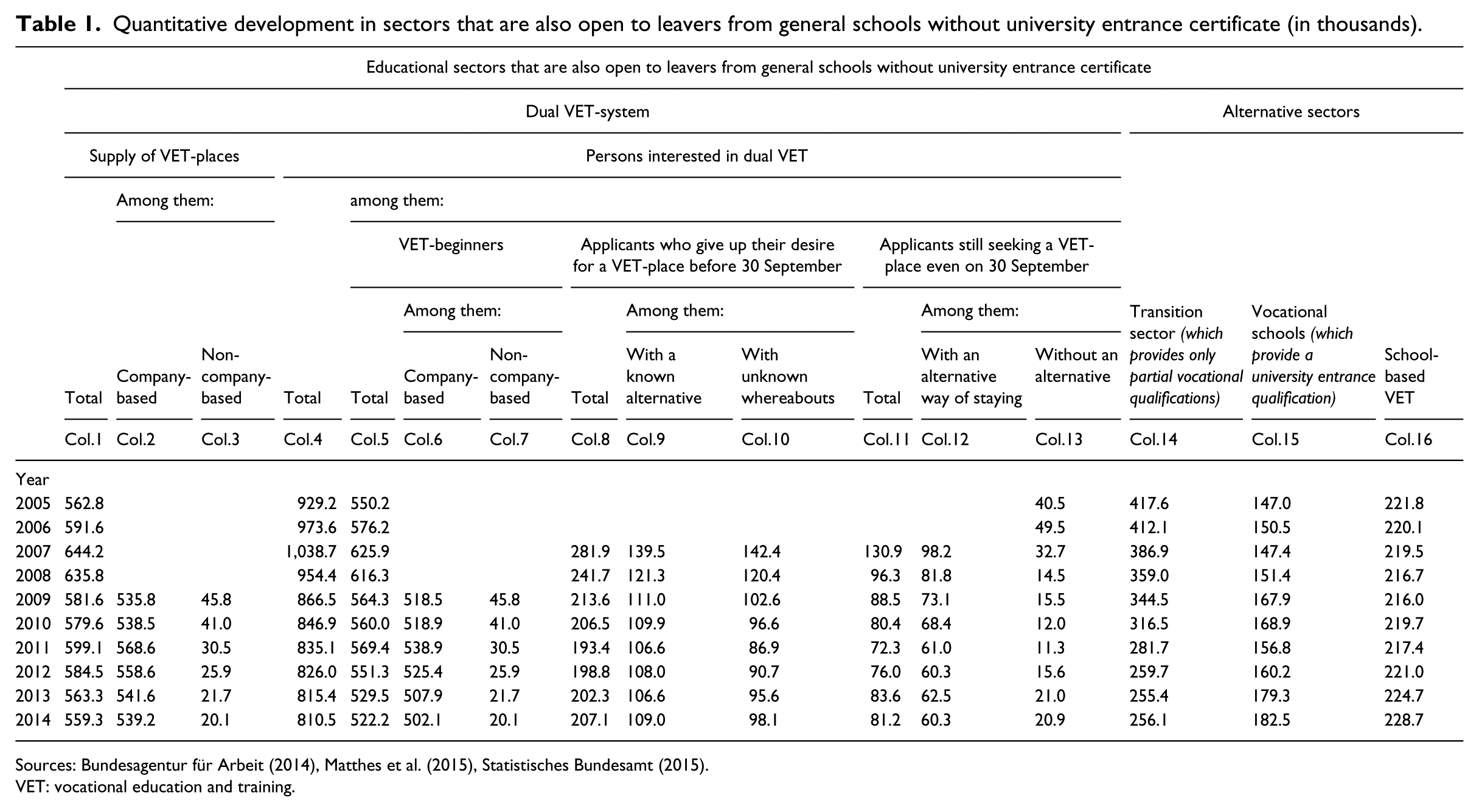
Dual VET is generally considered to be an attractive option by young people in Germany, even by those with a HE entrance certificate (Hochschulzugangsberechtigung), a group that now accounts for one quarter of all trainees (on the relation of VET and HE, see Wolter and Kerst in this issue). Over the past decades, the number of young people interested in dual VET (2014: 810,500; Table 1, col.4) has always been higher than the supply of company-based training places (2014: 539,200; Table 1, col.2). Accordingly, only a part of this group entered company-based training (2014: 502,100; Table 1, col.6). On the official cut-off date of 30 September, several weeks after the beginning of the training year, tens of thousands are still in search of a training place each year (2014: 81,200; Table 1, col.11). Many have even given up prior to this point and have – more or less voluntarily – sought an alternative (2014: 207,100; Table 1, col.8).
Quantitative development in sectors that are also open to leavers from general schools without university entrance certificate (in thousands).
VET: vocational education and training.
What are the educational alternatives for young people without a HE entrance certificate? Youngsters with an intermediate secondary school leaving certificate (Realschulabschluss) often take the route of vocational schools to acquire a HE entrance certificate (2014: 182,500; Table 1, col.15). Another option is to participate in full-time school-based VET. However, this sector is limited to only a small number of occupations (particularly occupations in healthcare and social services sectors; entrants in 2014: 228,700; Table 1, col.16). In addition, these occupations often require an intermediate secondary school leaving certificate and therefore exclude young people with the lowest school leaving certificate (Hauptschulabschluss).
The main alternatives that are open to young people with a lower secondary school leaving certificate, or no certificate at all, are interim solutions within the only partially qualifying ‘transition sector’ (entrants in 2014: 256,100; Table 1, col.14). These programmes take up to two years to complete, and they are intended to improve the participants’ chances of obtaining a company-based training place. Only some of these programmes offer the possibility of gaining a higher school leaving certificate. After completing, participants need to re-apply for VET places. If they fail, younger persons frequently re-enter the ‘transition sector’, whereas older persons go into casual employment or remain without employment (Beicht and Eberhard, 2013). The individual risk factors for this kind of development are well known – below-average school leaving qualifications, background in socially disadvantaged families, migrant families or an economically weak region with a shortage of VET places (Beicht and Walden, 2014; Hillmert and Weßling, 2014; Solga, 2005).
Paradoxically, among all disadvantaged young people, the group that has the highest chance of beginning dual VET are those who have such dramatic deficiencies in terms of social or performance behaviour that they are generally considered as incapable of completing company-based VET by the state stakeholders. This group includes young people such as those who have become criminal offenders or drug addicts, young people with language problems and young people with learning difficulties. As persons who are ‘socially disadvantaged’ or who have ‘learning difficulties’, they are trained in dual VET-occupations at extra-company training institutions, where they are provided with special educational support (Bundesministerium für Justiz und Verbraucherschutz 2015, §§ 76–78). A total of 20,100 of these training entrants were recorded in 2014 (Table 1, col.3). These also included persons with disabilities, for whom there are also special occupations and training institutions in place.
Therefore, ‘market-disadvantaged’ young people have the worst chances of entering dual VET. These are young people who are officially considered to have the necessary apprenticeship entry maturity, but who fail to find a company-based training place.
Debate about policy requirements for reforms
For many years, young people’s problems when it comes to accessing dual VET have provoked controversies between the different stakeholders of the state-corporatist system that steers dual VET (federal government, federal states, employers’ and business associations and trade unions). In order to understand the attitudes of these stakeholders (which are primarily sourced from their official responses to the annual VET Report of the Federal Ministry of Education and Research below), some preliminary theoretical remarks are useful. We combine them with a brief review of developments in recent decades. Our basic assumption is that even if ‘the overall aim and task for VET governance is to provide enough possibilities and places for education and training’ (Gonon 2014: 2), different stakeholder groups with different interests may arrive at very different conclusions with regard to what this means.
We make reference to agency theory (Eisenhardt, 1989) and to neo-institutional approaches, which focus on the institutional work of organisations (Lawrence et al., 2009). These enable us to understand why the stakeholders from the employers’ and business associations also officially commit to the objective of providing sufficient training places whilst finding different explanations for the adversities of disadvantaged young people. These theories also shed light on the strategies available to them for enforcing their attitudes within the state-corporatist governance system. Following the approach of actor-centred institutionalism, we thus see the development of the dual VET-system as a consequence of the cooperation between various stakeholders who pursue their own interests on the basis of given institutions that are nevertheless capable of being interpreted and shaped (Mayntz and Scharpf, 1995). We use these approaches to develop our assumptions concerning the chances of implementation of reform proposals that seek to secure access to dual VET, even for disadvantaged youth.
The dispute about access problems – Some remarks from theoretical perspectives
Following the Constitutional Court decision of 1980, the practical part of VET in Germany can be considered as a task that the state has traditionally left to the companies (see, for more details, Kuhlee in this issue). Efforts to organise this part with greater involvement from the state were always rejected by employer’s organisations, and ultimately the state accepted their demands. According to the agency theory (Eisenhardt, 1989), a principal and agent relationship exists between the state and the employers’ organisations. The state leaves the practical part of VET to the economy, which is rewarded for the execution of this task with numerous degrees of freedom and by being allowed to decide on the young people who are allocated to the training places. Nevertheless, in return, the state ‘must expect’ – according to the Constitutional Court: …that the societal group of the employers fulfils this task in accordance with the objective possibilities available to them and fulfils it in such a way that all young people willing to undergo training fundamentally get the chance to gain a training place. This also applies in circumstances where the free play of market forces to fulfil the tasks assumed may no longer be sufficient. (Translated by the current authors; see also Kreft, 2006: 281; Kath 1999 : 102f)
This judgement places the stakeholders from the employers’ and business associations in a dilemma. They are required to encourage their members – the companies – to provide training services that might go beyond a company’s own requirements. However, they cannot force them, especially as the Constitutional Court addressed its demands to the employers as a social group and not to the individual employer. On the contrary, the companies expect their decision-making autonomy, whether to offer training places and to whom, to be defended. According to the agency theory, in such a case, stakeholders from the employers’ and business associations would probably align themselves to their own benefit calculations rather than to the stipulations of the state, and would seek out opportunities to fulfil the task whilst they look for ways to handle the contract that mean their own interests are maintained to the greatest possible extent (Ebers and Gotsch, 2006: 261).
Their problem is, however, that this decision made by Germany’s highest court reinforces the powerful public expectation that its core content is no longer up for discussion. Nevertheless, various neo-institutional approaches indicate that, even in this case, stakeholders sometimes seek solutions that maintain the interests of their organisations by establishing illusory worlds and legitimacy facades rather than simply being the passive vicarious agent of a public expectation (Meyer and Rowan, 1977: 345). Conflicts of interests between institutional objectives and the associations’ own organisational goals – in this case between the public claim to a sufficient training supply and the companies’ demand for autonomy – lead them to a seemingly harmonious ‘both/and approach’ (Hargrave and Van de Ven, 2009: 127ff.).
In fact, this kind of ‘both/and approach’ is implemented in the official calculation of the unsuccessful demand for training places, a statistical practice that is strongly favoured and demanded by the employers (Beauftragte der Arbeitgeber, 2010: 56; Bosch, 2008: 242). Only those applicants are counted as ‘unplaced applicants’, who fall under each of the following three conditions: (a) the Labour Office classified them to have an ‘apprenticeship entry maturity’; (b) they are still looking for a VET place up to the cut-off date of 30 September; and (c) they have no ‘alternative’ (Table 1, col.13). Young people who are ‘guided’ into an interim programme within the ‘transition sector’ because they did not find a VET place until the start of a new training year – a date that always lies four to eight weeks before 30 September – are thus deemed to be ‘placed’ (Bundesagentur für Arbeit, 2014; Ulrich, 2013). The official number of applicants yet to be placed on the cut-off date is therefore always roughly as high as the supply of VET places still available. Therefore, the official figures for supply and demand (klassische Angebots-Nachfrage-Relation – ‘classic supply-demand ratio’) seem to be largely balanced, even in years in which the real number of persons interested in training is much higher. This statistical practice creates the impression that both sides, the right of the young people to be placed and the need of the companies to exercise autonomy, can be combined without conflict (Figure 2).
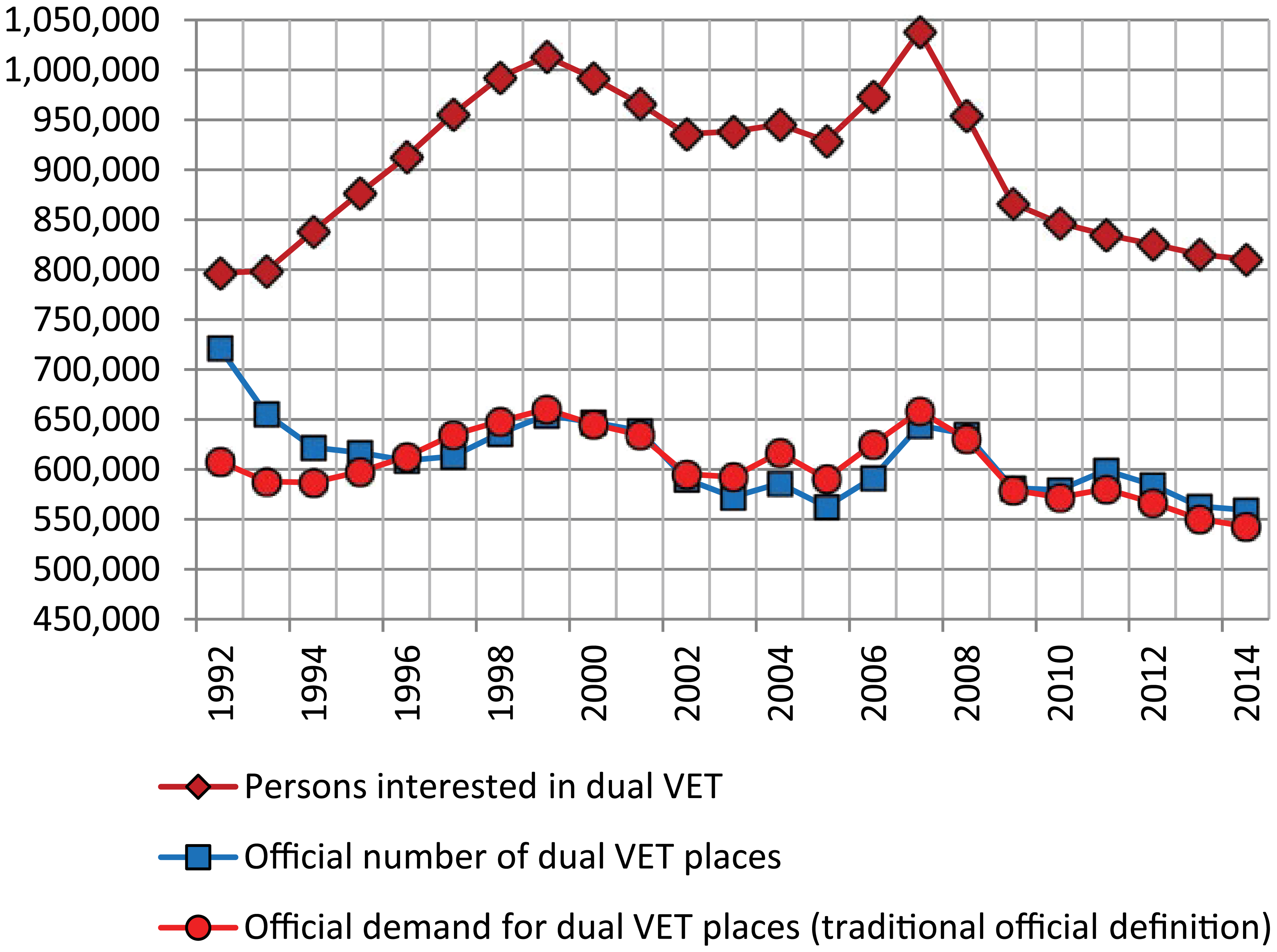
The development of the dual vocational education and training (VET) market 1992–2014.
In order to secure the legitimacy of this statistical practice, the stakeholders from employers’ and business associations explain the relatively high number of entrants in the ‘transition sector’ (Table 1, col.14) with the assertion that these young people lack ‘apprenticeship entry maturity’ (Frieling and Ulrich, 2013). At the same time, they complain about the lack of regional and occupational flexibility of youngsters who, officially, remain unsuccessful training place applicants. In this way, they steer the societal debate on so-called ‘disadvantaged youth’ in a direction that associates problems accessing VET with individual weaknesses of these young people and that does not call the market-based access to VET into question (Dobischat et al., 2012: 12; Luedtke, 2014: 89).
The question is why the state stakeholders have gone along with this practice thus far. After all, the Constitutional Court decision of 1980 accorded them the right to create incentives to increase the number of VET places by introducing penalty fees for companies not offering training. Governments led by the Social Democratic Party (SPD) have viewed this as an option and have repeatedly put forward draft laws, the last occasion being in 2004 (Busemeyer, 2009: 151; Kreft, 2006: 278). Ultimately, however, these governments have refrained from implementing such proposals, as have all conservative-led governments (see also Kuhlee in this issue). As the agency theory indicates, the employers’ and business associations benefited from information asymmetries. The state stakeholders were unable to check the employers’ assertion that compulsory fees would destroy the companies’ traditional willingness to provide VET places, something that had grown over centuries (Granato and Ulrich, 2013: 332; Kreft, 2006: 278). In order to legitimise their lack of action – after all, the Constitutional Court had decreed that the state must expect sufficient provision from the employers if it left the task of VET to the employers – they also ultimately favoured a restrictive calculation of training demand (for similar questions on data collection and statistics in England, see, e.g., Maguire in this issue). The pressure to act was thus removed from the statistics (Bosch, 2008: 242). In the light of neo-institutional approaches, both employers’/business associations and state stakeholders could thereby continue ‘muddling through’ (Powell and Colyvas, 2008: 277), formally satisfying social expectations on the one hand while avoiding fundamental reforms of market-based access on the other (Granato and Ulrich, 2013).
The state stakeholders from the federal government were largely immune to the chronic criticism of the trade unions that the official training market statistics covered up the extent and causes of the problems faced by disadvantaged young people and that the state undertook too little – despite the fact that the trade unions are an official part of the state-corporatist governance system of VET (Kreft, 2006). Nevertheless, it is likely that the power of the trade unions is significantly weaker (similar to Ebner and Clarke and Winch in this issue). Whereas the employers massively reduce the financial burden of the state by providing the practical part of VET, the unions provide virtually no financial benefits to the state through their involvement in the governance of VET.
More recently, the state stakeholders from the federal states have displayed greater openness towards more valid training market figures that take a larger number of the unsuccessful applicants into account (erweiterte Angebots-Nachfrage-Relation – ‘widened supply-demand ratio’; see Ulrich, 2013). They have also sought ways to provide a training guarantee for market-disadvantaged young people without impinging upon the decision-making autonomy of the companies (Euler and Severing, 2011). Several factors may have favoured their willingness for a reform. Firstly, the federal states have to bear large parts of the ‘transition sector’ costs, and the funds used in this sector could instead be used for financing additional VET places. Secondly, the lower birth rate means that the annual number of young people interested in dual VET has been falling constantly since 2007 (by 2014 it had already decreased by 228,200 or −22%; Table 1, col.4), and will probably decline by a further 165,000 by 2025 (Matthes and Ulrich, 2015). This threatens a shortage of skilled workers in the non-academic sector in particular, especially given the fact that the baby-boomer generation in Germany is now approaching retirement (Maier et al., 2014). Disadvantaged young people therefore form an increasingly important ‘hidden reserve’ that may reduce this shortage. It could be that the United Nations (UN) Convention on the Rights of Persons with Disabilities, which was ratified by Germany in 2009, has also played a marginal role. According to United Nations Educational, Scientific, and Cultural Organization (UNESCO), the causes of barriers to participate in education lie in inadequate organisation of educational systems (Deutsche UNESCO-Kommission, 2014). The educational areas should be reformed in a way that facilitates access to education and training for all persons, regardless of their background and possible individual impairments. In VET, this would include young people with disabilities as well as applicants who have not succeeded on the training market.
Recent reform proposals in favour of a training guarantee
Characteristics
If this kind of training guarantee is not to restrict the freedom of companies to decide whether they will offer training, it can only be realised via the additional provision of publicly financed, non-company based dual VET places. Although such a solution involves the risk that such places will be regarded by young people as not being equivalent to in-company VET (partly because of transitional problems in employment after completing the training), it would at least enable the start of dual VET. Possible options for learning venues are schools or extra-company-based training institutions. Unsuccessful applicants for a company-based apprenticeship would receive an offer to commence their training at one of these venues. A public educational monitoring system would need to be established at a local level for this purpose in order to identify all school leavers without a training place. To keep public costs low, publicly financed apprentices should be able to switch to company-based VET at any time as soon as there is an opportunity. In such a case, however, companies should credit the competencies already acquired and reduce the remaining period of training accordingly. This is the only way to avoid waste in training time and to legitimise the public costs thus far incurred.
Educational economics calculations actually permit the conclusion that it could be worthwhile for the public purse to assist unsuccessful applicants in this manner (Klemm, 2012). Given the strong decrease in the number of young people that has already taken place, the costs incurred would no longer be as high. Some federal states have recently developed models for reorganising youngsters’ transition from school to VET (Euler and Severing, 2011). Hamburg was the first federal state to offer a school-based vocational training year – at least for unsuccessful applicants with ‘apprenticeship entry maturity’ – which corresponds to the first year of dual VET. The subsequent aim is the transition to company-based training, crediting the first year of training if possible. If a transition is impossible, training is continued in schools (Behörde für Schule und Berufsbildung, 2009: 11).
However, this kind of model has not yet been implemented on a nationwide basis. Indeed, the talk of a ‘training guarantee’ is part of the coalition agreement concluded in 2013 between the by socialdemocratic and conservative parties led Federal Government. Nevertheless, in the ‘Alliance for Training and Further Education’ – which the Federal Government formed together with the federal states, trade and industry and the trade unions at the end of 2014 – only relatively vague formulations can be found: All young people interested in training should be shown a ‘pathway’ within the scope of the ‘training guarantee addressed in the coalition agreement’ that can ‘lead to a vocational qualification at the earliest possible point’ (Allianz für Aus- und Weiterbildung, 2014: 3, translated by the current authors). Company-based training is stated as having priority. Young people should only complete extra-company training on a case-to-case basis to the extent that no company-based provision is available.
Assumptions on the chances of implementing a training guarantee
The defensive character of the formulations chosen by the ‘Alliance’ is not likely to be a coincidence. We suppose that even a publicly financed training guarantee that does not include sanctions for companies that do not provide training will meet with reservations on the part of the stakeholders from the employers’ and business associations. They will primarily evaluate such a reform in terms of the possible consequences for the companies rather than with regard to benefits for young people. Although a training guarantee provided via extra-company training would not affect the companies’ freedom to decide whether they wish to offer VET places, those companies that wish to train would see this kind of guarantee reduce their chances to fill their training places.
The reason for this is that there are considerable problems matching the regional and occupational demand for VET from young people and the offer of such places by the companies. Many young people prefer training in modern service sector occupations, despite the fact that there are not enough places on offer in this field. In contrast, apprenticeships in the craft trades and in the hotel and restaurant sector tend to be unpopular. Companies operating in these sectors are increasingly forced to rely on applicants who consider their chances in other occupations to be poor, and who are willing to accept such occupations as a ‘second choice’ (Schier and Ulrich, 2014). Even today, many training places cannot be filled (Figure 3(a)).
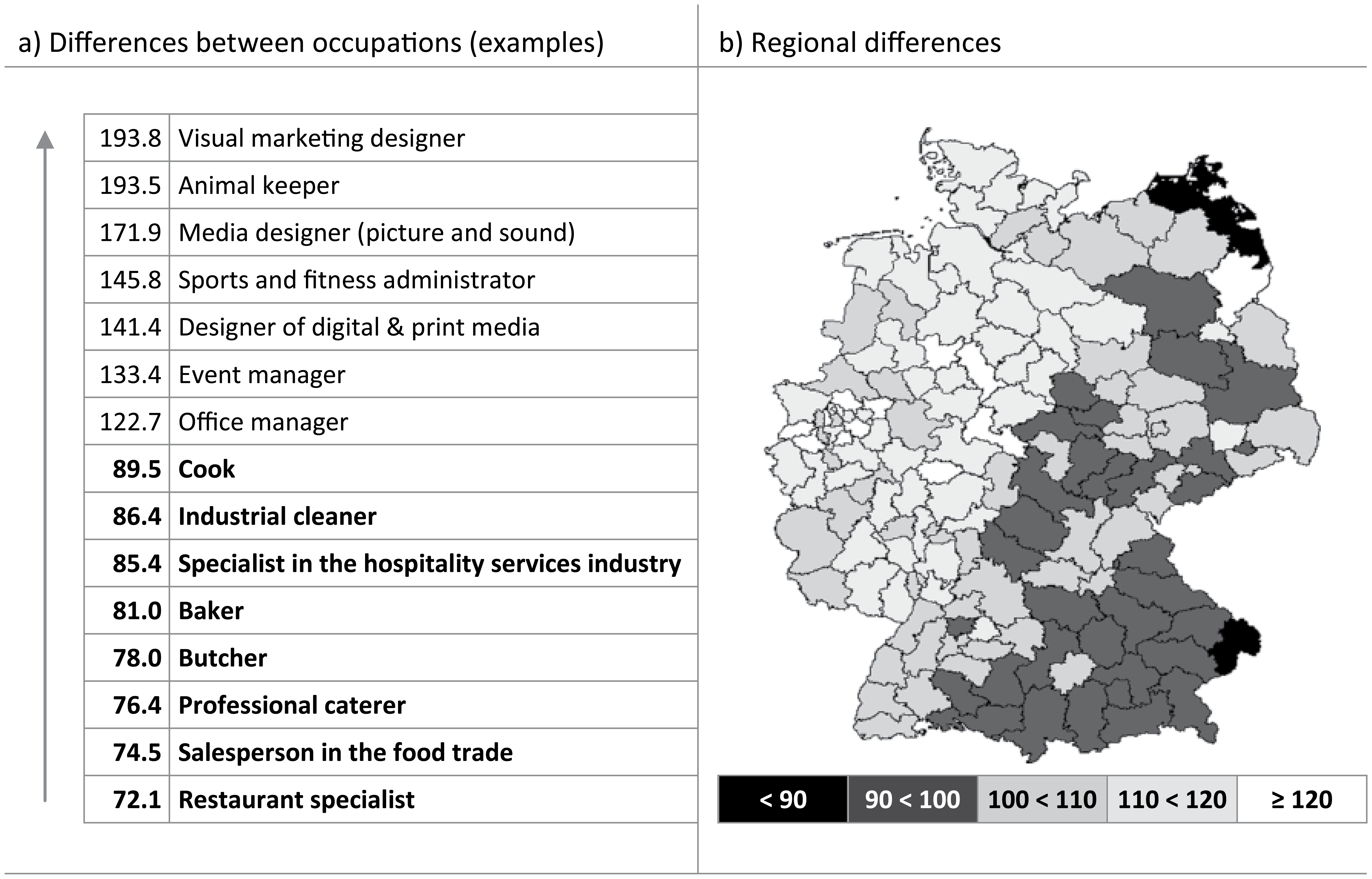
Official number of applicants per 100 dual vocational education and training (VET) places (in 2014).
This suggests that extra-company training places could and would primarily have to be offered in those training occupations that are favoured by youngsters. If this happened, however, less popular training occupations would find even fewer applicants. In addition, young people would probably be less willing to move between different regions. However, more regional mobility is indispensable when it comes to matching the demand for and the supply of dual VET places, because the ratio between these two variables varies strongly from region to region (Figure 3(b)).
We therefore assume the following.
(1) Stakeholders from employers’ and business associations will expect companies to face disadvantages in the case of extra-company training for unsuccessful applicants. When surveyed about this topic, they should have many more reservations concerning a training guarantee than trade union representatives, for example (Assumption 1).
(2) However, stakeholders from employers’ and business associations are likely to come under pressure to justify themselves if they reject a training guarantee. In order to obtain public recognition of their refusal, they may not primarily refer to their self-interest, but to central objectives of the public weal (Boltanski and Thévenot, 2007). We suppose that they will use arguments they have already presented in other contexts, that is, that the primary societal purpose of VET is to meet the skills requirements of the economy, not to satisfy the occupational wishes of young people. In addition, they will argue that the best way to produce vocational skills is within companies where apprentices are in direct contact with the world of work. Finally, they should complain that today’s young people lack the occupational and regional flexibility to make full use of the existing supply of company-based VET (Assumption 2).
In light of the considerable political influence exerted by employers’ and business associations, we also assume the following.
(3) Even VET experts who would welcome this kind of reform package believe that it is unlikely that a training guarantee will be introduced by 2020 (Assumption 3).
(4) VET experts should be aware that, with regard to this issue, the political power is not balanced between employers and trade unions. For this reason, they will make their assessment of the chances of a training guarantee more strongly dependent on how they think employers will react than how they expect trade unionists to react (Assumption 4).
Evidence from an expert survey
Research design
We used the Expert Monitor of the Federal Institute for Vocational Education and Training (BIBB) to test our assumptions. This is an online instrument that regularly surveys VET experts in order to gain their response to educational policy issues (https://expertenmonitor.bibb.de/index.php). Participation in this monitor is open to everyone who is involved in VET in the field of educational policy, at schools, companies, chambers, business and trade and industry associations, in the area of research and development, at employer and employee organisations, at government authorities and at educational institutions.
Since the number and characteristics of VET experts in Germany are unknown, it cannot be estimated how representative the sample is. However, previous studies carried out by the BIBB Expert Monitor show that the answers given by the VET experts are mainly influenced by their organisational affiliation and rarely by other characteristics, such as gender, age or their field of work. If the organisational membership is controlled in the calculations (as we always do in the following analysis), a crucial proportion of possible bias and errors can be reduced (Enggruber et al., 2014; Frieling and Ulrich, 2013; Granato and Ulrich, 2013).
A total of 317 VET experts took part in the Expert Monitor survey on the topic of a ‘training guarantee’ at the end of 2013. Figure 4 shows the organisational origin of the experts.
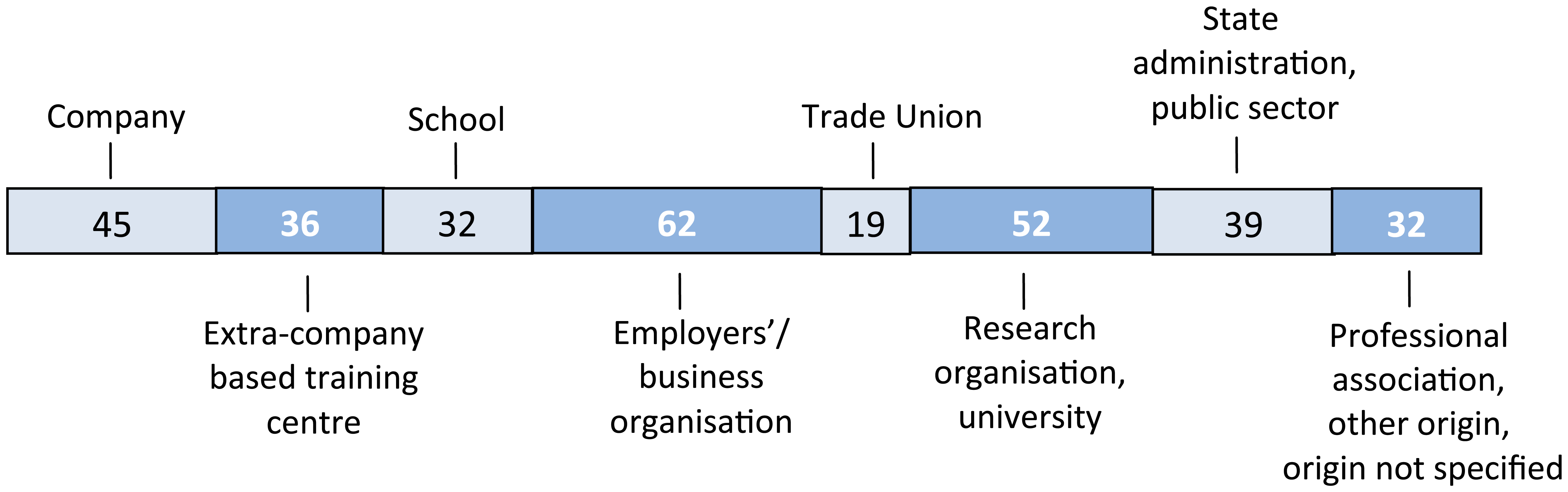
Organisational background of the 317 participants in the Expert Monitor 2013 of Federal Institute for Vocational Education and Training (BIBB).
Participants were asked about the reform proposals described in the Recent reform proposals in favour of a training guarantee section and about various VET policy positions (assumptions 1 and 2). Standardised items were used for this purpose. These were formulated within the scope of a preliminary study, based on discussions with state stakeholders and representatives of social parties (Enggruber et al., 2014). Five-level response scales were available to the experts in order to indicate the degree of agreement or rejection. Such scales were also used for the questions relating to the likelihood of the reform proposals being realised and the influencing factors (assumptions 3 and 4). If the experts did not feel able to offer an opinion, they were also given the option of using the category ‘I don’t know’ for each item, although only few actually did so. These answers were not taken into account in the following analysis (see the number of valid cases in the tables).
Results
Assumption 1: attitudes towards the reform proposals of a training guarantee
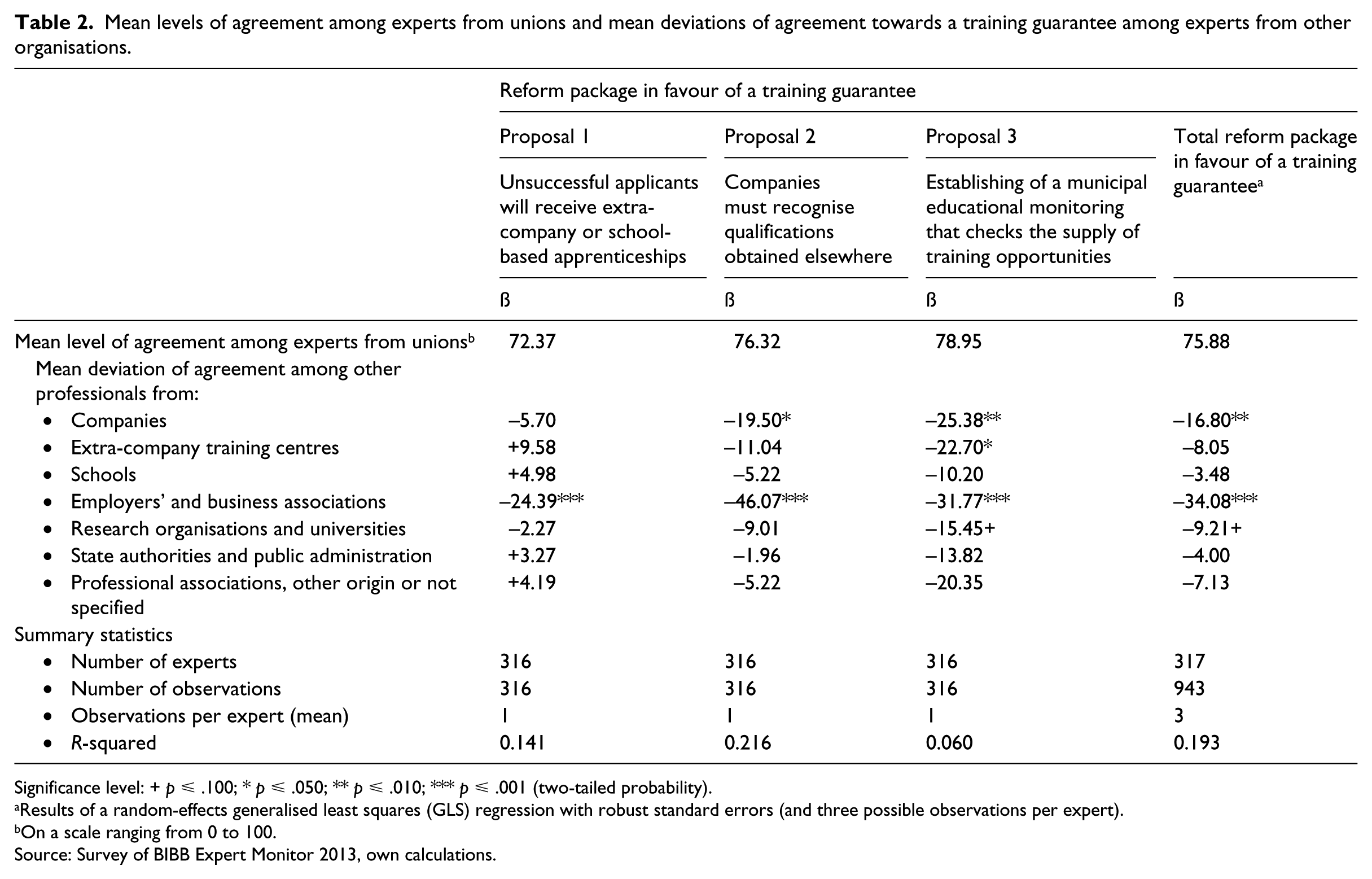
Table 2 shows the degree to which the experts from different organisations agreed to a reform package comprising a ‘training guarantee’ and other associated reforms.
Mean levels of agreement among experts from unions and mean deviations of agreement towards a training guarantee among experts from other organisations.
Significance level: + p ⩽ .100; * p ⩽ .050; ** p ⩽ .010; *** p ⩽ .001 (two-tailed probability).
Results of a random-effects generalised least squares (GLS) regression with robust standard errors (and three possible observations per expert).
On a scale ranging from 0 to 100.
Source: Survey of BIBB Expert Monitor 2013, own calculations.
The results were obtained by carrying out a regression analysis. The experts from the trade unions formed the reference group. The regression coefficients inform us how strongly the other groups deviate from the assessment of the trade unionists. In order to facilitate the interpretation of the results, the five available responses were recoded using values between 0 and 100 (‘do not agree at all’ = 0, ‘tend not to agree’ = 25, ‘partly agree’ = 50, ‘tend to agree = 75’, ‘strongly agree’ = 100). This allows us to display the mean results for the various expert groups on a percentage scale. The mean level of unionists’ agreement to reform proposal 1, for example, lies at ß0 = 72.37 points out of a maximum of 100 points. As expected, and as can be seen in the regression coefficient (ß1 = −24.39 points), the level of agreement among representatives of the employers’ and business associations is significantly lower. It lies at just 47.98 points (72.37 – 24.39).
The reaction of the employers’ and business representatives to reform proposals 2 and 3 was also, as expected, significantly more reserved, with a tendency towards rejection. In addition, company representatives signalled less agreement than trade unionists, even though they did not react as critically as the employers’ and business representatives. With regard to experts from other organisations, significant deviations from the attitude adopted by the trade unions only occur sporadically. If we consider all three reform proposals as a whole (regression model shown in the right-hand column of Table 2), we see that criticism of a training guarantee is voiced by company representatives and especially by experts from the employers’ and business associations.
Assumption 2: arguments against a training guarantee
How do the stakeholders from the employers’ and business associations justify their attitude? In order to be able to test the supposed correlations between organisational affiliation, fundamental educational policy conviction and attitude towards a training guarantee, we constructed a Structural Equation Model. This kind of procedure brings together measurement approaches (factor analysis) and structural approaches (path analysis) to facilitate the investigation of various dependency relations (arrows) and correlations (double arrows) within one model (Wang and Wang, 2012). The values of the coefficients should be interpreted in the same way as standardised correlation coefficients. The results indicate a very good fit between the model and the empirical data, as can be seen from the quality criteria listed at the bottom right (Figure 5).
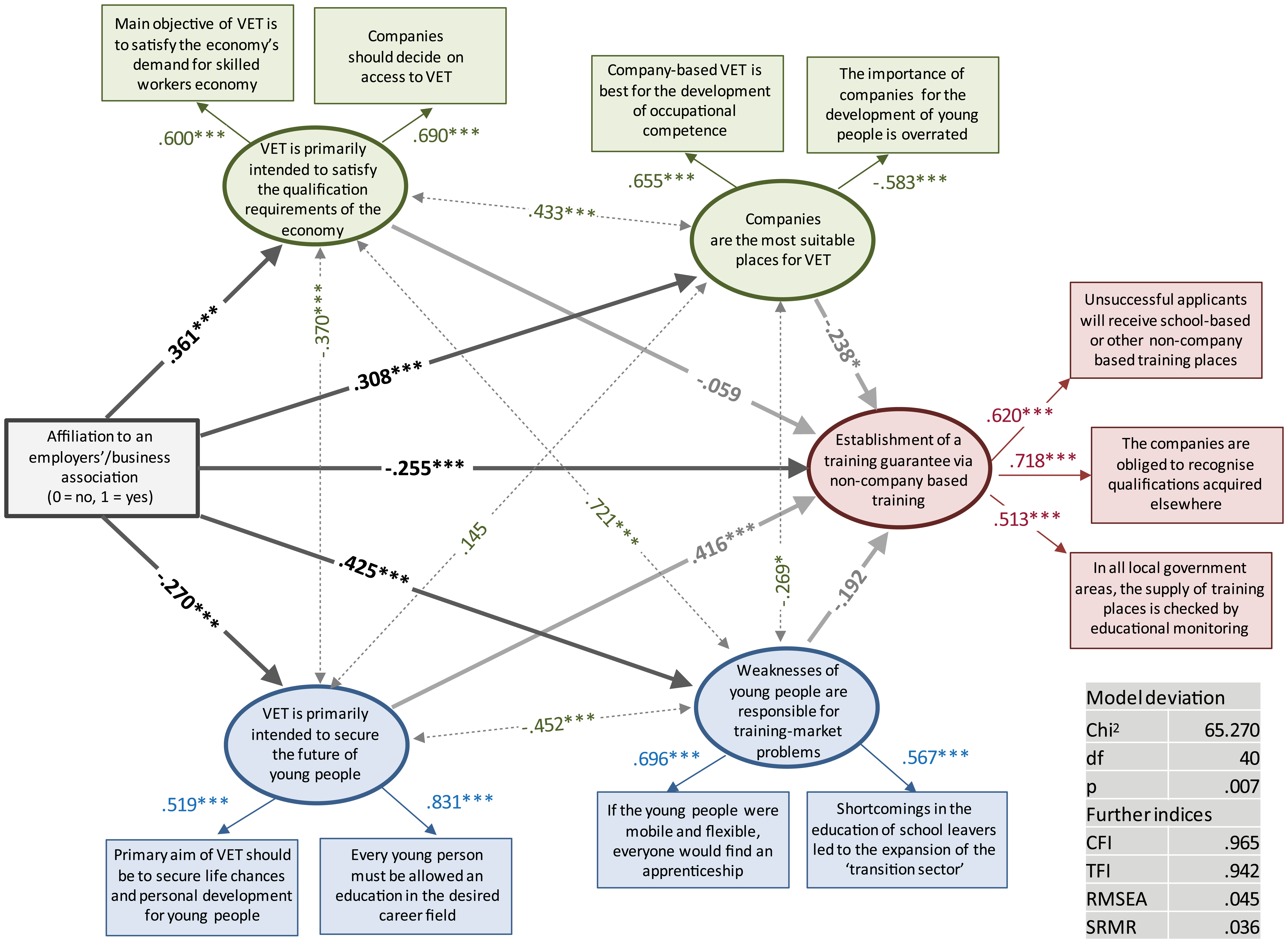
Arguments justifying the attitude towards a training guarantee and their relation to the membership of an employers’/business association: Results of Structural Equation Modelling (with standardised model results).
As expected, the affiliation to an employers’ or business association is more strongly linked to a conviction (a) that the governance of dual VET should be primarily aligned to the interests of the companies rather than those of the young people, (b) that companies are the more suitable learning venues for VET and (c) that individual deficiencies of young people are responsible for training market problems.
These beliefs, which significantly correlate with one another in certain cases, contribute in turn to a rejection of the ‘training guarantee’ reform package. About half (ß = −.288) of the negative overall effect exerted on the attitude to a training guarantee by affiliation to employers’ or business associations (ß = −.543) is mediated by these convictions (neither of the values are listed in Figure 5). The other half (ß = −.255, see Figure 5) is directly linked with the affiliation to employers’ and business associations. This direct effect could be an expression of the self-interest of the employers’ and business associations in rejecting a training guarantee, irrespective of all basic educational policy considerations. It is, however, also possible that it is influenced by further fundamental educational policy beliefs that were not included in the investigation.
Assumption 3: the expected probability of realisation of a training guarantee
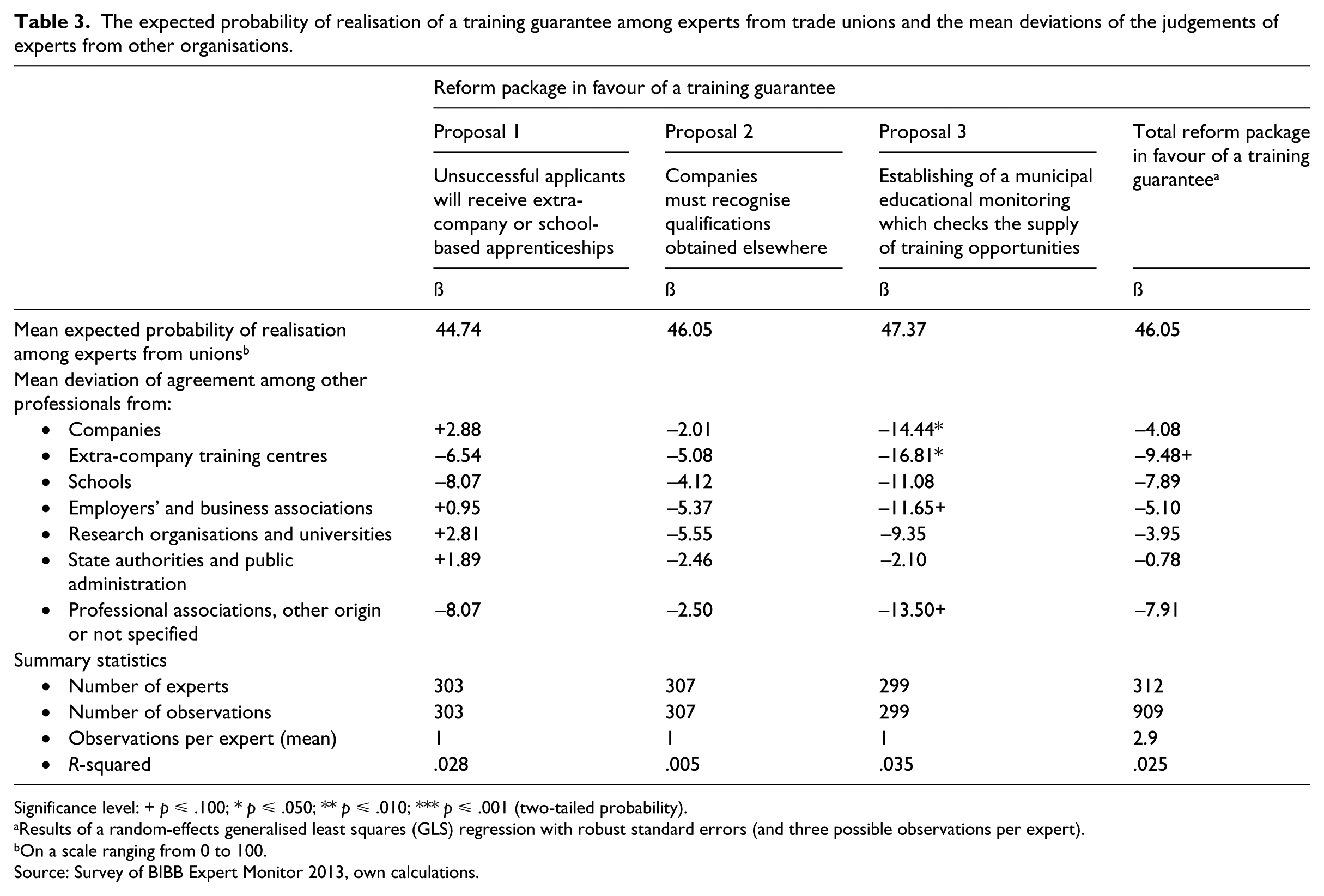
In contrast to their positive attitude towards a training guarantee (Assumption 1), the stakeholders from the trade unions adopt a more sceptical view of the expected probability of realisation until the year 2020. Depending on the specific reform proposal, the scores only reached between 44.74 and 47.37 out of a maximum of 100 points (Table 3).
The expected probability of realisation of a training guarantee among experts from trade unions and the mean deviations of the judgements of experts from other organisations.
Significance level: + p ⩽ .100; * p ⩽ .050; ** p ⩽ .010; *** p ⩽ .001 (two-tailed probability).
Results of a random-effects generalised least squares (GLS) regression with robust standard errors (and three possible observations per expert).
On a scale ranging from 0 to 100.
Source: Survey of BIBB Expert Monitor 2013, own calculations.
Experts from the other organisations only deviate from these evaluations sporadically and have a tendency to display an even greater level of scepticism. As can be seen from the low R2-values, the prevailing tone amongst the experts is very uniform. This confirms assumption 3, that is, the realisation of a training guarantee by the year 2020 tends to be viewed as improbable.
Assumption 4: presumed influence on the chances of realisation of the ‘training guarantee’ reform package
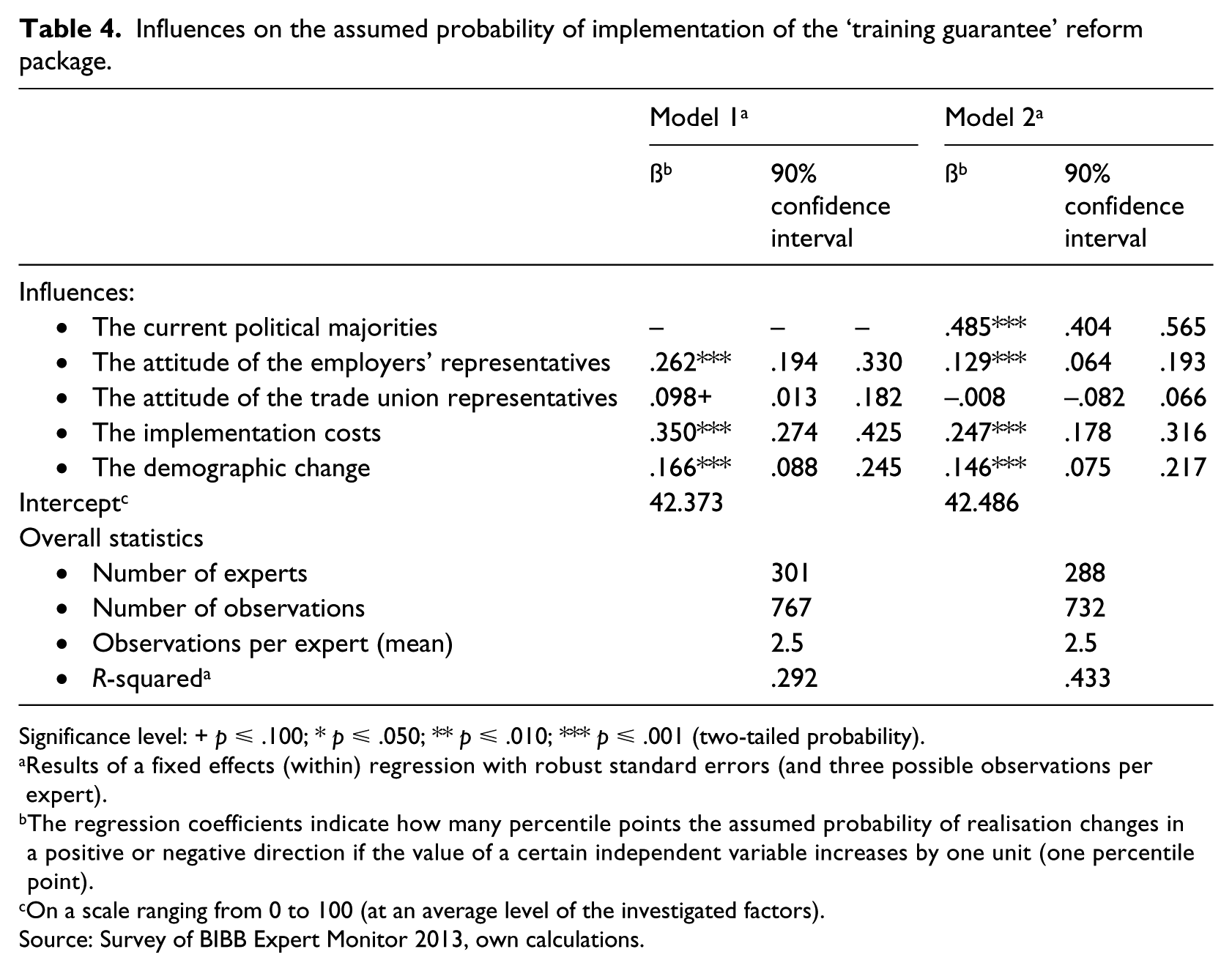
Why are the experts so sceptical? We asked them whether the implementation of the reform package is promoted or hindered by ‘the current political majorities’, by ‘the attitudes of the employers’ representatives’, by ‘the attitudes of the trade union representatives’, by ‘the implementation costs’ or by ‘the demographic change’. We subsequently linked the responses of the experts to these questions with their estimations concerning the likelihood of realisation of the three proposals in favour of a training guarantee. This enabled us to carry out a fixed effects regression analysis in order to determine which of the various factors appeared particularly significant to the experts with regard to the realisation of the proposals. Since each expert was asked to assess the probability of realisation of three proposals, the number of possible observations tripled. We calculated two models. The first model did not take into account the presumed influences resulting from the current political majorities because several experts had problems in evaluating this. However, they were taken into account in the second model (Table 4).
Influences on the assumed probability of implementation of the ‘training guarantee’ reform package.
Significance level: + p ⩽ .100; * p ⩽ .050; ** p ⩽ .010; *** p ⩽ .001 (two-tailed probability).
Results of a fixed effects (within) regression with robust standard errors (and three possible observations per expert).
The regression coefficients indicate how many percentile points the assumed probability of realisation changes in a positive or negative direction if the value of a certain independent variable increases by one unit (one percentile point).
On a scale ranging from 0 to 100 (at an average level of the investigated factors).
Source: Survey of BIBB Expert Monitor 2013, own calculations.
If the influence of current political conditions is left out of the equation (model 1), the implementation costs and the attitude of the employers are considered as being especially significant for the likelihood of realisation of the ‘training guarantee’ reform package. There is also a weaker but still significant effect caused by the demographic change (and the societal pressure this exerts). By way of contrast, the attitude of the trade unions towards this reform package does not have a significant effect on the presumed likelihood of realisation.
This does not change if current political majorities and their effects are also taken into account (model 2). As expected, this factor has the largest influence on the assumed probability of realising the ‘training guarantee’ reform package from the point of view of the experts. Nevertheless, the costs of implementation, the attitude of the employers and the demographic change continue to exert a significant influence. However, in this case, the effect of the trade unions’ attitude also remains insignificant.
Discussion
As expected, the experts evaluate the reform package in favour of a training guarantee in line with their organisational background, whereby the experts from employers’ and business organisations in particular are significantly more critical compared to other stakeholders (such as trade unionists). They legitimise their rejection of a ‘training guarantee’ by arguing that dual VET should be primarily aligned to the interests of the companies rather than to those of young people, that the companies are the more suitable learning venues and that the problems in the training market have been caused by individual weaknesses of the young people. Ultimately, as Luedtke (2014: 89) supposes, the reasons behind their discourses on disadvantaged youth are regulatory policy controversies between the educational and economic system, whereby the latter attempts to use the discourse ‘as a vehicle for determining the general conditions for the field of education and training in a way that is in greater accordance with its own ideas’ (translated by the current authors).
Within the light of neo-institutional approaches, it is once again revealed how effectively stakeholders from employers’ and business organisations secure their legitimacy by determining the public discourse and also take on an active role in shaping their institutional environment. Because of the differing power positions within the state-corporatist governance system of VET, trade union stakeholders are significantly less successful in this regard. An important symbol for this is certainly the fact that the German Trade Union Federation (DGB) is the sole voice of trade unions in the Alliance for Training and Further Education but facing four business associations (Busemeyer, 2015: 4).
The observation that the business associations in particular reject a training guarantee should not give the impression that other stakeholders are less guided by their own interests. It is no wonder that it is those experts who most advocate the establishment of extra-company or school-based dual VET training places who would benefit directly from corresponding public contracts (see again Table 2, proposal 1). However, their influence on political decisions is still significantly lower than the influence of trade unions, especially since they do not directly belong to the state-corporatist governance system.
State stakeholders from the Federal Government still seem to pursue their previous strategy of ‘muddling through’ (Powell and Colyvas, 2008: 277) whilst adopting a ‘both/and approach’ (Meyer and Rowan, 1977: 348). They speak of a training guarantee, but they tend ‘to vague declarations of intent rather than concrete and binding targets’ (Busemeyer, 2015: 4; translated by the current authors), which do not hurt the interests of the economy. After all, such behaviour is the result of a non-detachable institutional conflict between market and public claims (Granato and Ulrich, 2013). A market-based approach providing training has the consequence that, ultimately, the needs of the economy determine the kind and number of dual VET places (Wegge and Weber, 1999: 138). If the need of the economy is lower than the number of youngsters interested in training, such an approach necessarily generates ‘disadvantaged youth’ (Ulrich, 2003). However, a larger crisis of legitimacy of this approach is excluded, as long as the governance of VET – which includes the official calculation rules of the training market balance – is in the hands of a state-corporatist alliance in which the employers’ power exceeds the power of the unions.
In overall terms, our results indicate that VET experts in Germany tend to hold a sceptical attitude towards the realisation of a nationwide training guarantee for disadvantaged young people by the year 2020. The attitude of the employers plays a crucial role. Concerning the question of whether the institutional framework of access to dual VET should be more aligned to the interests of the economy or to the training needs of young people, employers’ and business associations seem to enforce their own point of view, even into the future (Granato and Ulrich, 2013: 331).
Thus, despite fundamental societal changes in Germany, which have been instigated by demographic developments and which will exert their full economic effect within the next decades, the prospects of a nationwide reform of access to dual VET via a training guarantee for all interested young people are thus not very likely (notwithstanding the fact that some federal states in Germany are trying to implement a guarantee at least for young people with ‘apprenticeship entry maturity’). The VET sector therefore continues to be driven by the companies’ current needs for specific skills, and young people are urged to adapt to the present requirements of the companies (Clement, 2007: 217). If the occupational wishes of the youngsters deviate from the training supply of the companies, extra-company training places must not result in softening young people’s readiness to adjust to the supply of the companies. Therefore it is not a coincidence that, within the scope of the new Alliance for Training and Further Education, the promise to give each unsuccessful applicant three training offers at the end of the year depends on the young people being sufficiently mobile in terms of occupation and location (Allianz für Aus- und Weiterbildung, 2014: 4; see also Busemeyer, 2015). Within this process, reference is made to training occupations in which many places cannot be filled, even today (Matthes et al., 2015).
For disadvantaged young people, this seems to strengthen rather than to resolve ‘social difference in educational participation’ (Kuhlee and van Buer, 2010: 907, translated by the current authors). As long as they are not categorised as persons with serious social disadvantages, learning difficulties or disabilities, they are called upon to pick up the dual VET places that have not been considered by other applicants. These are places in which training allowances tend to be low and in which training conditions are exceptionally difficult, as surveys of apprentices show (more frequent overtime, less compliance with the training plan and more tasks that have nothing to do with the training; see DGB-Jugend, 2014).
If these young people actually enter into those training occupations, the starting conditions for successful VET are anything but favourable. School leavers with lower school leaving certificates or none at all, who often come from a socially disadvantaged environment (Beicht and Walden, 2014), need to find their way through an apprenticeship that frequently does not correspond to their preferred occupations and in which they are more likely to be subjected to even more difficult training conditions than apprentices in other training occupations.
The consequences can be high contract dissolution rates of up to 50% in some training occupations, for example in the hotel and restaurant sector (Rohrbach-Schmidt and Uhly, 2015; Schier and Ulrich, 2014). Premature contract dissolutions are in turn one of the major risk factors as to why youngsters remain without a completed VET in the long run. It may appear ironic that, at least in this case, the law is willing to accommodate the young people affected and to grant them access to extra-company training in the same way as socially disadvantaged youngsters or young people with learning difficulties. However, the prerequisite is that dual VET that has already begun must be continued (which means that no changes should be made towards a different training occupation) and there must be a prospect of finishing this apprenticeship successfully (Bundesministerium für Justiz und Verbraucherschutz 2015, § 76). Thus, even in this case, the needs of the economy dictate the criteria of institutional support for young people.
Footnotes
Acknowledgements
We thank two anonymous reviewers and the editors for their very helpful revision notes on our first draft of this article.