




Abstract
To minimize negative interactions and their impacts, teachers and students must successfully negotiate loaded moments, points in time when two or more parties realize that their needs differ and that they must confront that difference. In this literature review, we synthesize 30 studies, published from 2000 to 2020, that describe the evolution of loaded moments between teachers and students with the goal of identifying and explicating the co-construction of escalation and de-escalation during classroom interactions. We found that macro level social contexts and existing classroom patterns set the scene for the occurrence of a loaded moment. In addition, loaded moments emerge when specific instigating circumstances are co-constructed, which refer to incompatibilities between teacher and student(s). Furthermore, loaded moments (de)escalate, depending on the co-construction of the moment as it progresses, such as through mutual trade-offs, turnings, or refusals. Finally, these co-constructions can result in a specific long-term relationship- and bond-development. Implications of these findings for research concerning student–teacher conflict are discussed.
Keywords
Student–teacher relationships form through patterned interactions over time (Wubbels et al., 2014). Empirical literature on school discipline has established the importance of positive student–teacher relationships to reduce exclusion (Welsh & Little, 2018). Particular developments in this field focus on social-emotional learning and culturally responsive restorative practices which have at their core a relational focus in teaching and learning (Agudelo et al., 2021; Gregory et al., 2021; Lustick, 2020; Shah, 2012). Teacher perceptions and biases play a significant role in causing racial disparities in classroom and school discipline (Emdin, 2016; Okonofua & Eberhardt, 2015). These perceptions and biases have impact during the interactions between teachers and students that contribute to the quality of student–teacher relationships, and they may also lead to the conflicts that ultimately result in students being sent out of the class or school (Gregory & Roberts, 2017; Kennedy et al., 2017). Wubbels and colleagues (2014) argued that repeated positive interactions develop positive relationships, implying the need to limit negative interactions for these positive patterns to take hold. Negative interactions are those which: (a) cause anger or sadness that is ultimately unresolved; (b) damage trust between teacher and students; and/or (c) disrupt the learning environment.
To minimize negative interactions and their impacts, such as teachers’ emotional exhaustion (Corbin et al., 2019) or students’ academic failure (Hajovsky et al., 2017), teachers and students must successfully negotiate “loaded moments.” We define loaded moments as the point in time when two or more parties realize that their wants, needs, values, or obligations differ, and they must negotiate that difference. An example of a loaded moment is when a teacher asks students to do a task or to adopt or change a behavior and they do not do it. De-escalation of a loaded moment maintains or restores harmony, whereas escalation of a loaded moment leads to conflict.
Existing research overwhelmingly takes an approach to understanding student–teacher relationships and exclusionary discipline that Mol (2002) calls “perspectivalism” (p. 10), a term describing a methodological focus on individual perspectives and experiences (e.g., using surveys and/or interviews). Perspectival research tells us how teachers and students understand and experience conflicts and discipline and may be conducted using post-positivist and interpretive paradigms that engage quantitative and/or qualitative methods. It tells us how various factors interact and affect each other, potentially leading to racial disparities. Mol argued that in perspectival research the essence of the phenomenon under study may “[recede] behind the interpretations” (p. 12). What the perspectival approach does not allow us to understand are the enactments of practices, how those enactments unfold in real time, and what elements of those enactments may be negated, dismissed, or absorbed in perspectival research, but might lead to different insights if examined using a different approach.
Therefore, in this literature review, we synthesize previous scientific work regarding the evolution of loaded moments between teachers and students with the goal of identifying and explicating the co-construction of escalation and de-escalation during classroom interactions. Understanding these enactments may give insight into conflict prevention and the development of positive student–teacher relationships. An example of the methodological approach representative of the types of studies we synthesized related to loaded moments more broadly can be found in the hallmark study on school suspension by Vavrus and Cole (2002). In this study, they examined how students and teachers co-constructed discipline events in real time. They conducted a longitudinal ethnographic study in two culturally diverse science classrooms at one high school, and found that teachers’ interpretations of the discourse practices of outspoken Black and Brown girls led to discipline events that resulted in exclusionary discipline. In this study, we see how the moment-to-moment interpretations of teacher and student embedded in their exchange led to escalation and erupted in school exclusion. In this review, we synthesize studies using similar approaches. Drawing upon Vavrus and Cole’s study, we extrapolated the search terms “moment” and “micro” to find these studies, as discussed below and shown in Figure 1. Nearly all of the studies in this review relied upon qualitative, longitudinal approaches involving direct observation.
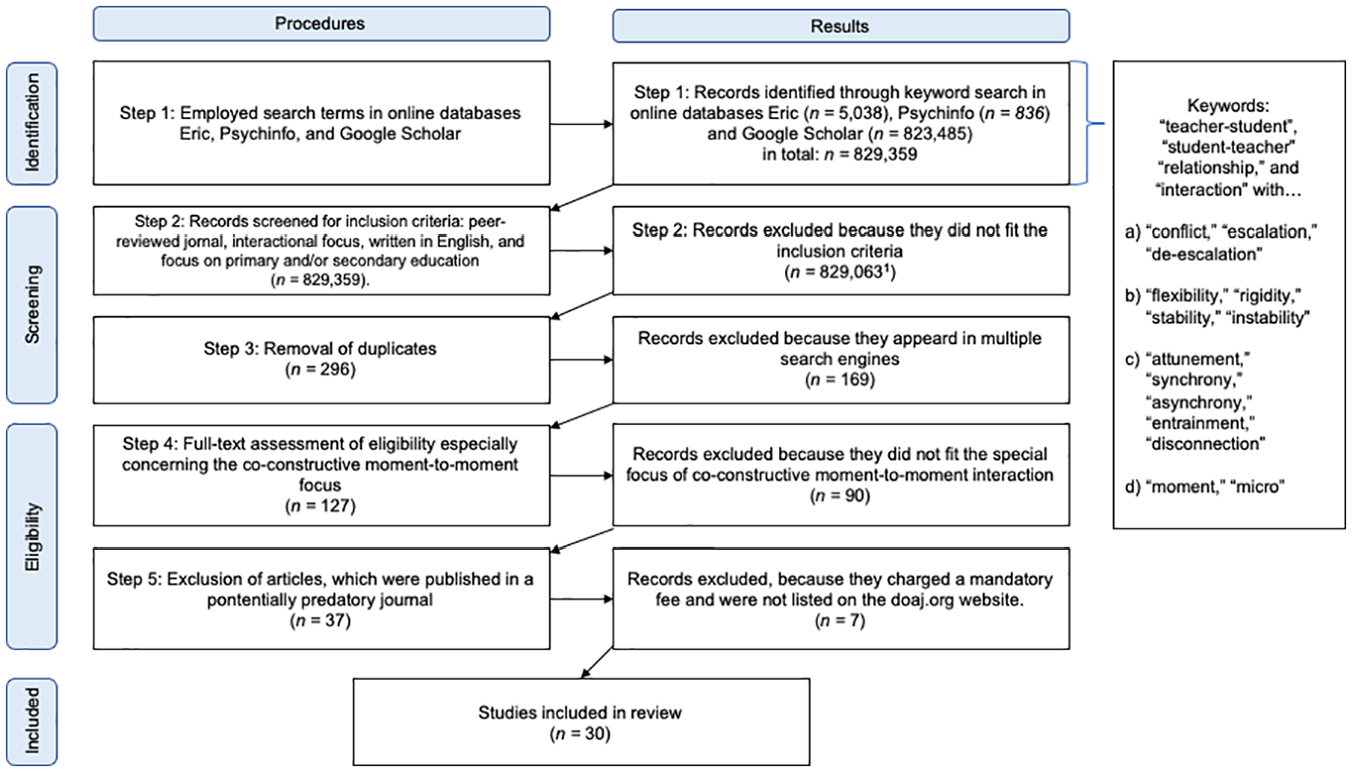
Literature Search Procedures.a,b
Theoretical Framework
To further identify these studies, we relied on terms related to process theories of development. Process theories of development undergird research sub-fields that focus on addressing questions of how phenomena develop over time. Scholars focusing on student–teacher relationships have drawn upon process theories in both psychological and sociological traditions. Applications of these theories in each of the respective fields have led to different paradigmatic and methodological approaches to studying the development of student–teacher relationships, and offer complementary contributions that provide a foundation for the further study of loaded moments. We particularly drew upon nonlinear dynamic systems theory as applied in educational psychology (Granic & Hollenstein, 2003; Pincus et al., 2008) and interaction ritual chains from microsociology (Collins, 2014) to guide our literature search and synthesis.
Nonlinear Dynamic Systems Theory
Granic and Hollenstein (2003) discussed dynamic systems theory as related to a class of theories focused on the complex interplay of multiple parts of a system in the development of outcomes. They identified the need for such theories among psychopathologists who noted that causal input-output theories commonly used in educational psychology reduced independent and dependent variables to in-group and out-group categories. They argued that these forced binaries could not account for the wide variation in whether, how, to what extent, in what contexts, and in whom psychopathologies might occur. Systems theories in general, and dynamic systems theory in particular, support research designs that more properly account for heterogeneity and explain change over time.
Granic and Hollenstein (2003) list the methods appropriate for this process as including discrete and continuous observations, short- and long-term longitudinal data collection, case studies, and various mapping techniques. Although we do not provide details regarding all of these methods here, we mention them because they helped to guide our understanding of the variety of approaches that might be relevant to studying the development and outcomes of loaded moments and to inductively identify relevant search terms for the review. For example, each of the methods identified to study a dynamic system involves micro-level data collection and analysis.
One mapping technique used to study nonlinear dynamic systems—state space grids—can be used to indicate an individual’s behavior according to two predetermined continuous variables over time. Each variable is represented by an axis on a two-dimensional Cartesian plane. The individual’s behavior is then analyzed according to the levels of each of the two variables demonstrated in each moment, and those moments are mapped on the plane and then connected with lines that illustrate how the behavior changed from moment to moment in real time. State space grids have been used to study moment-to-moment interactions between dyads (Lizdek et al., 2012), including within families (e.g., Branje, 2008), in therapeutic contexts (e.g., Altenstein et al., 2013), and among previously unacquainted pairs (e.g., Markey et al., 2010). Methodologically, these dyadic interactions are studied using this tool by mapping each individual’s behavior separately and then overlaying the maps onto each other to yield information about the dyadic system in each moment.
Studies of interpersonal conflict using state space grids, the subcategory of literature most relevant to the study of loaded moments between teachers and students, have suggested the importance of flexibility both within individuals as well as within dyads and small groups, in responding to dynamic system changes (Altenstein et al., 2013; Branje, 2008; Pincus et al., 2008). Flexibility allows for the dynamic system to adapt to challenge and change in ways that create new states of equilibrium. Conversely, rigidity keeps the system in an attractor state with high levels of instability. In both Branje’s (2008) study of mother–daughter conflict and Altenstein and colleagues’ (2013) study of therapeutic alliances, findings suggested that if the member of the dyad with more interpersonal authority (i.e., mother or therapist) resisted rigidity and hostility, dyadic alliance could be established and maintained. These findings may have implications for teachers during loaded moments.
In one of the few studies that have used the method to examine classroom interactions, Pennings and colleagues (2014) built upon Wubbels and colleagues’ (2014) interpersonal circle by using state space grids to study the development of student–teacher relationships in real time. They linked micro level moment-to-moment student–teacher interactions to macro level student–teacher relationship patterns, enacting the affordance of systems theories to connect multiple time scales (Granic & Hollenstein, 2003; Wubbels et al., 2014). Findings suggested that teachers with interpersonal profiles conducive to positive student–teacher relationships demonstrated more stable behavior patterns, whereas teachers with interpersonal profiles linked to less positive student–teacher relationships demonstrated less stable behavior patterns. As with other studies using state space grids, these researchers mapped moment-to-moment behavioral change in real time, an important contribution to understanding how relationships develop, particularly in the complex setting of a classroom.
Implied, but not yet explored in this research, is the importance of how teachers and students negotiate the loaded moments that result in these stable or unstable behavior patterns. We also noted that, despite the theoretical focus on a dynamic system, the methodological approach of state space grid studies such as this one rely upon an overlaying of individual maps that yield information about the dyad in one moment in time. Even though these overlaid maps can indicate what Sadler and colleagues (2009) called “entrainment” (p. 1006), or moments of synchrony within the dyad, mapping techniques decontextualize each moment of entrainment from events or the development of interactions. The overlaid maps do reveal where substantive changes occur in the dyadic system’s structure at the micro level, potentially leading to new attractor states. Thus, we do see both structure and content as characterized in nonlinear dynamic systems theory. However, we do not see how one moment leads to the next. We turn now to a discussion of interaction ritual chains, a theory from microsociology that positions relevant phenomena as co-constructions among individuals and allows for methodological examination of the development of entrainment in an interaction sequence.
Interaction Ritual Chains
Collins (2014) described the theory of interaction ritual chains as residing within Goffmanian microsociology. Goffmanian microsociology connects macro level theories of society with micro level phenomena that compose society by way of meso level chains of interaction rituals. Collins defines interaction rituals as situationally bound social exchanges in which individuals share a common focus of attention as well as an emotional experience. In a successful interaction ritual, individuals experience entrainment, a synchrony evidenced by smooth conversation patterns and relaxed, confident bodily postures.
Individuals bring emotional energy (EE) to an interaction ritual based on the EE that they have developed in previous similar situations. Collins (2014) distinguished EE from momentary and dramatic emotions by describing it as an enduring pattern, similar to affect. Each individual’s EE affects their interactions and levels of achieved synchrony, which then creates new EE. Synchrony, or attunement, occurs between people whereas EE develops within individuals. Patterns of individuals’ EE development and maintenance may repeat and reinforce each other, or these patterns may shift when the situation shifts. Collins argued that development of EE in micro level interaction rituals create patterns of EE exchange at the meso level, which compose social stratification at the macro level. According to Collins, researchers can identify attunement and measure EE using self-reports, bodily postures and movements, gaze direction and eye contact, voice rhythm and frequency, hormone levels, and facial expressions.
Interaction ritual chains in which power differentials exist, where one member in the interaction is positioned to give orders and direct the interaction and the other member(s) is/are positioned to take orders and respond, particularly impact the development and maintenance of EE. The individual in the position of power is likely to have a positive EE pattern whereas the individual(s) receiving orders is/are likely to have a negative EE pattern. Marcucci and Elmesky (2020) applied Collins’ (2014) interaction ritual chains theory to analyze classroom interactions between teachers and students during disciplinary interactions. They highlighted the power differential between teachers and students and asserted the need for classroom situations to support attunement between teachers and students that could, in turn, support students’ positive EE development and maintenance.
Marcucci and Elmesky’s (2020) microanalysis of student–teacher interactions focused on the culturally relevant attunement behaviors of White teachers with Black students. Although not a primary emphasis of Collins’ (2014) theory, race and culture play a role in interaction rituals by affecting verbal and nonverbal synchrony. Patterns and paces of speech and movement that differ across cultures can impede attunement and cause an interaction ritual to fail. Thus, Marcucci and Elemesky argued that, from their positions of power, teachers particularly need to initiate interaction styles that support cross-racial attunement, and these scholars demonstrated through moment-to-moment microanalysis of video observations how such attunement can occur through speech and nonverbal behaviors. In these disciplinary interactions, teachers’ responses minimized conflict and invited student re-engagement by building positive EE.
Present Study
This theoretical framework has focused the present study, which addresses the guiding question: How can we identify loaded moments and explicate the co-construction of escalation and de-escalation between teachers and students during classroom interactions? Nonlinear dynamic systems theory and interaction ritual chains theory both address connections between micro and macro scales of time and space and account for nonlinear relationships between inputs and outcomes of social interactions. Both theories also address the importance of the structure of the system, or situation, within which an interaction occurs as well as the content of the interaction itself. In scholars’ applications of these theories to student–teacher interactions, both theories have supported a focus on the roles of teachers’ verbal and nonverbal behaviors in the development of their relationships with students. With regard to our specific focus on loaded moments, nonlinear dynamic systems theory points our attention toward attractors, or the patterned states toward which interactions tend as they repeat through time. Attention to the assertions of nonlinear dynamic systems theory may also reveal when and how the student–teacher relationship “system” changes through students’ and teachers’ enactments of loaded moments. It is from nonlinear dynamic systems theory that we extrapolated the search terms “flexibility,” “rigidity,” “stability,” and “instability,” as discussed below, and shown in Figure 1. Interaction ritual chains theory directs our attention toward the role of EE and attunement (or lack of attunement) between teachers and students during loaded moments. It is from this theory that we extrapolated the search terms “attunement,” “synchrony,” “asynchrony,” “entrainment,” and “disconnection.”
Methods
Emotional energy, attunement, and dynamic systems theory have guided our selection of articles and synthesis procedures by helping us to articulate scientific language and concepts composing student–teacher interactions and loaded moments. The search terms derived from our theoretical framework and listed in the previous section ensured that our search would yield articles focused more on process-oriented rather than perspectival research. Additionally, these concepts have guided our thinking and decision-making regarding our entire approach to this study. We embraced the assertion that a co-construction is more than the sum of its parts and we therefore engaged co-construction itself as a method. Specifically, in addition to making collaborative decisions, we also co-read studies together in real time, and co-synthesized and authored the manuscript, producing qualitatively distinct knowledge from work done individually. In the sections below, we give more details about how we negotiated this process.
Data Collection
To select studies for the literature review, we first used search terms that described the phenomena under study and incorporated relevant terms from the theoretical framework to identify search terms for the review, as described above. Figure 1 gives an overview of databases searched and terms used. We included studies published between 2000 and 2020 to focus on recent developments in the field. This step yielded 829,359 studies. For the next step, we applied additional inclusion criteria to these sources: (i) appeared in a peer-reviewed, non-predatory research journal 1 ; (ii) described moments of interaction between teachers and students OR teachers’ and students’ perceptions of those moments, with a focus on connections between perception, action, and/or reaction; (iii) was written in English; (iv) focused on primary and/or secondary education (as defined in Table 1); and (v) included a sample from a public school (i.e., government funded) environment. We omitted articles that focused on correlations between individual characteristics that existed prior to the loaded moments and the outcomes of the moments themselves (e.g., student disabilities, student executive functioning, and teacher attributes) unless the articles primarily focused on teachers’ and students’ perceptions of loaded moments.
Summary of Articles in Literature Synthesis.
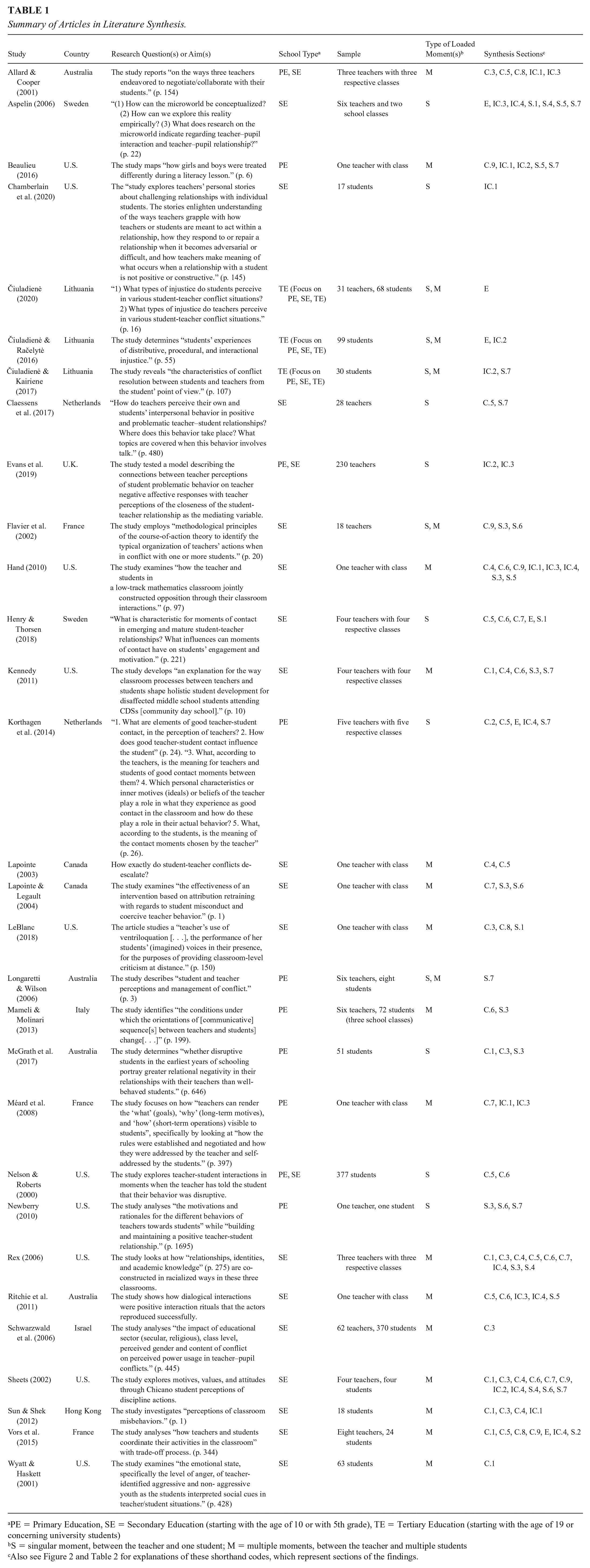
PE = Primary Education, SE = Secondary Education (starting with the age of 10 or with 5th grade), TE = Tertiary Education (starting with the age of 19 or concerning university students)
S = singular moment, between the teacher and one student; M = multiple moments, between the teacher and multiple students
Two coders entered all four categories of search term combinations into each search engine (listed as a–d for Step 1 in Figure 1) and applied the five inclusion criteria to found studies. After the first and second category of search terms were entered, the second author examined the articles included across both coders. The trend across coders showing the number of included articles from each database using each category of terms was parallel, but one coder consistently included more articles. Rather than aiming for interrater reliability, we decided to include all studies returned by both coders for further consideration.
After duplicate studies were removed, the first and second authors independently reviewed the full texts of the 127 remaining studies (i.e., Step 4 of Figure 1). Then, we compared notes from our individual spreadsheets, discussing each article for which we came to different individual conclusions (n = 9). In these cases, we tried to persuade each other of our reasoning, and if we continued to disagree, we excluded the article. These procedures yielded 37 articles. Next, we excluded predatory journal articles as described above, yielding 30 articles for analysis (see Table 1).
Data Analysis
We collaboratively read 10 studies randomly selected from these 30, and organized information under headings that indicated a chronological process because, through our discussion of the articles, we identified this organization as the most helpful for maintaining our micro level process focus to the synthesis across studies. These headings included the following: context, anatomy of a loaded moment, instigating circumstances, and subsequencies of loaded moments. Then, we synthesized findings from these 10 studies and added subheadings to reflect this synthesis. We engaged in this process through detailed dialogue about each study, which required continuous communication about how our different personal and professional backgrounds and areas of expertise contributed to particular interpretations and priorities. We took time to negotiate differences until we agreed upon steps for moving forward. Through this process, we kept track of inductively identified themes and then conducted a constant comparison by discussing if each new idea that we extrapolated from each article was similar enough to an existing theme that we could either add it as an example of that theme or else revise the theme to include all examples. In the instances when our discussion led us to decide that new ideas from the articles were mutually exclusive of the ones we had already identified, we added new themes or sub-themes until all concepts from all 10 studies that addressed the research question were accounted for in the themes that we then converted to headings and sub-headings, and that now organize the findings section.
From the 20 studies that remained after collaboratively reading these 10, we selected the studies that addressed all of the chronological steps in loaded moments, as defined in the outline produced in the previous step, in order to further develop themes. This selection yielded eight studies that we collaboratively read and discussed. We then proceeded to the remaining 12 articles which we examined in relation to existing headings and examples, amending and adding further examples where relevant. Notes collected in each subsection of our outline were then synthesized to produce findings sections. In Figure 2, we elaborate on the specific headings in each section, illustrate their relationship to each other, and list how many studies were synthesized to compose each heading.
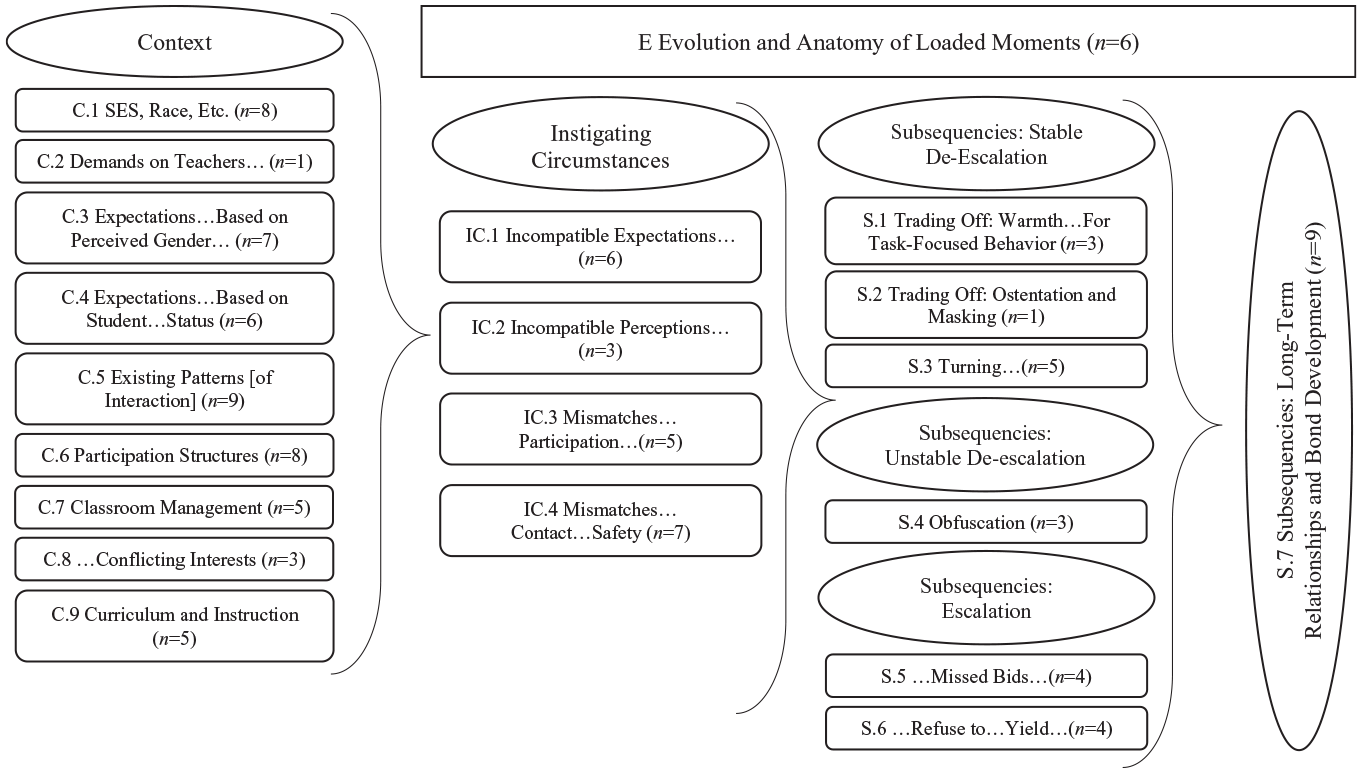
Diagram of the Relationships Between the Anatomy of Loaded Moments and Specific Headings in the Findings Section.a
Findings
In this section, we use the headings we identified during analysis to organize and report our findings. We begin by describing the role of the context of a loaded moment because each moment occurs within a specific classroom, school, and set of relationships. Next, we define and explain the anatomy of loaded moments. We used the term anatomy to connote the composition of the moment, including beginning, middle, and end. In Figure 2, we illustrate this anatomy and the specific headings in this section that relate to the context, beginning, middle, and end of loaded moments. In Table 2, we link the headings with shorthand codes, listed in the final column of Table 1, to show which studies were synthesized in each section. We also list the number of studies synthesized in each section next to the section headings in Figure 2. We further define, explain, and synthesize the literature regarding context and anatomy of loaded moments in the following sections. We limit our reporting to what we found in the included articles without suggesting that this is a comprehensive list of possible issues and compositions.
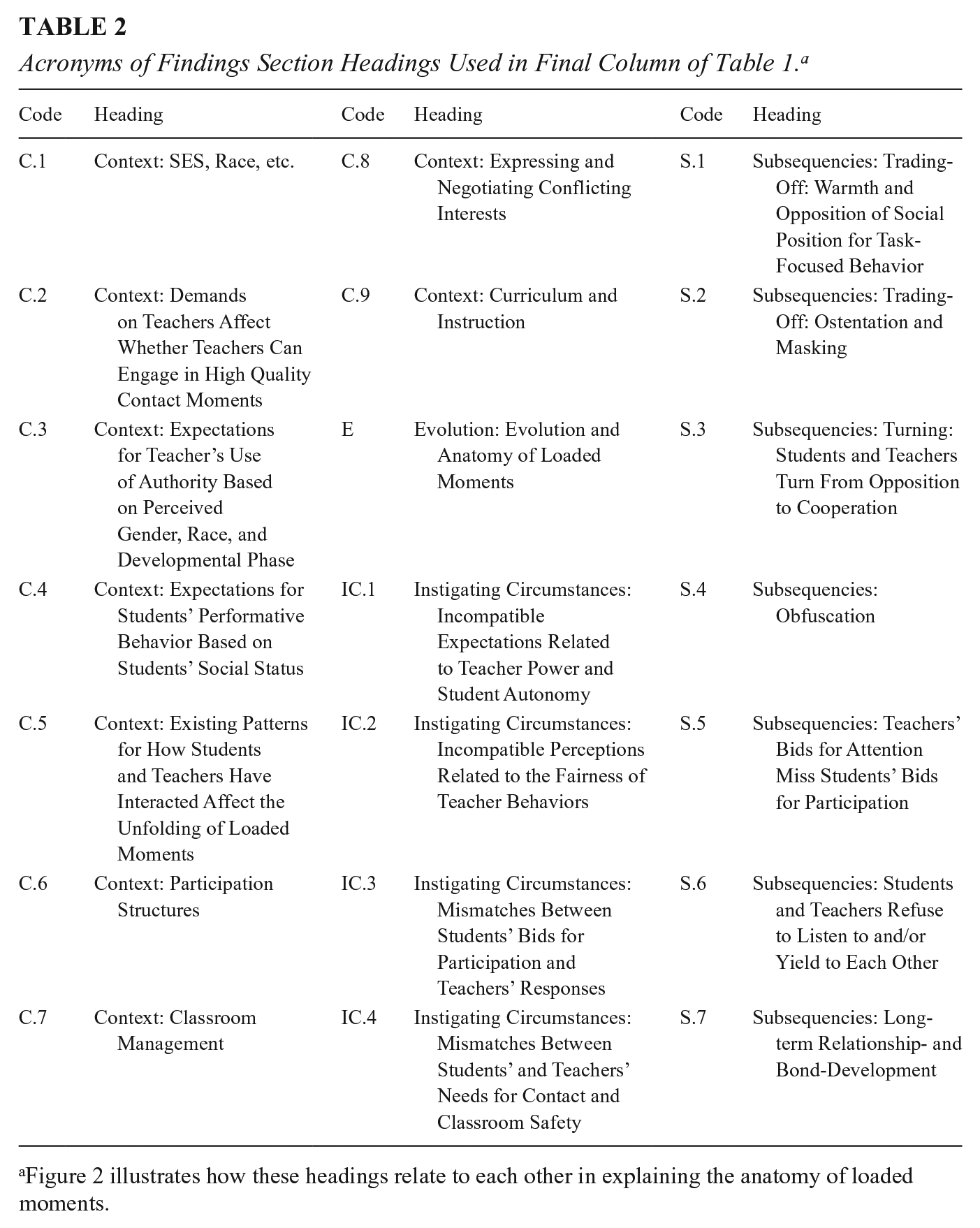
Figure 2 illustrates how these headings relate to each other in explaining the anatomy of loaded moments.
Context
During the synthesis process, we identified the context issues explored by each study’s authors related to the entirety of a loaded moment, which shaped a variety of teaching situations. These included school context, sociological positionalities, teachers’ professional demands, cultural expectations, social dynamics, and existing classroom processes. The collection of studies specifically addressing context (n = 23) reported how discontinuities between teacher and student expectations and behaviors could fuel instigating circumstances, particularly if they were embedded in existing classroom structures.
School Context Sets the Scene for Student–Teacher Interactions
School location, type, mission/vision, and community contexts set the scene for classroom interactions. The geographical and sociocultural position of the school shaped school culture and shared expectations for how students and teachers enacted their roles. In mainstream schools with high needs student populations, teachers may have been expected to overlook behaviors that might have been punished in other contexts (Schwarzwald et al., 2006; Vors et al., 2015). Conversely, teachers in such schools were also expected to act more punitively (Schwarzwald et al., 2006). Schools operating outside the traditional structure, such as disciplinary alternative public schools, may also have had structures that caused teachers to be more or less controlling (Kennedy, 2011).
SES, race, and other positional dispositions, and the need for teacher trade-off strategies
Specific context factors named in six studies as relevant in student–teacher interactions included socioeconomic status, race, and the role of chronic stress in the local community. The racial backgrounds of teachers and students seemed to play a particular role in the unfolding of loaded moments. For example, teachers who could provide relevant curriculum and meaningful relationships across racial lines identified and encountered less student aggression and were experienced by students as fairer (Rex, 2006; Sheets, 2002; Wyatt & Haskett, 2001). Teachers created those bonds through their approaches to classroom management and curriculum (Rex, 2006). Teachers who could not navigate across racial lines may have identified students as more aggressive or less capable than students saw themselves (Rex, 2006; Sheets, 2002). These discrepancies between teachers’ perceptions of students and students’ self-perceptions could set the scene for conflicts to erupt (Wyatt & Haskett, 2001).
Examining intersectional positionalities—such as race and SES—that shaped material experiences, as well as expectations related to behavior, revealed even more nuances in student–teacher interactions. For example, Vors and colleagues (2015) conducted a study at a “disadvantaged” (p. 341) school in France where national policies addressed improving school climate and violence in high poverty/high minoritized schools. These policies were designed to support teachers that struggled with classroom management in these contexts. Vors and colleagues found that teachers who were able to negotiate their own as well as their students’ needs, navigated loaded moments more smoothly. The authors named these approaches “trade-off strategies” (see below). Teachers’ abilities to use trade-off strategies, especially in schools with marginalized students, seemed to contribute to the context of loaded moments (Kennedy, 2011). Teachers and students in such schools also had to contend with chronic stress that could affect physical health as well as psychological and interpersonal conditions (Vors et al., 2015). Three studies specifically named the interpersonal condition of attachment style as relevant to student–teacher interactions (Evans et al., 2019; McGrath et al., 2017; Sun & Shek, 2012).
Demands on teachers affect whether teachers can engage in high quality contact moments
In addition to stressors caused by social factors in the community, stressors within the education system itself also played an important role in creating an environment ripe for conflict. One specific stressor named in one study was inordinate demands on teachers’ time and attention caused, for example, by high student–teacher ratios or by having too many tasks. In his interviews with five teachers who were describing good contact moments with students, Korthagen and colleagues (2014) reported that such moments occurred less when teachers did not have the time to be present with each student that needed attention. We further report on how this situation influenced the unfolding of loaded moments below.
Social Positions of Individuals and Expectations for Those Positions Affect Student–Teacher Interactions
Factors such as SES and race were connected to the school context as well as individual positionalities. Ten studies addressed how these positionalities shaped students’ and teachers’ expectations for the teacher’s and students’ roles and behaviors.
Expectations for the teacher’s use of authority based on perceived gender, race, and developmental phase
For example, culturally influenced expectations for teachers and students perceived as male or female played a role in the evolution of loaded moments and (de)escalation (Allard & Cooper, 2001; Leblanc, 2018). Some teachers viewed boys as more likely to be disruptive (McGrath et al., 2017) and expected girls to be more sensitive and conforming (Schwarzwald et al., 2006); in turn, girls had fewer discipline problems with teachers (Schwarzwald et al., 2006). Some teachers and students also had culturally influenced expectations about teacher authority and hierarchies (Sun & Shek, 2012). Teachers and students may have shared these expectations, such as in Sun and Shek’s (2012) study in which Chinese students in Chinese schools expected peers to obey teachers. Teachers and students may also have differed in these expectations (Rex, 2006), such as in Sheets’ (2002) study where Chicano students in U.S. schools shared with their peers a common suspicion of teachers’ racialized motives, and resentment of teachers’ attempts to exert control. In some cases, teachers and students from different racial backgrounds experienced moments of conflict as well as moments of shared expectations (Rex, 2006). Students’ developmental phases also contributed to both students’ and teachers’ expectations for teacher hierarchy and authority, with younger students less likely to challenge authority than adolescents, and teachers being more likely to anticipate this difference (Schwarzwald et al., 2006).
Expectations for students’ performative behavior based on students’ social status
Social discourses produced identities that students and teachers then performed both inside and outside of the classroom (Rex, 2006). For students, such identities might have included being seen as good at school or being seen as a troublemaker or clown. Students could have multiple conflicting social identities that they had to negotiate in each interaction (Rex, 2006). Students who had decided that they were not good at school or did not like it, sought power and attention through misbehavior (Lapointe, 2003). For example, Hand (2010) stated that student-centered, discussion-based classrooms may foster resistance if students with high status who are also negatively identified with school claim leadership roles in the discussion. Students who are positioned by themselves or others as challenging the teacher or another authoritative structure may be more likely to engage in “oppositional events” (Hand, 2010, p. 104). Since adolescents are collectively oriented, this positioning can lead to particular group dynamics (Kennedy, 2011; Lapointe, 2003). A student’s behavior patterns may lead them to have reputations among their peers as either positively or negatively identified with school. Sheets (2002) stated, “Students who consistently entertained peers developed reputations. Once a reputation was established, peers looked forward to being entertained” (p. 115). Whereas some students might be entertained by a peer’s negative behaviors, other students may view this behavior as threatening their own positions (Lapointe, 2003). Additionally, in some cases peers may find each other’s distractions as threatening to their educational success (Sun & Shek, 2012).
Existing Patterns for How Students and Teachers Have Interacted Affect the Unfolding of Loaded Moments
In contrast to social positions or school context factors, the occurrence and unfolding of loaded moments could also be affected by existing patterns of student–teacher interactions in the classroom. Moment-to-moment interactions lead to students’ and teachers’ mental representations of their relationship, which then inform new interactions (Claessens et al., 2017; Henry & Thorsen, 2018; Nelson & Roberts, 2000; Vors et al., 2015). The student–teacher relationship influences how each party interprets the social interaction between them (Henry & Thorsen, 2018). These moment-to-moment interactions may include what Korthagen and colleagues (2014) called “contact moments” (p. 23). Contact moments that affirm connectedness (e.g., shaking students’ hands, telling personal anecdotes, using students’ home language, tailoring one’s response to the person, praise) build and affirm positive relationships that shape later contact moments.
Participation structures
This ongoing co-construction of both relationships and classroom culture is composed in part by participation structures shared by students and teachers. Hand (2010) defined participation structures as “interactional routines (in discourse, gesture, posture, etc.) that are shaped by implicit rules and norms that participants in a social activity come to expect over time and that support coordinated action” (p. 101). While students and teachers both participate in creating these routines, structural components of classroom discourse position the teacher as the one with the power to decide the focus and course of verbal interaction (Mameli & Molinari, 2013). Teachers can use this power in their communication styles, for example, by using humor (Ritchie et al., 2011) and withholding judgment (Kennedy, 2011; Rex, 2006).
Teachers also deploy power to determine which students’ bids for participation are accepted as valid and which are ignored or punished (Hand, 2010; Rex, 2006). For example, in Hand’s (2010) study of a lower track high school algebra class, the teacher contributed to a polarized participation structure by making an explicit distinction between students’ answers that counted as mathematical and answers considered “nonmathematical” (p. 101), which generated engagement among a certain group of students and resistance among others. Conversely, teachers who created hybrid third spaces could avoid student resistance to performances of identity that were expected by dominant discourse but which students resisted (Hand, 2010). Including students’ “situated and discourse identities” (Henry & Thorsen, 2018, p. 225) in curriculum and instruction may lead to positive encounters (and potentially to fewer loaded moments), whereas boring instruction may also cause confrontations, as further described below (Nelson & Roberts, 2000; Sheets, 2002).
Classroom management
In addition to the domains of relationships and curriculum and instruction, teachers’ use of classroom management played a role in contexts of loaded moments. For example, teachers used body language and positioning to scan the room for students who needed help, such as by returning to the center of the room after helping each student individually (Henry & Thorsen, 2018). Teachers also balanced the resolution of conflicts with individual students with the maintenance of the instructional trajectory with the rest of the class (Méard et al., 2008). Teachers used body language to create physical expressions of symbols related to curricular content to re-focus students (Henry & Thorsen, 2018). In one study, students from non-dominant backgrounds identified poor classroom management as a factor causing confrontations with teachers (Sheets, 2002). Teachers used classroom rules to prevent and negotiate such confrontations. Rules can be useful in preventing loaded moments (Rex, 2006) but an over-focus on rules, or insincere inclusion of students in teacher-directed negotiations about rules (Méard et al., 2008), may actually lead to conflict (Sheets, 2002). Similarly, punitive and extrinsic reinforcement systems may correlate with teachers not attending to students’ perceptions of classroom problems, and instead prioritizing adult views that may lead to conflict (Lapointe & Legault, 2004).
Expressing and negotiating conflicting interests
Like existing classroom management and participation structures, the way teachers and students previously expressed and negotiated conflicting interests created the context in which loaded moments unfolded. The teacher played a role in initiating these structures by allowing for different approaches to a situation rather than directly interpreting and punishing in a way that the students would lose face or feel misunderstood. For example, some teachers created a classroom culture that allowed for the expression of conflicting perspectives (Allard & Cooper, 2001), or they used culturally responsive approaches to classroom discipline (Vors et al., 2015). Specific strategies that teachers used to create openness included trade-off negotiation strategies (Vors et al., 2015, see below) and ventriloquation (Leblanc, 2018, see below). All of these existing patterns of interactions set the scene for the evolution of loaded moments.
Curriculum and Instruction
The synthesis of studies illustrated the connection between classroom management, curriculum, and instruction (Kennedy-Lewis, 2012). In Beaulieu’s (2016) study, the teacher’s classroom management procedures revealed ineffective instructional approaches that led to student “off-task” behavior. Vors and colleagues (2015) and Flavier and colleagues (2002) explained how loaded moments occurred during knowledge transmission, organization and setting up of learning activities, and physical transitions, when unstructured student-to-student interaction was most likely. An additional classroom feature that promoted oppositional culture was a didactical instructional approach that reduced and/or simplified curricular content to discrete skills and tasks (e.g., fill in the “right” answer”), or which students found boring (Hand, 2010; Sheets, 2006). In this section, we have synthesized the conditions described across studies that set the scene for loaded moments. In the next section, we describe the anatomy and the unfolding of loaded moments.
Evolution and anatomy of loaded moments
These articles defined loaded moments as separate from existing patterns, naming them, for example, “micro moments” (Henry & Thorsen, 2018, p. 219) or “contact moments” (Korthagen et al., 2014, p. 23) containing “message stacks” (Aspelin, 2006, p. 232), all of which may contribute to entrainment (Collins, 2014). Micro moments contain physical dimensions of non-verbal exchanges (e.g., touch, smiles, eye contact, shared voice, and similar body-movement patterns; Henry & Thorsen, 2018). In these smallest moments of interactional exchange, there exist message-stacks in which messages that include physiological information become communicated in ways that may be unconscious to the participants. Message stacks and their interpretations and reactions are present and involved in the anatomy of loaded moments (Aspelin, 2006).
This synthesis illustrated loaded moments as having an anatomy, which means that they have phases that evolve as individuals interact with each other in chronological time (Van de Vliert, 1997). These chronological phases include instigation and subsequencies that occur between the teacher and at least one student. Contextual elements, such as the social positioning of teachers and students, can cause incompatible interests, which are instigations (Čiuladienė & Račelytė, 2016; Vors et al., 2015). Subsequencies may include de-escalation and escalation of the moment itself, as well as aspects of long-term student–teacher bond development.
Instigating Circumstances: Characterizing the Incompatibilities That Cause Loaded Moments
Loaded moments begin with instigations—interactions between teachers and students that disrupt (the possibility of) flow toward shared, short-term goals or outcomes. Seven studies elaborated on this part of the anatomy of loaded moments. Instigations occur when teachers and students experience incompatible interests related to their power positions, autonomy expectations, and perceptions of fairness (Longaretti & Wilson, 2006). Students and teachers may also experience mismatches related to students’ bids for participation, needs for contact, perceptions of safety, and momentary needs. These mismatches may precipitate a loaded moment. In the sections below, we synthesize findings related to each of these types of instigations.
Incompatible expectations related to teacher power and student autonomy
The role of teacher as authority figure is imbued with power that positions the teacher as interpreter of loaded moments and as having power over the course of these moments (Chamberlain et al., 2020). Teachers and students have certain expectations of that power role, and how teachers should enact authority and power (e.g., teachers as authority figures with power, students as compliant; Allard & Cooper, 2001; Chamberlain et al., 2020). The presence of power is continually renegotiated in the classroom in the context of these sometimes antithetical expectations. For instance, the power/authority of the teacher role positions the teacher as responsible for classroom control and maintaining momentum (Chamberlain et al., 2020), while also needing to attend to individual relationships with students (Beaulieu, 2016; Méard et al., 2008). The teacher is also positioned as the definer and enforcer of particular, appropriate types of participation, which may differ from students’ views (Hand, 2010).
Further complicating such situations, some teachers may be uncomfortable with wielding power (Sun & Shek, 2012), which could conflict with students’ expectations for the teacher’s authority (Allard & Cooper, 2001). Divergences of expectations, both within and between teachers’ and students’ expectations for teacher power, lead to struggles that can cause loaded moments (Chamberlain et al., 2020). Similarly, teachers and students may have incompatible expectations related to student autonomy. Loaded moments may occur when there is a mismatch between the autonomy that students want or need and the autonomy the teacher allows or supports (Chamberlain et al., 2020).
Incompatible perceptions related to the fairness of teacher behaviors
Loaded moments can also occur when students perceive a teacher’s behavior to be unfair while the teacher does not. According to Čiuladienė and Račelytė (2016), Čiuladienė and Kairiene (2017), and Čiuladienė (2020), students experienced the following types of unfair teacher behavior: distributive (e.g., not distributing equal opportunities to achieve high grades or to receive attention, or targeting the wrong person for punishment); procedural (e.g., not following through on class policies, not giving sufficient information for a task, or not giving feedback); and interactional (e.g., showing offensive, humiliating, or damaging aggression). When teachers and students had different racial backgrounds, the potential for incompatible perceptions was heightened. Students could perceive racialized microaggressions consisting of microassaults, microinsults, and microinvalidations (e.g., ignoring the participation styles of certain students; Beaulieu, 2016). When students perceived such unfair treatment, they sometimes acted out, potentially leading to a loaded moment (Čiuladienė, 2020; Čiuladienė & Račelytė, 2016; Sheets, 2002).
Mismatches between students’ bids for participation and teachers’ responses
In addition to perceived unfairness, mismatches between students’ bids for participation and teachers’ responses may have led to loaded moments. For example, cultural approaches for communicating bids sometimes differed between teachers and students. So, these cultural approaches informed students’—as well as teachers’—expectations for students’ identity performance (Hand, 2010). Loaded moments occurred when dominant expectations for identity performance held by the teacher were not shared by the students (Hand, 2010). In Hand’s (2010) study of a low track math class, students’ “performance talk,” or participation styles from outside school which they applied within the classroom, were interpreted by the teacher as nonmathematical, even if the content was about math. The teacher misperceived the students’ attempts to participate in these cases because the teacher linked participation with a particular (culturally based) communication style and missed the students’ links with the curricular content. Teachers’ expectations for students’ answers led teachers to miss contributions that students saw as connected to the content (Hand, 2010; Méard et al., 2008; Ritchie et al., 2011).
Conversely, students’ understanding sometimes synchronized with the teacher’s expectations for the task and participation in the task, but the loaded moment occurred if the students did not have ample opportunity for participation or autonomy over evaluating their participation. Teachers not listening carefully to students as a result of time pressures or classroom management demands, as described above, set up distributive unfairness (Aspelin, 2006; Čiuladienė, 2020; Hand, 2010). In Aspelin’s study (2006), the teacher missed the bid for participation of one student but accepted the bid for participation of another student who gave an incorrect answer. When the teacher accepted this answer, the first student objected and the teacher missed that bid as well. The student then gave up. The student’s demoralization set up a loaded moment.
In Allard and Cooper’s (2001) study, teachers and students engaged in pseudoparticipation in rule-setting. The primary school teacher in a multicultural classroom told the students they could choose class rules while simultaneously communicating that students did not have equal status with the teacher in the process. The teacher sent explicit messages to downplay his authority, while using that authority to filter students’ ideas. Students could only participate in ways that their suggestions did not conflict with the teacher’s agenda. Students went along with the process, not necessarily because they felt they had participated but because they actually expected the teacher to take an authoritarian role in rule-setting, as explained by one student in an interview. This exchange set up an instigating circumstance related to the quality of participation because the students made authentic bids based on their own ideas while the teacher received those inauthentically by only accepting the ones aligned with his pre-existing agenda. The mismatch in the teacher’s own expectations regarding his power in the classroom hierarchy, as described above, motivated this exercise in pseudoparticipation which set the scene for future loaded moments.
Mismatches between students’ and teachers’ needs for contact and classroom safety
Students and teachers also have needs for contact and classroom safety. Korthagen and colleagues (2014) distinguished between good and bad contact moments between teachers and students. Teachers defined a good contact moment as when teachers’ values aligned with students’ actions or responses. Students seemed to share teachers’ perceptions of these moments. Conversely, teachers defined “bad contact moments” (p. 27) as those where the child was not acknowledged; there was a lack of, or only brief, eye contact; the student’s thinking or the conversation was interrupted; or the teacher was not focused or clear. These moments occurred when teachers were too busy to do everything needed or were not attuned to the child in that moment (Hand, 2010; Sheets, 2002). Besides momentary mismatches, teachers’ longer-term misperception of students’ needs for contact also led to loaded moments (Aspelin, 2006). Teachers’ needs for contact also played a role in mismatches. For example, if students’ nonverbal behaviors, such as turning their head away from the teacher, demonstrated non-alignment to the teacher, there was also a mismatch between students’ and teachers’ needs for contact (Ritchie et al., 2011).
Good contact also played a role in the co-creation of a safe classroom but teachers were ultimately responsible for maintaining such a space. Teachers’ perceptions of student behavior necessary for safe classrooms determined teachers’ responses to classroom situations. Students may have considered some behaviors as culturally inappropriate or innocuous while teachers considered them destructive. For example, in Ritchie and colleagues’ (2011) study, the teacher became upset when a student laughed disrespectfully at another student’s content-related beliefs. In Rex’s (2006) study, students’ cultural language styles included signifying, which the teacher considered disrespectful and the students did not. After students crossed the teacher’s boundary, students and teachers had to negotiate the meaning of acceptable behavior, which sometimes set up a loaded moment (Rex, 2006). One study described that even when students and teachers shared the same set of expectations for, and perceptions of, behavior, students and teachers may have had different momentary needs, which could impact the quality of contact and classroom safety (Vors et al., 2015).
Subsequencies: When the Moment Gains or Loses Steam
After an instigating circumstance occurs, the moment may gain or lose steam. We name this next occurrence the subsequency of the loaded moment. Just as in the instigation of the loaded moment, the actors involved co-construct the subsequency. This co-construction may involve escalation or de-escalation. In an escalation co-construction, the actors may “use threats and coercive strategies, and end in the dissatisfaction of both parties” (Longaretti & Wilson, 2006, p. 5). A de-escalation co-construction may include either stable or unstable processes. A stable de-escalation co-construction leads to a full resolution in which both parties are satisfied, whereas an unstable de-escalation co-construction shifts attention away from the conflict but leaves open the possibility for a re-escalation (Longaretti & Wilson, 2006). In this section we discuss findings related to de-escalation and escalation co-constructions.
Stable de-sscalation co-constructions
The stable de-escalation co-constructions mentioned in eight articles primarily involved trade-offs and turns. In trade-offs, students and teachers accommodated each other’s behaviors to accomplish their own goals. In turns, students and teachers shifted their own perspectives to align more closely with the other. In this section, we give more detail about the types of trade-offs and turns found in stable de-escalation subsequencies.
Trading-Off: Warmth and Opposition of Social Position for Task-Focused Behavior
In three studies, teachers pursued a quiet classroom environment while students caused potential disruption. This instigating circumstance then led to a stable de-escalation by way of a trade-off. Specifically, teachers offered warmth and the accommodation of student behavior, and students offered reciprocal warmth demonstrated by compliance and a lack of protest. Teachers traded their expectation for specific student behavior for behavior that supported instructional focus. Henry and Thorsen (2018) recounted an example where students were working independently. One student who belonged to a peer group that was disengaged from school was tapping their feet and listening to music on headphones while completing work. Rather than directly confronting the student, the teacher warmly tapped on the student’s hand, at which point the student stopped tapping their feet. The teacher allowed the student to continue to listen to music as long as their behavior did not disrupt the rest of the class. In this example, the teacher traded off the requirement that students not listen to music during class to encourage task-focused behavior. The student responded to the teacher’s warmth by stopping the tapping. This student limited their expression of autonomy to maintain a positive relationship with the teacher.
We found an even more pronounced example of the teacher recognizing the social position of the students in LeBlanc’s study (2018), where a teacher used ventriloquation as a trade-off strategy. The teacher anticipated a loaded moment because the students had done something undesirable, so she created an imaginary student subject to whom she responded regarding the undesirable behavior. LeBlanc named this strategy ventriloquation because the teacher replaced the actual students with an imaginary subject and spoke to this subject instead of speaking to the students. This approach allowed the students to “maintain face” (Goffman, 1955, p. 213) because there was no direct communication exchanged about their (poor) performance. Unlike passive aggression, ventriloquation contributed to stable de-escalation because the actual subjects and the actual problems were addressed and this style maintained relational care rather than damaging it.
In a further example, Aspelin (2006) found that a teacher and one of her students used humor in a trade-off co-construction. In this case, a student bid for resistance by making a joke. The teacher avoided a confrontation by making a joke in return that aligned with the student’s joke and was not at the student’s expense. In doing so, the teacher accepted the student’s bid but was able to convert resistance to participation by bringing the focus back to the teacher’s point. The teacher traded an expectation of continual student compliance to maintain instructional momentum, whereas the student traded peer attention and resistance to instruction for teacher acceptance and validation. The student maintained their social position of being a “joker,” while also allowing the teacher to re-engage them in the class.
Trading-Off: Ostentation and Masking
Vors and colleagues (2015) found another type of trade-off strategy used by teachers in a sports class in a school in France, with a high percentage of minoritized students. They stated that in a successful interaction, teachers and students engaged in coordinated ostentation and masking. When students used ostentation they elaborately displayed certain desirable actions to avoid trouble, and when they used masking they hid their undesirable actions also to avoid trouble. Student masking behaviors occurred during work tasks and allowed the students to better hide their play. They used nonverbal clues about the teacher’s attention, such as shoulder position that indicated anticipated walking direction, to determine the best moments not to get caught. The teacher used ostentation by highlighting desirable student behaviors publicly with the entire class, while intentionally ignoring—and thereby masking their discontent with—students’ undesirable actions.
Teacher ostentation involved the intentional use of gesture, tone of voice, spatial positioning, and gaze to emphasize examples of student behavior that they wanted other students to emulate. The teacher’s intention was to highlight the work without getting the class distracted with reprimands and to motivate the distracted students to focus back on work. Teacher ostentation provided a sort of redirection, and the masking process a sort of ignoring, that resulted in few repressive interventions and limited disruptive behaviors, thereby limiting conflicts that could distract from the learning process of the entire class and affect the individual student–teacher relationship. Teachers stopped masking and intervened in student off-task behavior when they perceived that student behavior was: (a) prolonged; (b) physically dangerous; or (c) harmful to classroom work. The co-construction of ostentation and masking created stable de-escalation when both students and teachers had sufficient willingness to make a trade-off about behavioral expectations.
Turning: Students and Teachers Turn From Opposition to Cooperation
In addition to trading-off, students and teachers also engaged in a stable de-escalation process called turning, in which students and teachers released their mutually exclusive perspectives or desires and replaced them with those that accommodated the other. Students and teachers were able to turn toward each other under certain circumstances. Students accepted a teacher’s perspective because the teacher demonstrated a consistent and nonjudgmental position (Kennedy, 2011; McGrath et al., 2017; Newberry, 2010). Teachers used knowledge of students’ difficult circumstances to shape their reaction to the loaded moment (McGrath et al., 2017). Students and teachers turned from opposition to cooperation because their attributions of causes of conflicts changed (Lapointe & Legault, 2004).
In the turn from opposition to cooperation, students and teachers first resisted each other and then shifted away from resistance (Flavier et al., 2002). In a specific instance witnessed by Hand (2010) during fieldwork, a student opened a bid for resistance and the teacher faced the choice to either stabilize the resistance space by treating the talk as oppositional or else destabilize the resistance (thereby re-stabilizing the focus on, and engagement with, mathematics). To destabilize the resistance, the teacher needed to turn away from treating the talk as oppositional and turn toward validating the students’ contributions as a sort of participation (Rex, 2006). Mameli and Molinari (2013) also showed how students and teachers turned toward each other. In one example of a discussion about the origin of a piece of wood that the teacher was using as a clue in a lesson about inductive reasoning, the students described their theories about the wood that the teacher first considered to be off track. The students persisted with their reasoning, and the teacher ultimately opened to their ideas. Thereby, the teacher destabilized resistance by accepting, or turning toward, the students’ perspectives. Students also participated in turning by submitting to teacher perspectives or decisions (Flavier et al., 2002).
Unstable de-escalation co-constructions: Obfuscation
The unstable de-escalation co-constructions mentioned in three reviewed articles primarily involved a sort of obfuscation that, in contrast to stable de-escalation co-constructions, was not to the long-term benefit of both parties and set up the instigating circumstances discussed above. In Aspelin’s (2006) study, a teacher and her student misunderstood each other’s prompts during an initiation-response-evaluation (IRE) cycle (Cazden, 1988). Rather than explicitly addressing the misunderstanding, they both continued as if there were not a conflict. However, this de-escalation co-construction was unstable and led to further loaded moments because, even though the conflict was defused, the individuals did not feel understood or respected. There still existed a mismatch between students’ bids for participation and the teacher’s responses.
Whereas in Aspelin’s (2006) study the obfuscation occurred while the focus was on the instructional task, Rex (2006) and Sheets (2002) found that teachers and students also avoided direct confrontations when students were engaged in off-task behavior. In Rex’s study, students were teasing each other during whole class instruction and the teacher redirected by asking one student to proceed with answering an instruction-related question. Neither teacher nor student directly resolved the disruption, which could then fester. The teacher did not address the original mismatch between the teacher’s own perception of a safe classroom and the students’ behavior, an instigating circumstance for a future loaded moment. In Sheets’ (2002) study, teachers avoided conflict by allowing students to choose not to engage in class activities. Both parties accepted the students’ disengagement rather than directly confronting the teacher’s and students’ conflicting needs. This co-construction maintained the mismatch between students’ needs for contact and teacher responses, thereby also creating a new instigating circumstance.
Escalation co-constructions
In this section we turn from de-escalation co-constructions to co-constructions that escalated the loaded moment. The escalation co-constructions mentioned in seven articles involved a misperception on the part of either the teacher or the student followed by reactions to this misperception by both parties. In one type of escalation teachers and students missed each other’s bids, whereas in a second type of escalation teachers and students refused to yield to each other. Escalation co-constructions ended with the disciplinary sanctioning of students or the disgruntled submission of one or both parties.
Teachers’ Bids for Attention Miss Students’ Bids for Participation
In the escalation co-construction in which the teacher’s bids for attention miss students’ bids for participation, students started with a sincere effort to respond to the teachers’ requests for them to participate in the class instruction. However, teachers perceived students’ efforts as conflicting with the immediate instructional goals either because students gave unanticipated responses or because students’ efforts to understand the task were misperceived as direct opposition (Aspelin, 2006). Teachers’ negative reactions to students’ sincere efforts then drew out student resistance or withdrawal.
In Hand’s (2010) ethnographic study of one low-track algebra class, students’ answers to the teacher’s questions were not aligned with teacher expectations. In an effort to stay aligned with curricular pacing, the teacher engaged in quick IRE rounds in which he failed to notice the relevance of students’ answers. Hand pointed out that, in this process, the teacher created a polarized participation structure in which some answers and behaviors were considered mathematically productive whereas others were not. The cultural background of the students also came into play because their bids for participation did not align with the teacher’s culturally dominant expectations for their “right” answers. According to Hand, this polarized participation structure led to an oppositional participation structure, in which students then chose to position themselves as mathematically unsuccessful by engaging in mathematically unproductive behaviors as a form of resistance or opposition. The teacher co-constructed this positioning by chastising the students for the behavior, which confirmed that the behavior itself was unproductive but affirmed that the student had successfully engaged in an act of resistance. This study showed how students’ unanticipated responses fueled this co-construction.
In Beaulieu’s (2016) study, the nature of this escalation co-construction involved teachers perceiving students’ efforts to understand the task as direct opposition. Beaulieu presented field notes about a lesson in a multiracial primary school classroom, in which the teacher was distributing cards for an activity. The students were seated in groups and only one member of the group could see the card but a number of students reached for the cards anyway to better understand the teacher’s directions. One Latinx student named Juan asked the teacher multiple times for clarification, but the teacher did not respond due to the general chaos in the class. Juan finally reached for the card to see what was on it in an attempt to participate, which multiple others did as well. The teacher ended up reacting harshly to Juan in an exchange that Beaulieu labeled as a racial microaggression. In this escalation co-construction, the teacher asked for student attention to begin with an activity, but Juan responded to that bid by trying to better understand the activity in a way that the teacher interpreted as oppositional. After the teacher became angry with Juan, Juan completely withdrew from the activity in disgruntled submission, which ended the escalation. Here, Juan and his teacher co-constructed an escalation by missing each other’s communication attempts.
In a different but related and more subtle example, students in Vicki’s 7th grade science class in Australia missed Vicki’s bid for the students to participate (Ritchie et al., 2011). Vicki expected student engagement, but perceived, due to the students’ nonverbal communications—such as hair twirling and yawning—that they did not want to participate. Vicki’s surprise caused despondence to which she reacted by changing the curricular content. Richie (2011) captured this co-constructed escalation in the prosody of Vicki’s voice. When both Vicki and the students reflected on this escalation, the students felt embarrassed and indicated that they had not realized the nonverbal messages they were sending. In contrast to the examples of Hand (2010) and Beaulieu (2016) in which the teacher’s bids for attention miss the students’ bids for participation, Ritchie and colleagues’ (2011) example showed the students missing the teacher’s requests for them to participate. In all three examples, students and teachers missing each other’s communication fueled the escalation co-construction. In contrast to students and teachers missing each other, we describe below an additional escalation co-construction in which they receive each other’s communication but are not able to respond.
Students and Teachers Refuse to Listen to and/or Yield to Each Other
In four studies, students and teachers co-constructed escalation by refusing to listen to and/or yield to each other. Students and teachers may see different causes of loaded moments and may not be able to see each other’s perspectives (Lapointe & Legault, 2004). In Sheets’ (2002) study, students explained that, during escalations, teachers did not take class time to understand students’ perspectives on the contexts, occurrences, and possible solutions to loaded moments. Flavier and colleagues (2002) described a situation, in a physical education class, in which one team accused a member of the other team of cheating and the teacher disqualified that team member. The student protested that the teacher herself did not witness the incident and so should not react. The teacher proceeded by presuming that the opposing team members had reported the truth. She refused to yield to, or even explore, the student’s perspective and the blamed student remained agitated, which escalated the situation.
In other instances, students and teachers grappled for power and refused to yield to each other. Student Jacob in Newberry’s (2010) study of one primary classroom, tested teacher Sandy by kicking a chair. Sandy maintained consistency by calling the office, at which point Jacob ran out of the room. In both of these examples, the teachers refused to yield to the students and the situations escalated. However, the teacher in Flavier and colleagues’ (2002) study did not believe the student whereas Sandy intentionally refused to yield to Jacob to provide consistency that would ultimately build stability in their relationship. While both instances demonstrated an escalation co-construction, the ultimate impacts on classroom dynamics were different. In their refusals to yield, teachers may respond with coercion and control to student arguing, which can fuel continued arguments, or teachers can be calm and stable, which can still instigate an angry student response and lead to a blow-up in the short term.
Subsequencies: Long-Term Relationship- and Bond-Development
In this section, we report on the evolution of the loaded moment beyond the escalation or de-escalation phase. Čiuladienė and Kairiene (2017) described how unresolved loaded moments, for example due to a student’s passive response, could lead the student to like the teacher less, which could affect future interactions, as mentioned above. This is an example of how loaded moments might have the subsequency of a negative student–teacher relationship. Several studies specifically pointed out the role of racial differences between teachers and students in this relationship-development (e.g., Beaulieu, 2016; Sheets, 2002). Sheets (2002) described cultural discontinuities between teachers’ and students’ priorities during disciplinary events. These disciplinary events and teachers’ versions of those events, which resulted in further disciplining of students, led to mistrust, student disengagement, and negative relationship development. However, successful de-escalations could contribute to positive relationship-development (Kennedy, 2011; Longaretti & Wilson, 2006). Newberry (2010) highlighted the additional point that an escalation might also be an important event in the testing phase of relationship development because students and teachers learn to trust each other as they negotiate conflicts.
Discussion
This literature synthesis examined student–teacher enactments of loaded moments to contribute to understanding how micro-moment interactional sequences, about which students and teachers may be conscious or unconscious, contribute to the escalation or de-escalation of conflict. According to Baldwin’s (1994) relationship schema theory, repeated interpersonal experiences or perceptions of moment-to-moment interactions lead to more generalized views of the student-teacher relationship, which then also affect future interactions (Aspelin, 2006; Claessens et al., 2017; Korthagen et al., 2014). The framing of student–teacher relationship development as a nonlinear dynamic system, and the focusing on micro level interaction rituals within the context of this relationship development allows for the elucidation of how relationship patterns are formed in real time. These process theories and their requisite methodological approaches—such as micro ethnography—as applied in these reviewed studies, indicate how loaded moments arise and resolve. Here, we discuss how each anatomical phase of the moment-to-moment unfolding of loaded moments can be understood in light of broader scholarship. We then discuss the implications of these findings for educators and students, explain study limitations, and explore implications for future research.
How the Context Sets the Scene for Loaded Moments
These studies made connections between micro level processes and macro level social context factors. Although we did not position contexts as having determinant variables as in process-product research, we did gain insight into these connections. Existing literature primarily from the United States does position race and culture as playing critical roles in student–teacher relationships and classroom management (Emdin, 2016; Milner et al., 2019; Toshalis, 2015). Institutional racism and poverty cause chronic stress that can result in symptoms of trauma that trigger fight or flight reactions and diminish a person’s ability to respond productively to conflict (Brown et al., 2022; Carter et al., 2019; Crosby et al., 2019; Murphy et al., 2016). These individual level impacts are further challenged when the school is under resourced or teachers are underprepared (Brown et al., 2022). Cultural differences between teachers and students can further exacerbate such situations if these differences fuel misunderstandings or misinterpretations of communication attempts, which we saw in the findings. Cultural differences can also set up conflicting expectations related to authority, power, and compliance, that result in the incompatibilities that instigate loaded moments.
These macro–micro connections between race and socioeconomics and inter- and intrapersonal impacts were shaped by meso level factors, such as pacing guides and teachers’ workload expectations. Dealing with the challenges brought on by the traumas of racism and poverty require cognitive and emotional capacity and energy in addition to adequate training that teachers may not have if they are overworked or facing impossible requirements related to bureaucratic accounting, curricular pacing, or standardized testing (Luthar & Mendes, 2020). Further confounding such situations, teachers themselves may also experience trauma related to institutional racism or poverty (Kohli, 2009).
At the micro level of the classroom, we see how existing patterns related to the three domains of teaching set the scene for loaded moments. These three domains include relationships, classroom management, and curriculum and instruction (Kennedy-Lewis, 2012). We have focused on the development of student–teacher relationships in the synthesis; student–student relationships also play a key role. Relationship patterns among students created and reinforced the social positions that fueled students’ performative behaviors. How students acted out this behavior related to teachers’ classroom management practices and were further impacted by the quality of curricular content and instructional activities. Teachers’ mastery of effective practices in all three domains affected both the context for, and the unfolding of, loaded moments in class.
Further Unpacking the Incompatibilities and Mismatches That Instigate Loaded Moments
As mentioned above, social context factors and cultural differences may set up the incompatibilities and mismatches that instigate loaded moments. Individual biographies, needs, and differences may do so as well. For instance, individuals’ attachment histories and attachment patterns may shape social-emotional needs as well as perceptions of, and desires for, behaviors of others. According to attachment theory, people form scripts for intimacy and emotional safety in early relationships with primary caregivers. These scripts can support healthy and stable relationship patterns or unhealthy ones in later life (Bowlby, 1969). Chronic stress and trauma can negatively impact the development of these scripts. Students and teachers with insecure attachment scripts may engage in, and react to, interactions in more volatile ways, which could then lead to loaded moments (Evans et al., 2019; McGrath et al., 2017; Sun & Shek, 2012). Insecure and disorganized attachment styles also affect an individual’s needs and desires for contact, with insecure styles needing more contact and disorganized styles resisting connection (Ainsworth et al., 1978; Main & Soloman, 1990). These mismatched needs set up loaded moments.
Why Subsequencies May Unfold Differently
Across studies, we saw how these instigations could be escalated and de-escalated in interaction sequences involving both teachers and students. Escalation subsequencies could lead to conflict and negatively impact the relationship, but unstable de-escalation subsequencies could also set up instigating circumstances for future conflict. Existing theory and research can help explain why subsequencies unfold differently. Stable de-escalations required cooperation between teachers and students that involved skilled and strategic teacher responses such as warm demanding (Ross et al., 2008), planned ignoring (Simonson et al., 2008), and authentic praise (Kennedy et al., 2017). When teachers lacked “withitness” (Kounin, 1970), or students did not effectively advocate for their perspectives, only unstable de-escalations could be achieved. When neither party could understand—or yield to—the other, the moment was ripe for an escalation.
The Long-Term Importance of Resolving Loaded Moments
Longer-term subsequencies, or impacts of the subsequencies that occur during loaded moments, shape the quality of student–teacher relationships and interaction patterns that then form the context for future loaded moments. Collins (2014) posited that contact moments produce emotional energy as discussed in the sections above. Previous productions of emotional energy in student–teacher interactions may give teachers confidence and enthusiasm (Ritchie et al., 2011). Students who have experienced emotional energy and subsequent positive relationships with a teacher may not misbehave with that teacher, whereas the same students might indeed misbehave with other teachers with whom they do not have that history (Lapointe, 2003). Student–teacher relationships, which contribute to classroom culture, are constantly enacted by the classroom members. If significant members are absent temporarily, even stable, positive student–teacher relationships could fail to prevent the emergence of loaded moments, for example, between students and a substitute teacher (Allard & Cooper, 2001; Rex, 2006). These insights have implications for positive student–teacher relationship development as well as the reduction of racialized educational opportunity gaps that may result from escalations.
Implications for School Contexts
This synthesis specifically highlighted both stable and unstable co-constructions during micro-moments. We gain insight into the strategies and actions engaged by teachers and students during interaction ritual chain development (Collins, 2014), noting the interdependent nature of the quality of student–teacher relationships, classroom management, and curriculum and instruction that produce and are produced by these co-constructions (Kennedy-Lewis, 2012). Whereas existing literature often positions classroom management as a set of teacher strategies considered independently from co-constructions with students (e.g., Gold & Holodynski, 2017; König & Kramer, 2016), this collection of studies characterizes teachers and students as interdependent. We see both parties as engaged and having impact on the nature of a loaded moment and its subsequencies. By considering a loaded moment as having an anatomy that includes a context, instigating circumstances, and subsequencies, we have been able to examine each of these parts as playing a role in the co-construction. This finding has implications not only for teacher education and professional development but also for student–teacher negotiations of loaded moments during class.
Implications for Educators
School discipline studies, the body of research already focusing on racial disparities in exclusionary discipline in the United States, already includes restorative justice (e.g., Agudelo et al., 2021; Gregory et al. 2021; Kervick et al., 2019; Lustick, 2020; Shah, 2012), social-emotional learning (e.g., Bear et al., 2017; Slaten et al., 2015), and trauma-informed practices (e.g., Brown et al., 2022; Crosby et al., 2019; Joseph et al., 2020) as important approaches for reducing disparities. The field continues to evolve and join international conversations about diversity and inclusion by advancing in the area of belonging (e.g., Faircloth, 2021; Gray et al., 2018; Kennedy & Melfor, 2021).
Teacher educators and educators of educational leaders could particularly focus on helping educators become conscious of the presence of instigating circumstances and the unfolding of loaded moments. This focus might best serve student learning if positioned not only as classroom management but also as micro level enactments positioned always within the context of existing relationship patterns, as well as curricular content and instructional activities (Kennedy-Lewis, 2012). Professional development efforts might focus on positive aspects of loaded moments in ultimately supporting student–teacher relationships, and helping teachers identify points of leverage for limiting the negative potential of loaded moments. Ultimately, such efforts could empower both educators and students to consciously cooperate in mutually beneficial enactments that produce positive, productive, and just classroom experiences for teachers and students.
Implications for Students
In these studies, we see students as equal co-constructors who could also benefit from insights into how these loaded moments unfold. Although students are more likely to have negative EE due to their vulnerable positions in classroom power relations, according to Collins (2014), they take active and powerful roles in classroom processes. Explicating these processes by breaking down the longer sequences of a student–teacher conflict into smaller sequences may empower both teachers and students to steer loaded moments away from conflict. By participating in restorative practices or social emotional learning, students could learn to read interactions as well as their own responses to consciously de-escalate classroom conflicts, such as by choosing to yield, challenging their own interpretations, or making their participation bids more effective (Ross & Tolan, 2018).
Limitations and Implications for Future Research
This study has several limitations. We bounded the review using process theories focused on micro level interaction in order to capture the nature of interactions before they become conflicts. That means that we did not choose to adopt conflict theories or engage in the robust literature on conflict. We also chose to exclude studies focused on behavioral disorders or interventions or specialized contexts focused on behavioral change. This choice aligns with our paradigmatic framing of loaded moments as co-constructions rather than as products of individual states or traits. Future research might take up the complexity of placing individual states and traits within the co-constructed moment-to-moment interaction to further elucidate how and why escalations and de-escalations occur as well as the possibilities and limits of the agency of any individual participating in those interactions.
We also inductively derived themes and included all context factors, instigating circumstances, and subsequencies that were addressed within the synthesized articles, regardless of the number of times mentioned or the level of detail included. That means that our findings do not yet enable readers to determine how important a particular idea or finding is for understanding loaded moments. It also remains difficult to identify the range of types of loaded moments or the specific causal drivers. Future research could identify particular types of loaded moments to study and build upon the anatomy identified in our findings in order to further develop how these moments unfold.
Implications from this study suggest further investigations of classroom-based co-constructions might address questions such as: How do teachers and students co-construct enactments of healing and belonging in the classroom? Such questions might be investigated using approaches discussed above as well as emerging physiological measures that could capture even more about the enactment and workings of co-constructions (Donker et al., 2020; Junker et al., 2021; Junker & Holodynski, 2022; Mastromatteo et al., 2021). Collins (2014) paved the way for such a methodological application by studying emotional energy using prosody and body postures, and suggesting the relevance of measuring hormone levels and facial expression. Such studies could further elaborate connections between micro level processes in student–teacher interactions, which could support teachers, teacher educators, and students in co-constructing more equitable and responsive learning contexts.
Footnotes

Notes
Authors
BRIANNA L. KENNEDY is an assistant professor of Education in the Department of Education at Utrecht University, Heidelberglaan 1, 3584CS Utrecht, Netherlands; email:
DR. ROBIN JUNKER is a clinical psychologist for teacher burnout at the Schlossklinik Pröbsting, Pröbstinger Allee 14, 46325 Borken, Germany; email: