



Abstract
As a consequence of globalization and increased immigration, scholars call for reconceptualizations of citizenship and empirical studies to ascertain how citizenship education is enacted in schools serving youth from immigration backgrounds. This study addresses these needs by interviewing civic educators in purposefully selected secondary schools in Denmark and England and Scotland in the United Kingdom. Using data from semi-structured teacher interviews, complemented by classroom observations, the study revealed examples of civic teaching reflective of distinct civic cultures and global trends. In the British schools in the study, the extent to which citizenship was emphasized varied considerably. One school did much to promote local and global civic activism, whereas others emphasized school level participation and charity fundraising. Democratic participation in groups, support for the Danish welfare system, and valuing free expression featured strongly in the Danish schools in the study. Across countries, students were taught about human rights, global issues, and international organizations. Additionally, teachers identified opportunities and challenges in civic teaching for transnational students.
Keywords
At the beginning of the 21st century, globalization and migration challenge traditional notions of citizenship and civic education. These challenges have been acutely felt in countries where increases in immigration and global forces confront the idea of the nation as the sole focus of citizenship education. Additionally, each year many displaced peoples around the world leave their home countries to seek refuge in countries that are very different from their homeland culturally, politically, and economically. Thus, civic educators in economically developed countries face challenges educating increasingly diverse populations. Those educators wrestle with questions of how best to prepare all citizens—those from the dominant culture and those whose families are comparatively new to the country—to be politically and civically active. In this article, I report research in two northwestern European nations examining how civic educators in differing democratic contexts with transnational students conceive of citizenship, civic action, and democratic participation.
Despite international interest in education for democratic citizenship (Arthur et al., 2008; Schulz et al., 2010), there has been little attention to civic education for “transnational” youth—those young people whose allegiances, life experiences, and understandings of citizenship transcend a single nation state. For this study I purposefully selected secondary schools that serve youth from immigrant backgrounds in Denmark and England and Scotland in the United Kingdom. I interviewed teachers, observed classes, and conducted student focus groups from 2009 to 2014 to assess policies, practices, and teacher and student perceptions.
Conceptual framework
In light of globalization and migration, scholars recognize citizenship as more complex and nuanced than simply being a member of a nation-state (Banks, 2008; Heater, 2004; Held, 2004). One can be a member of cultural communities, a resident of a nation state, and may also perceive membership in a diasporic or global society. Furthermore, many individuals are transnational citizens. Refugees, migrant workers, immigrants, or people employed by transnational companies requiring their frequent relocation and their children maintain attachments to multiple communities (Abu El-Haj, 2009). In some cases they legally hold dual or multiple citizenship (Castles, 2004). Scholars have emphasized various aspects of this transformation (Alviar-Martin, 2008; Appiah, 2006; Heater, 2002, 2004; Knight Abowitz and Harnish, 2006; Kymlicka, 1995; Nussbaum, 2002; Ong, 2004; Osler and Starkey, 2005). I focus particularly on citizenship and transnationalism, when individuals live their daily lives across national borders and maintain attachments to multiple national communities (Abu El-Haj, 2009; Castles, 2004; Kivisto and Faist, 2007).
This study is rooted in sociocultural and ecological theories of learning, depicted in the Octagon Model of the Civic Education Study of the International Association for the Evaluation of Educational Achievement, or IEA (Torney-Purta et al., 2001; Torney-Purta et al., 1999). The model envisions the ways everyday lives of young people in homes, schools, and communities are nested in a wider social and political environment containing public discourse about societal goals and values. As students interact with peers, family members, teachers, and more abstract socialization agents, such as the media, they construct meaning of the social, political, and economic concepts and values they encounter. This study focuses on the roles of teachers and schools, embedded in particular civic cultures, as they provide opportunities for transnational youth and their peers to learn about enacting citizenship.
The concepts of civic culture and globalization are useful complements to the IEA Octagon model in understanding the civic-political socialization process cross-nationally. Almond and Verba (1965/1989a, 1989b) first drew attention to civic cultures, defined as “the distribution of patterns of orientation towards political objects among the members of a nation” (Almond and Verba, 1965/1989, p. 13). In their study of political attitudes in five countries, Almond and Verba related civic cultures to structures of politics and general attitudes toward people and society. Over subsequent years, scholars have used the concept “civic/civil culture” in analyses of civic education (Hahn, 1998; Kennedy et al., 2008; Schiffauer et al., 2004).
Importantly, since Almond and Verba (1965/1989a)published their classic study, the world has experienced an unprecedented interdependence of economic, political, and social systems captured in the concept globalization (Stromquist and Monkman, 2000). Today many comparative education researchers explore what Arnove (1999) called “the dialectic of the global and the local.” Comparative civic education researchers, in particular, ask: To what extent do students globally share understandings of the civic-political world and to what extent are their ideas locally or nationally distinct? (Kennedy et al., 2008). Similarly, in this study I pose the overarching question: To what extent do educators cross-nationally envision and enact their task of educating young citizens similarly and differently?
To address that question, I chose a comparative methodology, seeking answers to the following research questions in schools serving transnational youth in the United Kingdom and Denmark: (1) How do teachers of civic-related subjects conceive of citizenship and education for citizenship? (2) How do the teachers perceive the school’s role in preparing youth for civic action? (3) What do teachers see as the challenges and opportunities in teaching for active citizenship in schools serving transnational youth?
Previous research
Although scholars in many countries have written about the need to prepare citizens of multicultural democracies in a shared global society, to date we have limited empirical research on how shifting ideas of citizenship and education for citizenship play out in schools. Further, we do not know how teachers of transnational youth experience this process. We do, however, have some foundations.
The International Association for the Evaluation of Educational Achievement (IEA) sponsored the 30-nation Civic Education (CivEd) Study (Torney-Purta, et al., 2001; Torney-Purta, et al., 1999) and the 38-nation International Civic and Citizenship Study (ICCS) (Schulz et al., 2010). ICCS researchers revealed that in general, students from immigrant backgrounds demonstrated lower levels of civic knowledge but greater interest in political and social issues than non-immigrant students (Schulz, et al., 2010). Of particular relevance to this study, immigrant students in Denmark reported less positive attitudes toward the country in which they lived than non-immigrant students; in contrast, immigrant and non-immigrant students living in England held similar attitudes toward the country in which they lived (Schulz et al., 2010). 1 While providing valuable information from nationally representative samples of students, the IEA studies do not have qualitative data to reveal what characterizes civic education in schools serving youth from immigrant backgrounds. This study addresses that need.
Some scholars have described the intersection of civic education and multiculturalism in different countries (Banks, 2004, 2009). In one of the few empirical studies, a team of anthropologists examined the civic identity development of Turkish heritage youth in one school each in England, Germany, the Netherlands, and France (Schiffauer et al., 2004). Across sites, the Turkish heritage youth described their position in society using the discourse of the dominant society. Specifically related to this study, the researchers at the London school found textbooks, lessons, and youth reflected “a national imaginary” of Britain as a multicultural society, which valued equality of cultural communities, tolerance, and non-discrimination.
Several researchers studied teachers’ perspectives on citizenship and citizenship education in differing national contexts. For example, using non-representative samples of teachers of civic-related subjects, IEA researchers examined teacher perceptions of goals for civic education (Losito and Mintrop, 2001). Across countries, teachers were most likely to agree students should value knowing national history and obeying the law. Protecting the environment and promoting human rights were the next most frequently cited desired civic behaviors. Joining a political party was least cited. These generalizations applied specifically to the Danish and English teachers (the focus of this study), as well as to the total international sample. Additionally, the Danish and English teachers were, on average, slightly more confident teaching civic education than the international average; they were slightly less likely to report using textbooks, recitation, and lectures for civic instruction. Danish teachers were also more likely to use group work and projects and they were more likely than English teachers to say that knowledge and critical thinking were emphasized in civic education. English teachers were more likely than Danish teachers to say that values were emphasized. Both groups agreed civic action received little emphasis. 2 Importantly, the data for this study were collected prior to the introduction of required citizenship teaching in England in 2002.
Lee and Fouts (2005) reported on a cross-national study of teacher understandings of what “good citizenship” meant in Australia, England, the United States, Russia, and China. Drawing on survey and interview data from non-representative samples, researchers found that across countries, teachers emphasized the social dimensions of citizenship over the intellectual and political dimensions, with the words “moral” and “duty” among the priorities of educators in all five countries. Additionally, civic participation or civic action was not a priority for teachers in any of the five countries. To access English teachers’ perspectives for the study, Davies et al. (2005) studied teachers in both primary and secondary schools. Importantly, like the IEA researchers, they collected their data before citizenship became a statutory requirement for schools. Nevertheless, the consistency of the findings across time provides important background. Teachers associated citizenship with concern for the welfare of others, moral and ethical behavior, and tolerance of diversity within society. Secondary teachers were more likely than primary teachers to associate good citizenship with “understanding democratic processes.” Several secondary teachers referenced helping others beyond the local community through non-governmental organizations (NGOs) such as Amnesty International and Greenpeace. Teachers emphasized developing critical thinking over acquiring specific information. Notably, none of the English teachers associated good citizenship with patriotism and no one mentioned European citizenship.
Most researchers studying teacher perceptions did not examine whether the students in the teachers’ schools were culturally heterogeneous or had immigrant backgrounds. One notable exception was Biseth’s (2011) study of immigrant youth and their teachers in Oslo, Norway; Copenhagen, Denmark; and Stockholm, Sweden. Across the three sites, interviewees confirmed that human rights were important. Additionally, students referred to freedom of expression and teachers referred to gender equality. Biseth’s findings from Copenhagen schools are particularly relevant to this study. The Danish teachers and students referred to student councils, which dealt with school issues, such as making decisions about school sweaters, a school prom, and a bicycle stand. Biseth judged the councils to be “pseudo-democratic in practice” because they addressed what she considered minor issues. She also reported few teachers led discussions about racism and discrimination, which were part of students’ daily lives. Biseth argued that such silence was a missed opportunity to teach the content of democracy. She further noted the teachers under utilized the varied religious and linguistic backgrounds of students in their multicultural classrooms. She concluded that despite Scandinavian students scoring well on international civic assessments, the students in her study did not experience valuing pluralism as part of the substance of democracy.
A second qualitative study conducted near Copenhagen was an ethnographic study of a Danish folkeskole (for pupils aged 7 to 15) serving many students from immigrant backgrounds (Jaffe-Walter, 2011). The researcher examined media reports, observed English lessons, interviewed the teachers of the English lessons, and conducted student focus group interviews. She explored the conflicting discourses of inclusion/equality and nationalism/Islamophobia. Teachers expressed desires to help students and extend benefits of a democratic society to new immigrants while they enacted assimilative practices that were framed in benevolent language of concern. She noted the word “immigrant” carried the connotation of Muslim and that teachers perceived immigrants as problems, referring to oppressed immigrant girls, criminal boys, and communities that did not want to assimilate. Jaffe-Walter’s findings were based on English lessons and teachers, whereas this study focuses on social studies.
In summary, previous researchers found teachers’ views of citizenship and civic education varied cross-nationally. Several found teachers in schools serving youth from immigrant backgrounds tended to view difference as a barrier, rather than a resource, for teaching democracy. This study extended earlier work by comparing teachers’ conceptions of citizenship, civic education, and challenges and opportunities of civic education for transnational youth in specific national and school contexts.
Methodology
I purposefully selected four secondary schools in each country. 3 I used these criteria: the schools served a substantial number of students from immigrant backgrounds; they were located in different parts of each country; and they reflected different types of schools in each country.
At each school, I interviewed teachers of civic-related subjects and observed civic-related classes, such as Social Studies/Social Science (samfundsfag) in Denmark, Citizenship in England, and Modern Studies in Scotland. I collected policy documents and curricular guidelines for civic education and instructional materials used in the classes I observed. I conducted student focus group interviews in some schools and I kept a daily research journal in which I identified patterns and themes to probe on a continuing basis. Over a five-year period, I made from two to seven visits to each school, to observe the implemented curriculum, identify “typical” instructional practices, and learn about changes over time. I conducted hour-long semi-structured audio-recorded interviews in English with seven Danish teachers in three schools and with seven British teachers in two schools (see Appendix A, interview protocol). I also conducted informal interviews with another five teachers in two additional schools in England. Here I draw primarily from the teacher interview data, with supporting material from the other data sources to contextualize teacher explanations.
I used constant comparative analysis techniques, using codes to identify patterns, seeking themes within and across sites (Strauss, 1987). I used concepts from previous research for first level coding, as well as “in vivo” codes to capture participants’ meanings. 4 I triangulated data from various teachers and observations searching for themes and counter-evidence. I compared findings from schools in the same country and across countries. I have selected examples from varied sites to illustrate patterns.
Similar but different: National and school contexts
The study reported here is part of a larger project in four European countries that share a long democratic heritage and intertwined histories but where conceptions of citizenship and inclusiveness differ. 5 For this article, I focus on Denmark and the United Kingdom, which share similar challenges in educating changing populations for democratic participation, yet approach that task in distinct ways.
National discourses and immigration
Denmark and the United Kingdom have had reputations as being tolerant societies that welcomed immigrants. However, as the numbers of immigrants, refugees, and asylum seekers from North Africa, the Middle East, and Eastern Europe increased in the 1990s, anti-immigrant incidents also increased and immigration and citizenship policies became quite controversial.
In England, nearly 10% of 14 year olds in 1999 held virulent anti-immigrant attitudes (Torney-Purta, 2009). Further, after the July 2005 London bombings, there was considerable discussion in Britain about what it meant to be “British.” Later, in 2014, in response to British Muslim youth joining radical Islamists in Syria, Prime Minister Cameron reasserted the importance of teaching “British values.” Also, in the months leading up to the 2014 Scottish independence referendum, the public debated about the extent to which Scottish and English citizens did indeed share common values and perspectives.
Concern about immigration and social cohesion has also been on the public agenda in Denmark. When I first began studying Danish civic education in the 1980s there were few immigrants and there was a widespread assumption that Danish society was tolerant (Hahn, 1998). However, by 2010 10% of the population was born outside Denmark, and another 129,000 (out of a population of almost 5 million) were descendants of immigrants (Bruun, 2013). As the numbers and visibility of immigrants increased, particularly in the large cities of Copenhagen, Arhus, and Odense, so did the backlash against them. Right wing political parties that campaigned against liberal immigration policies grew and the media reported anti-immigrant incidents. When one right wing newspaper published a political cartoon depicting the prophet Mohammed as a terrorist, demonstrations swept across Europe and the Middle East.
Other changes in Denmark have been less sensational, but no less important. Conservative governments limited immigration to family reunification and refugees and they required immigrants to pass a test to become citizens. They discontinued policies that guaranteed immigrant children the right to free mother tongue lessons, unless they were from European Union countries. Meanwhile, in a context of globalization and neo-liberal discourse, politicians expressed concern about Danish students’ mediocre performance on international assessments. Educational reforms targeted increasing student competencies.
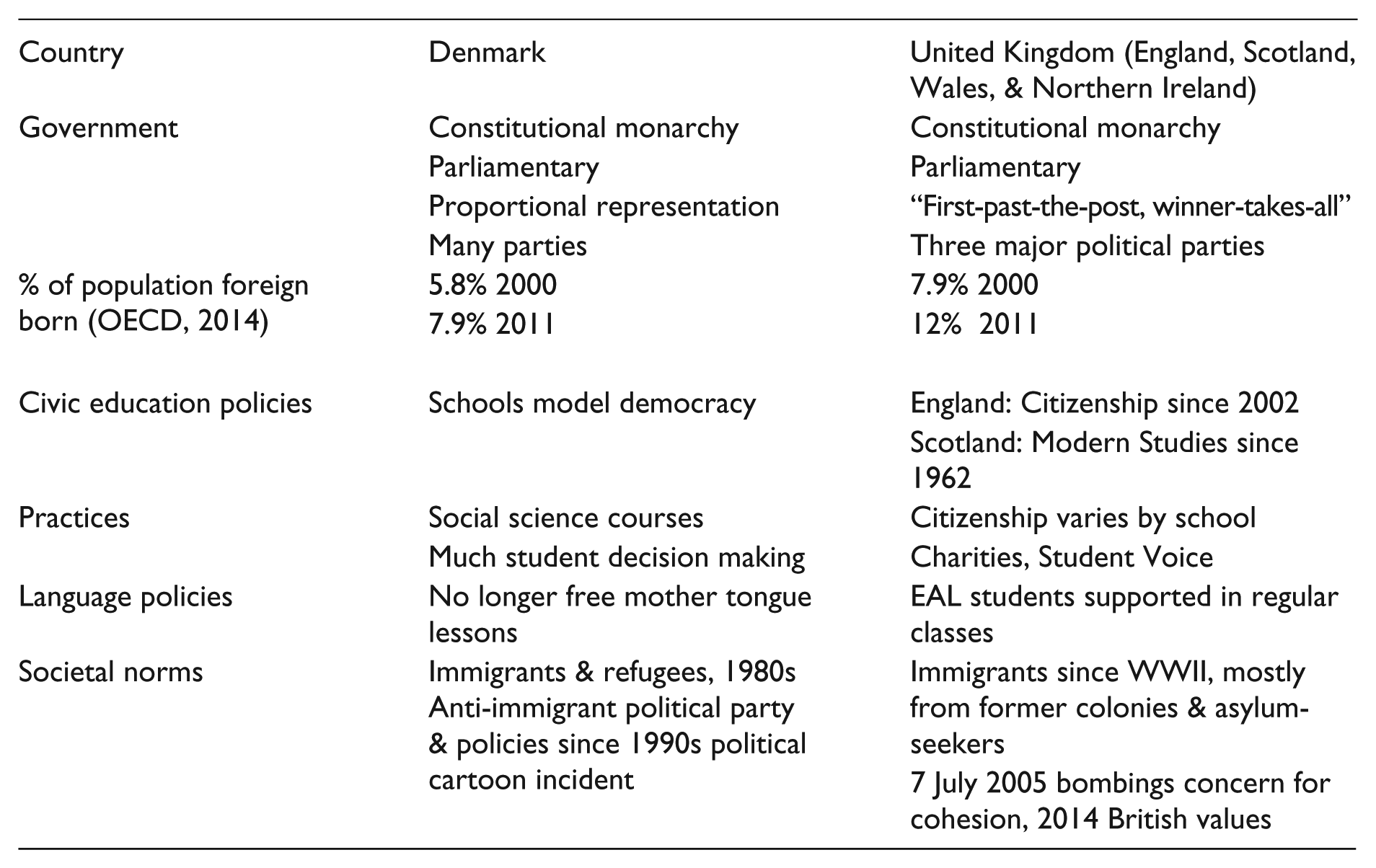
Importantly, debates about diversity, social cohesion, and citizenship have been occurring in both Denmark and the United Kingdom, which have different approaches to preparing youth for citizenship (see Appendix B). In the next section I describe the policy contexts and distinct pedagogical cultures I observed embedded in wider civic cultures, first in the United Kingdom and second in Denmark. For each country, I include descriptions of the specific school contexts where the educators in this study experience civic education (see Appendix C, summary of schools).
Educational policies and practices in schools in England and Scotland
The four constituent countries (England, Scotland, Wales, and Northern Ireland) of the United Kingdom of Great Britain and Northern Ireland have differing policies for citizenship education, as well as similarities and differences in pedagogical and civic cultures (Kerr et al., 2008). For this study, my sample included schools in three different parts of England and one in Scotland, in areas with large concentrations of immigrant populations.
England
Only since 2002 have secondary schools (serving students aged 10–16 or 18) been required to teach for citizenship. 6 Following the election of a new Labour Government in 1997, the Advisory Group on Education for Citizenship and the Teaching of Democracy, chaired by Professor Bernard Crick, recommended aims and purposes for citizenship education (Qualifications and Curriculum Authority, 1998). The Crick Report identified three strands: social and moral responsibility, community involvement, and political literacy. The strands were reorganized in subsequent policies into three elements: knowledge and understanding; skills of enquiry and communication; and skills of participation and responsible action. Later, a committee chaired by Keith Ajegbo (2007) conducted an evaluation of the citizenship part of the National Curriculum with attention to multiculturalism. Following the committee’s recommendations, a new strand was added to citizenship, Identity and diversity: Living together in the UK. The revised curriculum focused on key concepts (democracy and justice, rights and responsibilities, and identities and diversity) (Kerr et al., 2008).
After the 2005 London bombings, there was enhanced concern about developing “community cohesion” (Kerr et al., 2008) and schools were required to submit reports to the Office for Standards in Education, Children’s Services, and Skills (Ofsted) on how the school promoted community cohesion. By 2013, however, Ofsted no longer inspected for community cohesion. Ofsted did consider how a school fostered spiritual, moral, emotional, and cultural development, which could—but did not necessarily—include citizenship. Ofsted inspectors also considered how a school developed student leadership and promoted “student voice,” soliciting student perspectives on the learning climate. Ultimately, Ofsted’s (and schools’) primary focus has been on raising student achievement in core subjects such as English and mathematics. Further, in an era of neo-liberal emphasis on competition and choice, school websites and brochures advertise their students’ pass rates on the General Certificate in Secondary Education (GCSE) and Advanced (A- and AS-) level exams and newspapers publish “league tables” of exam results.
Importantly, school governors and administrators have the freedom to decide how citizenship will be delivered. Although official policy recommends that schools dedicate at least 5% of curriculum time to citizenship, this can be done through discrete citizenship lessons, in varied subjects as a cross-curricular theme, through tutor groups (which are like “homerooms” in the United States or home “classes” in Danish schools), special events, and/or extracurricular activities. There is a wide range of practice (Keating et al., 2009; Kerr et al., 2008). Under Prime Minister Cameron, the Conservative Government and subsequent Coalition (Conservative–Liberal Democrats) Government promoted academies (like US charter schools) and free schools (private), which were exempt from the National Curriculum, including citizenship. I turn now from the national policy environment to the ways in which schools in the study implemented citizenship.
At Southside School, 7 citizenship was a high priority. Like the estimated one-third of schools that researchers found to be “citizenship-rich” (Keating et al., 2009), the subject was addressed in multiple ways at Southside. The single sex school served many girls from immigrant backgrounds (95% “ethnic minority,” with 70% of their families from Bangladesh, and others from Somalia, Afghanistan, Iraq, Eastern Europe, and a few from Latin America). 8
Flags of many nations decorated the school entrance. The girls wore the school uniform, with most adding white headscarves. This school, unlike most schools in England, had a citizenship department with teachers who had university preparation to teach citizenship. This school was also unusual in that all students had a weekly citizenship lesson in years 7–9 and in years 10 and 11 they all prepared for a GCSE in citizenship, which required an extensive project (called “coursework”), as well as an examination at the end of the two years. History, geography, and religious education were taught as separate subjects until 2014 when teachers were reorganized into a humanities faculty (history and geography) and a social science faculty (citizenship and religious education, with the citizenship teachers delivering personal, social, and health education along with citizenship in “social studies” to years 7–9). Citizenship units addressed types of government, philanthropy/charities, and human rights, and issues, such as immigration/refugees and environmental sustainability. Each year students were required to do a citizen action project.
Southside School had an active student council. In the annual “hustings” (campaign), students gave speeches to their tutor groups about why they should be elected to the council. One year many of the speeches addressed the need to “improve the toilets,” which would include fixing the mirrors so students could rearrange their scarves. Another year, the student council led an effort to become a UNICEF Rights Respecting School. This school, like many in England, fostered “student voice” by training some students to observe lessons, collect data on student perceptions of teaching strategies and learning climate, and provide feedback to teachers. An array of clubs met at lunchtime. For several years the school celebrated an annual Citizenship Day when the whole school participated in citizenship-related activities, such as visiting parks and learning to protect green spaces in urban environments.
Other schools I studied in England revealed varied approaches to citizenship. At East High School (92% ethnic minority, including families from Turkey, Bangladesh, Pakistan, India, Somalia, and other African and West Indian countries and 192 refugees) and West Academy (10% ethnic minorities, mostly second generation, of Pakistani heritage) citizenship was delivered along with the Personal, Social, and Health Education (PSHE) program. The schools’ heads of citizenship designed lessons taught by non-specialist teachers. At East High School, tutors (homeroom or class teachers) delivered the weekly citizenship and PSHE lessons. Although the school initially offered a ½ citizenship GCSE, that was phased out in 2014. At West, which became an academy half way through my study, the physical education (PE) teachers taught citizenship lessons, apparently because so many of the lessons in the PSHE curriculum addressed health issues, such as smoking, alcohol, and sex education. In addition to the citizenship lessons, at East High and West Academy tutor groups discussed a weekly “thought for the day,” which was often based on a current event in the news.
East High School had a strong student voice program, which included high status Student Learning Consultants (SLCs) who were trained to collect data on teaching and learning and provide feedback to teachers. There was also a student parliament, consisting of two representatives from each tutor group, Sixth Form (A-level, ages 16–18) prefects who monitored student behavior, and a Head Boy and Head Girl. According to the student voice coordinator, these experiences were aimed at developing “student confidence and leadership skills,” with students volunteering for the positions and a committee of teachers and students interviewing and selecting them. At West Academy, the elected student council was replaced by a teacher-appointed group of Academy Leaders; the staff also began administering a questionnaire to solicit student opinions about the learning environment. One teacher described the new orientation as viewing students more as consumers than citizens. It is noteworthy that at the two schools where non-specialists taught citizenship along with personal and social education, students no longer elected peers to represent their interests in a model of representative democracy. In contrast, at the school where specialist teachers taught citizenship in England (as well as the Scottish school with Modern Studies), an active student council reflected the tradition of representative democracy.
There was also a range with respect to active citizenship in terms of volunteering and supporting charities. Students engaged in many volunteer activities to improve their school at Southside and East High Schools. Additionally, at both schools year 9 students participated in a youth philanthropy competition to obtain funds for a selected charity. At West Academy the discourse and student and staff energy focused on raising individual aspirations and school achievement. Those goals were not unimportant at the first two schools, but they were not the sole focus.
Scotland
Traditionally in Scotland, the school as a whole was expected to provide students with participatory opportunities to reflect on their rights and responsibilities in a democratic society (Greer, 2012). In that spirit, Scottish schools offered whole school and cross-curricular activities that provided opportunities for decision-making and community-based engagement. Additionally, since 1962 schools in Scotland taught the subject Modern Studies, which addressed topical social and political issues to develop political literacy (Kerr et al., 2008). A recent curricular reform, Curriculum for Excellence, gave considerable flexibility to schools to develop their own approach to enhancing student achievement. Rather than specifying content or subjects, it called for four “outcomes” or “capacities:” successful learners, confident individuals, responsible citizens, and effective contributors. Education for citizenship was deemed a whole school responsibility (Greer, 2012).
North Street School (50% from ethnic minority backgrounds) taught Modern Studies, in rotation with history and geography, to all students in S1–S2 (years or grades 7 and 8); students took one or two options from among those three “humanities” subjects in S3 and S4 (years 9 and 10). The school displayed their International School Award designation, which reflected their emphasis on language teaching (students took two foreign languages from among five offered, including Urdu) and their links with school partners in Europe, Pakistan, and South Africa. Additionally, North Street School earned a Green Flag designation, due to the work of the active Eco Club, which ran a sophisticated recycling program at the school. In earlier years the school received funding as a reception school for asylum seeker youth and housed a bilingual support unit for new arrivals. The school was located in an area that had experienced numerous waves of immigration; at the time of the study students at the school spoke 46 languages.
Students at all four of the British schools wore uniforms, attended weekly assemblies focusing on moral messages, and participated in student-centered, activity-based lessons for citizenship, PSHE, or Modern Studies lessons about once a week. The students did not use textbooks or take teacher-made tests in citizenship; assessments (other than the exam for the GCSE) consisted of extended responses written in booklets for each subject at the conclusion of a lesson. All four schools had a tradition of promoting fundraising for charities. Only one—Southside School—also encouraged students to take part in campaigns related to social and political issues.
Educational policies and practices in schools in Denmark
The law governing folkeskolen, 9 which students attend from a year before first grade through ninth or tenth grade, says that the school “must prepare students for participation, joint responsibility, and rights and duties in a society with freedom and democracy” (Bruun, 2013: 113). That emphasis extended to upper secondary schools. Denmark has two types of general upper-secondary education—a three-year gymnasium (pre-university) program (called STX) and a two-year program for a higher preparatory exam (called HF). Many schools offer both types of programs. The law governing gymnasien says that teaching shall contribute to personal development and to developing students’ interest in and capacity for active participation in a democratic society. Both folkeskolen and gymnasien have active student councils and elect representatives to the school council (who serve along with teacher and parent representatives at a folkeskole and teacher and community representatives at a gymnasium).
In addition to promoting student participation in governance, Danish schools foster democratic participation through class decision-making. In my visits to schools, students consistently confirmed that they regularly participated in decisions about topics and how they studied them. For example, students told me their teachers asked them which books they wanted to read in their English class, which topics they wanted to study in Sports (physical education), and which issues they wanted to investigate in their social studies/social science classes.
Samfundsfag, or social studies, is a required subject for all students in grades 8 and 9 at the folkeskole and comprises politics, economics, and social/cultural content. Similarly, in the pre-university (STX) track at the gymnasium, samfundsfag or social science deals with politics, economics, sociology, and international relations and it emphasizes the use of social science concepts and methods to develop “a critical view of society” (Eurydice, 2005). Gymnasium students must take samfundsfag at least at c-level (one year, ending with an oral exam). Alternatively, it may be taken at either a-level (three years) or b-level (two years), ending with a written exam. Students in the HF program cover social science and history topics prescribed by the Ministry of Education.
In different schools I observed classes that explored politics by studying the Danish political system, ideologies of the many Danish political parties, types of democracies, human rights, and laws. Classes in several schools chose to study the American presidential elections in 2008 and 2012. For sociology, classes in two schools studied identity development. For economics, classes studied the Danish welfare system, inflation, and European monetary policy.
A 2006 reform (called AT) required all gymnasium students several times each year to examine a topic from multiple disciplines. Students had to present a synopsis of the topic, using a critical perspective.
Oester Gymnasium, located in a large city, serves a population of students who are about 40% “second-generation” immigrants with parents from throughout the Middle East, Africa, and south Asia and is one of eight schools selected to be a “global school.” A committee, composed of about one-third teachers and two-thirds students, identified global topics for which they developed lessons that could be used in all the global schools. The school established links with several international partner schools. Additionally, one year when the student council was especially active, they sponsored a school meeting, attended by teachers, staff, and students, to deliberate about whether they should become a Fair Trade School, which included serving Fair Trade products in the school café. In 2010, one class of students worked with a campaign called “blood in the mobiles” to create awareness of child labor and other conditions in the mines in the Congo from which mobile phone companies obtain a mineral. In 2012 another class planned an action project working with NGOs in South Africa.
In fall 2009 Oester Gymnasium students sent representatives to the Youth Climate Change conference, which made recommendations to the United Nations Copenhagen conference. Students at this school, like gymnasium students all over the country, participated in the annual Operation Work Day. The national union of student councils sponsors the day when students stay out of school to do jobs to raise money for the project of the year, which included projects in Niger, the Amazon basin, and Myanmar.
I also interviewed teachers in Nord Gymnasium og HF and Vesterskole, in other large cities, and observed samfundsfag lessons. Nord and Vesterskole, respectively, had 30% and 22% of their students from immigrant backgrounds. Most of these “second generation” youth were born in Denmark and they tended to be enrolled in the HF program or the science classes of the gymnasium, as was the case at Oester Gymnasium.
Nord Gymnasium, like Oester, belonged to the Global School network; additionally, it offered the international baccalaureate (IB) program to students who took multiple languages. The school offered English, German, French, Spanish, and Arabic and they had links with partner schools in Egypt, India, Singapore, and New York. This school, like many Danish gymnasien, frequently had school parties that served alcohol and on Friday afternoons students relaxed with beer in the school common area. Many of the students who were not ethnic Danes, particularly girls, avoided these events. Interestingly, the immigrant heritage students at this school then organized parties without alcohol and with Arabic music, but very few ethnic Danes attended these parties.
At Vesterskole, although the school director seemed proud of the school’s multicultural student population, he emphasized that they were a Danish school, celebrating Danish holidays. He described the traditional morning assembly, when students played music and sang traditional Danish songs. I observed a similar assembly at Nord Gymnasium, noting that the immigrant background students did not join in the singing and merriment. Additionally, accommodations such as prayer rooms for Muslim students during Ramadan were not provided as they had been in some schools I visited in the 1990s.
The three Danish gymnasien were similar in several ways that differed from the British schools. Teachers and students dressed casually, most wearing jeans (and some female students in scarves); students called teachers and school directors by their first names; and social science classes often discussed articles from newspapers or news magazines.
Across these diverse school contexts in two countries, I interviewed teachers to capture their understandings of citizenship, their views of preparing students to be participating democratic citizens, and their perceptions of the challenges and opportunities in teaching for citizenship to youth from immigrant backgrounds. For the remainder of this article I focus on the teachers’ understandings of citizenship, civic action, and preparation for citizenship in these multicultural schools.
Teachers’ perceptions of citizenship
In each school I asked teachers what the term “citizenship” meant to them, if they taught the concept to students, and if so, how. I also asked about the relative attention they gave to rights and responsibilities and whether they focused on legal status, local, national, European, or global levels of citizenship. Overall, in comparing Danish and British teachers’ perceptions and approaches to teaching citizenship, several themes emerged. The British teachers I interviewed tended to associate the word “citizenship” with the school subject by that name and they said it encompassed both knowledge and an ability to participate; the Danish teachers emphasized democratic decision-making and participation in groups and did not use a term like “citizenship.” In both countries teachers emphasized a complementary relationship between rights and responsibilities and most talked about human rights and responsibilities in a shared community. The Danish teachers with whom I spoke were also concerned with instilling an appreciation for Danish cultural values, including support for the Danish welfare system and the right to free expression, which was dominant in public discourse following the political cartoon incident. Patriotism, European citizenship, and legal status did not feature in either group’s conceptions of citizenship or approaches to teaching it.
In the UK schools
At Southside School, an urban school serving young women with Bangladeshi, Somali, and other backgrounds, as noted earlier, citizenship was a high priority subject. The specialist citizenship teachers in the school agreed the concept had two main components: (1) knowledge or understanding; and (2) empowerment to take action. Several teachers commented that citizenship meant
giving a sense of empowerment to make a change. (James, 5 October 2009) skills to get actively engaged and knowledge or understanding to participate. (David, 5 October 2009) making students politically literate … global, political awareness about the world. (Anisha, 2 December 2009)
Several teachers explained that because citizenship was not taught as a subject in primary school, the teachers began with a lesson, “What is Citizenship?” in which the class discussed varied meanings of the term. After that, the concept was infused in the unit topics, such as forms of government, law, and the media.
When I asked teachers at other schools in England what citizenship meant, they also referenced the subject in the curriculum, rather than the wider societal meaning. For example, the head of citizenship at West Academy, who designed the lessons taught by PE teachers, explained that the purpose of citizenship was “to equip the next generation of voters with knowledge and drive to create change around them. (Helen, 6 July 2011)”
In Scotland, one teacher, Sean, explained that because there was no subject called citizenship, they did not explicitly teach the term; rather, Modern Studies included the topic “participation and representation.”
When I asked UK teachers if they taught primarily about local, national, European, or global levels of citizenship, only one Scottish teacher mentioned the European level. At Southside, the teachers said they addressed all three of the other levels—local, national, and global. They cited examples of local engagement, such as students working on a local campaign for affordable housing, and learning about and working with local charities on the philanthropy project. Regarding national topics, several lessons focused on Parliament and political parties, and all year 9 students visited the Houses of Parliament. As a culminating project for students’ year 10 coursework, many students wrote to their Member of Parliament (MP), who like many of their parents, was an immigrant from Bangladesh.
At Southside School teachers addressed the global level in units on nuclear weapons, the environment, human rights, and immigration. Additionally, displays in the school hallway showed photos of partner schools in South Africa and Kenya and several girls told me about their trip to Bangladesh, supported by the British Council, to work with Bangladeshi students on climate change. Teachers had varied opinions about the relative emphasis, with two teachers saying the school gave equal attention to all three levels and two saying they emphasized local and global, but not national. One teacher said he gave the least attention to local because it did not interest him personally, whereas another explained, “the local is the most important because it is where you are most likely to see change [from your efforts]. (David, 5 October 2009)”
East High School tutors taught lessons primarily focusing on the national level, including democracy, government, pressure groups, fair trade, and charities; additionally, they taught lessons on personal identity and social and emotional aspects of learning. Similarly, the PE teachers at West Academy who taught citizenship lessons covered primarily national level topics, including Parliament, rights and responsibility, young people and the law, the media, and discrimination and respecting diversity. They also taught a few lessons on global citizenship and the United Nations. These two schools, however, did not encourage students to work on local or global campaigns. At East High School, “local” meant involvement in the many extracurricular activities offered at school—from gospel choir, to soccer, or student learning consultants.
The unit on “participation and representation” at North High School included attention to both the Scottish (Edinburgh) and Westminster (London) parliaments. Students also studied the European Union and the United Nations. One teacher, Sean, said that teachers initiated discussions of local issues in the newspaper “to be accessible to students.” However, as noted earlier, much of the ethos of the school was global, including emphasizing foreign languages, international partner schools, and the Eco Club’s leadership on recycling and sustainability.
Regarding the relative weights schools gave to teaching rights and responsibility, Southside teachers mentioned units on human rights in years 8 and 10 and West Academy teachers noted units titled “Rights and Responsibilities” in years 7, 9, and 11. All of the UK teachers I interviewed said that both aspects were important and they pointed to their reciprocal nature. One Southside teacher explained,
“the fact that we have rights obliges us to look out for the rights of others”. (Caroline, 2 December 2009)
Another teacher in the same school gave the example:
“you have freedom of religion and a responsibility to accept others’ religions”. (David, 5 October 2009)
Two other teachers gave the example of having a right to vote along with a responsibility to vote. A Scottish teacher illustrated the reciprocity principle with the example of trade unions having the right to strike along with the responsibility to have a secret ballot (Sean, 21 May 2012).
In the Danish schools
At Oester and Nord Gymnasien, in two different Danish cities, teachers emphasized participation in a democratic community. They explained:
[Citizenship is] being part of something, a community, in which you share certain values, rights, and obligations that tie us together in some community. It can be local, national, or global. (Henrik, 9 March 2010) It is knowledge of politics, democracy, and the ability to participate in society … we teach … how you as a citizen are able to participate, to be involved in decisions. (Mette, 8 March 2010)
Further, Anders explained,
When you are a citizen in Denmark you have to give and take, you give a lot, be part of a group, participate in democracy, be part of the big group, pay your taxes, help people … Our religion is our welfare system. (9 March 2010)
One teacher had a different view, emphasizing national identity rather than participatory practices. For him, “citizenship is nationality … As Grundvig 10 said, if you feel you are Danish, then you are Danish. (Lars, 8 March 2010)”
All of the Danish teachers with whom I spoke said they taught citizenship by giving students opportunities to experience democratic decision-making. One teacher explained that the gymnasium law says,
Teachers must teach so as to end up with students who have the ability to participate … In all subjects we try to emphasize the critical approach to everything, to investigate and interrogate. We should ask, is this right? Do you agree or disagree with what he or she says? Why or why not? (Mette, 8 March 2010)
Other teachers similarly explained,
I teach them to act in a democratic society … it’s a rule—to teach them to become democratic citizens. (Lars, 8 March 2010) It has to do with involving students, with democracy. We work with students, not on the students. We try to be as inclusive, as possible. (Michael, 12 April 2012)
When I asked the Danish teachers the extent to which they emphasized legal status, and/or local, national, European, or global citizenship, most said they taught about national topics. Rather than listing topics, they explained they wanted their students to appreciate Danish culture, with several referencing the Danish welfare system as a reflection of that culture. One teacher said that local was important, citing the school wanting all students to get involved in school activities. Two teachers at different schools illustrated this by describing Danish cultural practices:
[students] learn to organize [in planning their parties] … in the Danish system whenever we want to do something, we make an organization … we try to train students to be able to do that. (Mette, 8 March 2010) We have a great tradition—unions, sports, and clubs. We have clubs for everything. People get together to cook, sew, and in the past for political parties. (Michael, 12 April 2012)
The teachers noted that students of immigrant backgrounds, in particular, needed to learn to appreciate the Danish welfare system, which relied on everyone’s willingness to pay high taxes to benefit all; they also needed to learn to organize and work together in groups. Even teachers at the two global schools who said they emphasized the global level did not elaborate with examples but instead shifted to explain about the need to teach Danish cultural values.
None of the Danish teachers I interviewed mentioned local participation in the community. Indeed, one teacher explained that there is “no tradition of volunteering” because people expect that the government and the welfare system will take care of those who need food, housing, health care, childcare, and elder care.
When I asked teachers how they taught about rights and responsibilities, they explained that students, like Danes in general, were aware of their rights. The challenge was to teach students, and particularly those from immigrant backgrounds, that rights carry corresponding responsibilities. All of the teachers I interviewed in three different cities referenced the welfare system, which guaranteed rights to education, health, and an adequate standard of living and which is dependent on all to contribute by paying taxes. They emphasized,
you have rights, but you also have a responsibility to fellow citizens in Denmark. (Anders, 8 March 2010)
Civic action
Across countries, citizenship implies expectations for citizen behavior. To compare expectations for citizen actions across schools and countries, I asked teachers how they thought students currently acted as citizens and how they thought they were likely to act as citizens in the future. I also asked how the school prepared youth for civic action. Overall, the main ways that teachers said schools in this study prepared youth for civic action was through student councils and clubs. Additionally, across the UK schools, students frequently worked on fundraising campaigns and across Denmark, gymnasium students participated in the Day of Work. In a few schools there were more activist opportunities, such as the active Eco Club in one UK school and the classes in one Danish school that organized campaigns for projects in Africa. Further, one English school stood out for being especially committed to preparing activist citizens as it required students to undertake civic action each year, particularly in terms of local and global campaigns. Across schools and countries, I did not hear of any service learning programs or other ways schools encouraged young people to volunteer their time to organizations in their communities. Additionally, no one mentioned that youth affiliates of political parties appealed to youth.
In the UK schools
Teachers in Southside School said most students’ civic action focused on the school, such as the student council working to get new uniforms and raising money for charities. One of the teachers commented that the year 10 students, who had citizenship lessons since year 7, were “very political” on their form [year] council and the student council. The student council at East High School worked on improving the canteen, raised money for charities, and worked on saving energy. Similarly, the North Street School in Scotland had an active student council and students raised money for charities. Additionally, the Eco Club’s school recycling program reflected civic action.
Southside School, unlike the others in the study, also encouraged students to share their knowledge about global and local issues by participating in awareness campaigns. Each year, students undertook at least one civic action project, which included making brochures and posters about littering and working on campaigns about fair trade, climate change, pollution in the waterways, forced marriage, and refugees. One teacher described some of the projects that students did for their GCSE citizenship course work, citing one group that invited a local councilor to the school and another group that interviewed students about how they felt about the burqa, with the intention of sending their findings to the French president.
Two of the Southside teachers noted that some students also participated in Muslim charities through their mosque. One teacher said: “In this community there is less engagement in politics or popular movements … [although] there is an interest in Palestine and Gaza.” Another teacher captured ideas expressed by several when she described students’ civic activities:
They are acting as citizens in their day-to-day life when they make decisions … They get to make choices in school, for example evaluating teaching and learning and the student council. And they make decisions in their tutor groups, so they are making decisions all the time, and I think that is part of being a citizen. And many of them are involved in things that affect the wider community … through the mosques they go to … working with younger students in community centers and youth centers. And they [participate in] the youth mayor’s election. (Angela, 2 December 2009)
In the Danish schools
Most of the Danish teachers I interviewed cited school-level participation as evidence of current student civic action. For example, Henrik explained,
The Student Society deals with parties, but it is more than that. It’s about getting the school to work. And the Student Council. And the Global High School—students are working really hard on that. But of course, it’s often the same students [who get involved] … Plus they are aware of problems, like the environment, and in society. Today in class one girl said she collected money for the Red Cross. And they are active in sports clubs and organizations. They don’t know the word “volunteer” so they don’t say they volunteer, but they do sell stamps to raise money for organizations. (9 March 2010)
At Vesterskole, teachers also referred to the student council and participation in clubs. The student council chose the furniture for a remodeled school lobby and students participated in after-school clubs, including Amnesty International, UNICEF, Red Cross, Operation Work Day, and a Film Club. At Nord Gymnasium, teachers also mentioned the student council. One Nord teacher also said a few students participated in political parties, but another said that the main parties no longer appealed to students, as they had in his youth. Additionally, two Nord teachers commented that many students had jobs, explaining that they pay taxes, exercising a type of civic action.
About the future, one Danish teacher speculated that as adults, young people would get involved with the parents’ group for their children and neighborhood or building associations. Echoing a point made by other teachers, Lars explained,
Danish citizens, they are members of local communities, you form a group all the time—for football, for good food, etc. It is a Danish tradition since the 19th century—a nursing ground for democratic thinking—we form societies, elect members to boards. This is important for raising people to democracy. And young people take part in that, Scouts, football clubs, handball clubs. We take this for granted, in socializing them. (8 March 2010)
Several of the teachers cited the Danish welfare system as framing the opportunities for citizen action. One explained:
We don’t take personal action, but we expect the system to take action … to take care of people when they can’t take care of themselves … So we expect the system to work, so we won’t have any poor people or any children who are not cared for or don’t go to school or don’t eat properly … So as a citizen, your duty is to contribute via the taxes you pay and to participate politically whenever there is an election—and 80% do vote in general elections, a little less in local elections. (Mette, 8 March 2010)
In addition, teachers at Oester School added that the global school prepared students for civic action by encouraging them to do interdisciplinary AT projects that were action-oriented. For example, Henrik referenced his students’ work on the “Blood in the Mobiles” campaign noting
the [gymnasium] law says we have to develop a critical, democratic citizen that is able to take action on its own in society. (9 March 2010)
At Oester School, each class elected two representatives to the school parliament, which was called The Fifties (because there were 50 representatives) and students advised their representatives on school issues, such as making the school more energy efficient, improving the toilets, and planning parties. School councils at other schools gave input on building a new sports hall, selected school furniture, and designated school smoking areas. And across schools, students participated in Operation Work Day when students took a day from school to raise money for a project in a developing country.
Opportunities and challenges
At all schools in the study, I asked teachers about opportunities and challenges in preparing students to be citizens in a school with students from varied backgrounds. I further explored whether students heard messages in their homes and communities that reinforced or contradicted school messages. Overall, most of the teachers with whom I spoke in both Denmark and the United Kingdom said they enjoyed discussions when diverse cultures and views were represented in their classes. However, no one mentioned that students’ families came from cultures that had their own political institutions and processes, that political views and attitudes were formed under differing conditions, and how those differences might affect students’ thinking of themselves and others as citizens. Some teachers recognized that students’ cultural views might influence how they thought about contemporary social and political issues related to gender equity. It was not clear, however, that they had worked through what else differing socio-political cultures might mean for teaching and learning citizenship.
In the UK schools
Several teachers at Southside School speculated that it was easier to teach citizenship in their multicultural school than in a more homogeneous school. They referred to their students having a
wider range of experience working with people of different cultures. (James, 5 October 2009)
Teachers gave examples of students from Bangladeshi backgrounds connecting to the topics of climate change and floods and students from Somalia being aware of conflict. They described two students from Afghanistan who presented an assembly on women’s rights in Afghanistan and then organized a petition drive asking the Prime Minister to promote women’s rights in Afghanistan. Several teachers reported that some of the Muslim students were especially interested in news stories impacting Muslim populations, such as the Iraq War, Israeli bombings in Gaza, and when a British Cabinet Minister said his employees could not wear a face cover. The students wanted to learn more about such issues and were keen to discuss them in class.
Southside teachers cited a few challenges along with the more numerous advantages they listed. These challenges were not overwhelming or particularly problematic—just barriers they needed to overcome occasionally. They included: the students were working class or poor, and many of their parents were not educated and/or did not speak English; the GCSE Citizenship exam was in English so some students for whom English was a second or third language did not do as well on the test as they did on their coursework; and those who arrived recently had limited access to the outside world after school hours, staying at home to watch Bengali TV. One teacher commented the students and their families did not have knowledge of the system and families did not listen to national news or read [English] newspapers, so
they lack knowledge and understanding that white British students bring to school. (Ian, 5 October 2009)
I asked if students received messages in their families and communities that might either complement or contradict messages related to citizenship that the school conveyed. Several teachers noted that the school promoted women’s equality and encouraged the students to pursue higher education and careers, which might conflict with some of the messages and models the girls experienced at home. Additionally, several teachers at Southside and East High Schools noted that teachers spoke against homophobia, which might contradict what some students heard from their Bangladeshi Muslim and African Christian families.
Teachers at East High and West Academy did not mention any challenges in teaching citizenship. Indeed, East High School’s motto emphasized harmony and the citizenship head explained, “We look at our school as a harmonious community.” He further explained that “each individual brought their own angle to seeing themselves as British citizens” and he had not experienced any problems in teaching citizenship. Similarly, West Academy’s head of citizenship said her own thinking was that “we are 99% biologically similar … we are all one school, one community.” She said that the diverse students provided an opportunity to “get different perspectives in a discussion—they learn from each other.” However, she offered no specific examples of culturally different perspectives that surfaced in discussions.
In Scotland, a Modern Studies teacher referenced several topics that required the teacher to be aware of diverse perspectives. For example, some students from Kurdish backgrounds did not have positive feelings toward their “home” country of Turkey, yet students from other ethnic groups were proud to be Turks and argued Turkey should be admitted to the European Union. These differences surfaced in discussions of human rights. He said that gender equality and religion were the two topics where some students received different messages from home and school. Nevertheless, he emphasized that regardless of their backgrounds, the students tended to think they were Scottish first—except in cricket, when many supported the Pakistani cricket team.
In the Danish schools
Three Danish teachers in different schools talked about opportunities and challenges in preparing students for citizenship in multicultural schools, but cited fewer examples than did the teachers in the UK schools. At Oester Gymnasium, Henrik commented that,
immigrants especially focus on rights and don’t feel the obligations. We teach that rights are the outcomes of obligations—for example, human rights. (9 March 2010)
At Vesterskole, the director said that it was an advantage to be the international gymnasium of the city, with many languages and religions. He explained that in subjects like social science
you can hear many views. (Andreas, 12 April 2012)
A teacher at the school gave an example of students from Afghanistan providing helpful information about conflicts between ethnic groups when the class read The Kite Runner. Similarly, in Nord Gymnasium, one teacher said it was “inspiring to teach, we have lots of cultures. It’s actually very exciting. You get some good discussions. You have the people right next to you, not just in a book.” Another Nord Gymnasium teacher, however, had a differing perspective toward recognition of difference:
I don’t treat them any differently. I treat them as if they have the same backgrounds … although if I am talking about Hinduism, I might ask if there are any Hindus … I draw on their experiences. I act as if all are the same … I don’t know precisely who is from where. I know that some at the school are refugees, but I don’t know which ones. (Lars, 8 March 2010)
Several teachers said it was a challenge to get immigrants and second generation youth to participate in voluntary activities as much as other students.
They say if it’s not required, I will just do my work. (Andreas, 12 April 2012)
Another teacher said that getting parents to attend meetings was a challenge, especially because schools could not use funds for translators since the conservative government said immigrants should learn Danish. This teacher also mentioned that although immigrant-background girls at the school, like their peers nationally, had the strongest motivations for higher education (followed by ethnic Danish girls, then ethnic Danish boys), immigrant-background boys had the least.
The same teacher recounted that when students had an opportunity to speak to an Egyptian visitor about the Arab Spring, she noticed students with Middle Eastern backgrounds were very interested and asked many questions. Another teacher at the same school made a special effort to attend a party organized by Muslim students (without alcohol and with Arabic music). He explained that most students with immigrant backgrounds seemed to hold similar attitudes to ethnic Danes in class discussions about social science topics including free expression and Danish welfare policies. However, when he showed a video about gay Muslims he was surprised to hear a few students express anti-gay comments and say that it was not possible for Muslims to be gay. He was anticipating divided views when the class discussed gender roles in the upcoming sociology unit, because several of the Muslim girls in class were feminists, and he anticipated that some might hold contrasting views.
At the time of general elections, two schools invited candidates for Parliament for their area to speak. That meant that a candidate for the party that advocated anti-immigrant policies was included. His participation was not challenged, as it was apparently accepted that everyone had the right to express his or her views.
Discussion
The purpose of this study was to identify teachers’ perspectives on educating youth for democratic citizenship in schools serving youth with immigrant backgrounds in two countries. My intent is not to generalize to all such teachers or schools but to gain insights into the varied understandings and experiences of some teachers working in those contexts. I am acutely aware that I have the most information from teachers in schools that gave the highest priority to educating youth for active global citizenship. It is not unusual for educators in the most innovative schools to be more open to sharing their views with outsiders than ones in more traditional schools. That tendency is exacerbated when conducting research cross nationally. I did obtain information from a range of schools in different parts of each country. Nevertheless, it is important to remember that this multisite case study makes no claim of wide generalizability.
With that limitation in mind, however, several trends are evident from the teachers I interviewed in England, Scotland, and Denmark. First, applying the IEA Octagon model of civic learning, it was clear that the teachers in this study conveyed messages about citizenship through class discussions and schools provided opportunities for young people to interact with their peers in civic-related activities, such as school councils, fundraising projects, and social issue campaigns in a few schools. Through these face-to-face interactions, young people construct understandings of citizenship. They also process messages about values from the wider societal discourse, such as the Danish students who heard much about the importance of free expression during debates over the political cartoon incident.
Second, distinct civic cultures emerged as being important to the meaning-making process. In the UK, teachers taught about the British parliamentary system, a complementary relationship between rights and responsibilities, 11 and the importance of equal opportunities for all in terms of gender and race. In UK schools students had opportunities to work for the improvement of their school community and to raise money for charities. In one school, students were encouraged to participate in campaigns on local, national, and global issues, but such high levels of activism were not promoted elsewhere. Because current policy lets each school decide how it will deliver citizenship, such variation is not surprising.
In Denmark, all the social science teachers I interviewed taught social science concepts and analytic skills, as emphasized in broad national guidelines. Most taught about the multiparty Danish political process, freedom of expression, and the Danish welfare system—all elements of Danish civic culture. Even though policies did not specify particular topics, they did require attention to politics, economics, and sociology. Danish civic culture includes a shared willingness to contribute to the good of all by paying high taxes. It did not include volunteering probably because there was a shared expectation that the welfare system would take care of the less fortunate. Finally, across school sites, little was said about Europe, the European Union (EU), or European citizenship, reflecting the civic cultures of two countries that—under the Maastricht treaty—“opted out” of the Eurozone and where there was little enthusiasm for further integration.
Third, alongside distinct civic cultures, globalization was also evident. Across schools the student population was diverse due to global patterns of migration. Families from former colonies of Pakistan and Bangladesh moved to the United Kingdom and refugees from countries like Somalia moved to safer societies, such as Denmark and the United Kingdom. Globalization was also evident in an explicit lesson on globalization in a Danish social science class and in lessons in the UK on human rights, fair trade, and global NGOs. In addition, it is interesting that in Denmark and the United Kingdom, there were some schools serving transnational youth that proudly identified themselves as global schools preparing global citizens. They sponsored exchanges of teachers and students, on-line communication with partner schools, and campaigns to promote solidarity with people in economically developing countries.
Interestingly, across schools in these two countries I saw no signs of nationalism. Whether or not the schools identified themselves as global, I never saw a national flag, never heard a national anthem, and never saw a photo of a national political leader or monarch displayed. Further, no teacher with whom I spoke mentioned teaching citizenship as a legal status. Rather, they seemed most comfortable preparing global citizens. In Denmark, several teachers did want to instill an appreciation for aspects of traditional Danish culture, but they saw this as a matter of culture, rather than allegiance to a nation state. It may be that most schools in the two countries do not reflect nationalism or it may be that teachers who have students from diverse national backgrounds—perhaps subconsciously—avoid topics that might make their students feel marginalized. Having visited other schools in these countries, I suspect that both tendencies are true although the teachers in this study did not explicitly mention them.
In discussing opportunities and challenges in preparing students from diverse backgrounds for citizenship, teachers identified some issues that may be less prevalent in schools without transnational students. In each of the schools in this study, some teachers emphasized their students from immigrant backgrounds brought diverse perspectives to class discussions, drawing on their experiences and those of their families. Teachers cited students’ understanding of issues like economic development and flooding from climate change. Some said students had a heightened interest in current events in countries with large Muslim populations. For these teachers, their transnational students made civic education topics real. In a study of exemplary global teachers, Merryfield (1998) found that the globally proficient teachers used the students’ experiences in their instruction. Similarly, advocates of “culturally responsive pedagogy” advise multicultural educators to use students’ experiences (Ladson Billings, 1994). It appears that the same might be said of teachers of transnational students.
Additionally, across contexts, teachers identified similar challenges in educating students from immigrant backgrounds for citizenship. Most frequently teachers cited the need to be sensitive when a class discussed particular topics, although they said they would not avoid the topics. Some teachers also noted many parents could not help students with schoolwork and there were challenges related to low socio-economic status. I was surprised that no teachers said it was a challenge for them to become sufficiently knowledgeable about the diverse political, economic, and cultural systems from which students’ families came so that they could make connections to information that was familiar to students.
Further, as educators work with increasing numbers of immigrant background youth across countries, I note the need to address and integrate students’ transnational lives into education for citizenship. The teachers made few references to their students living across borders, yet students with whom I spoke talked of having frequent video and email communication with relatives and friends across national borders in a diaspora, as well as with those in the home country. In some schools, many students made holiday trips with their families to homelands. Many watched Turkish, Bengali, or other television programs and heard their parents talk about news in home countries. But no teacher mentioned using these border-crossing experiences deliberately in planning assignments nor having students bring information to class from international media to present differing perspectives on global issues.
Clearly, citizenship teaching in schools with transnational youth faces special challenges—but it also offers many rich opportunities to prepare globally conscious, caring citizens.
Footnotes
Appendix A: Teacher interview guide
Teacher Name (Pseudonym)___________ Grade/Year, Subject Taught_________
Appendix B: Similar,yet different: National contexts
| Country | Denmark | United Kingdom (England, Scotland, Wales, & Northern Ireland) |
| Government | Constitutional monarchy | Constitutional monarchy |
| Parliamentary | Parliamentary | |
| Proportional representation | “First-past-the-post, winner-takes-all” | |
| Many parties | Three major political parties | |
| % of population foreign born (OECD, 2014) | 5.8% 2000 | 7.9% 2000 |
| 7.9% 2011 | 12% 2011 | |
| Civic education policies | Schools model democracy | England: Citizenship since 2002 |
| Scotland: Modern Studies since 1962 | ||
| Practices | Social science courses | Citizenship varies by school |
| Much student decision making | Charities, Student Voice | |
| Language policies | No longer free mother tongue lessons | EAL students supported in regular classes |
| Societal norms | Immigrants & refugees, 1980s Anti-immigrant political party & policies since 1990s political cartoon incident | Immigrants since WWII, mostly from former colonies & asylum-seekers |
| 7 July 2005 bombings concern for cohesion, 2014 British values |
Appendix C: Summary of schools
| School* | Country | Student demographics | Particular features |
|---|---|---|---|
| Southside School | UK (England) | Girls state school95% ethnic minority, with 70% from Bangladesh and others from Somalia, Afghanistan, Iraq, E. Europe, Latin America | Specialist citizenship teachers, GCSE, action projects yearly |
| Active Student Council | |||
| East High School | UK (England) | 92% ethnic minority, from Turkey, Pakistan, Bangladesh, India, Somalia, West Indies | “Harmonious”Tutors deliver cit. lessons on Friday mornings |
| Student Voice includes SLCs | |||
| West Academy | UK (England) | 10% ethnic minority, mostly 2nd generation Pakistani heritage | Academy statusPE teachers deliver cit. |
| Student Council replaced with teacher appointed Leaders | |||
| North Street School | UK (Scotland) | 50% ethnic minorityfrom diverse countries, 46 languages spoken | Modern Studies lessonsEco Club, International School award |
| Student Council elected | |||
| Oester Gymnasium | Denmark | 40% 2nd generation, from Middle East, Africa, South Asia | Global School, Student & School Councils |
| Fair Trade deliberation | |||
| AT projects for Congo & South Africa | |||
| Social science teachers | |||
| Nord Gymnasium og HF | Denmark | 30% from immigrant backgrounds, 2nd generation | Global School, IB programStudent & School Councils |
| Social science teachers | |||
| Vesterskole | Denmark | 22% from immigrant backgrounds, 2nd generation | Student Council, many clubs, including film club |
| Social science teachers |
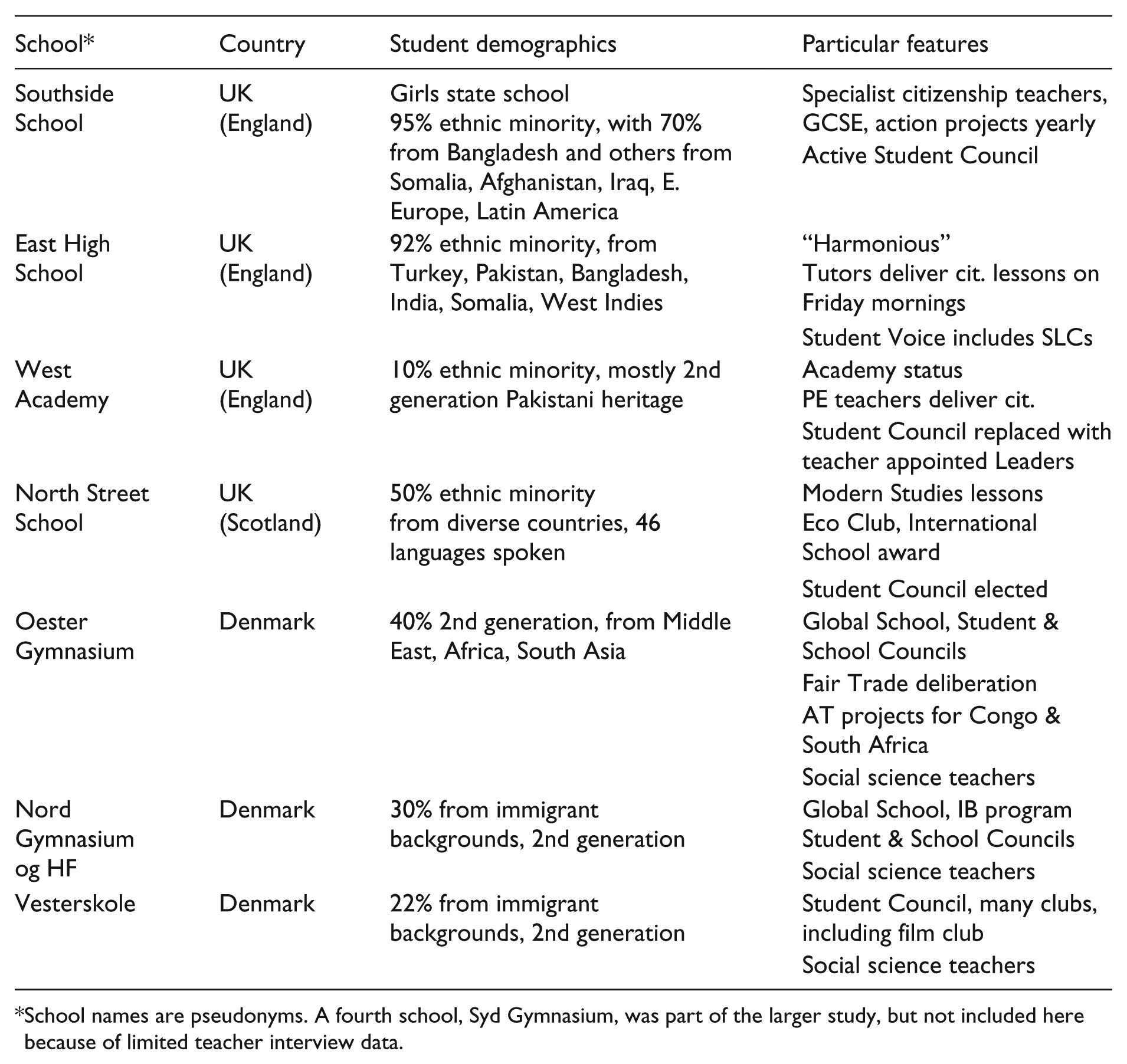
School names are pseudonyms. A fourth school, Syd Gymnasium, was part of the larger study, but not included here because of limited teacher interview data.
Funding
This research was supported by grants from the Spencer Foundation and the Leverhulme Trust.