



Abstract
The development of healthy national identifications in children and youth has important implications for the construction of democratic citizenries in culturally and linguistically diverse societies. In this comparative qualitative case study of two multicultural public schools—one in the United States and one in Costa Rica—I examined children’s understandings of national identity formation. I conducted individual and focus group interviews and ethnographic observations for 12 weeks in each school. I found that children conceptualized national identity using both concrete and abstract elements. In addition, children in each school deployed particular types of narratives to talk about national identifications. Although children in both schools reported ideas of “civic nationality,” children in the US school were more likely to express ideas of “ethnic nationality” (Hoyos et al., 2004). Further, children in the US school reported more cosmopolitan perspectives toward national identity than the children in the Costa Rican School. Based on the findings, I suggest expanding research to study the “national identity maps” of children in multicultural contexts.
Keywords
In 2013, the United Nations Children’s Fund (UNICEF) reported that approximately 7 million of international migrants in the world are children ages 5–9 and that adolescents ages 10–14 make up around 9 million of the total migrant population. In addition, the United Nations High Commissioner for Refugees (UNHCR) estimates that about 46% of the 16.7 million refugees worldwide are children (2013). 1 As the mobility of young people across nations increases, researchers have pointed out that development of healthy national identifications in children and youth has important implications for the construction of democratic citizenries in culturally and linguistically diverse societies (Banks, 2008; Osler, 2010; Waldron and Pike, 2006).
In this article, I share findings from a comparative qualitative case study of language ideologies and civic practices in multicultural schools in two top migrant destination countries in the Americas: Costa Rica and the United States. As part of the study, I included questions about children’s perceptions and construction of national identity in my data collection tools. My purpose in doing so was to look at students’ understandings of how and under what circumstances a person comes to identify herself as member of a national group, and how this was related to citizenship and language practices in each school.
My findings confirmed and expanded previous research on children and national identifications. I found that even when children conceptualized national identity as fixed and as determined by concrete geographical, familial, linguistic, and legal elements, they positioned individuals as having the agency to choose, negotiate, and expand their national identifications in accordance to their particular circumstances. Importantly, I noticed that the children in each school deployed specific types of narratives to talk about national identifications, with children in the Costa Rican school expressing more patriotic perspectives of national identity and children in the United States school expressing more cosmopolitan ideas of national identifications.
In the following sections, I provide an overview of relevant literature on national identity as it relates to children and, more specifically, to children from minoritized groups. I present the theoretical framework that grounded my analysis of the data, followed by a depiction of the sociocultural and educational contexts of Costa Rica and the United States. Then, I describe the research design, data sources, data collection tools, and data analysis process. Finally, I report on the four main themes that I identified in the data: Inhabiting, inheriting, legitimizing, and choosing national identifications, and highlight how they can inform theory, research, and practice.
Relevant literature
In the seminal text Imagined Communities, originally published in 1983, Anderson (2006) proposed that “nation-ness, as well as nationalism, are cultural artifacts” (p.4) and that the nation is an “imagined political community” (p.6). Scholars of nationalism argue that expressions of the nation in everyday life are pervasive (Billig, 1995) and that schools have a critical role in the discursive construction of national loyalties—which commonly promote the exclusion of minoritized immigrant and ethnocultural groups (De Cecilia et al., 1999; Gellner, 1983; Howard and Gill, 2001; Miller, 1997; Smith, 1991). The discursive construction of the nation through education is a prolific research field. Within this line of inquiry, scholars around the world have conducted studies on the relationship between historical narratives and students’ construction of the nation (Barton and Levstik, 1998; Carretero et al., 2012; Peck, 2009). The literature on children’s construction of national identity is also abundant. In this literature review I will focus on studies that (1) address children’s individual and collective national identity development; (2) look at children from immigrant, refugee, or ethnocultural backgrounds; and (3) look at children in heterogeneous school contexts.
Contemporary understandings of national identifications
An individual identification with a nation is commonly referred to as national identity or “the sense of membership in a national group” (Kymlicka, 1995: 13), a feeling of belonging to a nation. A collective identification with a nation, or nationality, is what David and Bar-Tal (2009) describe as a “notion of we-ness that transcends the individuals and leads to a collective action” (p.356) and which “indicates a joint awareness and recognition that members of a group share the same social identity” (p.356). Individual and collective identifications with a nation play important roles in student’s attitudes toward civic engagement and in their construction of democratic civic knowledge and skills. Research on the civic engagement and attitudes of children and adolescents suggests that along with the formal aspects of education, such as social studies curriculum and pedagogy, elements such as classroom climate and school ethos have a significant impact on students’ civic engagement (Angell, 1991, 1998; Callahan and Mueller, 2013; Hahn, 1998; Torney-Purta et al., 2001). These aspects of education are influenced by national cultures and likely to impact the political participation of children and youth.
According to Barrett (2000), national identities are objectified, pervasive, and invisible identities composed of both cognitive and affective aspects. For example, he mentions cognitive elements like the existence of a national group, categorization of the self as a member of that group, knowledge of the national geographic territory, knowledge of institutions, symbols, and traditions that represent national identity, beliefs about the typical characteristics and traits of the national group, beliefs about the self in relation to the national group, and beliefs about how people who are not members of our national group regard our national group (Barrett, 2000). In addition to these cognitive elements, there are affective aspects to national identity, such as “the feelings, emotions, and evaluations which make up the sense of national identity” (Barrett, 2000: 8), like the sense of attachment and commitment to the nation, feelings of affiliation and belonging, national pride, national solidarity and cohesion. In addition, for Barrett and Oppenheimer (2011) “children’s national identifications and attitudes are related to the everyday patterns of discourse and practices that occur within the particular socio-historical settings in which they are living” (p.8).
Children and national identity
In the last three decades, researchers have built a foundation to understand the patterns and contexts of national identity development in children. From a cognitive-developmental perspective, Barrett (2000) has pointed out that the salience of national identity becomes evident in childhood and that children’s knowledge and identification with a nation increases with age. By middle childhood most children have geographical knowledge of their own country, the country of others, and the symbols used to represent countries (Barrett and Oppenheimer, 2011). They also have acquired and developed elaborate national stereotypes, exhibiting a preference and strong national pride for their own country over other national groups, but still demonstrating a liking for those groups (Barrett and Oppenheimer, 2011). Some scholars reason that “national identification appears to be a matter of socialization or enculturation, more than maturity and cognitive development” (Cheoung and Li, 2011: 1507). For example, Cheoung and Li (2011) “examine[d] the effect of ritualized interaction in activities held for a national cause on Hong Kong school children’s identification with China” (p.1490). They surveyed 1788 school children in the seventh to ninth grade and found that “ritualized interaction was both a predictor and an outcome of national identification in that it predicted current national identification sentiment and was predictable by prior national identification behavior” (p.1502).
Qualitative studies have confirmed that children use concrete elements and context-dependent strategies to construct and appropriate national identities, drawing from experiences and narratives with which they were familiar. In a study of national identity in Australia, Howard and Gill (2001) reported on interviews with 21 Anglo-Australian students, ages 11 and 12. Using CDA, the researchers approached the data through the previously established categories of “content” and “strategies.” In the “content” category, they found that the themes of “symbols, stereotypes, and icons” and “everyday life” (e.g. language, standard of living, national characteristics) were common in the children’s responses. In the “strategies” category, they found that children used “rules and definitions,” “comparisons,” and “linguistic strategies” often. In both categories, content and strategies, children largely built from concrete and typified ideas of what it means to be Australian but remained open to new forms of national identity.
In a similar study, Waldron and Pike (2006) conducted qualitative research on what it meant to be Irish. The study was conducted with 119 children aged 10–11 in five primary schools in Ireland. The researchers conducted student collaborative activities to collect drawings and writing samples from all students. They also conducted group interviews with 15 children. Waldron and Pike found that children referred mostly to the material and expressive aspects of culture to refer to national identity. Identification with a national past, comparisons with other countries, and relevance of place of birth were also elements that children associated with national identity.
Carrington and Short (2008) obtained similar findings. They interviewed 265 children, aged 8–12, in one elementary school in the United Kingdom and another one in the United States. The researchers set out to investigate how age, location, and ethnicity influenced children’s national identity. Carrington and Short found that children “construe their national identity in largely concrete terms, referring mostly to its surface features, such as: place of birth, living or working in the country, or ties of consanguinity” and that very few children “viewed their national identity primarily as a form of cultural affiliation” (Carrington and Short, 2008: 120). In an earlier study, Carrington and Short (1995) found that many children’s responses to questions about national identity “were self-evidently racist” (p.236) and assimilative in nature. They suggested that children should be taught “about the differences to be found within any given national group or ethnic group” [emphasis in the original] (p.237). However, they also found that “children were receptive to the idea of a bifurcated identity” (p.237).
In another qualitative study of national identity, this time in Colombia and Spain, researchers Hoyos et al. (2004) interviewed 98 students ages 7, 10, 13, 16, and 19. They identified four levels of thinking about nationalities: (1) nationality as a fixed identity; (2) being unsure about whether a person could change nationalities; (3) accepting nationality changes justified by sociocultural and mobility aspects; and (4) accepting nationality changes justified by legal aspects. Hoyos et al. observed that students advanced along these levels as they grew older, moving “from a conceptualization of nationality as fixed property toward an understanding of the possibility of change” (p.105) [my translation].
As previous research has shown, students in the Hoyos et al. study were also more likely to mention concrete aspects as requirements for nationality regardless of their age. In addition, the researchers noticed that “the ethnic conceptualization of nationality—defined by place of birth, common language and history, and aspects that ensure a strong affective bond—appeared mainly among participants in the first two levels. Whereas the idea of civil nationality—in which they considered the possibility of acquiring a new nationality based on both legal aspects and constitutional requirements—was present in levels 3 and 4” (p.106) [my translation]. Importantly, regardless of the level, “the idea of nationality was presented [by the students] as an essential quality that is never lost and that does not depend on a legal process, but that is strongly intertwined with cultural processes” (p.106) [my translation].
The studies in this section have been instrumental in identifying patterns and concerns related to children’s national identity development. In short, researchers have concluded that the importance of national identity increases with age and that students’ understandings of national identity change with age as well, moving in a continuum from concrete to abstract elements, but always infused with contextual elements. Some scholars have shown concern that children’s thoughts on national identifications often rely heavily on ethnic markers. Yet, researchers report that children express interest, tolerance, and openness toward dual (national), global, and civil conceptualizations of national identity. Not only that, but children actively construct national identity and appropriate dominant ideas about what it means to identify with and be a member of a national group.
Children’s national identity around the world
Scholars have also shed light on the influence of particular national cultures in the construction of national identifications. Findings from research in multicultural contexts indicate that students from immigrant, refugee, and minoritized ethnocultural backgrounds are actively engaged in their national identity development process, often mobilizing sociocultural and historical narratives and counterstories to advocate for spaces that recognize their unique national identifications—spaces that are not always nurtured in schools. For example, Habashi (2008) conducted open-ended interviews with 12 Palestinian children aged 10–13 to explore the meaning of contemporary Palestinian identity in children’s voices. Habashi found that children constructed a Palestinian identity in terms of other (allying, religious, scattered, and oppressor other) and self (geographical, historical refugee, resistance, religious, ennobled, and traitor selves). For Habashi, children’s comments indicated that their “capacity to construct an identity is associated with the familiarity of past generations’ experiences and with their ability to connect to the global geopolitical discourse that affects the local milieu.” (p.28).
Similarly, Moinian (2009) found that children have close family relations that act as ethnic markers. His study of five Swedish children with Iranian parents, aged 12–16, revealed that the children constructed hybrid identities to access various cultural spaces. Moinian (2009) argued that there was a dissonance between the children’s experiences of dynamic identity construction and institutional foci that deemed ethnic categories as fixed and static. Through observations and interviews, Moinian determined that students created a third space where they could perform and recognize their various complex linguistic, cultural, and socioeconomic identities.
In an ethnographic study of first- and second-generation Muslim youth in a Danish folkeskole, Jaffe-Walter (2011) spent seven months conducting participant observations and interviews with students and teachers. She also examined nationalist discourses represented in Danish media and policy making. Jaffe-Walter examined the way in which Muslim immigrant youth positioned themselves and were positioned by others. She looked at the students’ processes of identity formation, at their negotiation of dominant narratives about Danishness, and their construction of critical counter narratives. Jaffe-Walter found that various political discourses “define structures, procedures, and identities that are all deployed to ‘discipline’ the immigrant” (p.200) and that both teachers and students negotiated those discourses employing different strategies. In particular, she found that “counter-narratives support the emergence of a new discourse of cultural citizenship…that moves beyond the binary of Danes and immigrants to insist upon new forms of belonging that incorporate cultural and religious differences” (p.202).
Narrative was also an important component of Koh’s (2010) national identity research with 155 students in the fourth and fifth grade in Singapore and the United States. Koh (2010) conducted observations of social studies classes, interviews, and drawing exercises with children in two schools in each country. She looked at the resources children in multicultural classrooms use in their constructions of citizenship and national identity. Koh (2010) concluded, “minority children from both countries adhere to the general narrative of their national stories but have rewritten it in ways in which they insert themselves personally into the narrative” (p.231). In addition, Koh (2010) found differences between the comments about national identity of children in the two countries. She remarked, “children in Singapore talk about national identity in material terms while American children evoke more abstract ideas” (p.xi). She attributed this to the particular branch of citizenship, either “political” or “patriotic,” that each country sponsored (p.58).
In addition, researchers have illuminated the national identity construction process of immigrant and refugee children and of children immersed in multicultural and pluri-national school settings in contrast to that of children with dominant national identities and/or immersed in homogenous contexts. Murdock et al. (2014) examined the salience of nationality in students’ spontaneous self-concept in one nationally homogenous school and in one nationally heterogeneous school in Germany, where they interviewed and surveyed 221 students aged 12–16. Murdock et al. (2014) found that “the salience of nationality [in particular the nationality of minority students] was significantly higher in the heterogeneous school” (p.129).
Yet, Barrett (2000) reported that, in a previous cross-national project in England and Spain, identifying with the nation was more important for children from the dominant national group (English children in England and Andalusian children in Spain) than for children from minoritized backgrounds (Scottish children in England and Catalan children in Spain). Not only that, but the English and Andalusian children saw themselves as being more British and Spanish, respectively, than the Scottish and Catalan children at all ages. At the time, Barrett (2000) theorized that these differences increase as the children reach their teenage years and children with different sociocultural backgrounds exhibit the trends differently.
In 2011, Oppenheimer and Barrett edited a special issue of the European Journal of Developmental Psychology reporting the findings of a cross-national comparative study in which researchers examined the national identity and in-group/out-group attitudes of 7- and 11-year-old children in Bosnia (Oppenheimer and Midzic, 2011), Cyprus (Mertan, 2011; Stavrinides and Georgiou, 2011), and the Basque Country (Reizabal and Ortiz, 2011), among others, using the Strength of Identification Scale (Barrett, 2007). Importantly,
…the findings from the individual studies as well as the comparative analyses show that theoretical models such as CDT [Cognitive-Developmental Theory] and SIDT [Social Identity Development Theory] that predict universal (developmental) courses for National Identification and in-group/out-group attitudes cannot be maintained across different socio-historical and political settings. (Oppenheimer, 2011: 131)
In light of scholars’ findings, questions remain as to whether specific school, sociocultural, and national contexts might nurture particular types of national identification paths and tools for national identity construction—something that has been suggested by Koh’s (2010) research—and how those paths might relate to children’s civic knowledge and engagement. How do children in academic and national contexts with different approaches to teaching about the nation and about citizenship conceptualize national identifications? In this article, I explore this question and make a contribution to continue building a robust body of literature in this field of study, particularly in Costa Rica and the United States.
Theoretical framework
Although housed in different research traditions and disciplinary fields, most recent studies on the topic of children’s national identification are similar in one way: their authors acknowledge that the construction of national identifications is not influenced by cognitive elements alone, but also by the historical, sociocultural, and academic contexts in which children interact. In this study, I approached children’s constructions of national identifications in the same way, as a dynamic and interactive process among the child and various contextual factors and socialization agents. In addition, I chose to position children as agents in the reception, perpetuation, construction, and contestation of narratives about belonging and membership in a national community. Grounded in the literature, I worked at the intersections of narrative (Bokhorst-Heng, 2007; Fairclough, 2010; Ross, 2007) and critical sociocultural approaches to national identity (Holland et al., 1998; Lewis et al., 2007).
I used Ross’s (2007) conceptualization of narrative, which posits it as the way to express, reinforce, and frame “collective memories and perceptions” (p.30). For Ross (2007), narratives are important because they reveal the understandings, fears, privileged and excluded actors, and normative processes of construction and strengthening of particular events and motivations of a group and, in this case, of the nation as “an imagined political community” (Anderson, 2006: 6). I also drew from Fairclough’s (2010) conceptualization of Critical Discourse Analysis (CDA). Fairclough (2010) describes discourses as “semiotic ways [such as language] of construing aspects of the world (physical, social or mental) which can generally be identified with different positions or perspectives of different groups of social actors” (p.232). As a theoretical framework, CDA highlights the “dialectical relations between discourse and power, and their effects on other relations within the social processes and their elements” (Fairclough, 2010: 8). Not only that, but it looks at social wrongs and at “possible ways of righting or mitigating them” (Fairclough, 2010: 11).
In order to address the collective and constructivist aspects of national identification construction and the role of particular positionings and narratives within those settings, I used Lewis et al.’s (2007) and Holland et al.’s (1998) articulations of sociocultural theory as part of the methodological framework for this study. Critical sociocultural theory explains that children are not passive receivers of stimuli (Corsaro, 2011), but, rather, they have an active role in their learning and socialization processes. Lewis et al. (2007) argue that current strands of sociocultural theory focus on identities and communities of practice, but do not address discourses at the macro level and do not necessarily address how individuals shape activities and produce or resist power as they are situated in particular systems. Critical sociocultural theory provides a framework to examine power dynamics situated at the micro level and embedded in macro-level discourses.
Contexts of comparison
Separated by roughly 1500 miles, Costa Rica and the United States have similarities and differences that illuminate the challenges and possibilities of particular geopolitical contexts for the development of healthy national identifications in multicultural societies (see Tables 1 and 2).
Contextual considerations.
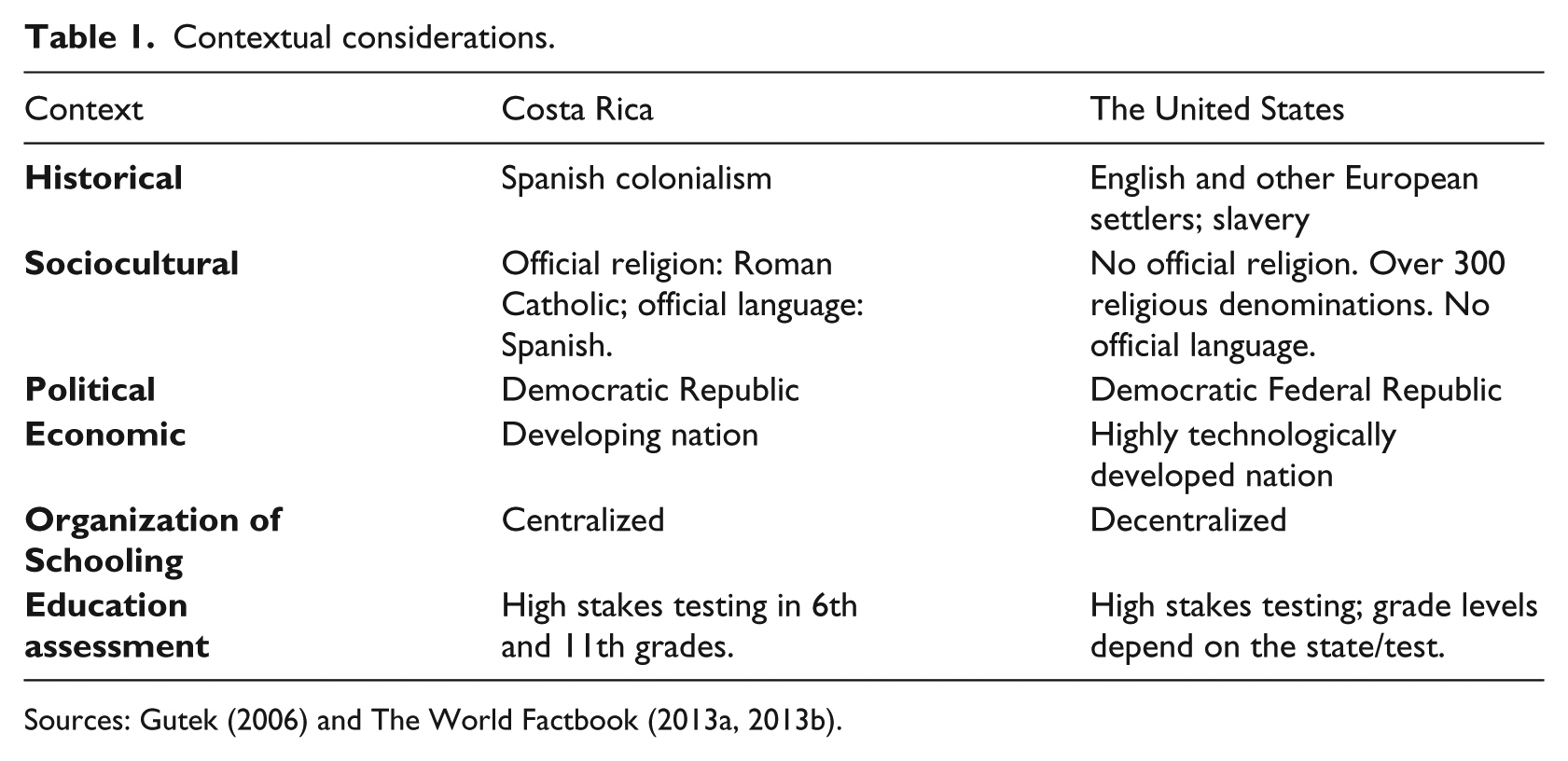
Sources: Gutek (2006) and The World Factbook (2013a, 2013b).
Country demographics.
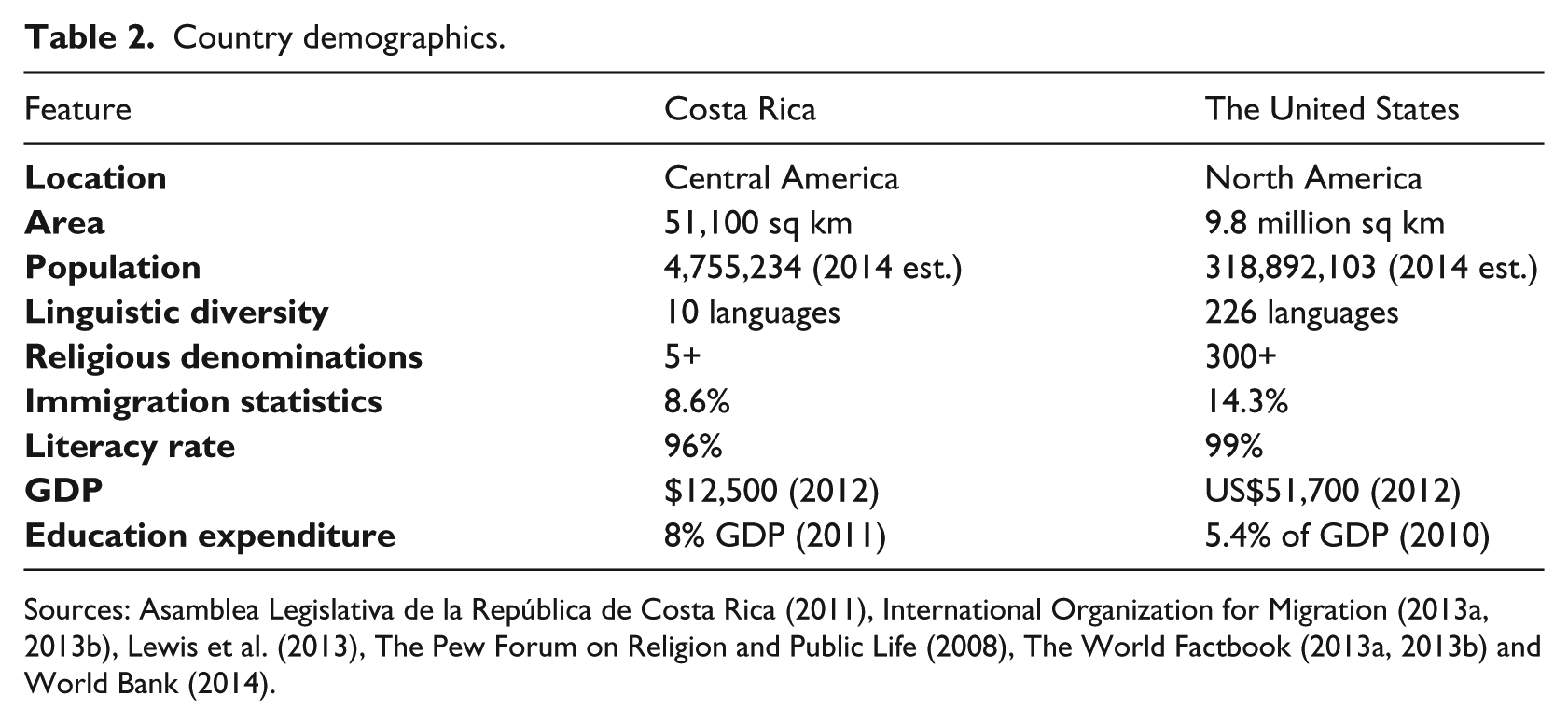
Firstly, Costa Rica and the United States are both stable democracies. A country without an army since 1949, Costa Rica has enjoyed long periods of peace with little, if any, international conflict. Costa Rica’s political stability—coupled with a thriving tourist industry and increasing investment of foreign technology firms—makes it one of the strongest economies in the Latin American region (World Bank, 2011). An exponentially larger country in territory and population, the United States also has a long democratic tradition and ranks at the top of many of the development indicators established by international organizations (Organization for Economic Co-operation and Development, 2012) playing a prominent role in many of them. Described as a “highly technologically developed nation” (Gutek, 2006: 161), the United States has a strong, diversified, capitalist, and market-oriented economy.
Secondly, both countries are top migrant destination countries in the Americas. Costa Rica is one of the top destination countries for migrants in Central America. In fact, migration flows from Nicaragua to Costa Rica are “one of the most important south-south flows in the [Central American] region” (International Organization for Migration, 2013c: para. 7). Costa Rican migration flows are both an emerging field in Latin American scholarly production and an underrepresented area in international academic literature. Only a few researchers have documented the effect of immigration patterns on students’ lives in Costa Rican schools. Yet, contemporary studies of Nicaragua–Costa Rica migration have provided varying types of evidence of persisting deficit thinking, inequality issues, and assimilation in education (Araya Madrigal and Hernández Carballo, 2011; Locke and Ovando, 2012a, 2012b; Paniagua-Arguedas, 2007; Ruiz Guevara, 2009; Sandoval-García, 2004, 2011).
The United States, on the other hand, stands out as the country with “the largest number of international migrants in the world” (International Organization for Migration, 2013b: para. 1). In 2011 alone, the United States admitted 56,384 refugees and 1,062,040 residents (United States Department of Homeland Security, 2011). Most recently, the United States has been the main destination for as many as 52,000 unaccompanied minors emigrating from Central American countries (Tobia, 2014). As in Costa Rica, researchers of immigration and education in the United States have denounced the academic challenges of immigrant and refugee children, who continue to face assimilating tendencies and various forms of exclusion at school (Olsen, 2008; Ovando, 2003; Suárez-Orozco and Suárez-Orozco, 2008, 2010).
In spite of these similarities, Costa Rica and the United States present important differences. The historical and sociocultural context of each country is marked by different patterns of colonization and experiences of racial diversity (see Table 1). Economically speaking, Costa Rica and the United States stand across what has been commonly termed the Global North–South divide. The Global North and Global South refer to distinct geographical regions with different levels of human development and inequality. Most countries ranking high in the Human Development Index from the United Nations Development Programme (UNDP) are located in the Northern hemisphere, whereas countries with mid-to-low human development are located in the Southern hemisphere, including many countries in Africa, Latin America, and Asia. The context of education in both countries is also different. Whereas the United States has a decentralized education system that grants a certain degree of curricular autonomy to states and districts, Costa Rica has a centralized education system that prescribes education for the entire country. For instance, in the United States, individual states write their own social studies standards, which are often modeled on the standards created by national organizations such as the National Council of Social Studies (NCSS). In Costa Rica, schools follow the guidelines in the Programa de Estudios Sociales y Educación Cívica [Social Studies and Civic Education Program] drafted by the Ministry of Education (MEP).
Methodology
I drew the data for this article from a comparative qualitative case study in which I investigated civic practices and language ideologies in one multicultural classroom in Costa Rica and one multicultural classroom in the United States (Solano-Campos, 2014a). I conducted four months of fieldwork in the United States during the spring of 2012 and four months of fieldwork in Costa Rica during the spring of 2013. The fieldwork included document/policy analysis, 12 weeks of ethnographic observations in each country, interviews, and focus groups with participating fourth-grade children in one classroom in each school. In this article, I report on the comparative data and findings related to children’s national identity specifically. 2
Research sites
The two schools where I conducted fieldwork were public schools located in urban areas, and they both enrolled large numbers of immigrant or refugee students from low socioeconomic backgrounds. I purposefully selected these schools not only because of their demographics and location, but also because of their explicit support of global and culturally relevant pedagogy. After contacting the principals to discuss the study, I invited them to nominate a classroom or teacher that would be appropriate, available, and willing to participate.
Escuela Montaña Verde
Escuela Montaña Verde (pseudonym) was an urban public school located in Costa Rica’s Central Region, in what is known as the Gran Area Metropolitana, in one of the counties with the largest concentration of Nicaraguan immigrants in the country (Castro, 2011: 21). The school enrolled children from various neighboring areas, a significant number of which came from one of the largest binational communities in the country, a nearby community often labeled as a precario [shantytown]. Neither the Ministerio de Educación Pública (MEP) nor the school administration had statistics on the national background of the students at the time of my research there. However, I had anecdotal evidence from the teachers that many of the children who attended the school were immigrant children or children from binational households who faced great economic needs. The school staff implemented what they called an “integral and inclusive school model.” According to school materials, the model was based on human rights and implemented through “inclusive practices that promote attitudes for understanding and valuing human diversity in the student body, families, faculty, and staff” (Escuela Montaña Verde, Institutional Brochure, 2013).
As a public school, Escuela Montaña Verde followed the Programa de Estudios Sociales y Educación Cívica [Social Studies and Civic Education Program] drafted by the Ministerio de Educación Pública de Costa Rica [Costa Rican MEP]. The textbook that the homeroom teacher used for social studies, Saber de Estudios Sociales 4, divided the content in three trimesters (aligned with the academic school year in Costa Rica) and included convivencia [coexistence] as a tema transversal [theme incorporated across all units]. The first trimester included lessons on Costa Rican cartography, geology, and geography. The second trimester included the study of Costa Rican geography, climate, and environmentalism. The third trimester included units on Costa Rican history, civic education, and peaceful conflict resolution (Murillo and Vásquez, 2013).
River Song Elementary
River Song Elementary (pseudonym) was a public charter international school located in one of the largest refugee resettlement areas in the United States, in a large metropolitan area in the Southeast. According to school materials, two thirds of the students enrolled in the school lived at or below the poverty level and almost 50% of the student body was made up of children who were immigrants or refugees. The students came from approximately 40 different countries and spoke up to 25 languages (School printed material, 2010). River Song Elementary followed the education standards required by their state but also the curricular guidelines established by the International Baccalaureate Organization (IBO) Primary Years Programme (PYP; 2000, 2009). The IBO PYP emphasized skills conducive to responsible citizenship, global engagement, and intercultural understanding. The state performance standards for fourth-grade social studies integrated United States geography, civics, and economics, and had an emphasis on United States history to 1860. Unlike most public schools, River Song Elementary did not use social studies textbooks. Rather, most of the content for the social studies class came from the USA Studies Weekly, a weekly magazine from a US publishing house.
Participants
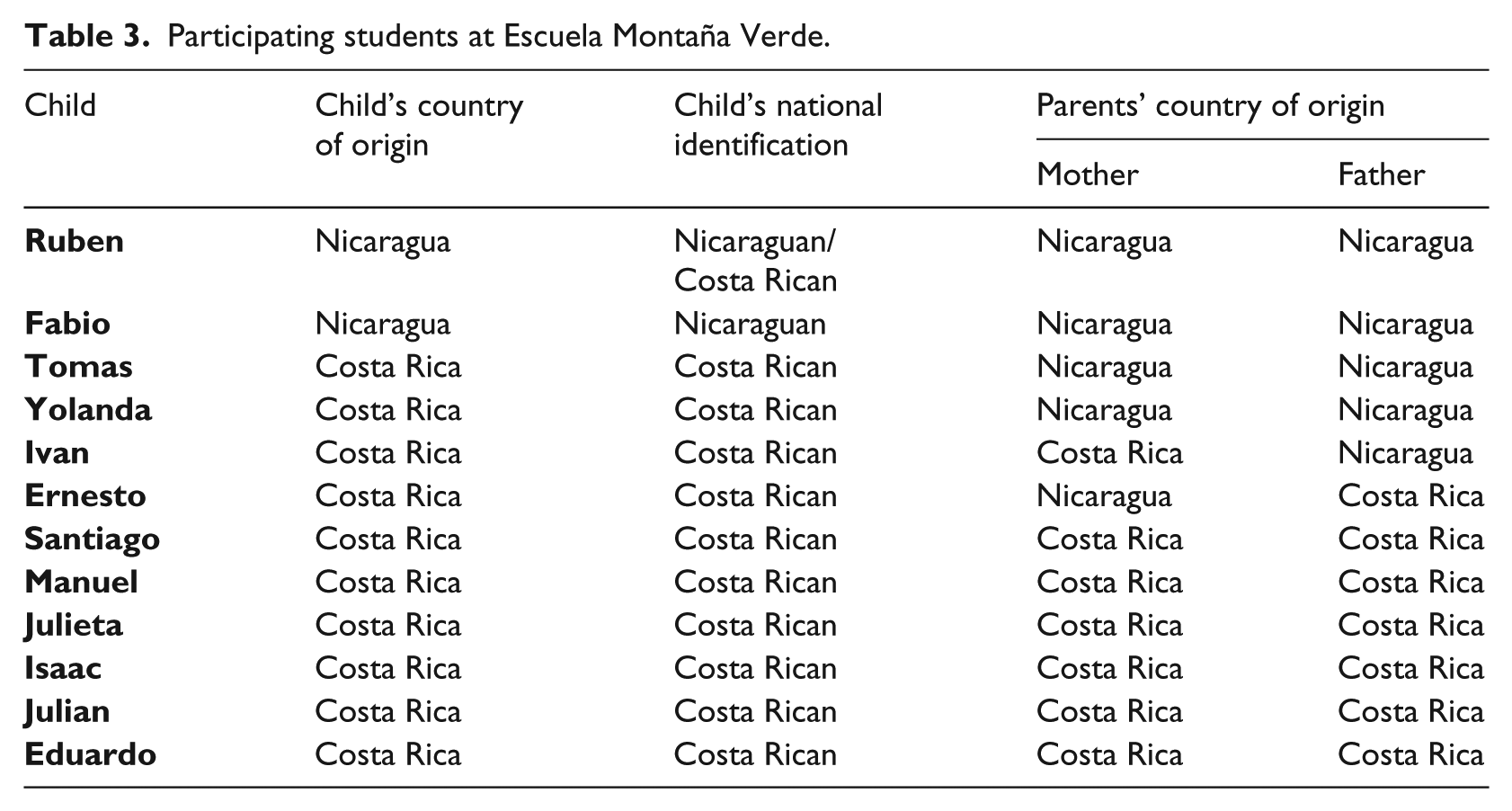
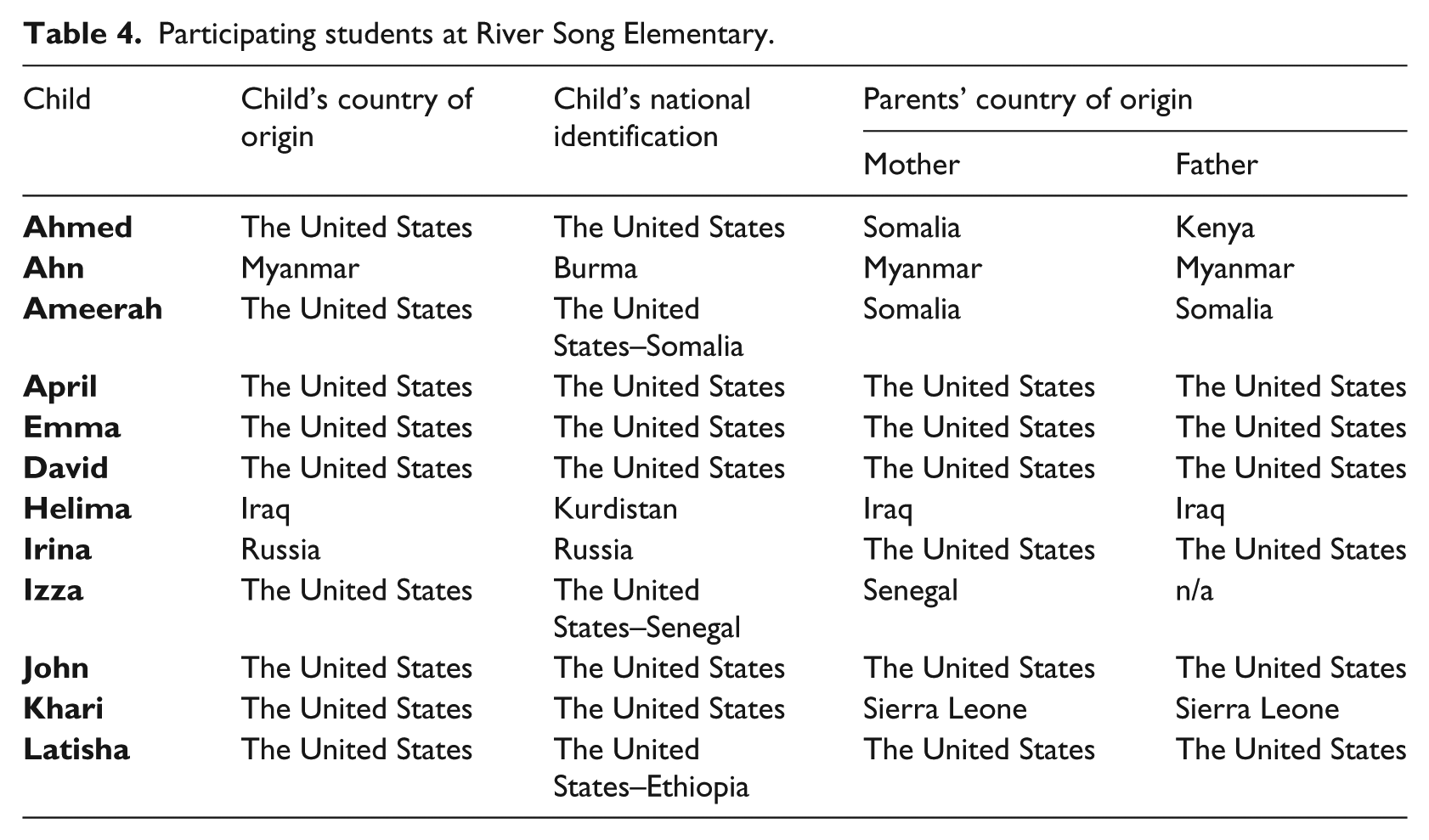
Students in middle childhood are at a crucial age in which awareness of social, national, and global issues increase (Barrett et al., 2003; Huston and Ripke, 2006). Taking that into consideration, I purposefully selected a fourth-grade class in each school. Twelve fourth-grade students in each school participated in the study. The students had diverse national backgrounds (as shown in Tables 3 and 4).
Participating students at Escuela Montaña Verde.
Participating students at River Song Elementary.
I used pseudonyms for all students, teachers, and informants, as well as schools.
Data sources
I conducted individual and focus group interviews with the children to explore various aspects of national identity and nationality. I planned guiding questions that elicited specific information from the children (Table 5).
Guiding questions.
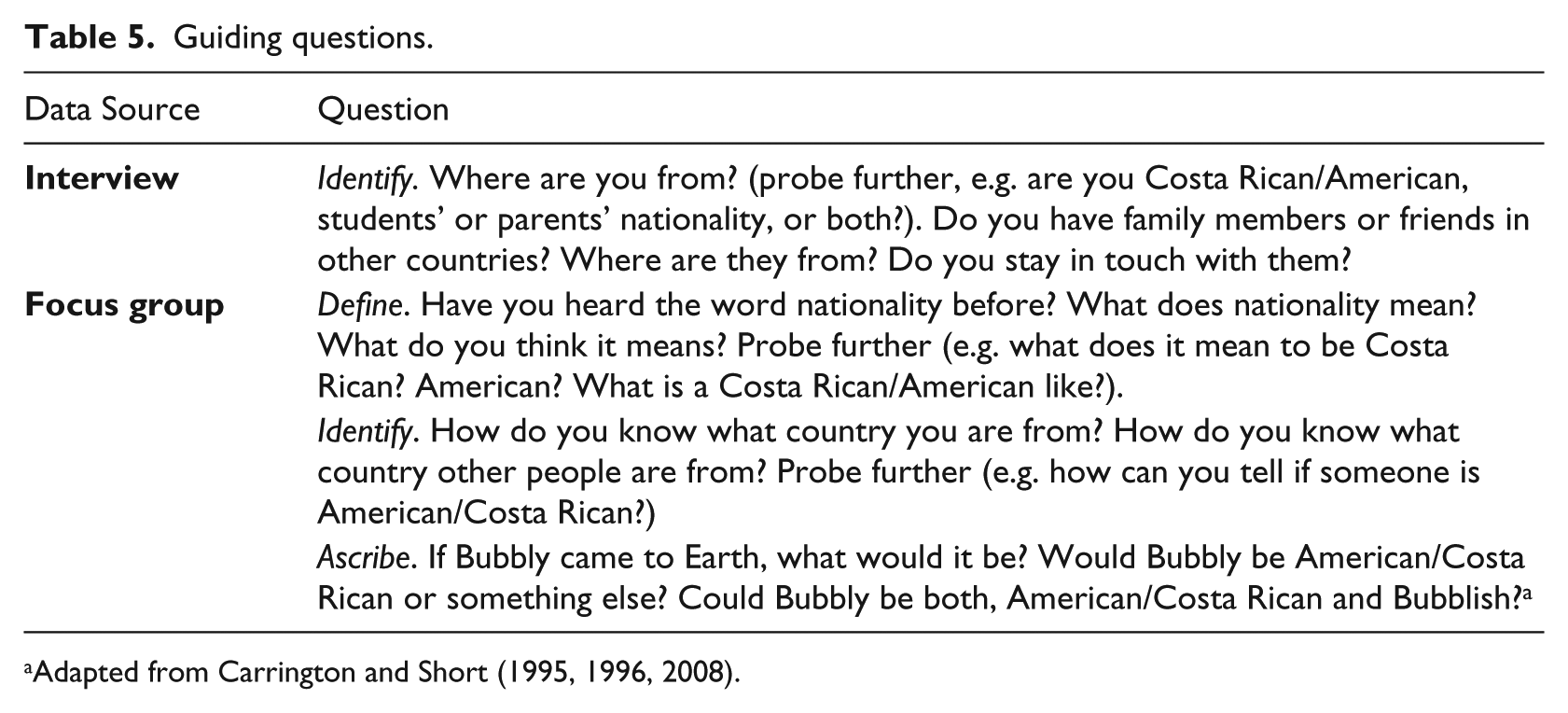
Adapted from Carrington and Short (1995, 1996, 2008).
The questions were a starting point. During our conversations I asked children further questions to encourage them to elaborate on their responses and to clarify meaning. Whereas the interviews allowed me to get to know the students better and to learn about their various identifications and family background, I also designed a focus group protocol. The purpose of the focus groups was to reveal “children discursively constructing their understanding about these issues: their choice of examples, the ways they chose to approach the questions, their inclusions and omissions were part of the group’s negotiation and construction of meaning” (Howard and Gill, 2001: 101).
Based on other studies that have used imaginative response to engage children in research activities (Carrington and Short, 1995; Koh, 2010; Waldron and Pike, 2006), I presented children with the task to explain to someone unfamiliar with Earth how they understood various concepts—among them national identifications. More specifically, I modeled the focus group interview protocols after Krott and Nicoladis’ (2005) Alien Puppet Interview (API). In my adaptation of the API, I assigned the character the name “Bubbly” (“Burbujeante” in Spanish) and asked the children questions that prompted them to define, identify, and ascribe national identifications. In addition, I conducted ethnographic observations for an average of 12 weeks in each school. However, for this article I focus on students’ understandings and only use data from observations to provide context for some of the students’ explanations.
Data analysis
I analyzed the data using Constructivist Grounded Theory (Charmaz, 2006), which acknowledges the central role of the researcher in the co-construction of the data and interpretation of the findings. I conducted open coding for transcripts and fieldnotes to identify meanings, actions, and processes that were important for the participants. Whenever possible, I used in vivo codes to preserve participants’ views. I also constantly compared codes across transcripts. Through the revising and refining of the initial codes, I established tentative categories and relationships among the codes. Next, I conducted focused coding. During this stage, I wrote memos and created graphic organizers to determine the codes that more appropriately captured and synthesized the main ideas in the participants’ comments. Finally, I triangulated data among data sources and elaborated on the main themes, patterns, and conceptual categories that I identified.
Findings
In this study, I examined how children in Costa Rica and the United States talked about individual and collective national identifications. I also looked at the ways in which they defined, identified, and ascribed national identifications and at whether these differed from one national context to the other. I found that children in both schools described the process of national identity construction as determined by place of birth and parental identity. However, some of the children also highlighted that people have the agency to choose, negotiate, and expand their national identifications according to their particular cross-border journeys. In addition, I found that whereas children in the Costa Rican school were more likely to highlight patriotic ideas of national identifications, the children in the school in the United States were more likely to communicate cosmopolitan ideas—something that aligned with the school-specific curricular and pedagogical orientations that I observed during class time. In the following sections, I elaborate on the main themes that I identified in the data: inhabiting; inheriting; legitimizing; and choosing national identifications (See Table 6).
Theme distribution by school.
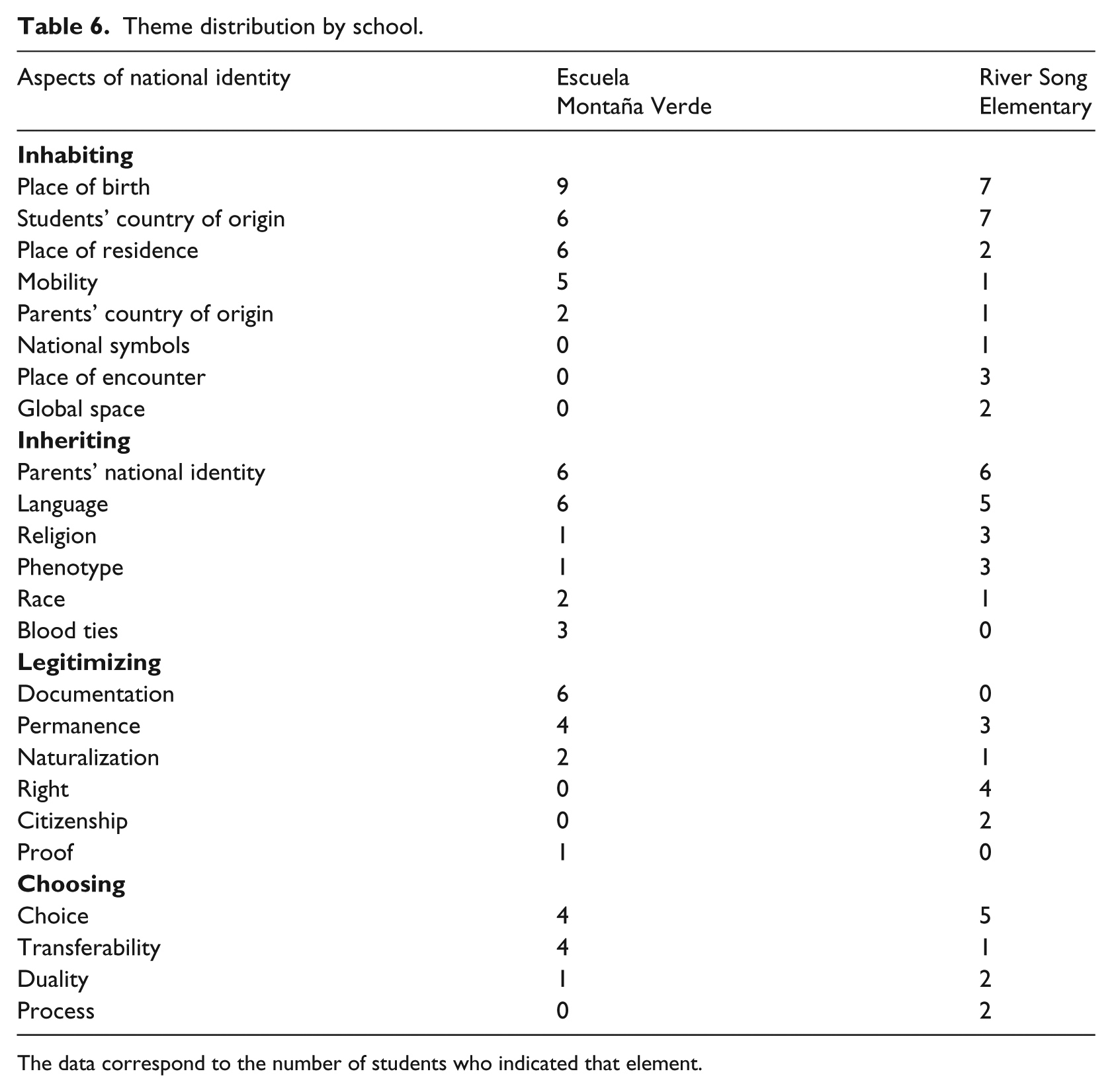
The data correspond to the number of students who indicated that element.
Inhabiting national identities
Place of birth was the single most important condition of national identification mentioned by the children. Across the two schools, half of the children who described national identifications as place of birth also made statements about the unchangeable nature of national identity, with the children at Escuela Montaña Verde indicating the most territorial attachment in their responses. In addition, a third of the children in Escuela Montaña Verde commented that a person’s place of birth determined that person’s nationality for life.
Many children at River Song Elementary agreed that place of birth was central to national identifications, arguing that Bubbly would still be Bubblish if he moved to the United States. However, their reasons varied from that of their Costa Rican peers. For instance, Izza remarked that Bubbly would continue to be Bubblish because “he was born in that planet Bubbleland. And then he just came to Earth; so, he doesn’t know a lot of things of Earth.” For Izza, place of birth did not determine Bubbly’s identification with Earth, but the length of his stay on Earth did.
The second most frequently cited condition of national identity was nation-based. For instance, Eduardo, a student at Escuela Montaña Verde, pointed out that nationality was “like the nation you are…let’s say, like Costa Rican or another country,” whereas Ameerah, a student at River Song Elementary, mentioned, “nationality means like your nation and where you come from. Like me I come from Somalia, and that is my nationality.” Students informed their responses with their knowledge of the word nation, a cognitive and linguistic strategy to infer meaning, but were quick to elaborate on their comments with geographical knowledge and personal experiences. Place of residence was an important feature of national identity for the children in Escuela Montaña Verde, but not as much for the children at River Song Elementary. When asked to identify or ascribe national identifications, the children in both schools mentioned place of residence, mobility, and parents’ place of origin as relevant indicators.
As previous researcher have found (Waldron and Pike, 2006), I noticed that bringing up issues of mobility often challenged children’s ideas about national identifications, and particularly about the role of place of birth in the construction of national identities. When I presented the children with questions such as “What would happen if Bubbly comes to Earth, what would it be?” most children responded that Bubbly would continue to be Bubblish. The children had different reasons to support their responses. For example, Julieta stated, “[Bubbly] can’t move from country to country to country to country….” For Julieta, mobility stood contrary to her understanding of a collective national identification.
In both schools, children shared with me experiences of transit and settlement across countries as well as of transnational networks that they maintained via Skype, telephone, and email. At River Song Elementary, six children (Izza, Ameerah, Khari, Helima, Ahn, and Ahmed) reported having relatives abroad, in their country of origin or another country. From those children, five indicated using computers, more specifically Skype (2), email (2), and Facebook (1), to stay in touch. The remaining child, Ameerah, simply said “I talk to them on the computer”. Three of the children reported visits as a way to stay in touch and visit their relatives, whereas Izza and Ahmed reported that their mom visited their country of origin. Izza, for example, remarked “when my mom is at Senegal, she bring me something back”. Finally, Ahn reported plans to visit her family in Myanmar in the upcoming summer.
The children at River Song Elementary described nationality as meeting and getting together with people from other countries and as sharing and talking about your national background with those people. Their comments reflected the international orientation of the school. For example, John pointed out that “[nationality is] like the whole world.” His all-encompassing and global definition of nationality stood out among most of the children’s ideas, yet it complemented some of the answers of other children at River Song Elementary, who defined nationality as the coming together and sharing of people from different national backgrounds.
At Escuela Montaña Verde, six children reported having relatives in another country—Nicaragua in most cases—and visiting with them often (Yolanda, Tomas, Ruben, Fabio, Ernesto, and Ivan). However, only one of the students reported speaking to family members abroad through the computer. The rest of the children indicated that they talked to their relatives over the phone. Overall, the children in the Costa Rican school remarked that having family in other countries was a positive experience because it brought them opportunities to increase their cultural, economic, and social capital. Unlike the children at River Song Elementary, the children at Escuela Montaña Verde did not make multicultural or global references in their comments about national identifications.
Unfortunately, students’ transnational physical and virtual journeys were not explicitly utilized in classroom instruction or reflected in school curriculum and textbooks. In fact, the social studies lessons, textbooks, and curricula that I observed in each school focused on “mainstream” epistemic resources for civic identity, which were nation-centered and communicated ideas of citizenship as an individual and legal relationship with one nation-state. This would partly explain why mobility was mostly perceived to exist in opposition to national identifications and why national identifications (both individual and collective) were described by many children as existing only within the geographical boundaries of one country.
Inheriting national identity
The children in both schools expressed learning about their own national identifications from their parents and described their national identifications as a quality that was “passed on” to them by family members. Across the two schools, the familial context featured prominently as students’ main source of information about their national identity. Only one child, Isaac from the Costa Rican school, mentioned the media as an influence in the construction of national identifications saying, “[We know we are from Costa Rica] because our parents tell us, or we hear it in the radio.”
The children at River Song Elementary were more likely than the children at Escuela Montaña Verde to speak about nationality as something they inherited from their parents. This was Ameerah’s case; she mentioned “[I know where I am from] because my parents are from the country, and then that goes on to me.” Khari too, said,
You can ask your parents where are they from; then, that can be your nationality…It’s hard that most of the people here are not really from another country, they were like born here, but their parents are from a different country; so, they go with their parents’ country.
Children at River Song Elementary were also more likely to highlight that they had asked about their national identities rather than just been told about them.
Contradicting findings from other quantitative and qualitative studies on the topic, few children in each school used identity markers when I asked them about national identifications (two children at Escuela Montaña Verde and two children at River Song Elementary). However, when I prompted the children to share how they knew where they or others were from, students talked about characteristics that people embodied and that they could “see” or “hear,” such as language, phenotype, and clothes or food. Language was the single most important identity marker that the children mentioned in their responses. Only two children across the two schools mentioned language in their definition of nationality. However, when I prompted the children to identify someone’s national identification, six children at Escuela Montaña Verde and five children at River Song Elementary reported language or accent as a relevant national identity marker. For instance, Helima, one of the students at River Song Elementary said, “[I know where I am from because of] how they speak, my parents, and my parents were born in Iraq, and they said I need to speak Kurdishian, and that is what I think.”
At Escuela Montaña Verde, Eduardo stated, “Because of the accent…There are various accents.” The importance of language for national identity is best illustrated in Ahmed’s comment. Ahmed, a student at River Song Elementary, indicated that even if Bubbly was not able to become American, he could become an English speaker. The following excerpt illustrates this:
Ahmed: Uhm, He is going to be Bubblish. Ana: Only Bubblish…Even if he lives here [in the United States] for a long time…? Ahmed: No…He can learn English… (FG3: 152–154)
In this example, Ahmed seemed to suggest that even if claiming an American identity was not within Bubbly’s reach, claiming a linguistic identity associated with the United States was possible; he would be able to identify with the United States linguistically by speaking English.
The children at River Song Elementary were also more likely to mention identity markers such as religion and race. For instance, Izza remarked
I asked my mom and then she told me that I was a Muslim, but I didn’t really know that I was a Muslim because she told me when I was young, and so I just kept on learning and learning, and then I learned about a lot of things, and I asked where I was from.
April, on the other hand, mentioned race as a marker of nationality during one of the focus groups. After explaining that nationality was “all of a country,” April asked to change her definition and explained “Nationality means like if you are black or white or Native American, like your skin color…that is your nationality.” The conversation then took an unexpected turn. The other children in the group gave her surprised and angry looks. Ahmed immediately blurted out “how dare you!…Black ain’t no [nationality].” Sensing the tension and trying to guess what she had said “wrong”, April clarified “you could say African American, I guess” (FG3: 129–131, 138–139).
This animosity toward the mention of race from the children was not a one-time occurrence. On the contrary, during my fieldwork at River Song Elementary, I noticed that students were quick to point out that mentioning someone’s race was not appropriate, a behavior that would align with the concept of “colormuteness” (Pollock, 2004), or a tendency to avoid talking about race. The opposite was the case at Escuela Montaña Verde, where only one of the children commented on physical characteristics. Ivan mentioned “[Nationality] is to be different from others…Like, we don’t look alike [pointing to Santiago]; the same with Ruben… we are not alike, none of the three of us looks alike.” Ivan’s answer was qualitatively different from April in that he focused on the fact of being similar or different, whereas April emphasized belonging to a particular ethnic or racial group. In looking at the responses from the children in both schools, I found that children at River Song Elementary provided more responses associated with what Hoyos et al. (2004) termed ethnic nationality or nationality based on place of birth and a common language and history (p.106) than the children at Escuela Montaña Verde.
Legitimizing national identifications
In their study of national identifications in Spain and Colombia, Hoyos et al. (2004) reported that participants who considered nationality as a characteristic susceptible to change were also more likely to express the idea of civil nationality, or nationality based on “both legal aspects and constitutional requirements” (p.106). They found that participants were more likely to indicate expressions of civil nationality as they grew older, from 10 years old onwards. In alignment with Hoyos et al.’s (2004) research, most participants in this study, nine students in the Costa Rican school and seven students in the school in the United States (16 out of 24 students total), referred to legal documents or constitutional processes as sources that legitimized a person’s national identity.
Although children in both schools talked about legitimizing national identifications via official channels, they did so in different ways. The children at Escuela Montaña Verde stressed the importance of legal documents to justify a particular national identity—almost always the Costa Rican identity—and of going through the naturalization process to make their dual or Costa Rican identifications official. At Escuela Montaña Verde, Ivan commented, “If he [Bubbly] is from space, he is from space. He might be from Costa Rica, but actually no, he would always be from space because his birth certificate from where he was born was from space.” Other students in the Costa Rican school, like Ernesto explained,
If he [Bubbly] goes to Nicaragua we would be Nicaraguan; he can be both…but he has to naturalize. Right now he would be Bubblish because he has not naturalized. Naturalization is switching your country in Migracion [the public agency in charge of citizen and immigrant issues]. So yes, he can be Bubblish and Costa Rican.
Santiago, also a student at Escuela Montaña Verde, added that “if he [Bubbly] married a Costa Rican wife, then he can be from Costa Rica.”
In contrast, the children at River Song Elementary indicated the right of all people, regardless of origin or appearance, to choose to affirm their original national identity rather than the nationality of their host country. In fact, three students at River Song Elementary supported their arguments that national identification is a choice by deploying narratives of freedom and constitutional rights. For example, Helima shared: “I think, you come to America, and you need to be, you can be any country because, uh, because if some people are not from here, they can come here because it is a free country to live in.” Similarly, Ameerah stated, “Well you don’t have to be American. You can be Bubblish because I am from Somalia and, I am in America, and I, uh, can be Somalian because that is a part of speech and a part of [the] American constitution.” Finally, Ahn mentioned, “he can, uh, he can be anything he wants, still a free country for everybody.”
When posed with the question of whether Bubbly would be Bubblish, American, or something else, Irina, a student at River Song Elementary, mentioned US citizenship—something that was not addressed by the children at Escuela Montaña Verde. She said, “[Bubbly would be] a US citizen…because he would have done the test and he would have passed it…if it is in his language…”
I interpreted the children’s comments as indications that their expressions of civil nationality mirrored dominant ideas of nationality present in their lives and school curriculum. In the Costa Rican school, the children were familiar with various processes of naturalization and assigned high importance to the possession of legal documents as proof of national membership. They seemed to draw this knowledge from their own or their relatives’ experiences and from school events. At River Song Elementary, the children’s comments reflected the content of social studies lessons I observed on the US Constitution and Bill of Rights. Their comments, which were less nation-centered than those of the Costa Rican children, also reflected the international orientation of the school.
Choosing national identifications
The theme of choice was also present in children’s comments. They described themselves as agents in their own identification with a nation and spoke to the different degrees of agency that people employ in constructing their national identifications. Although approximately one third of the children in each school spoke about national identity as a choice a person could make, only three children, Ameerah, Izza, and Fabio, reported identifying with two nations. This finding seems to indicate that even if children are aware of their ability to draw from various identifications and have the opportunity to do so, they do not always do it. It is thus important to ask what barriers are preventing children from being able to embrace multiple national identities, and, more importantly, to explore how educators can remove some of those barriers. In the Costa Rican case, I found that the prejudice against Nicaraguans was so strong in the society at large, that children often hid or concealed their parents’ Nicaraguan backgrounds from peers and teachers. Some Nicaraguan children also deployed the practice of “passing” as Costa Rican.
The theme of choice was more likely to be mentioned when I asked the children to ascribe a national identification to Bubbly (e.g. what would Bubbly be?) or presented with the option, would Bubbly be both American/Bubblish and Costa Rican/Bubblish? However, only four children across the two schools (John, Helima, and Khari at River Song Elementary and Ernesto at Escuela Montaña Verde) mentioned that Bubbly could hold dual national identities without specific restrictions. For instance, John, a student at River Song Elementary, stated, “he [Bubbly] would be the nationality of another world…He would be American and Bubblish… because he was from the planet Bubblish, and he moved here.” Some children indicated that Bubbly could switch its nationality but could not hold two nationalities at the same time. Fabio illustrated this when he explained, “[Bubbly] was born in Bubbleland…He is Bubblish… I am not sure why…But he cannot have both, because he was born in one country not in both.” Fabio’s comment was particularly interesting because he did identify himself as both Nicaraguan and Costa Rican. This suggested that whereas Fabio saw official and collective identifications with a nation as changeable but not overlapping, he considered his own affiliations to both Costa Rica and the United States as permanent and, more importantly, in coexistence with each other. Julieta, too, placed restrictions on Bubbly’s ability to choose its national identifications saying, “He [Bubbly] can also choose but he can’t move from country to country to country to country.” She indicated an expectation that settlement was a requirement for national identifications.
Discussion
In this study, I looked at children’s perspectives on national identifications in two multicultural urban schools, one in Costa Rica and another one in the United States, at two different points in time, the Spring of 2012 and the Spring of 2013. As such, the findings that I reported do not reflect the experiences of all children in those schools, or of children in other geographical and national settings. However, their experiences illustrate the potential challenges and possibilities for national identity construction in similar settings. With this in mind, I share some final thoughts to inform research, theory, and practice. I discuss four important issues to consider.
First, each student reported a different combination of elements and rules for national identity and nationality. For instance, at River Song Elementary, David explained that national identifications transcended location but were bound to place of birth. In other words, Bubbly could retain his Bubblish identity in the United States, but could not claim an American identity. Other students had understandings of national identifications that combined seemingly contradictory elements. In April’s case, for example, she spoke about nationality in terms of national boundaries, place of birth, and race, but also talked about it as a choice. In future research, it would be important to look at how individual students construct their unique trajectories over time by creating “maps” of student national identifications. These maps would serve to examine how students’ paths are similar/different and conducive to what type of civic knowledge, attitudes, and behaviors in the long run. This information could in turn be used to inform national identification theories and to design student-based curricula and teaching practices that acknowledge and draw from students’ backgrounds to complement and/or strengthen particular civic skills. Using the concepts of transnationality (Kivisto and Faist, 2010) and transnational multicultural education (Arshad-Ayaz, 2011) in curriculum and instruction would be important to this end.
Second, the nature of the questions in the data collection tools, whether they were questions that asked the children to define, identify, or ascribe national identifications, reflected different facets of children’s understanding about national identity construction. As many other researchers have reported, the children in this study referred mostly to concrete tangible aspects of national identity. There were important differences on how and when the children referred to those elements, which can inform future research and practice.
Children were more likely to provide concrete elements in their answers if the question asked them to define or identify national identifications. When I prompted the children to ascribe, they reported more abstract elements. This suggests that the documented tendency of children to report concrete aspects of national identity might also have to do with the particular line of questioning and not only with their cognitive development or with their particular social/national context. Although there is a need for more research to examine this finding in depth, it seems that the content of interview and survey questions in existing research might be limiting the information that children feel compelled to share. If that is the case, researchers, educators, and students will benefit from question/prompt design that includes various cognitive levels and that exposes students to complex or controversial issues and dilemmas. The latter is needed because researchers have found classroom discussion of current events and controversial topics can enhance students’ civic knowledge and engagement (Hess, 2002); however, we do not yet know how that process interacts with national identity.
Third, children’s responses aligned with their particular school and national context. Like Koh (2010), I found that the children in the school in the United States used more abstract ideas than the children in the Costa Rican school. Not only that, during my observations I noticed that Costa Rican schools followed a more “patriotic” approach that was close to Koh’s description of Singaporean schools. I also found that, not surprisingly, the answers of the children in the Costa Rican school were more nation-centered.
In contrast, children in the United States school mentioned constitutional rights/processes and multicultural/global ideas in relation to national identifications. Their answers were also more likely to present elements of ethnic nationality and students seemed to be more willing to embrace the fluidity of national identifications. Although students’ responses in both schools seemed to map onto the nation and school-specific curricula, Koh (2010) warns that children “have been trained to simply present back to teachers [or in this case, researchers] what they are taught” (p.165) and their responses might align with the school curriculum because they have been socialized to do so, not necessarily because those curricular elements are salient to them. There is, thus, a need for more research that could help to clarify and account for this particular finding. For example, how is the degree of patriotism included in the curriculum (or the type of education system, or the depiction of cultural diversity in textbooks) related to students’ national identifications and civic actions, if at all? How would this vary across countries? What would be the implications of those studies for teaching practice?
Finally, the use of imaginative response presented challenges and opportunities. I designed Bubbly’s journey to Earth as a metaphor of cross-border dynamics in both Costa Rica and the United States. Whereas the introduction of Bubbly was meant to produce a safe and fun environment for the students and to prompt them to think about issues they might empathize with, I noticed that some of the children took the idea of Bubbly literally and responded with fictionalized answers, after which it became significantly more challenging to drive back the conversations to responses grounded in the Costa Rican and United States sociocultural realities. In spite of this, the use of Bubbly afforded the children the opportunity to think about migration and identity without the constraints and fears of explicitly connecting the interview and focus group questions to their immediate school and home contexts. Bubbly gave the children “permission” to share their ideas. In the pilot stages of the study, I tried two approaches, providing a physical/visual representation of Bubbly and telling students about Bubbly without giving them any cues as to its appearance. The latter worked better because students were able to make their own interpretations of who Bubbly was, often co-constructing Bubbly’s character with their peers. This imaginative ownership of Bubbly seemed to aid students’ divergent thinking (e.g. their willingness and ability to explore multiple possibilities or outcomes, such as a person being able to identify with two nation-states). However, this remains an observation at the anecdotal level and needs to be further explored.
Conclusion
In this article I presented findings from a comparative qualitative study of two multicultural public schools, one in the United States and another one in Costa Rica. Through individual and focus group interviews, I examined children’s understandings of the process of national identity formation. I identified four main themes in children’s comments: inhabiting, inheriting, legitimizing, and choosing national identifications. I found most children in both schools conceptualized national identity as fixed and as determined by concrete geographical, familial, linguistic, and legal elements. However, some children also positioned individuals as having the agency to choose, negotiate, and expand their national identifications in accordance with their particular circumstances. Specifically, I noticed that the children in each school deployed particular types of narratives to talk about national identifications. Whereas children in the US school were more likely to express ideas of what ethnic nationality, the children in the Costa Rican school were more likely to express patriotic perspectives of national identity. Children in both schools reported ideas of civicnationality, with children in River Song Elementary pointing to more cosmopolitan elements than children in Escuela Montaña Verde. Together, these findings confirm earlier research pointing to the complexity of national identity formation. I suggested expanding research to study the “national identity maps” of children in multicultural contexts, to include research tools that engage children in higher level thinking about controversial issues, and to design research studies that engage children in safe and imaginative exercises.
Footnotes
Funding
This research received no specific grant from any funding agency in the public, commercial, or not-for-profit sectors.