




Abstract
Background:
A programme of research (PoR) is a cohesive and succinct expression of a researcher’s area of interest, capturing their passions and commitments, as well as their capabilities. A PoR takes the form of a series of related research projects with a specific focus on a knowledge gap, related to the researcher’s discipline. One way in which a PoR can be supported is through the articulation of a clear research aim and capability statement.
Aims
This paper aims to provide early career researchers (ECRs) with a process to develop their own capability statements, providing examples from a professional development activity undertaken by the authors.
Results:
This paper provides a five-step process for researchers to develop their own capability statement and gives examples and prompts to support this.
Conclusion and contribution to nursing:
Reflections on the value of this process are provided, demonstrating a gap in current ECR processes in articulating their own capabilities.
Keywords
Introduction
The world of academia and research is a complex fusion of teaching, research, industry liaison, funding acquisition and outcome dissemination, with the aim of contributing to worthy change and understanding. Project funding for research is highly competitive, with success often driven by the researchers’ track record, skills and experiences which may be clearly articulated within one’s programme of research (PoR).
A PoR may be described as a cohesive and succinct expression of a researcher’s area of interest, capturing the passions and commitments of the researcher (Holzemer, 2009) as well as their capabilities. A PoR takes the form of a series of related research projects with a specific focus on a knowledge gap, related to the researcher’s discipline (Pranulis, 1991; Morse, 2010), where knowledge on the topic is continuously evolving (Fitch, 1996). For those in the healthcare sector, a PoR should further articulate the significance and relevance of the research to clinical practice (Holzemer, 2009). Developing a PoR takes time, commitment and a cohesive network of research projects, which leverages and continuously builds on the efforts of the researcher.
One way in which the researcher can begin the development of and/or communicate their PoR is through the creation of a researcher capability statement. The capability statement is created in partnership with the evolving PoR and allows for a clear expression of the researchers’ identity, what skills they bring to research, and provides examples of their capabilities (among other information). Indeed, the academic community discusses the dynamic nature of a researcher’s identity in relation to the changing environment in which they work and the professional influences they experience (Castelló, et al., 2021).
Becoming a world class, successful researcher is a complicated process, which poses unique challenges for early career researchers (ECRs). Many ECRs find themselves working on disparate projects, based on serendipity and opportunities that arise rather than in a structured or purposeful way. For many ECRs, the way forward can be made clearer by developing a well-defined capability statement. Additionally, some ECRs report anxiety and imposter syndrome where achievements and accomplishments are minimised rather than receiving recognition for individual skill and merit (Bothello and Roulet, 2019). Furthermore, women may experience increased difficulty in developing their researcher status and reputation due to unequal opportunities and recognition within hegemonic masculine academic cultures that marginalises and devalues women’s contributions (Eslen-Ziya and Yildirim, 2022; Patel, 2021). Poor articulation of one’s research expertise poses a risk of having no clear path, vision or direction, thus being at the mercy of the whims of academia. For these reasons, the articulation of a capability statement, as part of the development of a PoR, is an essential exercise for ECRs.
Methods
This paper provides examples from a peer-led professional development activity undertaken by ECRs, supported by an experienced mentor; however, this activity may be appropriate for researchers at various levels of experience. This professional development activity was the product of a mentoring session, in which the ECRs sought guidance and assistance in advancing their research standing and better coordinating of their efforts. From this, the idea to develop a research aim and capability statement was born.
The aim of the professional development activity was to develop a capability statement to clearly articulate the PoR of the researcher. In doing so, this paper provides a structured ‘how to’ for completing a research capability statement with examples and reflections from the ECRs who undertook this process.
A peer-led process supported by structured mentorship was implemented to develop the outcome of this activity. Due to the geographical distance and distribution of the team (all three academics involved were in three geographical locations >1000 km apart), the mentor developed a PowerPoint presentation, which provided background information on the development of a PoR including the fundamentals of building researcher identity, instructions on how to develop a research aim, examples from the mentor’s own career and self-directed prompts to guide the development of the capability statement. The mentor is a senior, experienced researcher with over 20 years of academic experience. They have previously presented on the topic of developing a PoR to ECRs, industry partners and colleagues. The prompts are provided below in Table 1. The prompts, developed by the mentor, are based on a wide range of literature and workshops/presentations that the mentor has delivered, been involved in and used to develop their own PoR and approaches to articulating this in biographies, grant applications and project team overviews and reports.
These questions were used to underpin the five-step process for developing a capability statement.
Guiding prompts.

Results
Five steps were employed by the ECRs to develop their capability statement. These included:
Mapping your experience, interests, outputs and passions.
Articulating and refining your research aim.
Developing the capability statement.
Reflections and lessons learned.
What now? With whom?
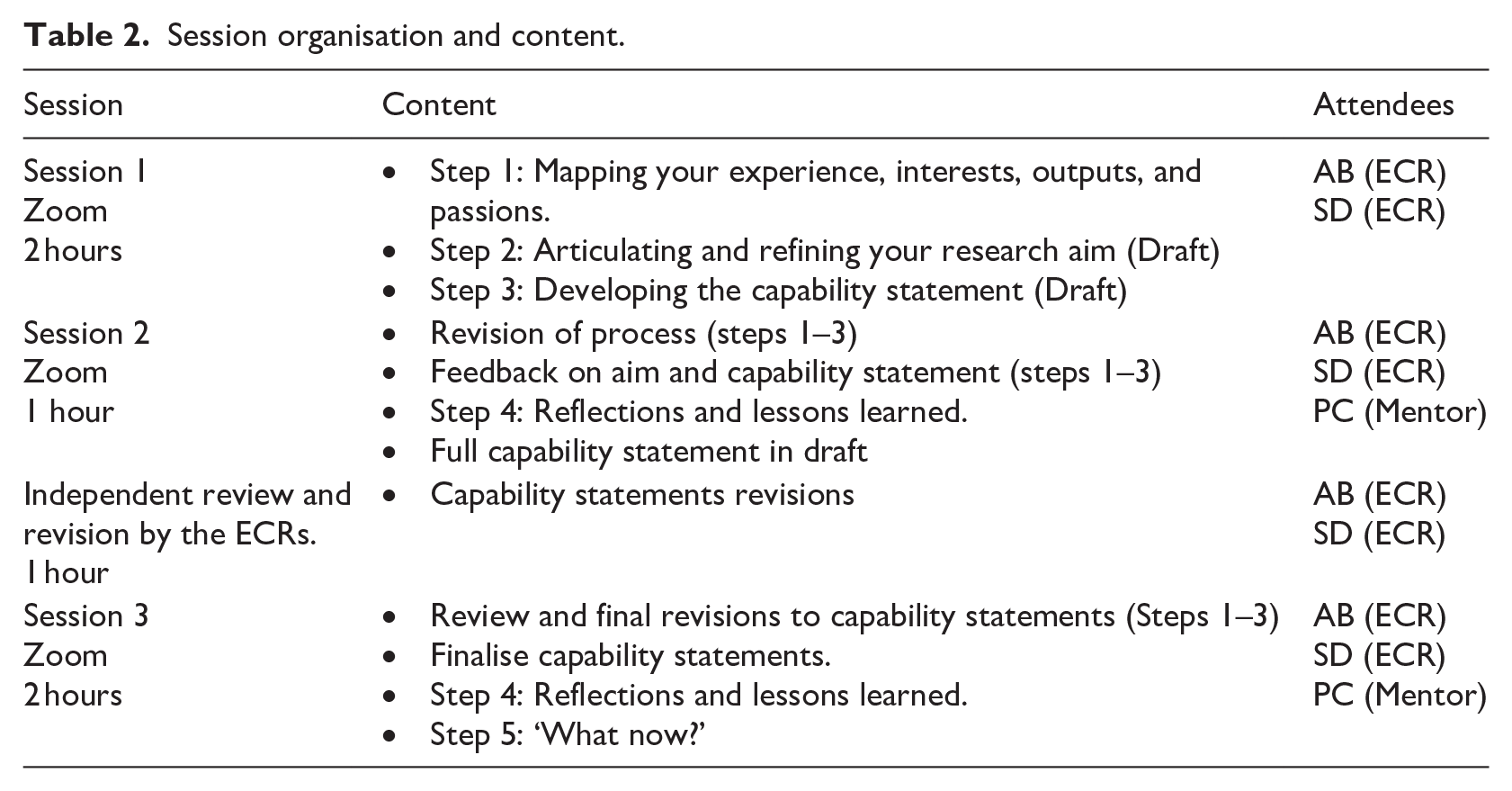
The steps were completed across several sessions, encompassing peer-led, mentor-led, and self-directed learning. The organisation of sessions and the content that was covered in each session is summarised in Table 2. This organisation was determined collaboratively to use peer-led, mentor-led and self-led processes. A combination of these methods was attractive to the ECRs, who felt that the peer support would be a good place to start, while also having mentor expertise to refine their work with and space to complete their work autonomously, without impacting onerously on the mentor’s time and availability.
Session organisation and content.
Step 1: Mapping your experience, interests, outputs and passions
Step 1 involved a 2-hour online Zoom session and followed the outline provided in the PowerPoint presentation prepared by the mentor. This was necessitated due to the diverse locations of the participants; however, face-to-face sessions may also prove fruitful.
Normally this would have been presented by the mentor as a presentation session; however, staff leave impacted upon this, and thus the PowerPoint presentation was reviewed by the ECRs and key points were discussed, including their professional experiences. The presentation aided the ECRs to consolidate information regarding the status of their PoR. Furthermore, a blank word document was opened and shared via Zoom, facilitating a sharing of notes and ideas. The below definition, from Holzemer (2009), was added to the document to focus and guide the discussion (underlined for emphasis):
A program of research is defined as a
The ECRs underlined what they viewed as important in the definition and discussed how these points could drive the content of their aims and capability statements. From this definition, the ECRs mapped their knowledge, skills and experiences using the guiding prompts, see Table 1.
Prompt 1 – What are/will be the topic areas within your PoR?
Prompt 2 – Why/what informs this choice?
Using the prompts provided, the ECRs discussed their professional backgrounds, qualifications, motivations for moving into their clinical areas, and their life experiences. Each researcher reflected upon their clinical and research journeys and considered how this shaped their areas of interests, their passions, and their focus. As this discussion occurred, key points were added to the word document.
Example
15 years, emergency, rural/remote DON/ Nursing Director, research, first-hand experience of health disparity, inequity, ie MR, leadership, rural and remote, nurse-led models of care, advocacy, Critical Discourse Analysis, Aboriginal and Torres Strait Islander people health. (ECR AB)
Prompt 3 – What is the significance of your research programme to the community/ health service?
Furthermore, the researchers considered the reasons behind their passions in relation to the communities they serve. This iterative discussion allowed the peers to challenge each another and to share experiences which led to their research focuses. Excerpts were extracted and added to the word document.
Example
Health workforce focused, models of care and system structures, rural and remote practice context, inequity, Aboriginal and Torres Strait Islander people, Social sciences. (ECR AB)
Prompt 4 – Who will you need to work with?
The ECRs next mapped the key stakeholders involved in their research areas and the nuances between these relationships and hierarchies.
Example
I work with nurses, all healthcare professions, executives and others in positions of power, the government as custodians of healthcare legislation, people and their families and their communities, advocacy groups, leaders, academics and researchers, community health services, non-government organisations. ECR SD
Prompt 5 – How will you engage with the key stakeholders you need to work with?
Using prompt five, the researchers discussed how they work with others, and how to initiate relationships. This discussion also involved discourse surrounding researcher reputation within the broader research and academic community.
Example
Networking, engagement, visibility, transparency, linking, volunteering and mentoring, organisational membership. ECR SD
Between each prompt, the ECRs reflected and revised their thoughts and articulation of their approaches and capabilities.
Step 2: Articulating and refining your research aim
At the commencement of step 2, the ECR considered what to include to develop a clear, concise and authentic research aim that aligned with their evolving PoR. This step challenged the ECRs to consider what drives them, what they want to be known for, and how to best capture this in an aim. The writing from step 1 assisted with this and examples of first draft aims are provided below.
Revisions were then made to the aims through an iterative process of discussion and re-writing, where the ECRs considered if the aims adequately captured their expertise, areas of interest, passions, and how the wording and linguistic choices may facilitate or limit their PoR.
Example
The aim of your PoR is to. . .
To improve workforce and healthcare system approaches for the vulnerable in rural/remote and regional areas. (ECR AB)
And
To improve integrated interdisciplinary emergency healthcare responses to intimate partner violence, in rural and regional areas. (ECR SD)
Session 2 commenced with reflections on the processes, feedback from ECRs to the mentor about the presentation, progress updates and consolidation and validation of the research aims. The mentor facilitated discussion of the specific elements of the aim and asked probing questions and for explanations of employed word use. For example, what does it mean to “improve”? Who are your target population and why is this the focus? This resulted in validation of the aim for ECR SD and in further refinement of the aim for ECR AB evidenced below.
Example
The aim of your program of research is to innovate models of care and health systems to reduce health inequity in rural/remote and regional populations. (ECR AB)
Step 3: Developing the capability statement
At this stage in the process, the ECR used their notes to further populate a draft capability statement, using the template provided in Table 3. The template was adapted from a university available template. The major headings were expanded by the researchers through this process to capture the information reviewed through the process. This was done collaboratively, and the drafts were emailed to the mentor (PC).
Capability statement template.

Furthermore, ECRs undertook further review of the draft capability statement with feedback and suggested revisions from the mentor. Feedback surrounded areas such as ensuring that each section provided new information, was concise, and included precise examples of achievements.
At the end of this session, a full-draft capability statement was achieved for both researchers who then individually refined them further. A final mentorship session (session 3) was organised where the mentor reviewed the capability statement, provided feedback for consolidation, and refinement. The peer-led process with regular mentor engagement created a safe space to be vulnerable and to express uncertainties around the academic environment. Session 3 concluded with a discussion reflecting on this process and the lessons learnt by the ECRs and mentor.
Step 4: Reflections and lessons learned
In reflecting upon the process, the participants took contemporaneous notes of their experiences. From these notes, a narrative evaluation was conducted, selected for its application in authentic storytelling, creativity, and resonance with participants (McCormack et al., 2016). This identified three main themes within their experience: The value of a peer, The role of a mentor and Forging your own path.
The value of a peer
The informal peer relationship was based on supporting each other and facilitated open dialogue between the ECRs, and promoted brainstorming and refinement of specific elements within the capability statement to promote its timely completion. This was evidenced in the following reflective comments:
Having a trusted peer created a space of psychological safety to discuss our achievements and work judgement free. From this experience I have learnt that I needed to grow confidence in what I have achieved, and using words that are reflective of my contributions was a skill; completing this activity with a trusted peer was essential. (ECR SD- reflection)
And
I feel like the peer review was essential for me as I needed to be pushed and to be validated by those I trust and respect. (ECR AB- reflection)
What this demonstrates is the need to be open, honest, respectful, and have shared expectations specifically to create and foster psychological safety about evolving professional identities.
The role of a mentor
Whilst mentorship relationships can be formed through a variety of different processes within research practices, this form of mentoring opened a space to challenge and counsel the ECRs and develop a small community with a shared vision. Furthermore, there was a collective responsibility to complete the research capability statement through collaboration, reflective professional inquiry, and individual refinement in alignment with the mentorship model (Gut, 2020). This is evidenced in the reflections below.
I think the culture and environment of academia can make finding your own path as an ECR very difficult. I believe this hesitancy to be assertive and proud of our achievements is an issue for women and specifically for women of younger generations in academe. These collaborative mentorship sessions gave me the push to feel confident in myself, in my word use and, in my capabilities. (ECR SD- reflection)
And
Having courage, confidence and forging your own path. (ECR AB- reflection)
The mentor made a conscious effort to build ECR capability by ensuring feedback was focused, understanding, improved clarity, and supported the veracity of claims within the capability statement. Using the Socratic questioning model where appropriate strengthened the environment of enquiry and mutual understanding. This is important as a PoR is focused on conveying a shared understanding and explanation of the researcher, their PoR and how this may be applicable to the wider research and health community.
Forging your own path
Feelings of imposter syndrome and the anxieties an ECR faces in obtaining recognition were evident within the ECR reflections below:
It was difficult to articulate who I am and what I do, because to me it is nothing special. I am just a ‘do-er.’ It was hard to be able to feel confidence in the use of strong language. I was worried that those around me would disagree with me and think that I was overstating my actual competence, achievements, and capabilities. Yet, I also wanted to be honest, factual, and authentic. (ECR AB- reflection).
The development of the capability statement gave the ECRs a sense of ownership and direction within their research, promoting their ability to forge their own paths and considering the future of their PoR.
Step 5: Now what?
A capability statement may be the first contact that a team, funding organisation or partner has with the researcher. In this contact, they want to know who the researcher is, and what they can contribute to the proposed research. After the development of the capability statement, researchers should consider how to leverage it to promote themselves, and what further research projects they may undertake to increase their capabilities, therefore developing their PoR. Many researchers with a capability statement often use elements of their statements as impact statements, short bios or promotion pieces that support outcome dissemination.
Finding the time and space to consolidate experiences and expertise, consider your future as a researcher, and develop an authentic expression of your research capabilities is a challenging, and at times. overwhelming journey. Indeed, the capability statement is never truly completed, as researchers develop new skills and experiences and explore new areas of enquiry; therefore, the capability statement evolves with the researcher. For these reasons, it is recommended that the capability statement be reviewed regularly to assess alignment with yearly performance. An ECR may also at this stage ensure the capability statement is reflected within their profiles on various platforms such as Research Gate, LinkedIn, University profiles, among other avenues.
The capability statement is a tool that can be used to pursue grants, partnerships, build networks and relationships with industry and like-minded key stakeholders. For those in academia, it may be used to consolidate one’s academic profile, aligning teaching and research interests. The applications of a capability statement are numerous and having one ‘on hand’ and relatively up to date is an easy way of facilitating engagement and relationships. Not only is the process of articulating a capability statement cathartic for the ECR, but it is also highly useful in self-promotion.
Discussion
Kearns and Gardiner (2013) discussed the need for a clear focus to maintain alignment within your PoR. As an accurate reflection of your research capabilities, the capability statement can be used to assist the ECR in maintaining focus on their emerging and developing PoR. The academic environment often requires ECRs to rapidly develop skills and networks, without formal professional development which explain how to achieve this. In completing this activity, it became clear that literature on developing a capability statement and PoR is limited. This paper provides some insights for capability development that may provide ECRs focus and direction on developing and articulating their PoR.
As suggested throughout this process, the role of peer-support and mentoring in such activities should not understated. Gheorghe et al. (2023) discussed the need for peer support within academe as it can be described as an isolating professional environment. The nature of academia and its competitive processes (grants, funding, promotions) necessitates the need for clear direction, intent, and articulation of research expertise. However, working within a peer network to support such growth and development is a perhaps underutilised method of professional development.
Peer-to-peer support within research has been proposed as a way for ECRs within academia to explore opportunities, as well as share knowledge, their own ideas, and experiences (Chiu et al., 2019). Wang et al. (2023) discussed how the horizontal relationship between peers promotes a collegial relationship that is more open, dynamic, and informal. Peer-to-peer relationships tend to involve more psychosocial support and concentrate on more detailed specific and technical aspects within research (Wang et al., 2023). In creating a capability statement, the value of peer support is in the psychological safety and empowerment that the relationship engenders.
Mentoring during this process is also vital. Gut (2020) discussed the importance of research mentorships where the mentor and mentee have shared ideologies, visions, and values. This shared understanding fosters collaboration towards the goal of the capability statement and prompts ECRs to think about the development of the PoR in a strategic and considered way. The benefits of intergenerational, interdisciplinary, and intercultural mentorships are also espoused (Gut, 2020), allowing ECRs to learn from their mentors’ experiences, explore diverse avenues of engagement, and to consider their future in a structured, yet fluid manner.
Within this process, there were shared aims and ideologies between the mentor and mentees which facilitated open dialogue. The mentor within this process offered an opportunity for ECRs to reflect on their current body of work, how they might expand this, who they want to work with, and how they can make a difference in their fields of research. Among other characteristics, a good mentor must operate from an authentic belief that the mentee can achieve their outcomes and is concerned with the career of the mentee (Human Resources Management International Digest, 2019). It is essential that the mentor can demonstrate clear expectations, mutual respect, and shared values for the outcome of the mentoring effort (Straus et al., 2013).
ECRs are well placed to take pause, reflect on and further develop their capabilities, with the intent of developing stronger networks, collaboration, and research skills. Having a capability statement aids in instilling confidence in their developed skills. The five-step process articulated in this paper provides a pragmatic professional development activity for ECRs to engage in meaningful peer and mentor supported improvement. While this research has focused on ECRs, peer support in the development of a capability statement for more senior researchers is likely to be beneficial.
Example capability statements are available via the authors ResearchGate profiles.
Conclusion
The development of a PoR is an important and dynamic process for researchers. While the PoR itself takes time and experience to develop, ECRs can ground themselves through the development and articulation of a capability statement. This paper provides a five-step process, with associated prompts and suggested session organisation to develop a clear capability statement, as a professional development activity. This paper highlights the gap in current processes for early career research development.
Key points for policy, practice and/or research
Developing a capability statement is an important step in creating a PoR.
The five-step process provided in this paper demonstrates a pragmatic approach to the development of a capability testament, allowing ECRs to strategically consider and articulate their research skills.
Clinicians in the healthcare field can use their capability statement to build a PoR around areas of community and clinical need, thus driving research engagement and partnerships.
Footnotes
Acknowledgements
None.
Author contribution(s)
Conceptualisation: AB, SD and PC; Data collection: AS and SD; Data analysis: AB and SD; Data validation: PC; Manuscript draft: AB, SD and PC; Manuscript editing: AB, SD and PC; Manuscript approval: AB, SD and PC.
Declaration of conflicting interests
The author(s) declared no potential conflicts of interest with respect to the research, authorship, and/or publication of this article.
Funding
The author(s) received no financial support for the research, authorship, and/or publication of this article.
Ethical approval
No ethics was obtained for this professional development activity.
