




Abstract
A growing literature has discussed multiple complexities of various researcher stances and the place of reflexivity in qualitative research. This article contributes to the literature by illuminating the importance and illustrating ways of incorporating perspective taking in insider processes of reflexivity. Specifically, this article dissects an insider-researcher’s attempt to resolve research uncertainties by considering the perspective of an outsider-researcher, who had conducted similar study at the same school. Through incorporating processes of perspective taking in reflexivity, the insider-researcher uncovered complexities and ethical quandaries that may have had an impact on her study. Subsequently, the article provides lucid accounts of perspective taking as a method to enhance qualitative research processes, namely, to help resolve methodological uncertainties and to portray a richer and nuanced inquiry picture.
Keywords
What is already known?
Reflexivity has been recognized as a crucial strategy in qualitative research.
What this paper adds?
This paper highlights and illustrates practical processes of perspective taking in reflexivity. Perspective taking may help resolve research uncertainties and portray a richer and nuanced inquiry picture. Modest doubt is called the beacon of the wise.
The role of the insider/outsider researcher has been widely discussed over the years (e.g., Hodkinson, 2005; Perryman, 2011), acknowledging the epistemological ground for claims to knowledge based in life experience (see Griffith, 1998). Mostly, there is an understanding that researchers are located in relations that construct both their inside and outside social boundaries. As such, insider/outsider knowledge is embedded in social differences, which may contribute to the formation of the research topic, the methodology used, and the knowledge gained (see Suwankhong & Liamputtong, 2015). Yet, although the researcher’s knowledge is always situated in particular sets of social relations, it seems that the terms insider/outsider are not definitive and should rather be considered as fluctuating, shifting, and as part of a continuum (Mercer, 2007), it is only “the beginning of the research story and not the end” (Griffith, 1998, p. 365).
Facing the complexity of the researcher position, the role of reflexivity has been increasingly recognized in qualitative research (Naples & Sachs, 2000). Specifically, researchers are encouraged to acknowledge their own presence and characterize their role in the formation of knowledge and to self-monitor the impact of their biases, beliefs, and experiences on their research to “maintain the balance between the personal and the universal” (Berger, 2015, p. 220). In other words, reflexivity, a concept used interchangeably with concepts such as reflectivity and critical reflection (D’Cruz, Gillingham, & Melendez, 2007), is commonly viewed as a continual internal dialogue and critical self-evaluation of the researcher’s positionality (Pillow, 2003), which leaves the researcher changed in its wake (Mauthner & Doucet, 2003).
Building upon and highlighting the importance of effective reflexive strategies, this article suggests incorporating a perspective-taking approach—which to the best of my knowledge has never been previously discussed in qualitative research literature—in processes of reflexivity, namely, encompassing a psychological reflexive mechanism that aims to consider others’ perceptions within the studied context. Acknowledging that perspective-taking initiatives work best for individuals who are not highly identified with the in-group and whose intergroup attitudes are least likely in need of modification (Tarrant, Calitri, & Weston, 2012), this additional element may greatly benefit insider-researchers. Specifically, it may assist to better understand the research processes, to develop more harmonious perceptions (e.g., Galinsky & Moskowitz, 2000; Vescio, Sechrist, & Paolucci, 2003), and to obtain a richer study picture. Ultimately, such reflexive strategy could help improve the quality and insight of future insider-research projects and potentially of other research projects as well.
Focused on how perspective taking could be used to help insider-researchers obtain a more transparent study picture, this article aims to contribute to a deeper understanding of the complexity of reflexivity. As such, this article will begin with an overview of some of the existing literature on the researcher’s role and reflexivity and on social perspective taking. The article will then illustrate the methodology of perspective taking by accompanying an insider-researcher, as she reflected upon and considered the perspective of an outsider-researcher who conducted a similar study at the same school. Finally, the article will conclude by elucidating the role of perspective taking in qualitative research processes; accentuating the strategy’s power to help resolve methodological uncertainties and to portray a richer study picture.
The Researcher’s Role and Reflexivity
Researcher stances can range from the researcher being an outsider, striving to explore an unknown environment and learn its characteristics in depth, to being an insider, serving as a member of the group as well as its observer (see Dwyer & Buckle, 2009).
The researcher’s role may affect the study in many ways. For instance, the researcher can influence individuals’ actions or responses in an interview. Denscombe (2007) refers to the impact on the interviewee as the interviewer effect, namely, how interviewees respond variably, depending on how they perceive the interviewer. Similarly, the researchers’ relationship with the setting may affect how they approach the interview. The way researchers perceive the research setting has significant bearing on how they anticipate methodological processes and the representation of themselves in relation to the research setting (Booth, 2015).
There are benefits and drawbacks to every researcher stance. On the one hand, outsider-researchers may find it difficult to gain access to participants, and participants may be unwilling to disclose their attitudes (Borrill, Lorenz, & Abbasnejad, 2012). A further contention holds that only insiders can properly represent the experience of a community (e.g., Charlton, 1998). In other words, insiders might come from a position of strength: for instance, knowing what to ask the participants, relating to issues of current relevance, and being less invasive to the studied context (see Bridges, 2001).
On the other hand, insider-researchers may find it difficult to detach their personal experiences from those of the participants (Kanuha, 2000), and contrary to outsider-researchers, they may struggle to offer a distinct, neutral, and balanced point of view (Chawla-Duggan, 2007). Such methodological challenges may affect the quality of the study (Thomas, Blacksmith, & Reno, 2000; Tilley & Chambers, 1996).
In both cases, the researchers’ personal experiences, thoughts, needs, and ethical deliberations may affect their data collection, interpretations, or how they later apply their findings (e.g., Drake, 2010; Drake & Heath, 2008; Floyd & Arthur, 2012; Minkler, 2004). Therefore, researchers must strive to engage in reflexive processes, which entail an internal dialogue and critical self-evaluation of the researcher’s positionality (Stronach, Garratt, Pearce, & Piper, 2007).
Specifically, reflexivity turns the researchers’ lens back onto themselves to recognize and take responsibility for their own situatedness within the research and for the effect that it may have on the setting, participants, questions asked, data collected, and data interpretations (Berger, 2015). According to Pillow (2003), when researchers are reflexive, they are attentive to how their experiences, knowledge, and social positions might impact the research process. In fact, researchers must think about themselves in relation to others in order to be thoughtful about ethical dilemmas in the research process (Hastings, 2010).
That being said, it is important to acknowledge that individuals’ perceptions are constructed rather than veridical reflections, and thus can be occasionally wrong, differing from the perceptions of others (Epley, Keysar, Van Boven, & Gilovich, 2004). Moreover, many social judgments or reflections are egocentrically biased, with individuals typically believing that their internal state and intentions are more transparent to others than they actually are (Gilovich, Savitsky, & Medvec, 1998). This subjectivity may clearly affect the processes and effectiveness of reflexivity.
Social Perspective Taking
Reflecting upon one’s own perspective is difficult and, therefore, may not be attempted (Collins, 1983). According to Collins, researchers tend to question the nature of their interpretation only when things go wrong. One approach that could help overcome such a methodological obstacle is engaging in social perspective taking, which is a multidimensional aptitude that incorporates the ability to understand others accurately (Gehlbach, 2004).
Social perspective taking is based on the psychological mechanism that encompasses the need to consider the world from alternate viewpoints (Davis, 1983). It enables individuals to step outside the constraints of their own immediate biased frames of reference (Moore, 2005), thereby minimizing egocentric perceptions of fairness in competitive contexts, but not at the expense of their own self-interest (Epley, Caruso, & Bazerman, 2006). In other words, perspective taking requires getting beyond one’s own literal or psychological point of view to consider the perspective of another person who is likely to have a different psychological point of view. Overcoming egocentrism and one’s own current state is therefore the essence of accurate perspective taking (Epley & Caruso, 2012, p. 299).
Numerous psychological, social, and academic benefits may accrue from engaging in social perspective taking (see Galinsky, Maddux, Gilin, & White, 2008). Such mechanisms, among others, are advanced moral reasoning (Kohlberg, 1976); empathic accuracy (Ickes, 1997); interpersonal sensitivity, which comprises the accuracy in judging or recalling others’ behavior (Hall, Andrzejewski, & Yopchick, 2009); and accuracy in judging what others may think, feel, and want (Ames, 2004).
The literature has acknowledged several strategies that are relied on in social perspective taking attempts (see Gehlbach & Brinkworth, 2012). Generally, in order to perform social perspective taking, there need to be at least three mental operations. First, the mental process of perspective taking must be activated, as some situations elicit empathic attempts to perceive the world from another person’s perspective (e.g., Decety & Sommerville, 2003). Second, individuals must go beyond their own perspective to seek to experience, simulate, or infer the perceptions of others—a typically slow, deliberate, and difficult process. Finally, it may require incorporating additional information, which can include stereotypes or other idiosyncratic information known about the other (Epley & Caruso, 2012).
Several scholars have proposed that individuals are unlikely to set aside their own perspectives when adopting another’s perspective, but rather use it as a starting point, or judgmental anchor, which may be very useful in different processes (e.g., Epley et al., 2004; Nickerson, 1999). In fact, individuals adopt others’ perspectives by initially anchoring their own perspective and only subsequently accounting for differences between themselves and others until a plausible estimate is reached (Epley & Gilovich, 2001).
In other words, upon engaging in social perspective taking, individuals may reflect on others through “searching their memories, recalling more details, and reanalyzing them” (Gehlbach & Brinkworth, 2012, p. 16). As such, researchers might negotiate different understandings without imposing commonly shared meanings when constructing, for instance, reflexive narratives. Narratives, if approached for analysis with an interpretive view, can provide elements of reflexive quality, a necessary component of perspective taking. Narrative analysis can reflexively provide access to the implicit and unstated assumptions that facilitate social perspective-taking processes (Boland, Richard, & Ramkrishnan, 1995).
Given these considerations, it is important to acknowledge three common barriers to accurate perspective taking (see also Epley & Caruso, 2012): (a) failing to activate—individuals may fail to turn on their perspective taking ability when needed, meaning, they don’t engage attentional resources or time and they lack the deliberated motivation to do so; (b) miscalibrated adjustment—individuals don’t leave their own perspective behind completely and may not adjust or correct an egocentric default; and (c) inaccurate adjustment—leaning toward using nondiagnostic or useless information, that is, struggling to evaluate the validity and accuracy of their own knowledge (Burson, Larrick, & Klayman, 2006), thus, assuming they have been adopting accurate information when they have not.
As a researcher taking an interest in social perspective taking, I, the insider-researcher described in this article, wish to stress that I do not claim to accuracy in my perspective taking but do include myself with other individuals, who strive to hone their social perspective-taking skills. As Epley and Caruso (2012) eloquently stated, making any kind of general statement about the accuracy of perspective taking is about as hopeless as making a general statement on the value of the U.S. dollar—it depends where you look, when you look, and how you measure it. (p. 298)
In what follows, I describe the context of my deliberate attempt to take the perspective of an outsider-researcher. Then, I illustrate the perspective-taking steps and how my own ethical dilemmas and biases were revealed and negotiated as a result of this process. Subsequently, I suggest perspective taking as a qualitative reflexive method to enhance insider qualitative research processes.
The Context: Facing a Methodological Uncertainty
This article is an outgrowth of 12 interviews relating to teachers’ perceptions of professional development programs (PDPs) in a single private American high school, established on rigorous academic standards and takes pride in its students’ high college enrollment rates. This school’s teachers are expected to provide a challenging learning environment for the students, the majority of whom aspire to acceptance at Ivy League schools. As such, this school offers extensive PDPs, designed to assist teachers in their work. As the head of school put it: There are two key goals: (a) students need to succeed, and (b) faculty should be a learning community. PDPs’ structures are for ongoing learning…[It’s about] giving people a clear sense of what we’re looking for in their teaching, helping them to get there…
Upon finalizing my findings, I learned of an outsider-researcher who was conducting a similar qualitative study at the same school and at the same time. I discovered this when some of my interviewees brought to my attention that they had been interviewed previously on the same topic. Amazed by the coincidence, I decided to approach the outsider-researcher and learn about her study. In discussing her research with her, I realized that our findings were entirely disparate. Facing methodological uncertainty, I sought to reflect upon and consider the outsider-researcher’s perspective, with the hope of obtaining a clearer study picture.
Perspective-Taking Steps to Enhance Research Processes
In an effort to resolve the methodological uncertainty I faced, I decided to examine and consider an outside perspective that was now presented to me. In the wake of reexamining my methodology, I took three perspective-taking steps, herein delineated.
Step 1: Activating the mental process of perspective taking
Research has shown that some situations may elicit empathic attempts to perceive the world from another person’s perspective (e.g., Decety & Sommerville, 2003). This is the case described in this article. Facing a research uncertainty, namely, discovering a similar research conducted by an outsider-researcher who reached different conclusions than my own, invigorated me to reflect upon an outsider’s perspective.
As a way of beginning, I sought to dissect the outsider’s perspective, thus hoping to distance myself from my own egocentric viewpoint and discover new aspects that could contribute to my study. Therefore, I positioned my research foundations in light of those of the outsider’s. I did not do so with the intention of comparing the two studies, since that would have been a complex endeavor, requiring an appropriate research project in itself to allow for any meaningful conclusions. Rather, I did seek to identify the outsider-researcher’s study’s underpinnings and other characteristics that may have played a role in her perspective. I thus aimed to identify diagnostic and useful information that would help me obtain as accurate data and knowledge as possible.
Overall, briefly reviewing the two studies’ foundations, I recognized that they shared three elements:
Topic and context: The main goal of both studies was to examine teacher perceptions of three fundamental PDPs, and their impact on teaching practices and work processes in the school. The first program, Mentoring for the Teacher,
1
established formal mentor relationships between veteran teachers and new teachers to the school. The mentors and mentees meet regularly as a group to reflect upon and learn from their experiences. In the second program, Colleagues in Action, teachers join an interdisciplinary group of six to eight faculty members, who observe and analyze each other’s classes. The group meets monthly, with the goal of learning from the collaborative process and improving their teaching practice. The third program, Traditional Education, focuses on personal development. Teachers in this program meet monthly to reflect upon their personal and professional experiences through the lens of traditional values.
Selection of scope: Both studies included administrators, group facilitators, and a range of teachers from different departments, having various degrees of experience, who took part in the PDPs. For reasons of confidentiality, I did not compare my participant lists with those of the outsider’s; however, I was aware of at least five participants who took part in both studies. Since the school had 70 teachers, and due to the scope and nature of the participants we sought, it is likely that there was a greater overlap in specific participants.
Interview processes: Both studies used semi-structured interviews. There was an overlap in the questions as well as the types of questions (see Table 1). Overall, the studies included experience and behavior questions, which aim to elicit the interviewee’s behavior, experiences, actions, and activities that would have been observable had the researcher been present at that time (Levenson, 2011). The outsider-researcher asked background questions that sought to identify characteristics of the individuals being interviewed (Patton, 2002), whereas I asked opinion and values questions, which focused on the cognitive and interpretive processes of participants’ opinions, judgments, or values. The purpose of these questions was to illuminate the individual’s goals, intentions, desires, and expectations (Patton, 2002).
Questionsa Asked in the Insider’s and the Outsider’s Studies.
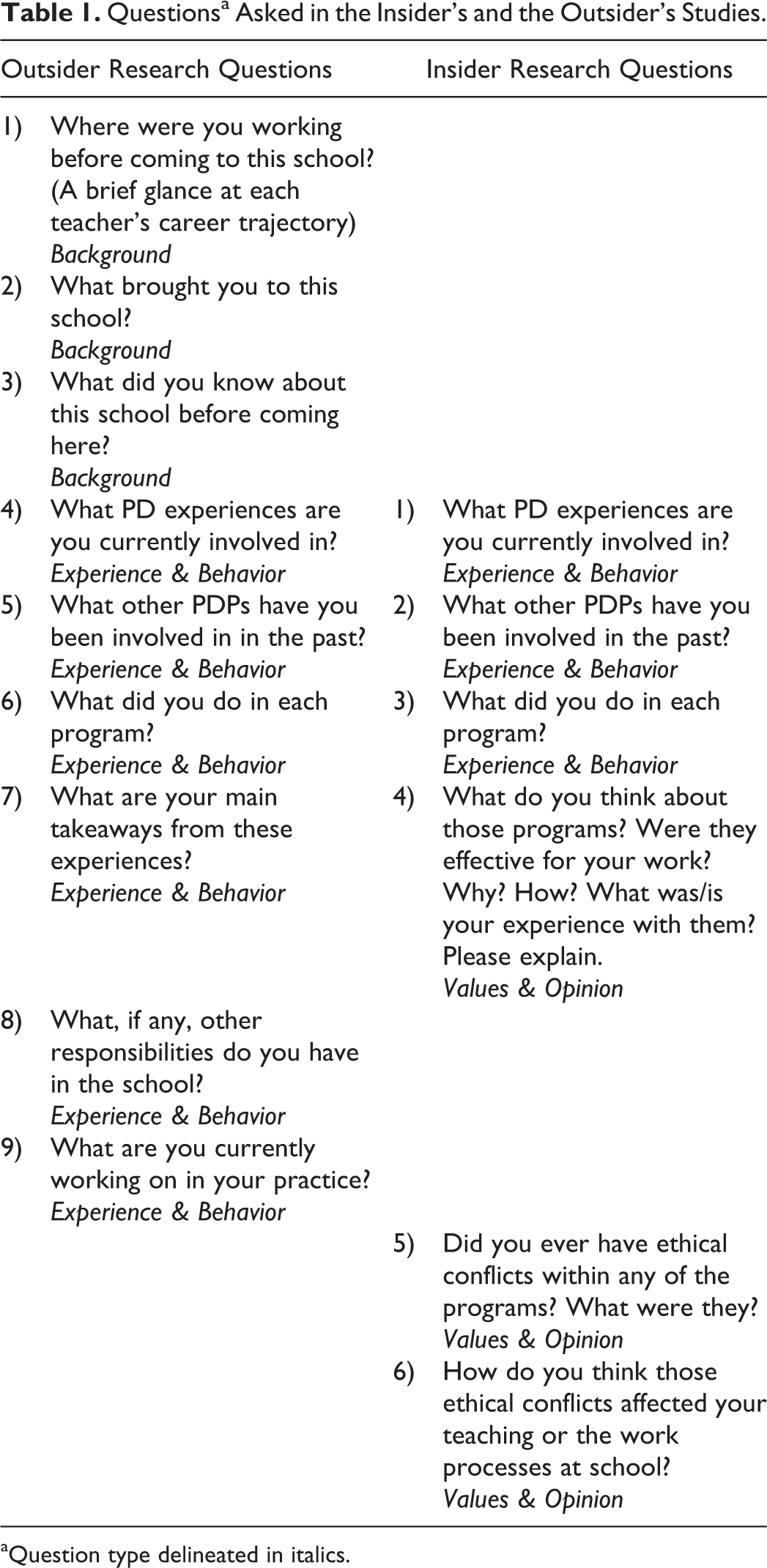
aQuestion type delineated in italics.
Overall, the studies revealed distinctive teachers’ perceptions of the PDPs’ effectiveness, participation requirements, and impact. The outsider’s research concluded that not only did the PDPs help the teachers individually, but they also enhanced the learning environment at school, while forming a positive work atmosphere. Also, the PDPs were portrayed as helpful and effective to the teachers’ work and, ultimately, to the students’ learning. In addition, the teachers in the outsider’s research viewed at least some of the PDPs as voluntary opportunities through which they could develop their teaching skills, if desired.
Conversely, my research showed that teachers felt obligated to take part in the programs, regardless of their personal or professional needs. Also, my findings indicated that the PDPs were mostly perceived as stress inducing and ineffective. Particularly, my study revealed that the PDPs at school, which were based on the principles of reflective practice, compromised students’ and teachers’ privacy, mitigated students’ learning processes, and subverted teachers’ ethical relationships with their colleagues. Moreover, the study showed how teachers’ ethical dilemmas upon reflective practices in PD may have engendered moral injury that may affect, among other things, teaching and learning processes at school (Finefter-Rosenbluh, 2016).
Step 2: Anchoring own perspective and dissecting the perspective of others
Having the foundations of both studies in mind, and acknowledging that researchers are advised to anchor their own perspective (Epley et al., 2004; Epley & Gilovich, 2001; Nickerson, 1999) then deliberately seek to simulate or conjecture upon the perceptions of others (Epley & Caruso, 2012), I dissected my insider perspective and then the outsider’s perspective, as described below:
My insider perspective
I began this study during my sixth year as a teacher in this high school and my first year as a research fellow. This was not my first experience as an insider-researcher, though; other studies of mine were conducted at the same school a few years earlier. Those studies were derived from different sets of data and were published elsewhere (Finefter-Rosenbluh & Court, 2014; Finefter-Rosenbluh & Levinson, 2015; Finefter-Rosenbluh & Perry-Hazan, 2016).
I embarked upon this study with the premise that while research is a collective sense-making activity, it may always be subject to researchers’ social-based preconceptions, as they are all individuals who live and work in social contexts. That said, I also presumed that insiders may not always have the knowledge of the subculture or experiences of a particular studied group, and it may even be advantageous not having preliminary knowledge regarding the phenomenon under study. This naive status can entail gathering data from a “fresh perspective” with “open eyes”—an action requiring a conscious effort (Asselin, 2003, p. 100).
In light of the above, consistent with Leigh (2014), I tried to minimize the extent by which my insiderness would undermine my research; hence, I also examined a PDP, Colleagues in Action, which I had never personally experienced and interviewed colleagues that were not with me in the same professional development (PD) group(s). Interviewing diverse faculty members helped me distance my own personal–professional knowledge from this study. At the time of the study, I was also aware that this was going to be my final year as a teacher at this school, given my plans to leave at the end of the year to focus on my research. Knowing this helped me disconnect from my PD experiences at the school and identify myself as a full researcher. As for my colleagues, they were not yet aware of this fact, although some of them speculated that I would leave the school in the near future.
From an early stage of the research, I knew I would be challenged to maintain the position of an objective observer while simultaneously working closely with my interviewees. This closeness could make the researcher “resistant to an unsympathetic critique of the field, or if they brave an unsympathetic critique, they may be at risk of damaging or losing their closeness to the field and/or someone within it” (Taylor, 2011, p. 14).
Indeed, speaking with my teacher colleagues about this study and asking to interview them was, overall, a smooth experience. I approached each of the teachers privately, usually in their office or in a quiet place in the school, making sure they were alone and available to listen to my description of the study. I made every effort to preclude any sense of coercion (real or perceived). Firstly, since I was not in a mentoring or supervision relationship with any of the teachers, neither in the past nor at the time of my study, I felt ethically secure in approaching them. Secondly, while I expressed my hope and eagerness for the teachers’ participation in my study, I stressed several times during our conversations that their participation would be completely voluntary and I would certainly understand if they would decline. All the teachers I approached expressed deep interest in my study and happily agreed to be interviewed as soon as possible, stressing that they would look forward to sharing many PDP experiences with me. That said, the question of my role as colleague and researcher was a source of confusion at times. Ethnographer–participant relationships may be unstable due to role confusion, conflict, and feelings of betrayal (Taylor, 2011). Undeniably, I felt at times as if I were betraying my colleagues by focusing on my study.
I recognize, for instance, that I came to the study with an intimate awareness of the complexity of the school’s PDPs. These impressions were the result of me having heard colleagues struggle with ethical quandaries. In addition, I had heard them expressing their resentment toward certain aspects of the PDPs, airing their frustrations in the course of hallway conversations at the conclusion of a PD meeting. As such, I may have encouraged my interviewees to reflect upon PD experiences that I had heard them address in the past, impressions that most likely would not have otherwise been brought to the research table. As Ball (1994) explained, there is always the possibility that “respondents may find themselves manipulated into saying more than they intend” (p. 181). Yet, as tempting as it was, I did not ask specific questions on specific PD situations that I knew my interviewees may have experienced.
Furthermore, I faced a dilemma involving having to choose between being collegially interactive or being formal and distanced in the interviews, though the interviewees expected me to be very interactive. I faced an ethically challenging situation, with which I struggled, within my collegial boundaries and my research-validity interest. Ultimately, I decided to share my thoughts with my colleagues at the end of each interview. It is still unclear to me whether this interview debriefing was a good solution, as there would always be the chance that those thoughts would be shared by the interviewee with other interviewees, producing potential bias in future interviewee responses.
Moreover, I deliberated over how I was going to present my research to my colleagues at the school. As Platt (1981) stated, this dilemma is particularly critical when interviewing one’s peers, as it seems offensive not to give some honest and reasonably full account of the rationale and the purpose of one’s study to such respondents (who are equals) and the account cannot be one that is intellectually condescending. However…it is difficult to do this without providing so much information that it may bias the interview. (p. 80)
Overall, though my colleagues were generally forthcoming and open in their interviews, some expressed concern over the assurance of their anonymity and requested that the findings would not be directly presented to the administration, as it could involve (unintentionally) divulging sensitive information. Once it was established that my study was for external research purposes only and not a part of school evaluation processes––namely, I was not an internal spy researcher, and neither the teachers’ statements nor any of the findings were going to be directly shared with the administration, the teachers became very cooperative. To this end, while the findings were ultimately published in the public domain, I freely accommodated my colleagues’ request to not to directly share my findings with the administration, even though such presentation could have led to a constructive breakthrough in the school.
As an insider, I was aware that my questions were sensitive and to some extent, personal. Yet, like Taylor (2011), I knew what was on or off the record, as, looking back over my interview transcriptions, I see many occasions where I inserted “[off the record].” Mostly, as in Taylor’s case, this was not because my interviewees explicitly asked me to keep it off the record, but because I knew implicitly that what they were currently telling me was not as a researcher, but rather as a colleague (e.g., reflections upon personal feelings or experiences which may easily be traced to them); hence, it would have been unethical to transcribe those statements for future analysis. As much as those sayings would have contributed substantially to my research, I chose to disregard them.
Procedurally speaking, the teachers consented to take part in my research under certain personal, tacit terms. The place of proceduralism is important, as it may help prevent weakness of will, namely, actions born of the researcher’s sympathy that would not be justifiable to other researchers. I know that for me, my sympathies may have justified my taking actions different from that of the outsider-researcher, who may have maintained different sympathies. I also understand that my researcher situation was complex and that my own concern for my relationship with my colleagues had a significant impact on my actions.
The outsider’s perspective
The outsider-researcher came to the research with an epistemological premise that outsiders can understand and represent accurately their participants through providing an appropriate and professional explanatory framework. She assumed that there could be an empowering effect of having a respected outsider articulating participants’ views. Furthermore, the outsider-researcher acted on the premise that being a stranger and observer may be beneficial, believing that her detachment would allow her to see what others may take for granted. Moreover, she assumed that her educational experience and her professional knowledge could produce a unique standpoint on PD.
The outsider-researcher came to examine the PDPs at the studied high school while affiliated with an Ivy League university, an element that likely helped her quickly gain the school administration’s trust. According to the outsider-researcher, her interest in the school began when it was described to her in several contexts as an impressive educational institution. She was also impressed by the PDs’ goals and offerings that were presented on the school’s website. Mostly, she heard about the school from a former PD facilitator, who was now a colleague in her institution. With her help, the outsider-researcher contacted one of the school’s administrators and requested permission to conduct her research. Once he agreed, they decided to meet weekly and that she would submit a report to him at the end of the semester. Although she did present a final report of her findings to the administrator, she did not share these findings with him until after she completed her interviews, compiled her data, and was no longer at the school.
The outsider-researcher reported feeling welcome in the school; faculty members and administrators were friendly, and several offered unprompted comments to her once they learned of the topic of her study. Those she interviewed were receptive and responded to her questions in ways that seemed open and genuine; however, some cautiously asked whether their conversation would be shared with the administration. She offered the teachers the opportunity to view the report at its completion, and several expressed interest in seeing the final product. After assuring them that all identifying characteristics would be omitted and that the data would be presented in aggregate form, the teachers cooperated with her questioning. That said, the outsider-researcher indicated to me that what seemed to her as comprising honest and candid answers at the time, now seem—after learning about my research findings—a bit artificial and disingenuous.
Although she approached most of her interviewees after consulting the faculty list on the school’s website as well as the master PD list, which delineated which teachers were facilitating or participating in each PD program that year, she was also introduced to some interviewees by the administrator himself. Drawing on that, from my insider perspective, I wonder to what extent did her association with the administrator, who was seen by the school faculty meeting with her weekly in his office (including the period prior to her interviewing), play a role in the teachers’ generally positive responses. After all, the teachers may have felt obligated to make a good impression on their administrator (employer) by communicating positive feedback through the outsider-researcher.
The outsider-researcher tried to be as friendly as possible in the interviews, striving to help the teachers forget they were talking to a complete stranger, and indeed, most interviews felt to her like a conversation about teaching and learning rather than a formal interview. The traditional interview format assigns an active role to the interviewer and a passive role to the interviewee, producing an asymmetric power relationship and an exclusion of emotion and reciprocity (De Vault & Gross, 2007). In her case, the outsider-researcher eschewed conducting a traditional interview, thus aiming to minimize her outsider status and to create an egalitarian setting. Oakley (1981) articulated it as the ethics of commitment and egalitarianism, in contrast to the scientific ethic of detachment and role differentiation between the researcher and the researched.
Ethics of commitment and egalitarianism redefine the interview situation, which involves interviewers’ acknowledging their identity. This entails a closer relationship between interviewers and respondents as well as efforts to minimize status differences and hierarchy in interviewing (Oakley, 1981). Through egalitarian processes, participants are induced to disclose more fully. However, reflections on research practice show that, while these ethics are laudable, qualities such as mutuality, egalitarianism, and reciprocity are inherently difficult to achieve (De Vault & Gross, 2007).
Indeed, according to the outsider-researcher, she did not fully share her thoughts with her interviewees. In all her interviews, she reported struggling with the issue of whether she should be conducting a two-way conversation about her professional views. For example, to what extent should she facilitate the teachers’ expanding on their experiences? The outsider-researcher was aware that her professional knowledge could be of help to the teachers in their work, yet she chose not to share it with them, as she was afraid it would affect her research. Drawing on that, perhaps the outsider-researcher assumed that her dilemma would resolve itself by sharing most of her knowledge and insights with the administrator, who would, in turn, share it with the teachers.
During some of her weekly meetings with the administrator, the outsider-researcher divulged anonymous statements she had heard from teachers that she found interesting or had questions regarding them. The administrator, in turn, shared his vision, educational beliefs, and personal views with her. Their conversations provided her with a broader picture of the administration’s goals and viewpoints as well as information about the evolution of the school’s PDPs. Yet, due to considerations of confidentiality, she was prevented from observing the PDPs’ meetings. Building on that, it is impossible to avoid speculating to what extent her positive relationship with the administrator and her not being present at any of the PDPs’ meetings influenced the type of questions she asked of the teachers and the quality of the responses she received.
After receiving her final report, the administrator asked for permission, which she granted, to share it with a wider group of teachers in the school. They also set up a meeting to discuss the report and its possible implications for future PDPs in the school. Nevertheless, throughout the process, the outsider-researcher wondered how helpful her report would be when all of the teachers’ responses were completely bereft of any identifying characteristics. While she wished, first and foremost, to protect the identity of the teachers, she believed that aggregate data might not be representative if specific perceptions were tied to a particular teacher’s specific experience. Yet, she chose to present aggregate data anyway, perhaps because she had already developed a good relationship with the administrator, who awaited her final report.
Step 3: Equilibrium—negotiating different understandings without imposing commonly shared meanings
Given the premise that narratives analyzed with an interpretive view would provide important elements of reflexive quality—a necessary component of perspective taking—I aimed at identifying the outsider’s implicit and unstated assumptions (see also Boland et al., 1995). In fact, I reflected upon both my insiderness and the perspective of the outsider-researcher, hoping to obtain a broader study picture.
It was clear to me that, while as an insider I may have had access to a particular kind of understanding of the participants’ experience, this access would not automatically grant me special authority to interpret those experiences. Also, while I recognized the limited understanding that the outsider may have acquired, it was clear to me that it would not necessarily follow that outsiders cannot develop and present an understanding, or, that such an understanding is valueless (see also Bridges, 2001, p. 374).
Considering the outsider’s approach, namely, associating with the administration and beginning the research with a positive belief in the school’s PDPs, the teachers may have chosen to show their loyalty to the school and promote its reputation, making sure to keep possible dirty laundry within school boundaries. Therefore, they may have felt more comfortable or may even have felt a need to talk with me, a colleague, about their struggles and to share certain experiences that only an insider would understand.
Furthermore, reflecting upon the outsider’s questions, which were focused on background and experiential/behavioral aspects, I realize now that I allowed myself to delve into the deep end of the teachers’ personal–professional perceptions’ territory. My feelings of personal–professional comfort with my school colleagues, along with a history of shared experiences, distanced me from the obvious background questions that were likely playing an important role in the outsider’s understanding and perspective of the research setting. That said, I wonder now to what extent the teachers’ pessimistic responses I received may have not only reflected their criticism toward the school’s PDPs but also their resentment toward my ethically focused invasive questioning. It could also be conjectured that the teachers assumed that it would be appropriate to express negative views to me regarding their PD experiences because this approach conforms to the school’s critical thinking culture, with which I am familiar as well as being an active player in it.
In the interface between researchers and participants, researchers may confront various ethical dilemmas, which could impact their data collection and interpretation (see also Wang, 2013). Integrating personal commitments with professional ethics is an example of a complex task, as many personal commitments involve unique commitments to ideals and values, which shape the work of individuals, without their necessarily being characteristic of all members of that profession (Martin, 2000). Professional ethics may relate to the ways by which the researchers uphold their own standards on moral issues, both professed standards and actual practices (Martin, 2000).
Dissecting the outsider’s perspective, she maintained her distance, choosing not to share her professional knowledge with the interviewees during the interview, despite her feeling that her input might be of help to their work. In addition, her positive relationship with the administration and her initial belief in the school’s excellence may have produced a halo effect, leading her to compose a positive final report. In addition, given the nature of the aggregate data that the outsider submitted, she did have some reservations regarding a possible ensuing artifact, with excessive weight given to one teacher’s specific experiences, thus questioning the representativeness of the data. Moreover, given that some of her participants were approached by the administrator asking them to take part in her research, teachers may have felt coerced, not only to participate but also to voice particular opinions, thus introducing ethical and methodological concerns.
Reflecting on my case, it is hence possible that some teachers, despite my specifically indicating that participation is voluntary, felt obligated to participate in my study—a research project closely resembling the outsider’s study, which was extensively supported by the administration. Since this possibility may also raise an ethical concern, I chose not to address this issue with my interviewees so as not to entangle the outsider’s study with my own, especially not in the eyes of my interviewees.
Moreover, I came to the study with prior knowledge of some colleagues’ struggles with the PDPs at the school, what now I believe has produced, by virtue of the nature of my questions, a horns effect, a reverse of the outsider’s halo effect. My questions were often ethically provoking, thus possibly emboldening, or even inadvertently prompting teachers to portray a deeper, more critical level of analysis regarding PDPs. I felt at times as if I were “betraying” my colleagues by focusing on my study, wondering how to present it and how to interview without diminishing its validity.
Furthermore, I believe that my personal–professional sympathies, which led to my excising parts of the interviews’ transcriptions and to accommodating colleagues’ request not to share the research findings with the administration, encouraged the teachers to open up. However, it came at the cost of undermining my professional commitment as a teacher, as one who should have been seeking ways to thwart the perpetuation of the PDPs’ low reported effectiveness. As such, it may be that my personal knowledge and personal commitments may have collided with professional ethics. These sorts of predicaments are inevitable, as “professional and personal dilemmas will arise, no matter which position the ethnographic researcher finds himself or herself in,” hence, it is important to attend to “how these complexities are managed within the field that make those uncomfortable moments seem all the more worthwhile” (Leigh, 2014, p. 439).
Reflecting and considering the complex perspective of the outsider-researcher, I reexamined my own methodological processes, prospective biases, and ethical dilemmas with critical eyes. Ultimately, my methodological concerns were reframed and embedded within my study (see Finefter-Rosenbluh, 2016). In addition, concurrent with these reflective perspective-taking processes, a few of the teachers who took part in my study chose to share some of their complex thoughts with the administration. It seems that the repeated exposure of the teachers to reflecting on the PDPs at school produced a dynamic that resulted in some teachers being more assertive and having an actual impact on the administration’s decisions. As a result, teachers’ participation in the PDPs is no longer compulsory, and teachers are encouraged to suggest PD modifications that will suit their own professional needs. In an interesting, indirect, and effective way, my dilemma of sharing was resolved.
Concluding Remarks
Social perspective taking has been thoroughly scrutinized in different areas over the years. This article opens a novel conversation about the role of perspective taking in reflexivity and qualitative research. This article demonstrates how engaging in perspective taking—a reflexive strategy which incorporates the need and the ability to consider the world from other viewpoints—could help researchers reveal tacit weaknesses that may lie within their methodological practices. Specifically, this article illustrates and suggests three methodological perspective-taking steps within reflexivity: (a) activating the mental process of perspective taking, (b) anchoring own perspective and dissecting the perspective of others, and (c) equilibrium—negotiating different understandings without imposing commonly shared meanings. Such steps may greatly, and especially, help insider-researchers in reexamining their research processes, and ultimately, assist resolve methodological uncertainties and portray a more transparent and nuanced inquiry picture.
Yet, much remains to be explored, and the next step should be examining in depth the role of perspective taking in researcher/participants relationship at the time of the research and data analysis. Particularly, it is important to identify, concurrent to conducting the research, in what ways does the researchers’ conscious take of their participants’ perspective affect their methodological processes and research analysis. Understanding this may illuminate more important angles in researcher practices and qualitative methodological processes.
Although this article is based on a unique opportunity, in which an insider had the occasion to reflect upon and to consider the perspectives of an outsider in the same research setting, it highlights how such an experience enables the identification of many tacit pieces of a given research puzzle. Hence, this experience should encourage other researchers to look for the tacit social and psychological pieces that may be hidden in their research.
Given that these tacit pieces are not easily recognizable, this article demonstrates that besides acknowledged methods such as journaling and member checking, an active self-engagement in social perspective taking within reflexivity could help researchers portray a much more nuanced and reliable research picture. Specifically, as much as it is important to acknowledge the fact that many factors can have an influence on researchers, it is critical for researchers to take action and actively look for ways that may help them to relieve potential confounders, such as their own biases or ethical dilemmas.
In summary, this article illustrates participants’ diverse approach to researchers, researchers’ diverse approach to participants, and how insider-researchers may obtain a broader study picture when considering the perspective of others. This is a further testament of why researchers should assume the responsibility of understanding where they are positioned within the research space and aim at achieving high methodological transparency. Although it may be technically, personally, and professionally challenging, striving to take the perspective of others at the research setting could help obtain a much more solid and reliable study picture. As Shakespeare wisely remarked, “Things done well and with a care, exempt themselves from fear” (See in Malone, 1821, scene II, p. 335).
Footnotes
Acknowledgments
I would like to thank Racheli Davies, Adam Lefstein, Benny Benjamin, and Lotem Perry-Hazan for their great comments and fruitful discussions.
Declaration of Conflicting Interests
The author(s) declared no potential conflicts of interest with respect to the research, authorship, and/or publication of this article.
Funding
The author(s) received no financial support for the research, authorship, and/or publication of this article.