



Abstract
Background:
The ability to generalise research generated findings to different contexts is a significant, yet overlooked, feature in qualitative studies conducted in nursing, where evidence-based clinical practice is highly regarded. The multiple case narrative is a constructivist-narrative approach, claimed to not only have the potential for analytical and case-to-case generalisation but also sample-to-population generalisation.
Methods:
This paper provides an overview of multiple case narrative by comparing it with similar methodologies, reviewing studies that have used this approach and critically evaluating its capacity for producing generalisable results.
Results:
The multiple case narrative approach addresses limitations of collective case study, case survey and meta-ethnography by employing greater sample sizes and more generalisable results. Most studies previously using this approach have been performed in the education field and with the purpose of overcoming sample size limitations in qualitative research. The approach offers a uniquely systematic approach to analysis by finding associations between categories generated from collective analysis of large number of cases and providing the potential for sample to population generalisation.
Conclusion:
Multiple case narrative, which to date has been underutilised, is a systematic approach with characteristics that make it an efficient research technique to provide valid qualitative evidence.
Introduction
The act of generalisation includes applying relevant outcomes from particular cases to other situations, which can often mean that inferences about what is not measurable are drawn based on what can be assessed (Polit et al., 2010). Generalisation is crucial in nursing and other applied health research as they allow findings to be applied to people, places and timeframes other than those in a particular study. There would be no evidence-based practice without generalisation, and research evidence can only be applied if it has some relevance to settings and persons outside of the contexts investigated (Carminati, 2018). Growing interest in evidence-based decision-making in medical care, as well as widespread adoption of systematic review methodology in scientific research, which began in the 1980s, have made generalisability of findings, a valued standard for decades, a critical criterion for assessing the quality of quantitative research (Polit et al., 2010). Since then, arguments over the feasibility of generalisation have attracted considerable interest from qualitative researchers as well; however, the feasibility of generalising findings has largely been seen as an illusion for qualitative scholars (Flyvbjerg, 2006).
In 2005, Asher Shkedi developed the multiple case narrative approach that deals with broader sample sizes than those typically employed in qualitative research and with the potential for all three forms of generalisations namely, case-to-case, analytical and sample-to-population generalisation (Shkedi, 2005). Shkedi questioned the validity, reliability and possibility of generalisation in qualitative studies, seeking to incorporate trustworthiness principles within the constructivist model in the multiple case narrative approach (Shkedi, 2005). Multiple case narrative is a constructivist-narrative approach that borrows some elements from constructivist grounded theory, valuing the importance of contexts and placing significant emphasis on the contextual and structural sense that identified a phenomenon in all its complexity (Shkedi, 2005).
Comparable research approaches to multiple case narrative
Comparable research approaches to multiple case narrative are instrumental and collective case study, case survey and meta-ethnography. A case study has been defined as an intensive, systematic assessment of a single person, group, community or other unit in which the researcher investigates in-depth data pertaining to multiple variables (Heale et al., 2018). Stake (1995) defined case study into three types: intrinsic, instrumental and collective. The intrinsic case study is used to develop a better understanding of a specific instance, whilst the instrumental and collective case studies are utilised to develop theory. The collective case study involves examining multiple cases simultaneously or sequentially to gain a deeper understanding of a certain subject (Bergen et al., 2000).
Multiple case narrative is most relevant to the instrumental form of case study when a general understanding and insight into a phenomenon is demanded (Shkedi, 2005). Yin maintains a positivist approach to case study research that involves establishing variables before commencing a study and seeing whether they fit in with the findings, where the role of the researcher in influencing results is not recognised (Yin, 1981). However, multiple case narrative does not attempt to discover correlations among previously established variables and acknowledges the role of the researcher and complexity of a phenomenon as a whole (Shkedi, 2005).
Comparable to multiple case narrative is the collective case, which is an expanded form of instrumental case study containing multiple cases; two to ten in one study, instead of a single case (Baxter et al., 2008). The number of cases in collective case studies is determined to ensure specific relevance to the areas of interest and the use of replication logic, where cases are selected to create predicted contrasting or comparable conclusion (Harrison et al., 2017). Multiple or collective case studies entail the careful selection of a number of cases, with a boundary usually established for each case indicating the breadth of the research topic, population studied and length of the study (Crowe et al., 2011). The multiple case narrative investigates a phenomenon from the perspective of the individuals who experience the phenomenon, organisation or process, with each case representing a unique individual. Cases are given without consideration to selection criteria and boundaries, and each is investigated within its own context (Shkedi, 2005).
Collective case study and multiple case narrative vary in the order of the within-case analysis and between-case analysis. Multiple case narratives begin with within-case analysis to retain the uniqueness of each case, in contrast to collective case studies that begin with cross-case analysis by estimating the cross-case values for certain variables (Shkedi, 2005b; Yin, 2009). One of the primary characteristics of a collective case study is that, despite discussing multiple cases and presenting them collectively, each case narrative is depicted with its own unique qualities and context (Stake, 1995). In contrast to collective case study, the multiple case narrative approach does not include a specific narrative of a case; instead, it discusses cross-cutting concepts that enable the researcher to see connections between cases (Shkedi, 2005). This approach allows for identifying broad patterns across a variety of narratives and facilitates generalisations in the notions of constructivist approach (Shkedi, 2005). Therefore, in addition to case-to-case and analytical generalisation as in single and collective case studies, the multiple case narrative approach provides the possibility for generalisation to other populations, which is generally only possible with positivistic-quantitative research approaches (Shkedi, 2005).
Case survey, or case meta-analysis, is another equivalent research strategy to multiple case narrative, which synthesises existing case studies and aims to achieve generalisability of the survey as well as depth of the case study (Shkedi, 2005). The case survey method proposes combining the advantages of two common research methods: case study and case survey (Larsson, 1993). Based on existing case studies, it intends to harness the generalisability of survey and depth of case study. This approach was developed as a means of merging diverse case studies under a single conceptual framework to enable the accumulation of findings (Larsson, 1993). The case survey focuses on certain components of previously published case studies while ignoring their specific contexts and integrating them using conventional statistics (Berger, 1983). In general, the number of available cases pertinent to a particular subject of interest is limited. Moreover, case survey relies on reports of completed case studies and has no access to information beyond these reports (Shkedi, 2005). It does not offer sufficient attention to specific context of the individual cases in case studies (Yin, 1981). It is also impossible for case studies to provide results upon which theoretical or statistical generalisations can be developed, as the selection of particular case narratives is beyond the scope of the secondary researcher (Berger, 1983; Yin, 1981).
Meta-ethnography addresses a number of limitations of the case study approach. Meta-ethnography utilises qualitative approaches to case studies to produce interpretive insights, whereas case survey primarily employs quantitative methods to synthesise case study findings (Doyle, 2003). However, like case survey, in meta-ethnography, the interpretive nature of the original studies tends to be ignored (Noblit et al., 1988). Furthermore, since the number of available studies is beyond the researcher’s control and original data are not accessible, generalisable results are unlikely to be produced (Shkedi, 2005). Multiple case narrative seeks to address the limitations of case survey and meta-ethnography by including primary data from a large number of case narratives, as part of the same research, and providing more in-depth analysis of phenomena (Shkedi, 2005).
Application of multiple case narrative
The analysis schema in the multiple case narrative consists of four steps, and each level of analysis builds on the level below including: (1) initial, (2) mapping, (3) focused and (4) theoretical. In multiple case narrative, analysis is accomplished when the primary categories are determined, their interrelationships are established and they are incorporated into a meaningful collective account (Shkedi, 2005).
An example of the implementation of multiple case narrative as a qualitative research approach was employed in a study examining the registration experiences of internationally qualified midwives through the context of Australia’s evolving registration standards that have undergone significant changes over the time (Safari et al., 2023). A total of 19 midwives from international countries, who applied for registration between 2000 and 2020, participated in the study. In-depth interviews were conducted with a purposeful sample of participants recruited nationally from Australia between November 2020 and September 2021. According to principles of the multiple case narrative, variation in study participants was established by selecting a purposive sample who represents a wide range of people and positions in the larger population under study (Shkedi, 2005).
Initial stage
In this stage, researchers look for what they can discover and define from their data through close examination of each case narrative separately, without losing the whole picture of all data. All case narratives are considered from the same conceptual perspective (Shkedi, 2005). The initial stage fragments the data and facilitates the identification of categories without requiring consistency and coherence and without the necessity to find an apparent relationship between categories; it only seeks to establish a broad orientation from the material. The process of grouping together components of data that pertain to the same phenomenon is referred to by Shkedi as categorisation. Categorisation is not only a process of classification, but also a way to expose and make meaning of data. It starts with a few broad categories to establish a general overview and then finding ways for progressively refining the data (Shkedi, 2005). For categorisation, the researcher should employ in-vivo names; keywords used by the individuals being investigated. The use of specific terminology drawn directly from narratives anchors the analysis to the context of these data (Shkedi, 2005). Once the data have been classified into broad categories, the second stage of analysis (mapping) can commence.
The initial stage of analysis was found to be comparable to ‘initial coding’ stage of analysis in grounded theory in which the researcher conducts initial coding by reading through the transcripts and selecting phrases until categories begin to emerge (Glaser et al., 1968).
In our study exploring transition experiences of internationally qualified healthcare professionals, at initial stage, the data were segmented, allowing for the identification of categories without requiring consistency or a connection between categories to be apparent. Data-driven categories were formulated to take the text out of chronological narrative order and category names were assigned derived from experiences discussed by participants (Safari et al., 2023).
Mapping stage
The mapping stage aims at providing a framework for establishing in-depth descriptions and explanations by identifying relationships between categories, which must be internally sound and empirically grounded (Shkedi, 2005). This stage of analysis is the result of continuous discussion between the data, conceptual perspectives of the researcher and of the subject area. Unlike the initial stage, where each case narrative was categorised separately, at the mapping stage, all case narratives should be classified collectively. At this stage, similarities and differences between categories are compared, as well as the degree of meaning consistency among categories, and they are clustered into families (Shkedi, 2005).
As multiple case narrative deals with several cases, it looks to find causal patterns based on associations between different categories after arriving at a tentative picture of the main categories. The nature of each pattern is determined by those common characteristics that are unique to a certain group of case narratives and distinguish them from other groups of cases; this strategy is known as the associational approach in multiple case narratives (Shkedi, 2005). Diversity in appearance of categories is essential and inferences drawn from the scarcity of some categories are as significant as those formed from prominence of other categories (Shkedi, 2005). The researcher must plot the characteristics of the categories on a continuum to assess their extreme possibilities. It is essential not to place as much emphasis on evidence by quantity as in positivistic-quantitative studies because in multiple case narratives like other qualitative studies, the context in which individual experiences are interpreted is more significant (Shkedi, 2005).
Shkedi recommends organising the mapping array of categories in a textual document and distinguishing two types of categories in the tree ‘indication categories’ and ‘content categories’ (Shkedi, 2005). Indication categories indicate a characteristic of the phenomenon and stipulate relationships between categories. Content categories, the lowest categories in the tree without subcategories, not only show characteristics of the categories but also have content elements (participants’ quotations). Multiple case narrative reports, like other qualitative methodologies, use direct quotations to convey informants’ experiences. The use of informants’ own words is congruent with the constructivist-narrative research approach and provides a genuine depiction of the investigated phenomenon (Shkedi, 2005).
This stage of analysis in multiple case narrative was found to be distinctive and distinct from grounded theory and other qualitative research approaches in a number of ways, including the collective analysis of the categories generated from all the cases and the identification of patterns and causal relationships between them using a systematic mapping.
At the mapping stage of our study, we found similarities in the categories generated from the narratives of the participants who applied for registration in Australia through four different programmes between 2000 and 2020. Accordingly, they were divided into four cohorts based on the programme through which they applied for registration, including bridging programme, national adaptation programme, upgrading programme and outcomes-based programme. The study then identified distinct patterns in the prevalence of the main categories among these four groups, including language barriers, variation in the process, inadequate orientation and misdirection (Figure 1).
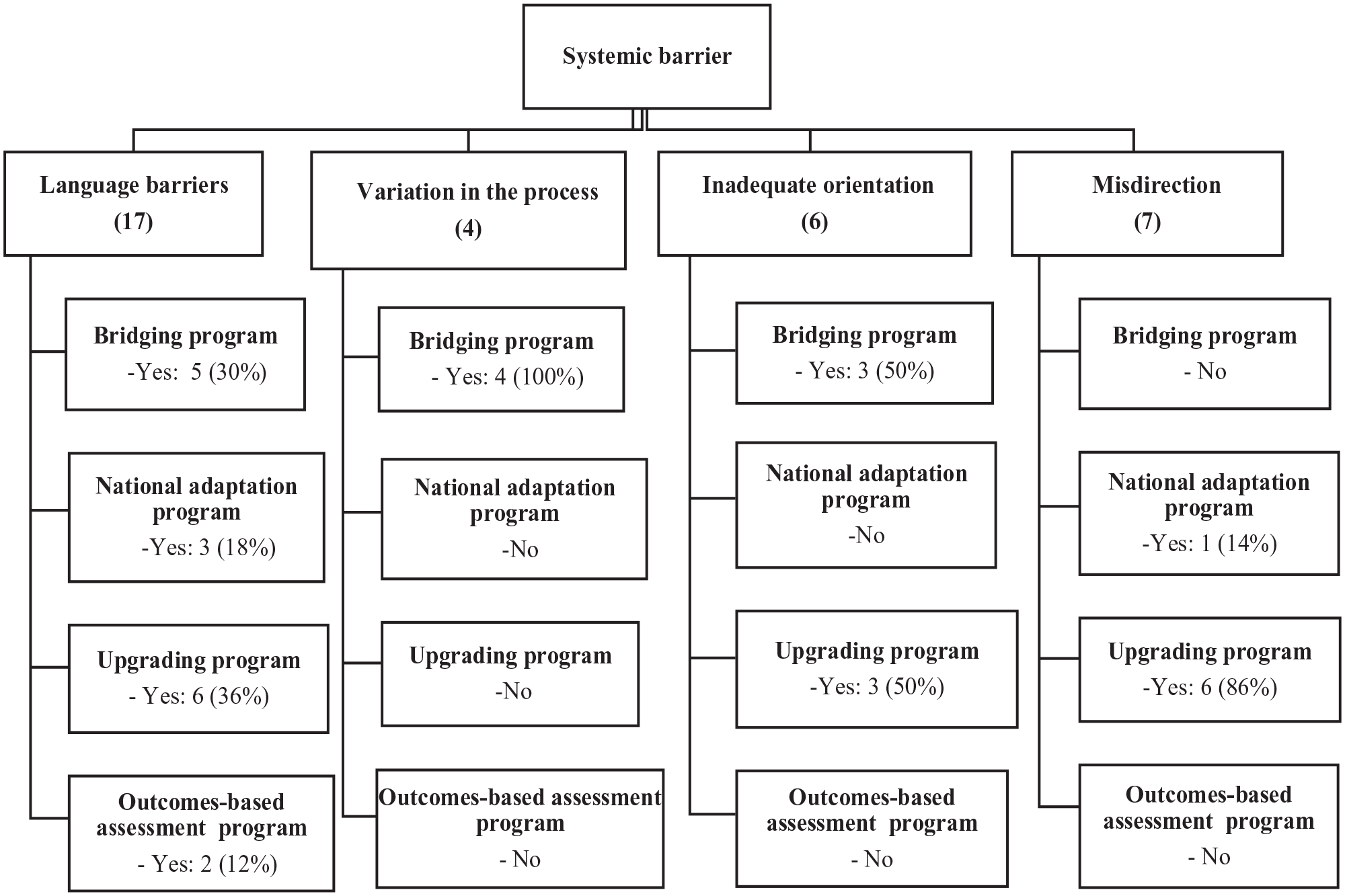
Mapping stage of analysis.
Characteristics of the categories were placed on a continuum to see the possibilities of the category’s characteristics in four groups and results presented in percentages. As illustrated in diagram 1, variation in the process was only discussed by those who applied through the bridging programme for registration, inadequate orientation was the issue equally encountered by those who went through the bridging and upgrading programmes for registration. A majority of participants (86%) experiencing misdirection by the system were in the upgrading programme group. The common theme of language barriers was present in all groups, though to varying degrees, with the majority being in the upgrading programme (n = 6, 36%) and the least in the outcomes-based programme (n = 2, 12%). These findings were supported by direct quotations from participants (Safari et al., 2023).
Focused stage
Focused categorisation, which can be the final stage of the study, occurs when the researcher centralises data into a cohesive account around the core categories and starts to formulate a better picture of study findings. The core category is the highest ‘indication’ category, to which many primary categories and subcategories are assigned. Therefore, the core category is the category that reflects the general identity of the entire set of categories (Shkedi, 2005). What appears to be the key concern or issue of the informants and the essence of relevance represented in the data would determine which category has the most potential to become a core category (Shkedi, 2005). The core category must be key to as many other categories and their features as possible, commonly present in the data, clearly relate to other categories and have clear implications for a more thorough explanation (Shkedi, 2005).
The focused stage of analysis corresponds to the ‘core category’ step of analysis in grounded theory, with the similar objective of determining a meaningful and relevant pattern of behaviour for individuals involved (Glaser et al., 1968).
In our example study, the focused stage of analysis saw the generation of the core category of systemic barriers in the registration experiences of internationally qualified midwives, which was easily related to other categories generated in the second stage of analysis and had clear implications for a broader explanation (Safari et al., 2023).
Theoretical stage
In the first three steps of analysis, researchers seek categorisation of data, comparison of categories across cases and pattern identification. In the theoretical stage, the generated categories are sorted until they fit an appropriate theoretical story. The theoretical narrative is a description of the investigated phenomenon that has been elevated to a theoretical level and a conception of a coherent description of the central phenomenon (Shkedi, 2005). First- and second-order analysis are distinguished as the key link between the data and their theoretical representation in multiple case narratives. First-order theoretical analysis involves direct translation of descriptive categories into theoretical concepts, but second-order theoretical analysis requires conversion of the existing system’s meaning to arrive at a new, abstract and more refined order of theoretical categorisation (Shkedi, 2005). While the description and theoretical interpretations are directly connected in first-order theoretical analysis, the connection in second-order theoretical analysis is actually the interpretation of what is being discovered in relation to what is already known and has been published in the relevant literature (Shkedi, 2005).
Similar to grounded theory, in multiple case narrative, once the researcher has introduced a unique set of categories, they can compare them to notions from the literature. To systematise and consolidate relationships, the researcher must utilise a combination of inductive and deductive reasoning, continually transitioning between posing questions, formulating hypotheses and drawing comparisons (Shkedi, 2005). The researcher can begin to rearrange and reorganise the categories until they appear to match a proper theoretical narrative and yield analytical interpretations. The theory developed in multiple case narrative in contrast to grounded theory, in which theoretical concepts are more abstract and applicable, is a low-level theory that arose from the study of phenomenon situated in a particular context (Shkedi, 2005).
Theory development was not the objective of our study; thus, the theoretical stage of analysis was excluded, which is a common practice in studies adopting multiple case narrative methodology, since according to the Shkedi the focused stage can be the final stage of analysis (O’Malley, 2020; Phelps, 2016). This distinguishes the multiple case narrative from grounded theory, where theory generation based on data is the primary objective of the researcher (Strauss et al., 1997).
Reporting of case narratives
In case-narrative research, there are two distinct types of results reporting. The first is a case-by-case narrative, which emphasises a specific case. The second type of narrative is the collective or multiple case narrative, which consists of multiple narratives around the phenomenon and requires both individual case narratives and cross-case analysis for reporting purposes (Yin, 1981). The multiple case narrative approach does not strictly align with these two narrative reporting styles, considering that this study approach includes a variety of case narratives. Moreover, the main purpose of this approach is not to present the narrative of each case separately, but to clarify associated or distinguishing characteristics by making comparisons between them. Thus, cross-case issues are generally addressed in multiple case narrative studies instead of introducing specific case narratives (Shkedi, 2005).
Multiple case narrative can make effective use of quantitative methods because of the inclusion of many case narratives, in contrast to some qualitative research that draws a sharp distinction between idiographic and nomothetic methods (Shkedi, 2005). In multiple case narrative study, statistical analysis using frequency counts with percentage outcomes is appropriate (Shkedi, 2005). Short quantitative descriptions are considered more focused and clearer in telling the story than long expressive descriptions. However, quantitative methods can only be used for those purposes consistent with the constructivist-narrative approach, the narrative nature of the research should be maintained, and actual verbal responses should be preserved (Shkedi, 2005).
Generalisation of results
Shkedi (2005) claimed three types of generalisation from multiple case narrative, including: (1) case-to-case generalisation, (2) analytical generalisation and (3) generalisation from sample to population.
Case-to-case generalisation. This concept requires the definition of generalisability to be modified to emphasise the degree to which the examined scenario is similar to other circumstances (Yin, 2013). This definition of generalisation offers a more realistic perspective on the generalisability of constructivist-narrative research findings. It is more in line with Stake’s (2005) definition of ‘naturalistic generalisation’, which emphasises applying research findings to other situations that are similar in order to better understand those other situations. In multiple case narrative, single case narratives are not represented as independent entities in the final report; however, case-to-case generalisation does not inherently mean that all elements of case narrative should be transferable to other contexts and may be partly applicable. This capacity of case-to-case generalisation enables the final report of the multiple case narrative, which focuses on the conceptual analysis of case narratives, to be adapted for generalisation of this type (Shkedi, 2005).
Analytical generalisation: This occurs when findings replicate across similar theoretical contexts. In order to perform analytical generalisation, the researcher should refer to the conceptual theoretical context to demonstrate how concepts have driven the data collection and analysis to outline the theoretical parameters of the study (Bergen et al., 2000). In the multiple case narrative as a constructivist-qualitative form of study, generalisation to theory is neither relevant to making assumptions, nor does it use the entire theory as a reference frame. The theories that emerge in multiple case narrative research are more of the grounded than the grand theory type (Shkedi, 2005). In this technique, the process of theoretical analysis, that is, the formation of theoretical concepts and correlations, serves as the basis for analytical generalisation. Thus, specifying the study’s relevance to multiple theories would facilitate analytical generalisation (Shkedi, 2005).
Generalisation to population: The aim for a certain degree of generalisation from a sample to the wider population in the multiple case narrative approach was claimed by Shkedi (2005). The ‘associational’ approach in multiple case narratives involves gathering information from various cases and allows for the ongoing comparison of data units. This process continues until the relationships of the categories are established and incorporated into a meaningful description (Shkedi, 2005). By including moderate-to-large numbers of cases from a sufficiently diversified sample and emphasising broad cross-case patterns, the researcher can avoid the idiosyncrasy that may arise in single-case studies and enhance the potential of sample to population generalisation in multiple case narrative (Shkedi, 2005). Treating case narratives as clusters of categories strengthens the potential of the study for sample-to-population generalisation by facilitating systematic comparisons between group of cases based on the pattern found in the emerged categories. If the researcher indicates that heterogeneity in the sample is comparable to that in other populations, then generalisation is more reliable (Shkedi, 2005).
Literature review
Reviewing studies that have reported using Shkedi’s approach indicate that this methodology has mainly been applied in the education field as a qualitative analysis approach allowing for the study of large populations and performing systematic analysis (Table 1). Multiple case study was reportedly also used as a qualitative methodology in two mixed methods studies (Clouston et al., 2019; Minibas-Poussard, 2018).
Characteristics of studies employing multiple case narrative approach.
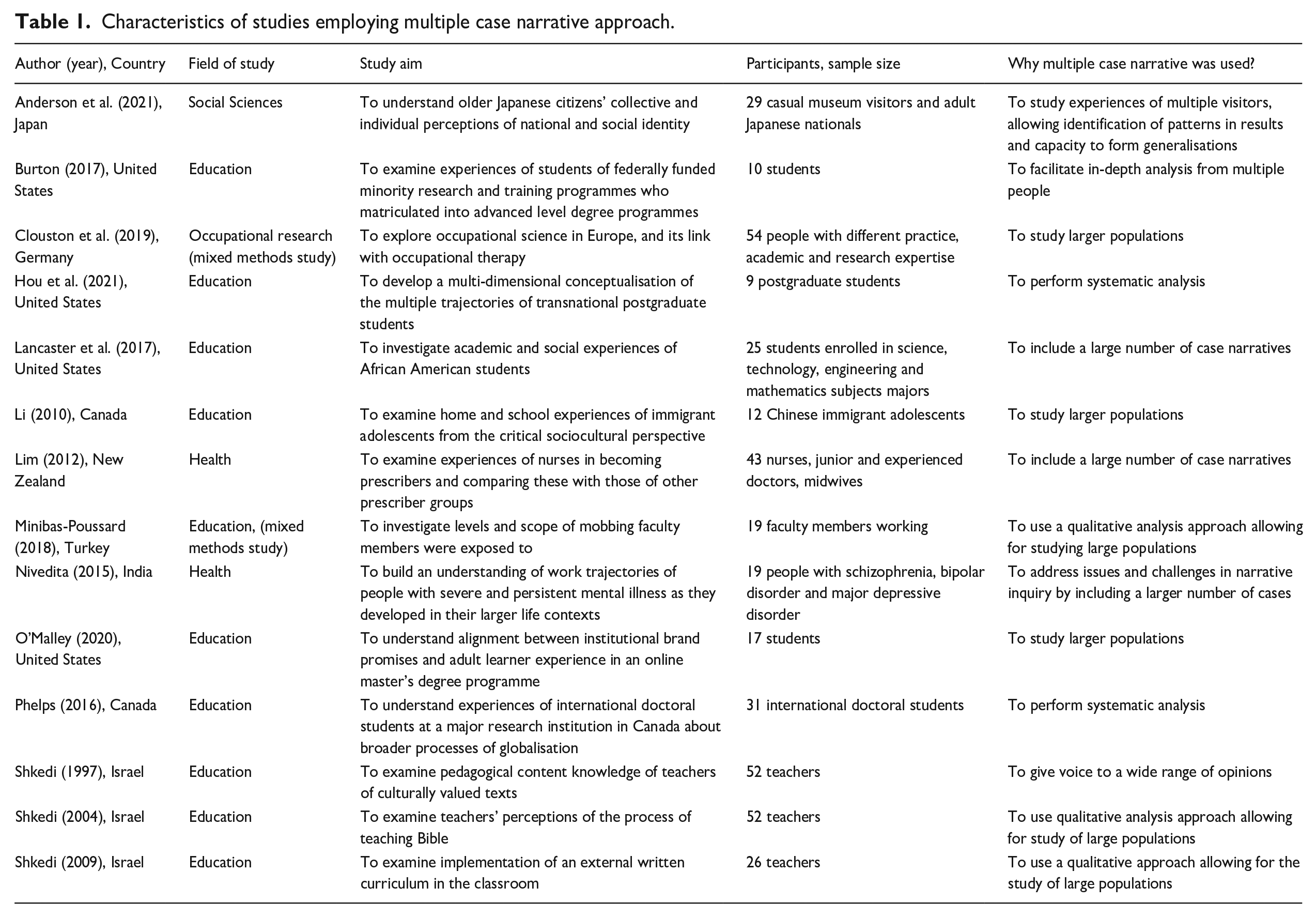
Examples of multiple case narrative demonstrate variance in sample size. Recent examples of multiple case narrative being used in an educational context include Minibas-Poussard (2018) who collected 19 case narratives to better understand unethical behaviour in higher education; Clouston et al. (2019) who studied 54 participants to explore occupational science in Europe and its link with occupational therapy and O’Malley (2020) who used multiple case narrative to understand the alignment between institutional brand promises and adult learner experience in an online master’s degree programme by including 17 participants in the United States. In addition to an educational context, health has been the other leading discipline to employ multiple case narrative in the past decade. Lim (2012) interviewed 43 nursing students to examine their experiences in becoming prescribers and compared these with those of other prescriber groups, whereas Nivedita (2015) sought to understand work trajectories of 19 people with mental illnesses as they developed in their larger life contexts.
Discussion
With extensive narrative research experience in education, Shkedi looked to incorporate trustworthiness principles within the constructivist model in multiple case narrative approach. This methodology can facilitate the development of findings that are more broadly cross-sectional and generalisable than collective case studies. Regardless of whether single- or multiple-case studies are performed, the inability to generalise from case studies has been a major limitation of the method. Existing case study research literature, notably from Eisenhardt (1989) and Yin (2009), has mostly emphasised the potential of multiple-case design for theoretical generalisation and claim that evidence from multiple cases is more convincing. However, selecting a case in a multiple-case study because it is expected to predict either (1) equivalent outcomes or (2) contrasting or opposite results based on established theoretical premises (Miles & Huberman, 1994; Yin, 2009) suggested that the case does not characterise the population from which it was drawn, limiting generalisability. Contrary to the commonly held belief that it is unimportant to select cases that are representative of the population to which they belong, if the purpose of a study is to establish empirical generalisation, selecting representative cases over theoretical sampling makes more sense, as the two populations should share certain essential characteristics to justify the generalisation (Mitchell, 1983). Larsson (1993) further emphasised that, while multiple case studies might achieve cross-case pattern analysis, small case sets may limit the method’s ability to profit from thorough cross-case analysis. The multiple case narrative technique protects researchers against biases that may occur in single or collective case studies by including a large number of case narratives and highlighting broad cross-case comparison (Shkedi, 2005).
The multiple case narrative approach also gives more comprehensive process assessments of a phenomenon than questionnaire surveys and overcomes shortcomings in meta-ethnography using primary data from a wide range of case narratives as part of the same research. While Shkedi claimed the uniqueness of this approach, referring to categorisation, generating the core category and its sub-categories for analysis in the multiple case narrative approach, evident parallels can be drawn with constructivist grounded theory procedures, which provides a robust methodological foundation for this approach.
Several qualitative studies have utilised this methodology, since it allows for larger sample sizes compared to other approaches. It has also been used in mixed methods research, where a larger sample size significantly improves the quality of data collected due to increased complexity resulting from quantitative and qualitative components bringing their own issues of representation, legitimation, integration and politics into the setting (Onwuegbuzie et al., 2007).
This approach attempts to integrate the study of the particular with the needs for comprehensive coverage of larger populations and a broader basis for formal generalisation. The concept of generalisability, the degree in which inferences from a study can be generalised to other populations, is often considered a criterion for evaluating quality and trustworthiness in qualitative health research (Spencer et al., 2004). Sample adequacy, which pertains to appropriateness of sample composition and size in qualitative inquiry, is always considered in appraisal of generalisability (Robinson, 2014). While most qualitative researchers would claim to be unconcerned with statistical inferences from qualitative findings, sample sizes in qualitative health research are commonly seen as small, resulting in tenuous foundations for validity of studies (Carminati, 2018). Multiple case narrative allows for the study of larger samples compared to other qualitative approaches ensuring sufficient data for identifying patterns in generated categories (Shkedi, 2005). The variety and diversity of participants are critical in qualitative research and multiple case narrative is especially accommodating to a diverse collection of participants (Shkedi, 2005). By extending the variety and size of the sample across a range of cases with distinctive features, it is more likely that exceptions will cancel each other out, hence strengthening the sample’s representativeness and promoting generalisation (Polit et al., 2010). Moreover, when heterogeneity in cases is comparable to that in other populations, then generalisation is more reliable (McClintock et al., 1979).
Multiple case narrative collects information on case narratives and systematically finds causal relationships in generated categories among different groups of cases. Finding relationships between categories derived from a sufficient number of cases utilised to compare groups increases not only internal but also external validity (Yin, 2013). Depending on how causality is viewed, qualitative studies can explore causal relationships. The positivistic-quantitative approach assumes there are real causes temporally prior to, or concurrent with, their effects, whereas the multiple case narrative approach assumes all entities are in a state of mutual simultaneous shaping, making it impossible to distinguish causes from effects (Shkedi, 2005). According to Shkedi, multiple case narrative does not violate these presumptions; rather, it seeks to broaden their boundaries. Additionally, while positivistic-quantitative research begins with development of a foundational theory upon which all subsequent research phases are based (Guba and Lincoln, 1994), the multiple case narrative approach does not arrive at causal explanation until conclusion of the research process, after data gathering and creation of informants’ descriptions (Shkedi, 2005).
Since the associational approach employs a probabilistic way of thinking that is prevalent in quantitative analysis, it is common to neglect exceptions. Additionally, it is likely that cases lose their individual identities, as this approach de-emphasises individual cases and case narratives are not represented in final reports as distinct entities, in favour of illuminating cross-cutting themes (Campbell, 1975; Firestone, 1993). Shkedi (2005) claimed that his approach overcame some limitations of the associational approach by attempting to partially avoid losing case identity and bringing along a large amount of information about each case through a matrix and illustrating strategies to see relationships among categories by generating a mapping tree. He encouraged starting analysis by examining individual cases, which encourages users to have a thorough understanding of case characteristics. Shkedi (2005) further emphasised that relationships formed between categories is supported by informant citations. In contrast, the positivist quantitative method eliminates all context-specific variables in order to apply conclusions to the greatest number of individuals and experiments possible (Maykut et al., 1994). However, most qualitative researchers aim to provide rich, contextualised understandings of human experience through intensive study of specific cases, and they do not all agree on the importance or attainability of generalisability (Carminati, 2018). Some believe that generalisation necessitates extrapolation that can never be fully justified because findings are always embedded in context and knowledge is idiographic, residing in particulars (Erlandson et al., 1993). Conversely, some qualitative researchers believe that in-depth qualitative research is ideally suited for exposing concepts, and theories that are not unique to a particular participant or location (Misco, 2007). The rich, exceedingly detailed and potentially informative quality of qualitative findings, according to this view, makes them perfect for generalisation.
Purposive sampling technique for use in multiple case narratives could lead to criticism of the generalisability of this approach. However, in the majority of quantitative research, the population to which generalisations are to be applied is typically poorly defined, and random sampling seldom yields random samples (Polit et al., 2010). Additionally, purposive sampling in multiple case narratives, which focuses on defining typical cases and selecting units to obtain the widest possible variation for the sample from the population with the most knowledge, is comparable to probabilistic sampling in that it expands the potential for study findings to be replicated (Gheondea-Eladi, 2014).
In our study exploring transition of international midwives in Australia, the application of the multiple case narrative approach was found to be beneficial in various ways, with certain limits. It promoted the inclusion of a larger sample size, as evidenced by other studies employing this methodology (Clouston et al., 2019; Minibas-Poussard, 2018; O’Malley, 2020). Identifying relationships between categories based on their pattern of emergence in different cases was found to add special value and depth to the study’s findings by introducing a quantitative dimension to the analysis procedure, which distinguishes the multiple case narrative approach from other qualitative approaches. Inclusion of the relatively large sample size facilitated obtaining comprehensive understanding of the transition experiences of international midwives in Australia. On the other hand, it complicated management of the vast quantities of data collected. This issue was largely overcome by employing NVivo 12, which was not only utilised for coding data, grouping data and auditing data, but also, with its special characteristics, enabled us to perform a large cross-case comparison and identify relationships between the generated themes in different cases. Covering more variance with a large sample size was found to not only improve the generalisability of the study by incorporating diverse perspectives on the phenomenon, but also to strengthen the associational method by raising the likelihood of comparing more distinct groups. Thus, if this methodology is used, the availability of a large sample size, which is essential for multiple case narrative, should be guaranteed.
Due to the inclusion of a larger sample size in multiple case narrative, there is a risk that context-specific details may be lacking in the findings, complicating examination of the context for each narrative and sacrificing the depth and contextual nature of insights. In addition, uncommon themes will be overlooked when comparing the categories of the enormous data generated from a large sample size. Generally, however, the appropriate approach depends in part on what is already known. If the field is well-charted, an initial emphasis on constructs may be more appropriate. However, if pioneering studies are required in areas where little is known, multiple case narrative study may be more beneficial.
Conclusion
As evidence-based practice is increasingly adopted, the health sector relies on researchers’ findings to implement in real-world settings. Rather than denying the possibility for qualitative research to yield general truths, researchers can take steps to improve the readiness of their studies for logical and reasonable generalisation. Generalisable evidence is the ideal beginning for evaluating a scientific hypothesis in light of clinical expertise and patient preferences. The multiple case narrative, which to date has been underutilised, is a systematic approach with characteristics that make it an efficient research technique to provide valid and generalisable qualitative evidence, offers new possibilities for nursing and health research.
Key points for policy, practice and/or research
The multiple case narrative is a systematic approach with characteristics that make it an efficient research technique to provide valid and generalisable qualitative evidence.
The multiple case narrative allows for the study of larger samples compared to other qualitative approaches.
This approach offers a uniquely systematic approach to analysis by finding associations between categories generated from collective analysis of large number of cases.
The multiple case narrative, which is mainly used in the education field, offers new possibilities for nursing and health research.
Footnotes
Declaration of conflicting interests
The author(s) declared no potential conflicts of interest with respect to the research, authorship, and/or publication of this article.
Funding
The author(s) received no financial support for the research, authorship, and/or publication of this article.
Ethical approval
Ethical approval was not required for this study as it solely focuses on providing a comprehensive analysis and synthesis of existing literature and does not involve any primary data collection from individuals. Therefore, no ethical considerations were applicable or necessary for this research.
