




Abstract
Background
Global nurse shortages present a threat to the sustainability of remote and rural healthcare. Interventions have been developed to support recruitment and retention of nurses that focus on providing pre-nursing experience for school pupils who intend to pursue nursing careers. However, there is a lack of evidence around how pre-nursing experience supports transition into nurse education.
Aims
This study aims to explore the impact of a pre-nursing scholarship for school pupils in remote and rural areas of Scotland on experiences of transition into nurse education.
Methods
This was a qualitative study involving semi-structured telephone and face-to-face interviews with pre-nursing scholarship participants.
Results
An authentic pre-nursing experience supported school pupils’ transition to nurse education. First, it increased students’ self-efficacy, both in their decision to choose nursing as a career and their ability to nurse. Second, it helped students to realise that the opportunity to study closer to home was available to them. Third, it supported students’ educational and social integration, helping them feel prepared for university teaching and learning approaches and the social experience of being a student.
Conclusions
Pre-nursing experience can support transition into nurse education and contribute to career pathways that support recruitment and retention of nurses in remote and rural areas.
Keywords
Introduction
Recruitment and retention of the nursing workforce remains an international challenge (World Health Organization, 2010a). An ageing population and workforce, as well as increasing global mobility, have resulted in an increase in demand and a decrease in the supply of nurses (World Health Organization, 2010a). These challenges are exacerbated in remote and rural areas where a reduction of an already limited pool of nurses significantly impacts upon local healthcare provision (Humphreys et al., 2017; World Health Organization, 2010a).
In Scotland nearly 20% of the population live in remote and rural areas (MacVicar and Nicoll, 2013). Providing equitable healthcare provision in sparsely populated areas presents logistical, technical and economic challenges. Access to services in rural areas may require lengthy journeys to reach care facilities. Many countries face similar challenges despite differences in landscape, climate or economy. In South Africa 46% of the population live in rural areas, but only 19% of nurses work in these locations (World Health Organization, 2010a). In Canada 24% of the population live in remote and rural locations, but only 9.3% of physicians work there (Dumont et al., 2008). While contextual variations exist, the recruitment and retention of nurses in remote and rural settings is an international concern (Roberge, 2012; World Health Organization, 2010b).
Nurses are the largest professional group in healthcare and have a crucial role in the provision of remote and rural care. Nurses may be the only healthcare providers in remote and rural areas (MacLeod et al., 2017), coordinating services and acting as knowledge brokers between other professionals. Shortages of nursing staff may therefore remove the ‘glue’ from remote and rural communities, negatively impacting on quality of care.
It is important, then, to understand the factors that influence nurses’ decisions to work in remote and rural areas in order to design effective recruitment and retention strategies. There is compelling evidence that rural origins can positively impact on healthcare professionals’ decisions to remain working in rural areas (Nugent et al., 2004; Yates et al., 2013). Nurses who trained in remote and rural campuses are more likely to work in these areas (Neill and Taylor, 2002). Findings from Australia identified that students who had previously lived or worked in rural areas were more likely to choose a post in a rural setting (Smith et al., 2001). A Cochrane Review confirmed that the most persuasive global evidence is that recruiting healthcare professionals from rural backgrounds increases the chance of graduates returning to practice in rural communities (Grobler et al., 2015). However, Grobler et al. (2015) note that there is a lack of reliable evidence in this field and conclusions are drawn primarily from observational studies of interventions for medical practitioners.
Choosing to work as a nurse in remote and rural areas is dependent upon a combination of demographic, developmental and environmental factors (Campbell, 2013). Such a complex interplay of factors requires more than a simple ‘one size fits all’ solution. The World Health Organization (2010a) has suggested implementing a ‘bundle’ (several interventions) of recommendations, as opposed to single strategies. To date, evidence has not expanded to detail a standardised bundle of interventions for success, but rather suggested a collection of interventions tailored to specific contexts. Their recommendations include recruiting from rural areas, locally situated campuses, and access to rural placement experience (World Health Organization, 2010a).
Current evidence points to the importance of establishing a pathway through nurse education into nursing careers in remote and rural areas. Encouraging the uptake of nursing programmes in remote and rural areas and supporting the transition from secondary education (high school) to tertiary education (university) is pivotal to the successful development of this pathway. An evaluation of a 2-year pre-nursing scholarship (PNS) pilot in Scotland that aimed to support school pupils transition into nurse education found that immediately after participation in the PNS most pupils strongly agreed (79.4%) that the PNS had put them in a ‘better position’ to decide whether nursing was right for them (Smith et al., 2015a). However, the experience of transition into nursing programmes for those participating in pre-nursing experience is not known. The aim of this study was to explore school pupils’ experiences of transitioning to undergraduate nursing programmes after participation in a PNS.
Methodology
Design
A qualitative study was conducted involving telephone or face-to-face interviews with PNS participants.
Intervention (PNS)
To support school pupils’ transition to undergraduate nursing programmes, a PNS was developed for penultimate and final-year secondary school students (S5/S6) from remote and rural areas of the Scottish Highlands and Western Isles. Further information about the scholarship is available elsewhere (Beattie et al., 2014). Briefly, the scholarship comprised four core components:
A Residential Week: pupils were accommodated on campus and were involved in university activities: i.e. face-to-face and video-conference lectures, clinical skills and evening social activities. Each school pupil was allocated to a ‘buddy’ (final-year student nurse) who accompanied them during the university week (Smith et al., 2015); Placement Week: observational placement in a hospital and/or community setting close to the pupils’ homes. School pupils were supported by a ‘buddy’. The buddy’s practice mentor supervised the experience; Qualification: completion of a Skills for Work (Health Sector) qualification accredited by the Scottish Qualification Authority (SQA) over the 9 months of the scholarship; Graduation: event to celebrate pupils’ completion of the scholarship.
Recruitment
All participants who completed the scholarship (n = 42) were invited to complete a questionnaire through the Bristol Online Survey platform (University of Bristol, UK) via email and posts on social media. The questionnaire included questions on socio-demographics, their future study intentions and whether or not they would be willing to participate in a follow-up interview.
Data collection
Fourteen participants responded to the online questionnaire. Semi-structured telephone/face-to-face interviews were conducted with seven participants to explore their experiences of the PNS, specifically around the effects of participation on their career decisions and preparation for commencing an undergraduate nursing programme. The interview topic guide is shown in Figure 1. Interviews were audio-recorded and transcribed.
Interview Topic Guide.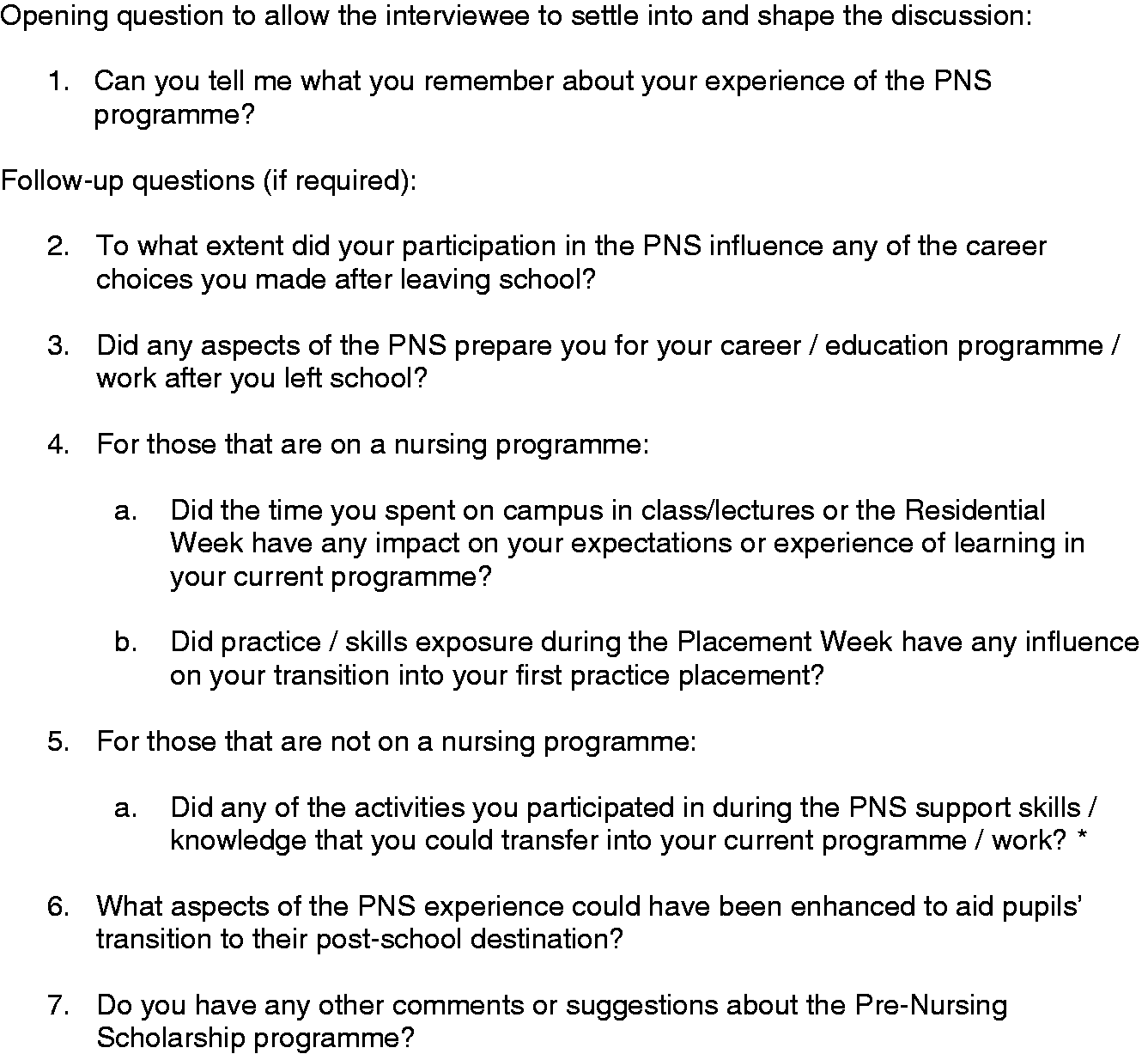
Data analysis
Thematic analysis of qualitative data involved a three stage process informed by the principles and procedures of framework analysis (Ritchie et al., 2013). First, all transcripts were read independently by each of the study authors to identify emerging themes. Second, to inform the development of a coding framework, the authors met to compare their independently identified themes and agree a coding framework. This ‘data workshop’ assured rigour in the analytical approach as it enabled in-depth discussion of each independently generated theme to develop agreed overarching themes. Third, all transcripts were coded against the agreed coding framework.
Ethics
The study was approved by the University of Stirling's Research Ethics Committee (Reference SREC 15/16). Informed consent was sought prior to completion of the online survey and/or interviews. Anonymity has been assured through the use of a unique participant identifier.
Results
Sample
Seven out of 14 (50%) questionnaire respondents participated in telephone interviews, all of whom had started nurse education. All participants were female. Only one male completed the scholarship (Smith et al., 2015) but did not respond to the survey invitation.
Transitions into nurse education
Analysis identified three themes: (a) increasing self-efficacy, both in their decision of choosing nursing as a career and their ability to nurse; (b) realising the opportunity available to them, for many closer to home than anticipated; and (c) aiding educational and social integration, both by feeling prepared for academic course content and social familiarisation. Each theme is discussed in turn.
Increasing self-efficacy
The scholarship was a catalyst for remote and rural pupils, fuelling their desire to choose a nursing career (Participant 3, 4, 8, 10) and also giving them confidence that they could do the academic and practical aspects of the nurses’ role. For some, taking part in the programme accelerated their entry to nurse education by giving them confidence to apply directly to university: Yeah, if I hadn’t taken part in it then I don’t think I would have even applied to go to university straightaway, I think I maybe would have … done college, so I think that gave me the boost to go for it. (Participant 6) The pre-nursing course gave me a general idea of what I would be learning through the three years. I actually had a conditional [university offer] so it did motivate me to work a bit harder to get my results. (Participant 2) Yeah, [doing skills] helped a lot out on placement ‘cause it was quite nice that we were able to go off and do some of those skills, blood pressure and taking pulses and stuff, which was quite good. (Participant 4)
Realising opportunity
Taking part in the scholarship helped students to see that nursing was a graduate-entry profession and that they could study in remote and rural campuses to gain their degree. For example, one student shared how they were unaware that a degree in nursing was an option: It opened the opportunity for me to get into nursing ‘cause I never really knew much about what uni, like what you did in university, I always just thought of it as a job rather than a degree. I really enjoyed the practical, the placement [in the] community and it just opened up what they actually do and gave me an idea that I wanted to do it. (Participant 8) Yeah, it definitely influenced me wanting to come here to [this campus] as well because it made me realise what the uni was here whereas before I didn’t even know there was a uni here. (Participant 8)
Aiding integration
The scholarship helped students to integrate into nursing programmes. Educational integration both into university and clinical practice along with social integration was valued by participants.
Educational integration
Generally, the scholarship made the experience of going to university less daunting. Specifically, familiarity with the university environment eased students’ transition into their undergraduate programme. Yeah, because like it wasn’t so scary ‘cause you’d done it before so you had a wee bit of insight and that was helpful, you know, when you get into university you’re sort of thrown into it a bit. (Participant 6) It was a lot less daunting because I had more of an insight into what to expect more so than other students who were in the same position as me who had just left school. (Participant 3) Well the programme as a whole definitely prepared me for starting in training but probably mostly the week in the hospital, because it really gave me a taste of what it’s like to be a student nurse and I realised how much I really enjoy being in a hospital setting and just being, possibly, potentially being a nurse in the future. (Participant 3) The placement really helped me because I got to see what patients are actually like and how to handle them … so I learnt some vital skills before I even came into the university course. (Participant 5) We got like the Folder of Evidence which is … basically like our OAR just now so like we kind of already knew about the OAR before we even started and it was a lot, it was a lot better ‘cause we kind of understood what university was actually going to be like before we even left school. (Participant 5) I think the folder work, like the paperwork side of things helped me realise what would be expected of me at uni because it was similar to uni paperwork and the practice helped me realise that it was what I wanted to do as a job as well. (Participant 8)
Social integration
Time spent during the scholarship establishing friendships and becoming familiar with faculty staff and student-nurse buddies helped students integrate at the start of their nursing programmes. Students knew people on campus and seeing these ‘familiar faces’ aided integration into university life. Yeah, I definitely felt more comfortable when I started the programme ‘cause I knew like what it would be like and I settled in very quickly, I wasn’t as nervous ‘cause I knew a lot of faces wandering around, so it helped a lot. (Participant 4) The friends I’ve made at university, four of them actually did the pre-nursing scholarship but just at a different time to me, they’re all in my year just now, so they’ve all went off to do nursing. (Participant 5)
Discussion
Our study found that taking part in a PNS helped support the transition experienced by participants from remote and rural locations into nursing education. The findings demonstrate that the authenticity of the scholarship experience where pupils were exposed to aspects of university life and clinical placements was fundamental to the success of the programme. To our knowledge, no other programme has been evaluated that provided similar in-situ experience. A Healthcare Travelling Roadshow (HCTRS) initiative in Canada reported how exposure to healthcare careers with rural youth was positively evaluated (Maurice et al., 2019); however, the roadshow travelled to the rural schools and destination evidence was not reported. Involvement in campus-based teaching and learning, clinical placements close to home, and forging friendships with student-nurse buddies and peers helped pave the way to entry to their programme. The scholarship gave participants confidence in their choice and ability to study nursing. Moreover, the scholarship accelerated or assured participants’ entry into nursing programmes, prompting those who may have delayed the decision to begin their studies and encouraged others who required specific exam results to obtain the grades for entry.
Previous research exploring pre-nursing experience has tended to focus on participants’ educational intentions at the end of programmes (Daumer and Britson, 2004; Drenkard et al., 2002; Matutina, 2008), with a lack of longer-term follow-up to assess actual behaviour. Our study provides promising evidence that participants act on their intention to pursue nurse education after pre-nursing experience, and that it supports their transition. In this way our work highlights transferrable lessons that can inform development of pre-nursing interventions in other international settings. First, providing evidence of a useful link to support an educational remote and rural pathway, and second, to identify elements of a scholarship programme that can be tested by others.
First, our study suggests how pre-nursing experience in remote and rural areas could play an important role in the design of rural nursing career pathways to address the growing global nursing shortages that threaten the sustainability of healthcare delivery in remote and rural areas (Capstick et al., 2008; Smucny et al., 2005). Given the evidence that healthcare professionals with rural origins are more likely to remain or return to work in these areas (Nugent et al., 2004; Yates et al., 2013), provision of an authentic pre-nursing experience offers an important contribution to the international challenge of the nursing shortage. While we found no other studies evaluating strategies to target admissions of students from rural backgrounds into nursing, there is evidence to suggest that exposure to rural placements during undergraduate studies positively influences choices to return to these contexts when qualified (World Health Organization, 2010a). There is also evidence that experiencing rural-based placements enables health professionals to ‘grow roots’ in remote and rural areas to facilitate important professional networks (World Health Organization, 2010a). Hence, pre-nursing experience that includes rural placements should be an important part of strategies that seek to encourage those from rural areas to pursue healthcare careers locally. Moreover, rural placements could be part of wider strategies to attract those who live elsewhere to study and work rurally. Pre-nursing experience for school pupils, regardless of their home locations, that includes rural clinical exposure could be a key aspect of such strategies.
A key finding of our study was that participants became aware of the opportunities to study and work locally. Given existing evidence suggesting that place of study has an important influence on place of work after graduation (Neill and Taylor, 2002; Smith et al., 2001), not being aware of rural provision could result in net out-migration from rural areas, compounding nurse shortages. Pre-nursing experience could be a mechanism to reverse this trend by encouraging local pupils to study and work locally, as well as attracting others to work in remote and rural settings. However, realising this potential will require investment from both educational providers and health policy-makers in pre-nursing experience to include this exchange experience.
Second, our study identifies the core components of pre-nursing experience that supported students’ transition into nurse education. Hence, it also provides evidence that is applicable beyond remote and rural contexts to inform the design of similar programmes internationally regardless of geographic context. Specifically, these lessons relate to students’ socialisation and confidence with future education and clinical practice. Participants who took part in an inter-professional immersion programme in rural North Dakota identified how unprepared they and other people in their community were to pursue higher education (Austin, 2019). Hence, getting to know peers and academics eased students’ social integration. Existing literature supports the fact that student nurses undergo a process of socialisation and that their integration with other nurses is essential for their professional development (Brown et al., 2013; Hasson et al., 2013).
Participating in the scholarship also created a common scholarship identity among participants, both within and across the two cohorts. A scholarship identity provided those living in remote and rural areas with a social network that sustained their interest in nursing and eased their passage into their degree programme. Over time this community of practitioners committed to remote and rural nursing could be established and strengthened, for example, through development of a PNS alumni network. However, paradoxically, while this scholarship identity smoothed the process of transition, for some it may create a sense of separation from other students that may be particularly pronounced in smaller cohorts typical in remote and rural areas. A balance between a ‘scholarship’ and ‘cohort’ identity needs to be considered to ensure equity and prevent segregation of specific groups. Hence, it is important to strike a balance between a scholarship and cohort identity by both providing opportunities for cohort identities to develop and equitable access to elements of the scholarship that supported socialisation, such as early introduction to faculty staff and fellow students, including approaches to peer mentorship for all students (Smith et al., 2015b).
Transition to nurse education was further supported by experiencing educational approaches such as lectures and tutorials underpinned by andragogy rather than school class-based didactic teaching. This prepared students for the different teaching and learning approaches used at university. Indeed, participants welcomed these different approaches during the scholarship that mirrored those they would encounter at university. Research in the UK has found that students are often ill-prepared for the educational approaches used at university (Blackman, 2017). Participating in pre-nursing experiences can therefore support this adaptation to andragogic academic approaches.
Just as early experiences of campus can be challenging for students, the first placement during a nursing programme is known to be a period of heightened anxiety and stress for student nurses (Sharif and Masoumi, 2005). Observing and practising clinical procedures during the placement week made clinical skills sessions and initial clinical experiences less daunting to participants after starting their nursing course. Moreover, the use of a Folder of Evidence during the scholarship that mirrored the OAR used by universities across Scotland to record practice learning further alleviated anxiety around practice learning assessment.
Strengths and limitations
This is the first study internationally to assess the impact of pre-nursing experience on school pupils’ transition into nurse education. It provides important evidence from a follow-up of pupils that took part in a PNS to inform development and evaluation of rural nursing pathways that could encourage recruitment and retention in remote and rural areas, as well as identifying core components that can support transition regardless of geographic context.
However, our study has several limitations. First, the sample size is relatively small. This means that the views of the students expressed here may not be shared by all scholarship participants. Specifically, participants who chose not to pursue nurse education after taking part in the programme proved particularly difficult to reach and their views are therefore unknown. Second, the specific design of the PNS will inevitably have shaped the transition experiences of the students in the study and cannot control for other variables that may have influenced the findings. Future studies would need to examine which elements work best, for whom and in what context. This study provides a useful foundation.
Conclusion
Pre-nursing experience for school pupils from remote and rural parts of Scotland helped them to transition into undergraduate nursing programmes. Our study provides promising evidence that pre-nursing experience in rural university campuses and clinical settings can encourage access to locally provided nursing degree programmes to those living in remote and rural areas who are most likely to return to these areas after graduation. Providing pre-nursing experience at schools of nursing in remote and rural areas has the potential to alleviate global staff shortages that may affect access and quality of care in remote and rural areas.
Key points for policy, practice and/or research
Recruitment of nursing students from remote and rural areas into local undergraduate programmes is known to increase the likelihood of recruitment into the local workforce post-qualification. Participation in a pre-nursing scholarship in a remote and rural area before entry to nurse education increased school pupils' desire to work in those areas after graduation. An authentic experience allowing familiarity with people, andragogical educational approaches, clinical procedures, and paperwork through a pre-nursing scholarship were key to successful transition into undergraduate nursing programmes.
Footnotes
Authors' note
Richard G Kyle is now affiliated with Deputy Head of Research and Evaluation, Public Health Wales, Cardiff, UK. He was formerly Reader, School of Health and Social Care, Edinburgh Napier. All authors conceived and designed the study, conducted data collection, analysis and interpretation, drafted and revised the manuscript for publication and approved the final version.
Acknowledgements
We are grateful to NHS Education for Scotland and project partners in NHS Highland, NHS Western Isles, Highland Council, and Comhairle Nan Eilean Siar; students who participated in the scholarship and this study; and our colleagues Isobel Chisholm, Michael MacPhee, Elaine Dibden and Lorna Gordon (University of Stirling) for their work in developing and delivering the pre-nursing scholarship.
Data
Data are not publically accessible but are available from the corresponding author on request at richard.kyle@wales.nhs.uk.
Declaration of conflicting interests
The author(s) declared no potential conflicts of interest with respect to the research, authorship, and/or publication of this article.
Ethics
The study was approved by the School of Health Sciences (University of Stirling) Research Ethics Committee, (Reference SREC 15/16).
Funding
The author(s) disclosed receipt of the following financial support for the research, authorship, and/or publication of this article: Development and initial evaluation of the Pre-Nursing Scholarship was supported by funding from NHS Education for Scotland (NES). The University of Stirling Enhancement of Learning Fund (SELF) supported follow-up evaluation of the programme.
