



Abstract
Background:
Enrollment challenges in pre-licensure nursing programs represent a new threat to the ongoing shortage of registered nurses in the United States. One way to avert declining enrollments is through proactive engagement with students in kindergarten through 12th-grade education to promote nursing as a viable career choice.
Objective:
Our pilot study evaluated the feasibility and acceptability of a nursing pipeline summer program targeting high school students in career technical education (CTE), a federally funded program focused on preparing high school students for a variety of careers through structured curriculum planning and experiences.
Methods:
This pilot feasibility study involved 11th- and 12th-grade high school students. We administered electronic surveys to collect data on program acceptability from students.
Results:
Over the 12 months from August 2023 to August 2024, we recruited 31 high school students into the blended-learning summer pipeline program. Twenty-seven students completed all program components and obtained 5 industry-recognized certifications. Those who responded to the program evaluation surveys (n = 16) rated their program experience favorably. For example, 93.8% reported that they truly enjoyed attending the course, and 87.5% would recommend this course to other students.
Conclusions:
We contribute to the nursing pipeline programs’ research by highlighting the role of CTE as a potentially valuable, yet underutilized partner in creating a sustainable conduit of youth into nursing. To expand the pipeline of students into nursing, nursing programs should consider partnerships with high schools offering CTE.
Keywords
Introduction
Enrollment challenges in pre-licensure nursing programs represent a new threat to the ongoing shortage of registered nurses (RNs) in the United States, estimated to reach 350 540 RNs by 2026 and 337 970 by 2036. 1 According to the American Association of Colleges of Nursing, 2 enrollments in generic Bachelor of Science in Nursing (BSN) programs decreased by 1.4% in 2022. While there was an increase of 0.6% in BSN program enrollments from 2022 to 2023, the number of vacant seats also increased from 23 698 to 28 035 over the same time period. 3 There is an urgent need for nursing programs to develop innovative approaches to fill all nursing program seats and avert further decay in enrollments.
Effective improvement approaches require targeting the contributing factors to the plummeting nursing program enrollments, including unfavorable perceptions of nursing among students and counselors. Research on the perceptions of nursing among high school students dates back over 20 years,4-6 but more recent research on the topic in the United States is scarce. 7 Palazzo and Erickson collected data in 2019 from 820 high school students from the Pacific Northwest region of the United States using the Nursing Attitudes and Perceptions Scale. 7 The scale includes 26 Likert-type questions about nursing as a career choice on a scale from 1 (strongly agree, the most positive response) to 5 (strongly disagree, the most negative response). Across all scale items, female students reported more positive responses than male students, although both reported generally more negative than positive perceptions of nursing. For example, for the item “Looking ahead, I am considering becoming a nurse” the reported mean score for males was 3.48 (SD = 1.05) and for females it was 3.29 (SD = 1.15) on a scale from 1 to 5, with higher scores indicating more negative perceptions. For the item “Most people I look up to are nurses” the reported mean score for males was 3.80 (SD = 1.15) and for females it was 3.46 (SD = 1.22). For the item, “Most people whose opinions I value think that I should chose nursing as a profession” the reported mean score for males was 3.52 (SD = 1.06) and for females it was 3.09 (SD = 1.15). There were no differences between females and those who self-identified as gay and/or bisexual males across all 24 items. The findings from this study 7 are similar to other research reporting that high school students do not perceive nursing as an ideal career due to the lack of desired autonomy, earning potential, and opportunities for leadership and power. 4
Regarding perceptions of high school counselors, in a national study, they reported that attributes such as trustworthiness, desire to help others, being caring, and having good interpersonal skills were less important necessary attributes for a nursing career than an interest in health and medicine and a strong background in sciences, math, and critical thinking. 8 Also, many counselors reported viewing nursing as a female profession and did not agree that a grade point average (GPA) of 3.5 or greater was necessary for nursing school. 8 In another study, counselors reported a need for more information about different education and career pathways in nursing, coupled with more exposure to practicing nurses and summer camps to introduce middle and high school students to nursing. 9 Further, counselors were particularly interested in learning about men in nursing and how to improve advising male students about nursing. 9
Apart from students’ and counselors’ perceptions of nursing, another contributing factor is the notable decline in 18-year-olds available to enter college, referred to as the demographic cliff, across all majors, including nursing. 10 Specifically, there will be ~300 000 fewer net new 18-year-olds available to apply to college from 2026 to 2030. 11 Another contributing factor is Generation Z’s preference for trade schools over college amid rising college costs which have more than doubled over the last 20 years, 12 earning them the title of the “toolbelt generation.” 13 Data from the National Student Clearinghouse support this trend by showing that the number of students enrolled in vocational-focused community colleges increased 16% from 2022 to 2023. 14 Next, more women, who represent the majority of the nursing workforce, are choosing careers in other science, technology, engineering, and math (STEM) fields, which reduces the pool of women available and interested in pursuing nursing. For example, in 1970, women made up 38% of all U.S. workers and 8% of STEM workers. By 2019, the STEM proportion had increased to 27%, and women made up 48% of all workers. 15 Last, the negative work experiences of nurses during the COVID-19 pandemic, including insufficient staffing, burnout, unsafe working conditions, and family caregiving obligations, have resulted in declining interest in the nursing profession among college-aged youth. 16
In the context of these contemporary demographic shifts and career-related generational preferences, the competition for students willing and able to enroll in nursing programs is rising. A purposive approach is urgently required to boost nursing career interest and to effectively compete for future students’ attention among all the options available to contemporary youth. Nursing programs must proactively engage with counselors and students in kindergarten through 12th-grade (K-12) education to promote nursing as a viable career choice in conjunction with a broader set of strategies for nursing pipeline expansion.17,18 An innovative approach is critical to address the rising number of fully staffed nursing school vacancies and nursing workforce gaps.
Career Technical Education
Research on pipeline programs targeting high school students for careers in healthcare 13 (and nursing specifically) is not new.19-25 However, our study is novel for targeting high school students in career technical education (CTE).
CTE is a federally funded program focused on preparing high school students for a variety of careers through structured curriculum planning and experiences. 26 CTE programs have become essential in preparing individuals for careers in healthcare, particularly in nursing. Nationally, CTE health sciences programs are among the most popular, with 42% of students enrolled in these programs focusing on health-related fields. 26 These programs help meet the growing demand for healthcare workers. The Carl D. Perkins Career and Technical Education Act, also known as Perkins V, has further reinforced CTE’s role in healthcare by funding programs that provide students with the certifications necessary to enter the workforce, such as Certified Nursing Assistant and Licensed Vocational Nurse credentials. 27
Pipeline Programs
Health professions pipeline programs have long played a vital role in expanding the healthcare workforce by removing the barriers to entry into health professions schools, especially for economically disadvantaged students.17,18,28-30
One of the most significant barriers to entry is financial instability. The high cost of nursing education often acts as a deterrent, preventing many students from even applying to nursing programs. 17 Despite efforts to provide financial aid and scholarships, these resources are often insufficient to cover the full cost of education, particularly for students facing personal or familial financial obligations. 25
Academic preparedness is another critical challenge. Students often attend under-resourced high schools that do not provide the level of academic preparation necessary for the rigorous coursework required in nursing programs. 31 This academic gap is particularly evident in foundational courses such as anatomy and physiology, where economically disadvantaged students experience higher rates of failure and attrition.24,32 Without adequate academic support, many students struggle to progress through nursing programs, leading to a phenomenon known as the “leaky pipeline.” 32
Another significant obstacle is the lack of mentorship and role models within nursing education. Many students often struggle to find mentors who understand their unique challenges and can provide culturally relevant guidance. This lack of mentorship contributes to higher attrition rates among vulnerable students, as they are less likely to persist through the challenges of nursing education without adequate support. 18
Partnerships between secondary education and nursing schools play an important role in adequately preparing students for the rigors of nursing education. These partnerships provide academic support, career counseling, and early exposure to the nursing profession, all of which are critical for ensuring students’ success. 20 A national survey of 30 nursing programs with structured pipeline activities focused on mentorship and academic and psychosocial support resulted in improved recruitment and retention of select students in nursing. 33 More recently, McCord and Otte conducted narrative reviews of studies on student recruitment, admission, and retention in nursing programs. 23 The authors concluded that pipeline programs help address the many barriers students face in pursuing nursing careers through various supports, such as academic tutoring, mentoring, and financial aid. One gap in the existing evidence on pipeline programs in nursing that merits further attention is the recruitment of students earlier in K-12 education.
We identified 7 studies that implemented programs to specifically recruit high school students into nursing.18-25 The studies focused on partnership programs between universities and high schools, particularly focusing on high school students from disadvantaged backgrounds in urban areas located within the states of North Carolina, Missouri, Washington, Ohio, Georgia, and Illinois. Universities administered the programs in the summer or throughout the school year on either a short-term (eg, several days or weeks) or a long-term (eg, semester-long) basis. The programs included common strategies for addressing social, financial, and academic barriers for students pursuing nursing education. Such strategies included increasing awareness of health career paths; admission and curriculum requirements; exposure to role models; peer and faculty mentorship; college readiness, specifically in math and reading; parent and high school teacher and counselor education; and test-taking and stress-relief skills. Grants from the U.S. Department of Health and Human Services or private foundations funded the programs.
Despite positive results of the programs targeting high school students, the authors reported challenges with youth recruitment. We contribute to the nursing pipeline programs’ research by highlighting the role of CTE as a valuable partner in creating a sustainable conduit of youth into nursing.
Purpose
The purpose of our study was to evaluate the feasibility and acceptability of partnering with high schools in Houston, Texas, to recruit and retain high school students enrolled in CTE into a summer nursing pipeline program. The recruitment goal was 30 high school students.
Methods
Design
We designed this pilot feasibility study 34 to assess the feasibility of a nursing pipeline program involving high school students enrolled in CTE programs. The Institutional Board for Protection of Human Subjects at the authors’ institution approved the study.
Participants and Setting
Participants included 11th- and 12th-grade high school students enrolled in a CTE health science track. Additionally, RNs actively practicing in a health system served as professional role models in virtual mentoring sessions. School of Nursing faculty delivered didactic curriculum virtually and in-person.
The study team met with the superintendent of Houston Independent School District (HISD) and the College and Career Readiness staff to explain the goals and objectives of the program. They provided feedback to determine meaningful approaches to implement the program with HISD students and discuss the best ways to implement the program. Through these meetings, the study team identified 5 HISD schools based on the school’s interest in participating in the program, the school’s Title I status, the percentage of students receiving free or reduced lunch, and the availability of CTE health science courses. The study team collaborated with the HISD school representatives to schedule recruitment events and implement required clearances to allow high school students to attend scheduled program components at the School of Nursing, at the health system, and virtually.
The schools the study team selected serve racially and ethnically diverse students, many of whom are economically disadvantaged. HISD defines economically disadvantaged students as those who qualify for free or reduced-price lunch under the National School Lunch Program or who meet other federal criteria for public assistance, such as families receiving benefits from the Supplemental Nutrition Assistance Program or Temporary Assistance for Needy Families. For example, in school 1, 16% of students self-reported being African American, 34% Asian/Pacific Islander, 36% Hispanic, and 44% economically disadvantaged; in school 2, 29% of students self-reported being African American, 7% Asian/Pacific Islander, 43% Hispanic, and 57% economically disadvantaged; in school 3, 4% of students self-reported being African American, 1% Asian/Pacific Islander, 94% Hispanic, and 93% economically disadvantaged; in school 4, 33% of students self-reported being African American, 2% Asian/Pacific Islander, 62% Hispanic, and 93% economically disadvantaged; and in school 5, 11% of students self-reported being African American, 1% Asian/Pacific Islander, 79% Hispanic, and 70% economically disadvantaged.
Leaders from the hospital system were included as part of the study team to engage practicing RNs to serve as professional role models and mentors. Additionally, the system leaders provided input into program design and shared information about the program, clinical mentor role, and time commitment with eligible clinical nurses to recruit interested volunteers. The study leaders coordinated necessary clearances and implemented training for nurse mentors to interact with high school students. The study leaders also recruited and trained faculty volunteers from the School of Nursing to deliver virtual and in-person curriculum components.
Program Description
Empirical evidence from the existing pipeline program studies18,20-25 informed the content and format of our program, Advancing Visibility through Accelerated Nursing Curricula with Collaboration and Engagement, to ensure the students received financial, social, and career-related supports. Key program components included: (a) a free-of-charge summer immersion program, plus stipends for attending the program; (b) stipends for child care, transportation, and food; (c) exposure to nursing school and health system role models and mentors; (d) education about nursing school admission and curriculum requirements; (e) nursing career planning; and (f) clinical and social skills building. The total stipend payment per student was $1650.
Students were provided with education that enabled them to earn 5 industry-valued certifications: Bloodborne Pathogens, Health Insurance Portability and Accountability Act, Occupational Safety and Health Administration, Stop the Bleed, and Basic Life Support. Clinical skills education included a modified head-to-toe assessment with standardized patients and simulations with mid- to high-fidelity manikins and skills trainers to apply the learned clinical skills including phlebotomy, electrocardiogram lead placements, medication safety, basic wound care, and aspects of the community emergency response team curriculum. Career-building skills included resume development, job interview skills, teamwork, communication, conflict resolution, and career and education pathway planning.
We delivered the program over 3 weeks in the summer. Students completed 2 weeks of the program virtually, which included faculty and clinical mentors leading didactic sessions on various clinical and professional topics. During the in-person 1-week session, students stayed at the school of nursing campus. Student engagement activities included a tour of the Texas Medical Center, the hospital’s simulation lab, as well as an opportunity to meet with the Life-Flight nurses and staff, followed by lunch with clinical nurse mentors and the medical center nursing leadership.
After the 3 weeks of summer immersion experience, students met virtually, once a month for 9 months, with clinical nurse mentors to continue personal development, professional development, and community-building activities such as developing a presentation about a community health topic (eg, mental health awareness). Students then had the opportunity to present to their high school classmates. At the end of the 9 months of virtual meetings, the health system partner held a dedicated virtual job fair for the program participants.
Program Evaluation
We tested 4 aspects of program feasibility: (1) the extent to which participants can be recruited and retained in the intervention; (2) the extent to which participants adhere to all components of the intervention; (3) the extent to which participants engage in data collection procedures, including participation and completion rates for questionnaires; and (4) acceptability of the intervention for the participants. We collected data on gender, race, and ethnicity because these data were required for reporting to the study funder. Additionally, the study participants completed survey questionnaires to evaluate the program at the end of the summer session and throughout the 9-month virtual mentorship sessions.
Results
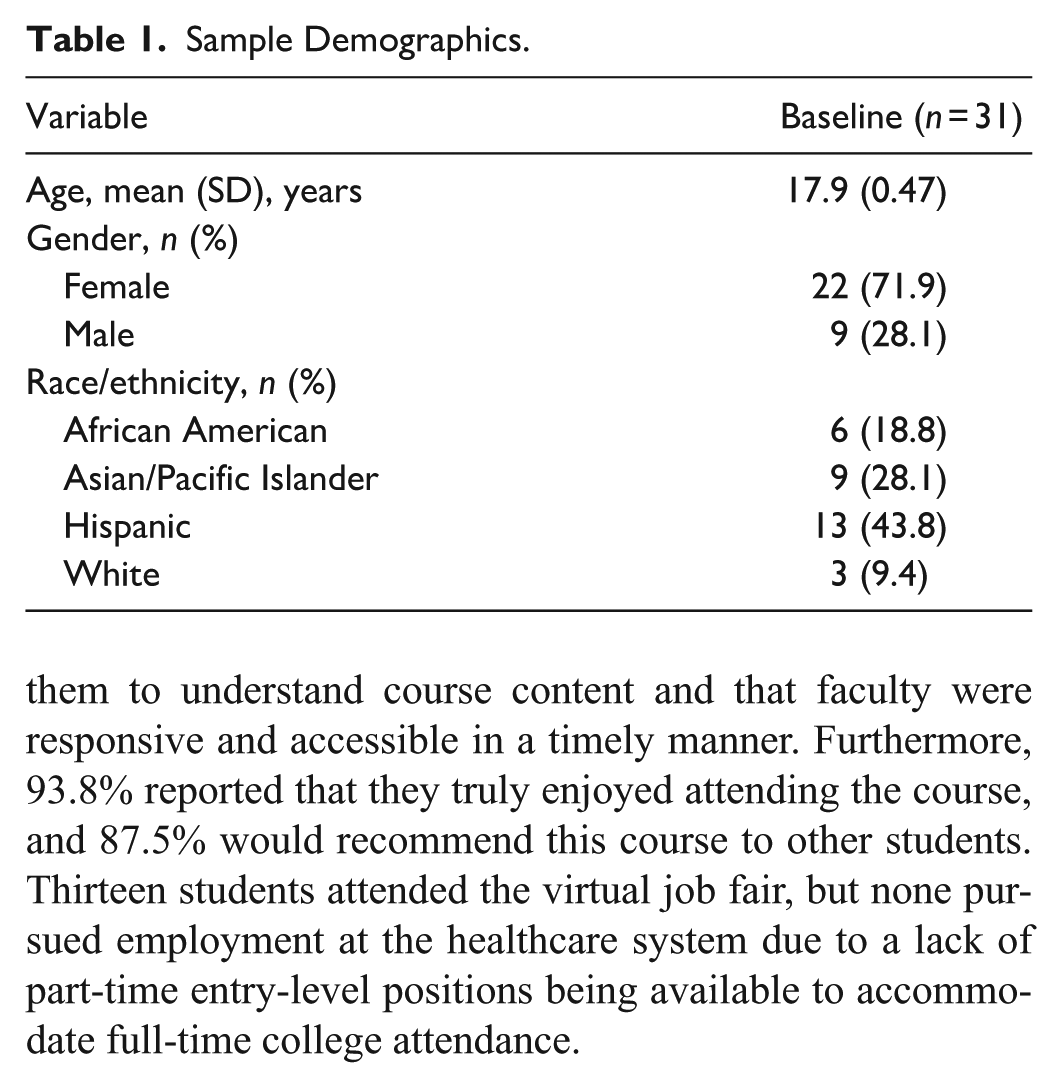
Over the 12 months of program implementation from August 2023 to August 2024, we recruited 31 high school students (see Table 1). Four students partially completed the program. Twenty-seven students completed all program components and obtained 5 industry-recognized certifications. All 31 students graduated from high school. Fifteen students responded to the postgraduation survey and indicated that they were enrolled in college.
Sample Demographics.
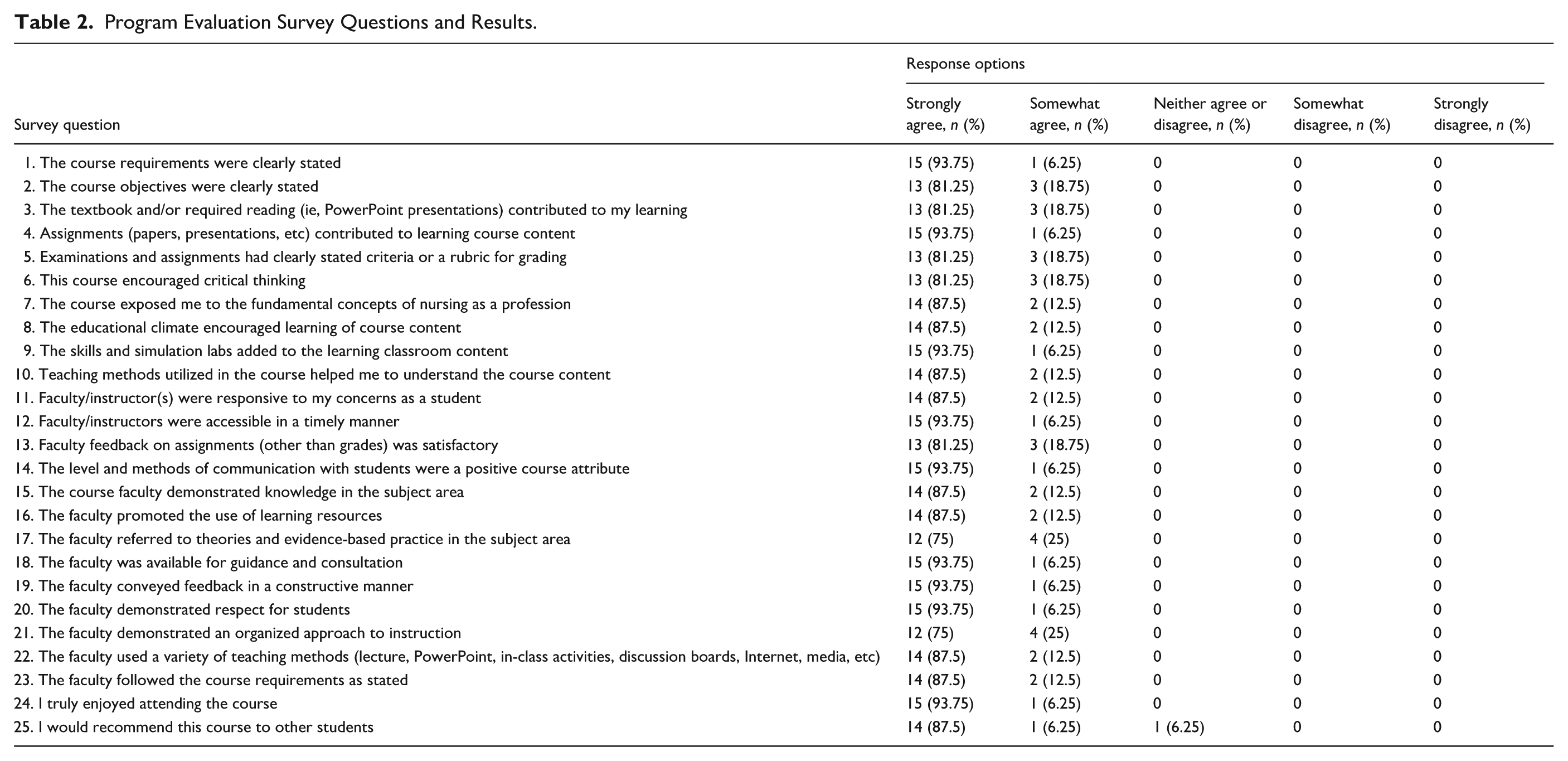
Those who responded to the program evaluation surveys (n = 16) rated their program experience favorably (see Table 2). For example, 82% reported strongly agreeing that the program exposed them to the fundamental concepts of nursing as a profession; 87.5% strongly agreed that the educational climate encouraged learning; and 87.5% strongly agreed that teaching methods utilized in the course helped them to understand course content and that faculty were responsive and accessible in a timely manner. Furthermore, 93.8% reported that they truly enjoyed attending the course, and 87.5% would recommend this course to other students. Thirteen students attended the virtual job fair, but none pursued employment at the healthcare system due to a lack of part-time entry-level positions being available to accommodate full-time college attendance.
Program Evaluation Survey Questions and Results.
Discussion
In the context of declining student enrollments and the increasing number of vacant and fully staffed seats at BSN programs nationally, there is an urgent need to study viable nursing pipeline programs to revitalize youths’ interest in the nursing profession. While prior research exists on health professions and nursing-specific pipeline programs, few studies targeted high school students, and none currently involve partnerships with students in CTE. This study is the first to highlight the opportunity of partnering with CTE as a promising strategy for nursing programs in developing a sustainable conduit of graduating high school youth into nursing education and the nursing workforce pipeline.
The study’s purpose was to test the feasibility of a nursing pipeline program for high school students from disadvantaged communities enrolled in CTE, a population not previously studied. The results show that offering a paid, blended learning summer immersion experience with virtual follow-up mentoring is a feasible and acceptable program for promoting nursing as a career choice among high school students living in disadvantaged communities. We recruited 31 high school students, 90% of whom completed all program components and obtained 5 industry-valued certifications.
The study’s results are consistent with other studies involving high school students in pipeline programs, where authors reported positive outcomes for students. Butler and Ampadu 19 reported statistically significant improvements from pre- to post-summer program experience in students’ understanding of admission requirements for health professions programs, confidence in discussing becoming a healthcare professional, and interest in pursuing a career in pharmacy, nursing, and dental medicine. Glazer et al 20 reported that students who participated in the Health Pathways Academy had higher GPA, better attendance, and increased knowledge about health-related careers and opportunities compared to the students who did not attend the program. Luaces et al 22 found that over 80% of the students who participated in the Kansas University Health Science Academy reported an increase in their knowledge of different types of health science careers, certificates, and programs, and in their intent to pursue a health science degree. Patterson et al 25 conducted a qualitative analysis of students’ experiences in the High School to Higher Education Pipeline Program and described 4 themes that emerged: (a) coming to realize; (b) managing stereotypes, stigma, and social norms; (c) making connections; and (d) expressing gratitude.
The unique contribution of our study is highlighting the partnership with CTE as a sustainable recruitment strategy for disadvantaged youth into the nursing pipeline. In Texas, where the study was conducted, 51% of students enrolled in health sciences CTE programs are from disadvantaged groups. 35 Furthermore, 42% of students enrolled in CTE health sciences programs in Texas were preparing for careers in nursing and other healthcare-related fields. 36 The state has also seen significant increases in student enrollment into vocational nursing programs, with over 7000 students enrolled in vocational nursing pathways that lead directly to nursing careers. 35 The Texas Center for Nursing Workforce Studies reports that 96% of graduates from these programs earned industry-based certifications, which are crucial for job readiness in nursing and healthcare. 37 CTE pathways are not only important for entry-level certifications but also for nursing recruitment, as many students continue their education and pursue advanced nursing degrees. Bridging entry-level opportunities with advanced nursing degree opportunities strengthens the workforce through a sustainable model of reinforced career development pathways. These programs are especially beneficial for nontraditional students, including first-generation college students or working adults seeking a career transition. 32 The accessibility and affordability of CTE programs make them an essential conduit for diversifying and expanding the healthcare workforce, particularly in nursing. 36
A core concept derived from our study is that students valued the mentorship provided by the working RNs from our health system partner. They also appreciated the opportunity to practice job interviewing techniques, build resume writing skills, and obtain feedback from professional recruiters. While half of the students in our program attended the virtual job fair sponsored by the health system partner, none got employment in entry-level positions. One barrier we identified was the lack of part-time entry-level positions that would allow students to attend college full-time while working part-time in a healthcare setting. Study while working programs are particularly valuable to students from disadvantaged backgrounds because they can offer financial support and on-the-job skills training with stackable credentials.
Limitations
This pilot feasibility study provided initial support for the feasibility and acceptability of a nursing pipeline program focused on high school students in CTE. There are several limitations. The study did not have a comparative cohort of students enrolled in CTE; therefore, our results do not evaluate the impact of pipeline program attendance more rigorously on student outcomes. Additionally, the study included a small cohort of participants with ~50% response rate to the survey and a single study location, limiting the generalizability of the findings. We did not conduct a pre–post-study assessment using a validated instrument to measure variables such as interest in nursing, perception of the profession, or intent to pursue a healthcare career. Lastly, our nursing program does not offer any prerequisite courses, so we were not able to measure the impact of the pipeline program on actual nursing program applications.
Implications
There are several implications of the study for research and practice. This study represents the initial step toward a more rigorous, longitudinal evaluation of the impact of a nursing pipeline summer program on actual nursing school matriculation and career entry, which is a critical gap in the field. For future research, we plan to address the limitations we described in this study and include a comparative cohort of high school students who do not attend the pipeline program in order to strengthen the evaluation of outcomes such as nursing program applications, enrollments, and retention. Next, scaling the pipeline program regionally and nationally would provide an opportunity for robust data collection and evaluation. Additionally, evaluating the feasibility of initiating the pipeline program with students in middle school would allow for improved course planning for dual credit and CTE courses; therefore, enabling students to graduate from high school with all or most of the nursing school prerequisites completed.
We believe that partnering with CTE high school students has been a neglected strategy that holds a strong promise for building a sustainable nursing education and workforce pipeline. Funded by the state and with over $1 billion in Texas in 2023 from The Carl D. Perkins Career and Technical Education Act, also known as Perkins V, CTE can play a transformative role in addressing the state’s RN shortage. In the 2021 to 2022 school year, of the 1 792 279 CTE participants in Texas, 42% were enrolled in CTE health sciences programs preparing for careers in nursing and other healthcare-related fields. 36 However, we have no data on how many of these students bridge over to nursing schools and jobs in healthcare. Focusing on bridging those students into nursing education and employment is necessary to prevent a leaky nursing pipeline.
In terms of practice implications, the findings of the study suggest that other nursing programs struggling to meet enrollment targets should consider partnering with CTE directors in their communities to develop pipeline programs tailored to the needs of their communities. Health systems should consider part-time positions with tuition benefits to allow for work and study programs with stackable credentials from patient care technicians or other entry-level roles to RN positions. Nursing schools should consider funding summer pipeline programs with funds from their marketing and student recruitment budgets. Similarly, health system partners should consider partnering with nursing programs and high school CTE programs as part of their staff recruitment and retention budgets. For example, offering part-time entry-level positions with tuition benefits to graduating high school seniors as they pursue their nursing education full-time could ensure at least a 3-year employee commitment and accelerate the transition to practice as those employees would already be familiar with hospital culture, practices, equipment, and electronic health records.
Conclusion
In the context of these contemporary demographic shifts and career-related generational preferences, the competition for students willing and able to enroll in nursing programs is rising. Intentionally working to create an interest in a nursing career and to effectively compete for students’ attention among all the options available to contemporary youth is urgently needed to fill the rising number of fully staffed vacant nursing programs. Nursing programs need to proactively engage with students in K-12 education to promote nursing as a viable career choice in conjunction with a broader set of strategies for nursing pipeline expansion.17,18 Our study suggests that partnering with CTE is a neglected strategy that holds a strong promise for building a sustainable nursing education and workforce pipeline. While the accessibility and affordability of CTE programs make them an essential conduit for expanding the healthcare workforce, particularly in nursing, there are no published nursing pipeline studies that describe a partnership involving nursing programs and HSS in CTE programs. Our study advances the knowledge of partnering with CTE HSS, through which nursing programs and health systems can build upon in an effort to advance opportunities for students residing in underprivileged communities while addressing dire nursing education and workforce shortages.
Footnotes
Acknowledgements
We are grateful to the high school students, parents, and counselors who participated in our program. Also, the program would not be possible without the support of the nursing school faculty and hospital-based clinical educators.

Ethical Considerations
The study was reviewed and approved by the University of Texas Health Science Center at Houston Committee for the Protection of Human Subjects. Institutional Review Board Approval number is HSC-SN-23-0432.
Funding
The authors disclosed receipt of the following financial support for the research, authorship, and/or publication of this article: This research was funded by the Hearst Foundations.
Declaration of Conflicting Interests
The authors declared no potential conflicts of interest with respect to the research, authorship, and/or publication of this article.
AI Statement
AI was not used in any capacity to write this manuscript.