




Abstract
Few projects have explored online research courses for people with intellectual disabilities. This practice paper reports the process and experience of trying out an online research course for people with intellectual disabilities. An in-person research course was adapted into an 8-week Zoom course with online lessons and a final in-person session. The paper was written by the teachers, students, and their support persons. Students discussed their experiences. The teachers noted and summarised their thoughts. Support persons fed back via email. All authors reviewed and approved their contributions. Eight students completed the course. They liked the course and learned about research. Zoom allowed students across the country to participate. Support persons and teachers saw students gaining confidence and skills. Technology can be challenging, and students missed face-to-face contact. Online research courses are possible, but no one size fits all. A hybrid course may be best: in a room and on Zoom.
Background
Researchers with intellectual disabilities being included as active members of the research team, carrying out various tasks during the research process, is becoming an essential element of social and health science research (Di Lorito et al., 2018; Frankena et al., 2019). For people with intellectual disabilities to have control to initiate, lead, and execute research projects, training and preparation is needed (Bigby et al., 2014). A recent list of key recommendations for universities to ensure research and teaching opportunities are inclusive for people with intellectual disabilities has been developed together with people with intellectual disabilities themselves (Spassiani et al., 2025). The list includes educating and training people with intellectual disabilities on how to do research. There are only a few formal research training opportunities available for people with intellectual disabilities (Fløan et al., 2022; Salmon et al., 2017; Schwartz et al., 2025; Tuffrey-Wijne et al., 2020) as most training is project specific (Flood et al., 2013; Gary et al., 2012; Strnadová et al., 2014; White and Morgan, 2012). There is a need for training in inclusive research to be more widely available (O’Brien et al., 2022).
One way of increasing the availability of formal research training for people with intellectual disabilities is by offering research training courses online. Since the COVID-19 pandemic, the use of digital devices has increased exponentially and rapidly, which has led to much greater utilisation of remote digital technology for all aspects of life (Chadwick et al., 2022). People with an intellectual disability report using technology for contacting family and friends; working from home; engaging in leisure activities; doing online shopping; playing videogames; and attending healthcare appointments, including online education during the COVID-19 pandemic (Chadwick et al., 2023). One study explored students with intellectual disabilities’ experiences of a face-to-face course being moved to an online format for 12 weeks (Gobec et al., 2021). The students reported positive experiences such as learning new technology and how pre-recorded sessions were helpful. People having increased control over their environment during online training has also been identified as beneficial (van Heumen et al., 2024). Online training reduces geographic barriers where many people with intellectual disabilities are dependent on others for transportation and support in navigating the community (Hopen, 2022; Miller and van Heumen, 2021).
Challenges to online activities persist as well, where one study identified three main systemic barriers to digital inclusion of people with intellectual disabilities: (1) Cost-related barriers; (2) Access-related barriers; and (3) Environment-related barriers (Seale, 2023). Cost-related barriers include affordability issues related to phone contracts, internet and wi-fi provision, and cost of data required for apps and software (Seale, 2023). The individual’s financial resources may compromise their access to software and devices (Chadwick et al., 2023; Lussier-Desrochers et al., 2017). For example, a study found that access to internet-enabled devices is lower for adolescents with intellectual disabilities than those without (Alfredsson Ågren et al., 2019). Such cost issues prevent people with an intellectual disability from participating in all types of online activities (Seale, 2023), and they generally have less access to online spaces and online skills training (Miller and van Heumen, 2021).
Access-related barriers include having outdated devices, not having wi-fi installed or having an unreliable connection (Seale, 2023). This domain also includes specific access challenges, where some people experience difficulties with the fine motor skills required to fully access online platforms such as pressing buttons on a screen (Lussier-Desrochers et al., 2017; Miller and van Heumen, 2021) and holding devices (Seale, 2023). People may also struggle with logging onto accounts required to access software and apps such as Zoom (Chadwick et al., 2023; Seale, 2023). Some people may also become stressed and anxious when the technology is not working as expected and such bad experiences can lead to people not wanting to use them again (Seale, 2023). The lack of face-to-face contact has also been pointed out as a barrier to online training (Chadwick et al., 2023; Gobec et al., 2021).
Environment-related barriers cover challenges with access to technology and staff with the right knowledge not being provided or prioritised by service providers. People who need support may be dependent on staff and support to access technologies (Björquist and Tryggvason, 2022; Chadwick et al., 2023; Mikulak et al., 2023). Resources, individual training, and support on how to use online platforms may be needed (van Heumen et al., 2024). However, being dependent on staff support can involve additional challenges if only certain staff members have the necessary knowledge to provide the support. If the right staff members are not working on the particular day, then the person with an intellectual disability cannot access the technology (Björquist and Tryggvason, 2022).
Only a few projects have explored online formal research training courses for people with intellectual disabilities. One study evaluated an online training course to support people with intellectual disabilities to become co-researchers in the US (van Heumen et al., 2024). Pre- and post-surveys of the seven course participants found that they had gained knowledge of what research was. Participants were actively engaged during the sessions and had a positive experience attending the course. However, the course only comprised two 1-hour training sessions.
'Research Ethics for All' is a free asynchronous online research ethics training course for people with intellectual disabilities (Schwartz et al., 2025). The co-developed training supports researchers with an intellectual disability to learn about ethical practices and decision-making when conducting research with participants with intellectual disabilities (McDonald et al., 2025). Training content is freely available on the project website and comprises five units that can be delivered either in-person or virtually. It should be delivered by an experienced research leader, and research teams are encouraged to apply learned content to their own projects. The training was positively assessed by three out of four trial teams who delivered it virtually (Schwartz et al., 2025). However, the training evaluation does not provide in-depth details of delivering the training course virtually.
In Norway, a research course for people with intellectual disabilities was moved online because of COVID-19 restrictions (Hopen, 2022). The course comprised 11 course days with 3-hour sessions, which included discussions, group work in Zoom breakout rooms, and homework in-between sessions. They used Zoom’s Polls function to evaluate the course days, and they describe how the students became skilled at using both Zoom, Polls, and at searching on the internet. The author explains that it was difficult for the students to remember course content but that the use of pictures and fun activities supported students’ memory. Overall, the course was positively assessed by teachers and the seven students.
There is a growing evidence base of people with an intellectual disability successfully navigating online activities, including research (Mikulak et al., 2023). However, there is a prominent evidence gap regarding formal online research courses for this group. With the increase in people with an intellectual disability working as university researchers, there is a need for more proper formal training courses being offered online and to share the learnings, processes, and reflections of doing so.
This paper reports on the process and experiences of adapting and trying out an in-person research course to an online format (with a final in-person session) from the perspectives of the students, their support persons, and teachers both with and without intellectual disabilities. A previous research training course for people with intellectual disabilities from 2019 (see Tuffrey-Wijne et al., 2020) was scheduled to take place at Kingston University London in Spring 2024 in the UK. It was offered free of charge and prospective students had to apply for a space on the course. By the application deadline, only five people had applied. The teaching team, including teachers with intellectual disabilities, suspected that this was due to the hard-to-reach university venue, and whilst only five people had applied, there were many enquiries about whether the course could be virtual or hybrid instead. For this reason, the teaching team decided to move the course lessons online, followed by a final in-person session.
Aims
The aim of this paper is to describe the process and outcomes of adapting and trying out a research training course for people with intellectual disabilities online on Zoom. The authors will (1) describe the content and structure of the online research course, and how it was adapted to Zoom; and (2) explore what the students, their support persons, and the course teachers learned from doing the research training course online.
It should be highlighted that this paper does not report on a formal study evaluating the online research course. The paper is meant as a description and reflection piece, which does not involve ‘participants’ nor formal ‘data’ collection or analysis.
Methods
How this paper was written
The paper was written together by the students, their support persons, and the course teachers. Thus, the paper has contributions from different co-authors. (1) The teachers without an intellectual disability (AB and IT-W) wrote the background and described the course. They facilitated and summarised the support persons’ and teachers’ reflections. (2) The students (DH, IaS, IsS, JS, KK, LW, MH, and RS) met three times on Zoom after completion of the online course. During the first Zoom writing session, they discussed their experiences using question prompts (each prompt is provided in the students’ reflection section). Their experiences and reflections were then summarised into simple jargon-free sentences with support from the teachers with intellectual disabilities. The summary was shared with the students for further discussion, additions, and approval during the second writing session. This approach was used to ensure the section properly reflected the students’ experiences and reflections, as the students would struggle to read, edit, and approve an academic version of their section. Thus, the students’ section reads differently from the others as it includes their own voices. In the third writing session, the overall structure and content of the paper was discussed and approved. (3) Teachers with intellectual disabilities (LJ and RK-B, with support from JG), who were students on the in-person course in 2019, supported the student group, contributed to their discussion, and helped summarise their words in their own voice. (4) Students’ support persons (AP and GW) provided feedback by answering five questions about the course via email. The support persons reviewed and approved their contribution. They also approved the whole paper in the third writing session on Zoom.
This way of writing a paper has its limitations. For example, there may be some challenges with objectivity as the paper is written from the view of both those who took part in and developed the course. Questions about the course were also asked by those who developed the course, which could make it difficult to share more critical views. The work described in this paper was not in itself a research project, but there is a need for formal and robust studies evaluating online research training for people with an intellectual disability. It is common within the intellectual disability field to share more informal projects and pieces of work (Mikulak et al., 2023; Tuffrey-Wijne et al., 2020), as they can provide valuable insights into a topic or a process as well as provide recommendations and directions for future formal research studies. At the end of this paper, suggested next steps are presented.
Description of the online research training course
The free online research course was held by Kington University London from April to June 2024. Prospective students applied for a space on the course via email or through online video-calls. Eight students applied and were offered a space on the course. Support persons were able to join as well. Five students needed practical help in accessing Zoom, and several students needed a support person nearby for encouragement and to help their confidence to speak, especially in the first lessons. All the students had good receptive language skills. Most also had good expressive language skills, although some used simple, short sentences and words.
Lessons were taught by AB and IT-W together with LJ and RK-B, supported by JG. LJ and RK-B are researchers with intellectual disabilities working at Kingston University London, and they both completed the 2019 in-person research course. JG’s role is to support LJ and RK-B in their research jobs. The teachers went through the content before each lesson together. This involved reviewing printouts of the lesson slides and activities as well as agreeing on who would say what during each presentation slide. The teachers sat in different rooms during the online lessons where JG and IT-W always sat together with either LJ or RK-B to support them in their teaching role. JG would write down the agreed questions that LJ and RK-B would ask during the lesson on their slide printouts before the lesson and have them ready. LJ and RK-B were then supported to ask the questions at the right time during the lesson. Their role during lessons also included monitoring students on the screen and their ‘raised hands' and sharing their experiences of doing the in-person research course as well as sharing their subsequent research experiences on various research projects (see Ryan et al., 2024; Tuffrey-Wijne et al., 2025; White et al., 2024).
Adapting to Zoom
Online course curriculum.
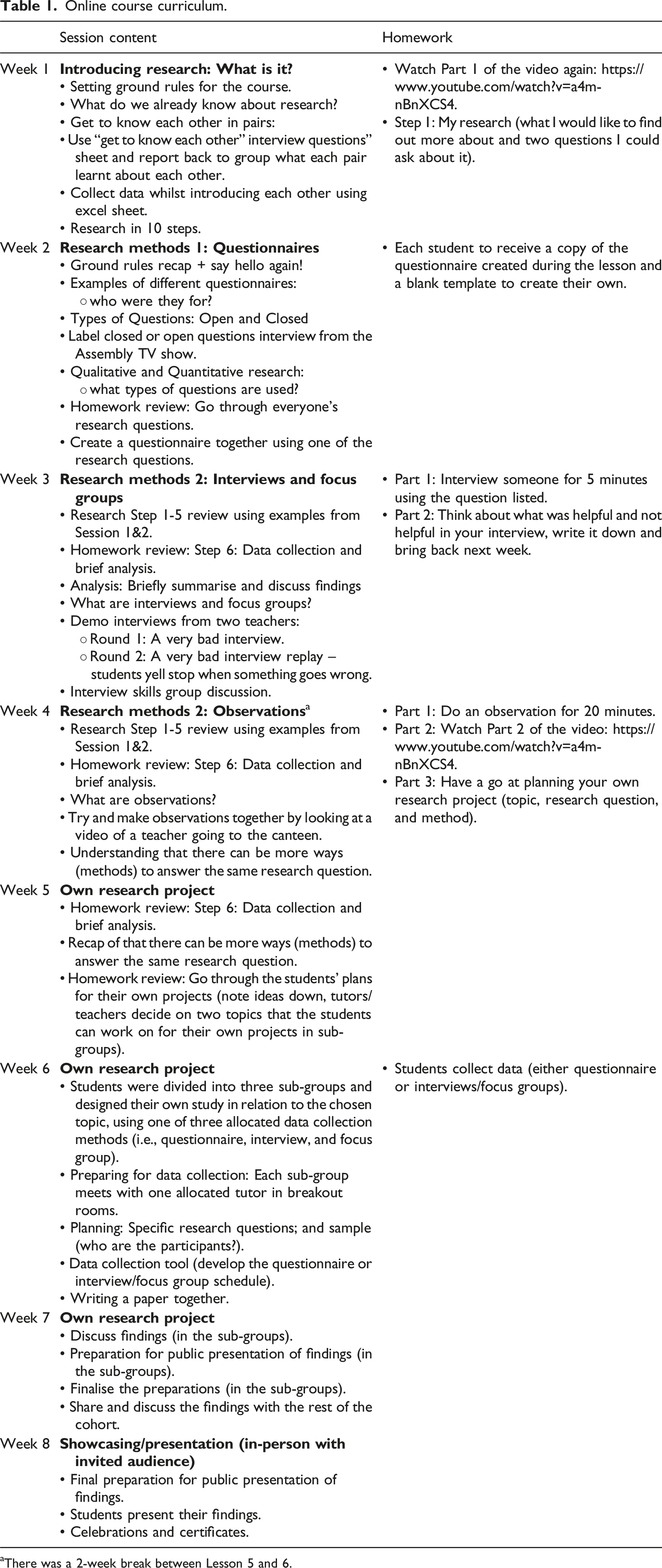
aThere was a 2-week break between Lesson 5 and 6.
Teaching materials included PowerPoint slides for each lesson designed to be accessible by using pictures and limiting text on each slide. Any text in the presentation slides was kept in simple jargon-free language and displayed using PowerPoint animation functions to avoid too much text appearing at once. Key points from previous lessons were repeated in the slides for each lesson to support students’ memory and learning. Homework materials were also created to be accessible by using easy language, making each task clear, supported by pictures. The materials can be shared upon request to AB.
Students were sent a folder with course materials before the first lesson, which included a lesson overview table and signs to hold up that indicated: yes/happy, maybe/not sure, no/not happy, and ‘I want to speak'. Before each lesson, the students received printed PowerPoint slides and homework materials in the post.
Observations as an ethnographic research method was included in the online course. This method was not covered in the 2019 course. Interviews and focus groups were taught in the same lesson to include the lesson on observations.
A learning point from the 2019 course was that more time should be spent on discussing the homework tasks, both beforehand and afterwards. For this reason, a significant amount of time was spent on reviewing the students’ homework at the beginning of the lesson as well as ensuring the homework tasks were clear before ending the lesson.
The lesson activities from the 2019 course were adapted to the online Zoom format in different ways. For example, ground rules included technical Zoom features and functions such as muting oneself, the ‘raise hand' function, and using the chat box. However, the teaching team also acknowledged and stressed that not all students may be familiar with or able to use Zoom functions. Students did their own research projects in three smaller groups in Zoom breakout rooms in Lesson 6 and 7, supported by the teachers. Breaks were incorporated into each lesson, often with music and dancing to encourage people to move around, acknowledging that two hours of training on Zoom can be tiring.
Based on teaching experiences from the 2019 course, it was deemed too difficult to include writing tasks during the lessons as the teachers could not see the students’ writing nor adequately support each student in doing such tasks. The tasks during the lessons were therefore carried out through group discussions, and the homework sometimes involved written tasks.
Another example where the online course was adapted from the 2019 one was with ‘The Very Bad Interview' role play demonstration. Rather than having to press large buzzers, the students yelled “stop” every time they spotted something the interviewer could improve on.
The nominal group technique applied in the 2019 course in Lesson 5, where students agreed on a research topic for the final project, was deemed too complicated to do online. Instead, the teachers noted all the students’ research topics and agreed on two topics that seemed feasible and realistic for the students to do their own research projects on within the given timeframe.
Reflections
Students’ thoughts about the online course
We are people with an intellectual disability. We did the research course at Kingston University. The course was on Zoom. It was not in a room.
We talked together about how easy or difficult it is to do the research course on Zoom. We also talked about what it would be like to do the course in a room at Kingston University. We did not do the course in a room, but we tried to imagine what that would be like.
The course and what we learnt
The teachers asked if we learnt something from the course.
We learnt about interviews and how to make and ask questions. We learnt different ways of doing a questionnaire. We learnt about observations. We learnt the word “hypothesis”.
The teachers were easy to follow and understand. We had a laugh.
We did the homework. Some of us had never done homework before. We liked the way it was presented. It was easy to read. We were interested in the topic.
But it was difficult to find participants to do interviews and questionnaires with.
You can’t trust the post and things get lost.
Doing things online
The teachers asked: “Are you used to doing things online?”.
Almost all of us use social media, for example Facebook and Instagram. Some of us play games online. Some of us do online shopping. Some of us have also done courses online before.
Doing courses together in a room
The teachers asked: What would be good about being in a room, and what might be difficult about being in a room?”.
We think doing courses together in a room is good because you can be sociable – and eat cake! It’s nice to meet each other in a room and have breaktime chats. You get to know people on the course and make new friends.
The room should be big, so you have enough space for yourself.
Some things are easier if you’re together in a room. We think you played more games in the last course. For example, ice-breaker games are easier if you’re together. It’s easier to get to know each other.
But travelling can be difficult. Most of us tried travelling to Kingston University for the last lesson. Some of us found the journey long and hard to do: “I’m never going on the London underground again!”. There were no nearby train stations. But some people enjoyed the travelling. Public transport can be late or cancelled. Then you can’t make it in time. Travelling can also be expensive. Many of us need help to travel. Sometimes it’s difficult to get the support to help us travel. Sometimes people don’t have time and can’t be flexible.
Doing courses on Zoom
The teachers asked us about what was difficult and good about doing courses on Zoom.
Zoom is better if people are coming from around the country or even the world, for example North England, Scotland, and Wales. Some of us live too far away from Kingston University. We could only do this course on Zoom because we couldn’t get to the room.
But we were worried about the technology not working. Some of us had problems making Zoom work. It’s annoying when there are technical issues.
Zoom can be stressful. You can’t see people face to face.
In a room or on Zoom?
The teachers asked us a last question: If they have another course, should they do it in a room or on Zoom?
We think it is good to have both ways. It would be good to have the course in a room for people who can get there. Maybe you can have Zoom for people who can’t be there.
Takeaways
(1) We liked the course and learned more about research. (2) Zoom is better if people are coming from around the country. (3) But Zoom can be stressful, and you can’t see each other face to face. (4) It would be good to have the course both on Zoom and in a room.
Support persons’ thoughts about the online course
The students’ support persons shared their thoughts on the course via email. They were asked to answer five questions about the course. Two support persons, AP and GW, provided feedback on the course.
How did they support the students to attend the online course?
AP supported one student, and GW supported a group of three students from West Yorkshire on the course. Their support involved assisting them with the technology to ensure they could take part in the course. It also involved supporting the students with coping with the course and passing on words about how well they were doing.
What was it like for them to support the students on the online course?
They described the course as a positive experience that they really enjoyed taking part in. It was good seeing how adaptions to the course had been applied to make an online format work without feeling it was a poor alternative to a face-to-face version. The course was a lot of fun with laughter as well as a sense of a safe space where the students felt supported and valued for their contribution and opinions. There was a sense of pride in how hard the students studied and the sense of achievement it provided them.
What did the students gain from the course from their point of view?
The students gained a sense of achievement and importance throughout the course. The support persons also saw their confidence grow. The students took onboard the lessons and applied them to the tasks, and they learned new skills and increased their knowledge. The course structure with a mix of fun activities and revisiting previous lesson content, as well as practical activities to put learning into practice, and encouraging students to think for themselves and learning from things going wrong was very valuable.
What did they think was good and difficult about doing the course on Zoom?
The online format allowed students from West Yorkshire to take part. Had the course been face-to-face, the students would not have been able to participate due to travel time and costs. The online format made it possible to fit the course into regular working hours, where an in-person format would have required much more time. Zoom freed up time to support the students to complete their homework and get to know each other.
The online format also took off some of the challenges and apprehension of meeting new people in a new environment. Being in one’s own home helped with that a great deal.
The printed materials for the course did not always arrive in the post, which had to be managed by printing them elsewhere.
When there was interaction in the group, ensuring all had an equal share in discussions could be challenging. However, this was quickly overcome by the teaching team and did not have a negative effect to the program overall.
In a room or on Zoom – what are their suggestions, ideas, or tips for the next course?
Zoom allows for the course to have a wider base of inclusion, both logistically and if an individual struggles in new or crowded surroundings. But the high level of preparation by the teachers must be maintained as it was in this course. The use of a variety of teaching styles, the use of humour, and visual tools put the points over clearly and made the course easy to enjoy and reaped excellent results.
Going to Kingston University for the final day of the course was a really good opportunity for the students, and they valued getting to meet everyone in person. Although the travel can be challenging and create some anxiety. Seeing the final day presentations, you could see the positive results. But that also showed that some in-person aspect of this form of education will always need to play a part. Without that day the course would not have had such a powerful impact on the students. It was great to see the progress they had made working together to succeed in the research they undertook.
An in-person version would also have both benefits and restrictions. Feedback from some students showed the benefits of not being in a room with a group as from a sensory processing perspective that can be challenging for autistic people. Adjustments could be made to an in-person approach such as giving thought to creating a neutral space, free from external distractions; spacing of seating to accommodate personal space; and the option of a breakout room if required. Some autistic people may also use noise cancelling headphones or a fidget device to help manage any sensory overload. The inclusive culture created by the teaching team supported people to feel accepted and at ease, which was received positively overall by everyone.
A hybrid approach could work well – in a room and on Zoom – with the best of worlds. The first and last sessions could be face-to-face with the remaining lessons being on Zoom. The two in-person sessions would allow the students and teachers an opportunity to meet in person at the outset of the course and then come together to celebrate at the end. Alternatively, to partnership with a university with a more central location.
Additional ideas to improve the course included more of the breaking up into the smaller groups at an earlier stage in the course. More time to complete the final assignment might also have added to the outcome, although this may also add some challenges.
Takeaways
(5) Support persons helped students with accessing the course on Zoom and helped them with coping with the course. (6) They had a positive experience supporting the students. (7) They saw the students gain confidence and skills throughout the course. (8) A hybrid approach involving both Zoom and face-to-face would work well.
Teachers’ thoughts about the online course
As this was the first time the teaching team had done an online research training lessons, planning and carrying out the research course was labour intensive. The 2019 materials needed to be updated and adapted to an online format. Most of which was difficult to do in advance when the teachers did not know the student cohort. A flexible approach was needed to ensure the level of the course and the activities were appropriate. This meant that for each week, slides and homework were being updated. Sometimes homework materials were finalised right after the lesson, as the course did not involve students completing written tasks during the lessons. Materials had to be posted to the students as soon as possible after the lesson to ensure they had enough time to do the homework before the next lesson.
Overall, the experience of doing the course was positive. Most of the content could be adapted to Zoom. The teaching team could see students learn and grow with confidence throughout the online course.
Having more time for the online lessons would have been useful. However, this does not seem feasible as both students and teachers seemed tired at the end of the lesson. Two hours on Zoom is a long time, and it is also a long time for anyone to stay concentrated, listen, and learn new information. Alternatively, more lessons could be added to allow for more content.
Having more time to prepare and trial teaching activities would also have been helpful. Weekly lessons made it difficult to experiment with adapting in-person teaching games to the online format. It would have been interesting to experiment with adapting the nominal group technique to Zoom. However, the lesson day was fully packed with preparing the lesson and going through the lesson content together as well as doing other research tasks and commitments. It was difficult to find more time as the teachers with intellectual disabilities work limited hours once a week. Bi-weekly lessons may be a way to allow for thoroughly trying different modes of teaching. This would also give the students more time to do their homework, where time could be tight when also having to wait for materials arriving in the post. It is essential to find the right balance between keeping momentum for the students and having enough preparation time for the teachers to make the course inclusive and engaging.
Having more support available for the teaching would have been helpful as well. It could be difficult to keep an eye on everyone on the screen during the lessons; despite having several teachers during the lessons. One of the students’ support persons, GW, also helped with facilitating one of the breakout rooms as there was not enough teachers without intellectual disabilities for three breakout rooms. Luckily, GW has research experience and was happy and able to help this group.
Conclusions and next steps
This paper shows that it is possible to do a formal 8-week online research training course, with a final in-person session, for people with intellectual disabilities on Zoom. The online lessons reduced the need for travelling, which was a major barrier, allowing participants across the UK to participate in the course. However, technology can be difficult, and the students missed the face-to-face contact and making new friends in-person. This highlighted that there is no one size that fits all when it comes to research training courses.
The paper reached similar positive conclusions as other projects on online research courses for people with intellectual disabilities (Hopen, 2022; Schwartz et al., 2025; van Heumen et al., 2024). The next step is to explore further what is possible in terms of technology by experimenting with features such as breakout rooms, writing tasks, and polling functions. One of the previous projects did successfully use such functions during their 11-week online course (Hopen, 2022). Future research courses, both online and in-person, and research within the field should also explore involving people with an intellectual disability more actively in curriculum development. A few projects have successfully created training materials with co-researchers with intellectual disabilities (Hopen, 2022; Mikulak et al., 2022; Schwartz et al., 2025). Meaningful and relevant research training courses can be developed by building upon the learnings and findings from previous projects, research courses, and the experiences of the researchers and teachers with intellectual disabilities. The bar needs to be raised to gain insights into what is possible in terms of online training. It has been stressed that with the increase in hybrid work in practice and access to education through online programmes, it is essential to enable equity of opportunity for people with intellectual disabilities (Chadwick et al., 2023). With the right support and guidance, people with an intellectual disability can participate in online research courses (Hopen, 2022). Still bearing in mind that ultimately, online methods may not be best for or be preferred by some people with intellectual disabilities (Miller and van Heumen, 2021). Hybrid solutions may be the way forward (see Mikulak et al., 2023; Schwartz et al., 2025): in a room and on Zoom.
In this paper, the authors have described the process of adapting and piloting a research training course for people with intellectual disabilities online on Zoom with a final in-person session. An essential next step for the field is to design and conduct systematic investigations of online research courses for people with an intellectual disability. Future research should include robust evaluation measures and be conducted using proper research methodologies such as surveys, interviews, and focus groups to explore the views of both students, support persons, and teachers. This was seen in the studies by Schwartz et al., 2025; van Heumen et al., 2024 using surveys. Future research could use a similar approach and use the in-depth process and reflection descriptions (including curriculum) provided in this paper and the paper by Hopen (2022).
Footnotes
Acknowledgements
We would like to thank the people who supported the students to take part in the online research training course: Prema Jhummun, Nigel Stevenson, and Victoria Stevenson. A big thank you to all the people who came and celebrated the students on the last day of the course.

Ethical Considerations
No ethical approval was required for this project.
Consent to participate
The project does not involve research participants and consent has therefore not been obtained.
Author contributions
• Course adaption: AB, IT-W. • Course teaching: AB, IT-W, JG, LJ, RK-B. • Manuscript writing: AB, AP, DH, GW, IaS, IsS, IT-W, JG, JS, KK, LJ, LW, MH, RS, RK-B. • Approval of manuscript: AB, AP, DH, GW, IaS, IsS, IT-W, JG, JS, KK, LJ, LW, MH, RS, RK-B.
Funding
No specific funding was received for this project. AB, IT-W, JG, LJ, and RK-B were funded by The National Institute for Health Research (NIHR) Research for Social Care (RfSC), Research for Patient Benefit (RfPB) Programme (NIHR202963).
Declaration of conflicting interests
The authors declare no conflicts of interests.
Data Availability Statement
Any sharable data are available in the paper or in the supplementary files. Lesson materials can be provided per request to Dr Andrea Bruun or Prof Irene Tuffrey-Wijne.
Permission to reproduce material from other sources
Lesson content from the previous research training course was updated and adapted with permission from Prof Irene Tuffrey-Wijne who owns the copyrights to the original content.