




Abstract
Students with intellectual developmental disability (IDD) may have impairments in conceptual, social, and daily life areas that will require support when these students are included in mainstream settings. In order to examine the facilitators and impediments involved in inclusion of students with IDD in regular schools in Israel, we interviewed six parents of students with IDD who were enrolled in inclusive classes, five teachers of inclusive classes, one teaching assistant and two school principals. Analysis of the interview transcripts revealed the perceptions regarding the included students, by their parents and the school staff. The school staff perceived family involvement and the connection between them and the parents as the most important. Parents perceived the possibility of studying in an inclusive class as an opportunity for social integration and scholastic advancement. All the participants indicated the social aspect as crucial to the inclusion of students with IDD.
Introduction
Including students with disabilities necessitating attention to special educational needs (SEN) in the general education system, instead of placement in segregated special education systems, has become common practice in recent decades. In the State of Israel, education policy emphasizes the commitment to provide an appropriate educational placement for every child, including those with SEN, preferably in a mainstream setting (Avissar et al. 2016; Avissar 2018). Despite these trends in education systems world-wide, many young children with Intellectual Development Disability (IDD) attend separate segregated schools and are not included in the general education system. 1
Inclusion of students with IDD
The definition of IDD presented in DSM-5 (APA 2013) refers to a comprehensive view of the individual’s life and functioning and includes impairments regarding the functions in conceptual, social, and daily life areas. It emphasizes adaptive functioning and performance of life skills and acknowledges impairments within fundamental skill domains i.e., conceptual and cognitive efficacy, social and practical functioning. Intelligence is assessed across three domains: conceptual, social, and practical and it reflects the impairment of general mental abilities needed for everyday life. These three domains include skills in language, reading, writing and math. The conceptual domain refers mainly to reasoning, knowledge, and memory; the social domain refers to empathy, social judgment, interpersonal communication skills, the ability to make and retain friendships, and similar capacities; the practical domain centers on self-management in areas such as personal care, job responsibilities, money management, recreation, and organizing school and work tasks.
The Israeli Ministry of Education has adopted the definition of IDD and the recommendations for services suggested by the American Association on Intellectual and Developmental Disabilities (AAIDD). Students are clinically evaluated to determine their educational placement and the level of support they might require. This is determined in relation to their intellectual functioning and their adaptive behavior (Avissar and Cohen-Bonana 2018). The current definition which focuses on three diagnostic criteria: significant limitations in intellectual functioning (approximately two standard deviations below the mean which equals an IQ score of 70 or below); significant limitations in adaptive behavior; onset of both during the developmental period and manifested before the age of 22 (Schalock et al., 2021).
Inclusion of students with IDD in the general education system in Israel
Over recent decades the Ministry of Education in Israel has been advocating the placement of students with SEN, including those with IDD, in the general education system, in accordance with the Law of Special Education (1988) (Fensirer 2011; Avissar 2018). This has resulted in a considerable decline in the number of children attending special education schools.
In 2018, the latest year for which data is available, there were 224,000 pupils with disabilities in Israel, of whom 59.6% attended inclusive classes, 20.1% attended special education classes in the general education schools and 20.3% attended special education schools and kindergartens (Israel National Council for the Child, NCC, 2018). In the 2017-2018 school year approximately 87% of the students with IDD (N=8,300) attended special preschools and special schools; nearly 10% of them studied in special classes within inclusive schools and about 200 students attended the general education classes and had an individual program (Avissar and Cohen Bonana 2018). Examination of the general education of students with SEN in Israel reveals different organizational models from partial to full inclusion. Partial inclusion is expressed in various ways from half a school day every day in a general class, to participating in specific lessons or social activities with all the other students, to sharing recesses with the others and more. With full inclusion, students study together with their peer group throughout the school day and receive support as needed (Avissar et al. 2003).
Inclusion calls for organizational, systematic and educational changes such as lengthening the school day, establishing study support setups, preparing personal learning plans, training teachers to teach in inclusive classes, unique medical and paramedical treatments and more. Furthermore, inclusion involves changes and adaptations in the learning environment i.e., school climate as well as social and physical environments which, in turn, might affect students’ behavior, cognitive abilities, social skills and personal development (Reiter and Metzer 2011).
Inclusion promotes acceptance of all students and willingness to restructure school routines in response to their needs, provide customized responses and remove barriers when necessary. Teachers are expected to adapt their teaching methods to a wide range of abilities (Tomlinson 2017) and are encouraged to create lesson variations by matching components of the curriculum: the content learned, the process, and the ways in which students learn and understand the new information (Griful-Freixenet et al. 2020).
The researchers (Pivick et al. 2002) noted four key components that could either facilitate or impede inclusion of students with disabilities in the general mainstreaming schools: a) peer group attitudes and behaviors such as accepting the child or teasing and excluding the child from social activities; b) the attitude of the school staff, such as awareness or complete or partial lack of knowledge; c) the physical environment and physical accessibility and d) social and/or learning difficulties of the students with SEN.
Studies examining the social and emotional adaptation of students with SEN, including IDD, indicate their difficulties in creating social relationships with children their age, feelings of dissatisfaction, social rejection, and a low level of personal support from peers. As such, it was found that 30%-50% of children and teenagers with SEN, including children with IDD, reported feeling lonely and having social problems in school, difficulty in acquiring and/or implementing social skills, having low self-esteem, and low self-efficacy (Heiman 2002a).
Perceptions of school staff and parents of children with IDD
The general education system involves several partners: the educational staff, mainly teachers and principals; parents and their children with disabilities, and parents with typically developing children. The present study focuses on the first two groups: the perceptions of school staff (principals and teachers) and of parents of students with IDD who study in inclusive classes.
Attitudes and mindsets of the school staff
Meaningful implementation of inclusive policy in education is considered to be dependent on educators having positive attitudes towards it. Avramidis and Norwich (2002) reviewed a large body of research in an attempt to elicit what factors might impact upon teacher acceptance of inclusive education. They found that teachers’ attitudes are generally positive and are strongly influenced by the nature and the severity of the disability in question. Other studies examining the implementation of inclusion in Israel found that the attitudes of teaching staff toward preschools and schools were generally positive, but there is concern about the difficulties involved in its implementation (Avissar, et al. 2016). Examination of the attitudes of general education teachers regarding students with disabilities in their classed revealed descriptions of the students’ academic, social and emotional progress as positive and an emphasis on the advantages of inclusive classes to all the students in the class, with and without disabilities (Heiman 2004). Other studies pointed out difficulties among teachers of inclusive class, such as coping with work overload, a need for additional help in the classroom, concern regarding changes in the social atmosphere in the class, or a negative stigma being linked to inclusion. Teachers also mentioned problems emerging from the mismatch of the curricula of the included students and the need to change or realign lessons in terms of the various needs of the leaners (Gavish and Shimoni 2013). Talmor et al. (2005) summed up the following factors as contributors to teachers’ attitudes toward inclusive education: the student’s characteristics i.e., the nature of the disability; the educational surroundings – school atmosphere, the principal’s position and support and cooperation among members of the teaching staff; teachers’ training and knowledge base. Gender, age and tenure were also found to affect teachers’ attitudes. In a recent study (Agam Ben-Artzi and Greenbank 2020), teachers’ attitudes towards parental involvement were examined. Significant differences were found between special education and regular education teachers. The latter had more positive attitudes toward parental involvement.
Involvement and cooperation among teachers, parents and students have a positive impact on the children and their treatment and contributes to their quality of life (Dor and Rucker-Naidu 2012). As such, successful cooperation is based on the ability of the professional staff to work with the parents in spite of their overloaded emotions (Heiman and Lavan 2011).
Attitudes and mindsets of parents of children with IDD
Findings concerning parents’ attitude towards inclusion are ambiguous. Some parents support inclusion while others express concern and doubts about the contributions of inclusion to their child with severe or multiple disabilities (Fishman and Nickerson 2015; Seery et al. 2000). Parents who support the inclusion policy mentioned that they expected it to contribute to the child's acquisition and development of social and study skills. Other parents expressed doubt about teachers’ abilities and skills to include and advance students with SEN, and mentioned their concern about the reactions of typically developing students and their parents, referring to negative attitudes toward their child (Leyser and Kirk 2004). Some parents expressed concern about difficulties in social inclusion, loneliness and social rejection, and a lack of support from peers (Garrick-Duhaney and Salend 2000). Other parents mentioned the lack of resources for promoting the inclusion of their children (Runswick-Cole 2008). Various studies have addressed the crisis parents undergo when one of the children in the family is diagnosed with an impairment and defined as having a disability (Heiman 2002a; Heiman 2002b; Heiman and Berger, 2008; Shavit and Gilor, 2019). A child with SEN is often a source of great familial stress, whether in terms of the parents’ relationship, of parenting each of their children, the relationship between the siblings, and even in terms of the relationship with the extended family. Studies have found that the personal and familial stress experienced by the parents was mainly influenced by the child’s level of functioning, the severity of the child's diagnosis, and the child’s age (Margalit and Kleitman, 2006).
The current study
The purpose of the current study is to examine the perceptions of the teachers who have a child with IDD included in the regular class, compared to parents' perceptions regarding their child with IDD included in the regular class. The study anticipated to identify similarities and differences regarding aspects that facilitate and impede the inclusion of a child with IDD. It was expected that teachers and parents will differently describe the inclusion process of the child with IDD, will differently describe measures of successful inclusion, and might focus on different aspects that support or impede the implementation of inclusion of students with IDD.
Methods
Participants
The research population consisted of 14 participants: (a) Six parents: four mothers and two fathers of children with IDD who study in regular classes. The age range of the parents was 35-57. Parents referred to their child diagnosed with IDD, 4 boys and 2 girls, aged 8 – 13. (b) Two principals of inclusive schools: One principal of an eight-year elementary and junior regional school and the another principal of a six-year elementary school. (c) Five homeroom teachers of inclusive classes and one teaching assistant. All were certified teachers and three of them were also certified in special education. Their teaching seniority average was 8 years (range = 6 - 11 years). All the teachers had at least one student with IDD included in their classes.
Participation was voluntary and the participants did not receive any payment.
The participants were recruited from five Jewish schools, that fully included children diagnosed with mild or moderate intellectual disability in regular classrooms. This five schools, out of 20 schools, expressed an explicit desire to participate in the study.
Characteristics of the research participants
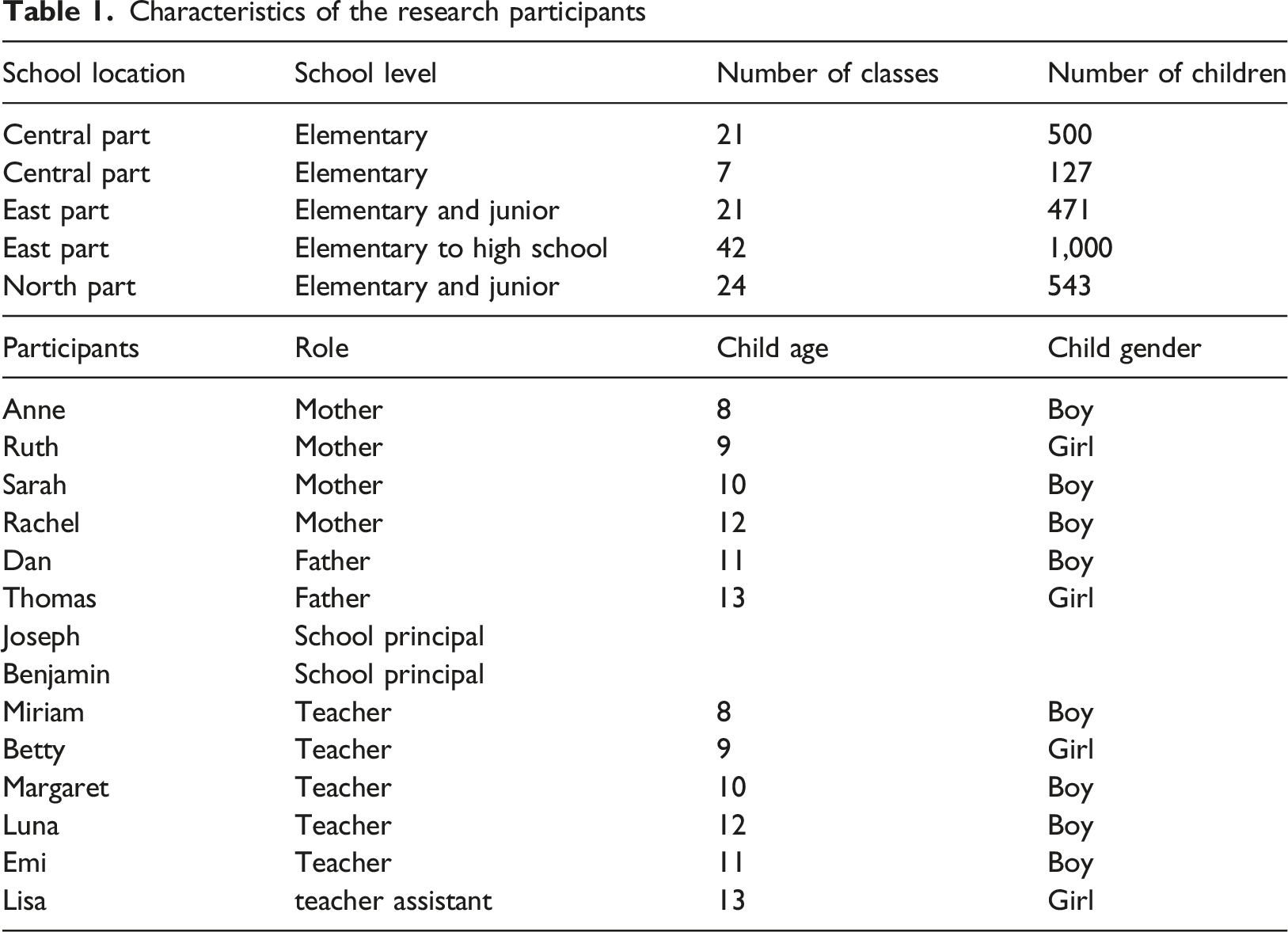
Procedure
This cross-sectional study was conducted between September to December 2021, during the COVID-19 pandemic was in Israel. Following the approval of the Chief Scientist of the Ministry of Education the researchers obtained a list of 20 inclusive schools, mainly elementary, where students with IDD were integrated in the regular classes with their peers. The first step was to contact the school principals to obtain their consent for the participation of the teaching staff and to gather contact details of parents of children with IDD enrolled in these schools. A letter detailing the aim of the study coupled with the aforementioned approval was mailed to the schools, followed by several telephone calls and e-mails. Despite the researchers' many efforts, only five schools, from different geographical regions of Israel, consented to participate.
The individual interviews were conducted following the participants' consent. Parents were contacted individually by the researchers and principals and members of the teaching staff were approached at their respective schools. They were interviewed in a place and mode of their choosing i.e., a telephone call, at their home or in a nearby playground. To enhance reliability and rigor of the study, a single researcher conducted the interviews. The interviews were recorded and lasted on average 50 to 90 minutes. The researcher avoided asking leading questions and only took notes during the interviews thus giving the interviewees a chance to clarify or correct the points they had previously made.
The Interview was semi-structured and contained four open-ended questions based on the literature review and constructed following the researchers' brainstorming sessions (the interview questions are presented in Appendix 1). The interviewees could add and expand their answers. The opening question was general: "Please describe the inclusion process of a student/your child as you see it." The other questions focused on expectations, successes, difficulties and possible benefits. Considering the different participants, linguistic adaptations were made for example: members of school staff were asked: “Are you satisfied with the way things are regarding the inclusion of students with IDD in your school and why?” while parents were asked: “Are you satisfied with the way things are regarding the inclusion of your child and why?"
The interviews were carefully transcribed. Detailed notes were taken in writing.
Thematic analysis
The data collected via the 14 interview protocols underwent thematic analysis following the coding process steps suggested by Smith et al. (2009). These steps include organizing the data, identifying categories, themes and patterns, and looking for possible explanations.
The researchers analyzed the main themes, the repeated expressions, and coded the themes. Where necessary, codes were added or merged and later ordered into pattern codes. The themes and quotations were translated from Hebrew into English and then checked by a translation service. The data categorization process was repeated several times. To ensure credibility and dependability, the researchers analyzed the data separately and met frequently. In order to establish reliability, an interrater reliability procedure have been made. During the data analysis procedure, the main themes and their subthemes were revised until a final version was decided. The determination of themes was conducted by both authors with discussions taking place until the final themes were agreed. Cross-checks were conducted until inter-coder agreement exceeded 96%.
Results
This exploratory study aimed to identify the perceptions of teaching staff and of parents of children with IDD, towards their inclusion in regular classes. Content analysis of the transcripts yielded a total of 67 statements which were grouped into three main categories: Perceptions regarding inclusion of students with IDD; Perceptions of the parents of included IDD students; Perceptions of school staff, including principals, homeroom teachers and a teaching assistant; and perceptions about the necessary professional accompaniment while practicing inclusive education. Each main category contains 3-4 sub-categories, 14 in total.
The categories and sub-categories are displayed in Figure 1. Perceptions of parents and of school staff regarding inclusive education for students with IDD presented by categories and sub-categories.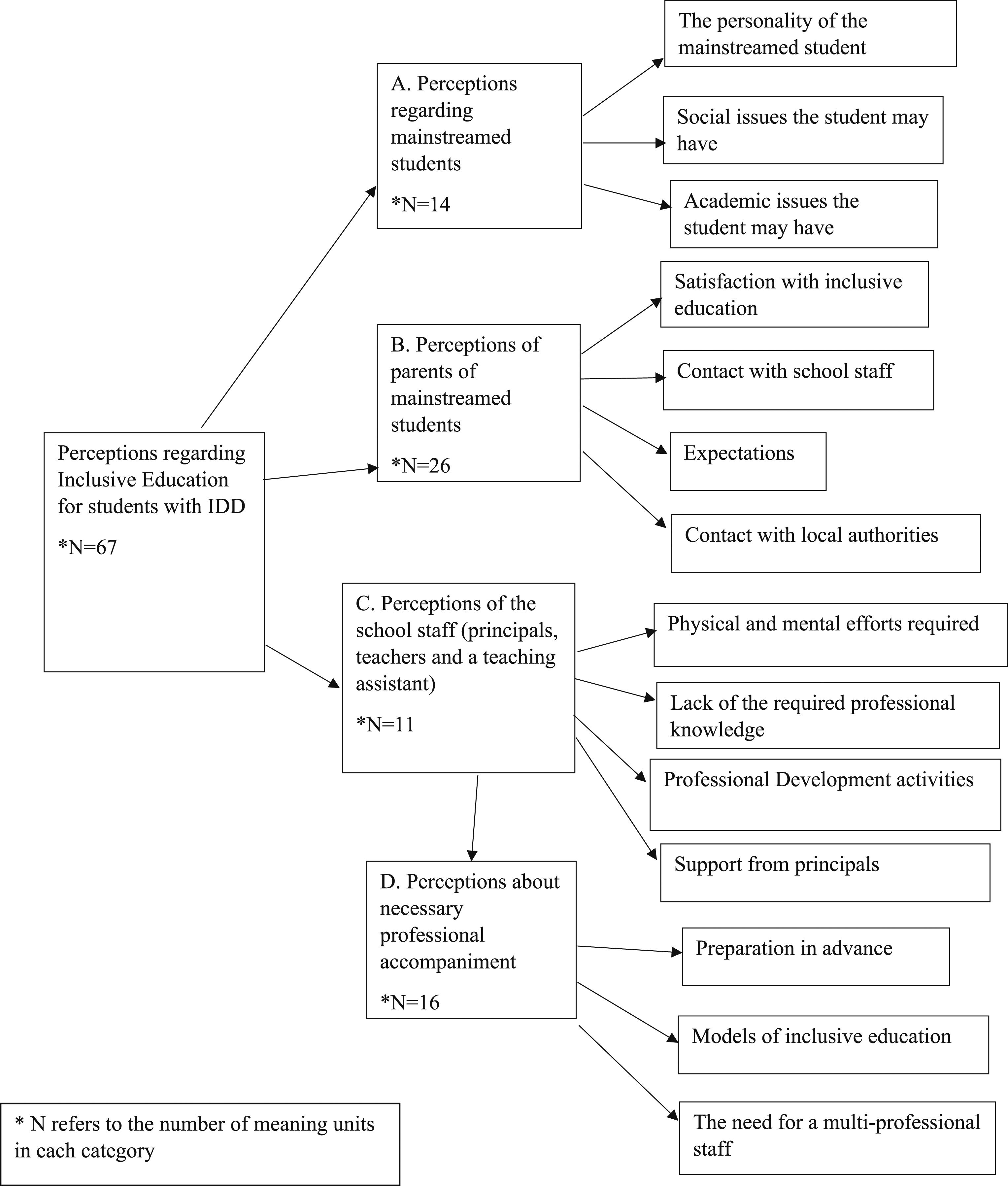
Category A. The included IDD students
The participants in the current study pointed more positive aspects of inclusion than inhibitory factors. This category includes references to the students’ personal characteristics as well as to social and academic issues, for example: "The student’s pleasant personality facilitated her inclusion in the class" (Miriam, a teacher).
The inhibitory factors indicated mostly by the educational staff referring to the students' abilities and difficulties in the cognitive field.
"The main indicator of academic success is the extent to which an integrated child learns the same subjects together with his classmates, in accordance with his abilities and with assistance as needed" (Dan, a father).
Teachers and parents give a high appraisal to the social success of the integrated students, even more than the child's academic success. Like the teachers, the parents emphasize the success in social integration but they are also aware of the expected changes of social relationships as their child grows older. Parents referred to the importance in social integration in terms of acquiring social habits "socialization will help the child later in life as an adult" (Ruth, a mother).
The teachers explained that the social difficulties of the integrated student are an integral part of his/her disability, "some typically developing children ignore the included student", "Some of the included children are very lonely, sometimes they are bullied by other students affects especially their deep sense of loneliness" (Betty, a teacher).
"The measures of social success are focused on the participation of the integrated child in all social activities in school; by having friends and meeting with them not only during the school day but also after school hours, and being invited to social events such as a birthday party" (Sarah, a mother).
Category B. The parents of the included students
This category includes references to the parents’ expectations and satisfaction with inclusive education and their contacts with the school staff. Most parents were satisfied, although they would have been happier if the teachers had paid more personal attention to their child: "I would like the teachers to really see her, get to know her ... there is a good staff taking care of her and she is happy in class” (Thomas, a father).
Other parents openly criticized the teachers and suggested what should be done. "Academically, she isn’t really getting what she needs, and they did not give her extra hours ... they teach regularly, and I don’t see that the teacher sits with her ... the teachers don’t have any energy left." (Rachel, a mother); "Parents could be a source of support for the teacher" (Sarah, a mother); "It is very important to include all the children in social activities during and after school" (Dan, a father).
In addition, a few comments made regarding contacts with the local authorities: "The burden of additional payments that parents are asked to pay for extra activities, for scholastic and physical support…" (Dan, a father); "There are insufficient treatments for my child, as speech therapy, occupational therapy and so on" (Anne, a mother).
Category C. The school staff, including principals, teachers and a teaching assistant
This category includes references to the needs of teachers when working in an inclusive education environment. The teachers emphasized the lack of professional guidance and instruction from professionals from outside the school. The assistant teacher was not satisfied with the level of involvement of the homeroom teachers with the included student with IDD: "Support from the school management team including preparations [for inclusive education] in advance, making necessary arrangement regarding the suitability of the student for inclusion" (Liza, a teacher); "The school staff lacks the necessary professional knowledge" (Emi, a teacher); "My expectations were to have more involvement of the regular teachers. I expected that we would sit together, work together, decide together, that they would be better prepared" (Luna, a teacher).
The principals’ views reflect their perceptions regarding the impact of inclusion on the entire school: "The level of cooperation of the other teachers is essential for inclusion", "the teaching assistant willingness to help and her support of the main teacher and the children is crucial" (Benjamin); "The staff willingness and the professional cooperation with the educational teams, are the main factors for a successful inclusion"; "I am very satisfied with the inclusion in my school, because I see success and the happiness of the children and their parents" (Joseph). The principal mentioned that the staff involved in the inclusion process consists of qualified and able teachers sharing a common professional language. They are very dedicated to their job and that has a positive effect on the school atmosphere.
D. The professional accompaniment needed
This theme contained statements referring to what was done in school to prepare for inclusive education, and what model of inclusive education was implemented: "Before we began the process of including the child with IDD, we had several meetings and discussions, whether the process was suitable. We looked into the total number of the included students and into the professional background of our homeroom teachers as well as their readiness to take part in inclusive education. We estimated the future cooperation from the parents, we matched expectations since the connection and the trust created with the parents are essential to the process. We also examined if inclusion is right for the other students in the school" (Joseph, principal).
Another principal described a new process established in his school to accompany the teachers, the parents and the included student through the process: "We have a special committee and team for this, consisting of myself, the homeroom teacher and the counselors. We discussed the student and where and how to start working, we learned about him ... we built an inclusion plan, including non-academic classes such as sport, and social activities, and then gradually we integrated [the child] into the class in terms of academic studies" (Benjamin, principal).
One teacher commented: "First, we had to reach a decision whether the child was ready for inclusion. Then we looked for the teacher who would be the homeroom teacher. We worked in a team comprised of myself, my co-teacher, a representative of the community support center, the emotional therapist, the communications clinician, the special education coordinator, the school counselor" (Miriam, a teacher).
Another teacher told the interviewer: "I included a girl with Down syndrome in my class. I had a talk beforehand with all the students about inclusion and had them share their feelings. Eventually, inclusion was very successful and they treated her as one of them" (Margaret, a teacher).
Two main models of the inclusion of students with IDD in general classes were mentioned: individual inclusion, and holistic inclusion. In both models, there is a specially trained teacher called ‘a mainstreaming teacher’ who functions as an accompanying professional to assist the homeroom teacher.
Individual inclusion could be either full or partial. In the former, the student studies in the general class throughout the school day and throughout the school year. In the latter, the student attends a special class within the school or attends a special school but takes part in the main class lessons or activities at least one day a week. The student receives scholastic and social support from a teaching assistant who accompanies him or her throughout the day. In this model the focus is on the individual child who is expected to adapt.
In this study we found that full individual inclusion with a support-teacher occurs mainly in Grades 1-5, and partial inclusion from Grade 6 onward. The focus in the latter is on the school climate.
Holistic inclusion is practiced in a school that functions according to the principles of an ‘inclusive school’. In such a school, the classes have fewer students than usual but about one third of the student body has disabilities. In each class there are two members of staff and the pedagogical style has less frontal teaching and more group and individual work.
Further content analysis of the 14 sub-categories revealed whether they are perceived by parents and school staff as having a facilitating or impeding effect on inclusive education. It was found that 6 sub-categories are perceived as facilitators, and 5 of the sub-categories are perceived as impediments and 3 other sub-categories could be either facilitating or impeding with regard to inclusive education.
Analysis of parents and teachers’ perceptions regarding facilitating and impeding effects on inclusive education.
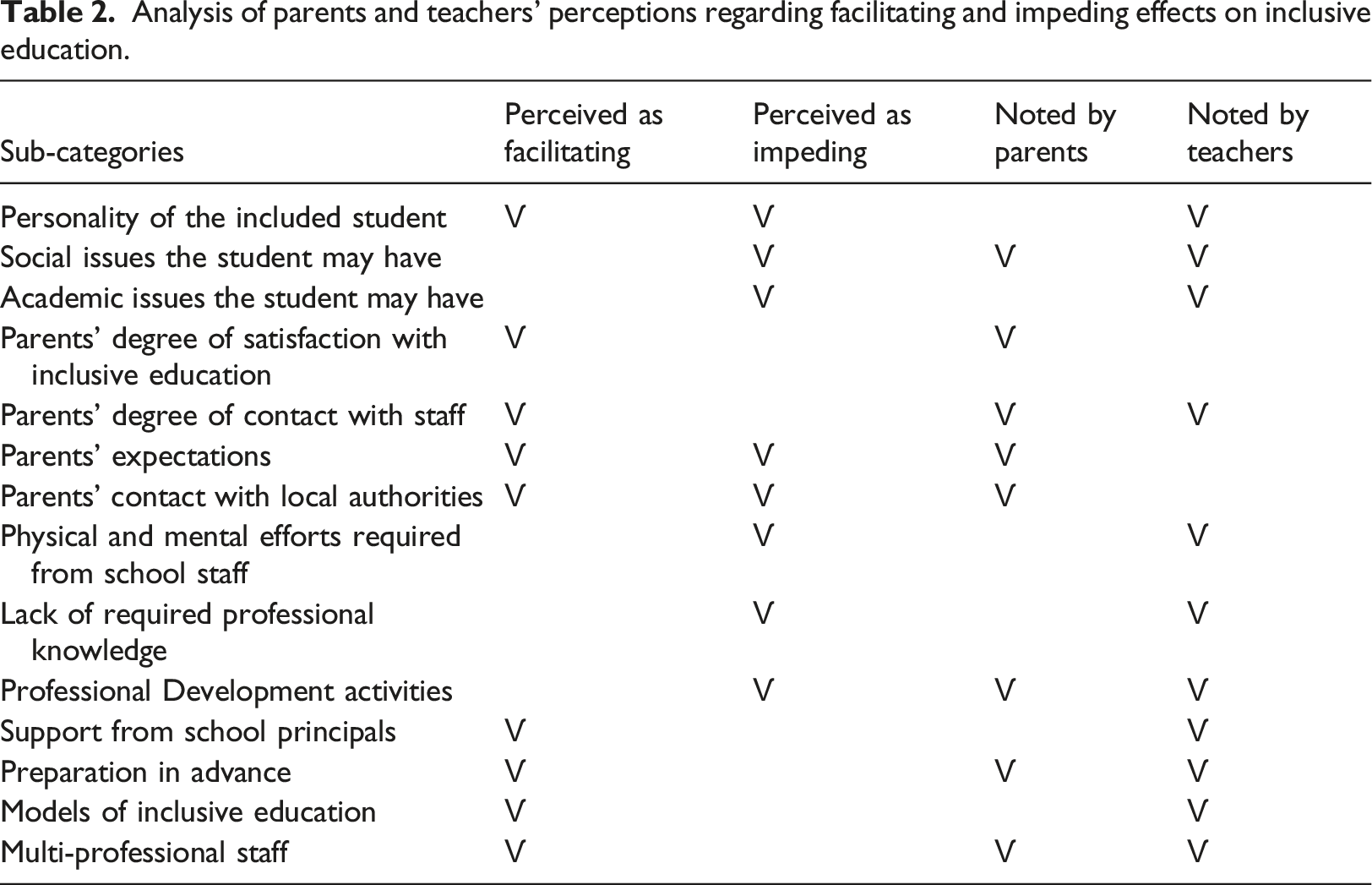
Both parents and school staff agreed that the following have a facilitating effect on inclusive education for students with IDD: (a) parents’ degree of contact with school staff; (b) planning and preparing in advance and (c) setting-up a multi-disciplinary team. Both parents and teachers noted social issues the students may have and lack of professional development activities as having an impeding effect.
Parents noted social issues the students may have as having an impeding effect whereas their degree of satisfaction may have a facilitating effect on the practice of inclusive education for their children with IDD. Parents were honest when referring to their expectations and the contacts with local authorities as having either a facilitating or an impeding effect.
School staff noted the following impediments: (a) academic issues the students may have; (b) the physical and mental efforts required of them; (c) lack of professional knowledge. The following were noted as facilitators: (a) support from the principal; (b) the model of inclusive education implemented in the school. School staff saw the personality of the included student as either facilitating or impeding inclusive education.
Parents are concerned with social issues their child may have and noted them as having an impeding effect. Most of them comprehend their child’s difficulties but nevertheless, they perceive social integration as a catalyst for personal development. They see inclusive education as an opportunity for their child to be socially included, in a manner that would not be possible in any other setting: "My daughter has progressed socially and personally, but not really scholastically" (Ruth, a mother); "I know that my child is behind her classmates, but her situation is better than a child who goes to a special school" (Thomas, a father).
One mother said the following: "Inclusion gave her some good social opportunities. She learned how to cope with social situations, arguments, conflicts. She is in Grade 3 and she is good socially, she is very happy with school, and very much enjoys having friends. Friends visit her at home, she has at least 4-5 friends who really love her. They don’t leave her on her own, and they invite her during the vacation" (Rachel, a mother).
The school staff has a different perspective on social integration i.e., the widening gap in all areas of development between the included child and his or her classmates: "At first, the girls loved H and were her friends, but with time, they are now in Grade 3, they have less interest in her and in playing with her" (Emi, a teacher). "Social ability is a very problematic area, perhaps, because there is a social-emotional gap between the student and her peers... her interests and those of the other girls in her class are different, her desire to play games that no longer appeal to her peers. Her connection with girls in her age is expressed mainly in that they look after her" (Lisa, a teacher assistant). "She progresses over the years, mainly personally. Socially – it is not simple. At times her behavior is nearly anti-social… In terms of studying – she progressed in language and in arithmetic. She studies together with the class and reads and writes quite well" (Betty, a teacher). "Academically she has progressed a lot, but it becomes harder and more complex for her. Socially and emotionally, there is no progress. On the contrary, the gap between her and the other girls grows, especially as they get older" (Miriam, a teacher).
Parents’ expectations are realistic: "She reads, expresses herself relatively well in writing. Arithmetic is hard for her. Over the years the teachers work with her more individually, or she attends the school’s learning center," (Rachel, a mother); "Academically, I am disappointed that there is no special treatment... the teachers don’t sit with her for studying," (Mother); "Scholastically, my daughter doesn’t really get help from the school, my wife sits with her and teaches her. A child without a parent who continues to help at home, will find it very hard to progress," (Dan , a father).
Discussion
The mainstreaming and educational inclusion of children with SEN in Israel is guaranteed by the 1988 Special Education Law, which addresses the right of children with SEN to receive educational services while attending a general education setting. The legislation requires the Ministry of Education to allocate resources, additional teaching hours, support teachers’ professional development, and provide additional paramedical treatments and remedial instruction for the pupils with disabilities (Special Education Legislation, 2018). Nevertheless, the staff in a general schools tend to report that they lack the knowledge and resources needed for teaching students with SEN. Teachers in Israel have to cope daily with crowded classrooms where students demonstrate social, behavioral and scholastic difficulties. As a result, they often feel burnout and exhaustion, which can potentially lead to negative attitudes towards inclusion.
Similar to previous studies on teachers’ attitudes towards included students with disabilities (Talmor et al., 2005), the findings of this study show that teachers, in general, have positive attitudes toward inclusion. Regarding facilitating and impeding factors, teaching staff and parents share similar opinions. Both mentioned three facilitating factors: the degree of contact between parents and school staff, having a multi-professional staff in school and preparing in advance for inclusive schooling, and two impeding factors: social issues the student may have and [lack of] professional development activities.
In Israel, parents play an important role in the school inclusion committee’s decisions and are expected to take an active part in placement issues. Similar to Leyser and Kirk findings (2004), the current study indicates varied opinions among parents concerning the potential of their child with SEN to be included in the general education setting, as they are willing to do whatever it takes to have their child in an inclusive education program. Our findings show that parents have a realistic and optimistic view of the inclusion of their child with IDD.
Parents indicated the importance of the social aspect, in terms of both the support their child needs and their expectation that their child will not feel isolated, either at school or after school hours. Thus, social relationships and effective social skills must be promoted, as well as the acquisition of learning and development of study and job skills.
Content analysis clearly shows that the participants felt there were slightly more facilitating components than impeding ones. Two main facilitating components that teachers and principals consider important focus on the family's cooperation and the staff's connection with the parents, and the teamwork within the school. Poor function of these connections is perceived as a factor that inhibits inclusion. There was also a consensus among parents, teachers and principals regarding the importance of professional support and guidance. Generally, it is understandable that parents want to be involved in the inclusion process of their child, and that they have clear opinions about the professional work.
The measures of success were found to be related to expectations, impressions and how various situations and events are interpreted, as well as the participants' point of view. Thus, all the participants in the study ranked the inclusion of the students’ social success highly, even higher than scholastic success. Parents see social inclusion as important not just during the school years, but also later on in terms of acquiring social skills that will help them in their adult life.
As recommended and emphasized by Israel’s education policy, that every child should be placed in an appropriate class, in the present study, the parents perceived the opportunity for their child to be included in a class with children with typical development as an opportunity for proper societal integration, and despite all the difficulties, the advantages outweigh the disadvantages. Attention should be paid to what participants say about the type of school – elementary or middle school. In elementary school classes, when the children are young, both teachers and parents report that the friendships developed are expressed outside school hours. In middle and high school classes, the social and scholastic gap widens, and this might impact on personal development.
The study’s findings indicate practical recommendations. A provision of theoretical knowledge and practical coping tools could help the educational and therapeutic staff as they include students with IDD in educational and community settings. Teachers in general schools should receive professional support, collaborate with the special education teachers, and develop supportive leadership in the schools with staff who are proficient in catering to children in special education. Another recommendation is to set up a multidisciplinary forum with teachers, psychologists, social workers, family members of included children, who will meet several times a year to advance optimal inclusion for all levels of education and to promote the social support via explanatory education from a young age.
Conclusions
The findings support promoting the inclusion of students with IDD through social-emotional intervention programs as well as by specific scholastic advancement. Teachers express the significance of challenges that they face in providing effective inclusive education to the students, emphasizing the need for the system to train and resource these teachers to ensure that they can work to close any widening academic and social gaps. While parents mostly emphasized the significance of the social aspect when attempting to integrate into the peer group at school and into society as an adult.
There should be further examination of the perceptions of adults with IDD to understand the climate of the included class, to gain insights about the implications of inclusion on all the students, as well as the perceptions of the teachers and parents about the contribution of inclusion from the scholastic and social aspects.
Yet, the small number of participants obviously had an effect on the findings. Follow-up studies should be conducted on a larger population. In addition, the severity and the type of the disability should be considered as well as the age and the class level. Furthermore, other research tools such as observations, should be used to examine success and satisfaction, and the extent of social and behavioral inclusion both at school and in after-school leisure settings. Furthermore, it is important to integrate effective tools for inclusion in higher education curricula and teacher education via specific courses relating to people with disabilities in general and people with IDD in particular, for different aspects such as the family, and social school and community setups.
Footnotes
Declaration of conflicting interests
The author(s) declared no potential conflicts of interest with respect to the research, authorship, and/or publication of this article.
Funding
The author(s) received no financial support for the research, authorship, and/or publication of this article.

Note
Appendix No. 1: Interview Questions:
1. Please describe the inclusion process of a student with IDD in your class as you see it (For school staff) / Please describe the inclusion process of your child as you see it (For parents) 2. In your opinion, what facilitates and what impedes the implementation of inclusive education for students with IDD? 3. What do you think are the measures of successful inclusion? 4. Are you satisfied with the way things are regarding inclusion of students with IDD in your school and why? (For school staff) / Are you satisfied with the way things are regarding inclusion of your child and why? (For parents)