



Abstract
Research on the lived experience of Canadian parents with intellectual disabilities involved in child protection is limited, particularly inclusive research with parents with intellectual disabilities involved in Canada’s changing child protection system. This inclusive study was done in collaboration with a co-researcher with intellectual disabilities who had lived experience as a parent. Thirteen parents from three Canadian regions participated in semistructured interviews about their involvement in child protection. Four major themes emerged in the findings: 1) key supports that contributed to positive outcomes; 2) parents’ attitudes toward child protection agencies and perceived attitudes about themselves; 3) systemic barriers impacting accessibility and the child protection experience; and 4) parents’ advice to other parents and professionals in child protection. This study provides a promising picture of child protection agencies as a key support despite existing barriers. Implications for social service providers are offered and areas for further exploration are discussed.
Keywords
Introduction
An increasing number of adults with intellectual disabilities are choosing to become parents (Perez-Curiel et al. 2023) or expressing the desire to form a parental identity (Guenoun et al. 2022). Most parents with intellectual disabilities are part of a hidden majority, who may not have a formal diagnosis and may or may not be receiving developmental support services (IASSIDD 2008). Sometimes, intellectual disability in parents is observed by service providers when parenting concerns arise, or child protection services become involved (IASSIDD 2008). Parents with intellectual disabilities have a regrettable history of stigma, marginalization, and social exclusion due to presumptions of parental incompetence by service providers and family members (Aunos et al. 2003; Aunos and Feldman 2002; McConnell et al. 2011, 2021). They are often under more scrutiny from child protection agencies than parents without intellectual disabilities (Booth and Booth 2004a, 2005; McConnell et al. 2011, 2021).
Parents with intellectual disabilities involved in child protection
The prejudice faced by parents with intellectual disabilities in the child protection system is well-documented. They are overrepresented in the child protection system at over 15% of cases (Booth and Booth 2004a; Booth and Booth 2004b; Booth, Booth, and McConnell 2004; Booth and Booth 2005; Booth, McConnell, and Booth 2006). In Canada, 6% of newborns born to mothers with intellectual disabilities are removed at birth by child protection services compared to less than 1% of newborns born to mothers without intellectual disabilities (Brown et al. 2018). Intellectual disability in parents impacts custody outcomes more than social factors and these cases are kept open for longer compared to parents without intellectual disabilities (McConnell et al. 2008; 2011; 2021).
Complex social situations, such as substance abuse, unemployment, unstable relationships, and poor housing can have detrimental effects on parent-child relationships and parenting behaviours (Aunos, Feldman, and Goupil, 2008; Darbyshire and Kroese, 2012). Parents with intellectual disabilities are more likely to be involved in child maltreatment cases involving neglect (compared to their peers without intellectual disabilities) and less likely to be involved in cases involving other types of child abuse (such as physical or sexual abuse) compared to other parents (Slayter and Jensen, 2019).
Parents with intellectual disabilities often describe challenges in understanding court processes and no accommodations are provided for cognitive accessibility (Booth and Booth, 2005; Cox, Kroese, and Evans, 2015; Tahir and Cobigo, 2023). Canadian parents with intellectual disabilities are not referred to suitable parenting programs tailored toward supporting their unique challenges as often as they are in the United States, although there is an evidence base for such programs (Feldman, 1994; Wade et al. 2008; McConnell et al. 2021; Slayter and Jensen, 2019). Prejudice is also evident in current formal risk assessment tools published across several Canadian provinces that indicate intellectual disability itself as a risk factor for child protection concerns (Government of Manitoba, 2013; Ontario Association of Children’s Aid Societies, 2021).
Positive parental outcomes in child protection
Relationship-based practice in child welfare and child protection social work has been well-established as the optimal method to achieve positive child welfare outcomes such as children’s safety, retention of child custody, and improvement in parenting skills and parental self-efficacy (Marsh et al. 2012; Smithson and Gibson, 2017; Tilbury and Ramsay, 2018; Lehtme and Toros, 2020). Child outcomes and improved parent-child interactions are considerably influenced by parent satisfaction with child protection services, which is closely related to positive client worker relationships (Tilbury and Ramsay, 2018). When child protection workers can build rapport and trusting relationships with parents, parents perceive conviction in the workers’ attitudes about their ability to be good parents. This leads to improved parental self-efficacy and positive outcomes, including being able to retain custody of their children (Tilbury and Ramsay, 2018; Lehtme and Toros, 2020).
Additional positive parental outcomes include being able to access and avail services to meet parents’ support needs, which directly impact parents’ ability to meet their children’s needs (Feldman and Aunos, 2011). For example, services that aid in meeting basic needs such as food security, stable housing, and employment have a critical impact in positive parenting behaviours for parents with intellectual disabilities (Aunos et al. 2008). Several supports have been identified as beneficial for parents with intellectual disabilities including informal social supports (such as peer support; Starke, 2022; Collings et al., 2020; Potvin et al. 2016); formal support networks (Koolen et al. 2020); effective individualized parent education programs (Feldman, 1994; Wade et al. 2008), specialist advocacy services (Atkin and Kroese, 2022) and delivery of services in a respectful and sensitive manner that champions a sense of autonomy and agency for parents (Theodore et al. 2018).
Although the support needs of parents with intellectual disabilities have been widely explored, challenges in providing consistent and timely support services continue to persist (Koolen et al. 2020). These can include referrals to ineffective parenting interventions (Pacheco et al. 2022); accessibility challenges (Tahir and Cobigo, 2023; Malouf et al. 2017; Matthews and Stansfield, 2014); a lack of formal guidelines in Canada for working with parents with intellectual disabilities (such as ones published in the United Kingdom; Tarleton, 2017); fragmented and siloed services and lack of access to primary healthcare and mental health services (MacIntyre et al. 2019; Brown et al. 2022; Malouf et al. 2017); unstable social relationships and experiences of interpersonal trauma (McConnell et al. 2021; Hammarlund et al. 2023); and persistent prejudice toward parenting with intellectual disability (Correa et al. 2022; Franklin et al. 2022). There also continues to be a lack of professionals’ training in intellectual disability (MacIntyre et al., 2019). Recognizing intellectual disability in parents and providing referrals for diagnosis has recently been identified as the first line of support (McConnell et al. 2021).
Lived experience of parents with intellectual disabilities
Parents with intellectual disability have expressed the desire for parenthood despite the ongoing societal stigma they face (Genoun et al. 2022; Theodore et al. 2018). The perspectives and lived experience of parents with intellectual disabilities involved in child protection cases have not been sufficiently captured in recent research, particularly in Canadian samples. A handful of studies have directly studied the lived experience of parents with intellectual disabilities undergoing child protection investigations, revealing themes of powerlessness, lack of appropriate supports, feelings of fear and distrust and lack of adequate legal representation during complex legal proceedings (Booth and Booth, 2004; 2005; Sheerin et al., 2013; Atkin and Kroese, 2022). A case study by Stefansdottir et al. (2023) examining the lived experience of a mother and father with intellectual disabilities found that supportive family members, advocates, and social service professionals were essential in achieving positive outcomes.
Inclusive research with parents with intellectual disabilities
Walmsley et al. (2018) defined inclusive research as research that incorporates the lived experience of persons with intellectual and developmental disabilities, recognizes their contributions to research, and empowers persons with intellectual disabilities to be collaborators in research and “stand with” the issues that are important to their lives. Inclusive research with parents with intellectual disabilities, particularly those involved in child protection, is limited. Only four inclusive studies were found examining the parenting and support experiences of parents with intellectual disabilities with collaboration from co-researchers with intellectual disabilities (Theodore et al. 2018; Collings et al. 2020; Strnadova et al. 2019; Franklin et al. 2022). They explored different types of social supports available to parents, the importance of structured peer supports, recognition of the need for professional services and resources despite pervasive assumptions about lack of parenting capacity, and the desire of parents with intellectual disabilities to engage in family planning. However, none of these inclusive studies directly examined the lived experience of parents within child protection investigations.
Research gaps and question
Most inclusive studies involving parents with intellectual disabilities included co-researchers with intellectual disabilities who may not be parents themselves. In the present study, we set out to fill this research gap by working in partnership with a co-researcher with intellectual disabilities who had the lived experience of being a parent involved with child protection. Her contribution to the research design and interpretation of findings was intentionally planned to increase the research validity. We asked the following research question: What were the facilitators of, or barriers to positive parental outcomes based on the lived experience of Canadian parents with intellectual disabilities involved in the child protection system?
Method
Developing an inclusive research design
Being intentional
This study utilized a qualitative inclusive research design. An intentional inclusive research plan was developed to contextualize the perspectives and voices of parents with intellectual disabilities within a place of lived experience. With consultation services from the social enterprise Open Collaboration for Cognitive Accessibility (Open, 2024), research materials were developed in accessible language, following Easy-to-read guidelines for documents (Inclusion Europe, 2024). Easy-read guidelines offer specific parameters for presenting information to persons with intellectual disabilities that aids comprehension (Sutherland & Isherwood, 2016). The guidelines published by Inclusion Europe (2024) include but are not limited to using short sentences, including only one idea per sentence, explaining difficult words, reducing visual clutter, using accessible fonts (such as Arial or Tahoma), and using active voice. As part of the recruitment strategy for inclusive methods, a co-researcher with intellectual disability and lived experience as a parent was recruited from Open’s team members to collaborate on the following phases of research: 1) review and validation of materials to ensure accessible language; 2) data collection; and 3) data analysis. All materials used to recruit and train the co-researcher were in accessible language, including an Advisor recruitment letter, contract, and consent form.
A contract was signed with the co-researcher to recognize the value of their contribution in this study and provide fair remuneration for their time.
Research training
At each phase of the study in which the co-researcher was involved, individualized training was carried out in person using strategies tailored to their learning style. The co-researcher expressed that their confidence increased when given the opportunity to practice and discuss prior to completing a task. Therefore, a Behaviour Skills Training (BST) approach (Leaf et al. 2015) was used to provide training in research skills: 1) verbal guidance; 2) modeling how to perform a skill or complete a task; 3) practice or rehearse how to perform a skill; 4) provide feedback on the practice or rehearsal. Prior to conducting participant interviews collaboratively during data collection, two training sessions were completed with the co-researcher using the BST approach. The training sessions included diverse learning and communication strategies, using accessible language, roleplay, repeated practice and feedback, use of multimedia and creative activities. Similarly, prior to data analysis, three teaching tutorials were provided using examples from archival and public data.
Privacy and confidentiality
Prior to having access to any participant data, the co-researcher reviewed and signed a confidentiality agreement in accessible language. Interview recordings were only accessed using the researchers’ computer in a secure research office. The importance of confidentiality and upholding participants’ privacy was thoroughly discussed with the co-researcher.
Length of involvement
A total of 20 meetings varying from 1 to 1.5 hours in length were carried out over a period of 8 months (January to August 2023). Some collaborative work, such as review of documents and providing comments on the coding structure during data analysis, was carried out remotely using a shared folder in cloud storage (no confidential data were shared via cloud storage).
Recruitment and participants
Ethics approval was obtained from the institutional ethics board (File #H-02-22-7670). Subsequent to institutional ethics approval, ethics approval was also obtained from specific local and regional developmental support agencies in two Canadian provinces, Ontario and Manitoba, to proceed with recruitment.
Recruitment of participants was carried out with the support of several local and regional developmental support agencies (i.e., organizations providing support services to persons diagnosed with an intellectual disability) who shared recruitment letters within their networks and provided program contacts. The inclusion criteria for participants included: 1) being a parent; 2) having an intellectual disability, in the form of a formal diagnosis or receipt of developmental support services, and 3) being involved with child protection at any point in their lives.
Participant Demographics.
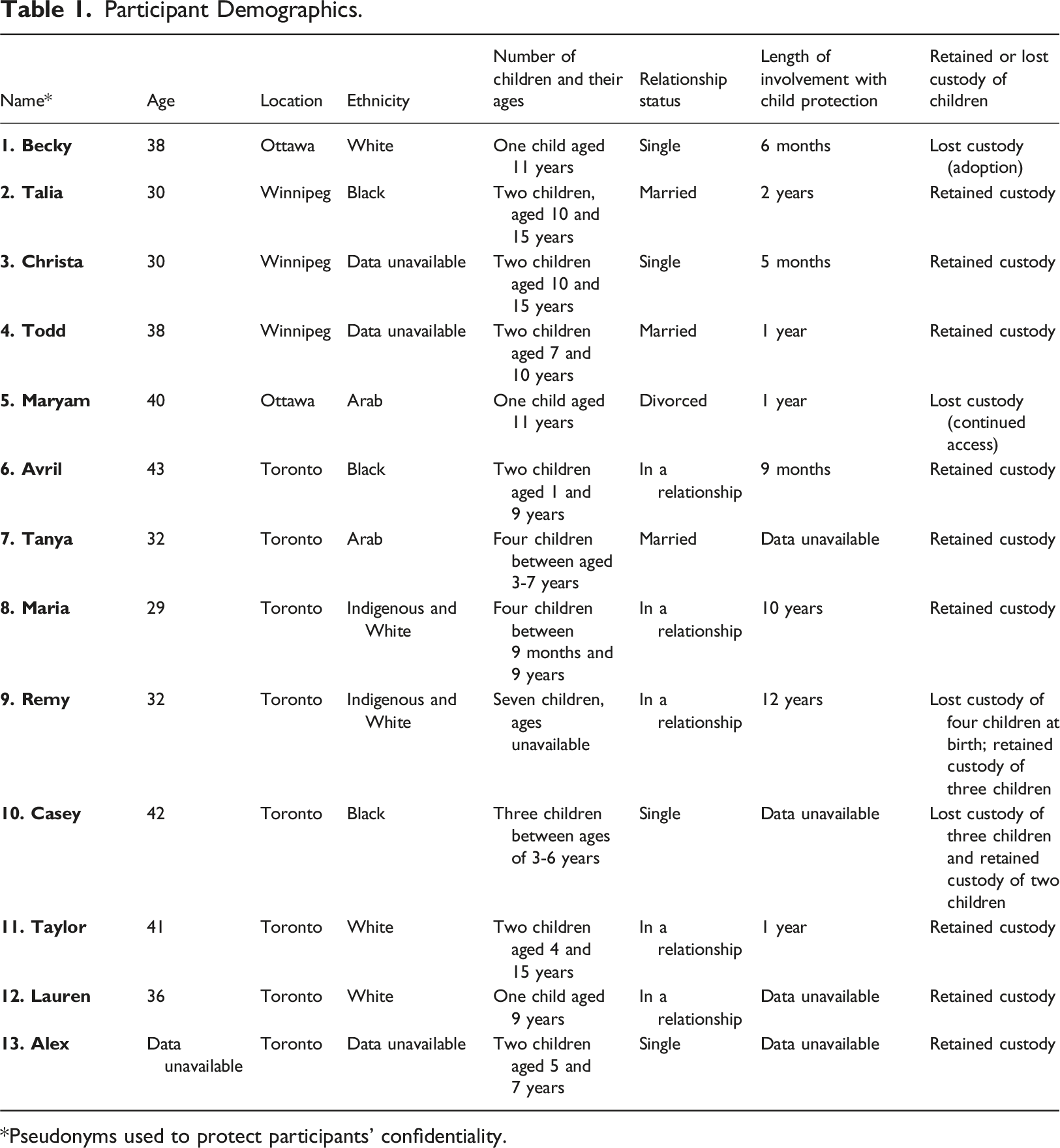
Pseudonyms used to protect participants’ confidentiality.
Materials
All materials used in this study, including the participant recruitment letter, consent form, and interview guide, were developed in accessible language in both official languages of Canada, English and French. Each document was reviewed by an Easy-to-read expert at Open. After ensuring that each research material met Easy-to-read guidelines, the materials were reviewed and validated by the co-researcher.
The interview guide was further adapted for the co-researcher to embed their own introduction. Questions in the interview guide included demographic information, experience with child protection, accessibility issues, support needs and challenges, perceptions of disability and advice for other parents with intellectual disabilities and professionals.
Data collection
In addition to signing an accessible consent form, participants were also asked for verbal consent prior to scheduling the interview. Semistructured interviews with participants were carried out virtually (on Zoom or Teams) or in-person, with or without the presence of a support person, based on the participants’ preferences. Participants were provided with flexibility in how and when they shared information. For example, the choice of answering questions in written format via e-mail was given to participants; most participants chose to answer questions verbally during interviews. Participants were also asked what style they would prefer for questions (e.g., specific questions vs. broad questions) and assured that they could choose to skip any questions or end the interview at any time. Interviews were recorded for data analysis, with participants’ consent. Each participant received an honorarium for taking part in the study.
A total of 12 participants completed the interview in English and one participant completed the interview in both French and English. After receiving interview training, the co-researcher collaboratively carried out one bilingual interview with a participant (English and French).
Data analysis
Thematic analysis was completed on the data (Braun and Clarke, 2012; Terry et al. 2017) after adapting the process into an inclusive and iterative procedure. After receiving data analysis training from the researchers, a collaborative data analysis form was developed with the co-researcher, who expressed that they would prefer to listen to audio recordings of the interview and verbally discuss, instead of reading transcripts and taking written notes.
All data analysis meetings were recorded, with consent from the co-researcher. The researcher took notes on the collaborative data analysis form based on the discussion with the Advisor.
To immerse within the data, the co-researcher and first author listened to an interview together prior to discussing and taking notes. The Advisor and researcher listened to 4 out of 13 (30%) interviews together. The Advisor was invited to share their ideas and points first before the researcher added their points, to remain authentic to the Advisor’s perspective as a co-researcher with lived experience.
Based on the Advisor’s ideas from the four interviews analyzed together, the first author developed a preliminary coding structure for the dataset in NVivo, a software for qualitative data analysis (Lumivero, 2024). The coding structure was provided to the co-researcher in accessible language to review and validate (i.e., confirm whether the codes are consistent with the interview discussions). After receiving feedback on the coding structure, the first author updated and applied the structure to the remaining interviews in the dataset.
Reliability scores were not completed in this study due to the ongoing debates about the validity and usefulness of calculating reliability scores in qualitative research (Yardley, 2000; O’Conner and Joffe, 2020). This is especially relevant in this inclusive study, in which objective coding of data was not realistic, nor desirable (O’Connor and Joffe, 2020). Since the goal is to understand the data from a place of lived experience, some degree of interpretation is required while being mindful of reflexivity. In lieu of calculating an intercoder reliability score, we embed other quality criteria such as constant comparison, transparent reporting of procedures, and “thick description” of participants’ experiences (Merriam and Tisdell, 2015).
Findings
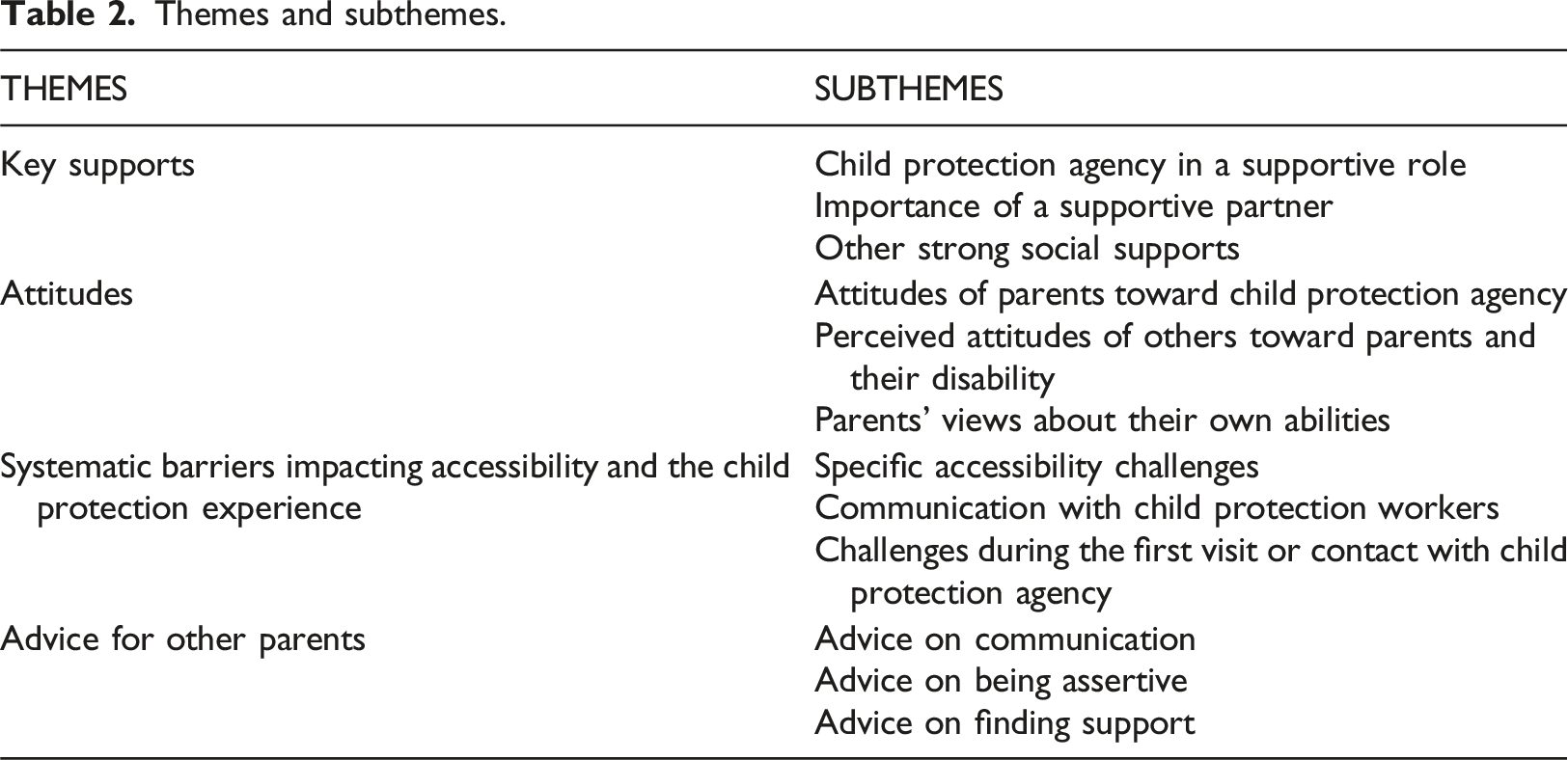
Themes and subthemes.
Key supports
Child protection agency in a supportive role
Parents from three different Canadian regions had varied experiences with their respective child protection agencies. Some parents described negative experiences and poor relationships with their child protection workers, while others identified significant positive experiences with child protection. The co-researcher identified this subtheme with surprise and cautious optimism upon hearing several parents express Children’s Aid Society (CAS; chapters of child protective agencies in Ontario, Canada) as being the strongest support and most positive influence in their lives. For example, Lauren attributed her confidence in her ability to parent and take care of her family to CAS: And someone in the building where I was staying, so found my place, before I ended up in a shelter, called on me. And the CAS lady that came said he’s hyperactive, I said oh yeah, from the time he wakes up till the time he goes to bed. And she goes, there's nothing wrong with him. There's no bruises, no nothing. So they were fine with me being a mom. But they've helped me go get my diagnosis of a learning, mental disability. And get my son into a really good school. They helped me to where I am today, standing on my own two feet.
Avril expressed that the child protection agency believed in her ability to parent and played an instrumental role in helping her regain custody of her child and preserve her family unit: They helped me with my son, they helped me know that my son is back with me in my custody. They helped me that my fiancée could see my son, and I could see my son.
Importance of a supportive partner
Another key source of support that parents expressed was their partner (spouse or long-term relationship partner). Some parents mentioned the absence of a supportive partner and being in unstable romantic relationships as a major influence on their poor family functioning and inability to meet their needs. Talia described her partner’s role as critical in helping her access the right services, in facilitating communication with workers, and in their family preservation: They live with me now, and that is because of my husband. If my husband was not to be here, or probably was not around, my kids would have been taken away from me.
Similarly, Remy, who experienced unstable relationships through most of her life, described improvements in her family life, access to supports and stability in her children’s lives after she found herself in a healthy long-term relationship: Ever since we've been together, things have been going uphill with us. He's been very supportive with me.
Todd, who is a father with intellectual disabilities, described a more nuanced experience and mentioned that it was easier for him to compromise with his partner (without intellectual disabilities) in order to continue seeing his children: Because in most cases I believe it's always better to let your partner have her way. For instance, in my own case it would have, the issue would have escalated more if I didn't consent to her caring for the kids.
Other strong social supports
Many parents expressed that informal social support including extended family members and friends have been a strong support while they were undergoing child protection concerns and for parenting in general. Maryam mentioned that her own parents were always there to support her: They help me with my daughter. She used to play and she's really stubborn. They know better than I do everything on my own. When I ask for help, they come.
Attitudes
Attitudes of parents toward child protection agency
Beyond the regional differences described above, several parents described being fearful and having distrust in child protection agencies at the outset. Remy, a mother who lost custody of four of her children immediately after birth, recounted her experience: I don't like how they just come into the hospital and just, pretty much up front saying we're taking your child after you just gave birth. I don't think they should be doing that. I think they should wait a couple minutes after. Because if the mother's had an epidural or something and after having a child, it does not help at all. It puts them in a depressed mode and that's where I think they should not be doing. It's a very fragile moment right there and then.
Talia expressed that she continues to be in a state of constant anxiety because she is unsure of when child protection workers will show up and what they will do: I don’t know if you have ever been in my situation, you will always feel insecure when they are around. I mean anything could happen. I still have the problem now. I am still in this condition, this mess right now. I am still not free from them taking away my children. It's just that my husband is by my side.
Perceived attitudes of others toward parents and their disability
Parents’ perceptions were varied in terms of whether child protection workers and other service providers had biased opinions toward their parenting capacity because of their disability. Maria mentioned that she never felt workers discriminated based on disability and she has never been referred for a parenting assessment: No, they never thought that my disability or like my mental health, would affect the way I parent. So like, I've never had to go for one.
Avril mentioned that child protection workers in her experience preferred to do an observation to ensure good parenting skills and did not make presumptions about her parenting ability: My children’s worker she followed me to my other big program that I had with my son and she observed me and I was a good parent, observed that I picked up my baby good, I sat down carefully, I feed my baby I did everything right you know. And I’m a good mother not a bad mother as people would think or say that.
Remy mentioned that she has been involved with child protection services for more than 10 years and in the early years, child protection workers often made assumptions about her parenting capacity based on her diagnosis: Because I have a learning disability, they think that I won't be able to protect my child or take care of them or anything like that.
Parents’ views about their own abilities
Parents’ confidence in their own parenting skills and self-efficacy presented in a complex picture influenced by the people in their lives, including family members and service professionals. Becky expressed that she felt judged by everyone in her life and this contributed to her strong feelings of failure in parenthood: I couldn’t take care of her at the end, I was surviving for myself. Like I tried my best, but it wasn’t enough.
Maryam was more confident in describing her parenting ability and felt more reassured that she had a network of support to help her in areas she could not manage herself: Well for me it’s clear, I can’t do it by myself and my ex-husband too he understands so the grandparents used to always take care of the little one.
Systematic barriers impacting accessibility and the child protection experience
Specific accessibility challenges
Many of the parents described cognitive accessibility challenges while involved in child protection. Barriers such as complex court processes, difficult language, rigid timelines, and lack of accessible information (including navigational directions, timings, and building access) were mentioned by several parents. For example, Taylor, who was a newcomer in Canada, was often confused about timings and directions provided by workers, due to both language and learning challenges: The time for everything was confusing. Everything was difficult to understand. Everything was confusing my English is very bad. I have mental health and [a learning] disability, but this time I did not have those diagnosis.
Becky expressed that her difficulties in understanding the complex court processes influenced her workers’ and family members’ perceptions of her parenting capacity: Like it’s still hard today. I’m a good person, trust me, I mean I love my daughter, I want everything for her, it’s just hard for me because the process, I didn’t really understand 100% what was going on.
Lauren spoke about the inaccessible language used during meetings and on forms and documents, that she would not be able to understand without the support of her developmental support worker and her mother:
There's so many different freaking words that I don't even understand.
Communication with child protection workers
Many parents emphasized the importance of having a positive and trusting relationship with their child protection workers. In cases where the workers did not believe in the parents’ ability to meet their children’s needs, there was distrust from the beginning of the involvement that negatively impacted the relationship throughout the case. Lauren mentioned that she kept open and honest communication with her worker, so nothing came as a surprise to them during regularly scheduled visits: And if I needed to call my worker about something up, like update her on something, I'd call her or e-mail them like they always got an update from me before they came to the house.
Similarly, Maria also indicated how critical it was to be honest with the child protection workers: I'll be honest with them, and if you're honest with them and cooperate on everything that they're asking you to do, or like any questions they're asking you just be truthful and helpful and it would like they'll be the workers will be helpful and truthful to you.
Challenges during the first visit or contact with child protection agency
When asked about their first contact with child protection, many parents were emotional as they described feeling helpless and terrified of losing their children. Casey, who was given no information about the child protection process, mentioned feeling scared when she found out she could no longer see her children after being removed by the child protection agency: I’m saying I did not understand. I'm thinking, well when they take them to the foster home that the parents can go there and see them.
Although Lauren went on to have a positive experience, she described her initial feelings of fear about the child protection agency because she had heard stories from other parents: They came the first time, and my mom was there because I thought I was going to lose my kid. A lot of people think oh when CAS comes to your house, they're going to take your kid. I had nervous breakdowns over it because it was the first time, they've ever been called on me. I'm like, I'm not losing my kid.
Advice for other parents and workers
Advice on communication
Parents in the study provided some key advice for other parents with intellectual disabilities who may find themselves in a similar situation as well as for child protection workers. Many parents expressed that having good communication and being cooperative with the child protection workers was important for positive outcomes. Lauren mentioned: Just keep that communication always open. Make sure the parent understands that you're not going to take the child away unless you do not the certain things that we need you to do. And just to always double check everything. Because sometimes the parents don't understand what's going on too. Like I didn't understand when they got called on me. Like, why did they get called on me like? Five years, six years. There's got to be something.
Advice on being assertive
Remy noted the importance of being assertive and expecting to be treated with respect even when involved in child protection and having her parenting evaluated. When a worker asked Remy personal questions about future pregnancies, she reached out to the agency: Yeah, I reported him. I told them like I need a new worker because I'm not going to have somebody like that who's going to ask me those kinds of questions which I don't want to answer.
Advice on finding support
One of the main areas in which parents provided advice for other parents with intellectual disabilities was in seeking out supports, one of them being the child protection agency itself, especially if there was previous experience with child protection. Remy mentioned reaching out to the agency herself: At first, I went to CAS, I told them like, hey, I'm pregnant. I know you guys are going to apprehend him by birth because you did it with the other four. I'm here to get some support and see what I can do to have him in my care. Because I want my child in my care.
Becky mentioned the need for peer support groups, so parents do not feel like they are alone in what they are going through: They should have the support groups [with other mothers], they should have like a way to say you’re a good person but let’s meet another time and see what we can do to help you out. And maybe remind them that they’re not bad you know. Seeing maybe the same person, see how they’re doing.
Maria noted that parents should be connected to services and resources to help meet basic needs: I feel like maybe having more resources like food cards and basic things that people would need access to right away, like formula and diapers and clothing and access to more stuff like that.
Importantly, based on the interviews and within the context of their own experiences, the co-researcher identified the need for timely and consistent services for parents with intellectual disabilities, instead of “waiting until they get in trouble” with child protection services for something they could have received help for when they first became parents, or even before giving birth.
Discussion
In this study, four out of 13 parents experienced permanent loss of child custody as a result of child protection investigations. Nine out of 13 parents who were involved in child protection had ongoing cases within the protection agency but did not experience child removal.
Social supports
The findings of this study contribute important evidence on the support needs of parents with intellectual disabilities. Social support from peers, particularly the presence of a supportive partner and being in a stable marital or romantic relationship, was mentioned as a key influence in positive child protection outcomes, also shown in extant literature (Koolen et al. 2020; Starke, 2022), The co-researcher’s collaborative data analysis was instrumental in understanding various dimensions of support needs mentioned by parents, including proper timing of supports, coordination and consistency between supports and the long-term nature of supports. The types of support identified as critical were social support from extended family, friends and partners, formal parenting programs, mental health, and emotional support particularly in the postpartum period, and counselling for trauma and intimate partner violence.
In fact, the inverse was also identified by parents: having poor relationships with partners and family members was perceived as a key reason parents continued to be investigated by child protection agencies. Parents with intellectual disabilities often have increased experiences of interpersonal trauma and intimate partner violence (Slater and Jensen, 2019; Collings et al. 2020). These experiences identify an important area of support that must be recognized and provided by local developmental support agencies (such as Developmental Services Ontario in Ontario, Canada; DSO, 2024a) as they build Individual Support Plans in line with social inclusion goals for parents with intellectual disabilities (Herps et al. 2016). In Ontario, Canada, once eligibility for developmental services is confirmed, formal social support, advocacy, case management and service coordination are provided by an adult protective worker (Adult Protective Service Association of Ontario; APSAO, 2024). In addition to this formal support, developmental support agencies must also enable parents with intellectual disabilities to build informal social networks in their community by providing platforms for healthy social interactions for parents struggling with social isolation or unstable relationships. This process must begin with a formal assessment of support needs, which is often not conducted as part of child protection investigations for parents with intellectual disabilities (Feldman and Aunos, 2020). There is an immense need for developmental support agencies to closely collaborate with local child protection agencies as they can play a vital role in identifying social strengths and needs for parents with intellectual disabilities. Currently, parenting support aimed at adults with intellectual disabilities is not mentioned or identified in any form within adult developmental services in Ontario (APSAO, 2024; DSO, 2024).
Child protection agency as instrumental support
Several parents described the child protection agency itself as an instrumental support system that helped their family retain child custody and access other essential services, which has not been demonstrated in previous literature involving parents with intellectual disabilities. This was especially true for parents in this study who lacked a social support network. This finding contrasts past research indicating adversarial relationships between parents with intellectual disabilities and child protection professionals (Proctor and Azar, 2013; Lewis et al. 2015; Albert and Powell, 2021).
Some parents notably attributed their success as parents to children with complex needs to the involvement and support of their local child protection agency. Parents with favourable views of child protection indicated that the agency helped with getting a diagnosis of intellectual disability, which in turn allowed access to a multitude of services that they would not otherwise have (such as an adult developmental support worker, financial support, and parenting support). McConnell et al. (2021) demonstrated similar findings in which a diagnosis of intellectual disability of parents involved in child protection was identified as a first line of support to open the door to other service referrals.
Furthermore, parents with positive views noted that the child protection agency provided coordination and seamless navigation across services for some parents, while enabling a sense of agency and respecting their parental identity. Parents mentioned having positive and trusting relationships with their workers and some even requested for their case file to be kept open. Open and honest communication as the basis of a strong relationship with workers was also a recurrent theme in the advice given by parents in this study. These findings highlight the significance of exploring the nuanced social context in cases represented in quantitative research indicating that child protection case files of parents with intellectual disabilities are kept open for longer (e.g., McConnell et al., 2011). Parents with intellectual disabilities have complex and long-lasting support needs (e.g., MacIntyre et al. 2019) that may have caused cases to be kept open for longer, which was not perceived negatively by parents but rather viewed as an important support mechanism for parents to stay connected to professional services.
It is important to acknowledge that although building positive parent-worker relationships is essential for positive child protection outcomes (Lehtme & Toros, 2020), in some of the cases in the current study, workers may have resorted to playing the coordination or case management role due to service system constraints and a lack of appropriate supports by local developmental support agencies. It is essential for child protection agencies and developmental support agencies to collaborate and ensure continuity of support for families who no longer have child protection concerns but are requesting their cases to be kept open to stay connected to services, as seen in the present study. Developmental support agencies must step in to ensure ongoing and consistent support for parents with intellectual disabilities at various stages of parenthood for positive family outcomes and to avoid unnecessary encounters with child protection for parents who do have a formal diagnosis of intellectual disability. In Ontario, these supports must fall within the purview of the adult protective services program (APSAO, 2024). This includes integrating tailored parenting education programs for parents with intellectual disabilities (e.g., Feldman, 1994; Wade et al., 2008) as part of individual goal planning. These changes must happen at a systemic level by creating effective communication pathways between child protection agencies and developmental support agencies.
It should be noted that planning for social supports at the developmental support agency level can become complicated for parents who may not have a formal diagnosis of intellectual disability and, as a result, may not be receiving services from their local developmental support agency. When parents involved in child protection are suspected of having an intellectual disability but may not be formally identified (as seen in extant literature; IASSIDD, 2008), it presents collaboration challenges for child protection agencies and developmental support agencies. The parents who participated in the present study were largely recruited through developmental support agencies, which may limit our understanding of the experiences of parents with intellectual disabilities who are involved in child protection but are not connected to developmental support agencies.
Based on demographics data, parents who reported positive experiences with child protection agencies were from the same geographical area in Canada. It is unclear if they were involved with the same child protection agency. Further exploration is needed to determine whether this is a geographical difference or agency-based difference. Much of the research on specialized parenting interventions and supports for parents with intellectual disabilities in the 1980s and 1990s was centered in the area where these participants received services (e.g., Feldman et al. 1985; Feldman et al.1986; Feldman et al. 1989; Feldman, 1994) and has influenced present day developmental support programs (e.g., Feldman Maurice and the Surrey Place Parent Enhancement Program, 2020).
In addition to geographical differences, it is important to explore the service load on the child protection workers supporting parents with intellectual disabilities. As mentioned by many parents who viewed child protection services as a key support, their workers often reached beyond their welfare role and played a service coordination or navigation role. It is crucial to further examine workers’ need for training and resources and perceptions of their own knowledge and ability to succeed in their role (Pytlowana and Kroese, 2021). It is also important to examine the impact of the service navigation workload on child protection workers as research has linked high turnover rates in child protection agencies to emotional exhaustion, burnout, and compassion fatigue experienced by workers in their demanding work (McFadden et al. 2015; Griffiths and Royse, 2017). Furthermore, research has shown that child protection workers often lack knowledge of intellectual disabilities and feel uncertain of how to effectively support parents with intellectual disabilities (e.g., Lewis et al. 2015), which may contribute to burnout and emotional exhaustion. Child protection workers often take a needs-based approach in evaluating parenting capacity, while developmental support agencies focus more on the parents’ strengths (Aunos & Pacheco, 2021; MacIntyre et al. 2019). Child protection workers would benefit from direct training on intellectual disabilities and focusing on parenting strengths to mitigate bias in their decision-making.
Systemic barriers: Cognitive accessibility
One of the primary systemic barriers adversely impacting the child protection experience for parents with intellectual disabilities is the lack of consideration of cognitive accessibility barriers. This lack of cognitive accessibility awareness occurred across every level of service provided during child protection. Based on parents’ experience, there was a lack of accessible information, lack of adapting case procedures and documents in accessible language, lack of flexible timelines and lack of accessibility support for parents at various stages of their child protection case. Also noted in Tahir and Cobigo (2023), in child protection cases, parents’ intellectual disability is identified but the need for accommodations and disability rights are not considered when planning for support. The only accessibility support described is informal communication support provided by family members or developmental service workers, which is only available inconsistently.
Several parents described not understanding what was happening during the first contact with child protection and feeling bewildered by the language used. Cognitive accessibility barriers can inadvertently make parents who experience accessibility barriers seem uncooperative or unwilling to avail supports they are referred to (Albert and Powell, 2021). The need for accessible information to be delivered in a child protection context has been identified in previous literature (McIntyre et al. 2019; Matthews and Stansfield, 2014) and while some resources exist in the United States and Australia (ProudParents, 2023; The Wash House, 2023), no such resources exist for Canadian parents. Region-specific resources are essential because child protection processes vary greatly across jurisdictions. Workers often do not have training to adapt communication methods based on accessibility needs of parents with intellectual disabilities. This lack of training and inability to provide appropriate supports may be related to persistent negative attitudes toward parents with intellectual disabilities within specific agencies and presumptions about parenting capacity on the basis of intellectual disability (e.g., Callow et al. 2017; Feldman and Aunos, 2020; Tahir and Cobigo, 2023).
Looking forward in inclusive research
An important methodological contribution of this study is its inclusive approach (Beail and Williams 2014; Ghaderi et al. 2023) with the inclusion of a co-researcher with intellectual disabilities who had lived experience as a parent experiencing child protection involvement. The first author consciously worked to resist the power imbalance inherent in academic research settings (Chalachanova et al., 2021). The co-researcher was invited to contribute to most major stages of the research process, including recruitment, data collection and data analysis. At each stage of research collaboration, information in documents and processes was adapted into Easy-to-read (Inclusion Europe, 2024) and accommodations were provided based on the needs of the Advisor. It is important to note that providing research training to co-researchers is essential for them to understand the context of the research study and provide meaningful contributions to the research process, as we would provide to new researchers. Therefore, the first author provided accessible tutorials and interactive training workshops to the co-researcher to practice interview skills and contribute to qualitative data analysis.
The co-researcher provided positive and constructive feedback throughout the research collaboration, which was an essential learning experience for the research team. For example, the first author initially prepared an accessible feedback form to enter notes during data analysis. The co-researcher shared that it would be most accessible to listen to audio recordings of interviews and share thoughts verbally in a real-time data analysis collaboration session. This important feedback allowed the first author to capture more accurate reactions and notes during data analysis which aided in building the initial coding structure.
There were some key lessons learned during the inclusive research process. For example, training materials need to be adapted into accessible language and flexible learning strategies at every stage. Transportation is a major consideration, and researchers must ensure that co-researchers are able to reach their destination during interviews and data analysis sessions. There also needs to be flexibility in timelines and extra time provided for review of documents.
We offered the co-researcher scientific authorship in this paper and discussed what it means to be an author on a research paper. After reflecting further on this responsibility, the co-researcher expressed that they would prefer not to be an author and instead focus on knowledge mobilization within the community, an endeavour the Advisor considered more valuable than authorship.
Limitations
This study is not without its limitations, most notably in the limited representativeness of the parents included in this study. Due to the difficulties in recruiting from this population, inconsistent descriptions of parents with intellectual disabilities and gatekeeping by social service agencies, many parents were recruited through an organization providing parenting support services to parents with intellectual disabilities in one specific, albeit large, Canadian region.
A second limitation is that only one father with intellectual disabilities was included in this study, which limits the understanding of the lived experience of fathers. Research has shown that fathers with intellectual disabilities often feel left out and may have varying support needs compared to mothers with intellectual disabilities (Ćwirynkało and Parchomiuk, 2023).
It may have been beneficial to include additional co-researchers to inform the data collection stage, which was the third limitation of this study. Given the sensitivity of the topic, it is expected that participating parents would feel more comfortable expressing their thoughts and sharing their story with another parent who has lived experience rather than an academic researcher (as shared by one parent whose interview was conducted by the Advisor).
Lastly, a fourth limitation was that the indigenous identity and other intersecting factors were not explored within this study, although 4 out of 13 parents identified as being indigenous. The unique lived experience of indigenous parents with intellectual disabilities must be explored in-depth to fully understand their contact with the child protection system in Canada. This is important given the context of truth and reconciliation with indigenous peoples in Canada in the wake of historical injustices, including residential schools and forced removal of children (Government of Canada, 2024).
Future research
Future research should continue to explore the lived experience of parents with intellectual disabilities in child protection within inclusive research designs. It is essential to incorporate an intersectionality framework in research with parents with intellectual disabilities to examine how indigenous identity and other intersecting identities influence the child protection experience. It is particularly essential to conduct a closer examination of the evolving landscape of child protection in Canada and its impact on Canadian parents with intellectual disabilities. With the removal of restrictive practices in some provinces such as birth alerts (Ontario Association of Children’s Aid Societies, 2021) and closed adoptions (Government of Ontario, 2020b), certain inequities have been removed and may have aided in mitigating some of the barriers faced by parents with intellectual disabilities. However, bias and prejudice in attitudes toward parenting with an intellectual disability continues to persist despite the growing number of parents. Future research must pay closer attention to agents of cultural change and mitigating systematic inequities and barriers for parents with intellectual disabilities.
Footnotes
Acknowledgements
We would like to sincerely thank the co-researcher who made this inclusive study possible with invaluable contributions in data collection and data analysis. We would also like to thank Open Collaboration for Cognitive Accessibility for its services in adapting research materials to Easy Read and connecting us with the co-researcher. We are grateful to the parents who participated in this study and shared their deeply personal stories with us. The views expressed in this publication are those of the authors and do not reflect the opinions or views of Open Collaboration for Cognitive Accessibility. Munazza Tahir is supported in part by funding from the Social Sciences and Humanities Research Council (SSHRC) in Canada under grant 752-2019-0079.
Declaration of conflicting interests
The author(s) declared no potential conflicts of interest with respect to the research, authorship, and/or publication of this article.
Funding
The author(s) disclosed receipt of the following financial support for the research, authorship, and/or publication of this article: This work was supported by the Social Sciences and Humanities Research Council of Canada, 752-2019-0079.
