



Abstract
Wordless picture books enhance comprehension and vocabulary growth and motivate children with intellectual disabilities to participate in literary activities. However, the reception of picture books can be challenging because deliberate selective attention processes and recognition of the image's meaning are often delayed. Examining eye movements may help explore these cognitive processes. Therefore, we examined eye movements in 29 children with mild and moderate intellectual disabilities as they explored a wordless picture book, presented on a screen and compared them to 14 typically developing children using a Tobii Pro X3-120 eye tracker. The findings showed that children with moderate intellectual disabilities had shorter fixation duration, fixated less often, and revisited regions of interest less frequently. Our results suggest that children with moderate intellectual disabilities have greater difficulties in selectively directing their attention toward regions of visual input with a high level of informativeness and expend less cognitive effort to understand their meaning.
Introduction
The ability to read is an important skill for children and adults with and without intellectual disabilities. The acquisition of literacy skills contributes to quality of life and participation in society). These skills form the foundation for learning academic skills and open opportunities for participation and interaction in social, employment, and civic activities (Copeland and Keefe, 2017).
Literacy
“Emergent literacy” is a term used to describe the reading and writing experiences of young children before they learn to write and read conventionally. It “comprises all of the actions, understandings, and misunderstandings of learners engaged in experiences that involve print creation or use” (Koppenhaver and Erickson, 2003: 283). These literacy activities contribute to building rich language skills, vocabulary, and understanding as the foundation for learning to read. Several language intervention studies support the importance of providing frequent, engaging, and meaningful communication opportunities, combined with a literacy-rich environment, and emphasizing the meaning of shared book reading on language comprehension as well as vocabulary size (Wessling et al., 2017). A body of research has shown that the shared reading of both printed picture books and picture book applications enhances comprehension and vocabulary growth (Mol and Bus, 2011; Mol et al., 2008, 2009; Van Den Broek et al., 2005).
These results indicate the importance of wordless picture books as early opportunities to encourage children to participate in literacy activities (Ratz and Lenhard, 2013; Wilke et al., 2018;). Wordless picture books contain little to no written text; the content of the story can be told based on the sequences of the presented pictures (Serafini, 2014a). There are two ways to use picture books in early childhood: first, the child can read the book alone to understand the presented story. Second, a picture book can be explored with the support of a proficient and creative reader, who reveals the world portrayed in the book using language and encourages the child to enter that world.
During shared picture-book reading, children are exposed to a wide variety of vocabulary and sentence structures, as well as story grammar. In dialogic reading, a literate partner (e.g., parent, teacher, or older child) engages with the child through reading and telling the story. During this process, the child listens to, comments on, shares their experiences, asks questions about, and retells parts of the story. Home literacy environments influence typically developing children’s interest in reading and emergent literacy skills (Baker and Scher, 2002; Bus et al., 1995; Whitehurst et al., 1988). In their meta-analysis examining the influence of joint reading on children’s literacy skills, Bus et al. (1995) found that parent-child storybook reading accounted for up to 8% of the variance in language growth, emergent literacy, and reading achievement of typically developing children.
In view of these results, a literacy-rich environment and frequent opportunities for dialogic reading of picture books can support the language and literacy development of children with intellectual disabilities. Unfortunately, the literacy environment of children with intellectual disabilities differs from that of typically developing children. Children with intellectual disabilities have fewer literacy materials to interact with than their peers without intellectual disabilities (Marvin, 1994; Trenholm and Mirenda, 2006), are read to less frequently, and during storybook-reading interactions, the main behaviors of their parents only point to or label the pictures; higher-order reading interactions such as asking what would happen next or retelling a story are used less frequently during storybook reading (Trenholm and Mirenda, 2006; Van Der Schuit et al., 2009). Comparing the home literacy environments of children with intellectual disabilities and children without disabilities of the same mental age, Van Der Schuit et al. (2009) found that although parents adapted their level of communication to the developmental age of their child, the children were less involved in picture and story orientation. They assumed that these differences were largely caused by children’s variables (e.g., cognitive and speech disabilities). Because picture books may introduce large amounts of perceptual input and a high cognitive load, it may be difficult for them to engage in this type of literacy activity. Therefore, the following question arises: What cognitive processes are involved in picture-book reception?
Cognitive processes in picture-book reception
Picture-book reception is a constructive process that includes several components. The ability to interpret, negotiate, and make meaning from information presented in the form of an image is conceptualized as visual literacy. This concept extends the meaning of literacy, which commonly refers to the interpretation of written or printed text. Visual literacy is based on the idea that pictures can be “read” and that meaning can be discovered through reading (Avgerinou and Ericson, 1997; Felten, 2008).
Children must focus their visual attention, differentiate visual signs, and recognize the meaning of objects or characters on the image presented on a page. In search of meaning within narratives, they also try to interpret the ideas and feelings of the protagonists, deal with ambiguity, recognize several storylines, and build hypotheses and imaginative processes as an important background in understanding the content of narrations (Serafini, 2014b). They must integrate prior knowledge, understand the goal structure, and generate causal inferences to create a coherent mental representation of the narration presented in a book (Best et al., 2008; Graesser et al., 1997, 2003).
Among these processes, selective attention is the foundation for the acceptance of picture books. Selective attention is necessary for focusing on relevant information while ignoring irrelevant sources to search for new information, compare and contrast dimensions of a visual image, flexibly shift from one visual entity to another, and maintain focus on the task (Iarocci et al., 2012). Individual components work together in a coordinated manner to successfully contribute to the overall processing of information in picture books.
Selective attention can be best understood in terms of a framework based on two fundamental dimensions. The first concerns whether the selection occurs with or without awareness. The selection without awareness is automatic, effortless, and rapid. Selection based on awareness is controlled, effortful, and often slow. The second dimension, used to distinguish between different aspects of attention, concerns the origin of the selective process. Exogenous selection is innately specified, and therefore, does not require learning. Endogenous selection involves learning and prior experience (Enns and Trick, 2006). Based on these distinctions, Enns and Trick (2006) further subdivided the controlled processes into exploration and deliberate selective attention. Exploration is innate and performed in the absence of a specific goal. Deliberate selective attention involves controlled, effortful processes and deliberate selection of a specific goal. Developmental changes are most evident in deliberate visual attention; that is, visual selective attention is less developed in younger children than in older children (Iarocci et al., 2009).
Exploration and deliberate visual attention are involved in picture-book reception. When the primary goal is to explore a picture, certain image attributes can direct visual processing. The properties of visual materials (such as contrast, color and brightness, intensity, spatial arrangements, complexity, and density of visual entities) may influence which visual stimuli are preferentially processed over others (Conklin et al., 2018; Enns and Trick, 2006; Rychener 2011). However, the recognition of the meaning of images in a picture book story (“visual literacy”) requires an effortful process of focusing attention on visual elements, shifting attention from one to another, controlling impulsive reactions to distractors, and recognizing the information value of visual elements.
Examining picture-book reception in children with intellectual disabilities may reveal restrictions on the cognitive resources necessary for creating meaning from information presented as an image. Specifically, deliberate selective attention processes and the reception of meaning may be delayed in the development of children with intellectual disabilities (i.e., consistent with their developmental level) or impaired (compared with their general cognitive ability). In a survey of studies concerning selective attention, Iarocci et al. (2012) demonstrated different attentional profiles in several genetic syndromes (Fragile X, and Williams and Down syndromes). Spaniol and Danielsson (2022) published a meta-analysis of studies that used laboratory measures to examine inhibition, shifting, and attention as components of executive function in individuals with intellectual disabilities. They identified ten studies with a group comparison matched for mental age and found significant differences in the ability to control attentional processes (selective attention, attention switching, and response inhibition) between children with intellectual disabilities and children matched for mental age with typical development. Their results provide evidence that executive functioning in children with intellectual disabilities is characterized by a specific deficit in deliberate attention processes.
Memory-related problems represent the second factor that contributes to the degree of intellectual impairment. Short-term working memory problems have long been documented in children with intellectual disabilities (Sigafoos et al., 2020). Working memory refers to a brain system responsible for temporarily storing and manipulating information necessary for complex cognitive activities like language comprehension, learning, and reasoning (Baddeley, 1992). It involves the temporary storage of limited amounts of information but also requires maintenance and attention while simultaneously processing information. According to Baddeley (1986), it consists of four parts: the phonological loop, visuospatial sketchpad, episodic buffer, and central executive, which integrate information from the verbal and visual material. In several meta-analyses, Lifshitz et al. (2011) and Godfrey and Lee (2018) provided evidence of large group differences between children with intellectual disabilities and children with neurotypical development in verbal and visual memory tasks when the comparisons were based on chronological and mental age. These differences were particularly pronounced when the tasks required further cognitive processing beyond simple recognition or recall.
Impairments in selective attention, short-term memory, integration of visual and verbal information in the central executive, and understanding the meaning of images may contribute to problems with picture-book reception. For children with intellectual disabilities, it may be difficult to focus on visual elements of images to find out what is new, identify similarities and differences in relevant elements, recognize their informative value, and maintain and manipulate this information for a short time period to understand the stories in picture books. Thus, impairments in attentional and cognitive abilities may explain individual differences between children with intellectual disabilities and those with typical development in their ability to engage in and learn from picture-book reading.
Internal attentional and cognitive processes during image reception and ongoing construction of narrative mental representations (while comprehending a story presented in a picture book) can be assessed using think-aloud protocols and probe questions. Furthermore, a child’s narration when asked to retell the story shows the information that has been processed. Both assessment types are difficult in the case of children with intellectual disabilities as they have problems monitoring their ongoing attentional behaviors and reasoning, and expressive language deficits may constrain their ability to retell a story (even if it is comprehended). Examination of eye movements may provide a potential alternative and valuable tool for exploring attentional and cognitive processes during picture–book perception.
Examining internal processes via eye-tracking
In recent years, eye-tracking has become an important data source for applied linguistic research. It has been increasingly used in studies exploring cognitive processing in cases of intellectual disabilities because examining eye movements offers the possibility of investigating cognitive processes in this group of children without being dependent on their expressive language competence.
Eye-tracking technology tells us about eye movements (saccades) and where people’s eyes land (fixate) when looking at visual stimuli. This information can be used to calculate metrics that might be used to define the observer’s engagement; e.g., the number of times the eyes land in a position or area of interest (fixation count), how long each fixation lasts (fixation duration), the time it takes to the first fixation, determine whether the eyes return to a previous point (regression), and measure saccade duration and length (Bylinskii & Borkin, 2015). Fixations, saccades, and regressions generally occur “automatically,” without conscious awareness (Rayner et al., 2012). Thus, tracking eye movements provides a “direct” measure of processing effort during a task rather than at the output of a decision, recall, or production task, which are often subject to various other influences (Su et al., 2018). Eye-tracking is based on the assumption that there is a tight relationship between eye movements and cognitive processing: (1) what is being fixated on is what the processing system is working to decode and understand, and (2) the amount of time spent fixating on an item or area reflects the cognitive effort required to process it. A long duration of looking at a certain area can indicate a high level of interest and cognitive effort, whereas shorter durations can indicate that other areas on the screen or in the environment attract more visual attention.
Thus, by tracking eye movements, inferences are made about what the child is attending to and how much cognitive effort is expended in doing so. Eye-tracking measures indicate how participating children allocate their attention to the different sources of input as well as referential decisions, meaning that participants look at what they think is important or are being referred to (Conkin et al., 2018; Key et al., 2020). Our study is the first study to systematically compare the reception of picture books by children with intellectual disabilities and children with neurotypical development using eye-tracking.
Aims
Because eye-tracking is a promising method for examining how visual information in wordless picture books is processed, the current study aimed to explore the influence of individual differences in selective attention and symbolic comprehension skills while perceiving and processing visual input on images and recognizing visual entities as objects of interest. Overall, our study aimed to improve the understanding of the basic processes underlying visual attention, which may be relevant for solving more complex tasks such as comprehending narratives in wordless picture books.
Our first aim was to compare the eye movements of children with intellectual disabilities with those of typically developing children (control group).
We hypothesized that fixation count, fixation duration, time to first fixation (TTFF), and revisit counts would differ between the two groups (alternative hypothesis H1), because the task of understanding the information presented may require greater processing effort for children with intellectual disabilities.
Our second aim was to compare the eye movements within the group of children with intellectual disabilities.
We hypothesized that eye movements would differ based on the degree of intellectual disability. Specifically, children with moderate intellectual disabilities may show a shorter fixation duration, fewer fixations, a shorter TTFF, and more revisits to the areas of interest (AOIs) than children with mild intellectual disabilities (alternative hypothesis H2), because children with moderate intellectual disabilities focus less on the AOIs to decode the meaning of visual elements and expend less cognitive effort in understanding their information value.
Third, we aimed to explore verbal and symbolic comprehension skills of children with intellectual disabilities as potential indicators of the ability to recognize the meaning of pictures, which may be associated with individual differences in eye movements while looking at a picture book.
We hypothesized that higher verbal and symbolic comprehension skills would be positively associated with shorter fixation durations, lower fixation counts, shorter TTFF in the AOIs, and more revisits to particular AOIs (alternative hypothesis H3). This hypothesis was based on the observation that differences in eye movements of typically developing preschool children while looking at picture books are associated with their receptive vocabulary when tasks to assess receptive vocabulary require pointing to one of the several pictures that represent the meaning of a verbal word or simple sentence (Evans and Saint-Aubin, 2013; Su et al., 2018).
Method
Participants
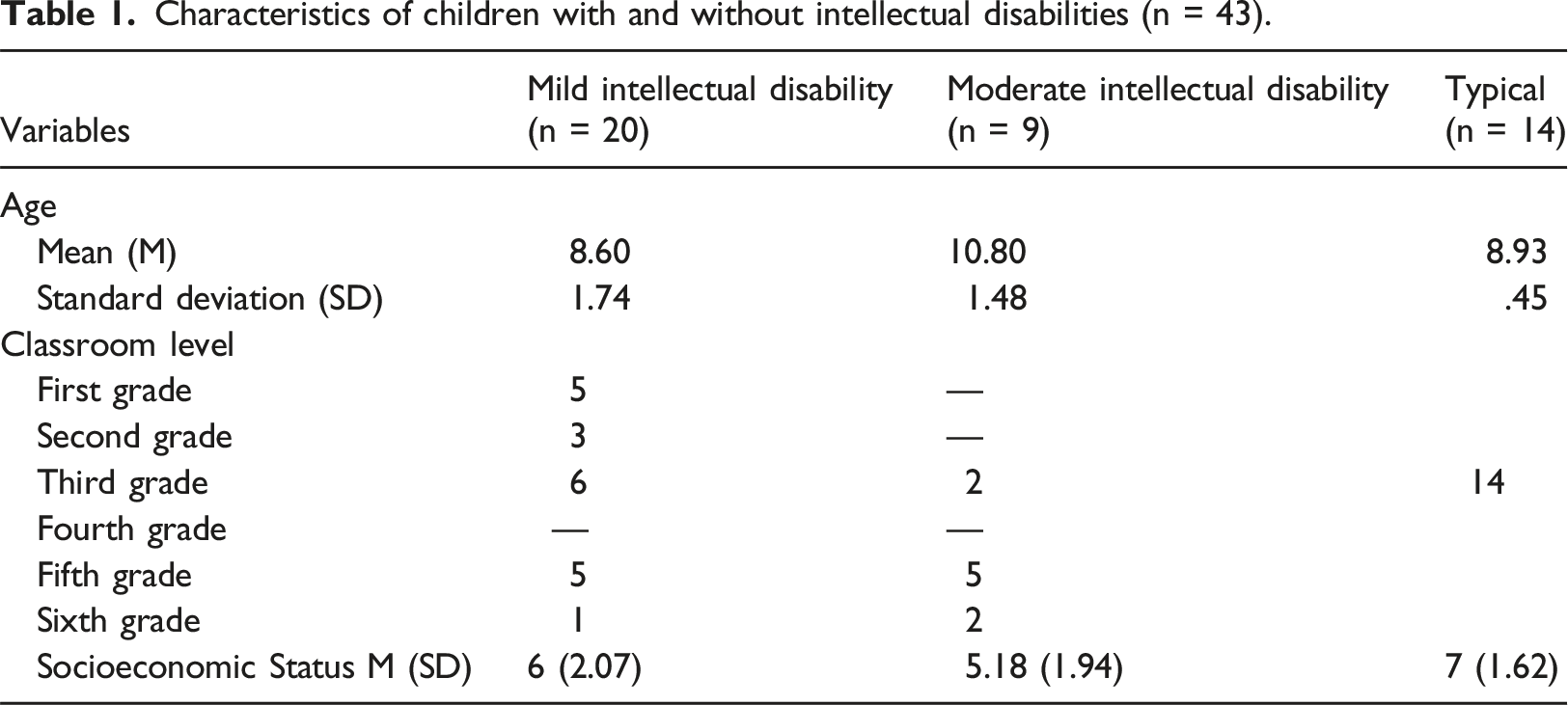
A convenience sample of 43 students comprising 29 individuals with intellectual disabilities (34.5% girls) and 14 neurotypically developed individuals (42.8% girls) was recruited from Bavaria, Germany. The sample consisted of 16 girls and 27 boys aged 6–13 years. Children with intellectual disabilities (Mage = 9.28, SD = 1.95) attended grades 1-6 in either special schools for children with intellectual disabilities or inclusive schools where they were taught according to the curriculum for children with intellectual disabilities. Special educational needs were documented by an expert report which was available in the children’s school files. Neurotypically developed children attended grade 3.
Recent scores on standardized intelligence tests were reported in the files of 17 of the 29 children with intellectual disabilities. These 17 children were classified as having a mild intellectual disability (IQ: 50–70). The mean IQ of this subgroup was 63.2 (SD = 5.06). For the 12 children without standardized test results, the intensity of their intellectual disabilities was rated by their teachers based on the student's reading levels. Three of them were classified as having mild intellectual disability (teachers reported that reading was at the alphabetic or orthographic level). Nine children had moderate intellectual disabilities as rated by the teachers (IQ: < 50). None of them had reached the alphabetic or orthographic reading levels. Additionally, the teachers provided information on the children’s language levels. At the time of testing, 23 students spoke at least simple word combinations and understood at least simple phrases. Six children were nonverbal or minimally verbal, and three used an augmented and alternative communication (AAC) device. Children with intellectual disabilities were in the first (n = 5), second (n = 3), third (n = 8), fifth (n = 10), and sixth (n = 3) grades.
Children with neurotypical development (M age = 8.9 years, SD = 0.45) were recruited from regular third-grade classrooms with no history of developmental difficulties regarding language or cognitive competence. The mean age of children with neurotypical development did not differ significantly from that of children with intellectual disabilities.
Characteristics of children with and without intellectual disabilities (n = 43).
Measures
Verbal comprehension
Verbal comprehension abilities were assessed only in children with intellectual disabilities. 18 items from two German language tests were used (SETK 2, Language development test for two-year-old children, and SETK 3-5, Language development test for three- to five-year-old children; Grimm, 2015, 2016). We used the subtests „word comprehension“ and „sentence comprehension“ which are conceptualized for children between 2 and 5 years. This age range seemed appropriate for the developmental age of the children with moderate intellectual disabilities in our sample. In each of these test items, four pictures were presented and the children were asked to point to the one that represented the meaning of a given verbal word or a simple sentence. Nine items were used to assess word comprehension (range of points: 0–9), and 12 items corresponded to simple sentence comprehension (0–12). For example, an item assessing word comprehension was presented as follows: The child was exposed to a stimuli surface of four pictures [“apfel, karotte, käse, brot,” (apple, carrot, cheese, bread)]] and the child had to point to the picture representing “karotte” (carrot). For sentence comprehension, the child was exposed to a stimuli surface of four pictures of different actions and asked to find the picture corresponding to the sentence [e.g., “Die Kinder sitzen unter dem Tisch” (”The children are sitting under the table”)].
Symbolic comprehension
The ability to understand the meaning of images was evaluated using two tasks from a German reading test specifically developed for children with intellectual disabilities. This test used a broader concept of reading, including stages of “reading pictures” (10 items) and “reading symbols” (10 items) as precursors of alphabetical and orthographical reading skills (“Gießen Screening to assess reading ability”; Euker et al., 2016). In the “reading pictures” subset, a range of photos and colored or black-and-white drawings were provided, and the child was asked to name the objects represented by them. In the ”reading symbols” subtest, the child had to recognize the meaning of the colored or black-and-white icons and symbols (i.e., more abstract representation). Again, the children were asked to name the meaning; the symbols represented, for example, the sign for the location of a toilet in a restaurant. Non-verbal or minimally verbal children had to point to one of the four pictures representing the meaning of the picture or symbol instead of naming it. All correct answers were added up and constituted a reading score.
Examination of eye movements
To examine the eye-movements during the reception of wordless picture books, eight pages from the picture book “The journal” (Becker, 2020) were selected. It provided a narration without text, in which the protagonist, a young girl, travels through a world full of fantasy and adventure. She experiences dangerous situations, meets new friends and discovers her own “magical identity”” during her journey. The book’s design consists of colorful pictures with many meaningful details used repeatedly as the narration turns further. Eight pages were selected because of their prominent meaning in the narration plot. The stimuli were presented on a Dell monitor (format 16:10) at a resolution of 1920 × 1080 pixels.
Eye movement data were obtained using a stationary remote Tobii Pro X3-120 eye tracker that uses a video-based corneal reflex method. When viewing the stimuli on the screen, the participants sat on a chair at a distance of 60 cm from the screen that showed the images on a standard 50% gray background. The eye-tracker measurement accuracy was within an average deviation of 0.4°–0.5° between the actual and measured points of view. It recorded the X- and Y-coordinates of the eye position and pupil diameter. Two points of reference to the eye were needed to separate eye movements from head movements, which promotes more natural user behavior because it does not place restraints on the participants, such as helmets, head-mounted sensors, or glasses.
The AOIs were defined for each of the eight pages of the Wordless Picture Book. The number of AOIs varied between two and five depending on the stimulus input (see Figure 1 for an example), and the total number of AOIs was 30. These AOIs were chosen according to the distinct elements representing the meaning of the narration. This picture presents the heat map that was created by the eye tracker when one child of the sample explored one of the pages of the wordless picture book “The Journal”. The picture shows the girl lying on the bed not knowing what she could do. When the cat leaves the room, a view of the magic chalk is revealed, which gives the girl the opportunity to enter a magical world as the story progresses. The red-colored parts of the image indicate the regions with the longest fixation duration of the child’s eye movements.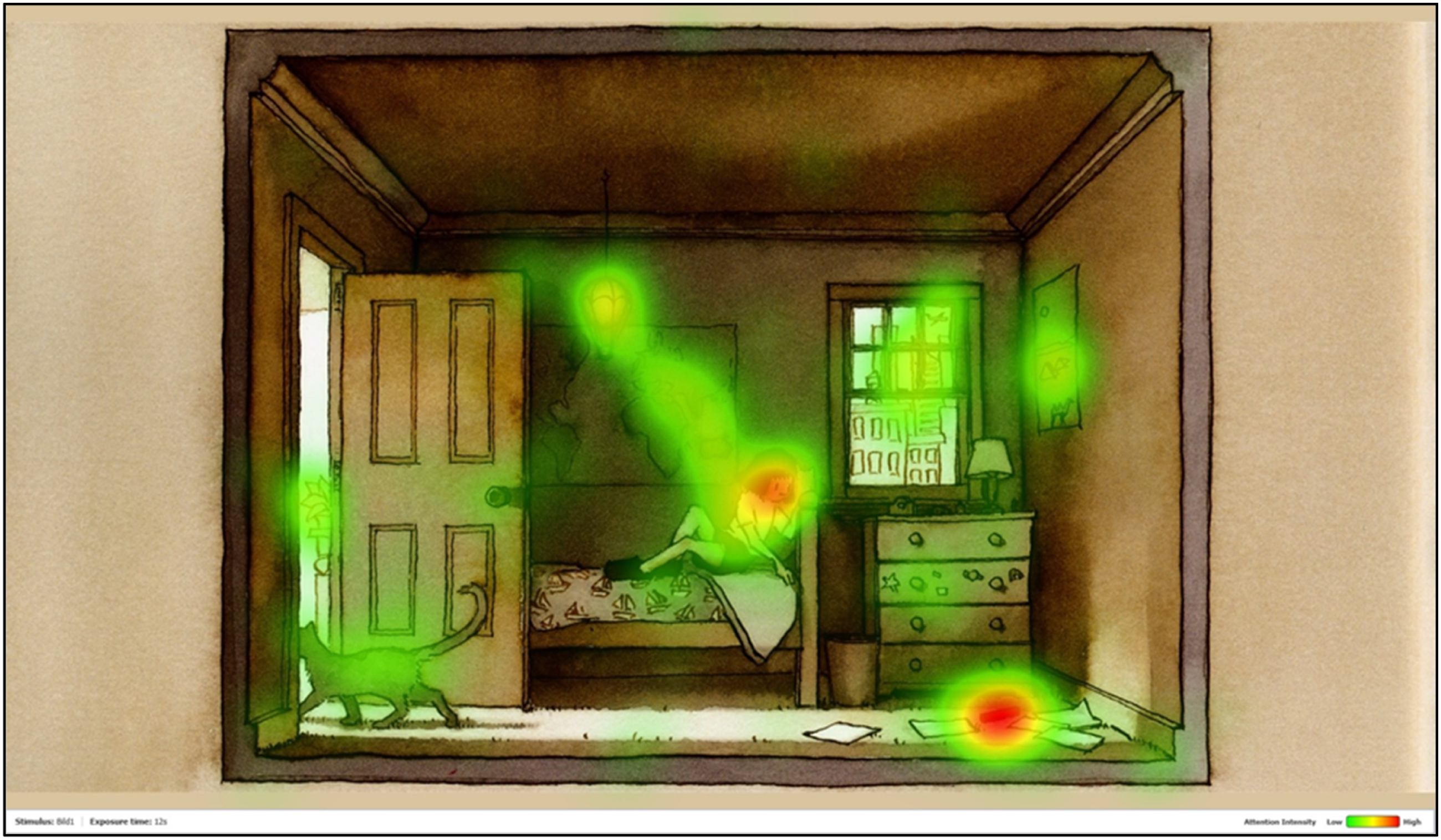
The following eye movement measures were extracted and analyzed as measures of attention allocation: • Fixation duration (”dwell time gaze,” i.e., the sum of all fixation durations within each AOI) • Fixation count (total number of fixations in a trial within each AOI) • TTFF (the amount of time a respondent took to look at a specific AOI from stimulus onset) • First fixation duration (duration of the first fixation of the AOI, which may be informative in combination with the TTFF sequence) • Revisit count (how many times a participant returned their gaze to a particular spot, as defined by an AOI)
All measurements were computed by the software “iMotions” (iMotions 9.3.8, 2023) and analyzed using RStudio (RStudio Team, 2020).
Procedure
To familiarize the children with the book, we started with a preparatory learning activity lasting 20 min in a group format. The groups were led by a student teacher for children with special needs. The student teacher showed important pictures from the book using a projector as well as the paper version. During the lesson, the student teacher commented on the pictures, talked about the storyline and behavior of the protagonist, answered the students’ questions concerning the content and meaning of the narration, and encouraged them to summarize the story. Children who relied on alternative means of communication participated in the activity using the devices they usually used in class, which contained the vocabulary needed to ask questions about the story. This preparatory learning activity was scheduled the day before the eye-tracking assessment began.
Data on verbal and symbolic comprehension tasks and eye-tracking assessments were collected individually in a quiet room at the participants’ school. The room was prepared with appropriate lighting and acoustics. For the eye-tracking assessment, the seat position of the participants was at the optimal tracking distance. Each child was tested in one session lasting approximately 10–15 min. For calibration, the child had to successively fixate on nine small dots appearing at the center top, bottom left, and bottom right of the screen. The standardized nine-point calibration was repeated up to three times if the calibration failed.
Initially, 35 children with intellectual disabilities were recruited for the study. Six children were excluded from the study as they were not able to complete the calibration because of their short attentional periods, difficulties in social cooperation, and reactions to verbal instructions. Among the remaining 29 children with mild and moderate intellectual disabilities, the calibration was judged as excellent (seven children with mild intellectual disability/none with moderate intellectual disability), good (six children with mild intellectual disability/four with moderate intellectual disability), and poor (seven children with mild intellectual disability/five with moderate intellectual disability). Among the subsample of children with neurotypical development, calibration was judged as excellent in ten cases and good in four cases.
Next, pictures were presented on the screen, each lasting 12 s. The student teacher was positioned next to the child and attempted to maintain the participants’ attention and motivation by asking them to look at the pictures shown on the screen. However, specific verbal instructions directing the child’s attention were avoided.
Statistical analysis
Descriptive statistics were computed for all the variables. To answer the first research question, we compared children with intellectual disabilities to those with neurotypical development using eye-tracking measures. A two-sample t-test was conducted to determine whether the means of the two groups were significantly different (p < .05). To answer the second research question, a Kruskal-Wallis-Test was used to examine differences in eye-tracking measures between children with neurotypical development, children with mild intellectual disabilities, and children with moderate intellectual disabilities to further analyze subgroup differences between children with mild and moderate intellectual disabilities (because the data was not normally distributed). To answer the third research question, Spearman’s rank correlation coefficients between each eye-tracking measure and verbal and symbolic comprehension test scores were computed to analyze the role of these competencies. As these tests were conducted only for children with intellectual disabilities, the correlation coefficients were calculated only in this subsample (n = 29). All statistical analyses were performed using RStudio (RStudio Team, 2020).
Results
Eye-movement of children with intellectual disabilities and those with neurotypical development
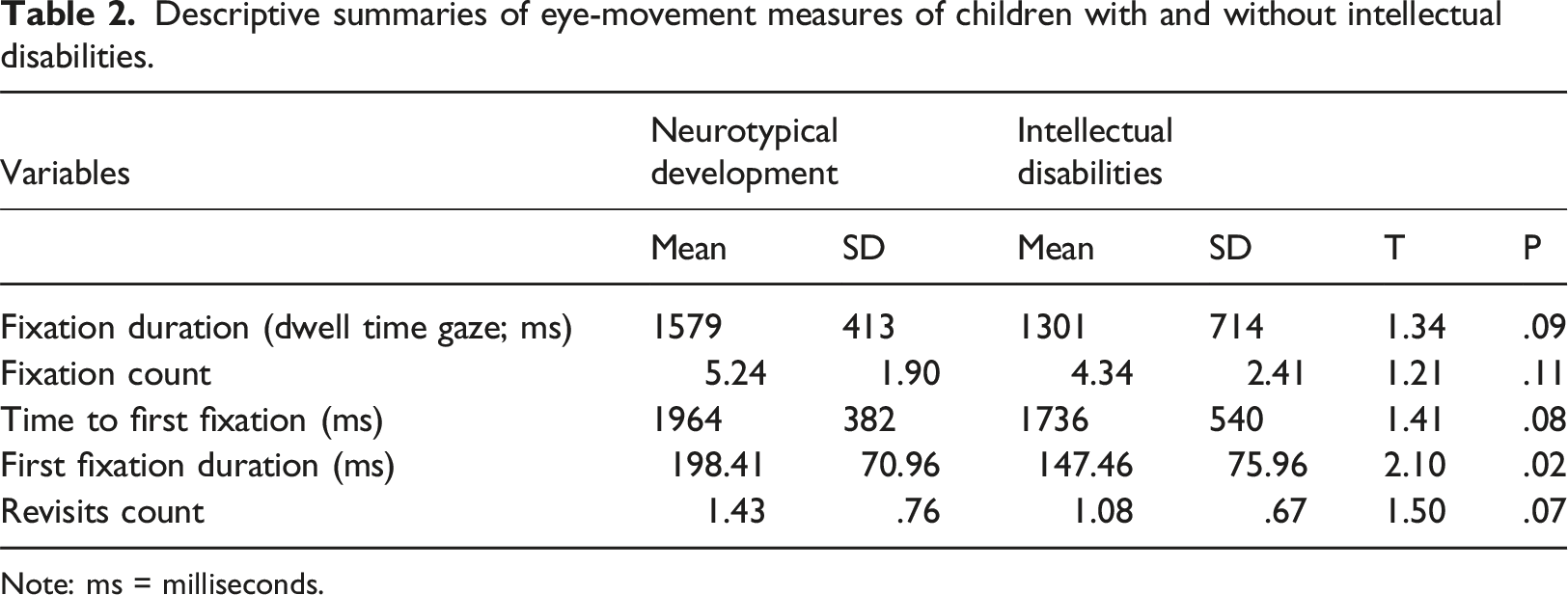
Descriptive summaries of eye-movement measures of children with and without intellectual disabilities.
Note: ms = milliseconds.
Eye-movements of children based on degree of intellectual disability
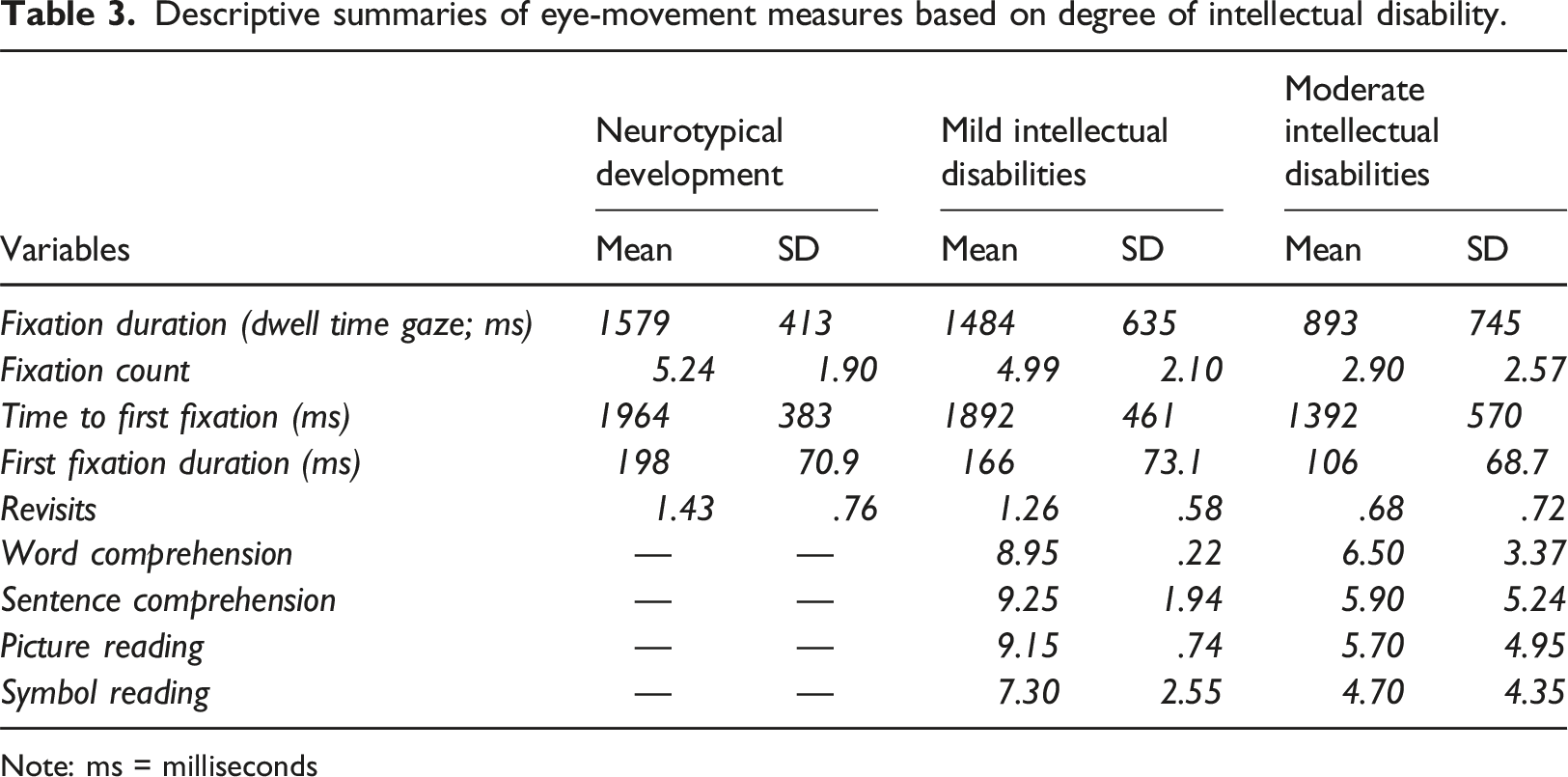
Descriptive summaries of eye-movement measures based on degree of intellectual disability.
Note: ms = milliseconds
Additionally, the mean scores and standard deviations for word comprehension, sentence comprehension, picture reading, and symbol reading were obtained for children with mild and moderate intellectual disabilities (see Table 3). Consistent with our hypothesis, the mean scores differed significantly between the two groups (Mann-Whitney-U-Test; U > 69.0; p < .01). Children with moderate intellectual disabilities obtained lower scores on almost all measures. Only the scores in the symbol reading subtest did not differ significantly (U = 75.0; p = .11).
Relationship between eye-movements and verbal or symbolic comprehension
Correlations among eye-movement measures and comprehension or reading scores.
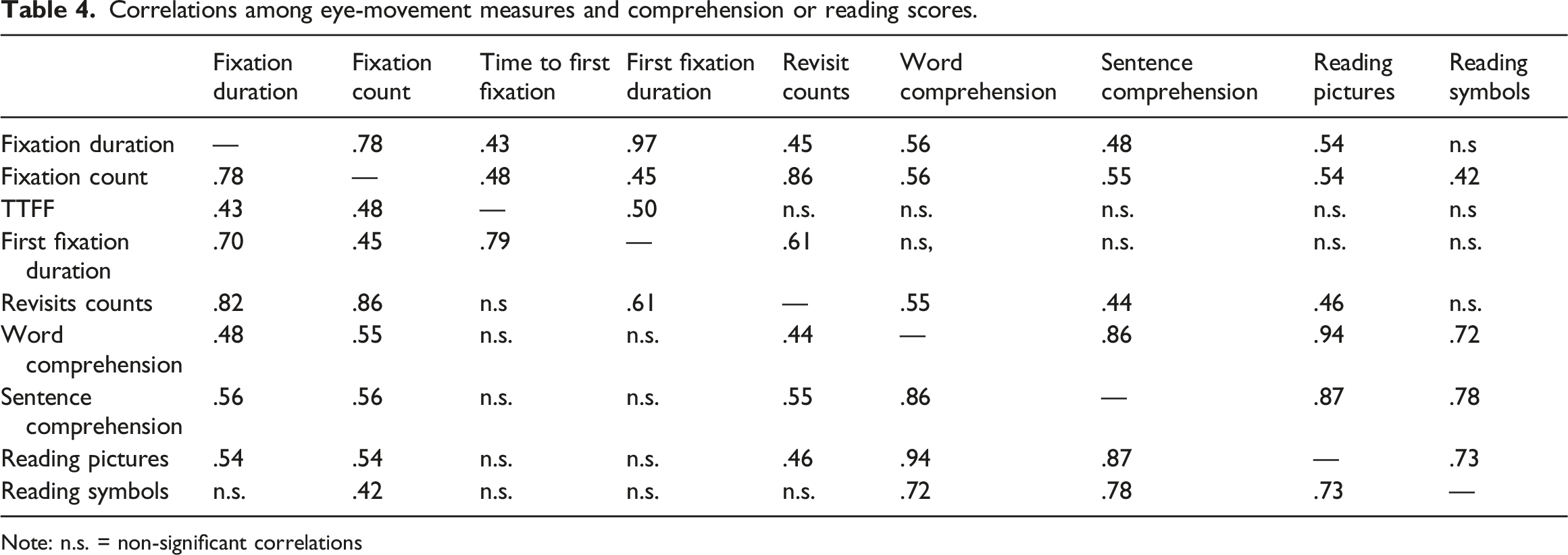
Note: n.s. = non-significant correlations
Discussion
This study provides insight into attentional processing during image reception in wordless picture books by children with intellectual disabilities. The eye movements of children with mild and moderate intellectual disabilities were compared with those of children with neurotypical development. More specifically, we examined fixation duration, fixation counts, and revisits on image areas that were valuable for understanding the presented story. We hypothesized that children with intellectual disabilities would have more difficulty focusing on visual elements and recognizing meaning from information presented in the form of an image, which is required for the reception of wordless picture books.
Children with intellectual disabilities differed from those with neurotypical development in eye movement measures, as hypothesized (H1). However, these differences were significant only for children with moderate intellectual disabilities (H2).
Fixation duration, fixation counts, and revisits of children with mild intellectual disabilities did not differ from those of children with neurotypical development of the same chronological age. In contrast, children with moderate intellectual disabilities showed different patterns. Their fixation duration was shorter, and they fixated on and revisited AOIs less often. Our results suggest that children with intellectual disabilities have more problems focusing their attention on AOIs with a high level of information, and expend less cognitive effort to understand their meaning. AOIs that were relevant for understanding the story attracted less visual attention from children with moderate intellectual disabilities compared to children with neurotypical development. The eye movements of children with mild intellectual disabilities did not differ from those of children with neurotypical development while processing a wordless picture book.
Furthermore, we found significant differences in the TTFF and duration of first fixation between children with moderate intellectual disabilities and those with neurotypical development. Children with moderate intellectual disabilities spent less time exploring a picture until they focused on the AOI and the duration of the first fixation was shorter. Perhaps a lower level of reasoning ability prevented children with moderate intellectual disabilities from focusing their attention on meaningful areas of the picture.
The difference between students with mild and moderate intellectual disabilities in attentional processing during image reception might be attributed to the degree of impairment in cognitive functions. Students with moderate intellectual disabilities likely experience more pronounced difficulties in focusing and sustaining attention on areas of interest (AOIs) due to more severe limitations in cognitive processing and reasoning ability, which are critical for decoding and understanding visual information (Sermieret al. 2019). Conversely, students with mild intellectual disabilities, whose cognitive impairments are less severe, may have eye movement patterns similar to those of neurotypical peers, indicating a closer ability to focus on and derive meaning from visual elements in wordless picture books.
Our findings address a research gap: according to a literature search conducted by the authors, no study to date has systematically compared the reception of picture books by children with intellectual disabilities and children with neurotypical development using eye-tracking. Eye-tracking measures indicate how children allocate their attention to areas of a picture that are important (Conkin et al., 2018; Key et al., 2020). Burris & Brown (2014) point to a lack of studies examining comprehension processes in atypical populations, e.g. children with cognitive constraints. As these cognitive processes in narrative comprehension can hardly be queried via think-aloud processes or probe questions in children with moderate intellectual disabilities, the measurement of eye movements provides a potential alternative. Selective visual attention and executive functioning are extensively analyzed in relation to children with intellectual disabilities in general (e.g. Iarocci et al., 2012) or children with specific syndromes, e.g., Down syndrome (Kaplan-Kahn et al., 2022). These results suggest that the selective attention mechanisms of children with intellectual disabilities are similar to those of children with typical development of the same developmental level. Consistent with the developmental trajectories of attention in children with typical development, it is to be expected that children with moderate intellectual disabilities have more problems with selective visual attention than children with mild intellectual disabilities of the same age (Kirk et al., 2017). Spaniol & Danielsson (2022) concluded a meta-analysis of the executive function components inhibition, shifting, and attention in intellectual disabilities with the statement, that they would expect differences between children with mild, moderate, and severe intellectual disabilities although their analysis presented no clear evidence for mental age or degree of intellectual disability as moderator variables. They attributed this finding to inconsistent reporting of these variables in the studies they reviewed.
Regarding the third research question (H3), the results showed that processing patterns were associated with the verbal comprehension of words, simple sentences, and verbal production of words naming pictures. Higher scores on verbal comprehension and naming tasks were correlated with longer fixation durations, more fixations, and more revisits among children with intellectual disabilities. This finding aligns with the observation that the selective attention of typically developing preschool children while looking at picture books (measured by eye-tracking) is associated with their receptive vocabulary (Evans and Saint-Aubin, 2013; Su et al., 2018). In contrast, symbolic comprehension did not significantly correlate with fixation duration or count. This finding can be explained by the differences between tasks. The verbal comprehension and naming tasks measure the ability to retrieve the verbal representation of an object presented in a picture from a mental lexicon, whereas the symbolic comprehension task is more complex. To find the correct answer in this task, the child must recognize the abstract symbol and infer its meaning if it is familiar with the symbol. Inferring the meaning of a symbol is a cognitive process that is not captured by eye-tracking measures. Our findings showed that children with a basic understanding of words and sentences could focus their visual attention on regions of images in a storybook that were of high interest for a longer period. They spent more time and had more fixations on the AOI, and investigated more cognitive effort in processing their meaning.
TTFF and duration of the first fixation were not associated with the measures of verbal or symbolic comprehension. As these eye-tracking measures reflect the exploration of visual images instead of deliberate visual attention to recognize meaning, it is reasonable to assume that they are not associated with comprehension skills.
To summarize the results briefly, impairments in selective attention (Iarroci et al., 2012) may contribute to problems with picture-book reception, at least in children with severe intellectual disabilities. This might explain why they benefit less from dialogic reading to extend their receptive and productive vocabulary than children with neurotypical development (Van Der Schuit et al., 2009).
In addition, processing difficulties may contribute to our understanding of word-decoding problems when children with intellectual disabilities are confronted with reading tasks. The cognitive skills required for reading acquisition include visual and visual-attentional abilities (Pezzino et al., 2019). It is important to note that the children with moderate intellectual disabilities who participated in our study had not reached the level of alphabetical or orthographical reading. In contrast, children with mild intellectual disabilities had reached this level of reading competence according to their teachers. We assume that problems in focusing visual attention and processing the meaning of visual elements may be related to problems in focusing on letters in a sequence that forms a written word in decoding tasks.
Limitations
Although our study provides evidence that selective visual attention and processing of the meaning of images in a wordless picture book present a challenge for children with moderate intellectual disabilities, it is important to acknowledge its limitations. This study is the first to examine the potential role of visual attention and processing allocated to images in wordless picture books among children with intellectual disabilities. The AOIs were defined based on meaningful areas of the picture. However, the procedure used in the present study did not allow us to examine whether the children identified the parts of the images that were informative for understanding the story within the short period when the images were presented on the screen. It is still unclear whether similar patterns of eye movements are observed when questions directing visual attention are posed (for example, “What is happening in this image?” or “What is the girl doing in this image?”), or when the time of each picture is extended. Another limitation in the interpretation of our results is that the preparatory lessons were not standardized. We cannot rule out the possibility that the student teachers’ comments on the pictures and talking about the storyline may have influenced the children’s attentional focus during the subsequent presentation of images on the screen to record their eye movements. While carefully considered, the choice of the book can be considered a limitation too. Using a book presenting a fantasy world instead of real-life events might represent an additional obstacle for the book reception of children with significant intellectual disabilities.
We must also acknowledge that calibration for eye-tracking measures was judged as poor among 12 participants with intellectual disabilities. This highlights the general problem of using eye-tracking measures in research on children with intellectual disabilities. Future research could test children more than once to ensure the reliability of the results.
Finally, the sample of children with moderate intellectual disabilities was small (n = 9), which may explain why some comparisons barely reached significance in the analysis. Moreover, the sample size may not be representative of the population, leading to biased estimates. Given that some of our findings are correlational, the mechanisms generating the observed correlations remain open to discussion. Future studies should also acknowledge potential confounding factors. In addition, the intelligence scores of this group were not measured using standardized tests. Future studies could obtain the IQ of each child participating in the study and collect data on hearing and motor impairments as well as psychosocial background. For a generalization of the results, data from a larger group of children with different degrees of intellectual disabilities should be collected and compared with the results of children with typical development and the same developmental age.
Despite these limitations, the results of the present study suggest that eye-tracking measures can provide an alternative to think-aloud protocols or probe questions, and can be a valuable tool to explore attentional and cognitive processes while exploring picture books in children with intellectual disabilities. These measures may also be useful for analyzing basic reading processes in this group of children.
Footnotes

Declaration of conflicting interests
The author(s) declared no potential conflicts of interest with respect to the research, authorship, and/or publication of this article.
Funding
The author(s) received no financial support for the research, authorship, and/or publication of this article.