



Abstract
This scoping review examines cyberbullying victimisation in people with mild to moderate intellectual disabilities, focusing on specific types of cyberbullying behaviours, such as flaming, harassment, and stalking. A five-stage review of empirical research was conducted using 15 electronic databases, covering publications from October 1969 to January 2024. Twelve studies were selected, reporting cyberbullying victimisation rates ranging from 5% to 64%. Harassment was the most common behaviour experienced. However, flaming, cyber-stalking, griefing, and shaming have not been thoroughly investigated. The impact and coping strategies, including support mechanisms, also lack research. Further investigation is needed to understand the various types of cyberbullying experienced by people with intellectual disabilities and to develop coping and resilience strategies. Recommendations for future research and practice are provided.
Background
Digital inequalities exist for people with intellectual disabilities, a situation that has worsened due to the COVID-19 pandemic (Chadwick et al., 2022). A recent report by Ofcom (2019) concluded that people with intellectual disabilities are less likely to have Internet access than people without an intellectual disability and around 18% of people with intellectual disabilities stated that their computer use was restricted or prohibited due to their condition. Similarly, Ågren et al. (2020) revealed that a digital lag exists, with significantly lower information and communication technology (ICT) use by adolescents with intellectual disabilities compared to those without intellectual disabilities. Glencross et al. (2021) further propose that digital inequality extends beyond limited access and use, to limited participation. For example, when a person with intellectual disabilities is only able to utilise ICTs for a restricted number of tasks, and in contexts where they are less prone to convert online activities to offline benefits such as educational attainments and social capital.
People with intellectual disabilities are therefore at an increased risk of restriction in their range and rate of Internet use and access in comparison to people without disabilities and those with other types of disabilities (Chadwick et al., 2017; Patrick et al., 2020). Therefore, it is important that—within the population of individuals with disabilities—further research is undertaken into the subpopulation of people with intellectual disabilities.
It is essential to address digital inequality given that it may lead to societal exclusion and exclusion from the potential benefits of ICT for individuals with intellectual disabilities. These benefits include the use of ICT in enabling and supporting social interactions, hobbies and other daily activities (Ramsten et al., 2020); as a tool for organising one’s life and for fostering social connectedness (Barlott et al., 2020); in the development of social identity and self-esteem (Caton and Chapman, 2016) and in facilitating enjoyment and the development of competence and self-worth (Chadwick and Fullwood, 2018).
Barriers to internet access and use prevent access to the aforementioned benefits. Considering both individual and environmental factors, five barriers have been identified: access to ICT devices, sensorimotor abilities for internet use, cognitive abilities for internet use, technical abilities necessary to ensure ICT devices stay operable (e.g., anti-virus software) and the requirement to know about internet social interaction rules and conventions (Lussier-Desrochers et al., 2017). Another conceptualisation takes a wider perspective and identified six barriers: financial and economic barriers; societal attitudes and exclusion; policy and governmental support; individual impairment-related difficulties in accessing the internet, and support, educational and training barriers (Chadwick et al., 2013). For those people with intellectual disabilities who are supported to use ICT, perceptions of online risk by those providing support can lead to more restrictive mediation strategies, including preventing access (Chiner et al., 2017; Gómez-Puerta and Chiner, 2021).
In order to promote dignity (Perske, 1974) by effectively weighing the benefits of the internet against the risks as part of a positive risk-taking approach to digital inclusion rather than a risk-aversion (restricted mediation) or risk management approach (Seale et al., 2013), we need to better understand online risks for people with intellectual disabilities.
In adopting a protection from harm stance, the EU Kids Online framework by Livingstone and Haddon (2009) incorporates a typology for classifying online risks in children and young people and has been frequently applied to people with intellectual disabilities. In this model, the researchers outline three categories of online risks: 1. Online content, in which the individual is the recipient of widely distributed content - including harmful sexual, violent or hateful content. 2. Online contact, in which the individual is a participant in an interactive situation- including being (cyber) bullied, harassed, stalked or groomed. 3. Online conduct, in which the individual is an actor in an interaction- for example, bullying or harassing another or engaging in illegal activities. The latest update of the framework includes online contract risks. This refers to the individual as the consumer and can transpire when the individual accepts Terms of Service/Conditions which can result in exploitative, security or privacy risks such as identity theft, fraud/scams and phishing (Livingstone and Stoilova, 2021).
Previous reviews of cyberbullying victimisation as a specific online contact risk tend to be larger in scope, with the conflation of disabilities/conditions (Alhaboby et al., 2019; Beckman et al., 2019; Eldridge et al., 2021), online and offline bullying (Martínez-Cao et al., 2021) and overall risks (Chadwick, 2019; Glencross et al., 2021). Such conflations may appear necessary where literature is scarce but may also serve to undermine better understanding. People with intellectual disabilities cannot be assumed to have the same experiences as those with other disabilities, and we cannot assume that offline bullying equates to cyberbullying. This is particularly true given the advent of both cyber-specific and cyber-facilitated types of bullying that do not translate to the offline environment, such as ‘happy slapping’- recording an assault on a person and then disseminating it online (Campbell, 2006), which cannot exist without the use of technology. In addition, ICT means the bullying follows you around and is less easy to escape than traditional bullying (Tokunaga, 2010).
The current review aims to focus on the empirical literature on cyberbullying victimisation and the precise types of cyberbullying behaviours experienced, highlighting those papers which consider the perspectives of people with intellectual disabilities themselves. This is necessary and warranted as cyberbullying victimisation is linked to negative impacts on wellbeing and is arguably one of the most pervasive and universally growing online contact risks (Juvonen and Gross, 2008; Kowalski et al., 2014). No review to date has examined specific online contact risks such as cyberbullying or the specific types of cyberbullying for people with intellectual disabilities.
Method
Study design
The scoping review method was chosen over the systematic review method based on the study aim of identifying knowledge gaps and examining the scope of the literature in relation to the broad research topic - cyberbullying victimisation for people with intellectual disabilities - rather than asking a more precise research question (e.g., regarding the effectiveness, feasibility or appropriateness of a practice or treatment), as is typical of systematic reviews (Munn et al., 2018).
Approach
The current review followed the Preferred Reporting Items for Systematic Reviews and Meta-Analyses extension for Scoping Reviews (PRISMA-ScR) Checklist (Tricco et al., 2018). Prior to starting the scoping review, the review was pre-registered on Open Science Framework in 2020, in line with this checklist (registration link: DOI 10.17605/OSF.IO/8JKRN). The scoping review employs a five-stage framework outlined by Arksey and O’Malley (2005), which serves as the basis for the subsequent headings.
Stage one: Identifying the research question
The research question employed to explore the literature is: “What is known about the experiences of cyberbullying victimisation and its subtypes as an online contact risk for people with intellectual disabilities? Following the PCC framework, this question, in line with the inclusion and exclusion criteria discussed below, addresses the following: Population (people with intellectual disabilities), Concept (experiences of cyberbullying victimisation and its subtypes) and Context (the direct perspectives of those with intellectual disabilities). For this review, cyberbullying is defined broadly as actions via ICTs to harm another individual (Bauman, 2014) and is denoted by the types of cyberbullying outlined in Willard's (2007) taxonomy. It includes the following behaviours: 1) flaming – involves rude, vulgar, or offensive language and even threats; 2) harassment – the recurrent sending of offensive messages to a single person (one-sided; flaming is two-sided); 3) denigration – communications about a person which are false, damaging or cruel, including gossip and rumours; 4) impersonation – pretending to be the person and posting content which reflects poorly on that person or negatively impacts their relationships; 5) outing and trickery – outing entails posting and sending private communications or pictures (which may include intimate or embarrassing information); trickery is part of outing and occurs when the person is tricked into believing that their communications or images will be private once sent, but they are subsequently shared or used as a threat; 6) exclusion – labelling those who are not connected to the in-group as an outcast and 7) cyberstalking – the continual sending of harmful messages which may include extortion and/or threats of physical aggression, intimidation or extreme offense. Cyberbullying victimisation is being a victim of cyberbullying. Intellectual disability refers to individuals who have a diagnosis of an intellectual disability, through self-identification, identification by salient others in their lives or through membership or use of services for people with intellectual disabilities.
Stage two: Identifying relevant studies
Studies were sourced through comprehensive literature searches of 15 electronic databases (APA PsychInfo, British Education Index, Business Source Complete, Child Development and Adolescent Studies, CINAHL Plus, Computer Source, eBook Collection (EBSCOhost), Education Abstracts (H.W. Wilson), Educational Administration Abstracts, Education Research Complete, ERIC, Humanities International Complete, Medline with Full Text, Psychology and Behavioral Sciences Collection and SocINDEX), all accessed through EBSCOhost or CINAHL Plus. Various combinations of ‘online contact risks’, ‘cyberbullying behaviours’, ‘online’ and ‘intellectual disabilities’ using the Boolean operator ‘and’ were used to identify all relevant literature. The final search encompassed papers published between October 1969, which is when the first host-to-host network connection was established (Encyclopædia Britannica, inc., 2020), and November 2021; the resulting paper references and abstracts were exported from the databases and duplicates were removed. Following the preliminary screening process, reference lists in key review papers and journals were manually searched to identify other relevant papers. In order to ensure the search remained up-to-date with the latest research, the search was re-run in February 2024 and encompassed papers published between December 2021-January 2024.
Stage three: Study selection
The inclusion and exclusion criteria were fixed prior to conducting the search to procure sources appropriate to the review’s aims and research question. The initial database search strategy, with English language studies and human studies being the only limitations applied to the results, resulted in 2,720 papers. Twenty-one additional papers were identified by screening the reference lists of the review papers found through the database search resulting in 2,741 papers. The secondary database search identified a further 990 papers, resulting in a total of 3731 papers, which were de-duplicated. Papers were initially screened based on titles and abstracts. If the relevance was not clear at the outset, the entire text was read to determine eligibility. Furthermore, if the relevance of a paper was still unclear after the full text had been read, the paper was discussed between the researcher and supervisory team until an agreement was reached using the inclusion or exclusion criteria. See Figure 1 for the study selection process guide. Study Selection flow diagram. *Two papers refer to one empirical study.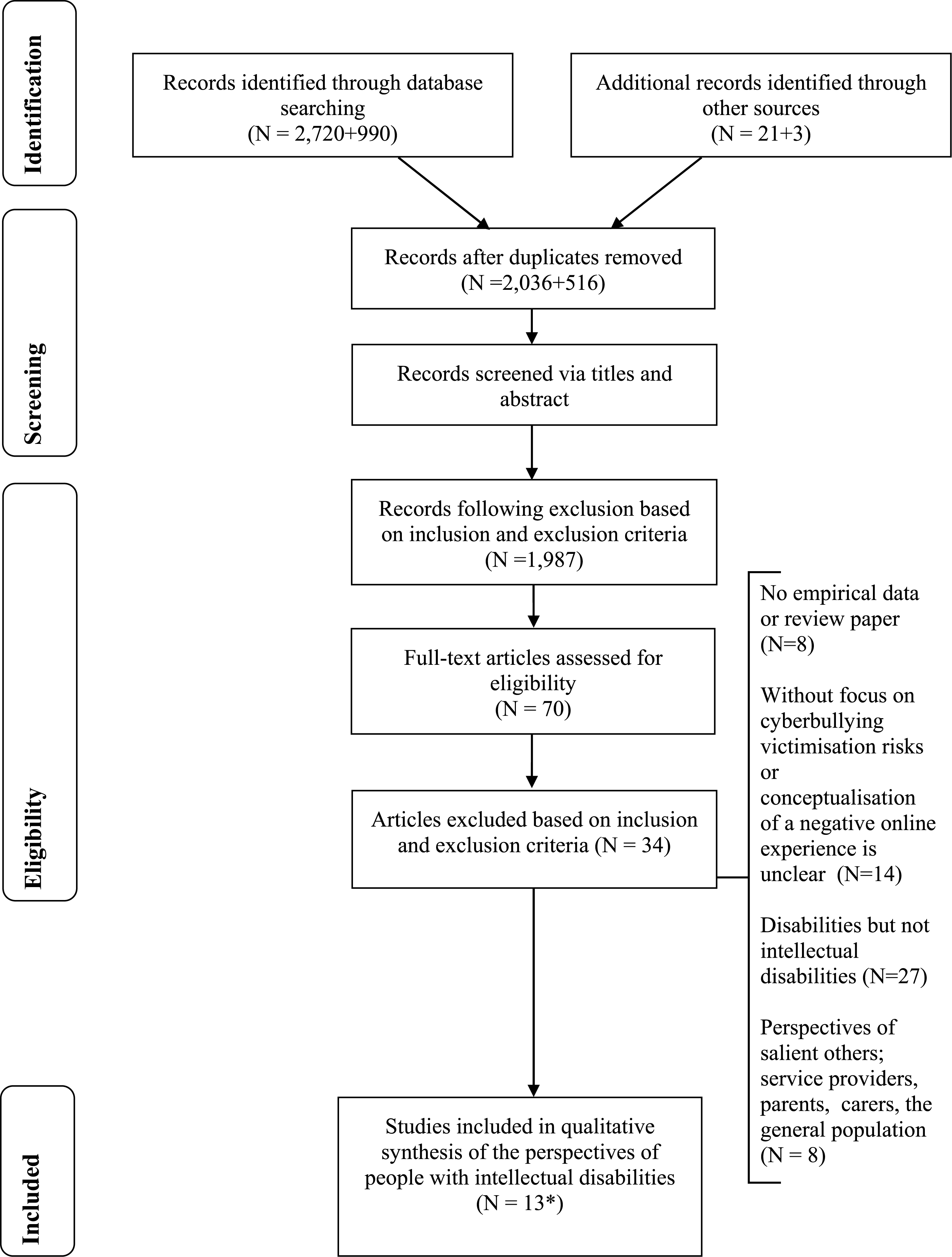
Stage four: Organising the data
To organise the data, summaries from each included study were tabulated (see Supplementary Material). Information was extracted from each study about the author(s), year of publication, study location(s), key sample characteristics, study design and data sources, key findings related to cyberbullying victimisation, study limitations, and study recommendations.
Stage five: Collating, summarising and reporting the results
Following data organisation, an iterative process was undertaken by the first author in which study summaries were read multiple times and coded according to the cyberbullying behaviours identified in the literature. The final codes were then reported in a descriptive narrative summary of the identified behaviours, highlighting the key findings and any knowledge gaps in the reviewed sources. The finalised study summaries and narrative summary form the results section of this paper.
Results
Study characteristics
Thirteen papers pertaining to twelve studies were selected for inclusion. The studies were published between 2009 and 2023, with the majority of studies published from 2017 onwards (N=10; 83%). Most studies were conducted in high-income countries including the United States (N=2; 17%), Spain (N=2; 17%), Canada (N=1; 8%), the United Kingdom (N=3; 25%), Sweden (N=2; 17%) and the Netherlands (N=1; 8%). A single study (N=1; 8%) was conducted across both the high-income countries of Spain and Chile and the lower-income country of Mexico.
Population characteristics
Just over half of the studies (N=7; 58%) specified the level of intellectual disability. In these studies, the most common level of intellectual disability was mild intellectual disability, which was noted in three studies, followed by mild to moderate intellectual disability in two studies and moderate intellectual disability in a single study. In one study, 73% of participants had mild to moderate intellectual disability and 27% had a moderate intellectual disability.
Half of the studies were carried out with adults with intellectual disabilities (aged 18–76 years; N=6; 50%). Some studies recruited samples that comprised a mix of children, adolescents and adults with intellectual disabilities. These samples were predominately labelled as ‘young people’ (aged 16–20 years) but were also referred to as ‘adolescents’ (aged 10–25 years). Another predominant label was ‘students’ (aged 13-21 years), but this also incorporated the designations of ‘youth’, ‘children’ and ‘adolescents’ (aged 12–19 years) (N=4; 33%). Only two studies were conducted solely with adolescents (aged 13–15 years; N=2; 17%).
Study design
All the studies included in this review were primarily descriptive, gathering data via quantitative self-report questionnaires (N=6; 50%), qualitative case studies (N=1; 8%), qualitative semi-structured interviews (N=3; 25%), a combination of semi-structured interviews and focus groups (N=1; 8%) or mixed methods, which comprised both quantitative self-report questionnaires and semi-structured interviews (N=1; 8%). The majority of the studies were cross-sectional (N=9; 75%), apart from two quantitative surveys which adopted a one-year longitudinal design (Wright, 2017; Wright and Wachs, 2020) and one qualitative case study based on observations from clinical practice (Holmes and O’Loughlin, 2014).
The literature search did not identify any experimental studies or randomised controlled trials suitable for inclusion in this study; hence, it appears that no intervention studies on cyberbullying victimisation for people with intellectual disabilities currently exist. One study on the negative Facebook experiences of adults with intellectual disabilities mentioned that these experiences ultimately resulted in a therapeutic group offering practical and emotional support, but this was not the primary focus of the study (Holmes and O’Loughlin, 2014).
Narrative synthesis of key findings
The narrative synthesis will outline the key findings in relation to the perspectives of people with intellectual disabilities themselves. Key findings linked to cyberbullying victimisation, including the perceived risk, frequency of victimisation (rounded to the nearest percentage) and specific types of victimisation, experiences of victimisation, the impacts of victimisation and the management and support for experiences of victimisation are delineated where appropriate.
Frequency of cyberbullying victimisation
With reference to overall cyberbullying victimisation prevalence, only three of the studies considering the perspectives of people with intellectual disabilities (25%) provided frequency rates for cyberbullying for people with intellectual disabilities. Reported rates varied widely, with estimates ranging from 5% to 64% for current experiences (Begara Iglesias et al., 2019; Didden et al., 2009 ) and 15% for past experiences of cyberbullying victimisation (Jenaro et al., 2018).
Frequency of harassment as a specific type of cyberbullying victimisation
The most common type of cyberbullying victimisation reported was harassment, which was evident in nine of the studies (75%). Frequency rates for general harassment ranged from 12% to 21% (Didden et al., 2009). Concerning subtypes of harassment, rates for being insulted ranged from 21% to 34%, while rates for being made fun of ranged from 12% to 29% (Begara Iglesias et al., 2019; Didden et al., 2009; Jenaro et al., 2018).
Experiences of harassment as a specific type of cyberbullying victimisation
One study on internet use found that harassment experiences of being insulted, mocked or made fun of or of receiving threats were common for the majority of participants (Normand and Sallafranque St-Louis, 2016; Sallafranque St-Louis and Normand, 2017); receiving threats also occurred in another study in the context of online gaming, alongside disrespectful text-based and picture-based messages, which were also described by students with intellectual disabilities (Borgström, 2021). Another study also found harassment in the form of messages to be a common experience for many of the adults with intellectual disabilities. This included name-calling, and aggressive, unpleasant or socially unacceptable messages; for example, one participant disclosed an experience of name-calling about his autism (Clements et al., 2023). Similarly, being harassed in the form of receiving unwanted messages or harmful messages with comments about their appearance and Facebook activities were part of several people’s experiences of using the platform (Holmes and O’Loughlin, 2014; Molin et al., 2017). Facebook was also the platform for harassment in which an adult with an intellectual disability described receiving a comment about being a parent’s child in the context of a school reunion; however, in this study, contrasting the other studies, experiences of harassment and cyberbullying more generally were not frequently disclosed (Chadwick, 2022).
Frequency of other types of cyberbullying victimisation
While other types of cyberbullying were investigated—including exclusion, denigration and impersonation—these behaviours were the least frequently reported across the studies. With regard to exclusion, frequency estimates ranged from 17% to 48% for experiences of online access being blocked, including access to social networks and chats (Chiner et al., 2017; Jenaro, Flores, Vega et al., 2018). However, estimates as low as 12%–18% were found for exclusion in the form of ignoring calls or ignoring someone via the internet (Didden et al., 2009). For denigration, estimates for the spreading of rumours and lies stood at 39% (Jenaro et al., 2018). One study also noted that 36% of participants had their password used by another person (Chiner et al., 2017); although such actions could potentially be malicious, the frequency of further such behaviours is unclear. Without an explicit mention of cyberstalking, one study found that 10% of participants had received threats of physical aggression towards themselves and their families, which could be defined as cyberstalking in line with Willard's (2007) definition (Jenaro, Flores, Vega et al., 2018).
Experiences of other types of cyberbullying victimisation
Concerning impersonation, a case study vignette described the experience of an adult with an intellectual disability who had a friend log in to their Facebook account and send inappropriate messages to their contacts. This was accompanied by experiences of outing and trickery, where the person disclosed that their personal and private information was posted on their Facebook profile by cyberbullies and was visible to all their contacts (Holmes and O’Loughlin, 2014). There was no explicit reference to flaming, but one study alluded to behaviour that could also be categorised as flaming in line with Willard (2007). In the study, a young person with an intellectual disability shared past experiences of posting on Facebook and how this would always lead to long debates and “quarrels” which would subsequently lead the individual to self-exclude from the internet and spend more time watching movies instead (Molin et al., 2017).
Psychological and physical impacts of cyberbullying victimisation
Only two studies considered the psychological and physical impacts of cyberbullying victimisation specifically. This includes the positive links between psychological variables (including depression and low self-esteem) and physical variables (including unhealthy behaviours) with experiences of cybervictimisation. For example, a significant moderate negative correlation was found between cybervictimisation via the internet and self-esteem, and a moderate positive correlation with depressive symptoms for adults with an intellectual disability (Didden et al., 2009). Furthermore, it has been found that adults with an intellectual disability who were cyberbullied historically were significantly more likely to score higher on Beck’s Depression Inventory than those who were not cyberbullied; additionally, adults with an intellectual disability who reported experiencing cyberbullying currently were significantly more likely to engage in more unhealthy behaviours, such as smoking and drinking, take more internet risks and score higher on the Beck’s Depression Inventory (Jenaro et al., 2018). Two qualitative studies examined the psychological impact of cyberbullying in the context of overall online risks with contrasting findings. One study found that the adults with intellectual disabilities did not tend to report many negative impacts, including emotional impacts, of cyberbullying and online risks (Chadwick, 2022); however, another study found that across the interviews the participants tended to experience negative emotions following cyberbullying, such as anger and upset, blaming the perpetrator rather than themselves for the risk experience (in contrast to those who experienced sexual based online risk experiences, such as image-based sexual abuse) (Clements et al., 2023). In both these studies the adults with intellectual disabilities also described positive impacts from the risk experience including learning, increased confidence, resilience and personal growth.
Management and support for cyberbullying victimisation
Only two of the studies examined the coping or management strategies used by people with intellectual disabilities to deal with instances of cyberbullying victimisation, such as accessing support, where both studies found that many students and adults with intellectual disabilities prefer to manage online risks such as cyberbullying independently and do not feel they need advice or assistance. Both studies highlighted the tension for people with intellectual disabilities regarding when support is needed and the risk of gatekeeping and control by supporters in response (Borgström, 2021; Chadwick, 2022). Though, there is a small amount of evidence concerning accessing social support as an effective coping strategy due to its protective effects when it comes to the negative impacts of cyberbullying victimisation. In the first of the two longitudinal studies included in the review, Wright (2017) found a small-moderate positive correlation between cybervictimisation at Timepoint 1 and depression at Timepoint 1 and Timepoint 2 (one year later) in adolescents with an intellectual disability, with small-moderate negative correlations between social support from parents, teachers and friends at Timepoint 1 and depression at Timepoint 1 and Timepoint 2. Moreover, the relationship between cybervictimisation at Timepoint 1 and depression at Timepoint 2 was weaker with greater levels of perceived social support from parents and teachers at Timepoint 1, which the authors take as evidence of a buffering effect by social support from parents and teachers. Similarly, the second longitudinal study by Wright and Wachs (2020) found that cyberbullying victimisation at Timepoint 1 was positively associated with Timepoint 2 subjective health issues, suicidal ideation and non-suicidal self-harm. However, greater amounts of parental social support weakened the association between Timepoint 1 cyberbullying victimisation and Timepoint 2 subjective health issues and suicidal ideation. Conversely, this association was stronger with lower amounts of parental social support, providing further evidence of its buffering impact.
Discussion
To address gaps in the literature, this review identified 13 papers pertaining to 12 studies from the existing literature, synthesised their results, and summarised what is known about cyberbullying victimisation and its subtypes in intellectual disabilities, focusing on the perspectives of people with intellectual disabilities.
For the frequency of overall cyberbullying victimisation for people with intellectual disabilities, only three (25%) of the studies from the perspectives of people with intellectual disabilities reported rates for current experiences (5%–64%) and past experiences (15%). Comparing these findings to the frequency for people with other disabilities and chronic conditions (2%–42%) (Alhaboby et al., 2019) and the general population without disabilities (10%–40%) (Kowalski et al., 2014; O’Brennan et al., 2009; Pontzer, 2010),
As the research into online risks and intellectual disabilities is still in its infancy and is based mainly on cross-sectional instead of controlled experimental or longitudinal designs, firm conclusions cannot be drawn at this time (Chadwick, 2019). Nonetheless, we can tentatively report that
While other types of cyberbullying were also examined, including exclusion, denigration and impersonation, these types were less frequent and were reported in only 33% of the studies considering the perspectives of people with intellectual disabilities. Although most studies on the frequency of cyberbullying victimisation have tended to examine victimisation as an amalgamated concept, there is some evidence to suggest that harassment is also the most common form of cyberbullying for the general population without disabilities (Popovic-Citic et al., 2011). Further studies are needed to verify the findings reported here and to expand the types of cyberbullying behaviours examined in those without disabilities beyond harassment, outing and denigration. This review can tentatively conclude that harassment is the most commonly reported type of cyberbullying victimisation experienced by people with intellectual disabilities.
The psychological and physical impact of cyberbullying victimisation for people with intellectual disabilities has been minimally investigated to date. In the small number (17%) of quantitative studies addressing the perspectives of people with intellectual disabilities that investigated this,
In terms of management and support for people with intellectual disabilities and cyberbullying victimisation, unfortunately
Nonetheless, the current review outlined two studies alluding to
There are limitations within the current review. The studies did not comprehensively cover all types of cyberbullying behaviour and each study required a different severity of behaviour to meet the criteria for the presence of the specified type of cyberbullying, making interpretation and comparison between studies challenging, and highlighting the necessity for a consensus over the definition and operationalisation of cyberbullying in the literature.
The results also reflect the accuracy of the search strategy. Additional studies relevant to the scope of this review may have been missed if they were published in other databases or languages other than English; this could account for the relatively small number of studies included in this review. This review also predominantly focused on peer-reviewed journals; therefore, other grey literature (e.g., newspapers, service reports, etc.) have not been included.
This study used Livingstone and Haddon's (2009) conceptual model of online contact risks and focused specifically on the risk of cyberbullying victimisation as informed by Willard's (2007) taxonomy as the most widely cited taxonomy to date of cyberbullying behaviours. However, this is only one conceptualisation; other cyberbullying typologies exist that were not considered in this study, such as Rivers and Noret's (2010) 11 types of text/email messaging cyberbullying content and Huang and Chou's (2010) categorisation of the roles of victims, bystanders and aggressors.
Going forward, this review has shown that there are few interventions to prevent cyberbullying victimisation for people with intellectual disabilities. For instance, interventions could focus on ways to support and enable individuals when experiencing harassment, which is experienced at a considerable rate. Given the reduced digital participation and Internet use by this population and risks of online victimisation found in this review, this raises concerns surrounding increased victimisation rates as digital inclusion improves for this population. Specifically, digital victimisation of people with intellectual disabilities might also increase as use rates increase. Hence, future research and practice should consider how best to support people with intellectual disabilities to manage and navigate these cyberbullying risks as use increases. Therefore, two recommendations are for an intervention that aims at societal change to reduce harassment, and one for individual training to support people with intellectual disabilities to better handle and manage (the use of coping strategies for) harassment and its subtypes, e.g., receiving online communications in which the person is insulted or made fun of. Indeed, such an intervention would be consistent with a personal ‘bottom-up’ approach rather than a societal ‘top-down’ perspective, which holds people with intellectual disabilities to a different standard than people without intellectual disabilities (Seale and Chadwick, 2017). In addition, training for family and paid carers in supporting people with intellectual disabilities who are cyberbullied could be beneficial given the buffering effect of social support indicated. Carers increased focus on protection instigated both by wanting to protect the wellbeing of a loved one or due to feelings of organisational or institutional responsibilities has been highlighted in recent literature (Chadwick and Buell, 2023). This case study also highlighted the importance of power in interactions around technology use.
The search terms for this scoping review included individuals with severe to profound intellectual disabilities but no papers were found, highlighting the differential power imbalance within intellectual disabilities research participation. Thus, this review has only captured the perspectives of individuals with mild to moderate intellectual disabilities. This finding is not unexpected given that previous reviews have concluded that individuals with severe to profound intellectual disabilities tend to be excluded from research due to the level of cognitive impairment and additional communication needs of this subpopulation, which means that accessing their thoughts, and feelings directly is not possible (Jones et al., 2020). Yet, it is important that we understand the perspectives of all persons with intellectual disabilities including this subpopulation who are arguably the most marginalised. Thus, this review has identified examining the digital experiences of people with profound intellectual disabilities as an important area for future research. This could involve inclusive practices that value the unique communication strategies of this subpopulation, such as a sensory-dialogical approach based on sensory ethnography, which has shown promise for this sub-group (Gjermestad et al., 2023).
This review also searched for studies on specific cyberbullying behaviours, including flaming, and none were found, despite being established for the general population without disabilities (Moor et al., 2010). This review has also searched for studies on newer cyberbullying behaviours among people with intellectual disabilities but, again, none were found; as such, this review highlights the current absence of such research. Newer behaviours, such as griefing (Chesney et al., 2009; Coyne et al., 2009) and shaming (De Vries, 2015), have been identified and studied with the general population without disabilities. Therefore, these behaviours need to be investigated to determine how commonly they are experienced by people with intellectual disabilities, how they are managed and the nature of their impacts on well-being.
In general, apart from the study by Clements et al. (2023) which identified name-calling, aggressive and unpleasant messages, the studies identified in this review did not tend to address or focus on the details of specific behaviours such as harassment. This may be because many of the studies used a cross-sectional questionnaire/survey design, which offers a limited number of responses to participants. Indeed, such designs may provide only a superficial overview of the topic. Instead, further qualitative, longitudinal and ethnographic studies can be undertaken to chart cyberbullying victimisation over time and explore the nuances of these experiences such as the details of cyberbullying subtypes.
Research should endeavour to investigate any associations between cyberbullying victimisation for people with intellectual disabilities and other psychological variables not yet investigated but established for the general population without disabilities, including anxiety, suicidality and loneliness. Longitudinal, intervention and experimental studies in this area would allow for the determination of causation in understanding the psychological impact of cyberbullying victimisation. Research also needs to address the significant gaps in the areas of coping strategies and support for people with intellectual disabilities in relation to cyberbullying victimisation and online risks more generally.
Conclusions
This review has offered an insight into cyberbullying victimisation for people with intellectual disabilities focusing on their perspectives. The review identified frequency rates of cyberbullying victimisation have ranged from 5% to 64%, and harassment has been found to be the most reported type of cyberbullying victimisation behaviour experienced by people with intellectual disabilities. This included receiving insults, being mocked, being made fun of, name-calling, and receiving unpleasant and aggressive messages, including receiving threats e.g., of physical harm. It is clear from this evidence that interventions at both the societal and individual levels are warranted. Further research also needs to be conducted in this area and, specifically, in relation to types of cyberbullying victimisation behaviours experienced, into newer types of cyberbullying victimisation, and into the psychological impact and coping strategies for experiences of cyberbullying victimisation.
Supplemental Material
Supplemental Material - A scoping review investigating the perspectives of people with mild to moderate intellectual disabilities on experiences of cyberbullying victimisation and its subtypes
Supplemental Material for A scoping review investigating the perspectives of people with mild to moderate intellectual disabilities on experiences of cyberbullying victimisation and its subtypes for Fiona A Clements, Darren D Chadwick and Lisa J Orchard in Journal of Intellectual Disabilities
Footnotes
Declaration of conflicting interests
The author(s) declared no potential conflicts of interest with respect to the research, authorship, and/or publication of this article.
Funding
The author(s) received no financial support for the research, authorship, and/or publication of this article.
Ethical statement

Supplemental Material
Supplemental material for this article is available online.
References
Supplementary Material
Please find the following supplemental material available below.
For Open Access articles published under a Creative Commons License, all supplemental material carries the same license as the article it is associated with.
For non-Open Access articles published, all supplemental material carries a non-exclusive license, and permission requests for re-use of supplemental material or any part of supplemental material shall be sent directly to the copyright owner as specified in the copyright notice associated with the article.
