




Abstract
In people with intellectual disabilities research and policy are often still focused on risks or the prevention of risks. Research on the process of resilience is in its infancy in the care for people with intellectual disabilities. In the current study, applying a guided photovoice procedure, people with intellectual disabilities were asked what helped them to deal with adverse events. Additionally, informants from their social network were asked to reflect on this question. The following sources of resilience were identified: acceptance, autonomy, beautiful memories, perseverance, physical wellbeing, positive emotions, social skills, spirituality, activities, a home and the social network. Our findings provide practical guidelines for clinicians to talk about resilience with people with intellectual disabilities. Suggestions for future research are made that will contribute to the process of resilience and inclusion of people with intellectual disabilities.
Since the 1960s, resilience has been widely studied in diverse and vulnerable populations (Masten et al., 2004). Nevertheless, Scheffers et al. (2020; 2022) showed that very little research has been conducted among people with intellectual disabilities despite their elevated risk for adversities throughout life (Goad, 2021; Mevissen & de Jongh, 2010; Wigham & Emerson, 2015). Research has shown that the prevalence of adverse life events is higher for people with intellectual disabilities compared to those in the general population (Hulbert-Williams & Hastings, 2008; Wigham et al., 2014). It is estimated that children with intellectual disabilities are at a 3-7 times higher risk of experiencing an adverse event compared to children without disabilities (Mehari et al., 2020; Vervoort-Schel et al., 2021). Furthermore, these adverse life events seem to have a greater impact on people with intellectual disabilities leading to a higher prevalence of psychiatric, emotional and behavioural problems (Hulbert- Williams et al., 2014). To date, practitioners and policy makers have mainly focused on intellectual disabilities identifying vulnerabilities and risks instead of resiliency factors, and primarily with the objective to refer people with intellectual disabilities the right type of care. (Clark, & Adams, 2021; Scheffers et al., 2020; 2022). As research has offered a large body of evidence concerning risk factors, the next step is to focus on sources of resilience among people with intellectual disabilities.
In the past decades, researchers explained resilience as a trait (Fisher et al., 2019). Today, research has established that resilience is a systemic process in which internal and external factors interact (Masten & Wright, 2010; Ungar & Theron, 2020). Windle (2011) presented a review of various definitions of resilience and concluded that resilience is the process of effectively negotiating, adapting to, or managing significant sources of stress and trauma. Lepore and Revenson (2006) identified three stages in effectively dealing with adverse events: recovery, resistance and reconfiguration. A first stage focuses on recovery, to resume to day to day life after experiencing an adverse event. Resistance is the second stage of resilience, in which a person is able to maintain normal functioning despite the occurrence of an adverse event. The reconfiguration stage is the final stage, in this stage a person is able to adapt to the disruption in such a way that they are better able to deal with future adverse events. A better understanding of the process of resilience in people with intellectual disabilities will help professional caretakers to effectively support clients with intellectual disabilities.
In an attempt to learn more about factors that are deemed important to promote resilience for people with intellectual disabilities, Scheffers et al. (2020; 2022) conducted two systematic literature reviews. Based on these reviews an overview on the available literature on resilience in people with intellectual disabilities was constructed (See Supplement Appendix A). In the first review sources of resilience were identified from the perspective of people with intellectual disabilities themselves: autonomy, self- acceptance, physical health, social network and daily activities (Scheffers et al., 2020). In the second review the focus was on the perspectives of the social network of people with intellectual disabilities. Similar and different sources of resilience were identified namely: positive emotions, network acceptance, sense of coherence and network support (Scheffers et al., 2022). A limitation of both reviews was that the sources that were found were primarily based on case reports, limiting the generalizability of the results (Scheffers et al., 2020; 2022). The group of people with intellectual disabilities is heterogeneous in both abilities and limitations, whilst the studies included in the review focused uniquely on people living in residential settings with professional support (Sajewicz-Radtke et al., 2022). However, many people with intellectual disabilities live independently and receive outpatient care on a more or less structural basis (Maulik et al., 2011). Furthermore, the perspectives of the people with intellectual disabilities themselves were generally not well taken into account.
Nowadays, the notion ‘nothing about us without us’ is increasingly applied through the inclusion and active participation of people with intellectual disabilities in research (Bradley et al., 2015; Jones et al., 2020; Sarju, 2021). Kooijmans et al. (2022) showed in their systematic review that while many researchers make suggestions on how to include people with intellectual disabilities in research there is still little scientific evidence to support these suggestions. Currently, no specific guidelines are available to adequately include people with intellectual disabilities in research. However this does not mean that the given advice and suggestions are not effective at all. Jen-Yi et al. (2015) have shown that research on people with intellectual disabilities should be flexible to adapt to the specific needs of individuals with intellectual disabilities. When conducting research in people with intellectual disabilities the researchers should continuously reflect on this procedure and be able to make adaptations without compromising the quality of the scientific procedure. The overview of suggestions provided by Kooijmans et al. (2022) can be used to critically reflect on the actual research procedures and construct a more inclusive research method. One suggestion that can help to gain a better insight into the lives of people with intellectual disabilities is to include both people with intellectual disabilities and informants from their social network (Kooijmans et al., 2022; Lunsky & Bramston, 2006; Mileviciute, & Hartley, 2015; Perkins, 2007; Simoes, & Santos, 2016).
Today inclusive methods are available to involve people with intellectual disabilities in research (Beail & Williams, 2014; Frankena et al., 2015; Frankena et al., 2019; Hall, 2013; Hollomotz, 2018; Sigstad & Garrels, 2018). Through alternative ways of communication people with intellectual disabilities can feel more empowered to share their stories. Guided photovoice is an example of an inclusive research method for people with communicational challenges such as people with intellectual disabilities (Overmars-Marx et al., 2018). In a guided photovoice procedure a researcher is present to assist the participant whenever needed to take photos of a specific subject. Guided photovoice is not yet commonly used in research in people with intellectual disabilities. However this research method has the potential to not only include people with intellectual disabilities in scientific research but also give them more autonomy and control (Overmars-Marx et al., 2018, Scheffers et al., 2023). In guided photovoice the participant can determine the subject to be discussed by pointing the camera at a specific subject, thus taking control over the interview. This procedure is highly adaptive which corresponds with the diverse needs of people with intellectual disabilities (Overmars-Marx et al., 2018; Povee et al., 2014).
The current study aims to add to the body of knowledge of resilience in people with intellectual disabilities. A better insight into the process of resilience in people with intellectual disabilities can help to construct more efficient and effective interventions to better support people with intellectual disabilities and their social network. On a societal level insight into the process of resilience is needed to create more inclusive policies. Both people with intellectual disabilities and informants from the social network were included as participants in the research. The main question of the present study was: ‘What sources of resilience help people with intellectual disabilities to deal with adverse events according to people with intellectual disabilities and their social network’.
Method
Participants
Twelve people with intellectual disabilities were recruited through organizations specialized in the care for people with intellectual disabilities in the Netherlands. In the Netherlands there are different types of organizations that provide care to people with intellectual disabilities. In the current study, both organizations specialized in independent client support and ambulatory support as well as residential care setting were approached. The final sample size was based on data saturation. Data saturation was achieved after 10 interviews with participants and informants. Two extra interviews were conducted to double check data saturation. This is in line with Guest et al. (2020) who showed that data saturation occurs within the first twelve interviews. The researcher met all potential participants for a short meeting. The goal of this meeting was to get know the participant and to explain the purpose of the research project. The information was provided verbally and visually using a leaflet that the potential participant could read again afterwards. In the leaflet the steps of the guided photovoice procedure were explained. Also informed consent, voluntary participation and the right to ask for the deletion of information were explained. Participants shared their information voluntarily on the basis of informed consent (and / or with the consent of their custodian). Next the respondent chose a person from their social network to be invited separately as an informant in the research resulting in 24 people participating individually in the current research, 12 adults with intellectual disabilities and 12 informants from their social network.
Inclusion criteria for the current study was the presence of an assessment of intellectual disabilities according to the criteria of the DSM 5. In the Netherlands people with borderline intellectual functioning (total IQ scores 71 to 85) can under certain conditions receive help from services designed for people with intellectual disabilities. This is not common practice in many other countries although more and more research supports the notion that people with mild intellectual disabilities (MID) and borderline intellectual functioning (BIF) experience similar problems (Alloway, 2010; Greenspan, 2017). To be sure only participants with MID or BIF were included DSM-5 guidelines were followed by assessing the severity of the intellectual disabilities of each participant based on the level of cognitive and adaptive functioning. Exclusion criteria were people with intellectual disabilities that were not yet 18 years old. When reviewing the case file of the participants, sufficient information needed to be present to assess the level of adaptive and cognitive functioning (see measures). The researchers aimed at including a diverse sample from the population of people with intellectual disabilities. Therefore, no exclusion criteria were adopted regarding the living situation and the verbal abilities of the participants.
Procedure
The guided photovoice procedure was conducted by the first author and a research assistant, both female, who were trained in communication with people with intellectual disabilities. The research proposal was approved by the Ethics Review Board of the University of Amsterdam. A detailed description of the guided photovoice procedure can be found in Supplement Appendix B. The guided photovoice procedure was administered between September 2020 and July 2021. During the guided photovoice procedure safety measures were taken regarding COVID-19. Measures that were taken were: health checks before the appointments, social distancing, regular cleaning of materials and the use of hand sanitizer. All interviews were audio-taped and the duration of the conversations ranged from 28 minutes to 2 hours and 40 minutes. Using guided photovoice, the participant went out with a researcher to take photos on the theme: 'What helps you in difficult times?'. Photos were taken under the supervision of the researcher who could assist in taking the photos and could answer any questions. The methodology has four different phases: joint preparation, taking digital photos together, the semi-structured interview based on the photos taken and the post-interview.
Measures
Adaptive and cognitive functioning
Information about the level of adaptive and cognitive functioning was based on case-file documentation of every participant. The level of cognitive functioning of the participants with intellectual disabilities was assessed using the Dutch versions of either the WISC-III-NL, the WAIS-IV-NL or the SON-R 6-40 test of intelligence, which all have been proven valid and reliable in various studies on cognitive functioning (Bouman et al., 2015; Pearson assessment & information BV, 2012; Tellegen & Laros, 2011; Wechsler, 2012).
Analyses
Statistical analyses were performed in SPSS statistics version 26. Descriptive statistical analysis were conducted on the data concerning demographics. After transcribing all 24 interviews (12 with respondents with intellectual disabilities and 12 with informants), a thematical analysis on every transcript was conducted using Atlas.ti version 8. Only the words that were used by participants were analysed and not the physical photos to avoid possible misinterpretations. Based on the results of the systematic literature reviews, a first concept of the coding scheme was created (Supplement Appendix A). This coding scheme was used by the first author and a research assistant to independently analyse the first four interviews of the respondents and their informants. Results were analysed and discussed in the research team. Based on these analyses new themes were added to or merged into the initial coding scheme. Data saturation was achieved after 10 interviews with both participants and informants. Throughout the entire process both researchers discussed and verified thematic concepts until agreement was reached. After coding and recoding all data, the inter-rater reliability was calculated using Krippendorff’s Alpha and was found to be almost perfect at 0.98 (Sim & Wright, 2005). The interrater reliability for themes related to adverse events was 0.91. Reaching inter-rater reliability regarding internal sources of resilience appeared to be more difficult initially, probably since the specific wording of internal sources is more prone to subjectivity. The initial interrater reliability for internal sources of resilience was 0.65, which was considered insufficient. After discussing the nature of internal sources between assessors independent coding was repeated, resulting in a Krippendorff’s Alpha 0.88, which can be considered sufficient. The COREQ (Consolidated criteria for Reporting Qualitative research) checklist by Tong et al. (2007) was used to report all essential information of the study (Supplement Appendix C).
Results
. Overview of descriptive characteristics of participant.
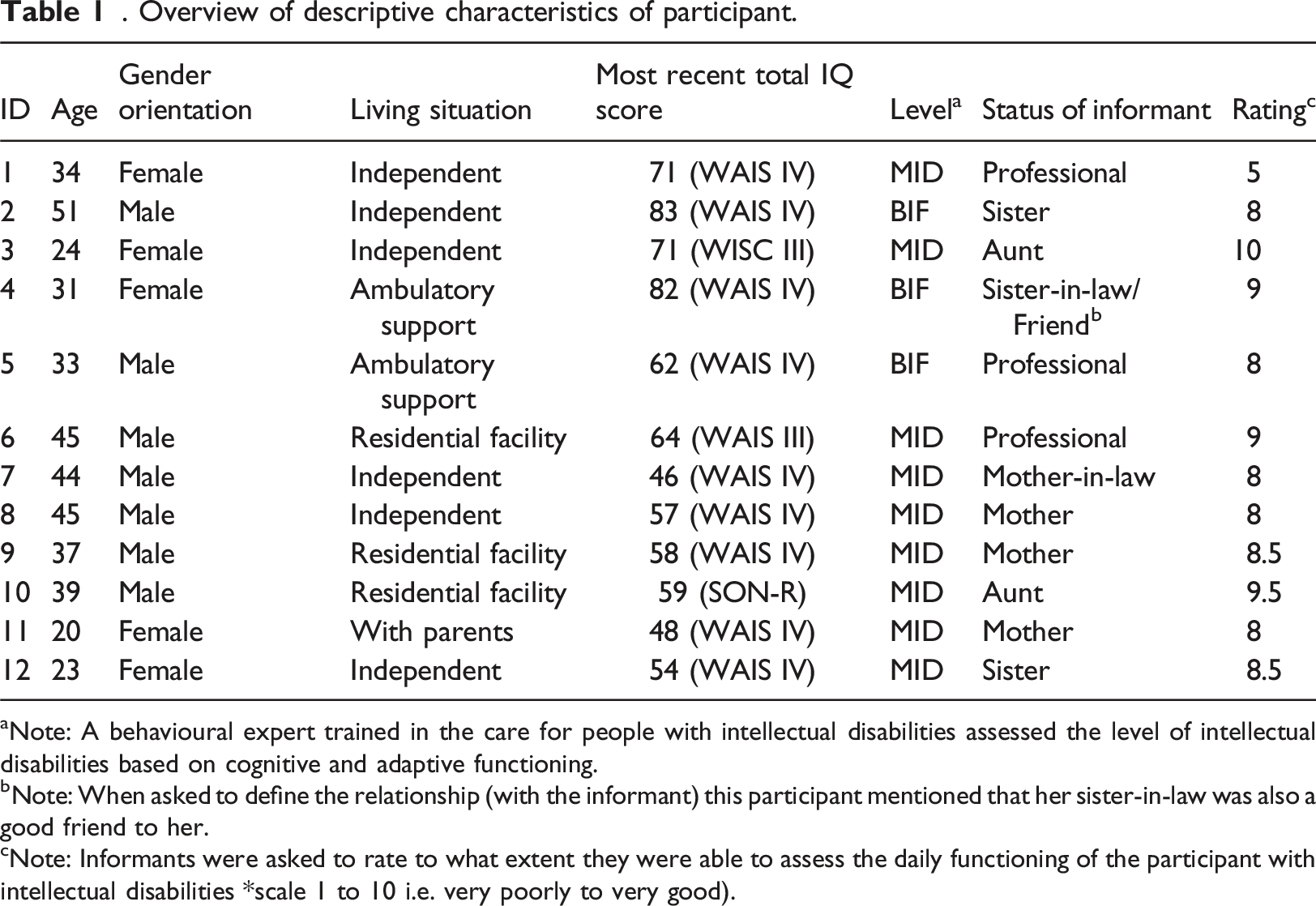
aNote: A behavioural expert trained in the care for people with intellectual disabilities assessed the level of intellectual disabilities based on cognitive and adaptive functioning.
bNote: When asked to define the relationship (with the informant) this participant mentioned that her sister-in-law was also a good friend to her.
cNote: Informants were asked to rate to what extent they were able to assess the daily functioning of the participant with intellectual disabilities *scale 1 to 10 i.e. very poorly to very good).
To start, participants were asked about the adverse events they experienced as well as their respective informant, to better understand to which adversities possible sources of resilience were related. Second a wide variety of themes regarding sources of resilience were identified. To provide insight into the experience of participants and informants a characteristic quote is mentioned per theme. The quotes were chosen based on the following criteria: illustrative, succinct and representative (Lingard, 2019).
Adverse events
Overview of adverse events in alphabetical order according to participants and informants.
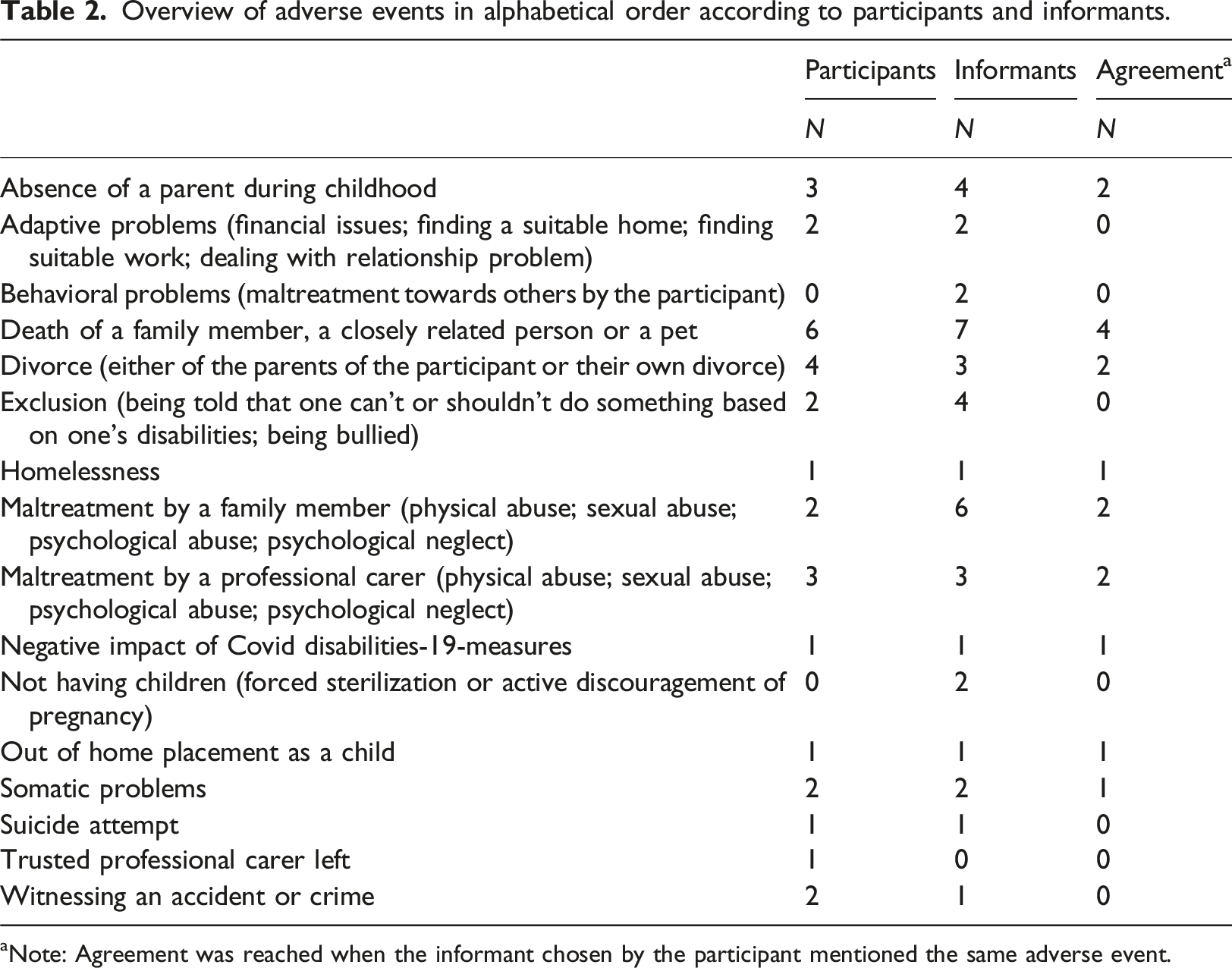
aNote: Agreement was reached when the informant chosen by the participant mentioned the same adverse event.
Internal sources of resilience
Internal sources of resilience were defined as qualities, characteristics and skills that the participants with intellectual disabilities possess that help them to deal with adverse events. After having analysed the data, the following themes were identified regarding internal sources of resilience: acceptance, autonomy, beautiful memories, perseverance, physical wellbeing, positive emotions, social skills and spirituality.
Acceptance
This theme was related to accepting difficult events but also accepting oneself as a person with both limitations and qualities. This was evidence from statements from participants such as: ‘What has happened has happened', and ‘I can't change it'. Acceptance helped to reduce the stress caused by the event. However, some respondents reported that they still struggled with the fact that the consequences resulting from specific life events could not be reversed.
‘And then it is not possible to justify what I have done. So, you do need action- response. You have to accept it too; I've been wrong too. I have also done wrong. If I had done well, I would still be married, so I have also done things wrong in my life.’
- Participant 3-
Informants specifically mentioned self- acceptance by the participant with intellectual disabilities as a subtheme of acceptance. Some informants mentioned that a longer time period was important to achieve acceptance.
‘She is very often misunderstood. You see ‘Participant 11’, you hear her talk and you are surprised that she cannot do certain things. And she is constantly confronted with that. Well, not in my family, or with all friends. But one or two people in our circle of friends also ask her for help, you know, and then she'll help too. One has a small business and she says: How is it possible that ‘Participant 11’ still doesn't understand that, I've done it three times! Then I think: Yes, you sometimes have to do it 20 times and then it goes well.’
- Informant 11-
Autonomy
This theme relates to the experience of autonomy, a certain degree of control and independence over one's own life. During setbacks, it has helped participants to feel more in control by making their own choices. From this perspective, a person learns to trust their own abilities through setbacks. Autonomy does not mean that someone deals with adverse events all by themself. In contrast, it indicates that someone is able to access the appropriate sources of resilience on their own terms, for instance by asking a specific person for help and being allowed to take their time to process events. Autonomy can be strengthened according to participants by being able to do activities by themselves or under self-chosen supervision:
‘And then we went by car. And that was really my greatest wish to go alone with my brother, without support of my mother, father or guidance. And we just wanted to do it, yes, just that part, since we had the same wish. And that was travelling alone by car and taking care of ourselves in terms of communication abroad. And that just went really well.’
- Participant 6-
Informants would say that participants showed autonomy by reaching out to tell the informant what they wanted to change.
‘She said: I can't take this anymore, mama. She dared to tell others that she needed help. So we could take action and then she would feel heard, and know that something is going to change.’
- Informant 11-
Beautiful memories
Participants mentioned that thinking of beautiful memories helped them cope after or during setbacks related to adverse events. Beautiful memories are especially important to deal with the loss of a person or pet that passed away.
‘Um and oh, doing things my way. Thinking good things about that, the good times you had.’
- Participant 9-
Informants appeared to be important facilitators to remember shared memories by talking about beautiful memories together. This then could evoke positive emotions and strengthen relationships by laughing together and reminiscing about these memories:
‘No, look, we often talk about grandma, you know. That's just how it is. We just talk about her quite often. […] I think the memories give him strength, you know. […] I- I can smile again and I'm like, oh, yeah, she was like that, you know. It was always fun with her. And that transcends your sadness.’
- Informant 2-
Perseverance
Perseverance is about the ability to continue with life and day-to-day business after experiencing adverse events. This means that someone can continue to function in daily life, but can also seek distraction in other activities. Perseverance is about sticking to certain steps or a trajectory, even when this is difficult. Through setbacks, someone also learns to persevere in other phases of life when this is difficult, or even during activities. Participants would mention that they themselves often had to believe in their own strength and ability to persevere since other people did not believe in their abilities:
‘Yeah, willpower, I guess. Yeah, I don't know how to explain that. Just keep going. […] If you say: 'No, I'm not going to help you'. Fine, I'll look for help then. Just keep going. Ask for help. Keep fighting. And the louder you say: 'You can't do that', the harder I show that I can. […] So yes, that power of myself.’
- Participant 5-
Informants would continuously mention being amazed about the abilities of the participants to persevere after adverse events.
‘He really wanted to have a different kind of job. And so he got in touch with a previous professional carer through Facebook and that ball started rolling. And he managed to organize that by himself. I'm very proud of that. And his current organization said: no, you can't, because they don't belong to the foundation and blah blah blah, a lot of hassle. But in the end it worked out well. I always have to laugh, because he often says: My mother always says you just have to try, because if you haven't tried, you don't know.’
- Informant 10-
Physical wellbeing
This theme included statements that were related to physical health, among others a healthy diet, sports or other physical activities. Physical wellbeing was only reported by participants and not by informants as a source of resilience.
‘I take more time for myself; I try to relax. […] Eat healthy, no matter how tough that process is… Still trying to get strength out of it, you know what you're doing it for.’
- Participant 3-
Physical expressions of stress can also be referred to as a signal to seek help:
‘And then something broke inside me. I thought well you know, I just can't take this anymore.. […]. And then my heart muscle started to hurt. Then I went to the doctor and said: it bothers me. The doctor said: That is stress and tension. […] and stress affects your body, so I also explained what was going on at home. Then he said think carefully about this and what you want.’
- Participant 1-
Positive emotions
Positive emotions were expressed in statements such as ‘It gives me peace’, ‘I enjoy it’, ‘It gives me pleasure’, ‘I feel proud’, and ‘It’s a relief’. Positive emotions often create more opportunities for further positive interactions, making the network more willing to offer help. All kinds of things can lead to the development of positive emotions, for example enjoying your own children, being close to loved ones, beautiful natural phenomena, achieving your goals and doing all kinds of activities. Many participants specifically mentioned experiencing serenity as an important positive emotion.
‘So you can actually see in that photograph that it is well maintained. Yes, there we did some hoeing, so to speak. And that also gives a bit of peace, say, when you're hoeing, you don't have to think about it. Then I am just going through those gardens.’
- Participant 10-
Informants on the other hand mainly mentioned positive emotions such as joy and hope that had a more clearly visible positive aspect.
‘Sometimes he needs a little push, but because of that he is quickly doing his thing again. Being happy and very social with people.’
- Informant 9-
Social skills
Social skills relate to the ability to connect with others in a positive way. Based on these skills, relationships are built that can potentially be supportive in the future. Participants and informants both mentioned social skills as an important source of resilience. Participants would mention feeling proud of their social skills and ability to connect. These skills are about making contact with others, but also helping others by lending a listening ear for example, as one participant explained:
‘Yes, I am usually lending a listening ear to a lot of people. Yes, I often listen to others and stuff. Well, it gives me a good feeling that people… Yes, that they, what do you call that? That they confided in me. Because not everyone would just talk about their stuff to everyone, I guess. So, it kind of gives you a good feeling of, yes, you can be trusted.’
- Participant 4-
Informants would explain how the social network of the participant would expand due to the social skills of the participant.
‘That he is very interested in other people, he makes contact very easily and he has a lot of interest in people. To a certain extent, he also forgets things again, but he wants to be involved with people. He needs to connect with people, and he makes connections easily.’
- Informant 10-
Spirituality
Spirituality is linked to a general belief in 'something'. This can be a higher power or higher plan in life based on religion, but this does not need not be tied to religion only. Some participants gave meaning to events, for instance one participant mentioned that ‘the universe only gives you what you can handle’. Indicating that by experiencing these events she viewed herself as a strong individual and that she believed in a higher power that oversees all. Spirituality also relates to giving meaning or purpose to your life. From a sense of purpose, after a major event, someone can gain more appreciation for the things in life that really matter (such as taking care of a child). Some participants also mentioned that after an important person deceased they still felt their presence:
‘Yes, sometimes I have the impression that he is still there. Yes, then a lamp goes out, then that goes out again. I think he's back. He will always be with us. That makes me feel good.’
- Participant 7-
Informants would specifically mention rituals that the participants would use to express their spirituality, such as listening to music, visiting or bringing flowers to a grave or lighting a candle.
‘By burning a candle for her every now and then, so just being busy with her, picking a flower for her and just remembering it.’
- Informant 11-
External sources of resilience
External sources of resilience are defined as contextual factors such as: social relationships, properties, activities and locations that are supportive in dealing with adverse events. The following themes were identified regarding external sources of resilience: activities, home and social network. While discussing external sources of resilience both participants and informants explained how these sources of resilience interacted with internal sources of resilience.
Activities
Activities refer to anything a person can do throughout the day that helps to cope with a difficult event. A wide variety of activities need to be available to cater to the diverse needs of people with intellectual disabilities. Activities provide both structure and distraction to cope with setbacks. Activities can also help to form your own identity and show the outside world what you can do. A huge diverse variation of activities was mentioned by participants and informants: various jobs, taking care of children, listening to music, looking up inspiring texts, mindfulness exercises (meditation or listening to online platforms), being in nature (either sitting or walking), physical exercises like going for a walk, meeting with friends, watching television or Netflix, reading books, playing videogames, going on a holiday, cleaning at home and creative activities such as crochet/ drawing/ painting or colouring books (for instance with mandalas). Participants mentioned how a specific activity would help to achieve feeling at peace:
‘So I'm going to draw fanatically and it also has to be finished. And now it's done, then I can just do everything again. I don't know. I always say there are rooms inside me. And that one room that now overflows that I throw on paper, that room is then empty for a while afterwards and I am at peace.’
- Participant 1-
Informants would also mention how these activities would lead to meeting new people, and being included in society:
‘She does volunteer work at a nursing home. She just likes knowing that she is doing something for those people, that she can mean something to someone else. She likes to mean something to someone else.’
- Informant 11-
Home
A home is about having your own place to live where someone feels good and experiences peace. Both participants and informants mentioned that having a home is an important source of resilience. Participants mainly mentioned how the new home affected their wellbeing. Sometimes someone moves to a different environment, which stops being bullied by neighbours and others. It could also happen that intolerant neighbours moved themselves, which could also give more peace of mind. What a suitable home was, was reported differently by participants who talked about this. Some participants mentioned that living in a residential care facility helped them to experience peace and a feeling of autonomy. Other participants were finally at peace after they experienced an independent living situation, as one participant stated:
‘My house (takes photo of living room) also gives me strength. For most people, everything is very normal. Not for me. Nobody expected I could live independently, not even me.’
- Participant 4-
Informants mentioned how the process of moving was also often stressful to the participants. A new home offered new opportunities to connect to different people.
‘I think what helped him is the same as what he found difficult, to move to a new place. That put him in a different situation for a while, so that he could tell his story to other people.’
- Informant 9-
Social network
The theme social network was mentioned by all participants and informants. The social network of participants included a wide variation of connections and consisted of family, friends, professional carers, neighbours, pets, children or even contacts through social media according to participants. A supportive network is about experiencing unconditional love and connection where space is offered to be oneself. Participants mentioned that it was important that people are real friends and that there is reciprocity in the relationship. An important recurring sub-theme was talking about and expressing emotions in interaction with persons in the network. Next to support from persons, all participants mentioned experiencing support from a pet. By talking to pets participants said they felt relief, the animals would listen unconditionally and not judge them.
‘Well, when I'm feeling sad or gloomy, she comes to me, she knows I don't feel well, not well. So then I talk to her, then she listens, then she also listens and then she comes and cosies up to me. Then then, yes, then I feel good again. […] When I'm alone, she notices. Because she feels it. Cats always feel what is there. So then she comes to me and then she wants to sit on my lap. Then I think: OK, just come. Yes.’
- Participant 12-
Informants mainly mentioned relationships with family and friends leading to the description of a smaller network.
‘But, so, so beautiful and so wonderful that we were together, at that time. And he was a part of that.’
- Informant 9-
Discussion
In the current study participants and their informants were asked about the type of adverse events they experienced in their lives. The results confirm the need for a broadening of the definition of stressor criterions for people with intellectual disabilities in the DSM-5 (Rittmannsberger et al., 2019). Due to the nature of the disabilities in people with intellectual disabilities certain milestones in life can be considered as potential stressors. Specific adverse events were found to be related to either a need for independency or a need for protection: adaptive problems (financial issues, finding a place to live, finding suitable work, dealing with relationships), exclusion (being referred to a specialized school, being told that you can’t or shouldn’t do something based on your disabilities), wanting children or the loss of a relationship. In many instances people with intellectual disabilities experienced that their autonomy and decision-making was diminished. When caregivers do not include people with intellectual disabilities in decision making processes, this could enhance the experience of adversity. At the same time we found autonomy to be an important source of resilience in people with intellectual disabilities. When people with intellectual disabilities are empowered to make their own choices this could not only prevent the occurrence of adverse events but could also lead to a positive developmental pathway to strengthen sources of resilience.
In the current study people with intellectual disabilities were asked what helped them to deal with adverse events, also informants from their social network were asked to reflect on this question. A guided photovoice procedure was used to gain a better understanding of the experiences of people with intellectual disabilities (Scheffers et al., 2023). The following internal sources of resilience were identified: acceptance, autonomy, beautiful memories, perseverance, physical wellbeing, positive emotions, social skills and spirituality. External sources were considered factors that can be found within the socio-cultural context of a person. External sources that were identified in the current study were: activities, a home and the social network.
In a previous systematic literature reviews a first step was taken to create an overview of internal and external sources of resilience in people with intellectual disabilities (Scheffers et al., 2020). Based on this review known sources of internal resilience were confirmed in the current research: autonomy, acceptance, physical health and positive emotions were also identified in the current study. Two external sources of resilience were also confirmed in the current study namely, a supportive social network and engaging in daily activities. New internal sources of resilience that were not previously identified were: beautiful memories, perseverance, social skills and spirituality. Having a home was identified as a new external source of resilience that was not previously identified.
Beautiful memories have been found in many different studies to be important to protect against the effects of trauma (Narayan et al., 2017; Starbird & Story, 2020; Tahirovic & Jusić, 2016). Remembering positive things and talking about them could support resilience in people intellectual disabilities by enhancing more positive emotions (Philippe et al., 2009; Speer & Delgado 2017; Vanderlind et al., 2017). Today the treatment of trauma often focuses on reducing the negative effects related to the traumatic events (Schnurr, 2017; Schnyder et al., 2015). New studies concerning treatment show that it is possible to go beyond diminishing the impact of negative memories and also focus on positive memories (Contractor et al., 2018; Contractor et al., 2020). The rationale behind this approach is that firstly the retrieval and processing of positive memories may provide immediate benefits for affect and cognitive processes. Secondly, an enhanced focus on positive memories and a reduced focus on negatively-valanced memories may reduce negative affect and upregulate positive affect (Joormann et al., 2007; Josephson, 1996; Rusting & De Hart, 2000). Improved affect may subsequently increase positive thoughts (Fredrickson, 2001 positive interpretations of events (Blaney, 1986; Rusting & De Hart, 2000), and self-esteem (Steel et al., 2015), which together can help to counter trauma cognitions (Contractor, et al., 2018).
Perseverance was mentioned by almost all participants and informants. Perseverance is the ability to continue with life and day-to-day business after experiencing adverse events. Being able to persevere during hardships is a necessary ability in the first two stages of resilience, recovery and resistance (Lepore & Revenson, 2006). In the recovery stage, one is able to resume to day-to-day life after experiencing adversity. Resistance is the following stage where a person is able to maintain normal functioning despite the occurrence of adversity. In order to persevere a person needs to have access to resources (Ungar, 2013). Caution is therefore advised when using the term perseverance (Northway, 2017; Shaw et al., 2016). Perseverance is not just the ability of one person but generally made possible through different resources such as a supporting social network and the access to appropriate care. Being able to persevere is hugely important in effectively dealing with adverse events. However, it is even more important to understand how a person is able to persevere during hard times. Future research is needed to explore which specific resources are associated with perseverance of persons with intellectual disabilities to better understand the dynamic character of this resiliency factor.
Social skills that were mentioned by participants were facilitating positive contacts with or lending a listening ear to others. In the study of Giesbers (2020), it is shown that people with intellectual disabilities feel more included and connected when they are able to provide support to others next to receiving help for themselves. Social skills are necessary to connect with other people. Many studies suggest that increasing social skills in people with intellectual disabilities will lead to a wider personal social network (Mamta & Ahmad, 2020; O’Handley et al., 2016). Ungar (2010) describes internal sources of resilience as specific qualities and characteristics that help people to navigate towards sources of resilience. From a systemic perspective, it is suggested that when a person displays positive social skills this is both caused by and the consequence of experiencing many positive interactions. By experiencing inclusion in many different contexts from a young age on a person will develop greater social skills (Louw et al., 2020). To increase social inclusion of people with intellectual disabilities, interventions and policies should not only focus on enhancing social skills but also on assisting people with intellectual disabilities in the process of societal inclusion from a young age which enables them to increase their opportunities for experiencing positive social interactions.
Spirituality is a basis of beliefs and can lead to many different resources such as positive emotions and being part of a community. It is important to note that in the current study spirituality was studied more broadly not only identifying membership of a religious community. From the perspective of resilience the occurrence of a manageable challenge or adverse event could serve as a turning point for a person to generate a greater sense of spirituality (Manning, 2013). Spirituality in people with intellectual disabilities related to resilience is an under researched theme (Carter & Boehm, 2019; Liégeois, 2014). The limited results of research show that spirituality can lead to better social inclusion and is important in understanding the quality of life in people with intellectual disabilities (Sango & Forrester-Jones, 2018). More research is needed to better understand the concept of spirituality related to resilience in people with intellectual disabilities and their families.
Having a home was found as a new external source of resilience, previously not identified in the systematic literature reviews (Scheffers et al., 2020; 2022). In the current study no specific type of living situation was associated with resilience. Some participants mentioned that staying in a residential facility relieved them from stressors. Other participants mentioned that having their own place to live made them feel independent, giving them more self-confidence and a feeling of societal inclusion. Throughout the years, there has been a policy shift from institutionalized to community based care (Collins, 2015). This study shows that the concept of a home should be understood from a person oriented perspective to fit a persons’ specific needs. The right to adequate housing is documented in Article 25 of the Universal Declaration of Human Rights (UDHR; United Nations, 1998). However, in people with intellectual disabilities having a home that suits their specific needs is often not self-evident. As an example, people with intellectual disabilities are hugely overrepresented among homeless populations (Durbin et al., 2018; Brown & McCann, 2021) and they experience many social inequities in access to housing (Emerson, 2011).
A sense of coherence was found in the systematic literature review to be an important external source of resilience but could not be identified in the current study (Scheffers et al., 2022). A sense of coherence was defined by Antonovsky (1987) as: “The extent to which one has a feeling of confidence that one’s environment is predictable and that things will work out as well as can reasonably be expected”. The reason that this theme was not identified can probably be explained by the way the systematic literature review was done (Scheffers et al., 2022). Themes were identified that were important according to the social network in order to provide adequate support. Possibly, a sense of coherence is important to support resilience in people with intellectual disabilities from the perspective of their social network while the focus of the current study was what a person with intellectual disabilities finds important.
The most mentioned theme was support by the social network. This theme was also identified as important in both systematic literature reviews (Scheffers et al., 2020; 2022). In the current study the theme social network was mentioned by all participants and informants. Afifi and MacMillan (2011) focused on protective factors for child maltreatment in the general population and also showed the preventive effect of a stable family environment and supportive relationship. Not previously identified as an external source of resilience but explicitly found in this study was the support pets can give when dealing with adversity. Participants talked about feelings of a warm deep connection to their animals. When a participant did not feel well their pets would comfort him or her without hesitation. Participants talked to their pets about everything without being interrupted. In the study of Bould et al. (2018) it is shown how the ownership of pets can support inclusion to society by following a training program with a pet or simply just walking a dog in the neighbourhood. People with intellectual disabilities are considered to be very good candidates for treatment programs involving the collaboration with animals such as dogs, horses or even donkeys (Borioni et al., 2012; Colombo et al., 2020; Scorzato et al., 2017). These findings could help to reconsider institutional policies. For instance, in many residential settings pets are not allowed due to allergies or hygiene. Special programmes could be developed to support people with intellectual disabilities to take care of their pets adequately. Also care farms are an example where people with intellectual disabilities are provided the opportunity to connect and care for animals (Hassink et al., 2017).
When reviewing the results, some differences and similarities were found between data retrieved from participants with intellectual disabilities and informants from their social network. On average informants would mention less adverse events compared to the participants with intellectual disabilities. None of the informants mentioned exactly the same adverse events of sources of resilience as participants with intellectual disabilities confirming the finding in earlier studies that the perspectives of participants and informant have unique characteristics (Jen-Yi et al., 2015; Lewis & Morrissey, 2010; Lunsky & Bramston, 2006; Mileviciute & Hartley, 2015; Simoes & Santos, 2016). On a conceptual level there was some overlap between themes found in the interviews with the participants with intellectual disabilities and the interviews with the informants from their social network. Participants and informants would sometimes use different examples to explain a theme. With regard to positive emotions, it was found that people with intellectual disabilities often explained that they considered calmness, serenity or tranquillity to be positive emotions. While informants from the social network would say that people with intellectual disabilities showed joy, happiness and enthusiasm as signals of positive emotions. When reviewing data from both participants with intellectual disabilities and their respective informants from the social network, one needs to be aware of the different perspectives revealed by these sources. Interviews with informants from the social network cannot replace the stories of people with intellectual disabilities themselves but are important for researchers to gain a full understanding of concepts and occurrences at stake.
Different limitations should be taken into consideration concerning the current study. Regarding the interpretation of the data of internal sources of resilience we found a need for discussion between assessors. It is very important to closely listen to the words used by participants and informants in the context of the conversation and to member check these results to gain agreement about the categorization of these themes. Specific benefits and challenges of the use of a guided photovoice procedure should be taken into account (Overmars-Marx et al., 2018; Scheffers et al., 2023). In addition, it is important to consider that, based on the limited scope of the current study, it is not possible to conclude whether or not people with intellectual disabilities have a need for different sources of resilience compared to people without disabilities. Previous research on the occurrence of resilience in the general population has shown to be insufficiently inclusive to address specific needs of people with intellectual disabilities, since no procedures for active involvement of this population were described in the research procedures (Frankena et al., 2015; Jefferies et al., 2019; Woelders et al., 2015; Walmsley et al., 2018). The current study, combined with the results of our previous systematic literature reviews, provide a first overview of the sources of resilience that are important to people with intellectual disabilities (Scheffers et al., 2020; 2022). These combined results can be used to adapt policies and interventions to better fit the needs of people with intellectual disabilities from a resilience based perspective.
Lepore and Revenson (2006) explicate that resilience is a process following different stages through the analogy of a tree. The tree bends in the wind (recovery), stands still (resistance) or changes its shape (reconfiguration). To develop further on this metaphor we would like to expand our knowledge about trees that effectively deal with wind. Not only would we like to know more about the characteristics of the tree (internal sources) but also about the soil, the amount of sunlight and the surrounding flora and fauna that could support the tree in dealing with the wind (external sources).
Our research shows that people with intellectual disabilities can have access to many different internal and external sources of resilience. However, if the inclusion of people with intellectual disabilities in society continues to fall behind then the actual access to these resources can become more limited over time. This will lead to a greater dependency of people with intellectual disabilities on mental and physical health care on the long term. In conclusion, the societal inclusion of people with intellectual disabilities can help to build more resilient communities.
Supplemental Material
Supplemental Material - Resilience in the face of adversity: How people with intellectual disabilities deal with challenging times
Supplemental Material for Resilience in the face of adversity: How people with intellectual disabilities deal with challenging times by Femke Scheffers, Eveline van Vugt and Xavier Moonen in Journal of Intellectual Disabilities
Footnotes
Acknowledgements
I would like to extend my sincere thanks to Doriene Roozendaal as a research assistant.
Declaration of conflicting interests
The author(s) declared no potential conflicts of interest with respect to the research, authorship, and/or publication of this article.
Funding
The author(s) disclosed receipt of the following financial support for the research, authorship, and/or publication of this article: This work was supported by Stichting tot Steun Vereniging tot Christelijke Verzorging van Geestes- en Zenuwzieken.
Author note
The data that support the findings of this study are available on request from the corresponding author. The data are not publicly available due to privacy or ethical restrictions.
Ethical approval
The research proposal was approved by the Ethics Review Board of the University of Amsterdam in the Netherlands (project number 2020-CDE-12405).

Supplemental Material
Supplemental material for this article is available online.
References
Supplementary Material
Please find the following supplemental material available below.
For Open Access articles published under a Creative Commons License, all supplemental material carries the same license as the article it is associated with.
For non-Open Access articles published, all supplemental material carries a non-exclusive license, and permission requests for re-use of supplemental material or any part of supplemental material shall be sent directly to the copyright owner as specified in the copyright notice associated with the article.
