



Abstract
Exploring individual differences and looking beyond averaged parameters of early numeracy in young children with mild intellectual disabilities has become an area of interest to many researchers worldwide. This study aimed to identify the different profiles of early numeracy skills in young children with mild intellectual disabilities. For this purpose, we assessed early numeracy through Utrecht early numeracy test and learning aptitude through Detroit Test, in a sample of 135 children diagnosed with intellectual disabilities. The mean of their mental age was 5:09 (years:months). Two-step cluster analysis identified four homogenous groups of children with distinct early numeracy profiles as follows:C1 were fluent in relational and numerical skills up to 20, C2 were fluent in relational skills and numerical skills up to 10, C3 had basic knowledge of relational skills and inconsistent numerical skills up to 10 and C4 had inconsistent relational skills and numerical skills. Results are discussed with reference to their educational implications.
Introduction
Over the past decades, the importance of early childhood education has gradually gained recognition, especially for young children with intellectual disabilities (Charitaki, et al., 2021; Hojnoski et al., 2018). Since, they are faced with significant deficits in intellectual functioning and adaptive behaviour (American Psychiatric Association, 2013; Schalock et al., 2010), they need systematic instruction to achieve a later independent living and social inclusion (Storey & Miner, 2017). Admittedly, individual differences in gaining early numeracy skills could be considered as a crucial aspect in a macro-level for their social inclusion (Atkinson et al., 2002; Duncan et al., 2007; Geary et al., 2013; Ritchie & Bates, 2013; Trilling & Fadel, 2009), but also in a micro-level for school inclusion (Skwarchuk, 2020). Contrary to the growing recognition of the importance the early numeracy skills bear in the field, early numeracy profiles in young children with intellectual disabilities is an underrepresented area of research (Sermier Dessemontet, et al., 2020; Schnepel, et al., 2020).
According to recent societal trends, exploring individual differences and looking beyond averaged parameters of early numeracy in young children with mild intellectual disabilities has become an area of interest to many researchers worldwide (Porter & Campbell, 2020). Nevertheless, research evidence seems to be scarce in terms of early numeracy profiles in young children with intellectual disabilities (Sermier Dessemontet et al., 2020; Schnepel et al., 2020). Existing published research in the field has focused on exploring early numeracy in young children with intellectual disabilities (Brodeur et al., 2013; Brigstocke et al., 2008; Camos, 2009; Charitaki et al., 2014a, 2014b, 2015; Clarke & Faragher, 2014; Herrera et al., 2010; King et al., 2017; Lanfranchi et al., 2015; Noda & Bruno, 2017; Porter, 2019, 2018, 1999) through a variable-centered approach, assuming that all participants from the sample are represented only by a single population through estimated “averaged” parameters. However, a drawback of this approach is the possibility that the sample might include multiple subpopulations characterized by different sets of parameters (Howard, & Hoffman, 2018; Morin, et al., 2016). Consequently, uniqueness and variability of the sample are disregarded. On the other hand, the existing person-centered published research is limited to cases of typically developing children (Hannula-Sormunen et al., 2017; Hellstrand, 2021; Newton & Penner-Wilger, 2015;) and children with autism spectrum disorder (McDougal et al., 2020). There is only one study (Sermier Dessemontet et al., 2020) exploring profiles of early numeracy in young children with intellectual disabilities. Though, they employed a small sample of 57 participants and they assessed only early numeracy parameters. Such a sample size (n=57) could be appropriate for variable-centered analyses, but not for person-centered analyses since convergence problems and difficulty in identification of smaller profiles will possibly emerge (Vargha et al., 2016).
Early numeracy
It is clear that early numeracy consists of important skills assisting later achievement in elementary school mathematics (Aunio & Niemivirta, 2010; Braeuning et al., 2020; Charitaki et al., 2020; Clarke & Faragher, 2014; Desoete et al., 2009; Gersten et al.,2015; Krajewski & Schneider, 2009; Zhang et al., 2014), the achievement in high school mathematics (NRC, 2009), and the academic achievement in general (Jordan et al., 2007). Despite the significance of early numeracy, research on the individual differences in terms of early numeracy acquisition in young children with intellectual disabilities is in need of expansion (Kleemans et al., 2012). Additionally, there is a well-established belief in placing numerical skills under the definition of early numeracy (Kleemans et al., 2012; Porter, 2019).
Early numeracy consists of a range of different skills, such as relational skills, counting skills and operations (O) (Aunio et al., 2009; Purpura & Lonigan, 2013; Van de Rijt et al., 2003). With respect to relational skills, their definition includes a synthesis of areas such as classification, seriation, comparison, and correspondence (Piaget, 2013). The ability of creating and identifying homogenous groups of items, in terms of one or more perceptual features (e.g., green books), is assessed through classification tasks. Comparison tasks involve the identification of non-equivalent items (e.g., the shorter girl), while seriation tasks include repetitive tasks of comparison in order to create a series of items. Finally, correspondence tasks assess the ability of one-to-one pairing an item from set A with one and only one item from set B.
The definition of counting skills describes the child’s ability to perceive quantity, to know and understand the rules and processes of the counting sequence (Purpura & Lonigan, 2013). Finally, the definition of the term operations describes child’s skills of composition and decomposition of sets of objects (Clements & Sarama, 2007; Jordan et al., 2006; Purpura & Lonigan, 2013; Starkey et al., 2004).
Relations between early numeracy and cognitive functions-learning aptitude
Several studies on early numeracy either in typical, or in populations of young children with intellectual disabilities, support the basis of individual differences and the existence of significant variations in early numeracy attainments even before the typical school entry. Prior knowledge could be considered the best predictor for later academic achievements (Aunola et al., 2004). Consequently, it is important to begin with a thorough investigation of learning aptitude. With respect to learning aptitude, cognitive functions in areas of language, attention and motor abilities (Figure 1) seem to share significant variance in predicting early numeracy skills and could be considered predictors (Newton & Penner-Wilger, 2015). Cognitive functions in areas of learning aptitude (Hammill & Bryant, 2005).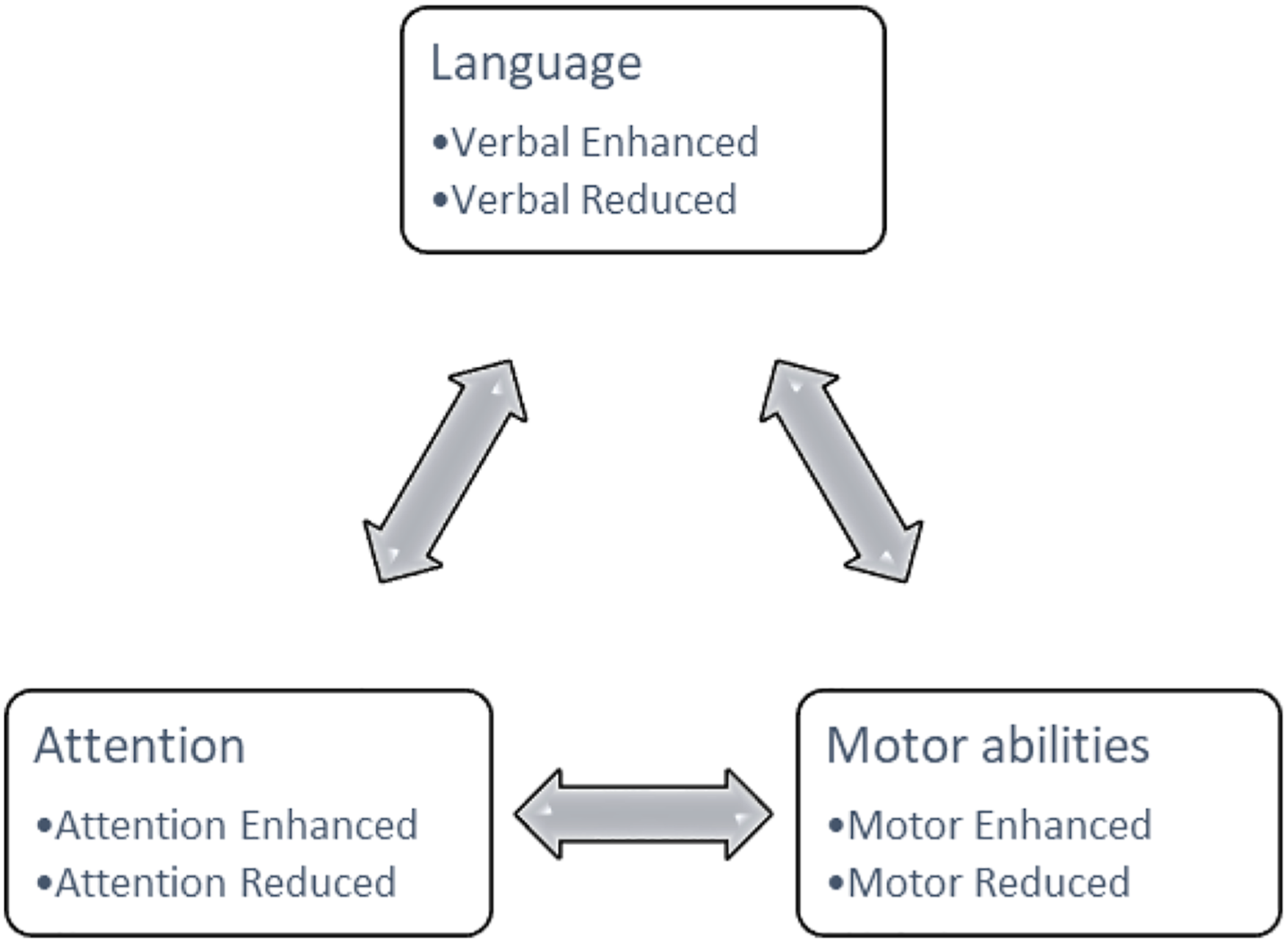
Through learning aptitude assessment, a significant number of individual cognitive functions are being simultaneously assessed. More specifically, conceptual matching assesses two cognitive functions. The first one is related to verbal reduced domain of language and non-verbal comprehension, while the other one is the correlation of concepts. Design reproduction assesses four cognitive functions, summarized to attention, motor abilities, direct memory, and spatial relations. Digit sequences assess memory recall, and short-term memory. Motor directions assess reduced attention and motor abilities. Object sequences assess short-term memory and visual correlation. Picture identification assesses long-term memory and concept comprehension. Sentence limitation assesses language enhanced domain and more specifically, the comprehension and use of oral speech. Symbolic relations assess non-verbal symbolic reasoning, perceptual integration, and long-term memory. Word sequences assess memory recall and short-term memory (Hammill & Bryant, 2005).
Limited ability in the above-mentioned specific skills, could explain deficits in early numeracy acquisition as well. Research findings indicate the significant effect of linguistic factors to procedural aspects of early numeracy, since they share a common basis in terms of learning rules (LeFevre et al., 2010). Moreover, they share a common basis on abstract hierarchical representations (Kleemans et al., 2012). Besides language, attention and motor factors are strongly related to early numeracy (Abdelhameed, 2007; Brueggemann & Gable, 2018).
Person-centered investigation of early numeracy
Uniqueness is a commonly admitted characteristic of human beings. Despite the similarities, each human differs from one another, in terms of strengths and weaknesses. Heterogeneity is a significant factor which can be observed within the same human in different times. Though, it is important to mention that both heterogeneity and homogeneity are significant. Admittedly, it seems impossible to find even two humans that are 100% identical or 100% different in every way (Porter & Campbell, 2020). Despite, the fact that children with intellectual disabilities are typically clustered, there is a considerable heterogeneity-diversity in terms of their attainments, which still remains under investigation.
Admittedly, all children (with and without intellectual disabilities) have different strengths and weaknesses (Burack et al., 2011, 2012, 2020). Recent findings describing the children’s individual characteristics regarding early numeracy, could facilitate teachers’ efforts to implement effective interventions. This is the main reason why the researchers have been turned to person-centered approaches (Hannula-Sormunen et al., 2017; Hellstrand, 2021; McDougal et al., 2020; Newton and Penner-Wilger, 2015; Schnepel et al., 2020; Sermier Dessemontet et al., 2020).
The critical synthesis of these limited research efforts provides us with two basic conclusions: a) there is a significant lack of research findings in the field and b) significant differences and controversies exist within the available research findings. Additionally, these significant variations can be attributed to differences in research questions, research tools and data analyses. The only common basis in the proposed early numeracy profiles, within all populations (intellectual disabilities, autism spectrum disorder and typical development), includes the suggestion of two distinct profiles (the lowest achieving and the highest achieving) (Hannula-Sormunen et al., 2017; Hellstrand, 2021; McDougal et al., 2020; Newton & Penner-Wilger, 2015; Sermier Dessemontet et al., 2020). Moreover, we should highlight that only Sermier Dessemontet et al. (2020) worked with a sample of children with intellectual disabilities.
For example, McDougal et al. (2020), working with typically developing children, suggested a three-profile solution which emphasized on the attention (Pr_1: Good attention – higher achieving, Pr_2: Average attention – average achieving and Pr_3: Poor attention – lower achieving). Despite the fact that they assessed all domains of early numeracy including numerical operations and mathematical reasoning, they didn’t present a detailed description of diversity within early numeracy domains. As a result, no significant evidence regarding early numeracy variability can be gained through this study.
Similarly, Hellstrand (2021), suggested a three-profile solution emphasizing on overall performance, while Newton & Penner-Wilger (2015) suggested a profile solution which emphasized the visuospatial working memory. Both of them worked with typically developing children. In the same way, no significant evidence regarding early numeracy variability can be gained through these studies, too.
The only study that was exclusively oriented to the potential profiles of early numeracy in a sample of young children with intellectual disabilities was this of Sermier Dessemontet et al. (2020). More specifically, Sermier Dessemontet et al. (2020) suggested a four-profile solution (Pr_1: children with inconsistent basic numerical skills with numbers up to 10, Pr_2: children with basic numerical skills with numbers up to 10, Pr_3: children with numerical skills with numbers up to 20 and Pr_4: children with numerical skills with numbers up to 100 and arithmetic skills), which provided sufficient evidence for children’s individual early numeracy attainments and could promote individual interventions. Nevertheless, their findings were limited to the domain of counting skills. Although they assessed relational skills through a number of tasks, no further analysis was provided regarding conceptual aspects of early numeracy, thus focusing only on the procedural aspects of early numeracy. Moreover, children’s characteristics related to learning aptitude (language, attention and motor abilities) were not taken into account.
As previously mentioned, it is obvious that there is a significant gap regarding variability of early numeracy skills of young children with intellectual disabilities. Researching their profiles would enable us to reveal their strengths and weaknesses and promote individualized interventions. Thus, the aim of the current study is to evaluate whether procedural and conceptual aspects of early numeracy in young children with intellectual disabilities can be better described through specific and discrete profiles. Moreover, the effect of learning aptitude (language, attention and motor abilities) on early numeracy individual differences in children with intellectual disabilities will be evaluated. Finally, whether early numeracy profiles demonstrate significant variations across relational and counting skills will be examined.
Method
Variable-centered approaches are commonly used in educational research and support the assumption that all the sample participants are representative of the population, which can be adequately described by averaged parameters. Contrary to those, person-oriented approaches reinforce the possibility that there is heterogeneity in the sample, which enables the identification of multiple subpopulations with different characteristics (Howard, & Hoffman, 2018). Person-oriented approaches reinforce the possibility that there is heterogeneity in the sample, which enables the identification of multiple subpopulations with different characteristics (Howard, & Hoffman, 2018). This type of approach was also employed in the present study to identify the different profiles of early numeracy skills in young children with mild intellectual disabilities.
Participants
A total number of n = 155 young children with intellectual disabilities were initially enrolled in the study. An examination of outliers revealed their significant effect on Type I error rates. More specifically, we observed that the outliers showed up as a separate cluster and also caused other clusters to merge. Moreover, the assessment of cluster stability suggested that clustering was not efficient when outliers remained in data set. (explanation) Consequently, n = 20 children were excluded from the initial sample. All of them had a full-scale intelligence quotient ranging from 63 to 65 and their mean chronological age was 9:00 years old. Their full-scale intelligence quotient was estimated with Wechsler Intelligence Scale for Children-Third Edition (WISC-III)). Their mean mental age was 5 years and 09 months (min = 5:02, max = 6:08, sd = 0.678), while their chronological age was 8 years and 11 months (min = 7:02, max = 9:06, sd = 0.713). 23.7% of them were diagnosed with Down’s syndrome, while all the others were diagnosed with intellectual disabilities without any other etiology (participants with autism spectrum disorder or other disabilities were excluded from the sample). All children were enrolled in 14 primary special school settings in Greece (Attica). The sample can be considered as representative of the population of Greek children with intellectual disabilities, since 40% of them live in Attica. There was also an attempt for an equal distribution of participants by gender with 42.5% (n = 66) being girls. Consent letters were signed by the parents of all children included in the sample.
Measures
Utrecht early numeracy test
For the aims of the study, Utrecht early numeracy test (Van Luit et al., 1994) was employed. It is a standardized criterion and the specific age range of the Greek standardization sample was formed at 4.00 – 7.05 (years: months) (Barbas et al., 2008). More specifically, ENT assesses a set of 40 independent items. Eight equal-multitude of item sub-scales assess aspects of early numeracy, namely comparison, classification, correspondence, seriation, using number words, structured counting, resultative counting and general number knowledge-problem solving). The initial construct of ENT was for the unidimensional assessment (Van Luit et al., 1994) of the three domains of early numeracy (relational skills, counting skills and operations). Contrary to the initial claims, our previous research findings (Charitaki, Soulis, & Alevriadou, 2021) in a sample of young children with Intellectual disabilities suggest a two-factor model for early numeracy (relational skills, counting skills + operations), which was employed for the interpretation of the Utrecht early numeracy test assessments in the current study.
Detroit Learning Aptitude Test (DTLA-P:3)
Moreover, Detroit learning aptitude test (DTLA-P:3) (Hammill & Bryant, 2005) was employed. It is a standardized criterion and the specific age range of the Greek standardization sample was formed at 4.00 – 7.11 (years: months) (Tzouriadou et al., 2008). More specifically, DTLA-P:3 assesses nine sub-scales of learning aptitude, such as word sequences, digit sequences, object sequences, symbolic relations, sentence imitation, picture identification, motor directions, conceptual matching and design reproduction. The test is used for the assessment of language, attention and motor abilities.
Procedure
Data collection took place in public special primary school settings. The Ministry of Education and Religious Affairs approved the implementation of the study. The number of the special primary schools participated in the study, comprised 90% of the existing special schools in Attica, Athens. The administration of ENT and DTLA-P:3 were implemented by the Garyfalia Charitaki with the assistance of a school psychologist. A one-to-one approach was used for each child’s assessment, away from disruptive factors. An average of 12 separate sessions (less than 8 minutes) took place for the entire assessment of each child. Avoidance behaviors, commonly presented in intellectual disabilities populations (Patel et al., 2018), determined the abovementioned model of assessment in the sample, in terms of the number of sessions needed to administer the assessment in each child.
Data Analysis
An initial identification of potential clusters was implemented with a two-step cluster analysis. Segmentation analysis indicated a 4-cluster solution. A further investigation for potential cluster solutions was made. Ratios of sizes (larger cluster to smallest cluster) and silhouette measures of cohesion and separation from the 1-cluster to 5-cluster solutions were assessed. Moreover, the values for the ratio of distance measures and the Schwarz’s Bayesian Criterion were estimated. Further, Multivariate Analysis of Variance (MANOVAs) was used to assess the effect of gender on the clusters. In addition, the effect of learning aptitude on the clusters was assessed (cluster membership was the independent variable, while all domains of learning aptitude were the dependent variables). In order to achieve a significant decrease of Type I error, level of significance in Bonferroni adjustments was a = .001. Next, a post-hoc analysis was performed with the use of Scheffe's method. Finally, the stability of cluster membership was assessed by performing the hierarchical four-cluster solution and comparing the stability of cluster membership across two-step and hierarchical solutions.
Results
Cluster profiles
Segmentation analysis through two-step cluster technique revealed a four interpretable clusters’ solution for early numeracy in young children with mild intellectual disabilities. Silhouette measure of cohesion and separation showed a “good” cluster quality for the four-cluster solution, while the evaluation of all the other potential solutions resulted in worse cluster quality. Moreover, ratios of sizes [largest cluster (n = 42 – 31.1%) to smallest cluster (n = 29 – 21.5%)] = 1.45< 3 was acceptable and lower than all the other potential solutions, which were greater than 3. We used Figure 2 in order to interpret the profiles of the four clusters. Early Numeracy Profiles for the four clusters.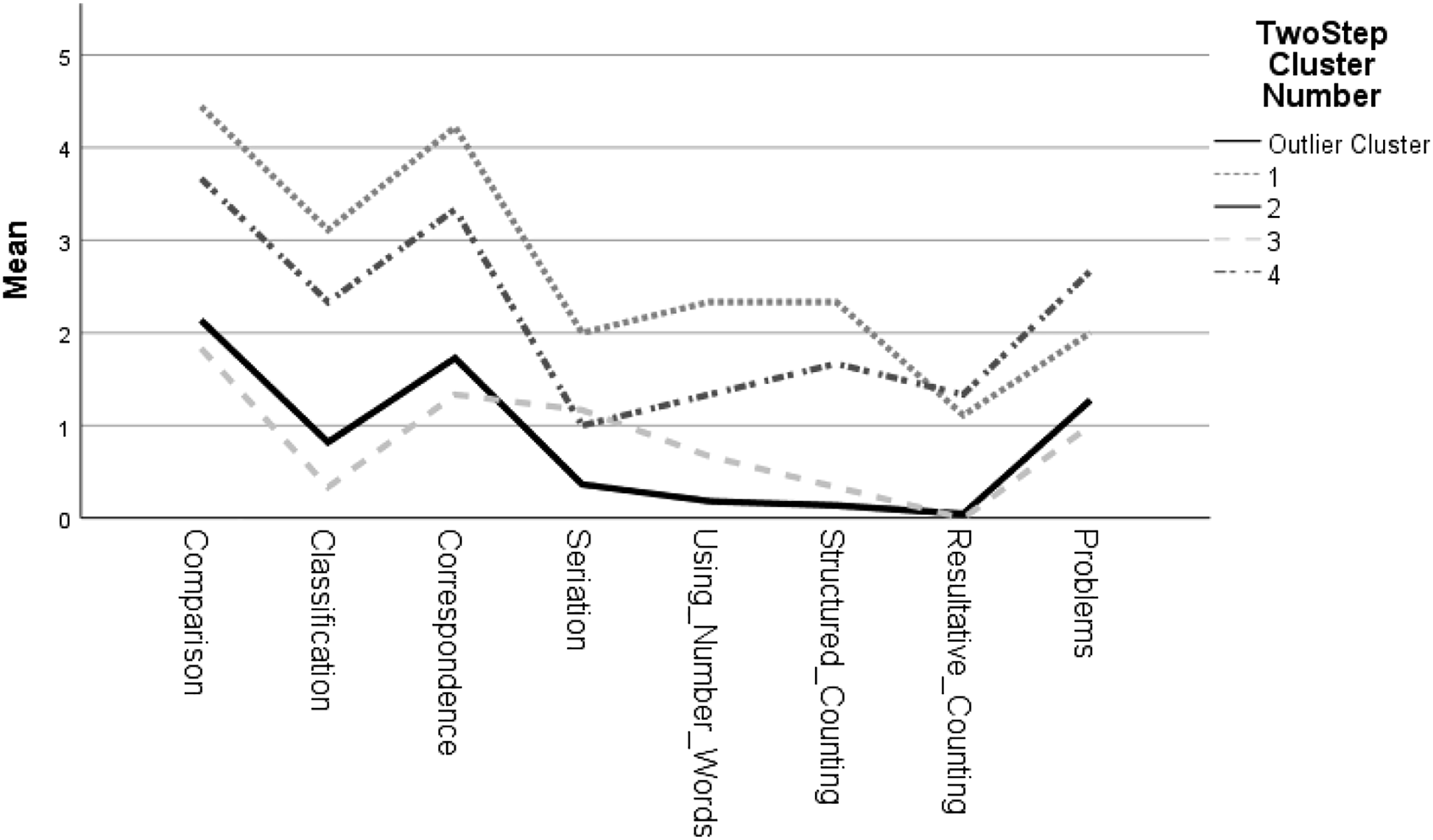
Cluster 1: Fluent in relational and numerical skills up to 20
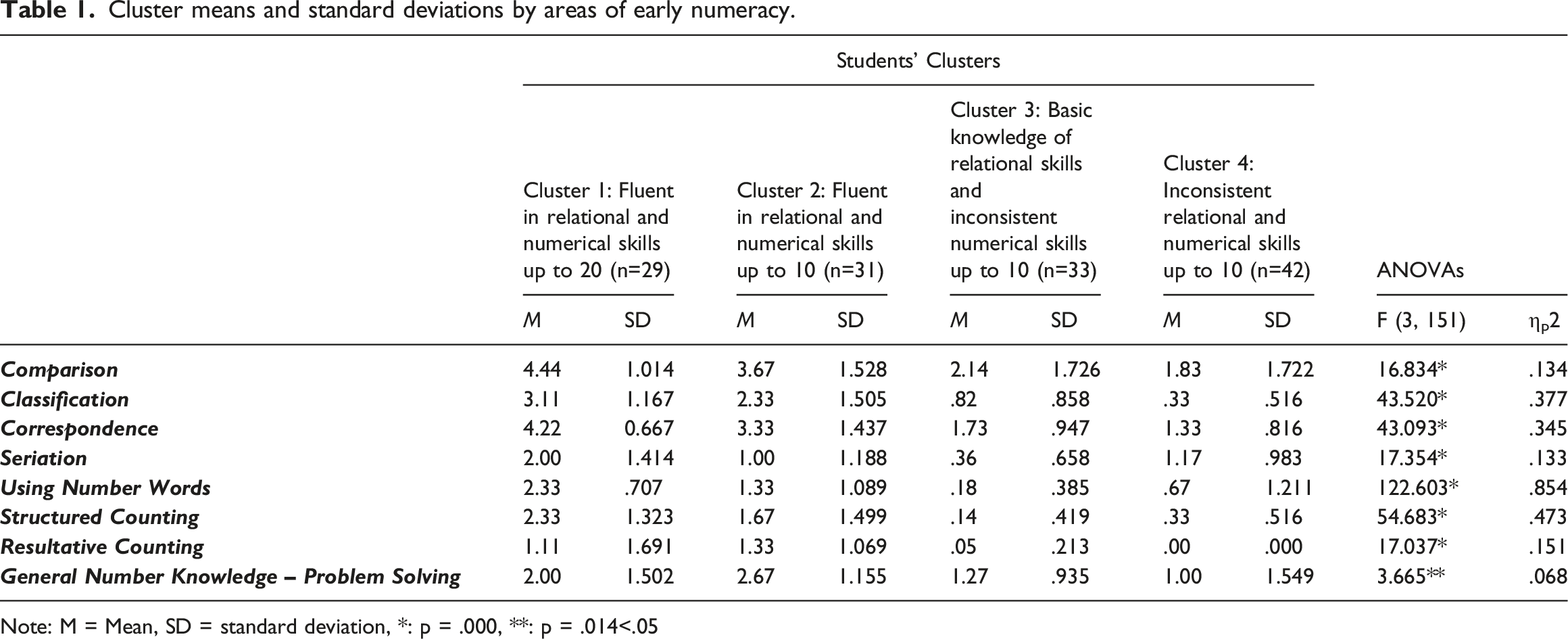
Cluster means and standard deviations by areas of early numeracy.
Note: M = Mean, SD = standard deviation, *: p = .000, **: p = .014<.05
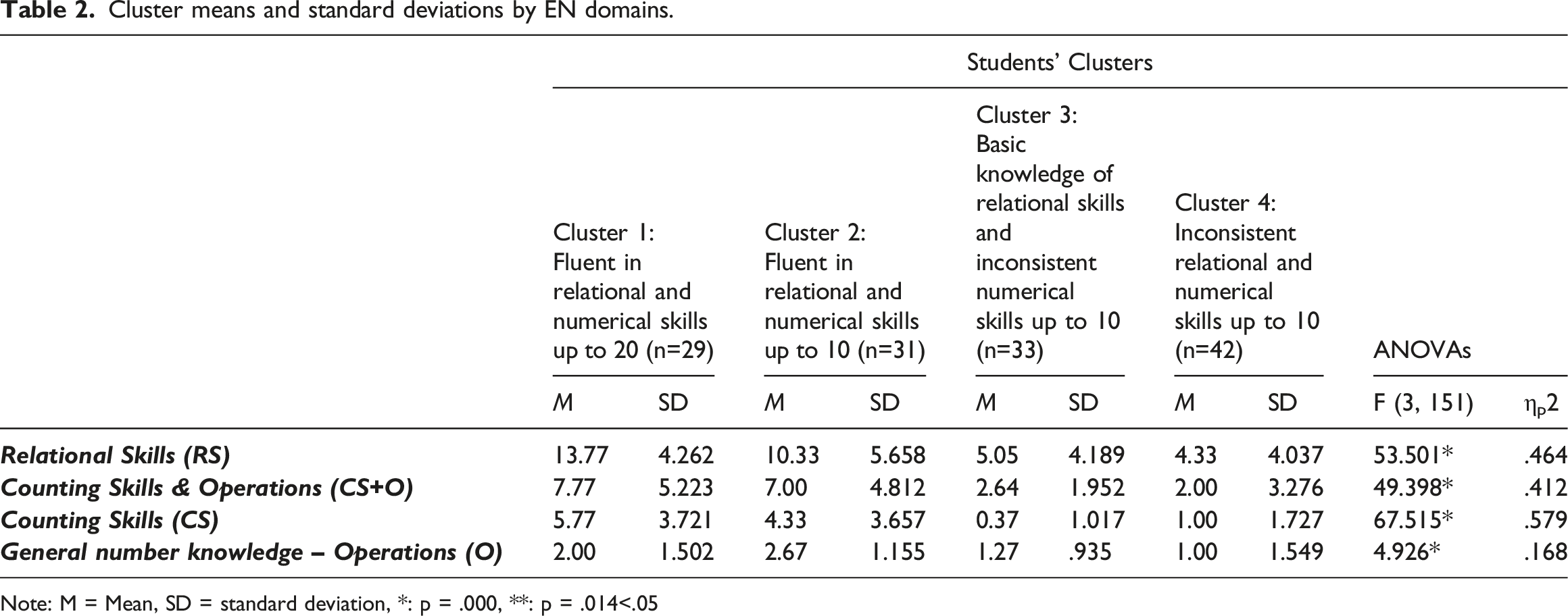
Cluster means and standard deviations by EN domains.
Note: M = Mean, SD = standard deviation, *: p = .000, **: p = .014<.05
Cluster 2: Fluent relational skills and numerical skills up to 10
A total number of n = 31 young students with intellectual disabilities were enrolled in Cluster 2. These students were labeled as “Fluent relational skills and numerical skills up to 10”. More specifically, the students in this cluster outperformed the participants of Cluster 3 and 4 in all domains of early numeracy (Table 1, Figure 2). Significant difficulties were observed in seriation and counting tasks, while their performance in problem solving tasks is almost the same with the participants of Cluster 1. Their performance in tasks related to learning aptitude domains such as design reproduction, digit sequences, symbolic relations and word sequences was lower compared to the performance of the participants of Cluster 1 (Table 2). The percentage of girls in the cluster was 51.2%.
Cluster 3: Basic knowledge of relational skills and inconsistent numerical skills up to 10
A total number of n = 33 young students with intellectual disabilities were enrolled in Cluster 3. These students were labeled as “Basic knowledge of relational and inconsistent numerical skills up to 10”. Outperformance is observed in the first three domains of relational skills (Table 1, Figure 2). Moreover, participants of Cluster 3 underperformed in domains of learning aptitude such as conceptual matching, design reproduction, digit sequences, motor directions, object sequences, picture identification, sentence imitation, symbolic relations and word sequences compared to participants of Cluster 2. (Table 2). The percentage of girls in the cluster was 37.2%.
Cluster 4: Inconsistent relational skills and numerical skills up to 10
A total number of n = 42 young students with intellectual disabilities were enrolled in Cluster 4. These students were labeled as “Inconsistent relational skills and numerical skills up to 10”. More specifically, the students in this cluster underperform in all domains of early numeracy compared to the other participants (Table 1, Figure 1). Moreover, they underperformed in all domains of learning aptitude such as conceptual matching, design reproduction, digit sequences, motor directions, object sequences, picture identification, sentence imitation, symbolic relations and word sequences (Table 2). The percentage of girls in the cluster was 24.1%.
Cluster differences in students’ learning aptitude domains
Cluster means and standard deviations by learning aptitude domains.
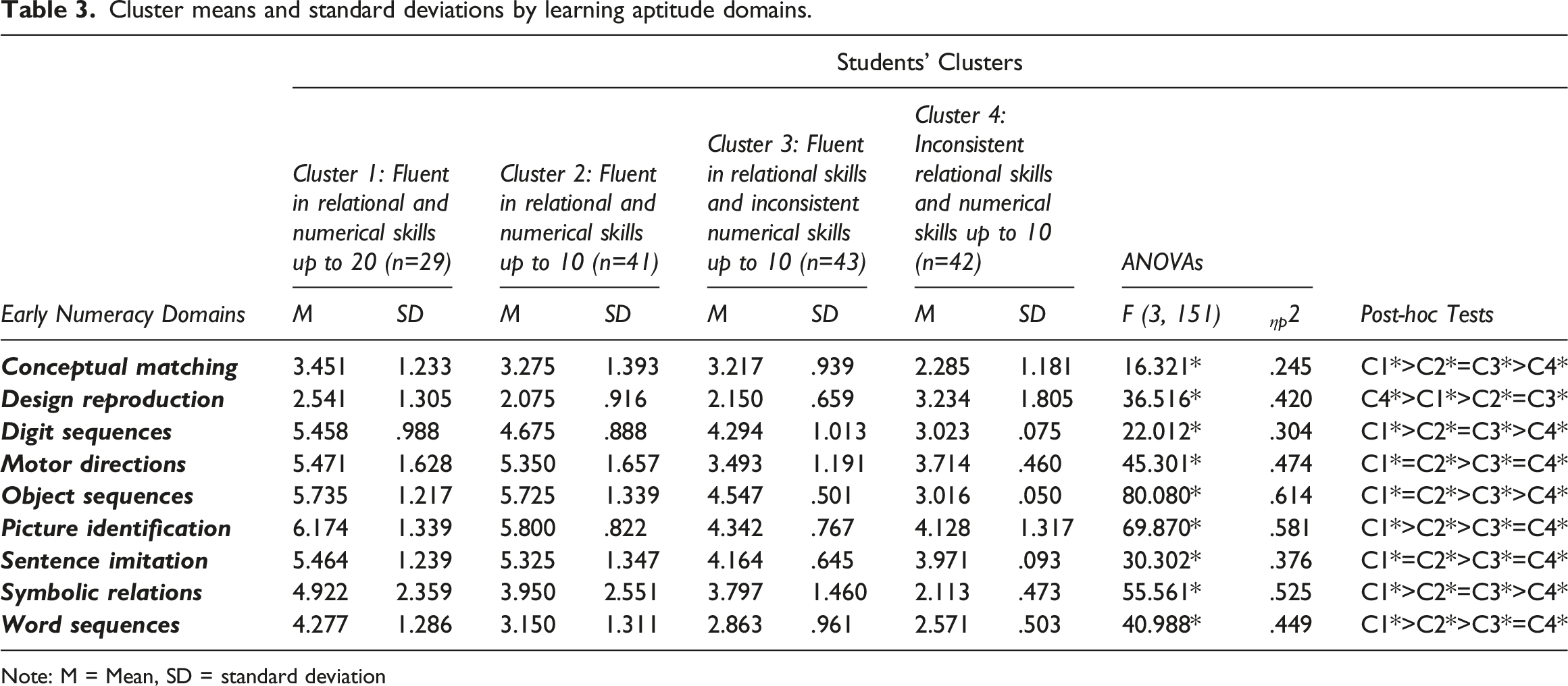
Note: M = Mean, SD = standard deviation
A similar performance was observed in domains of motor directions and sentence imitation for students from Cluster 1 and Cluster 2, while they outperformed students from Cluster 3 and 4, who had similar performance. Moreover, students from Cluster 1 had similar performance in the object sequences with those of Cluster 2 and outperformed students from both Cluster 3 and Cluster 4. Lastly, students from Cluster 1 had the best performance in the picture identification and word sequences domains. Students in Cluster 2 had better performance than those in Cluster 3 and Cluster 4, who had similar performance.
Internal Validity
127 students, comprising 94% of the initial sample remained in the same cluster across clustering techniques. A random selection of 70% of the initial sample was used for the re-estimation of the cluster solution. The solution indicated stability of the clusters, since, 88% of the students remained in the same cluster.
Discussion
The aim of this study was to explore diversity in early numeracy attainment of young children with intellectual disabilities and, more specifically, to suggest specific profiles in terms of early numeracy. Segmentation analysis through two-step cluster technique revealed a four interpretable clusters’ solution for early numeracy in young children with Intellectual disabilities, labeled as follows: C1 were fluent in relational and numerical skills up to 20, C2 were fluent in relational skills and numerical skills up to 10, C3 had basic knowledge of relational skills and inconsistent numerical skills up to 10 and C4 had inconsistent relational skills and numerical skills up to 10. Our findings are in line with those of Sermier Dessemontet et al. (2020), who assessed specific profiles of early numeracy in children with Intellectual disabilities and explain the diversity of the early numeracy attainments in young children with Intellectual disabilities.
Nonetheless, the existing diversity related to teaching methods, family background and support, may influence the early numeracy skills acquisition. A significant number of parameters-characteristics may possibly have a direct effect on child’s early numeracy attainments and should be carefully considered in terms of educational implications. Within the child’s zone of proximal development, teachers could support each child individually, by taking into consideration the children’s individual characteristics as emerged in the findings of the present study. A systematic and intensive teaching of early numeracy concepts (Hardy & Hemmeter, 2019; Jimenez & Besaw, 2020), based on children’s early numeracy profiles will possibly ameliorate their performance in the domain. It is worth noticing that a link between the developmental approach and early numeracy attainment can be observed (Burack et al., 2011, 2012, 2020), since, there is clear evidence that children with intellectual disabilities follow the developmental pathways of their aged-matched typically developing children.
Conceptual understanding vs procedural fluency
According to our findings, relational skills are better developed than counting skills in all early numeracy profiles apart from C4 and conceptual knowledge of early numeracy domains is grounded on prior procedural knowledge of early numeracy domains, similarly to typically developing children (Gersten et al., 2015; Kolkman et al., 2013; Missall et al., 2012; Toll et al., 2016). It can be observed that as children’s performance decreases in conceptual tasks from Cluster 1 to Cluster 4, the same applies to the procedural tasks in which children significantly underperformed. A possible explanation may lie on cognitive functions, such as language skills, memory and non-verbal reasoning skills which support counting skills (Koponen, Eklund, & Salmi, 2018). In young children with intellectual disabilities, all the above-mentioned cognitive functions are impaired (Charitaki et al., 2015). At the same time, estimations and magnitude comparisons promoting conceptual learning of early numeracy seem to be better established in young children with intellectual disabilities, similarly to typically developing preschoolers (Bernabini et al., 2020).
The effect of Learning Aptitude
The specific domains of learning aptitude assessed were: conceptual matching, design reproduction, digit sequences, motor directions, object sequences, picture identification, sentence imitation, symbolic relations and word sequences. Results indicated that all domains of learning aptitude, apart from picture identification and word sequences domains, have a direct and strong effect on early numeracy of young children with intellectual disabilities.
A possible interpretation of the results may lie on the fact that visualization has a direct effect on early numeracy attainments and offsets short-term memory problems in young children with intellectual disabilities (Charitaki et al., 2015). Commonly, children with intellectual disabilities demonstrate impaired short-term memory, which is closely related to their counting skills. A potential explanation of the phenomenon may be related to the fact that spoken instruction rather than visual presentations are used (Abdelhameed, 2007). Their short-term memory deficits compromise the development of early numeracy skills (Kolkman et al., 2013; Kroesbergen & Van Dijk, 2015; Toll et al., 2016). Consequently, they should not be underestimated. Apart from the limited short-term memory capacity, children with intellectual disabilities have severe deficits in their expressive language and difficulty in using rehearsal strategy (Abdelhameed, 2007). They also have significant problems with their long-term memory (Henry & Winfield, 2010; Schuchardt, Gebhardt, & Mäehler, 2010). As a result, children who enrolled in cluster 4 could employ the visual support that was provided and outperformed in tasks which assessed long-term or short-term memory. Results indicate that children in cluster 4 seem to overuse their visual short-term memory to solve tasks.
Practical Implications
It is generally admitted that all children with intellectual disabilities need systematic instruction. Significant variations within the group of young children with intellectual disabilities suggest systematic research of their profiles, which could be considered as a common basis for educational practice. More specifically, a significant effort for the identification of students whose profile is closer to Cluster 3 and Cluster 4 is needed. Teachers should be aware of these considerable variations of their early numeracy skills. Their precise and comprehensive assessment could support the smooth delivery of an effective intervention programme, especially in terms of setting learning goals for each student and planning instruction.
Mapping early numerical ability and its subcomponents in young children with intellectual disabilities will provide insights of their individual differences in terms of early numeracy acquisition, which in turn could support teachers to plan evidence-based and personalized instructions. Moreover, such an effort could promote the understanding of the learning mechanisms that children with intellectual disabilities utilize to perceive, represent, learn, and manipulate early numerical concepts (Desoete & Warreyn, 2020).
Moreover, universal screening with reliable and valid measures assessing all domains of early numeracy is necessary to be established in early-childhood educational settings, allowing teachers to identify children with intellectual disabilities, who enter typical elementary education, and are not able to count to 20 or even have difficulties with relational skills. At the same time, there are children with intellectual disabilities whose attainments in terms of early numeracy should not be underestimated. Participants of Cluster 1, who demonstrated fluent relational and numerical skills up to 20 were formed at 21.5%. Consequently, special education teachers should not be biased against their students’ early numeracy achievements.
Conclusion – Suggestions for Future Research
The area of early numeracy skills in young children with intellectual disabilities is underinvestigated. This study suggests a four-profile solution for the description of all domains of early numeracy. A further investigation in a longitudinal basis could possibly shed light to their developmental pathways in terms of early numeracy. Moreover, early numeracy skills should not be assessed separately but in conjunction with their learning aptitude.
Footnotes
Authors’ contributions
All authors contributed equally in writing the manuscript.
Availability of data and material
Moreover, we declare that data will be available upon request.
Consent to participate
Signed consent forms were obtained from all teachers and parents of the children that participated in the study.
Consent for publication
All the teachers and parents of the participants were informed for the purposes of the research and gave their consent for publication of its findings.
Declaration of Conflicting Interests
The author(s) declared no potential conflicts of interest with respect to the research, authorship, and/or publication of this article.
Funding
The author(s) received no financial support for the research, authorship, and/or publication of this article.
Ethics approval
The study was approved by the Ministry of Education and Religious Affairs of Greece.
