



Abstract
Background: Information regarding the common-daily support needs of older people with intellectual disabilities remains scarce, despite the necessity of such knowledge to the provision of adequate support. This exploratory study aims to identify the most important support needs. Method: A mixed-method design was conducted, in which 11 semi-structured interviews were held with psychologists to gain insight into the support needs of older people with intellectual disabilities. Results: The data provide an overview of the support needs of older people with intellectual disabilities in all quality-of-life (QoL) domains. Physical well-being, emotional well-being, interpersonal relationships and self-determination were identified as the most important domains for older people with intellectual disabilities. Conclusions: The findings of this study may guide the development of a specific training for support staff and constitute a valuable contribution to raising awareness among support staff concerning the broad range of support needs existing among older people with intellectual disabilities.
Introduction
The life expectancy of people with intellectual disabilities has increased in recent decades (Shoostari et al., 2012). As a result, more people with intellectual disabilities are dealing with age-related difficulties. For example, they might experience declines in physical and/or cognitive ability, suffer substantial losses in their social networks and encounter increasing limitations in their social movements (Evenhuis et al., 2012; McCausland et al., 2016). In addition, due to premature ageing and a higher prevalence of multiple chronic health impairments (e.g. respiratory diseases) and psychiatric disorders (psychotic disorders) in older people with intellectual disabilities compared to the general population of the same age, ageing with intellectual disabilities is considered to be a complex process (Alftberg et al., 2019; WHO, 2018). These complex ageing processes inevitably lead to augmentation and changes in their support needs. Care as usual, that is, existing care and support strategies seems no longer sufficient and, therefore, it can be assumed that gaps in professional knowledge and experiences of uncertainty might arise among support staff dealing with ageing people with intellectual disabilities who receive lifelong support (Alftberg et al., 2019; Bigby, 2004). To be able to adjust to these changes, support staff need insight into the broad range of support needs of older people with intellectual disabilities and the question how to keep providing adequate support at this stage of life.
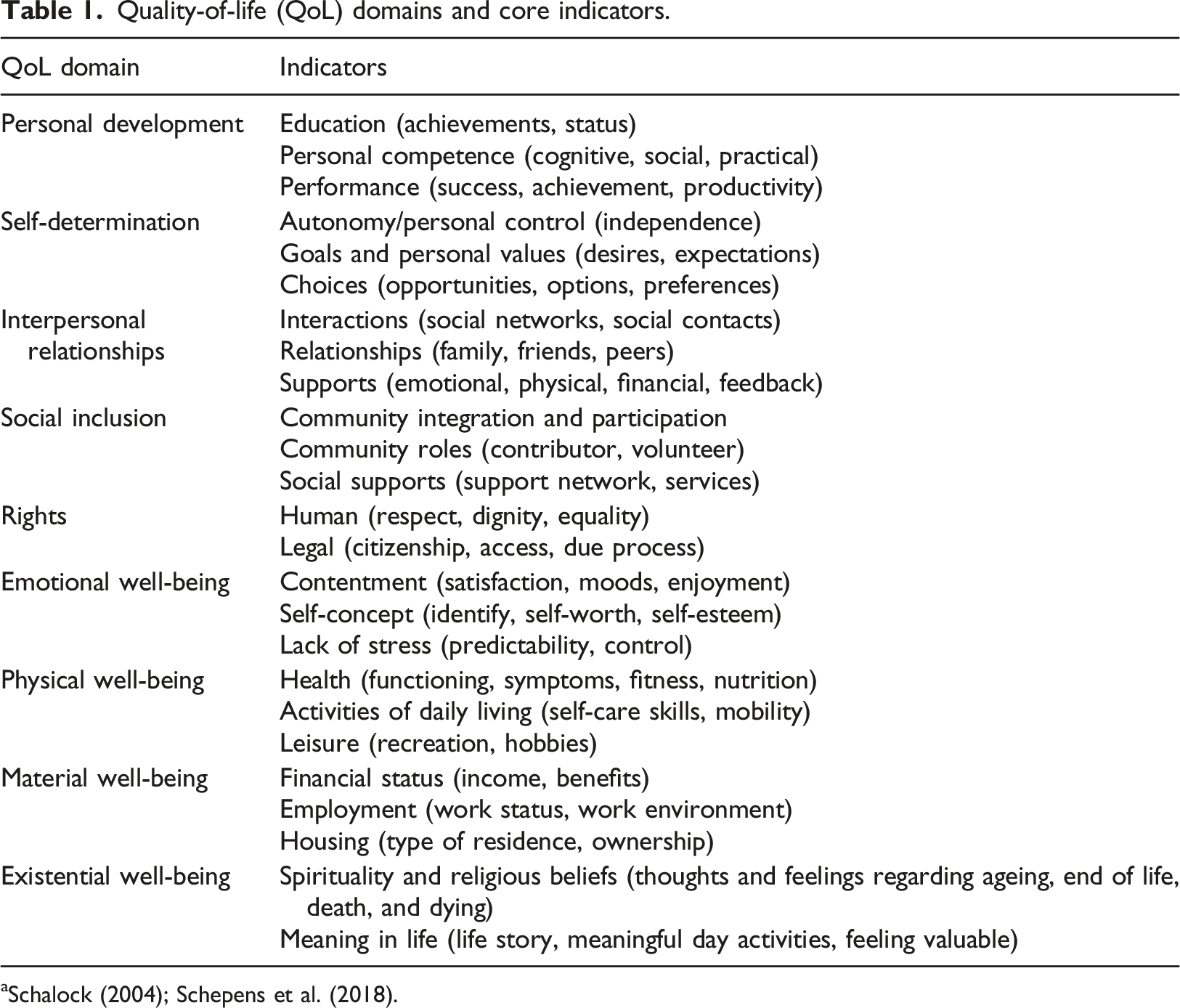
Quality-of-life (QoL) domains and core indicators.
Psychologists are regarded as a valuable source of information for monitoring the support needs of older people with intellectual disabilities. It is part of their profession to provide insight into the entire range of support needs of this specific population across all domains of life. Psychologists have direct contact with individuals with intellectual disabilities on a regular basis, they coach and collaborate with support staff, they consult and are in close contact with experts in other specialist areas (e.g. doctors and occupational therapists), and they possess the competencies needed to analyse cases at the meta-level (Stenfert Kroese & Smith, 2018). Psychologists represent an as yet under-exposed source of professional knowledge that could complement the reported experiences of both support staff (Albuquerque & Carvalho, 2020; Alftberg et al., 2019) and older people with intellectual disabilities themselves (Schepens et al., 2019). These studies indicate that support staff acknowledge that older people with intellectual disabilities are a profoundly diverse group representing different needs and older people with mild intellectual disabilities are capable of talking about their experiences, quality of life, and the support they need. However, these studies also suggest that support staff still need more awareness and knowledge to be able to respond adequately to the different needs and signs of ageing in people with intellectual disabilities. In light of these findings, this study deliberately examined the views and perspectives of psychologists of various care organisations within the Netherlands on older people with intellectual disabilities (≥50 years), aimed at exploring and documenting the most important support needs across all QoL domains. The age criterion of ≥ 50 years was chosen in line with Hermans and Evenhuis (2014), in order to account for premature ageing and the early onset of age-related deficiencies.
Method
A mixed-methods design was applied in this study. In the qualitative part, the support needs of older people with intellectual disabilities were explored and identified. The quantitative part of this study evaluated the importance of each QoL domain for older people with intellectual disabilities (Morse & Niehaus, 2009).
Ethics
After obtaining approval from the Ethical Review Board of Tilburg University (EC-2019.33), the first author selected and invited psychologists to participate. Participants were provided with written and oral information about the nature and purpose of the study. They were further informed that their responses would be audio recorded and processed anonymously, and that they could withdraw from the study at any time.
Participants
All participants are working as psychologist (n = 2 clinical psychologists; n = 9 developmental psychologists) across 11 different residential-care organisations for people with intellectual disabilities in the Netherlands with an average working experience of 10.3 years (SD = 6.8; range: 5–27). Participants were identified and selected through a process of nominated expert sampling (Trotter, 2012) based on their extensive expertise and experience regarding older people with intellectual disabilities. All but one of the participants were female and all participants met the following inclusion criteria: (1) being involved for at least 5 years in the direct care of older people with intellectual disabilities (≥50 years of age) who are living in residential care facilities for people with intellectual disabilities and (2) selected by stakeholders within different care-organisations in the Netherlands because of their unquestionable expertise in the field of older people with intellectual disabilities. No further inclusion or exclusion criteria were applied.
Measures
A semi-structured interview guide based on the QoL model (Schalock et al., 2010) was developed in advance to guide the individual interviews (i.e. Personal development, Self-determination, Interpersonal relationships, Social inclusion, Rights, Emotional well-being, Physical well-being, Material well-being and Existential well-being). The interview consisted of three parts. First, in the qualitative part, participants were asked whether older people with intellectual disabilities in general experience a need for support in each of the nine QoL domains (see Table 1). Then, they were asked to mention the most important support needs that older people with intellectual disabilities experience within each QoL domain based on their own estimation. Finally, they rated the importance of each QoL domain for older people with intellectual disabilities more generally along a scale ranging from 1 (not important) to 10 (very important).
Procedure
Nominated expert sampling was applied by contacting stakeholders within different care organisations in the Netherlands. Researchers asked them for their assistance by nominating potential participants (i.e. psychologists in the support of older people with intellectual disabilities). For each nominated participant, the first author ensured that this person met the inclusion criteria. If the criteria were met, the participant was invited to participate and written information about the study was provided.
After obtaining informed consent from all participants, the first author conducted individual semi-structured interviews by telephone. Each interview lasted 45–60 min and was held at a time convenient to the participant. By using a predetermined, semi-structured interview guide, participants were asked to provide details about the most important support needs older people with intellectual disabilities experience on all domains of QoL. The number of interviews was based on the principle of data saturation (Guest et al., 2006). After 11 interviews, all domains were thoroughly explored in detail, no new information emerged in subsequent interviews and data saturation had been achieved.
Data analysis
In line with the standards for qualitative research (Kratochwill et al., 2010), each of the two authors (MT and WvO) analysed the transcripts of two interviews independently using inductive thematic analysis (Braun & Clarke, 2006), which is a method for identifying, analysing and reporting patterns in data. Each interview yielded a list of most important support needs and corresponding quotes for each QoL domain. Subsequently, the two authors discussed overlaps and divergences with regard to their interpretations and coding decisions until inter-coder consistency was reached and the procedure was further strengthened (Ritchie & Lewis, 2014; Thomas & Harden, 2008). The first author then analysed the remaining nine interviews. To mitigate any potential bias due to working with a single researcher (Zhang & Wildemuth, 2009), the results of all interviews were also discussed within the research team (MT, WvO, KV and PE) until full consensus was reached. Finally, a member check was conducted by sending the lists with the most frequently mentioned support needs in each QoL domain to each participant, to verify that the lists accurately reflected their knowledge and experience (Ritchie & Lewis, 2014). In the quantitative part, descriptive statistics were performed by using SPSS to assess means, standard deviations, median and range for the grades of importance (1–10) of each QoL domain according to the participants. The mean scores were used to rank the QoL domains by importance.
Results
Support needs
Overview of most important needs within each QoL domain identified by psychologists.
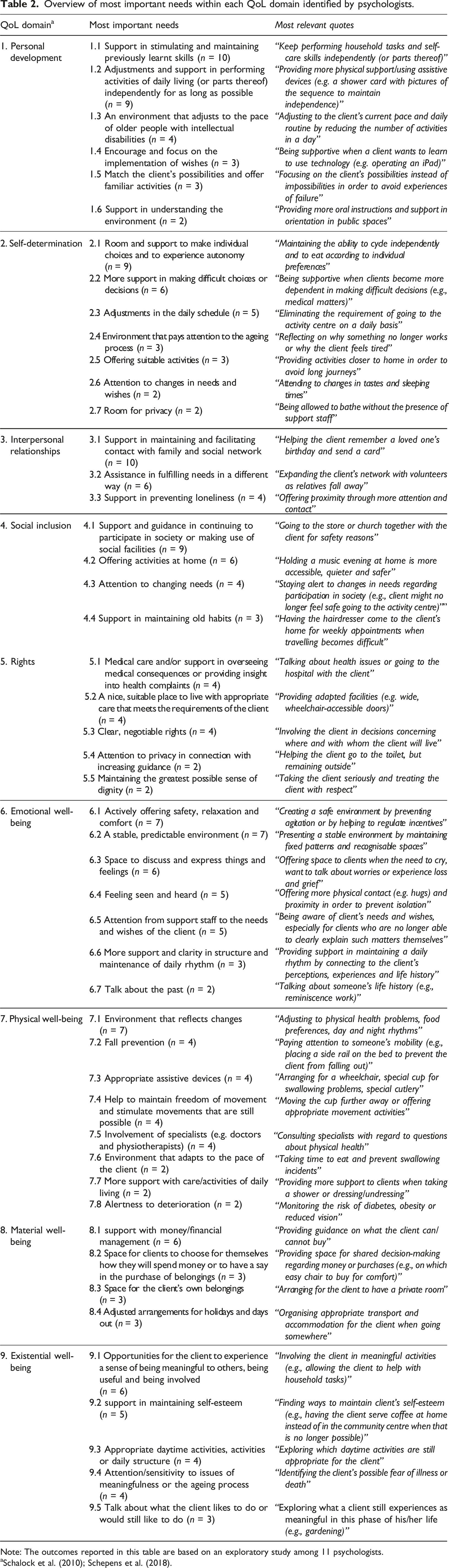
Note: The outcomes reported in this table are based on an exploratory study among 11 psychologists.
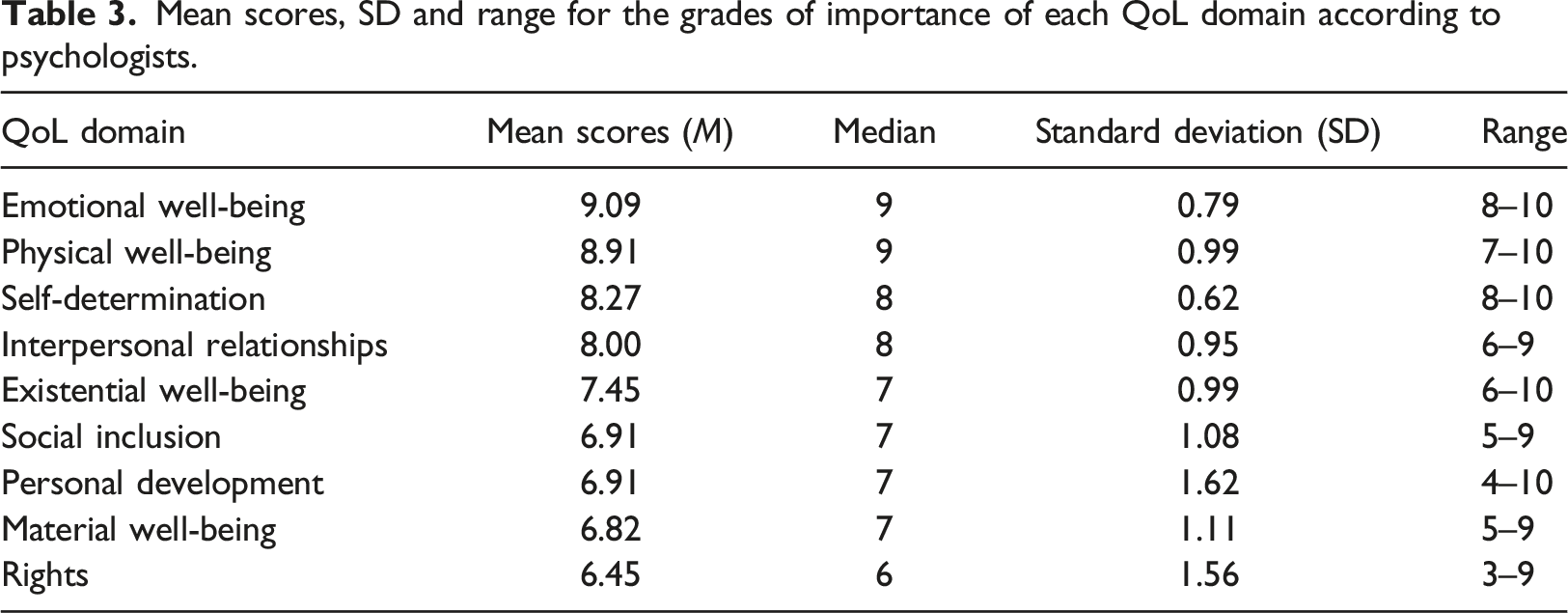
Mean scores, SD and range for the grades of importance of each QoL domain according to psychologists.
Ageing with an intellectual disability: Contextual information
In addition to identifying and prioritising support needs within the QoL domains, the participants provided more general but relevant insights related to ageing with an intellectual disability. These insights provide contextual information that can enhance the interpretation of the results of this study. The psychologists repeatedly emphasised that, in addition to changes in the type and extent of needs throughout the ageing process (e.g. from making coffee or taking a shower independently to being highly dependent on support staff when performing these tasks), the support needs of people with intellectual disabilities increase in number. Second, participants repeatedly highlighted that the majority of older people with intellectual disabilities have been living in residential facilities for most of their lives and that they therefore have no spouses or children who can take care of them. As a result, their social networks become significantly smaller as they age. Third, the participants acknowledged that experiences of grief and loss call for adequate, specialised support, as do questions concerning the end of life.
Discussion
Due to increased longevity, more people with intellectual disabilities experience age-related difficulties which lead to augmentation and changes in their daily support needs (Alftberg et al., 2019; Bigby, 2004; Shoostari et al., 2012). The present study provides an overview of the most important, common-daily support needs of older people with intellectual disabilities, based on the professional knowledge of 11 psychologists. This overview can be seen as an addition to existing knowledge based on the perspectives of support staff and older people with intellectual disabilities themselves as psychologists approach this matter from a different angle (i.e. meta-level). The support needs identified, are related to the entire range of nine QoL domains, and therefore consistent with the gerontologic concept of successful ageing (Fesko et al., 2012). Successful ageing implies that physical, psychosocial, material and existential aspects enable older people to experience increased longevity, QoL and life satisfaction while retaining their functional capabilities. Present data confirm the presence of support needs regarding these specific aspects.
In addition to demonstrating the presence of support needs across all QoL domains, the results underline the importance of each QOL domain for older people with intellectual disabilities. The ratings assigned by the participants suggest that psychologists regard support needs relating to emotional well-being, physical well-being, self-determination and interpersonal relationships as being the most important. The importance attached to support needs within the domain of physical well-being is not surprising, given that older people with intellectual disabilities experience greater physical health needs (e.g. a strong focus on medical and physical domains of life). This is also reflected in the international literature (Navas et al., 2019). Furthermore, the need for social well-being, as referred to in Social Production Function theory (Ormel et al., 1999), clarifies and highlights the established importance of the support needs regarding emotional well-being, interpersonal relationships and self-determination, as indicated in the current study. In particular, older people with intellectual disabilities are likely to encounter emotional life events, due to age-related decline, loss of significant others, forced relocations and difficulties in maintaining their autonomy and self-determination (Hermans and Evenhuis, 2012; Judge et al., 2010; Perkins and Moran, 2010). Moreover, as the social networks of older people with intellectual disabilities shrink, their remaining interpersonal relationships become more important (McCausland et al., 2016). It is, therefore, understandable that the psychologists in this study rated the support needs in these domains as valuable.
Implications for practice
Previous studies demonstrated the multiple and complex nature of the support needs of older people with intellectual disabilities and the significant challenges that they pose for support staff, including the possible lack or requirement of specific knowledge and skills to support this population (Alftberg et al., 2019; Innes et al., 2012; Ryan et al., 2014). With this context in mind, the findings of our study provide several important implications for improving clinical practice and add to existing knowledge. First, the results of this study indicate that psychologists stress the importance of meeting support needs in the entire range of QOL domains (i.e. both the physical and social needs). Psychologists then have the task to effectively coach support staff based on these insights (Stenfert Kroese and Smith, 2018). Additionally, it is also important for support staff themselves to stay aware of the support needs occurring across all QoL domains. Although signs of ageing are mainly associated with medical aspects and physical abilities (Alftberg et al., 2019), the results of our study indicate that the support needs in other QOL domains are equally important. Our overview of concrete, common-daily support needs within each domain could serve as a practical tool that psychologists can use in coaching support staff in the direct care of older people with intellectual disabilities. The results could also be valuable for implementation studies. For example, it would be interesting to investigate ways in which support staff can meet the particular needs of older people with intellectual disabilities and improve their QoL throughout the ageing process. Finally, it might be interesting for future intervention studies to combine the different perspectives (e.g. support staff, psychologists, older people with intellectual disabilities and their informal network) available to develop an integrated approach (i.e. policy development, staff training) which support staff can apply in their daily work. In this approach or training, special attention can be paid to the elements (e.g. support needs) that were reported by all parties, as well as elements that were not collectively revealed.
Study limitations and justifications
This exploratory study is subject to several limitations, which might affect the generalisability of the findings. First, during data collection, no distinctions between levels of intellectual disability (e.g. mild, profound or severe), dual diagnosis with psychiatric disorders or behavioural challenges were made. The level of functioning and differences in behaviour might nevertheless influence the intensity and quantity of support needs experienced by a particular individual. Second, in addition to the experiences of both support staff (Albuquerque & Carvalho, 2020; Alftberg et al., 2019) and older people with intellectual disabilities themselves (Schepens et al., 2019), this study is based solely on the professional knowledge and experiences of clinical and developmental psychologists. For future studies it may, be interesting to outline the experiences and professional knowledge of medical health disciplines regarding the broad range of QOL domains as well.
Conclusion
This study adds to the existing knowledge concerning the support needs of older people with intellectual disabilities from the perspective of psychologists. The interviews provide an overview of broad-ranging daily support needs of older people with intellectual disabilities across all QoL domains. It further identifies the domains of emotional well-being, physical well-being, self-determination and interpersonal relationships as the most important with regard to support needs. The outcomes of this study thus make an important contribution to raising awareness among support staff in the direct care of older people with intellectual disabilities and improving QoL throughout the ageing process.
Footnotes
Acknowledgements
We would like to thank the psychologists who were willing to participate in this study.
Declaration of conflicting interests
The author(s) declared no potential conflicts of interest with respect to the research, authorship, and/or publication of this article.
Funding
The author(s) disclosed receipt of the following financial support for the research, authorship, and/or publication of this article: This study was funded by Philadelphia, a care foundation in the Netherlands. The first and third researcher are employed by Philadelphia. The first researcher is detached as a science practitioner at Tilburg University. Funders played no role in the design, execution, analysis and interpretation of data or writing of the manuscript. Philadelphia Care Foundation has not imposed any restrictions on free access to, or publication of the research data. Furthermore, the research team included external researchers with no links to Philadelphia Care Foundation.
