




Abstract
Inappropriate bricklaying techniques can result in extruded mortar joints, which may partially fill the air gaps within brick veneer timber frame walls. This leads to an unintended connection or “bridge” between the brick masonry cladding and its adjacent layer (such as insulation or weather-resistant barriers). This bridging effect compromises the capillary break function of the air gap, allowing water to reach adjacent layers and intensifying the impact of water penetration, under wind-driven rain (WDR) conditions. This study employs a probabilistic analysis in combination with a machine learning metamodel to investigate the impact of extruded mortar joints on mould growth. The metamodel, developed using the random forests (RF) machine learning algorithm, is used to predict the maximum mould index (MMI). In addition, this study assesses the effects of two different water penetration criteria—ASHRAE and experimental study-based (ES)—on extruded mortar joints under climatic conditions in Gothenburg, Sweden. In order to figure out how different orientations affect the analysis; the study examines the case study from four different orientations. The findings showed that the ES and ASHRAE criteria were in agreement for orientations with substantial WDR loads (e.g. south). On the other hand, the ASHRAE criteria illustrated a higher MMI than the ES criteria in walls facing orientations with relatively small WDR loads (e.g. north). Furthermore, an increased extruded mortar depth and higher MMI were shown to be positively correlated by the linear and non-linear mould sensitivity analyses. However, depending on the WDR loads (or different orientations) and chosen water penetration criteria, this correlation’s strength can vary. The air change rate (negative correlation), the solar absorption coefficient (negative correlation), the WDR’s reduction/splash coefficient (positive correlation), and the thermal conductivity of the Rockwool insulation (positive correlation) were additional important variables influencing the MMI.
Keywords
Introduction
Background
The hygrothermal performance of buildings significantly impacts construction projects with regard to health issues (Fisk et al., 2007; Bayat Pour et al., 2023a), economic outcomes (Bayat Pour and Elsayed, 2020), and material deterioration (Wang et al., 2020). It is widely agreed that modelling the hygrothermal performance of external wall assemblies is essential for identifying and addressing moisture-related issues, including the risk of microbial growth (Künzel and Dewsbury, 2022). Analysing temporal variations in temperature (T) and relative humidity (RH) is essential for assessing the risk of mould growth in exterior walls. Over the past few decades, various mould models have been developed, including International Energy Agency (Hens, 1992), Lowest Isopleth for Mould (LIM; Sedlbauer et al., 2011), the m-model (Wadsö et al., 2022), the Mould Resistance Design (MRD) model (Thelandersson and Isaksson, 2013), and the Finnish mould growth model (Building Physics, 2024) which is the updated version of the VTT model (Ojanen et al., 2007). For a comparative evaluation of these models and their applicability to various hygrothermal conditions, the reader is referred to the review by Gradeci et al. (2017).
Clay brick masonry façades are commonly used in residential buildings due to their longevity and aesthetic value (Kahangi Shahreza et al., 2022). Wind-driven rain (WDR) is a significant source of moisture in Nordic countries, while brick cladding offers effective protection against that (Erkal et al., 2012). When bio-based materials are present, adverse effects such as material degradation and mould growth become more severe (Gholamalipour et al., 2022). According to Abuku et al. (2009), mould growth can be significantly influenced by water penetration caused by WDR loads, particularly at wall edges. Furthermore, the relationship between WDR and water penetration potential in brick walls has been established by various studies (Hens, 2010; Johansson et al., 2014; Matthews et al., 1996; Mumovic and Santamouris, 2019). The noticeable costs associated with rebuilding building envelopes due to rain penetration were highlighted by Kayll (2001). It is mentioned that the water infiltration problems in multi-family wood-frame buildings between 1993 and 2000 resulted in approximately one billion Canadian dollars in damage costs. Watertightness issues accounted for approximately half of the documented building damage cases in Belgium between 2010 and 2015 (Vos et al., 2020), with water penetration through the building envelope being the most common type of damage. In France, rain penetration in the building envelopes constituted 64% of all damage-related expenses reported between 2018 and 2020 (Observatoire de la Qualité de la Construction, 2021). In a survey by Boverket with 822 industry professionals (Kartläggning av fel, brister och skador inom byggsektorn, 2018), 12% of respondents identified rain penetration through facades as an issue, making it the seventh largest moisture issue in Swedish buildings.
Even though water penetration significantly impacts the hygrothermal performance of building envelopes, there is no consensus on the amount of water penetration in brick masonry cladding (Calle et al., 2020; Carbonez et al., 2015). According to the guidelines set out in the North American Standard (ASHRAE, Standard 160-2021, Criteria for Moisture-Control Design Analysis in Buildings, 2021), the moisture source behind the cladding is defined as the deposition of 1% of WDR on the external surface of a wall. The 1% water penetration due to WDR has been investigated in numerous studies (Saber et al., 2014; Straube and Burnett, 1997). However, inclusive evaluations of experimental research have indicated that WDR penetration into clay brick cladding can range from 0% to 20% (Calle et al., 2020; Kahangi Shahreza et al., 2021; Künzel and Zirkelbach, 2008; Van Den Bossche et al., 2011). Although the recommended WDR-induced penetration through the cladding is 1% of rain reaching the surface (ASHRAE, Standard 160-2021, Criteria for Moisture-Control Design Analysis in Buildings, 2021), experimental studies (Fishburn et al., 1938; Straube and Burnett, 1997) demonstrated a delay between the initiation of WDR exposure and the first reported instance of penetration, even when extreme conditions for testing were considered. This related to the fact that a specific saturation level is required in brick masonry before water penetration can occur (Kahangi Shahreza et al., 2021; Straube and Burnett, 1998). Consequently, WDR penetration may not occur in masonry walls that still have the capacity to absorb and retain water. Additionally, it takes time for the surface to reach saturation, after which runoff begins to form which may lead to water penetration. Further, the ASHRAE standard does not distinguish between different external surfaces, including varying textures and material types. Nevertheless, the ASHRAE criterion has been widely adopted due to the lack of consensus on WDR-induced water penetration rates across various exterior cladding surfaces (Calle et al., 2020; Carbonez et al., 2015; Künzel, 2014). This emphasises the importance of employing a method that accurately determines the percentage of water penetration in brick claddings caused by WDR.
There is disagreement not only regarding the amount of water penetration in brick masonry claddings, but also about the location of the moisture source in hygrothermal models. According to ASHRAE 160-2021 (ASHRAE, Standard 160-2021, Criteria for Moisture-Control Design Analysis in Buildings, 2021), the moisture load resulting from WDR-induced water penetration should be placed at the external surface of the weather-resistant barrier. If a weather-resistant barrier is not present, the placement site should be determined based on technical rationale. According to Groot and Gunneweg’s (2010) experimental study, workmanship has the greatest effect on rainwater penetration of masonry walls in historical buildings among the various variables influencing WDR-induced water penetration. Rainwater penetration into brick veneer façades is commonly associated with poor workmanship, such as voids in mortar joints, incomplete bonding, and inconsistent joint finishing, all of which can compromise the water-shedding capability of the cladding system. Mortar extrusion, often occurring simultaneously with these deficiencies, can further exacerbate moisture risks by forming projections into the cavity that trap water or create pathways for capillary transport. Poor workmanship can result in mortar extrusion, which significantly affects the moisture response (Calle et al., 2020; Kahangi Shahreza and Abdul Hamid, 2023). Mortar extrusion can cause moisture-related issues when rainwater penetrates wall assemblies with clay brick masonry cladding. Therefore, to develop a reliable building envelope design, as well as a more precise determination of the deposition site, it is crucial to incorporate the influence of extruded mortar into the hygrothermal analysis process. In the case of considering a WDR-induced water penetration (like 1% in ASHRAE), this percentage is not influenced by the presence of mortar joints but is used as a baseline condition to assess how different extrusion depths affect moisture retention and mould risk. This study focusses on the hygrothermal implications of extruded mortar as a distinct moisture-retaining layer, particularly in relation to mould growth potential in timber frame wall assemblies.
There are inherent uncertainties in modelling extruded mortar joints when combined with hygrothermal analysis. In order to handle uncertainties in hygrothermal performance modelling, probabilistic approaches are employed (Bayat Pour and Abdul Hamid, 2024; Bayat Pour et al., 2024b; Kahangi Shahreza et al., 2024). Certain tools, such as uncertainty propagation, sensitivity analysis, and metamodelling techniques, are crucial for probabilistic hygrothermal analysis, according to Annex 55: Subtask 2 (Janssen et al., 2015). The systematic method for hygrothermal analysis based on a Monte Carlo simulation was introduced by Geving (1997), marking the first publication to perform hygrothermal uncertainty propagation. Afterwards, combining different sampling techniques, such as the multilayered sampling scheme (Tijskens et al., 2021b, 2023) or Latin Hypercube Sampling (LHS; Moon and Augenbroe, 2005, 2008; Zhao, 2012) were performed by several studies, with the objectives of reducing computational time and increasing sampling efficiency.
Monte Carlo methodology is widely employed for probabilistic hygrothermal analysis (Reiter, 2008); however, it is computationally time-consuming and expensive (Tijskens et al., 2021b). To address this, metamodels have been developed. Ramos et al. (2013, 2014) pioneered the use of response surface methodology (RSM) for probabilistic hygrothermal assessments. Marincioni et al. (2018) used generalised additive models (GAM) to evaluate moisture risks in wall assemblies, achieving close approximations to simulations, with minor underestimations. Tijskens et al. (2019a, 2019b, 2021a, 2021b) employed neural networks, finding that convolutional neural networks (CNN) outperformed other models for predicting non-linear hygrothermal patterns. Freire et al. (2017) used support vector regression (SVR) to model hygrothermal parameters with satisfactory accuracy. Aggarwal et al. (2022, 2023) used partial least squares (PLS) regression for Canadian climates. Bayat Pour et al. (2023b) proposed integrating probabilistic methods with random forests (RF) to improve robustness in hygrothermal and mould analysis. Consequently, conducting a probabilistic hygrothermal analysis in combination with a metamodel may help resolve the uncertainties surrounding extruded mortar joints and examine their impact on mould growth.
Objectives and outline of the paper
The main objective of this study is to examine the impact of extruded mortar joints on the hygrothermal performance of wall assemblies across various orientations, considering two different water penetration criteria using AI-based probabilistic approach. The study assesses how extruded mortar joints in clay brick masonry claddings influence the moisture behaviour of timber frame walls, focussing on their susceptibility to mould growth. To achieve this, a hybrid probabilistic and machine learning framework is employed, supported by both linear and non-linear sensitivity analyses. The analysis is simulation-based and evaluates, through coupled 1D and 2D hygrothermal models, how different extrusion depths alter cavity ventilation and moisture accumulation conditions. Physical simplifications are introduced to enable a scalable probabilistic framework, while metamodelling techniques are applied to efficiently propagate uncertainties and assess parameter sensitivities.
Building upon the earlier research (Bayat Pour and Kahangi Shahreza, 2024), which introduced a Monte Carlo-based probabilistic framework for mould reliability and sensitivity analysis of traditional wall assemblies, the present study advances the methodology by developing an AI-based probabilistic approach. This approach employs a Random Forests (RF) machine learning algorithm to replace time-consuming Monte Carlo simulations, enabling large-scale uncertainty analysis with improved computational efficiency and predictive accuracy. Together, the development of the AI-based probabilistic method and its application to a new case study typology constitute the main novelties of this work.
Methodology
Case study
Figure 1 (left side) shows a case study of lightweight wood frame walls with brick veneer, a common type of wall construction in Sweden, where timber studs are placed within the insulating layer (Hall and Vidén, 2005; Kahangi Shahreza and Abdul Hamid, 2023). The use of wooden materials in these frames makes them particularly susceptible to mould growth, which could result in health concerns for occupants (Bayat Pour et al., 2023a). Figure 1 (right side) illustrates the occurrence of mortar extrusion that may have taken place during the bricklaying process. A schematic of the extruded mortar, which is the focus of this study, is shown. Notably, the mortar water content and workmanship involved in the bricklaying process could influence the morphology and dimensions of the mortar.
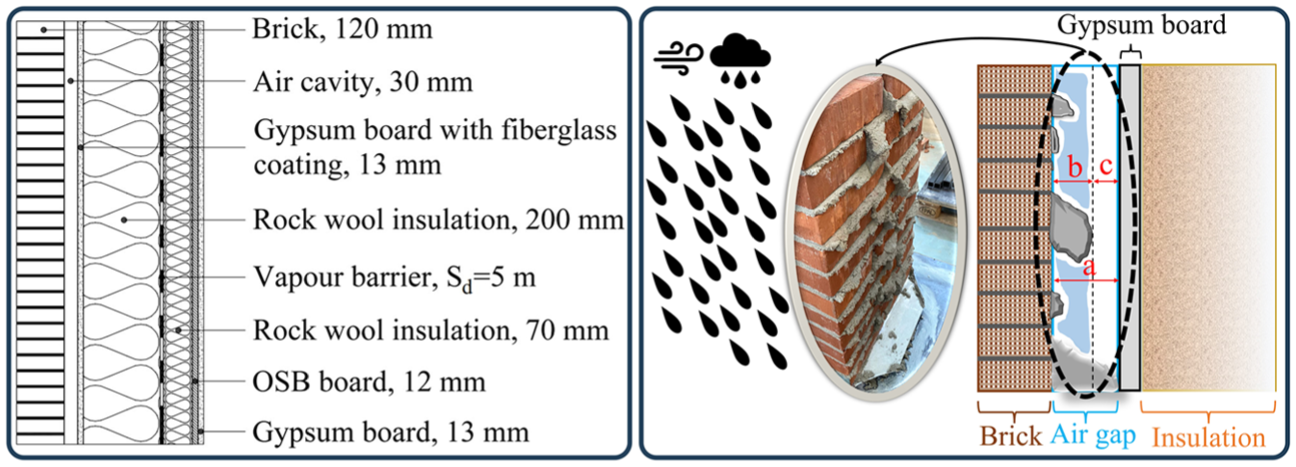
Left: External wall assembly as a case study. Right: Mortar extrusion phenomenon for clay brick cladding (the dimensions are not scaled). (a) [mm]: whole air gap thickness, (b) [mm]: extruded mortar thickness, and (c) [mm]: net air gap thickness. Grey clouds: extruded mortar. Blue clouds: existing air between extruded mortar.
The air gap layer, which facilitates air exchange and interferes with the moisture transfer mechanism, is shown in Figure 1 between the brick layer and the gypsum board. The gypsum board is attached to the combined layer of timber studs and insulation. Poor workmanship during bricklaying can lead to mortar extrusion that could partially fills the air gap layer, thereby facilitating moisture to transfer from the brick layer to the other layers of the wall. As shown in Figure 1 (right), the extruded mortar, represented by grey clouds, may either fall into the air gap or remain within the air gap area in front of the joint, where it subsequently dries. In the worst-case scenario, the extruded mortar could create a bridge between the brick and the weather-resistant barrier (fibreglass gypsum board in this study), thus compromising the air gap and increasing the risk of moisture-related issues. In this study, the effect of extruded mortar is incorporated into the hygrothermal modelling for a more appropriate understanding of this phenomenon. While mortar extrusion can be modelled accurately using a two-dimensional (2D) hygrothermal analysis, applying 2D models in a probabilistic approach can be highly time-consuming. Therefore, the aim of this study is to develop a one-dimensional (1D) model with a customised material that serves as an acceptable alternative for representing the mortar extrusion layer. After verification through a limited number of 2D hygrothermal simulations, the 1D model is employed for the probabilistic modelling to ensure a balance between accuracy and computational efficiency.
1D hygrothermal model
Delphin 6.1 (Delphin, 2021), a comprehensive numerical simulation tool for the combined heat, air, and moisture (HAM) transport modelling, is used to analyse the hygrothermal performance of the building envelope assemblies. The outermost surface of the wooden stud was selected as the target screening point. This location was chosen because the wooden stud is a moisture-sensitive component in timber frame walls, making it particularly vulnerable to mould growth. Monitoring this spot helps assess the potential for mould development, which, as noted in Viitanen (1996), can lead to odours and health issues for occupants.
According to SS EN 15026 (EN 15026:2007, 2007), indoor climatic conditions can be modelled based on outdoor T:
Indoor T fluctuates between 20°C and 25°C when outdoor T is between 10°C and 20°C.
When the outdoor T is below 10°C, the indoor T is fixed at 20°C. If the outdoor T exceeds 20°C, the indoor T is set to 25°C.
For indoor RH:
If the outdoor T is between −10°C and 20°C, the indoor RH linearly varies between 35% and 65%.
When the outdoor T falls below −10°C or rises above 20°C, the indoor RH remains fixed at 35% and 65%, respectively.
The WDR is modelled in Delphin 6.1 using the ISO 15927-3 standard (ISO 15927-3:2009, 2009), which considers microclimatic factors such as terrain, topography, obstacles, and wall-specific conditions to enhance the accuracy of hygrothermal simulations.
In the hygrothermal model, the mesh sizes are automatically adjusted across the different layers based on their thicknesses, ensuring an optimal balance between accuracy and computational efficiency. A minimum mesh size of 1 mm and a stretch factor of 1.3 are applied. This approach allows for finer meshes in thinner layers while still maintaining computational efficiency, making the simulation process both reliable and feasible for complex assemblies (Bayat Pour and Kahangi Shahreza, 2024).
According to Vereecken and Roels (2013), the masonry wall can be modelled as a homogeneous brick layer under real climatic conditions to simplify the hygrothermal modelling procedure. The limitations of this simplification have been highlighted by Johansson et al. (2014). However, this simplification is not extended to the extruded mortar region, which is explicitly represented as a distinct layer with composite hygrothermal properties derived from a mixture of mortar and air. The use of a homogeneous brick layer supports model tractability and computational feasibility in the probabilistic analysis, while the separate treatment of the extrusion enables detailed investigation of its influence on moisture transport and mould growth.
Choosing a representative material for the mortar extrusion layer in 1D hygrothermal modelling can be challenging since this layer (the layer denoted by dimension b in Figure 1, right side) is partially filled with mortar. It means that, the extruded mortar layer is composed of a mix of mortar (represented by grey clouds in Figure 1, right side) and air (represented by blue clouds in Figure 1, right side). Therefore, using standard air, which has a saturation point of about 0.017 kg/m3, for the 1D extruded mortar layer is inappropriate, as it does not adequately represent the hygrothermal behaviour of this mixed material layer. In Delphin, excess water is automatically removed from the moisture balance equation when moisture contents exceed the saturation point (Calle et al., 2020). On the other hand, in 1D modelling, it is neither realistic nor representative to consider pure mortar as the extruded mortar layer; thus, a customised material is considered to overcome these challenges. To prevent unrealistic moisture transport, liquid convection is disregarded for this layer, and vapour diffusion is considered the primary mechanism for moisture transport. For this mechanism, the water absorption coefficient (Aw) should be set to zero. The saturation point from the mortar material properties (θeff = 0.21 m3/m3) is used, and the moisture storage function is formulated using the mortar sorption isotherm. The assumption that vapour diffusion is the dominant moisture transport mechanism within the extruded mortar layer of the 1D model is grounded in field observations showing that such extrusions typically consist of irregular, partially detached lumps of mortar that disrupt capillary continuity. These protrusions are effectively a heterogeneous mix of air and mortar. To reflect this behaviour in the 1D simulations, the capillary liquid transport mechanism is disabled by assigning an Aw of zero, so that only vapour diffusion is considered for moisture redistribution. This approach is implemented in Delphin through a customised material definition and represents a conservative assumption in which moisture retention in this layer is not underestimated. Importantly, preliminary simulation tests confirmed that if liquid transport were allowed in the 1D framework, the modelled extruded layer behaves unrealistically as a continuous sponge that absorbs and retains large quantities of water along the entire wall height. This leads to excessive and unrealistic moisture accumulation and associated risks that are not supported by empirical evidence. These outcomes, confirmed through several rounds of simulations and iterations (1D simulations against 2D simulations), provide further justification for the modelling approach adopted in this study. Air and vapour permeability are influenced by the porosity, which is set at 0.5 m3/m3. Other material properties are adopted using the air properties from Delphin’s default settings for the customised material. This configuration ensures that the extruded mortar layer can hold any unexpected moisture inflow up to the mortar material’s saturation point.
The depths of the extruded mortar, defined using the LHS technique, are incorporated into the probabilistic model for each scenario. A uniform distribution is used with a range between 0 mm to 30 mm, indicating an equal likelihood of having no extruded mortar or a maximum depth of 30 mm. The entire depth of the extruded mortar is considered as the moisture source element, that is, the moisture source is spread over the entire depth of the extruded mortar. The thickness of the extruded mortar (denoted as dimension b in Figure 1, right side) is considered to calculate the net air gap thickness (denoted as dimension c in Figure 1, right side) using equation (1). This approach allows the model to dynamically adjust the ventilation potential of the air gap in each simulation scenario based on the degree of obstruction introduced by mortar extrusion. Thus, scenarios with greater extrusion result in narrower air gaps and, consequently, reduced ventilation and drying potential. The ACR values used in the model reflect this geometry-sensitive ventilation mechanism and are applied accordingly in the 1D boundary condition setup.

The boundary conditions and material properties used in this study are presented in Tables 1 and 2, along with relevant references. The brick material properties listed in Table 2 are obtained from experimental investigations (Kahangi Shahreza et al., 2022), supplemented with data from relevant literature (Zhao, 2012). The outdoor convective heat exchange coefficient is computed using data from the Delphin database (Delphin, 2021), which varies from 12 to 20 W/(m2 K), depending on the wind exposure conditions (EN 15026:2007, 2007). This coefficient is then used to calculate the outdoor vapour diffusion coefficient, as these parameters are correlated. Two other input variables—solar absorption coefficient and long-wave emissivity—are determined by the surface texture and colour, with ranges of 0.4–0.8 and 0.85–0.95, respectively (Delphin, 2021). The amount of splashed WDR is considered by using a reduction/splash coefficient of WDR. The default value in Delphin is 0.7, indicating that 30% of the WDR is splashed after hitting the wall. In this study, a variation range of ±0.1 is assigned to this variable to account for associated uncertainties (Bayat Pour et al., 2023b). The effect of indoor airflow direction is considered by adjusting the interior surface heat transfer coefficient, which ranges from 5 to 10 W/(m2 K) according to (ISO 6946:2017, 2017).
Probability distribution values for indoor and outdoor conditions.
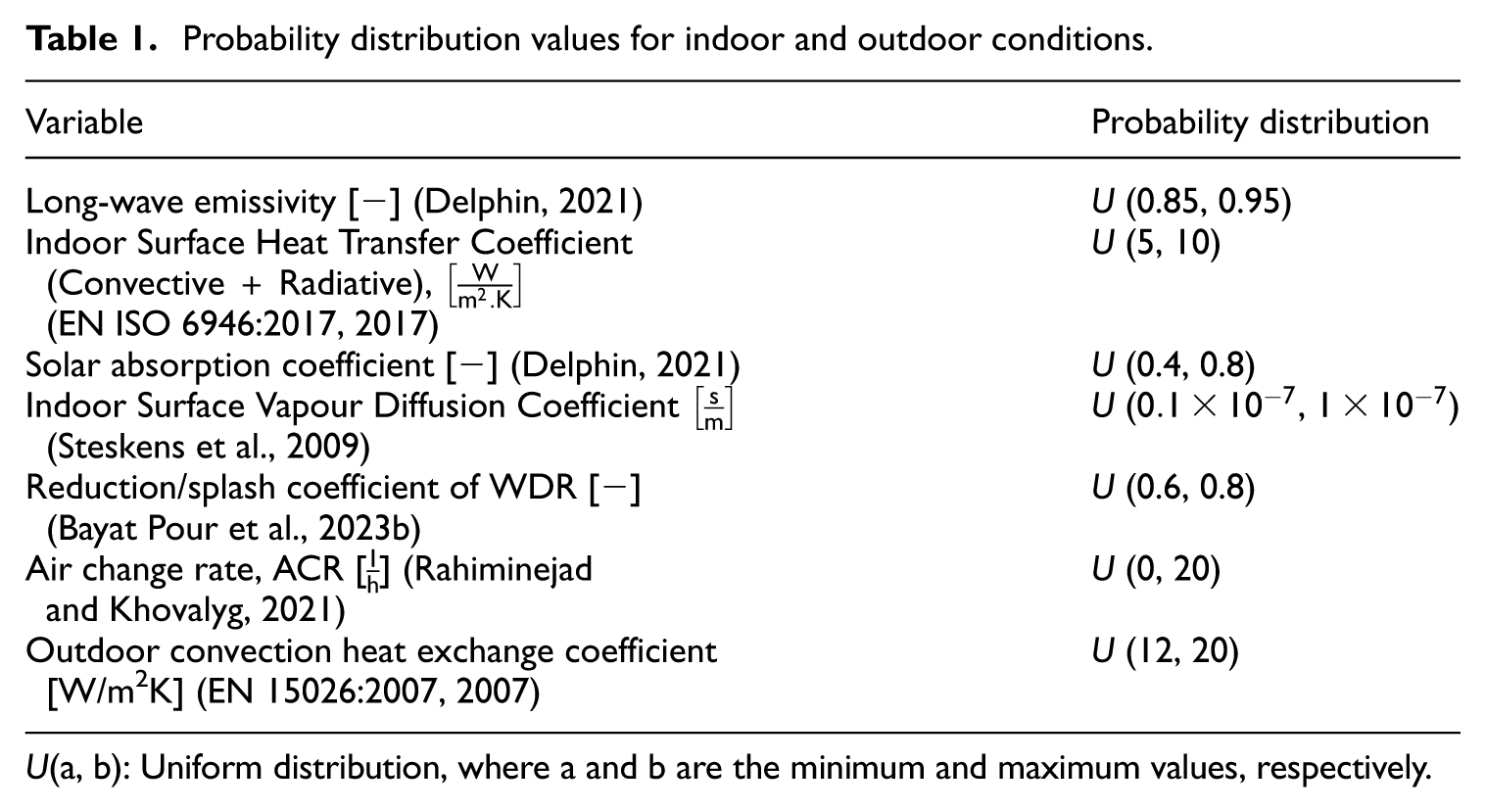
U(a, b): Uniform distribution, where a and b are the minimum and maximum values, respectively.
Probability distributions for the material properties.
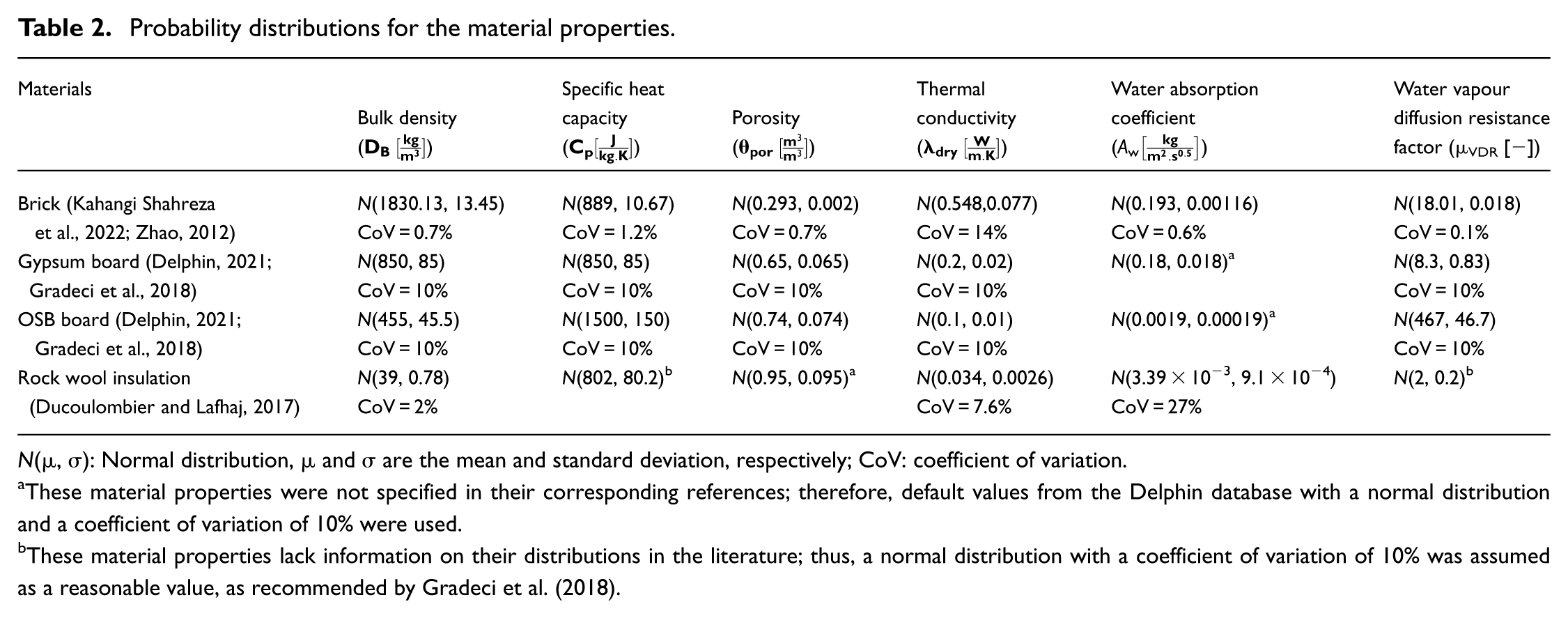
N(µ, σ): Normal distribution, µ and σ are the mean and standard deviation, respectively; CoV: coefficient of variation.
These material properties were not specified in their corresponding references; therefore, default values from the Delphin database with a normal distribution and a coefficient of variation of 10% were used.
These material properties lack information on their distributions in the literature; thus, a normal distribution with a coefficient of variation of 10% was assumed as a reasonable value, as recommended by Gradeci et al. (2018).
A uniform distribution was assigned to all parameters listed in Table 1 to ensure equal probability across their defined ranges. This choice was made for two main reasons. First, some parameters (e.g. solar absorption coefficient and longwave emissivity) are closely related to surface colour and texture, which are often determined by occupant or designer preferences. Using a uniform distribution allows all possible values to be treated as equally likely, reflecting this user-dependent variability. Second, for parameters such as air change rate and the reduction/splash coefficient of WDR, no reliable empirical distributions were found in the literature. Since these values depend on a range of building-specific and environmental factors, it was decided to apply uniform distributions to avoid making unsupported assumptions. This ensures a conservative and unbiased representation of uncertainty.
The vapour diffusion resistance factors (µ-values) listed in Table 2 were selected based on literature and hygrothermal databases to represent conservative conditions appropriate for mould risk assessment. For brick, a µ-value of 18 was selected. This value is consistent with literature for dense, low-porosity clay bricks, and aligns with the material characteristics of the bricks tested in the laboratory for the ES-based moisture penetration criterion.
2D hygrothermal model
Figure 2 shows both 1D and 2D hygrothermal models used in this research that aim to assess the accuracy of the 1D model against the more detailed 2D model. 2D modelling was performed using Delphin 6.1 to verify the 1D model. Since 1D modelling involves a simplified representation of wall assemblies, 2D simulations were conducted in selected scenarios to confirm the accuracy of the 1D simulation results. 2D hygrothermal models are developed, using ASHRAE water penetration criteria for the southern orientation in order to verify the proposed 1D hygrothermal model, focussing on three scenarios: low mortar extrusion (5 mm), high mortar extrusion (25 mm), and a base case with no mortar extrusion. Each scenario considers a 30 mm air gap width. In the 1D model, the extruded mortar layer is represented by a customised material, which is a mix of air and mortar. Meanwhile, the 2D model incorporates standard mortar and air properties, with the mortar elements (depth and position) randomly positioned within the airgap. Variations in the position and volume of the moisture source, influenced by the depth and location of mortar extrusion, are implemented separately in the model setup. Both models (1D and 2D) share the same input conditions for the hygrothermal simulations, ensuring consistency in the verification analysis. The material properties of the mortar are presented in Table 3.
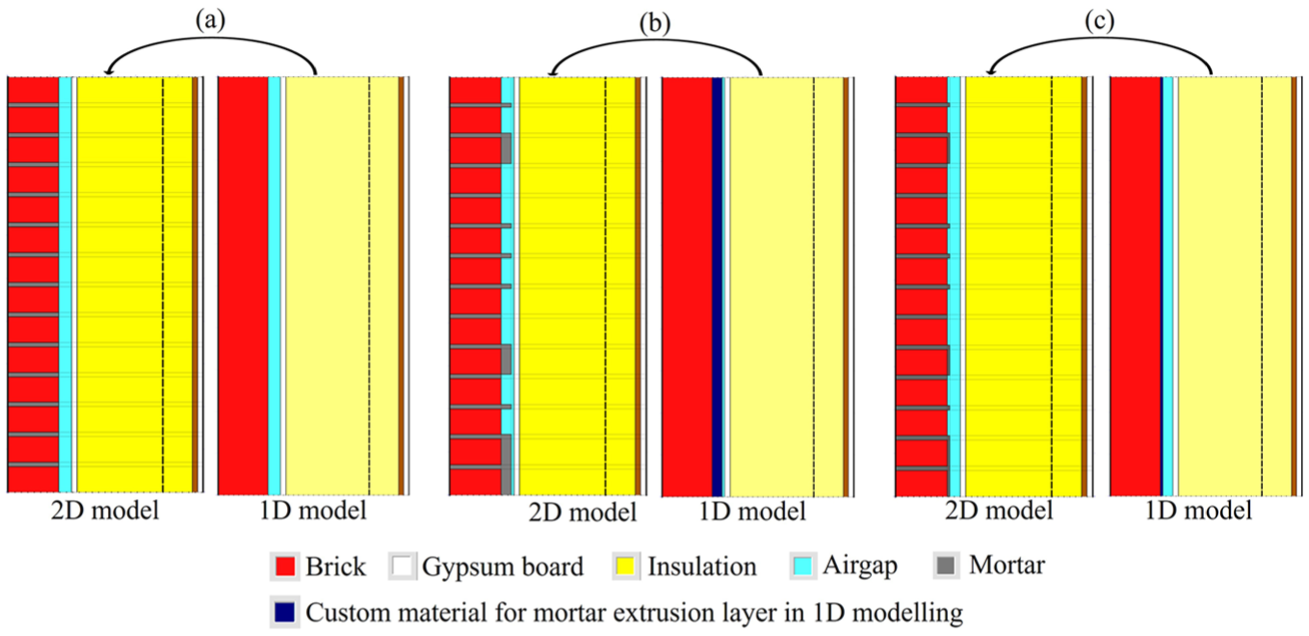
1D versus 2D modelling for hygrothermal model verification: (a) base case, (b) high mortar extrusion (25 mm), and (c) low mortar extrusion (5 mm).
Material properties of mortar.
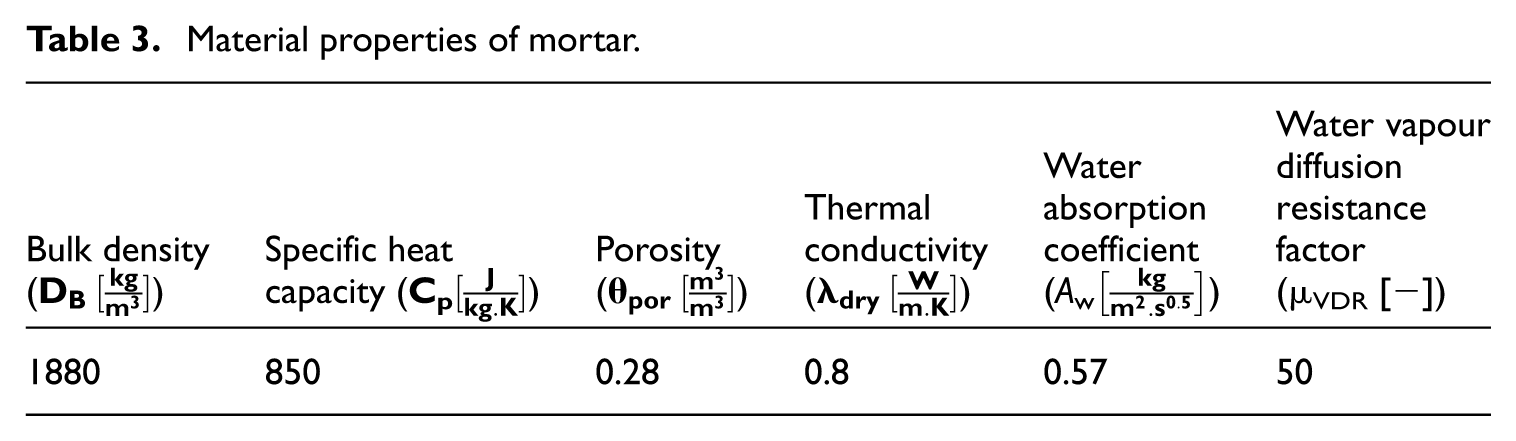
In the 2D simulations, extruded mortar was represented using standard mortar material properties from the Delphin database, which include both water vapour diffusion and liquid water advection mechanisms. This reflects a more physically realistic modelling of moisture behaviour in continuous porous materials. The 2D model assumes the extruded mortar can be dried out through both vapour and liquid mechanisms. This contrasts with the 1D model, where the extruded mortar layer is treated as a discontinuous, vapour-only transport medium.
Figure 3 presents a side-by-side comparison of the complex moisture dynamics occurring in practice (right) versus the simplified assumptions used in the 1D modelling framework (left). In real conditions, when WDR impacts the external brick surface, the rainwater separates into three parts:
Splashing away from the wall (due to surface geometry and rain impact angle),
External surface runoff (water draining downward over the brick façade),
Absorption into the brick-and-mortar pores.
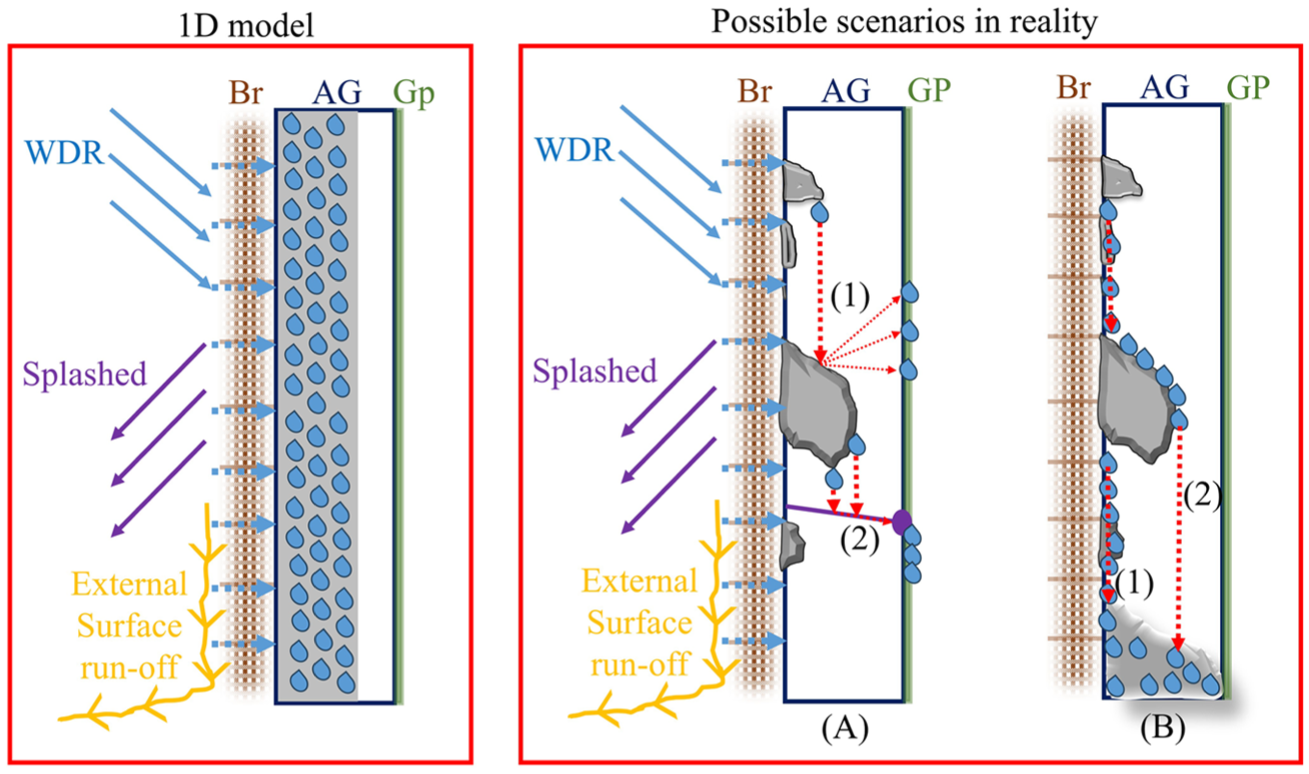
Comparison of 1D simulation of the wind-driven rain (WDR)-induced water penetration interaction with brick veneer cavity walls featuring extruded mortar with the complex moisture dynamics occurring in practice.
In practice, only the absorbed portion has the potential to penetrate deeper into the wall assembly (in the ideal brick veneer without crack and imperfections). Capillary bridging effects may occur if mortar extrusion connects the outer façade to internal materials. The behaviour of penetrated moisture is then governed by cavity ventilation conditions, material properties, and drying potential. However, in this study, for modelling consistency and to enable probabilistic simulation, a fixed percentage of the total WDR impacting the façade (e.g. 1% according to ASHRAE 160) was assumed as the moisture source input, without distinguishing between splashed, absorbed, or runoff fractions.
The 1D model (left panel of Figure 3) assumes that when rainwater penetration criteria (ASHRAE or ES-based) are met, a fixed amount of moisture is directly introduced into a predefined layer—specifically, the depth corresponding to the extruded mortar thickness. The model neglects lateral redistribution, secondary reabsorption, vertical runoff accumulation, and multidirectional drying within the cavity. The extruded mortar acts as a storage layer, uniformly retaining the introduced moisture.
By contrast, the right panel of Figure 3 shows more realistic and localised phenomena that happens in the reality. Four broad scenarios are shown:
Scenario A1: Droplets dripping from an upper extruded mortar impinge on lower mortar extrusions, causing secondary splashing onto nearby surfaces.
Scenario A2: Dripping water strikes wall ties, potentially transferring moisture into internal layers if wall tie slopes are incorrect.
Scenario B1: Rainwater runoff within the cavity collects at the wall base, where accumulated mortar can absorb large quantities of water.
Scenario B2: Dripping runoff water accumulates at the cavity bottom and is absorbed into ground-level mortar deposits, increasing base-level moisture risks.
Outdoor climate data
In this study, hygrothermal analyses are conducted over a 5-year period (2018–2023) using historical climate data at hourly intervals. To reduce the effect of initial conditions on the simulation outcomes, the climate data for 2018 are repeated twice prior to the primary simulations, establishing a 2-year initialisation period. As a result, the outputs from the 5-year period (2018–2023) are used for further analyses. The analyses focus on four different façade orientations—north, east, west, and south—under the climatic conditions of Gothenburg, one of the cities in Sweden with highest annual WDR load (Johansson et al., 2014).
The primary source for outdoor climate data in this study is the Swedish Meteorological and Hydrological Institute (SMHI; Swedish Meteorological and Hydrological Institute (SMHI), 2024), which provided variables such as rain intensity [mm/h], air pressure [hPa], T [C], RH [%], shortwave diffuse and direct radiations [W/m2], wind velocity [m/s], and wind direction [°]. Since SMHI lacks data on long-wave counter radiation, this data is supplemented using Meteonorm (Meteonorm (en), 2024), which generated hourly climate data for a representative year based on actual measurements.
Water penetration criteria
The ASHRAE standard 160-2021 (ASHRAE, Standard 160-2021, Criteria for Moisture-Control Design Analysis in Buildings, 2021) outlines a widely used methodology for assessing water infiltration through external surfaces. This standard designates a default water penetration rate of 1% for the rainwater adhering to the exterior surface of the wall assemblies. The primary location for this moisture source is identified as the outer surface of the weather-resistant barrier. Nonetheless, with the proper technical rationale, alterations can be made to this deposition point. Because Delphin applies this fraction only after subtracting splash losses, the input was corrected by dividing 1% by the splash coefficient (typical value is 0.7), in order to comply with ASHRAE’s definition of “total incident rain.” Both the position and volume of the moisture source are modified based on the depth of the extruded mortar, with the moisture source being distributed across the entirety of the extruded mortar’s depth.
Kahangi Shahreza et al. (2022) have developed an alternative criterion for water penetration that is based on the moisture content of the brick veneer. Their experimental study demonstrated that if masonry walls are capable of absorbing and retaining water induced by WDR, penetration may not occur. Specifically, penetration will happen only when the masonry wall gets nearly saturated. Building on their findings, the experimental-based water penetration criterion (referred to as ES in this paper) has been established. Consequently, a portion of the WDR, referred to as the fraction of normal rain in the hygrothermal simulations, penetrates and is modelled as the moisture source in the hygrothermal analysis. In the ES-based criterion, developed from laboratory testing, the volume of penetrating water is derived as a fraction of the total water sprayed in the experiment and is applied not at a fixed depth, but across the full thickness of the extruded mortar layer, which varies per scenario (similar to ASHRAE criterion). This treatment assumes that extruded mortar acts as a localised retention zone, holding penetrated water proportionally to its volume. The probability distributions for the saturation level threshold, saturation point, and fraction of normal rain flow for the tested brick are provided in Table 4. Due to the statistical fitting of the rain infiltration fraction distribution to a limited number of experimental data points, a very small number of samples resulted in minor negative values. Since negative rain infiltration is not physically possible, these samples were conservatively corrected by setting the value to zero, ensuring physical consistency in all probabilistic scenarios.
Experimental data of the brick (probability distributions) with the fraction of normal rain consideration as the moisture source (Kahangi Shahreza et al., 2022).
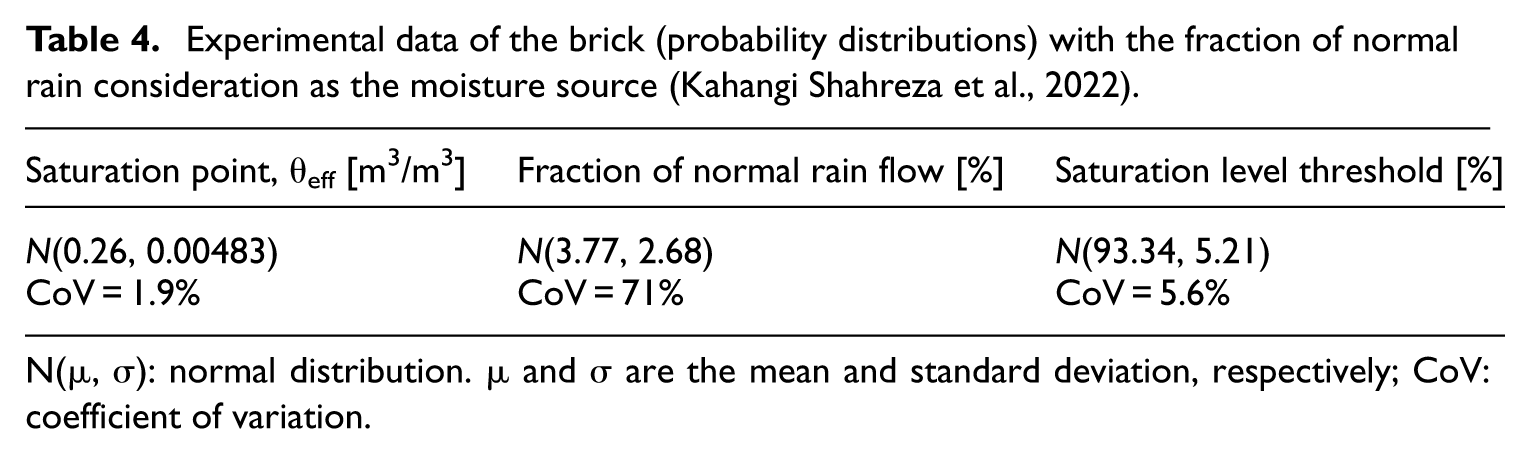
N(µ, σ): normal distribution. µ and σ are the mean and standard deviation, respectively; CoV: coefficient of variation.
Probabilistic mould growth analysis
The present study employs probabilistic hygrothermal analyses to evaluate a case study’s hygrothermal performance under different scenarios. Based on these results, the study further analyses the risk of mould growth using a mathematical mould growth assessment model (Building Physics, 2024). In this study, the probabilistic hygrothermal analysis is performed using the mould reliability analysis (MRA) approach, originally introduced by Bayat Pour et al. (2023b). Figure 4 illustrates the MRA approach, which consists of two main sections: probabilistic analysis (PA) and metamodel analysis (MA), represented by dashed-line boxes. The PA section includes sampling, hygrothermal simulations, and mould growth assessment. The approach starts with conducting simulations for 10 datasets each with 100 scenarios. These scenarios are generated using the LHS technique. At each subsequent iteration, 100 new samples are appended to the previous dataset (i.e. 100, 200, …, 1000 samples), forming 10 datasets corresponding to the first 10 iterations required by the convergence method. After these initial 10 iterations, additional datasets are generated only if the convergence criterion is not met.
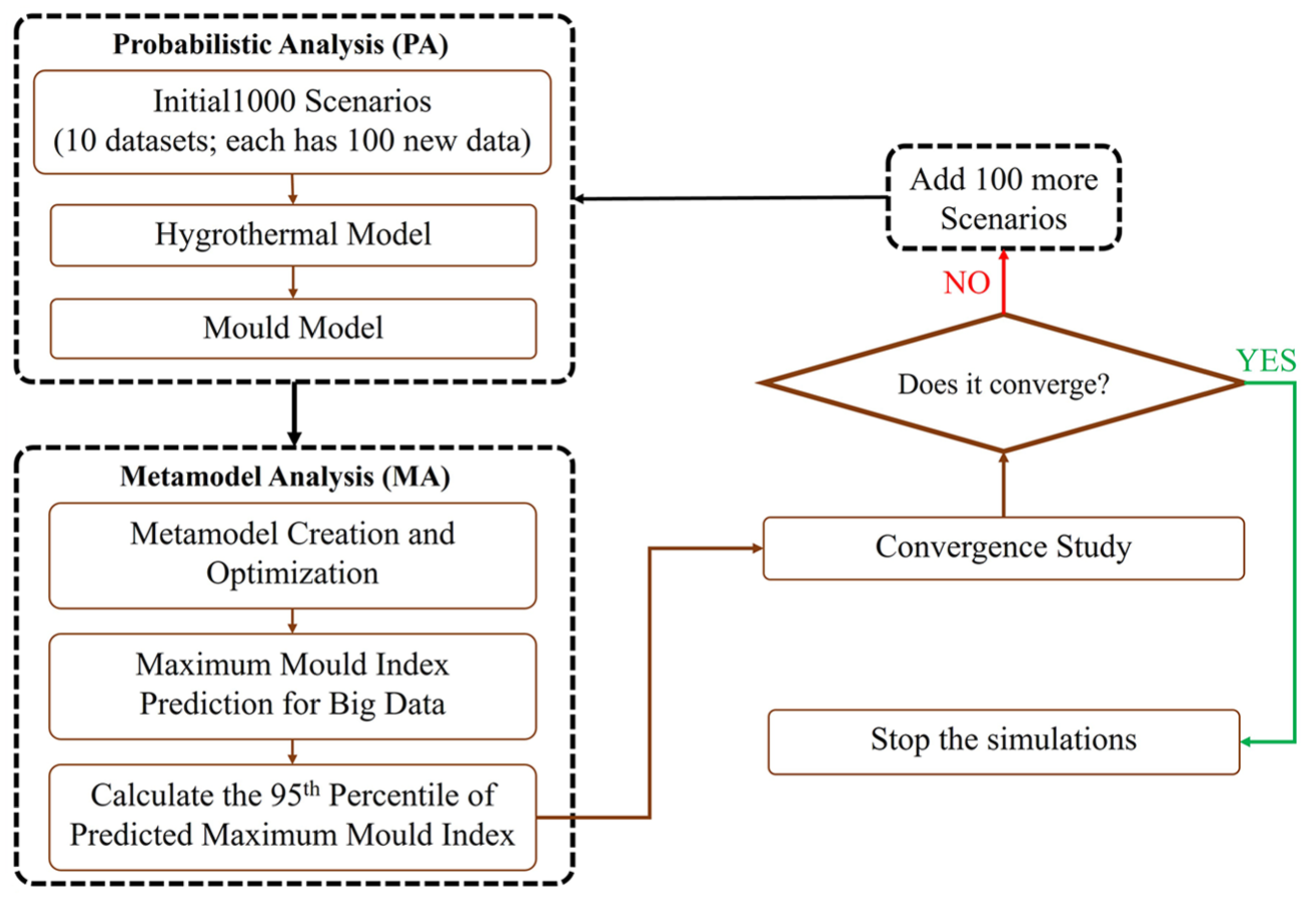
Probabilistic mould growth analysis procedure.
The MA section involves creating the metamodel, predicting maximum mould indices (MMI) and calculating their 95th percentile. This metric reflects near-worst-case outcomes, which are relevant in safety-based design and regulations. A metamodel is developed using the random forests (RF; Breiman, 2001) machine learning algorithm that addresses the time-consuming nature of real simulations.
The purpose of the probabilistic framework is to quantify mould growth risk under variability in environmental exposure and material properties. Given the uncertainty in the input variables such as material properties and boundary conditions, probabilistic analysis is used to capture a potential range of outcomes. The probabilistic approach supports both risk-based interpretation (e.g. 95th percentile outcomes) and the identification of input variables most responsible for elevated risk.
The PA section concludes with a mould assessment using the Finnish mould growth model (Building Physics, 2024), which is based on the VTT model (Ojanen et al., 2007; Viitanen and Ojanen, 2007). The Finnish mould growth model characterises mould development with an index ranging from 0 to 6 (Building Physics, 2024), providing a framework for mould assessment. Notably, it is broadly applicable to various building materials, accounting for the effects of coatings and surface types through decline and sensitivity classifications. The mould growth can decline when unfavourable conditions persist for more than 6 or 24 h, while no decline is assumed for periods between 6 and 24 h (Ojanen et al., 2007). Equation (2) is used to determine the MMI based on the hourly mould indices obtained from the Finnish mould model:

Sampling
The LHS technique (Wyss and Jorgensen, 1998) is employed for both the PA and MA sections. The present study builds upon an improved sampling approach, as suggested by Bayat Pour et al. (2024a), with the objective of minimising the risk of insufficient RF extrapolation of the developed metamodel. This approach compares the ranges of the samples used for hygrothermal simulations with those used for metamodel predictions, subsequently adding any additional ranges that fall below the minimum or exceed the maximum of the metamodel samples to the range of the hygrothermal simulation samples. In the PA section, a uniform distribution is also applied to all input variables. This approach was adopted to avoid the normal distribution, which tends to concentrate samples around the mean. It is crucial to ensure a diverse training set with data points covering the entire range of values for each variable in the chosen distribution. This goal can be achieved by employing a uniform distribution, which assigns equal weight to all segments of the variable distributions. Consequently, this enhances the performance of the developed metamodel by incorporating extreme scenarios and prevents the model from overfitting to average outcomes.
Metamodel creation
The RF algorithm (Breiman, 2001), which is well-known for its efficiency in handling regression and classification tasks, is employed in the MA section. The widespread use of the RF algorithm is primarily due to its interpretability, computational efficiency, robustness of metamodels, and its ability to handle nonlinear relationships (Bayat Pour 2023b). As described in Bayat Pour et al. (2023b), the feature selection process is the first step in developing a metamodel in the MA section. The optimal number of features to include in the metamodel is determined through a parametric analysis during this process. The most effective features are identified by iteratively analysing the number of features that yield the highest coefficient of determination (R2) between the observed and predicted MMI. To facilitate model training and evaluation, the dataset is then randomly divided into training (70%) and testing (30%) subsets.
The accuracy of the trained metamodel is evaluated using the coefficient of determination (R2) and the mean absolute error (MAE), as represented in equations (3) and (4).


Here, n represents the total number of original data points,
To achieve optimal performance of the metamodel, fine-tuning of the RF model’s hyperparameters is required. In this study, the RF model was optimised by adjusting various parameters, including the number of trees, selecting the most relevant features, and using out-of-bag samples to estimate the generalisation score. The remaining hyperparameters were set to the default values specified in (scikit-learn, 2024).
The metamodel is introduced not as a modelling goal in itself, but as a surrogate tool to reduce computational cost and enable efficient uncertainty propagation and sensitivity analysis. It approximates the maximum mould indices for a big dataset (n = 107) of the scenarios of the 1D hygrothermal simulations over the sampled input space. Once its accuracy is examined, the metamodel allows the analyst to explore thousands of scenarios, identify dominant variables, and perform convergence checks—all without needing to rerun the full Delphin model.
It should be noted that the present study uses an AI-based metamodel developed using the RF machine learning algorithm, as previously verified in Bayat Pour et al. (2023b). The metamodel allows the consideration of millions of scenarios and facilitates extrapolation beyond the training dataset, thereby accounting for a broader range of uncertainties. Applying this approach to the mortar extrusion problem extends the methodology and improves the robustness of probabilistic moisture analysis in building envelopes.
Convergence study
To determine an adequate number of simulations in the PA section, a convergence study is required. To facilitate the convergence analysis in the field of probabilistic hygrothermal analysis, Bayat Pour et al. (2023b) proposed an equation that tracks the 95th percentile of the MMI (the target variable) while systematically increasing the number of simulations. Monitoring the change in the target variable over the 10 previous iterations is part of the convergence criterion. A new iteration is created by adding 100 new scenarios to the existing set of simulations. The simulation process continues until the convergence value falls below the predetermined threshold of 0.001, as described by Bayat Pour et al. (2023b). The convergence value is calculated using equation (5), where

Mould sensitivity analysis
The mould sensitivity analysis (MSA) method, developed by Bayat Pour et al. (2023b), is employed in this study to determine the impact of uncertainties in input variables on the output, specifically the MMI. It incorporates two distinct types of sensitivity analysis as shown in Figure 5: correlation analysis and feature importance analysis.
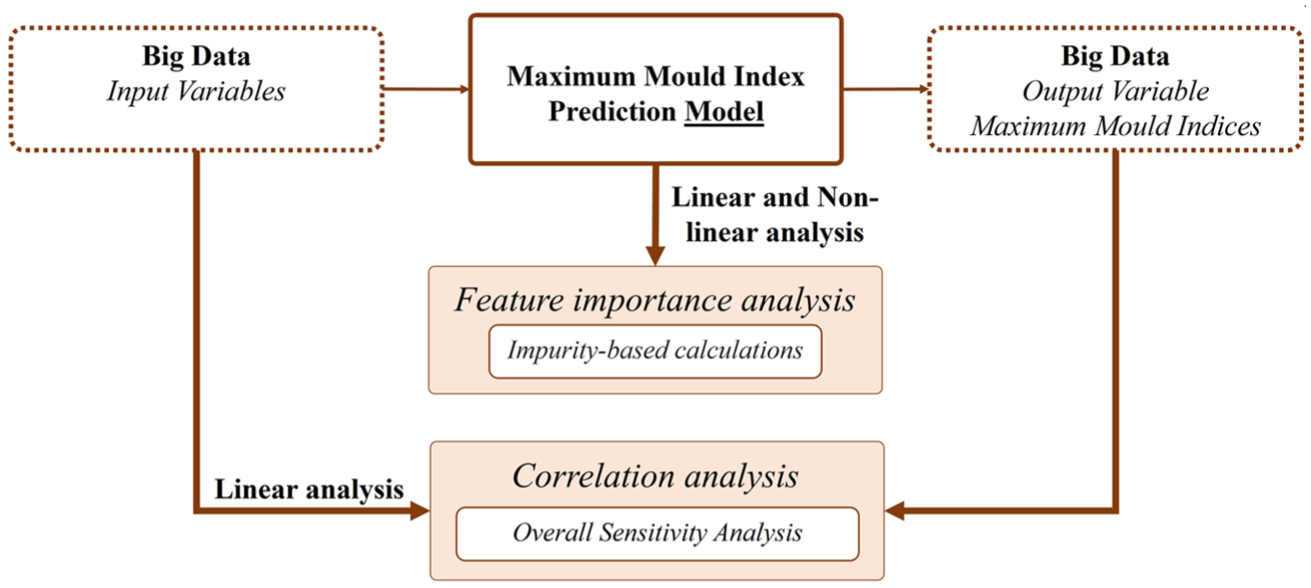
Mould sensitivity analysis procedure.
Spearman’s correlation coefficient, denoted as

The degree of correlation between two variables is assessed using the Spearman’s correlation coefficient, with values ranging from −1 to +1 (Hamby, 1994). The direction of the relationship between two variables is indicated by the Spearman’s correlation coefficient sign. A positive sign represents a positive correlation, where both variables increase or decrease together. Conversely, a negative sign signifies a negative correlation, where an increase in one variable is associated with a decrease in the other, and vice versa. The conventional interpretation of the correlation strength, based on the Spearman’s correlation coefficient, is as follows (Schober et al., 2018):
0.00−0.09: Negligible correlation
0.10–0.39: Weak correlation
0.40–0.69: Moderate correlation
0.70–0.89: Strong correlation
0.90–1.00: Very strong correlation
In a trained RF model, feature importance analysis is crucial for assessing how changes in input variables influence output variables (Bayat Pour et al., 2023b). The RF algorithm, which is an ensemble machine learning method including multiple decision trees, takes into consideration both linear and non-linear relationships between inputs and outputs. The model divides the data into different sets with related responses by using specific features at the internal nodes. The selection criteria for dividing the data are variance reduction for regression tasks and Gini impurity for classification tasks. Feature importance is determined by evaluating the effect of each feature on impurity reduction. The average impurity reduction across all trees is calculated to assess the importance of a feature. A higher feature importance score demonstrates a greater impact of that feature on the model’s performance. This allows for a better understanding of which features contribute most significantly to the prediction, helping to focus on the factors that have the most influence on the output.
Results and discussion
Hygrothermal model verification (1D vs 2D)
To assess the potential and accuracy of the 1D hygrothermal model in calculating the mould growth, the model was verified against a 2D hygrothermal model. Figure 6 illustrates a 5-year simulation of mould growth for three distinct scenarios: the base case, high mortar extrusion (25 mm), and low mortar extrusion (5 mm). The red solid line indicates the mould index progression in the 1D hygrothermal model, specifically for the southern orientation. The corresponding black dashed, dotted, and solid lines represent the maximum, average, and minimum mould indices derived from the 2D model over a 1-meter height of the wall assembly. The figure demonstrates an alignment between the 1D and 2D models. The 1D model, utilising the custom material properties for the mortar extrusion, closely follows the trend of the 2D model’s average mould indices. In certain intervals, the 1D model exhibits slightly higher mould index values compared to the 2D model, indicating a more conservative prediction of mould growth. Despite these occasional deviations, the overall trends between the two models remain consistent, reinforcing the verification of the 1D model as a reliable approximation for assessing mould risk in the wall assembly.
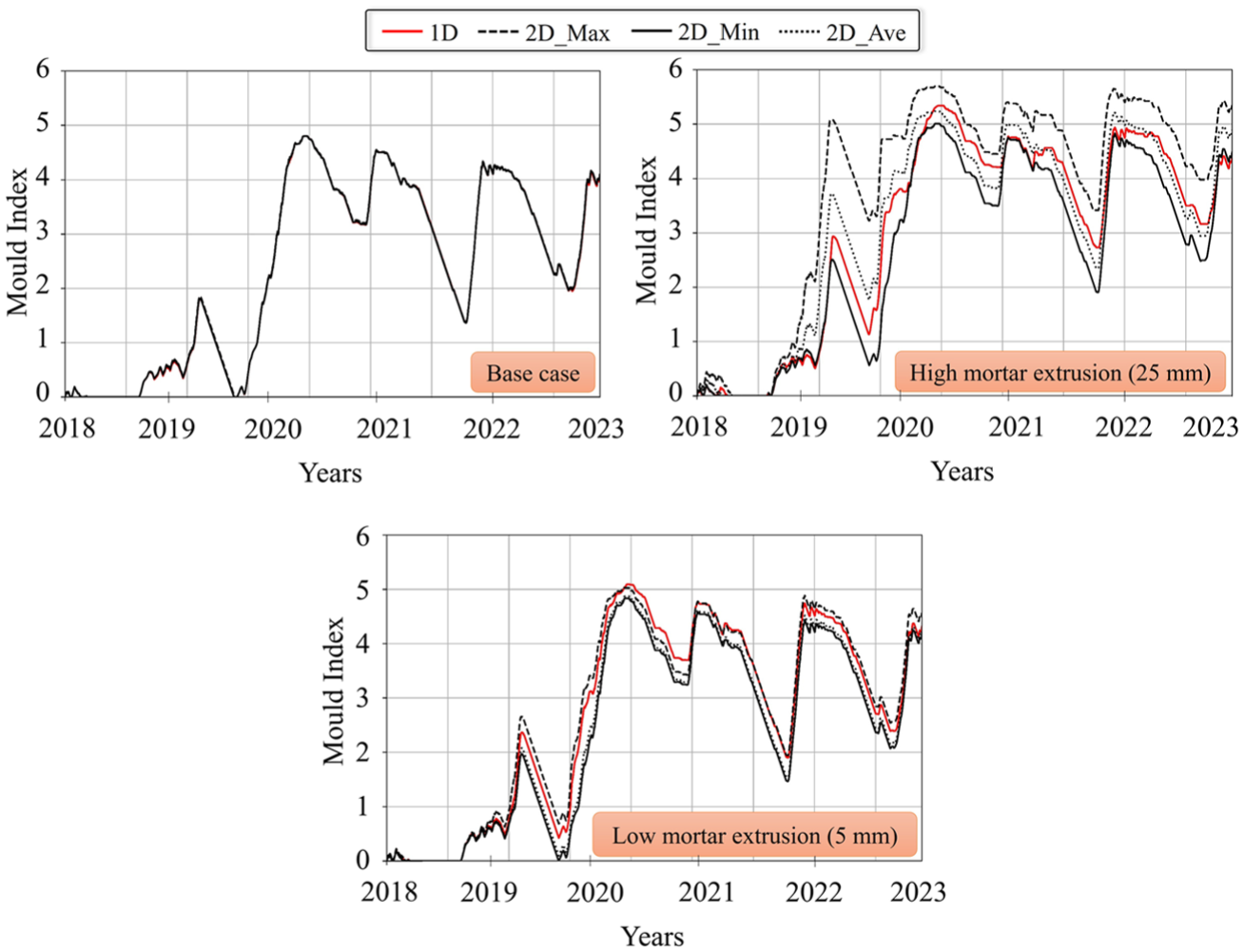
Wall assemblies modelling for verification, 1D versus 2D. Max/Min/Ave: maximum/minimum/average mould index [−] within the 1 m height of the wall in the 2D model.
Although Figure 2 presents the 2D–1D comparison only for the southern orientation under the ASHRAE water-penetration criterion, all four orientations (north, east, west, and south) were analysed. The southern façade was found to represent the worst-case scenario due to its highest exposure to WDR. The concept of simplifying the 2D model to a 1D representation was already developed and verified through several 2D simulations in the previous publication (Bayat Pour and Kahangi Shahreza, 2024). In the present study, this simplification is revisited mainly to double-check the previously validated approach and to demonstrate the methodological progress achieved by extending the workflow from 2D to 1D and further to an AI-based metamodel, which constitutes the main focus of this paper.
As shown in Figure 6, the 1D model reproduces the overall trend of the 2D simulations with consistency. The slight deviation observed in the early stages of the high mortar extrusion case (Figure 6, top right) diminishes over time, and the curves converge towards similar mould index values. The performance evaluation based on accuracy metrics (R2 = 0.799 for the maximum 2D curve, and = 0.968 for average conditions) confirms that the 1D model provides an acceptable approximation of the 2D behaviour, particularly considering the significant reduction in computation time. For practical design purposes, comparison with the average 2D curve is considered more representative of typical construction conditions, while the maximum curve is included for decision-makers who wish to assess extreme scenarios.
Table 5 provides a comparison of the R2 and MAE values between the 1D and 2D models for mould growth prediction, specifically under southern orientation. The analysis accounts for the maximum, average, and minimum values across the 2D model meshes. The high R2 values, consistently above 90% in most cases, suggest that the 1D model can predict over 90% of the variation observed in the mould indices of the 2D model. For the base case, where no mortar extrusion is present, the R2 values are high (0.992–0.998), indicating strong agreement between the 1D and 2D models. Correspondingly, the MAE values remain minimal (0.01–0.02), reinforcing the close alignment between the two models. This high level of agreement is expected given that the primary construction difference between the models lies in the modelling of the brick layer, leading to only minor variations.
Coefficient of determination (R2) and mean absolute error (MAE) between the mould indices [−] of 1D and 2D models (maximum mesh, average of all meshes, and minimum mesh), southern orientation.
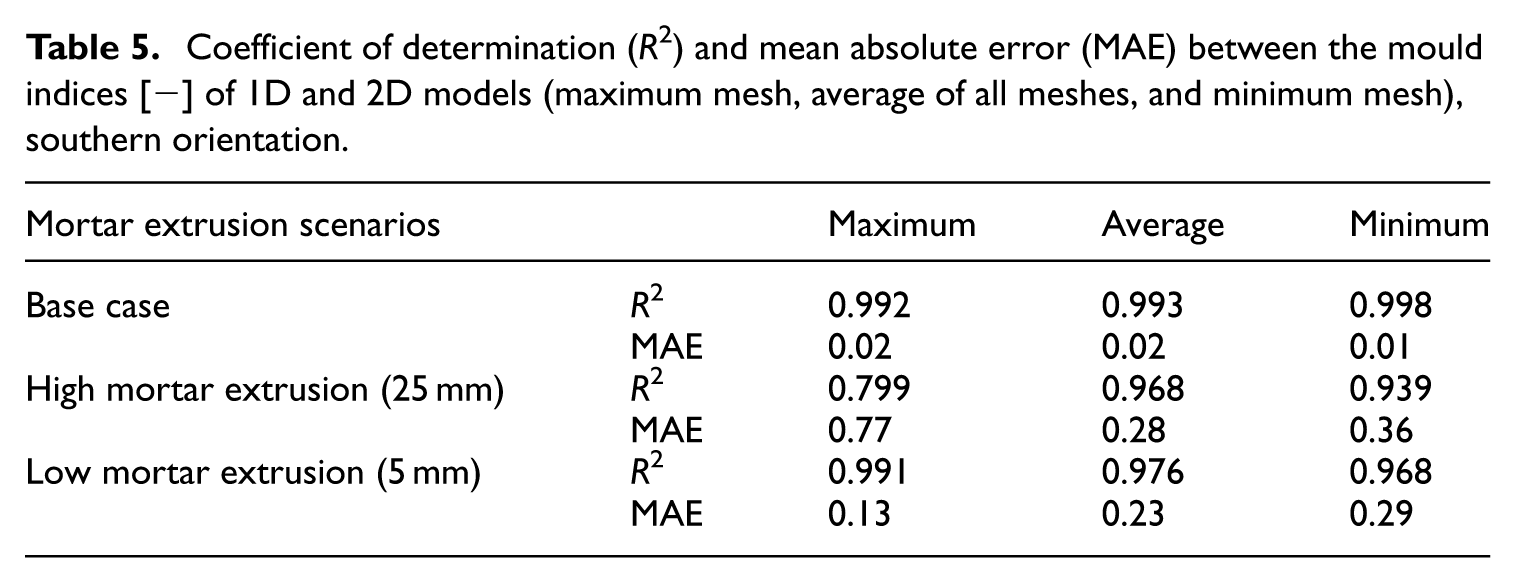
In the scenario with high mortar extrusion (25 mm), the R2 for the maximum mesh drops to 0.799, reflecting a reduction in the model’s predictive accuracy. However, the average and minimum mesh values retain high R2 values of 0.968 and 0.939, respectively. The MAE values for this case are larger, with a maximum error of 0.77 and a minimum error of 0.36, indicating a moderate deviation between the 1D and 2D models. Despite this, the overall MAE remains below 0.36, meaning the discrepancies between the models do not substantially affect the reliability of the 1D model, particularly when considering the considerable reduction in computational time. For the low mortar extrusion (5 mm), the 1D model demonstrates an acceptable predictive capacity, with R2 values ranging from 0.991 to 0.976. The MAE values are also within an acceptable range (0.13–0.29), signifying that the 1D model provides a reliable approximation of the 2D model, with only minor discrepancies in mould index predictions.
The 1D model provides a practical alternative to the time-intensive 2D simulation (approximately 5.8 minutes per simulation for 1D model compared to 793 minutes per simulation for the 2D model), delivering the mould growth predictions with significant computational savings, especially when applied in long-term simulations, such as the 5-year analysis conducted in this study. Based on this analysis, this study considers the trade-off between computational time (1D) and model accuracy (2D) to be within acceptable bounds, as the observed deviations do not critically impact post-processing evaluations, such as failure probability assessments.
Optimisation of RF Metamodel
The prediction error, visualised using a colour gradient in Figures 7 and 8, represents the absolute difference between the predicted and observed values for each data point. Additionally, the optimisation of the metamodels was carried out by examining the most influential features that contribute to the construction of these models. As demonstrated in Figures 7 and 8, the accuracy metrics for the optimised metamodels indicate acceptable performance for both water penetration criteria (ASHRAE and ES) across various wall orientations (North, East, West, and South). The R2 values, which ranged from 0.90 to 0.95, suggest that the optimised metamodels could explain a substantial portion of the variability in the dataset, capturing the relationship between input features and predicted mould indices. Additionally, the MAE values, which remain minimal across the different cases, show the acceptable precision of these models in predicting mould growth indices.
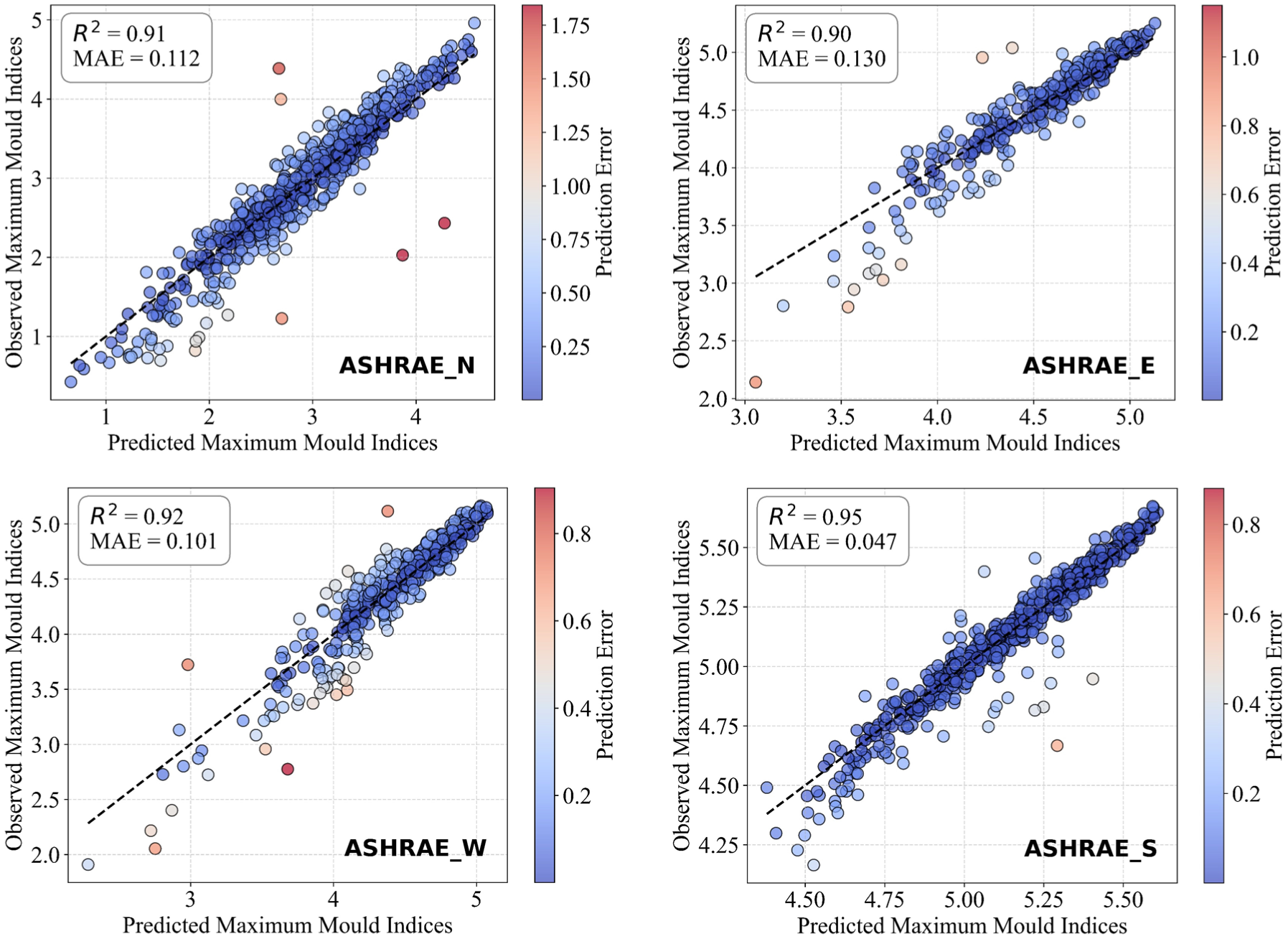
Predicted vs observed data during the machine learning model testing, using ASHRAE standard.
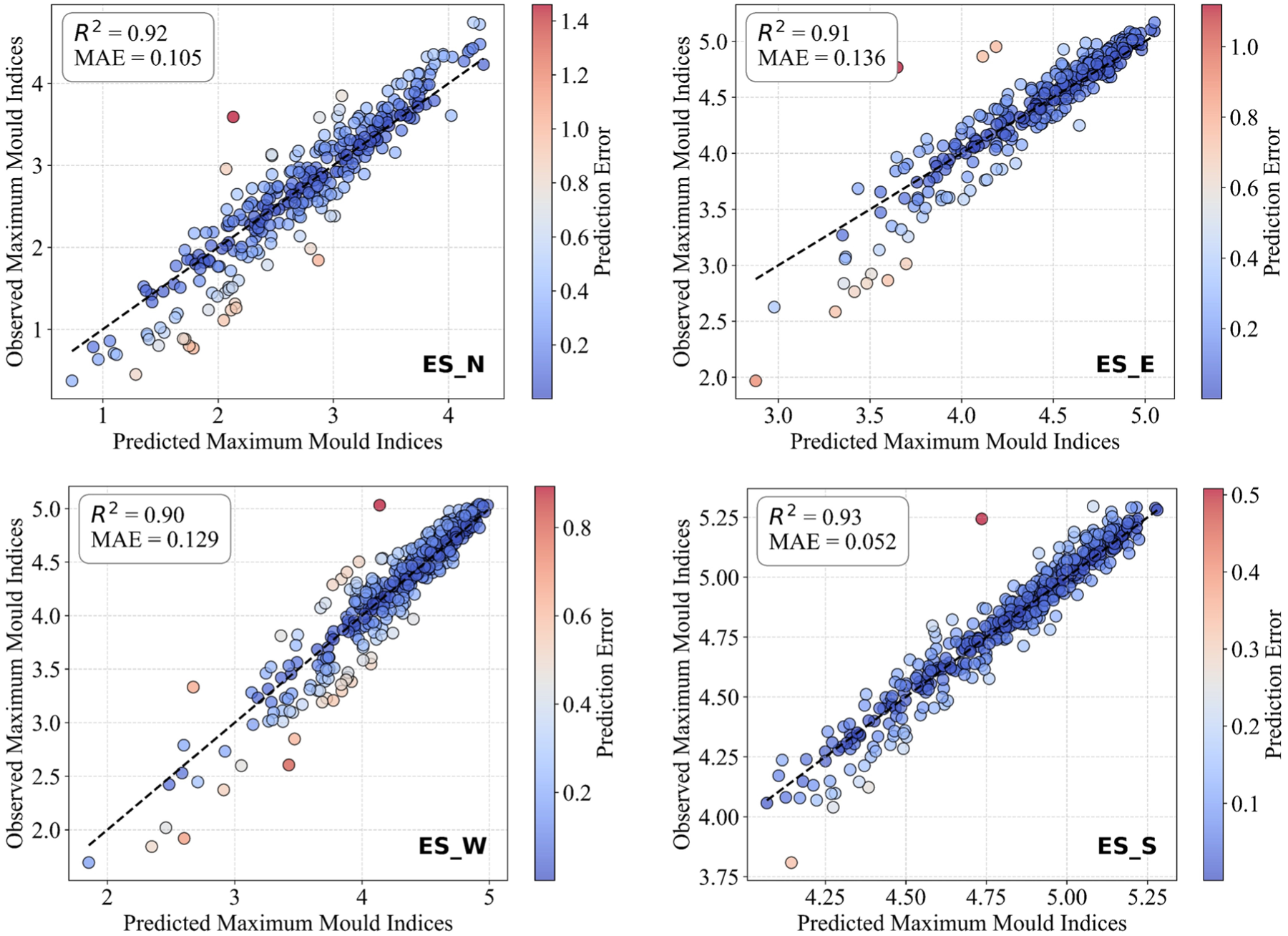
Predicted vs observed data during the machine learning model testing, using ES standard (case studies based on experimental study data).
Several key factors influenced the variability in R2 values observed across the different case studies. One important factor is the inherent variability in the training data. The diversity and complexity of the dataset, including variations in material properties, climate conditions, and wall orientations, directly affect the model’s ability to predict outcomes accurately. Furthermore, the unique attributes of each case study, such as the specific type of brick used or the water penetration criteria applied, introduce additional complexity that can influence the model’s performance. The choice of features included in the machine learning model also plays a significant role in determining the accuracy of the metamodel. Features that are highly informative in one case study may not hold the same relevance in another, which could account for variability in the R2 values. For instance, a feature like the thermal conductivity of brick might be more critical in one scenario, while in another, factors like air change rate or solar absorption coefficient may dominate. This discrepancy in feature importance is likely a contributing factor to the observed variations in performance metrics across different orientations and case studies.
It should be noted that model simplification from 2D to 1D and from 1D to the metamodel inevitably introduces some degree of error. These errors were quantified in this study using accuracy indicators such as R2 and MAE, confirming strong agreement between the simplified and reference models. The purpose of the simplification is to balance accuracy and computational efficiency, allowing the analysis of complex phenomena such as mortar extrusion within a feasible timeframe. The acceptable level of accuracy is project-dependent and should be determined by decision-makers or stakeholders based on their tolerance for uncertainty. The proposed metamodel serves as a demonstration of how AI-based probabilistic tools can predict moisture-related risks, while providing quantified error measures to guide their use in practice. Although some uncertainties arise from model reduction, a wide range of uncertainties in material properties and boundary conditions were already incorporated.
Mould growth analysis
Table 6 shows the 95th percentile of the MMI for each case study, where 95% of the scenarios resulted in a lower MMI than the values shown. Under the southern orientation, there was a slight difference between the MMI values obtained using the ASHRAE and ES criteria—approximately 7%—with the ES criterion yielding a lower value. In contrast, under the northern orientation, the ES criterion produced about 15% lower MMI values compared to the ASHRAE standard. The relatively minor difference observed under the southern orientation can be attributed to the substantial WDR load, as discussed by Kahangi Shahreza and Abdul Hamid (2023). In the south, higher WDR loads led to an increased water content in the brick, often surpassing the moisture threshold set by the ES criterion, resulting in more frequent moisture source considerations in the hygrothermal simulations.
Mould growth calculations. ES: case studies based on experimental study data, ASHRAE: case studies based on ASHRAE 160-2021 standard, N: north, E: east, W: west, S: south.
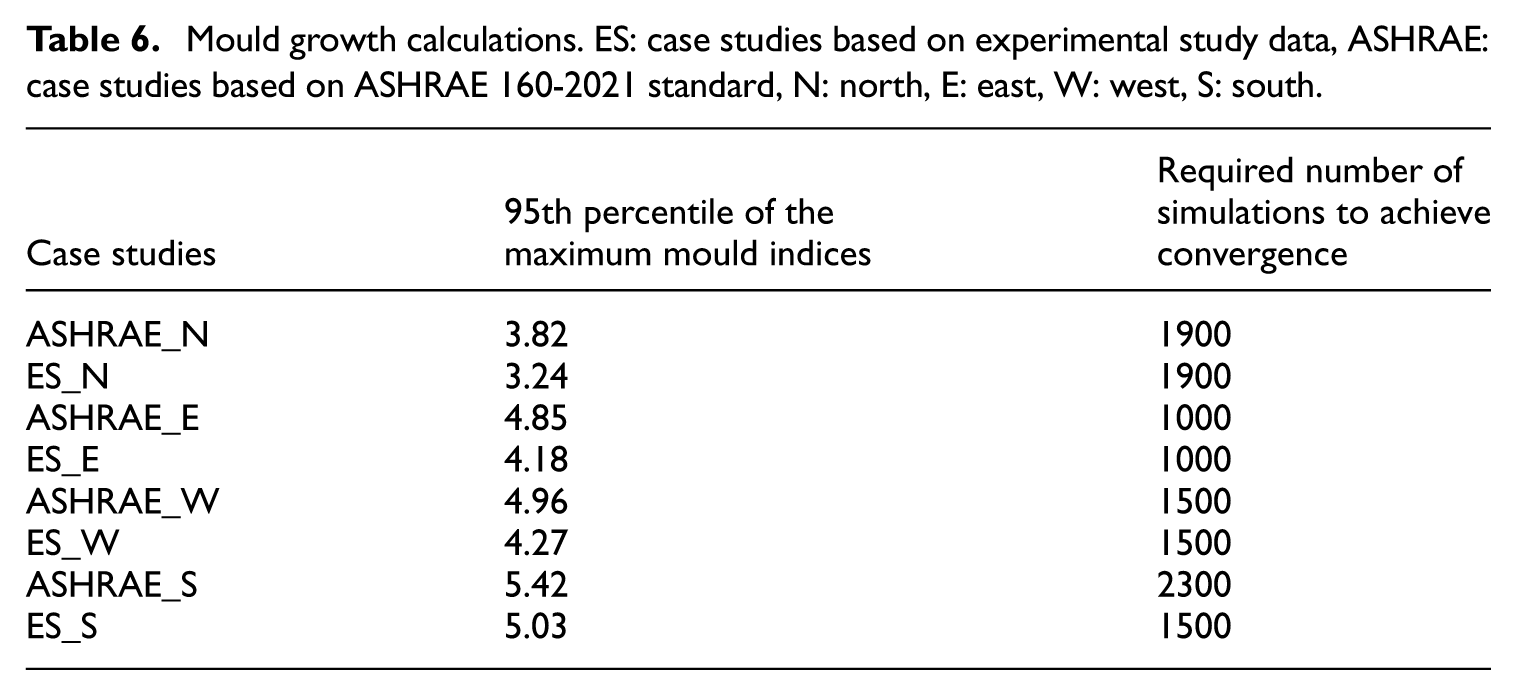
Conversely, in the northern orientation, where the WDR load is significantly lower, the masonry absorbs rain without consistently exceeding the ES-defined moisture threshold. This results in a higher 95th percentile MMI when following the ASHRAE standard, as it considers 1% of the WDR load at all times, whereas the ES criterion only factors in moisture beyond a certain threshold. In the north, where this threshold is seldom surpassed, ASHRAE’s more conservative approach leads to a higher impact on the MMI.
Figure 9 further supports this observation by comparing the water content in clay brick masonry façades for the south and north orientations (have highest and lowest WDR loads, respectively) over the 5-year period from 2018 to 2023. The red lines represent the saturation threshold of the brick, while the blue lines show the water content in the masonry during this period. Although Figure 9 (left side) presents data from a single scenario for clarity, the remaining scenarios exhibited similar trends. The left side of Figure 9 shows that the brick in the southern orientation reached capillary saturation during much of the winter months. Consequently, instances where the water content surpassed the threshold were more frequent in the south, thereby increasing the likelihood of moisture source considerations from WDR. This pattern explains the closer alignment between the ES and ASHRAE results in the southern orientation.
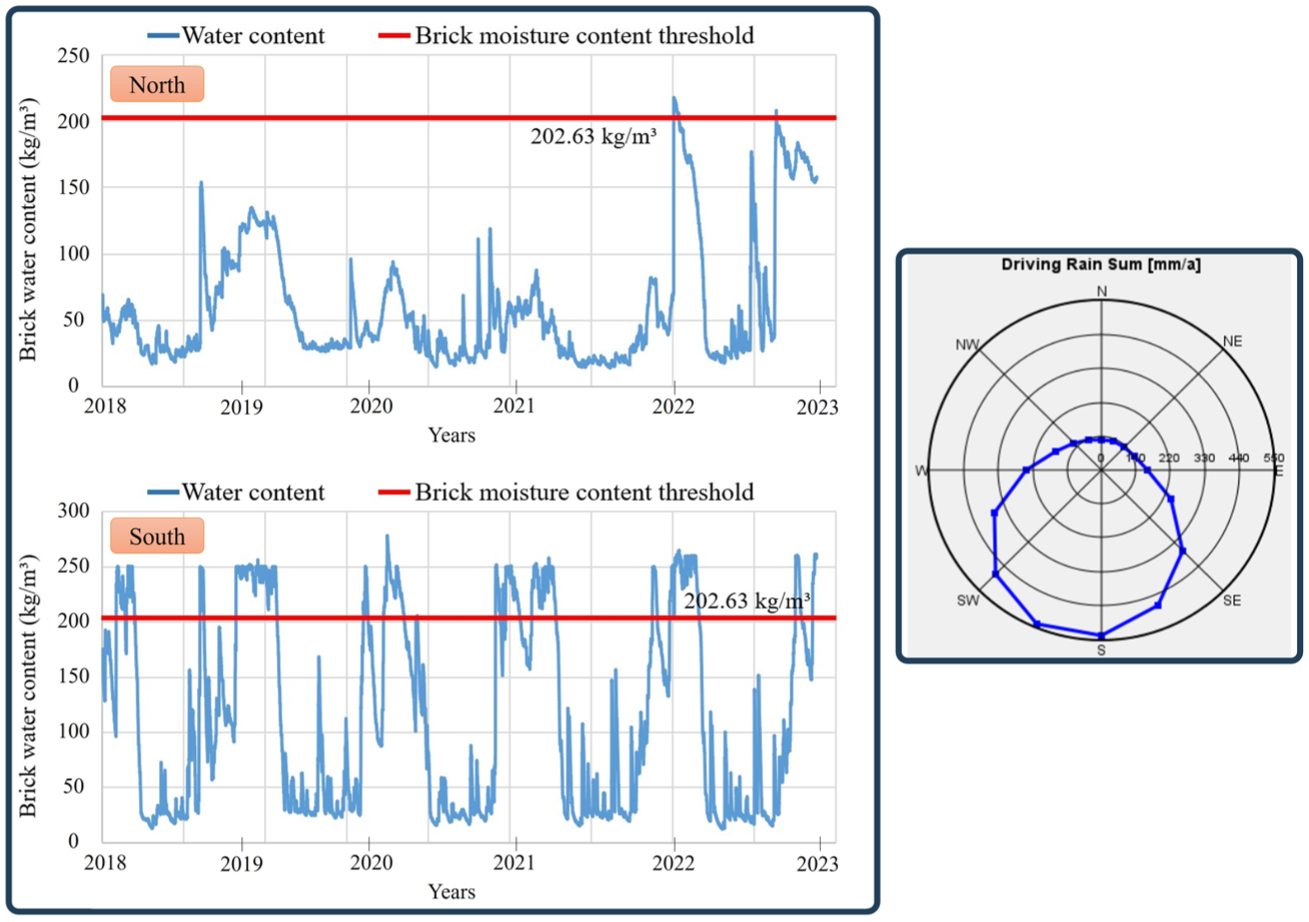
Water content of clay brick masonry façade (left side) between 2018 and 2023 where the red line is the brick moisture content threshold based on ES water penetration criterion, WDR chart (right side).
In contrast, the northern orientation, also shown in Figure 9 (left side), rarely exceeded the moisture threshold, with only brief periods where the water content surpassed this limit. The lower WDR load in the north (see Figure 9, right side) reduces the likelihood of significant water penetration during the study period, demonstrating the benefit of considering the water absorption capacity of brick masonry. In these scenarios, the ES criterion, which accounts for the water absorption threshold, becomes more critical for avoiding overly conservative moisture source estimates. However, in orientations with frequent and intense WDR loads, such as the south (see Figure 9, right side), the results of the ASHRAE and ES criteria tend to converge.
Mould sensitivity analysis
Figure 10 shows a bubble chart illustrating the sensitivity of each input variable to the MMI. Variables with negligible correlation to the MMI are excluded from this figure. Five variables are identified as sensitive to the MMI through linear and non-linear sensitivity analyses.
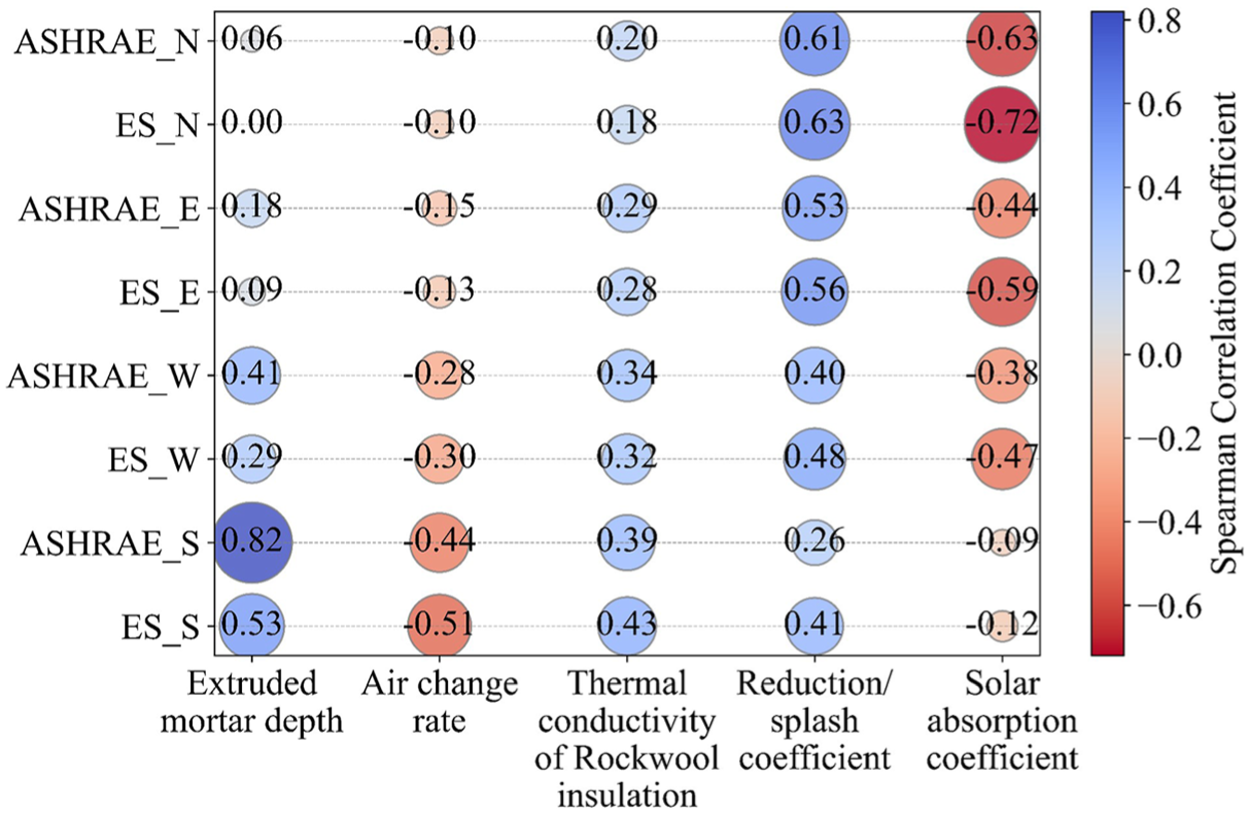
Spearman correlation coefficients between the input variables and maximum mould index (MMI). Colourmap guide: 0.00–0.09: negligible relationship, 0.10–0.39: weak relationship, 0.40–0.69: moderate relationship, 0.70–0.89: strong relationship, and 0.90–1.00: very strong relationship.
Figure 10 illustrates that MMI is positively correlated with mortar extrusion. The correlation rank can vary depending on the orientation of the wall assembly and the water penetration criterion applied. The positive correlation of extruded mortar on mould growth is due to its capacity to act as a potential moisture source, absorbing, and retaining water that penetrates due to WDR. A greater depth of extruded mortar brings the moisture source closer to the timber stud or insulation layer. In the worst-case scenario, if the mortar extrusion connects to the adjacent layer, it can bridge the air gap and facilitate the transport of penetrated water. The positive influence of mortar extrusion was also confirmed by previous studies, including (Bayat Pour et al., 2024a; Bayat Pour and Kahangi Shahreza, 2024; Calle et al., 2020). Using the ASHRAE water penetration criteria, a stronger correlation was demonstrated between mould growth and extruded mortar than the ES criterion across all orientations. This difference arises because ASHRAE consistently considers 1% of WDR as a moisture source throughout the simulation period. In contrast, the ES criterion only accounts for instances where moisture content exceeds a certain threshold (illustrated by the red line in Figure 9 (left side)). Among all orientations, the southern side exhibits the strongest correlation between mould growth and mortar extrusion, attributed to the higher WDR load in this orientation compared to others. This orientation resulted in a greater potential for water absorption by the extruded mortar. In contrast, the other orientations showed weaker correlations, with the north orientation being the weakest. In these cases, even if mortar extrusion exists, the limited WDR load means that less moisture is allocated to it as a source, resulting in drier conditions with minimal impact on moisture transport.
Regarding the importance of mortar extrusion, the comparison between cases with and without mortar extrusions in Figure 6 indicates that even relatively modest differences in the predicted mould index can correspond to significant variations in the extent of mould growth. For instance, in the representative scenario shown in Figure 6, the maximum mould index increases from approximately 4.8 (no extrusion) to 5.9 (25 mm extrusion). According to the Finnish mould growth model, this change represents a progression from roughly 50 % surface coverage to nearly 100 % coverage. Moreover, Figures 7 and 8 demonstrate that, depending on the orientation, the maximum mould index can vary substantially (e.g. between 1 and 4 on the north façade) across different realisations of the probabilistic analysis. These results highlight that the presence of mortar extrusions, in combination with other uncertain input variables such as wind-driven rain load and material properties, can significantly amplify the risk of mould growth. For example, while a maximum index of 1 corresponds to very minor mould development only visible under a microscope, an index of 4 indicates that over 10 % of the examined surface area is visibly affected. These findings are consistent with the Spearman correlation coefficients shown in Figure 10, which further demonstrate the influence of mortar extrusions and indicate that their relative significance varies depending on façade orientation and the intensity of wind-driven rain exposure. Collectively, these results emphasise the need to account for both the direct effects of mortar extrusions and their interactions with other factors when evaluating moisture-related risks.
The air change rate (ACR) exhibits a negative correlation with the MMI for all orientations. The moderate correlation is observed between MMI and ACR under south orientation. This is due to the fact that the drier conditions within the air gap can be achieved by increasing the ACR, thereby the probability of mould growth is reduced. The importance of maintaining a well-ventilated air gap behind the cladding in wood-frame walls to prevent mould growth was established by Mundt-Petersen et al. (2013)and Bayat Pour and Kahangi Shahreza (2024). The significance of ACR becomes more pronounced in orientations with elevated WDR loads, such as the south side, as indicated by the moderate correlation. In this orientation, the air gap contains more moisture, which could be effectively reduced by increasing the ACR. In contrast, the air gap is drier in orientations with lower WDR, resulting in a weaker effect of ACR. Consequently, ACR has a smaller effect on orientations with lower WDR loads while bringing a moderate effect on orientations with higher WDR loads.
The thermal conductivity of the Rockwool insulation shows a positive correlation with the MMI across all wall orientations, as illustrated in Figure 10. With a higher thermal conductivity (lower insulating efficiency) the insulation contributes to a larger heat flux through the external wall, further heating the external gypsum board positioned between the air gap and insulation. If the higher temperature—resulting from increased heat flux due to higher thermal conductivity—fails to sufficiently dry out the insulation and reduce the RH below the critical threshold (∼70%), it raises the temperature within the insulation, thereby promoting mould growth. One potential reason for this inability to lower the RH is the presence of an additional moisture source caused by WDR penetration. The positive correlation between MMI and the thermal conductivity of insulations was also confirmed in the study by Bayat Pour and Kahangi Shahreza (2024).
Figure 10 shows a positive correlation between the MMI and the WDR’s reduction/splash coefficient. Given that a higher reduction/splash coefficient in Delphin indicates less splashing of the WDR load (and a larger fraction of adhering WDR), this association is expected. As a result, more of the WDR load is accessible for water penetration, which increases the MMI. Additionally, as the reduction/splash coefficient increases, the moisture content in the brick layer also increases. In orientations with lower WDR loads (e.g. north), where the moisture source contribution to the WDR load was relatively minor for both criteria, this correlation ranking remained constant, showing a moderate correlation for both water penetration criteria. As a result, there were minimal differences in the correlation rankings between the two criteria in these orientations. In contrast, the ASHRAE criterion shows a lower correlation between the MMI and the reduction/splash coefficient than the ES criterion under high WDR load orientations, particularly in the south. This disparity arises from the significant WDR load, as the ASHRAE standard allowed for 1% of the WDR load regardless of the brick’s saturation level. Thus, even when splashing causes a reduction in the WDR load, the amount of water penetration remained significant. Consequently, under the ASHRAE criterion, the effect of the reduction/splash coefficient on the water penetration process is less pronounced than under the ES criterion.
The negative correlation between the solar absorption coefficient and the MMI is evident in Figure 10, and the underlying reason related to the influence of solar radiation on the hygrothermal behaviour of the wall assembly. The solar absorption coefficient describes the fraction of solar radiation that the exterior surface of the wall absorbs. A higher absorption coefficient indicates that more solar energy is absorbed by the external surface, raising the temperature of the outer layers, such as the brick. This absorbed heat reduces heat loss through the wall by warming the external surface and also contributes to a drier facade. As a result, increasing the solar absorption coefficient lowered the likelihood of mould growth, hence the negative correlation. Variations in WDR loads between orientations explained the changes in correlation ranks between the solar absorption coefficient and the MMI. These correlations are negligible and weak in the southern orientation, but moderate to strong in other orientations. The WDR load is higher for the southern orientation compared to the others. Consequently, the significant amount of absorbed water in the brick outweighs the heating effect of solar radiation, even though the surface absorbed solar energy. This explained why the correlation between the solar absorption coefficient and MMI was weaker and negligible on the south side. Conversely, the north side, which experiences the lowest WDR load, shows the strongest correlation between the solar absorption coefficient and MMI, particular when ES criterion is used. The reason the ES criterion shows a higher correlation was also links to the consideration of a lower WDR load under this criterion.
In addition to the linear sensitivity analysis provided in Figure 10, feature importance analysis offers a comprehensive illustration of both linear and non-linear correlations across all orientations. The importance of the parameters identified by the Spearman correlation analysis was also confirmed by the feature importance analysis.
Limitations
This study makes some assumptions that, while necessary for the scope of analysis, introduce certain limitations. One assumption is that the extruded mortar consistently absorbs and retains penetrated rainwater. However, real-world scenarios are more complex and may present alternative mechanisms, such as dripping droplets and rainwater runoff inside the air gap, which could influence moisture accumulation and distribution differently. In practice, mortar extrusion occurs due to imperfect joint finishing and can range from thin smears to partial bridges into the cavity. These dynamics were not fully captured in the current model and could lead to variations in moisture performance depending on the specific characteristics of the building envelope.
The exclusion of liquid transport in the extruded mortar layer in the 1D model presents a simplification of the physical drying processes. In reality, extruded mortar elements may dry on multiple surfaces exposed to the cavity, particularly when ventilation is present. However, the 1D model restricts moisture flow to a single direction and does not allow lateral or multidirectional drying.
In this study, a combined 1D–2D modelling framework was adopted to balance accuracy with computational efficiency. However, it is acknowledged that in cases with highly irregular or pronounced extrusions, local moisture transport along joints may not be fully represented by the 1D approximation.
Another potential limitation lies in the method used for modelling moisture sources. This study employed a uniform distribution model, which assumes that moisture is evenly distributed across the extruded mortar layer. While this approach simplifies the modelling process, it may not fully represent the reality of moisture penetration, which can often occur as concentrated or point sources. Calle et al. (2020) discussed the point moisture source as a viable alternative, suggesting that certain areas of the façade might be more susceptible to moisture penetration.
The model does not account for the potential reabsorption of runoff at unsaturated inner surfaces of the brick veneer, nor for multidirectional drying and drainage effects. These simplifications may result in conservative predictions of moisture retention and mould risk, especially for cases with large extrusion depth or poor cavity ventilation.
The reliability of the results also depends on the accuracy of the input data, such as material properties, climate data, and boundary conditions. Although this study addressed uncertainties in moisture safety design through probabilistic modelling, the inherent limitations of input data quality remain. Furthermore, while the probabilistic approach accounts for variability in material properties and boundary conditions, it does not encompass other stochastic variables that could affect hygrothermal performance, such as uncertainties in indoor and outdoor climate conditions (Gradeci et al., 2018; Marincioni et al., 2018).
Additionally, the case studies presented in this paper are based on specific climatic and construction conditions, particularly those relevant to the Gothenburg region. These assumptions, while carefully selected and justified, limit the generalisability of the findings to other geographic locations or building designs.
Conclusions
The mould growth and sensitivity analyses of mortar extrusion within the clay brick masonry claddings of timber frame walls were conducted in this study. Two distinct water penetration criteria were considered: the ASHRAE and an Experimental Study (ES)-based criteria. The brick material properties were derived from experimental data, and the case studies were considered under Sweden’s climate, specifically focussing on the city of Gothenburg and four different wall orientations (north, east, west, and south). The analyses employed the Mould Reliability Analysis (MRA) and Mould Sensitivity Analysis (MSA) methodologies, utilising a probabilistic model integrated with the random forests (RF) machine learning algorithm. This study also verified the effectiveness of the 1D hygrothermal model against more complex 2D hygrothermal models, confirming the practicality and robustness of the 1D approach for the study’s scope. The innovative combination of metamodelling with uncertainty propagation and sensitivity analysis significantly advanced the understanding of moisture-related risks associated with mortar extrusion. The results offered valuable insights into the uncertainties surrounding the hygrothermal performance of timber frame walls clad with clay brick masonry, particularly in terms of mould growth risk. The findings highlight the practical utility of probabilistic modelling in assessing moisture safety, with key results summarised in the following points.
1D versus 2D hygrothermal models
The accuracy metrics between the 1D and 2D hygrothermal models (R2 higher than 90% and minor MAEs) demonstrated that the proposed 1D model effectively captured the variations in the MMI calculated by the more computationally expensive 2D model. This illustrates the reliability of the 1D model for analysing moisture behaviour, especially when customised material properties are used. The marginal differences between the models further emphasised the potential of the 1D approach as a practical alternative to 2D modelling, particularly when computational efficiency is a concern.
Mould growth analysis
The 95th percentile of the maximum mould index (MMI) decreased by 7% when the ES criterion was applied instead of the ASHRAE criterion, particularly under high WDR load orientations, such as the south. This suggests general consistency between the two water penetration criteria in conditions with high WDR exposure. However, compared to the ASHRAE criterion, the ES criterion resulted in a 15% reduction in the 95th percentile of the MMI under low WDR loads, such as in the north orientation. This indicates that in scenarios with reduced WDR exposure, the ASHRAE criterion tends to overestimate the risk of mould growth, potentially leading to overly conservative design decisions.
Mould sensitivity analysis
Using the ASHRAE criterion, the sensitivity analysis, which included both linear and non-linear methods, showed a strong positive correlation between extruded mortar depth and MMI for orientation with high WDR loads (i.e. south). However, under the ES criterion in this orientation, the influence of mortar depth on MMI was reduced to a moderate correlation. In contrast, the relationship between mortar depth and MMI was negligible for both water penetration criteria, for wall orientations with low WDR loads (e.g. north). The air change rate (negative correlation), the reduction/splash coefficient of WDR (positive correlation), the solar absorption coefficient (negative correlation), and the thermal conductivity of Rockwool insulation (positive correlation) were additional important input parameters influencing MMI.
Future studies opportunities
While this study primarily employed a 1D modelling approach due to the high computational expense of 2D and 3D simulations, future research could benefit from incorporating 2D or 3D modelling techniques. These advanced approaches would allow for a more detailed representation of the extruded mortar’s shape and size across multiple orientations, including along the X-, Y-, and Z-axes. Additionally, expanding the scope to include more uncertain variables (e.g. future climate data) could significantly enhance the accuracy and realism of the hygrothermal model. Incorporating these factors would provide a more comprehensive assessment of the moisture risks associated with mortar extrusion in different building envelopes and climates.
Future work will include experimental verification of the developed AI-based probabilistic framework through real-world monitoring of temperature and relative humidity within timber frame wall assemblies. This step will enable calibration of the hygrothermal and mould growth predictions under actual climatic and boundary conditions.
Another promising direction for future work is to develop a simplified 2D model—comprising, for example, a few brick rows including both extruded and regular joints—to reduce the computational demand while maintaining more detailed material representations. Coupling such a simplified 2D model with a metamodel could further enhance efficiency by allowing large-scale probabilistic analyses based on 2D physics.
Footnotes
Appendix
Acknowledgements
The authors are grateful for the Delphin support team’s technical support.

Funding
The authors disclosed receipt of the following financial support for the research, authorship, and/or publication of this article: The authors gratefully acknowledge the financial support from FORMAS, the Swedish Research Council for Sustainable Development, for the research grant 2019-00673.
Declaration of conflicting interests
The authors declared no potential conflicts of interest with respect to the research, authorship, and/or publication of this article.