



Abstract
In-situ cast concrete slabs with high moisture content and elevated pH levels (approximately pH 12.5) create optimal conditions for hydrolysis reactions, leading to the degradation of PVC flooring adhered to these slabs. To mitigate this issue, solutions identified in the 1990s include either installing floor coverings on sufficiently dry concrete (with a relative humidity limit of 85% as recommended by most floor covering manufacturers) or placing a layer of low-alkali material, typically a self-levelling screed, between the concrete slab and the floor covering. This paper presents a 5-year follow-up study on the degradation (measured by VOC emissions) of PVC floorings containing the contemporary plasticizer di(isononyl) cyclohexane-1,2-dicarboxylate (DINCH), installed under varying conditions of concrete relative humidity and the pH of the underlying material. The findings indicate that both the pH and the type of screed material significantly influence the degradation process and VOC emissions. Specifically, lower pH levels of the material in contact with the flooring result in reduced VOC emissions. The critical pH threshold is identified around pH 12; materials with higher pH levels lead to a substantial increase in emissions. Additionally, there are notable temporal variations in the occurrence of different emission compounds.
Introduction
In Finland, numerous moisture and indoor air quality (IAQ) issues have been reported with glued PVC floorings, even in recent years. Despite continuous advancements towards low-emission or emission-free materials and the establishment of specific guidelines for moisture control during construction, challenges persist.
Volatile organic compounds (VOCs) are significant indoor pollutants that adversely affect human health and well-being, causing symptoms such as odour nuisance and irritation of the eyes and upper respiratory tract (Wolkoff et al., 2006). VOCs are emitted from various indoor sources, including building materials (e.g. flooring, paints, carpets, plasterboard), furniture, and household products (e.g. waxes, detergents, deodorizers). Several guideline limit values and national labels (RTS Foundation Building Information, 2019) have been developed to promote low-emitting building products, primarily focusing on controlling primary emissions, which are the physical release of compounds from new products. However, determining secondary emissions, defined as compounds produced by chemical reactions within the product or indoor environment (Uhde and Salthammer, 2007), requires comprehensive studies of the entire structure, including concrete, adhesive systems, and flooring under real conditions.
Both PVC flooring and some commonly used flooring adhesives, such as acrylate-based copolymer adhesives, contain esters. The hydrolysis of esters is a source of secondary emissions (Uhde and Salthammer, 2007), with the efficiency of the reaction depending on moisture content or relative humidity (RH), temperature, and pH. Common hydrolysis reaction products in floorings include 2-ethyl-1-hexanol (2-EH) from the hydrolysis of diethylhexyl phthalate (DEHP, a plasticizer in PVC), and n-/2-butanol from the hydrolysis of di-/iso-butyl phthalate (DBP/DIBP) (Uhde and Salthammer, 2007). Additionally, the hydrolysis of 2-ethylhexyl acrylate (adhesive) produces 2-EH, and the decomposition of n-butylacrylate (adhesive) results in n-butanol (Chino et al., 2009). Inhalation exposure to 2-EH has been shown to cause irritation of the mucous membranes in the eyes, nose, and throat in experimental animals, and studies in human volunteers have reported increased olfactory irritation and eye discomfort based on a literature review by Wakayama et al. (Wakayama et al., 2019).
Phthalates, long used as plasticizers to enhance the flexibility of rigid PVC products, are prevalent in various consumer products, including flooring and wall coverings. The emission of phthalates from PVC flooring has been extensively studied over the past decades (Afshari et al., 2004). The European Commission (2018) restricted the use of DEHP, DBP, and benzylbutyl phthalate (BBP) in toys and childcare products as early as 2006, and recently adopted new restrictions on DEHP, DBP, BBP, and DIBP. In recent years, phthalate plasticizers in PVC have been replaced with alternatives such as di(isononyl) cyclohexane-1,2-dicarboxylate (DINCH, CAS 166412-78-8) (Schossler et al., 2011), whose hydrocarbon chain is C8-C10 alkyl isomers. Under hydrolysis conditions the long alkyl isomers will degrade into various long-chain alcohols (e.g. C9-alcohols) (Castagnoli et al., 2019).
In Finland, strict action limit values exist for the total indoor concentration of volatile organic compounds (TVOC) and 2-EH concentrations in indoor air (Ministry of Social and Health, 2015). The action limit for TVOC is 400 µg/m3, and for 2-EH, it is 10 µg/m3, determined as toluene equivalents.
The potential for secondary emissions due to the degradation of PVC flooring glued to concrete slabs is high, as the moist and high pH of the concrete slab (approximately pH 12.5) provide ideal conditions for hydrolysis. The most common preventive measure is to install floor coverings on sufficiently dry concrete, with most PVC floor covering manufacturers recommending that the RH at the interface layer should not exceed 85%. An in-situ cast concrete slab begins to dry from the surface, while the core RH remains high. After the floor covering is installed, the moisture in the concrete slab redistributes, causing the drier upper part to become wet and the lower part to dry. Based on experience and Swedish studies from the 1990s (Hedenblad, 1997), the maximum RH level of the interface layer after floor covering installation equals the RH (RHcrit) below the so-called equivalent depth before installation. This equivalent depth depends on the structure; for example, if the concrete slab is only drying on one side, such as a slab-on-ground, the equivalent depth is 40% of the slab’s thickness, measured from the surface.
Another method to prevent hydrolysis is using a low-alkali layer (screed) between the concrete and the floor covering. Laboratory tests have shown some degradation of PVC floor coverings at pH 11 (Björk et al., 2002) and it has been concluded that the critical pH value for the degradation of flooring adhesives is between pH 11 and 13 (Björk et al., 2003; Sjöberg and Ramnas, 2007). In the study by Björk et al. (2003), only two pH levels and three humidity levels were used in small-scale test samples (test tubes). It should be noted that the pH of the low-alkali layer is not constant over time, as hydroxide ions from the concrete can migrate to the low-alkali layer. The rate of transport is lower when the RH of the concrete is lower (Anderberg, 2007) so the low-alkali screed should also be applied over sufficiently dry concrete. Studies (Björk and Eriksson, 2002) have concluded that when the RH of the concrete is very high (95% RH) the pH of the concrete surface increases over time. A transport process allows hydroxide ions dissolved in the pore water in the concrete to diffuse towards the surface. However, even in this case, no effect on the pH of the studied low-alkali screeds was observed during the 12-month research period. A similar conclusion was reached in another study (Alexanderson, 2004), which showed that low-alkali levelling compounds (screed), based on calcium aluminate cement, can act as a barrier against secondary emissions of 1-butanol and 2-ethylhexanol, provided the humidity does not exceed a critical level, recommended to be 90% RH with some safety margin. A minimum thickness of 5 mm of the levelling compound was recommended, although tests showed that the levelling compounds provided protection even at 2 mm (Alexanderson, 2004). The test specimens, 240 mm in diameter and 100 mm high concrete blocks, were stored under constant conditions (86% or 96% RH) before and after the installation of the PVC floor covering and any screed layer (Alexanderson, 2004). The type and composition of the concrete and the type of self-levelling screed were varied in the test series, with only one adhesive and PVC flooring used. VOC concentrations were analysed using the FLEC method (European Committee for Standardization, 2006) and the results are reported as total volatile organic compounds (TVOC) and the alcohols 1-butanol and 2-ethylhexanol. The uncertainty of the FLEC measurements is typically ±15%. In this study, using constant ambient air conditions, the concrete structure had no opportunity to dry, providing extreme conditions for the deterioration of flooring structures. In real floor structures, the concrete has the ability to dry, which affects the behaviour of the floor structure, including the potential for hydroxide ion transport in the pore water.
The most comprehensive study on the subject, presented in (Persson, 2003, 2006), involved 60 full-thickness (140 mm) test specimens. The variables included the water/cement (w/c) ratio of the concrete, type of self-levelling screed (low alkali and normal alkali), adhesive (standard polyacrylate and alkali-resistant), and type of floor covering (rubber, linoleum, PVC). The study concluded that the effect of relative humidity (RH) at an equivalent depth of 55 mm from the top of the concrete on total volatile organic compounds (TVOC) was inconsistent. Some flooring combinations showed an increase in TVOC with increasing RH, while others showed a decrease or constant TVOC. Notably, pH was not measured in this study.
The objective of this research was to investigate long-term deterioration processes. Various combinations of screed, adhesive, and PVC floor coverings were tested under different floor covering conditions (RH of the concrete) in full-scale thickness laboratory test series. The structure of the laboratory test specimens mimicked a typical slab-on-ground structure, with thermal insulation (EPS) under an 80 mm concrete slab, drying capacity only upwards, and glued PVC on top. Compared to previous studies, primarily conducted in Sweden in the 1990s and 2000s, the PVC flooring materials have undergone significant changes, including the replacement of plasticizers and reduction of primary emissions due to legislation. The duration of the test series is notably long, extending at least 5 years after the installation of the flooring. This study includes a series of tests to demonstrate the effect of low-alkali screeds on the deterioration of typical PVC flooring. Preliminary results from approximately 1.5 years after the installation of the floor covering have already been presented in (Leivo et al., 2021, 2022).
Test samples and methods
Test samples
As described in (Leivo et al., 2022), a series of laboratory test samples was constructed for studying the deterioration behaviour. Test samples were cast into 530 × 325 × 10 mm3 steel boxes. A 20 mm layer of EPS (expanded polystyrene) thermal insulation was first applied to the bottom of the box. An 80 mm layer of concrete, with a water/cement ratio of 0.5, was cast on top. The test samples were stored under constant conditions: T = +21°C and RH = 50%, until the RH of the concrete at the equivalent depth reached the agreed floor covering criteria (RH80%, RH85% or RH93%). The common floor covering RH criteria for PVC flooring is RH85%. A total of 23 samples were tested (Table 1).
Test specimens.
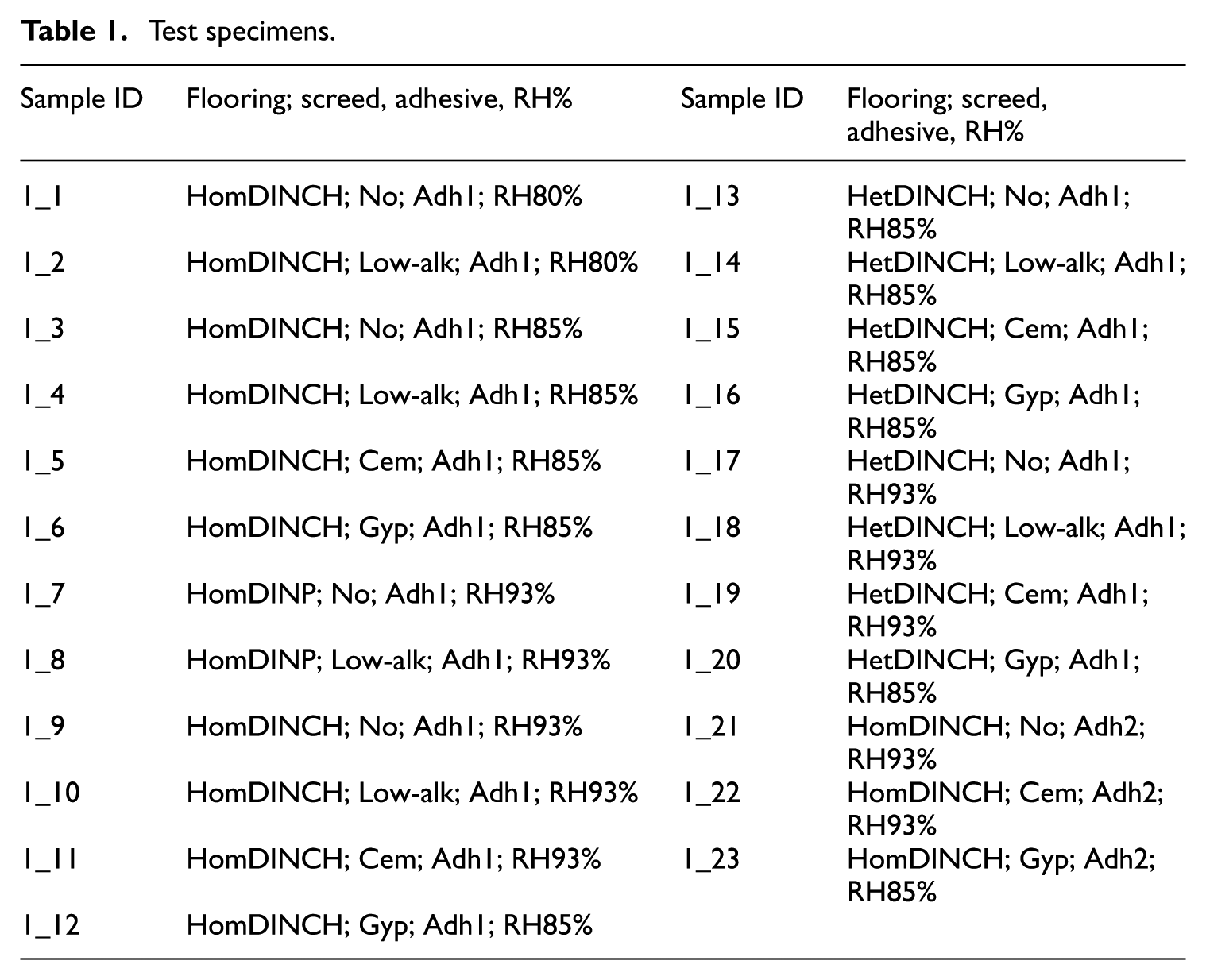
Three types of flooring: homogeneous flooring with DINCH (di(isononyl) cyclohexane-1,2-dicarboxylate) plasticizer (typically used in public spaces), homogenous flooring with DINP (di(isononyl) phthalate) plastizer (previous used, nowadays first mentioned replaced) and heterogeneous flooring with DINCH plasticizer (typically used in residential areas) were included in test series. Four screed types: no screed (No), 5 mm layer of low-alkali screed (Low-alk), 5 mm of cement based screed (Cem) (pH equal to concrete) and gypsum based screed (Gyp), were studied. The low alkali self-levelling screed consisted of cement, calcium sulphate and quartz and the pH was <11, according to the manufacturer’s information. Two types of adhesives were also studied: acryl copolymer dispersion (Adh1) with synthetic resin dispersion primer (typically used in PVC flooring) or alkali resistant adhesive (Adh2). The same amount of adhesive was used to prepare all the test samples.
The VOC emissions of the material samples from each test samples were analysed five to eight times during the minimum 5-year measurement period after installing flooring.
Test methods
Measurement of moisture of concrete and screed
The acceptable moisture level for concrete or floor covering criteria before installation of floor covering is determined by measuring the relative humidity (RH%) of the concrete or RHcrit. This value indicates the maximum RH in the near-surface area under the floor covering. Before installing the flooring on the concrete RH is measured on the concrete at the equivalent depth, which is 40% of the slab thickness for unidirectional drying. At this depth of the concrete, the RH is assumed to be the same as the maximum RH immediately below a dense floor covering after installation of floor covering. The actual equivalent depth is slightly smaller, about 30% of the slab thickness for unidirectional drying (Persson, 2003). The criterion value of 40% criterion is chosen based on certain partial coefficients (Persson, 2003).
The RH of the concrete slab at the equivalent depth and at the interface between the concrete or screed and the floor covering was measured using computer-controlled Vaisala HMP110 temperature and RH sensors and hand-held Vaisala HMP40 T and RH sensors, with an accuracy of ±2 RH%. Before casting the concrete, Ø 16 mm plastic tubes were installed at the appropriate depth (0.4 × 80 mm = 32 mm) to measure the RH of the concrete slab during drying and during VOC measurement or sampling. These plastic tubes were sealed at both ends to prevent fresh concrete entering and to prevent drying of concrete through the tube. After the concrete hardened, the seal of tube at the head inside the concrete was removed by drilling. The RH sensor was then installed into tube, tube was sealed and after a few hours of settlement, the RH was measured, Figure 1.
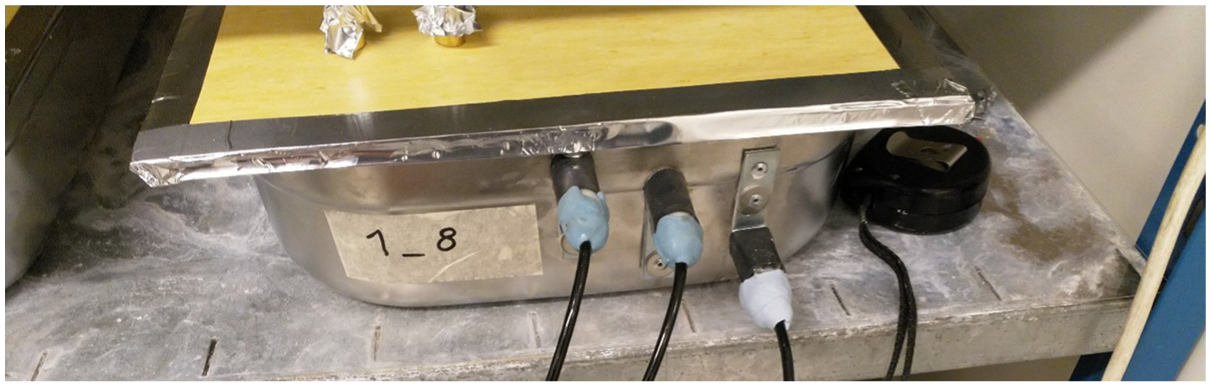
Test sample with measuring tubes for the RH sensor.
VOC measurements
VOC emissions were analysed from material samples and surface emission samples. Material samples or Bulk-VOC samples were taken from a material sample of approximately 40 × 40 mm2, including floor covering and some adhesive and screed, into a Tenax TA tube using a Micro-Chamber/Thermal Extractor (Micro-Chamber, µCTE). The emissions were analysed using a TD-GC-MSD (European Committee for Standardization, 2004). This analysis method was chosen as primary method because any possible deterioration occurs at the interface between the concrete and flooring, making it detectable in the material samples. It would take longer for the emissions pass through the flooring and be measurable at the surface of the flooring. Some surface emission samples were taken for comparison. These samples were collected using the Field and Laboratory Emission Cell (Flec) method (Nordtest, 1996) and analysed using a TD-GC-MS. The difference between the used Flec method and the widely-known ISO method (European Committee for Standardization, 2013) is that in the Flec method, the inlet air from the chamber is filtered indoor air rather than pure gas, and the air inlet into the chamber is not moistened.
pH measurements
The pH of the concrete and the screed was determined from material samples using a method described in (Björk et al., 2003). This method was compared with the pore-squeezing method and it was found to have good correlation (Björk et al., 2003). Reproducibility was also high, with differences in duplicate measurements (from different boreholes) was typically less than 0.1 pH-step. The method involved drilling a small sample from the concrete, or the screed and mixing 0.5 ± 0.01 g of drill dust with 5 ± 0.2 g of ion-purified water. After the solids settled in a laboratory tube, the pH of the liquid solution was measured using a pH electrode.
Both VOC emissions and pH of material (screed or concrete surface) in contact with the flooring were analysed simultaneously. After cutting material samples (flooring, adhesive, some screed), dust samples (screed and/or concrete) were drilled at the same location for pH analysis.
Results
In the following analysis, the total VOC (TVOC) concentration and concentration of 2-EH, 1-butanol and C9-C10-alcohols are presented, as these single compounds are indicators of the degradation of the PVC floor covering or adhesives. These compounds also dominate the TVOC concentration.
VOCs in material samples (Bulk)
A total of 156 VOC analyses, together with pH analysis, were carried out on material samples (Bulk) taken from 23 test specimens. In this chapter some key findings have been presented.
Figure 2 presents comparison of the TVOC concentrations of the material samples (Bulk) where only the screed material was different (samples 1_3, 1_4, 1_5, and 1_6) and the measured pH of the material (screed or concrete) facing the flooring. The flooring was homogenous flooring with DINCH plasticizer. The TVOC_BULK emissions were clearly higher in two specimens (1_3; No screed and 1_5; Cement based screed). Also the pH have been higher (over pH 12) in the same specimens.
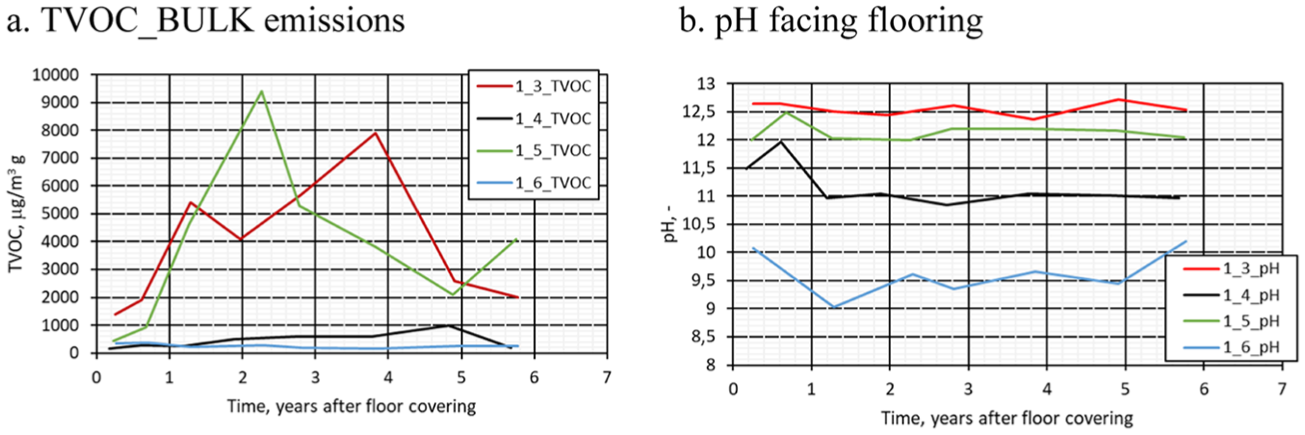
(a) TVOC_BULK emissions of material samples and (b) measured pH. All four test specimens have homogenous flooring with DINCH plasticizer, acryl copolymer dispersion adhesive and flooring was installed when RH of concrete was RH85%. Specimen 1_3 had No screed, 1_4 had 5 mm Low-alkali screed, 1_5 had 5 mm Cement based screed and 1_6 had 5 mm Gypsum based screed. (a) TVOC_BULK emissions and (b) pH facing flooring.
Figure 3 presents emissions of individual compounds (2-EH, 1-Butanol and C9-C10 alcohols) of two test specimens: 1_3 (No screed) and 1_4 (Low-alkali screed). The emissions of all compounds are higher in sample 1_3 (No screed) and the dominant compound is 2-EH. The 2-EH emissions reached the highest value about one year after installing floor covering. The dominant compound in sample 1_4 (Low alkali screed) is C9-C10 alcohols, which reached the highest value almost 5 years after floor covering.
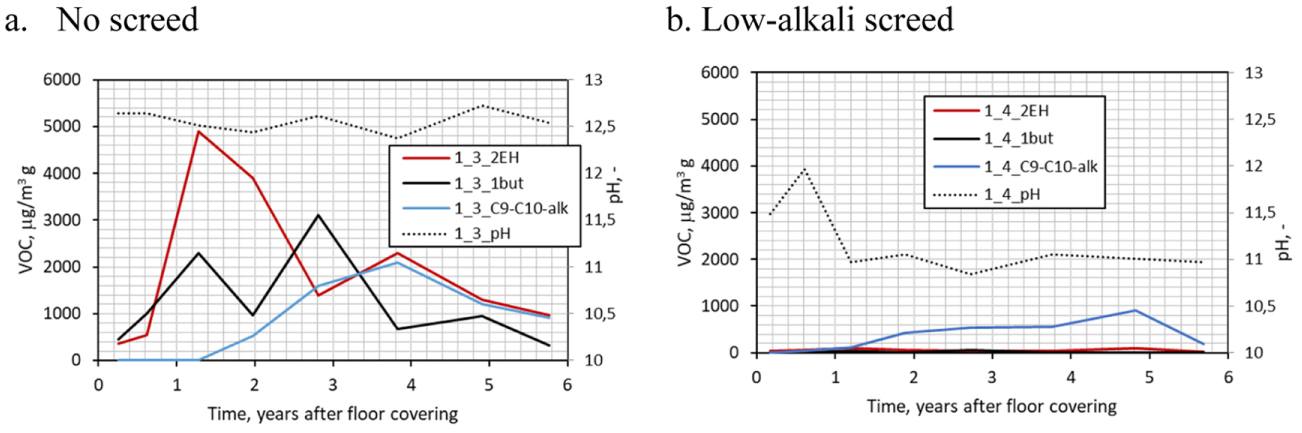
(a) 2-EH, 1-Butanol and C9-C10-alcohol emissions of test specimen 1_3 (No screed) and (b) test specimen 1_4 (Low-alkali screed). Homogeneous floor covering with DINCH plasticizer. Also pH is presented (dashed lines). (a) No screed and (b) low-alkali screed.
Figure 4 presents comparison of two different floorings with different plasticizer and with or without the screed layer. The TVOC_BULK emissions of the specimens without screed and higher pH (above 12) are higher than those of the samples with low alkali screed. It can also be noticed that the emissions of flooring with DINP plasticizer are higher than those with DINCH plasticizer, which is transparent since DINCH plasticizer was partly developed in order to reduce emissions. If specimens 1_3 (Figure 2(a)) and 1_9 (Figure 3(a)) are compared, it can be noticed that the TVOC emissions are higher in specimen 1_3. The specimens are the same, except the RH was lower in specimen 1_3 (RH85%) than in specimen 1_9 (RH93%). The pH of concrete layer in contact with the flooring is lower in 1_9 than in 1_3, which could explain the difference.
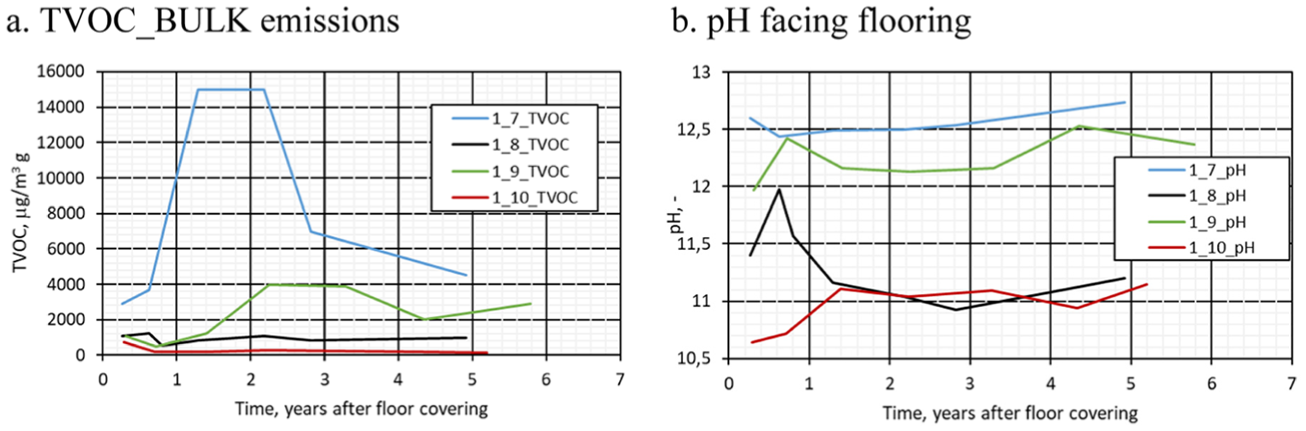
(a) TVOC_BULK emissions of material samples and (b) measured pH. All four test specimens have acryl copolymer dispersion adhesive and flooring was installed when RH of concrete was RH93%. Specimens 1_7 and 1_8 have homogenous flooring with DINP plasticizer and specimens 1_9 and 1_10 have homogeneous flooring with DINCH plasticizer. Specimen 1_7 and 1_9 had No screed and 1_8 and 1_10 had 5 mm Low-alkali screed. (a) TVOC_BULK emissions and (b) pH facing flooring.
Figure 5 presents the comparison of screed material to TVOC_BULK emissions where flooring was heterogeneous flooring with DINCH plasticizer. The differences in emission levels are not as clear as for the homogeneous flooring samples, but the highest emissions are from the specimen with no screed layer. The heterogeneous flooring is more permeable to air than the homogeneous and therefore the degradation products are more easily emitted through flooring. Also, the different composition of the floorings could partly explain the differences between heterogeneous and homogenous flooring. This can be seen in Figure 6, which compares the bulk sample emissions (TVOC_BULK) and surface emissions (TVOC_FLEC). There are more VOC emissions (BULK) in material samples in test specimens of more airtight homogeneous flooring than in heterogeneous flooring specimens. Conversely surface emissions (FLEC) are higher for air permeable heterogeneous flooring compared to material emissions. The average BULK/FLEC ratio of homogeneous flooring is 15.6 and heterogeneous flooring is 2.7. The permeability of the flooring also affects the drying of the concrete, so that the higher permeability of the flooring leads to lower RH of concrete. The RH (in the same measurement depth as before floor covering) was measured about 2 years after installing the flooring. For instance, the sample 1_14 (heterogeneous flooring with higher permeability) reached about RH = 77.5 %, while the sample 1_4 (homogeneous flooring) reached about RH = 80.3%.
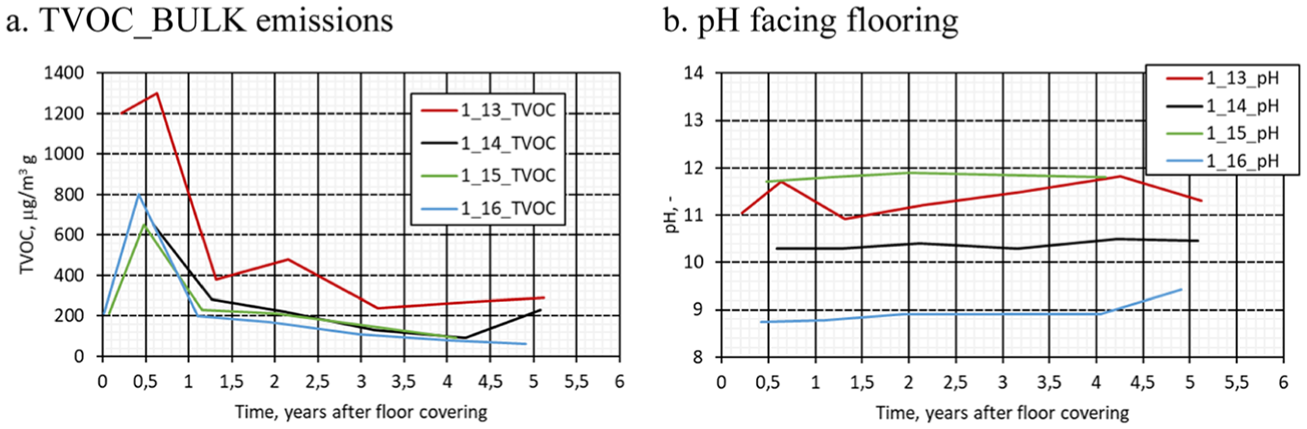
(a) TVOC_BULK emissions of material samples and (b) measured pH. All four test specimens have heterogeneous flooring with DINCH plasticizer, acryl copolymer dispersion adhesive and flooring was installed when RH of concrete was RH85%. Specimen 1_13 had No screed, 1_14 had 5 mm Low-alkali screed, 1_15 had 5 mm Cement based screed and 1_16 had 5 mm Gypsum based screed. (a) TVOC_BULK emissions and (b) pH facing flooring.
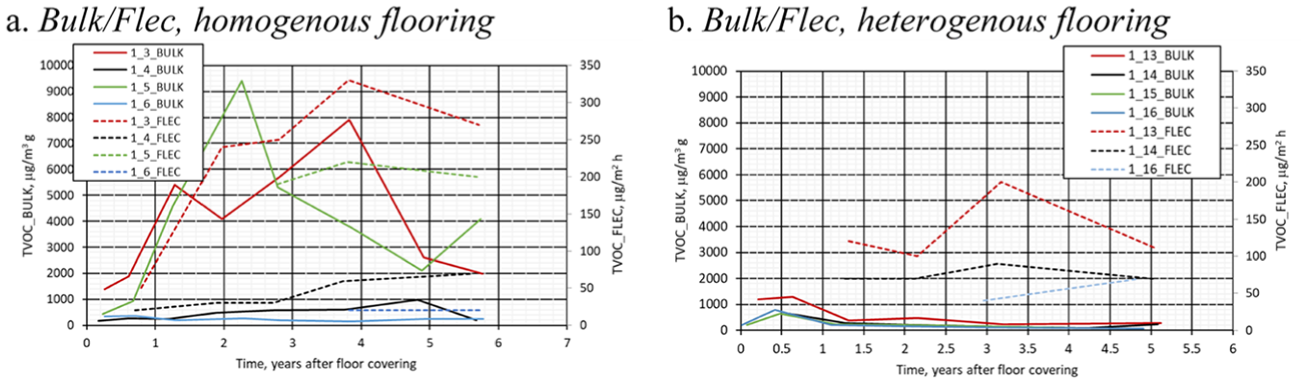
(a) TVOC emissions from material samples (Bulk) and surface emissions (Flec) of test specimens with homogenous flooring with DINCH plasticizer, and (b) Bulk- and Flec-TVOC emissions of test specimens with heterogeneous flooring with DINCH plasticizer. (a) Bulk/Flec, homogeneous flooring and (b) Bulk/Flec, heterogeneous flooring.
Figure 7 presents emissions of individual compounds (2-EH, 1-Butanol and C9-C10 alcohols) from two test specimens: 1_13 (no screed) and 1_14 (low alkali screed). In these samples, the dominant compound is 1-Butanol which reached its highest value in less than 1 year after floor covering.
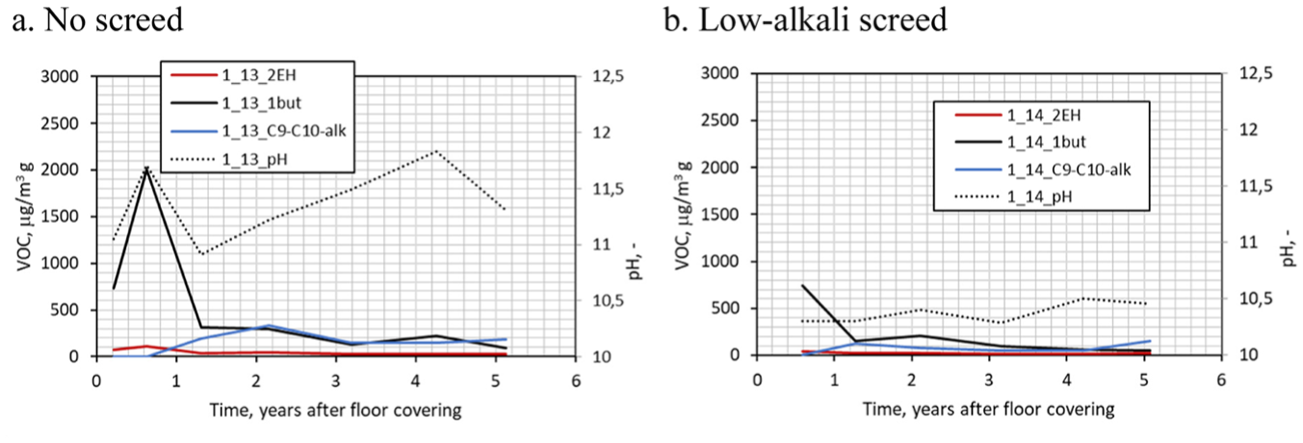
(a) 2-EH, 1-Butanol and C9-C10-alcohol emissions of test specimen 1_13 (No screed) and (b) test specimen 1_14 (Low alkali screed). Heterogeneous floor covering with DINCH plasticizer. Also pH is presented (dashed lines). (a) No screed and (b) low-alkali screed.
Figure 8 presents a comparison of the TVOC emissions from the test specimens where adhesive was alkali resistant. The emissions were quite low, with test specimen 1_23 (Gypsum-based screed) less than 100 µg/m3 g in all the analyses.
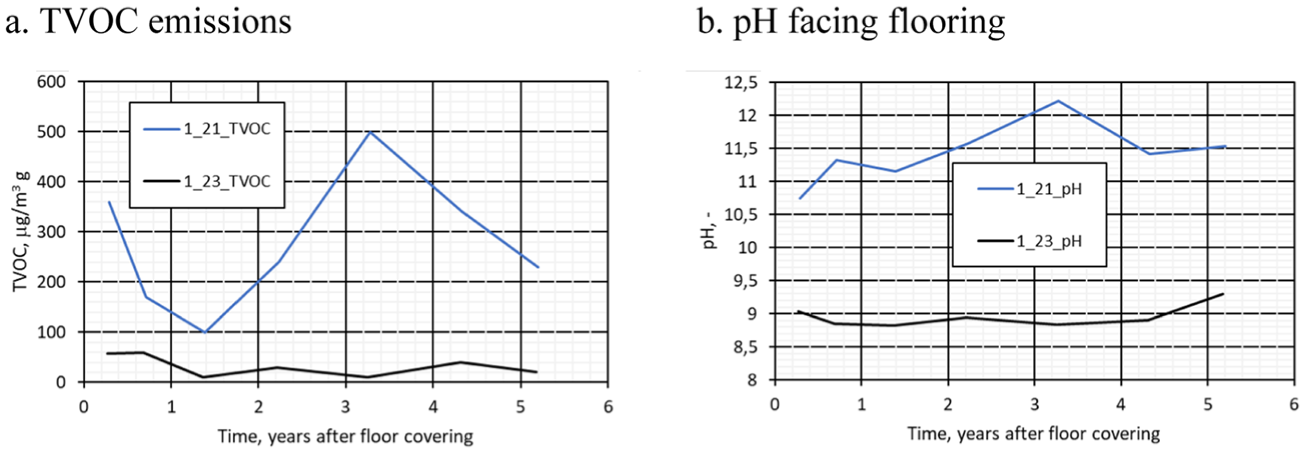
(a) TVOC emissions of test specimens with alkali resistant adhesive, sample 1_21 (No screed) and 1_23 (Gypsum based screed), (b) pH of test specimens 1_21 and 1_23. Homogenous floor covering with DINCH plasticizer. (a) TVOC emissions and (b) pH facing flooring.
The correlation of relative humidity of concrete or pH of material facing flooring to VOC emissions
Figure 9 presents a comparison of the TVOC emissions of the material sample and the relative humidity RHcrit) when the floor covering was installed. There is very weak correlation (Pearson Correlation Coefficient, ρ = −0.02), although some of the highest emissions were measured from samples where the floor covering was installed when the RHcrit of the concrete was high (RHcrit = 93%). Similar weak correlations were found between RHcrit and 2-EH (correl ρ = −0.05), 1-Butanol (ρ = −0.02), and C9-C10 alcohols (ρ = −0.02).
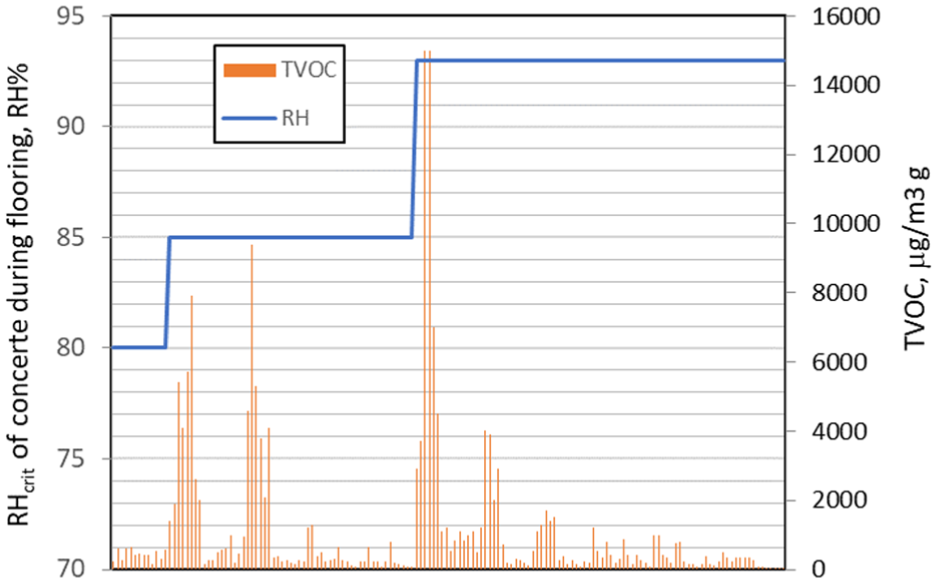
Comparison of TVOC emissions of material sample and RHcrit when floor covering was installed.
Figure 10 presents a comparison between the TVOC emissions of the material sample and the pH of the material (concrete or screed) facing the flooring. There is clearer correlation (ρ = 0.44) between TVOC emissions and the pH of the material facing the flooring. Similar correlations were found between pH and 2-EH (correl ρ = 0.37), 1-Butanol (ρ = 0.31), and C9-C10 alcohols (ρ = 0.41).
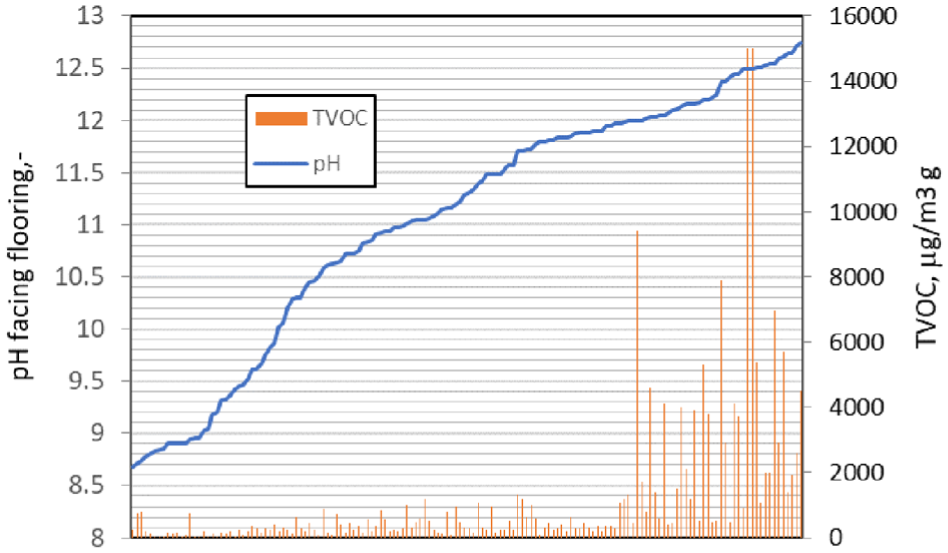
Comparison of TVOC emissions of material sample and pH of material facing floor covering.
Discussion
Based on VOC analysis of material samples (Bulk) the following findings could be made:
In this study the most commonly used analytical method for VOCs was to analyse VOC from material samples. The main reason for this was that hydrolysis reactions take place in the interface of the concrete slab and the flooring. By taking material samples, including flooring, adhesive and partly screed or concrete, it is possible to measure the reaction product earlier and comprehensively emitted into the flooring structure. In order to be able to assess emissions into indoor air, the emissions should be analysed from indoor air or from the surface of the studied structure. In this study some comparative emission samples have been taken from the surface (Flec). There is no solid correlation between measured Bulk-VOC and Flec-VOC, or the correlation is depends on the flooring material, mainly on the air permeability of the flooring. Bulk VOC emissions in material samples are higher in test specimens of more airtight floor covering compared to the surface emissions (Flec) because reaction products are emitted slowly through floor covering. Conversely, surface emissions (Flec) are higher for air permeable flooring compared to bulk emissions. It is therefore important not to confuse different methods of analysis and make misleading interpretations.
The material samples (Bulk-VOC) could have variation based on the amount of adhesive and concrete included in the sample, and this could cause some error in the TVOC and different compounds. This could explain some of differences between the different samplings, but the trends of emissions could be noticed.
In some countries it is common to use different layers of silane, epoxy etc. or polyethylene sheets between alkaline concrete and PVC flooring to prevent hydrolysis reaction of PVC and adhesive. The disadvantage of these layers is that in many cases that they are water vapour tight and therefore prevent water vapour diffusion from the concrete upwards. In certain cases (moist concrete slab or slab-on-ground slab diffuses moisture from to ground) it is possible that the vapour condenses under vapour tight layer, causing mould problems. Therefore the most common floor structure of concrete slab and PVC flooring, in Nordic countries, such as Finland and Sweden, does not have any vapour tight layers. Usually a levelling layer is required between the concrete slab and the PVC flooring, and choosing a low alkali screed means no additional layers or work is required.
Conclusions
Based on five-year follow-up study of the degradation of PVC flooring due to alkaline moisture (from an in-situ cast concrete slab), it can be concluded that pH of underneath material has much clearer impact on the deterioration process or VOC emissions than the moisture content (RH) of concrete slab during installation of the floor covering. The critical pH value is around pH = 12.
Footnotes

Funding
The authors disclosed receipt of the following financial support for the research, authorship and/or publication of this article: This research was financed by the Confederation of Finnish Construction Industries, the Finnish Concrete Industry, the Concrete Association of Finland, the Federation of Floor and Wall Covering Contractors, Saint-Gobain Finland/Weber Inc., Upofloor Inc., Kährs Inc., Gerflor Inc., Kiilto Inc. The authors thank all financiers and steering board members for their valuable contributions.
Declaration of conflicting interests
The authors declared no potential conflicts of interest with respect to the research, authorship and/or publication of this article.