




Abstract
Treating visual representations as a socio-legal text that offers entry points to critical debates about colonial legacies, experiences, and resistance, this article explores how visual and representational culture both shape and have the potential to destabilize the legal regime of colonialism. Drawing on display practices undertaken by Ontario’s largest community museum, The Ken Seiling Waterloo Region Museum, as well as the individual practices of Cree visual artist, Kent Monkman, this article is driven by the following question: How can visual representations be used to reveal, speak back to, and unsettle colonialism as a legal cultural order?
Keywords
1. Introduction
From Albert Bierstadt to Paul Kane and Cornelius Krieghoff, museums across the continent hold in their collections countless paintings that depict and celebrate the European settlers’ expansion and “discovery” of the North American landscape, but very few, if any, historical representations show the dispossession and removal of the First Peoples from their lands. This version of history excised Indigenous people from art history, effectively white-washing the truth from Canada’s foundational myths and school curriculums.
Cree visual artist, Kent Monkman.
1
September 2017
In its 2012 report, Canada’s Truth and Reconciliation Commission (TRC
Treating visual representations as a socio-legal text 5 that offers entry points to critical debates about colonial legacies, experiences, and resistance, I argue that visual and representational culture both shape and have the potential to destabilize the legal regime of colonialism. To illustrate this argument, this article employs a two-part approach. First, I investigate how the “largest community museum in Ontario,” 6 The Ken Seiling Waterloo Region Museum (The Museum) furthers the ongoing representational work of colonial institutional power. In this section, I analyze how their 2017 Going Beyond a Birthday interactive exhibition, and their current and main gallery exhibition, What Makes Us Who We Are? construct similar forms of visuality to validate the discursive formation of institutions that fit into the discursive practice of nation-making. Second, I explore how Monkman challenges discourses of national unity in his highlighting of the historical atrocities brought upon Canadian Indigenous peoples. 7 In this section, I unpack four of his visual representations, including, a ceramic plate, silicone hands, a skateboard, and a live skit that were on display during my visit to his private studio on June 20, 2017. Inspired by Monkman, this article is driven by the following question: How can visual representations be used to reveal, speak back to, and unsettle colonialism as a legal cultural order?
2. The Ken Seiling Waterloo Region Museum
Located minutes from the city’s downtown core, The Museum is a popular cultural attraction, and according to TripAdvisor is currently voted number 1 out of 135 things to do in Kitchener, Waterloo. 8 Delivering several cultural activities and experiences for visitors of all ages, including the Doon Heritage Village—a recreation of a rural village in 1914, with historic buildings and interpreters dressed in attire from 1914—a children’s reading area; the Waterloo Region Hall of Fame; a War Memorial; and the main gallery, it offers what Laurajane Smith (2006) terms the “authorized heritage discourse.” 9 Providing insights into the political value of heritage in the construction of community, The Museum utilizes the heritage discourse to shape understandings about the past, and as an act of meaning-making for the present. 10
Since its inception, the public museum has prioritized education and learning and has played a significant role in shaping national and cultural identity. 11 As a community museum in Ontario governed by standards set out by the Ministry of Heritage, Sport, Tourism and Culture Industries, The Museum is no exception. The Museum’s mission statement as seen on its website, for example, provides potential visitors with information that demonstrates its pedagogical aims and institutional vision and offers lessons that attempt to connect them to the past, present, future, and other members of a particular national identity. The page’s mission statement states that they “collect, preserve and share places, artifacts and stories of cultural significance in Waterloo Region so [they] can engage citizens and build a cohesive community through mutual learning, discovery and exchange.” 12 I found that the careful selection and use of the words, “citizen” as well as “cohesive community” reinforces the myth that the Canadian nation is what Benedict Anderson (2006) 13 describes as an imagined community and works to construct boundaries of identification. In using the word “citizen” for example, the Museum constructs a rationale for the creation of boundaries as to who is considered inside and who is considered outside of the community. In settler societies, like Canada, civilization is linked to state power and its method of allocating rights and protections. 14 Employing words like “citizen,” I suggest, therefore, marks the differences between subjects and objects of power organized by the rhetorics of settler citizenship. These oversimplified and reductionist binary oppositions dismiss the unique political rights of Indigenous peoples and demonstrate how differences in gender, race, and ethnicity are subsumed under the guise of community. The limited framing presented on The Museum’s website via its mission statement equips its visitors with a cultural roadmap on how to proceed through and make sense of the narratives in their forms of display.
2.1. Going Beyond a Birthday
The Museum’s 2017 Going Beyond a Birthday interactive exhibition reproduces the structured narrative found on The Museum’s website and exemplifies the disciplinary significance of colonial visual orders. In June 2017, a couple of weeks before Canada’s 150th birthday, I visited The Museum for the first time. Upon entering The Museum, I purchased my admission ticket and made my way down a large corridor toward their main gallery. As I made my way down the hall, I came to realize that there was an additional exhibit located to the left of the main gallery. Entering through the double doors brought me to the Going Beyond a Birthday interactive display, where I was interpellated and narrated into the White historian’s version of North American history. Geared toward The Museum’s younger visitors, the display works to shape the national consciousness of its younger patrons and can be considered as a means to fill what Joanna Kidman (2016) describes as the “ontological incompleteness” of childhood. 15 According to Kidman (2016) if we equate childhood with “goodness,” “innocence,” and “vulnerability” it can be “represented allegorically as a form of terra nullius, something that can be shaped, defined, and ultimately possessed by others.” 16 In viewing the Going Beyond a Birthday celebration, and the accompanying interactive activities as an institutional articulation of power and knowledge relations, 17 I unpack how The Museum’s curricula work to educate its young patrons. Housed in a large hall, the Going Beyond a Birthday display offers its young visitors a participatory and active learning experience. 18 The interactive timeline (see Figure 1), for example, invites its visitors to participate in the construction of the story of Canada as a nation. Occupying a signification portion of the hall’s wall, the chronological timeline begins (approximately) 12,000 years before European contact with an image of a green turtle and the words “Sky Woman and the Creation of Turtle Island” and moves forward in time, with the past behind and the future ahead. Although the timeline includes the Indigenous Creation Story, the discursive formations that worked throughout the exhibit to further nationalism as an ideology limit how the story can be constituted. Through its visual separation of, and emphasis on the dualism between a time before Confederation (marked in blue and black) and a time after (marked in red), for example, The Museum divides and controls time and space into a “before” and “after” constructing a point of contrast between pre-historic and historic. This form of distancing and separation signals that the Indigenous Creation Story existed during a time before the nation and reinforces the (mistaken) idea that Indigenous knowledge and traditions ceased upon contact with modern, Western societies. 19 Reinforcing what Tony Bennett (1995) describes as a “temporally ordered succession of different forms of life” 20 the timeline’s linear representation of history constitutes a “looking back” at First Peoples. In doing so, The Museum invites its visitors into a discourse that captures and assimilates Indigenous temporalities into the colonial ordering of temporality and represents the world as divided according to the dichotomy, “the West and the Rest.” 21 In drawing attention to difference, the Museum conjures up notions of the uncivilized “other” and works to characterize Indigenous peoples as distinctly different from citizens of Canada’s imagined community.
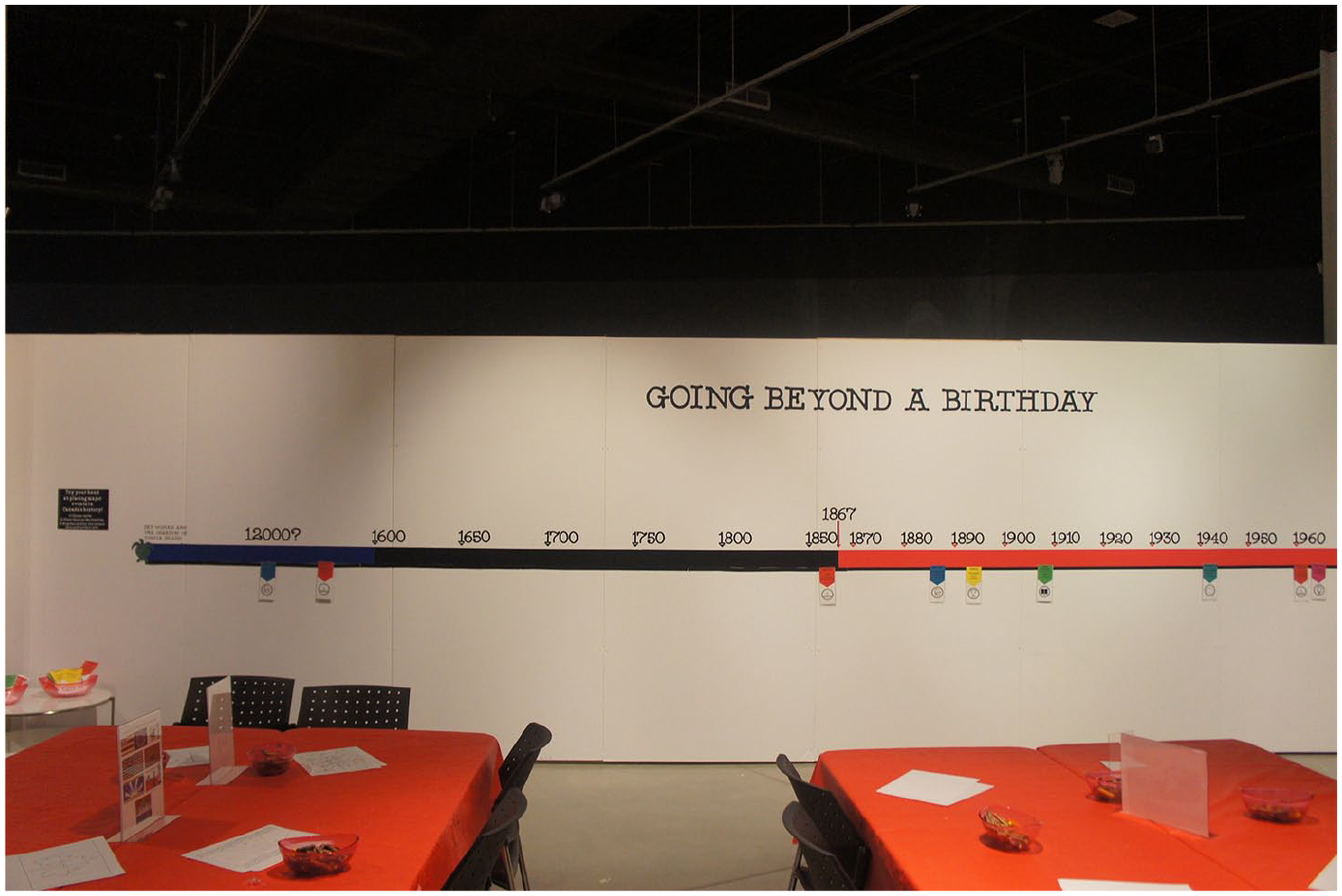
Interactive Timeline, The Ken Seiling Waterloo Region Museum.
2.2. Flag and Reading Area
The reading space (seen in Figure 2) provides another example of The Museum’s attempt to “promote learning and enjoyment” among its younger patrons. 22 Set up as a reading area, children and their families were encouraged to read stories about Canada as a nation and engage with puzzles in the shape of Canadian colonial maps. Strategically placed amidst the objects were Canada and Quebec flags, further validating, constituting, and reinforcing a normatively oriented representation of reality. Figure 3 showcases the display of more flags, all of which were sketched across a large white wall only a few steps from the reading area. Not unlike The Museum’s mission statement, and interactive timeline, the flags are rooted in a colonial past and metaphorically represent the unity of the nation. The three flags on display include the Royal Union flag, a Canada 150 flag, and the Flag of Canada, all of which represent the history, ideologies, and culture of the Canadian nation. 23
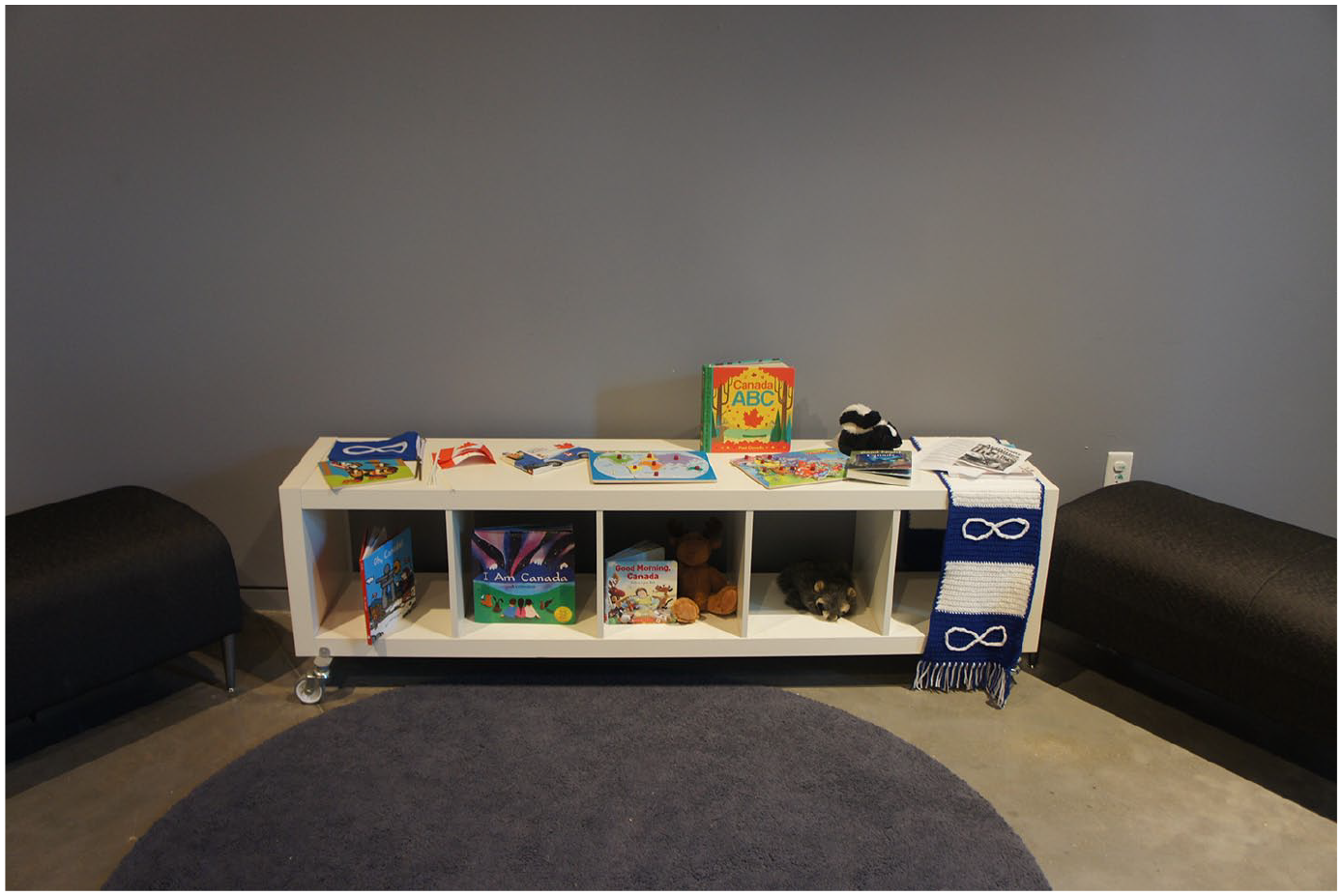
Reading Space, The Ken Seiling Waterloo Region Museum.
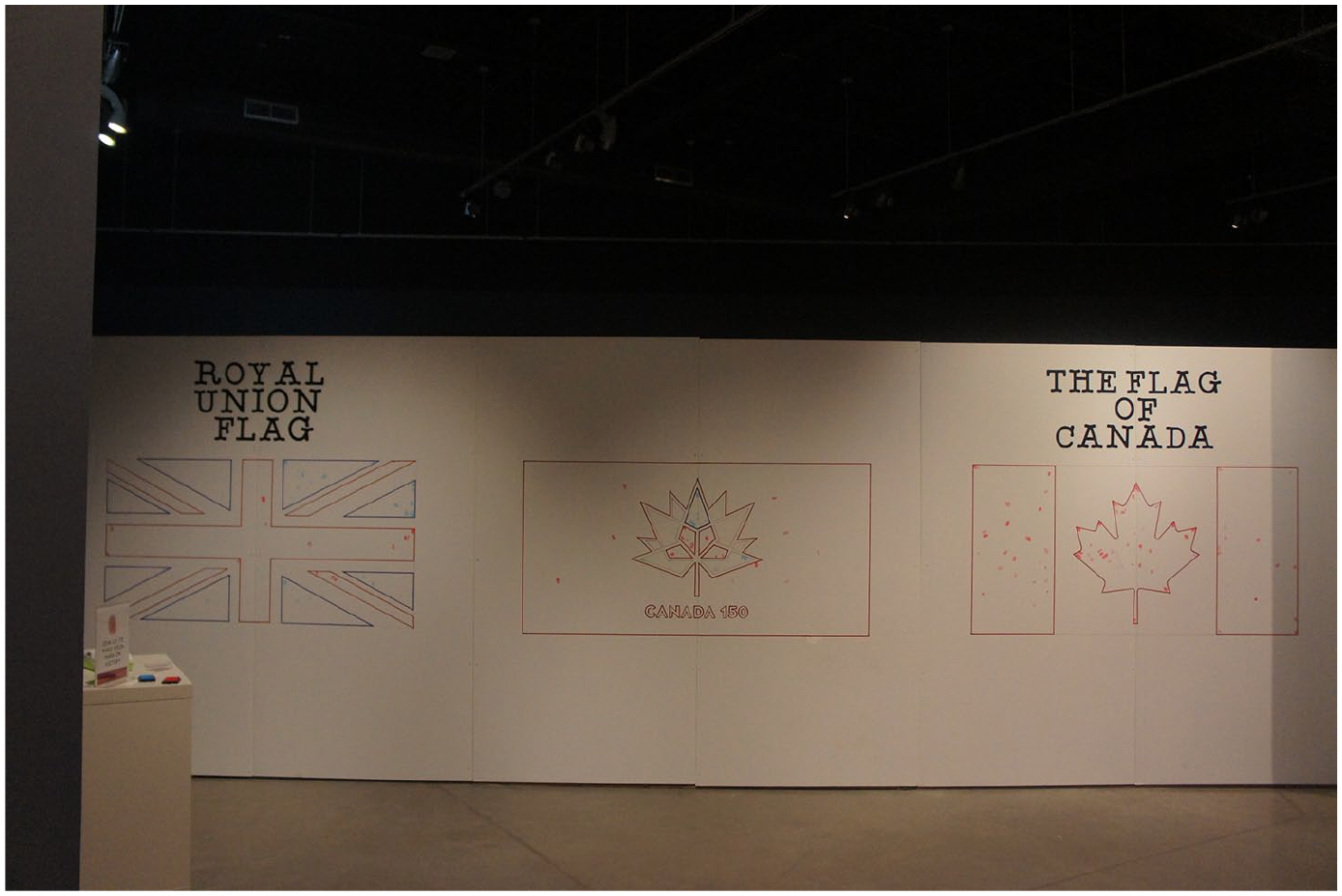
Flags, The Ken Seiling Waterloo Region Museum.
The first of the three flags displayed, the Royal Union flag, commonly known as the Union Jack, for example, was Canada’s official flag until the early twentieth century and is “flown as a symbol of Canada’s membership in the Commonwealth and allegiance to the Crown.” 24 The display of this symbol reinforces the chronological narration of history that details Canada’s transition from colony to nation and further validates the story of terra nullius and the doctrine of discovery framework. The second flag, Canada 150, and the third flag, the Flag of Canada offers additional visual representations that emphasize and celebrate Canada as a sovereign nation. Displayed in an area geared toward its younger visitors, the flags function as subtle symbols of colonial culture, and demonstrate how in the “liminal space of the museum” everything on display, including timelines, maps, and children’s activities can become art and a form of meaning-making. 25 Although Going Beyond a Birthday was successful in promoting civil engagement in a cultural institution, it neglected to meet the demands of Indigenous peoples for engagement, recognition, self-determination, and representation.
2.3. What Makes Us Who We Are?
In August 2022, I returned to The Museum to observe its main gallery, What Makes Us Who We Are? Housed in the main gallery recently renamed The Maple Leaf/Schneiders Gallery in honor of Schneiders and Maple Leaf and their substantial financial donation, the exhibit mirrors the discourse of national belongingness found in the Going Beyond a Birthday display. The colorful, wall-to-ceiling-sized didactic that greets visitors upon their entrance into the main gallery tells its visitors that the story presented “spans thousands of years, from First Nation’s peoples’ first connections to this land, to European settlement and industrialization, to the vibrant high tech-community of today.” 26 Representing life in the region as a set of sequential events, the didactic provides its visitors with a map of how to proceed throughout the exhibition. However, before visitors are introduced to the main gallery’s chronological timeline of the 12,000-year history of the region they are presented with displays that affirm a legal subjectivity and relationship to the law within the parameters of state nationalism. The placement of “Hazel’s Tale” or “Hazel” for short (Figure 4) a retired but restored steam engine and “her huge red flywheel” at the beginning of the exhibition, for example, immediately draws museum visitors into the practice of representation.
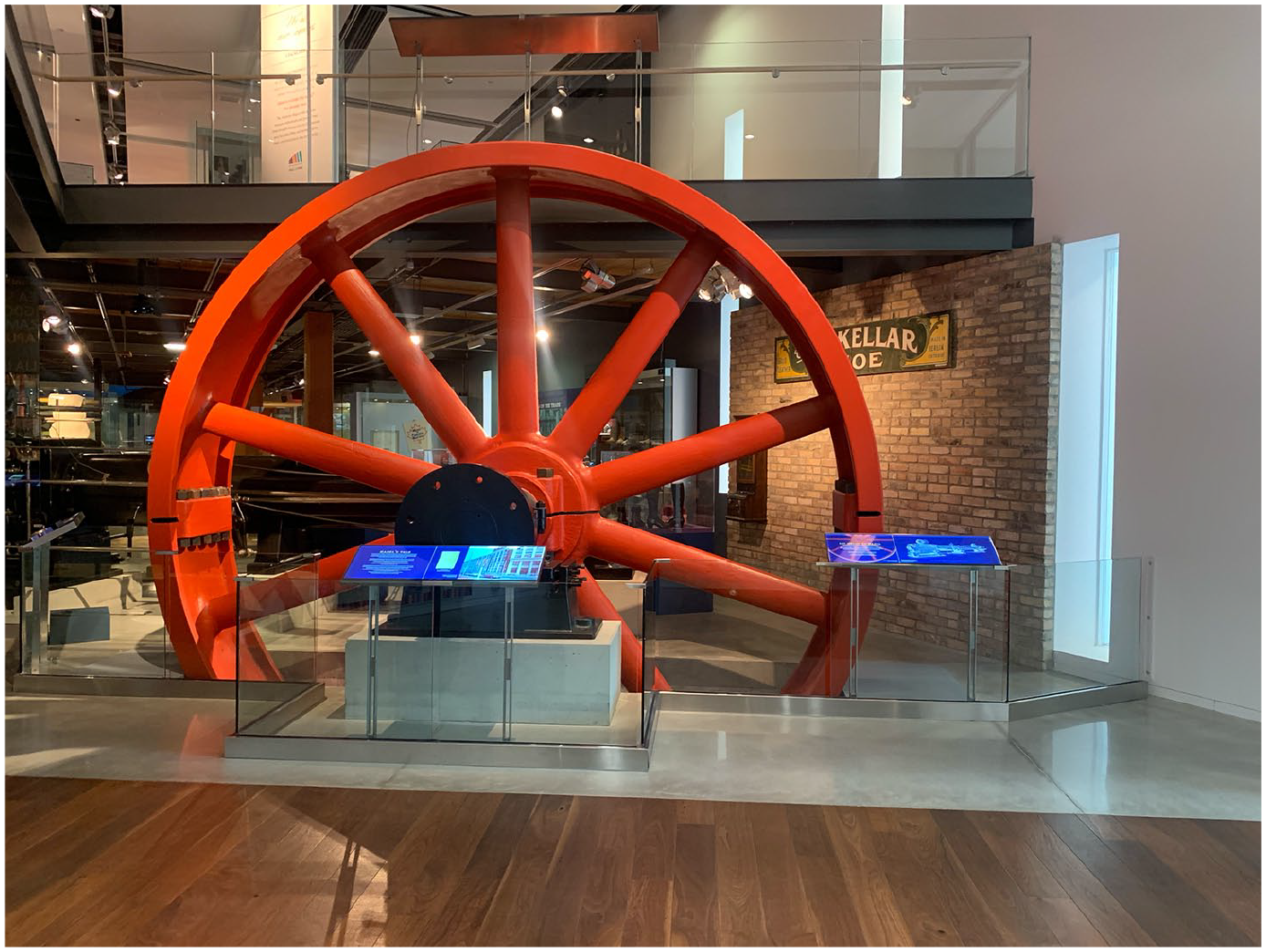
Hazel’s Tale, The Ken Seiling Waterloo Region Museum.
According to one of the digitized signs accompanying Hazel, entitled “Hazel Facts” she was manufactured in 1908, when run at full speed could generate about 450 kW of electrical power, and was primarily used to power machinery in the Kaufman plant until her retirement in 1990. The sign entitled “Say Hello to Hazel” further emphasizes the importance of Hazel and industrialization to the region’s success. For example, it explains that she powered machines operated by thousands of workers, “and those machines produced products, mainly shoes and boots, worn by millions of Canadians.” Presented as a route to capital accumulation for the Waterloo Region, Hazel is celebrated as one of the keys to the Region’s economic and social success. In showcasing the triumph of imperialism and one of the most significant technologies of the Industrial Revolution, the steam engine, the display of Hazel, illustrates a specific narrative of history that reinforces ideologies of progress and civilization. Not unlike the display of the interactive timeline in the Going Beyond a Birthday exhibit, Hazel maintains a chronological representation of history that commits itself to idealized principles of progress, civilization, and modernity.
Immediately following the didactic panel and display of Hazel, I came upon another display of Canada’s colonial national discourse (Figure 5). The panels that describe what is being shown explain people have immigrated for different reasons, including “for freedom,” “for a better life,” “for education,” “to escape the ruins of war,” and “for love.” Displaying a wall covered with the names of countries from around the world, and a short film playing on a continuous loop featuring the stories of people who have immigrated to Canada, The Museum represents Canada as the land of opportunity. Watching and hearing the immigrants on-screen describes their immigration stories in their own words, highlights the benefits of Canadian citizenship, and allows visitors a glimpse into the world of other members of the nation’s imagined political community. The display located directly across (Figure 6) continues to celebrate the nation and reinforce the idea that national unity is created through diversity. The wall-to-ceiling shelves hold luggage brought “by immigrants to Waterloo Region from different parts of the world,” including, the United States, Germany, Grenada, England, Scotland, China, and Russia. Each piece of luggage is represented as “a person’s hopes and dreams for the future and their new life in the region” and highlights Canada as a nation of immigrants. Among the items on display is an item used by First Nations described as a “Reproduction splint basket used by First Nations group.” I view the inclusion of an item used by Indigenous peoples among items “brought by immigrants” named First Peoples as immigrants and panders to the erasure of the distinct political rights of Indigenous peoples under the guise of “our shared history.” In line with the pedagogical aims set out in The Museum’s vision statement, the display constructs a kind of political identity in terms of multicultural democratic citizens. Although it works to foster a sense of belonging and commonality among all Canadians, the discourse of a multicultural national identity reinforces a political subjectivity, one that imagines its visitors as autonomous, rational, and sovereign subjects moderated by their inclusion in the national community. 27
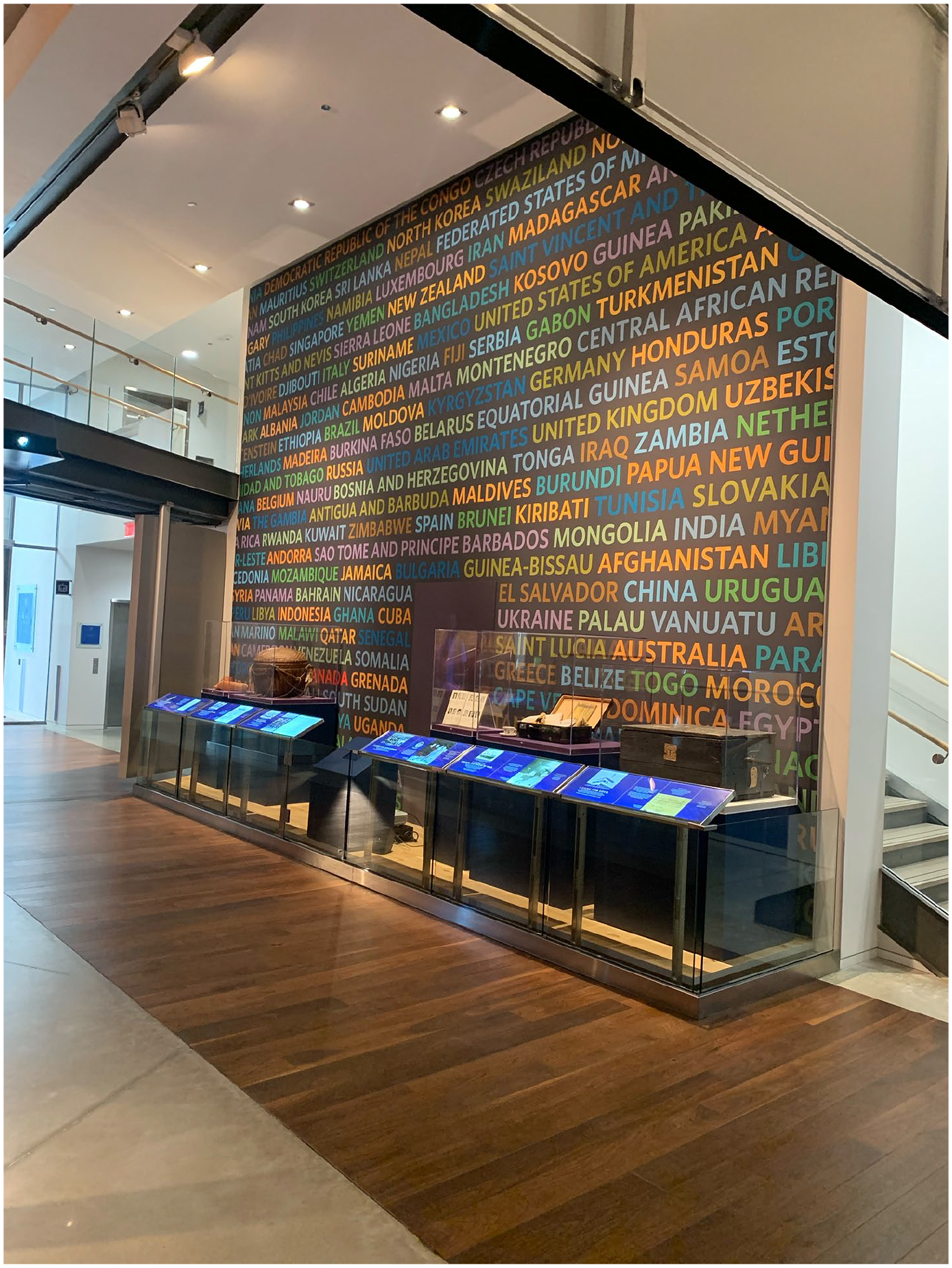
The Land of Opportunity, Ken Seiling Waterloo Region Museum.
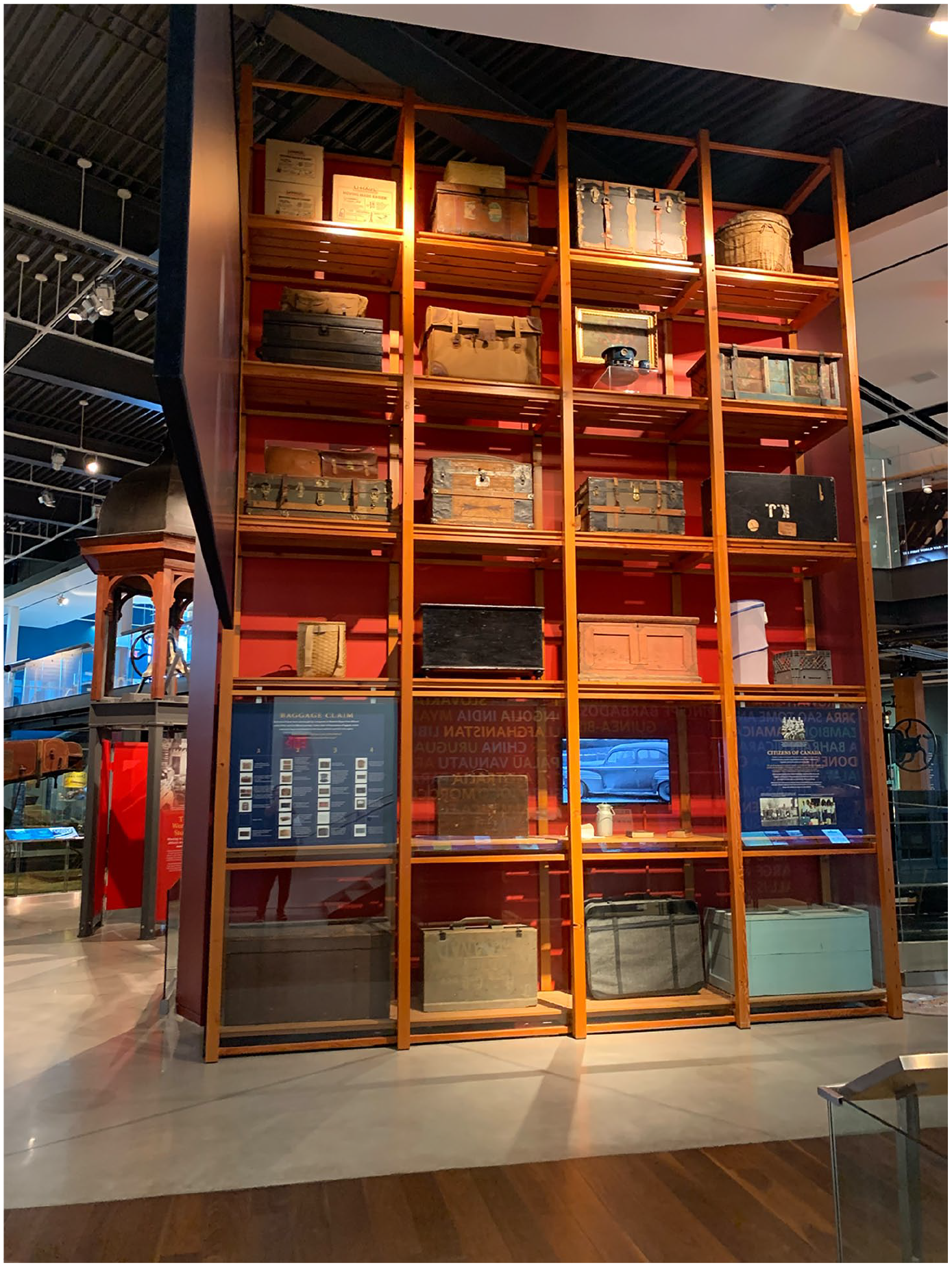
Baggage Claim and Citizens of Canada, Ken Seiling Waterloo Region Museum.
A few feet away I came upon the numerous panels that tell The Museum’s story of the Waterloo Region. The main gallery’s What Makes Us Who We Are? display not unlike The Museum’s Going Beyond a Birthday display, begins with the Indigenous Creation Story. Beginning with a quote from the 2003 winner of the Trillium Book Award, author and scholar Thomas King, the panel tells the story of the creation of Sky Woman and Turtle Island. Placed in a glass case shared with The Museum’s Artistry and Craftsmanship of the First Nations display, the panel invites visitors to reflect retrospectively on the information that was previously presented while acknowledging the Indigenous Creation Story. Although including the Indigenous Creation Story appears to respect and include differences, visitors are unlikely to understand its significance, because as Bryony Onciul (2017) reminds us, the typical museum visitor gazes upon the Indigenous other from afar and interprets and translates Indigenous traditions and practices from an outsider perspective. 28 The Artistry and Craftsmanship of the First Nations display further serves a colonial narrative by mediating the meanings of the objects on display. The glass case, for example, creates a separation between the object on display, and The Museum’s subject, the visitor, so they cannot be held, handled, or touched. 29 This display tactic removes items out of their “ritual, magic, religious, or symbolic contexts” 30 and places them in a sterile and ordered environment reducing them to ahistorical, autonomous objects.
In line with arguments proposed by Elizabeth Crooks (2010), 31 I view the Artistry and Craftsmanship of the First Nations display as an expression of Western identity as it detaches objects from their original temporal rhythms and renames and repurposes them for the Western gaze. I also consider The Museum’s placement of non-Western utilitarian objects at the beginning of the exhibit, separate from modern stories that appear in the majority of the exhibit’s panels, as a disciplinary technology. 32 In their presentation of targeted information and a specific narrative around history, including describing how the objects were used “13,000 years before present,” for example, The Museum maintains the idea that non-Western utilitarian objects are pre-historic and primitive rather than modern. This makes way for the classification and categorization of differences, works to keep visitors docile in their thinking, as well as reinforces expectations and responsibilities expected of members of The Museum’s imagined political community. Interestingly on the panel, there is no mention of who authored the text that accompanies the display. The signage does point out, however, that the items on display were “found in Waterloo Region” and were “likely imported through trade networks.” I found the use of the word “found” particularly interesting as it furthers the narrative that the objects were rescued from decay or loss and/or located during explorations. Suggesting benign intent, The Museum’s choice of words maintains the European settlers’ narratives of expansions and “discovery” of North America, while silencing how what was once celebrated as “explorations” has been more recently and perhaps more appropriately characterized as “looting.” 33
The next panel in the sequence entitled, “Waterloo Region’s Aboriginal Community Today,” further reinforces the fiction of the Canadian nation as an imagined community. The panel explains that the Native Peoples in Waterloo Region today are “Like you, we value our families, the wisdom of our elders, a good sense of humour, hospitality, and loyalty.” Using the words “like you” furthers the discourse of sameness and largely downplays differences between Indigenous and non-Indigenous peoples. The five accompanying pictures of Indigenous peoples currently living and thriving in the Waterloo Region work to authenticate the story being told. Displaying the accomplishments of descendants of the ancestors who feature in the stories that follow, including Dan Kennedy pictured at Wilfrid Laurier University’s Aboriginal Student Centre in 2011; Millie Falconer, the recipient of the Waterloo Region Small Business Centre’s 2011 Inspiring Women Award; Kandice Baptiste, the Aboriginal Students Recruitment and Retention Officer at the Aboriginal Student Centre at Wilfrid Laurier University, 2011; Members of Mino Ode Kwewak Ngaarnowak, 2011; and Michelle Lewis, at Wilfrid Laurier University’s Aboriginal Student Centre in 2011, for example, and the incorporation of the first-person point of view through the pronouns “we” and “us” communicates that the story being told is authentic as it is being told from the perspective of Indigenous peoples.
In their celebration of sameness, The Museum renders the “other” familiar and in doing so, can control how they are presented and perceived by predominately non-Indigenous visitors. 34 The four panels that immediately follow tell the stories of how First Peoples in Waterloo Region “lived,” “adapted,” and “sustained a rich and thriving culture.” Not unlike The Museum’s mission statement, and interactive timeline, the panels present stories of national unity and belonging through their telling of how the Anishinabek, Haudenosaunee, and Europeans first came to coexist and live together in the Waterloo Region. However, the numerous panels that follow largely ignore Indigenous stories and silence what Avery Gordon (1997) calls the “ghostly” 35 aspects of social life (p. 7). Described as a social figure that draws attention to something missing from historical narratives a ghost can lead to a radical change in the ways we generate and understand knowledge. 36 Borrowing from this theory, being haunted recognizes that the What Makes Us Who We Are? event is not a celebration of Indigenous culture and heritage. Instead, it is a celebration of a colonial narrative that fails to provide its visitors with knowledge to make connections between the past and present. Without these links, visitors are provided with a similar logic to that of the interactive timeline that similarly freezes Indigenous peoples of a different or more “authentic” time. Maintaining the dichotomy, “the West and the Rest” 37 The Museum presents discourses that further the narratives of shared history between settlers and colonizers as though their experiences are the same while silencing ghostly memories of dispossession, genocide, and other colonial legacies.
The Museum’s Going Beyond a Birthday display, as well as its What Makes Us Who We Are exhibit, demonstrates the theoretical insights and the specificities of the making of a particular imagined community through visual representations and displays. Through their use of particular words via their vision statement, interactive activities, presentation of targeted signage, and timelines that depict a chronological, linear telling of history, The Museum regulates its visitor’s behaviors and curates a specific experience that maintains Canada’s colonial national discourse. Providing several examples of how visual representations can reveal colonialism as a legal cultural order, The Museum’s exhibition and curatorial practices reinforce the discursive order, keeping visitors docile in their thinking and unaware of their subjugation.
3. Kent Monkman
My investigation into past and present curatorial and exhibition practices undertaken by The Museum demonstrates how art institutions maintain and reinforce what Canadian Indigenous visual artist, Kent Monkman refers to as a “white-washing” of Canadian history. 38 In my investigation into how Monkman uses visual representations to combat colonial knowledge, I visited his private studio on Sterling Street in Toronto, Ontario to attend a private showing of Chateau Miss Chief: Pride Edition, as well as his curatorial talk at the University of Toronto’s Art Museum for his first solo-exhibition, Shame and Prejudice: A Story of Resilience. Monkman’s traveling tour which began in 2017 at the Art Museum at the University of Toronto and ended at the Museum of Anthropology at the University of British Columbia in 2021 has been exhibited in almost every region throughout Canada, except the Arctic. 39 Reflecting on the last 150 years of the Indigenous experience, Monkman’s exhibition centers on all parts of Indigenous history, including “the signing of the numbered treaties, the reserve system, genocidal policies of the residential schools, mass incarceration and urban squalor.” 40 For my analysis, I unpack four of his visual representations I encountered in his studio during my visit on June 20, 2017, including Resilience Plate, a cobalt transfer on ceramic; Praying Hands, a silicone butt plug that draws inspiration from Albrecht Durer’s Praying Hands; a skateboard meets art, a collaborative endeavor undertaken with Cree artist, Michael Langan; and a live interactive skit. 41
While making my way to Monkman’s factory turned studio from the outskirts of Toronto to the downtown core, I appeared calm to not alarm my Uber driver, but inside I was petrified that upon arriving at Monkman’s studio I would be labeled as someone who enjoys considerable privilege. As I continued in silence to Monkman’s studio, I reminded myself that I cannot escape the fact that I am a half-White, non-Indigenous, highly educated, Canadian citizen, with a heterosexual orientation, and can control how I enter into and exist in intercultural spaces. As I neared Monkman’s studio, I reminded myself of my privilege and committed to moving away from what Dylan Robinson (2020) describes as “hungry listening.” 42 Upon entering the studio, I was greeted by a large, diverse, and welcoming crowd. After grabbing a tall boy from the small makeshift bar located at the back of Monkman’s studio, I roamed around, engaged with interactive performers, and had insightful conversations with other guests. The incredibly inviting environment that Monkman created within his studio and the bringing together of Indigenous and non-Indigenous peoples to think, share stories, and have conversations demonstrates how ideas around “community” can exist outside of white supremist foundations and the rhetoric of Western citizenship.
3.1. The Daddies
On a shelf beside what appeared to be Monkman’s desk space, I located a cobalt transfer on a ceramic plate of Monkman’s painting The Daddies (2016) (Figure 7). The painting attempts to create the likeliness of Robert Harris’ historical piece, Meeting of the Delegates of British North America to Settle the Terms of Confederation (1864)—often referred to as The Fathers of Confederation—with one major difference, the addition of Monkman’s naked alter ego, Miss Chief Eagle Testickle or Miss Chief, for short. 43 Taking the form of a time traveler and third gender, Miss Chief asserts her agency and challenges the linear representation of history displayed in The Museum’s Going Beyond a Birthday and What Makes Us Who We Are? exhibits. Moving forward and back through time she “lives in the past, present and future” 44 and puts on display the limited viewpoint associated with a single national identity. In using Miss Chief to play up colonial stereotypes around Indigenous peoples, Monkman teases “out the truths behind false histories and cruel experiences” 45 and reverses the colonial gaze to look back on Europeans.
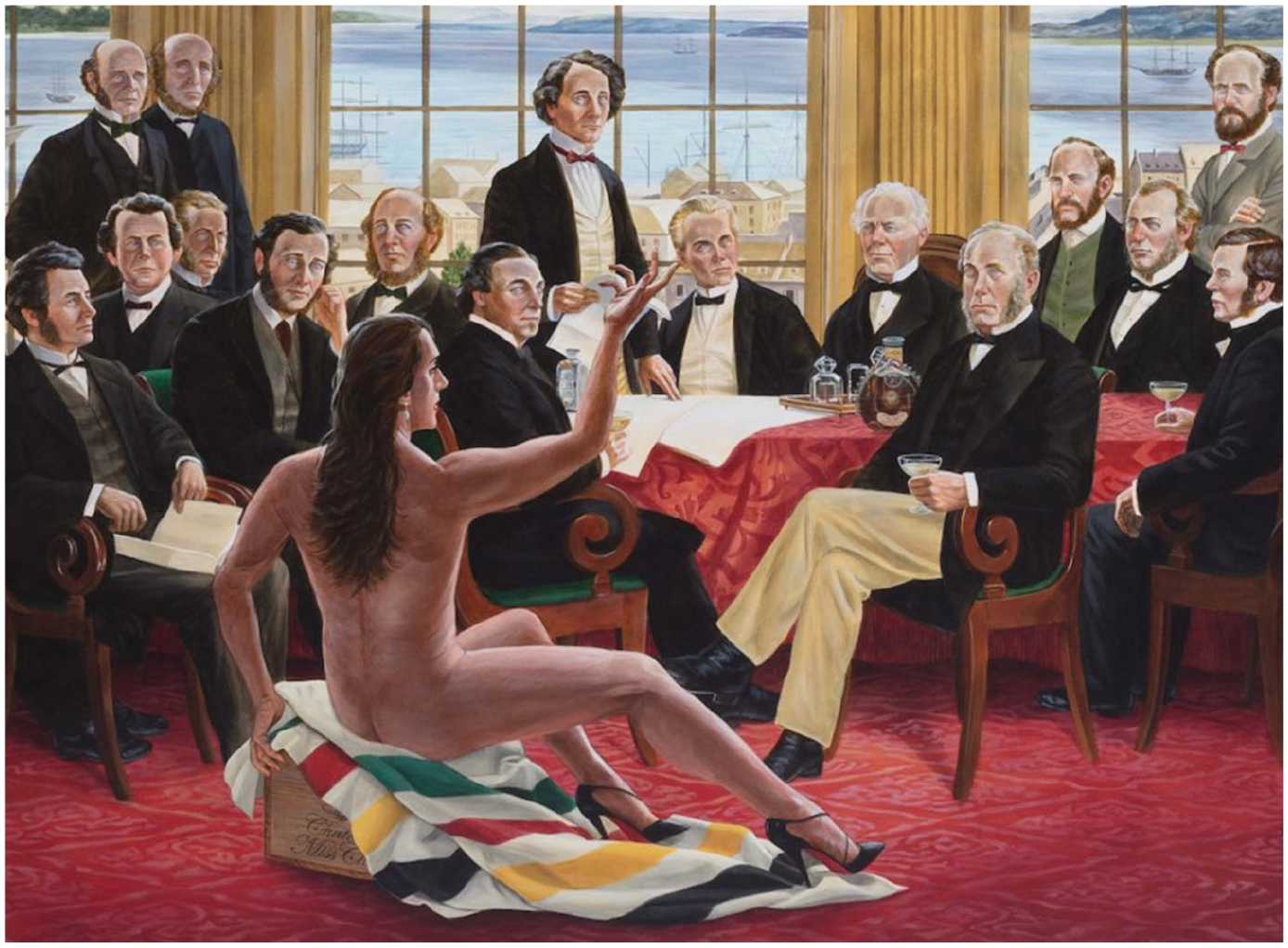
The Daddies (2016).
During his curatorial talk at the Art Gallery at the University of Toronto, Monkman details how The Daddies (2016) attempts to draw attention to the violence associated with depicting the female body. In using Miss Chief’s naked body as a metaphor for violence against the female Indigenous spirit, for example, Monkman speaks back to the work of Pablo Picasso, a well-known misogynist, who painted female nudes depicted brutally and violently. 46 He explains that in this painting Miss Chief who takes the form of a third gender is depicted as having similar intentions as the Bennet sisters in Jane Austen’s Pride and Prejudice (1813). 47 Here Monkman uses, accepts, and works with the shifting, unstable character of meaning, and enters into a struggle over representation. Instead of avoiding the Indigenous body, he uses Miss Chief to speak back to the dominant gender and sexual definitions of racial difference by drawing attention to her sexuality.
In his exploration into the untold histories of Miss Chief, Monkman centers on the forms of sexuality that were present in pre-colonial Indigenous societies and highlights how homosexuality and two-spirited peoples within certain tribes were celebrated for their ability to bridge the gap between genders. Embodying the refusal of colonial binaries of female/male and straight/queer privileged within Euro-Canadian culture, Miss Chief highlights the misrepresentation of sexuality in Indigenous cultures. Nicole Perry (2020) explains how Miss Chief’s “evolution” and its accompanying “labels and terms such as berdache, two-spirit, and most recently gender fluid,” 48 work to reveal the reductionist and oversimplified understandings of gender found in the dominant discourse. Berdache, for example, is a derogatory colonial term that represents Indigenous peoples as primitive or pre-historic while also “projecting masculinism and sexualization onto them.” 49 Painters, such as Monkman’s arch nemesis, George Catlin, who was both opposed to and fascinated by two-spirited peoples, attempted to record the ways of life of the berdache. 50 His painting Dance to the Berdashe (1835–1837) which represents a group of Indigenous men, including one dressed in women’s clothing performing a traditional dance to celebrate a two-spirit person who has masculine and feminine traits, is one such example of his accounts. In his notes, Catlin describes the dance as “one of the most unaccountable and disgusting customs that I have ever met. . .[and] I should wish that it might be extinguished before it be more fully recorded.” 51 His painting combined with his racist remarks inspired Monkman to create Miss Chief. In framing Shame and Prejudice: A Story of Resilience and the display of the exhibition’s various visual representations, including The Daddies (2016), as if they are from Miss Chief’s memories, Monkman represents the trickster’s view of history and, in doing so, creates and draws attention to new and/or different understandings of gender outside of the heteronormative paradigm of Euro-Christian culture.
3.2. Miss Chief’s Praying Hands (2016)
Placed on the shelf next to the cobalt transfer on a ceramic plate I spotted Miss Chief’s Praying Hands (2016) (Figure 8). A recurring motif in Monkman’s work, the painted blood-red hands are the unofficial symbol in many missing and murdered Indigenous women, girls, and Two-spirit people’s campaigns. 52 As a play on Albrecht Durer’s Praying Hands (1508), the silicone pair of hands are joined in prayer to mock the colonial influence and power inflicted on Indigenous peoples at the hands of the church. 53 Made from the same silicone rubber as sex toys, Miss Chief’s praying hands and butt plug base makes way for conversations around how “Christianity has fucked Indigenous peoples over for centuries.” 54
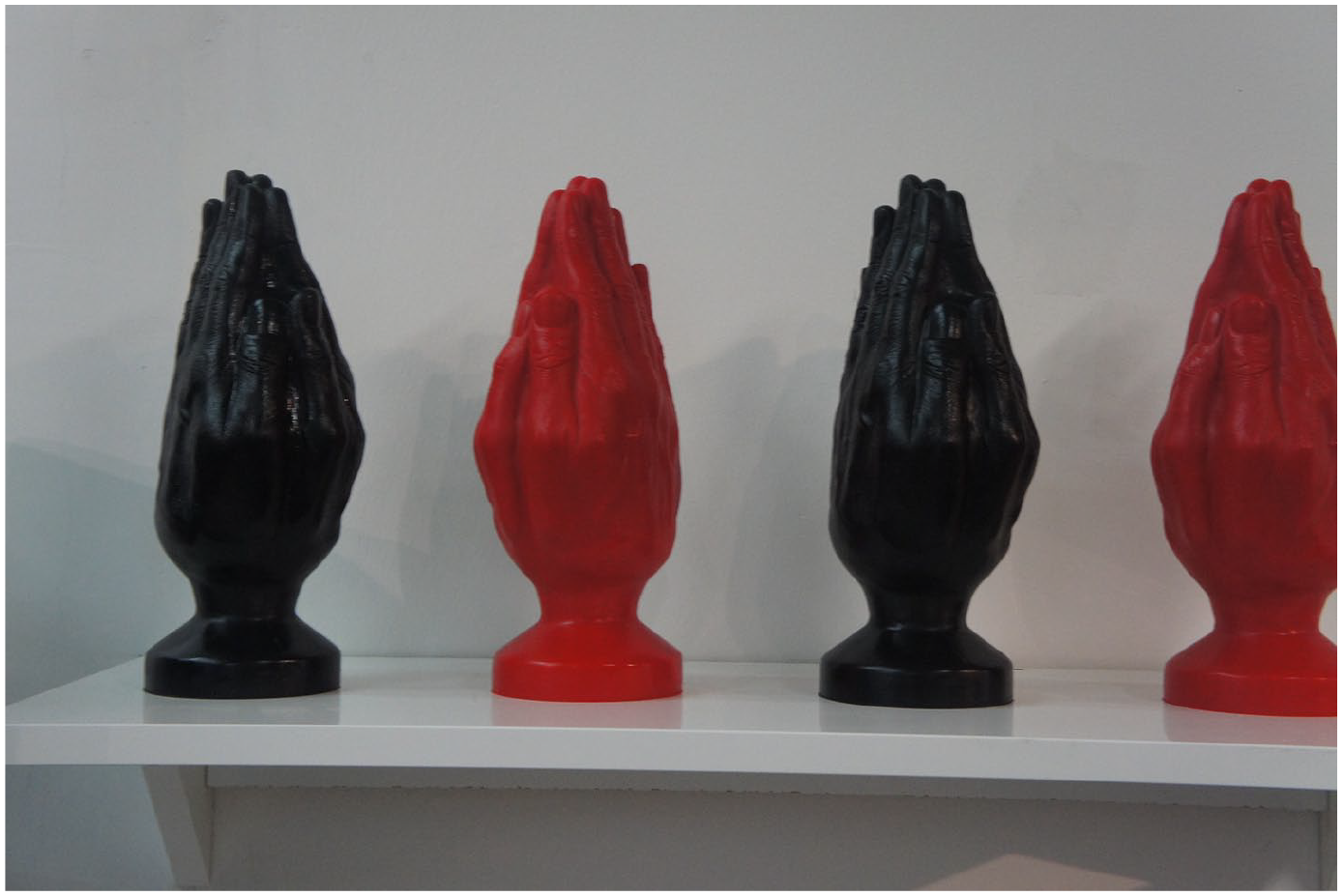
Miss Chief’s Praying Hands (2016).
In 2020, the recurring motif of painted blood-red hands appeared in Monkman’s controversial painting Hanky Panky (2020). In the same year, he issued an apology for the painting on his website and social media demonstrating how reconciliation proves to be a complex process imbued with politics. Described in a since-deleted post on Monkman’s Instagram page, as an attempt to highlight the “problems with the Canadian (in)justice system” including the “victimization,” “violence,” and “legal neglect” of Indigenous women girls, and “Two-Spirit people” 55 the work depicts a man resembling Canadian Prime Minister Justin Trudeau on all fours, naked from the waist down, surrounded by a group of laughing Indigenous women. Behind him, Miss Chief holds up a pair of blood-red praying hands while a number of former Canadian Prime Ministers, including John A, Macdonald, Stephen Harper, and Jean Chrétien look on in what appears to be fear. Playing tongue-in-cheek on the violence of missing and murdered Indigenous women, girls, and Two-Spirit peoples, his painting demonstrates the discomfort associated with turning the colonial narrative on its head. Patty Krawec, an Ojibwe-Ukrainian, for example, argues Monkman made Indigenous peoples “complicit” in “violence” 56 and some members of the traditional council of Cree women law keepers, the Okihcitâwiskwêwak who Monkman references in the painting take offence with the idea that they would take pleasure in what they view as sexual assault. 57
In response, Monkman acknowledges he “failed” to “prioritize the safety of marginalized genders” and explains he intended to show a “consensual act” 58 between Trudeau and the characters depicted. His apology provides a heavy irony as he ends up being in a position where he has to apologize for presenting issues that the colonial government has pressed upon Indigenous peoples. The controversy surrounding Hanky Panky (2020) challenges us to look at the function of art and to question if there are different standards for Indigenous art and other forms of art. Considering the ongoing success of Western artists, including, Pablo Picasso, for example, and his works like Young Girl with a Flower Basket (Fillette à la corbeille fleurie) (1905) which sold in 2008 for 115 million dollars despite his sexualized depiction of a prepubescent girl, demands no apologies. 59 Instead, Picasso is deemed a transgressive artist known for his controversial works of art. With Hanky Panky (2020), Monkman has been accused of going too far, begging the question should members of Monkman’s community be able to dictate how he should paint and think? His controversial painting unsettles and disrupts settler colonial narratives, as well as the discomfort for Indigenous communities demonstrating how the process of reconciliation can be complicated.
3.3. The Scream
A few steps from Monkman’s office space, I came upon five skateboards that depicted Monkman’s visceral and graphic painting, The Scream (2017) (Figure 9). Seeing the skateboards brought me back in time to the moment I happened upon the huge two-by-three-meter painting while exploring the Shame and Prejudice: A Story of Resilience exhibition at the Art Museum at the University of Toronto. 60 Confronted with mother’s faces filled with anguish and grief as their children are literally ripped from their arms by Royal Canadian Mounted Police officers and members of the Catholic church to be sent to residential schools, The Scream (2017) evoked a visceral response from me. As a socio-legal scholar, I have encountered a great number of readings detailing the horrors and devastation of colonization, but no amount of text could as vividly and vibrantly capture the story being told. Centering on the horrors of residential schools, The Scream (2017) tends to the ghosts and draws our attention to the roles that the police and church played in the enforcement of various provisions of the Indian Act. Here, Monkman highlights the idea that the sending of Indigenous children to residential schools could not have been accomplished without the active role of the police and the church. 61
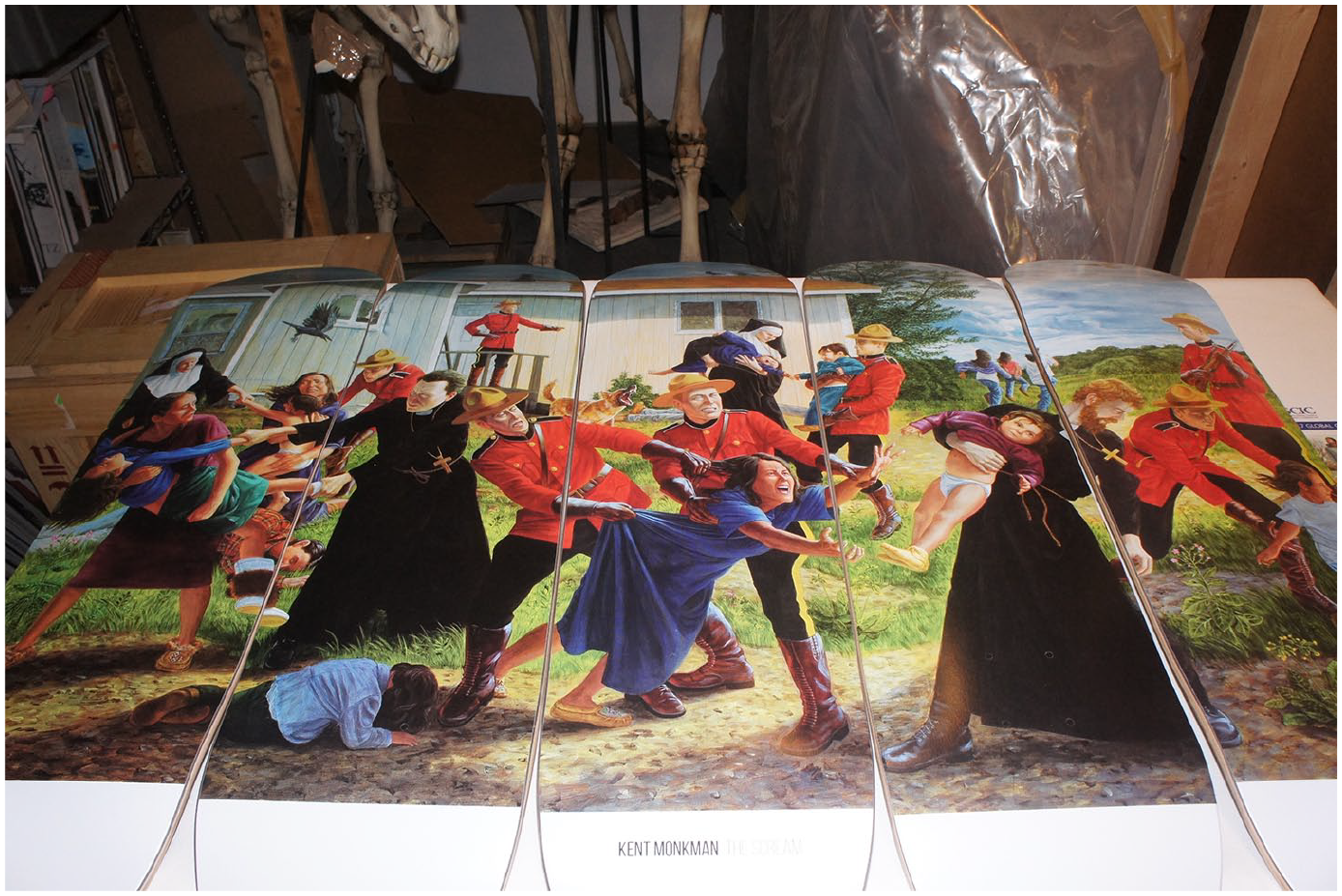
The Scream on Skateboards.
With his skateboard meets art collaboration with Cree artist, Michael Langan, Monkman demonstrates how reconciliation comes in many forms. In taking his visual representations out of the gallery to the streets, for example, Monkman’s stories reach a wider audience than the typical museumgoer. During a 2017 interview with Blake Lough for CBC News, 62 Langan explains how skateboard art has encouraged conversations among youth at the skate park, and believes their collaboration provides an example of how we might move forward through truth and reconciliation. Although the five skateboards that depict The Scream (2017) are sold out on Langan’s website, he currently has a number of other boards available that center on the Indigenous experience of history. With each board purchased, he includes a write-up explaining what colonialism is, and how it continues to affect Indigenous peoples today.
3.4. Live Interactive Skit
In the early twentieth century, paintings by the Canadian Group of Seven, as well as other Western landscape artists, reinforced the transition from colony to nationhood—as evidenced in their depictions of the Great Canadian wilderness and empty Canadian landscapes. 63 Challenging narratives of discovery and empty lands, Monkman inserts Indigenous sexuality into a canonical representation of North American history. Figure 10, for example, captures two two-spirit individuals seducing and being seduced by White cowboys in front of a large backdrop resembling what appears to be a Western landscape painting depicting empty lands. Appearing to adopt the aesthetic style and presentation of old-time photography, the various representational techniques used connote the developing nature of new stories while acknowledging the historical and analytical roots that prepare for their manifestations. Utilizing camp humor, Monkman uses the performance to speak to a period before Confederation, and before treaties when Indigenous peoples were still players in the economy. Challenging the constitutive relationship between “us” and the “other” he depicts a scene during a time when the West was still wild, and where Indigenous and non-Indigenous peoples coexisted as equal, sovereign, and autonomous bodies. Disrupting the Western arrangement of time, the interactive performance complicates things in terms of time and space as it builds upon the past while conflating the past with the present.
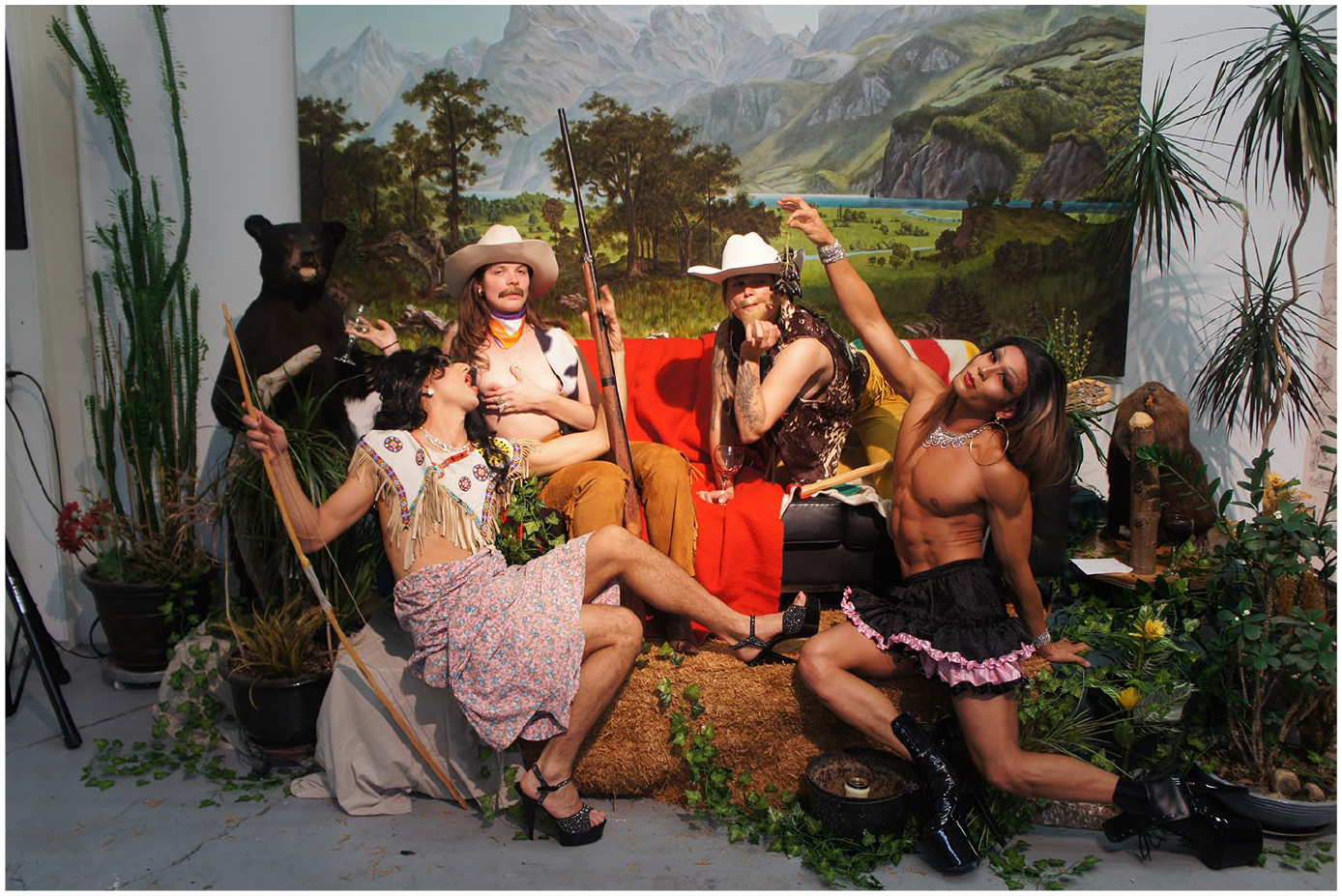
Live Interactive Skit.
With this visual representation, Monkman mocks the legacy of knowledge appropriation and conflates the landscape genre by inserting queerness and the contemporary Indigenous body into a canonical representation of history. In addition, it disrupts display culture as it allows its visitors to engage, touch, and interact with the visual representations on display. Including the Hudson Bay blanket, a trade blanket and emblem of Canada that has ties to the fur trade, Monkman further draws attention to the historical atrocities brought upon Canadian Indigenous peoples. Used as a means of biological warfare by the British forces to infect First Nation populations with smallpox the Hudson Bay blanket was a tool utilized by colonists to reduce the populations of Indigenous Nations. 64 In drawing attention to key moments in Canadian trade history, Monkman highlights the devastating consequences for Indigenous peoples.
3.5. Decolonize Now, Celebrate Later
In opening his studio doors to members of the public, Monkman provided an experience that was social in nature and interactive. Importantly, it also fostered relationship-building between non-Indigenous and Indigenous people, as it offered a space to engage in dialogical interactions. On my ride home from Monkman’s studio visit, I was left with more questions than answers. Engaging with visual representations outside of an art institution provided a unique experience that made way for diverse ways of knowing and perspectives. In this context, I questioned if the pedagogical value of visual representations, especially in revealing, speaking back to, and unsettling colonialism as a legal cultural order can ever be fully realized in colonial spaces, like the museum. As I watched Canadians celebrate Canada’s 157th birthday, just a few days ago, I still grapple with this question. Although Canadian art institutions have attempted to implement initiatives to reimagine museums and their colonial collections from decolonial perspectives change is slow to come. The recent firing of the Anishinaabe curator Wanda Nanibush from the Art Gallery of Ontario (AGO)—followed by the resignation of Inuk curator Taqralik Patridge—underscores this reality. Illustrating the museum’s deep ties to the art market and the interests of their boards, Nanibush was pushed out of her position as the inaugural curator of Indigenous Art after pro-Israeli donors and supports of the museum pressured Stephan Jost, the director and chief executive into stopping her efforts to educate the public about Palestinians and their fight for freedom. 65
Nanibush, who wrote the book Moving the Museum: Indigenous + Canadian Art at the AGO (2023) 66 with Georgiana Uhlyarik, a fellow curator of Canadian Art in the Canadian and Indigenous Art Department at the AGO, co-led the ground-breaking Indigenous and Canadian department at the AGO. With Uhlyarik, Nanibush struck the Canadian Wing to create a non-chronological exploration of settler-colonial, immigrant, and Indigenous visualities. The decision was also made to create an “Indigenous-only” installation space, which was revolutionary. And yet, alas, the endeavor ultimately failed. In a letter addressed to the AGO’s leaders, Aylan Couchie, a Nishnaabekwe interdisciplinary artist and curator from Nipissing First Nation stated Nanibush’s dismissal “followed a long line of failures by arts and academic institutions to properly support Indigenous people, women in particular, who are expected to help ‘decolonize’ from within while constantly working against limiting policies and discriminatory behaviour by those who we’re expected to be in collaboration with.” 67 In a similar vein, in an interview, the AGO’s former Canadian-art curator Andrew Hunter explained how he has seen how colonial institutions “that claim to be about diversity and decolonizing” either push out, or “leave traumatized” individuals from marginalized communities, whether Indigenous, people of color, the Black community, and/or people living with disabilities. 68 Nanibush is no exception. As the third Indigenous curator to leave a major Canadian art institution in recent years, 69 her dismissal raises many questions, including whether decolonial efforts are ultimately thwarted by the limits of institutional practices. Indeed, Nanibush’s departure demonstrates that despite the Canadian Museum Association, the International Council of Museums, and the United Nations championing of decolonizing the museum, change is slow to come, and little has changed in art spaces since Canada’s 150th birthday.
4. Conclusion
Treating visual representations on display in The Museum and Monkman’s studio as socio-legal texts has offered two different entry points into critical debates about colonial legacies, experiences, and resistance. The first point of entry, the institutional colonial story, highlights museum display practice and focuses on the objects on display. Situating Ontario’s largest community museum, The Museum, within the broader colonial apparatus, I expose how the museum as an overlooked site of legal discourse works to discipline and educate its visitors. I hope that in doing so, readers will be encouraged to think about how the arguments being made are not just about the museum, or Kent Monkman. Instead, it is about something broader that touches all institutional spaces, in different ways and through different degrees of obviousness.
In highlighting the role of the museum in fostering the ongoing representational work of colonial institutional power, I illustrate how The Museum maintains and reinforces settler colonial renderings of North American history in line with narratives that are being upheld, supported by, and perhaps even generated through the education system. As an educational space with a pedagogical function, an engagement with these narratives raises questions about the role education plays more generally and makes way for critical investigations into how the university, too, is integral to ongoing processes of colonization.
The second point of entry, Monkman’s response to settler colonial narrations of North American history illustrates how creative and artistic representations can disrupt the continuity of colonialism. Working to educate institutions on the implications of settler colonial histories, Monkman displaces and corrects colonial narratives from the experience and historical knowledge of Indigenous peoples. Inspired by Monkman, I see art as necessarily political and am compelled in my ongoing work to engage art as a form of engaged activism and knowledge production. As I explore the potential to decolonize sites of institutional power, including the museum, the gallery, and the university, through challenging imperialist histories of curatorial and exhibition knowledge and contemplating the implications these challenges have for knowledge production more generally, I investigate the pedagogical value of art, and the need for institutions to recalibrate what that might look like.
