




Abstract
This essay introduces the reader to the poetics (or, at least, the enargeia) of Peter Goodrich by offering an assembly of images seasoned with text, and vice versa. What follows is a short collection of emblems and their commentary. The Latinized name adopted for Professor Peter Goodrich, replacing the academic title (Pr.) with a new agnomen or nickname, is Bonus Dives Imaginosus. Bonus, meaning “good”, and dives, meaning “rich”, with imaginosus as a neologism advertising his connection with imagination and wit. Such additions to one’s name were well established in Antiquity and revived by humanists as a flyting game. In the case of Peter Goodrich, both adjectives “good” and “rich” already hint at distinguishing nicknames. The invention of an emblematic alter ego goes hand in hand with a tribute to Peter Goodrich’s baroque and pataphysical language, an outward contempt for the aseptic tongues of positivistic jurists, often sterilized by the academic chisel. The collection below, of emblems and accompanying discussion, is dedicated to Bonus Dives Imaginosus, the enfant terrible of Benjamin Cardozo School of Law at Yeshiva University, a published cook whose character is also a metaphor of a sleeping god, devoted to rêverie.
This essay introduces the reader to the poetics (or, at least, the enargeia) of Peter Goodrich by offering an assembly of images seasoned with text, and vice versa. What follows is a short collection of emblems and their commentary. The Latinized name adopted for Professor Peter Goodrich, replacing the academic title (Pr.) with a new agnomen or nickname, is Bonus Dives Imaginosus. Bonus, meaning “good”, and dives, meaning “rich”, with imaginosus as a neologism advertising his connection with imagination and wit. Such additions to one’s name were well established in Antiquity and revived by humanists as a flyting game. In the case of Peter Goodrich, both adjectives “good” and “rich” already hint at distinguishing nicknames. 1 The invention of an emblematic alter ego goes hand in hand with a tribute to Peter Goodrich’s baroque and pataphysical language, an outward contempt for the aseptic tongues of positivistic jurists, often sterilized by the academic chisel. The collection below, of emblems and accompanying discussion, is dedicated to Bonus Dives Imaginosus, the enfant terrible of Benjamin Cardozo School of Law at Yeshiva University, a published cook whose character is also a metaphor of a sleeping god, devoted to rêverie. The trifles assembled are nothing but elucubrations in noctem consilium. Originally written to complement a set of drawings by David Bond, the accompanying notes are meant as an aid for those disadvantaged by the deteriorating standing of the Humanities in our education system. Anti-institutional and fiercely critical of the present status of academic complacency, yet lighthearted and whimsical, I hope the collection will remain readable to an assumed audience far beyond the lawyers whom it was primarily designed to assist. In the polyphony of their competing voices, these gathered pieces encapsulate a series of images of Goodrich’s œuvre: dissent, social critique, critical legal studies. To shape and polish an emblem is one thing: to invent it altogether is another. Echoes, reminiscences, and table-talking are difficult to revive faithfully.
Emblematic thinking leads to a reappropriation of the free and imaginative language of Diderot’s Lettre sur les Sourds et Muets, in which Diderot deplored “the pretended nobility which has led us to exclude from our idiom a large number of energetic expressions”. 2 An early supporter of the philological coup d’état, Peter Goodrich often overturns academic habits, questioning mainstream norms of legal interpretation. He usually presents himself as a humanist foolosopher, 3 a sound but unpredictable theoretician, embracing sophisticated neologisms. He often dispenses with providing a simple semantic equivalent, leaving his readers perplexed. Because of his absolute disrespect for any form of canon, sterile academicism, or standards of “beautiful style”, it seems necessary to explode the sclerotic tradition of the festschrift, the polished exercise of academic encomium, which would appear, in his case, as a first-rate funeral. In invoking emblem creation as an appropriate craft for his tribute, I am following a long tradition, weaving together ancient thought (on education, democracy, privilege) with observations on contemporary politics and culture. But the essay also contains numerous unguarded glosses and visual interpolations. Traditionally, emblem books were intended for the use and benefit of various professions (enamellists, embroiderers, decorators, fresco painters). These devices were designed as ready-mades, ornamental and moveable pieces to be inserted ad libitum on glasses, tapestry, hangings, vases, seals, ensigns, the table, the couch, and so on. What follows below uses the emblematic mindset for the invention of conceits. Every emblem offers a relation of a body and a soul, and this prototype is at the heart of a purely symbolic relation, which cannot be converted into a causal relation. Symbolic acts involve the entire body-soul dialogue and this is why they appeal to our ability to perceive expressive qualities, beyond the realm of pure textuality.
Throughout the early modern era, emblems were deeply woven into the fabric of the law. Invented by a witty jurist, crafted as a tool of his trade, emblematic creations were forged during festive hours as an erotic pastime, under the favorable auspices of carnivalesque comedy. The original wit and phallic innuendos were soon covered up with moralistic tones or baroque spirituality.
4
Painted on facades or worn as hat-badges, amulets, or rings, emblems were also signs affixed to all sort of objects. They would first display a humanistic style of decoration, but in doing so they would also show elective affinities, tokens of friendship, family ties, or imaginative kinships. The emblematic mindset was also pervasive in court culture, as a particular set of self-fashioning tools used for efficient visual persuasion. In the same way that otium can be a good or an evil depending on how it is used, imagination holds a mirror in her hand, leading either to spiritual contemplation or to misplaced (?) Philautia. According to an apocryphal text by Petrarch, laurels of poetic glory are quite different from corporatist emblems received ceremonially when a scholar is being puffed up with his insignia doctoris. In a dialogue between an orator and an idiota, a young academic “fool” is described in scathing terms: A young fool approaches the temple to receive the doctor’s insignia. His tutors pay him homage, either out of love or by mistake. The young man blushes, the rabble is stunned, friends and family applaud. On command, he climbs on the cathedra, now looking down on everything and muttering something unintelligible. Then the most eminent doctors praised him to the skies. The bells ring, trumpets sound, kisses are given, rings are exchanged back and forth, and a round, magisterial cap is placed on his head. Once this has been accomplished, the idiot returns downstairs, a wise man. An admirable metamorphosis unknown even by Ovid. That's how scholars are made today.
5
Before we get to the emblems proper, an introductory image can help emblematize the paradoxical qualities of emblematic thinking. Figure 1 is a portrait of a headstrong man, Henry Wriothesley, 3rd Earl of Southampton. Painted in 1603, it is attributed to John de Critz. This portrait emblematizes a scene of forced inaction, as the Count is kept locked up in the Tower of London, with his cat for sole company and a pose with a falling glove. The painting introduces us to the paradoxes of re-presentation, as the image reflects and problematizes various effects of duplication. The persona that the portrait of Southampton represents is very like Peter Goodrich’s own: the bound yet undefeated crit, always seeking escape from the drudgery of hegemonic law. From the present-day perspective, interpreting this emblematic portrait seems to imply a separation between emblematic persona and man. But one of the issues with emblematic thinking concerns the very nature of the blurring of this divide.
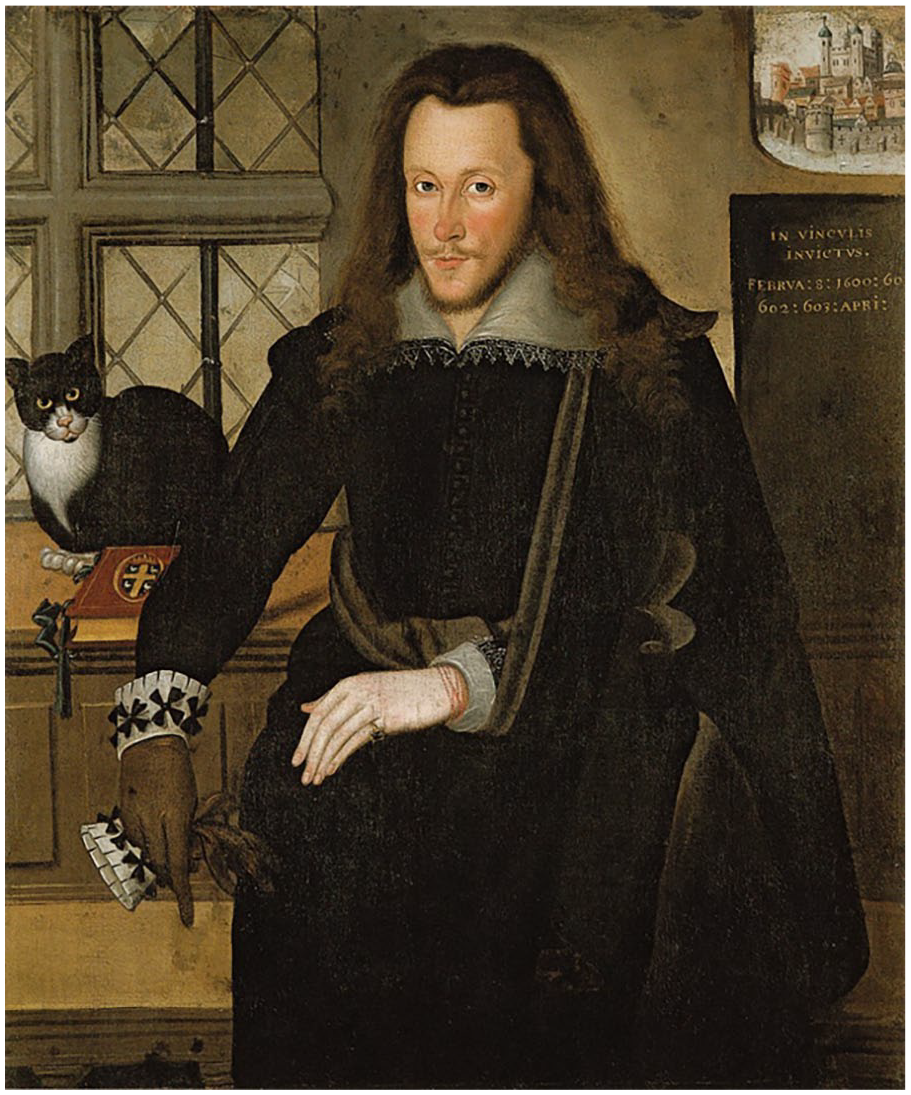
Portrait of Henry Wriothesley.
The first specular effect is that of the motto “in vinculis invictus” (in chains but unconquered). The legal phrase in vinculis means in custody or in chains but applied figuratively, it can also mean the condition of a person who is compelled to submit to oppression. As a code of chivalrous conduct, the impresa is always related to personal matters, it is most probably here an allusion to his independence vis a vis marriage arrangements or his own sexual proclivities. 6 But we may also relate this impresa to his choice of studies: though Southampton was admitted to Gray’s Inn in 1589, he preferred Arts over Law. Significantly, his time at Gray’s Inn was not devoted to acquiring much knowledge about litigation: instead, he would enjoy his otium at a time when satires, skits, and plays were performed inside the court setting. Southampton loved to make a spectacle of himself, and his androgynous image was frequently associated with Narcissus or Ganymede.
The second effect is narrative: in the top right-hand corner of the canvas we can glimpse a symbolic figure of the Tower of London, along with the precise dates of Southampton’s imprisonment. It alludes to his conspiracy with his friend Essex to recover by violence their influence at Queen Elizabeth’s court. Arrested and sent to prison, Southampton was brought to trial on a capital charge of treason. 7 As an exemplary vanity portrait, the painting explicitly alludes to King James’s ascension and his order of 5 April 1603 to release Southampton from the Tower of London. The inscription records the period of his incarceration (February 1601-April 1603). An indignant-looking cat seated upon the window sill echoes his defying gaze.
The third and most intriguing specular effect is that of the inset mise en abyme of the Tower of London. Though the hermeneutic value of this conceit is usually understood as a text-within-the-text, the mise en abyme—a casting into the abyss—also involves visual conceits such as the framing of a visual quote inside a heraldic device. 8 Here, within the emblematic self-portrait of a prisoner, the miniature painting of the Tower of London incorporates a tiny duplicate of the larger structure of the fortress. It is a visual play-within-the-play, as the prisoner becomes a constituent of the staging of an imprisonment. But, at the same time, his paradoxical motto alludes to another microcosm, where the freed man can look at his prison from another perspective, setting up an apparently unending visual paradox. Although painted inside his cell in the Tower of London, the sitter has his back to a skylight that provides a perspective view of the prison from the outside. Which, of course, is impossible if we take this scene to be a realistic painting. The emblematic effect comes from the fact that the sitter is both inside the prison and outside, unconquered. In vinculis invictus.
Such visual innuendo also abolishes restrictions of time and space, to render the will to free oneself both past, future, and present. Such a framing effect requires the interpreter to practice a witty contemplation, in order not to fall into the abyss. This fits well with Pierre Legendre’s elaboration of the emblem as a rite that classifies and institutes social being as social place. 9 In search of a new, “truthful”, form of visual rhetoric, the emblematic portrait of the imprisoned sitter signifies that he defiantly freed himself from his past condition. Not only is he a potentially great patron of the arts, a symbol of high resilience through warfare and battle, with his bright eyes and alluring gaze, but he also challenges us to be enticed by the visual wit with which he proclaims these achievements. A master of artful disguising, Southampton defies the conventions of aristocratic portraiture: he renders visible a series of signs that allude to his pugnacious trajectory, showing that whatever happened, his soul was never defeated. If his own image “survives in more contemporary portraits than anyone else’s but the queen’s”, 10 he also deliberately outwits the aristocratic norms of court portraits of the time. The self-portrait might have been executed so he could resume his place at court. Fully restored to his former rights by an act of parliament on 18 April 1604, he was later awarded lands and estates in Essex as well as the custom on sweet wines, a farm that previously belonged to Essex. This symbolic gesture invites or commands a narcissistic prayer to the self, but also a promissory note, as he hopes to be equally repaid by law, by love, and by wine. The painting wishes to restore his bona fama. Philautia here is the weapon for a conquering ethos, asserting visually the belief in the advancement of his rehabilitation within elite courtliness. To a certain extent, this melancholic painting is a trophy won over prison time and exile.
Because of this paradoxical mindset, emblematic creations, when inserted within a meaningful frame, allow for a reflection on language’s truth potential. It is thus important, before entering the below collection, to recall that emblems are also an essential part of academic life, as a basic form of ethical exchange through language. The demands of representation and the laws of our current Western mode of knowing also require a special kind of mens emblematica. At first (this is the narrative or anecdotical level), these emblems seem to disapprove of the gross misconducts that academics indulge in order to forget they are mortal, making an inventory of all the agitations, worries, games, and stirrings with which they entertain us. Secondly (this is the typological level), the pieces collected below passionately defend the laws of imaginal thinking, as it is just as futile to disavow reason as it is to believe only in its power. May they praise the power of eccentricity and wit, that splendid part of man that delights in dominating and controlling reason, his enemy, but also knows it to be a master of error and falsehood. An emblem book usually displays a special kind of emblematic rhetoric, an outward show of celebratory art and visual wit. Images are curious montages designed to arouse curiosity, but they also remain motivated by a gift-giving economy where patronage plays its role. Academic mores are scrutinized insofar as they defy the tyranny of self-love, the self-proclaimed imperium of Philautia.
Is this collection, then, a mockery or an ethical proposition? The further one penetrates into these iconotexts, the more vertiginous and perhaps risqué do the mises en abyme become. These contemporary emblems aim at pinpointing some more common academic misconducts, name-dropping, or shaming practices, than the ones Andrea Alciato used to capture in his infamous emblem Ad doctorum agnomina. Vices of the tongue are all the more detrimental to academia in general, in that they affect society on small and large scales, from quotidian interactions on campus to wider networks of international consortia, from intimate conversations to theatrical and pompous colloquia.
Thirdly (this is the encomiastic level), the emblematic proverbs or legal adages collected here may be used equally to praise or to blame. Depending on who uses them (prosecution or defense), they can either shame or honor, vilify or applause. Because of their intrinsic ambivalence, they are as sharp as a double-sided sword. Emblems regularly challenge our ways of knowing: sitting somewhere between openness and secrecy, they question the legitimacy of intellectual authority. Because we live in an era that rejects the principle of non-contradiction by practicing the yes-and-no, these kinds of self-fashioning ethical tools are increasingly needed. Emblems offer an obsessive, perhaps even pompous, distribution of institutional symbols; part of their strategy is to stamp one’s identity onto cultural capital so as to raise a lineage, a genealogy, or an institution above others. But emblems are also risky enterprises, because “it is always the illegitimate ruler who needs the most metaphysical props for his power and propaganda”. 11
This short collection is fragmentary. Selection is not easy as there are a great many legal sayings, mottoes, maxims and words which might have been incorporated. My objective was not led by hubristic exhaustivity: the third emblem hints at the ever-present theme of temporality (one emblem for the past, one for the present, and one for the future), concluding that Goodrich’s opus sectile is also a reflection of the vanity of all kinds of systems of collecting as part of our mania or tendency to pile up cultural artifacts. Of little practical use to the contemporary lawyer, this set is intended as no more than a sort of vademecum, a humble guide for nomadic scholars in their uses of nomadic masks. Goodrichean it is, Imaginosus it remains, since it also aims to season the lawyerly experience with obiter picta, providing light relief, ironical twists, or incidental amusement. It is worth noting here that, in our now Post-Brexit, Post-Pandemic, Post-Truth era, the following emblematic depictions of sins are portrayed as a vigorous plea for esoteric knowledge. By showing that these fragments offer no grand narrative of self-realization through the sedentariam vitam of academics, these emblems also reveal some of the costs and consequences associated with our civilization’s continued masking in such narratives of progress and mastery.
First emblem. Analogia
Pictura: Mise en abyme of mirrored portrait of Peter Goodrich with a shield bearing a cornix whose eyes are pierced with arrows (Figure 2).
Motto: Cornicum oculos configere
Adaptable to an inlaid cabinet, a flag, or a bookshelf decoration.
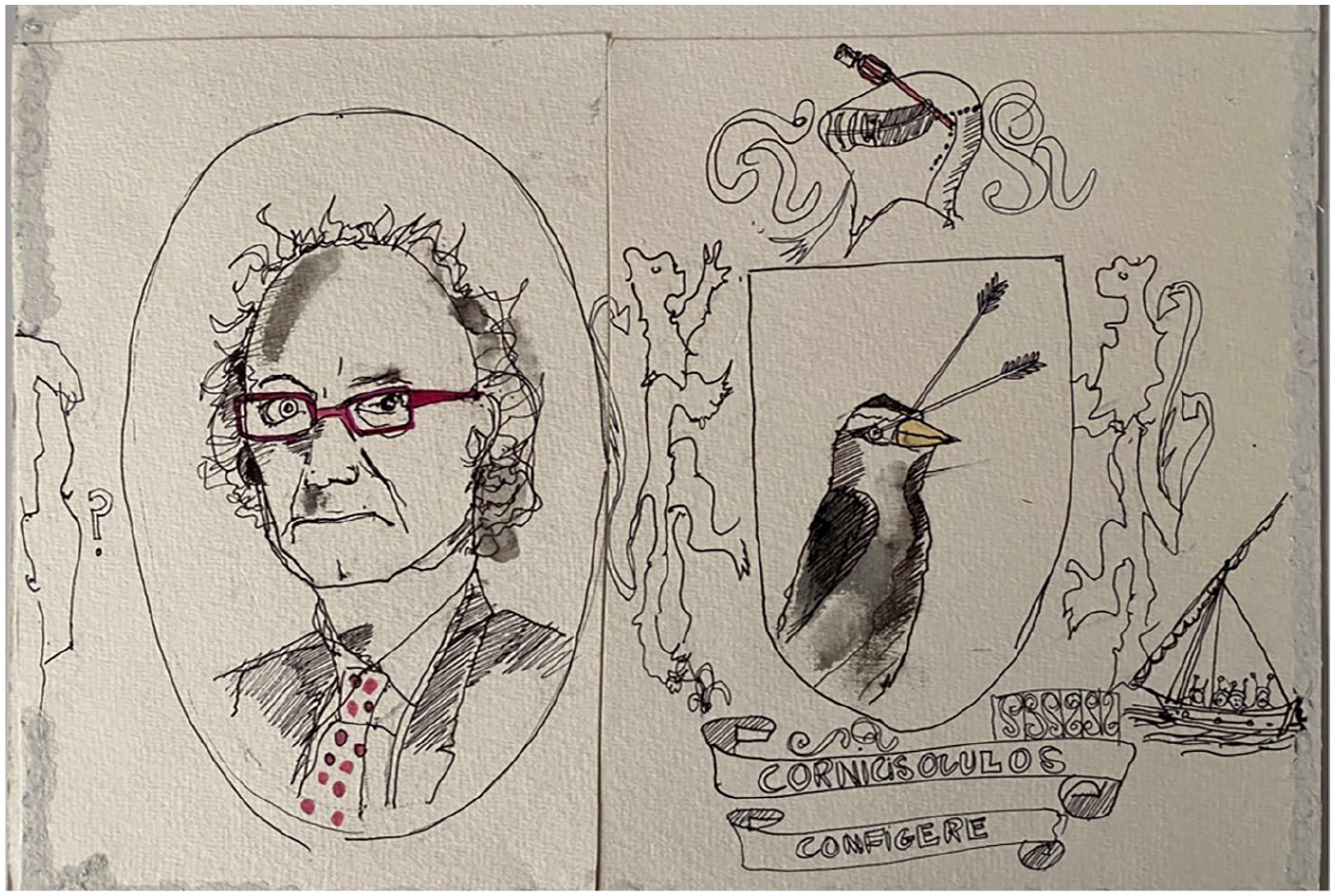
First Emblem. Analogia: Cornicum Oculos Configere.
Cornicum oculos configere is a classical proverb (“to pierce the crows’ eyes”) 12 that applies well to Peter Goodrich’s trajectory: it symbolizes the tension inherent to the transmission of legal truth. In a foundational moment of Roman legal history, a simple clerk, Gnaeus Flavius, is said to have uncovered the secrets behind the operations of the law, to which only the pontiffs had privileged access. He then published them for the public good. Depending on which side of authority one stands, this iconoclastic gesture may be seen as a theft, an infamous assault, an attack to the sacredness of the Law, or a valuable deed, as his publication was beneficial to the public. As much as the story of Flavius’s theft, as told by Sextus Pomponius, is recorded in the opening pages of the Digest (1.2.2.7), our first emblem draws a parallel with Peter Goodrich’s valuable theft of legal emblems. This service so ingratiated him with the agnomen ex virtute “imaginosus” that his work became a tribune for a new critical reading of emblematic literature, far beyond the narrow circle of emblem studies experts. Erasmus’s understanding of Flavius’s bold gesture (taking privileged information from the private intellectual capital of the pontiffs to disclose it and place it under public purview) stands as an exemplary symbol of the ways in which emblem-making always questions contested modes of authorship. The proverb itself (to pierce the crows’ eyes) refers to the crows’ technology of death: they attack their prey first in the eye to beat them at their own game, as configere can mean “to fasten” or “to transfix”, to “pierce through” as well as “to nail together”. All these senses allude to an in-famous trope of retinal justice: sharpness and blinding, through the joining of eyelids or the transfixing of a gaze, or of nailing the eyes to the image, of making us see, in particular a sight that pierces the veil. Interpretation (judgment) is viewed as the killing of potential meanings. The violence of the metaphor holds open the question of whether such a triumph should be praised as poetic justice or blamed as a disreputable vice.
A word of warning. The classical proverb “cornicum oculos configure” can be uttered in irony. As Emma Herdman insightfully notes, it is also used to trace the ambivalence of valuable but unauthorized publication.
13
Sources are far from unanimous in praising Flavius Imaginosus for this assault upon emblem studies’ territory. This is why it seems important to recall that emblems may be used as gifts, shared between friends; a type of transmission that allows thought of intellectual property as a symbolic capital, which also includes the possession of a good reputation. In his letter Against Monastic Life (1517 or 1518), Andrea Alciato recalls that: the Athenian priests once persecuted with their decrees Diagoras of Melos. He was a man who had the greatest reverence for the gods and who considered nothing more important than the true cult of the gods. Nevertheless, after the island of Melos, his homeland, was captured by the Athenians, after he had gone to Athens and a friend had refused him money he had deposited, he became so hostile to the gods of that people that he was called ‘Theomachos’ (an enemy of the Gods). When he found himself on some occasion in an inn and had no wood to cook his lentils, he put a statue of Hercules, which was there by chance, on the fire, and mocked the god in this verse: ‘Here cook a lentil and add another labour to your twelve’ After this, this man divulged to everyone those arcane Athenian ritual meals, which it was unlawful to eat among common people, and “pierced the eyes of the crows”. His contempt went so far that he turned many away from religion, and persuaded them not to be consecrated in the future. So, he was proscribed by decree of the citizens, and a price was put on his head for those who captured him, or killed him if he resisted.
14
Depending on how territorial academics are, Peter Goodrich may appear either as a thief or as a modernizer. This reworking of the ironical adage highlights two points: first, emblem-making is a sophisticated craft; second, it evidences the true benefit of what may be coined as a fruitful epistemological theft. Lawyers are usually known for their conservative mindset: what is rewarded is respect for precedent, lucid prose, and sagacity. In defense of openness, the act of piercing the eyes of crows is invaluable to the humanistic shift towards law and the visual. Only an open attitude to sharing emblems as gift-giving practices will achieve an effective commonwealth of knowledge. Amicorum communia omnia.
The legal adage may also apply to digital justice. Though artificial intelligence is still a tool in its infancy, its potential is sometimes hailed as a major revolution or viewed as no more than an apocalypse by tech-sceptic or conservative minds. However, many technophile lawyers today use Chatbots to help them prepare court filings. Blinded with the smokescreen replete with made-up cases, ruling, and quotes, they sometimes believe, a little too hastily, that the cases provided are real because they can be found in reputable legal databases. But they are not. Moreover, artificial intelligence raises wider questions about the interpretability of raw data, and it seems useful to bear in mind the fundamental opaqueness of what is commonly understood as “Open AI”. When we ask Chat GPT about its opinion or insight on how to interpret the adage cornicum oculos configere and although its response appears at first to be perfectly articulated, the “answers” generated by the large language model at the core of the application only adds another level of opacity to the issue. What remains hidden from view is the pace at which the internet’s datapool is growing, along with the immense power of metrification of our existences. The communication algorithm of such an “Open AI” may offer an anthropomorphic imitation of what emblem-making is, but what is aggregated cannot simply be processed by a human brain. Instead of trying to develop an unrestricted increase of robotic scholars, this first emblem questions the very essence of publication. Is publication without intent always desirable? Why are some secrets reserved to some circle of experts? Who or what is a proper repository for emblematic knowledge? What is the philosophical basis for such devices as ChatGPT? Is ChatGPT even “intelligent” in the sense that emblem craftsmanship might understand it? From a legal point of view, this use of images and texts written by others without even asking the question of reproduction rights pushes the challenge of any collage practice to the extreme.
Is an emblem just a clumsy piece of copy and paste, or is there more to it? When Quintilian alludes to the mosaic of speech in Book II of Institutio oratoria, he criticizes the use of ill-pasted commonplaces in forensic oratory. Like appliqué work, they remain extraneous and superfluous ornaments, they can even be counter-productive. 15 The capacity for imitation and logical inference is one thing, but the handling of symbols quite another. This is not a new problem. Pascal already distinguished in his time between “l’esprit de finesse” and “l’esprit de géométrie”. The former knows how to apply principles finely, while the latter only knows how to trace particularities back to the principle. The mens emblematica is undoubtedly on the side of the “esprit de finesse”. If any awe is attached to the legal profession, what if someone dares to pierce the crows’ eyes, to enable the people to pluck their wisdom from learned counsels and use digital justice instead?
Lastly, this adage may also apply to Peter Goodrich’s radical and refreshing disregard for academic hierarchy. Following Guillaume Budé’s interpretation of this adage, we may cultivate Cicero’s lawyerly enthusiasm for Gnaeus Flavius, which “shows that it means to overthrow and surmount cunning and clever men through cleverness and cunning. Just as a nail is driven out by a nail, craftiness is foiled by craftiness and artfulness by artfulness”. 16
Second emblem. Problema (about Ochlocracy)
Pictura: Peter Goodrich with a microphone and a cartouche containing a manus oculata (Figure 3).
Motto: Ad Captandus Vulgus.
To adorn a mental architecture, a memory theatre, or a chamber pot.
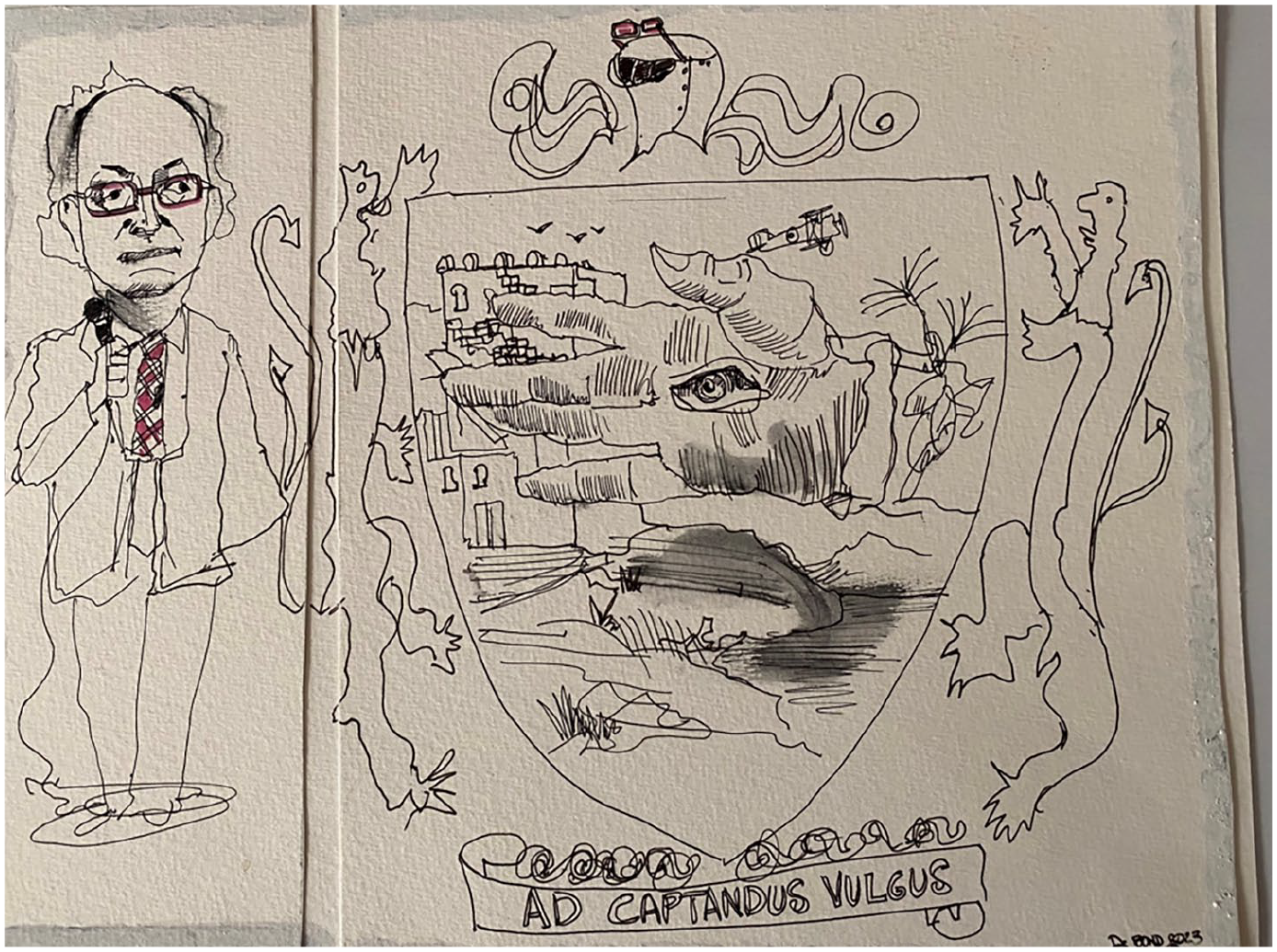
Second Emblem. Problema: Ad Captandus Vulgus.
Two standard fallacies (ad ludicrum and ad captandum vulgus) relate to what Guy Debord prophesied as the Société du Spectacle. The Latin noun ludicrum means “game, spectacle” and it can be translated as “dramatics”. In the adage “ad captandus vulgus”, the public has degraded into “the rabble”, democracy into ochlocracy and captare aptly meaning “to seize”, “to try”, or “to win by insinuation”. This emblem may apply ad libitum and ex tempore to promises with the quality of bribes made by politicians, particularly in manifestos at election time. As Jacques Rancière explained, in ancient Greece the term democracy is originally used as “an insult by those who see in the unnamable government of the multitude the ruin of the legitimate order”. 17 What we now praise as a political ideal—democracy—was born as a term of abuse. Thus, our need to use instead the word “ochlocracy”, a term created by Polybius, to emblematize a degenerative form of democracy. Whereas “the people” in democracies is led by the most virtuous citizens, in ochlocracy, the rabble becomes prey of demagogues and populist leaders. When the motto “ad captandus vulgus” applies in particular to Brexit and Boris Johnson’s demagogic plays, it may be translated as “playing to the gallery” or “playing to the crowd”, referring to a histrionic orator whose way of acting appeals to popular tastes. The speaker tries to get the laughs on his side, and his opponent indignantly rejects the discursive histrionics. In his Euthydemus, Plato depicts sophists giving such performances.
The hand combined with an eye (manus occulata) was first introduced in an edition of Andrea Alciato’s emblems from 1548. 18 Blazoned here on a coat of arms crowned with pink glasses, it conveys the idea that one ought to touch what people report with one’s finger, before believing in it. A hand detached from the body, an eye on the palm floats like a surrealistic cloud above a deserted landscape. The icon refers to a quotation from the Greek comedy writer Epicharmus: “Be temperate and remember to be careful what do you believe. These are the sinews of the mind”. The expression “manus occulata” comes from the Roman playwright Plautus (Asin.202): “Semper oculatae manus sunt nostræ: credent quod vident” (Our hands have eyes; they believe what they see). But this emblematic motif also suggests the literalism of legal vision, its failure to see with the tactile eyes of faith, to recognize the word in its flesh. This emblem essentially contradicts the Pauline definition of faith as “the evidence of things not seen” (Heb. 11:1), a topic on which Peter Goodrich has written extensively. 19
These malicious tyrants ought to be reminded of an effigy of Nemesis, the vengeful goddess, because she is thought by the painters to hold in one hand a bridle and in the other a measuring rod, so that we may understand the lesson that the tongue must be restrained by the horse’s bit and the arm by the hand: no insult is uttered or defamatory gesture done against anyone. This adage, Nec verbo nec facto quemquam laedendum (Neither in word nor in deed should anyone be injured), is especially relevant today if we think of a Garde des Sceaux who has gone so far as to desecrate the hemicycle by stooping to making an arm of honour in the middle of the French National Assembly.
In his Theory of the Nomogram, Peter Goodrich emphasizes the “emblematic lust of desiring law”, the humorous side of persuasion within the forensic sphere and the pleasant injunction that “wit should govern law”. 20 If Foolosophy is to be taken seriously, if the clown genuinely belongs to the court, what are we to do with malicious fools, modern Herostratuses tearing apart all social bonds so that through destruction their name might be spread throughout the whole world? The vicious arsonist seeks fame at any cost, but it is his name which outlives the names of his judges. When falsehoods are gussied up as mere “alternative facts”, the very possibility of a language of truth encounters its hard limit.
It proves useful here to assert how emblems can be put to good use. Far from being trifles or ancient remnants of a now collapsed symbolic order, the main asset of these devices is to show that they encapsulate heavy signifiers, double-sided arguments, and casus perplexus. The emblem represents what cannot be said; it is a political conundrum. When the people cannot be trusted to govern or participate responsibly in their own governance, when the dignity of the people is somehow blurred with the chaotic impulses of the rabble, how do we cope with the rabble? Emblems are never designed primarily as power assertions; their intrinsic nature is obscene in the theatrical sense of the term. Nobody fully controls how their valences may be appropriated or misappropriated. Void of any definitive agreement or disagreement, they stand as a type of watchword for soldiers (tesserae). They are coined here as signs of vigilance, warning stigmata, omina, whether good or bad. From the nuptial ring to the token or salaam given to the eunuch on entering a brothel, an essential trajectory is outlined: an emblematic token, a symbolon as an object cut in two, which harbors conflicts that remain irreducible to ideological positions or moral stances. The time has perhaps come to use them wisely.
This second emblem focuses on a very pressing and genuine problem that impairs the representativeness of democracy. And yet, even as right-wing ochlocratic speeches demonize expertise and elites in a particularly playful style, I contend that moralizing the virtuous and advocating truth values should not be our principal counterresponse. Moral indignation itself—that is to say, the most avowed of incentives to lucidity—is not likely to ensure a real ethical capital of respectability and integrity. If we stay on this course, we will obtain, at best, very meagre satisfactions: a good conscience for ourselves and self-esteem, in other words a small-minded philautia, which only takes shape in the negative mode of resentment.
An example of the ambivalence of the uses of political mottoes captures well the risks at stake. When Hillary Clinton coined the phrase “the basket of deplorables” during her 2016 presidential campaign, 21 she revealed the distinctive features of the contemporary mob-rule: “You could put half of Trump’s supporters into what I call the basket of deplorables: the racist, sexist, homophobic, xenophobic, Islamophobic—you name it”. Clinton’s opponents rapidly seized on the motto, weaponizing it so as to brand it in the commercial sense. Just as much as emblems of the past were worn as hat-badges, caps, embroideries or costumes, the “basket of deplorables” now have their T-shirts, banners, hats, tattoos and stickers to prove it. These objects say “this is what I am” and “this is what I believe in”, the deplorable becomes a sign of pride, a revenge upon the elite.
Third emblem. Paronomasia (about Peter Goodrich’s name)
Motto: “Nemo vir bonus dives brevi evadi”,
Displayable on table ornaments, togas, or sleeves (with or without accompanying gloss).
Peter Goodrich’s name bears the multiple valences of an omen: imagination shapes his conduct of office: he offers a good and rich anti-dogma. Since one of the objectives of this emblem triad is to persuade our eminent readers that Bonus Dives Imaginosus is worthy enough to have a monument made for him, I first tried to gather sketches or portraits. Thom Giddens reminded me of Isobel Williams (Mrs Neil Jeffares) who had already captured some of the performative features of Goodrich’s characterology. What remained to be done was a scintillating fabula picta trying to grasp some of his multiple personae. At the time the Covid pest was everywhere, I saw in a vision his youngest avatar, then a flamboyant hippie with a hairy chest, in full flow against Neil MacCormick, drawing out some of the most heterodox beliefs of legal science. 22 Then came Cicero’s paradox: animus hominis dives, non arca appellari solet (Paradoxa stoicorum ad Brutum, 6, 1, 44), where wealth is taken as referring not to a bank balance but to a philosophical mindset. Yet, there is humour in applying this paradox to an individual, as if we frame it in a lavish encomium, the true essence of Peter Goodrich’s lifestyle appears irreducible to these philosophical antipodes. There is no ground to see behind this easy wordplay a mystical concatenation of cause and effect.
Andrea Alciato was very concerned about his style and, for example, he asked his friend Calvus in all seriousness how he could translate the name of a German, Pflug, and in the end he latinized it to Aratus. 23 This looks very much like an excess of Ciceronianism. Mais enfin, le style, c’est l’homme.
If Bonus Dives betokens both an aspiration to be good and a desire to be rich, then the name holds not merely different meanings (as many words do) but polarized meanings. Is wealth compatible with the common good? Conventional onomastics fail to do justice to this oxymoronic name. As with most early modern name puns, the game only starts when all dimensions (whether in good or bad faith) are unpacked. Festina Lente should be Goodrich’s most useful motto as Natalis Comes justly reported that “Nemo vir bonus dives brevi evadit” (No man who has become rich in a short time can be considered a good man).
According to the Biographia Britannica, or The Lives of the Most Eminent Persons who have flourished in Great Britain and Ireland and digested in the manner of Mr Bayle Historical and Critical Dictionary (1748), Bonus Dives ille erat was the anagram of Laurentius Bodleius, who was of great use to this brother Sir Thomas Bodley in founding his famous library at Oxford. He was chief mourner at that great man’s funeral; and, the day after it, namely March 30, 1613, was actually created Doctor in Divinity as a member of Christ Church. This Latin anagram is still visible in Saint Peter’s Cathedral in Exeter, near the choir, under a flat marble stone, with an epitaph, now obliterated.
The pictura chosen here (Figure 4) tells the biblical parable of Lazarus and the rich man. Pompously dressed in furs and jewels, Dives (the allegorical portrait of the rich man) has a double chin, a clear sign of his over-indulgent manners. The manuscript illumination frames emblematically the paradoxes of the feast of Dives. Most obviously, it indicates the antagonism between Lazarus, left outside the frame, begging for some scraps from the rich man’s table. Dives’s dog licks the festering sores of the beggar’s body. Dives enjoys lust (the company of two women at the same time) and is overlooked by a monkey and a parrot in a cage. His three doormen are tasked de facto with expelling beggars from his sight. This deeply Catholic image may be used as the backbone of the legend of Bonus Dives. Below lies the dead body of Lazarus, whose soul is taken over by two angels and folded into a shroud.
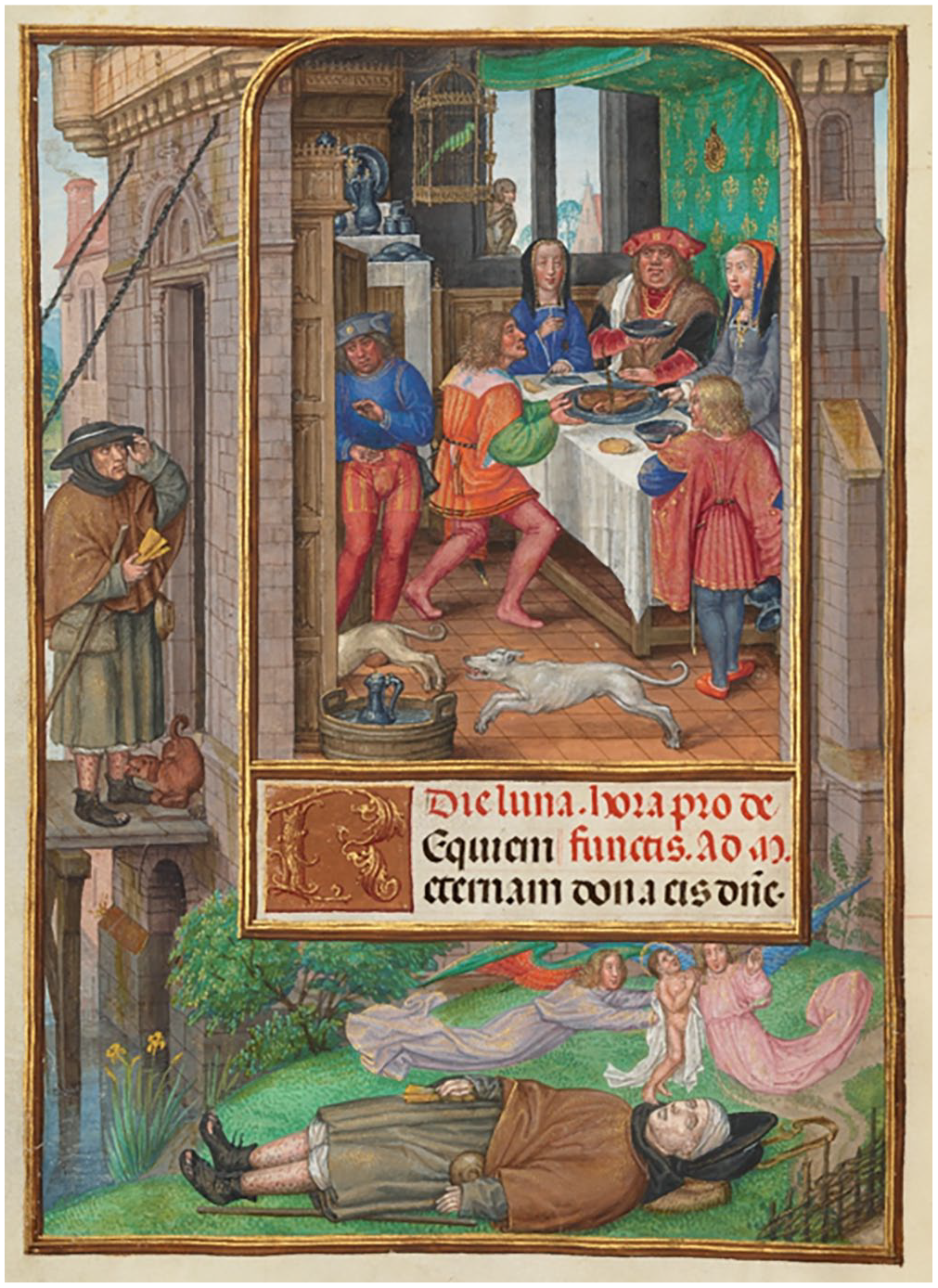
Third Emblem. Paronomasia (About Peter Goodrich's Name).
The early Christian tradition of the “good rich man” is expounded by Clement of Alexandria, Who Is the Rich Man That Shall Be Saved? And Cyprian of Carthage, On Works and Alms. Behind this name, we may also recall elements of the interpretive story of the parable of Dives and Lazarus (Luke 16:19-31). This tradition almost always enhances visions of the hereafter of social justice. One of the sermons at Dexter Avenue Baptist Church by Martin Luther King applies Jesus’s parable to a dramatic end: it had the ability to spark the humanitarian flame in the life of Albert Schweitzer, who willingly relinquished an attractive professorship in one of Europe’s most prestigious universities to establish a missionary hospital in Lambaréné, French Equatorial Africa (present-day Gabon). In Martin Luther King’s reading, Dives is not a bad man by our contemporary worldly standards, his sin is not being cruel to Lazarus, but rather his only fault is to refuse to “bridge the gap of misfortune that existed between them”. 24 Rich in education, rich in social prestige, rich in influence, rich in charm, Peter Goodrich not only lives merrily, his name warns him not to fall in worldly self-love.
The style of Peter Goodrich’s satirical humility draws upon the omen in his name: it is not about worldly detachment per se, his renunciation only begins with the healthy idea of despising academic glory insofar as it is a way to sever himself from the conventional theater of academic flattery. It is precisely because he’s not puffed up by his own good fortune that he is able to use his wealth wisely, for the continuous support of his cause. By employing moral largesse as the binding force and the ultimate virtue, this name provides a palatable office which Peter Goodrich has certainly fulfilled. Bonus Dives Imaginosus is not a closeted exegete who would preach apostolic poverty. This web of biblical allusions cannot do justice to his trajectory. What is more telling is the initial absence of any proper name for the rich man in the parable, when the poor man was named Lazarus. It is only in the Middle Ages that readers of the Latin Bible came to treat the Latin adjective dives for the rich man as a proper name. In English, this use of “Dives” may be traced back as far as Chaucer and Langland’s Piers the Plowman, sometime before 1400. 25 Aside from the bleak reality of the parable’s original moral lesson, the parable is a way to unpack the good omen inside Peter Goodrich’s name. This emblematic rêverie arises in the context of other seldom discussed versions of the subject where the feast is more frugal, as perhaps an indication of digestive ennui or bored appetite. 26 Venetian treatments of the theme (Bonifacio de’ Pitati and Jacopo Bassano 27 especially) highlight Dives’s culpability in creating a wider, dystopian malaise. Particularly popular amongst pamphleteers in Germany’s early modern protestant circles, the depiction of Dives’s sufferings in hell was also strikingly counterposed to the portrayal of the beggar on Dives’s porch. Dives is seated at a banquet, surrounded by two women dressed as courtesans, embracing the luxurious lifestyle of his country estates. The visual depiction of Christ’s parable is often the basis of a dystopian portrayal of villa life. Lazarus’s figure also emblematizes more than poverty or leprosy, but all types of skin disease with which Lazarus came to be associated during that period.
EV Milner revisited the character in the New Testament parable to offer a reflection on what he calls “the paradox of Dives and Lazarus”. In the biblical narrative, both the rich man and the beggar die. Dives is consigned to hell, but the beggar is received in “Abraham’s bosom”. Dives pleads Abraham for mercy, but Abraham replies that this abrupt reversal is a just retribution to the evil deeds he inflicted upon Lazarus. The last resort of Dives (to be able to warn his five brothers of what is awaiting them) is also rejected. However, if we suppose that the last demand of Dives had been granted, an intriguing paradox comes to the fore. “For if I knew”, says Milner, “that the unhappiness which I suffer in this world would be recompensed by eternal bliss in the next world, then I should be happy in this world”. 28 And being happy in our earthly world would necessarily entail that I would fail to qualify for happiness in the next world. Milner concludes: “Put epigrammatically, it would appear that the proposition ‘Justice will be done’ can only be true for one who believes it to be false”.
The biblical lesson serves here as a site of renunciation of conventional apologetics such as festschrifts and academic vanity publications. In spite of this bleak truth, the emblematic envelope of this problema has an ability to elicit fantasies and desires, as a way to inscribe the norm on the inside, within the heart. Readers are thus summoned to step out of their ordinary perceptual habits and question their own understanding of wealth: Dives takes on a range of unsettling meanings as it stands in opposition to a number of virtuous exemplars. It is worth bearing in mind that onomastics have no simple interpretation. Along the main road of inquiry, name puns are also joyful games, shrewdly joining malice to irony. They are an integral part of the image of homo academicus that Peter Goodrich wishes to project: they only gesture towards meaning, warning against those who take his words unseasoned, at face value.
Gaudeamus
An emblem is often announced in written text by an introductory title (titulus) followed by a motto. The term is revealing. Several Latin authors remind us of tituli carried in triumphal processions. As a visible sign, the titulus can be paraded as a placard, it can act as a strong announcement of the self. Since an emblem is a multimodal sign that speaks to us, and a sign that also speaks to us with images, stemming from various components or earlier corpora, its form also displays nomina ac simulacra (names and representations) in a particularly willful style. In Latin epigraphy, the moulded frame of a titulus often takes the form of a sign with wings, handles, or dovetails. During the Renaissance, tituli were inscribed on shields or rolled leather. The meaning of the word titulus in Latin was originally threefold: titulus referred to the ring attached to the neck of the slave to be sold (hence their knobbed ends or handles), but also to the inscription intended to show someone’s deeds performed, or the term announcing the content of a book.
We now come to reassert the Saturnalian essence of legal emblems, far away from the idea that they only bear serious utterances, driven by some sort of categoric moral imperative. If these witticisms are to be considered as the otium that follows negotium, writing emblems is inevitably a way to engage with transgression and subversion. Emblem books are too often reduced to tedious compendia of moralistic lessons, and this is detrimental to the understanding of their impetus. I have suggested that scintillating emblems expand and deepen the connection between Goodrich’s personae and the oneiric figure of Bonus Dives, mainly by transposing biblical or legal imagery from the omens enshrouded in his Latin name into a contemporary key. Although adopting the emblematic mode might itself be seen as a type of flattery, these analogies (especially if we see them in the light of post-modern taste) are meant to be taken with a grain of salt. Here Bonus Dives receives his apotheosis, something like a heraldic crest. Stellified as a wise Cornix, the bearer of such signs, is invited to respond. He might even censor some of these lines before they reach the printing stage. Who knows?
Yet, emblems cannot simply praise illustria facta. They sometimes bear the “aphoristic quality of much of the Corpus Juris Civilis, whose terseness and sharp focus were seen as characteristic of legal style and juristic decisiveness in general”. 29 There is one feature which always escapes any normative account of their form or function. They are designed to make known, to declare or to challenge the meaning of the image. Since emblems are built as scaffolds, pegmata or frames, they can always be misused, twisted, perverted, or misconstrued. Legal fictions (the assumption made that something false is true, in the name of equity) also give access to truth in figurative or allegorical manner. They contained veiled truth, while being literally untrue.
Unlike some shoddy printers or uncontrolled legal commentators, Peter Goodrich cultivates the high ironic praise Erasmus’s Folly once delivered to lawyers: Amongst the learned, lawyers are the most self-satisfied class of people, as they roll their rock of Sisyphus and string together six hundred laws in the same breath, no matter whether relevant or not, piling up opinion on opinion and gloss on gloss to make their profession seem the most difficult of all.
30
Fed daily on a diet of polished erudition and rhubarb fish with chives on top, Peter Goodrich relentlessly calls upon the defense of humanist studies within the discipline of the civil law, initiating a new kind a wrestling school, under the golden rule of the Gallic Hercules. On that day, bells rang through New York University, a fantastically garbed actor sang, to the accompaniment of flutes, hautboys and clarinets: he wore a Venetian mask and climbed onto a pedestal, on a satyr-drawn triumphal chariot. The effect, according to one of the witnesses, was electrical and irresistible. Goodrich’s speeches remain invariably full of emblematic devices: masques, shows, processions, curious neologisms as well as embroidered names. Any friend or foe lucky enough to hear their laudatio magna as a loving address is struck by terror, awe, or sideration. To those academics, who are always hungering after notoriety, may these oral jousts serve as demonstrations that one should refrain from the worst misconducts (such as inserting one’s own name in the footnotes of a text which is not their own, seeing the chance of a little cheap popularity 31 ). Litera scripta manet. Oral eulogies, because they focus on individualities interesting to begin with, may spark genuine charm out of these proofs of almost fierce sincerity.
In his Emblemata, Alciato argued that res could signify actively in the form of hieroglyphics. May the gesture of Harpocrates remind those who take themselves a little too seriously that a parsimonious use of time will always keep them from the vices of verbositas, otiosa operositas, or clausulae supervacuae. The jocular use of imagines is deeply rooted in classical rhetoric. But the particular use of ridicula is a kind of wit that needs cautious handling and extreme circumspection. Perpetual jokes are in fact no more than another sort of cavillation as they are sometimes considered as being beneath the orator’s dignity. Yet, urbanitas and hilaritas can dispel melancholy, anger, or hate, and sometimes force the unwilling to laugh anyway. Moreover, a reasonable skill in humour, and especially when dealing with the cut-and-thrust exchanges inside the courtroom, is certainly desirable. The main theoretician on humour in Cicero’s De oratore (II, 266), Caesar Strabo Vopiscus, reports of a joke he made in calling to order a certain Helvius Mancia. The joke itself consisted in pointing out with his finger a Gaul depicted on a shield, hung up over one of the Tabernae Novae as a sign: Images also provoke loud laughter: as a rule they are levelled (ducuntur) against ugliness or some physical defect, and involve likeness with something even uglier (cum similitudine turpioris); an example was a joke of mine on Helvius Mancia, ‘I will now show what manner of man you are’, to which he answered, ‘Pray show me’, whereupon I pointed out with my finger a Gaul depicted on the Cimbrian shield of Marius sub Novis, with the body twisted, the tongue protruding and the cheeks baggy; this raised laughter, for nothing so like Mancia was ever seen (De Oratore, II, 266)
32
Applied emblems can also serve a cruel or humorous intent, when they are used as an unexpected replacement of an object with its image. At times, the Roman emperor “Elagabalus would send to the table (of his parasites) only embroidered napkins with pictures of the viands that were set before himself, as many in number as the courses which he was to have, so that they were served only with representations made by the needle or the loom. Sometimes however paintings too were displayed to them, so that they were served with the whole dinner”.
33
If we are to model emblemata after the ancient gift-giving economy of Saturnalia, it is worth recalling Suetonius’s note on the inaequalissimarum rerum sortes invented by Augustus: on the Saturnalia (. . .) he would now give of clothing or gold and silver; again, coins of every device, including old pieces of the kings and foreign money; another time nothing but hair cloth, sponges, pokers and tongs, and other such things under misleading names of double meanings (titulis obscuris et ambiguis). He used at a dinner-party to offer for sale lottery tickets for articles of most unequal value, and paintings of which only the back was shown.
34
Gifts are sometimes made of strange mixtures: half-serious, half-ironical, they are part of a wider context of promissory notes, high expectations or humour in factis. Examples of ill-bargains abound: After having received huge gifts from Pharasmanes (King of the Hiberi), including some cloaks embroidered with gold, Hadrian sent into the arena three hundred condemned criminals in gold-embroidered cloaks for the purpose of ridiculing the gifts of the king.
35
The appetite of emblem fantasy is intense. As Peter Goodrich, a baroque enthusiast, knows well, it must be fed its special food. Essential for emblem-making is an inventive spirit that adds distinction, memorability, oddity and often joy or visual wit to messages that might otherwise be quite dull or flavourless. However, there is also a danger that we think of emblems as merely ornamental or simply sarcastic. A deep sense of what serio ludere means philosophically is needed to point out the unavoidable interplay of emblems with language’s truth potential. If these signs are subject to what Rancière coined as “the law of the great parataxis”, 36 contemporary emblems need to unbound several value scales at the same time, producing their own laws, against a provocative fabric of desire.
Peter Goodrich is known for breaking with convention, even in his own line of work. But what is his real job? Since this question remains an enigma to me, let me conclude by recalling the legend of Diogenes the Cynic, known for his marginal life and legendary insolence, who is said to have been a counterfeiter. Diogenes was the son of Hicesius, a banker. Instead of following his father’s path, he became a counterfeiter. When he went to the Delian oracle in Delphi to inquire whether he should do what he had been urged to do (defacing the currency), the oracle responded with the words “to restamp the currency” (paracharattein to nomisma), playing on the double meaning of “nomisma” (Diog. Laer. 6.49). “Nomisma” can refer not just to coinage, but also to social customs, and the phrase “to restamp the currency” can thus mean to violate custom or innovate in the social sphere. Chisel-marking the coins, leading to one’s exile, may also be a practical definition of “mens emblematica” today. Being caught to adulterate the actual coinage when you are entrusted with it is seen here as a genuine philosophical ethos, much more than the words and deeds of a comedic figure, a jester, or a type of foolosophical wit at the margins of academic culture. Instead of trying to mint his apprentices in his image, Peter Goodrich’s witticisms are positively charged with Socratic irony.
