



Abstract
The vulnerability of sex workers in the porn industry is a heated debate within feminism. The UK 2014 Audiovisual Media Services Regulations and 2017 Digital Economy Act, which burden the production of online pornography, provoked sex workers’ Face-Sitting and Kink Olympixxx protests. This paper investigates how throughout these protests, humour communicates sex workers’ discomfort on this legislation. Arguing that humour is a thermostat that senses public uneasiness and slowly activates social change, this paper examines the two protests highlighting how sex workers employed unrefined bawdy humour to unearth their neglected rights and move towards more adequate rights.
Introduction
The use of humour in protests is by no means new, and recently it seems to appear more and more in framing political issues in the contemporary public sphere. The 2019 anti-Brexit protestors held up humorous placards saying ‘Pulling out never works’ 1 accompanied by the image of a pregnant Britannia, while a protest during President Trump’s official visit to London in 2018 involved a 6-meter-high inflatable balloon flown over Parliament Square depicting the US president wearing a nappy and holding a mobile phone. 2 Across the political spectrum, behaviour at rallies is comparable to playground practices as protestors display numerous topsy-turvy features of Bakhtin’s carnival. It is common for demonstrators to paint their faces, to wrap themselves in flags or to be masqueraded in amusing ways. In October 2019, members of the Italian anti-Fascist Sardine movement dressed up as fish; 3 the Finnish parody group ‘Loldiers of Odin’ patrolled the streets in clown costumes alongside official Soldiers of Odin to protect citizens from migrant criminality, 4 and 2021 saw a rioter posing as a Native American during the siege on the Washington Capitol. 5 It should come as no surprise if sex workers involved in porn, an activity that for many is cause for a snigger, if not outright laughter, should turn to the comedic mode to get a political point across.
This paper aims at shedding light on the potential of humour to achieve social change. By focusing on the case of porn workers’ recent protests against Parliament, we argue that humour measured their discomfort and initiated a discussion towards more adequate laws. Section I looks at how pornography has evolved into a business triggering debates within feminism, followed by a discussion on the inadequacy of laws in addressing porn as work in section II. Section III examines two humorous protests organized by porn workers giving them visibility before Parliament. Finally, section IV maintains that humour in protests can act as a thermostat sensing and activating the need for social change.
I. The Development of Pornography from Art to a Business of Concern to Feminists
The term pornography first appeared in the 18th century when sexually explicit marble statues were unearthed from the ruins of the Roman city of Pompeii. 6 Initially the term referred to sexually explicit pieces of art, such as paintings and sculptures that were the result of an artists’ invention. Pornography was an erudite genre of art employed to resist state and church authorities by shocking them through sex. 7 This is argued to be one of the reasons why pornography was initially made economically inaccessible to people from the lower classes, women and children. 8
The initial niche aura characterizing pornography was soon made redundant with the advent of new technological tools, from the camera and the motion picture up to the development of the internet and smart technology. 9 Pornography, as a type of sex market, presented itself capable of adapting to new technology and making the best out of it 10 ; sexually explicit pictures of women appeared first in magazines, then in videos and finally on on-demand direct-to-consumers online platforms. 11 By doing so, not only did porn companies increase profits because materials are more easily accessible to consumers, being cheaper and enjoyable through the privacy given by technological devices, but websites also ensure their greater success because they are ‘sexier’ and thus capable of attracting more consumers. 12
Throughout history, pornography has changed and has evolved into a multi-billion dollar industry. This industry no longer involves an artist - be it a sculptor, painter or novelist - who creates a pornographic work which is detached from themselves and is purely the fruit of their imagination, but it now involves many different stakeholders, from porn producer companies, directors and managers to agents, crew members, workers and consumers. 13 Crucially, porn workers are sex workers, because although they might be limiting direct genital interaction with colleagues, and they might not always perform self-stimulating or otherwise sexually explicit content, they are employed to work with their audience on an intimate level – be it sexual or not. 14 Under UK laws, the most recent definition of pornography is that of a product of ‘such a nature that it must reasonably be assumed to have been produced solely or principally for the purpose of sexual arousal’ (2017 Digital Economy Act, section 13). In the current gig economy marketplace, porn performers are often directly interacting with their customers not necessarily for the sake of sexual arousal. 15 From interviews carried out with 8 porn workers by the authors, it also emerges that porn workers do not always produce sexually explicit content. If clients request content that might not be sexual in nature, porn workers will produce content that contains no sex at all. Particularly striking were examples of workers who often were requested to walk around a room fully clothed and not while naked or in their lingerie. Some porn workers even believe that often their work consists of chatting with customers without engaging in any type of sexual activity, be it filming sexually explicit content or sexting. This takes us to the point raised by Porn Studies scholars who claim that consumers ‘engage with porn in a range of complex, nuanced, critical – and yes contradictory ways’. 16 These ways might go beyond their need to search for hardcore pornography or beautiful porn stars. Consumers play a crucial role in the creation of porn because they directly engage with the workers who produce content to satisfy them. Consumers might often turn to pornography to understand their sexual preferences, and by doing so, they might influence the production of more ethical pornography that does not portray men and women according to the mainstream paradigm of heterosexuality. 17 It goes without saying that both men and women consume porn, and it has been suggested that porn consumers need not ‘be taken seriously’ precisely because their engagement with porn tends to be so contradictory. 18 This statement goes to the heart of this article, as porn workers themselves challenge the way the law portrays them through the very use of humour; they do not take themselves so seriously because porn is all about performance. Yet, throughout this article we reference sex workers as a broad category of individuals selling sexual services – and not only, and we focus on porn workers as a distinctive type of sex worker whose needs are neglected by current moral laws. For the sake of consistency, we will favour the term ‘porn workers’ over ‘sex workers’.
The technological turn of events witnessed by the porn industry has been one of the causes that have led to the so-called sex wars or porn wars, as the presence of women in sexually explicit poses has triggered a ground upon which feminists cannot agree and are divided. 19 On the one hand, anti-pornography feminists, mainly second-wave radical feminists, oppose the industry as harmful, 20 whereas, on the other hand, sex positive, mainly liberal feminists, defend and praise pornography in the name of freedom of speech and women’s sexual liberation. 21
Anti-pornography feminists adduce that pornography mirrors a patriarchal society in which female sexuality is objectified and subordinated by men through violence and domination. 22 It institutionalises women as inferior to men, not only in their sexual rights, but in all spheres of life. While pornography is protected in terms of freedom of speech, it silences women and makes them ‘second-class citizens’. 23 The type of speech, which is in fact protected and encouraged by pornography, is that of porn companies and producers and not that of women who radical feminists see violently portrayed in heterosexual pornography. 24 The porn industry is liable of dangerous and harmful beauty standards and sexual practices, but by normalizing them through its products, it contributes to their presence in society. 25 Following the anti-pornography stance, the objectification of women through pornography has created a society in which men can no longer distinguish between women in porn and women they see ‘in their day-to-day lives’. 26 Similarly, patriarchal culture is so sexualised that women consent to their ‘sexual self-objectification and display’, while ‘unaware of their victimization’. 27 Pornography theorizes sexual violence against women, paving the way to a ‘rape culture’ 28 where sexual crimes against women are the norm. 29 Anti-pornography feminists finally concede that the porn industry might have harmful effects for the women involved in its production, by claiming that it traffics and exploits them. 30 From this perspective, no human being would ever consent to working in the porn industry. 31
Sex positive feminists maintain that pornography deals with sexual agency, 32 freedom of opportunities and sexual empowerment. 33 It is a female’s personal choice to earn money. 34 At the same time, pornography, both from the perspective of consuming and of performing it, is empowering because it overturns male domination; women take advantage of their own bodies and sexuality and become more economically successful than men on the labour market. 35 As a result, they argue against the elimination of the industry through criminalization and censorship laws because these would merely push it further underground and do little to materially protect and improve the lives of workers in the porn industry. 36 Radical feminists’ correlation between porn and sexual violence and misogyny is yet to be corroborated with substantial evidence, 37 and might benefit a moral agenda, according to which porn producers and consumers are potential criminals requiring increased state ‘surveillance and police authority’. 38 Sex positive feminists believe that the problem of women’s socio-economic subordination to men will not be solved by eliminating the porn industry, but through a stronger plan regarding educating society on women’s rights and sexual diversity as well as granting women ‘greater economic and political independence’. 39 While first- and second-wave feminists are concerned with political correctness around how women should behave and be portrayed, third-wave and 21st-century feminists embrace the complexity of desire, fantasy and pleasure. 40 They tend to adopt a queer theory perspective, which accepts that, as pornography deals with fantasies, it cannot ‘conform to a specific behaviour’. 41 Gayle Rubin argues that by excessively focusing on the paradigm of men as oppressors and women as victims, anti-pornography campaigners fail to take into account the oppression of sexual minorities. 42 She rejects totalizing types of feminism that structure sex ‘into systems of power, rewarding some and punishing others’ as the line between good and bad sex is imaginary. 43 Sex positive feminists therefore theorize new sexual politics where porn is not a ‘negative social phenomenon’, but ‘a constituent element of’ a progressive and transparent new ‘sex-political ecology’. 44
About 40 years since their outbreak, the sex wars have not ended yet, but have simply taken a different form through which UK radical and sex positive contemporary feminists are fighting their battles on different grounds. Gail Dines has been labelled as the ‘21st century Andrea Dworkin’, 45 as she is pushing forward an anti-pornography propaganda which is centred on the idea that today’s porn is ‘more dangerous than ever before’. 46 She maintains that most contemporary societies are going through a process of ‘pornification’ because the sexualisation of women in the media has slipped ‘into every corner of our consciousness without us noticing’. 47 As Barnett argues, she has contributed to a ‘sex panic’ environment through ‘endless sensational claims of harm’ 48 freed by evidence and tangible ‘examples of pornification’. 49 Children and teens are being used as a weapon to fight the porn industry; the media exposes them to porn against their will, increasing their chances of prematurely developing ‘sexualised behaviour and promiscuity’. 50 Still, we lack evidence of exactly how porn is corrupting children, showing that centring their protection, which is of course important as they are among the most vulnerable categories in societies, is a strategy used to increase anxiety on the dangerousness and evil of porn. 51
The new sex wars prove that anxieties around sex cannot easily fade away as they continue to re-emerge ‘in different forms’. 52 Between 2013 and 2014, UK anti-pornography feminists focused their energy into fighting against the presence of so called ‘lads mags’, namely sexually explicit magazines, in supermarkets. 53 UK Feminista and Object! two radical feminist organizations at the centre of this campaign, resented the idea that explicit heterosexual sexual material was available in public spaces. They claimed that such a presence was a breach of the 2010 Equality Act, 54 because it constitutes sexual harassment, as it is ‘unwanted conduct of a sexual nature’. 55 Both employees and customers were exposed against their will to pornographic materials triggering their opportunity to bring a sexual discrimination and sexual harassment claim. 56 This campaign resulted in the introduction of so-called modesty bags that would cover pornographic magazines and only allow their titles to be displayed. 57
The campaign was about removing sex from public spaces, rather than about dealing with sexism and how to engage with sexuality. 58 It created anxiety around the idea that middle- and upper-class women and children could be exposed to unwanted sex. Anti-pornography feminists’ moral high ground associates porn with ‘bad working class men and women’ 59 and believe sex should be hidden in ad hoc spaces, such as red-light districts and sex shops in sleazy alleys outside cities. 60 Sex positive feminists believe that, once again, anti-pornography feminists are leaving out sexual minorities’ sexualities, as they are excessively focusing on the portrayal of ‘white, heterosexual, slim, young, cis-gender, British and American women’ without acknowledging that non-heteronormative sex acts might be a form of resistance. 61
This brief outline of the sex wars is mainly related to the 70–80s feminists’ disagreements around pornography. However, as Cossman highlights ‘over twenty years later, the Sex Wars are with us still’ as we are facing their consequences on a new and different level. 62 While radical feminists have turned to focus on sexual violence, shifting their anti-pornography insights towards anti-trafficking work, sex positive feminists are now investigating ‘the regulation of consensual sexual identities and practices’. 63 Cossman calls the current feminists’ disagreements the ‘Sex Wars 2.0’ because not only do feminists still disagree on how the law should regulate sex work –decriminalisation or asymmetrical criminalisation, but they also question how the law should respond to sexual speech and harassment. 64 Their disagreement is now built upon the lines of whether sexuality is ‘a site of danger’ and whether women can be sexual agents rather than victims. 65 Opening their disagreement on the regulation of sexual harassment on US campuses and with the #MeToo movement, they share different views on how the law should regulate violence against women. While radical feminist resent the way the law has prevented and redressed instances of sexual violence so far, they still believe it is a crucial tool to achieve change for women. 66 In order to do so, they take up MacKinnon’s view of the need for ‘affirmative consent’. 67 Feminists like Halley, however, see sexual harassment laws as a way to portray women as victims depriving them of their own agency. 68 She believes that a legal intervention as the one wished by radical feminists could include ‘a broad range of desired but later regretted sexual encounters’. 69 Sex positive feminists favour a vision of sex that might be a site of both danger and pleasure, but they believe pleasure should trump regulatory interventions. 70 In sum, feminists of the Sex Wars 2.0 are wrestling with the definition of sexual harm and consent and specifically on how autonomy and agency can be addressed ‘under conditions of sex inequality’. 71 They therefore struggle with how and if the law can empower women, given that it is so ‘embedded in social inequalities of race, sexuality, and gender’. 72 The law might well reproduce such inequalities.
Contemporary feminists disagree on pornography in different ways, moving away from the 70–80s binary between exploitation and empowerment. Porn studies now focus on how to enforce ‘freedom to’ and ‘freedom from’, meaning both liberation discourses and issues around harm, and specifically how to be freed from harm at the hands of the state. 73 While anti-porn positions apply to real people’s sexual practices, sex positive feminists have now moved towards an agenda based on the non-normative and outlaw status of feminists and queers in the wake of ‘new and creative ways to live’ intimacies and ‘pleasures democratically’. 74
While a thorough analysis of the current feminist’ disagreement goes beyond the scope of this paper, it is important to bear in mind the way they influence the current debated status of pornography, and more importantly the lack of adequate regulations for porn workers. The sex wars debates are crucial for considering the ‘good and bad’ in the porn industry, but fall short of addressing the reality that porn is legal and that it is composed of workers. Anti-pornography feminists can be appreciated for their acknowledgement of harm committed to workers in the course of production, but with their moral discussions around harm to women, society and the enforcement of patriarchal sexual hierarchy between men and women, they increase to stigmatize the industry as bad despite its legality. The recent campaigns by Object! and UK Feminista, for instance, have attacked the striptease industry for being oppressive, male run and exploitative of their female workers. 75 Their agenda depicted sex workers as suffering from the Stockholm syndrome at the hands of their pimps who inevitably abuse and control them. 76 In doing so, however, radical feminists are not listening to the needs of women working in the sex industry, creating new panics around the urge to criminalise sex businesses. Similarly, sex positive feminists acknowledge the presence of workers who would be left worse off in the event of enactment of criminal or censorship laws to eradicate the porn industry. However, in their effort to associate freedom to work in the porn industry with empowerment, they are glossing over the reality of many workers who choose such a job because of their need to pay rent, bills and provide for their families. They are also foreshadowing the reality that working environments come with power dynamics where workers enjoy little freedom over how their labour is going to be performed – in the case of porn performers they are often subjected to decisions of agents, managers, porn companies and directors and of course, online platforms. 77
Significantly, the way pornography is regulated under the law reflects feminists’ tension and anxiety between ensuring that it exists in the name of freedom and regulating it out of fear of its the potential harm to society. In the next section, we will examine when pornography elicits a legal reaction.
II. Pornography in the Eye of the Law
The feminist tension between criminalising or sanitizing pornography from culture and defending it in the name of freedom is mirrored in the legal approach to the regulation of pornography. In the UK pornography is legal, but the publication of sexually explicit conduct that could offend the morality of society triggers censorious responses under criminal law. Strikingly, the law is focusing on the end product of pornography rather than the production process, meaning that it is shadowing the business behind production increasing the invisibility of porn workers’ rights and failing to address their needs. 78 Pornography triggers an interest before the law in three instances: when it is indecent and/or obscene, when it falls under the category of extreme pornography and when the state feels it is urgent to control online pornography to protect children and vulnerable adults from being exposed to potentially harmful and dangerous materials against their will.
The 1981 Indecency Displays (Control) Act Chapter 42, section 1 makes ‘guilty of an offence’ whoever publishes ‘any indecent matter’, while the criminality of publishing obscene materials comes under the 1959 Obscene Publication Act (OPA). Although, from a legislative perspective the terms obscenity and indecency are kept separate, R v Stanley (1965) established that if a matter is obscene, it will be indecent as well but not vice versa because obscenity and indecency are at the opposite ends of a scale, where the former sits at the upper and the latter at the lower end. While etymologically obscenity is something ‘filthy’ and which ‘should not be shown’, 79 under the OPA, Chapter 66, section 1, the censorial response of the state is expected when a pornographic product ‘taken as a whole’ has the tendency ‘to deprave and corrupt persons’. 80 The state thus criminalizes the distributors of porn content on the basis of the effect the latter might have on the viewer; 81 criminal law makes a normative claim on what types of sexualities might be morally unsound or rotten. 82 Specifically, prosecutors have the task to inquire into whether pornographic products might deprave and corrupt consumers, taking into account also those who are less innocent in order to protect them from further corruption and avoid feeding their addiction. 83 The only exception is foreseen by the so-called public good defence (section 4 (1)), which allows judges not to apply obscenity condemnations in the event that the product, as a whole, triggers ‘the interests of science, literature, art or learning, or of other objects of general concern’.
The law focuses on the representational aspect of pornography, meaning its end product that is published and is purchased by consumers on the market. As a result, pornography under the law is the result of freedom of speech, which should be censored only in the event that it causes a nuisance to the public on moral grounds. The test of whether a product is obscene in fact requires a personal judgement from judges who are called upon to define whether the nature of the pornographic representation, as a whole, could be perceived as indecent or as otherwise potentially corrupting to society. 84 Although the goal of protecting society from being exposed to ethically questionable sexual representation is worthwhile pursuing, such a legal approach fails to address the reality of pornography, meaning that of a huge industry composed of heterogeneous stakeholders who are all in need of legal protection. Furthermore, in the current digital environment, the distinctiveness of pornography can no longer be its representational character as direct-to-consumer pornographic performances through porn platforms have overtaken traditional ways of producing porn through porn studios, companies and directors. The OPA cannot successfully be stretched to adequately cover these types of porn products, as its application is limited to products produced within the UK. 85
In order to overcome the challenges posed by the internet to the OPA, the 2008 Criminal Justice and Immigration Act (CJIA) section 63 was enacted to criminalize the possession of extreme pornographic images. 86 Extreme is an adjective that conveys information about its referent – in this case pornography, and acts as a substitute for looking into the latter’s real meaning. 87 The label is very powerful because it facilitates the criminalisation of pornography without delineating a clear reason for doing so. Although it is evident that extreme pornography implies a pejorative comparison with non-extreme porn, it still says little about its content. 88 It definitely increases the negative connotations of the term porn, but it is tautological because porn already carries ‘visual excess’. 89 It is of no surprise that porn is used in the media to describe the ‘extremity of particular portrayals’ of architecture or food. 90 Defining porn as extreme reinforces the idea that porn is bad but in an uncertain way as its meaning is vague and legislators link it to an ethical judgement.
Rather than introducing a new type of crime, the CJIA seems to be a further enforcement of the moral standard laid down in the OPA. 91 The 2003 homicide case 92 that saw Jane Longhurst strangled by Graham Coutts, following his access and viewing of internet pornographic content dealing with strangulation and death, the government was solicited through a petition and a campaign led by the victim’s mother to legislate on the matter. 93 On the other hand, Backlash was founded as a campaign group to defend all types of sexual activities and expressions. 94 Led by obscenity lawyer Myles Jackman, it challenged Parliament’s threats to sexual freedom and unconventional sexualities. As the correlation between violent pornography and criminal conduct was not supported by evidence, the House of Commons made its moral motives explicit. 95
Section 63 (7) prohibits specific fetishist sexual acts available on the internet, i.e. necrophilia, bestiality, life threatening acts and acts that might damage genitals, anuses and breasts. As the law criminalises not only the filming of real sexual activities, but also its realistic depictions, it rules out the opportunity that porn workers might be giving their consent to perform in the type of porn enjoyed by the BDSM (Bondage and Discipline, Dominance and Submission, Sadism and Masochism) community. 96 Although state censorship is justified especially to protect children and women from viewing extreme content, this justification seems rather an ‘emotive tool’ . . . ‘to persuade the public’ about the fairness of the CJIA. 97 The Act was enacted to protect human dignity, but necrophilia and bestiality, which are types of porn representing sexual activity respectively with dead people and animals, are argued to be incompatible with such an aim. 98 Furthermore, the law does not list ‘pro-rape websites’ 99 as a type of extreme pornography the possession of which should be criminalised to protect human dignity, 100 showing that its real concern is sanitizing cyberspace from sexual minority pornography, such as kinky BDSM porn. Rather than changing the original moral approach contained in the OPA, section 63 6 (b) and 7, it reinforces it because it defines the possession of the listed extreme pornographic images as being criminal because they are ‘grossly offensive, disgusting or otherwise of an obscene character’ to a ‘reasonable person’. The criminal reaction to the possession of extreme pornography is in fact, dependent upon a discretionary judgement of an ethical nature that is likely to have been dictated by judges’ disgust and fear. 101
Although such new legislation might have an indirect effect on the production of porn because it prohibits potentially dangerous and harmful acts from being purchased so that porn directors should not film them for British audiences, porn workers are not the concern of Parliament. While debating on the passing of the bill, the then Minister of Justice argued in favour of the criminalization of extreme pornography because they are ‘pretty disgusting images’ which he found ‘horrific’ and made him feel ‘sick’. 102 Extreme pornographic images were described as ‘abhorrent, degrading and disgusting’ appealing to notions of taste because Parliament saw them as ‘unpleasant’. 103 Since the enactment of Section 63, it has been made clear that its aim is not to avoid offences ‘committed in the production of the material’ but merely to deplore ‘the material itself. 104 The consent of the participants is irrelevant for the CJIA, and similarly, the intention of the producer to record pornographic content takes a step back; what matters is whether for viewers the images are sexually arousing and morally questionable because they are extreme. 105
While legislature usually hides the real moral argument behind laws dealing with pornography, the CJIA makes them ‘central and explicit’. 106 Yet, jurors’ feelings on a pornographic image come into play following investigations and judgements made by other members of the criminal justice system, such as the police and the Crown Prosecution Service. Johnson thus believes that the section 63 morality test is a respectable tool ‘to evaluate the social toleration of the private possession of a certain class of pornography’ 107 because it is simply a benchmark for judges, but will not automatically result in a conviction. 108 However, the CJIA still risks criminalising sexual activities that are legal to be performed in private life so as not to offend the sensibility of the collective morality. 109 Porn workers’ agency is silenced – whether they are porn performers or directors – because it is the state determining whether a product might be harmful. The CJIA is thus a further state attempt to regulate which sexualities are acceptable according to judgements based on the tastes of a magistrate or a jury. 110
The condemnation of the possession of extreme pornography does not consider the needs of the industry of pornography. Porn workers might still be performing some of these acts to sell them to consumers based in other jurisdictions and they might still perform potentially dangerous acts for on demand pornography that does not produce distinctive products, but rather simultaneous performances that do not result in end products possessed by consumers because they are live broadcasts. However, ‘on-demand programme service’ productions, albeit being the predominant way to produce pornography, are explicitly excluded from the reach of extreme pornography legislation. 111
An attempt to regulate the production of online on-demand pornography arrived with the 2014 Audiovisual Media Services Regulations amendment of the Communications Act of 2003, section 368 B, subjecting on-demand pornography to the British Board of Film Classification (BBFC) guidelines which are governing ‘DVD sex shop-type’ porn. The BBFC had already prohibited from in home videos ‘sadomasochistic material going beyond the “trifling or transient’ infliction of pain or injury”, urolagnia (known as “water sports”), fisting, face sitting and erotic asphyxiation, and finally physical restraint which prevents participants from indicating a withdrawal of consent’. 112 Following the new amendment, the Board expressed further acts that online on-demand pornography should not show: ‘spanking, caning, aggressive whipping, penetration by any object “associated with violence”, physical or verbal abuse (regardless of it being consensual), role-playing as non-adults, physical restraint, humiliation, female ejaculation, strangulation’.113–114
The regulation of online pornography has also been impacted by the enactment of the 2017 Digital Economy Act. In its goal of making ‘provision about electronic communications and infrastructures’ (Digital Economy Act 2017, Chapter 30 Introduction), ‘persons under 18’ cannot access online pornography. Specifically, individuals making ‘pornographic material’ available ‘on a commercial basis’ through the internet will be liable for contravening the act if they do not introduce an age verification system ensuring that their consumers are above the age of 18. Under this law, porn consumers should open up an account where their age is verified through their ‘credit card, mobile phone details, passport or driver’s license’. 115 However, the implementation of this regulation is yet to be seen and is pushing porn workers’ online to self-regulate their compliance with the law. In the porn industry, this has been implemented through the AgeID verification system offered by the porn conglomerate MindGeek which, by owning the biggest porn platforms such as YouPorn, PornHub, and Brazzers, instantly checks the age of all customers. 116
In its attempt to protect children as vulnerable individuals from accessing online pornography, Parliament acts motivated by ethical considerations on when it is crucial to censor the end product of pornography, but does very little to regulate the business of pornography. Sexual minority pornography is especially targeted by two laws. The Audiovisual Media Services Regulations prohibits acts claimed to be practiced especially outside heteronormative sexual encounters and within ‘female dominant pornography’, such as female ejaculation (but not men’s) and face sitting. 117 The law does not foresee the possibility that people may consent to the prohibited sexual practices and fails to give workers guidelines as to the threshold required to make sexual acts harmful to the extent to which they are prohibited under the new law.118–119 Juries themselves have struggled to draw the line regarding where the portrayal of BDSM sexual encounters are acceptable, showing that BDSM practitioners are at the lowest end of the hierarchy of tolerable sexual acts.120 –121 Moreover, the law seems contradictory and requires further justifications because not only are consumers allowed to watch them nonetheless, but also because such prohibition is limited to recording the acts, while nothing prohibits individuals from practicing them in their private life. 122 BDSM sex therefore seems acceptable when it takes place privately as long as it is kept away from the public eye. 123 Members of the BDSM communities already face stigma and discrimination for not fitting into heteronormative sexual standards, but the state now restricts their right to enjoy their sexuality over the internet, which although publicly accessible, should not contain sex that might corrupt viewers. 124 It appears that while it may be possible to consent to being aggressively whipped in one’s private life, porn workers cannot do so under their working contracts.
The law is liable for increasing differences between big porn production and smaller and amateur production; while the Audiovisual Media Regulations does not criminalize levels of consumption, it gives space to wealthy productions to move jurisdiction abroad and produce ‘illegal pornography’, yet still ensuring themselves a British market of consumption. Furthermore, under the Digital Economy Act, big porn companies could easily introduce steps to verify the age of their consumers automatically because of their budget availability, whereas small porn productions have suffered the cost of having to change the way they introduce their content on the market. Small productions are unable to pay the £300 rate per day to MindGeek as they barely make £1,000 per month. 125
Sex workers operating in the porn industry are thus straddling legality and illegality; although they are offering their labour in a legal industry, the legislator’s anxiety around whether a specific sexually explicit image needs to be eliminated because potentially harmful, is mainly based on its potential nuisance to society on moral grounds. Yet, through this ‘moralistic agenda’ the state has created strict liability offences, which might result in depraving individuals of their freedom. 126 The CJIA, for instance, foresees up to 3 years imprisonment regardless of whether the defendant had knowledge and thus the intention required to be criminally liable as the label ‘extreme’ is not absolute, but highly uncertain and requiring further explanation on its meaning. 127 Porn workers are unsure of when their sexual representation might become obscene or even extreme because of the vague legal definitions, 128 and the increase in internet and state surveillance forces them on the streets to secure clients. 129 A custodial sentence for the commission of an act, that the defendant could not be fully aware of being criminal, because the conviction is dependent on judges’ tastes, seems to go against the principle of autonomy that relies on the idea that individuals exercise their right to self-determination and thus consciously choose to commit crimes. 130 This places porn workers in great uncertainty as they attempt to predict whether their porn content will fall under one of the prohibited acts and self-regulate what will be deemed acceptable for the state. However, porn workers deserve to be legally protected through enforceable rights that would give them entitlement to bring cases to court so that they could be empowered to negotiate their own terms and conditions. Under current legal uncertainty, porn workers have adopted humour as a strategy to cope with the stigma they face as well as to self-regulate their working environment and achieve visibility and social change. The comedy-powered protests around the enactment of the Audiovisual Media Services Regulations and the Digital Economy Act are examples of this.
III. Humorous Protests: The Face-Sitting Protest and the Kink Olympixxx
Porn and sex worker activist movements did not receive the amendment to the 2003 Communication Act warmly; consequently, on 12 December 2014, following the lead of the activist Charlotte Rose, about 70 demonstrators staged the so-called ‘Face-Sitting protest’ outside Westminster. 131 Throughout this event, protesters enacted what Willson defines a ‘politics of bawdiness’ by dressing up as dominatrixes and femdoms and comically simulating some of the banned sexual acts in order to ridicule the prohibition. 132 Participants donned scanty outfits that revealed erogenous zones, colourful wigs, and a wide range of fetish clothing while pretending to engage in BDSM activities such as caning, and spanking. 133 One man wore snorkels to mimic asphyxiation, and several male demonstrators stretched out on the ground while female protesters straddled their torsos and simulated face sitting. 134 A sex worker dressed up as an upper-class lady in a fur coat and carrying a walking stick sat on the snorkel man in order to ridicule the idea that he might die of asphyxiation (Fig. 1). These performances were enriched with placards showing drawings of female genitalia accompanied by slogans such as ‘I reserve my right to the English vice’, and by participants singing ‘Shame on You: We Come Too’ and the Monty Python song ‘Sit on my Face’. 135
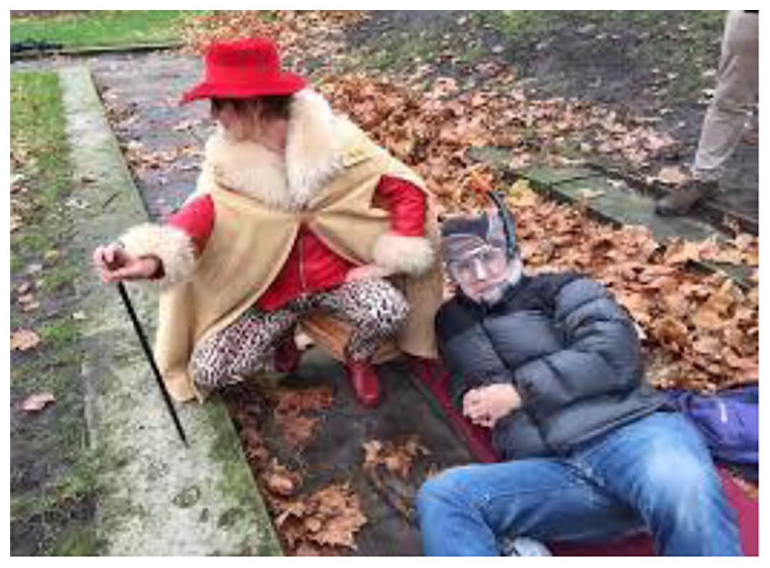
Sex worker dressed like an upper-class woman.
A similar protest, the Kink Olympixxx, took place outside Westminster on 17 October 2016. This demonstration was led by Backlash (pun intended), an organization defending freedom of sexual expression among consenting adults in the UK, to challenge the enactment of the 2017 Digital Economy Act. Like in the Face-Sitting protest, participants carried placards containing wordplay such as ‘urine for a shock if you expect us to stop’ and ‘We weren’t porn yesterday’. Compared to the previous demonstration, the Kink Olympixxx took parody up a notch with masqueraded porn workers playing fisting volleyball, and taking part in a spanking relay race and a one-legged bondage race (Fig. 2). Couples also enacted squirting water fights in which one person knelt down while the other shot water into their wide-open mouth from a water pistol held in their groin. The protest resembled a raucous garden party, where the contrast between demonstrators in fetish leather outfits and chains and a table laden with dainty cucumber sandwiches, ganache and chocolate cakes created a striking contrast.
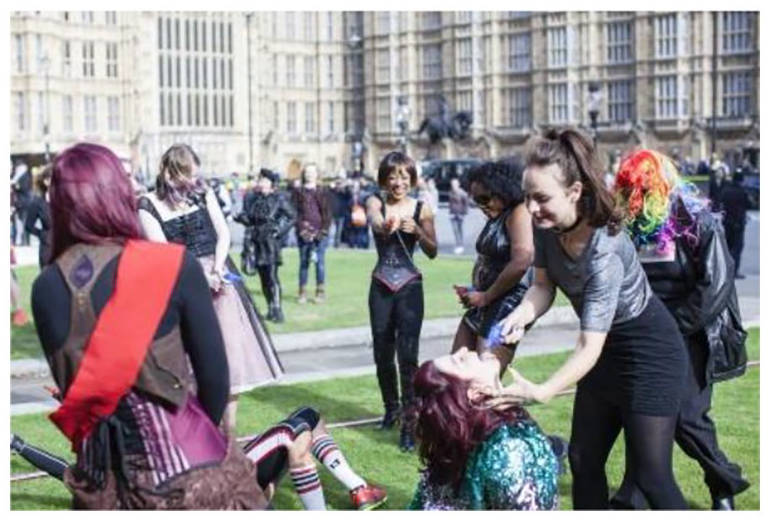
Watersports at the Kink Olympixxx1.
Both demonstrations attracted huge media attention. The media christened the Face-Sitting protest a ‘porn pantomime’ and the Kink Olympixxx ‘Satirical Games’. Participants in the Kink Olympixxx played straight into the media’s hands by publicly greeting Metropolitan Police Officers by thanking them for coming along with their ‘precious handcuffs’ and ensuring that the porn workers were ‘fully disciplined’. 136 Through a colourful display of joyful indecency, protesters successfully engaged with the media and ultimately brought home a serious message regarding the enactment of a series of what they considered outdated and ridiculous legislation.
The oppositions to the law were not a mere reiteration of previous pushbacks against anti-pornography feminists and Parliament’s moral agenda, but they were a powerful opposition against the gendered and sexist code the law sought to institute. The law delineated ‘appropriate forms of sexualities’ by excluding and delegitimising sex which does not fit within ‘the matrix of compulsory heterosexual sexuality’. 137 Following a patriarchal view of sex, by prohibiting specific types of female sexual pleasure, the state enforces the view that women cannot freely explore their sexual desires, diminishing their right to ‘erotize and control their own bodies, fantasies and sexualities’. 138 The law reinforces the idea that women cannot consent to be objectified, and the fact that the mere pretence of sexual violence is prohibited, stigmatises certain female sexual fantasies. 139
There is no doubt that the aim of the two demonstrations was to make a serious point using humorous means, the most prominent and striking means being Bakhtin’s carnivalesque. The display of non-normative bodies and desires was the main way through which porn workers and demonstrators humorously and shamelessly asserted control and authority. In essence, they highlighted the existence of pleasure beyond heteronormativity. The protests displayed resistance towards the ‘sexist and kink-phobic’ legislation turning the spotlight on porn workers claiming their right to be heard and seen before the law. 140 The porn pantomime dispels the anxiety of the legislation prohibiting the representation of sexual minority pornography, and specifically female pleasure and sexual encounters involving BDSM, thanks to the carnivalesque play of manly and kinky female porn workers acting out the potentially dangerous and prohibited sex acts in a comic way. By doing so, they highlighted the harmless nature of the sex acts; not only are they nonthreatening, but the carnivalesque successfully dissipated concerns through laughter.
The carnivalesque has the potential to incite uprising because it subverts the status quo 141 and both demonstrations certainly conveyed the notion of Bakhtinian anarchy and disorder. The carnival represents a universal type of humour that treats its subjects as equals by suspending all social hierarchies in such a way as to engender laughter. 142 The protest’s bawdy humour challenges the inviolability of class and gender through a movement from the lower domain to the upper 143 ; porn workers step out of their role and present themselves as members of the privileged English upper-class. The degeneration and excess through which the carnival inverts the status quo has thus regenerative power. 144
Willson argues that during the face-sitting protest, female porn workers adopted the role of the pantomime Dame, who triggers laughter out of her inept femininity and incapability of fitting the lady-like social role expected of her by performing as an upper-class lady. 145 The British pantomime that was originally known for giving voice to the popular consciousness of the ‘anarchic insubordinate revelry and ancient traditions of misrule’ threatened by the urbanization of England, is certainly referenced. 146 Porn worker dominatrixes acted out face-sitting sexual encounters dressed in English upper-class lady like equestrian costume, speaking with a ‘cut-glass’ English accent and ‘drinking a cup of tea’ while sitting on top of male protestors (Fig. 3). 147
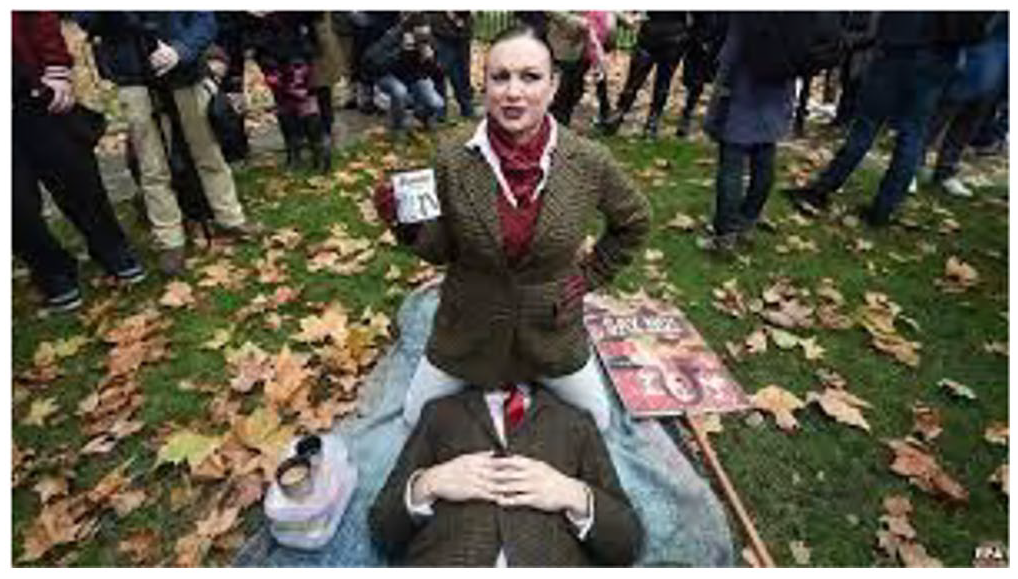
Sex worker in a tailored jacket drinking tea while face-sitting.1
The body of a porn worker overlaps and at the same time opposes that of an upper class English woman, linking the latter with the notion of ‘English vice’ and hypocrisy. 148 In other words, these bodies can be read in terms of two scripts – one pertaining to the porn worker’s sexuality and the other to the value of (high) class and connected dis-value of hypocrisy. Hence a visual and social clash that humorously makes a point.
Yet, the face-sitting protest distinguishes itself from the traditional pantomime. The colourful costumes and the raucous interplay with the audience and passers-by recalls the tradition, but significantly, without the hide and seek of the innuendo. Susan Sontag defines the comic as ‘essentially a theory of non-knowing, or pretending not to know, or partial knowing’. 149 And partial knowing is very much what the British panto is all about. The audience knows that the dame is really a man and that the leading boy is actually a girl and that both are part of the ‘Oh yes it is’/‘Oh no it isn’t’ farcical experience involving the back-and-forth between hidden and the apparent.
Although these protests subvert a series of givens regarding heteronormative pleasure, there is little or no hiding involved in both the two protests that were much more ‘in your face’ than any Christmas panto and more in line with the Orwellian notion of ‘low humour’. 150 In fact, one of the most striking elements of the two performances lies in protesters defiance of bodily decorum. One female player played fisting volleyball in a tight red latex minidress with an opponent in a corset bustier top, although the most defiant costume was that of a man wearing leggings that exposed his naked posterior allowing him to emulate fisting with the aid of a hand dildo (Fig. 4).
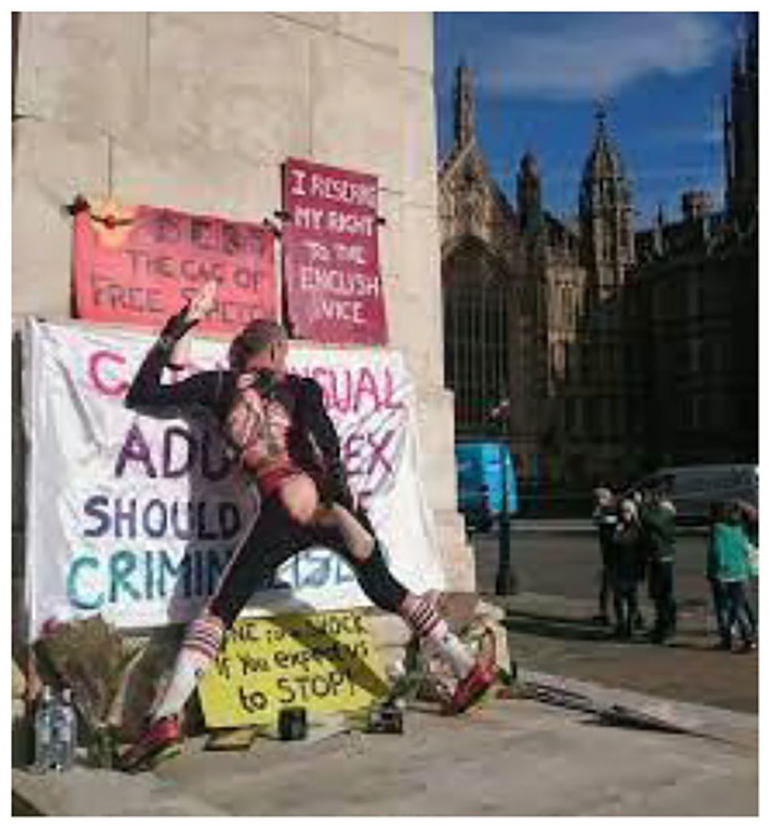
Sex worker with a dildo.1
This protester climbed onto the statute of George V and ostentatiously acted out fisting highlighting the divide between the prestige of royalty, aristocracy and the perceived baseness of fisting. 151 Again, two girls in gimp masks engaged in giving the middle finger with both hands at the media. Such a brash denial of shame recalls the kind mix of schoolboy humour and raucousness typical of British traditions such as Donald McGill’s saucy seaside postcards and Carry On films.
The two displays were, of course, satirical. Satire maintains social boundaries distinguishing between same and other, between or good and evil 152 and aims to critique ‘perceived social wrongness’ because of a strong moral opposition. 153 Satire exists because those excluded by social boundaries found their condition so unbearable that its function to criticize the status quo and entertain finds solid ground. 154 What is happening in these protests is that porn workers openly place certain sexual acts that, according legislation are disgusting, in front stage position in order to display their indignation and disgust towards the law. As we have seen, pornography can evoke both indignation and disgust, the same two emotions that satire aims to trigger in audiences. The whole point of satire is to attack, say a public figure or a political issue and thus provoke indignation. Current psychological research on the emotions shows that these negative emotions overlap with humour. 155 It is normal for the public to be disgusted by what is lampooned via satirical performance, especially in the case of political satire. Yet what is happening here is that disgust itself is being openly lampooned thereby creating a double take where disgust ridicules disgust.
Pandora Blake, a notorious porn worker performing kinky porn, took part in the Kink Olympixxx dressed up as half a Victorian sex worker and half as a suffragette. Blake tweeted that she was glad her outfit ‘was so legible’. 156 Porn workers intentionally stepped out of their role as sexual, gendered and class outsiders by upholding their right to be ‘on top’ as well, e.g. being able to live their sexuality as they wish. 157 The protest is a resistance to the reforms and turns the spotlight on porn workers claiming adequate rights before the law.
At the Kink Olympixxx, a porn worker with a leather gimp mask, recalling the outfits of BDSM sexual encounters, wearing a tailored jacket held a ‘silver tray stacked with fondant fancies’ (see Fig. 5). 158 The satirical additional element of food reinforces the carnivalesque inversion from a different angle. Convivial gatherings and food are a traditional theme in satirical literature that can be traced back to Petronius’ notorious Cena Trimalchionis. 159 Roman banquets were moments of conviviality for the nobles, and thus were taken by Roman writers as an opportunity to ‘comment on society and rehearse alternative arrangements’. 160 Petronius does so by inviting an outsider by definition, a slave, to join Trimalchio’s banquet that is characterized by grotesque and excess engendering a threat to social hierarchies. Here the triumph of the carnival becomes evident when a slave appears in the role of Dionysus invoking ‘festive deity’. 161 During the Kink Olympixxx, not only were porn workers dressed up as members of the upper class, but they are also invited to join a grotesque banquet outside the Houses of Parliament, albeit being outsiders.
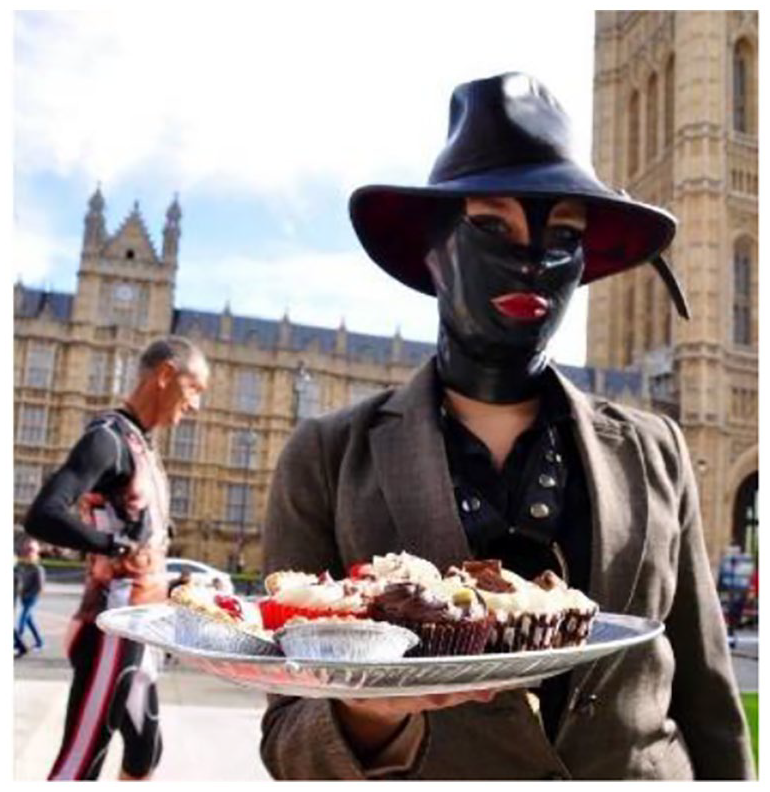
Sex worker with a humorous mask bringing cakes to the banquet.1
Pandora Blake’s suffragette costume becomes even more powerful because, by presenting herself in the role of a heroic figure of the British feminist movement, the carnivalesque triumphs challenging and threatening the status quo. Finally, food is (also) about taste. For some, the Kink Olympixxx might be seen as a display of bad taste and therefore disgusting (from the Latin ‘dis-gustus’). The link between what may make some people physically sick and morally sick is palpable. We may laugh at what disgusts us and what we fear. The state’s regulation of the display of sex demonstrates its disgust and fear for specific types of sexual acts. Some British people may morally oppose such acts as well. Nonetheless, when porn workers comically perform the prohibited sexual acts outside Parliament, humour and laughter take a seat next to disgust and fear.
The two demonstrations make a serious point. However, they do so through what much of the public imaginary might well consider vulgar. For many, ensuing laughter may well resemble a snigger evoked by a mixture of humour and disgust. Some might stifle a laugh by covering their mouths with their hand – a gesture also linked to the reaction to something perceived as disgusting. Demonstrators at both rallies specifically aimed at challenging social and legal value systems that define when sexuality can be pleasurable and when it should be subjected to shame. The present legislation plays around the existence of an ‘ideal sexual and gendered behaviour’, 162 and these protests humorously call out Parliament for shaming pleasure through the inter-section of ‘class, gender and Englishness’. 163 While the protests were humorous, porn workers are wholly aware of the seriousness of laws threatening ‘users’ personal sexual preferences’, negatively impacting sexual minorities’ freedom of expression and imposing ‘State censorship and surveillance’. 164 Porn workers’ concern with the law was triggered by the fact that the ban towards the representation of specific sexual acts is likely to be grounded on morality rather than on concrete evidence of their potential harm, and eschews the possibility that individuals might consent to them. As a result, both carnivalesque performances criticize society while simultaneously providing relief through laughter.
As Orwell famously claimed, ‘Every joke is a tiny revolution’ 165 and these performances are certainly that. Our demonstrators successfully ridicule what they see as oppressive legislation by undermining it. Their lack of dignity is thus revolting in both senses of the word. According to Orwell, it would seem that you cannot be funny without being vulgar: ‘. . . respect for the intellect and strong political feeling, if not actually vulgar, are looked upon as being in doubtful taste. You cannot be really funny if your main aim is to flatter the comfortable classes: it means leaving out too much. To be funny, indeed, you have got to be serious’. 166 And these demonstrations were both seriously funny and simultaneously, funnily serious.
IV. Humour as a Thermostat for Social Change
While Parliament ignores porn workers’ needs and rights, they were able to come out in the open and draw attention to the ‘hypocrisy’ 167 of laws that are shaming the representation of sexual minority pornography. The law prohibits the pornographic performance of sexual minorities, albeit allowing it in real-life sexual encounters, passing on the message that censorship is justified because of a governmental fear of its potential societal harm. Production is thus hindered because this type of pornography is struggling to maintain its right to sell porn. The enforcement of moral concerns on expected sexualities rules out that individuals could consent to perform these sex acts because they might find economic pleasure and professional satisfaction in their performance. The politics of bawdiness, however, inverts the social values and rules on sex that are strengthened by the legislation on pornography. It acts as a means to achieve social change, because the interplay of ‘humour, performance and protest’ highlights the existence of porn workers as well. 168 Yet, as is often the case when humour is used to highlight a political issue, while it brought about no significant change in the law, it did, however, lead to new parliamentary debate. This raises the issue of whether political jokes and, by extension political humour in general, take the socio-political temperature or whether they act as a thermostat slowly leading to change. 169
Willson argues that humour gives voice to porn workers’ concerns while losing, because it waters down the transgressive possibilities of the threat that those excluded by social boundaries are posing to class hierarchies. 170 As laughter brings relief, it might undermine porn workers’ desire to be taken seriously through legally enforced rights; it also underestimates the fear they are posing to the moral fibre of society which is intentionally leaving them at the bottom of social hierarchies. To a certain extent, Willson is right; ‘satires got what they wanted’ 171 would be a slender volume and their effect is impossible to predict. Yet we still maintain that the opposite is true; humour is a serious tool that allows porn workers to fight for social change. The two demonstrations presumably aimed to offend not only by publicly displaying the unmentionable but also by doing so in a hyperbolic fashion. In that sense, the demonstration drew attention to the harmlessness of certain acts. Where Willson fears that laughter may undermine porn workers’ desires to be taken seriously, we argue that that very laughter may lead to building tolerance.
The carnivalesque and satire critique opens up an ‘appeal to negative emotions’, such as ‘anger, sadness, disgust and outrage over the current world order’ through the non-violent power of laughter. 172 Emotions and logic should not be viewed as separate from each other because humour, along with its capacity to make people laugh, awakens feelings of concern, the seriousness of which cannot be doubted. The seriousness of humour is in its power to joke around issues that might also disgust, frighten or even upset individuals showing its ambiguous nature. Humorous resistance does not undermine the fact that porn workers are a threat to society and that the government manages to keep them at bay through laws embedded in morality. However, in its capacity to bring porn workers’ moral opposition to the status quo to the surface, humour allows hope and joy to be centred when ‘thinking about the future’. 173 Humour is a strategic tool to appeal to the emotions and imagination through its ambiguity between the logic of serious issues and the triviality of jokes. 174
Protests staging humorous performances engender ambiguity because their non-violent characteristics are distinct ‘from other forms of non-violent action’ 175 ; they bring amusement to their audience (and overall society) as well as awakening negative emotions and being potentially seen as aggressive. 176 The non-violent use of humour for resistance purposes is embedded in its incongruity. 177 The act of laughing is likely to be triggered by an incongruity that makes humour and emotions two inseparable entities. 178 Humour overcomes ‘the fear for apathy’, 179 while its moments of carnivalesque joy, as well as frustration and outrage towards the status quo, have the power to initiate serious debate. 180 The degree of response of the interlocutor depends on the willingness and ability of those holding power to shift that ‘bottom to top movement’ displayed through the carnivalesque into the real life. 181
Humour becomes a collective element for porn workers to enact cultural resistance. 182 It highlights that porn workers cannot individually participate in challenging their outsider status before the law, and that their struggle requires manifestation through solidarity and community among themselves. 183 Humour finds its place in the porn industry as a form of resistance signifying conflict and group membership. 184 It is a tool kit giving porn workers a sense of belonging by boosting collective identity. 185 While the law places porn workers in total uncertainty and precarity, humour can suspend their outsider status and challenge stereotypes and ideologies related to their jobs; it unveils their negative emotions through laughter. Although Parliament seems wary of the improvement of porn workers’ working conditions, their protests did not go unheard.
Neither the Audiovisual Media Services Regulations nor the Digital Economy Act have been annulled by Parliament. However, they are both inefficient and hardly ever enforced showing how porn workers’ protest succeeded in bringing their unreasonableness in censoring porn work to light. Although the law has not been annulled and is de jure still in force, both the 2014 and 2017 regulations are inefficient because they have de facto never been enforced. As a result, porn workers are still self-regulating their performances in the absence of efficient and reasonable laws. 186 It may be argued that in light of the 2021 Online Safety Bill, which addresses illegal and harmful content online, including pornographic content, humour has little space to successfully challenge censorial approaches from the British government. Yet, the strike organised by sex workers on 9 March 2022 in London’s Leicester square shows that the carnivalesque is still used by sex workers to protest against their exclusion from labour rights (see Figs. 6 and 7).
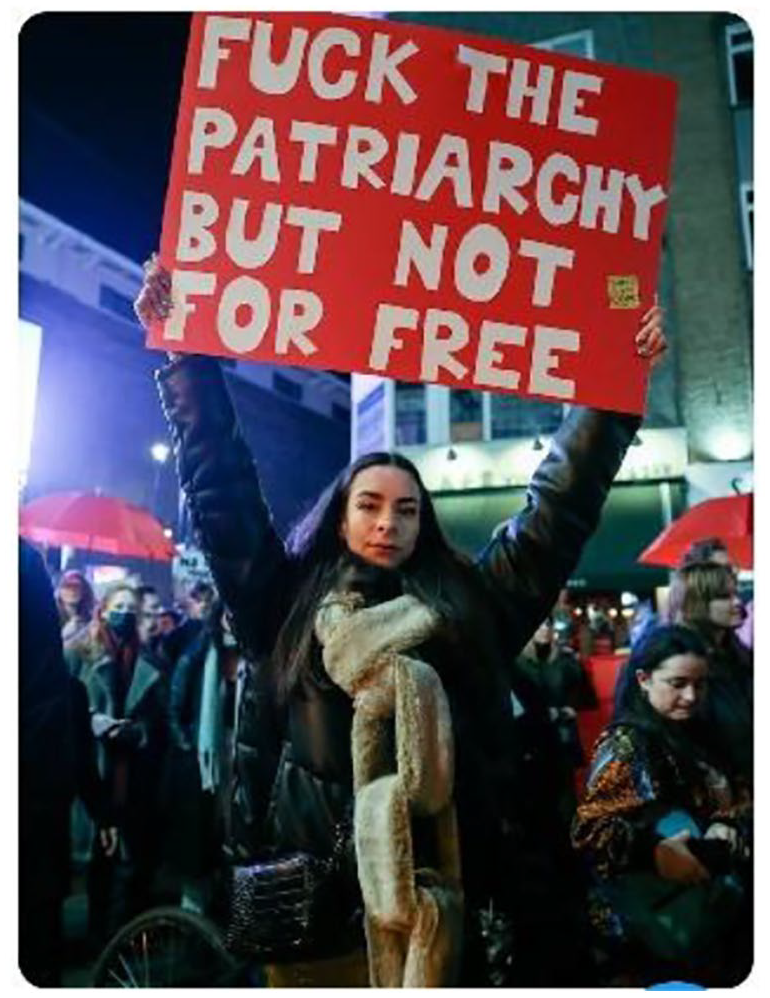
8 March 2022, Leicester Square Strike on Sex Workers’ Labour Rights.1
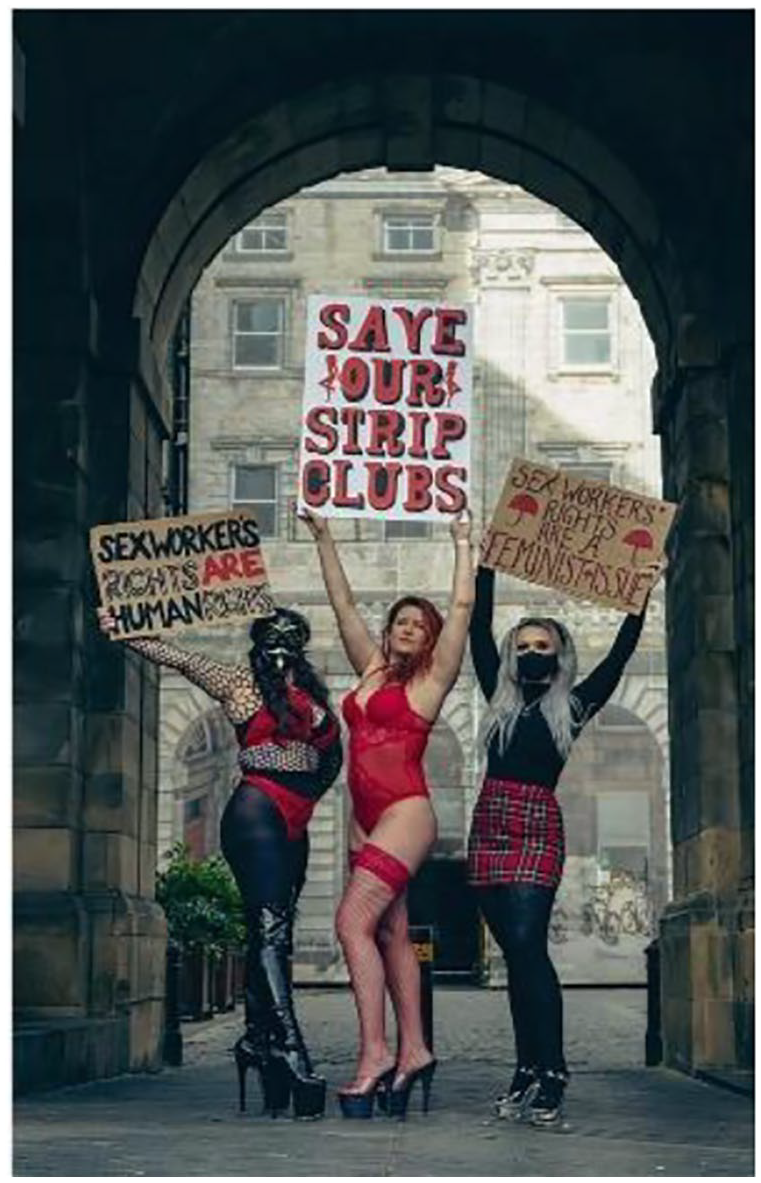
Strippers protesting against Edinburgh City Council curfew on strip clubs.1
Sex workers wearing humorous masks and holding placards with provocative statements against the government show that humour is still capable of challenging the moralising agenda of the British government.
Between 2018 and 2019, The Crown Prosecution Service enacted legal guidance on how to deal with pornographic material that could be deemed illegal under the OPA because it portrays BDSM sexual encounters. 187 It is now recommended that lack of consent among adults ‘must be distinguished from consent to relinquish control’. 188 Specifically ‘without more’, any form of bondage would not automatically constitute a non-consensual sexual encounter. 189 BDSM activities such as fisting, involving bodily substances, infliction of pain, torture, bondage/restraint, placing objects into the urethra and any other sexual encounters that are not illegal can be represented under four conditions. They must be consensual, causing no serious harm, not inextricably linked to other criminal activity and its audience must be above the age of 18 or not otherwise vulnerable. This has been seen as a win for porn workers because it has been the first legal attempt to liberalise BDSM pornography.
Crucially following the lack of success in the implementation of the Digital Economy Act, Parliament published the Online Harms Whitepaper to substitute the age verification system. 190 As the new law would target content and activity that might be harmful particularly to children, 191 it foresees ‘a new system of accountability’. 192 While waiting to draft what now is the Online Safety Bill, the UK government nominated the watchdog Ofcom as its regulatory body in order to ‘avoid fragmentation of the regulatory landscape’. 193 Online platforms are currently under the obligation to comply with Mastercard bank regulations. 194 These require evidence of written documentation that adult content is being sold with the consent of any workers involved in the production if the platforms want to process payments through Mastercard. 195 Surely, the introduction of new regulatory bodies policing online adult content will meet opposition by porn workers, as it appears to be another type of censorial approach. Yet, although recent discussions are not quite centring workers’ rights, the humorous protests impacted the Audiovisual Media Services Regulations and the Digital Economy Act efficiency bringing their ludicrousness censorial power to light and instigating a reaction from the government itself.
The laws are still in force, but porn workers’ humorous protests were able to mitigate the negative effects they would have had on their working environments and freedom of expression. Their use of humour acted as a thermostat sensing the degree and level of public discontent. This capacity of humour is not trivial because, once it successfully feels the existence of a socio-political temperature needing to be addressed, it activates a movement towards social change. Albeit still far from being subjected to laws centring their rights and needs, porn workers have initiated a conversation with the government. The Houses of Parliament have yet to follow up with but are considering different approaches to the regulation of online pornography. It would appear that porn workers’ revolting revolution is slowly bringing about change.
Conclusion
As Philip Dormer Stanhope, 4th Earl of Chesterfield, notoriously claimed of sexual intercourse ‘The pleasure is momentary, the position ridiculous, and the expense damnable’, if he is right then it is hardly surprising that people find sex funny and why there are thousands of jokes on the subject. And beyond the joke form, numerous writers have engaged in Sonntag’s notion of ‘partial knowing’ by including sex as a comic trope – suffice it to think of Chaucer, Boccaccio and Shakespeare to mention just three great authors who were unable to resist including sexual innuendo in their work. But what of pornography? If we Google ‘funny pornography’, we obtain 732,000 hits. Does that mean that porn can be funny? Some may certainly snigger at people who engage with porn. Yet a snigger is a kind of laughter. It may be a suppressed laugh, but it is still a laugh. In other words, we may ridicule a person for watching porn by somehow surreptitiously criticising this activity through a snigger. In effect, the kind of humour attached to pornographic performance is similar to that of the seaside postcard and the Carry On film. Admittedly, there is something intrinsically incongruous between the smutty humour portrayed in Donald McGill’s artwork, the dirty joke, pornography and the seriousness of the law. Through their pantomimic and carnivalesque performances, demonstrators highlight this very incongruity as they lampoon issues of gender and class in defiance of ‘no sex please we’re British’.
Pornography is no longer uniquely a product that consumers purchase on the market, but it is also a business where workers are employed to perform sexually explicit acts while being recorded. Yet, as feminists argue around whether pornography should have a place in the market as it might harm women and society, Parliament regulates its end product through censorship laws that neglect porn workers. In doing so, it shows its feelings of disgust and fear around the sexual representations of sexual minorities. The 2014 Audiovisual Media Services Regulations and the 2017 Digital Economy Acts are evidence of this. While they aim at avoiding the representation of potentially dangerous sexual acts over the internet, they unveil Parliament’s fear and disgust towards them. The law is unreasonable as it specifically affects sexual minority pornography without adequate justification.
The Face-Sitting and Kink Olympixxx protests have demonstrated how porn workers’ use of humour in the form of the carnivalesque and satire subverted expected social norms around sexuality while showing protestors’ opposition and discomfort towards the recent reforms. Through an interplay of humour and vulgarity, porn workers were able to highlight the seriousness of the fact that the law leaves them out of current regulations on pornography hindering their working environment.
The porn protests exemplify that the laughter triggered by humour is not trivial, because humour deals equally with both logic and the emotions. While it arises from the seriousness of public discomfort, it also brings joy and relief. In doing so, it acts as a thermostat sensing public urge to move towards social chance. The porn protests might not have pushed Parliament to annul the law, but they did elicit newer discussions around the regulation of online pornography. In other words, the thermometer triggered the thermostat and altered the temperature, albeit slightly. Humour can thus be seen in terms of a fundamental opportunity to be seized by social movements striving to make change happen. At the end of the day, the two revolting demonstrations portray two tiny revolutions.
Footnotes

2.
3.
4.
6.
Walter Kendrick, The Secret Museum: Pornography in Modern Culture (Berkley, University of California Press, 1996), p. 3.
7.
Lynn Hunt, The Invention of Pornography: Obscenity and the Origins of Modernity, 1500–1800 (New York, Zone Books, 1993), p. 11.
8.
Kendrick, The Secret Museum, pp. 2–13, 273.
9.
Hunt, The Invention of Pornography, p. 261.
10.
Donna M Hughes, “The Internet and Sex Industries: Partners in Global Sexual Exploitation,” IEEE Technology and Society Magazine 19(1) (2000), 36–37.
11.
Jerry Barnett, Porn Panic! (Winchester, Zero Books, 2016), 34.
12.
Hughes, “The Internet and Sex Industries,” p. 40.
13.
Heather Berg, Pork Work: Sex, Labour and Late Capitalism (Chapel Hill: The University of North Carolina Press, 2021).
14.
Madeline V Henry and Panteá Farvid, ‘“Always Hot, Always Live”: Computer-Mediated Sex Work in the Era of ‘Camming’, Women’s Studies Journal 31 (2) (2017), 117–118.
15.
Berg, Pork Work.
16.
Sharif Mowlabocus and Rachel Wood, “Introduction: Audiences and Consumers of Porn,” Porn Studies 2(2–3) (2015), 119.
17.
Rachael Liberman, ‘“It’s a Really Great Tool’: Feminist Pornography and the Promotion of Sexual Subjectivity,’ Porn Studies (2–3) 2015.
18.
Mowlabocus and Rachel Wood, ‘Introduction’.
19.
Carolyn Bronstein, Battling Pornography: The American Feminist Anti-Pornography Movement, 1976–1986 (Cambridge: Cambridge University Press, 2011), p. 16.
20.
Catharine A. MacKinnon and Andrea Dworkin, In Harm’s Way: The Pornography Civil Rights Hearings (Cambridge, MA: Harvard University Press, 1997).
21.
Bronstein, Battling Pornography.
22.
Andrea Dworkin, Pornography: Men Possessing Women (London: Penguin Group, 1989).
23.
Catharine A MacKinnon, “Pornography as Defamation and Discrimination,” Boston University Law Review 71 (1991), p. 802.
24.
Op. cit.
25.
Deborah Cameron, Feminism (London: Profile Books, 2018), p. 90.
26.
Barnett, Porn Panic! p. 89.
27.
Brian McNair, “Rethinking the Effects Paradigm in Porn Studies,” Porn Studies 1 (1–2) (2014), p. 162.
28.
Robert Jensen, “Stories of a Rape Culture: Pornography as Propaganda,” in Big PornInc: Exposing the Harms of the Global Porn Industry (Melinda Tankard Reist and Abigail BraySydney, eds) (Spinifex, 2011), pp. 25–33.
29.
McNair, “Rethinking the effects,” p. 162.
30.
Catharine A MacKinnon, Only Words (Cambridge, MA: Harvard University Press, 1993), p. 28.
31.
Alison Phipps, “Sex Wars Revisited: A Rhetorical Economy of Sex Industry Opposition,” Journal of International Women’s Studies 18(4) (2017), 306–314; Catharine A. MacKinnon, “Pornography as Trafficking,” Michigan Journal of International Law 26(4) (2005), 1004.
32.
Ronald Dworkin, Freedom’s Law: The Moral Reading of the American Constitution (Oxford: Oxford University Press, 1996), p. 238;
Ronald Dworkin, “Is There a Right to Pornography?” Oxford Journal of Legal Studies 1(2) (1981), pp. 178, 194.
33.
Bridget J Crawford, “Toward a Third-Wave Feminist Legal Theory: Young Women, Pornography and the Praxis of Pleasure,” Michigan Journal of Gender and Law 14(1) (2007), 141–146, 151–152.
34.
Dworkin, Freedom’s Law, p. 233.
35.
Crawford, “Toward a Third-Wave Feminist Legal Theory,” pp. 141–146, 151–152.
36.
Nadine Strossen, ‘A Feminist Critique of “the” Feminist Critique of Pornography,’ Virginia Law Review 79 (55) (1993), pp. 1154, 1157; Nadine Strossen, “Prostitution, Pornography, and Censorship: Two Humanist Approaches—The Perils of Pornophobia,” The Humanist 55 (3) (1995), p. 9.
37.
McNair, “Rethinking the effects,” p. 165.
38.
Patrick W Galbraith, “RapeLay and The Return of the Sex Wars in Japan,” Porn Studies 4(1) (2017), p 112.
39.
McNair, “Rethinking the effects,” p. 169.
40.
Barbara DeGenevieve, “The Emergence of Non-Standard Bodies and Sexualities,” Porn Studies 1 (1–2) (2014), p. 193.
41.
Op. cit., p. 195.
42.
Gayle S Rubin, Deviations: A Gayle Rubin Reader (Duke University Press 2011).
43.
Galbraith, “RapeLay”, p. 112.
44.
McNair, “Rethinking the effects,” p. 169.
45.
Thomas Waugh, ‘“Men’s Pornography, Gay vs. Straight”: A Personal Revisit’, Porn Studies 4 (2) (2017), 132.
46.
Kris Taylor, ‘“Accessing Something that’s Meant to be Inaccessible”: Pornography Viewers’ Reconciliation Between Early Pornographic Memories and Pornography’s Perceived Risk’, Porn Studies, 8 (1) (2021), p. 39.
47.
Barnett, Porn Panic! p. 97.
48.
Op. cit., p. 83.
49.
Op. cit., p. 97.
50.
Taylor, “Accessing Something that’s Meant to be Inaccessible”, p. 40.
51.
Op. cit., p. 42.
52.
Jude Roberts and Melissa Shani Brown, “What Have We Got to Lose? Feminist Campaigning and the Exclusion of Sex from the Supermarket”, Porn Studies 5 (4) (2018), p. 449.
53.
Op. cit.
54.
Ss 26 and 29.
55.
Op. cit., p. 443.
56.
Op. cit., p. 446
57.
Op. cit.
58.
Op. cit., p. 453.
59.
Op. cit., p. 441.
60.
Op. cit., p. 449.
61.
Op. cit., pp. 453–454.
62.
Brenda Cossman, The New Sex Wars: Sexual Harm in the #MeToo Era (New York: New York University Press, 2021), 69.
63.
Op. cit.
64.
Op. cit, p. 70.
65.
Op. cit.
66.
Op. cit., p. 82.
67.
Op. cit.
68.
Op. cit., p. 79.
69.
Op. cit., p. 82.
70.
Op. cit., p. 83
71.
Op. cit., p. 85.
72.
Op. cit., p. 86.
73.
Carla Freccero, “Updating the Sex Wars: Political Challenges to Liberationism,” The Communication Review, 11 (2008), p. 213.
74.
Op. cit., 215.
75.
Barnett, Porn Panic! p. 78.
76.
Op. cit., p. 79.
77.
Berg, Pork Work.
78.
Heather Berg, “Workers and Publics,” Porn Studies 5 (2) (2018), 217–220.
79.
Reba Wilcoxon, ‘Pornography, Obscenity, and Rochester’s “The Imperfect Enjoyment”’, Studies in English Literature, 1500–1900 15 (3) (1975), 376; Dworkin, Pornography, Preface.
80.
Emily Jackson, “The Problem with Pornography: A Critical Survey of the Current Debate,” Feminist Legal Studies 3 (1) (1995), 49–70.
81.
Sarah Beresford, ‘Obscene performative pornography: R v Peacock (2012) and the legal construction of same-sex and gendered identities in the United Kingdom’, Porn Studies 1 (4) (2014), p. 380.
82.
Op. cit.
83.
DPP v Whyte [1972] 3 All ER 12.
84.
Catharine A MacKinnon, “Pornography, Civil Rights, and Speech,” Harvard Civil Rights-Civil Liberties Law Review 20 (1) (1985), p. 21; James Lindgren, “Defining Pornography,” University of Pennsylvania Law Review 141(4) (1993), p. 1159.
85.
Catharine A MacKinnon, “Not a Moral Issue,” Yale Law & Policy Review 2 (2) (1984), 328–329, citing Dworkin Pornography.
86.
Paul Johnson, ‘Law, Morality and Disgust: The Regulation of “Extreme Pornography” in England and Wales’, Social & Legal Studies 19(2) (2010), p. 149.
87.
Steve Jones ‘“Extreme” Porn? The Implications of a Label’, Porn Studies 3 (3) (2016), 295–296.
88.
Op. cit., p. 296.
89.
Op. cit., p. 297.
90.
Op. cit.
91.
Anna Carline, “Criminal Justice, Extreme Pornography and Prostitution: Protecting Women or Promoting Morality?” Sexualities 14 (3) (2011), p. 326.
92.
R v Coutts [2005] EWCA Crim 52.
93.
Johnson, ‘Law, Morality and Disgust’, p. 149.
94.
Clare McGlynn and Hannah Bows, “Possessing Extreme Pornography: Policing, Prosecutions and the Need for Reform,” The Journal of Criminal Law 83 (6) 2019, p. 478.
95.
Johnson, “Law, Morality and Disgust,” p. 150.
96.
McGlynn and Bows, “Possessing Extreme Pornography,” p. 481.
97.
Eleanor Wilkinson ‘“Extreme Pornography” and the Contested Spaces of Virtual Citizenship’, Social & Cultural Geography 12(5) (2011), p. 503.
98.
Lawrence Siry, “Extreme Pornography Regulation in the UK: Recent Developments,” Masaryk University Journal of Law and Technology 6 (2) (2012), p. 291.
99.
Carline, “Criminal Justice, Extreme Pornography and Prostitution,” p. 326; See further Clare McGlynn and Erika Rackley, “Criminalising Extreme Pornography: A Lost Opportunity,” Criminal Law Review 4 (2009).
100.
Siry, “Extreme Pornography Regulation in the UK,” p. 291.
101.
Johnson, “Law, Morality and Disgust,” p. 149.
102.
Op. cit.
103.
Carline, “Criminal Justice, Extreme Pornography and Prostitution,” p. 322.
104.
Johnson, “Law, Morality and Disgust,” p. 149.
105.
Carline, “Criminal Justice, Extreme Pornography and Prostitution,” p. 326.
106.
Johnson, “Law, Morality and Disgust,” p. 155.
107.
Op. cit., p. 156.
108.
Op. cit., p. 159.
109.
Op. cit.
110.
Op. cit., p. 327.
111.
Johnson, “Law, Morality and Disgust,” p. 149.
113.
114.
BBFC, p. 24.
115.
116.
Op. cit: Silvia Rodeschini, “New Standards of Respectability in Contemporary Pornography: Pornhub’s Corporate Communication,” Porn Studies 8 (1) (2021), p. 79.
117.
Jacki Willson, “Porn, Pantomime and Protest: The Politics of Bawdiness as Feminine Style,” Porn Studies 5(4) (2018), pp. 428, 436.
118.
In R v Brown [1993] UKHL 19, the performance of extreme sadomasochist acts was condemned despite being consensual. Following the Offences against the Person Act 1861, section 20 individuals can never consent to the infliction of harm.
119.
Alex Dymock and Matt Lodder, “The Erotics of Injury: Remembering Operation Spanner Workshops 10th - 11th September 2015, University of Essex and Royal Holloway, University of London,” Porn Studies 320 3(3) (2016), p. 320.
120.
R v Peacock (unreported, Southwark Crown Court, 6 January 2012); R v Walsh (unreported, Kingston Crown Court, 8 August 2012).
121.
Sarah Beresford, “Obscene performative pornography,” p. 385.
122.
Barnett, Porn Panic! p. 37.
123.
Wilkinson, “Extreme Pornography,” p. 501.
124.
Op. cit., p. 506.
125.
Efforts in Inefficacy.
126.
Carline, “Criminal Justice, Extreme Pornography and Prostitution,” p. 330.
127.
Jones, “‘Extreme’ Porn?’, p. 302.
128.
Julian Petley, “Loosening the gag: the Crown Prosecution Service’s revised legal guidance on the Obscene Publications Act 1959,” Porn Studies 6 (2) (2019), p. 241.
129.
Carolyn Bronstein, “Deplatforming Sexual Speech in the Age of FOSTA/SESTA,” Porn Studies, 8 (4) (2021), p. 368.
130.
Jeremy Horder, Ashworth’s Principles of Criminal Law (9th edn, OUP 2020).
131.
Willson, “Porn, Pantomime and Protest”.
132.
Op. cit.
133.
Op. cit.
134.
135.
Willson, “Porn, Pantomime and Protest,” pp. 426, 427, 434
137.
Carline, “Criminal Justice, Extreme Pornography and Prostitution,” p. 329.
138.
Wilkinson “Extreme Pornography,” p. 505.
139.
Ingrid Olson, “Too “Extreme”: Gonzo, Snuff, and Governmentality,” Porn Studies, 3 (4) (2016), p 399.
140.
Willson, “Porn, Pantomime and Protest,” p. 435.
141.
Op. cit.
142.
Maria Plaza, ‘“The Culture of Folk Humor” in Petronius’ Cena Trimalchionis’, Literary Imagination 3(3) (2001), p. 404; Mikhail Bakhtin, Rabelais and His World, trans. Helene Iswolsky, (Bloomington, IN, 1984), II, p. 11–12.
143.
Plaza, “The Culture of Folk Humor,” p. 424.
144.
Paul Allen Miller, “The Bodily Grotesque in Roman Satire: Images of Sterility,” Arethusa 31 (3) (1998), p. 258.
145.
Willson, “Porn, Pantomime and Protest,” p. 436.
146.
Op. cit., p. 434.
147.
Op. cit., p. 436.
148.
Op. cit.
149.
Susan Sontag, ‘Performance Art’, PEN America Issue 5: Silences (2004), pp. 92–96.
150.
George Orwell, “The Art of Donald McGill,” Horizon: September 1941.
151.
Kink Olympixxx 2016.
152.
Miller, “The Bodily Grotesque in Roman Satire,” p. 278.
153.
Dieter Declercq, “A Definition of Satire (and Why a Definition Matters),” The Journal of Aesthetics and Art Criticism 76 (3) (2018), p. 323.
154.
Miller, “The Bodily Grotesque in Roman Satire,” p. 278; Declercq, “A Definition of Satire”.
155.
Paul Rozin, Laura Lowery, Sumio Imada, and Jonathan Haidt, “The CAD Triad Hypothesis: A Mapping Between Three Moral Emotions (Contempt, Anger, Disgust) and Three Moral Codes (Community, Autonomy, Divinity),” Journal of Personality and Social Psychology 76 (4) (1999), 574–86.
157.
Willson, “Porn, Pantomime and Protest,” p. 435.
159.
Plaza, “The Culture of Folk Humor,” p. 404.
160.
Op. cit.
161.
Op. cit., p. 406.
162.
Willson, “Porn, Pantomime and Protest,” p. 427.
163.
Op. cit.
164.
Kink Olympixxx.
165.
George Orwell, Funny, but not Vulgar (London, Leader, 28 July 1945).
166.
Op. cit.
167.
Willson, “Porn, Pantomime and Protest,” p. 436.
168.
Op. cit.
169.
Christie Davies, Jokes and Targets (Bloomington: University of Indiana Press, 2011), pp. 2011, 248.
170.
Willson, “Porn, Pantomime and Protest,” p. 438.
171.
Phiddeas Robert, Satire and the Public Emotions (Cambridge: CUP 2019), pp. 12–14.
172.
Majken Jul Sørensen, “Laughing on The Way to Social Change: Humor and Nonviolent Action Theory,” Peace & Change 42 (1) (2017), p. 132.
173.
Op. cit., p. 143.
174.
Op. cit., p. 129.
175.
Op. cit, p. 128.
176.
Op. cit, p. 148.
177.
Op. cit, p. 132.
178.
Op. cit.
179.
Op. cit., p. 144.
180.
Op. cit, p. 132.
181.
Op. cit, p. 149.
182.
Teela Sanders, “Controllable Laughter: Managing Sex Work through Humour,” Sociology 38 (2) (2004), p. 279.
183.
Op. cit., p. 284.
184.
Op. cit, p. 277.
185.
Op. cit, p. 284.
186.
Personal communication with Myles Jackman via phone on 8 October 2020.
187.
Julian Petley, “Loosening the Gag: The Crown Prosecution Service’s Revised Legal Guidance on the Obscene Publications Act 1959,” Porn Studies 6 (2) (2019).
190.
Efforts in Inefficacy.
191.
Terry Flew and Rosalie Gillett, ‘Platform Policy: Evaluating Different Responses to the Challenges of Platform Power’ (Finland 2020). Paper accepted for International Association for Media and Communication Research (IAMCR) annual conference Tampere, p. 7.
192.
Efforts in Inefficacy.
193.
Flaw and Gillet, Platform Policy, p. 8.